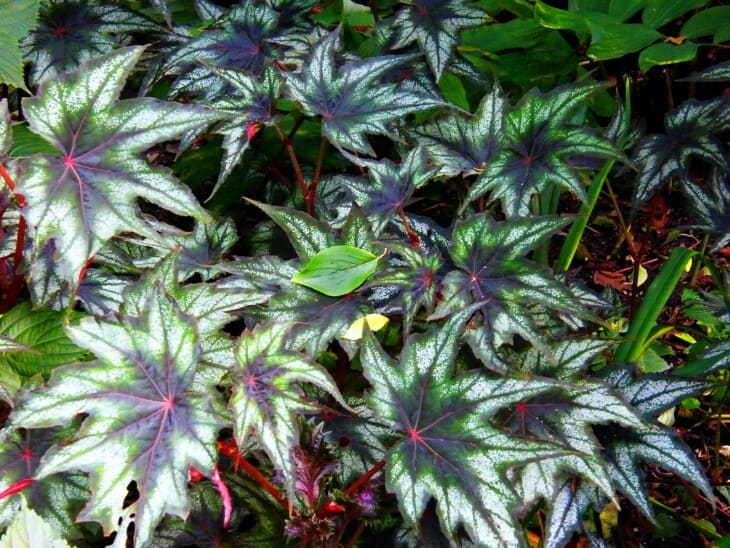
The plants most often mistaken for begonias fall into two groups. For patterned leaves like rex and cane begonias, look at coleus, caladium, coral bells, polka dot plant, Persian shield, watermelon peperomia and strawberry begonia, which isn’t a begonia at all. For flowers like wax and tuberous begonias, look at impatiens, geraniums (pelargoniums), camellias, ranunculus, moss rose, cyclamen and fuchsia. The quickest check is the leaf: almost every begonia leaf is lopsided, with one side of the base larger than the other. Begonias also have separate male and female flowers, and the female ones have a three-winged seed pod behind the petals.
Contents
- Plants With Begonia-Like Leaves
- Plants With Begonia-Like Flowers
- Impatiens (Impatiens walleriana and New Guinea impatiens)
- Geranium (Pelargonium) (Pelargonium × hortorum and others)
- Camellia (Camellia japonica and C. sasanqua)
- Ranunculus (Persian Buttercup) (Ranunculus asiaticus)
- Moss Rose (Portulaca) (Portulaca grandiflora)
- Florist’s Cyclamen (Cyclamen persicum)
- Fuchsia (Fuchsia × hybrida)
- How to Tell a Begonia From a Lookalike
Begonias are a huge genus of about 2,000 species from the tropics and subtropics of Central and South America, Africa and Asia. Gardeners grow three main kinds: wax begonias (Begonia semperflorens group) for summer bedding, tuberous begonias with large, rose-like flowers for shady pots and baskets, and rex and cane begonias for their patterned or spotted leaves. Most need shade or part shade and aren’t frost hardy. Begonias are toxic to dogs and cats, especially the underground tubers.

- Plants With Begonia-Like Leaves
- Plants With Begonia-Like Flowers
- How to Tell a Begonia From a Lookalike
| Plant | Botanical name | Looks like a begonia because | How to tell it apart |
|---|---|---|---|
| Coleus | Coleus scutellarioides (Plectranthus scutellarioides) | Brightly patterned leaves in red, pink, lime and purple | Square stems; leaves in opposite pairs and symmetrical; spikes of small blue flowers |
| Caladium | Caladium bicolor | Large, colorful, papery leaves for shade | Arrow- or heart-shaped leaves on long stalks straight from a tuber; no stems |
| Coral Bells (Heuchera) | Heuchera spp. | Rounded, scalloped leaves in purple, silver, amber and lime | Hardy perennial; leaves in a low mound; wiry spikes of tiny bell-shaped flowers |
| Polka Dot Plant | Hypoestes phyllostachya | Leaves splashed with pink, red or white spots | Leaves in opposite pairs, pointed and symmetrical; soft stems |
| Persian Shield | Strobilanthes dyeriana | Iridescent purple and silver leaves | Long, pointed, symmetrical leaves in opposite pairs |
| Watermelon Peperomia | Peperomia argyreia | Round, fleshy leaves striped like a watermelon | Leaves thick and succulent, attached in the center; flowers are thin green spikes |
| Strawberry Begonia | Saxifraga stolonifera | Rounded, hairy leaves with silver veins; sold as a begonia | Sends out thin red runners like a strawberry; five-petaled white flowers with two long lower petals |
| Impatiens | Impatiens walleriana and New Guinea impatiens | Bright flowers on a mound of shade-loving bedding plants | Flowers have a thin spur behind them; seed pods burst when touched |
| Geranium (Pelargonium) | Pelargonium × hortorum and others | Round clusters of red, pink or white flowers; rounded leaves | Leaves often have a dark zone and a strong smell when rubbed; flowers in round heads on long stalks |
| Camellia | Camellia japonica and C. sasanqua | Large, rose-like double flowers in red, pink and white | Woody evergreen shrub with glossy leaves; flowers in fall, winter or early spring |
| Ranunculus (Persian Buttercup) | Ranunculus asiaticus | Layered, rose-like flowers in bright colors | Finely cut leaves like parsley; each flower on its own stem; spring only |
| Moss Rose (Portulaca) | Portulaca grandiflora | Ruffled, rose-like flowers in bright colors | Fleshy, needle-like leaves on a low, spreading plant; flowers close in shade |
| Florist’s Cyclamen | Cyclamen persicum | A winter houseplant with patterned leaves and bright flowers | Heart-shaped leaves; upswept, swept-back petals like a butterfly |
| Fuchsia | Fuchsia × hybrida | Hanging baskets of drooping flowers for shade | Flowers dangle on thin stalks, with a tube, swept-back sepals and a skirt of petals |
Plants With Begonia-Like Leaves
Coleus (Coleus scutellarioides (Plectranthus scutellarioides))
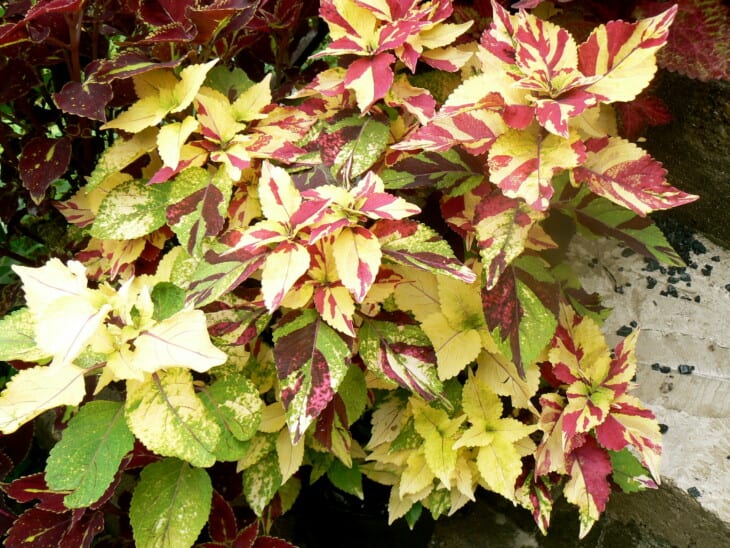
Coleus is grown for the same reason as rex begonias: its leaves come in almost any mix of red, burgundy, pink, lime, yellow and green, often with scalloped or frilly edges. It is a tender perennial from Southeast Asia, grown as an annual in shade or, for newer varieties, full sun. The easiest way to tell it apart is the stem: coleus is in the mint family, with square stems and leaves in opposite pairs, and each leaf is symmetrical. Pinch off its small blue flower spikes to keep the plant bushy.
Caladium (Caladium bicolor)

Caladiums are tropical plants from South America grown from tubers for their large, thin, arrow- or heart-shaped leaves, splashed or veined with white, pink or red. In shady summer beds and pots they fill the same spot as angel wing and rex begonias. Each leaf rises on its own long stalk straight from the tuber, and the plant has no leafy stems. Caladiums are hardy only in zones 9 to 11. Elsewhere, dig the tubers in fall. All parts are poisonous to people and pets.
Coral Bells (Heuchera) (Heuchera spp.)

Coral bells are North American perennials with rounded, lobed and scalloped leaves that look a lot like the leaves of rex and other rhizomatous begonias. Modern varieties come in purple, near-black, silver-veined, amber, peach and lime. They grow in a low mound and send up wiry stems of tiny, bell-shaped flowers in late spring and summer. Unlike begonias, they are hardy in zones 4 to 9 and come back every year, so they are a good choice for shady beds in cold climates.
Polka Dot Plant (Hypoestes phyllostachya)

Polka dot plant, from Madagascar, has soft, oval leaves heavily spotted with pink, red or white, much like a spotted cane begonia. It grows 1 to 2 feet tall and is used as a houseplant or a summer bedding plant in shade. Its leaves grow in opposite pairs and are pointed and symmetrical. Pinch the tips often to keep it bushy, and remove its small lavender flowers.
Persian Shield (Strobilanthes dyeriana)

Persian shield, from Myanmar, has long, pointed leaves with a metallic purple and silver sheen over dark green veins, like some of the showiest rex begonias. It grows 3 to 4 feet tall as a summer annual in part shade, and as a houseplant. It is in the acanthus family, with leaves in opposite pairs that are symmetrical at the base. Its color is brightest in light shade and fades in strong sun.
Watermelon Peperomia (Peperomia argyreia)

Watermelon peperomia is a small houseplant from South America with round, thick leaves striped silver and green like a watermelon rind, on red stalks. It looks like a small rex begonia at first glance. Its leaves are thick and fleshy, attached to the stalk near the center, and perfectly symmetrical, and its flowers are thin, green, rat-tail spikes. Like begonias, it needs bright indirect light and should dry out a little between waterings.
Strawberry Begonia (Saxifraga stolonifera)
Strawberry begonia, also called creeping saxifrage, isn’t a begonia at all: it is a saxifrage from China and Japan. Its rounded, hairy leaves are dark green with silver veins above and red underneath, much like a begonia’s. It spreads by thin red runners that root to form new plants, like a strawberry. In late spring it has airy sprays of small white flowers with two long lower petals. It is grown as a houseplant or as a groundcover in shade, hardy in zones 6 to 9.
Plants With Begonia-Like Flowers
Impatiens (Impatiens walleriana and New Guinea impatiens)

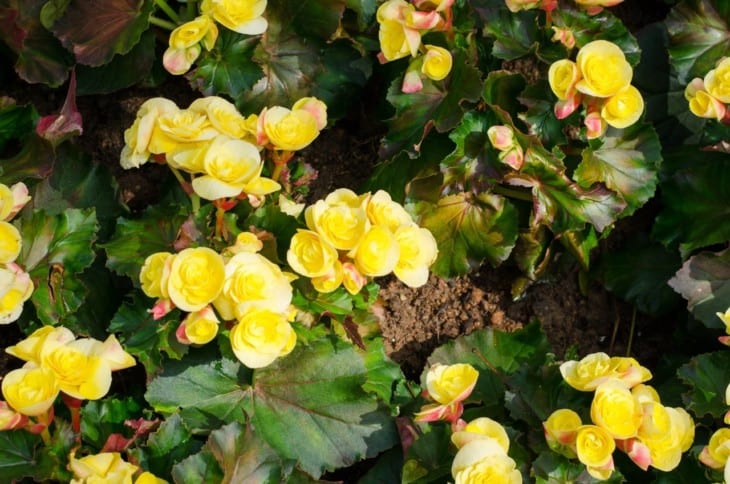
Impatiens are the other favorite bedding plant for shade, and in pots and beds they can look very like wax begonias. They have juicy stems and flat, five-petaled flowers in white, pink, red, orange, purple and coral. Double forms look like small roses or tuberous begonias. Each impatiens flower has a thin spur behind it, and ripe seed pods burst when touched, giving the plant the name touch-me-not. New Guinea impatiens have larger flowers and tolerate more sun. See our list of plants that look like impatiens.
Geranium (Pelargonium) (Pelargonium × hortorum and others)

The bedding geraniums sold in garden centers are pelargoniums from southern Africa. Their rounded, scalloped leaves, often with a dark band called a zone, and their bright red, pink, salmon or white flowers make them easy to confuse with begonias from a distance. Up close, geranium flowers are held in round heads on long stalks well above the leaves, and the leaves have a strong smell when rubbed. Unlike begonias, they want full sun and dry soil.
Camellia (Camellia japonica and C. sasanqua)

Camellia flowers look very like the large double flowers of tuberous begonias, and some tuberous begonias are even sold as “camellia-flowered”. Camellias, though, are woody evergreen shrubs from East Asia, 6 to 12 feet or more tall, with glossy, leathery leaves. Camellia sasanqua flowers in fall and C. japonica in winter and early spring, when begonias aren’t in bloom. They are hardy in zones 7 to 9 and need part shade and acid soil.
Ranunculus (Persian Buttercup) (Ranunculus asiaticus)
Ranunculus has tightly layered, ruffled flowers in red, pink, orange, yellow and white that look very like double tuberous begonias. It is grown from claw-shaped tubers and comes from the eastern Mediterranean and Southwest Asia. Its leaves are finely divided, like parsley or celery leaves, and each flower sits alone on a stem 12 to 18 inches tall. It flowers in spring and dies back in summer heat. It needs full sun and is hardy outdoors only in zones 8 to 10.
Moss Rose (Portulaca) (Portulaca grandiflora)

Moss rose is a low, spreading annual with single or double flowers in hot pink, red, orange, yellow and white, like small begonia flowers. Its leaves are the giveaway: short, fleshy and needle-like, like a succulent’s. It is the opposite of a begonia in the garden, thriving in full sun, heat and poor, dry soil, and its flowers close on cloudy days and in the late afternoon.
Florist’s Cyclamen (Cyclamen persicum)
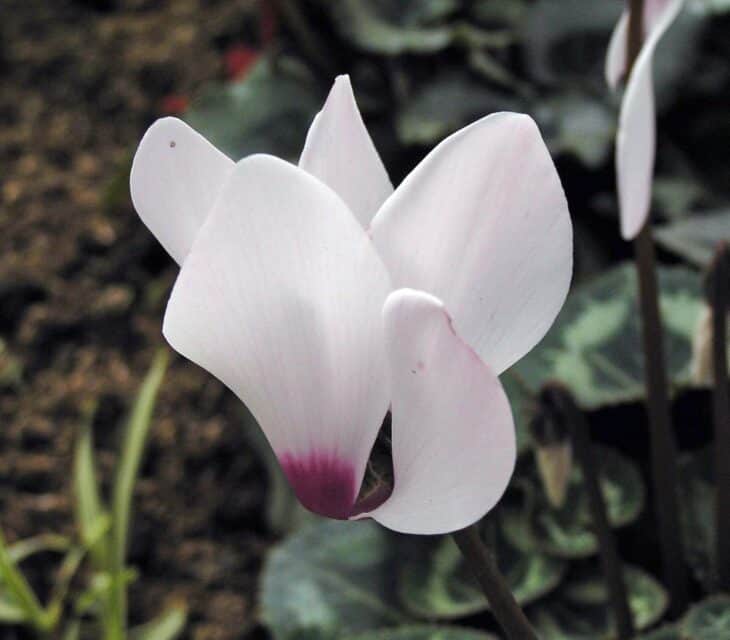
Florist’s cyclamen is a common winter houseplant, like the Rieger begonias sold at the same time. It has heart-shaped leaves marbled with silver and flowers in white, pink, red or purple, with petals swept up and back like a shuttlecock. It grows from a tuber and prefers cool rooms. It goes dormant in summer. The tuber is poisonous to pets.
Fuchsia (Fuchsia × hybrida)

Fuchsias fill the same shady hanging baskets as trailing tuberous and dragon wing begonias. Their flowers dangle on thin stalks, with a colorful tube, four swept-back sepals and a “skirt” of petals, often in two colors such as red and purple or pink and white. Fuchsias come from Central and South America and New Zealand. They like cool summers and suffer in hot, humid weather.
How to Tell a Begonia From a Lookalike
- Lopsided leaves: almost every begonia leaf is asymmetrical, with one side of the base larger than the other. Coleus, polka dot plant, Persian shield and peperomia leaves are symmetrical.
- Leaf arrangement: begonia leaves alternate along the stem or grow from a rhizome. Opposite pairs mean coleus, polka dot plant or Persian shield.
- Flowers: begonias have separate male and female flowers on the same plant. The female flowers have a swollen, three-winged seed pod behind the petals.
- Stems: begonia stems are fleshy and brittle, often jointed like bamboo on cane begonias. A square stem means coleus.
- Growing conditions: begonias like shade and moist but well-drained soil. Moss rose and geraniums want full sun.