The plants that look most like lamb’s ear are other silver, woolly-leaved plants: common mullein, rose campion, dusty miller, snow-in-summer, angel wings and silver sage. Culinary sage and lavender share the gray color with a scent of their own, and betony and hedge nettle are close relatives with the same flower spikes but green leaves. Most of these can stand in for lamb’s ear in a sunny, dry border. The one to be careful with is foxglove: its fuzzy, gray-green first-year rosette can pass for mullein or lamb’s ear, and it is poisonous.
Contents
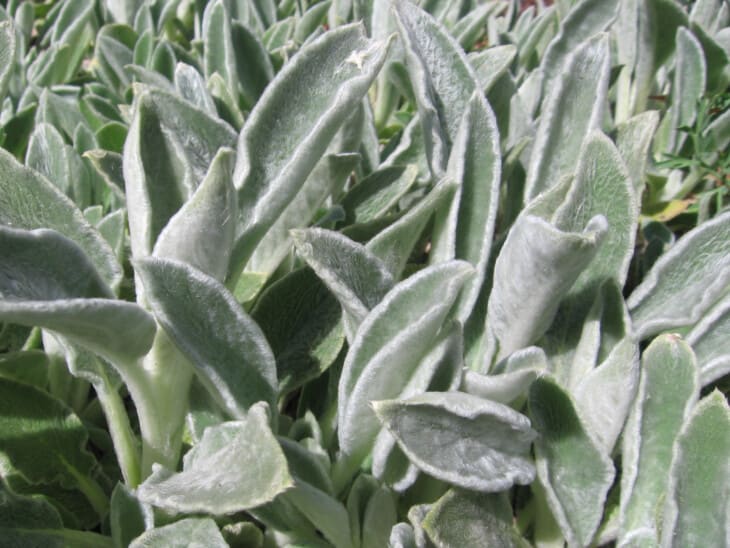
Lamb’s ear (Stachys byzantina) is a perennial from Turkey, the Caucasus and Iran. It forms spreading mats of thick, tongue-shaped leaves covered in dense, silvery-white hairs, soft as felt. The leaves stay about 6 to 8 inches tall. In early summer it sends up woolly flower spikes 12 to 18 inches tall with small pink-purple flowers, which bees love. It is hardy in zones 4 to 8 and easy in sun and dry, well-drained soil. Its weakness is wet, humid summers, when the hairy leaves can rot in the middle of the clump. Non-flowering cultivars such as ‘Silver Carpet’ and the large-leaved ‘Helene von Stein’ (‘Big Ears’) are grown for the leaves alone.
- Silver, Woolly Lookalikes
- Herbs With Gray, Hairy Leaves
- Close Relatives With Green Leaves
- A Poisonous Lookalike
- How to Tell Lamb’s Ear From Its Lookalikes
| Plant | Botanical name | Height | How to tell it from lamb’s ear |
|---|---|---|---|
| Common Mullein | Verbascum thapsus | Rosette 1–2 ft; spike 4–7 ft | Much bigger rosette; one tall spike of yellow flowers |
| Rose Campion | Silene coronaria | 2–3 ft | Magenta flowers on branching silver stems; smaller leaves |
| Dusty Miller | Jacobaea maritima | 1–2 ft | Deeply lobed, lacy silver leaves; yellow flowers |
| Snow-in-Summer | Cerastium tomentosum | 6–10 in | Tiny, narrow silver leaves; masses of white flowers |
| Angel Wings | Senecio candicans | 12–16 in | Large, rounded, wavy-edged leaves; grown as a foliage plant |
| Silver Sage | Salvia argentea | Rosette 1 ft; flower stalk 2–3 ft | Huge, woolly, wrinkled leaves; white flowers on branched stalks |
| Common Sage | Salvia officinalis | 1–2.5 ft | Woody shrub; pebbly leaves; strong sage scent |
| Lavender | Lavandula spp. | 1–3 ft | Narrow, gray leaves; strongly scented flower spikes |
| Betony | Betonica officinalis | 1–2 ft | Green, scalloped leaves, not woolly; dense purple spikes |
| California Hedge Nettle | Stachys bullata | 1–3 ft | Green, toothed, wrinkled leaves; pink-purple flowers in whorls |
| Foxglove | Digitalis purpurea | Rosette 1 ft; spike 3–5 ft | Softly hairy, gray-green, toothed leaves; tubular flowers; poisonous |
Silver, Woolly Lookalikes
Common Mullein (Verbascum thapsus)

Common mullein is the plant most often mistaken for lamb’s ear. In its first year it forms a big, flat rosette of gray-green, flannel-soft leaves, each up to a foot long, much larger than lamb’s ear leaves. In its second summer it sends up a single stiff spike 4 to 7 feet tall, covered in small yellow flowers, and then dies. It is a European biennial that grows along roadsides and in disturbed ground across North America. Unlike lamb’s ear, it doesn’t spread into a mat, only by seed.
Rose Campion (Silene coronaria)
Read our guide to Rose Campion

Rose campion (also sold as Lychnis coronaria) has woolly, silver-gray leaves in a low rosette that looks much like lamb’s ear. In early summer it sends up branching, silver stems 2 to 3 feet tall with bright magenta, white or pink flowers, each about an inch wide and open, not in a spike. Its leaves are narrower and a little smaller than lamb’s ear leaves. It is a short-lived perennial that reseeds freely in zones 4 to 8.
Dusty Miller (Jacobaea maritima)
Read our guide to Dusty Miller
Dusty miller, also called silver ragwort, has the same felted white-silver look as lamb’s ear, but its leaves are deeply cut into lacy lobes, not smooth tongues. It grows into a mound 1 to 2 feet tall and is sold everywhere as a bedding plant, usually treated as an annual, though it is perennial in zones 8 to 10. If it survives into a second year, it makes clusters of small yellow daisies.
Snow-in-Summer (Cerastium tomentosum)

Snow-in-summer is a silver groundcover that spreads into mats like lamb’s ear, but its leaves are tiny and narrow, only about an inch long. In late spring it is covered in white, star-shaped flowers. It likes the same hot, dry, sunny spots and poor soil, and it can spread aggressively in zones 3 to 7.
Angel Wings (Senecio candicans)

Angel wings is a newer foliage plant with the whitest, softest leaves of this list, velvety like lamb’s ear but much larger, rounded and wavy at the edges. It forms a mound 12 to 16 inches tall and rarely flowers in gardens. It comes from coastal Chile and Argentina and is only hardy in zones 8 to 10, so most gardeners grow it as an annual or in pots. It needs very well-drained soil and dislikes overwatering.
Silver Sage (Salvia argentea)
Silver sage forms a flat rosette of large, wrinkled leaves covered in thick, silky white wool, the closest match to lamb’s ear in texture and even softer. The leaves grow up to 8 inches long. In its second summer it sends up branched stalks of white flowers, after which it often declines. It is a short-lived perennial from the Mediterranean, hardy in zones 5 to 9, and it needs sharp drainage.
Herbs With Gray, Hairy Leaves
Common Sage (Salvia officinalis)

Culinary sage has gray-green, oblong leaves with a pebbly, softly hairy surface that looks like a smaller, less woolly lamb’s ear leaf. But sage is a small woody shrub, 1 to 2.5 feet tall, not a groundcover, and the leaves have a strong herb scent when you rub them. It blooms in early summer with spikes of violet-blue flowers. Sage is hardy in zones 5 to 8. Lamb’s ear is not a culinary herb.
Lavender (Lavandula spp.)

Lavender shares lamb’s ear’s silver-gray color and its love of sun and dry soil, and the two are often planted together. Its leaves are narrow and needle-like, though, and the whole plant has a strong, sweet fragrance. It is a woody shrub 1 to 3 feet tall, with purple flower spikes in summer. The photo shows Spanish lavender (Lavandula stoechas), with its “rabbit ear” petals at the top of each spike. English lavender (L. angustifolia) is the hardiest type, to zone 5.
Close Relatives With Green Leaves
Betony (Betonica officinalis)

Betony (also listed as Stachys officinalis) is a close relative of lamb’s ear and has similar spikes of small purple-pink flowers. The difference is the leaves: betony’s are green, only slightly hairy and oblong, with scalloped edges, in a neat basal clump. It grows 1 to 2 feet tall and blooms from early to mid-summer. It is a tidy perennial for zones 4 to 8 and tolerates more moisture and humidity than lamb’s ear.
California Hedge Nettle (Stachys bullata)
Read our guide to California Hedge Nettle

California hedge nettle belongs to the same genus as lamb’s ear, Stachys. It has the same kind of flower spikes, with pink-purple flowers in rings around the stem. Its leaves are green, softly hairy, wrinkled and toothed, and not silver. It is native to coastal California, where it grows in moist, shady spots, and has a musky smell. It doesn’t sting, despite the name.
A Poisonous Lookalike
Foxglove (Digitalis purpurea)

In its first year, foxglove makes a rosette of long, soft, gray-green, slightly toothed leaves that can be mistaken for mullein, comfrey or a large lamb’s ear. In its second year it sends up a spike of drooping, tubular flowers in purple, pink or white, often spotted inside. All parts of foxglove are poisonous. They contain heart glycosides, and people have been poisoned after using the leaves as a mullein or comfrey tea. Never make tea from a fuzzy-leaved rosette unless you are certain what it is.
How to Tell Lamb’s Ear From Its Lookalikes
- Touch. Lamb’s ear leaves are thick and felted, like flannel, on both sides. Mullein and silver sage are just as soft. Sage, betony and foxglove leaves are only slightly hairy.
- Size and shape. Lamb’s ear leaves are 4 to 6 inches long and tongue-shaped. Leaves a foot long point to mullein. Lacy, lobed silver leaves are dusty miller.
- Spread. Lamb’s ear creeps into wide mats. Mullein, foxglove and silver sage make single rosettes.
- Scent. Rub a leaf. Sage and lavender smell strongly of herbs. Lamb’s ear has almost no scent.
- Flowers. Lamb’s ear has small pink-purple flowers tucked into woolly spikes. Yellow flowers on a tall spike are mullein, and tubular bells are foxglove.
- Humid summers. Where lamb’s ear rots in humid weather, betony is a tougher substitute with similar flowers.