The plant most often mistaken for a strawberry is mock strawberry, a creeping weed with the same three-part leaves and runners and small red berries that taste of nothing. The quickest way to tell them apart is the flower: real strawberries have white flowers (a few garden varieties are pink), while mock strawberry, cinquefoils, avens and buttercups have yellow ones. Barren strawberry has white flowers too, but never makes a fleshy berry. None of the strawberry lookalikes on this list has poisonous fruit, but buttercup leaves and stems are toxic, so don’t eat anything you can’t identify for sure.
Contents
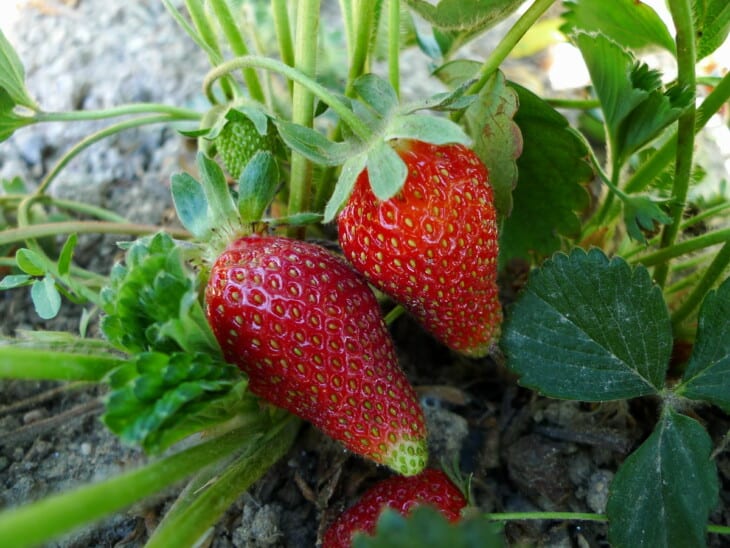
A garden strawberry (Fragaria × ananassa) is a low perennial with leaves divided into three toothed leaflets. It spreads by runners, has five-petaled white flowers with a yellow center, and bears a red, fleshy fruit with the tiny seeds on the outside. It is not descended from mock strawberry. It is a hybrid of two wild American species, the Virginia strawberry and the Chilean strawberry, that first crossed in French gardens in the 1700s.
- Low Plants That Look Like Strawberry Plants
- Trees and Shrubs With Strawberry-Like Fruit
- How to Tell a Real Strawberry From a Lookalike
- Should You Keep Mock or Wild Strawberries in Your Garden?
| Plant | Botanical name | Flowers | Fruit | How to tell it from a strawberry |
|---|---|---|---|---|
| Mock Strawberry | Potentilla indica | Yellow | Red, round, held upright; bland | Yellow flowers; fruit points up and tastes of nothing |
| Wild Strawberries | Fragaria virginiana and F. vesca | White | Small, red, very sweet | This is a real strawberry, just smaller |
| Barren Strawberry | Potentilla sterilis | White | None (dry seeds) | No berry; gaps between the petals; dull, bluish-green leaves |
| Rough Cinquefoil (Strawberry Weed) | Potentilla norvegica | Yellow | None (dry seeds) | Grows upright, 1–3 ft; hairy stems; no runners |
| Avens | Geum spp. | Yellow, orange, red or pink | Bur of hooked seeds | Leaves divided into several leaflets; burry seed heads |
| Buttercups | Ranunculus spp. | Glossy yellow | Dry seeds | Glossy yellow flowers; leaves more deeply cut; poisonous |
| Strawberry Tree | Arbutus unedo | White or pink bells | Red, round, bumpy; mealy | Grows on a shrub or tree; fruit is round and warty |
Low Plants That Look Like Strawberry Plants
Mock Strawberry (Potentilla indica)
Read our guide to Mock Strawberry

Mock strawberry, also called Indian strawberry or backyard strawberry, is the classic strawberry lookalike. It is a creeping perennial from Asia that has spread into lawns, woods and flower beds across the eastern U.S. It has the same three toothed leaflets and long runners as a strawberry, and small red berries covered in tiny red seeds. There are three sure differences. The flowers are yellow, not white. Behind each flower there are leafy, three-toothed bracts that are longer than the sepals. And the berry is held upright, above the leaves, instead of hanging down. The fruit isn’t poisonous, but it is dry and tasteless. It was long known as Duchesnea indica.
Wild Strawberries (Fragaria virginiana and F. vesca)
Read our guide to Wild Strawberries
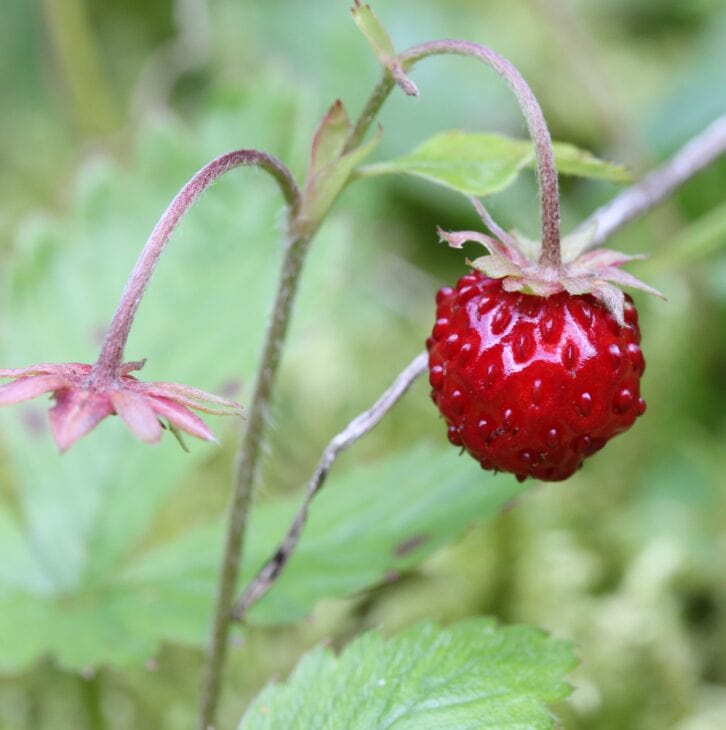
Wild strawberries are real strawberries, so everything about them matches the garden kind except the size. In North America the common one in fields and along roadsides is the Virginia strawberry (Fragaria virginiana), one of the two parents of the garden strawberry. Woodland strawberry (F. vesca, shown) grows in shadier spots in both North America and Europe. Its fruit is often held above the leaves on a slender stalk. Both have white flowers and small, fragrant, very sweet berries, often no bigger than a fingernail. Alpine strawberries, sold for gardens, are varieties of woodland strawberry that fruit all summer and hardly make runners.
Barren Strawberry (Potentilla sterilis)

Barren strawberry is a small European cinquefoil with white flowers and three-part, toothed leaves, so in spring it looks almost exactly like a wild strawberry. It never makes a fleshy berry, only small dry seeds. Before it fruits, look at the flower: the petals are narrower and don’t touch, leaving gaps. The leaflets are a dull, bluish green with silky hairs underneath, and the tooth at the tip of each leaflet is shorter than the teeth next to it. In the U.S., the name “barren strawberry” is also used for a native groundcover, Geum fragarioides (formerly Waldsteinia), which has similar leaves but yellow flowers.
Rough Cinquefoil (Strawberry Weed) (Potentilla norvegica)

Rough cinquefoil, also called Norwegian cinquefoil or strawberry weed, has hairy leaves divided into three coarsely toothed leaflets that look like strawberry leaves when the plant is young. It soon grows into an upright, branching plant 1 to 3 feet tall, which a strawberry never does, and it doesn’t make runners. It has small yellow flowers from summer to fall, followed by dry seeds instead of fruit. It is a common weed of gardens, fields and waste ground across North America.
Avens (Geum spp.)

Avens are herbaceous perennials in the rose family, like strawberries. The basal leaves of many species, such as wood avens (Geum urbanum, shown), are divided into three or more toothed leaflets that can pass for strawberry leaves. The five-petaled flowers are usually yellow in the wild species and orange, red or pink in garden varieties. Instead of a berry, avens form a round head of seeds with hooked tips that catch on clothing and fur. Prairie smoke, Geum triflorum, is a native avens grown for its feathery pink seed heads.
Buttercups (Ranunculus spp.)

Several buttercups have three-parted, toothed leaves, and creeping buttercup (Ranunculus repens) even spreads by runners, rooting along the ground like a strawberry. The flowers are shiny, bright yellow, and they form small heads of dry seeds, not berries. The leaflets are usually more deeply cut and lobed than strawberry leaflets. Carolina buttercup (R. carolinianus), a native of wet woods in the eastern U.S., is another one that gets confused with strawberry plants. All buttercups are poisonous when fresh. They blister the mouth and cause vomiting, so they are a real concern where children or livestock graze.
Trees and Shrubs With Strawberry-Like Fruit
Strawberry Tree (Arbutus unedo)

Strawberry tree is an evergreen shrub or small tree, 15 to 30 feet tall, from the Mediterranean and the southwest of Ireland (it is also called the Killarney strawberry tree). In fall it has clusters of small, white or pink, bell-shaped flowers at the same time as the red fruit from the previous year. The fruit is round, about an inch across, with a bumpy, warty skin, and it does look like a strawberry from a distance. It is edible, but mealy and only mildly sweet. In Portugal it is made into a strong spirit called medronho. The species name unedo is often explained as “I eat one”, meaning one is enough. It is hardy in zones 7 to 10.
How to Tell a Real Strawberry From a Lookalike
- Flower color: white (or pink in a few garden varieties) means strawberry or barren strawberry. Yellow means mock strawberry, cinquefoil, avens or buttercup.
- The fruit: a real strawberry hangs down or leans over, is juicy and sweet, and has its seeds sitting in small dimples. Mock strawberry holds its fruit upright, and the fruit is dry and bland with raised seeds.
- Behind the flower: mock strawberry has large, three-toothed leafy bracts behind each flower and fruit. Strawberry has only small, simple sepals.
- Growth habit: strawberries stay low. Anything that grows into an upright plant a foot or more tall is not a strawberry.
- If in doubt, don’t eat it. Mock strawberry is harmless, but buttercups are not, and young plants are easy to mix up.
Should You Keep Mock or Wild Strawberries in Your Garden?
That’s up to you. Mock strawberry spreads fast by runners and can smother small plants in a flower bed, so most gardeners pull it. It is easiest to remove when the soil is moist: pull up the whole plant and the runners, because every rooted runner makes a new plant. In a shady lawn or under trees, though, it makes a tough, evergreen groundcover, and birds eat the berries. Wild strawberries are worth keeping. They make an attractive native groundcover, flower in spring for early bees, and give you a few sweet berries if you get to them before the birds and chipmunks do.
See also plants that look like raspberries.