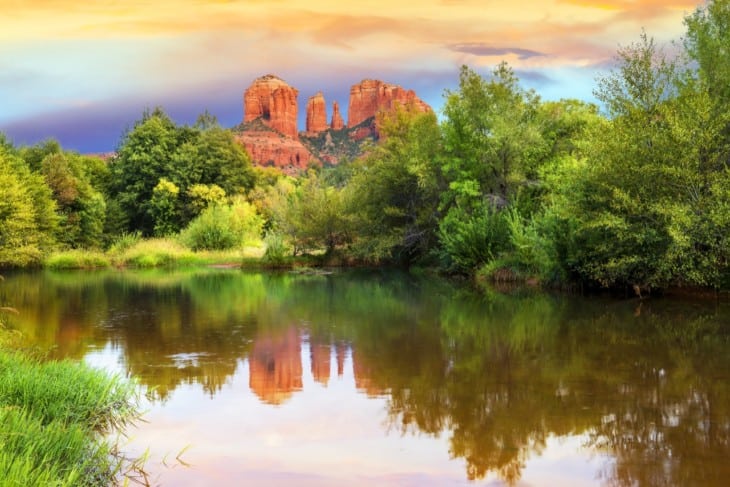
Arizona is not just desert. Its elevation ranges from about 70 feet near Yuma to over 12,600 feet on Humphreys Peak, and the trees change with every few thousand feet of climb. Palo verde, mesquite and ironwood grow in the Sonoran and Mojave deserts. Cottonwood, sycamore and ash line the rivers and canyons. Pinyon, juniper and oak cover the middle elevations, and above them is the largest ponderosa pine forest in the world, along the Mogollon Rim, with aspen and fir on the highest peaks.
Contents
- Desert Trees
- Palo Verde (Parkinsonia spp.)
- Saguaro (Carnegiea gigantea)
- Velvet Mesquite (Prosopis velutina)
- Screwbean Mesquite (Prosopis pubescens)
- Desert Ironwood (Olneya tesota)
- Catclaw Acacia (Senegalia greggii)
- Whitethorn Acacia (Vachellia constricta)
- Desert Willow (Chilopsis linearis)
- Joshua Tree (Yucca brevifolia)
- California Fan Palm (Washingtonia filifera)
- River and Canyon Trees
- Mountain and High-Country Trees
- Ponderosa Pine (Pinus ponderosa)
- Arizona Pine (Pinus arizonica)
- Two-Needle Pinyon (Pinus edulis)
- Alligator Juniper (Juniperus deppeana)
- Arizona Cypress (Hesperocyparis arizonica)
- White Fir (Abies concolor)
- Quaking Aspen (Populus tremuloides)
- Western Redbud (Cercis occidentalis)
- Chokecherry (Prunus virginiana)
- Oak Trees in Arizona
This guide groups Arizona’s most common trees by where they grow, followed by the state’s native oaks.
| Tree | Botanical name | Group | Native |
|---|---|---|---|
| Palo Verde | Parkinsonia spp. | Desert | Yes |
| Saguaro | Carnegiea gigantea | Desert | Yes |
| Velvet Mesquite | Prosopis velutina | Desert | Yes |
| Screwbean Mesquite | Prosopis pubescens | Desert | Yes |
| Desert Ironwood | Olneya tesota | Desert | Yes |
| Catclaw Acacia | Senegalia greggii | Desert | Yes |
| Whitethorn Acacia | Vachellia constricta | Desert | Yes |
| Desert Willow | Chilopsis linearis | Desert | Yes |
| Joshua Tree | Yucca brevifolia | Desert | Yes |
| California Fan Palm | Washingtonia filifera | Desert | Yes |
| Fremont Cottonwood | Populus fremontii | Riparian | Yes |
| Arizona Sycamore | Platanus wrightii | Riparian | Yes |
| Velvet Ash | Fraxinus velutina | Riparian | Yes |
| Arizona Walnut | Juglans major | Riparian | Yes |
| Netleaf Hackberry | Celtis reticulata | Riparian | Yes |
| Boxelder | Acer negundo | Riparian | Yes |
| Water Birch | Betula occidentalis | Riparian | Yes |
| Gregg Ash | Fraxinus greggii | Riparian | Yes (rare) |
| Chinaberry | Melia azedarach | Riparian | No (invasive) |
| Ponderosa Pine | Pinus ponderosa | Mountain | Yes |
| Arizona Pine | Pinus arizonica | Mountain | Yes |
| Two-Needle Pinyon | Pinus edulis | Mountain | Yes |
| Alligator Juniper | Juniperus deppeana | Mountain | Yes |
| Arizona Cypress | Hesperocyparis arizonica | Mountain | Yes |
| White Fir | Abies concolor | Mountain | Yes |
| Quaking Aspen | Populus tremuloides | Mountain | Yes |
| Western Redbud | Cercis occidentalis | Mountain | Yes |
| Chokecherry | Prunus virginiana | Mountain | Yes |
| Silverleaf Oak | Quercus hypoleucoides | Oak | Yes |
| Shrub Live Oak | Quercus turbinella | Oak | Yes |
| Emory Oak | Quercus emoryi | Oak | Yes |
| Arizona White Oak | Quercus arizonica | Oak | Yes |
| Gambel Oak | Quercus gambelii | Oak | Yes |
| Canyon Live Oak | Quercus chrysolepis | Oak | Yes |
| Netleaf Oak | Quercus rugosa | Oak | Yes |
| Wavyleaf Oak | Quercus × undulata | Oak | Yes |
| Dunn Oak | Quercus palmeri | Oak | Yes |
Desert Trees
These trees handle extreme heat and very little rain. Most of them drop their leaves in drought, or photosynthesize through green bark. Many are also excellent low-water landscape trees for Phoenix and Tucson.
Palo Verde (Parkinsonia spp.)

Palo verde is Arizona’s state tree. Its name is Spanish for “green stick”: its bark and branches are green and carry out most of its photosynthesis, so the tree can drop its tiny leaves in drought. Blue palo verde and foothill palo verde usually grow 15 to 30 feet tall. In April and May they cover the desert in bright yellow flowers.
Saguaro (Carnegiea gigantea)

The saguaro is a giant cactus rather than a tree, but it is the signature plant of the Sonoran Desert, and in Arizona it grows almost nowhere outside the Sonoran. It grows very slowly, first flowers at around 35 years old, and usually starts growing arms after 50 to 75 years. Old saguaros reach 40 feet and live 150 to 200 years. Its white flower is Arizona’s state flower. See them at Saguaro National Park near Tucson.
Velvet Mesquite (Prosopis velutina)
Read our guide to Velvet Mesquite

Velvet mesquite is the most common mesquite in Arizona, found along washes and on desert flats and grasslands. It usually grows 20 to 30 feet tall. Its roots can reach groundwater far below the surface. It has thorny branches, feathery compound leaves and yellow catkin flowers in spring. The sweet bean pods were a staple food, ground into flour, and mesquite wood is prized for grilling.
Screwbean Mesquite (Prosopis pubescens)

Screwbean mesquite is a smaller mesquite of river bottoms and washes in western and southern Arizona. It is easy to identify by its seed pods, which are tightly coiled like a corkscrew. It has feathery grey-green leaves, paired white spines and yellow flower spikes in spring.
Desert Ironwood (Olneya tesota)

Desert ironwood grows only in the Sonoran Desert, mostly in washes, and reaches 15 to 30 feet. It keeps most of its grey-green leaves year-round, and it flowers lavender-pink in late spring. Its wood is so dense it sinks in water. It is one of the longest-lived desert plants, often living more than 800 years. It is a “nurse tree” that shelters young saguaros and many other plants, and its seeds are edible.
Catclaw Acacia (Senegalia greggii)

Catclaw acacia is a thorny shrub or small tree, occasionally up to 30 feet, common along desert washes. Its short, curved thorns catch clothing, which earned it the nickname “wait-a-minute bush”. Fuzzy, pale yellow flower spikes appear in spring and are a good nectar source for bees.
Whitethorn Acacia (Vachellia constricta)

Whitethorn acacia is a shrub of desert grasslands and slopes, usually under 12 feet. It is named for its paired, straight white spines. Fragrant, round yellow flower heads appear after the summer rains, followed by narrow reddish pods.
Desert Willow (Chilopsis linearis)

Desert willow is not a willow. It is related to catalpa, and it is named for its long, narrow leaves. It grows along washes in central and southern Arizona, usually 15 to 30 feet tall. It flowers from late spring through summer, with trumpet-shaped pink, lavender or white flowers that hummingbirds love. It is a popular low-water landscape tree.
Joshua Tree (Yucca brevifolia)

Joshua tree is a tree-sized yucca of the Mojave Desert. In Arizona it grows only in the northwest of the state, in Mohave County, including a dense forest along the Joshua Tree Parkway (US-93). It usually grows 15 to 30 feet tall, with clusters of stiff, dagger-like leaves at the ends of its branches. Creamy white flowers appear in spring.
California Fan Palm (Washingtonia filifera)

California fan palm is the only palm native to the western US. In Arizona it grows wild only in a few canyons in the Kofa Mountains, the best known being Palm Canyon. It grows 30 to 60 feet tall with a thick trunk, and if its dead fronds are not trimmed, they hang down as a “skirt”. It is widely planted in Phoenix and Tucson. Mexican fan palm is the taller, slimmer relative.
River and Canyon Trees
Arizona’s streams and canyon bottoms are narrow ribbons of green through dry country. Although they make up only a tiny fraction of the land, they support most of its wildlife.
Fremont Cottonwood (Populus fremontii)
Read our guide to Fremont Cottonwood

Fremont cottonwood is the biggest tree along Arizona’s desert rivers, often 40 to 80 feet tall with a massive trunk. It has triangular, coarsely toothed leaves that turn gold in fall. In spring, female trees release seeds in cottony fluff. It needs a shallow water table, and its groves are some of the richest bird habitat in the Southwest.
Arizona Sycamore (Platanus wrightii)

Arizona sycamore grows along streams and canyon floors in central and southern Arizona, commonly 50 to 80 feet tall. Its bark peels in patches to expose a smooth, white trunk, and its large leaves have deep, pointed lobes. Its seeds grow in round, bristly balls.
Velvet Ash (Fraxinus velutina)

Velvet ash (Arizona ash) grows along streams and in canyons across most of Arizona and reaches 30 to 50 feet. It has compound leaves with fuzzy undersides and grey, furrowed bark. Its winged seeds are spread by the wind. It is widely planted as a shade tree, and the ‘Modesto’ cultivar is common in older neighborhoods.
Arizona Walnut (Juglans major)

Arizona walnut grows in canyons and along streams at middle elevations, usually 30 to 50 feet tall. It has compound leaves with 9 to 13 narrow, toothed leaflets. Its small, hard-shelled nuts are eaten by squirrels and other wildlife.
Netleaf Hackberry (Celtis reticulata)

Netleaf hackberry is a small tree, usually 20 to 30 feet tall, of canyons, washes and streamsides. Its thick, rough leaves have a raised net of veins on the underside, which gives it its name. Its small orange-red berries are sweet and eaten by birds.
Boxelder (Acer negundo)

Boxelder is a native maple with compound leaves that look more like ash leaves. In Arizona it grows along streams and in moist canyons at middle elevations, usually 30 to 50 feet tall. Clusters of small flowers appear in early spring, followed by paired, winged seeds.
Water Birch (Betula occidentalis)

Water birch is a shrubby, multi-stemmed tree, 10 to 30 feet tall, along mountain streams in northern and eastern Arizona. It has shiny, reddish-brown bark marked with horizontal lenticels and small, toothed leaves. Its tiny winged seeds are spread by wind and water.
Gregg Ash (Fraxinus greggii)

Gregg ash (littleleaf ash) is a small evergreen ash, usually a shrub under 20 feet, of rocky canyons in southeastern Arizona. It has very small compound leaves and winged seeds. Its tolerance of heat and drought makes it an occasional landscape plant.
Chinaberry (Melia azedarach)

Chinaberry is an Asian tree that was widely planted and now grows wild along Arizona’s streams and irrigation ditches. It is a fast-growing tree with an umbrella-shaped crown and fragrant lilac flowers in spring. Its yellow berries are poisonous to people and pets. Do not plant it.
Mountain and High-Country Trees
Above the desert, pinyon-juniper woodland covers huge areas of the plateau. Above it grows ponderosa pine forest, then fir and aspen on the highest mountains, including the San Francisco Peaks, the White Mountains and the “sky island” ranges of the southeast.
Ponderosa Pine (Pinus ponderosa)

Ponderosa pine forms the largest continuous ponderosa pine forest in the world, stretching along the Mogollon Rim from near Flagstaff into New Mexico. Mature trees are 60 to 130 feet tall. Their thick, orange-brown bark is broken into large plates and smells of vanilla or butterscotch on warm days. The long needles grow in bundles of three.
Arizona Pine (Pinus arizonica)

Arizona pine is a close relative of ponderosa pine and grows in the sky island mountains of southeastern Arizona, such as the Chiricahuas and the Santa Ritas. It reaches 60 to 100 feet. Its needles usually grow in bundles of five (sometimes three or four), and its cones are smaller than those of ponderosa.
Two-Needle Pinyon (Pinus edulis)

Two-needle pinyon is the common pinyon of northern Arizona, usually 15 to 35 feet tall. It forms woodlands with junipers across the Colorado Plateau, including around the Grand Canyon. Its needles grow in pairs. Its large, edible pine nuts were a key food for the region’s Native peoples and are still harvested today.
Alligator Juniper (Juniperus deppeana)

Alligator juniper is named for its thick bark, broken into square plates like alligator hide. It grows on mountain slopes in central and southeastern Arizona and usually reaches 30 to 50 feet, sometimes more. Old trees are often many centuries old. The scale-like foliage is blue-green, and the berry-like cones are eaten by birds, deer and foxes.
Arizona Cypress (Hesperocyparis arizonica)

Arizona cypress grows on rocky slopes and in canyons in the mountains of central and southeastern Arizona. It has blue-grey, scale-like foliage and round cones about an inch across. It is drought-tolerant and widely grown as a windbreak, a screen and a Christmas tree.
White Fir (Abies concolor)

White fir grows on cool, moist slopes in the high mountains of Arizona, often mixed with Douglas fir and ponderosa pine. It commonly reaches 80 to 130 feet. Its flat, blue-green needles are 2 to 3 inches long. Its bark is smooth and grey on young trees and becomes deeply furrowed with age.
Quaking Aspen (Populus tremuloides)
Read our guide to Quaking Aspen

Quaking aspen grows in groves on the San Francisco Peaks, the Kaibab Plateau and the White Mountains. Each grove is often a single clone connected by its roots. The trees are 40 to 80 feet tall, with smooth white bark, and their round leaves tremble in the slightest breeze. In late September and early October they turn gold.
Western Redbud (Cercis occidentalis)
Read our guide to Western Redbud

Western redbud is a small, multi-stemmed tree, 10 to 20 feet tall, of canyons in northern Arizona, including the Grand Canyon. Its bare branches are covered in magenta-pink flowers in early spring. Heart-shaped, blue-green leaves follow, and flat purple-brown seed pods hang on the tree into winter.
Chokecherry (Prunus virginiana)

Chokecherry is a shrub or small tree, usually under 20 feet, of mountain canyons and streamsides. Cylindrical clusters of white flowers appear in spring and become dark red to black cherries by late summer. The cherries are astringent raw but good in jams and syrup. The leaves, stems and seeds are toxic.
Oak Trees in Arizona
Arizona has about a dozen native oaks. Most are evergreen or semi-evergreen shrubs and small trees of the chaparral and the oak woodlands between the desert and the pine forest. Oaks here hybridize freely, which can make individual trees hard to identify. The most common are silverleaf, Emory, shrub live oak, Arizona white oak and Gambel oak.
Silverleaf Oak (Quercus hypoleucoides)
Read our guide to Silverleaf Oak

Silverleaf oak grows in the mountains of southeastern Arizona, usually 20 to 30 feet tall with enough water. Its narrow, leathery leaves are shiny dark green on top and bright silvery-white underneath. In spring it bears yellow-green catkins.
Shrub Live Oak (Quercus turbinella)

Shrub live oak is one of the most common plants of Arizona’s chaparral. It usually forms dense thickets 6 to 12 feet tall. Its small, holly-like, grey-green leaves have spiny teeth, and it produces small acorns in its first season.
Emory Oak (Quercus emoryi)

Emory oak is a common oak of the grasslands and woodlands of central and southeastern Arizona. It usually grows 20 to 40 feet tall, with dark, almost black bark. Its evergreen leaves are glossy and lance-shaped, with a few teeth. The small, sweet acorns, called bellotas, are gathered and eaten, and Apache communities have harvested them for generations.
Arizona White Oak (Quercus arizonica)

Arizona white oak grows on slopes and in canyons in central and southeastern Arizona and reaches up to about 40 feet. Older trees have light grey bark. Its thick, blue-green leaves are sometimes toothed and sometimes smooth-edged, and it produces acorns in its first season.
Gambel Oak (Quercus gambelii)

Gambel oak is the deciduous oak of northern Arizona’s ponderosa pine forests and high plateaus. It grows as a clonal thicket or a tree up to 40 feet. Its deeply lobed, glossy leaves turn yellow to orange in fall. It is in the white oak group, so its acorns ripen in a single season, in fall.
Canyon Live Oak (Quercus chrysolepis)

Canyon live oak grows in canyons and on steep slopes in central Arizona. It is usually a shrub or small tree here, although it can reach 80 feet in California. Its evergreen leaves are dark green on top and gold-dusted underneath when young. The acorns have thick, golden, fuzzy cups. Its roots can reach 24 feet deep.
Netleaf Oak (Quercus rugosa)

Netleaf oak grows in the sky island mountains of southeastern Arizona and in Mexico. It is usually a shrub or small tree, up to about 30 feet in Arizona. Its thick, leathery, cupped leaves have a raised net of veins and are covered with dense reddish-brown hairs underneath.
Wavyleaf Oak (Quercus × undulata)

Wavyleaf oak is a naturally occurring hybrid of shrub live oak and Gambel oak. It usually grows as a shrub 4 to 8 feet tall. Its leaves are extremely variable, deeply lobed, shallowly lobed or unlobed, blue-green on top and hairy underneath.
Dunn Oak (Quercus palmeri)

Dunn oak (Palmer oak) is an evergreen shrub or small tree, up to 20 feet, of canyons and chaparral. Its stiff, waxy, olive-green leaves are wavy with sharp spiny teeth, much like holly, and its twigs are reddish-brown.