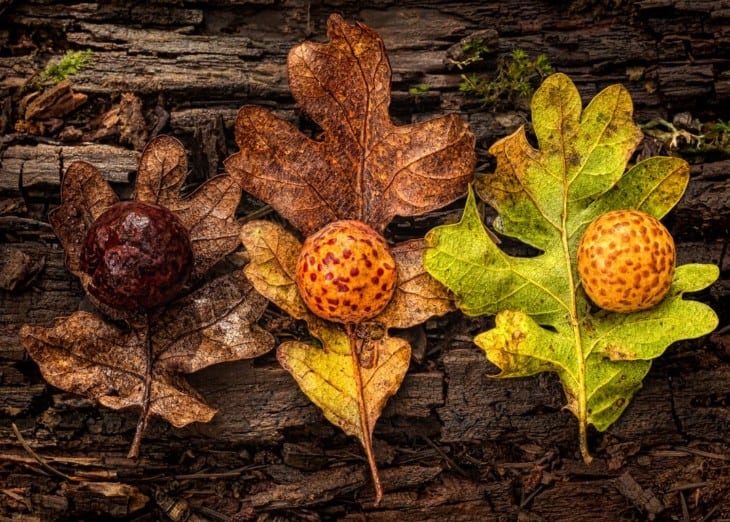
The balls on oak trees are oak galls. The tree grows these swellings around the eggs and larvae of tiny gall wasps. The wasps are only a few millimeters long and don’t sting people. Most galls, including the large round “oak apples” on the leaves, are harmless to the tree and need no treatment. The exception is the hard, woody galls on twigs, such as horned and gouty oak galls. Heavy infestations of those can kill branches, and sometimes small pin oaks. Pruning out the galled twigs is the only control that works reliably.
Contents
- What Are Oak Galls?
- Common Leaf Galls (Harmless)
- Twig Galls (Can Damage the Tree)
- What to Do About Oak Galls
- Other Balls and Bumps on Oak Trees
What Are Oak Galls?
A gall starts when a female gall wasp (family Cynipidae) lays an egg in a leaf, bud, twig, flower or root of an oak. As the larva hatches and feeds, chemicals from the egg and larva make the oak’s own tissue swell into a gall around it. The gall shelters the larva and feeds it until the adult wasp chews its way out through a small round exit hole. A gall with a hole in it is empty.
Oaks carry more kinds of galls than any other trees. North America alone has around 700 species of oak gall wasps, and each one makes a gall of a particular shape on a particular part of the tree. Many of them have two generations a year, and the two generations make completely different galls, often on different parts of the tree.

| Gall | Made by | Where and what it looks like | Harmful to the tree? |
|---|---|---|---|
| Oak Apple Gall | Amphibolips confluenta | Round, 1–2 in, on leaves; green and spongy, then tan and papery | No |
| Jumping Oak Gall | Neuroterus saltatorius | Tiny seed-like dots under white and bur oak leaves; leaves may brown | No (cosmetic) |
| Wool Sower Gall | Callirhytis seminator | White cottony ball with pink spots, on twigs of white oaks in spring | No |
| Horned Oak Gall | Callirhytis cornigera | Hard, woody, marble- to fist-sized knots on twigs with small horns; pin, black, blackjack and willow oaks | Yes, in heavy infestations |
| Gouty Oak Gall | Callirhytis quercuspunctata | Rounded, woody swellings on twigs without horns; pin, red, scarlet and black oaks | Yes, in heavy infestations |
| Oak Bullet Gall | Disholcaspis quercusmamma and others | Hard round balls, 1/4 to 1/2 in, clustered on twigs of bur and other white oaks; sticky, attract ants and wasps | Rarely |
Common Leaf Galls (Harmless)
Oak Apple Gall (Amphibolips confluenta)
Oak apples are the big round balls people notice most, 1 to 2 inches across, attached to a leaf or leaf stalk of red, black and scarlet oaks. They form in spring and are green and slightly spongy at first, like a small unripe apple. By summer they dry into light, papery tan shells with a single larva cell held in the middle by fine fibers. They look alarming but do the tree no harm, and they often fall with the leaves.
Jumping Oak Gall (Neuroterus saltatorius)

Jumping oak galls are tiny, about 1 millimeter, round and tan, and they cover the undersides of white oak and bur oak leaves in late spring. In heavy years the leaves turn brown and scorched-looking by early summer. In early summer the galls drop to the ground, where the larva inside makes them “jump” like tiny seeds. The damage looks bad, but healthy trees leaf out normally the next year.
Wool Sower Gall (Callirhytis seminator)
The wool sower gall looks like a ball of white cotton wool, 1 to 2 inches across, often with pink or red spots, on a twig of white oak or another white-oak-group tree in spring. Inside the wool are many hard seed-like cells, each with one larva. It is conspicuous but harmless and dries up by summer.
Twig Galls (Can Damage the Tree)
Horned Oak Gall (Callirhytis cornigera)
Horned oak galls are hard, woody lumps on twigs and branches, from marble-sized to 2 inches or more. Short horns stick out of the surface, and the adult wasps emerge from them. The galls grow for 2 to 3 years before wasps come out, and in the meantime they cut off water flow in the twig. A few galls do little harm. But a tree can carry hundreds, and then whole branches die. Heavily infested young pin oaks can be killed.
Gouty Oak Gall (Callirhytis quercuspunctata)
Gouty oak galls are similar to horned galls, woody swellings on twigs up to about 2 inches across, but they have no horns. The wasps leave through many small holes. Like horned galls, they can kill twigs and branches when numerous, mostly on pin, red and scarlet oaks.
Oak Bullet Gall (Disholcaspis quercusmamma and others)
Bullet galls are hard, round, brown balls about the size of a pea or marble, stuck directly to the twigs, often in clusters. When fresh, they ooze a sweet honeydew that attracts ants, bees and wasps, which is often how people first notice them. They rarely harm the tree.
What to Do About Oak Galls
- Leaf galls: leave them. Oak apples, jumping galls and wool sower galls don’t need treatment. Raking up and removing fallen leaves in autumn can reduce jumping oak galls a little the next year.
- Twig galls: prune them. On small trees, cut out twigs with horned or gouty galls in late winter, before the adults emerge in spring. Cut back to healthy wood, and bag or burn the galled twigs. Don’t leave them lying under the tree.
- Don’t bother spraying. The larvae are sealed inside the gall, where insecticides can’t reach them. Spraying at the right moment for egg-laying is very hard to time, and it kills the tiny parasitic wasps and other insects that already keep most galls in check.
- Keep the tree healthy. Water deeply during drought and avoid damaging roots and bark. Stressed trees suffer most from twig galls.
- Call an arborist if a large tree has many dying branches with woody galls. An arborist can also rule out other problems such as oak wilt.
Other Balls and Bumps on Oak Trees
Not every ball on an oak is a gall. These are the most common other causes:
- Acorns. Young acorns in their cups are sometimes mistaken for galls. They grow in pairs or small clusters at the tips of twigs. Acorns are toxic to horses, cattle and dogs in quantity; see our guide to acorns.
- Kermes scale. These are small, round, brown bumps about 1/8 to 1/4 inch across, tucked into twig forks and leaf buds. They are scale insects, not galls. They feed on sap and can cause twig dieback. Unlike galls, they can be treated with horticultural oil in winter.
- Oak leaf blister. A fungus (Taphrina caerulescens) causes raised, round, yellow-green blisters on the leaves in spring. They later turn brown and are hollow underneath. It is cosmetic and needs no treatment.
- Mistletoe. Round, green, bushy clumps high in the branches, most visible in winter, are oak mistletoe (Phoradendron). It is a parasitic plant, not a gall.
Gall wasps are not the same as the social wasps and hornets that sting; see our guide to wasps and hornets.