Virginia’s best flowering trees are mostly its own natives: flowering dogwood, which is both the state tree and the state flower, redbud, serviceberry, fringe tree, sourwood, red buckeye, southern and sweetbay magnolia and Carolina silverbell. For a longer season, add Yoshino and Kwanzan cherries in early spring, kousa dogwood and Japanese snowbell in late spring, and crape myrtle through the whole of a Virginia summer.
Contents
- Native Flowering Trees
- Flowering Dogwood (Cornus florida)
- Eastern Redbud (Cercis canadensis)
- Downy Serviceberry (Amelanchier arborea)
- White Fringe Tree (Chionanthus virginicus)
- Sourwood (Oxydendrum arboreum)
- Southern Magnolia (Magnolia grandiflora)
- Sweetbay Magnolia (Magnolia virginiana)
- Carolina Silverbell (Halesia carolina)
- Red Buckeye (Aesculus pavia)
- American Yellowwood (Cladrastis kentukea)
- Black Cherry (Prunus serotina)
- Hawthorn (Crataegus species)
- Tulip Tree (Liriodendron tulipifera)
- Pawpaw (Asimina triloba)
- Southern Catalpa (Catalpa bignonioides)
- American Witch Hazel (Hamamelis virginiana)
- Introduced Ornamental Trees
- Yoshino Cherry (Prunus × yedoensis)
- Kwanzan Cherry (Prunus serrulata ‘Kanzan’)
- Higan Cherry (Prunus × subhirtella)
- Sargent Cherry (Prunus sargentii)
- Flowering Peach (Prunus persica)
- Saucer Magnolia (Magnolia × soulangeana)
- Star Magnolia (Magnolia stellata)
- Kousa Dogwood (Cornus kousa)
- Flowering Crabapple (Malus species and hybrids)
- Crape Myrtle (Lagerstroemia indica and L. × fauriei)
- Japanese Snowbell (Styrax japonicus)
- Cornelian Cherry Dogwood (Cornus mas)
- Sasanqua Camellia (Camellia sasanqua)
- Trees to Keep Out of a Virginia Garden
- Planning Your Virginia Planting
Virginia spans USDA zones 5b in the far southwest mountains to 8a on the lower Eastern Shore, so a tree that thrives in Virginia Beach may not survive in Blacksburg, and a tree that loves Winchester may bake in Suffolk. Check your zone before you buy. The trees below are grouped by whether they are native, introduced ornamentals, or plants to keep out of the ground entirely, because Virginia has a serious problem with escaped Callery pear.

- Native Flowering Trees
- Introduced Ornamental Trees
- Trees to Keep Out of a Virginia Garden
- Planning Your Virginia Planting
| Tree | Botanical name | Blooms | Height | Native to Virginia |
|---|---|---|---|---|
| Flowering Dogwood | Cornus florida | April | 20–30 ft | Yes |
| Eastern Redbud | Cercis canadensis | March–April, before the leaves | 20–30 ft | Yes |
| Downy Serviceberry | Amelanchier arborea | March–April | 15–25 ft | Yes |
| White Fringe Tree | Chionanthus virginicus | May | 12–20 ft | Yes |
| Sourwood | Oxydendrum arboreum | June–July | 25–30 ft | Yes |
| Southern Magnolia | Magnolia grandiflora | May–June, sporadically to fall | 60–80 ft | Yes, in southeastern Virginia |
| Sweetbay Magnolia | Magnolia virginiana | May–June | 20–35 ft | Yes |
| Carolina Silverbell | Halesia carolina | April | 25–40 ft | Yes, in the mountains |
| Red Buckeye | Aesculus pavia | April–May | 12–20 ft | Yes |
| American Yellowwood | Cladrastis kentukea | May–June, heavily every 2–3 years | 30–50 ft | No, but native nearby and well adapted |
| Black Cherry | Prunus serotina | April–May | 50–80 ft | Yes |
| Hawthorn | Crataegus species | April–May | 15–30 ft | Yes, several species |
| Tulip Tree | Liriodendron tulipifera | May | 70–100 ft | Yes |
| Pawpaw | Asimina triloba | April | 15–25 ft | Yes |
| Southern Catalpa | Catalpa bignonioides | May–June | 30–40 ft | No, naturalized throughout |
| American Witch Hazel | Hamamelis virginiana | October–December | 15–20 ft | Yes |
| Yoshino Cherry | Prunus × yedoensis | Late March–early April | 25–40 ft | No |
| Kwanzan Cherry | Prunus serrulata ‘Kanzan’ | April, after Yoshino | 25–30 ft | No |
| Higan Cherry | Prunus × subhirtella | March, and again in warm spells in fall | 20–35 ft | No |
| Sargent Cherry | Prunus sargentii | Late March–April | 20–40 ft | No |
| Flowering Peach | Prunus persica | March–April | 15–25 ft | No |
| Saucer Magnolia | Magnolia × soulangeana | Early to mid March | 20–30 ft | No |
| Star Magnolia | Magnolia stellata | Early March | 15–20 ft | No |
| Kousa Dogwood | Cornus kousa | Late May–June, after the leaves | 20–30 ft | No |
| Flowering Crabapple | Malus species and hybrids | April | 15–25 ft | Some species; the garden forms are hybrids |
| Crape Myrtle | Lagerstroemia indica and L. × fauriei | July–September | 8–25 ft | No |
| Japanese Snowbell | Styrax japonicus | May–June | 20–30 ft | No |
| Cornelian Cherry Dogwood | Cornus mas | Late February–March | 15–25 ft | No |
| Sasanqua Camellia | Camellia sasanqua | October–December | 6–12 ft | No |
| Callery Pear (‘Bradford’ Pear) | Pyrus calleryana | March | 30–50 ft | No — invasive |
| Mimosa (Silk Tree) | Albizia julibrissin | June–July | 20–40 ft | No — invasive |
| Golden Rain Tree | Koelreuteria paniculata | June–July | 30–40 ft | No — seeds aggressively |
| European Mountain Ash | Sorbus aucuparia | May | 20–40 ft | No — poorly adapted |
Native Flowering Trees
Flowering Dogwood (Cornus florida)

Flowering dogwood is Virginia’s state tree and state flower, and it is the defining tree of the Piedmont woodland edge in April. What look like four white petals are bracts around a tight cluster of tiny green flowers, followed by red fruit that birds strip in fall and deep red-purple autumn leaves. It is an understory tree: give it morning sun, afternoon shade and moist, acidic, well-drained soil. Dogwood anthracnose has killed many trees in cool mountain sites, so choose resistant cultivars such as ‘Appalachian Spring’ and avoid planting in deep shade or wet ground.
Eastern Redbud (Cercis canadensis)

Redbud flowers earlier than dogwood, in magenta-pink clusters that come straight out of the bare twigs and even out of the trunk, and it is at its best in front of dark woods along Virginia’s back roads. Its heart-shaped leaves follow, turning clear yellow in fall. It is a legume, short-lived at 30 to 50 years, and it grows in sun or part shade in almost any soil that drains. ‘Forest Pansy’ has purple leaves; the native white form is f. alba.
Downy Serviceberry (Amelanchier arborea)

Serviceberry is the first native tree to flower in Virginia, opening drifts of white, slightly fragrant, strap-petaled flowers in the woods before dogwood or redbud. It is a four-season plant: sweet purple-black June fruit that tastes of almond-scented blueberry, orange-red fall color, and smooth gray striped bark. Birds usually beat you to the fruit. ‘Autumn Brilliance’ is the common hybrid selection, chosen for reliable orange-red autumn leaves.
White Fringe Tree (Chionanthus virginicus)

Fringe tree, also called old man’s beard or grancy graybeard, hangs the whole canopy with clouds of drooping, thread-like white petals in May, weeks after dogwood, and the male trees are the showier ones. It is a slow, tough, adaptable small tree, native from Virginia south, and it leafs out very late, which alarms new owners every spring. Female trees carry blue-black fruit that birds take. It is one of the last trees emerald ash borer has begun attacking, so watch for dieback.
Sourwood (Oxydendrum arboreum)

Sourwood is Virginia’s best native summer-flowering tree, hanging one-sided sprays of small white bell flowers in midsummer that bees work heavily; sourwood honey from the southern Appalachians is prized. In fall its narrow crown turns scarlet and crimson, the first tree to color in the woods, while the dried seed capsules stay on like lace. It needs acidic, moist, well-drained soil and full sun for good flowering, and it will not tolerate compacted urban soil or road salt.
Southern Magnolia (Magnolia grandiflora)
Read our guide to Southern Magnolia

Southern magnolia is evergreen, with glossy leaves felted rust-brown beneath and cream flowers 6 to 12 inches across that smell of lemon. It is native to southeastern Virginia and grows well across the Coastal Plain and Piedmont, but full-size trees reach 60 to 80 feet and hold their lower branches to the ground, which most yards cannot accommodate. For a smaller garden choose ‘Little Gem’ at 20 feet or ‘Bracken’s Brown Beauty’, which is the most cold-hardy.
Sweetbay Magnolia (Magnolia virginiana)
Sweetbay is the magnolia named for Virginia and the one to plant in a wet spot, where it thrives in the swamp edges of the Coastal Plain. Its creamy 2- to 3-inch flowers smell strongly of lemon and vanilla and appear over many weeks, and its leaves flash silver-white undersides in the wind. It is semi-evergreen in eastern Virginia and deciduous in the mountains. It is a larval host for the eastern tiger swallowtail.
Carolina Silverbell (Halesia carolina)
Carolina silverbell hangs rows of small white bells along its branches in April, at the same time as dogwood, and it is native to the moist coves of southwestern Virginia and the southern Appalachians. It is an understory tree that wants the same conditions as dogwood, acidic moist soil and part shade, and it is far less prone to disease. Its four-winged dry fruits hang on into winter. It is badly underused in gardens.
Red Buckeye (Aesculus pavia)

Red buckeye carries upright spikes of tubular scarlet flowers in mid-spring, timed to the return of ruby-throated hummingbirds, which is exactly what it is pollinated by. It is a small, multi-stemmed understory tree for part shade and moist soil, and it drops its leaves early in dry summers, which is normal rather than a problem. Its glossy brown seeds are poisonous to people and livestock, as are the young leaves.
American Yellowwood (Cladrastis kentukea)

Yellowwood hangs 12-inch chains of white, wisteria-scented pea flowers in late spring, and a good year is spectacular. It is a rare native of limestone slopes in Kentucky, Tennessee and North Carolina, not Virginia, but it grows well throughout the state. It flowers heavily only every second or third year. Its smooth gray bark and bright yellow fall color are good year-round, and its narrow branch crotches split in ice storms, so prune it in summer to build good structure.
Black Cherry (Prunus serotina)

Black cherry hangs slender white racemes along its branches in late spring, then drops small black cherries that feed dozens of bird species. It is one of the most valuable wildlife trees in the eastern forest, supporting more than 400 species of caterpillar, and it is the source of the state’s finest cabinet timber. It is a forest tree rather than a lawn specimen: it seeds everywhere, drops fruit that stains, and its wilted leaves are poisonous to horses and cattle.
Hawthorn (Crataegus species)

Virginia has a dozen or more native hawthorns, all with flat clusters of white, apple-like flowers in spring and red fruit that holds into winter. Green hawthorn ‘Winter King’ is the best garden form, with heavy red fruit, silver bark and good rust resistance. Most hawthorns carry serious thorns 1 to 3 inches long, which makes them excellent hedgerow and bird cover and a poor choice next to a path. Cedar-hawthorn rust is common where red cedars grow nearby.
Tulip Tree (Liriodendron tulipifera)

The tulip tree is Virginia’s tallest hardwood and among the tallest in the East, straight-trunked to 100 feet or more. Its flowers are genuine tulips, green-yellow with an orange band at the base, but they open high in the canopy in May and are mostly noticed when they fall on the lawn. Its four-lobed leaves turn clear gold in fall. It grows very fast in deep, moist soil, has weak wood, and needs far more room than most gardens have.
Pawpaw (Asimina triloba)

Pawpaw flowers are dark maroon, hanging and faintly unpleasant-smelling, because they are pollinated by flies and beetles rather than bees. The tree is worth growing for the fruit, North America’s largest native edible, which tastes of banana and mango and ripens in September. It suckers into colonies in bottomland woods. Plant two different named cultivars for fruit, since it needs cross-pollination, and give it shade for its first two years. It is the only host plant for the zebra swallowtail.
Southern Catalpa (Catalpa bignonioides)

Catalpa carries upright trusses of large white, frilled, orchid-like flowers spotted purple and yellow in early summer, on a tree with huge heart-shaped leaves and long bean-like pods. It is native to the Gulf states and has naturalized across Virginia, where it is often the tree flowering in old farmyards in June. It is brittle, messy with pods and leaves, and short-lived, but few trees flower as dramatically. Catalpa worms are prized fishing bait.
American Witch Hazel (Hamamelis virginiana)

American witch hazel is the last thing to flower in Virginia woods, opening ribbony yellow flowers in late fall as its leaves drop, and it releases last year’s seed explosively at the same time. It is a large multi-stemmed shrub or small tree of moist woods and stream banks, happy in shade, and it is the source of the drugstore astringent. For winter and very early spring flower instead, plant the hybrid H. × intermedia, in copper, orange and yellow.
Introduced Ornamental Trees
Yoshino Cherry (Prunus × yedoensis)
Yoshino is the cherry of the Tidal Basin in Washington, so it is the tree most Virginians picture, and it performs well across the state. It opens single, faintly almond-scented flowers that are pale pink in bud and nearly white when open, all over the bare branches, for about two weeks. It grows fast into a wide, spreading crown, needs full sun and good drainage, and is short-lived at 30 to 40 years. Its small black fruits feed birds.
Kwanzan Cherry (Prunus serrulata ‘Kanzan’)

Kwanzan is the double pink cherry, with fat pompom flowers of 20 to 30 petals crowding the vase-shaped branches about two weeks after Yoshino, extending the season. It sets no fruit, so there is nothing to clean up. It is the most disease-prone of the common cherries, with a short life of 15 to 25 years, and it is susceptible to borers in hot, stressed sites, so keep it mulched and watered and never wound the trunk with a mower.
Higan Cherry (Prunus × subhirtella)

Higan cherry is the toughest and longest-lived of the flowering cherries, and the ‘Autumnalis’ form has the unusual habit of opening a scattering of semi-double pink flowers in warm autumn and winter weather as well as in spring. The weeping form, ‘Pendula’, is the familiar weeping cherry of Virginia front yards. It tolerates heat and cold better than Yoshino or Kwanzan and can live well over 50 years.
Sargent Cherry (Prunus sargentii)

Sargent cherry is the best flowering cherry for fall color, turning bronze-red and orange, and it has glossy, polished reddish-brown bark with prominent horizontal lenticels. Its single deep pink flowers open with the new bronze leaves. It is more cold-hardy and longer-lived than Yoshino or Kwanzan and is a better street tree. Its small black cherries are eaten by birds and are too bitter for people.
Flowering Peach (Prunus persica)

Flowering peach is grown for double flowers in white, pink, red or two colors on one tree, opening before the leaves. It is the shortest-lived tree here: expect 10 to 15 years, because peaches in Virginia are attacked by peach tree borer, leaf curl and canker. Plant it in full sun with excellent air movement, keep the trunk clear of mulch and accept it as a temporary tree. Fruiting varieties need a spray schedule to produce edible peaches.
Saucer Magnolia (Magnolia × soulangeana)

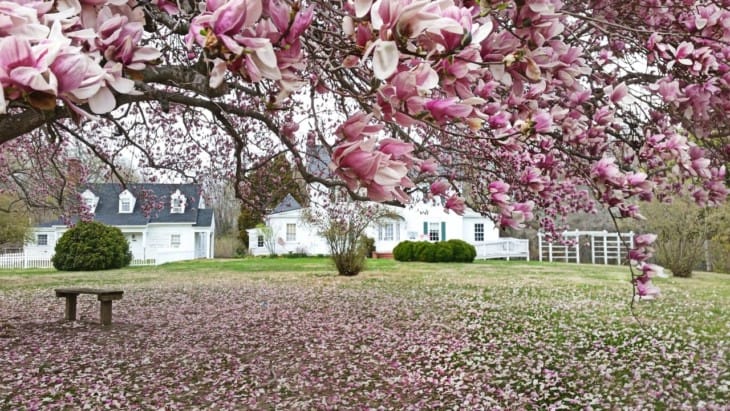
Saucer magnolia opens large goblet-shaped flowers, purple-pink outside and white within, on bare branches in early March, and in Virginia a late freeze turns them brown roughly one year in three. That is the tree’s whole story. Choose a late-flowering cultivar such as ‘Jane’ or one of the other Little Girl hybrids to dodge most frosts, and avoid planting it on a warm south wall, which pushes it into flower even earlier.
Star Magnolia (Magnolia stellata)

Star magnolia is the smallest of the common magnolias, a large shrub or small tree covered in fragrant white flowers with 12 to 18 narrow, ribbon-like petals before any leaves appear. It flowers even younger and even earlier than saucer magnolia, so it is at the same risk from late frost. Give it a sheltered spot, ideally with some shade from the early morning sun, which is what actually damages frozen buds.
Kousa Dogwood (Cornus kousa)
Read our guide to Kousa Dogwood

Kousa dogwood flowers a month after native dogwood, with pointed white bracts held above the leaves on a distinctly tiered, layered frame, and it is far more resistant to dogwood anthracnose and borers. It follows with red, raspberry-like fruits that are edible but bland, and its mottled, exfoliating bark is excellent in winter. It takes more sun than C. florida but less drought. The hybrids of the two, the Stellar series, combine early flowering with disease resistance.
Flowering Crabapple (Malus species and hybrids)

Flowering crabapples give the heaviest flower display of any small tree, in white, pink or rose, and their fruit feeds birds all winter. The only thing that matters when buying one in Virginia is disease resistance: apple scab, fire blight and cedar-apple rust disfigure susceptible varieties by July. Choose proven cultivars such as ‘Prairifire’, ‘Sugar Tyme’ or ‘Adirondack’, and never plant the old ‘Hopa’ or ‘Radiant’ types.
Crape Myrtle (Lagerstroemia indica and L. × fauriei)

Crape myrtle carries Virginia through the summer, flowering for 60 to 100 days in watermelon pink, red, lavender and white, with smooth mottled cinnamon bark and orange-red fall color. It is hardy through most of Virginia and dies back to the ground in the coldest mountain counties, where it regrows as a shrub. Buy the size you want, from ‘Pocomoke’ at 3 feet to ‘Natchez’ at 25, and prune only to remove crossing branches: cutting back the main stems each spring ruins the shape permanently. Crape myrtle bark scale has spread through the state, so check trunks for white felty spots.
Japanese Snowbell (Styrax japonicus)

Japanese snowbell hangs hundreds of small, fragrant white bells on short stalks beneath horizontally tiered branches, so the effect is best seen from below, which makes it a fine patio tree. ‘Pink Chimes’ is the pale pink form. It needs moist, acidic, well-drained soil, afternoon shade in hot parts of Virginia, and shelter from drying wind. It is shallow-rooted, so mulch it and do not let it dry out in its first years.
Cornelian Cherry Dogwood (Cornus mas)
Read our guide to Cornelian Cherry Dogwood

Cornelian cherry is the earliest flowering tree in this list, covering itself in small clusters of bright yellow flowers before forsythia, on bare branches in late winter. It is a dogwood, but the showy parts are the flowers themselves rather than bracts. It follows with edible tart red fruit used for preserves in central Europe, and its flaking gray-brown bark is good in winter. It is tough, pest-free and tolerant of clay and alkaline soil.
Sasanqua Camellia (Camellia sasanqua)
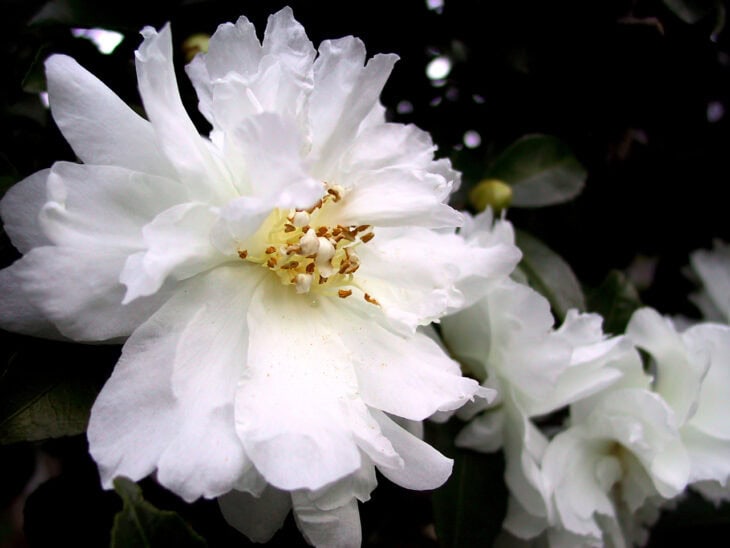
Sasanqua camellia flowers in late fall and early winter, which no other broadleaf evergreen in a Virginia garden does, in white, pink or red single or semi-double flowers over small glossy leaves. It is hardier and more sun-tolerant than the spring-flowering C. japonica and reliable through zone 7, so it succeeds across most of Virginia but not in the coldest mountain counties. Give it acidic, well-drained soil, shelter from north wind and afternoon shade.
Trees to Keep Out of a Virginia Garden
Callery Pear (‘Bradford’ Pear) (Pyrus calleryana)
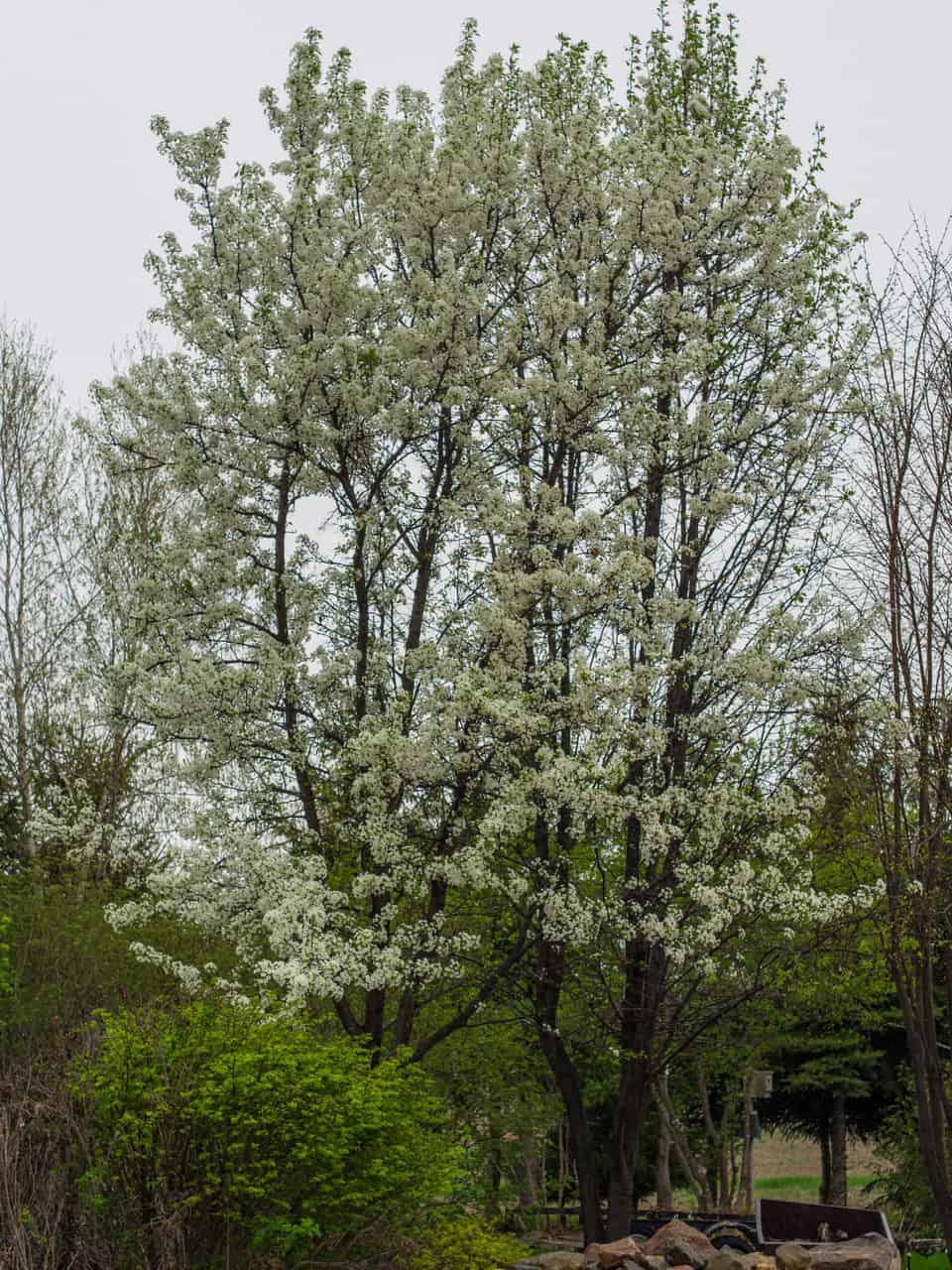
Do not plant Callery pear. Several states, including Ohio, Pennsylvania and South Carolina, have banned its sale outright, and Virginia lists it as an invasive species and has moved to restrict it; check current state rules before buying or removing one. Cultivars sold as sterile cross-pollinate with each other and with rootstock sprouts, and the resulting thorny seedlings have taken over roadsides and old fields across the Piedmont, crowding out native trees. The white flowers also smell strongly unpleasant, and the branch structure splits apart in storms by about year 20. Replace it with serviceberry, hawthorn or fringe tree.
Mimosa (Silk Tree) (Albizia julibrissin)
Mimosa’s pink powderpuff flowers and ferny leaves are attractive, and it is listed as invasive in Virginia. It seeds heavily into stream corridors, roadsides and woodland edges, its seed stays viable in the soil for years, and it resprouts vigorously when cut. It is also short-lived and prone to mimosa wilt, a soil fungus that kills mature trees suddenly. For the same fine-textured look, plant honey locust ‘Sunburst’ or a yellowwood.
Golden Rain Tree (Koelreuteria paniculata)
Golden rain tree hangs long sprays of bright yellow flowers in early summer, followed by papery lantern-shaped seed pods, and it tolerates heat, drought and poor soil. The problem is the seed: it germinates everywhere, and the species is listed as invasive in several southeastern states and watch-listed in Virginia. If you want it, choose the later-flowering K. bipinnata with caution, or accept the weeding. It is not a tree to plant near woods or a stream.
European Mountain Ash (Sorbus aucuparia)

European mountain ash makes flat white flower clusters and brilliant orange-red berry crops, and it is a beautiful tree in Maine, Scotland and the upper Midwest. In most of Virginia it is a short-lived disappointment: it needs cool summers and suffers badly from borers, fire blight and canker in the heat, rarely lasting 20 years below the mountains. Plant the native American mountain ash only at high elevation, or plant a ‘Winter King’ hawthorn instead for the same red winter fruit.
Planning Your Virginia Planting
- Know your zone. Virginia runs from zone 5b in Highland County to 8a on the lower Eastern Shore. The 2023 USDA map moved much of the state half a zone warmer, so old tags may understate hardiness.
- Plant for a season, not a week. Cornelian cherry in February, saucer magnolia and Higan cherry in March, dogwood and redbud in April, fringe tree and snowbell in May, sourwood and catalpa in June, crape myrtle from July, sasanqua camellia in November.
- Match the tree to the soil. Heavy Piedmont clay suits redbud, hawthorn, crabapple and crape myrtle. Wet Coastal Plain ground suits sweetbay magnolia, red maple and pawpaw. Dry ridges suit sourwood and serviceberry only with irrigation while establishing.
- Plant in fall. October and November planting lets roots establish over the mild Virginia winter, ahead of summer heat. Spring-plant magnolias and cherries, which prefer it.
- Plant at the right depth, with the root flare visible at the surface, and keep mulch off the trunk. Deep planting and volcano mulching kill more young trees in Virginia than any pest.
- Check before you buy. The Virginia Department of Conservation and Recreation publishes an invasive plant list; Callery pear, mimosa, princess tree and tree of heaven are all on it.
For more, see our guides to spring flowering trees and the most common trees in North America.