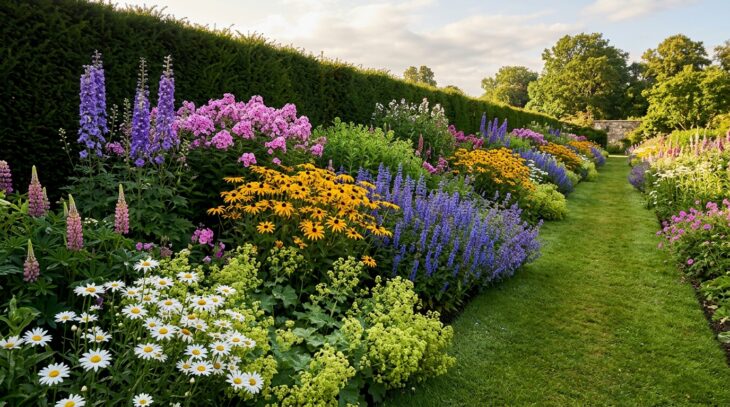
A well-planted border is the backbone of any beautiful garden. Whether you’re working with a narrow strip along a fence, a sweeping curved bed, or a formal edge beside a path, the right border can add color, texture, structure, and life to spaces that might otherwise feel flat. These 25 garden border ideas cover every style, season, and skill level — from cottage charm to contemporary calm — each with a vivid scene to inspire you and practical guidance to help you bring it to life.
Contents
- 01. Classic English Mixed Perennial Border
- 02. Lavender Path Border
- 03. Cottage Rose and Sweet Pea Border
- 04. Ornamental Grass Border
- 05. Hot-Colored Summer Border
- 06. White and Silver Moon Garden Border
- 07. Drought-Tolerant Mediterranean Border
- 08. Native Wildflower Border
- 09. Shady Fern and Hosta Border
- 10. Formal Clipped Box Border
- 11. Tropical Statement Border
- 12. Dry Stone Wall Border
- 13. Pollinator Meadow-Style Border
- 14. Spring Bulb Border
- 15. Creeping Ground Cover Border
- 16. Curved Informal Cottage Border
- 17. Japanese-Inspired Border
- 18. Cut Flower Border
- 19. Evergreen Structure Border
- 20. All-Foliage Textural Border
- 21. Rainbow Gradient Color Border
- 22. Climbing Rose Fence Border
- 23. Kitchen Herb Border
- 24. Low-Growing Front Lawn Border
- 25. Gravel and Architectural Plant Border
01. Classic English Mixed Perennial Border
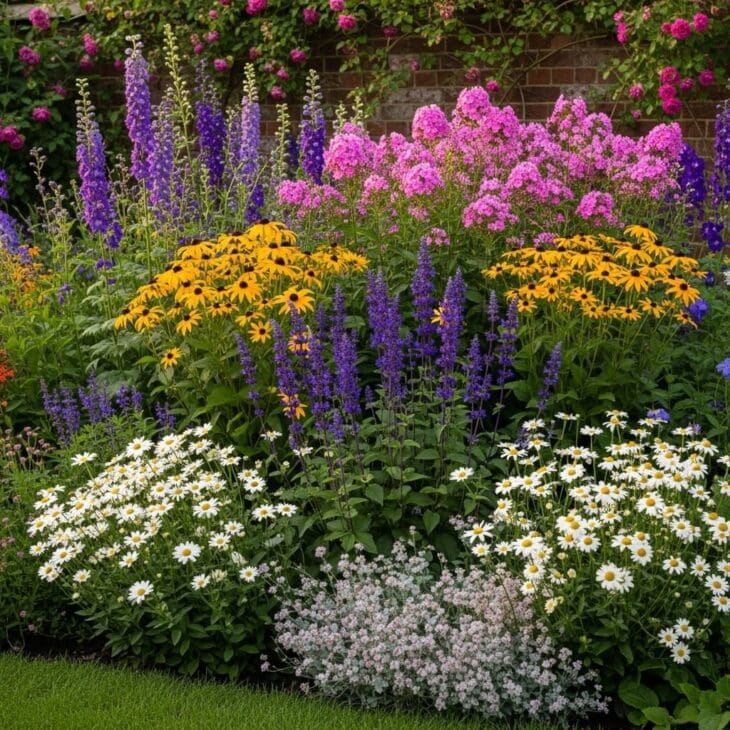
What you see Tall purple delphiniums tower at the back of this border, their spires catching the afternoon sun, while layers of pink phlox, rudbeckia, and blue salvia fill the mid-section with soft, billowing color. At the front, white shasta daisies and lime-green alchemilla tumble gently over the path edge, softening the boundary between bed and lawn. A warm brick wall in the background ties the whole scene together with old-world warmth.
Why it works The genius of the classic English border lies in its layers. Tall plants at the back create vertical drama without blocking light; medium-height fillers provide the bulk of color through summer; low edging plants tie everything to the ground and hide bare stems. The slightly-overflowing, naturalistic look is intentional — this is a border designed to feel as though it grew itself.
How to get it Choose a backbone of reliable perennials: delphiniums, phlox, and echinops for height; rudbeckia, achillea, and geraniums for the middle; and alchemilla, nepeta, or stachys for the front. Plant in loose drifts of three to five rather than in rows, and allow plants to self-seed a little for that effortlessly abundant look year after year.
02. Lavender Path Border
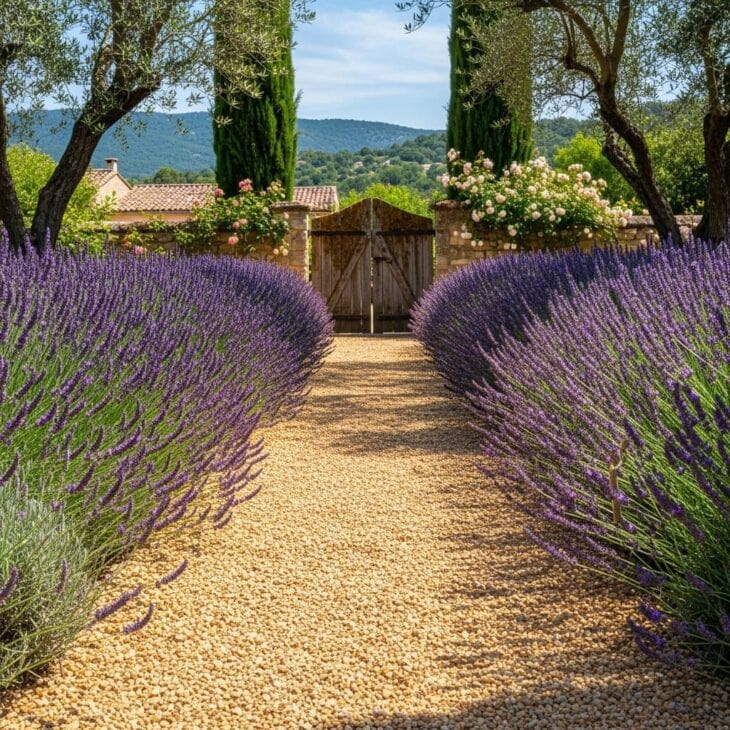
Two dense rows of lavender line either side of a warm gravel path, their purple flower spikes rising above silvery foliage and humming with bees on a bright summer morning. The honey-colored gravel reflects the light, making the purple pop even more intensely. In the distance, the path narrows toward a wooden gate, framed by the lavender as if leading somewhere quietly beautiful.
Few plants make a path feel more intentional than lavender. Its compact, mounding form creates a clear sense of structure without any hard edges, while the fragrance rewards anyone who brushes past. The grey-silver foliage looks good from spring right through to late autumn, meaning this border earns its keep for at least eight months of the year.
Use ‘Hidcote’ or ‘Munstead’ for compact, reliable mounds along narrower paths; ‘Grosso’ or ‘Vera’ for wider, more dramatic borders. Plant in full sun with excellent drainage — lavender sulks in clay or damp soil. Trim lightly after flowering to keep plants tidy and bushy. Replace plants every five to seven years as they become woody.
03. Cottage Rose and Sweet Pea Border
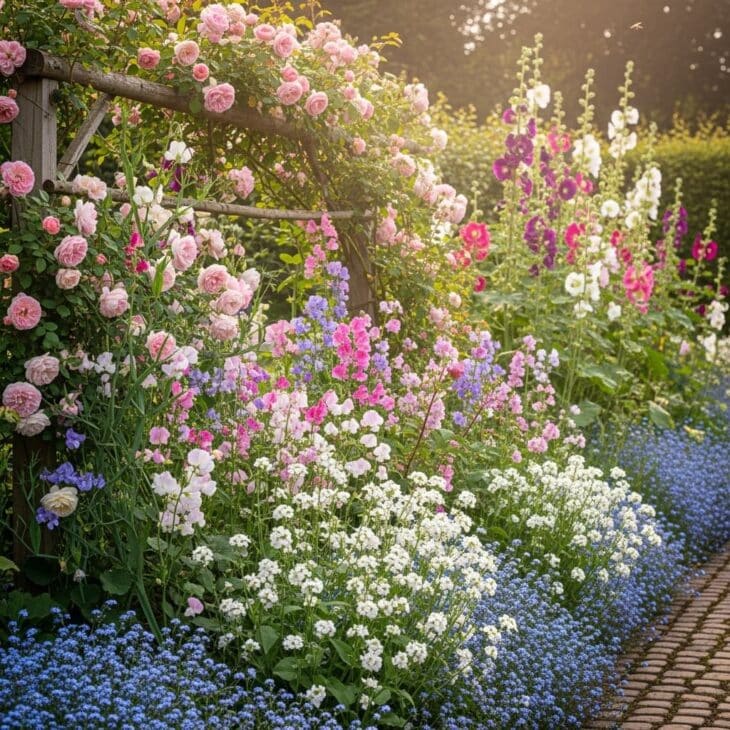
What you see Soft pink and cream roses tumble over a weathered wooden trellis, their blooms nestled among pastel sweet peas in lilac, blush, and white that twist and climb between the stems. Hollyhocks stand like sentinels in the background, their single flowers stacked in tall spires, while the front of the border melts into a drift of blue forget-me-nots and white arabis. The effect is romantic and slightly untamed — exactly as it should be.
Why it works This combination works because it layers fragrance, color, and texture across multiple heights. Roses provide the long-season backbone and structure; sweet peas add delicate, scented annual color and encourage cutting; hollyhocks give vertical drama at the back. The whole border smells extraordinary throughout June and July, which is as important as how it looks.
How to get it Anchor the border with a climbing rose like ‘Constance Spry’ or ‘Generous Gardener’ trained over trellis or a wall. Sow sweet peas directly at the base in autumn or early spring for the best display. Add hollyhock seeds along the back in summer for blooms the following year. Edge with low annuals like lobularia, arabis, or forget-me-nots for a soft, spilling front line.
04. Ornamental Grass Border
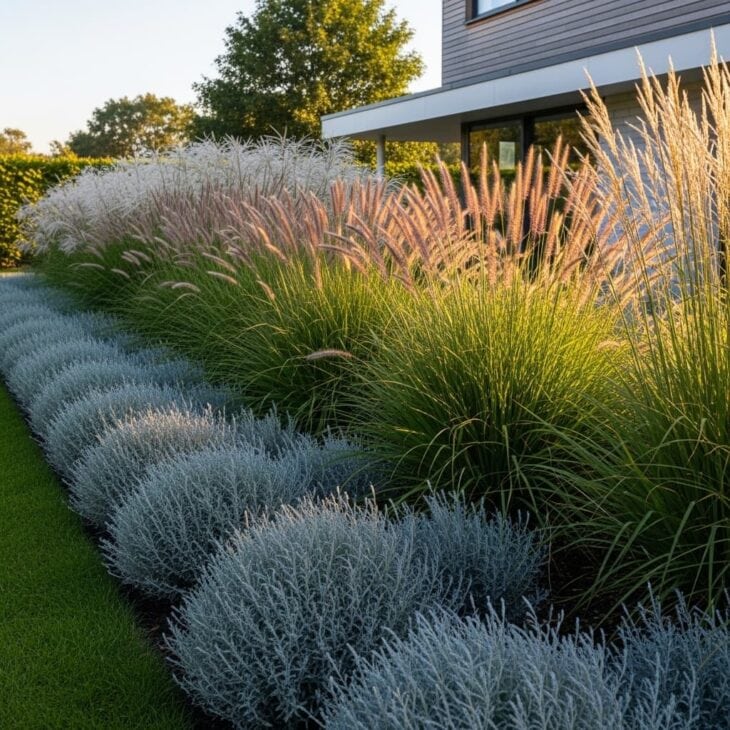
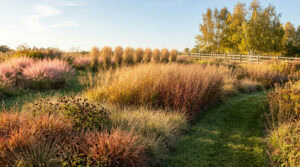
What you see Tall plumes of Miscanthus sinensis catch the last of the evening light, their silver seed heads glowing softly above a mid-layer of Pennisetum that has turned warm bronze at the tips. At the front, clumps of steely blue Festuca glauca provide a cool, tidy edge that grounds the movement and drama above. The whole border sways gently in the evening breeze — a scene that feels as much like sound as sight.
Why it works Ornamental grass borders offer something that few other plantings can: year-round presence. Grasses are dormant in winter but retain their form and color, looking beautiful even under frost. In spring, fresh green growth returns; by late summer, the plumes emerge; in autumn, the whole border turns amber and gold. They also ask very little — minimal watering once established, and a single annual haircut in late winter.
How to get it Build from back to front in three height tiers: tall grasses like Miscanthus or Cortaderia at the back, medium Pennisetum, Calamagrostis, or Panicum in the middle, and low Festuca, Carex, or Ophiopogon at the front. Mix three to five varieties for textural contrast rather than a single species. Cut the whole border back to 15–20cm in February before new growth emerges.
05. Hot-Colored Summer Border
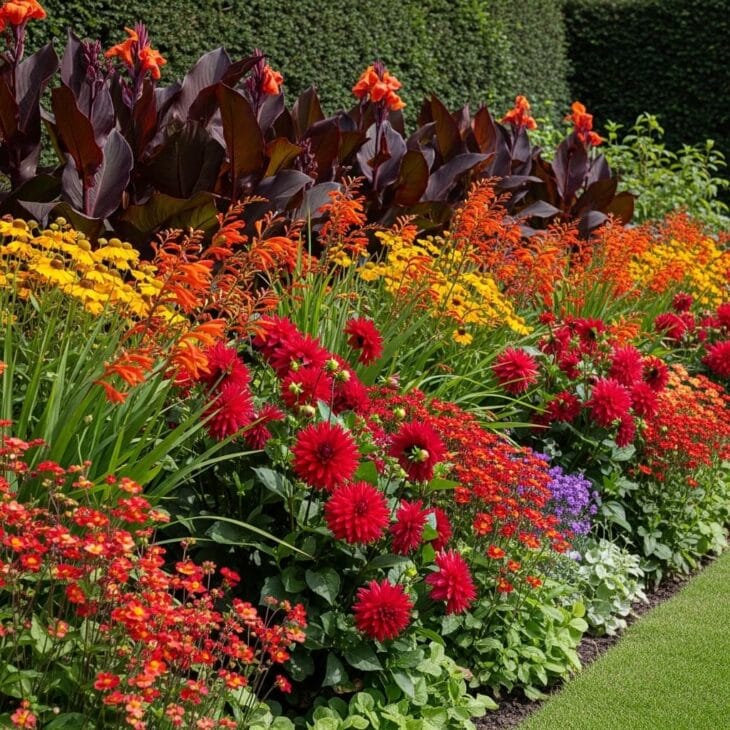
What you see Against a dark clipped yew hedge that acts like a stage curtain, this border absolutely blazes: orange crocosmia arcs out in long sprays, deep red dahlias hold their plate-sized blooms high, and golden helenium nods in drifts of warm yellow. Tall burgundy-leaved cannas bring tropical scale to the back of the border, their dark foliage making the surrounding colors feel even hotter and more electric.
Why it works The secret to a hot border is contrast — not just between colors, but between tones and textures. Mixing the deep burgundy of dahlia and canna foliage with orange and gold flowers makes the warm tones advance and sing. A dark backdrop, whether a yew hedge, a painted fence, or a shadowed wall, prevents the border from becoming garish by giving the eye somewhere to rest between the bursts of color.
How to get it Build the backbone with dahlias (lift tubers in autumn and store frost-free), crocosmia, and cannas for tropical drama. Layer in annual rudbeckia, tithonia, and tagetes for season-long fill. Use helenium and geum as reliable long-flowering perennials. Red, orange, gold, and deep burgundy are your palette — avoid pink and purple, which cool the effect. Deadhead dahlias twice a week to keep blooms coming.
06. White and Silver Moon Garden Border
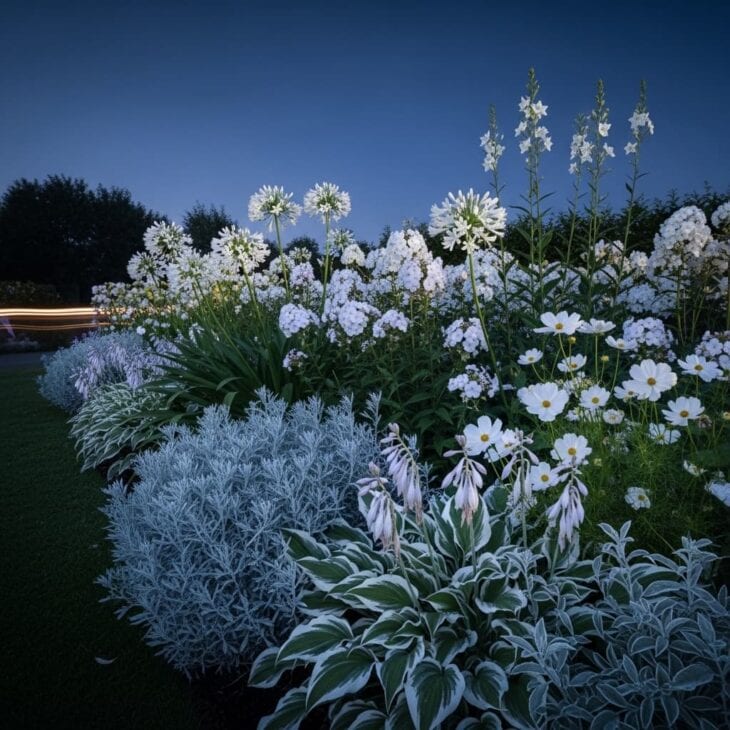
What you see As daylight fades, this border comes into its own: white cosmos, agapanthus, and phlox seem to generate their own soft glow in the dusk, their flowers luminous against the deepening blue sky. Silver-leaved artemisia and white-variegated hostas catch the last of the light at the front, shimmering like frost. Tall white nicotiana releases its heavy, sweet fragrance into the still evening air — a border designed to be experienced after sunset.
Why it works White and silver borders — sometimes called moon gardens — are one of the most practical ideas in garden design. They extend the usable hours of any garden, transforming it into a beautiful evening space after dark. They also work brilliantly in tight urban gardens that are seen mainly from indoors at night, where white flowers and silver foliage catch ambient light from windows and reflected sky.
How to get it Choose plants that contribute both white flowers and interesting texture: white agapanthus, phlox, shasta daisy, and nicotiana for bloom; artemisia, stachys byzantina, and white-variegated hostas for year-round silver foliage. Add scent to the mix — white jasmine, nicotiana, and white sweet peas are evening performers. Keep the planting scheme pure — a single warm cream or blush pink is fine, but anything bolder will break the spell.
07. Drought-Tolerant Mediterranean Border
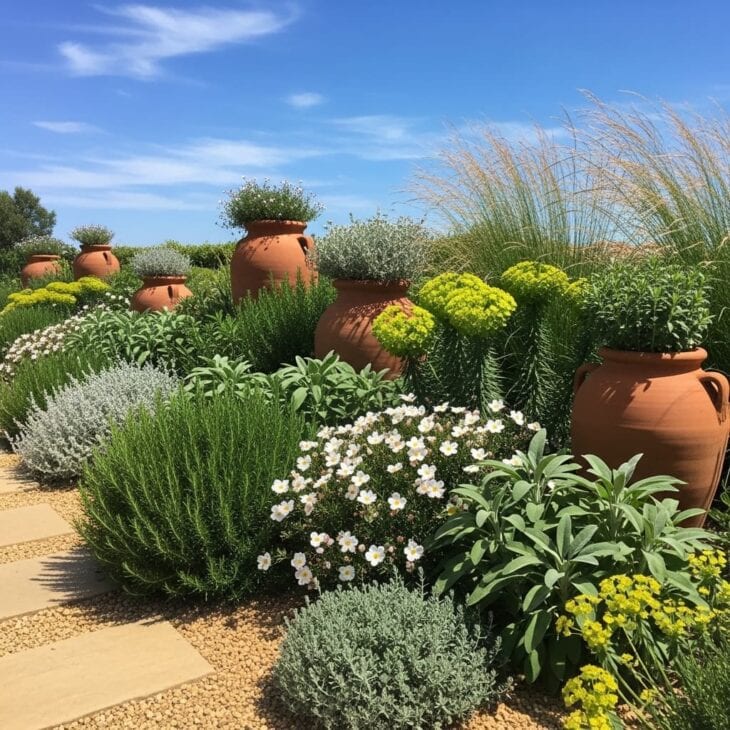
What you see Silver-leaved rosemary, sage, and cistus bask in full sun over a warm golden gravel mulch, their drought-adapted foliage gleaming in the heat. Mounds of euphorbia provide chartreuse structure, and feathery Stipa tenuissima grass ripples in the breeze like spun silk. A terracotta urn anchors one end of the border, half-hidden by a spill of trailing rosemary — the whole scene radiating a relaxed, sun-drenched ease that feels borrowed from a hillside in Provence.
Why it works Mediterranean borders are among the most sustainable choices you can make. Once established, they require almost no watering, no fertilizing, and very little maintenance. The grey and silver foliage that defines this style has evolved to reflect heat, which means these plants thrive precisely where others struggle: south-facing walls, gravel gardens, and dry spots beside paths or driveways.
How to get it Use sharp drainage as your foundation — work grit into heavy soil or plant into raised beds over gravel. Key plants: lavender, rosemary, cistus, phlomis, euphorbia, eryngium, and salvias. Mulch with gravel rather than bark to reflect heat and keep roots warm. Avoid feeding, which promotes soft, frost-susceptible growth. Cut back after flowering to keep plants compact; don’t cut into old wood on rosemary or cistus.
08. Native Wildflower Border
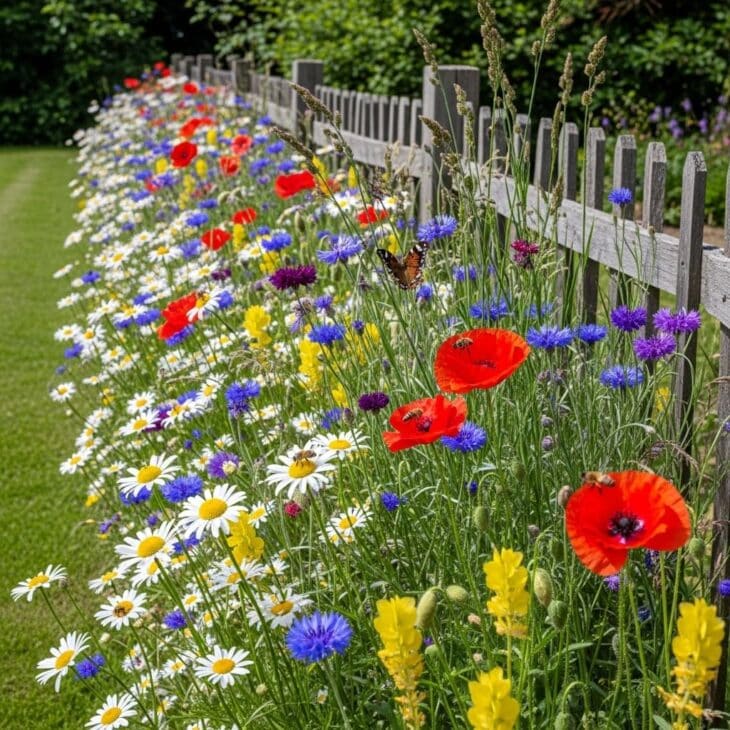
What you see Red field poppies and blue cornflowers rise above a froth of ox-eye daisies and wild grasses along a simple garden fence, butterflies drifting between the blooms and bumblebees working the knapweed. The border has the beautiful disorder of a country roadside in June — loose, colorful, and clearly teeming with life. It looks entirely unplanned, which is, of course, the most difficult look to pull off intentionally.
Why it works A wildflower border does double duty: it’s visually joyful and ecologically valuable. Native annuals and perennials like cornflowers, ox-eye daisies, and knapweed support specialist pollinators that garden flowers can’t feed. Yellow rattle — a semi-parasitic plant that weakens grass — is particularly useful in established grass borders, as it suppresses the dominant grasses and lets wildflowers compete.
How to get it The easiest method is to buy a pre-mixed native wildflower seed packet designed for your soil type (chalk, clay, or acid). Clear the ground of all existing vegetation first — wildflowers need bare soil and cannot compete with established plants. Sow in autumn or spring; water in if dry. Mow the border once a year in autumn after seeds have set. Resist the urge to tidy — the less you interfere, the better it gets.
09. Shady Fern and Hosta Border
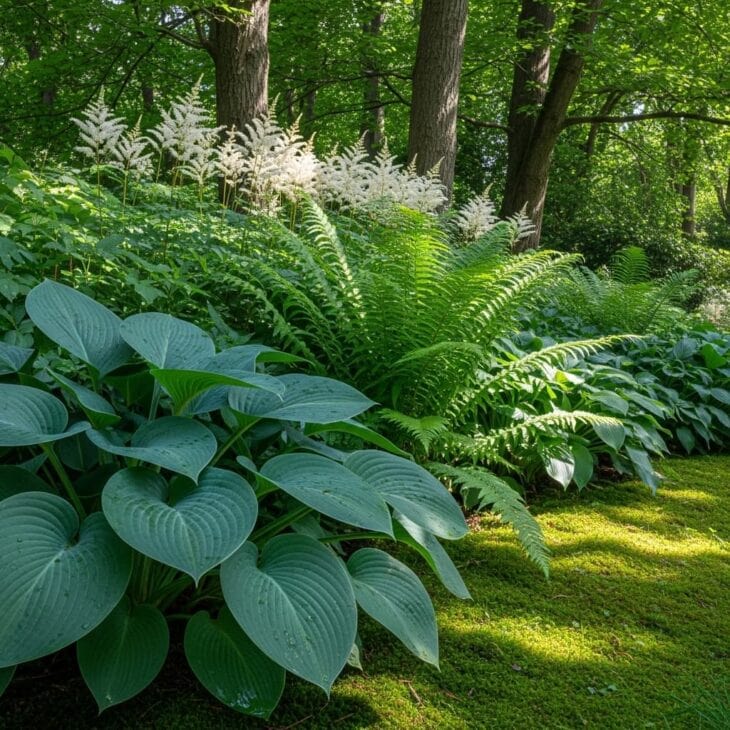
What you see Under the dappled shade of tall trees, bold hosta leaves in blue-green and chartreuse overlap with arching fern fronds, creating a layered tapestry of greens that feels cool and calm even on the hottest summer day. White astilbe plumes float above the foliage like candlelight, while a carpet of soft moss covers the ground between the plants. Shafts of filtered light pick out the textures — the ribbed, waxy hosta leaves, the feathery fern fronds, the papery astilbe.
Why it works Shaded borders are often treated as a problem to solve rather than an opportunity to embrace. But hostas, ferns, astilbes, and woodland perennials are superbly adapted to shade, and a well-planted shady border has a calm, restful quality that a full-sun border never quite achieves. This is a border you’ll want to sit next to on a hot afternoon — it creates its own microclimate of cool, still air and filtered green light.
How to get it Pair large-leaved hostas (‘Sum and Substance’, ‘Halcyon’, ‘Frances Williams’) with contrasting ferns — hardy polypody or shuttlecock fern (Matteuccia) for structure, soft shield fern for texture. Add astilbe for vertical color and pulmonaria for early spring interest. Keep the soil consistently moist and rich with organic matter. Protect hostas from slugs in spring when the leaves are unfurling.
10. Formal Clipped Box Border
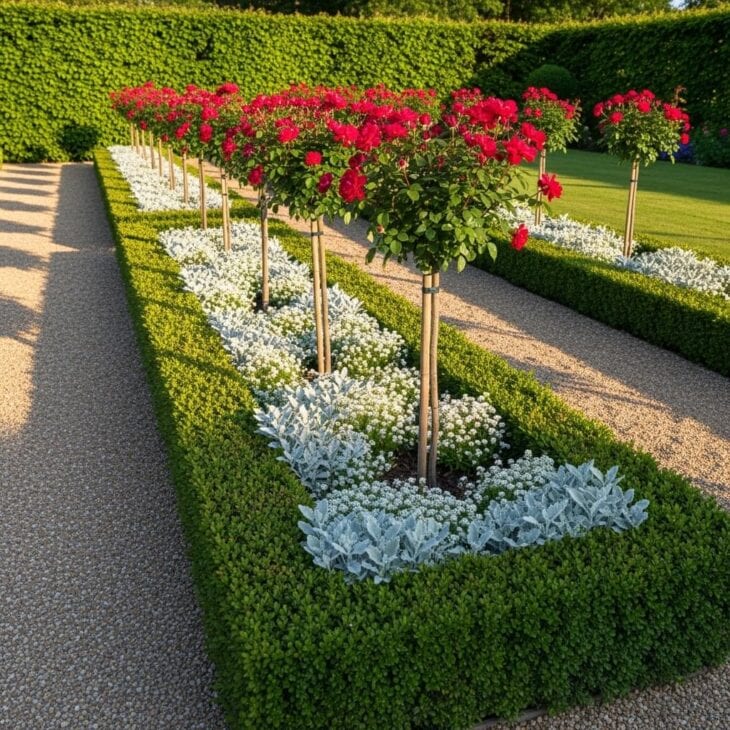
What you see Low, perfectly clipped box hedging forms a precise green ribbon along the border edge, its sharp geometry giving the planting inside a sense of contained richness. Standard rose bushes in deep red stand at regular intervals, underplanted with a cool carpet of white alyssum and silver stachys that softens the formality slightly. Long afternoon shadows fall across the gravel path, and the whole scene has the measured, unhurried quality of a garden that has been here for decades.
Why it works Formal edging transforms a simple border into an architectural statement. The box hedge creates a clear line between bed and path, making even a simply planted interior look deliberately composed. It also defines the garden’s structure in winter when everything else has died back — the clipped evergreen lines remain, keeping the garden readable and beautiful even in the depths of December.
How to get it Use Buxus sempervirens ‘Suffruticosa’ for the tightest, most compact edging — plant 15cm apart and clip twice a year (June and August). If box blight is a concern in your area, substitute Ilex crenata (Japanese holly) or Berberis thunbergii ‘Atropurpurea Nana’ for a similar effect. Keep the interior planting simple to honor the formal structure: roses, standard lavender, or a single species underplanting all work well.
11. Tropical Statement Border
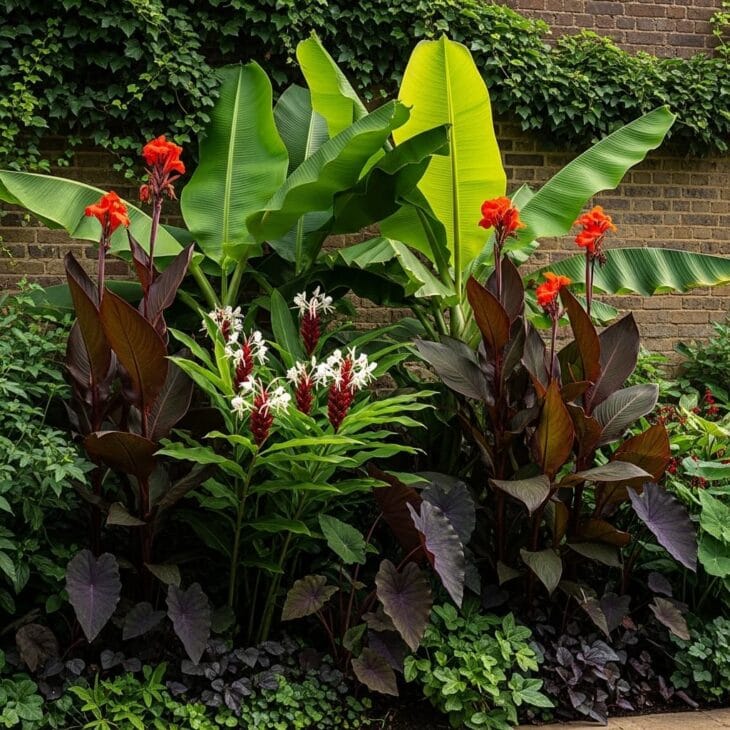
What you see Giant banana leaves arch over a wall of drama: burgundy-leaved cannas push orange flowers high into the summer air, ginger lily blooms carry their sweet fragrance across the garden, and the glossy dark leaves of taro fill every gap with tropical presence. All of it is set against warm brick, which traps the heat and gives these tender plants the warmth they need to thrive in a temperate garden. The effect is bold, theatrical, and utterly unlike a typical border.
Why it works Tropical borders work because large, dramatic leaves read as exotic and lush even when the plants behind them are perfectly hardy. The key is scale — big leaves create big impact. A single large-leaved Gunnera, Musa, or Tetrapanax can transform a corner of a garden more dramatically than any flower border. In cooler climates, many tropical-looking plants are surprisingly cold-hardy once established, or can be lifted and stored over winter.
How to get it Start with hardy architectural plants: Fatsia japonica, Phormium, Trachycarpus (hardy palm), and Tetrapanax for year-round bones. Layer in tender summer performers: Musa basjoo (the hardiest banana), cannas, Hedychium, and Colocasia (taro). Plant against a south-facing wall for maximum warmth. In autumn, cut back cannas and Hedychium and insulate crowns with a thick mulch of bark or bracken.
12. Dry Stone Wall Border
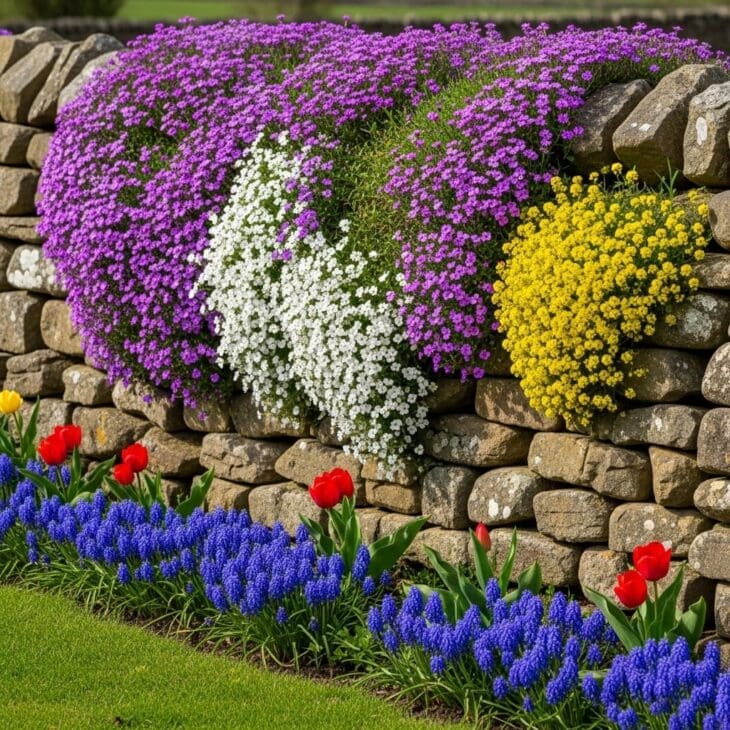
What you see Purple and mauve aubrieta cascades over the face of a dry stone wall like a slow-moving waterfall of color, filling every gap and crevice with vivid blooms. Yellow alyssum glows between the stones and white arabis drapes softly down the lower courses, while at the base of the wall a simple border of blue muscari and red tulips completes a classic spring color scheme. The wall and plants together look as if they’ve grown this way for a hundred years.
Why it works Dry stone walls offer some of the best planting opportunities in any garden. The crevices between stones create perfectly drained, warm microhabitats where alpine and rock garden plants thrive, and when a wall is in full bloom in spring it can be more striking than any flower bed. Even a small section of dry stone wall — or a built retaining wall with intentional planting gaps — can become a year-round garden feature.
How to get it For wall crevices, plant aubrieta, alyssum, arabis, and sedums in autumn or early spring. Mix a little soil and compost into a thick paste, pack the mixture into the gap, and push the plant root in firmly. Water well until established. At the base of the wall, spring bulbs perform brilliantly: tulips, muscari, and narcissus suit the well-drained conditions. Follow with summer sedums and creeping thyme for a long season of interest.
13. Pollinator Meadow-Style Border
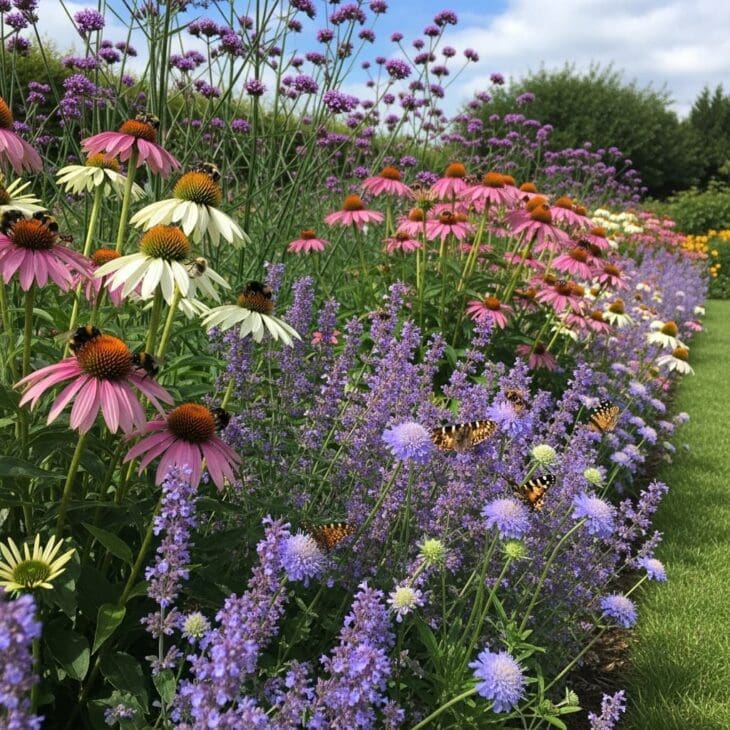
What you see Dozens of bumblebees work the scabious and nepeta while painted lady butterflies drift between the echinacea and verbena bonariensis — a border so full of pollinators it hums audibly. The planting is loose and naturalistic: tall verbena on airy stems floats above mounds of blue nepeta, while cones of pink and white echinacea provide landing pads for bees from July well into October. The border is clearly managed, but only just — and that’s exactly its charm.
Why it works Pollinator borders have become one of the most important ideas in contemporary gardening, and also one of the most rewarding. The plants that attract the greatest diversity of bees, butterflies, and hoverflies tend to be beautiful in their own right — echinacea, scabious, verbena, and nepeta are all excellent garden plants that would earn their place on looks alone. The wildlife benefit is a free bonus on top of a genuinely beautiful display.
How to get it Focus on single-flowered varieties over doubles, which are often sterile or inaccessible to insects. Top performers for bees and butterflies: nepeta (catmint), verbena bonariensis, echinacea, scabious, Knautia macedonica, agastache, and single-flowered dahlias. Avoid using pesticides within 15 metres of the border. Leave seed heads over winter — they feed birds and provide overwintering habitat for insects.
14. Spring Bulb Border
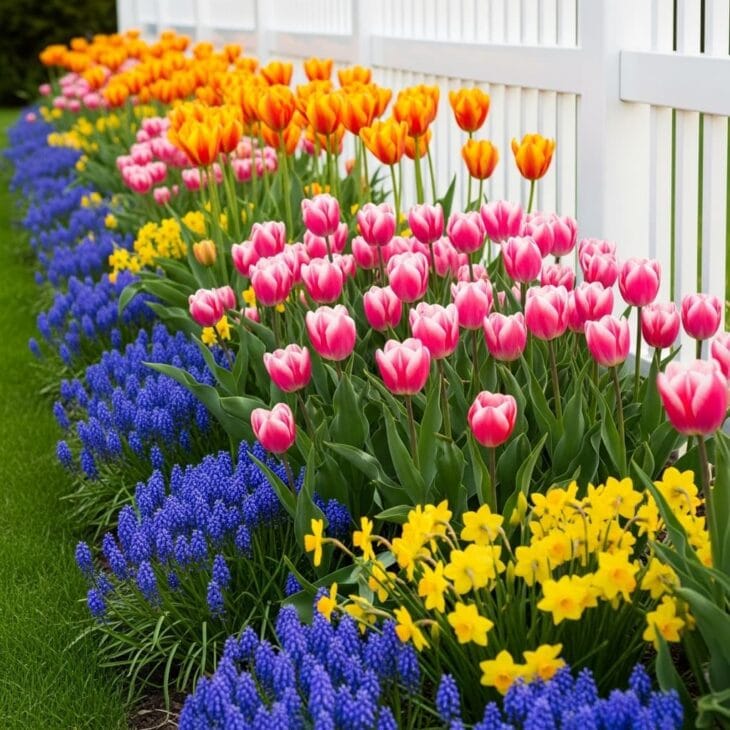
What you see Tall orange and yellow tulips stand shoulder to shoulder at the back of the border, their petals glowing in the fresh morning light, while a middle tier of blush and white Darwin hybrids fills the center with elegance. At the front, a dense edge of deep blue muscari and cheerful yellow narcissus spills forward, creating a complete picture of early spring abundance. Against a white picket fence in new green grass, the whole scene feels like the garden announcing it has woken up.
Why it works A dedicated spring bulb border is the highest-return investment in the gardening calendar. A single afternoon of planting in October or November delivers months of color from February through May — and tulips in particular offer a range of colors, heights, and flowering times that allows for careful, painterly composition. Planted in layers (late-season over early-season bulbs), a border can be kept in continuous bloom for twelve weeks or more.
How to get it Layer your planting for a long season: plant late tulips deep, early narcissus at medium depth, and small bulbs like muscari and crocus near the surface in October. Use a bulb planner to stagger varieties that flower from early March through to late May. After flowering, allow foliage to die back completely before removing it — the leaves are recharging the bulb for next year. In rich soil, many tulips will naturalize reliably for several seasons.
15. Creeping Ground Cover Border
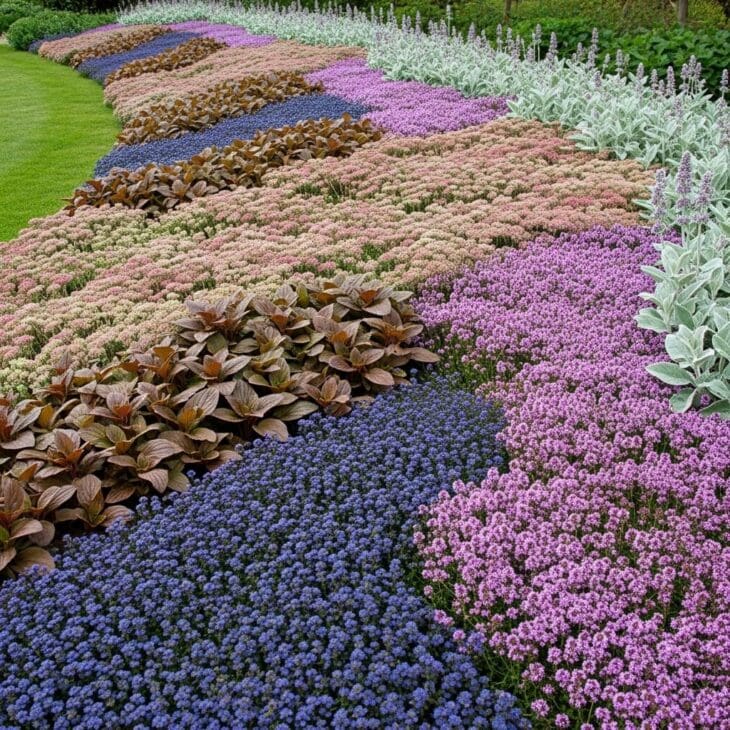
What you see Viewed low and close, this border reveals a tapestry of interlocking textures: bronze-purple ajuga rosettes spread across the front, their blue flower spikes catching the light in spring; silver-pink sedum forms dense mounds; creeping thyme creates a dense, fragrant mat of tiny purple-pink flowers in summer; and silver-leaved Stachys byzantina — lamb’s ears — threads between everything with its uniquely soft, furry foliage. This is a border you want to reach out and touch.
Why it works Ground cover borders are the ultimate in low-maintenance planting. Once established, a well-chosen mix of spreading plants will suppress weeds almost entirely by covering every centimetre of bare soil. They work brilliantly in awkward spots: dry areas under trees, sloping banks that are difficult to mow, the narrow strip along a fence, or a border in front of a garage where nothing else seems to thrive.
How to get it Choose plants for different seasons: ajuga for spring flowers and year-round bronze foliage; creeping thyme for summer fragrance and flowers; sedum for late summer and autumn; stachys for silver foliage through winter. Plant densely — initially closer together than the final spread — and mulch gaps in the first year. Water regularly in the first summer; once established, these plants are largely self-sufficient.
16. Curved Informal Cottage Border
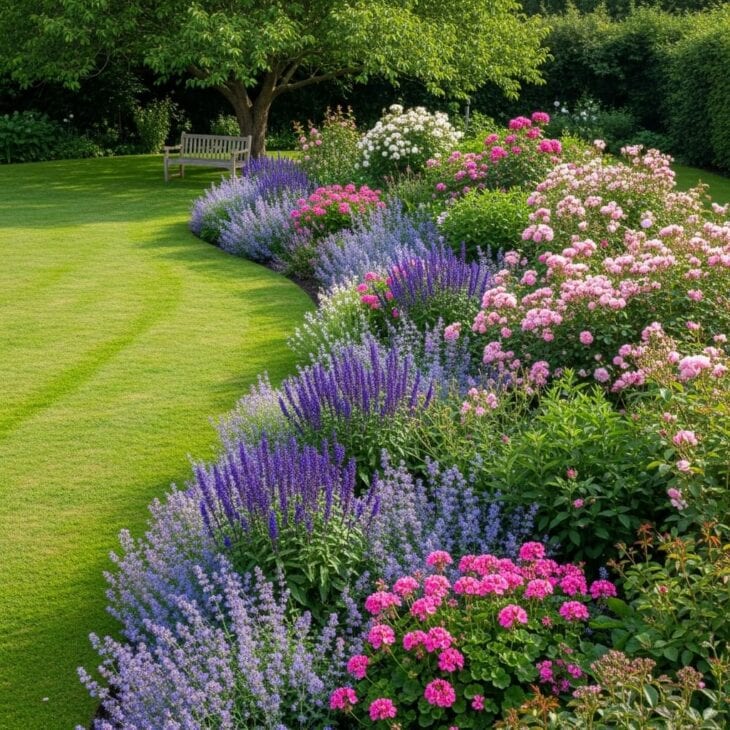
What you see A wide, gently curving border flows through a green lawn like a river of soft color — geraniums, salvia, and catmint flowing together in waves of pink, blue, and purple, with English roses rising above them in blush and cream. The curve draws the eye naturally toward a garden bench half-hidden in the distance, creating a sense of discovery. From above, the whole composition has a flowing, organic beauty that a straight-edged border simply can’t achieve.
Why it works Curves are one of the simplest ways to add movement and interest to a garden. A straight border reads as a background; a curved one becomes a journey. The eye follows the line around the bend, instinctively wondering what comes next. Curves also make borders appear wider and more generous, and they soften the geometry of rectangular gardens or houses into something that feels more natural and relaxed.
How to get it Mark out the curve with a hosepipe before cutting — it lets you adjust the arc until it looks right from every angle, especially from inside the house. Aim for a sweeping, generous curve rather than a tight zigzag; deep curves allow deeper planting and more dramatic planting combinations. Fill with a cottage mix of geraniums, salvias, nepeta, roses, and penstemons for a long and abundant display from June to October.
17. Japanese-Inspired Border
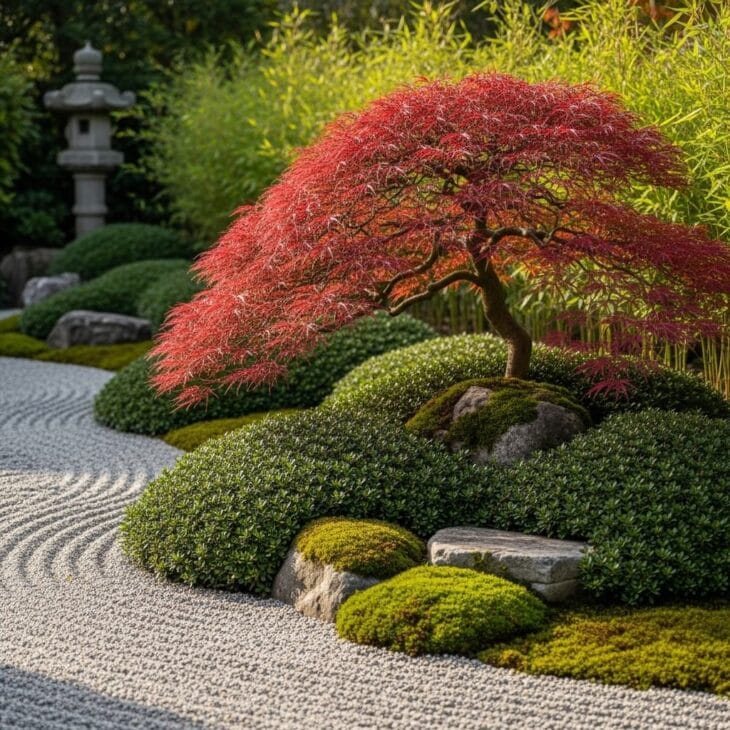
What you see A Japanese maple in deep crimson holds absolute center stage, its finely cut leaves trembling in the autumn air above mounds of dark-clipped azalea and moss-covered stones. Slim bamboo canes cast thin shadows across a raked gravel path, and a stone lantern is half-visible in the background, half-hidden by the maple’s canopy. The entire scene is still, spare, and charged with a quiet intentionality that Western garden design rarely achieves.
Why it works Japanese-inspired borders work on the principle of restraint — fewer plants, more thought. Every element earns its place and is chosen for its contribution across all four seasons: the maple for spring growth, summer shade, autumn color, and winter silhouette; azaleas for spring bloom and evergreen structure; moss and stone for permanence and texture. There is no filler planting, no accidental color. Everything is deliberate.
How to get it Centre the border on a focal specimen: a Japanese maple (Acer palmatum), a pine, or a clipped camellia. Add low evergreen structure with clipped azaleas, box balls, or Sarcocca. Dress the ground with fine gravel, decomposed granite, or living moss. Introduce stone — a weathered lantern, a flat stepping stone, or a carefully placed rock — to provide a counterpoint to the plant material. Resist the temptation to add more.
18. Cut Flower Border
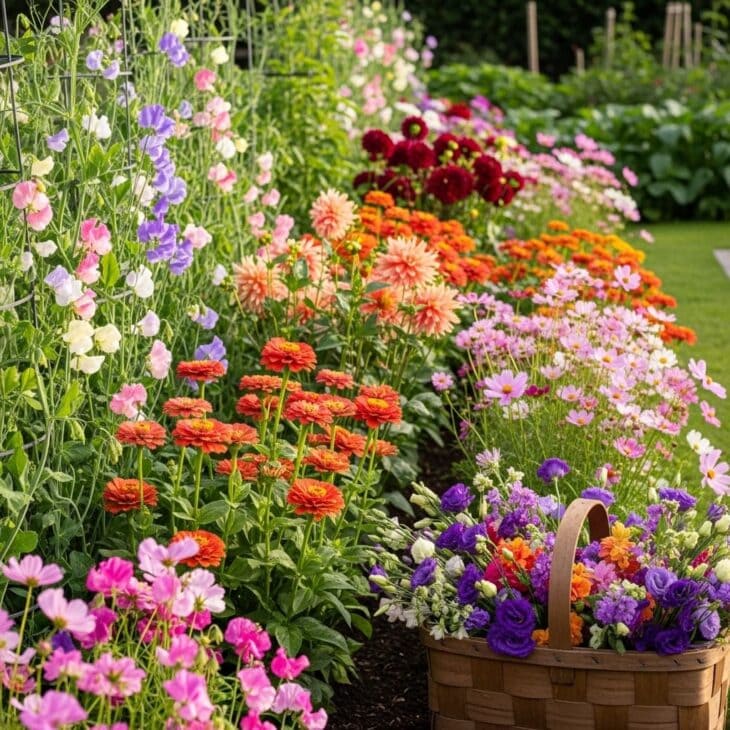
What you see Row upon row of cutting flowers fill this dedicated border in high summer: sweet peas in a blur of pastel climbing a row of bamboo supports, zinnias in bold coral and orange, dahlias in peach and burgundy holding their architectural blooms at shoulder height, and cosmos in pink and white swaying above everything on thin, wiry stems. A wooden trug sits on the grass path beside the border, already half-filled with the morning’s harvest, scenting the air around it.
Why it works A cut flower border justifies every inch of space it takes. From June through October, it provides a constant supply of flowers for the house — the kind of loose, natural arrangements that cost a fortune at florists and last better when cut fresh at home. Cutting also encourages the plants to produce more flowers, creating a virtuous cycle where the more you pick, the more you get. It is gardening that directly rewards you in the most immediate, domestic way.
How to get it Divide the border into rows of annuals and perennials: sweet peas, zinnias, and cosmos as reliable annuals; dahlias and Veronicastrum as long-season perennials. Add lisianthus, statice, and ammi for foliage and filler. Sow annuals in March indoors or April directly. Plant dahlia tubers after the last frost. Cut stems in the morning when they’re fully hydrated, and plunge them immediately into deep water. Deadhead anything not cut to keep production going.
19. Evergreen Structure Border
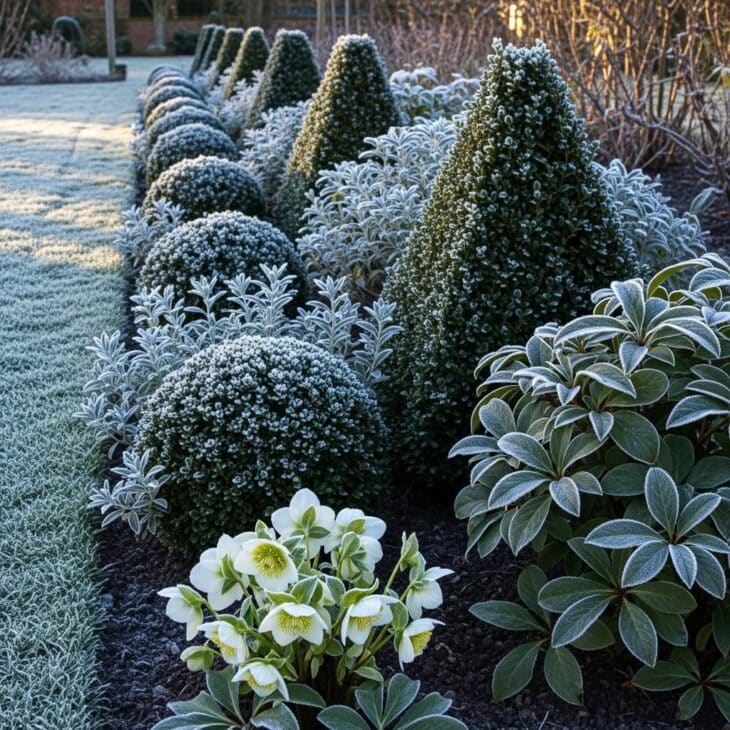
What you see In the depths of January, when the rest of the garden has retreated, this border is still fully present: clipped dark box balls and a box pyramid alternate with the silver-edged leaves of Elaeagnus and the glossy dark green of Viburnum tinus, already in bud with its clusters of pink-white flowers. White hellebores have emerged at the front, their downturned blooms dusted with frost. The low winter sun throws long shadows across the whole border, giving it a drama that’s entirely different from summer.
Why it works An evergreen structure border is the most important long-term investment you can make in your garden. When a garden looks good in January, it looks good all year. Evergreens provide the “bones” that make seasonal plantings pop — they frame, anchor, and give context to flowering plants, making them look more deliberate and designed. They also give the garden presence from inside the house during the months when you spend the least time outside.
How to get it Build with a backbone of clipped evergreens: box balls and cones (or their alternatives like Ilex or Pittosporum), tall Elaeagnus ‘Quicksilver’ for silver contrast, and Viburnum tinus for winter flowers. Add Sarcocca for deep winter scent and Helleborus for January-March bloom. Underplant with spring bulbs to emerge between the structural plants. Clip evergreens once in summer — a tidy, shaped border looks good even when nothing is flowering.
20. All-Foliage Textural Border
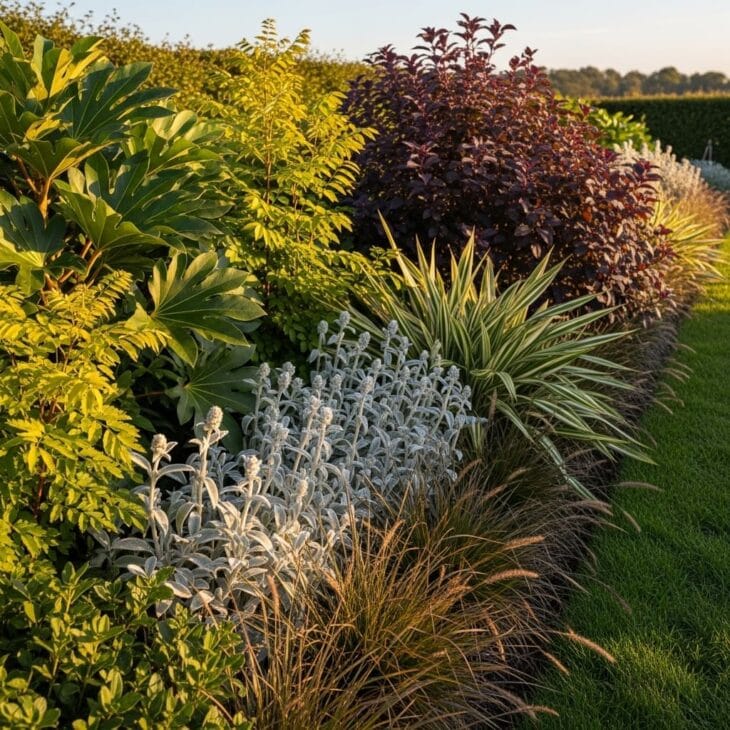
What you see Not a single flower in sight — and yet this border is extraordinary. The large, glossy, hand-shaped leaves of Fatsia japonica sit beside the smoky purple cloud of a Cotinus smoke bush, while golden Robinia fronds catch the afternoon light and silver stachys glows at the front. Striped phormium spikes cut upward through the composition, and fine bronze sedge fills the gaps with a soft, grassy texture. The range of color, scale, and texture is richer than most flowering borders ever achieve.
Why it works Foliage borders challenge the assumption that a garden needs flowers to be beautiful. In practice, leaves are more reliable, longer-lasting, and often more interesting than flowers — they provide color and texture for twelve months rather than a few weeks, and they never have an off day. Foliage borders also tend to be low maintenance, requiring neither deadheading nor the replacement of spent annuals, and they look as good in grey November as they do in bright July.
How to get it Build on strong contrast: pair large leaves with fine ones, glossy with matte, dark purple with silver or gold. Key plants: Fatsia, Cotinus ‘Royal Purple’, Sambucus nigra ‘Black Lace’, golden Robinia or Gleditsia, Phormium, ornamental grasses, and silver Elaeagnus or stachys. Avoid more than four or five different plants — the power of a foliage border comes from bold repetition and contrast, not variety for its own sake.
21. Rainbow Gradient Color Border
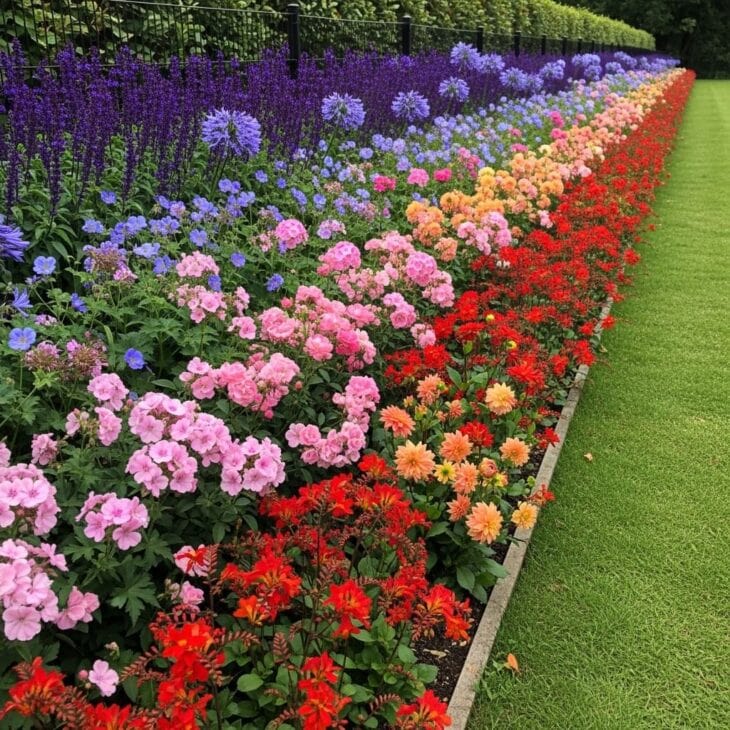
What you see This long border is planted as a single, continuous color journey: deep purple salvias and blue agapanthus at the far left give way to soft mauves and geraniums, which transition through blush and pink roses and phlox, then warm into peach and apricot dahlias, before finishing in an energetic blaze of orange geum and red crocosmia at the right end. Viewed from a distance, the whole border reads as a slow, deliberate gradient — a garden rainbow that feels both joyful and controlled.
Why it works Color gradient borders — sometimes called “ombre” borders — are one of the most sophisticated ideas in garden design, but they require planning rather than skill. The key is to choose plants whose colors sit next to each other on the color wheel so the transition is smooth rather than jarring. The gradient works best in long borders where the journey from one color to another takes time and the eye can follow the gradual change.
How to get it Map the gradient on paper first: purple → blue → mauve → pink → blush → peach → apricot → orange → red. Choose two to three plants for each color zone and allow them to overlap slightly with their neighbors for a seamless blend. Repeating heights and textures through the border (e.g. a consistent mid-height daisy-type in each zone) adds coherence. Long season performers — dahlias, salvias, geraniums — work best as they hold their color reliably for months.
22. Climbing Rose Fence Border
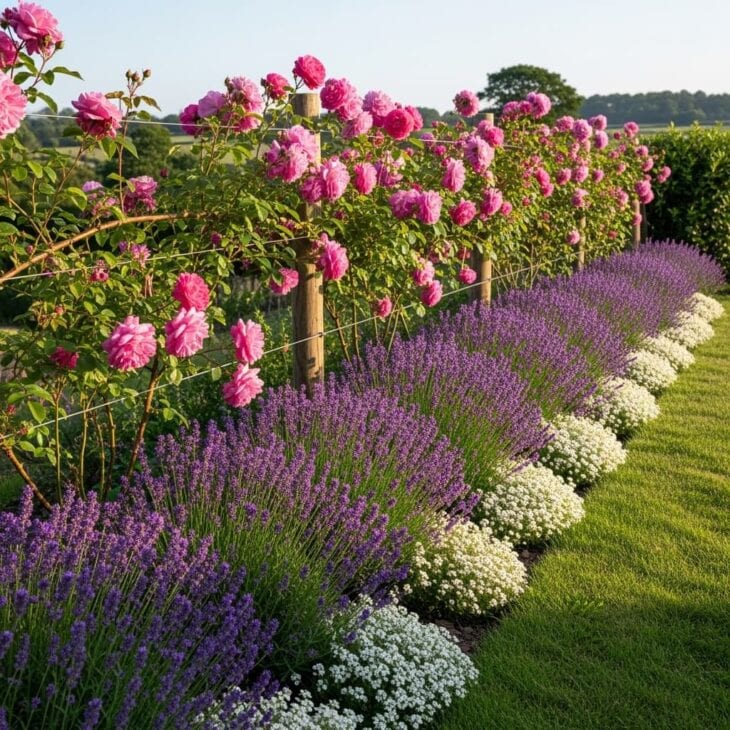
What you see An entire garden fence disappears behind a climbing rose in full June bloom, its blush-pink flowers cascading in loose clusters from canes trained horizontally along wire. The horizontal training has encouraged flowering all the way along the fence rather than just at the tips, creating a curtain of bloom six meters wide and two meters tall. Below it, a simple underplanting of lavender, nepeta, and white alyssum softens the base and extends the planting down to ground level.
Why it works Training a climbing rose horizontally along fence wires is one of the best-kept secrets in rose growing. When a rose is trained vertically, it flowers only at the tips. Bend the canes down toward horizontal and the plant produces flowering side-shoots all along its length — dramatically increasing the quantity of blooms. A fence that was previously a hard, flat surface becomes a living wall of fragrant flowers.
How to get it Install horizontal training wires at 40cm intervals up the fence before planting. Choose a climbing or rambling rose suited to the aspect: ‘New Dawn’ for shade, ‘Compassion’ for fragrance, ‘Constance Spry’ for a single spectacular June flush. Fan the main canes outward and tie to the lowest wires; as the rose grows, add new canes to higher wires. Keep the underplanting simple — lavender, nepeta, or Geranium ‘Rozanne’ complement roses perfectly without competing.
23. Kitchen Herb Border
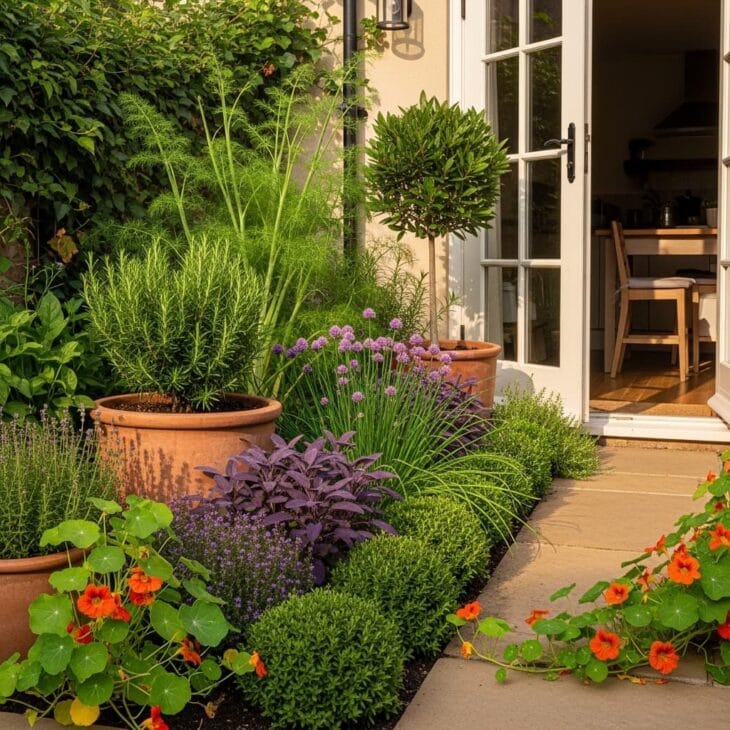
Just outside the back door, a kitchen herb border manages to be genuinely beautiful as well as entirely functional. Clipped thyme forms the low front edge, its tiny leaves releasing fragrance with every step past. Purple sage, chives in purple pompom flower, and trailing nasturtiums in orange fill the middle, while bronze fennel rises at the back in a feathery, copper-toned column. Terracotta pots of rosemary and a clipped bay tree anchor the composition. The whole border smells extraordinary on a warm afternoon.
Kitchen herb borders are among the most satisfying gardens to design because beauty and usefulness reinforce each other. A herb border close to the back door is a practical one that actually gets used — the shorter the distance from kitchen to cutting, the more often you reach for fresh herbs. But it should also look considered, because it’s typically one of the most-seen parts of the garden, visible every time you come and go.
Plant on a sunny, well-drained spot close to the kitchen. Use a low edge of thyme or clipped dwarf lavender to contain the border. Plant permanent herbs as the backbone: rosemary, bay, sage, chives, and tarragon. Add annuals for seasonal interest and usefulness: basil (in pots you can bring inside), nasturtiums, and dill. Avoid planting mint in the open ground — it spreads aggressively. Instead, plunge a pot of mint directly into the soil to contain the roots.
24. Low-Growing Front Lawn Border
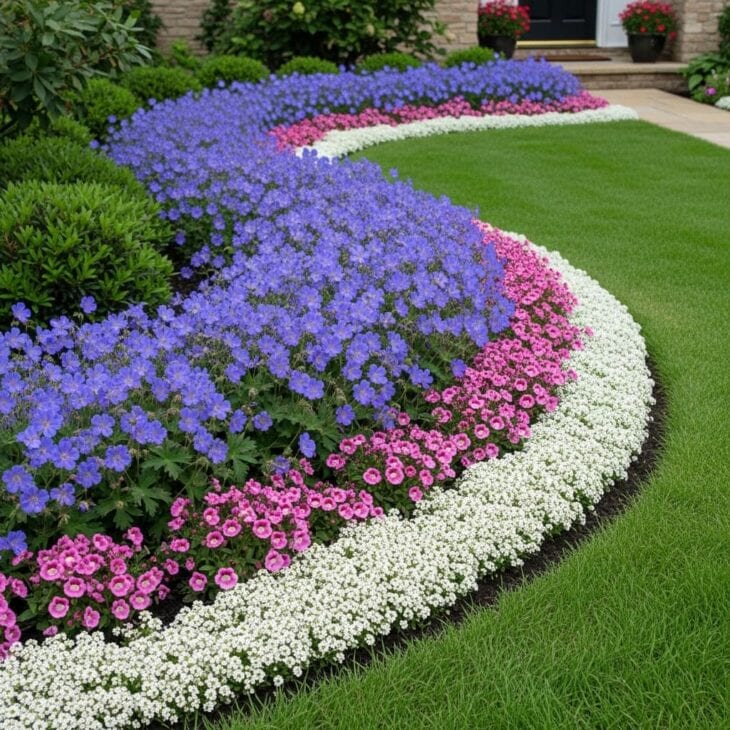
What you see A deep, sweeping border of Geranium ‘Rozanne’ in clear blue-purple wraps around the edge of a small front lawn, its flowers smothering the ground from June through to the first frost. White alyssum and pink diascia fill the front edge with low, tidy color, drawing the eye from the street toward the front door in a welcoming, considered arc. The border is entirely low — nothing over 45cm — keeping the view open while providing generous, long-season color.
Why it works Front garden borders need to work hard in both directions: looking good from the street as a first impression, and feeling welcoming from the front door looking out. Low-growing borders are particularly effective in small front gardens because they frame the space without blocking views or crowding the approach. Geranium ‘Rozanne’ is one of the best front garden plants ever bred — it flowers from June to November, spreads to cover large areas, and requires almost no maintenance.
How to get it Keep the planting scheme to two or three colors for a cohesive, neat look that suits a formal front garden setting. Geranium ‘Rozanne’ as the main plant; edge with low alyssum, armeria, or diascia. For winter and spring interest, plant bulbs through the geranium: snowdrops, blue muscari, and small daffodils work perfectly as they emerge before the geranium comes into leaf. Cut the geranium back hard in autumn and it will regenerate thickly the following May.
25. Gravel and Architectural Plant Border
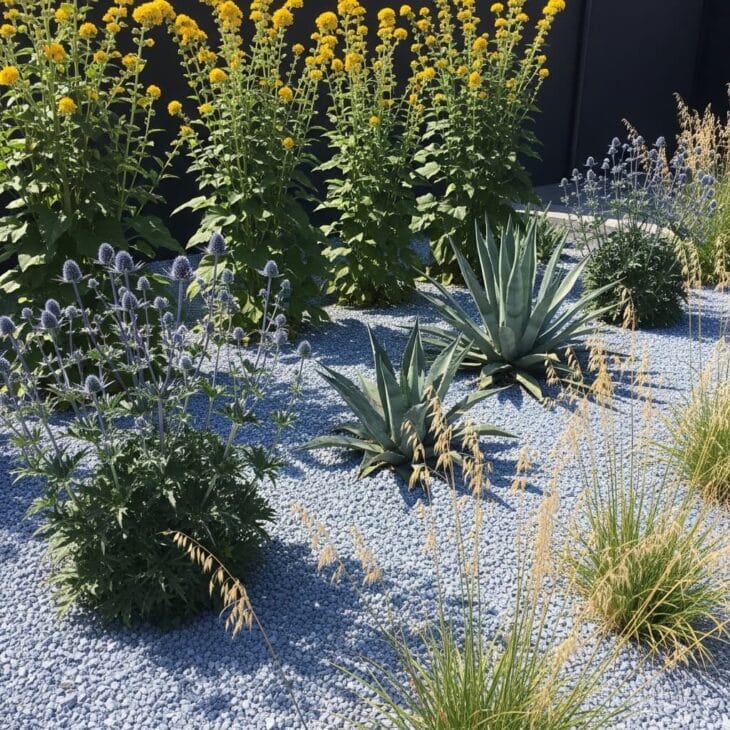
What you see On a ground of silver-blue gravel, bold architectural plants stand apart like sculptures: tall Verbascum olympicum throws its yellow flower spire six feet into the air, Eryngium agavifolium holds its extraordinary architectural seed heads above steel-blue bracts, and Stipa gigantea arches in a waterfall of golden oats, glowing in the afternoon sun. Space between plants is as deliberate as the planting itself — the gravel is part of the composition, not just a mulch. The result is spare, confident, and utterly contemporary.
Why it works Gravel and architectural planting borders represent a significant shift in garden thinking: instead of covering every centimetre of soil with plants, this approach uses space and restraint as design tools. The gravel surface creates a clean, neutral backdrop that makes each plant stand out with unusual clarity. It is a particularly effective style for modern houses with clean lines and large windows, where the garden is as much a view from inside as a space to be in.
How to get it Use 10-20mm silver-grey or flint gravel as your ground surface — lay it 5-8cm deep over weed-suppressing fabric. Choose plants that make an architectural statement alone: Verbascum, Eryngium, Euphorbia characias, Agave or Yucca, Stipa gigantea, and Melianthus major. Plant in odd numbers (3 or 5) for each species and leave meaningful space between plants — the gaps are intentional. Top-dress the gravel around plants each spring to refresh the clean surface.