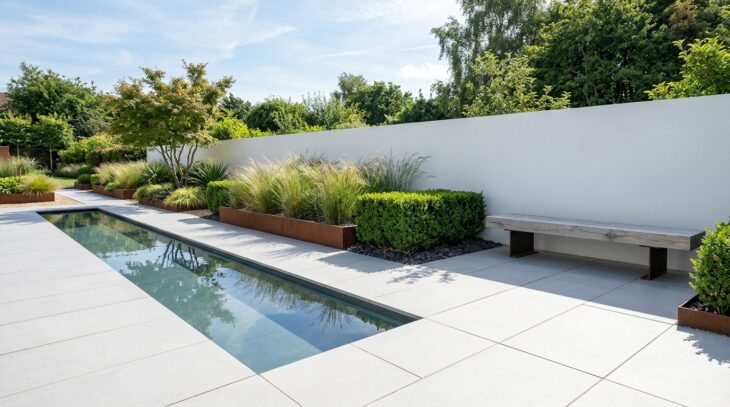
A modern garden is not a cold one. The best contemporary spaces are built on a few clean lines, a short list of materials, and plants used with real confidence, which is exactly what makes them feel calm the moment you step outside. Strip away the clutter and what is left has room to breathe.
Contents
- 01. Corten Steel Raised Planters
- 02. Ornamental Grass Block Planting
- 03. Monochrome Concrete Courtyard
- 04. Multi-Stem Silver Birch Grove
- 05. Linear Water Rill
- 06. Clipped Boxwood Cube Grid
- 07. Black-Stained Slatted Fence
- 08. Floating Hardwood Deck
- 09. Sunken Fire Pit Lounge
- 10. Slatted Timber Pergola
- 11. Living Green Wall Panel
- 12. Architectural Agave and Succulent Bed
- 13. Large-Format Porcelain Paving
- 14. Reflection Pool
- 15. Pleached Hornbeam Screen
- 16. Recessed Step and Path Lighting
- 17. Concrete Bowl Water Feature
- 18. Bamboo Screen in a Steel Trough
- 19. Single-Species Mass Planting
- 20. Poured Concrete Outdoor Kitchen
- 21. Modern Corten Kitchen Garden
- 22. Stone Monolith Feature
- 23. Matte Cylinder Container Grouping
- 24. Prairie-Modern Perennial Border
- 25. Minimalist Gravel and Boulder Garden
- 26. Contemporary Courtyard with Japanese Maple
- 27. Built-In Rendered Seating Wall
- 28. Green Joints in Paving
- 29. Cantilevered Floating Steps
- 30. Black Plunge Pool
The 30 ideas below run from a single corten steel planter you can drop into an existing border to a full courtyard rebuilt in concrete and porcelain. Some are weekend projects on a small budget, others are proper landscaping investments. There are ideas for shady side returns, sun-baked terraces, tiny urban plots, and wide open backyards.
Read it as a menu rather than a manifesto. Pick two or three ideas that suit your site, repeat their materials, and the modern look will follow on its own. Scroll through the full list, or jump straight to whatever catches your eye.
01. Corten Steel Raised Planters
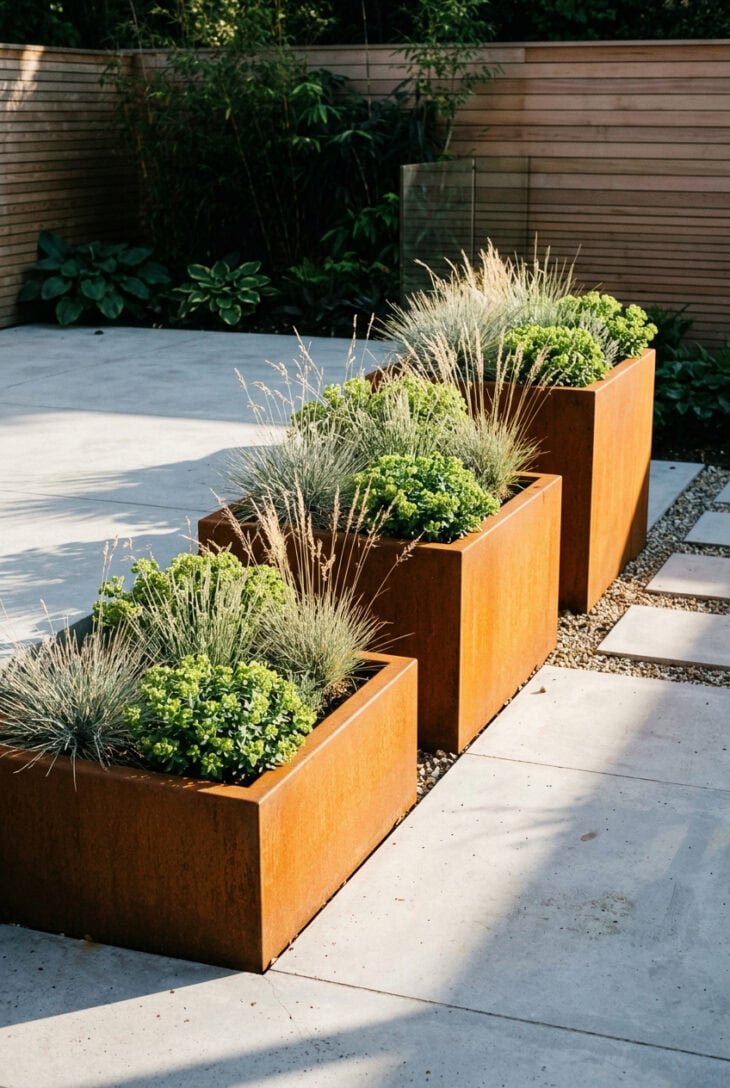
What you see Three rectangular steel planters sit at stepped heights on pale grey paving, their weathered surfaces glowing a deep rust orange in the late sun. Silvery grasses spill over the sharp top edges, and the shadows the boxes throw are as much a part of the composition as the plants.
Why it works Corten steel is the signature material of modern garden design for good reason. It rusts to a stable, self-protecting orange patina and then simply stops, so it needs no paint and no maintenance, and that warm color is the perfect foil for cool concrete and green foliage. The crisp geometry of a rectangular box also gives loose, wispy planting something firm to lean against.
How to get it Buy planters in at least 3mm gauge steel, since thinner sheet can distort under the weight of wet soil. Vary the heights (try 16in, 24in, and 32in / 40cm, 60cm, and 80cm) but keep the footprint and the width consistent, which is what makes a group read as one piece. Set them on a hard surface with feet or spacers underneath so water drains freely and the base does not sit wet. Expect a full year of runoff staining while the patina develops, so keep new steel off pale limestone and light concrete until it has settled. Plant with maiden grass (Miscanthus sinensis ‘Gracillimus’) or blue fescue for that fine, movable texture against the hard edge.
02. Ornamental Grass Block Planting
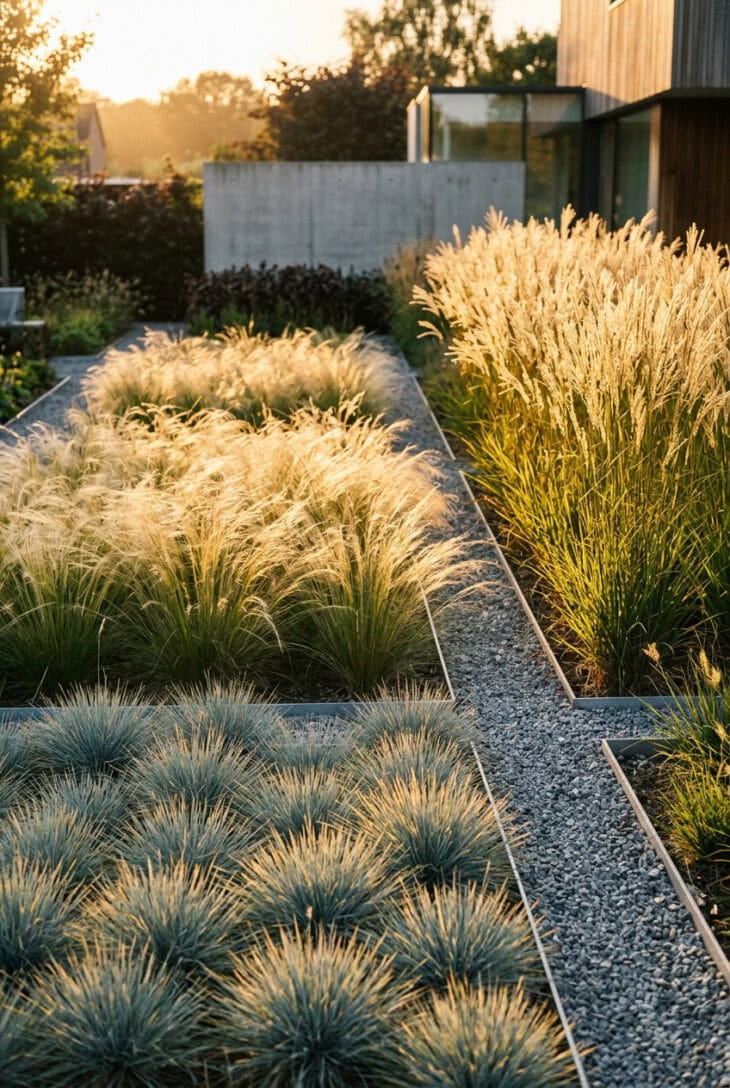
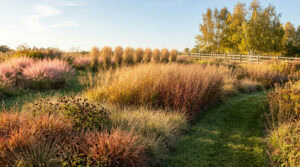
What you see Big rectangular blocks of grass sit side by side like tiles, each one a single species: tall bronze miscanthus, a low blue-grey mat of fescue, a hazy cloud of feather grass. The evening sun comes through from behind and every seed head lights up, so the whole bed seems to smoke and shimmer in the breeze.
Why it works Mixing one of everything is what makes planting look busy. Planting in blocks does the opposite: each grass gets enough space to show its true shape and texture, and the eye reads the bed as a few calm shapes rather than a hundred individual plants. Grasses also give you the two things modern gardens are usually short of, which are movement and sound.
How to get it Use no more than three or four grass species across the whole bed and repeat them, rather than adding a fifth. Plant in odd-numbered groups of at least 5 to 7 per block, spacing at roughly two thirds of the plant’s mature width so the block knits into a solid mass in its second year. Mexican feather grass (Nassella tenuissima) gives the softest haze, fountain grass (Pennisetum alopecuroides) the plumpest seed heads, and blue fescue (Festuca glauca) a low steel-blue edge. Cut deciduous grasses right back to 4in (10cm) in late winter, and simply comb evergreen ones through with your fingers instead of cutting.
03. Monochrome Concrete Courtyard
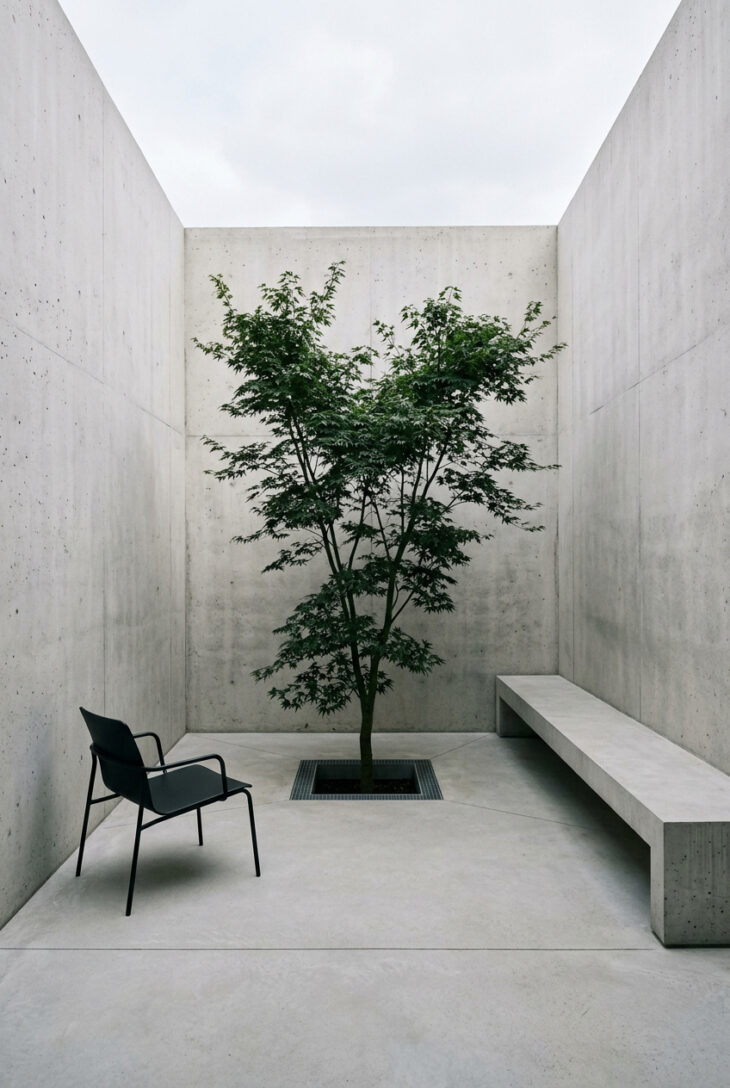
What you see Walls, floor, and bench are all the same smooth pale grey concrete, so the courtyard reads as a single carved room. One slender tree rises out of a square opening cut into the floor, its green canopy the only color in the space, and the soft overcast light keeps every surface calm and shadowless.
Why it works Using one material everywhere removes every visual join and makes a small space feel bigger and quieter than it is. It also does something clever to the planting: when there is only one plant, that plant becomes a sculpture, and you notice its trunk, its shadow, and the way it moves in a way you never would in a mixed border.
How to get it Poured in-situ concrete needs a good contractor and a dry week, so most people are better off with large-format concrete-effect porcelain on the floor and a smooth render on the walls, tinted to the same grey. Ask for a light broom or honed finish rather than polished, because polished concrete outdoors is dangerously slick in rain. Leave a planting pit of at least 3ft x 3ft (90cm x 90cm) and 24in (60cm) deep for the tree, and line it with a root barrier if it sits close to the house. This treatment suits tiny urban plots better than any other, because the lack of clutter is the whole point.
04. Multi-Stem Silver Birch Grove
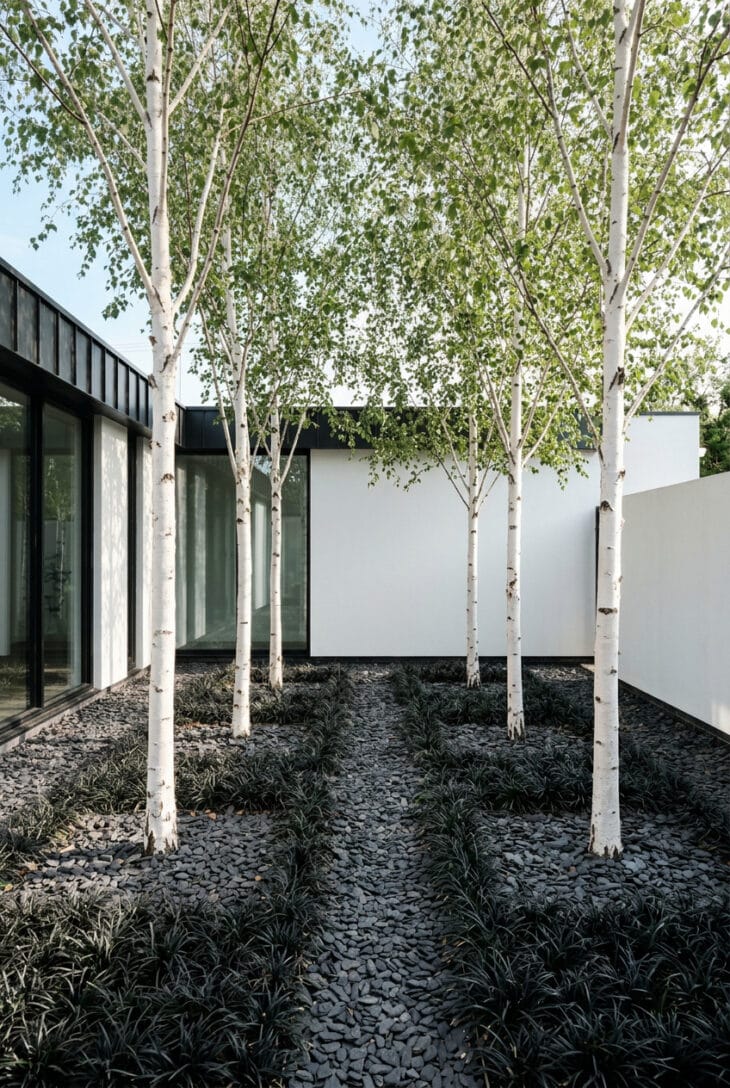
What you see Five multi-stem birches stand in a loose grid, their chalk-white trunks almost glowing against a dark carpet of near-black grass and slate chippings. The canopy is light enough to see straight through, and the dappled shade it throws moves across the ground all afternoon.
Why it works A grove gives you height, privacy, and a sense of enclosure without the heavy visual weight of a single big tree, which is why it has become the default modern answer to an overlooked garden. Birch is the perfect candidate: the trunks are graphic and sculptural, the canopy is airy enough that plants still grow beneath it, and multi-stem forms give you three or four trunks for the price of one footprint.
How to get it Plant silver birch (Betula pendula) or, for the whitest bark of all, Himalayan birch (Betula utilis var. jacquemontii ‘Grayswood Ghost’). Space the trees 6 to 8ft (180 to 240cm) apart, closer than a textbook would tell you, because the point is a grove and not an avenue. Buy multi-stem specimens with three or more trunks and a clear stem of at least 3ft (90cm) so the bark is visible at eye level. Underplant with black mondo grass (Ophiopogon planiscapus ‘Nigrescens’) for maximum contrast, and wash the trunks gently with a soft cloth and water each spring to keep the white bright.
05. Linear Water Rill
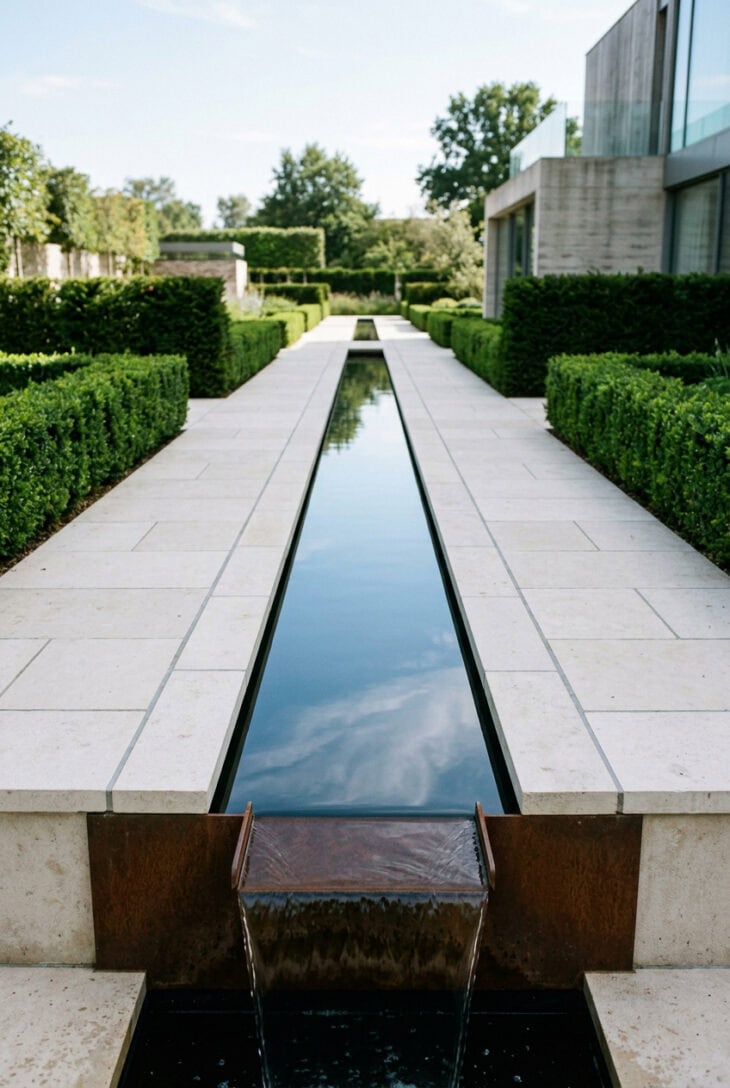
What you see A narrow channel of dark, still water runs the whole length of the garden, cut cleanly into pale stone paving. At one end a thin sheet of water folds silently over a rusted steel lip, and the flat surface holds a perfect mirrored reflection of the sky.
Why it works A rill does three jobs at once: it draws the eye down the length of the plot and makes it feel longer, it adds the sound of water without the visual noise of a fountain, and its still surface doubles the amount of sky in the garden. It is also the most restrained water feature there is, which is exactly why it belongs in a modern scheme.
How to get it Keep it narrow (8 to 12in / 20 to 30cm wide) and shallow (6in / 15cm of water is plenty), because the proportions are what make it look designed rather than accidental. Render the inside of the channel and paint it matte black, which is the trick that makes shallow water look deep and reflective. Run a small submersible pump on a timer, feeding a header tank at the top so the flow over the weir stays even. Add a simple UV clarifier if algae becomes a problem, and keep the rill in shade for part of the day to slow it down.
06. Clipped Boxwood Cube Grid
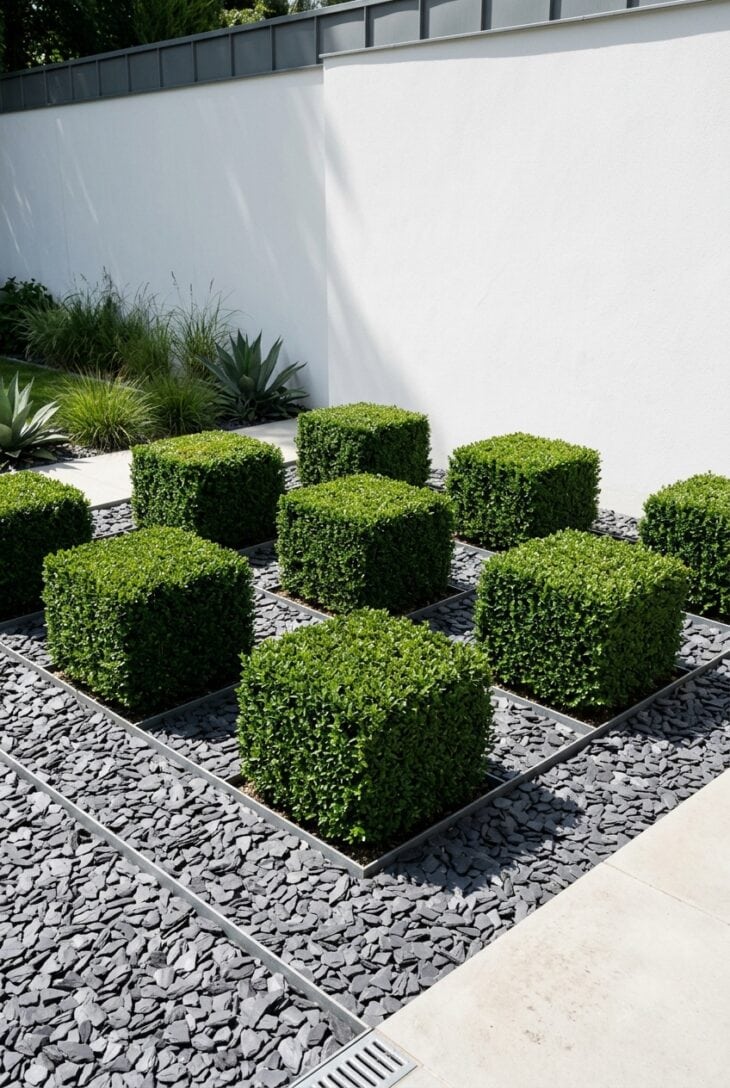
What you see Nine dense green cubes sit in a perfect grid on dark grey slate, each one clipped so tightly that the surface looks solid. Strong sun cuts crisp diagonal shadows between them, and the white rendered wall behind makes the whole arrangement read like a piece of sculpture.
Why it works Repetition is the quiet engine of modern design. One clipped cube is a topiary novelty, but nine identical cubes on a grid become a pattern, and a pattern is architecture. It also gives you a garden that looks exactly as good in February as in July, which very few planting ideas can claim.
How to get it Use common boxwood (Buxus sempervirens) if box blight is not a problem in your area, and Japanese holly (Ilex crenata ‘Dark Green’) if it is, since it clips to an almost identical finish and is immune. Set the plants out on a measured grid with 12in (30cm) of gravel between each cube so the shadows have room to fall. Clip twice a year, in late spring and again in late summer, using a string line and a light timber frame as a guide until your eye is trained. Feed in spring with a slow-release fertilizer, because hard clipping is demanding and hungry plants go thin and yellow.
07. Black-Stained Slatted Fence
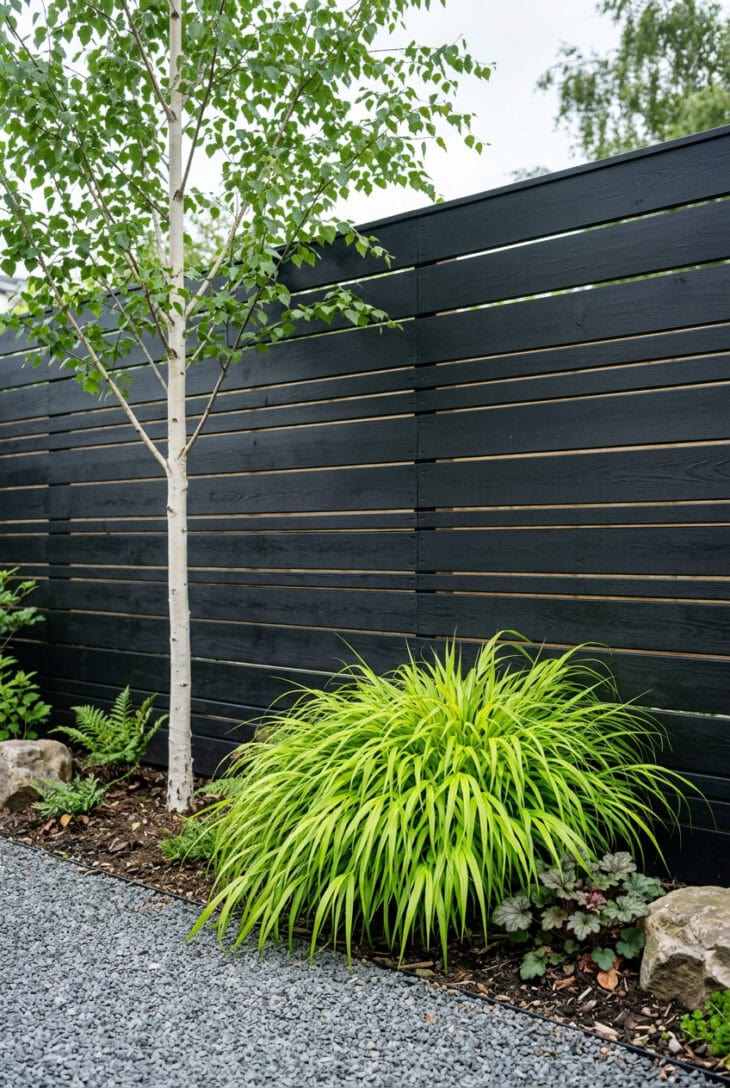
What you see A boundary of horizontal timber slats, stained a deep charcoal black, runs the width of the garden with a fine shadow gap between every board. In front of it a mound of acid-green grass and a pale-barked tree seem to jump forward, lit from within.
Why it works This is the cheapest transformation in modern garden design. A dark fence recedes, so the boundary visually disappears and the garden feels deeper, and at the same time it acts as a matte backdrop that makes every green in front of it read brighter and more saturated. Horizontal slats also pull the eye sideways, which makes a narrow garden feel wider.
How to get it Use planed 4 to 6in (10 to 15cm) boards with a consistent 0.5in (12mm) gap, screwed to vertical battens rather than nailed, so a damaged board can be swapped out later. Stain rather than paint: an opaque black wood stain soaks in, breathes, and fades gracefully, while paint blisters and peels within a couple of seasons. Two coats before you hang the boards, including the back and the cut ends, will double the life of the timber. If you are replacing an existing fence, you can often just batten and re-clad over the old panels rather than dig out the posts. Slatted screens are also one of the strongest moves in a narrow plot, because they buy privacy without stealing floor space.
08. Floating Hardwood Deck
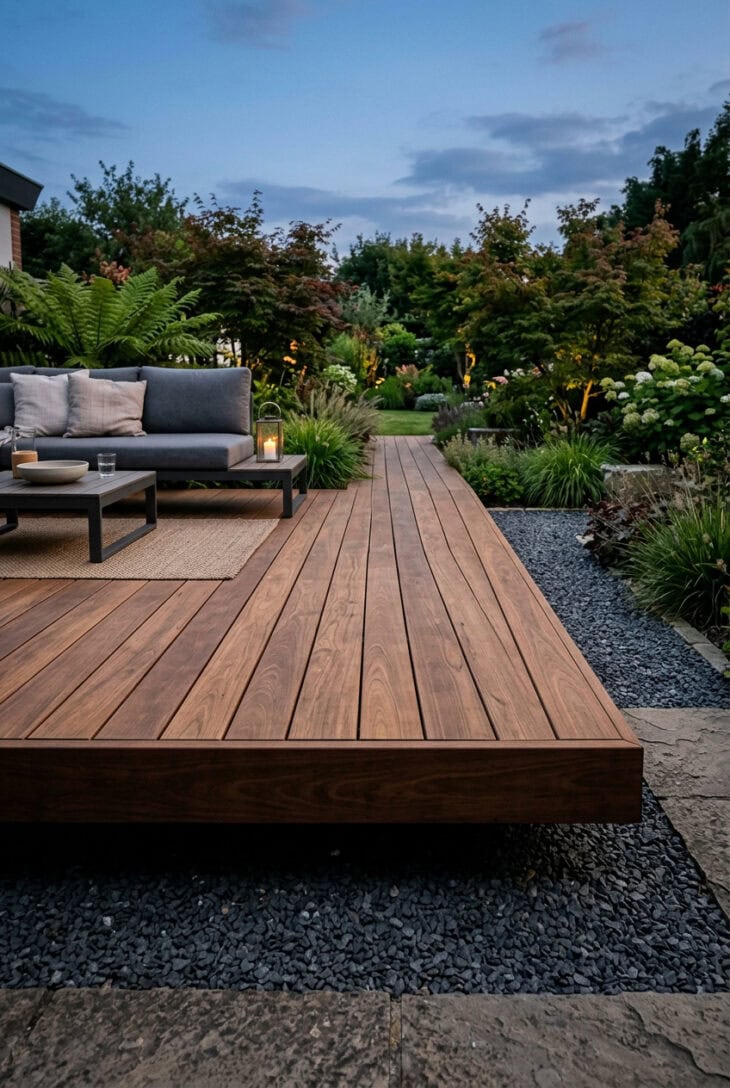
What you see A wide deck of deep brown hardwood hovers a few inches above grey gravel, with a dark shadow line running all the way around its edge so it seems to float. There are no visible screws, no railing, and the boards all run in one direction, straight out into the garden.
Why it works The shadow gap is the whole trick. Lifting the deck clear of the ground and leaving a dark void beneath the edge removes the visual bulk, so a heavy timber platform reads as a light plane laid over the garden. Running the boards in a single direction, with no border and no picture frame, keeps the surface calm and makes the deck feel larger.
How to get it Specify a dense hardwood such as ipe or garapa, or a good composite if you want zero maintenance, and insist on hidden clip fixings rather than face screws. Cantilever the boards 2 to 3in (5 to 8cm) beyond the last joist to deepen the shadow line at the edges. Keep the deck within an inch of the level of any interior floor it adjoins, since a flush threshold is what makes the inside and outside read as one space. Oil hardwood once a year if you want to keep the rich brown, or leave it to weather to a soft silver-grey, which is a perfectly good modern finish in its own right. A raised timber platform also works beautifully as the anchor of a wider patio garden layout.
09. Sunken Fire Pit Lounge
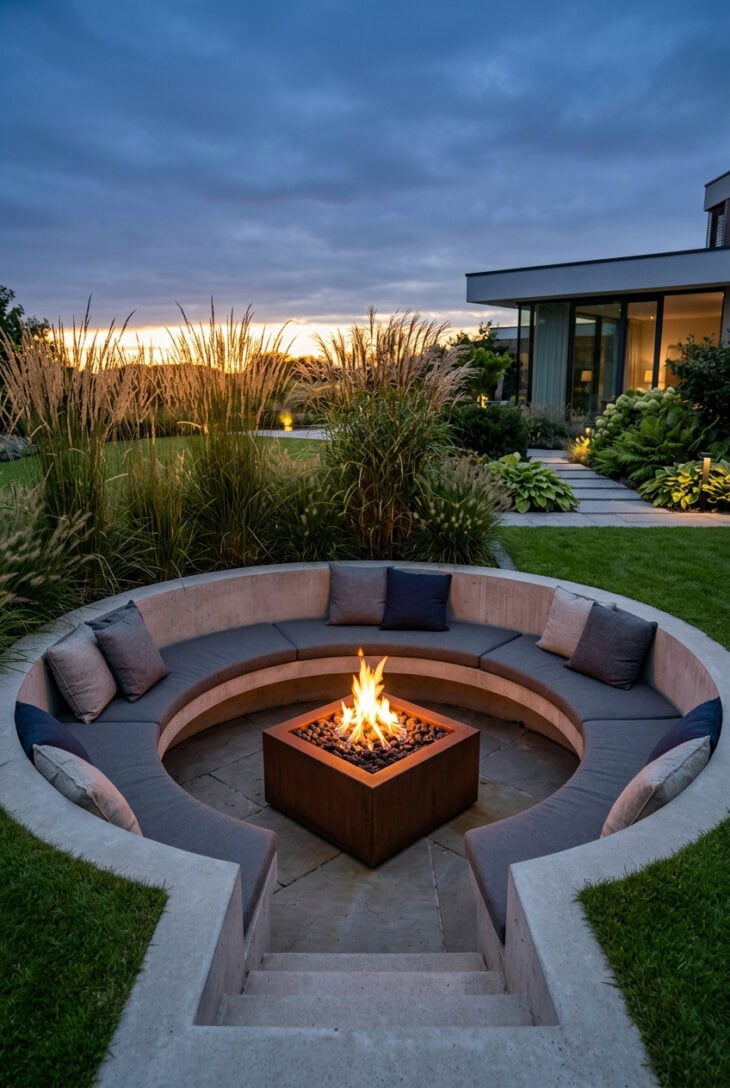
What you see A circle of built-in concrete bench sits below the level of the lawn, wrapped around a low steel firebox that is burning quietly at dusk. Grasses at the rim catch the last of the light overhead while the seating area itself glows warm and orange, sunk into the ground like a room without a roof.
Why it works Dropping a seating area even 18in (45cm) below grade changes it completely: you get instant shelter from wind, a real sense of enclosure, and eye-level views straight into the planting rather than down onto it. It also keeps the garden’s sight lines clean, because no bulky furniture breaks the horizon.
How to get it Sink the floor 16 to 20in (40 to 50cm) and build the retaining ring in blockwork, then render it or clad it in the same material as your paving so it disappears. Drainage is the thing people get wrong: a sunken area is a sump, so put a channel drain or a gravel soakaway in the floor before you lay a single slab. A gas firebox with a manual shutoff is far more usable than wood on a small terrace, since there is no smoke to chase your guests around the circle. Leave 30in (75cm) of clear floor between the bench and the fire so people can pass behind seated guests.
10. Slatted Timber Pergola
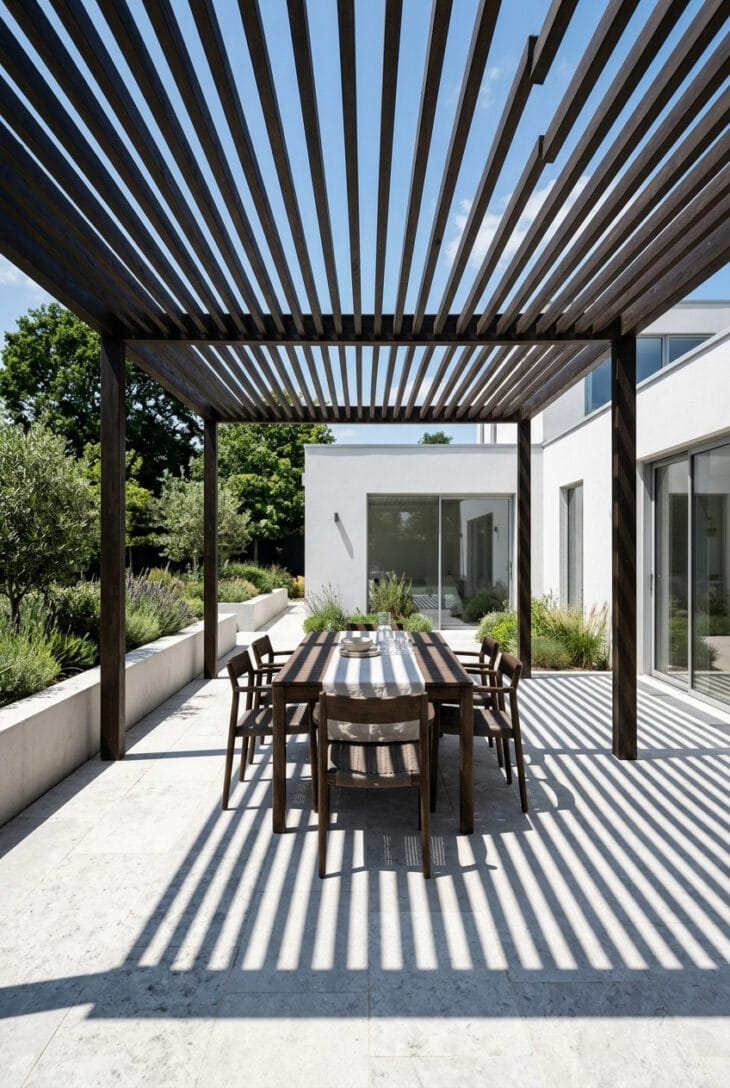
What you see Slim dark posts carry a run of closely spaced overhead slats, and the midday sun turns them into bold stripes of light and shadow across the pale stone terrace. A dining table sits in the middle of the pattern, half in sun and half in shade.
Why it works A slatted roof gives you the two things a solid roof cannot: dappled shade that moves through the day, and a shadow pattern that becomes the most beautiful thing in the garden for free. Because it is open, it also keeps the terrace bright and stops the space beneath from feeling like a shed.
How to get it Run the slats on the north to south axis if you want shade at midday, or east to west to catch the low evening sun. Set them on edge rather than flat, with a gap roughly equal to the slat depth, which gives about 50 percent shade and reads far lighter than solid boards. Keep the posts slim (4in / 10cm square is enough on a domestic span) and set them in galvanised post shoes on a concrete pad rather than sinking bare timber into the ground, which is what rots pergolas. If you want to green it, plant a single climber per post and let it run overhead: wisteria (Wisteria sinensis) is the classic, but it needs a strong frame and twice-yearly pruning to stay under control.
11. Living Green Wall Panel
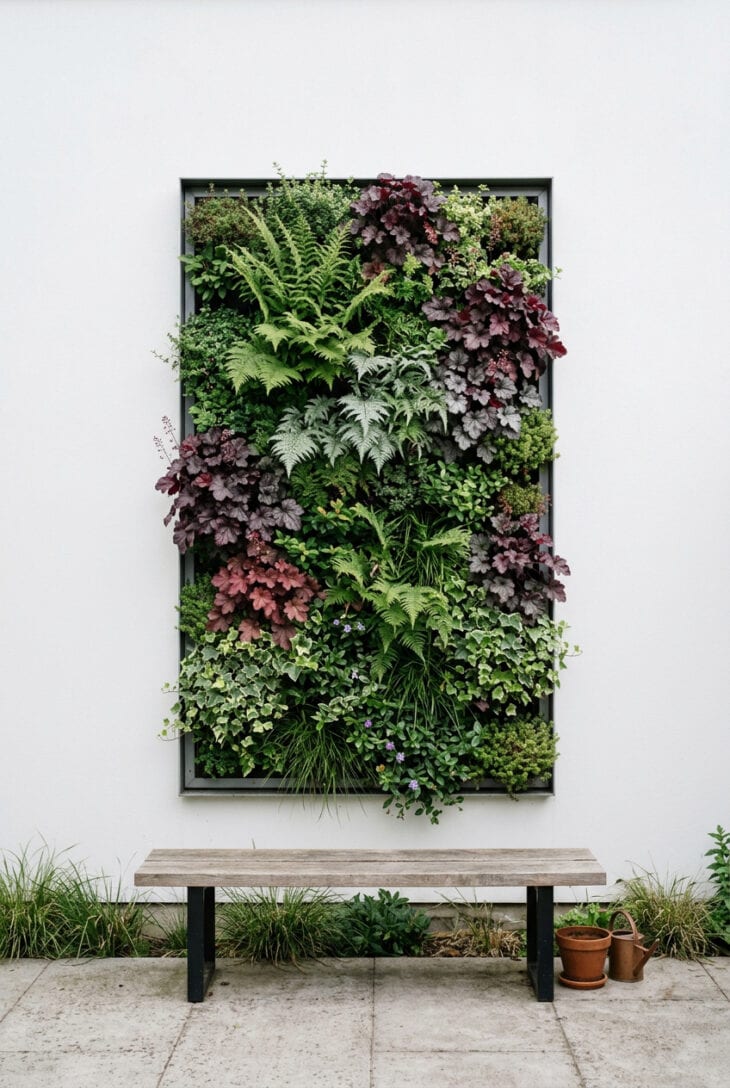
What you see A single tall panel of dense foliage is set into a smooth white wall like a framed painting, packed with ferns, silver-marked heuchera, and deep burgundy leaves. Everything around it is bare and white, so the panel of green reads as the one rich, textural event in the space.
Why it works Framing a green wall as one panel rather than cladding the whole surface is the difference between design and decoration. The white render around it does the work of a mount around a print, and it also means you only have to irrigate and maintain a manageable area rather than an entire boundary.
How to get it Do not skip the irrigation. A living wall without an automatic drip line fed by a timer will be dead within one hot week, so budget for that before you budget for plants. Choose a shaded or east-facing wall, because south-facing panels dry out faster than any system can keep up with. Plant tough evergreens that hold their shape: coral bells (Heuchera sanguinea), hardy ferns, and mondo grass (Ophiopogon japonicus) all work far better than the trailing annuals you see in showrooms. Expect to replace around 10 percent of the plants each spring, and feed through the irrigation with a dilute liquid feed in the growing season.
12. Architectural Agave and Succulent Bed
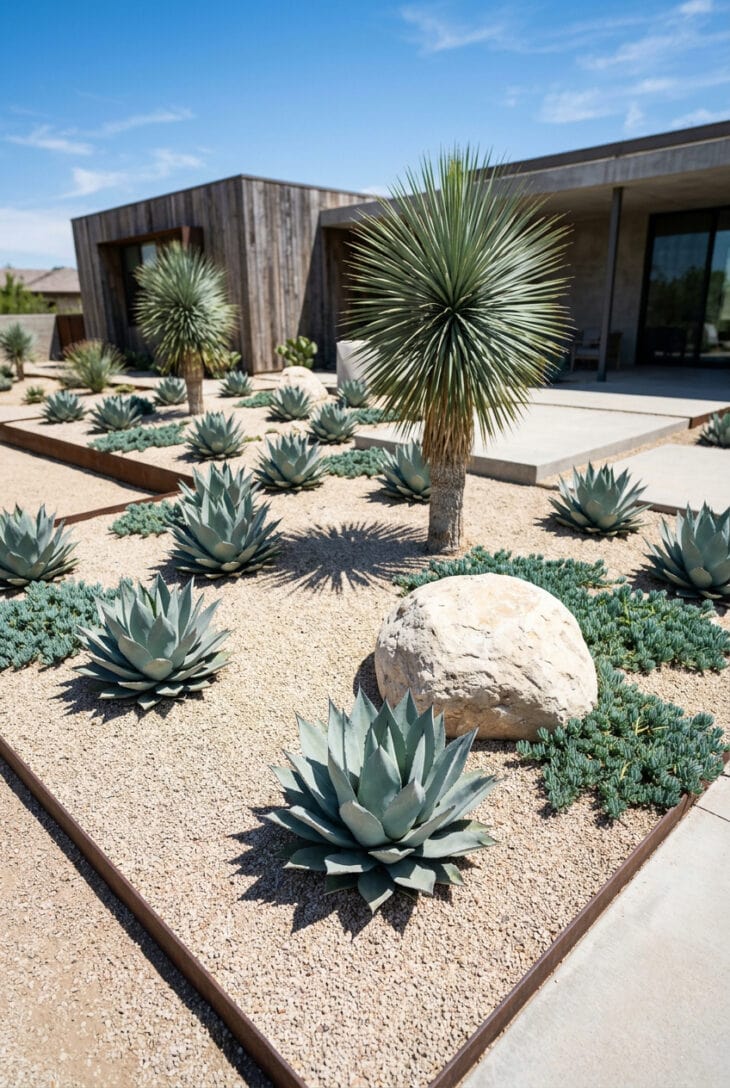
What you see Big blue-grey agaves sit in pale gravel with real space around them, each rosette throwing hard spiky shadows in the midday sun. Low mats of blue-green sedum pool at their feet, and a single pale boulder anchors the composition. Nothing is crowded and nothing is flowering.
Why it works Agaves and yuccas are already sculpture, so a modern garden only has to give them room and get out of the way. The gravel between them is not empty space, it is the negative space that lets each silhouette register, and the harder the light, the better the whole thing looks.
How to get it Drainage matters more than cold here: most agaves survive surprisingly low temperatures if their crowns stay dry in winter, and rot in wet soil at temperatures they would shrug off in a desert. Excavate 12in (30cm) and backfill with a 50/50 mix of grit and topsoil, then mulch with 2in (5cm) of gravel right up to the neck of each plant. Space them at their full mature width, which usually means far further apart than looks right on planting day. Keep spiny species such as century plant (Agave americana) well back from paths, and choose the softer-tipped red yucca (Hesperaloe parviflora) where people brush past. The same bed is a natural fit for drought-tolerant planting in hot, dry climates.
13. Large-Format Porcelain Paving
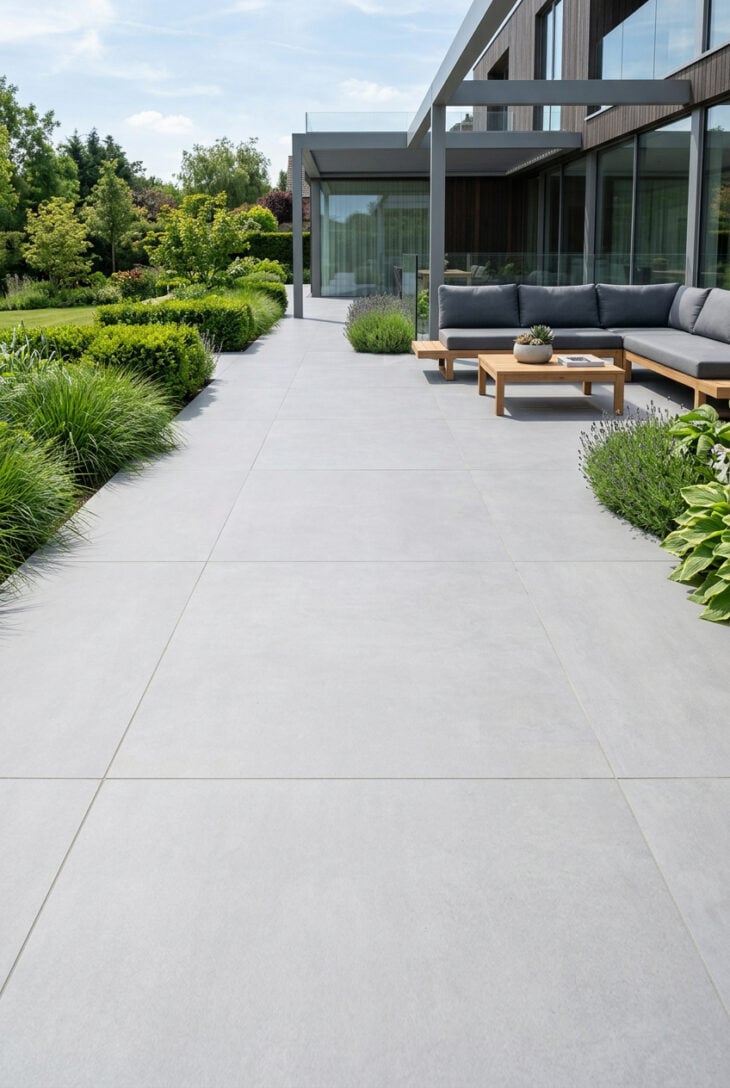
What you see Enormous pale grey slabs are laid edge to edge with joints so fine you have to look for them, and the surface runs out from the house almost like a single sheet. It is matte, subtly textured underfoot, and completely free of pattern or color variation.
Why it works Nothing dates a garden faster than small, busy, multi-size paving. Going the other way, with fewer and bigger units, is the single most effective way to make a terrace read as modern, because it reduces the number of lines your eye has to process. Porcelain also stays the color it was on day one, resists algae, and does not need sealing, which natural stone cannot match.
How to get it Use slabs of at least 24 x 48in (60 x 120cm), laid in a stack bond or a simple half bond rather than a random pattern. Porcelain must be laid on a full mortar bed with an SBR slurry primer on the back of each slab, since it is not porous and will not bond to mortar on its own. Specify a joint of 3 to 5mm and a matching grey grout, because a contrasting joint color reintroduces exactly the grid you were trying to remove. Check the R-rating for slip resistance: R11 is the sensible minimum for an outdoor terrace, and anything smoother becomes an ice rink in rain.
14. Reflection Pool
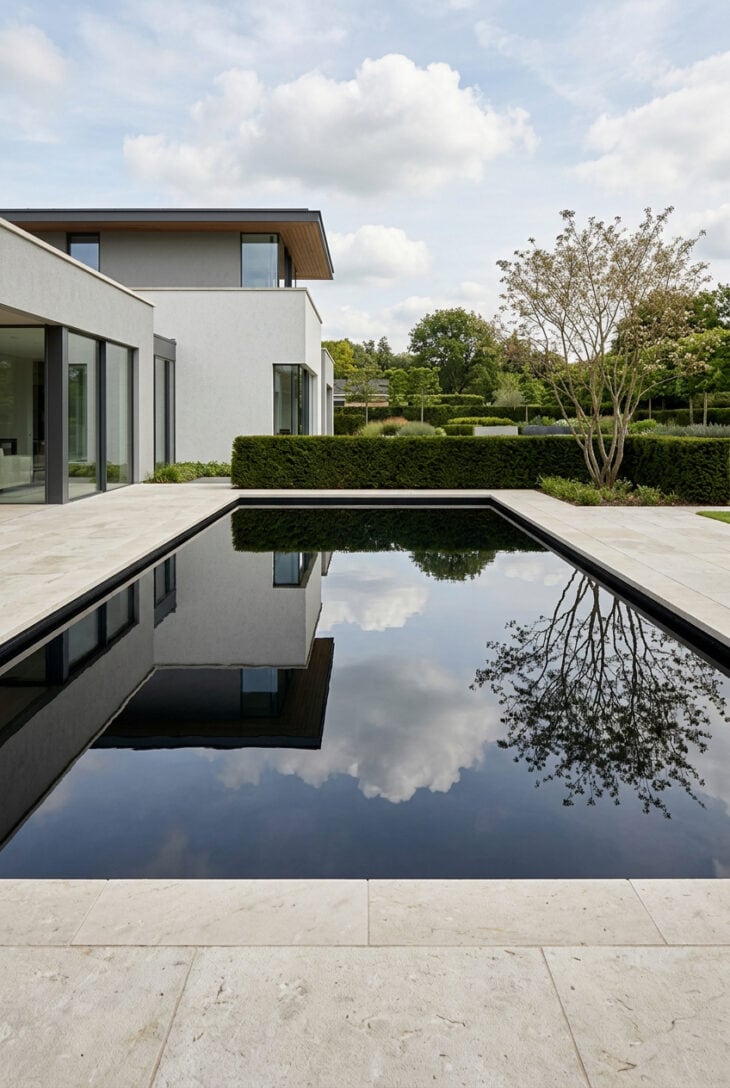
What you see A wide, shallow rectangle of black water lies absolutely still, holding a perfect mirror image of the house, the tree, and the clouds moving overhead. The stone coping sits flush with the paving so there is no rim to break the illusion, and there is not a fountain or a water lily in sight.
Why it works A reflection pool does not really add water to a garden, it adds sky. On a plot hemmed in by fences, that borrowed light and movement overhead is worth more than any planting, and because the surface must be still to reflect, it delivers a real sense of calm rather than the busy splash of a conventional feature.
How to get it Depth is not the point: 8 to 12in (20 to 30cm) of water over a black-rendered or black-lined base reflects just as well as 3ft (90cm) and is far safer around children. Set the coping flush with the surrounding paving and let the water sit within an inch of the top, since a visible dry rim is what kills the mirror effect. Keep it out of full sun and away from overhanging deciduous trees, because algae and fallen leaves are the two things that will ruin it. A small circulation pump feeding a hidden filter, running a few hours a day, keeps the water clear without ever disturbing the surface.
15. Pleached Hornbeam Screen
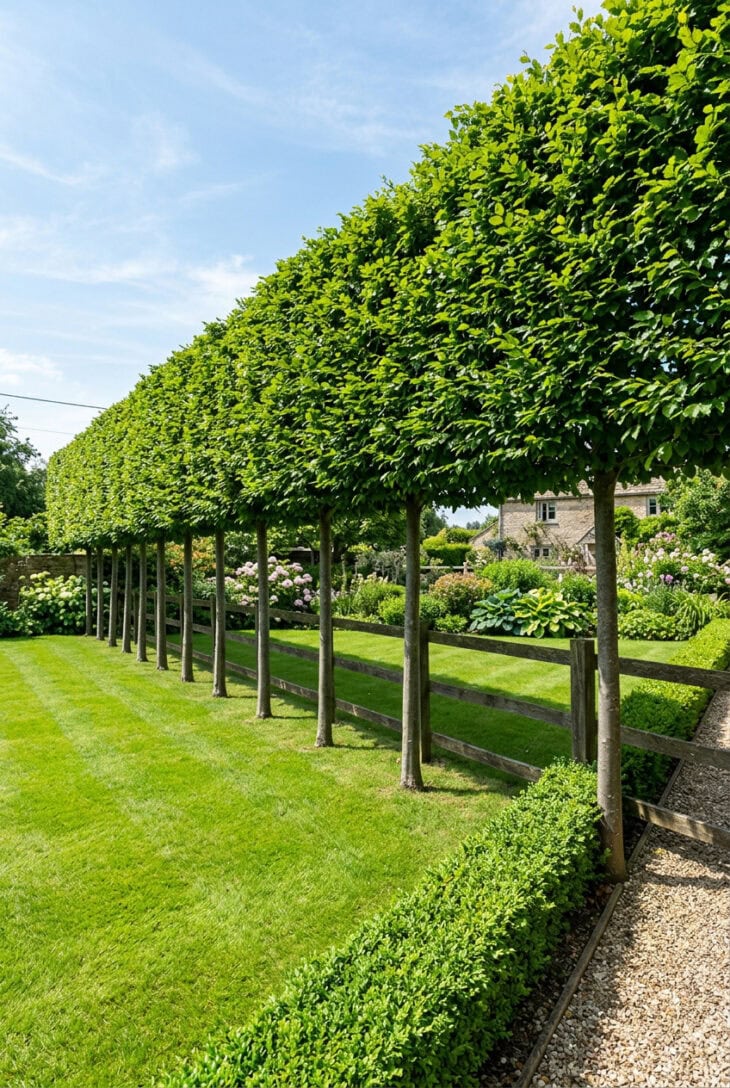
What you see A line of hornbeams stands with clear, bare trunks at regular intervals, their canopies clipped into one continuous flat green rectangle floating above the fence line. Beneath them the ground stays open, so the screen delivers privacy at eye level upstairs while giving away almost nothing at ground level.
Why it works Pleached trees are the elegant answer to being overlooked by a neighbouring upstairs window. A taller fence would be oppressive and probably not allowed, but a hedge on stilts blocks the sightline exactly where it needs to and leaves the border below free to plant. The clipped rectangle is also strongly geometric, which is why it sits so well in a contemporary scheme.
How to get it Buy them pre-trained on a frame, as growing your own from scratch takes the better part of a decade. Hornbeam (Carpinus betulus for the classic European form) holds its brown leaves through winter and clips beautifully; evergreen alternatives include Portuguese laurel (Prunus lusitanica). Space the trees 6 to 8ft (180 to 240cm) apart, matching the width of their trained panels so the canopies just touch. Water deeply and regularly for the first two summers, since a pleached tree carries a large canopy on a small rootball and will drop leaves the moment it is stressed. Clip once a year in late summer, keeping the bamboo or wire frame in place until the branches have fused.
16. Recessed Step and Path Lighting
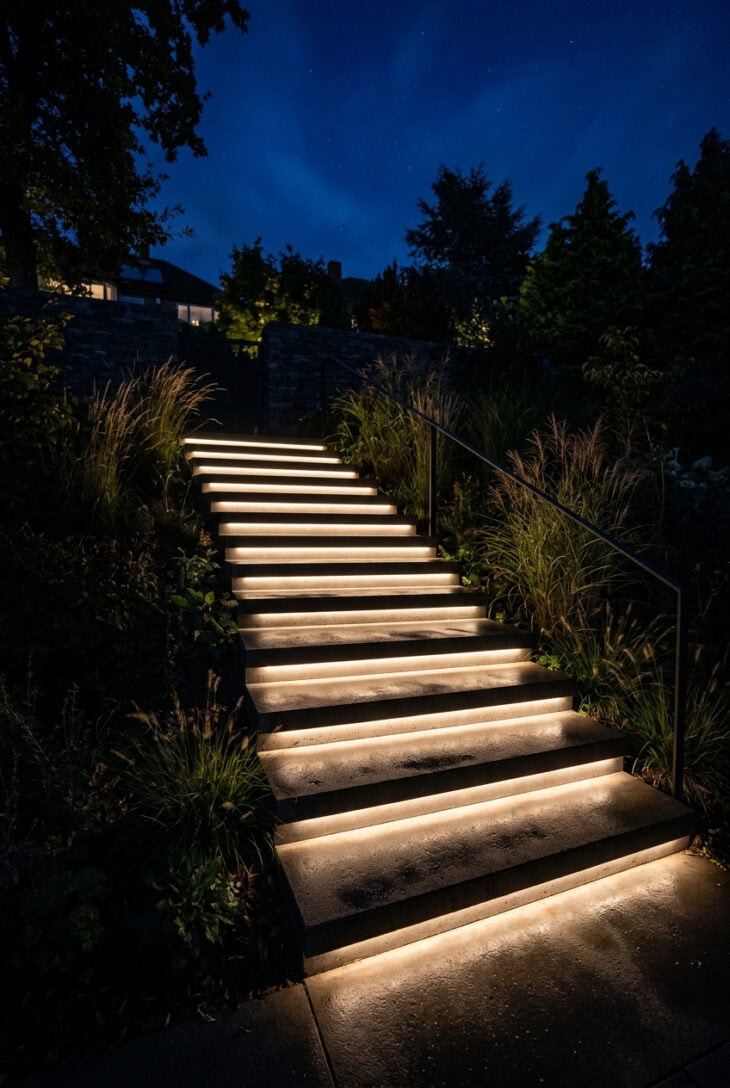
What you see Wide steps float in the dark, each tread washed with a soft band of warm light that appears to come from nowhere. The fittings themselves are invisible, so what you see is not lamps but light, and the grasses at the edge of the flight catch just enough spill to glow faintly.
Why it works Modern lighting hides the fitting and shows only the effect. Recessing a strip under the nose of each riser lights the tread exactly where a foot needs to land, which makes the steps genuinely safer, while keeping the night sky dark and the garden atmospheric instead of floodlit like a parking lot.
How to get it Use warm white LED at 2700K, never cool white, which drains the color out of foliage and makes the whole garden look clinical. Choose IP67-rated strip in an aluminium channel with a frosted diffuser, so you see an even band of light rather than a row of dots. Plan the cable runs before the steps are built, because retrofitting a channel into finished stone is miserable work. Keep the total lit area small: three or four well-chosen effects beat twenty spotlights, and a run of low-voltage 12V cable on a transformer and timer is safe to install yourself.
17. Concrete Bowl Water Feature
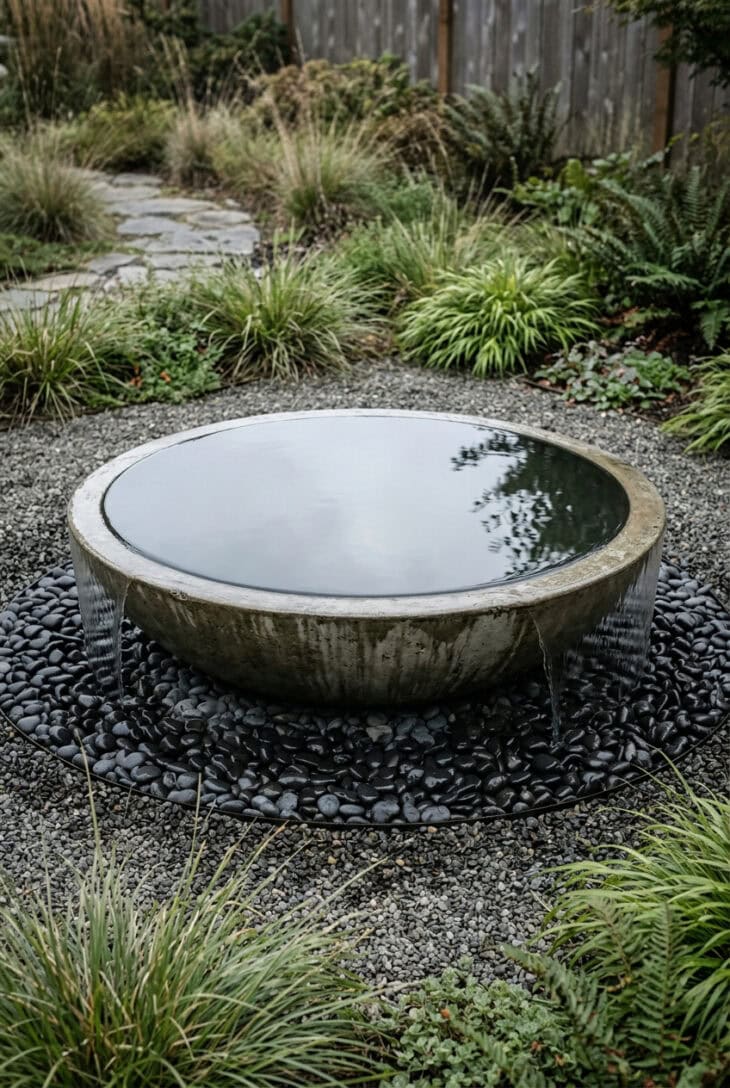
What you see A wide, shallow concrete bowl brims so full that water slips silently over the entire rim in a thin film and disappears into black pebbles below. The surface is flat enough to reflect the sky, and low grasses grow right up to the edge of the gravel around it.
Why it works This is the modern water feature for people who do not want a pond. A brimming bowl gives reflection, gentle sound, and a drinking station for birds, all from one object with no open water for a child to fall into. Because the reservoir is buried, the bowl itself looks like a piece of sculpture that happens to hold water.
How to get it Dig a reservoir pit below the bowl, drop in a rigid sump or a heavy-duty tank, and stand the bowl on a load-bearing grid over it, with the pump inside the sump feeding up through the base. A bowl of water plus concrete is genuinely heavy, so check that the grid is rated for it. Level the bowl with a spirit level in two directions, because even a few millimetres out and the water will spill down one side only. Top it up weekly in summer, and drop a small float or a stone into it in freezing weather so ice has somewhere to expand.
18. Bamboo Screen in a Steel Trough
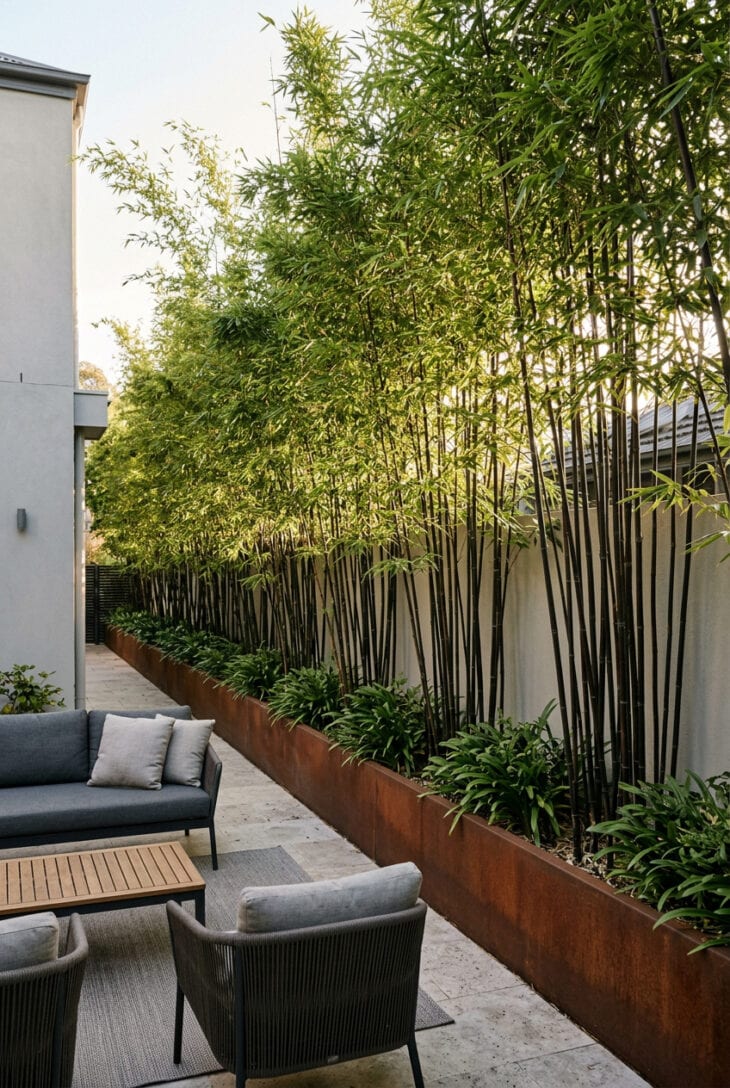
What you see A long steel trough runs the length of the terrace, packed with tall bamboo whose dark canes rise into a soft green screen. Light filters through the leaves rather than being blocked by them, and the whole wall of foliage moves and rustles with every breath of wind.
Why it works Bamboo screens faster and higher than almost anything else, and its vertical canes are naturally graphic, which is why designers keep reaching for it. Growing it in a raised trough rather than the ground gives you the height instantly, at a level where it actually blocks a sightline, and solves the plant’s one real vice at the same time.
How to get it Contain it, always. Running bamboo (Phyllostachys) will cross a lawn and come up in a neighbour’s border, and the trough is your root barrier. Even so, choose a clumping species such as Fargesia rufa where you can, and if you want the dramatic dark canes of black bamboo (Phyllostachys nigra), accept that it is a runner and keep it in a sealed container with no drainage holes cut in the base large enough for roots to escape. Give it at least 18in (45cm) of soil depth, water it hard in summer (container bamboo dries out fast and browns quickly), and thin out the older canes each spring to keep the screen light and see-through rather than a solid thicket.
19. Single-Species Mass Planting
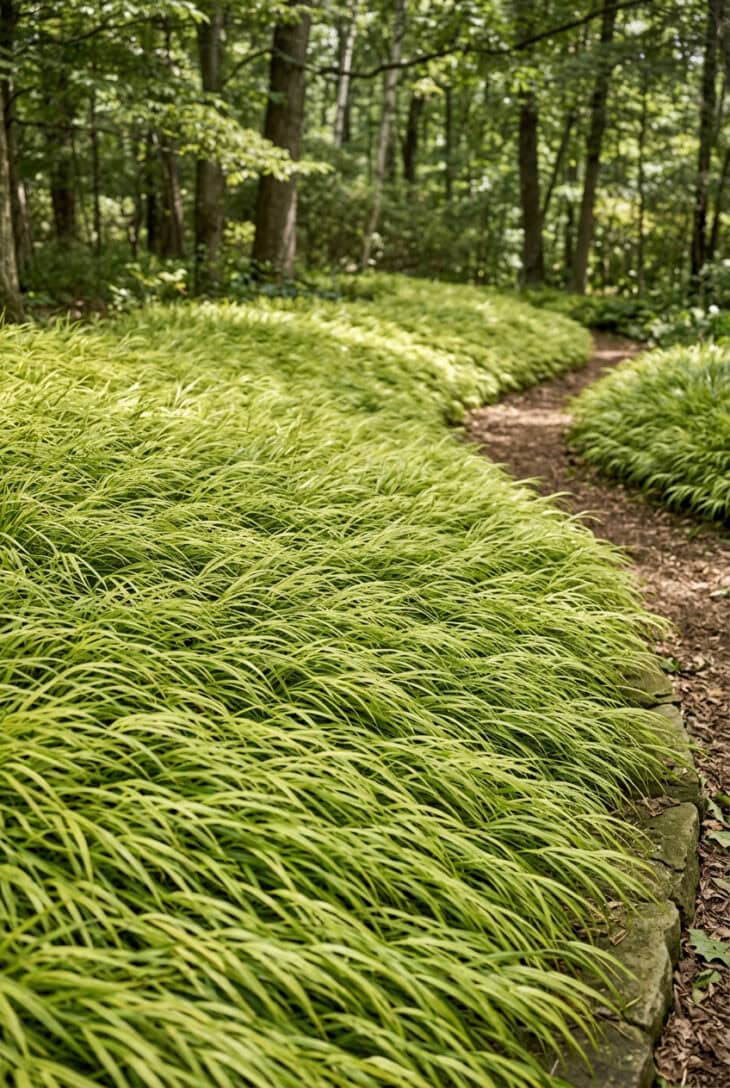
What you see A wide bed is filled with one plant and nothing else: hundreds of Japanese forest grass plants flowing together like a single golden-green river, every arching leaf falling in the same direction under light shade. There is no other species in sight, and the effect is quietly hypnotic.
Why it works Mass planting is the boldest move in the modern planting playbook and also the easiest to maintain. One species means one set of needs, one pruning date, and no plant elbowing out another. Visually, it converts a collection of small plants into a single large form, and large forms are what make a garden feel designed.
How to get it Pick a plant that spreads politely and looks good for a long season. Japanese forest grass (Hakonechloa macra) is the finest choice for part shade, catmint (Nepeta mussinii) for sun, and mondo grass for evergreen ground cover. Plant on a triangular grid at around 12 to 15in (30 to 38cm) centres, which is close enough to close the gaps in one or two seasons. Buy small plants in quantity, because a 9cm pot will catch up with a 2 litre one within a year and you will need a lot of them. Mulch heavily the first spring, since weeds are the only real threat to a young mass planting. This approach is a natural fit for a shade garden, where quiet texture beats a scatter of flowers.
20. Poured Concrete Outdoor Kitchen
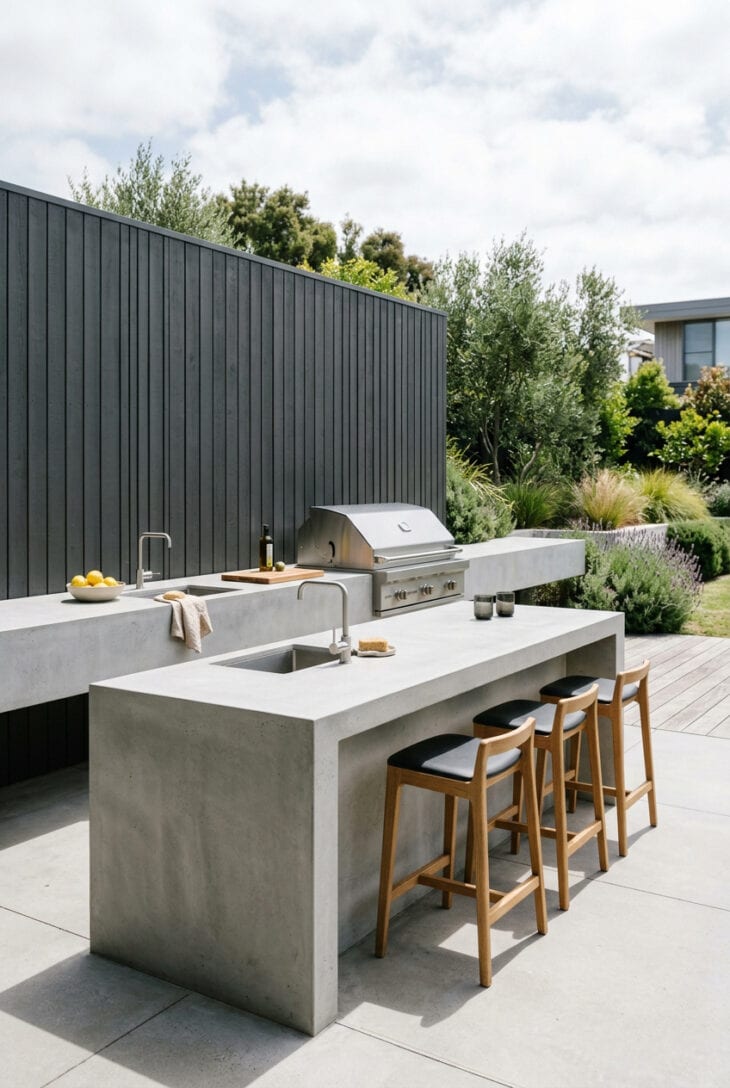
What you see The kitchen is one continuous run of pale grey concrete, with the sink and grill dropped into the worktop and no cupboard doors interrupting the front. It stands against a charcoal slatted wall, and the whole thing looks less like garden furniture and more like part of the building.
Why it works A built-in kitchen solves the problem every terrace has, which is a bulky freestanding grill parked in the middle of the view. Building it as one mass in a single material makes it disappear into the architecture, and giving it a worktop long enough to actually work on turns a barbecue into a place people gather.
How to get it Build the carcass in blockwork or a steel frame and clad it, rather than trying to pour a whole unit in place. A cast concrete top needs sealing every year or two, so a concrete-effect porcelain or a sintered stone slab gives the same look with far less upkeep. Run the services before you build: gas, a power outlet, and a cold water feed with a drain, because a kitchen without a sink means every rinse happens indoors anyway. Leave at least 24in (60cm) of clear counter each side of the grill, and site the whole run so the prevailing wind carries smoke away from the dining table rather than into it.
21. Modern Corten Kitchen Garden
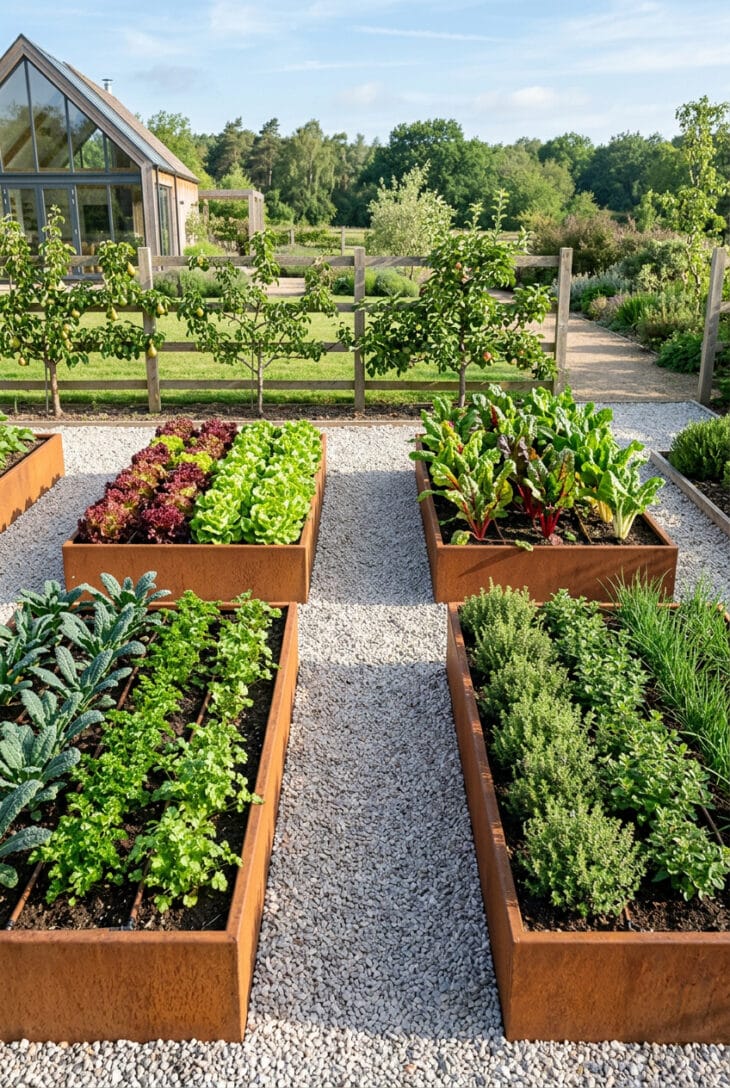
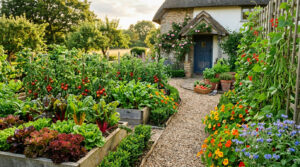
What you see Four identical rust-orange steel beds sit in a grid, divided by crisp paths of pale grey gravel, each one planted in neat rows of lettuce, chard, and herbs. It is unmistakably a vegetable garden, but the geometry is so clean that it looks designed rather than merely productive.
Why it works Growing food does not have to look rustic. Swapping timber for corten steel and running the beds on a strict grid gives you all the practicality of a potager (warm, well-drained soil, no bending, easy netting) inside a framework that suits a contemporary house. The rust orange also happens to be the perfect complement to green foliage.
How to get it Keep every bed the same size and no more than 4ft (120cm) wide, so you can reach the center from either side without stepping on the soil. A depth of 16 to 20in (40 to 50cm) is enough for almost every crop except long-rooted parsnips. Leave paths of at least 24in (60cm), and 36in (90cm) on the main run if you use a wheelbarrow. Fill with a mix of roughly 60 percent quality topsoil to 40 percent compost, and top up with an inch of compost each spring rather than digging. If you want the full build detail, our raised bed garden ideas and vegetable garden ideas go deeper on layout and crops.
22. Stone Monolith Feature
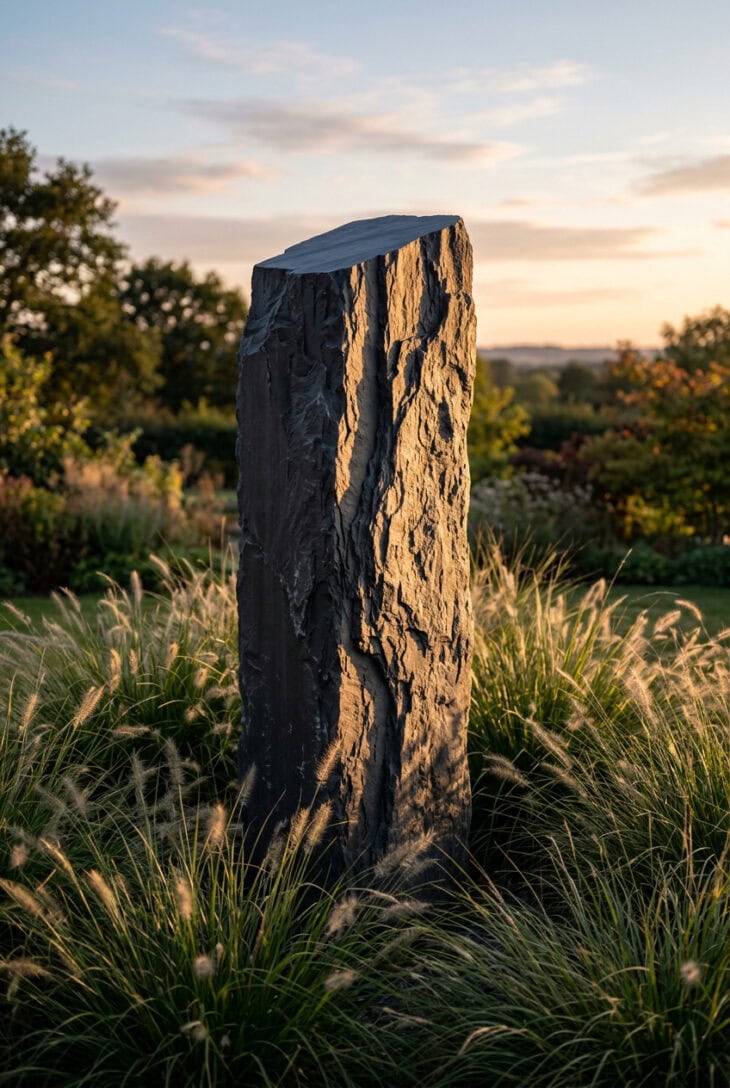
What you see One tall slab of dark slate stands upright out of a sea of fine grasses, its riven face rough and its top cut flat. Low evening sun rakes across it from the side, throwing every ridge and fracture into relief, and there is nothing else in the bed to compete with it.
Why it works Modern gardens are mostly horizontal (paving, decking, low planting), so a single strong vertical is what stops the whole thing from feeling flat. A raw stone monolith does that job while adding the one thing sleek gardens often lack, which is texture, and unlike a piece of sculpture it never looks like it is trying too hard.
How to get it Buy from a stone yard and pick the actual piece yourself, because the character of the face is everything. Bury at least a quarter of the total height for stability, in a hole backfilled with compacted crushed stone rather than concrete, so any movement can settle rather than crack. Getting a 6ft (180cm) slate upright is a two or three person job with a strap and a lever, so plan the route across the garden before it is delivered. Set it slightly off-centre in the bed and let the grasses grow right up to its base, which makes it look like it grew there instead of being installed.
23. Matte Cylinder Container Grouping
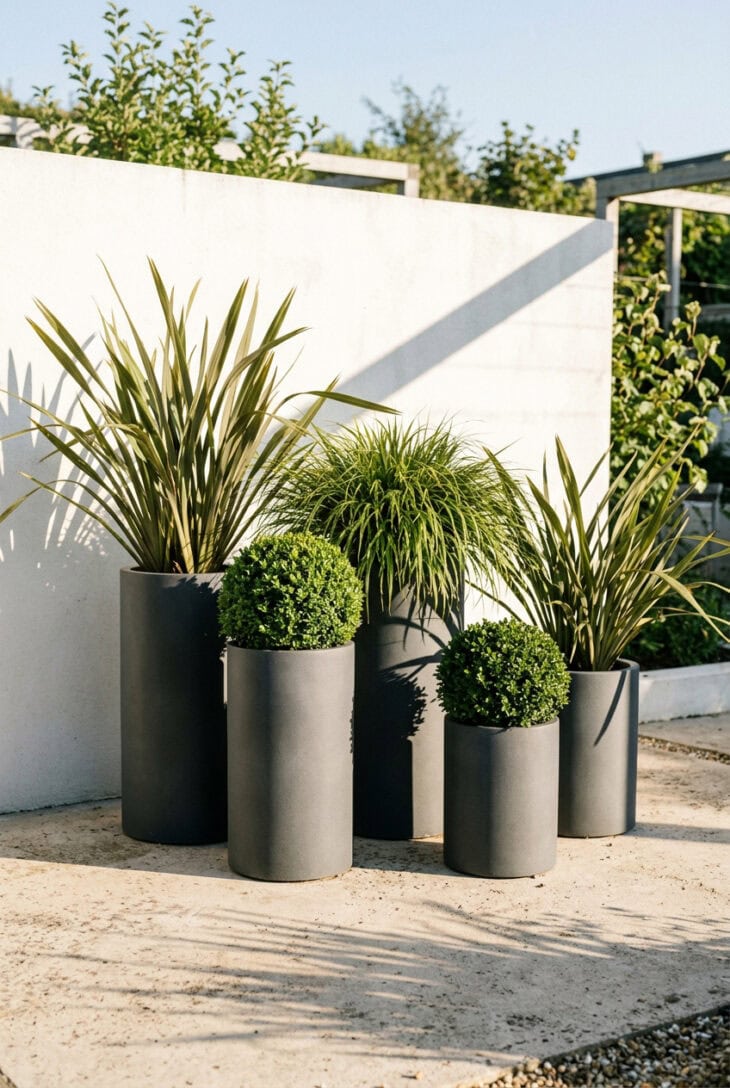
What you see Five matte charcoal cylinders stand shoulder to shoulder at three different heights, each holding one bold plant: a spiky flax, a clipped green ball, a fountain of grass. Long shadows stretch away across pale concrete, and the group reads as one object rather than five pots.
Why it works A scattering of mismatched pots is the fastest way to make a terrace look untidy. Grouping identical containers in varying heights does the opposite, because repetition of the pot shape gives the eye something stable while the varying heights give it interest. Matte finishes also photograph and weather far better than gloss glaze, which chips and reads dated.
How to get it Buy pots in one color and one profile, in at least three sizes, and use an odd number of them. Fiberglass and powder-coated aluminium are the sensible modern choices: both are light enough to move and neither cracks in frost, which is what will happen to a cheap terracotta or glazed pot. Give each container a single plant, not a mixed arrangement, since one plant per pot is what keeps the group graphic. New Zealand flax (Phormium spp.) gives the spikes, a clipped boxwood ball the solid form, and a grass the movement. There are more combinations in our guide to container garden ideas.
24. Prairie-Modern Perennial Border
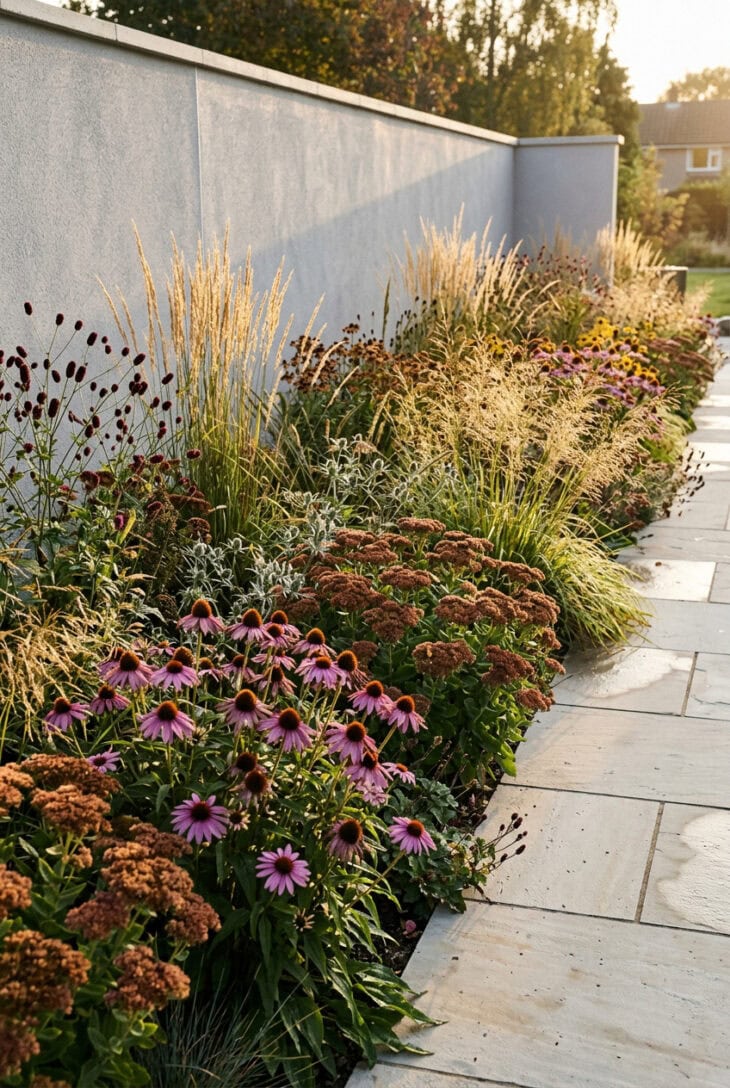
What you see Drifts of purple coneflower, rust-brown sedum heads, and tall airy grasses run together in a loose late-summer haze, all seedheads and muted color. Right alongside, the paving is razor sharp and the rendered wall is smooth and white, so the planting looks wilder than it is.
Why it works This is the modern border, and its whole logic is the tension between loose planting and a hard frame. Left in a cottage garden the same plants would look merely pretty, but set against clean geometry they read as deliberate and wild at once. The palette is deliberately muted, and the seedheads are left standing into winter, which is what carries the border through the dead months.
How to get it Choose perennials that die well, meaning ones with structural seedheads that stand through frost. Purple coneflower (Echinacea purpurea), black-eyed Susan (Rudbeckia hirta), and salvia (Salvia nemorosa ‘Caradonna’) are the backbone, threaded through with grasses at roughly one grass to every three perennials. Plant in repeating drifts of 5 to 9 of each, and resist adding a new species: a short list, endlessly repeated, is the entire technique. Cut the whole border to the ground in one go in late February, not in autumn, and lift and divide the clumps every third year. It pairs naturally with our flower bed ideas for a softer take.
25. Minimalist Gravel and Boulder Garden
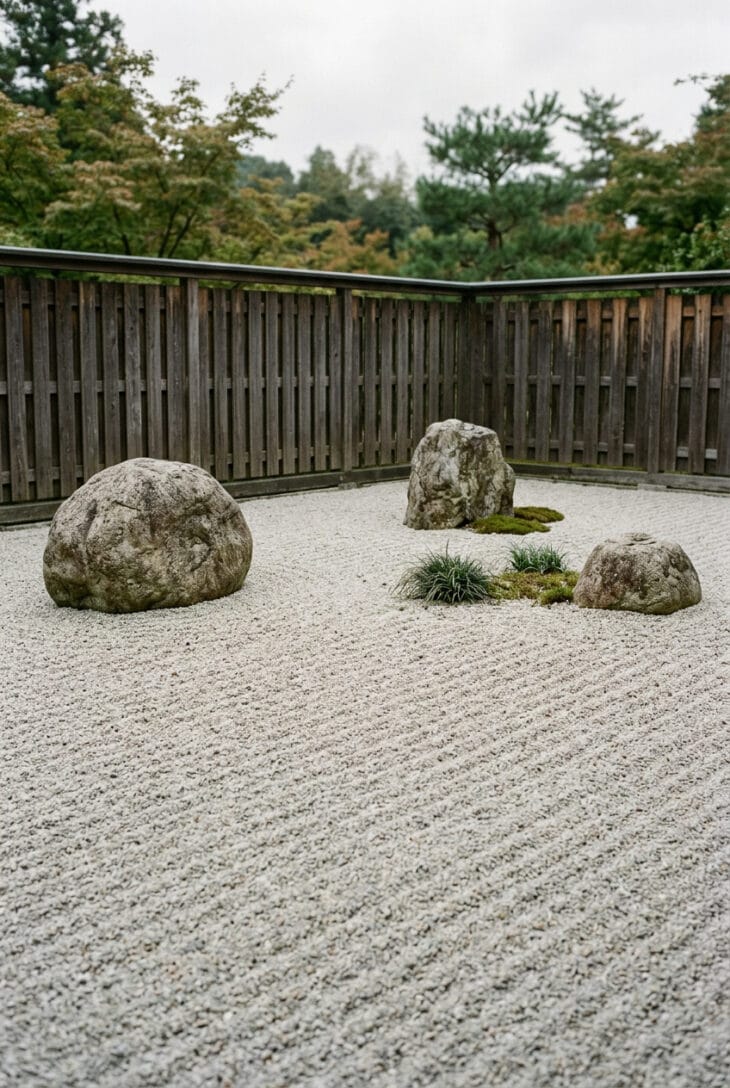
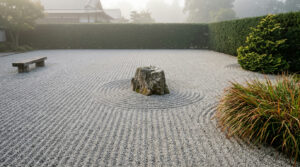
What you see Pale grey gravel is raked smooth and almost empty, broken only by three rounded granite boulders of different sizes and a few low tufts of grass. There is far more space than object, and the soft overcast light makes the whole thing feel silent.
Why it works This is the hardest idea on the list to pull off, because it depends entirely on restraint. With so few elements, the placement of each one carries all the weight, and getting it right produces a garden that is genuinely restful in a way a full border never is. It is also close to maintenance free and uses no water at all.
How to get it Use an odd number of boulders in clearly different sizes, never the same size, and never in a straight line. Bury each one by at least a third of its height so it looks embedded rather than dropped, and turn its best face toward the main viewpoint from the house. Lay a permeable membrane and 2in (5cm) of angular gravel, which locks together and stays raked, unlike rounded pea shingle that shifts underfoot. Then stop, and add nothing else for a season. If you want a slightly greener version of the same idea, our gravel garden ideas and low-maintenance garden ideas are the natural next step.
26. Contemporary Courtyard with Japanese Maple
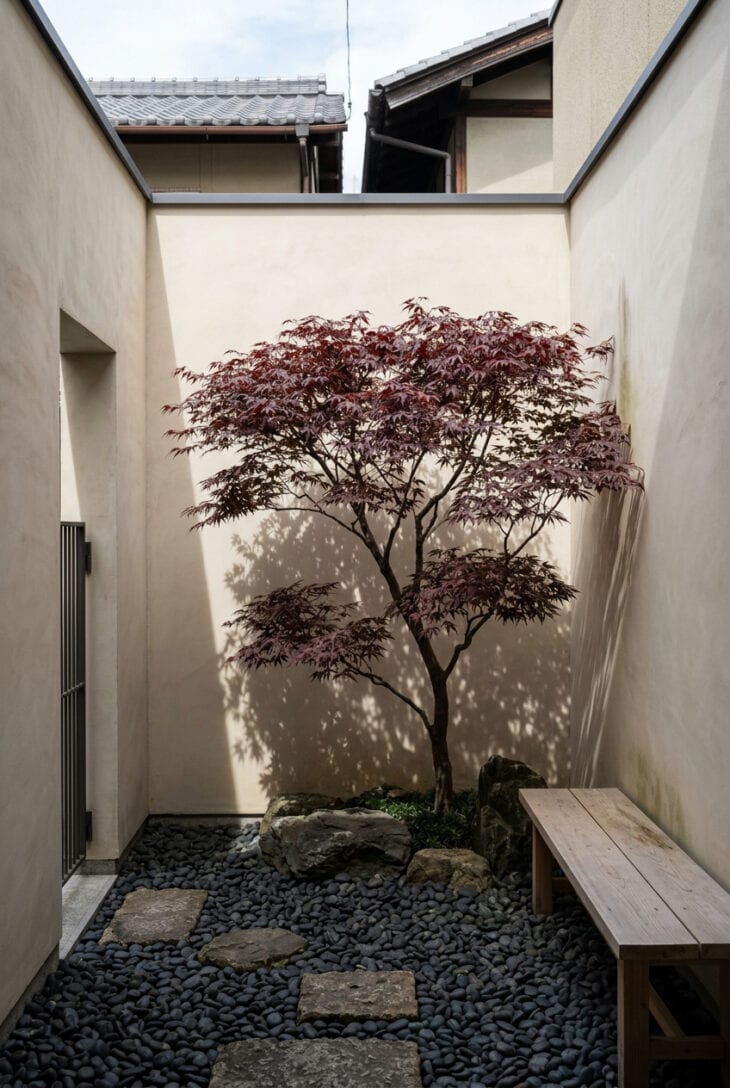
What you see A single Japanese maple with deep burgundy leaves rises out of black pebbles in a small courtyard of smooth pale walls. Its fine foliage throws a delicate moving shadow across the render behind, and one simple timber bench sits beneath it. Nothing else is needed.
Why it works A courtyard is a room, and a room needs one focal point, not five. A Japanese maple is the ideal candidate: it stays small, it has a naturally layered branch structure that looks composed even bare in winter, and the shadow it casts on a plain wall gives you a second, moving artwork for free.
How to get it Japanese maple (Acer palmatum ‘Bloodgood’ for deep burgundy, ‘Sango-kaku’ for coral winter stems) wants shelter above all: scorching wind and hot afternoon sun burn the leaf edges brown, which is the single most common way people kill the look. A north or east-facing courtyard is close to ideal. Give it neutral to slightly acid soil, keep it evenly moist but never waterlogged, and mulch with 2in (5cm) of composted bark. Prune only in midwinter, and only to remove crossing branches, since a maple’s natural shape is the whole reason you planted it.
27. Built-In Rendered Seating Wall
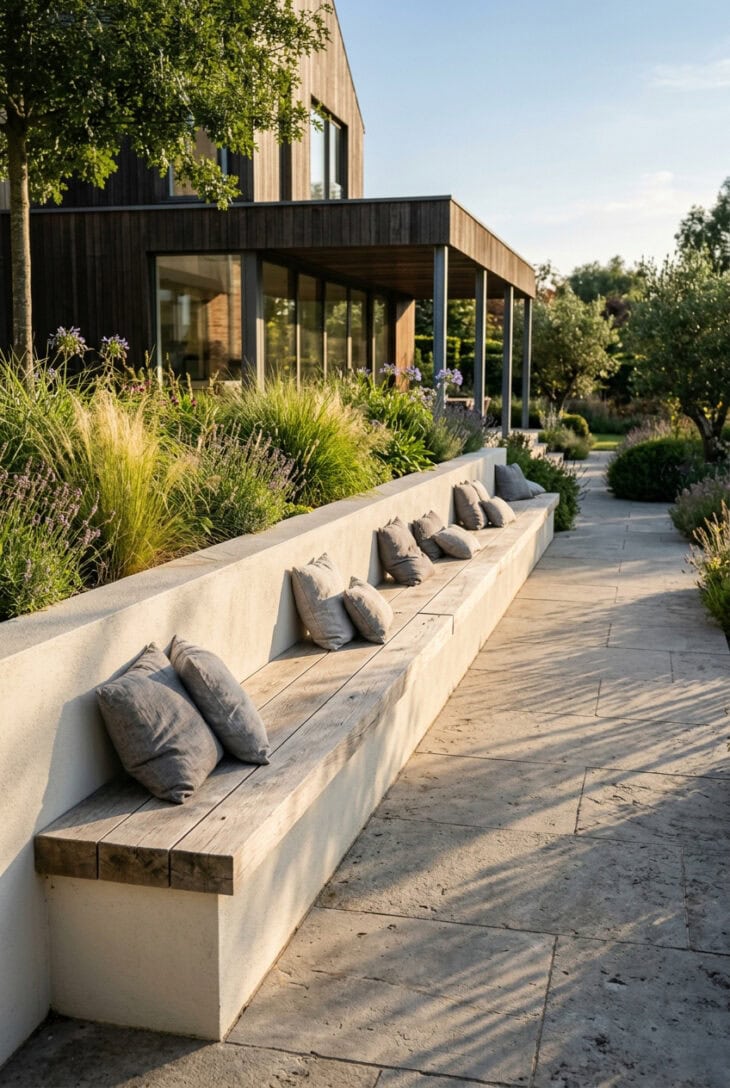
What you see A low off-white wall runs the length of the terrace, capped with a thick slab of pale timber that turns it into a bench, softened with a few grey cushions. Behind it, a raised bed of grasses sits at exactly the same height, so the wall reads as part of the garden’s structure rather than as furniture.
Why it works Built-in seating gives you somewhere for eight people to sit that takes up no floor space and never needs putting away for winter. It doubles as a retaining wall for the bed behind, so one structure earns its keep twice, and it keeps the terrace clear of the mismatched chairs that clutter most gardens.
How to get it Build the wall to a seat height of 17 to 18in (43 to 45cm) including the top slab, which is the height that feels right to almost everyone, and make it at least 16in (40cm) deep so it is comfortable to sit on properly. Use a fiber-reinforced exterior render or a silicone render, not an interior mix, and paint it with a breathable masonry paint so trapped moisture does not blow the surface. Cap it with hardwood or a stone slab that overhangs the render by an inch on each side, which throws rain clear of the wall and stops the dirty streaking that ruins so many rendered walls. Store cushions in a bench box or bring them in, because nothing looks worse than a sodden cushion.
28. Green Joints in Paving
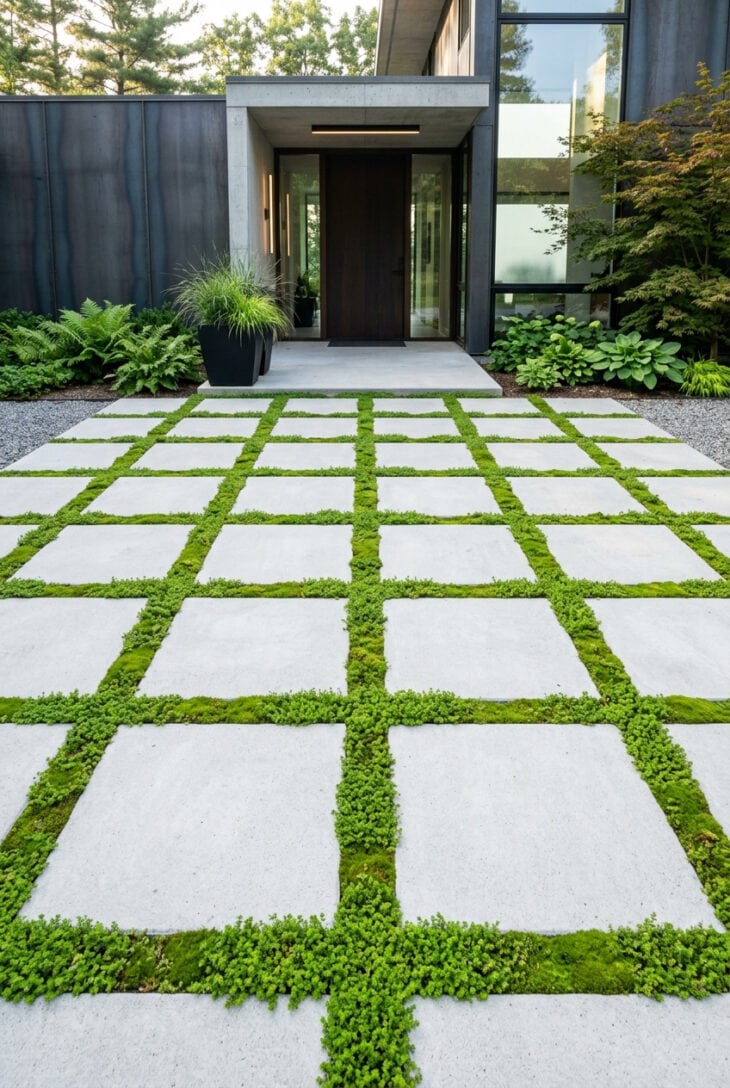
What you see Big pale square pavers are laid with generous gaps between them, and every joint is filled with a lush green strip of creeping thyme and moss growing level with the stone. The result is a graphic green grid drawn straight across a hard surface, soft underfoot and quietly alive.
Why it works This is a modern garden’s answer to the paving versus planting question: do both, in the same square foot. It breaks up a large hard surface without giving up any usable ground, it lets rainwater soak away instead of running off, and it produces a strong pattern from nothing but the joints you had to detail anyway.
How to get it Lay the pavers on a compacted crushed stone and grit base, never a solid mortar bed, since the plants need something to root into and water needs somewhere to go. Set the joints at 2 to 3in (5 to 8cm) wide and fill them with a free-draining mix of topsoil and grit, kept a little below the paver surface. Creeping thyme (Thymus serpyllum) takes light foot traffic and smells wonderful when trodden on, while Irish moss (Sagina subulata) gives the tightest, greenest carpet in cooler shade. Water daily for the first three weeks, keep off it for a month while it roots, and accept it will take a season to knit fully.
29. Cantilevered Floating Steps
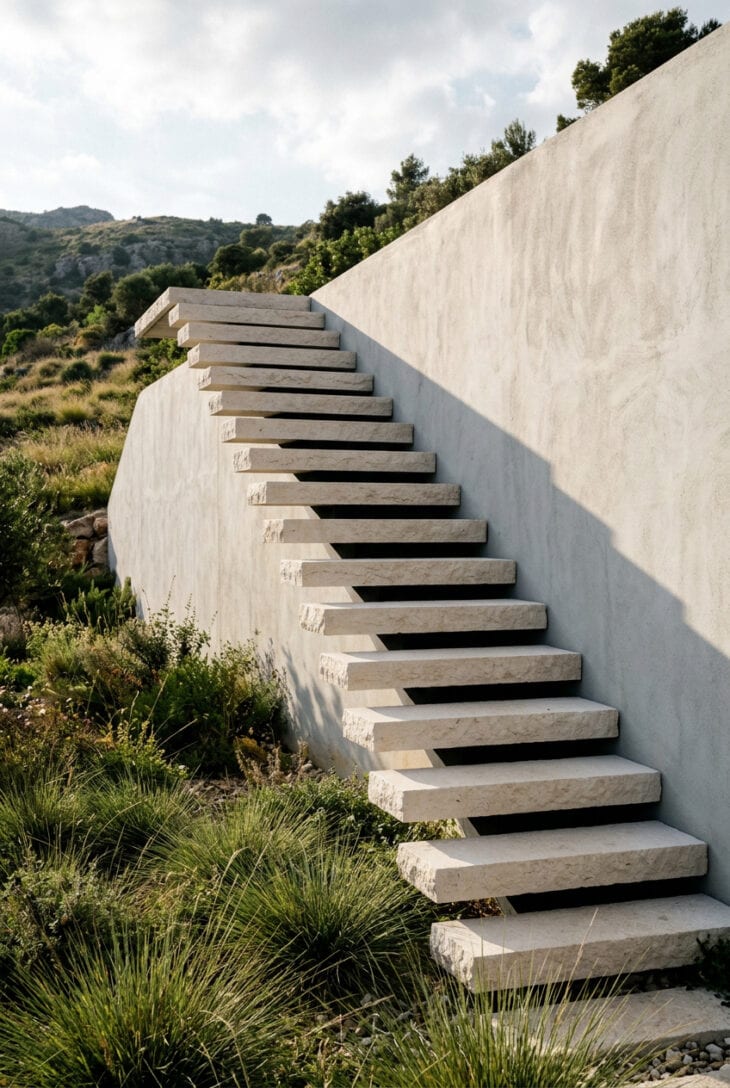
What you see Thick pale stone treads project straight out of a smooth rendered wall with nothing visible holding them up, a deep band of shadow beneath each one. Grasses grow at the foot of the flight, and the steps seem to climb the wall of their own accord.
Why it works Steps are usually the heaviest, most solid thing in a sloping garden. Cantilevering them removes all that visual mass at a stroke, so a change of level stops feeling like an obstacle and starts feeling like a feature. The shadow gaps also do something no ordinary flight can: they draw a series of hard dark lines across the wall that change through the day.
How to get it This is one to hand to a professional, because each tread must be built into the supporting wall on a steel or concrete corbel sized for the load, and a tread that works loose is a genuine hazard. Keep treads a consistent 6 to 7in (15 to 18cm) rise and at least 12in (30cm) deep, since inconsistent risers are what trip people up. Specify a slip-resistant finish, and consider running a recessed LED strip under each nose, which pairs perfectly with the shadow gap that is already there. On a steep site this detail transforms a bank that was previously just something you walked around.
30. Black Plunge Pool
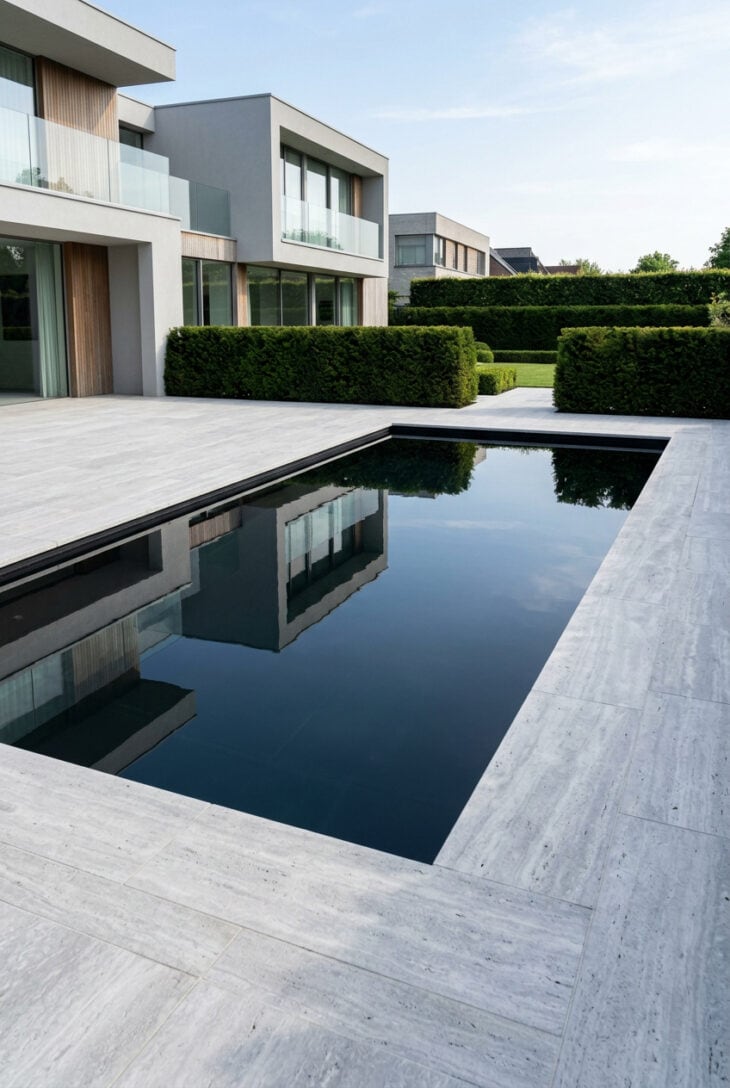
What you see A compact rectangle of black water sits flush in pale grey stone, so still that it mirrors the house and the clipped hedges behind it. There is no raised coping, no rail, and no pool furniture, so from a few feet away it could as easily be a reflection pool as somewhere to swim.
Why it works A black interior is what separates a modern pool from a suburban one. It absorbs light instead of bouncing it back as that familiar bright turquoise, so the water reads as a dark mirror that reflects the garden rather than shouting about itself, and it warms up noticeably faster in the sun. Keeping the pool small and flush with the terrace does the rest.
How to get it A plunge pool of around 12 x 8ft (360 x 240cm) and 4ft (120cm) deep costs a fraction of a full pool, fits a normal backyard, and still gives you somewhere to cool off. Get the black finish from a dark plaster, a dark tile, or a dark liner, and know that dust and leaf debris show up more against black, so expect to skim it more often. Check local rules on fencing and safety covers before you dig, since they usually apply to any body of water over a certain depth. Plant the surround with something evergreen and non-shedding: clipped yew (Taxus baccata) is ideal, and never plant a deciduous tree upwind of a pool unless you enjoy skimming.