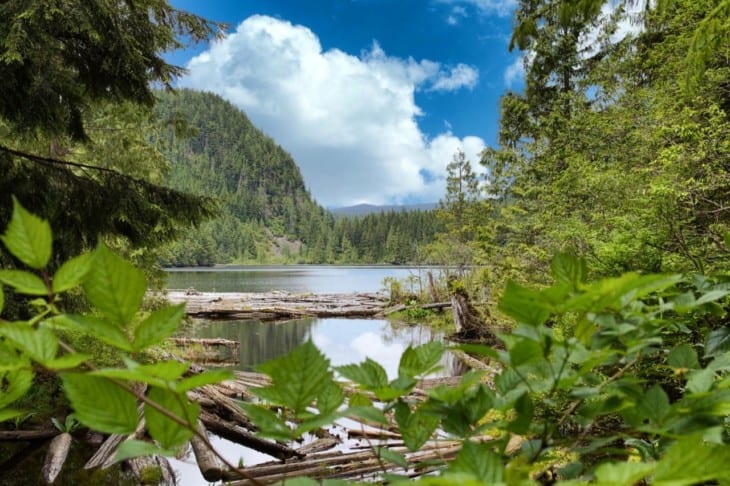
Washington’s most common trees are conifers. West of the Cascades, where winters are wet and mild, the forests are Douglas fir, western hemlock and western red cedar, with Sitka spruce in the coastal rainforests and red alder, bigleaf maple and black cottonwood along rivers and in logged land. East of the Cascades, in the rain shadow, ponderosa pine, Douglas fir, western larch and lodgepole pine grow on the mountain slopes, and the lowlands are sagebrush steppe and farmland. Western hemlock has been Washington’s state tree since 1947.
Contents
- Western Washington: Coast, Olympics and Puget Sound
- Douglas Fir (Pseudotsuga menziesii)
- Western Hemlock (Tsuga heterophylla)
- Western Red Cedar (Thuja plicata)
- Sitka Spruce (Picea sitchensis)
- Grand Fir (Abies grandis)
- Pacific Silver Fir (Abies amabilis)
- Red Alder (Alnus rubra)
- Bigleaf Maple (Acer macrophyllum)
- Vine Maple (Acer circinatum)
- Pacific Dogwood (Cornus nuttallii)
- Pacific Yew (Taxus brevifolia)
- Pacific Madrone (Arbutus menziesii)
- Oregon White Oak (Garry Oak) (Quercus garryana)
- Black Cottonwood (Populus trichocarpa)
- Cascara (Frangula purshiana)
- High in the Cascades and Olympics
- Eastern Washington
- Don’t Plant These Invasive Trees
- How to Identify Washington’s Common Conifers
This guide covers 27 native trees you are most likely to see in Washington, grouped by region, and 3 widely planted trees that you shouldn’t plant because they invade the state’s forests.

- Western Washington: Coast, Olympics and Puget Sound
- High in the Cascades and Olympics
- Eastern Washington
- Don’t Plant These Invasive Trees
- How to Identify Washington’s Common Conifers
| Tree | Botanical name | Where you’ll see it in Washington |
|---|---|---|
| Douglas Fir | Pseudotsuga menziesii | Forests statewide; dominant in the Puget lowlands and western Cascades |
| Western Hemlock | Tsuga heterophylla | Moist forests west of the Cascades and in the northeast; the state tree |
| Western Red Cedar | Thuja plicata | Moist and wet forests west of the Cascades; also northeastern Washington |
| Sitka Spruce | Picea sitchensis | A narrow belt along the coast; the Olympic Peninsula rainforests |
| Grand Fir | Abies grandis | Lowland and valley forests on both sides of the Cascades |
| Pacific Silver Fir | Abies amabilis | Western slopes of the Cascades and Olympics, about 2,000 to 5,000 ft |
| Red Alder | Alnus rubra | Streams, wet slopes and logged land west of the Cascades |
| Bigleaf Maple | Acer macrophyllum | Stream banks, valley floors and mixed forests west of the Cascades |
| Vine Maple | Acer circinatum | Forest understory and clearings west of the Cascades |
| Pacific Dogwood | Cornus nuttallii | Understory of mixed forests west of the Cascades |
| Pacific Yew | Taxus brevifolia | Shady, moist forests and stream banks, scattered under conifers |
| Pacific Madrone | Arbutus menziesii | Dry, rocky bluffs around Puget Sound and the San Juan Islands |
| Oregon White Oak (Garry Oak) | Quercus garryana | Prairies of the south Puget Sound, the San Juan Islands and the Columbia River Gorge |
| Black Cottonwood | Populus trichocarpa | River banks and floodplains statewide |
| Cascara | Frangula purshiana | Moist forests and forest edges west of the Cascades |
| Mountain Hemlock | Tsuga mertensiana | Subalpine forests near timberline, in deep snow country |
| Subalpine Fir | Abies lasiocarpa | High mountains on both sides of the Cascades, and the Olympics |
| Alpine Larch (Subalpine Larch) | Larix lyallii | East side of the North Cascades, near timberline, about 5,800 to 7,500 ft |
| Whitebark Pine | Pinus albicaulis | High ridges near timberline, mainly on the east side of the Cascades |
| Engelmann Spruce | Picea engelmannii | High, cold forests on the east slope of the Cascades and in northeastern Washington |
| Ponderosa Pine | Pinus ponderosa | Lower slopes of the east Cascades, the Spokane area and the Blue Mountains |
| Lodgepole Pine | Pinus contorta | East slope of the Cascades, northeastern mountains; shore pine on the coast |
| Western Larch | Larix occidentalis | East slope of the Cascades, northeastern Washington and the Blue Mountains |
| Western White Pine | Pinus monticola | Northeastern Washington, and moist forests in the Cascades and Olympics |
| Quaking Aspen | Populus tremuloides | Moist spots in eastern Washington, especially the northeast |
| Paper Birch | Betula papyrifera | Northeastern Washington, and scattered in the west |
| Western Juniper | Juniperus occidentalis | Dry, rocky hills of south-central Washington, near the Columbia River |
| English Holly | Ilex aquifolium | No, invasive: forests and parks around Puget Sound |
| English Laurel (Cherry Laurel) | Prunus laurocerasus | No, invasive: forests, ravines and greenbelts west of the Cascades |
| English Hawthorn | Crataegus monogyna | No, invasive: pastures, fence rows and forest edges west of the Cascades |
Western Washington: Coast, Olympics and Puget Sound
Douglas Fir (Pseudotsuga menziesii)

Douglas fir is Washington’s most common and most valuable timber tree. West of the Cascades it commonly grows 150 to 250 feet tall, with a straight trunk bare of branches for much of its height. Its soft, flat needles spread all around the twig. The cones are the easiest way to identify it: three-pointed bracts stick out from under each scale. Old trees have very thick, corky bark that protects them from fire. Despite the name, it isn’t a true fir.
Western Hemlock (Tsuga heterophylla)
Western hemlock is Washington’s state tree. It grows 125 to 200 feet tall and has a drooping top, or leader, that you can spot from far away. Its short, flat needles come in mixed lengths on the same twig and have two white bands underneath, and its small cones are only about an inch long. It is the most shade-tolerant large tree in the region, so it grows up in the shade of Douglas firs and slowly replaces them in old forests.
Western Red Cedar (Thuja plicata)

Western red cedar is in the cypress family, not a true cedar. It grows 150 to 200 feet tall, with a flared, buttressed base and reddish-brown bark that peels in long, stringy strips. Its scale-like leaves grow in flat, drooping sprays with white bow-tie marks underneath. Trees can live more than 1,000 years. Its rot-resistant wood is used for siding, shingles and decks, and the Native peoples of the coast used it for canoes, longhouses, clothing and baskets.
Sitka Spruce (Picea sitchensis)

Sitka spruce is the largest spruce in the world, often 160 to 230 feet tall. In Washington it grows only near the coast, where fog and rain keep the air moist all year, and it reaches its greatest size in the Hoh, Queets and Quinault rainforests of the Olympic Peninsula. Its stiff, sharp needles stick out all around the twig and hurt to grab. The thin, gray bark flakes off in small, round scales.
Grand Fir (Abies grandis)
Grand fir is a tall true fir, 130 to 200 feet, with glossy, flat needles that lie in two neat, flat rows on the sides of the twig. The needles have a notched tip, two white lines underneath and a citrus smell when crushed. Its cones stand upright on the top branches and fall apart there. It grows in the Puget lowlands and in moister forests east of the Cascades.
Pacific Silver Fir (Abies amabilis)
Pacific silver fir is the main tree of the middle elevations on the wet side of the mountains, above the Douglas fir and western hemlock forests. It grows 100 to 180 feet tall, with smooth, pale gray bark dotted with resin blisters. Its needles are dark, glossy green above and bright silvery-white underneath, and those on top of the twig point forward, covering it. It handles deep snow and shade well.
Red Alder (Alnus rubra)

Red alder is the most common broadleaf tree in the Pacific Northwest. It grows 40 to 80 feet tall and quickly fills in logged land, burns and stream banks. Its smooth bark is gray, often with white patches of lichen, and the inner bark turns rusty red when cut or scraped. Its oval, toothed leaves stay green until they fall. Bacteria in its root nodules fix nitrogen, so alder enriches the soil for the conifers that follow it.
Bigleaf Maple (Acer macrophyllum)

Bigleaf maple has the largest leaves of any maple, usually 6 to 12 inches across and sometimes much bigger, with five deep lobes. It grows 50 to 100 feet tall with a broad crown. In the wet forests its trunk and branches are often covered in thick moss and licorice ferns. Its leaves turn yellow in fall, and its winged seeds hang in large clusters.
Vine Maple (Acer circinatum)

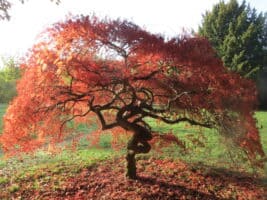
Vine maple is a small tree or large shrub, usually 15 to 25 feet tall, with several crooked stems that sprawl under the conifers. Its round leaves have seven to nine shallow lobes, and they turn orange and red in fall, especially in open sunny spots. Where its long stems bend down and touch the ground, they can take root. It is a popular native tree for small Washington gardens.
Pacific Dogwood (Cornus nuttallii)

Pacific dogwood is a small tree, 20 to 50 feet tall, that grows in the shade of taller conifers. In spring it is covered in what look like large white flowers. Each is really a cluster of tiny greenish flowers surrounded by four to seven white bracts, often 4 to 6 inches across. Clusters of red berries follow in fall, and the leaves turn pink and red. A fungal disease, dogwood anthracnose, has killed many trees in moist, shady sites.
Pacific Yew (Taxus brevifolia)

Pacific yew is a small, slow-growing tree, usually 15 to 40 feet tall, that grows in the shade of old-growth forests. Its flat, dark green needles grow in two rows, and its thin, reddish-purple bark peels in scales. Instead of cones it has single seeds, each held in a fleshy red cup. The cancer drug paclitaxel (Taxol) was first found in its bark. All parts except the red flesh around the seed are poisonous.
Pacific Madrone (Arbutus menziesii)

Pacific madrone is a broadleaf evergreen tree, 20 to 80 feet tall, often leaning out over the water from dry bluffs and rocky shores. It is easy to recognize by its smooth, orange-red bark, which peels in thin, papery sheets to show green new bark beneath. It has thick, glossy leaves, clusters of white, bell-shaped flowers in spring and orange-red berries in fall that birds love. It is related to manzanita and strawberry tree.
Oregon White Oak (Garry Oak) (Quercus garryana)
Read our guide to Oregon White Oak (Garry Oak)

Oregon white oak is Washington’s only native oak. It grows 40 to 90 feet tall, with a broad, rounded crown, gray, furrowed bark and leathery leaves with deep, rounded lobes. In Washington it grows on dry prairies and rocky slopes, where fire once kept conifers out. Much of its habitat around Puget Sound has been lost to development and to invading Douglas firs, so the remaining oak prairies are protected in places.
Black Cottonwood (Populus trichocarpa)

Black cottonwood is the tallest broadleaf tree in the Pacific Northwest, often 100 to 150 feet. Its triangular leaves are dark, shiny green above and silvery-white underneath. In spring its sticky buds give off a sweet, balsam smell, and in early summer female trees release masses of cottony seeds. It grows very fast along rivers on both sides of the Cascades, and its roots seek out water, so keep it away from pipes and foundations.
Cascara (Frangula purshiana)
Cascara is a small tree, 15 to 30 feet tall, with smooth, silvery-gray bark and oval leaves with prominent, parallel veins running to the edge. It has tiny greenish flowers in spring and small, blue-black berries in summer, which birds eat. Its bark was harvested for more than a century as a laxative called cascara sagrada, and heavy stripping killed many wild trees.
High in the Cascades and Olympics
Mountain Hemlock (Tsuga mertensiana)

Mountain hemlock grows high in the mountains, where snow lies deep for much of the year. It is usually 50 to 100 feet tall in the forest and stunted near timberline, with a drooping top like western hemlock. Its needles are different: blue-green, thick and arranged all around the twig in star-like tufts. Its cones are longer, 1 to 3 inches, and purple when young.
Subalpine Fir (Abies lasiocarpa)
Subalpine fir has a very narrow, spire-shaped crown that sheds heavy snow, and it is one of the most recognizable trees of the high meadows. It grows 50 to 100 feet tall in sheltered forest, but near timberline it forms low, sprawling clumps. Its flat, soft needles curve upward along the twig, and its dark purple cones stand upright on the top branches.
Alpine Larch (Subalpine Larch) (Larix lyallii)

Alpine larch grows at the very edge of the treeline on the east slopes of the North Cascades, in places such as the Enchantments and around Maple Pass and Blue Lake. It is a deciduous conifer: its soft, four-sided needles grow in tufts, turn bright gold in late September and early October and then drop. It is usually 30 to 80 feet tall, and it can survive extreme cold, wind and thin, rocky soil. Hiking to see the larches in fall is a Washington tradition.
Whitebark Pine (Pinus albicaulis)
Whitebark pine is a slow-growing, often twisted pine of high, windy ridges, with needles in bundles of five and pale, smooth bark. Its purplish cones don’t open on their own. Clark’s nutcrackers break them apart and bury the seeds, and forgotten seeds grow into new trees. White pine blister rust, bark beetles and fire have killed many whitebark pines, and it was listed as a threatened species in 2022.
Engelmann Spruce (Picea engelmannii)

Engelmann spruce grows in cold forests and along streams high in the mountains east of the Cascade crest. It is 80 to 120 feet tall, with a narrow, pointed crown and short, four-sided needles. The small cones, 1 to 2.5 inches long, have thin, papery scales. It often grows with subalpine fir.
Eastern Washington
Ponderosa Pine (Pinus ponderosa)

Ponderosa pine is the most common pine in eastern Washington, where it forms open, park-like forests at the edge of the steppe. Its long needles, 5 to 10 inches, grow in bundles of three, and old trees have thick, orange-brown bark in large plates that smells of vanilla or butterscotch on a warm day. It grows 60 to 130 feet tall. Its thick bark protects it from the frequent low fires that once burned through these forests.
Lodgepole Pine (Pinus contorta)

Lodgepole pine forms dense stands of straight, slender trunks east of the Cascades, especially after fires, because many of its cones stay closed until heat opens them. Its needles grow in pairs and are short and often twisted. It grows 50 to 80 feet tall. Along the coast and around Puget Sound, a short, crooked form called shore pine (P. contorta var. contorta) grows on dunes, bogs and rocky shores.
Western Larch (Larix occidentalis)

Western larch is the largest larch in the world, often 100 to 180 feet tall. Like alpine larch, it is a deciduous conifer, and its soft needles turn golden-yellow in October before they drop, lighting up whole mountainsides in the northeast. It has very thick bark and high branches, so it survives fires that kill other trees. Its strong, heavy wood is used for flooring, beams and poles.
Western White Pine (Pinus monticola)

Western white pine has soft, blue-green needles in bundles of five and long, slender cones, 6 to 10 inches, that hang from the upper branches. It grows 100 to 180 feet tall. It was once a major timber tree in the Inland Northwest, but white pine blister rust, a disease introduced around 1910, killed most of the big trees. Rust-resistant seedlings are now being planted. It is Idaho’s state tree.
Quaking Aspen (Populus tremuloides)
Read our guide to Quaking Aspen

Quaking aspen has smooth, white bark with black scars, and round leaves on flattened stalks that tremble in the slightest breeze. In fall it turns a clear gold. It spreads by root suckers into groves of many trunks that are all one plant. It usually grows 20 to 60 feet tall around meadows, springs and streams east of the Cascades.
Paper Birch (Betula papyrifera)

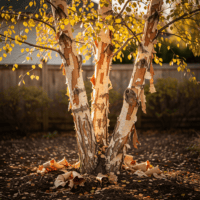
Paper birch has the bright white bark that peels in thin, papery strips. In Washington it grows mainly in the moist forests of the northeast, around Colville and the Pend Oreille River, usually 50 to 70 feet tall. Its oval, toothed leaves turn yellow in fall. It needs cool summers, and planted trees west of the Cascades often suffer from heat and birch borers.
Western Juniper (Juniperus occidentalis)
Western juniper reaches the northern edge of its range in Washington, where it grows in scattered stands on dry, rocky ground near the Columbia River. It is a small, often bushy tree, 15 to 30 feet tall, with shreddy, reddish-brown bark, tiny scale-like leaves and blue-black, berry-like cones with a whitish bloom. It is much more common in central Oregon.
Don’t Plant These Invasive Trees
These three trees were planted in western Washington gardens for decades. Birds spread their berries into forests, where they grow in the shade and crowd out native plants.
English Holly (Ilex aquifolium)

English holly was widely planted in western Washington for its glossy, spiny leaves and red berries, and it is still grown commercially for Christmas greenery. Birds spread the berries into forests, where the shade-tolerant seedlings grow into dense thickets. It is now one of the most common invasive plants in Seattle-area parks. Pull seedlings while they are small. Tall Oregon grape is a good native alternative.
English Laurel (Cherry Laurel) (Prunus laurocerasus)

English laurel is a fast-growing evergreen hedge with large, glossy leaves, spikes of white flowers in spring and black, cherry-like fruit. It has been planted as a privacy hedge all over the Puget Sound area, and birds spread its seeds into nearby woods, where it forms dense stands. Its leaves and seeds contain compounds that release cyanide. It is also hard to remove and resprouts from the stump. Native alternatives include evergreen huckleberry and Pacific wax myrtle.
English Hawthorn (Crataegus monogyna)

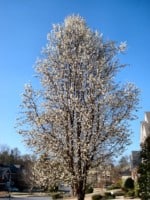
English hawthorn is a European hedge tree, 15 to 30 feet tall, with deeply lobed leaves, thorns, white flowers in spring and red berries in fall. Birds spread it into pastures, oak prairies and forest edges, where it forms thorny thickets, and it hybridizes with the native black hawthorn. Native black hawthorn, Pacific crabapple or serviceberry are better choices.
How to Identify Washington’s Common Conifers
| If the needles… | It’s probably |
|---|---|
| Are flat and soft, spread all around the twig, and the cones have three-pointed bracts | Douglas fir |
| Are flat, of mixed lengths, and the tree has a drooping top | Western hemlock |
| Are blue-green, in star-like tufts, high in the mountains | Mountain hemlock |
| Are scale-like, in flat sprays with white bow-tie marks underneath | Western red cedar |
| Are flat, glossy, in two neat rows, and smell of citrus | Grand fir |
| Are silvery-white underneath and point forward on top of the twig | Pacific silver fir |
| Are stiff and sharp enough to hurt, near the coast | Sitka spruce |
| Come in bundles of 3, 5 to 10 in. long | Ponderosa pine |
| Come in bundles of 2, short and twisted | Lodgepole or shore pine |
| Come in bundles of 5, with long, slender cones | Western white pine |
| Turn gold and fall off in autumn | Western larch or alpine larch |
Washington’s neighbor to the south shares most of these trees; see our guide to trees in Oregon.