

South Carolina runs from the Blue Ridge in the Upstate, across the Piedmont and the Sandhills, down to the Lowcountry marshes. The trees change with it: hemlock and sourwood in the mountains, oak-hickory and loblolly pine in the Piedmont, turkey oak on the sandhills, and live oak, cabbage palmetto and bald cypress along the coast. About two-thirds of the state is forested.
Contents
- Common Trees in South Carolina
- Cabbage Palmetto (Sabal palmetto)
- Red Maple (Acer rubrum)
- Sassafras (Sassafras albidum)
- Sweetgum (Liquidambar styraciflua)
- American Sycamore (Platanus occidentalis)
- Loblolly Pine (Pinus taeda)
- Black Tupelo (Nyssa sylvatica)
- American Beech (Fagus grandifolia)
- American Holly (Ilex opaca)
- American Hornbeam (Carpinus caroliniana)
- Black Cherry (Prunus serotina)
- Winged Elm (Ulmus alata)
- Flowering Dogwood (Cornus florida)
- Eastern Redbud (Cercis canadensis)
- Southern Magnolia (Magnolia grandiflora)
- Tulip Tree (Liriodendron tulipifera)
- Mockernut Hickory (Carya tomentosa)
- Sourwood (Oxydendrum arboreum)
- Wax Myrtle (Morella cerifera)
- Bald Cypress (Taxodium distichum)
- Eastern Hemlock (Tsuga canadensis)
- Eastern Redcedar (Juniperus virginiana)
- Oak Trees in South Carolina
- Black Oak (Quercus velutina)
- Blackjack Oak (Quercus marilandica)
- Swamp Chestnut Oak (Quercus michauxii)
- Laurel Oak (Quercus laurifolia)
- Live Oak (Quercus virginiana)
- Northern Red Oak (Quercus rubra)
- Overcup Oak (Quercus lyrata)
- Post Oak (Quercus stellata)
- Southern Red Oak (Quercus falcata)
- Turkey Oak (Quercus laevis)
- Water Oak (Quercus nigra)
- White Oak (Quercus alba)
- Willow Oak (Quercus phellos)
This guide covers the trees you are most likely to see in South Carolina, followed by the state’s native oaks.
| Tree | Botanical name | Group | Native |
|---|---|---|---|
| Cabbage Palmetto | Sabal palmetto | Common | Yes |
| Red Maple | Acer rubrum | Common | Yes |
| Sassafras | Sassafras albidum | Common | Yes |
| Sweetgum | Liquidambar styraciflua | Common | Yes |
| American Sycamore | Platanus occidentalis | Common | Yes |
| Loblolly Pine | Pinus taeda | Common | Yes |
| Black Tupelo | Nyssa sylvatica | Common | Yes |
| American Beech | Fagus grandifolia | Common | Yes |
| American Holly | Ilex opaca | Common | Yes |
| American Hornbeam | Carpinus caroliniana | Common | Yes |
| Black Cherry | Prunus serotina | Common | Yes |
| Winged Elm | Ulmus alata | Common | Yes |
| Flowering Dogwood | Cornus florida | Common | Yes |
| Eastern Redbud | Cercis canadensis | Common | Yes |
| Southern Magnolia | Magnolia grandiflora | Common | Yes |
| Tulip Tree | Liriodendron tulipifera | Common | Yes |
| Mockernut Hickory | Carya tomentosa | Common | Yes |
| Sourwood | Oxydendrum arboreum | Common | Yes |
| Wax Myrtle | Morella cerifera | Common | Yes |
| Bald Cypress | Taxodium distichum | Common | Yes |
| Eastern Hemlock | Tsuga canadensis | Common | Yes |
| Eastern Redcedar | Juniperus virginiana | Common | Yes |
| Black Oak | Quercus velutina | Oak | Yes |
| Blackjack Oak | Quercus marilandica | Oak | Yes |
| Swamp Chestnut Oak | Quercus michauxii | Oak | Yes |
| Laurel Oak | Quercus laurifolia | Oak | Yes |
| Live Oak | Quercus virginiana | Oak | Yes |
| Northern Red Oak | Quercus rubra | Oak | Yes |
| Overcup Oak | Quercus lyrata | Oak | Yes |
| Post Oak | Quercus stellata | Oak | Yes |
| Southern Red Oak | Quercus falcata | Oak | Yes |
| Turkey Oak | Quercus laevis | Oak | Yes |
| Water Oak | Quercus nigra | Oak | Yes |
| White Oak | Quercus alba | Oak | Yes |
| Willow Oak | Quercus phellos | Oak | Yes |
Common Trees in South Carolina
Cabbage Palmetto (Sabal palmetto)
Read our guide to Cabbage Palmetto

The cabbage palmetto (sabal palm) is South Carolina’s state tree and appears on the state flag. It is native to the coast, where it grows up to about 65 feet on a single unbranched trunk, and it is widely planted inland as far as the Midlands. It shrugs off salt spray and hurricane winds. In 1776, palmetto-log walls absorbed British cannon fire at Fort Moultrie, which is how it became the state symbol.
Red Maple (Acer rubrum)
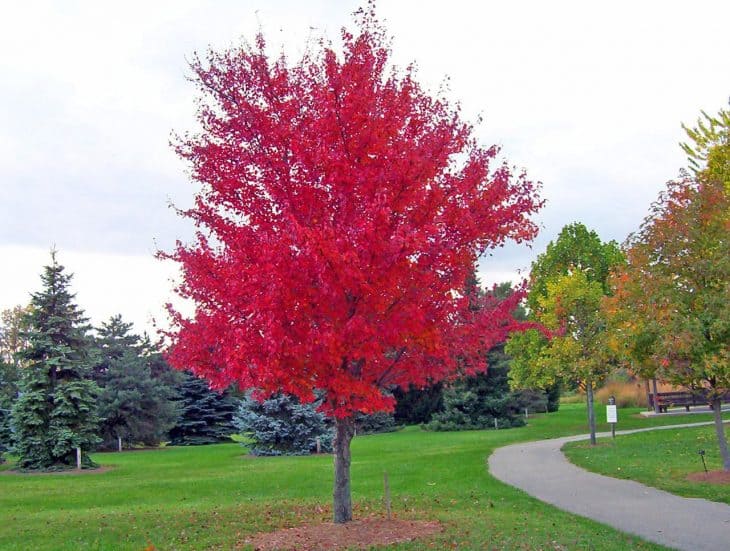
Red maple grows statewide, from Lowcountry swamps to mountain slopes, and is one of the most common trees in South Carolina. Red flowers open in late winter before the leaves, and the fall color ranges from yellow to scarlet. It is widely planted as a street tree and reaches 60 to 80 feet in the wild.
Sassafras (Sassafras albidum)

Sassafras is common along field edges and in young woods across the state and can reach about 60 feet. It spreads by root suckers, so it often forms thickets of small trunks. It has a spicy, root-beer scent and leaves in three shapes (oval, mitten and three-lobed) on the same tree.
Sweetgum (Liquidambar styraciflua)

Sweetgum is one of the most common hardwoods in the Southeast. It usually grows to about 60 to 80 feet on moist soils. The star-shaped leaves turn yellow, red and purple in fall, and the spiky round seed balls are a well-known nuisance in lawns.
American Sycamore (Platanus occidentalis)

American sycamore grows along rivers and streams across most of the eastern US. Its bark peels in patches to reveal white, cream and green underneath, which makes it easy to recognize from a distance. The leaves are large and maple-like, with three to five shallow lobes.
Loblolly Pine (Pinus taeda)

Loblolly pine is the dominant timber tree of South Carolina and often reaches 100 feet. It has needles in bundles of three, 6 to 9 inches long, and prickly reddish-brown cones. It grows fastest on moist sites. It is less wind-firm than longleaf pine, the tree that once covered the Coastal Plain, so hurricanes often snap or topple it.
Black Tupelo (Nyssa sylvatica)

Black tupelo (black gum) grows statewide, from swamp edges to dry uplands, and reaches about 60 feet. The glossy oval leaves turn brilliant scarlet in early fall. The small greenish spring flowers are good for bees, and the dark blue fruits are eaten by many birds.
American Beech (Fagus grandifolia)

American beech grows 60 to 80 feet tall on rich, moist, well-drained soils, mostly in the Piedmont and Upstate. It has smooth, light grey bark and oval, toothed leaves, dark green on top and paler underneath. Young trees hold their papery tan leaves through winter.
American Holly (Ilex opaca)

American holly is an evergreen understory tree with stiff, glossy leaves edged with spines. Female trees carry bright red berries through winter, which feed birds. It grows slowly to 15 to 30 feet and tolerates shade.
American Hornbeam (Carpinus caroliniana)

American hornbeam (ironwood or musclewood) is a small tree, usually 20 to 30 feet, of shaded stream banks and bottomlands. Its smooth grey trunk is fluted like a flexed muscle. The seeds feed songbirds, turkeys and squirrels.
Black Cherry (Prunus serotina)

Black cherry grows throughout South Carolina, often along fencerows where birds drop its seeds. Young trees have smooth bark with horizontal lenticels. On older trees the bark breaks into dark, curling plates often likened to burnt potato chips. Hanging clusters of white flowers in spring become small dark cherries eaten by birds. The wilted leaves are toxic to livestock.
Winged Elm (Ulmus alata)

Winged elm is a small to medium elm of the Southeast, common on dry uplands and old fields across the state. It is easy to identify by the thin, corky “wings” along its twigs. Its small leaves are rough on top.
Flowering Dogwood (Cornus florida)

Flowering dogwood is a small understory tree, 15 to 30 feet tall, found in woods throughout the state. Its white “petals” in April are really bracts around a cluster of tiny flowers. Red berries and red-purple leaves follow in fall. It prefers part shade and moist, acidic, well-drained soil.
Eastern Redbud (Cercis canadensis)

Eastern redbud covers its bare branches with rosy-pink flowers in early spring, then forms flat brown seed pods over summer. It grows 20 to 30 feet tall with heart-shaped leaves. It tolerates most soils and part shade.
Southern Magnolia (Magnolia grandiflora)
Read our guide to Southern Magnolia

Southern magnolia is native to the Coastal Plain and planted across the state. It is an evergreen with large, glossy leaves, rust-colored underneath, and huge fragrant white flowers in late spring and early summer. It can reach 80 feet and tolerates wet soils.
Tulip Tree (Liriodendron tulipifera)

Tulip tree (tulip poplar) is one of the tallest hardwoods in the East, commonly 80 to 100 feet. Its leaves have a distinctive square-cut, four-lobed shape and turn yellow in fall. Tulip-shaped yellow-green and orange flowers open high in the canopy in spring.
Mockernut Hickory (Carya tomentosa)

Mockernut is one of the most common hickories in South Carolina. Its bark is grey with tight, interlacing ridges. The leaves are compound, with 7 to 9 leaflets that are hairy underneath and smell fragrant when crushed. The thick-shelled nuts hold little meat, which is where the name “mockernut” comes from.
Sourwood (Oxydendrum arboreum)

Sourwood is a small tree of the Upstate and Piedmont. In early summer it bears drooping sprays of white, bell-shaped flowers, the source of the prized sourwood honey. Its leaves turn deep red early in fall and taste sour when chewed.
Wax Myrtle (Morella cerifera)

Wax myrtle is an evergreen shrub or small tree of the Coastal Plain and Midlands, often used as a fast screen. Its narrow leaves are dotted with aromatic resin glands, and female plants bear waxy grey-blue berries that colonists boiled to make bayberry candles. The bark is smooth and grey.
Bald Cypress (Taxodium distichum)

Bald cypress is the tree of the Lowcountry swamps, including the old-growth stand at Congaree National Park. It is a deciduous conifer: its soft, flat needles turn rusty orange and drop in fall. The bark is fibrous and reddish-brown. In standing water it forms buttressed trunks and knobby “knees”.
Eastern Hemlock (Tsuga canadensis)

In South Carolina, eastern hemlock grows only in the cool, moist ravines of the Blue Ridge in the Upstate. It is an evergreen conifer with short, flat needles that have two white lines underneath, and small cones. Many of the state’s hemlocks are being killed by the hemlock woolly adelgid, a sap-sucking insect.
Eastern Redcedar (Juniperus virginiana)

Eastern redcedar is an evergreen juniper common on old fields, fencerows and dry soils across the state. Its foliage is dark green in summer and often takes a bronze tint in winter. It makes a tough hedge or windbreak, and its blue berry-like cones feed cedar waxwings and other birds.
Oak Trees in South Carolina
South Carolina has more than 20 native oaks, from the huge live oaks of the Lowcountry, such as the Angel Oak on Johns Island, to the scrubby turkey oaks of the sandhills. Oaks fall into two groups: white oaks, whose acorns ripen in one season, and red oaks, whose acorns take two.
Black Oak (Quercus velutina)

Black oak is a red oak of dry upland woods, usually 50 to 80 feet tall. Its leaves are glossy dark green on top and yellowish-brown and slightly fuzzy underneath. The inner bark is bright orange-yellow and was once used as a dye.
Blackjack Oak (Quercus marilandica)

Blackjack oak is a small, slow-growing red oak, rarely over 40 feet, of the dry sandhills and poor, sandy soils. It has broad leaves shaped like a bell or a wide T, and nearly black, blocky bark. The acorns take about 18 months to mature. Its wood burns hot, but it pops and sparks in an open fireplace.
Swamp Chestnut Oak (Quercus michauxii)

Swamp chestnut oak is a white oak of Coastal Plain bottomlands, about 65 feet tall. Its leaves are 4 to 11 inches long with rounded, wavy teeth and turn red in fall. The large acorns, up to 1.5 inches long, are sweet and heavily eaten by wildlife and cattle, which gives it the nickname “cow oak”.
Laurel Oak (Quercus laurifolia)

Laurel oak (swamp laurel oak) is a fast-growing, semi-evergreen oak of the Coastal Plain, 65 to 80 feet tall. Its narrow leaves are 1 to 5 inches long and hang on into late winter. It is popular as a shade tree but lives only 50 to 70 years, which is short for an oak. Its acorns feed turkeys, raccoons and ducks.
Live Oak (Quercus virginiana)

Southern live oak is the defining tree of the Lowcountry, often draped in Spanish moss. It rarely exceeds 60 feet tall, but its limbs spread much wider, sometimes more than 100 feet. It keeps its leathery leaves through winter. The Angel Oak near Charleston is estimated at several hundred years old, and the strong, curved wood was prized for building sailing ships.
Northern Red Oak (Quercus rubra)

Northern red oak grows in the Upstate and the mountains of South Carolina, in deep, slightly acidic soils. It commonly reaches 80 to 90 feet with a trunk 2 to 3 feet across. Its reddish-brown wood is one of the most important timbers for flooring and furniture, and its ridged bark has distinctive shiny stripes running down it.
Overcup Oak (Quercus lyrata)

Overcup oak is a white oak of Coastal Plain floodplains, about 65 feet tall. Its lyre-shaped leaves give it its Latin name. The acorn is almost completely covered by its cup, which helps it float and spread on flood water.
Post Oak (Quercus stellata)

Post oak is a slow-growing white oak of dry, poor soils, rarely over 50 feet. Its leaves have a cross-like shape. The thick bark helps it survive fire. The rot-resistant wood was the traditional choice for fence posts, and the acorns feed deer and turkeys. Like all oaks, its acorns contain tannins that are toxic to cattle and horses in large amounts.
Southern Red Oak (Quercus falcata)

Southern red oak (Spanish oak) is one of the most common upland oaks in South Carolina. It grows 70 to 90 feet tall. Its leaves usually have three to five bristle-tipped lobes, with the end lobe long and often curved. The undersides are fuzzy, and the leaves are shaped like a turkey foot or a bell. It is hardy in USDA zones 6 to 9.
Turkey Oak (Quercus laevis)

Turkey oak is a small red oak of the sandhills and sandy ridges, usually 20 to 40 feet tall. Its deeply cut leaves are shaped like a turkey’s foot and often twist to stand vertically, which reduces heat and water loss. They turn red in fall. It thrives on dry, infertile sand where few other trees grow.
Water Oak (Quercus nigra)

Water oak grows up to 100 feet tall in lowlands and along streams. Its small, spatula-shaped leaves are dull blue-green and vary a lot in shape, even on one tree. The acorns ripen in the fall of their second year. It grows fast but is short-lived and often develops heart rot.
White Oak (Quercus alba)

White oak is named for its pale, light grey bark. It reaches 80 to 100 feet tall and can live more than 400 years. Its rounded, lobed leaves turn red to purple in fall, and the sweet acorns drop in early October. Its tight-grained wood is used for furniture, flooring and whiskey and wine barrels.
Willow Oak (Quercus phellos)

Willow oak is a fast-growing red oak, adding up to 2 feet a year. It reaches 65 to 100 feet with a trunk up to 5 feet across. Its narrow leaves, about 5 inches long and 1 inch wide, look like willow leaves. It is a popular street tree in the Southeast, but it grows bigger than planners often expect, and its roots can crack sidewalks.



_-_Flickr_-_Jay_Sturner_(1).jpg)


