Yes, pine trees are edible. Every true pine (Pinus) has edible needles, inner bark, seeds, pollen and young spring tips, and none is deadly. Pine needle tea is the easiest place to start: a handful of young needles steeped in hot water makes a fresh, citrusy drink with some vitamin C. Spruce, fir, Douglas fir, larch and hemlock trees are edible too. The dangerous lookalikes are yew, which is deadly, and Norfolk Island pine, arborvitae and most cypresses, which aren’t pines at all and shouldn’t be eaten.
Contents
Two warnings before you start. Don’t drink pine needle tea if you are pregnant: the needles of ponderosa pine and some other conifers contain isocupressic acid, which causes abortion in cattle, and no one knows the safe dose for people. And identify the tree with certainty before you put any of it in your mouth, because yew looks superficially like a fir and can kill.

- Which Pines and Conifers Are Edible
- Conifers to Avoid
- What Parts of a Pine You Can Eat
- How to Make Pine Needle Tea
- Harvesting Without Hurting the Tree
- Other Ways to Use Pine in the Kitchen
- Safety Checklist
Which Pines and Conifers Are Edible
All true pines are edible, though some taste much better than others. Pines have needles in bundles of two, three or five, held together by a papery sheath at the base. Eastern white pine is the classic choice for tea: mild, soft and slightly sweet.
| Conifer | Botanical name | Best parts | Flavor |
|---|---|---|---|
| Eastern white pine | Pinus strobus | Needles, inner bark, spring tips | Mild, lemony; the best for tea |
| Scots pine | Pinus sylvestris | Needles, tips | Strong, resinous |
| Red pine | Pinus resinosa | Needles, inner bark | Sharp and piney |
| Pinyon pines | Pinus edulis, P. monophylla | Seeds (pine nuts) | Rich, buttery |
| Italian stone pine | Pinus pinea | Seeds | The pine nuts sold in stores |
| Spruces | Picea species | Spring tips, needles | Citrusy, sharp |
| Firs | Abies species | Spring tips, needles | Sweet, like tangerine |
| Douglas fir | Pseudotsuga menziesii | Spring tips, needles | Bright citrus; a favorite of chefs |
| Larch and tamarack | Larix species | Spring tips | Tart, soft; needles drop in fall |
| Eastern hemlock | Tsuga canadensis | Needles | Mild and fruity, nothing like poison hemlock |
Eastern hemlock trees (Tsuga) confuse people because they share a name with poison hemlock, the deadly plant in the carrot family. They are not related. Hemlock trees are safe, and their needles make a pleasant tea.
Conifers to Avoid
Yew (Taxus species)
Yew is the one that matters. Every part except the red, fleshy aril around the seed is extremely poisonous, the seed inside that aril included, and yew poisoning can kill within hours. There is no antidote. Yew is a common hedge and foundation plant, so it grows in many yards.
Tell it apart from pine and fir: yew needles are flat and dark green with pale green undersides, arranged in two flat rows along the twig, and they are soft, not prickly. A yew has no cones. Instead, female plants have single seeds in bright red, open-ended, berry-like cups. Yew bark is thin, reddish-brown and flaking, and broken yew twigs have no resin and almost no smell.
Other Conifers Not to Eat
- Norfolk Island pine (Araucaria heterophylla): a popular houseplant that isn’t a pine. It is listed as toxic to dogs and cats and isn’t edible for people.
- Arborvitae and cypress (Thuja, Cupressus, Chamaecyparis): these have flat, scale-like leaves rather than needles, and they contain thujone and other oils that are toxic in more than trace amounts.
- Junipers: the berry-like cones of common juniper (Juniperus communis) flavor gin and are used as a spice, but several junipers, including savin, contain oils that can cause miscarriage and kidney damage, and the foliage should never be brewed as tea.
- Ponderosa, lodgepole and Monterey pines: safe to handle and their seeds are edible, but their needles cause abortion in cattle, so don’t use them for tea, especially not if you are or might be pregnant.
What Parts of a Pine You Can Eat
Needles
Needles are the most commonly foraged part, and mostly they are used for tea rather than eaten whole. Young, light-green spring needles are milder and more tender than old ones. Chopped finely, they can also flavor sugar, salt, shortbread, vinegar or cream for ice cream.
Spring Tips
The new growth at the ends of the branches in spring, soft, pale and tender, is the best-tasting part of any conifer. Spruce and fir tips taste of citrus and pine resin at once. Use them in syrup, salt, vinegar, beer or pickles, and pick only one or two tips from each branch, never the leader at the top.
Inner Bark
The inner bark, or cambium, is the soft, whitish layer between the rough outer bark and the wood. It is starchy and mildly sweet, and it was a famine and travel food across the northern hemisphere. The Sami of Scandinavia harvested it for bark bread, and the Mohawk name for the Algonquin people, the source of “Adirondack”, is often translated as “bark eaters”.
It is tough raw. Cut it into strips and fry them, boil them into a porridge, or dry and grind them into flour to mix with wheat flour. Only take small vertical strips from a large tree, and never a ring all the way around, which kills it.
Pine Nuts
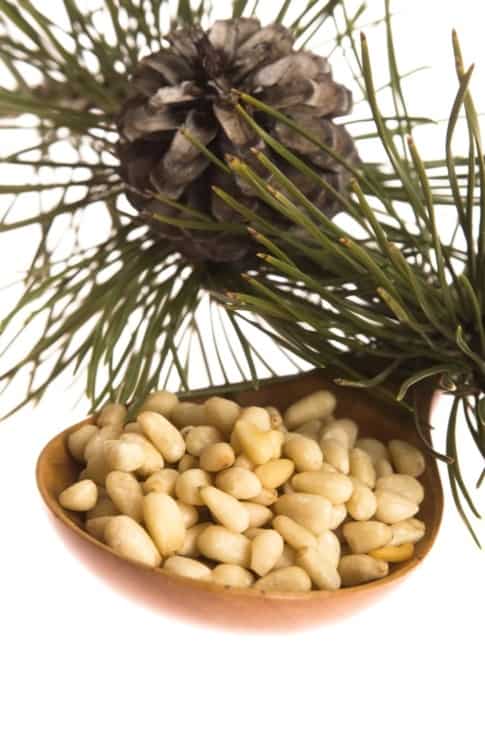
Almost all pine seeds are edible, but only about 20 species have seeds big enough to be worth harvesting. In North America these are the pinyon pines of the Southwest, whose nuts fall from the cones in fall and have been a staple food of the Hopi, Navajo and Great Basin peoples for thousands of years. The pine nuts in stores are mostly Italian stone pine from the Mediterranean or Korean pine from Asia.
To harvest your own, collect closed, mature cones in late summer, dry them in the sun or a paper bag until the scales open, shake out the seeds, then crack the shells. Note that the seeds of one Asian species, Pinus armandii, cause “pine mouth”, a harmless but nasty metallic taste in the mouth that can last a week or two.
Pollen
In spring, the small male cones at the base of new shoots release clouds of yellow pollen. It is protein-rich and has a mild, slightly sweet flavor, and it can be shaken into a bag and used in smoothies, pancakes or bread. Collect it on a dry, still morning, and skip it if you have a pine pollen allergy.
Resin
Hardened resin can be chewed like gum, and small amounts are used to flavor food and drink, such as Greek retsina wine. It is antimicrobial and was used on wounds, but it is sticky, strong and mildly irritating, so use only a little and take it only from fresh drips, never by cutting the tree.
How to Make Pine Needle Tea
- 1. Pick a small handful of young needles, about a cup loosely packed, from a tree you have identified as an edible conifer.
- 2. Rinse them and snip them into ½-inch pieces to release more flavor.
- 3. Heat 2 to 3 cups of water until steaming, not boiling. Hard boiling drives off both the vitamin C and the aroma.
- 4. Pour the hot water over the needles, cover, and steep 10 to 15 minutes. The longer it steeps, the more resinous it tastes.
- 5. Strain, and sweeten with honey or a squeeze of lemon if you like.
The tea is pale green-gold and tastes fresh and slightly citrusy. It does contain vitamin C, though how much varies with the species, season and how you brew it, and claims that it has many times more vitamin C than an orange aren’t well supported. Treat it as a pleasant drink, not a medicine, and drink it in moderation: a cup or two a day, not a jug.
Harvesting Without Hurting the Tree
- Take a little from many trees: a small handful of needles per branch, and never strip a branch bare.
- Leave the leader: don’t pick the tip at the top of a young tree or the ends of every branch. That’s this year’s growth.
- Never girdle: take inner bark only as narrow vertical strips from a large tree, or from a tree that has just been felled. A ring of bark removed around the trunk kills it.
- Collect cones from the ground or from recently cut trees.
- Skip roadsides and treated landscapes: avoid trees within about 50 feet of busy roads, and any tree in a park or yard that may have been sprayed.
- Ask permission, and check the rules before foraging in parks, which often prohibit it.
Other Ways to Use Pine in the Kitchen
- Pine tip syrup: simmer spring tips with equal parts sugar and water, then strain. Good on pancakes, in cocktails and over ice cream.
- Pine salt and sugar: dry the needles, then grind them with coarse salt or sugar for seasoning fish, lamb or shortbread.
- Pine vinegar: steep needles in white wine vinegar for two weeks for a resinous dressing.
- Spruce tip beer: a traditional Scandinavian and colonial American brew, once used against scurvy on long voyages.
- Smoking: a few green boughs on a grill add an aromatic smoke to fish and meat.
Safety Checklist
- Identify the tree first. Needles in bundles held by a papery sheath means a true pine. Flat needles in two rows with red berry-like cups and no cones means yew: don’t touch it.
- Don’t use pine during pregnancy, and avoid ponderosa, lodgepole and Monterey pine needles generally.
- Go easy at first. Try a small cup of tea and wait a day, as some people react to conifer resins.
- Talk to your doctor if you take regular medication or have a chronic condition. Pine needle tea has no proven medical benefit, and it shouldn’t replace treatment.
- Don’t gather from unknown or sprayed trees or from conifers in the cypress family.
For help telling the trees apart, see our guides to the most common trees in North America and the shortleaf pine.