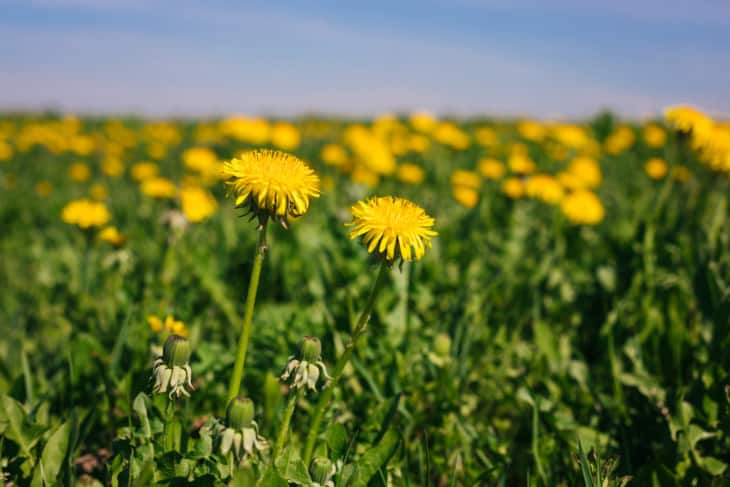
The plants that look most like dandelions are catsear (also called flatweed or false dandelion), hawkbits, hawksbeards, sow thistles, hawkweeds, coltsfoot, mountain dandelion and yellow goatsbeard. All of them are in the same part of the daisy family as the dandelion and have similar yellow flowers. The quickest check is the stem. A true dandelion has one flower on each smooth, hollow, leafless stem. Most lookalikes have branched stems with several flowers, solid stems, leaves on the stem, or hairy leaves.
Contents
The common dandelion (Taraxacum officinale) grows from a thick taproot as a flat rosette of leaves. The leaves are hairless or nearly so, with jagged lobes that point back toward the center of the plant. That is where the name comes from: dent de lion, French for “lion’s tooth”. Each flower head sits alone on a hollow stem that bleeds milky sap when broken, and it turns into the familiar round, white “clock” of seeds. Every part of a dandelion is edible.

- Plants That Look Like Dandelions
- How to Tell a Dandelion From a Lookalike
- Are Dandelion Lookalikes Edible?
| Plant | Botanical name | Flowers per stem | Leaves | How to tell it from a dandelion |
|---|---|---|---|---|
| Catsear (Flatweed) | Hypochaeris radicata | Several, on branched stems | Rough, hairy rosette | Branched, solid stems; hairy leaves |
| Autumn Hawkbit | Scorzoneroides autumnalis | Several, on branched stems | Narrow, deeply lobed, mostly hairless | Flowers late summer and fall; wiry, branched stems |
| Hawksbeard | Crepis spp. | Many, on branched stems | Lobed rosette plus leaves on the stem | Tall, leafy, branched stems with many small flowers |
| Sow Thistle | Sonchus spp. | Several, in clusters | Clasping the stem, with soft prickles | Tall, leafy stem 1–4 ft; prickly leaf edges |
| Hawkweeds | Pilosella and Hieracium spp. | Several, in a tight cluster | Unlobed, very hairy | Leaves not lobed; black hairs on the buds |
| Coltsfoot | Tussilago farfara | One | Large, hoof-shaped; appear after flowering | Flowers in early spring before any leaves; scaly stems |
| Mountain Dandelion | Agoseris glauca | One | Narrow, grass-like, bluish-green | Long, narrow, mostly unlobed leaves |
| Yellow Goatsbeard | Tragopogon dubius and T. pratensis | One | Long, grass-like, clasping the stem | Grass-like leaves on a tall stem; seed head 3–4 in wide |
Plants That Look Like Dandelions
Catsear (Flatweed) (Hypochaeris radicata)

Catsear, also called flatweed or false dandelion, is the lookalike most people mistake for a dandelion in lawns. It has the same flat rosette of lobed leaves and a taproot, and its yellow flowers turn into fluffy seed heads. But its leaves are covered in stiff hairs and feel rough, its flower stems are wiry, solid and usually branched, with two or more flowers, and the stems carry small, scale-like bracts. It comes from Europe and is now a lawn weed across North America, Australia and New Zealand. The leaves are edible, like dandelion leaves, but catsear has been linked to stringhalt, a nerve disorder in horses that graze large amounts of it.
Autumn Hawkbit (Scorzoneroides autumnalis)

Autumn hawkbit, also called fall dandelion, looks like a smaller, thinner dandelion. It has a rosette of narrow, deeply lobed leaves that are mostly hairless, like a dandelion’s. The difference is the stems: they are thin, wiry and usually branched, with a flower at the tip of each branch, and they thicken just below the flower head. It blooms from July to October, when most dandelions have slowed down. It is a European weed of lawns and pastures, naturalized in northeastern North America. It was long known as Leontodon autumnalis.
Hawksbeard (Crepis spp.)

Hawksbeards are the lookalikes that are hardest to tell from dandelion before they flower, because the young rosette of lobed leaves looks almost the same. Then they send up a tall, branched stem, 1 to 3 feet high, with leaves on it and many small yellow flower heads, each smaller than a dandelion’s. Smooth hawksbeard (Crepis capillaris) is a common lawn and pasture weed, and narrowleaf hawksbeard (C. tectorum) is a weed of crops in the northern Plains and Canada. Most are annuals or biennials, so they don’t come back from a taproot year after year the way dandelions do.
Sow Thistle (Sonchus spp.)
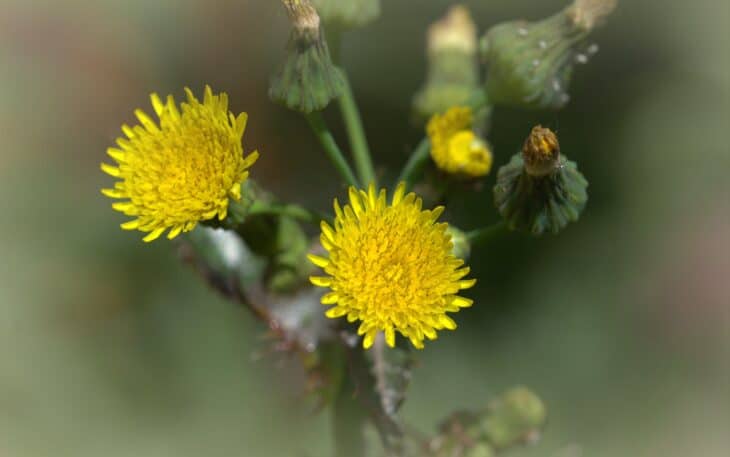
Sow thistles have yellow flowers and white seed puffs very like a dandelion’s, and the same milky sap. But they grow into tall, upright plants, 1 to 4 feet high, with a hollow, leafy stem topped by a cluster of several flower heads. The leaves are lobed and have soft, prickly teeth along the edges, and their bases wrap around the stem. Common sow thistle (Sonchus oleraceus) is an annual weed of gardens. Perennial sow thistle (S. arvensis) spreads by creeping roots and is a noxious weed in several states and Canadian provinces. It is not milk thistle, which is a different, purple-flowered plant (Silybum marianum).
Hawkweeds (Pilosella and Hieracium spp.)
Hawkweeds have yellow or orange dandelion-like flowers and milky sap, but their leaves are not lobed. They are smooth-edged, oval to strap-shaped and covered in long hairs. Several flowers grow in a tight cluster at the top of each stem, and the buds and stems are covered in dark, bristly hairs. Meadow hawkweed (Pilosella caespitosa, yellow) and orange hawkweed (P. aurantiaca) both came from Europe. They spread by runners into dense mats, and they are noxious weeds in several western states and in British Columbia, so don’t plant them.
Coltsfoot (Tussilago farfara)

Coltsfoot is the easiest lookalike to tell apart once you know it. Its yellow flowers come up in very early spring, often in March, on short, thick stems covered in reddish scales, and there are no leaves at all at that point. The flowers have many thin rays around a flat center, so they look more like a small daisy than a dandelion. The large, rounded, hoof-shaped leaves only appear after flowering. Coltsfoot comes from Europe and Asia and is invasive in parts of the northeastern U.S. Although it was once used in cough remedies, it contains pyrrolizidine alkaloids that damage the liver, so it should not be eaten.
Mountain Dandelion (Agoseris glauca)

Mountain dandelion, also called pale agoseris or false dandelion, is a native wildflower of prairies and mountain meadows in western North America. Like a dandelion, it has a single yellow flower on each leafless stem, milky sap and a fluffy seed head. The difference is the leaves. They are long, narrow and grass-like, usually with smooth edges or only a few teeth, and often bluish-green. The seeds have a long beak, like a dandelion’s. It grows in wild places rather than lawns.
Yellow Goatsbeard (Tragopogon dubius and T. pratensis)
Yellow goatsbeard, also called western salsify, is sometimes called a “giant dandelion”. It has a single pale yellow flower head on a tall stem, 1 to 3 feet high, with long, pointed green bracts sticking out beyond the petals. The flowers open in the morning and close by midday. The leaves are long and grass-like and wrap around the stem, nothing like a dandelion’s. Its seed head is a huge, perfect globe, 3 to 4 inches wide, much larger than a dandelion clock. It comes from Europe and is common along roadsides and in dry fields.
How to Tell a Dandelion From a Lookalike
- Count the flowers on a stem. A dandelion has one flower per stem, and the stem never branches. Catsear, hawkbit, hawksbeard, sow thistle and hawkweed usually have several.
- Break the stem. A dandelion stem is hollow, like a straw, and has no leaves or scales on it.
- Feel the leaves. Dandelion leaves are smooth or nearly hairless. Catsear and hawkweed leaves are clearly hairy, and sow thistle leaves are prickly.
- Look at the lobes. The lobes of a dandelion leaf point back toward the center of the rosette.
- Check the season. Coltsfoot flowers before it has leaves, in very early spring, and autumn hawkbit flowers mainly in late summer and fall.
Are Dandelion Lookalikes Edible?
Many are. Catsear, sow thistle and young hawksbeard leaves are all eaten as greens, and none of them is seriously poisonous to people. Coltsfoot is the exception: don’t eat it, because of the liver-damaging alkaloids. As with any wild food, only eat what you have identified for certain, and don’t pick from lawns, roadsides or anywhere that may have been sprayed with weed killer.
See also plants that look like clover.