Most plants that look like hollyhocks are its relatives in the mallow family (Malvaceae): the mallows (Malva), tree mallow, marshmallow, checkerbloom, wild hollyhock, rose of Sharon, hardy hibiscus and even okra. They all have the same open, five-petaled, papery flowers with a central column of stamens. To tell them apart, look at height, flower size and the leaves. Hollyhock leaves are large, rounded and rough, with shallow lobes. The one common lookalike from outside the family, foxglove, is poisonous.
Contents
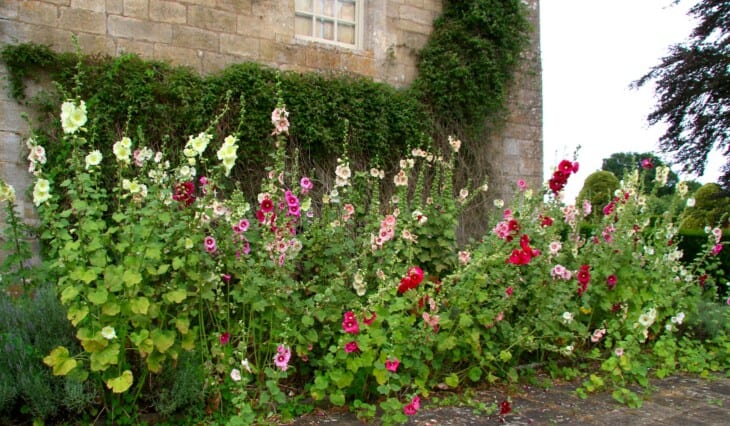
Hollyhock (Alcea rosea) is a biennial or short-lived perennial. In its first year it forms a low rosette of leaves. In its second year it sends up flower spikes 5 to 8 feet tall, sometimes taller. The flowers are 3 to 5 inches across, single or double, and come in pink, red, white, yellow, purple and a near-black maroon. There is no true blue hollyhock. The plant has been grown in gardens for so long that its origin is uncertain; it probably came from southwestern Asia.
- Mallows: The Closest Lookalikes
- Native Wild Hollyhocks and Checkermallows
- Hibiscus and Okra
- Foxglove: A Poisonous Lookalike
- How to Tell a Hollyhock From Its Lookalikes
| Plant | Botanical name | Height | How to tell it from a hollyhock |
|---|---|---|---|
| Common Mallow (Cheeseweed) | Malva neglecta | Under 1 ft, sprawling | Low weed; small white-pink flowers; round leaves |
| High Mallow | Malva sylvestris | 2 to 4 ft | Smaller purple-pink flowers with dark veins, along the stems |
| Musk Mallow | Malva moschata | 2 to 3 ft | Deeply cut, finely divided upper leaves |
| Annual Mallow (Tree Mallow) | Malva trimestris | 3 to 4 ft | Annual; bushy, not spiky; glossy, satiny flowers |
| Marshmallow | Althaea officinalis | 3 to 4 ft | Velvety gray-green leaves; small pale pink flowers |
| Wild Hollyhock (Streambank Globemallow) | Iliamna rivularis | 3 to 6 ft | Many smaller pale pink flowers; maple-shaped leaves |
| Checkerbloom | Sidalcea malviflora | 1 to 2 ft | Short spikes; round lower leaves, deeply cut upper leaves |
| Scarlet Globemallow | Sphaeralcea coccinea | 4 to 16 in | Low; orange-red flowers; gray, hairy, deeply divided leaves |
| Rose of Sharon | Hibiscus syriacus | 8 to 12 ft | Woody shrub; smaller, toothed, 3-lobed leaves |
| Hardy Hibiscus (Swamp Rose Mallow) | Hibiscus moscheutos | 3 to 7 ft | Huge flowers up to 12 in; dies back to the ground each winter |
| Okra | Abelmoschus esculentus | 3 to 6 ft | Pale yellow flowers with a maroon center; followed by edible pods |
| Foxglove | Digitalis purpurea | 3 to 5 ft | Tubular, drooping flowers on one side of the spike; toxic |
Mallows: The Closest Lookalikes
Mallows are the plants most often mistaken for hollyhocks, because they are close relatives. Mallows are smaller in every way. Their flowers are usually 1 to 2 inches across and grow along the stems, not in one tall spike.
Common Mallow (Cheeseweed) (Malva neglecta)

Common mallow is the weed most often confused with a young hollyhock. Its rounded, shallowly lobed leaves with scalloped edges look almost exactly like a hollyhock seedling or a first-year rosette. The difference shows when it grows: common mallow sprawls along the ground from a deep taproot, and its flowers are tiny, pale pink to white and under an inch wide. It is native to Europe and now grows in lawns, gardens and waste ground across North America. It also carries hollyhock rust, so pull it from hollyhock beds.
High Mallow (Malva sylvestris)

High mallow is a bushy European mallow grown in cottage gardens and found as an escape along roadsides. It grows 2 to 4 feet tall and has purple-pink flowers about 1.5 to 2 inches wide, with dark purple stripes running down each notched petal. Its leaves are rounded and lobed like a hollyhock’s but smaller. The flowers grow in clusters all along the stems, not in a single tall spike. The cultivar ‘Zebrina’ has pale pink flowers with bold purple stripes.
Musk Mallow (Malva moschata)

Musk mallow has pale pink or white flowers, 1.5 to 2 inches wide, and is often sold as a cottage-garden perennial. The flowers look like small single hollyhocks, but the leaves are completely different. The upper leaves are cut into narrow, finger-like segments, while hollyhock leaves are broad and rounded. It grows 2 to 3 feet tall and has naturalized in parts of the northern U.S. and Canada.
Annual Mallow (Tree Mallow) (Malva trimestris)

Annual mallow, sold as lavatera (it was long classified as Lavatera trimestris), is a fast-growing annual from the Mediterranean. It grows 3 to 4 feet tall and forms a bushy plant covered in trumpet-shaped, satiny flowers 3 to 4 inches wide in pink, rose or white, with darker veins. The flowers are as large as a hollyhock’s, but the plant is bushy and branched, not a single tall spike, and it flowers the same year it is sown. The larger shrubby lavateras (Malva × clementii) grow 6 to 8 feet tall and are grown in mild climates.
Marshmallow (Althaea officinalis)

Marshmallow is a European and Asian perennial of salt marshes and damp meadows. It was once the source of the root extract used in the original marshmallow candy. It grows 3 to 4 feet tall and has pale pink to white flowers about 1.5 inches wide, much smaller than hollyhock flowers. The best tell is the leaves: they are soft and velvety, gray-green, and more pointed and toothed than hollyhock leaves. It has naturalized in parts of eastern North America.
Native Wild Hollyhocks and Checkermallows
These North American natives are good alternatives if you want the hollyhock look with native plants.
Wild Hollyhock (Streambank Globemallow) (Iliamna rivularis)

The plant most often called wild hollyhock in the West is Iliamna rivularis, a native perennial of stream banks and mountain meadows from British Columbia to Colorado. It grows 3 to 6 feet tall and looks like a hollyhock with smaller flowers. They are pale pink to rose-purple and 1 to 2 inches wide, on branched spikes. Its leaves are shaped like maple leaves, with 3 to 7 pointed lobes. Hollyhock leaves are rounder.
Checkerbloom (Sidalcea malviflora)

Checkerbloom, or checkermallow, is a native perennial of the West Coast. Its flowers look like small hollyhock flowers, pink to rose-purple and about 1 to 2 inches wide, with fine white veins. They grow in spikes, but the plant is only 1 to 2 feet tall. Its lower leaves are round and scalloped like a hollyhock’s, while its upper leaves are cut into deep, narrow lobes. Garden hybrids of Sidalcea, often called miniature hollyhocks or prairie mallows, grow 2 to 4 feet tall.
Scarlet Globemallow (Sphaeralcea coccinea)

Scarlet globemallow is a low perennial of the Great Plains and dry western grasslands. Its orange-red flowers, about 1 inch wide, have the same cupped, five-petaled mallow shape as a hollyhock. It is only 4 to 16 inches tall, though, and its gray-green leaves are covered in fine star-shaped hairs and deeply divided into narrow lobes. It is a tough, drought-tolerant plant for xeriscapes.
Hibiscus and Okra
Rose of Sharon (Hibiscus syriacus)
Read our guide to Rose of Sharon
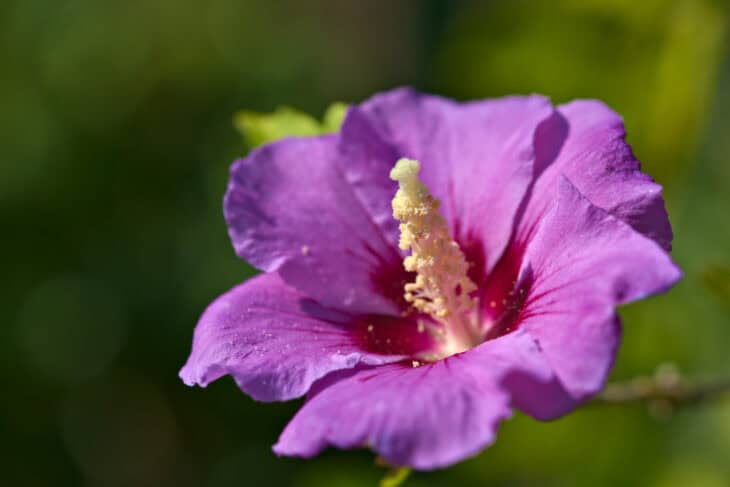
Rose of Sharon has flowers so similar to single hollyhocks that the two are often confused, especially the pink and purple forms with a dark red center. But rose of Sharon is a woody, deciduous shrub, 8 to 12 feet tall, that flowers along its branches from mid-summer to fall. Its leaves are small, toothed and three-lobed, not the large rounded leaves of a hollyhock. In the eastern U.S. its seedlings can spread aggressively, so choose seedless cultivars.
Hardy Hibiscus (Swamp Rose Mallow) (Hibiscus moscheutos)
Hardy hibiscus is a perennial native to wetlands of the eastern U.S. Its flowers, in white, pink or red, are larger than any hollyhock’s: 6 inches across in the wild species and up to 12 inches in garden hybrids. It grows 3 to 7 feet tall and dies back to the ground each winter. It comes up late in spring and flowers from mid to late summer. Its leaves are oval and toothed, not rounded and lobed. It grows well in wet soil where hollyhocks would rot.
Okra (Abelmoschus esculentus)
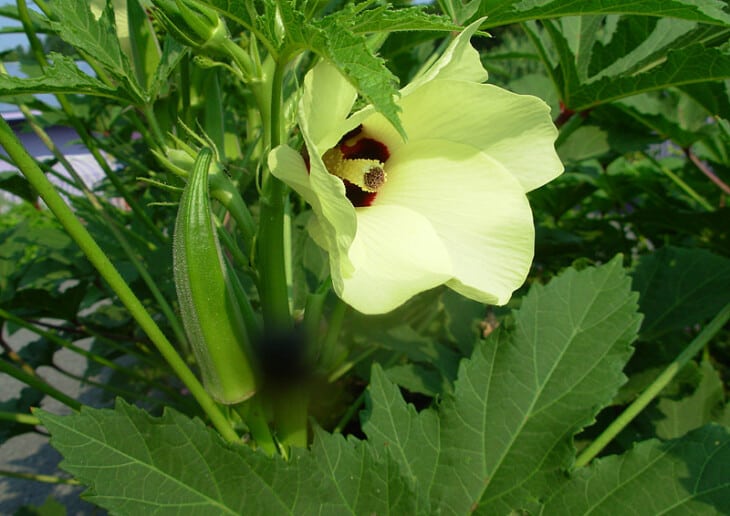
Okra is a mallow-family vegetable, and its flowers show it: they are pale yellow, about 2 to 3 inches wide, with a deep maroon center, and they look like a yellow hollyhock. The plant grows 3 to 6 feet tall with large, deeply lobed leaves. Each flower lasts a single day and is followed by the ribbed green pod that you harvest for eating.
Foxglove: A Poisonous Lookalike
Foxglove (Digitalis purpurea)

Foxglove is not a mallow, but from a distance its tall spikes in cottage gardens look a lot like hollyhocks, and both are biennials. Up close they are easy to tell apart. Foxglove flowers are tubular bells that hang down, mostly on one side of the spike, and they are often spotted inside. Hollyhock flowers are open and saucer-shaped. Foxglove leaves are long, soft and lance-shaped, not rounded. Every part of foxglove is poisonous because it contains heart glycosides, so keep it away from children and pets.
How to Tell a Hollyhock From Its Lookalikes
- Height and spike. Only hollyhocks send up a single, unbranched flower spike 5 feet tall or more, with flowers opening from the bottom up.
- Flower size. Hollyhock flowers are 3 to 5 inches across. Mallow and checkermallow flowers are 1 to 2 inches.
- Leaves. Hollyhock leaves are large (up to about a foot across), round and rough to the touch, with 3 to 7 shallow lobes. Deeply cut leaves point to musk mallow, checkerbloom or globemallow, and velvety gray leaves point to marshmallow.
- Woody stems. A woody shrub with hollyhock-like flowers is rose of Sharon.
- First-year hollyhocks. A young hollyhock is a flat rosette of round leaves. Common mallow looks similar but spreads along the ground and flowers the same year.
- Rust spots. Orange pustules under the leaves are hollyhock rust. Mallows carry the same rust, which is another reason to weed them out near hollyhocks.
Hollyhocks are not considered poisonous to people or pets, though their hairy leaves can irritate sensitive skin. See our poisonous plants guide for details.