The plants that look most like holly are false holly (holly osmanthus), Oregon grape and its relatives leatherleaf mahonia, agarita and Texas barberry, holm oak, hollyleaf cherry and New Zealand holly. All of them have stiff, glossy leaves with spiny teeth. Toyon and nandina have holly-like clusters of red berries in winter. The quickest check is how the leaves are arranged and divided. Holly leaves are single, not divided into leaflets, and alternate, one at each point on the stem. False holly’s leaves grow in opposite pairs, and Oregon grape’s are compound, with several spiny leaflets on one stalk.
Contents
- Plants With Holly-Like Leaves
- False Holly (Holly Osmanthus) (Osmanthus heterophyllus)
- Oregon Grape (Berberis aquifolium (Mahonia aquifolium))
- Leatherleaf Mahonia (Don’t Plant) (Berberis bealei (Mahonia bealei))
- Agarita (Wild Currant) (Berberis trifoliolata)
- Texas Barberry (Berberis swaseyi)
- Holm Oak (Holly Oak) (Quercus ilex)
- Hollyleaf Cherry (Prunus ilicifolia)
- New Zealand Holly (Olearia macrodonta)
- Sea Holly (Eryngium spp.)
- Plants With Holly-Like Red Berries
- How to Tell a Holly From a Lookalike
- Which Lookalikes Are Safe to Eat?
True hollies belong to the genus Ilex, with around 500 species of evergreen and deciduous trees and shrubs. The familiar Christmas hollies are American holly (Ilex opaca), native to the eastern U.S., and English holly (I. aquifolium) from Europe. Both have leathery, spiny-edged leaves. Holly plants are either male or female, and only females bear berries, usually red, after small, white, four-petaled flowers in spring. Holly berries are poisonous to people and pets. Eating them causes vomiting and diarrhea, so keep them away from small children.

- Plants With Holly-Like Leaves
- Plants With Holly-Like Red Berries
- How to Tell a Holly From a Lookalike
- Which Lookalikes Are Safe to Eat?
| Plant | Botanical name | Looks like holly because | How to tell it apart |
|---|---|---|---|
| False Holly (Holly Osmanthus) | Osmanthus heterophyllus | Glossy, spiny-toothed leaves | Leaves in opposite pairs; fragrant white flowers in fall; blue-black fruit |
| Oregon Grape | Berberis aquifolium (Mahonia aquifolium) | Glossy, spiny leaflets that turn red-purple in winter | Compound leaves with 5–9 leaflets; yellow flowers; blue berries |
| Leatherleaf Mahonia (Don’t Plant) | Berberis bealei (Mahonia bealei) | Stiff, spiny leaflets | Long compound leaves with 9–15 leaflets; yellow flowers in late winter; blue berries |
| Agarita (Wild Currant) | Berberis trifoliolata | Stiff, spiny leaves and red berries | Each leaf has just 3 gray-green leaflets; yellow flowers |
| Texas Barberry | Berberis swaseyi | Spiny, glossy leaflets | Compound leaves with 5–9 leaflets; yellow flowers; yellowish to red berries |
| Holm Oak (Holly Oak) | Quercus ilex | Young leaves have spiny, holly-like teeth | Older leaves smooth, gray and felty underneath; acorns |
| Hollyleaf Cherry | Prunus ilicifolia | Glossy, spiny-toothed leaves | White flower spikes; dark red to purple cherries with a large pit |
| New Zealand Holly | Olearia macrodonta | Grayish-green, holly-like toothed leaves | Leaves white and felty underneath; clusters of white daisy flowers; no berries |
| Sea Holly | Eryngium spp. | Stiff, spiny, silvery leaves | A perennial with thistle-like, steel-blue flower heads |
| Toyon (California Holly) | Heteromeles arbutifolia | Clusters of bright red berries in winter; toothed, leathery leaves | Leaves toothed but not spiny; berries in large, flat clusters |
| Nandina (Heavenly Bamboo, Don’t Plant) | Nandina domestica | Clusters of bright red berries in winter | Finely divided, bamboo-like leaves; no spines |
| Boxwood | Buxus sempervirens and others | Small, glossy, evergreen leaves on a dense shrub | Leaves in opposite pairs, smooth-edged; no red berries |
Plants With Holly-Like Leaves
False Holly (Holly Osmanthus) (Osmanthus heterophyllus)
Read our guide to False Holly (Holly Osmanthus)

False holly, also called holly osmanthus or holly olive, comes from Japan and Taiwan and is the plant most often mistaken for holly. Young plants and lower branches have glossy, dark green leaves with sharp spines, just like holly, but on older plants many leaves are smooth-edged. The easiest check is the leaf arrangement: false holly leaves grow in opposite pairs, while holly leaves alternate along the stem. In fall it has small, white, very fragrant flowers. Its occasional fruit is blue-black, never red. It grows 8 to 15 feet tall and is hardy in zones 6 to 9. Variegated forms such as ‘Goshiki’ are popular.
Oregon Grape (Berberis aquifolium (Mahonia aquifolium))

Oregon grape is an evergreen shrub native to the Pacific Northwest, where it is Oregon’s state flower. Its species name, aquifolium, is the old Latin name for holly. Each leaf is divided into five to nine glossy, spiny leaflets that look like holly leaves, but they are arranged in pairs along a single stalk. In early spring it has bright yellow flower clusters, followed by dusty blue, grape-like berries that are edible but very sour and are used for jelly. It grows 3 to 6 feet tall and is hardy in zones 5 to 9.
Leatherleaf Mahonia (Don’t Plant) (Berberis bealei (Mahonia bealei))

Leatherleaf mahonia is a Chinese shrub, 5 to 10 feet tall, with stiff, upright stems and long compound leaves of 9 to 15 thick, spiny leaflets. In late winter it has upright spikes of fragrant yellow flowers, followed by blue-black berries with a waxy bloom. Birds spread the seeds into woods, and it has become invasive in forests across the Southeast. Plant a native such as Oregon grape in the West or American holly in the East instead.
Agarita (Wild Currant) (Berberis trifoliolata)

Agarita, also called agarito or wild currant, is a native shrub of Texas, southern New Mexico, Arizona and northern Mexico. It grows 3 to 6 feet tall, with stiff, gray-green leaves that each have three very sharp, spiny leaflets. In late winter it has small, fragrant yellow flowers, and in late spring it bears bright red berries that look like holly berries. Unlike holly berries, they are edible and are used for jelly and wine. It is very drought tolerant and a good wildlife shrub for dry gardens.
Texas Barberry (Berberis swaseyi)

Texas barberry is a rare evergreen shrub found only on the Edwards Plateau of central Texas. It grows 3 to 6 feet tall, with compound leaves of five to nine small, spiny-edged leaflets. It has yellow flowers in early spring and juicy, yellowish to reddish berries. It is related to agarita and Oregon grape and, like them, has divided leaves, which is the easiest way to tell it from holly.
Holm Oak (Holly Oak) (Quercus ilex)
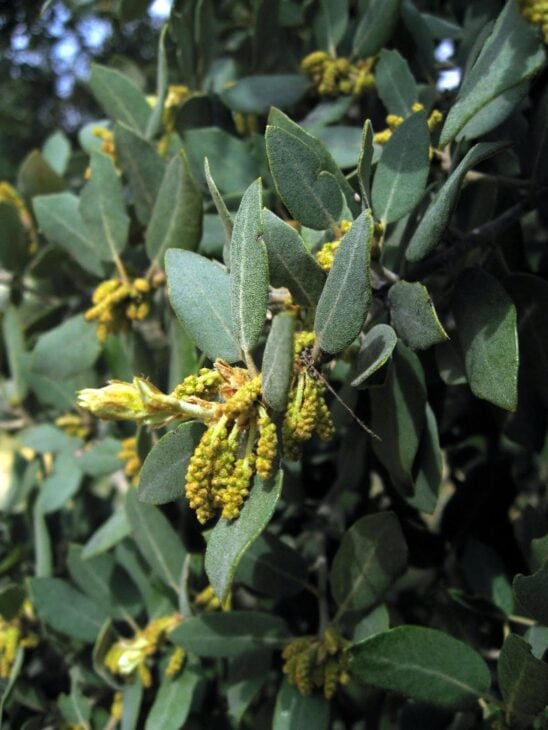
Holm oak is an evergreen oak from the Mediterranean, a large tree 50 to 80 feet tall with a dense, rounded crown. Its leaves are dark green and leathery on top and gray and felty underneath. On young trees and low shoots they have spiny teeth, very like holly, while on mature branches they are often smooth-edged. Ilex was the Roman name for this oak, and the name was later given to the holly genus. Acorns show that it is an oak. It is grown in mild coastal areas of Britain and California, zones 7 to 10.
Hollyleaf Cherry (Prunus ilicifolia)

Hollyleaf cherry is an evergreen shrub or small tree, 10 to 30 feet tall, native to the coastal hills of California and Baja California. Its glossy, leathery leaves have wavy, spiny-toothed edges and look very like holly. In spring it has short spikes of small white flowers, and in fall it has round cherries that ripen from red to dark purple. The thin, sweet flesh is edible, but the large pit contains compounds that release cyanide and shouldn’t be eaten raw. It is a drought-tolerant hedge plant for California gardens.
New Zealand Holly (Olearia macrodonta)

New Zealand holly is a daisy bush, not a holly, and it comes from the mountains of New Zealand. It is an evergreen shrub or small tree, 10 to 20 feet tall, with grayish-green, wavy leaves that have sharp, holly-like teeth and a white, felty underside. In early summer it is covered in flat clusters of small, white, daisy-like flowers with a musky scent. It has no berries. It tolerates salt wind and is popular for hedges in coastal gardens, but it is hardy only to about zone 8.
Sea Holly (Eryngium spp.)
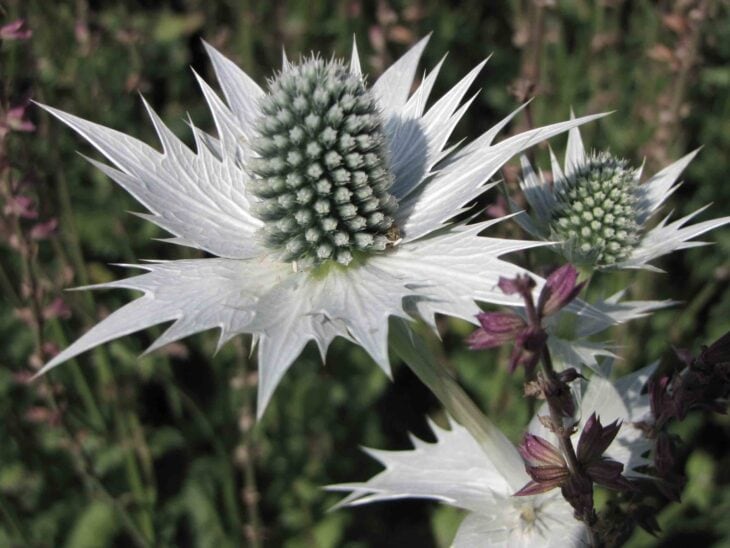
Sea hollies are perennials in the carrot family, not shrubs, but they get their name from their stiff, spiny, often silvery leaves. Their flowers are cone-shaped, steel-blue or silvery heads surrounded by a ruff of spiny bracts, on stems 1 to 3 feet tall in summer. Sea holly (Eryngium maritimum) grows on European beaches. Garden species such as flat sea holly and Miss Willmott’s ghost (E. giganteum) are popular in dry, sunny gardens and for cut and dried flowers. Bees love them.
Plants With Holly-Like Red Berries
Toyon (California Holly) (Heteromeles arbutifolia)
Read our guide to Toyon (California Holly)

Toyon, also called California holly or Christmas berry, is an evergreen shrub or small tree, 6 to 15 feet tall, native to California. Its leathery leaves are sharply toothed but not spiny, and in winter it is covered in large, flat clusters of bright red berries, which is how it got its common names. Hollywood is often said to be named after its hillsides of toyon. It is in the rose family and very drought tolerant, and the berries feed robins, cedar waxwings and mockingbirds.
Nandina (Heavenly Bamboo, Don’t Plant) (Nandina domestica)

Nandina is an evergreen shrub from China and Japan, 4 to 8 feet tall, with upright, cane-like stems and finely divided leaves that turn red in winter. It has large, drooping clusters of bright red berries through fall and winter that look like holly berries from a distance. The berries contain compounds that release cyanide. They have killed cedar waxwings and other birds, and they are toxic to cats and dogs. Nandina is also invasive in the Southeast. If you want one, choose a dwarf variety that doesn’t fruit, such as ‘Firepower’.
Boxwood (Buxus sempervirens and others)

Boxwood doesn’t look much like a Christmas holly, but it is very easy to confuse with Japanese holly (Ilex crenata), a true holly with small, smooth-looking leaves that is sold as a boxwood substitute. Both are dense, small-leaved evergreen shrubs used for hedges. Boxwood leaves grow in opposite pairs and have no teeth. Japanese holly leaves alternate along the stem and have tiny teeth at the edge, and the females have black berries. Boxwoods are native to Europe and Asia, and all parts are poisonous.
How to Tell a Holly From a Lookalike
- Leaf arrangement: holly leaves alternate along the stem. Opposite pairs mean false holly or boxwood.
- Simple or compound: each holly leaf is single. If the “leaf” is really a row of spiny leaflets on one stalk, it is Oregon grape, a mahonia, agarita or Texas barberry.
- Flowers: hollies have small, white or greenish, four-petaled flowers. Yellow flowers mean one of the barberry relatives. Daisy-like flowers mean New Zealand holly.
- Berries: hollies have single red, orange, yellow or black berries along the stem, only on female plants. Blue berries mean Oregon grape or a mahonia. Large, flat clusters mean toyon.
- Underside: a gray or white, felty leaf underside means holm oak or New Zealand holly.
Which Lookalikes Are Safe to Eat?
Holly berries are poisonous, and so are nandina berries and all parts of boxwood. Oregon grape and agarita berries are edible and are traditionally used for jelly, and the flesh of hollyleaf cherry is edible, but not the pit. Toyon berries are bitter raw and were cooked before eating by Native Californians. If a child or pet swallows berries from a plant you can’t identify, call Poison Control (1-800-222-1222 in the U.S.) or your vet.
English holly is invasive in the forests of the Pacific Northwest; see our guides to trees in Oregon and trees in Washington State.