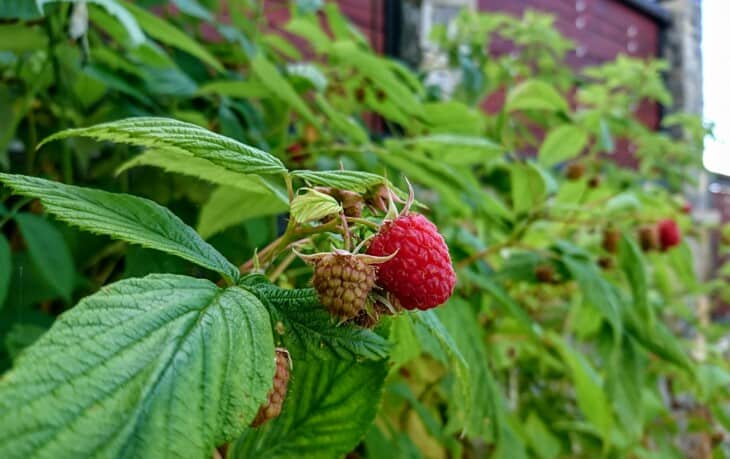
The plants most often mistaken for raspberries are close relatives: blackberries, wineberries, thimbleberries, salmonberries, cloudberries and loganberries are all in the same genus, Rubus, and all of them are edible. The two tests that settle almost every case are the core and the leaves. A ripe raspberry pulls off its white core and comes away hollow, like a thimble, and raspberry leaves are compound, with 3 to 5 toothed leaflets that are whitish underneath.
Contents
- 11 Plants That Look Like Raspberries
- Cloudberry (Rubus chamaemorus)
- Red Mulberry (Morus rubra)
- Thimbleberry (Rubus parviflorus)
- Strawberry Tree (Arbutus unedo)
- Kousa Dogwood (Cornus kousa)
- Salmonberry (Rubus spectabilis)
- Virginia Creeper (Parthenocissus quinquefolia)
- Blackberry (Rubus spp.)
- Japanese Wineberry (Rubus phoenicolasius)
- Loganberry (Rubus × loganobaccus)
- Red Currant (Ribes rubrum)
- How to Tell a Raspberry From Its Lookalikes
Raspberries (Rubus idaeus, plus the black raspberry Rubus occidentalis) grow on prickly canes 3 to 6 feet tall. Each cane lives two years: it grows leaves the first year and flowers and fruits the second. The berries can be red, gold, purple or black. The only plant in this list with fruit you should not eat is Virginia creeper, and its berries don’t actually look like raspberries.
| Plant | Botanical name | Edible? | How to tell it from a raspberry |
|---|---|---|---|
| Cloudberry | Rubus chamaemorus | Yes | Low plant under 10 in. tall with a single amber berry; round, lobed leaves |
| Red Mulberry | Morus rubra | Yes | Grows on a tree; the fruit keeps its stem and core when picked |
| Thimbleberry | Rubus parviflorus | Yes | No prickles; huge, soft, maple-shaped single leaves; flat, soft berry |
| Strawberry Tree | Arbutus unedo | Yes (bland) | Grows on an evergreen tree; round, bumpy berry, solid inside |
| Kousa Dogwood | Cornus kousa | Yes | Grows on a tree; round fruit on a long stalk, with a tough, bumpy skin |
| Salmonberry | Rubus spectabilis | Yes | Magenta flowers; fruit orange-yellow to red; Pacific coast only |
| Virginia Creeper | Parthenocissus quinquefolia | No, toxic | Climbing vine; 5 leaflets from one point; small blue-black berries in clusters |
| Blackberry | Rubus spp. | Yes | The core comes off with the berry, so it is solid, not hollow |
| Japanese Wineberry | Rubus phoenicolasius | Yes | Canes covered in red, bristly hairs; sticky husks around the berry |
| Loganberry | Rubus × loganobaccus | Yes | Long, conical, dark red berry that keeps its core |
| Red Currant | Ribes rubrum | Yes | Shiny, see-through berries on long hanging strings; lobed leaves |
11 Plants That Look Like Raspberries
Cloudberry (Rubus chamaemorus)

Cloudberry is a low, creeping plant of bogs and tundra across the far north, including Alaska, Canada, northern New England and Scandinavia. Each stem is under 10 inches tall and carries a single white flower and then a single berry. The berry starts red and ripens to soft amber-orange, so an unripe cloudberry looks a lot like a red raspberry. The leaves give it away: they are round and shallowly lobed, like a small maple or mallow leaf, and not divided into leaflets. Cloudberries are edible and prized in Scandinavia for jam, but they are rarely grown commercially.
Red Mulberry (Morus rubra)

Red mulberry is a native tree of the eastern United States, 35 to 50 feet tall, with broad, toothed leaves that are sometimes mitten-shaped or lobed. Its fruit ripens from red to dark purple in early summer and looks like a long, narrow raspberry. The difference is obvious once you pick one: a mulberry comes away with a small green stem and a solid center, while a raspberry leaves its core behind. And a raspberry never grows on a tree. Ripe mulberries are sweet and edible. Unripe fruit and the milky sap can upset your stomach.
Thimbleberry (Rubus parviflorus)

Thimbleberry is a thornless Rubus native to western North America and the upper Great Lakes. It forms thickets 3 to 8 feet tall. Its berries are red and hollow like raspberries but flatter, softer and more crumbly, and they fall apart easily in your hand. The leaves are the quickest tell: large (up to 8 inches across), soft and fuzzy, and shaped like a maple leaf with 5 lobes, not divided into leaflets. The large white flowers are also bigger than raspberry flowers. The berries are edible and have an intense, tart flavor.
Strawberry Tree (Arbutus unedo)

The strawberry tree is an evergreen shrub or small tree from the Mediterranean, 15 to 30 feet tall, grown as an ornamental in mild climates such as California and the Pacific Northwest (zones 7 to 10). Its round red fruits are covered in small bumps, which is why they get confused with raspberries at a glance. They are solid and slightly gritty inside, and they grow on a woody tree with glossy, leathery leaves. They are edible but mealy and bland raw; in Portugal they are used for jam and the brandy medronho.
Related: Plants That Look Like Strawberries
Kousa Dogwood (Cornus kousa)
Read our guide to Kousa Dogwood

Kousa dogwood is an East Asian ornamental tree, usually 15 to 30 feet tall, that is widely planted in American yards. In late summer it bears round, pinkish-red fruits about an inch across on long stalks. Their pebbled skin makes them look like large raspberries from a distance. Up close they are completely different: the skin is tough, the flesh inside is soft, orange and custard-like, and there are a few hard seeds. The flesh is edible and tastes a little like mango, but the skin is best spat out.
Related: Pros and Cons of Dogwood Trees · Are Dogwood Berries Poisonous?
Salmonberry (Rubus spectabilis)

Salmonberry grows along the Pacific coast from Alaska to California. It forms dense thickets of canes 3 to 13 feet tall. Its berries look like large raspberries in shades from yellow-orange to deep red. Two things set it apart: its showy magenta-pink flowers, which appear early in spring, and its leaves, which always have 3 leaflets. The berries are edible but watery and mild, so they are eaten fresh or cooked into jam.
Virginia Creeper (Parthenocissus quinquefolia)

Virginia creeper is a native climbing vine, not a cane, and it is the one plant here that is dangerous to eat. It gets mistaken for a young raspberry or blackberry shoot when it trails along the ground, because its leaves are divided into toothed leaflets. Count them: Virginia creeper has 5 leaflets that all spread from a single point, like the fingers of a hand, and its stems have no prickles. Its fruit is a cluster of small, round blue-black berries on red stalks in fall, which look more like wild grapes than raspberries. The berries contain oxalate crystals and can make children and pets sick.
Blackberry (Rubus spp.)

Blackberries are the closest lookalike of the black raspberry. The two grow on similar prickly, arching canes and ripen to the same glossy black. The reliable test is the core: a ripe blackberry comes off the plant with its white core inside, while a black raspberry comes off hollow. Black raspberries also have a dusty white bloom on their canes and ripen earlier, in early summer. Blackberries are usually larger and ripen from mid to late summer. Both are edible. The invasive Himalayan blackberry (Rubus armeniacus) is the most common wild blackberry in the Pacific Northwest.
Japanese Wineberry (Rubus phoenicolasius)

Japanese wineberry is a raspberry relative from East Asia that has become invasive in the eastern United States, from New England to Georgia. It grows in forest edges and along trails, with arching canes up to 9 feet long. Its orange-red, glossy berries look like small raspberries and taste a lot like them. Look at the canes: they are covered in dense red, bristly hairs rather than scattered prickles. Each berry also develops inside a sticky, hairy husk (the calyx) that opens as it ripens. The leaves have 3 leaflets with bright white undersides. The berries are safe to eat, but don’t plant it, because it spreads aggressively.
Loganberry (Rubus × loganobaccus)

The loganberry is a hybrid between a blackberry (Rubus ursinus) and a raspberry, which appeared by chance in the garden of James Harvey Logan in California in the early 1880s. Its dark red berries are longer and more cone-shaped than raspberries. Like a blackberry, a loganberry keeps its core when picked. The plant grows trailing canes 6 to 8 feet long that need a trellis. Most garden plants today are thornless cultivars, but the original loganberry has prickles. The fruit is edible and tart and is mostly used for jam, pies and juice.
Red Currant (Ribes rubrum)

Red currant is a European shrub, 3 to 5 feet tall, grown for its fruit. Its berries are red like raspberries, but that is where the likeness ends. They are small, perfectly round, smooth and translucent, and they hang in long clusters (called strigs) like tiny grapes. The leaves are simple and 3- to 5-lobed like a maple leaf, and the stems have no prickles. Red currants are edible and very tart; they are mostly cooked into jelly and sauces.
How to Tell a Raspberry From Its Lookalikes
- Pick one berry. A ripe raspberry comes off hollow; blackberries, loganberries and mulberries keep their core or stem.
- Look at the leaves. Raspberry leaves are compound, with 3 to 5 toothed leaflets that are whitish or silvery underneath. Single, lobed leaves (thimbleberry, cloudberry, currant) mean it is not a raspberry.
- Check the stems. Raspberries grow on woody canes with small prickles. A vine with no prickles and 5 leaflets from one point is Virginia creeper.
- Check where it grows. Berries on a tree (mulberry, kousa dogwood, strawberry tree) are never raspberries.
- If you aren’t sure, don’t eat it. Apart from Virginia creeper, the plants on this list are edible, but there are many other toxic red and black berries in the wild.