
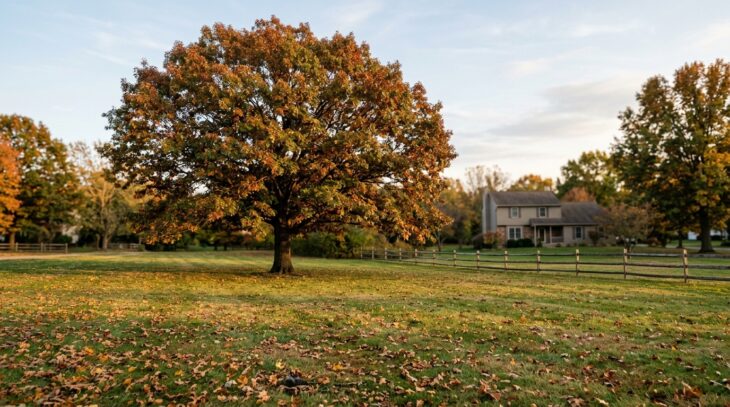
Oak trees (Quercus spp.) are the most valuable trees you can plant for wildlife, and they live for generations. They are also huge, hard to replace once lost, and the red oaks are vulnerable to a fast-killing disease called oak wilt.
Most landscape oaks reach 50 to 80 feet (15 to 24 m) tall and about as wide. The common US species are native to the eastern and central states, and together they cover Zones 3–10.
Whether an oak is a good idea comes down to three things: how much room you have, what your soil pH is, and which species you pick. A bur oak and a pin oak behave very differently in the same yard. Each pro and con below names the species it applies to.

Pros Of Oak Trees
Native Oaks Feed More Wildlife Than Any Other Tree
Native oaks (Quercus spp.) support more insect herbivores than any other plant genus in North America. That finding comes from a widely cited 2009 study by Doug Tallamy and Shropshire. It matters because caterpillars are what songbirds feed their nestlings.
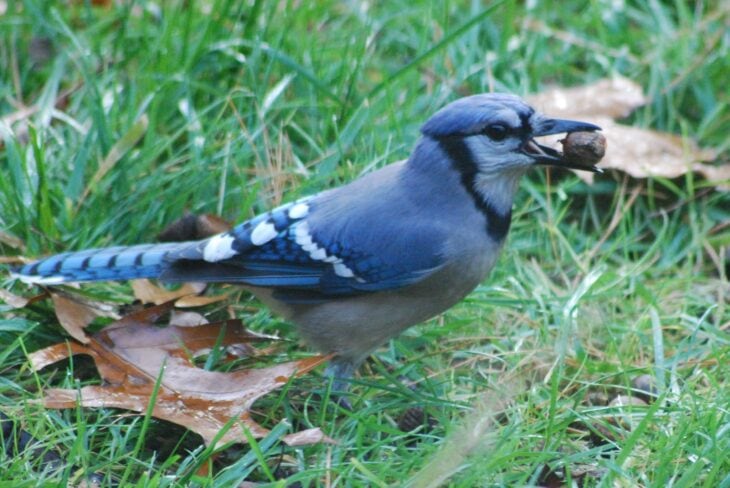
In one study of Carolina chickadees cited by the University of Delaware, native oaks hosted 28% of the birds’ foraging, more than any other tree group. The acorns feed woodpeckers, blue jays, wild turkeys, white-tailed deer and black bears.
This benefit belongs to native oaks planted in their native range. Sawtooth oak (Quercus acutissima), an Asian species once popular as a street tree, has bitter acorns that wildlife don’t favor, and it is now invading eastern forests.
Oaks Live for Generations and Stand Up to Storms

An oak is a tree you plant for your grandchildren. NC State Extension describes white, bur, willow and live oak as long-lived, and swamp white oak (Quercus bicolor) as living up to 300 years.
Some oaks are also very wind-firm. In University of Florida hurricane studies, live oak (Quercus virginiana) ranks among the most wind-resistant trees, alongside sand live oak (Quercus geminata) and southern magnolia. Bur oak is known for strong branches.
Not every oak is strong, though. NC State notes that water oak has weaker wood than most oaks, and that southern red and willow oak are susceptible to wind damage. Coastal gardeners in Zones 8–10 get the most from this pro by choosing live oak.
There Is an Oak for Almost Every Kind of Yard
Oaks span Zones 3–10 and a wide range of soils, so most US yards have at least one well-suited native species. The trick is matching the oak to the site rather than buying whatever the garden center has.
Bur oak (Quercus macrocarpa) handles alkaline, dry and clay soils in Zones 3–8. Swamp white oak takes spring flooding and dry summers in Zones 4–8. Willow oak (Quercus phellos) and pin oak (Quercus palustris) grow in wet clay and tolerate city pollution.
White oak (Quercus alba) tolerates drought, heat and salt once established. Live oak handles salt spray and periodic flooding along the coast in Zones 8–10. If your yard has a hard site, an oak may be one of the few large natives that will thrive there.
Many Oaks Grow Faster Than Their Reputation
“Oaks are too slow to bother with” is one of the most repeated tree myths. It’s true of white oak, which NC State rates as slow-growing, but not of the genus.
NC State rates northern red oak (Quercus rubra), pin oak, willow oak and scarlet oak (Quercus coccinea) as rapid growers, and calls bur oak reasonably fast-growing. Pin oak is one of the faster red oaks.
The fast growers are also the easy ones to plant. Pin oak is shallow-rooted, northern red oak transplants easily, and willow oak has a fibrous root system. That makes them the best picks for gardeners who want shade within their own time in the house.
Oaks Cast Broad Shade, and Many Color Up in Fall
Most landscape oaks spread 50 to 80 feet (15 to 24 m), so one mature tree shades a large part of a yard. Planted well away from the south or west side of a house, an oak can shade it without its roots or limbs crowding the building.
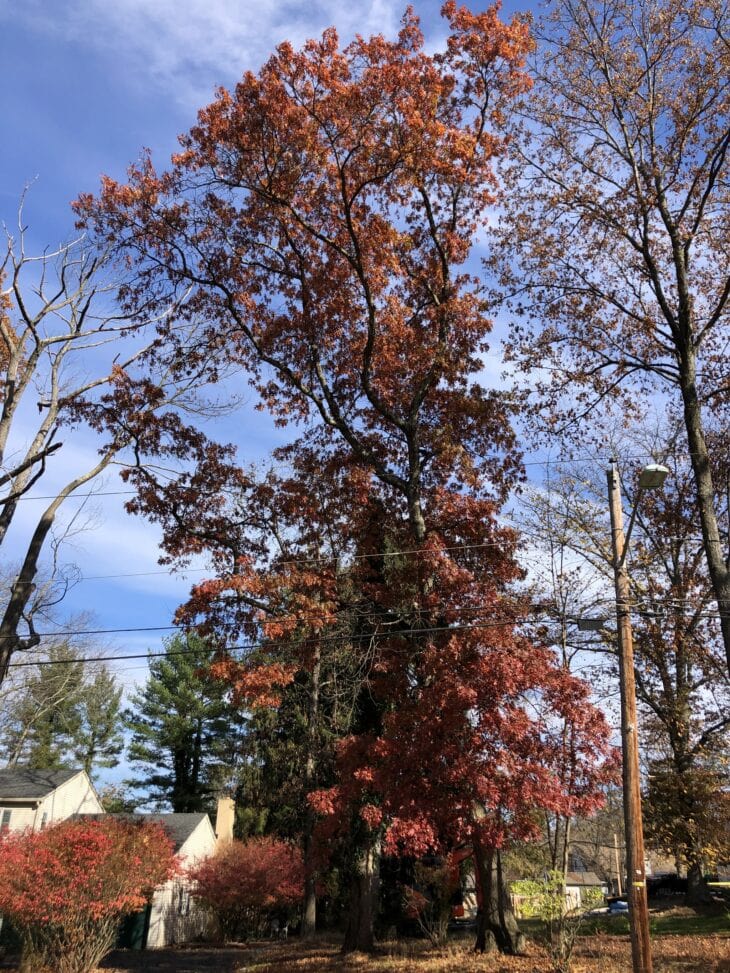
The red oak group brings the best color. Scarlet oak (Quercus coccinea) turns scarlet late in the season, pin oak goes orange, bronze or red, and Shumard oak (Quercus shumardii) turns red. White oak turns a late purplish to reddish brown, while bur oak has no real fall color.
Cons Of Oak Trees
Most Oaks Outgrow a Small Yard

Most landscape oaks (Quercus spp.) reach 50 to 80 feet (15 to 24 m) tall and nearly as wide. Live oak can spread 40 to 100 feet (12 to 30 m), and white oak can top 100 feet (30 m) tall.
NC State Extension says white oak should not be planted near structures or pavement because of its eventual size. On a small lot, that rules out most oaks before any other con comes into play.
If you want an oak in tighter space, choose a narrow species. Willow oak spreads 25 to 50 feet (7.5 to 15 m) and Shumard oak 30 to 40 feet (9 to 12 m). For a truly small yard, one of the smaller natives listed below is the better choice.
Oak Wilt Can Kill a Red Oak in One Season
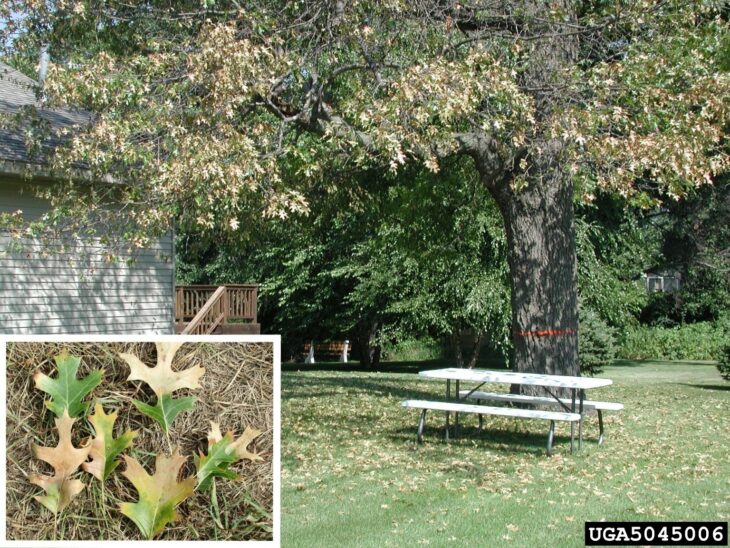
Oak wilt is a fungal disease (Bretziella fagacearum) reported from more than 24 eastern and midwestern states and Texas. The Morton Arboretum says red oak group trees usually die within weeks or months of infection. White oaks decline more slowly, with branch dieback for years.
Most new infections spread underground through root grafts between neighboring oaks. Sap beetles also carry spores to fresh pruning wounds, which is the part you can control. Pin, northern red, scarlet and Shumard oak are all in the vulnerable red oak group.
Never prune or wound an oak while the beetles are active. Minnesota and Michigan guidance says no pruning April through July, and the Morton Arboretum in Illinois says mid-April to mid-October. Prune between early November and early April, and paint any unavoidable summer wound right away.
For a valuable tree that isn’t yet infected, an arborist can apply a preventive systemic fungicide. On the West Coast, the comparable threat is sudden oak death (Phytophthora ramorum), mainly in foggy coastal northern California, Oregon and Washington, where infested counties are under quarantine.
Acorns and Leaf Litter Mean Seasonal Cleanup
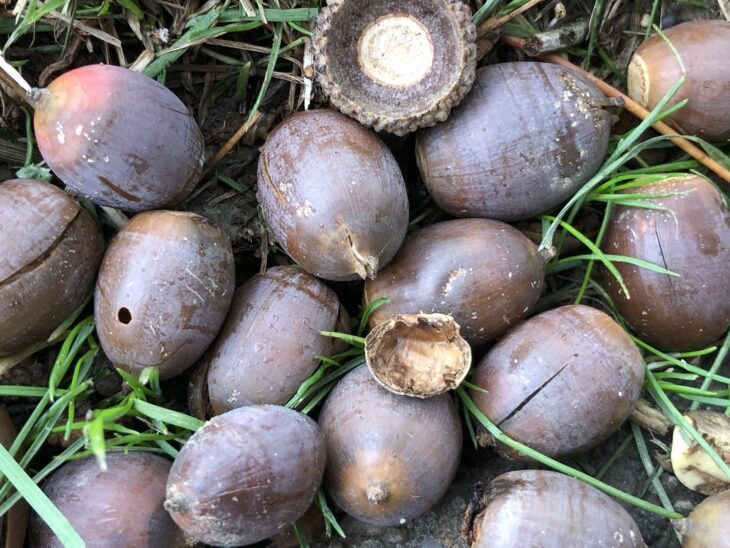
NC State flags white oak as messy, with acorns that can be numerous. Oaks also have boom years: in Missouri, black, white and northern red oak bear heavy acorn crops every 2 to 4 years, according to the USDA Forest Service.
Leaf drop is drawn out, too. Pin oak and northern red oak hold some dead leaves through winter and drop them gradually. Live oak sheds its old leaves in spring as the new ones emerge, so its cleanup comes then.
Site the tree away from patios, driveways and pools, and mulch a wide bed under the canopy to absorb the litter. If you keep horses, take acorns seriously: the ASPCA lists oak as toxic to horses, and acorns can block their digestive tract.
Oak Roots Are Easily Damaged by Construction
Grading, trenching, added fill and compaction from heavy equipment destroy the fine roots oaks rely on in the top foot (30 cm) of soil. University of Wisconsin Extension notes that trees often decline and die several years after the damage.
NC State lists white and swamp white oak as sensitive to soil compaction. White and bur oak also have deep taproots that make them hard to transplant, so buy them small.
Before any project near an existing oak, fence off the root zone and keep vehicles and soil piles out of it. Wisconsin Extension’s rule of thumb for tree wells is 1 foot (30 cm) of distance per inch (2.5 cm) of trunk diameter, so 10 feet (3 m) for a 10-inch (25 cm) trunk. Bur oak is among the more construction-tolerant species.
Pin Oak Turns Yellow in Alkaline Soil
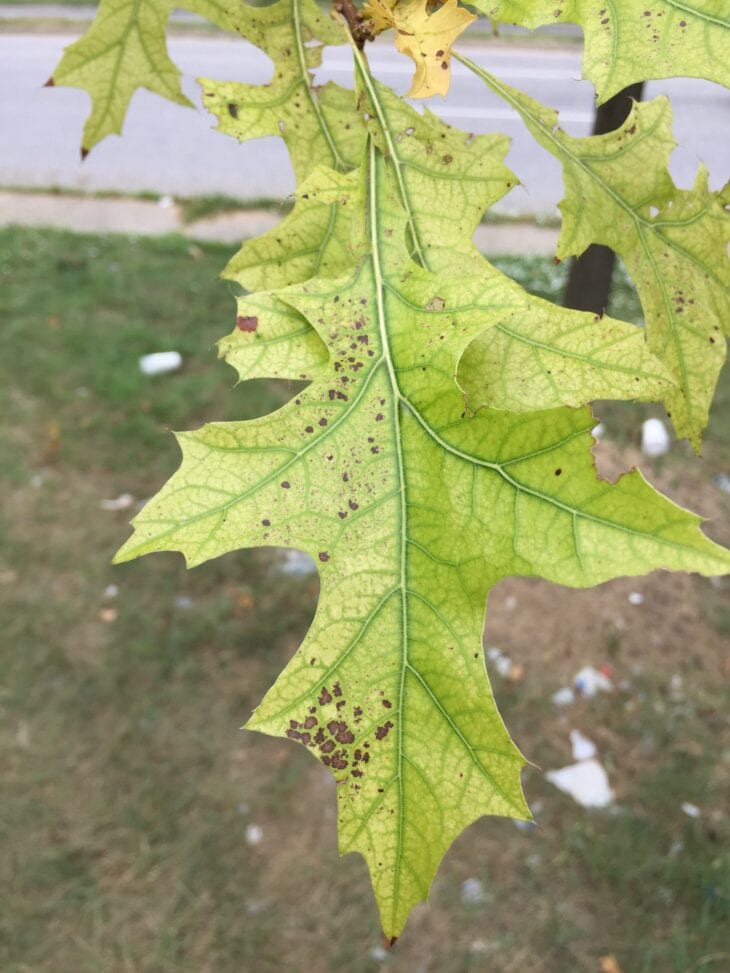
In soil above pH 7.5, pin oak (Quercus palustris) can’t absorb iron and develops chlorosis: yellow leaves with green veins. Iowa State Extension says branches and twigs may start to die after several years of it. Willow oak gets the same problem on high-pH soil.
Treatments exist (soil sulfur or iron sulfate, chelated iron, foliar sprays and trunk injection), but Iowa State notes that each has limitations. The reliable fix is prevention: test your soil pH before you plant.
On alkaline soil, Iowa State suggests northern pin oak (Quercus ellipsoidalis) or scarlet oak instead of pin oak. Bur oak tolerates alkaline soil better than most oaks.
Is an Oak Tree Right For You?
An oak suits a sunny yard with room for a tree 50 to 80 feet (15 to 24 m) wide, planted by someone who values wildlife and plans to stay.
Match the species to the site: bur oak for alkaline or dry soil in Zones 3–8, swamp white or willow oak for wet clay, white oak for well-drained acidic loam, and live oak on the coast in Zones 8–10.
Skip the oak if your lot is small, or if the only open spot is within the future canopy of the house, pavement or power lines. Think twice if horses can reach the acorns, if you have alkaline soil and your heart is set on pin oak, or if construction or trenching is planned nearby.
For a smaller yard or a shady spot, American hornbeam (Carpinus caroliniana) is a native that grows 20 to 30 feet (6 to 9 m) tall in Zones 3–9 and tolerates wet soil and storms. Black gum (Nyssa sylvatica) gives you a native shade tree with scarlet fall color and a narrower 20 to 35 foot (6 to 11 m) spread in Zones 4–9.
Serviceberry (Amelanchier) is the pick for the tightest spaces: a native small tree of 15 to 25 feet (4.5 to 7.5 m), hardy in Zones 4–9, and one of the first to flower in spring.
Frequently Asked Questions
Is it good to have an oak tree in your yard?
Yes, if the yard has room for it. Native oaks support more insect species than any other North American plant genus, which feeds birds and other wildlife, and some live for centuries. The catch is size: most reach 50 to 80 feet (15 to 24 m) tall and wide, so plant well away from the house and pavement.
What are the downsides of having live oak trees?
Live oak’s spread of 40 to 100 feet (12 to 30 m) is the biggest downside, so it needs a large lot. It drops its old leaves in spring as new ones emerge, which means a spring cleanup, and it is only hardy in Zones 8–10. On the plus side, it is one of the most wind-resistant trees in University of Florida hurricane studies.
When should you prune oak trees?
Prune oaks in winter, between early November and early April, while the beetles that spread oak wilt are inactive. Minnesota and Michigan guidance says never prune April through July, and the Morton Arboretum in Illinois extends that to mid-October. If a branch breaks in summer, paint the wound right away.
Are oak trees poisonous to dogs or horses?
The ASPCA lists oak as toxic to horses because of gallotannin in the leaves and acorns, and acorns can also block the digestive tract. Its listing does not include dogs or cats. NC State rates oak’s poison severity as low for people, with stomach upset from raw acorns or young leaves. Call your vet if any animal eats a lot of acorns.




_just_north_of_Maryland_State_Route_173_(Patapsco_Avenue)_in_Baltimore_City,_Maryland.jpg)