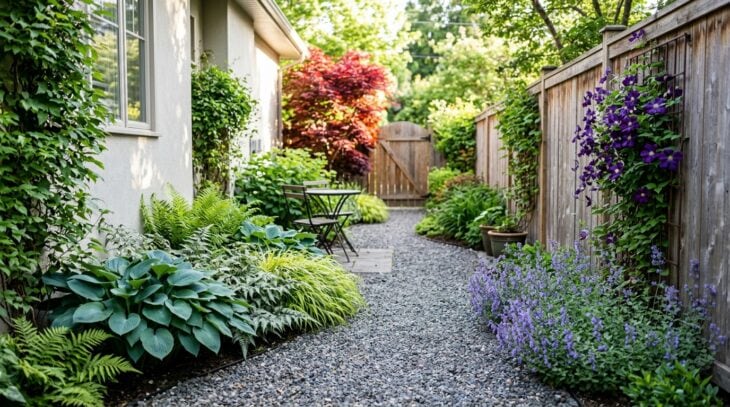
The strip between your house and the property line is easy to ignore. It is often only 3 to 10ft (90 to 300cm) wide, shaded by one wall and crowded with bins, meters and an air conditioner, so most side yards get nothing but gravel, weeds and a mower path.
Contents
- 01. Gravel Path Lined With Hostas and Ferns
- 02. Stepping Stones Set in Creeping Thyme
- 03. Shade Carpet of Mountain Pachysandra and Wild Ginger
- 04. Moss and Stone Quiet Walk
- 05. Slatted Screen to Hide Bins and the AC Unit
- 06. Dry Creek Bed for Downspout Runoff
- 07. Rain Barrel Watering Station
- 08. Pea Gravel Dog Run With Tough Edging
- 09. Hidden Potting Bench and Compost Corner
- 10. Bistro Nook Where the Yard Widens
- 11. Rose Arch Tunnel Down the Passage
- 12. Japanese Maple Focal Point at the Far End
- 13. Window-View Garden of Hellebores and Sweet Box
- 14. Pocket Planter Wall on a Blank Facade
- 15. Climbing Hydrangea on a Shady Wall
- 16. Clematis Climbing a Fence Trellis
- 17. Espaliered Apple Against a Sunny Wall
- 18. Slim Columnar Evergreens for Privacy
- 19. Snowball Hydrangea Hedge in Part Shade
- 20. Narrow Raised Bed Vegetable Strip
- 21. Kitchen-Door Herb Strip
- 22. Cut Flower Row Along a Sunny Fence
- 23. Pollinator Ribbon of Coneflower, Tickseed and Catmint
- 24. Lavender and Russian Sage in a Gravel Strip
- 25. Pot Ladder Against a Sunny Wall
These 25 ideas treat that strip as a real garden. They cover shady and sunny passages, drainage fixes, screens for the utility clutter, edibles, climbers and seating, from a weekend of gravel and edging to a full espaliered fruit tree.
Start with the first job your side yard has to do, whether that is carrying the bins, draining a downspout or hiding the condenser, then pick the planting that matches your light. Call 811 before any digging, because utility lines often run through these strips.
01. Gravel Path Lined With Hostas and Ferns
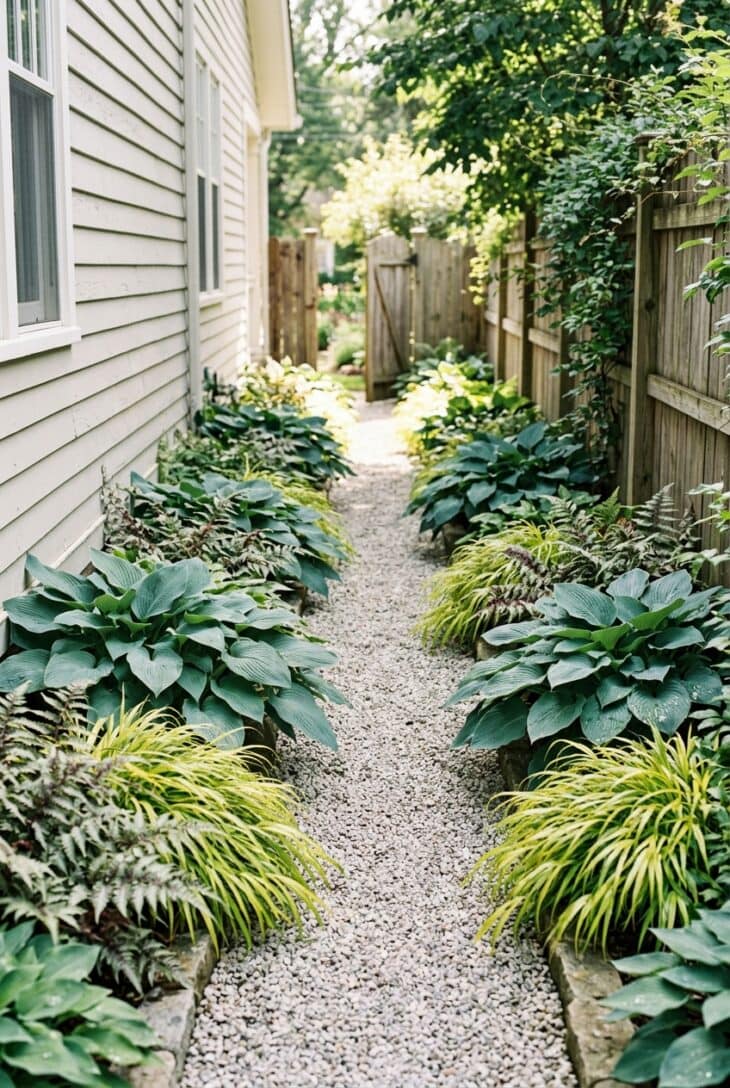
What you see A strip of pale gravel runs straight down the passage, and the planting on either side is all foliage: broad blue-green hosta leaves, silver-and-burgundy fern fronds and a ribbon of golden grass spilling over the edge. There is almost no flower color, yet the textures read as rich because every leaf shape differs from its neighbor. The shade is cool and even, and the far end glows where the path meets a gate.
Why it works Most side yards sit in the shadow of the house for much of the day, and foliage is the planting style that thrives in that light instead of fighting it. Contrasting leaf shapes (bold hosta, lacy fern, fine grass) give the eye plenty to read in a space you only pass through. The gravel keeps the route clear for the mower, the bins and the wheelbarrow, which is the first job any side yard has to do.
How to get it Compact 3 to 4in (8 to 10cm) of crushed stone over firmed soil, top it with 1in (2.5cm) of pea gravel, and edge both sides so the beds stay out of the path. Plant a blue hosta (Hosta ‘Halcyon’), hardy in Zones 3 to 9, at 2 to 3ft (60 to 90cm) spacing, with Japanese painted fern (Athyrium niponicum var. pictum) in Zones 4 to 9 and Japanese forest grass (Hakonechloa macra ‘Aureola’) in Zones 5 to 9 between them. Deer and rabbits eat hostas, and NC State lists them as a problem for cats and dogs if chewed, so the ferns and grass carry the planting where either is a worry. Thicker-leaved hostas tend to suffer less slug damage than thin-leaved ones. For more surfaces and layouts, browse these garden path ideas.
02. Stepping Stones Set in Creeping Thyme
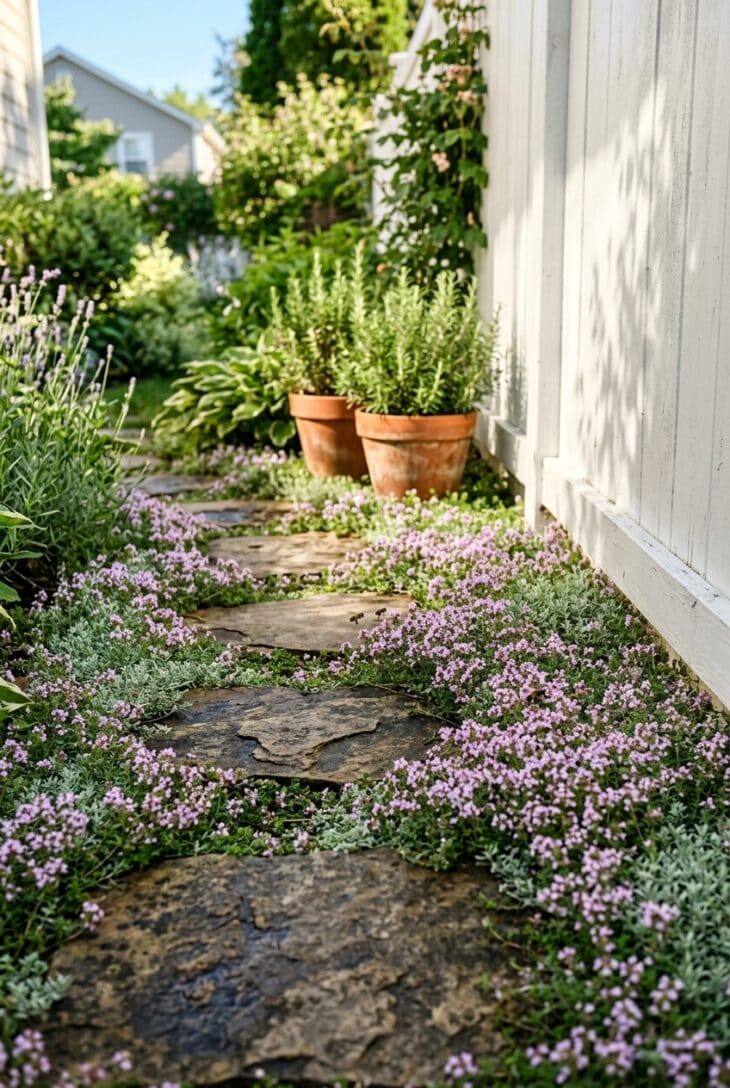
What you see Flat flagstones step down the strip, and between them a low mat of tiny leaves is flecked with lilac-pink flowers. Bees work the blooms in early summer, and a warm, resinous scent rises each time a foot brushes the plants. It looks like a path someone planted rather than paved.
Why it works Creeping thyme stands up to light foot traffic, so it softens a hard path without the upkeep of a lawn, and once established it asks for far less water than turf. It also solves the mowing problem, since a 3ft (90cm) wide side yard is a miserable place to push a mower. Where the sun reaches, this is one of the cheapest ways to turn a utility strip into something fragrant.
How to get it Pick a spot with 6 or more hours of direct sun and fast-draining soil, because thyme rots in soggy ground. Set the stones about 20 to 24in (50 to 60cm) apart center to center, bed them in 1in (2.5cm) of sand, and plant mother of thyme (Thymus serpyllum), hardy in Zones 4 to 9, in the gaps at 8 to 12in (20 to 30cm) spacing after your last frost. Water weekly until it knits together, which takes a season or two, and hand-weed while it fills in. Trim the plants lightly after flowering to keep the mat dense. Keep it off the bin route, because daily wheeling will wear it thin.
03. Shade Carpet of Mountain Pachysandra and Wild Ginger
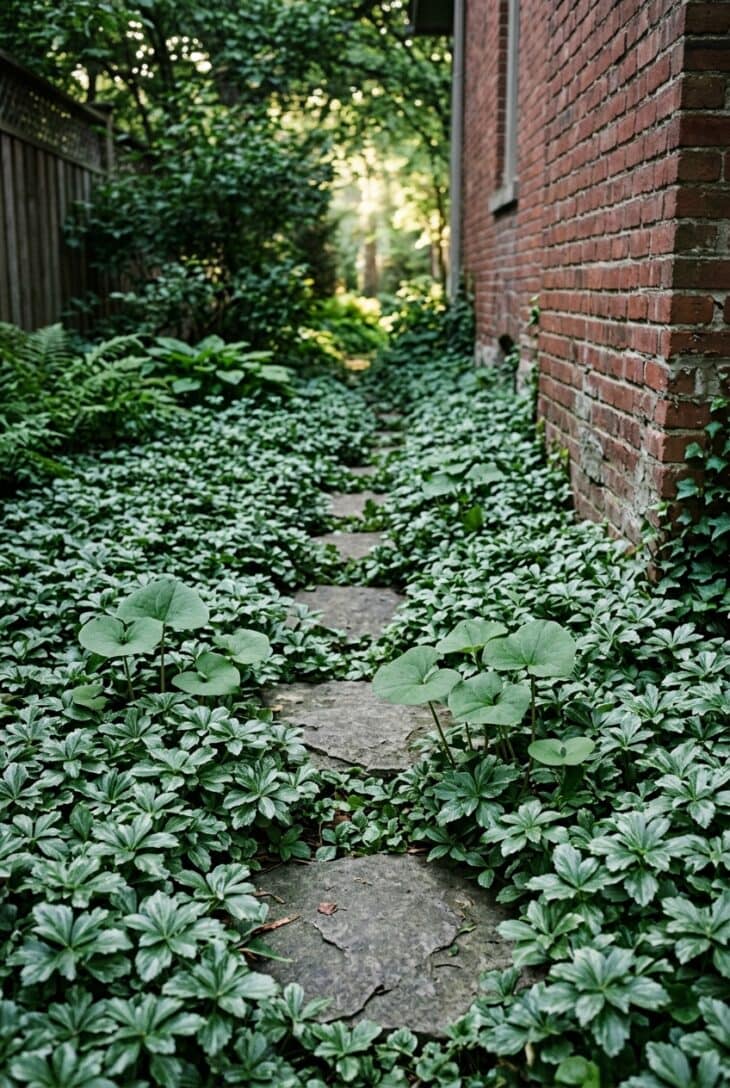
What you see A dense green mat spreads along the base of the wall: scalloped, silver-mottled pachysandra leaves arranged in whorls, with heart-shaped wild ginger leaves rising through them like velvet. No bare soil shows anywhere. It is quiet and cool, the kind of ground cover that makes a dark strip look finished rather than neglected.
Why it works Bare soil under a roof edge turns to mud, weeds and splashed siding, and a thick ground cover solves all three at once. Shade is the condition both plants are built for, so they hold their ground without constant thinning or feeding. Once the mat closes there is almost nothing left to do.
How to get it Mountain pachysandra (Pachysandra procumbens) is native to the southeastern US, and NC State describes it as not invasive. Space plants 6 to 12in (15 to 30cm) apart and water only when the top inch (2.5cm) of soil dries; it stays evergreen to semi-evergreen in Zones 7 and 8 and loses leaves in colder winters. Canadian wild ginger (Asarum canadense), hardy in Zones 4 to 6, covers colder gardens, but NC State flags its leaves, stems and roots as toxic, so never eat any part of it. The common garden-center option, Japanese spurge (Pachysandra terminalis), is evergreen in Zones 4 to 9 and takes about three years to cover the ground. Plant in early spring or about 6 weeks before your first fall frost.
04. Moss and Stone Quiet Walk
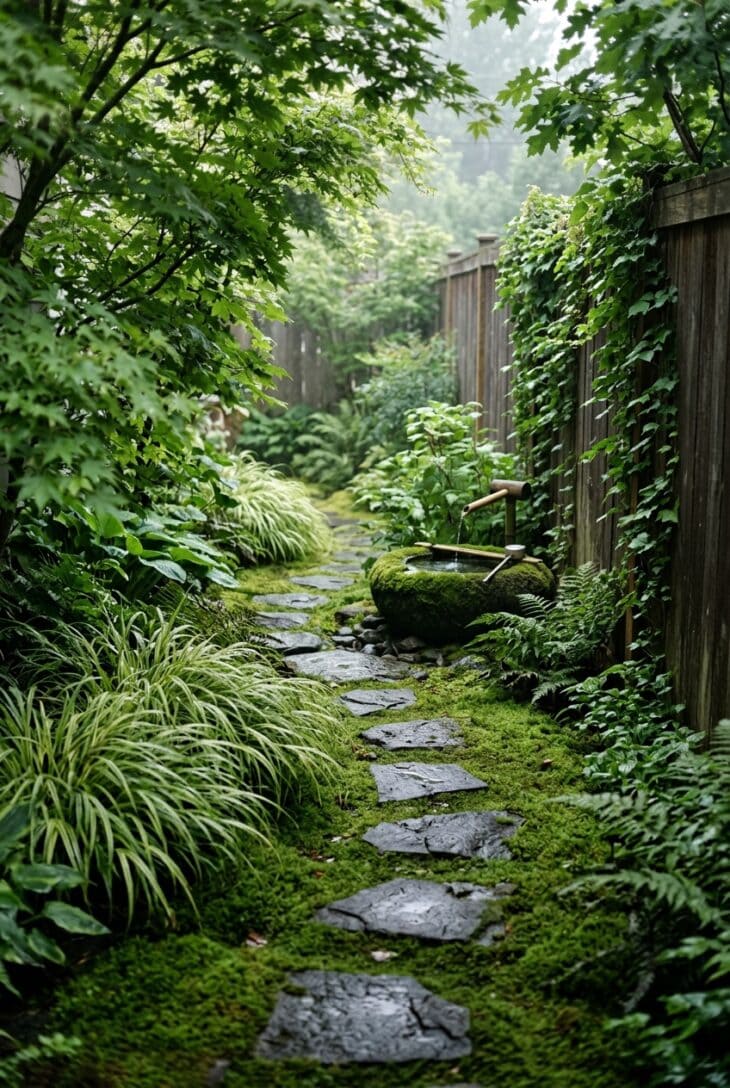
What you see Irregular stones float on a cushion of emerald moss, and a low stone basin near the far end holds a few inches of still water. Fine-bladed sedges arch from the edges, and the whole passage feels hushed and green. It reads like the entrance to a tea garden, not a gap beside a garage.
Why it works A narrow, shaded corridor is exactly the proportion designers use for passages meant to slow you down. Moss thrives where grass and most perennials sulk: constant shade, moisture and compacted, acidic soil. With a palette of stone, moss and one or two evergreen plants, there is almost nothing to deadhead or divide.
How to get it Clear the strip, rake it level and firm it, but do not enrich the soil, since moss prefers lean, acidic ground. Bed the stones in place, buy moss pads from a nursery rather than stripping them from the woods, press them onto damp soil and keep them moist for the first few weeks. Add variegated Japanese sedge (Carex morrowii ‘Ice Dance’), hardy in Zones 5 to 9, along one edge for fine texture. In hot, dry regions moss needs regular misting, and it never tolerates heavy foot traffic, so keep it around the stones rather than on them. For more of this look, see Japanese garden ideas.
05. Slatted Screen to Hide Bins and the AC Unit
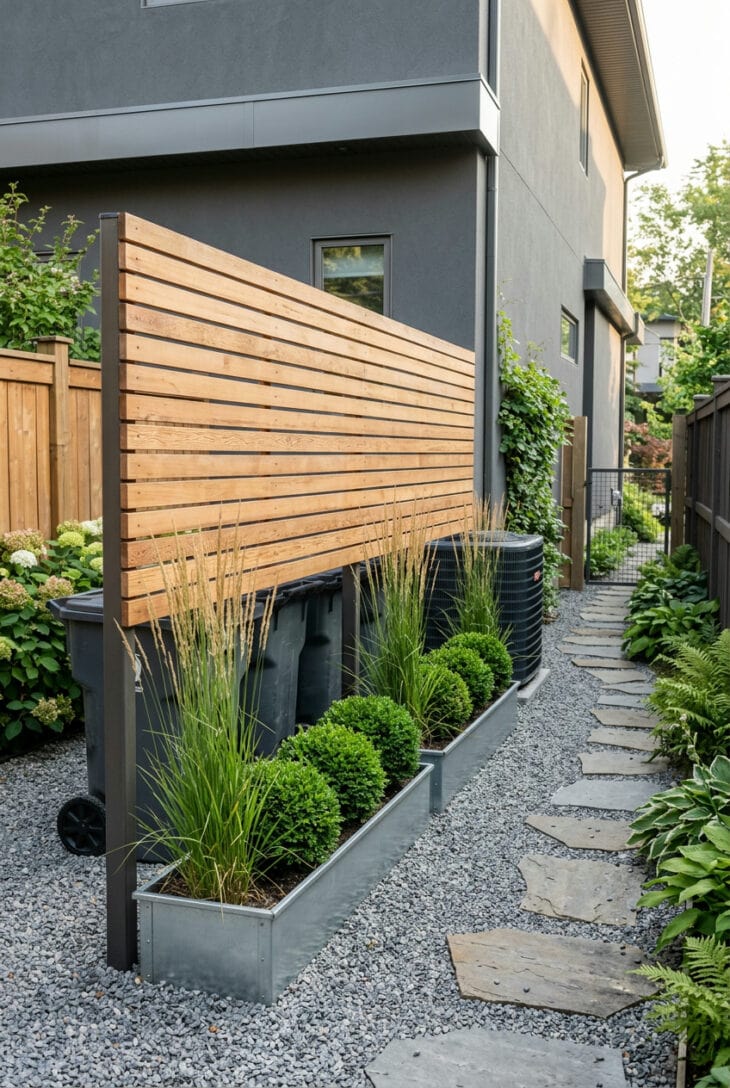
What you see Horizontal cedar slats form a clean wall of warm brown, and through the gaps you can just make out the edge of a trash bin and a gray condenser. In front, a long narrow planter holds upright feather reed grass and a pair of clipped boxwood globes. The utility corner now looks designed instead of dumped.
Why it works The things a side yard has to hold (bins, a heat pump, a hose reel) are the reason most people avoid it. A screen turns that clutter into a deliberate backdrop, and the planters make the screen read as part of the garden. Slats with gaps also let air through, which the equipment needs.
How to get it Follow the clearances in the unit’s manual (often 2ft (60cm) or more around the sides, and more above) and build the panels removable or hinged so a technician can reach the unit. Never box in gas or water meters or shutoffs, because the utility needs access. Leave 1/2in (1.3cm) gaps between cedar slats, and keep a clear 3ft (90cm) route for rolling bins out. Plant the visible side with feather reed grass (Calamagrostis x acutiflora ‘Karl Foerster’), hardy in Zones 4 to 9, which stays upright and tidy.
06. Dry Creek Bed for Downspout Runoff
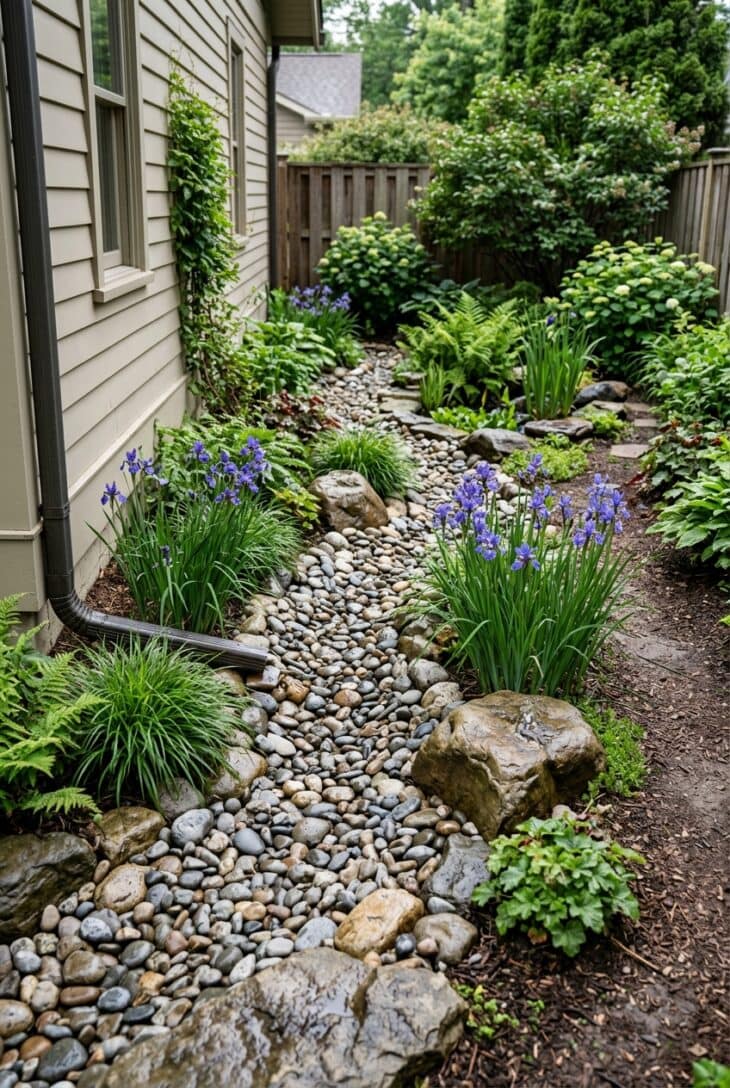
What you see A shallow channel of mixed river rock snakes away from the downspout, with larger boulders set at the bends as though a stream had cut it. Blue-purple iris flowers and grassy sedge clumps crowd the banks. After rain the stones darken and the channel looks like a real, working streambed.
Why it works Downspouts that dump beside the foundation leave puddles, erosion and wet basements, and the narrow side yard is where most of them end up. A dry creek bed carries the water away and makes the fix look like a feature. In dry weather it is a rock-lined path of texture, in a storm it moves roof water off the house.
How to get it Call 811 before you dig, then cut a shallow swale 8 to 12in (20 to 30cm) deep and 2 to 3ft (60 to 90cm) wide, starting at a downspout extension and sloping away from the house, with the water discharging at least 5 to 10ft (150 to 300cm) from the foundation. Fill it with river rock in mixed sizes, 2 to 6in (5 to 15cm), and set a few boulders half-buried at the bends. Plant Siberian iris (Iris sibirica), hardy in Zones 3 to 8, along the banks; NC State lists it as tolerant of wet and dry soil and resistant to deer and rabbits. If the water has nowhere to go, end the channel in a planted basin and see these rain garden ideas.
07. Rain Barrel Watering Station
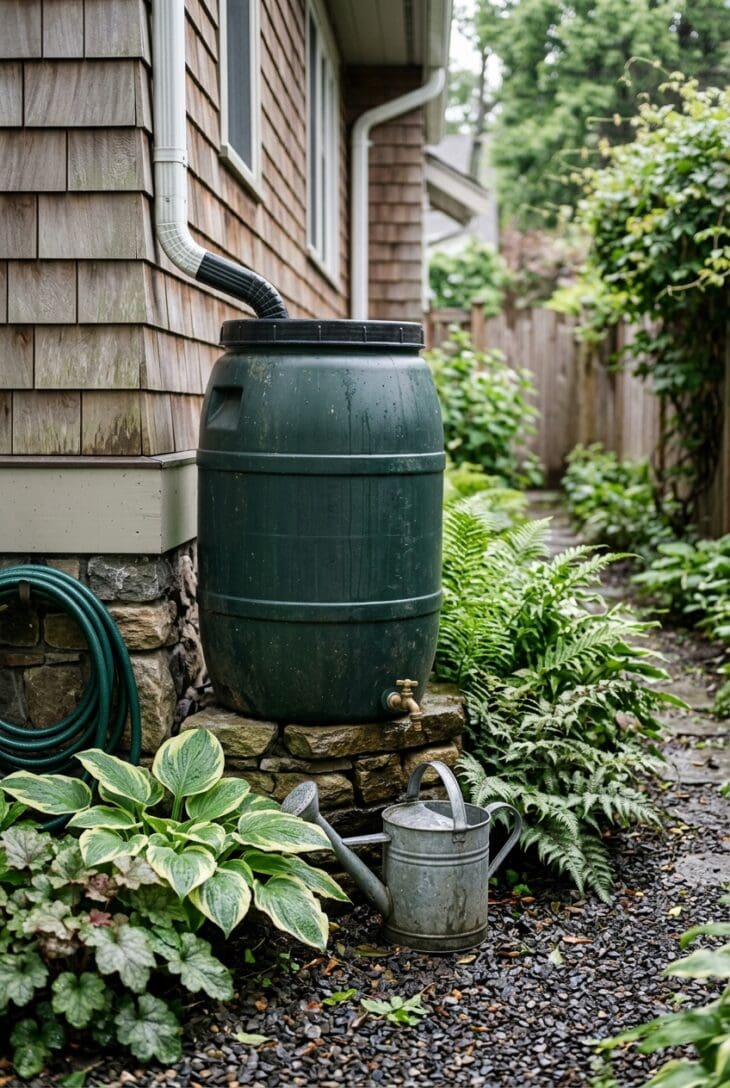
What you see A dark green barrel sits on a stone base at the corner of the house, a short pipe feeding it from the downspout and a brass spigot low enough for a watering can. Ferns and hostas soften its base, and a coiled hose waits beside it. It looks like the garden’s own water tap.
Why it works A roof sheds far more water than most gardeners realize: 1in (2.5cm) of rain on a 1,000 sq ft (93m²) roof yields about 620 gallons (2,350L). A barrel captures a share of that for free, takes pressure off a downspout and puts water exactly where the side yard’s thirsty plants live. Collecting it also keeps a dry stretch from forcing a hose out of the garage.
How to get it Set the barrel on a level, sturdy base 12 to 18in (30 to 45cm) high so a can fits under the spigot; a full 50-gallon (190L) barrel weighs over 400lb (180kg). Fit a diverter on the downspout, a screened lid to keep out mosquitoes and debris, and an overflow hose that runs well away from the foundation. Use the water on ornamentals and at soil level on vegetables, but not over edible leaves, since roof runoff can carry grit and contaminants. A few western states regulate rain collection, so check your local rules before you install one.
08. Pea Gravel Dog Run With Tough Edging
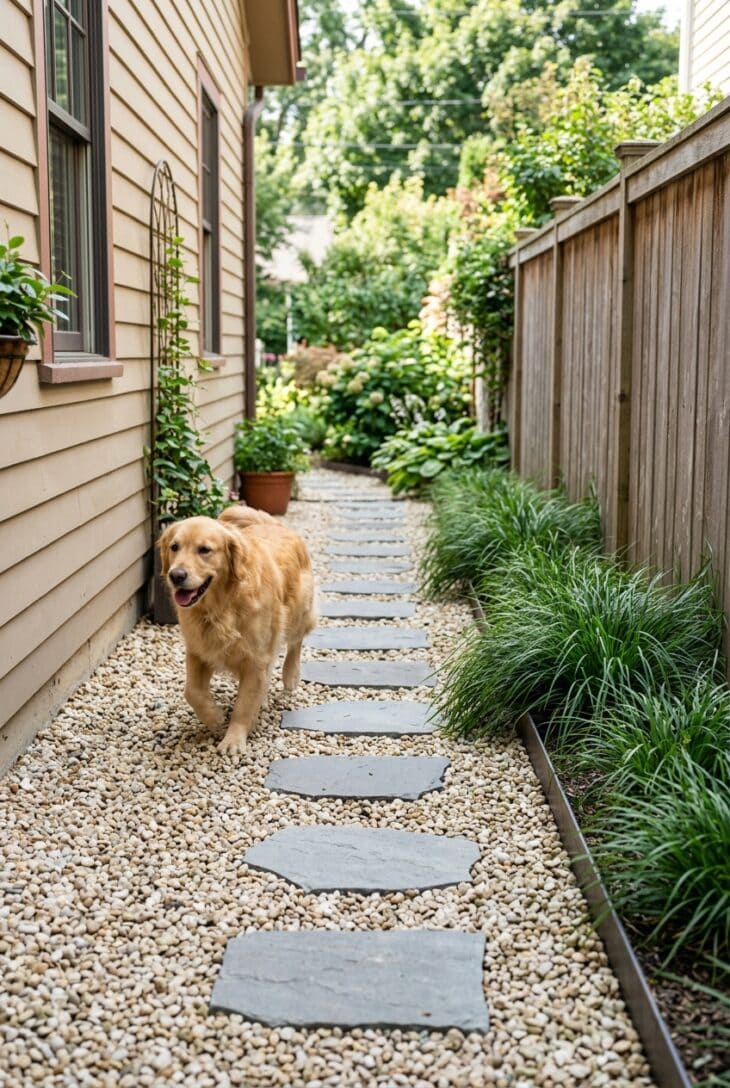
What you see Pale pea gravel fills the passage from wall to fence, with a line of flat stones down the middle for a clean walkway. A narrow bed of tough grasses is held back from the run by crisp steel edging, and a golden retriever trots along it. Nothing here is mud.
Why it works Dogs wear a path along the fence in any side yard, and left alone it becomes a trench of bare dirt that the whole house tracks inside. Defining the run on purpose keeps the wear in one place and drains cleanly after rain. It also gives the planting a protected edge instead of a battleground.
How to get it Lay 2 to 3in (5 to 8cm) of 3/8in (1cm) pea gravel over a compacted base, and hold it in with steel or stone edging (see these garden edging ideas). Bury hardware cloth 12in (30cm) deep along the base of the fence if your dog digs. Skip cocoa shell mulch, which contains theobromine and can poison dogs. Gravel in full sun can get hot on paws, so test it by hand and add shade where needed. Check every plant against the ASPCA’s toxic plant list, since NC State lists common hostas as a problem for dogs.
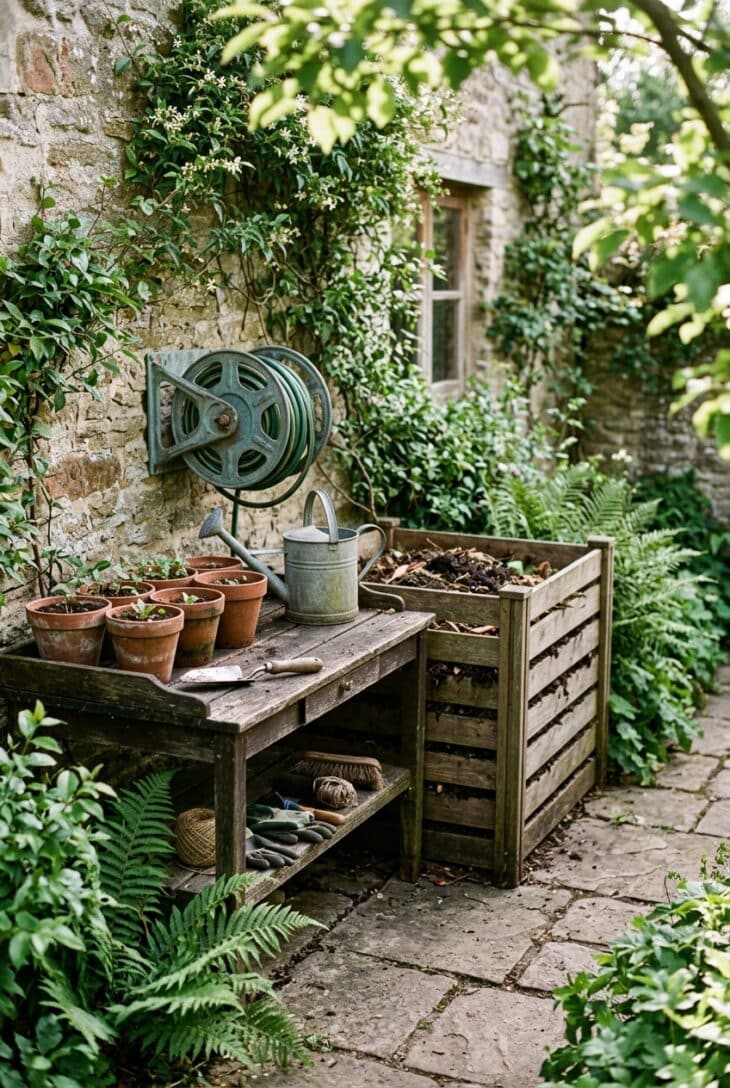
What you see A weathered potting bench stands against the wall with terracotta pots stacked at one end and a watering can hanging beside it. Next to it, a slatted wooden bin holds the compost, tidy and out of sight from the lawn. The corner looks like a place where real gardening gets done.
Why it works Potting soil, pots and compost are the unglamorous half of gardening, and the side yard is the ideal place to keep them: close to the beds, out of sight from the patio. Having a dedicated bench means repotting happens when you feel like it, not when you have cleared the kitchen table. A bin next to it turns trimmings into free soil improver.
How to get it Build the bench 34 to 36in (86 to 91cm) high with a 20in (50cm) deep top, and set a shelf below for bags and pots. A 3ft (90cm) cube is the usual minimum for a pile that heats up, so make the bin that size and leave one side removable for turning. Keep the bin on bare soil so worms can move in, and a few inches (8cm) away from wooden siding so damp never rots it. Skip meat and dairy, which attract pests, and check HOA or city rules before you start. For the options, see types of compost.
10. Bistro Nook Where the Yard Widens
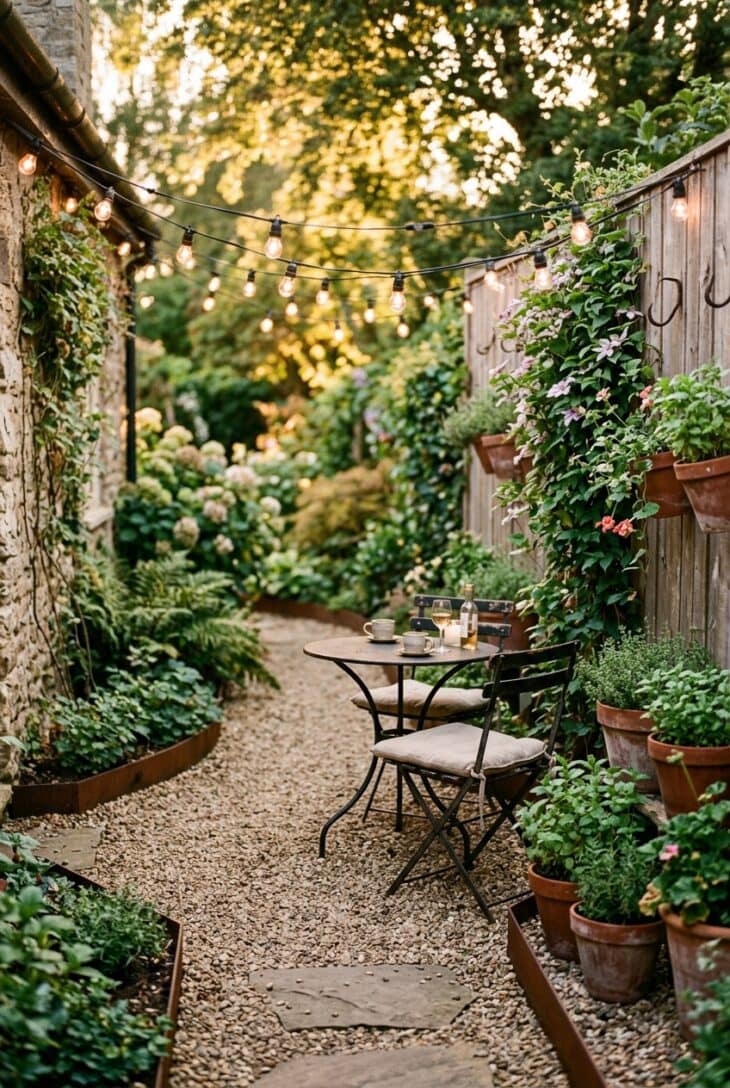
What you see A round café table and two chairs sit on a pad of gravel where the passage opens up, with a string of warm lights zigzagging overhead. Pots of herbs stand along the wall and a vine climbs the fence behind. It feels like a hidden café in the middle of your own yard.
Why it works Side yards are the one place on the lot that is private, sheltered and already a little secret. A tiny seat there beats a big patio you never use, because it is steps from the kitchen and enclosed on both sides. The lights make it work after dark and make the passage inviting.
How to get it Choose the widest point, usually near a door or a bump-out, and make the pad about 5 by 5ft (150 by 150cm) so chairs can slide out, with a clear 3ft (90cm) route beside it for walking. Build it with 4in (10cm) of compacted crushed stone and 1 to 2in (2.5 to 5cm) of pea gravel, held in with edging. Use outdoor-rated string lights on a GFCI-protected outlet, and hang them from hooks screwed into fence posts, not the siding. For more ways to use the space, see these patio garden ideas and garden lighting ideas.
11. Rose Arch Tunnel Down the Passage
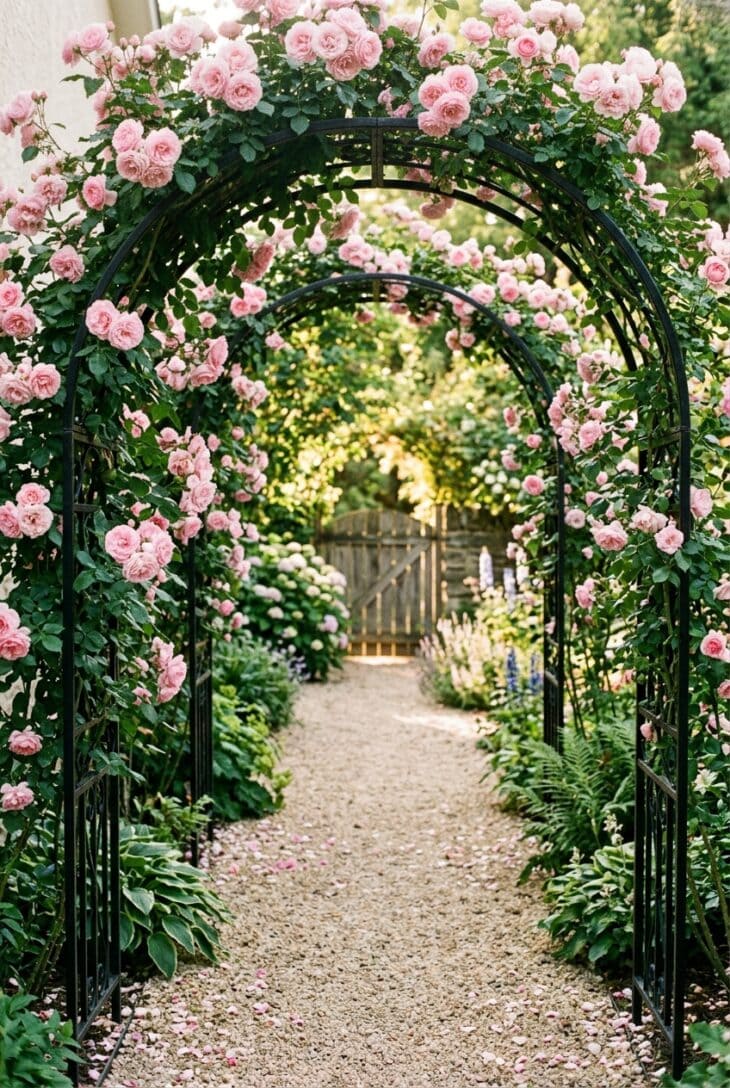
What you see Three steel arches march down the passage, each one wrapped in soft pink roses that meet overhead. Petals litter the gravel below, and the path ends at a bright gate that seems to glow through the tunnel. Walking through it feels like entering a different garden.
Why it works A narrow space is the perfect size for an arch tunnel, because the sides are already defined and the eye is led forward. Repeating the arch builds rhythm, and the roses add fragrance and height without taking any floor space. A plain strip becomes a destination.
How to get it Use arches at least 8ft (240cm) tall and 4ft (120cm) wide so you can walk through once the roses fill in, set 4 to 6ft (120 to 180cm) apart, and sink the legs 18in (45cm) into the ground or concrete so wind cannot tip them. The thornless Bourbon rose (Rosa ‘Zéphirine Drouhin’) is hardy in Zones 5 to 9 and reaches 6 to 12ft (180 to 365cm), and it is thornless, so nobody gets snagged walking through. Roses need 6 or more hours of sun, so put this idea where the passage is open to the sky, and give them good air circulation because this rose can get powdery mildew in still, humid air. Tie canes sideways rather than straight up to push more bloom, and prune in late winter.
12. Japanese Maple Focal Point at the Far End
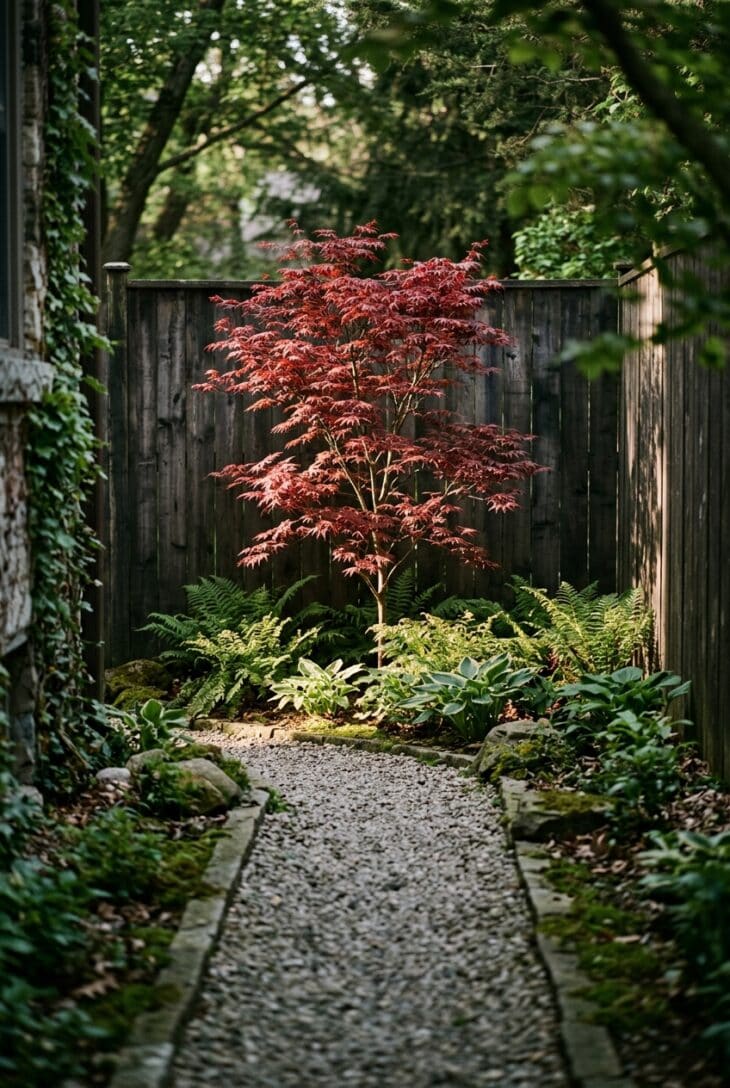
What you see At the end of the passage, a compact maple holds a shaft of morning light, its finely cut red leaves glowing against a dark fence. Ferns and low hostas gather at its feet. The whole path seems to lead to it.
Why it works A narrow space has a direction, and a focal point at the end gives that direction a payoff. One strong plant draws the eye through the passage, makes it feel longer and hides the dead end of a fence. Japanese maple does it with just one stem and a lace of leaves.
How to get it Pick a compact cultivar and check the tag for its mature size, since NC State gives the species 15 to 25ft (4.5 to 7.5m) in height and many named forms are far smaller. The species is hardy in Zones 5 to 8 and does best in dappled light, so protect it from hot afternoon sun and drying wind, which scorch the leaf edges. Plant it in rich, well-drained soil, set the top of the rootball level with the ground, and mulch 2 to 3in (5 to 8cm) deep, keeping mulch off the trunk. Water deeply through the first two summers. See the full Japanese maple profile for cultivars, and use a large glazed pot if a tree will not fit.
13. Window-View Garden of Hellebores and Sweet Box
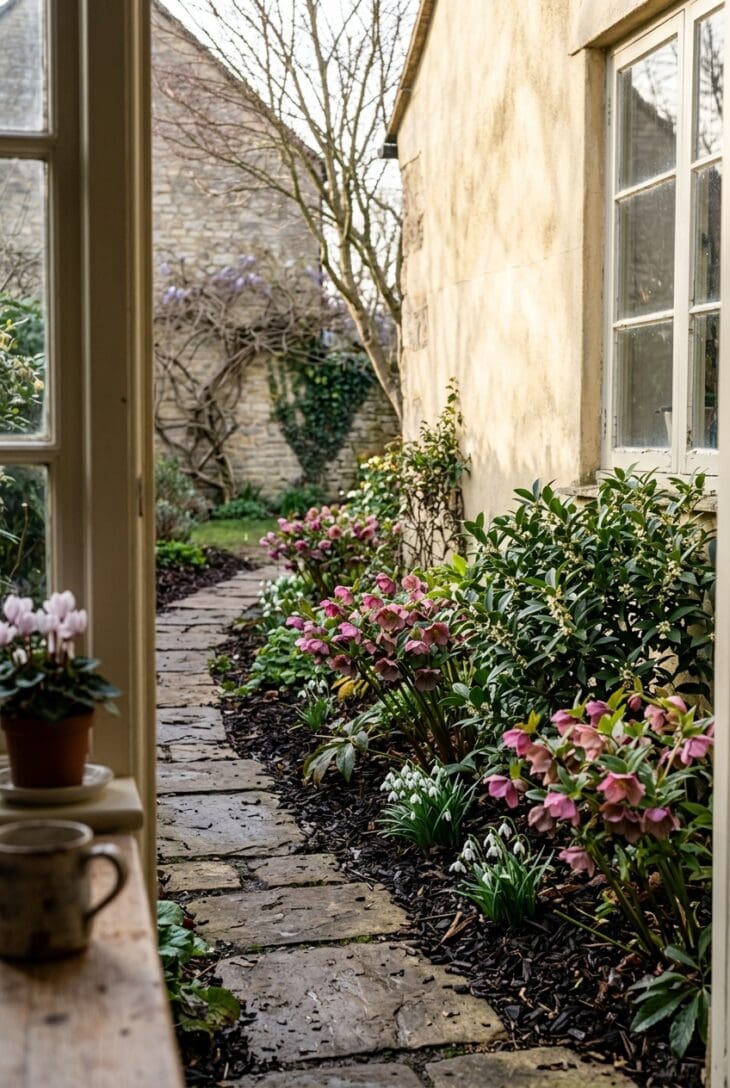
What you see Seen through a window, nodding hellebores in plum and dusty pink bloom beneath glossy evergreen shrubs while the rest of the yard is still bare. A few snowdrops speckle the mulch, and the low winter sun lights the wall behind. It is the first real color of the year, framed like a picture.
Why it works The side yard is the view from the kitchen sink, the hallway and the stairs, so it is seen far more often than it is walked. Planting for that view, evergreen and winter-flowering, gives you a garden to look at in the months you are indoors. Shade-loving plants that peak in late winter do the job without competing with summer.
How to get it Plant hellebores (Helleborus x hybridus), hardy in Zones 4 to 9, in fall in partial to deep shade, 18in (45cm) apart in rich, well-drained soil. NC State lists them as resistant to deer and rabbits but flags the leaves as toxic, so wear gloves and keep pets from chewing them. Pair them with fragrant sweet box (Sarcococca confusa), hardy in Zones 7 to 9, which scents the air in winter. Cut the old hellebore leaves to the ground in late winter, just before the flower stems rise, so the blooms show clearly. For more plants for the shady side, see these shade garden ideas.
14. Pocket Planter Wall on a Blank Facade
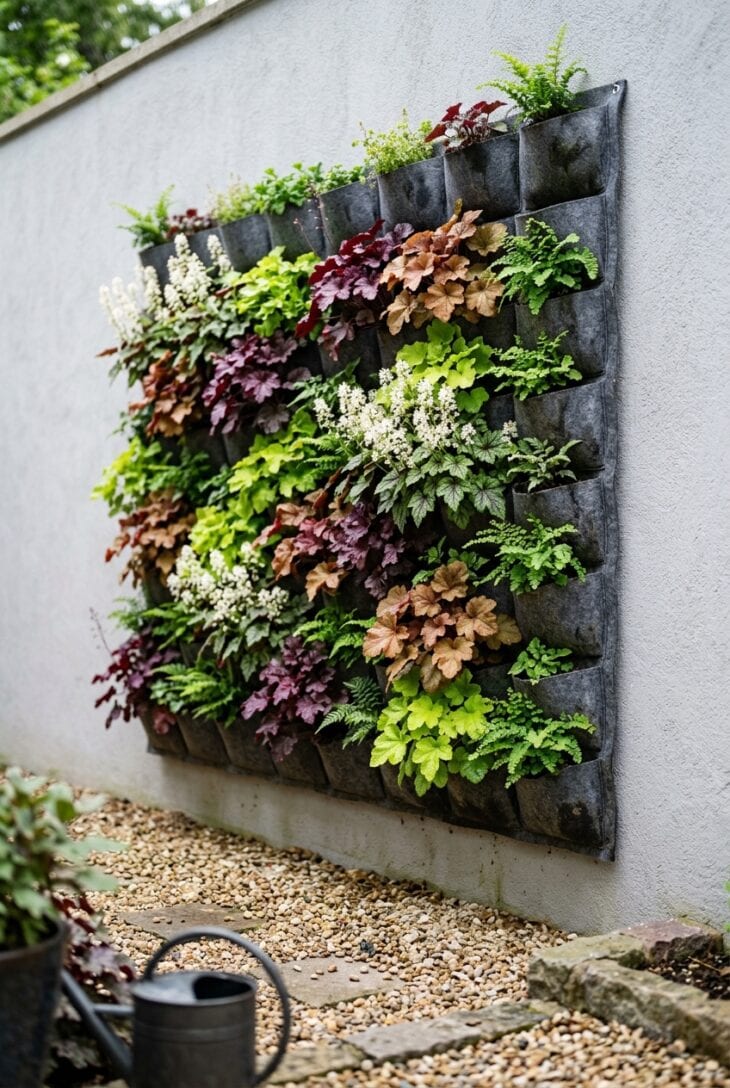
What you see A bare wall now wears a patchwork of foliage: caramel, burgundy and lime coral bells, frothy white foamflower and small ferns, each tucked in its own pocket. The planting reaches from knee height to above your head. The path in front is the same narrow strip, but it no longer feels like a corridor of plain wall.
Why it works A side yard has almost no floor space but a lot of wall, and a pocket planter uses the vertical surface without spending any ground. Foliage plants keep it looking good for months, not weeks. It is also movable: it comes off the wall, which suits renters.
How to get it Choose a felt or fabric planter and hang it from a fence or on brackets rather than drilling into brick. Wet soil is heavy, so make sure the fence or wall can bear the load. Plant coral bells (Heuchera villosa), hardy in Zones 3 to 8, and foamflower (Tiarella cordifolia), hardy in Zones 3 to 8 per NC State. Pockets dry out much faster than ground soil, so water daily in summer or add a drip line, and note that plants in above-ground pockets face colder roots than plants in the ground, so a common rule of thumb is to choose plants hardy to two zones colder than yours. For more, see these vertical garden ideas.
15. Climbing Hydrangea on a Shady Wall
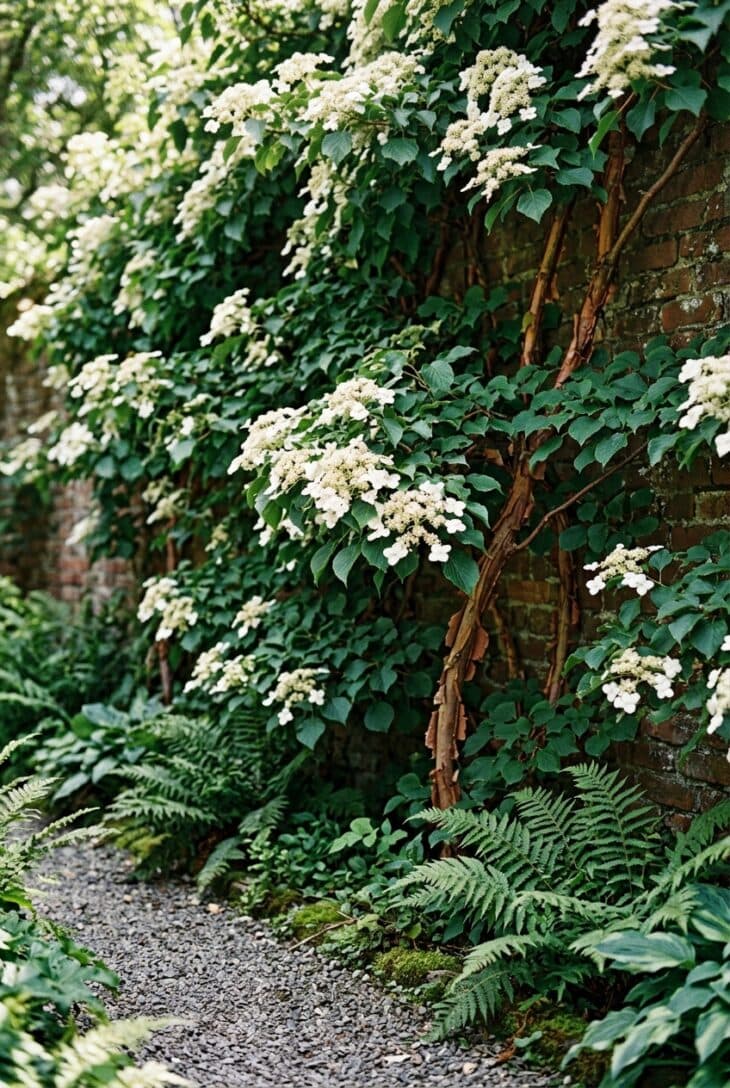
What you see A shady brick wall is covered edge to edge with rounded green leaves and flat white flower heads that look like lace plates. Between the foliage, cinnamon-colored stems peel in thin strips. Below, a few ferns edge a gravel path.
Why it works Few climbers flower in deep shade, and this is one of them. It clings by itself, so there is no trellis to build, and it gives a bare wall a soft, layered face in summer and interest from its peeling bark in winter. In a narrow yard it turns the tallest surface into the garden’s centerpiece.
How to get it Plant climbing hydrangea (Hydrangea petiolaris), hardy in Zones 4 to 8, in rich, moist soil in part to deep shade, and expect slow growth for the first few years before it takes off. NC State lists the mature height at 30 to 60ft (9 to 18m) and width at 5 to 6ft (150 to 180cm), so plan to prune. Aerial rootlets cling to masonry, but keep it off wood siding, soffits and gutters, or give it a freestanding trellis 6in (15cm) off the wall. Prune right after it flowers, since flower buds form on old wood. Water weekly through the first two summers.
16. Clematis Climbing a Fence Trellis
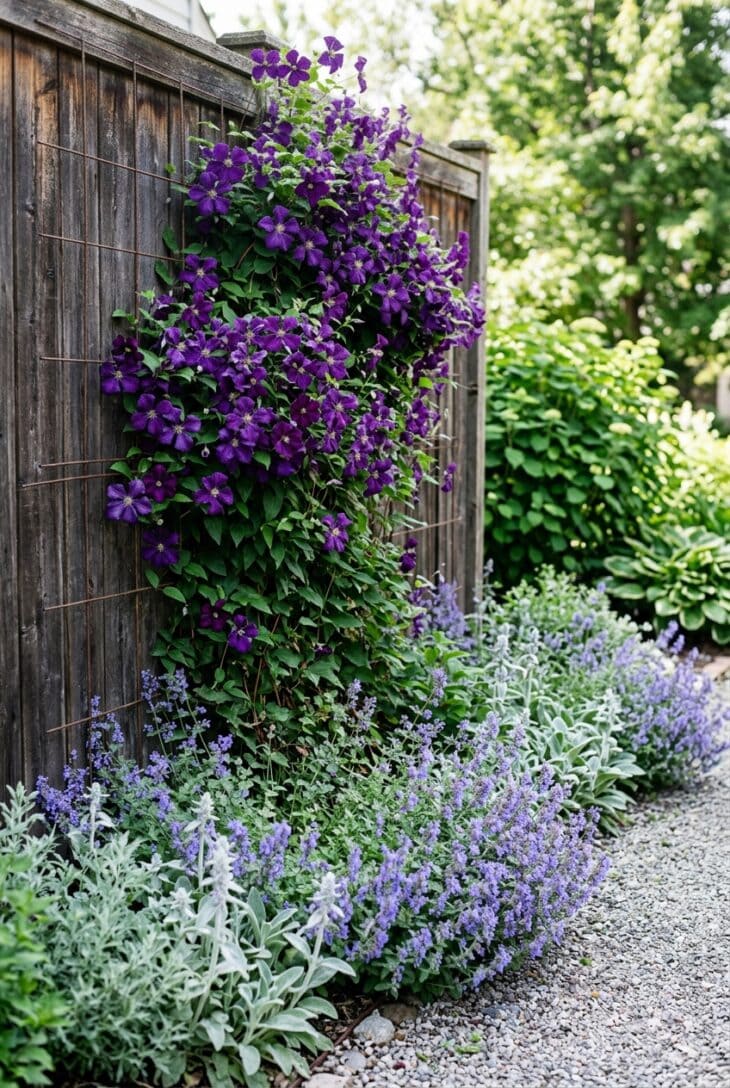
What you see Deep purple clematis flowers fill the fence from top to bottom, their velvety petals catching the morning sun. At the base, a low edge of silvery foliage and blue catmint shades the roots. The plain boards behind have vanished under bloom.
Why it works Clematis likes its head in the sun and its feet in the shade, and a side yard fence delivers both: a tall surface that catches the light and a base that the border can shade. It uses a surface that was going unused and gives a long season of flowers. The fence stops being a boundary and becomes the main feature.
How to get it Fix a wire or lattice trellis to the fence, because clematis cannot grip flat boards and needs thin supports to twine around. Plant clematis (Clematis ‘Jackmanii’), hardy in Zones 4 to 9, with the crown 2in (5cm) deeper than it sat in the pot, and mulch the roots or shade them with low plants. It flowers on new wood, so cut it back hard to about 12in (30cm) in late winter or early spring. NC State lists all parts as poisonous, so wear gloves when pruning and keep pets from chewing it. For more on boundaries, see these garden fence ideas.
17. Espaliered Apple Against a Sunny Wall
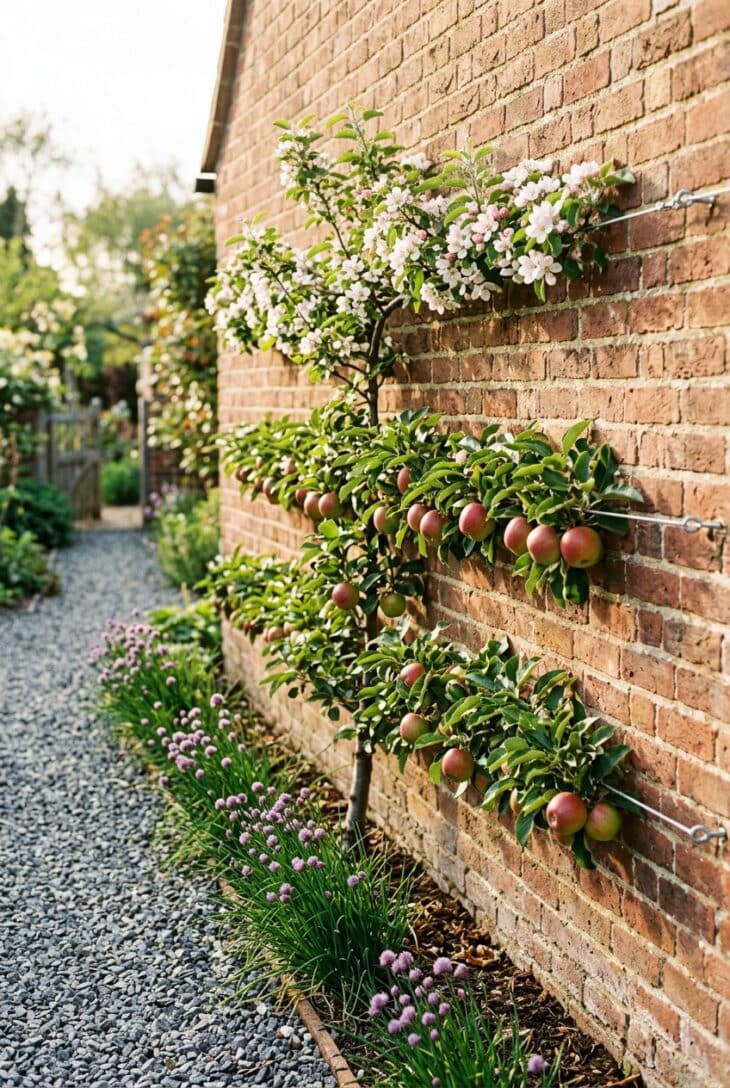
What you see An apple tree spreads flat against the brick in clean horizontal tiers, its branches tied to taut wires and hung with red-flushed fruit. Chives edge the path beneath, and the sun-warmed wall glows behind. It is orchard fruit grown in a space only 3ft (90cm) deep.
Why it works An espalier lets you grow a full-size fruit tree where a normal one would be impossible, because the branches stay in one flat plane. The wall reflects heat, which ripens fruit, and the training turns the tree into an ornament in winter, too. It is the most productive use of a thin, sunny strip.
How to get it Pick a wall that gets 6 or more hours of sun, ideally facing south or west, and set up horizontal wires 18in (45cm) apart. Plant a dwarf-rootstock apple (Malus domestica) 8 to 12in (20 to 30cm) off the wall; most apples need a second compatible variety blooming nearby to set fruit, and a neighbor’s tree can count. Tie branches down as they grow and prune in summer to hold the shape. Ask your state extension for varieties suited to your chill hours and resistant to local disease. For more, see these backyard orchard ideas.
18. Slim Columnar Evergreens for Privacy
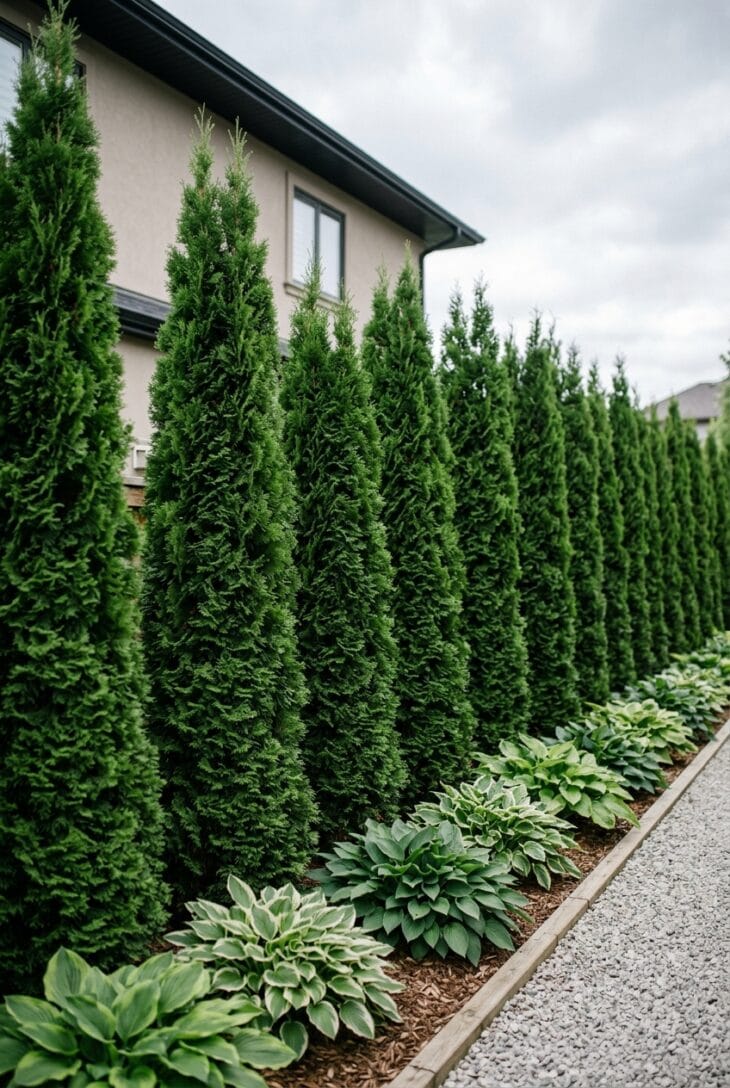
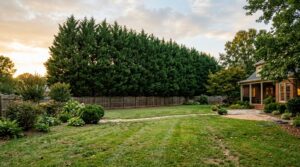
What you see A row of slim, dense, green columns stands evenly spaced along the boundary, each one a narrow pillar of foliage. They screen the neighbor’s windows without taking much floor space. A low border of hostas softens their feet.
Why it works A side yard has no room for a wide hedge, but a columnar evergreen is only a few feet across. It is the narrowest form of living privacy screen, and it stays green year round. Planted in a line, the columns read as a green wall.
How to get it Plant arborvitae (Thuja occidentalis ‘Smaragd’), also sold as ‘Emerald Green’, hardy in Zones 3 to 7 per NC State’s species range, about 3ft (90cm) apart and 2 to 3ft (60 to 90cm) from the fence. It stays slim, around 3 to 4ft (90 to 120cm) wide and 10 to 15ft (3 to 4.5m) tall, but deer commonly browse it, and it struggles in the heat south of Zone 7. Water deeply every week through the first two summers. Check the property line and local height rules first, and see these arborvitae alternatives for warmer or deer-heavy regions. For other ways to screen a boundary, read these garden privacy ideas.
19. Snowball Hydrangea Hedge in Part Shade
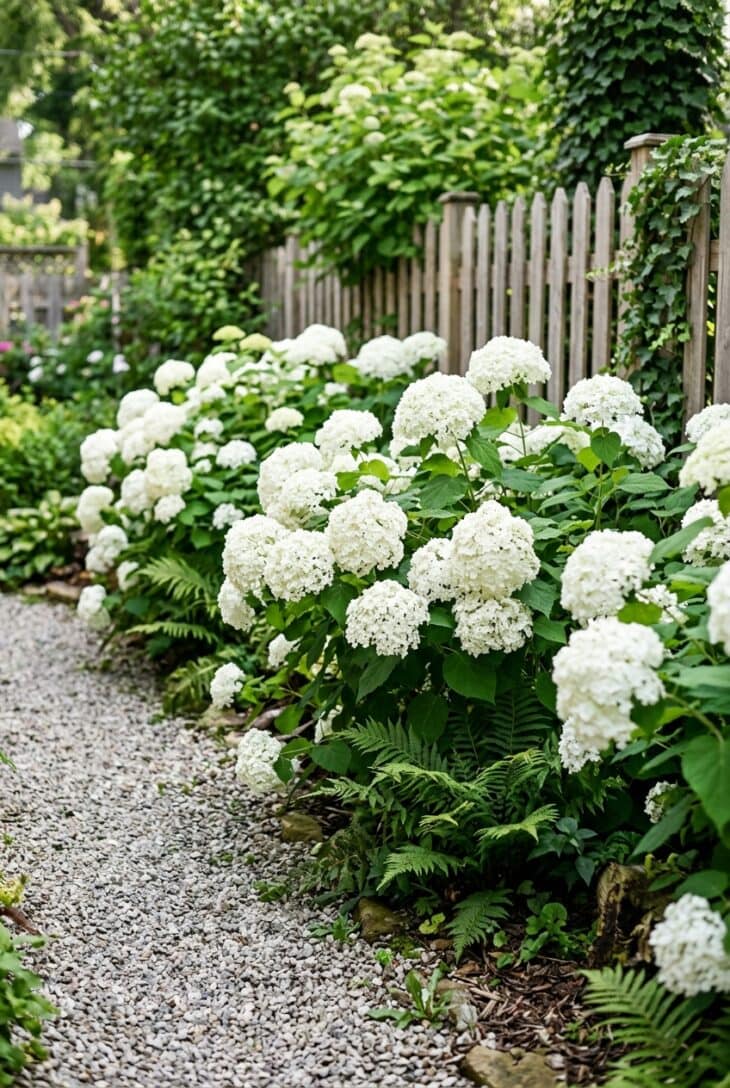
What you see A row of big white blooms, round as snowballs, runs along the fence, each flower head the size of a dinner plate. The leaves are fresh green and the gravel path in front is lit by early sun. It reads as soft and generous in a space that is only a few feet wide.
Why it works Smooth hydrangea tolerates the part shade a side yard offers and blooms on new wood, so a hard winter does not cost you the flowers. A row makes a loose screen, a wall of bloom for weeks, and needs only one pruning a year. It is one of the most forgiving shrubs for this kind of space.
How to get it Plant snowball hydrangea (Hydrangea arborescens ‘Annabelle’), hardy in Zones 3 to 9, 3 to 5ft (90 to 150cm) apart in morning sun and afternoon shade. Soil under eaves is often dry, so water deeply in summer. Cut stems to 6 to 12in (15 to 30cm) in late winter, because it blooms on new growth. The big heads of ‘Annabelle’ can flop after rain, so try the sturdier ‘Incrediball’. Mulch to keep the roots cool and moist.
20. Narrow Raised Bed Vegetable Strip
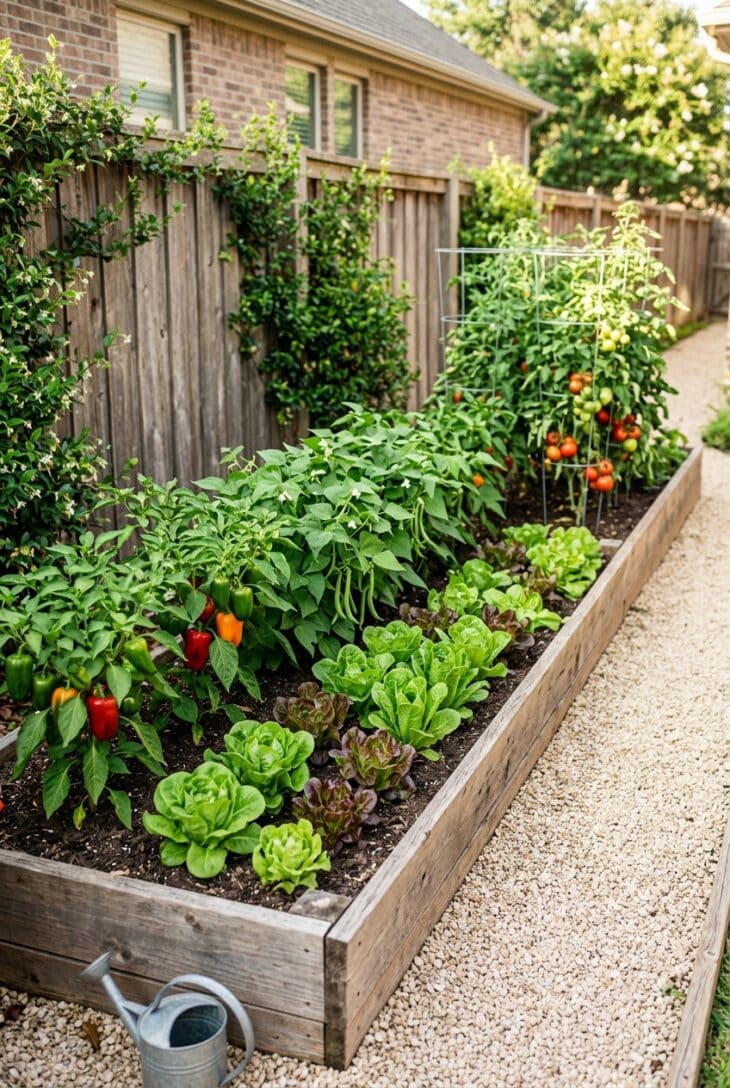
What you see A long cedar bed runs along the fence, planted in neat rows of lettuce, bush beans and pepper plants hung with ripening fruit. A gravel path runs beside it, wide enough to walk. It is a full vegetable garden in a space a couple of feet across.
Why it works Raised beds fit the proportions of a side yard, and they let you control the soil in a place where the native soil is often compacted or poor. The strip along a sunny fence is an ideal growing site, as the wall holds warmth. You can grow a surprising amount in a bed 2 to 3ft (60 to 90cm) wide.
How to get it Choose a spot with 6 to 8 hours of direct sun, since fruiting crops like peppers and tomatoes crop poorly in shade. Keep the bed 2 to 3ft (60 to 90cm) wide so you can reach across it, with a path of at least 3ft (90cm). Fill it with purchased soil rather than the ground beside the house: in older homes, flaking exterior paint can leave lead in the soil near the foundation, so test before growing edibles in place. Sow lettuce as soon as the soil can be worked, and set out peppers and beans after your last frost. For more designs, see these raised bed garden ideas.
21. Kitchen-Door Herb Strip
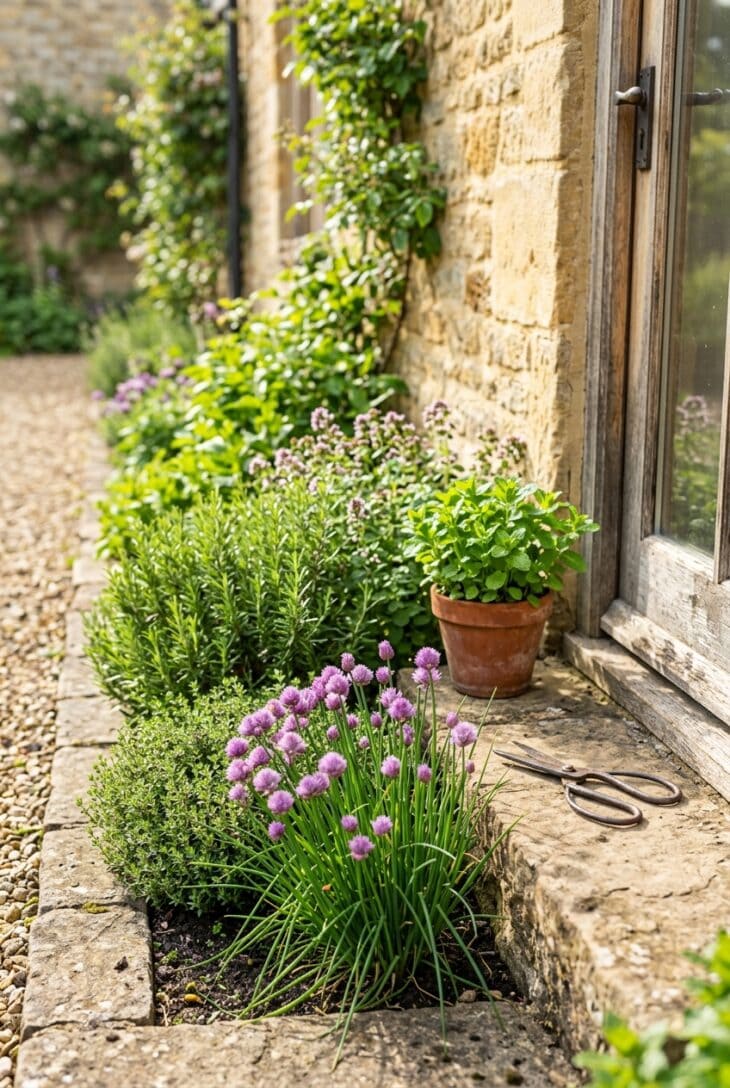
What you see Just beyond the door, a narrow bed holds clumps of rosemary, thyme, oregano and chives with purple pom-pom flowers. A small pot of mint sits on the step. You can see the dinner herbs from the sink, and snip them without putting your shoes on.
Why it works Herbs get used when they are a step away, and a side yard door is often the closest outdoor spot to the kitchen. Most culinary herbs also want what the strip offers: sun, sharp drainage and a warm wall at their back. They are compact, fragrant and ornamental.
How to get it Choose a spot with 6 or more hours of sun and well-drained soil. Plant thyme, oregano (Origanum vulgare), hardy in Zones 4 to 8, and chives (Allium schoenoprasum), hardy in Zones 4 to 8, in the ground, and rosemary (Salvia rosmarinus), hardy only in Zones 8 to 10, in a pot you can bring in elsewhere. Keep peppermint plants (Mentha x piperita) in a pot or a sunken bucket, because it spreads by runners. Harvest often to keep plants bushy. For layouts and plant combinations, see these herb garden ideas.
22. Cut Flower Row Along a Sunny Fence
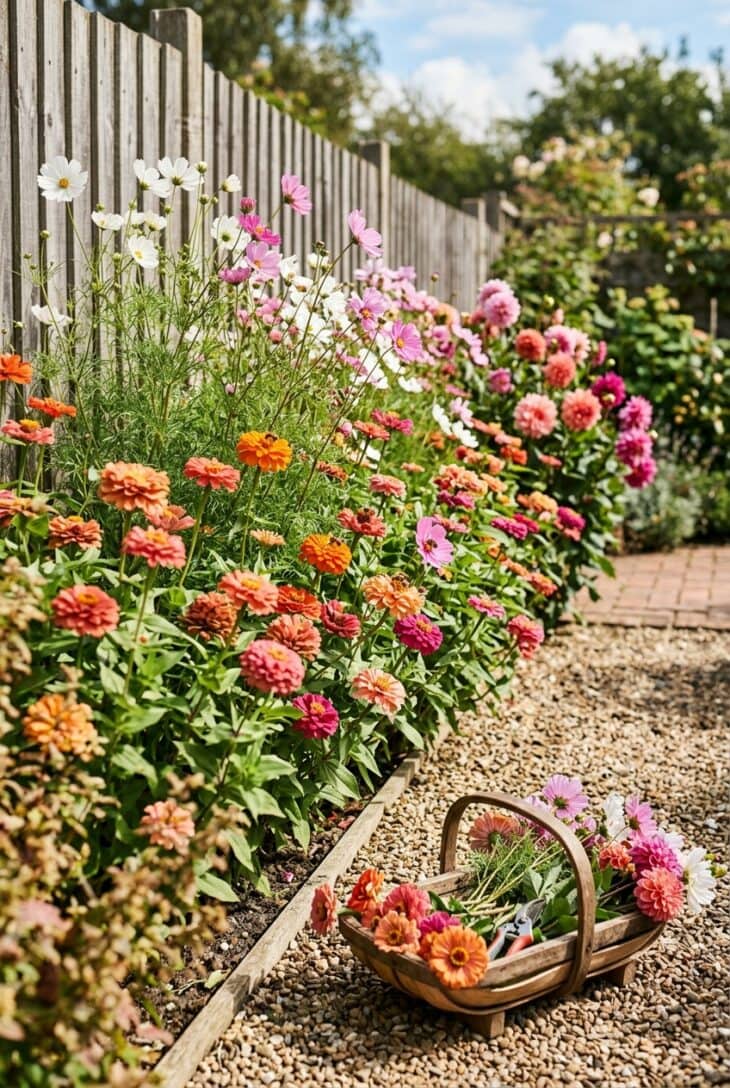
What you see A single row of zinnias in orange, pink and coral runs along the fence, with feathery white cosmos towering above them. A trug of cut stems rests on the path, and bees work the blooms. The bed is only a couple of feet wide, yet it supplies bouquets all summer.
Why it works Cut flowers need sun and a long, narrow row is the most efficient way to grow them: easy to reach, easy to cut and easy to support against the fence. The more you cut, the more they bloom. A side yard with sun gets turned from afterthought to supplier.
How to get it Choose a spot with 6 or more hours of sun. Sow zinnias and cosmos directly in the soil after your last frost, about 8 to 12in (20 to 30cm) apart, and pinch the growing tip of each zinnia at about 8in (20cm) tall for bushier plants. Plant dahlia tubers after frost once the soil has warmed to about 60°F (16°C). Stretch support netting between stakes at 12 and 24in (30 and 60cm) so tall stems stay upright. Cut in the cool of the morning and pick often. For varieties and arrangements, see these cut flower garden ideas.
23. Pollinator Ribbon of Coneflower, Tickseed and Catmint
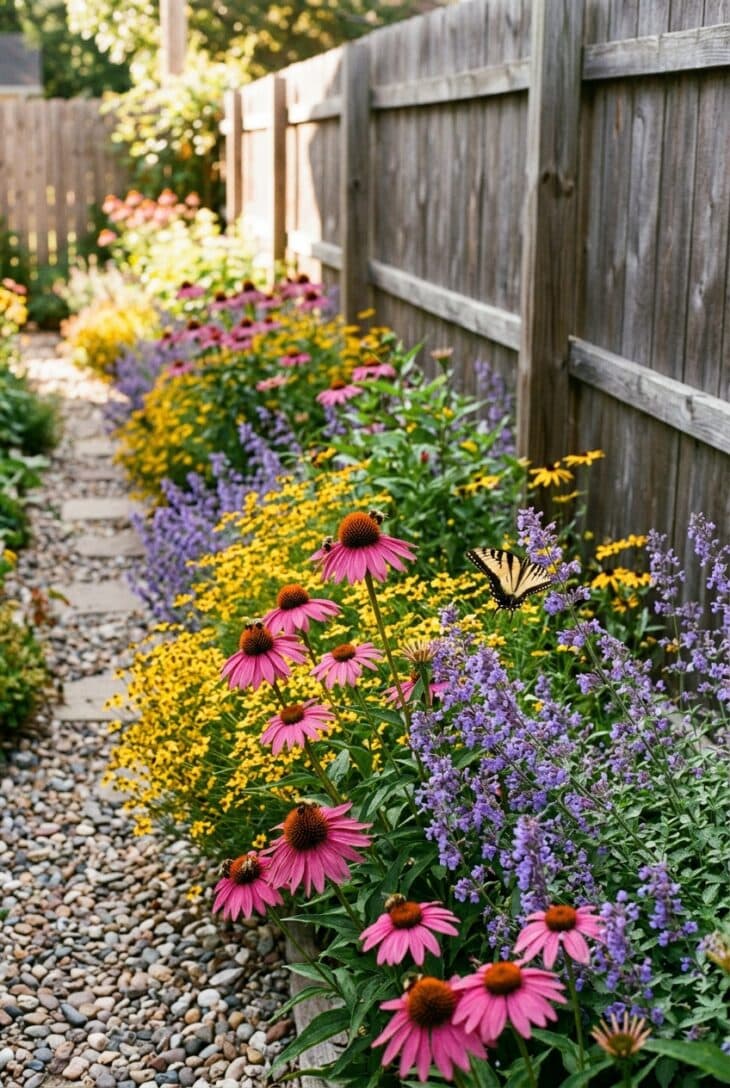
What you see A ribbon of pink coneflowers, golden tickseed and lavender-blue catmint runs along the fence, humming with bees. A swallowtail balances on a catmint spike. The strip is only a couple of feet wide, but it feels alive.
Why it works Narrow beds work for pollinators because it is the flowers, not the acreage, that count: continuous bloom from three tough perennials feeds insects for months. The plants are drought tolerant, need no feeding and come back each year. They turn the strip into a small corridor of habitat.
How to get it Choose a spot with 6 or more hours of sun. Plant pink coneflower (Echinacea purpurea), hardy in Zones 3 to 8, threadleaf tickseed (Coreopsis verticillata), hardy in Zones 3 to 9, and blue catmint (Nepeta x faassenii ‘Walker’s Low’), in drifts of three to five, 18in (45cm) apart. Leave the coneflower seedheads for goldfinches. Skip insecticides, which can harm bees and butterflies, and always follow the label if you do use one. See these pollinator garden ideas for more.
24. Lavender and Russian Sage in a Gravel Strip
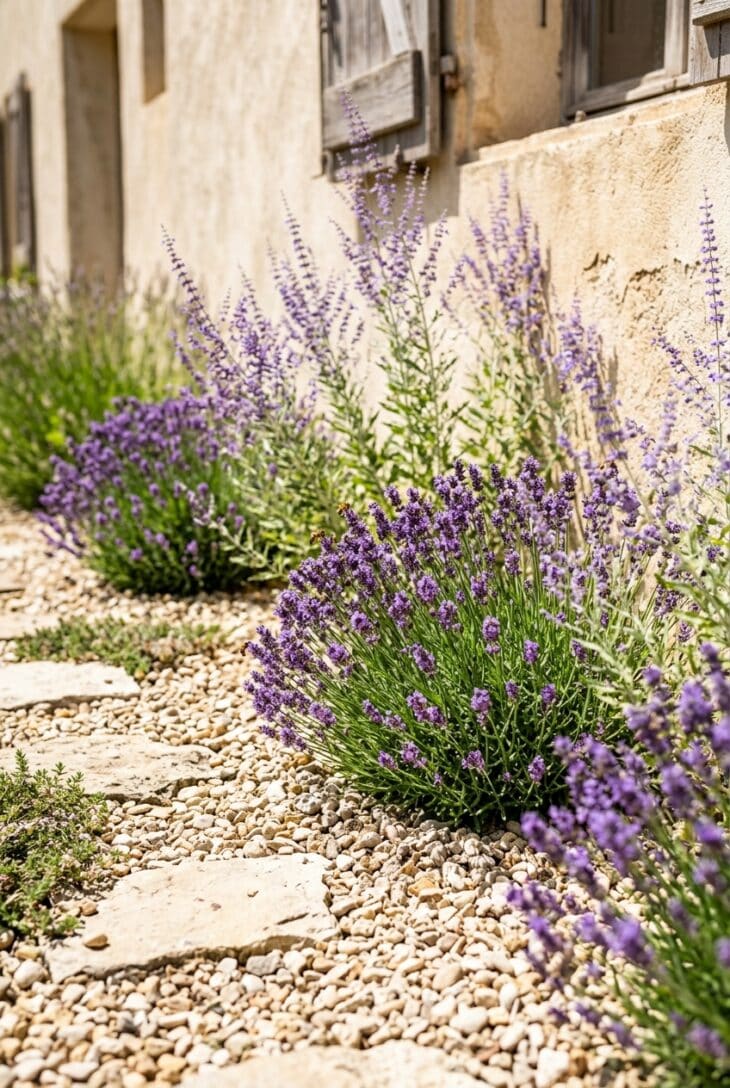
What you see Rounded mounds of purple lavender line a gravel strip, with airy spires of silver-blue Russian sage rising behind them. The wall behind is warm and pale, and bees move from flower to flower. The scent hangs in the heat.
Why it works The dry strip under the eaves, baking against a wall and out of the rain, defeats most plants, but lavender and Russian sage ask for exactly that. They like heat, drainage and lean soil, and a gravel mulch keeps their crowns dry. It is the same logic behind most drought-tolerant garden ideas.
How to get it Choose a spot with 6 or more hours of sun and fast-draining soil, mixing in coarse grit if it holds water. Plant English lavender (Lavandula angustifolia), hardy in Zones 5 to 9, 2 to 3ft (60 to 90cm) apart. In humid regions, choose a lavandin such as ‘Phenomenal’ (Lavandula x intermedia), which tolerates humidity better. Add Russian sage (Perovskia atriplicifolia), hardy in Zones 5 to 9 and 2 to 4ft (60 to 120cm) tall, and mulch with 2in (5cm) of gravel, not bark. Cut Russian sage to 6in (15cm) in spring and water weekly in the first summer only. See these gravel garden ideas for more.
25. Pot Ladder Against a Sunny Wall
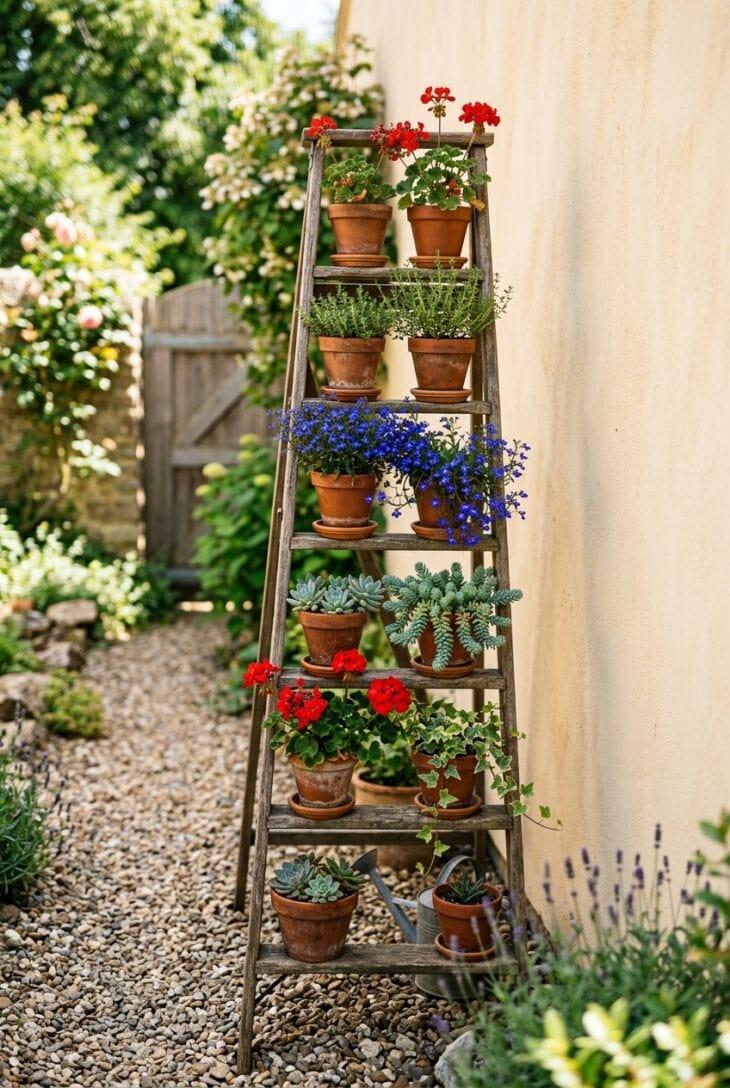
What you see A wooden ladder shelf leans against the wall, and each rung carries a small pot: red geraniums, blue-green sedum, trailing lobelia and thyme. The pots step up the wall like a staircase of color. The path at its foot is still wide open.
Why it works Pots stack on a ladder shelf and use the wall instead of the floor, so a side yard that cannot spare a bed can still carry a full planting. Containers are easy to rearrange, easy to replant each season and a good fit for rented spaces. The ladder gives a bare wall height and interest.
How to get it Pick a shelf with rungs 10 to 12in (25 to 30cm) deep and anchor it to the wall or fence so wind cannot tip it. Use pots with drainage holes and fill them with potting mix; skip the old trick of adding gravel to the bottom of a pot, because it does not improve drainage and can leave the roots wetter. Small pots dry out quickly, so water daily in hot weather. Geraniums (Pelargonium) are frost tender, so bring them in before the first fall frost. For more ideas, see these container garden ideas.