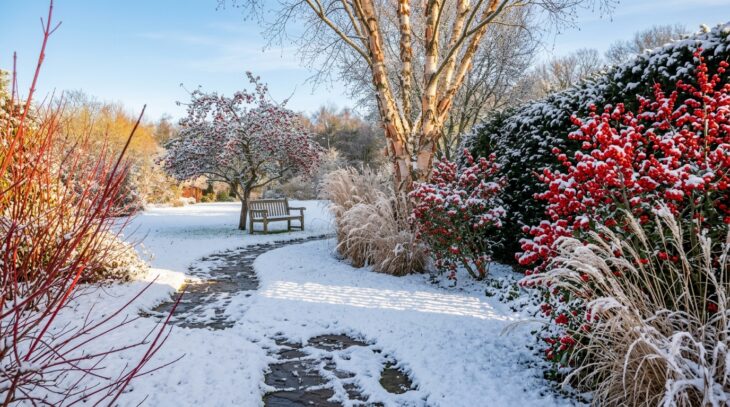
Winter is when a garden’s structure shows, and the ones that hold up were planned for it: colored bark, berries that stay put, grasses that keep their shape, and a few flowers brave enough to open in the cold. A bare bed under snow can look like a sketch, while a well-planned one looks finished. The ideas below are built around that difference.
Contents
- 01. Red-Twig and Yellow-Twig Dogwood Against the Snow
- 02. River Birch Clump with Peeling Bark
- 03. Paperbark Maple as a Lawn Specimen
- 04. Coral-Bark Japanese Maple Against a Pale Wall
- 05. Contorted Hazel as Living Sculpture
- 06. Ornamental Grasses Left Standing for Winter
- 07. A Seedhead Border for Winter Birds
- 08. Winterberry Holly Loaded with Red Fruit
- 09. Persistent Crabapples as a Bird Buffet
- 10. Dwarf Conifer Rockery in Gold and Green
- 11. Clipped Boxwood Parterre Dusted with Frost
- 12. Witch Hazel in Late-Winter Bloom
- 13. Hellebores Under a Bare Tree
- 14. Snowdrop and Winter Aconite Drifts
- 15. Winter Heath Carpet Along a Path
- 16. Fragrant Sweet Box by the Front Door
- 17. Winter Jasmine Trained on a Wall
- 18. Camellia Sasanqua Hedge for the South
- 19. Pansies and Ornamental Kale for Mild Winters
- 20. Oakleaf Hydrangea for Dried Blooms and Cinnamon Bark
- 21. Winter-Blooming Aloes in a Dry Garden
- 22. Cold Frame of Hardy Winter Greens
- 23. Evergreen Doorway Pot with Cut Stems
- 24. A Winter Bird Station with Open Water
- 25. A Cleared Path with Lanterns and a Bench
The range covers Zone 3 snow belts and Zone 10 mild winters, tiny doorways and full yards, and budgets from a pot of cut stems to a specimen maple. Some ideas suit a first winter garden, and others, like a cold frame or a witch hazel in the right spot, ask for more planning. Each one names the zones it suits, because a winter plant that sulks in your climate is worse than none.
Look up your USDA zone, then pick the ideas that fit it. Stand at a window in January and note where the view is empty, because that is where these will earn their place. For a plant-by-plant list to go with them, see our guide to winter plants for outside.
01. Red-Twig and Yellow-Twig Dogwood Against the Snow
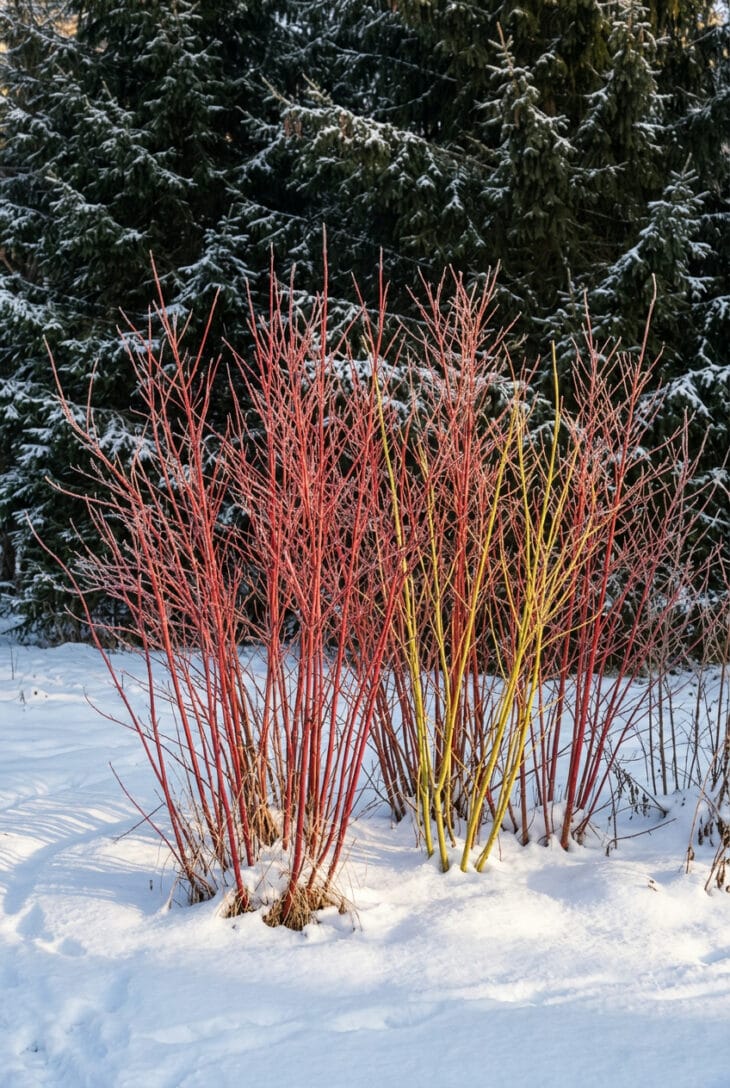
What you see A cluster of bare dogwood shrubs stands in fresh snow, the young stems glowing bright red with a few yellow-green ones mixed in. Behind them a wall of dark spruce makes the color look brighter. Low winter sun hits the stems from the side, and frosted tips arch over the snow. There is not a leaf or a flower in the picture, and it is still the brightest spot in the yard.
Why it works Dogwood stems are one of the cheapest ways to get strong winter color, and they read best against snow or dark evergreens, where the red has nothing to compete with. The color is deepest on young wood, so a well-pruned shrub outshines a big old one. Red-twig dogwood (Cornus sericea) is hardy in Zones 3–7 and copes with wet soil and heavy clay, which makes it useful in spots where other shrubs sulk.
How to get it Plant it in full sun to part shade and moist soil, in a drift of three to five. Pair it with yellow-twig dogwood (Cornus sericea ‘Flaviramea’), and in a small yard try ‘Arctic Fire’ (Cornus sericea ‘Farrow’), which stays near 4ft (120cm). Each late winter, before the buds open, cut the oldest third of the stems to the ground to force bright new growth. The species spreads by suckers into a colony, so give it room or slice the edges with a spade.
02. River Birch Clump with Peeling Bark
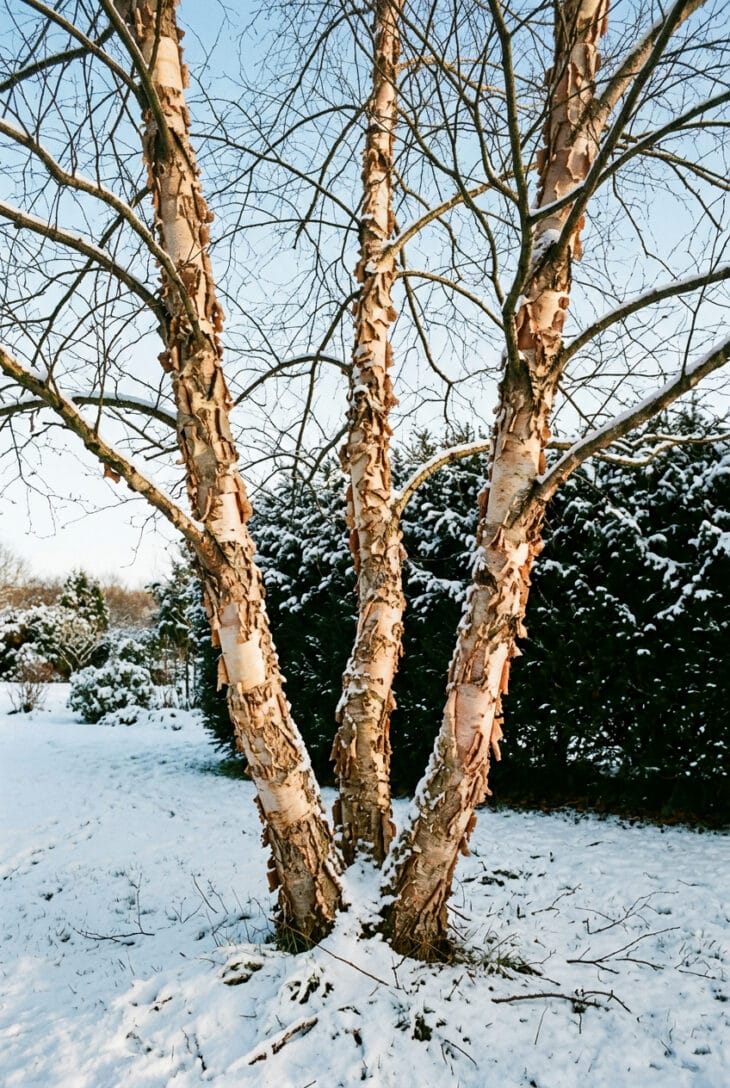
What you see Three trunks rise from one base on a snowy lawn, each wrapped in bark that peels in curls of cream, salmon and tan. With no leaves to hide it, every ridge and curl shows. Low sun warms the colors, and a thin line of snow sits along each branch fork. A dark hedge behind makes the pale trunks stand forward.
Why it works Peeling bark is a feature that improves in winter, when the leaves are gone and the light is low. River birch (Betula nigra) ‘Heritage’ is hardy in Zones 4–9 and handles summer heat better than white-barked birches, which are prone to bronze birch borer in warm areas. A multi-stem clump puts more bark in the view than a single trunk does.
How to get it Give it full sun to part shade and soil that stays reasonably moist, because river birch is a streamside native. It grows 30 to 70ft (900 to 2100cm) tall, so plant it at least 20ft (600cm) from the house and well away from drain and septic lines. It drops twigs and leaves, so keep it off patios and pool edges. Mulch the root zone to keep it cool, and water deeply in dry spells for the first few years.
03. Paperbark Maple as a Lawn Specimen
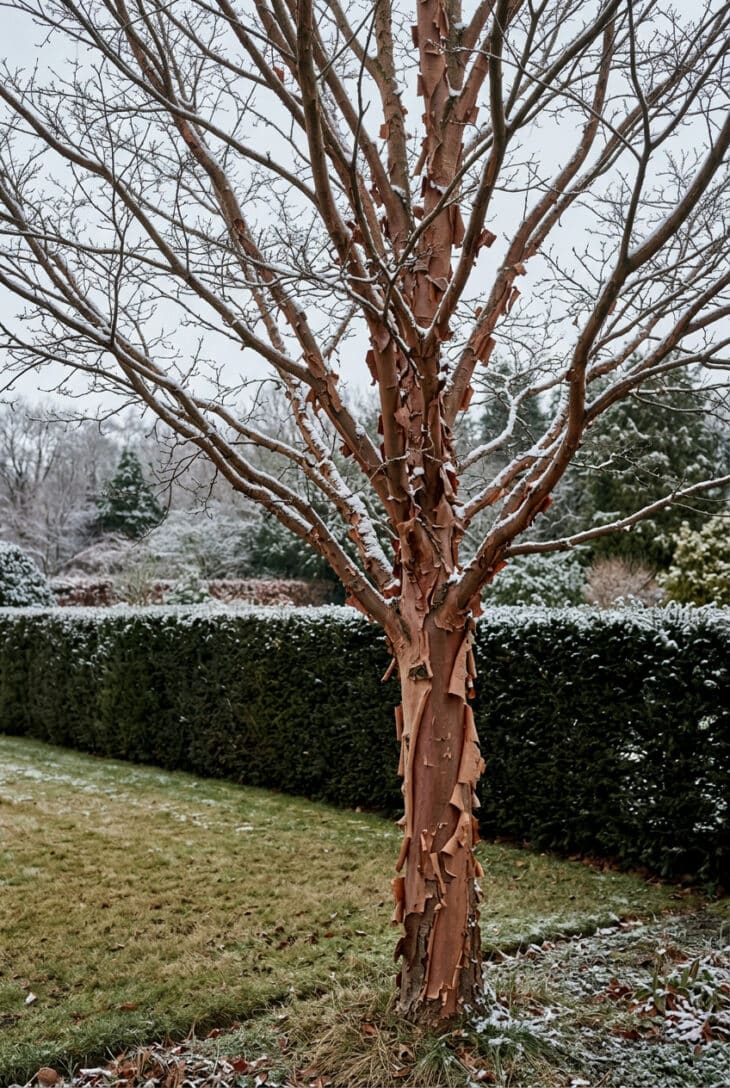
What you see A single paperbark maple stands at the edge of a lawn, about 12ft tall, its trunk and branches wrapped in cinnamon-colored bark that curls back in thin papery sheets. The curls show a rose-brown layer beneath. A low evergreen hedge behind gives the bark a plain dark backdrop, and a light dusting of snow rests in the branch forks.
Why it works Few trees reward a close look in winter like this one. Paperbark maple (Acer griseum) keeps its peeled bark attached to the branches instead of dropping it, so the texture stays visible all season. It is hardy in Zones 4–8 and stays a modest 20 to 30ft (600 to 900cm) tall. It is slow-growing, so it works as a specimen rather than a quick screen.
How to get it Plant it in full sun to light shade and well-drained soil, because it dislikes soggy ground. Buy the largest tree you can afford, since a small one can take years to get going. Set it where you can see the trunk from a window or reach it from a path, and leave the bark alone, because it sheds on its own. Underplant with hellebores or sweet box for winter interest at its base.
04. Coral-Bark Japanese Maple Against a Pale Wall
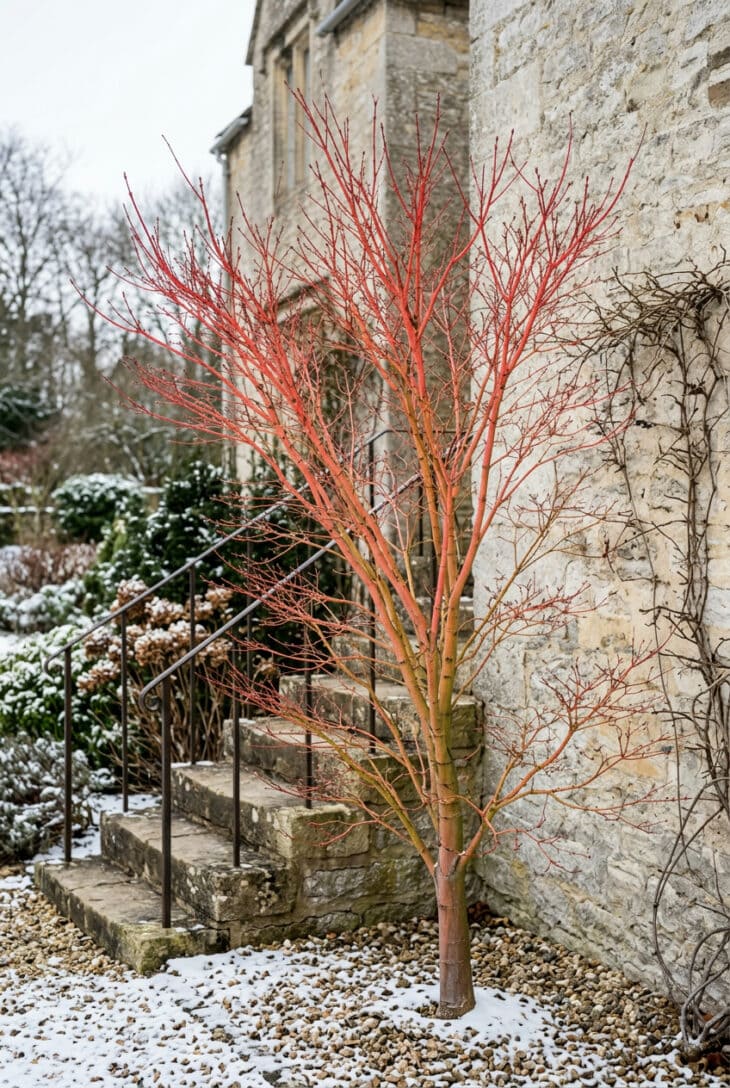
What you see A young Japanese maple stands against a pale stone wall beside the entry steps, completely bare, its upper twigs glowing coral red. The lower branches fade to pink-orange and yellow-green. Gravel and a little snow lie at its base, and soft winter light makes the stems look almost lit from within.
Why it works ‘Sango-kaku’ is a Japanese maple (Acer palmatum) whose young twigs turn coral to red in cold weather, so the display is a winter one by design. Against a pale wall or a dark conifer the color jumps out when little else in the front yard is moving. Japanese maples suit Zones 5–8, and the fine-textured shape fits the calm look of Japanese garden ideas.
How to get it Choose a sheltered spot with morning sun and afternoon shade, in well-drained soil that does not dry out. In Zone 5, plant it out of the wind and mulch the roots in late fall, because cold, drying wind damages the twigs. The best color is on young stems, so lightly thin out the oldest branches rather than shearing the tree. Water through dry spells in summer, since drought stress shows up as leaf scorch.
05. Contorted Hazel as Living Sculpture
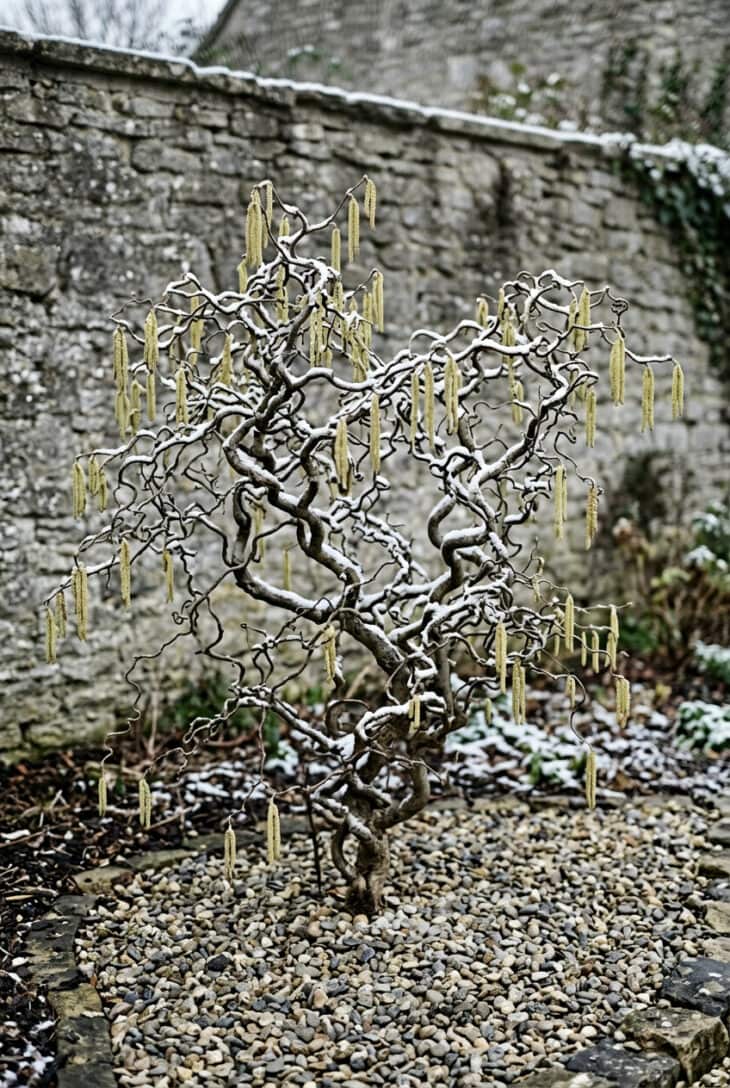
What you see A contorted hazel stands alone in a gravel bed, its bare branches coiled and corkscrewed like handwriting. Long yellow-green catkins hang from the twists in late winter, and a thin line of snow traces the curves. A plain stone wall behind keeps the eye on the shape.
Why it works In summer this plant is ordinary, with crinkled leaves and a modest shape. In winter the twisted branches are the whole show. Contorted hazel (Corylus avellana ‘Contorta’), also called Harry Lauder’s walking stick, is hardy in Zones 4–8. It stays far smaller than the straight species, typically 8 to 10ft (240 to 300cm) tall after many years.
How to get it Plant it in full sun to part shade and ordinary well-drained soil, against a plain backdrop of snow, a wall or evergreens, so the shape does not get lost. It is grafted, so any straight, vigorous shoots that come up from the base are rootstock and should be cut off where they emerge. Prune only to remove dead wood, since the twisted growth is the point. Put it in a bed with good summer interest too, because the leaves add little.
06. Ornamental Grasses Left Standing for Winter
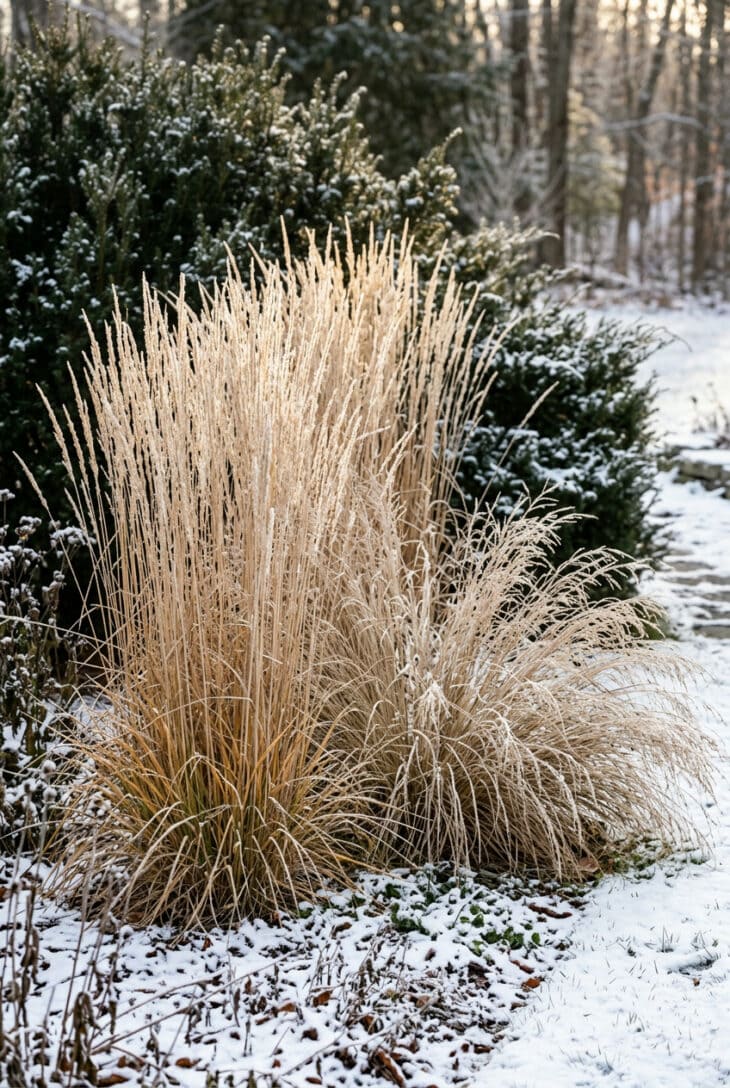
What you see A broad drift of feather reed grass stands upright in a snowy border, the buff seedheads topped with frost and the lower leaves faded to gold. A clump of switchgrass leans beside it in a looser fountain of tan. A few dark evergreens behind give the pale stems depth, and low winter sun lights the plumes from behind.
Why it works Grasses are among the few plants that look better after the first hard frost, because they hold their shape and move in the wind. They also catch snow and ice in a way that makes them look sculpted. Feather reed grass (Calamagrostis × acutiflora ‘Karl Foerster’) is hardy in Zones 4–9, and switchgrass (Panicum virgatum ‘Northwind’) suits Zones 5–9 and holds a stiff, narrow column. For more ways to use them, see our ornamental grass garden ideas.
How to get it Plant in full sun and leave the stems standing until late winter. Cut them to 4 to 6in (10 to 15cm) just before new growth starts, because cutting earlier removes the winter show and cutting later slices off new shoots. Feather reed grass reaches 3 to 5ft (90 to 150cm), so give each clump about 2ft (60cm). Skip Miscanthus sinensis in parts of the East and Midwest, where it escapes into wild areas, and in fire-prone regions cut grasses back near the house in fall.
07. A Seedhead Border for Winter Birds
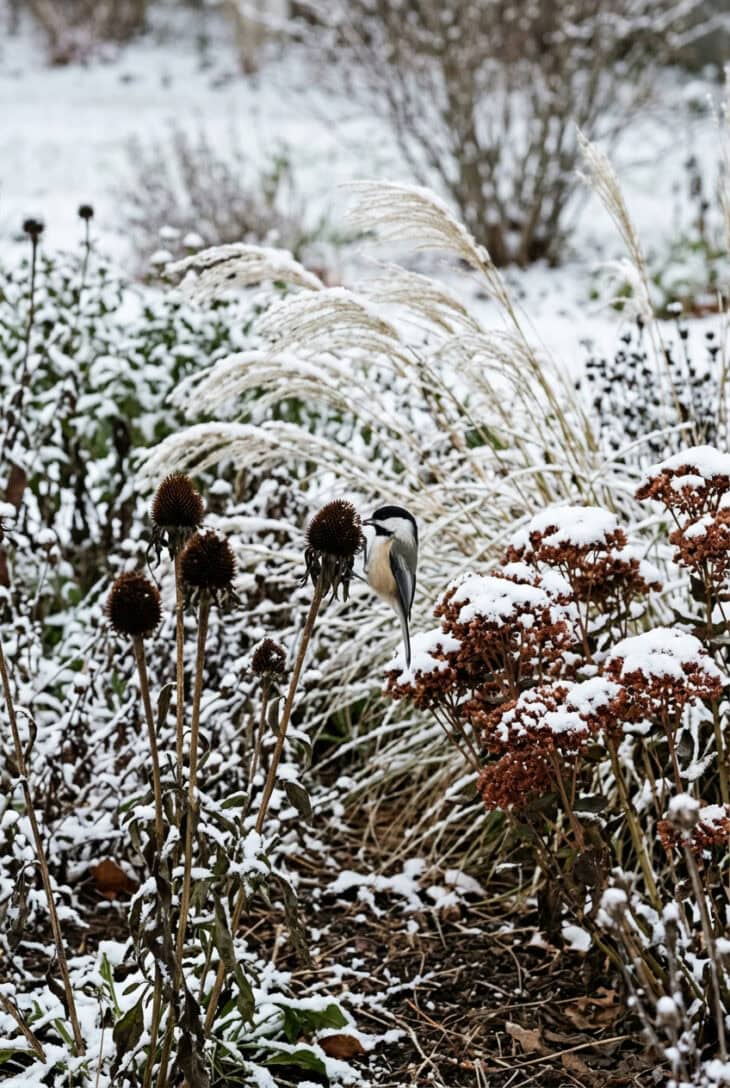
What you see A mixed border in January holds its seedheads: dark brown coneflower cones, rusty sedum flower heads capped with snow, and a few pale stems of feather grass. A black-capped chickadee clings to one coneflower, picking at the seed. The soil between the plants is bare and brown, and the border looks left standing on purpose.
Why it works Cutting a border down in fall removes both its winter shape and a winter food source. Seedheads feed small birds such as chickadees and goldfinches, and some native bees nest and overwinter in hollow stems. Pink coneflower (Echinacea purpurea) is the classic choice, and stonecrop (Hylotelephium ‘Herbstfreude’, often sold as Sedum ‘Autumn Joy’) holds firm heads that turn rust brown. Both are hardy in Zones 4–8.
How to get it Leave perennial stems and seedheads standing until spring. Wait to cut until daytime temperatures are regularly above 50°F (10°C), then leave stubs 8 to 24in (20 to 60cm) tall, because some native bees nest in the cut stems. Plant in full sun and ordinary, well-drained soil. Add shrubs for cover and a source of water, and the border becomes a working part of a wildlife garden.
08. Winterberry Holly Loaded with Red Fruit
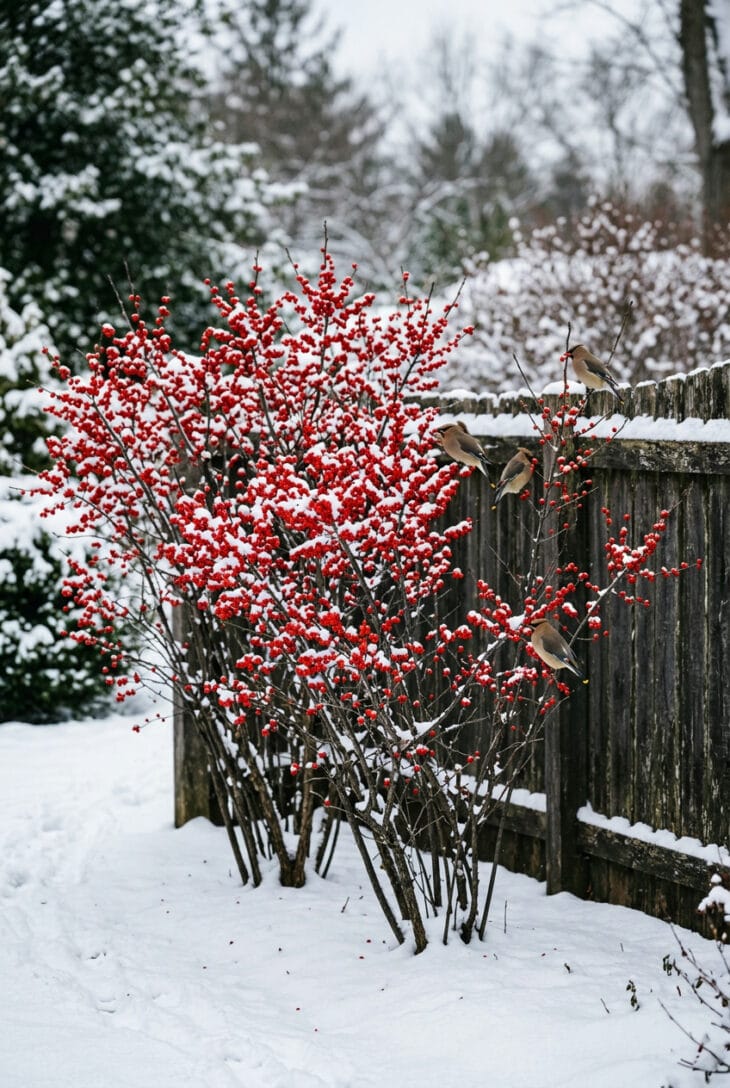
What you see Winterberry shrubs stand bare in the snow, every branch thick with bright red berries the size of peas. A few cedar waxwings feed from the outer twigs, and a dusting of snow sits on the fruit. A dark fence behind makes the red look electric.
Why it works Winterberry holly (Ilex verticillata) is deciduous, so the leaves drop and leave the fruit with nothing in front of it. It is hardy in Zones 3–9, tolerates wet soil, and its fruit is eaten by dozens of bird species. Only female plants bear berries, and they need a male nearby to pollinate them, which is the step most people miss.
How to get it Buy a fruiting female such as ‘Winter Red’ and a male sold as a pollinator for it, since the bloom times must overlap and the nursery tag lists which pairs match. Plant the male within about 50ft (1500cm) of the females, and one male can serve several females. Winterberry wants acidic soil, steady moisture and full sun to part shade, with the most fruit in sun. The berries are mildly toxic if eaten, so think twice before planting it where toddlers or dogs roam.
09. Persistent Crabapples as a Bird Buffet
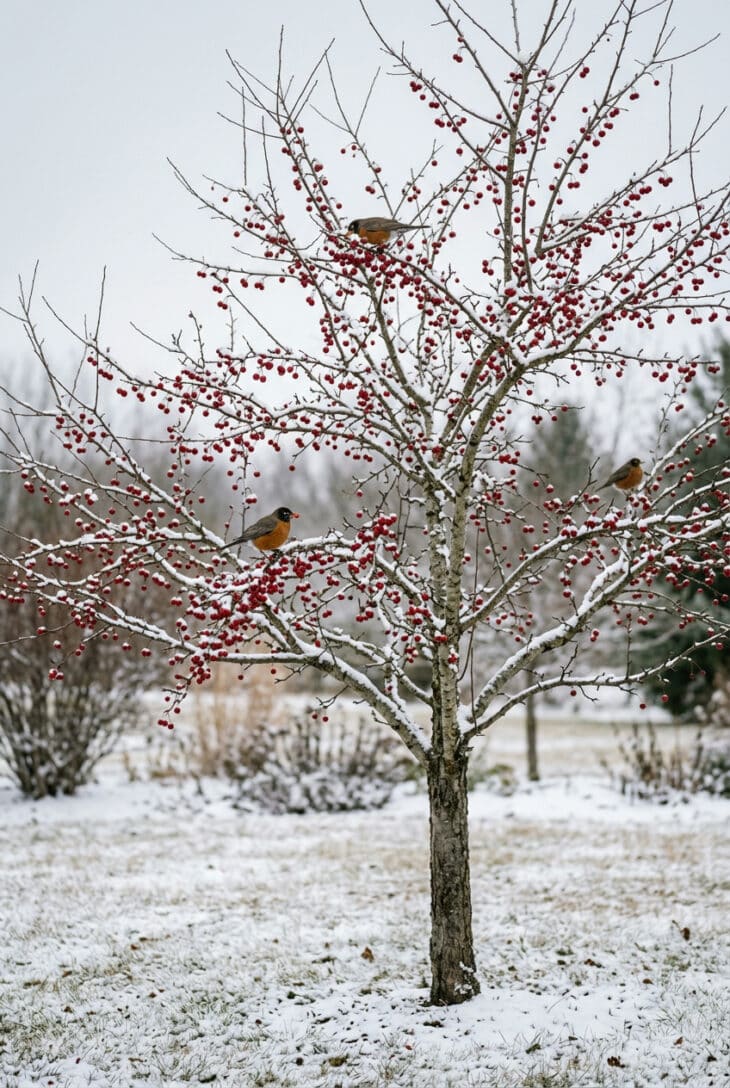
What you see A small crabapple tree stands in a lawn after leaf drop, its branches still carrying hundreds of tiny glossy red fruit. Snow lies along the branches, and a few American robins pick at the fruit. The fine twigs let every berry show against a gray sky.
Why it works Most crabapples drop their fruit by early winter, so the trick is choosing a cultivar that holds it. ‘Sugar Tyme’ (Malus ‘Sutyzam’) keeps its half-inch red fruit well into winter, when birds take it through the leanest months. It is hardy in Zones 4–8 and stays around 14 to 18ft (425 to 550cm) tall, small enough for a suburban lawn. It is also rated for good disease resistance, which is the usual weakness of crabapples.
How to get it Plant in full sun and well-drained soil, with room for an 11 to 15ft (335 to 450cm) spread. Look for a persistent-fruit cultivar on the label rather than just “crabapple”, and check that it is rated for scab and fire blight resistance. Water well through the first two summers. A crabapple also earns its place in a small backyard orchard, where its spring bloom feeds pollinators.
10. Dwarf Conifer Rockery in Gold and Green
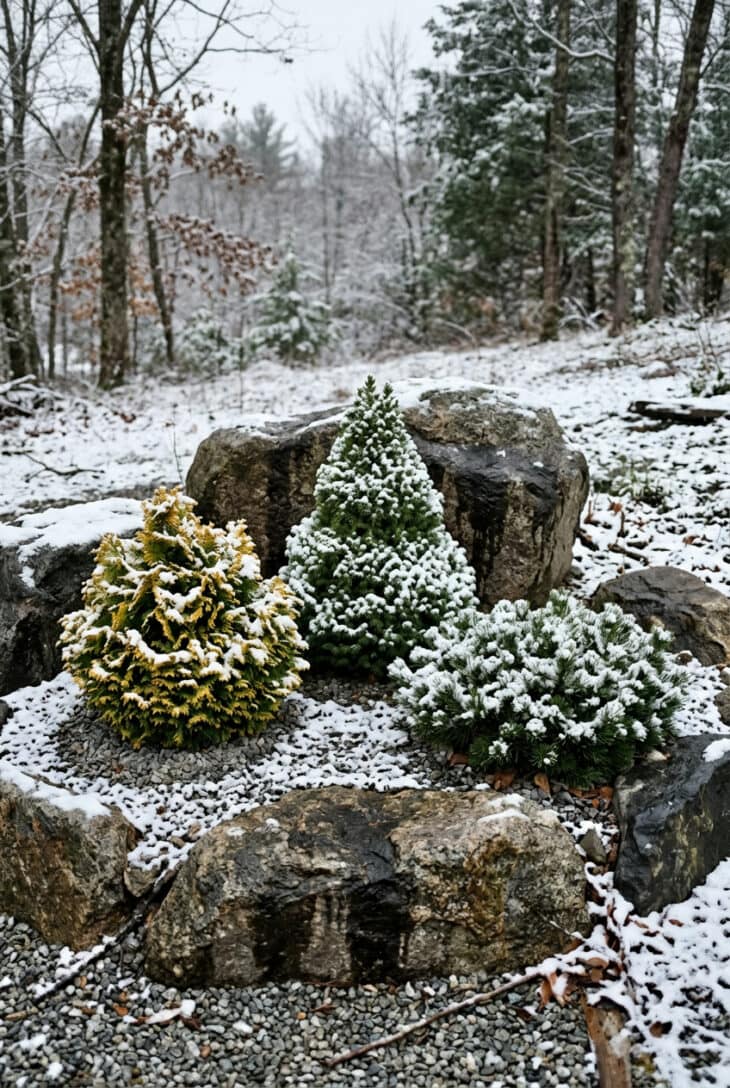
What you see A gravel bed with a few large rocks holds a small collection of conifers in gold and green: a rounded golden hinoki cypress, a neat cone of dwarf Alberta spruce, and a low mound of mugo pine. A thin layer of snow rests on the foliage, and the rocks between them show dark where the snow has slid off. The mix of shapes and colors holds the bed together without a single flower.
Why it works Conifers carry a winter bed because they never have an off season, and cone, mound and fan shapes in different greens and golds read as a composition. Dwarf forms keep it in scale. Golden dwarf hinoki cypress (Chamaecyparis obtusa ‘Nana Lutea’) suits Zones 4–8, dwarf Alberta spruce (Picea glauca ‘Conica’) suits Zones 3–6, and dwarf mugo pine (Pinus mugo ‘Mops’) suits Zones 3–7. The bed pairs naturally with rock garden ideas.
How to get it Read the label for the ten-year size and the mature size, because dwarf conifers are slow rather than tiny, and dwarf Alberta spruce can eventually reach 10ft (300cm) or more. Give each plant full sun and sharp drainage, and mulch with gravel or bark. Check dwarf Alberta spruce for spider mites in hot, dry spells, which show up as bronzed, dusty needles. Keep the bed away from rooflines where snow slides off in heavy loads.
11. Clipped Boxwood Parterre Dusted with Frost
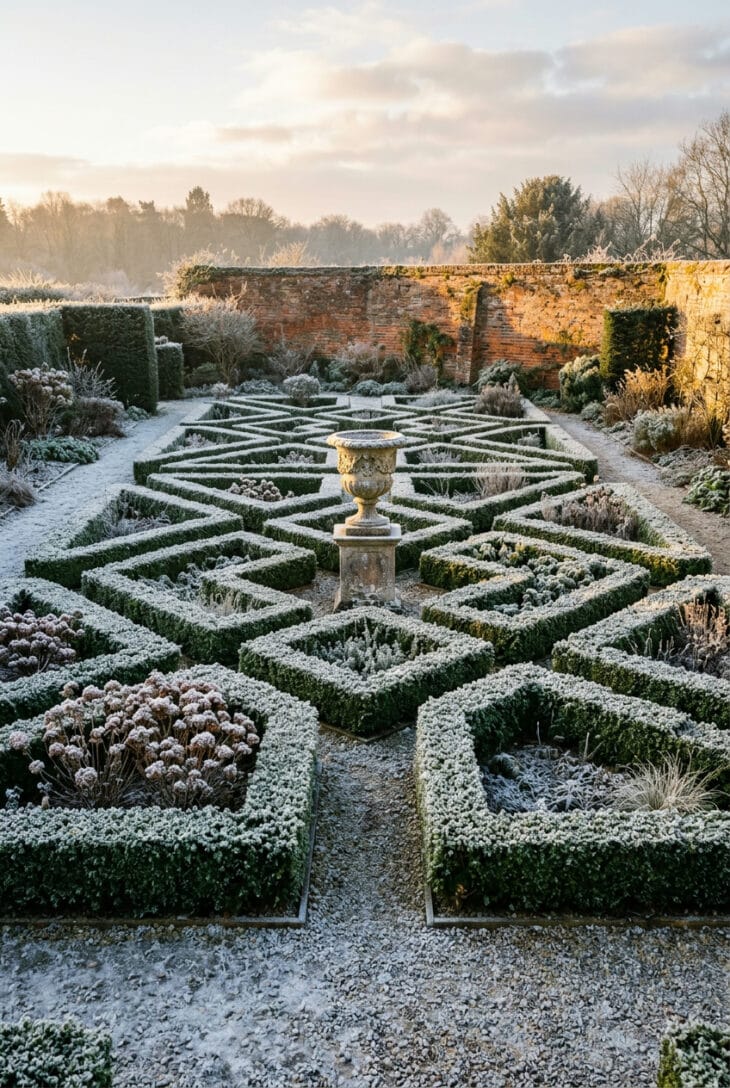
What you see A formal low parterre of clipped boxwood hedges makes a geometric pattern around a central stone urn, every edge sharp and dusted with frost. Gravel paths run between the beds, and a brick wall behind holds a little low sun. In the early light the garden looks drawn with a ruler.
Why it works Clipped evergreen structure is what gives a garden form once the flowers are gone, and boxwood does it better than almost anything. A parterre is as much about the empty space as the plants, so it looks finished in winter in a way a mixed border cannot. Boxwood (Buxus sempervirens) is hardy in Zones 5–8, and hybrids such as ‘Green Mountain’ resist winter bronzing better than many boxwoods. The straight lines and gravel paths also suit a small enclosed space, as in our courtyard garden ideas.
How to get it Space plants 12 to 18in (30 to 45cm) apart for a hedge that knits together in a few years. Shear in late spring once new growth has hardened off, not in fall, when a late flush of tender growth gets frosted. Brush heavy snow off with a broom, because wet snow splays the branches. Boxwood blight is a serious fungal disease in many states, so buy from a nursery that follows blight-free practices and clean your pruners between plants. Boxwood is toxic to dogs and cats if eaten (see the ASPCA listing).
12. Witch Hazel in Late-Winter Bloom
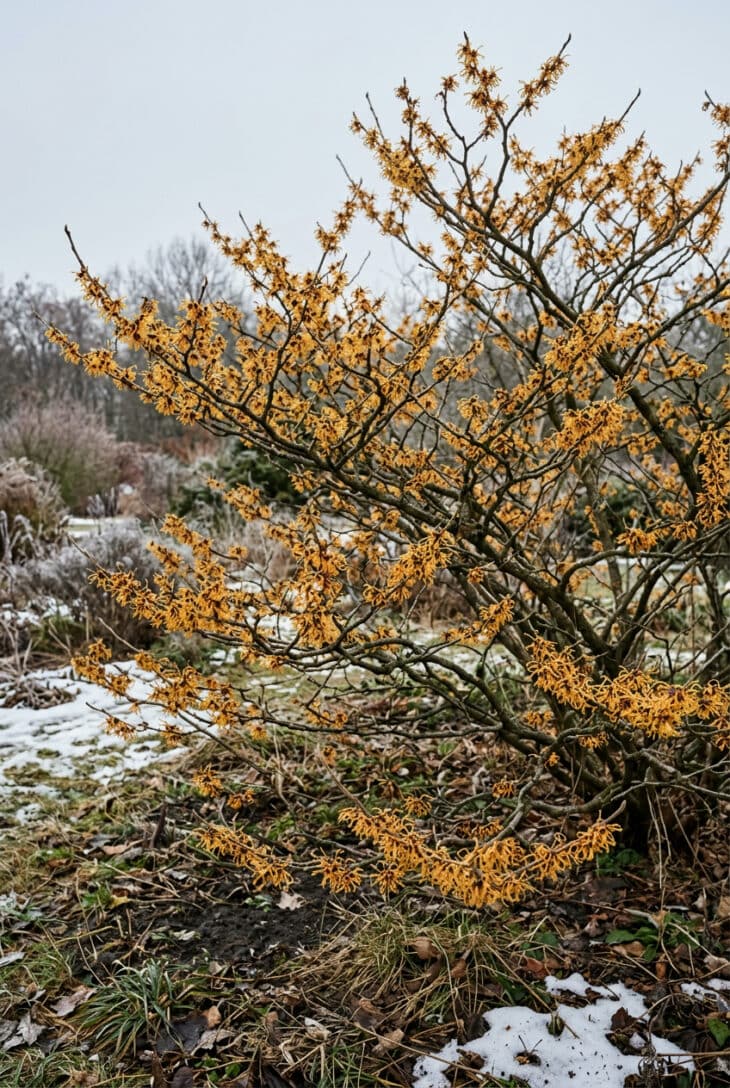
What you see A witch hazel in full bloom stands bare of leaves against a gray sky, its branches covered in spidery yellow-orange flowers with ribbon-like petals. Some petals are still curled against the cold, and others have loosened in the afternoon sun. Patches of old snow lie on the ground below.
Why it works Witch hazel (Hamamelis × intermedia ‘Arnold Promise’) flowers in mid to late winter, when almost nothing else does. The petals curl up in hard freezes and open again when it warms, so a cold snap does not ruin the display, and the flowers carry a light fragrance on mild days. It is hardy in Zones 5–8 and grows slowly to 15 to 20ft (450 to 600cm) tall.
How to get it Plant it in full sun to part shade in acidic, well-drained soil, with room for 8 to 10ft (240 to 300cm) of spread. Put it beside a path or a window you look out of, because late winter is when you least want to go outside. Prune only after flowering, and remove any straight shoots that come up below the graft. Where witch hazel struggles, cornelian cherry (Cornus mas) is a larger alternative for Zones 4–8, covered in small yellow flowers in late winter, at 15 to 25ft (450 to 750cm) tall.
13. Hellebores Under a Bare Tree
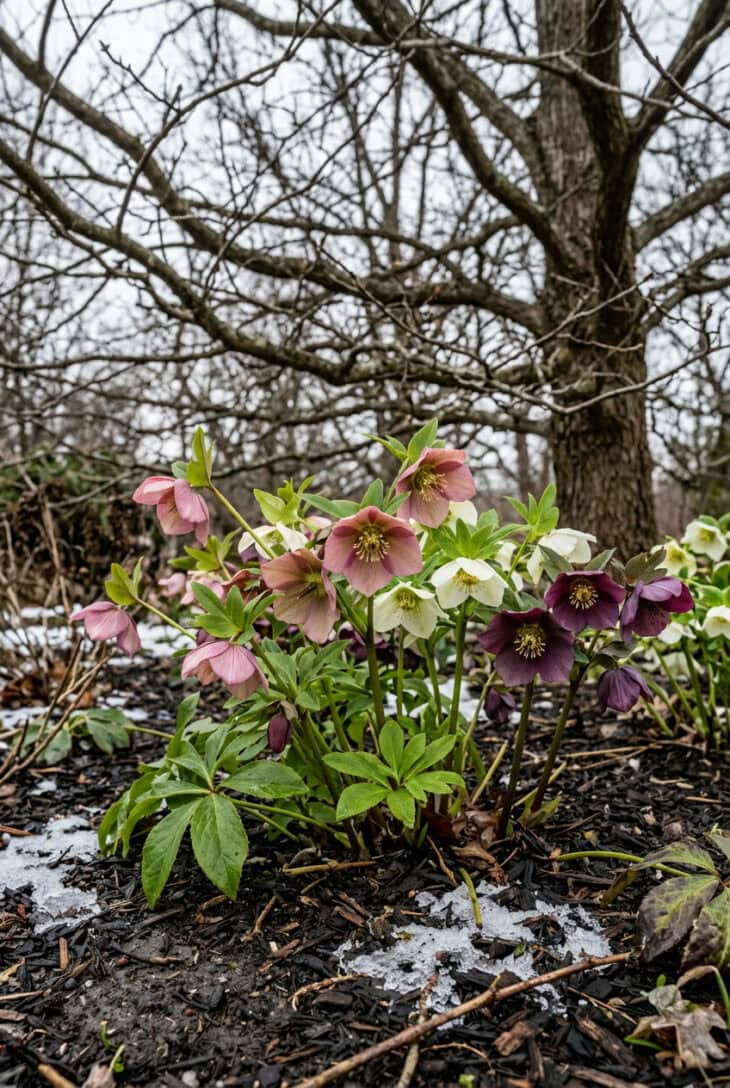
What you see A group of hellebores nods beneath a bare tree, their cup-shaped flowers in dusty rose, white and deep plum with yellow centers. Melting snow lies in patches around them, the soil is dark with mulch, and the old leaves have been cut away so the flowers show. The leathery foliage stays green at the edge of the snow.
Why it works Hellebores bloom from mid winter into spring in shade, which is exactly where winter gardens are weakest. Lenten rose (Helleborus × hybridus) is hardy in Zones 4–9, evergreen to semi-evergreen, and lives for many years once planted. It is a natural partner for shade garden ideas under deciduous trees, which let in the winter sun.
How to get it Plant in part shade or dappled shade and rich, neutral to slightly alkaline soil that drains well, spacing plants 18in (45cm) apart. Cut the old leaves to the ground in late winter as the flower buds rise, which shows off the blooms and removes leaf spot. Do not move them once settled. All parts of a hellebore are toxic, so keep it away from dogs, cats and children who chew plants (see the ASPCA listing).
14. Snowdrop and Winter Aconite Drifts
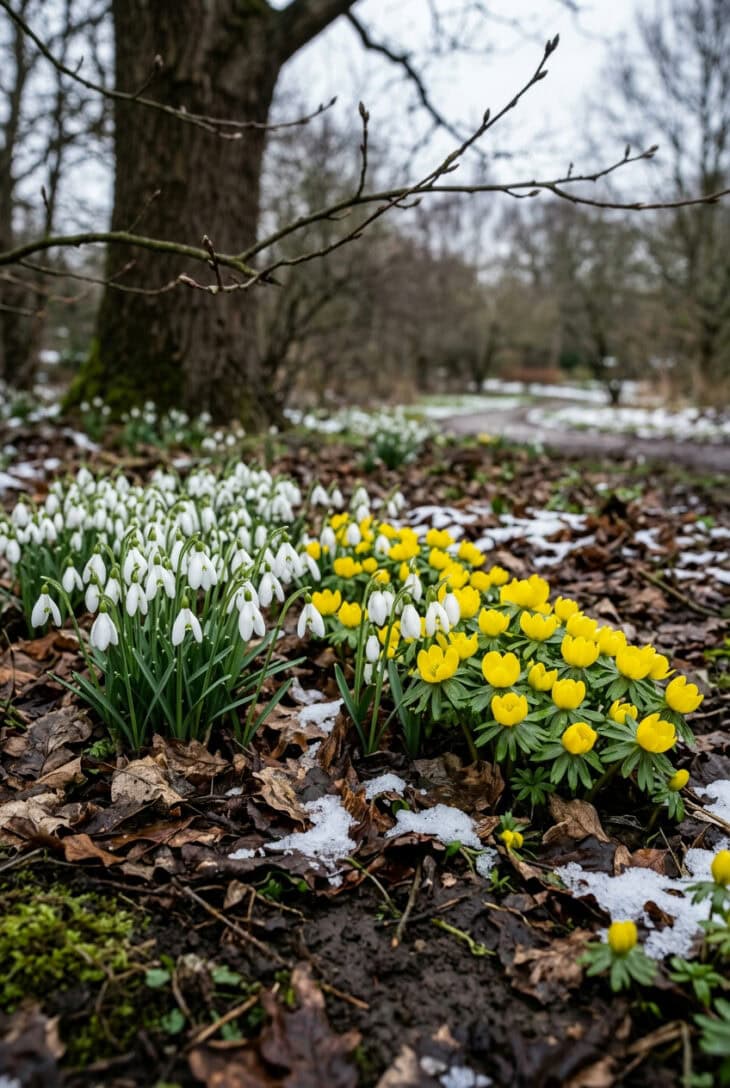
What you see White snowdrops and bright yellow winter aconite push up through bare soil and brown leaf litter under a deciduous tree. A few patches of snow remain around them, and the nodding white bells and yellow cups grow in separate drifts that meet in the middle. The ground still looks like winter, but the flowers say otherwise.
Why it works These are two of the earliest bulbs to flower, and they naturalize, spreading into larger drifts over the years rather than needing replanting. Snowdrop (Galanthus nivalis) is hardy in Zones 3–8, and winter aconite (Eranthis hyemalis) in Zones 3–7. They are the opening act for the daffodils and tulips in our spring bulb garden ideas.
How to get it Plant bulbs in fall, 3in (8cm) deep and about 3in (8cm) apart, in part shade and soil that does not stay soggy in summer, ideally under deciduous trees. Dry bulbs are sometimes slow to establish, so many gardeners plant snowdrops “in the green” just after flowering. Leave the foliage to die back naturally before mowing. Winter aconite is highly toxic to people, dogs, cats and horses if eaten, and snowdrops are mildly toxic, so wear gloves and keep pets off freshly planted areas.
15. Winter Heath Carpet Along a Path
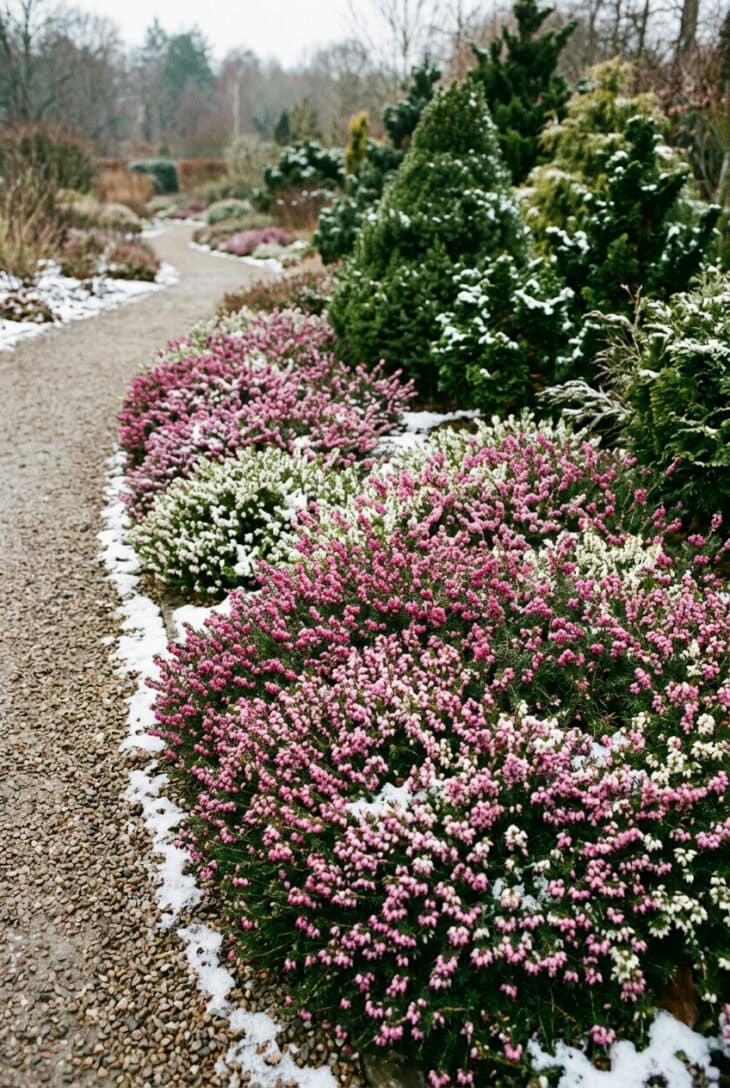
What you see A low carpet of winter heath spreads along the edge of a gravel path, its tiny bell flowers in pink, magenta and white, with thin snow lying between the clumps. Dwarf conifers behind add height, and the fine needle-like foliage stays green through the cold. The path curves away to the left.
Why it works Winter heath (Erica carnea) flowers from mid winter into spring, and its low evergreen growth works as a groundcover on path edges and open banks. Most nursery sources list it for Zones 5–7. It is a good fit for the sunny banks that sloped garden ideas struggle to cover, and bees visit the flowers on mild days.
How to get it Plant in full sun and acidic to neutral, well-drained soil, 12in (30cm) apart, and keep the soil moist, never soggy, through the first year. Shear the plants lightly right after flowering to keep them dense. Avoid hot, humid sites, where heaths struggle. A thin mulch of bark or gravel keeps weeds down while the plants knit together.
16. Fragrant Sweet Box by the Front Door
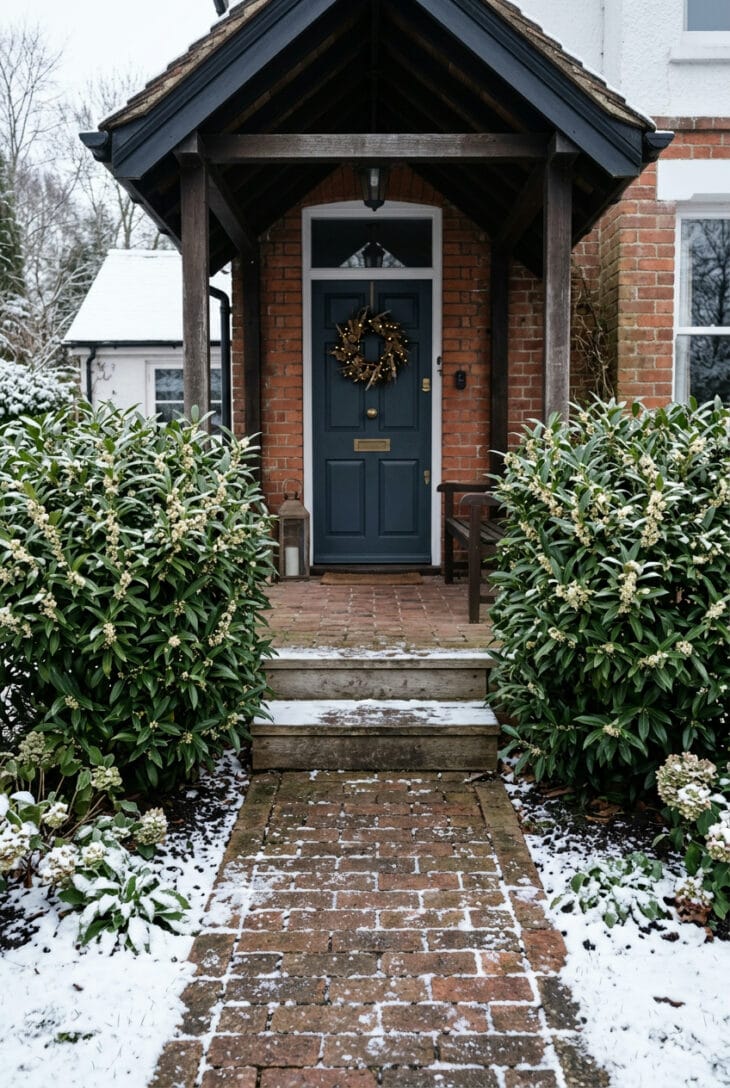
What you see Sweet box shrubs flank a shaded entry path, dark and glossy green and dotted with small cream-white flowers that are barely visible from a distance. A little snow lies on the ground, though the porch roof has kept it off the stems. Brick steps lead up to the door.
Why it works The flowers are tiny, but their fragrance carries a long way, honeyed and a little like vanilla, in mid to late winter. Sweet box (Sarcococca hookeriana var. humilis) is evergreen, grows in deep shade, and stays tidy without pruning. It is hardy in Zones 6–8 and solves the problem of a dark entry where little else will grow, which makes it one of the best front garden ideas for scent.
How to get it Plant it in part to deep shade and moist, well-drained soil, 3ft (90cm) apart, near the door or path where people will pass and smell it. It grows 3 to 5ft (90 to 150cm) tall depending on the form and spreads slowly by suckers. Mulch to hold moisture, because it dislikes drying out. The flowers open on mild days, so cut a few stems for a vase to enjoy the scent indoors.
17. Winter Jasmine Trained on a Wall
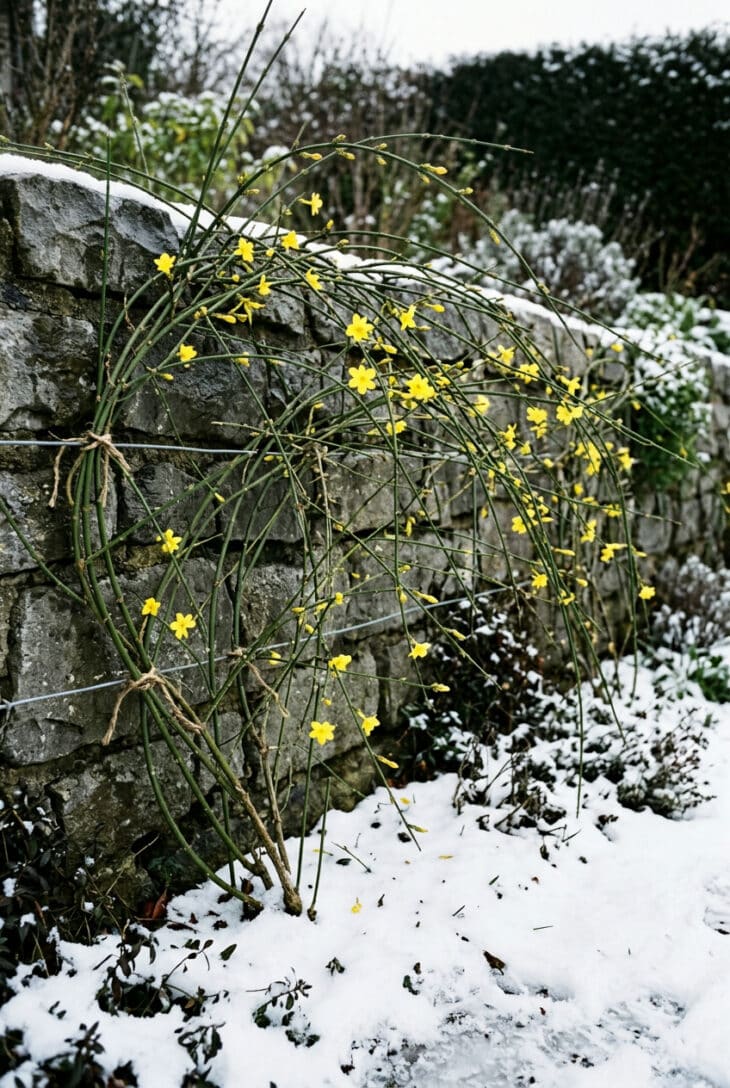
What you see A wall is veiled in arching green stems of winter jasmine, with small bright yellow flowers scattered along the bare branches. Snow lies at the foot of the wall, and a few flowers are open despite the cold. The stems are tied loosely to a wire trellis, and the gray stone behind gives a quiet background.
Why it works Winter jasmine (Jasminum nudiflorum) flowers on leafless green stems from mid winter into early spring, and each open flower is a small bright note when little else in the yard is moving. It is hardy in Zones 6–10 and has no scent, which is worth knowing before you plant it. Trained on a plain wall or fence, it adds the color that garden fence ideas often lack.
How to get it Plant it against a sunny wall in full sun to part shade and ordinary well-drained soil. Tie the long stems to wires or a trellis, because it will not cling on its own. Prune right after flowering, cutting the flowered stems back hard to keep it dense. Frost can nip open flowers, but more buds follow in the next mild spell.
18. Camellia Sasanqua Hedge for the South
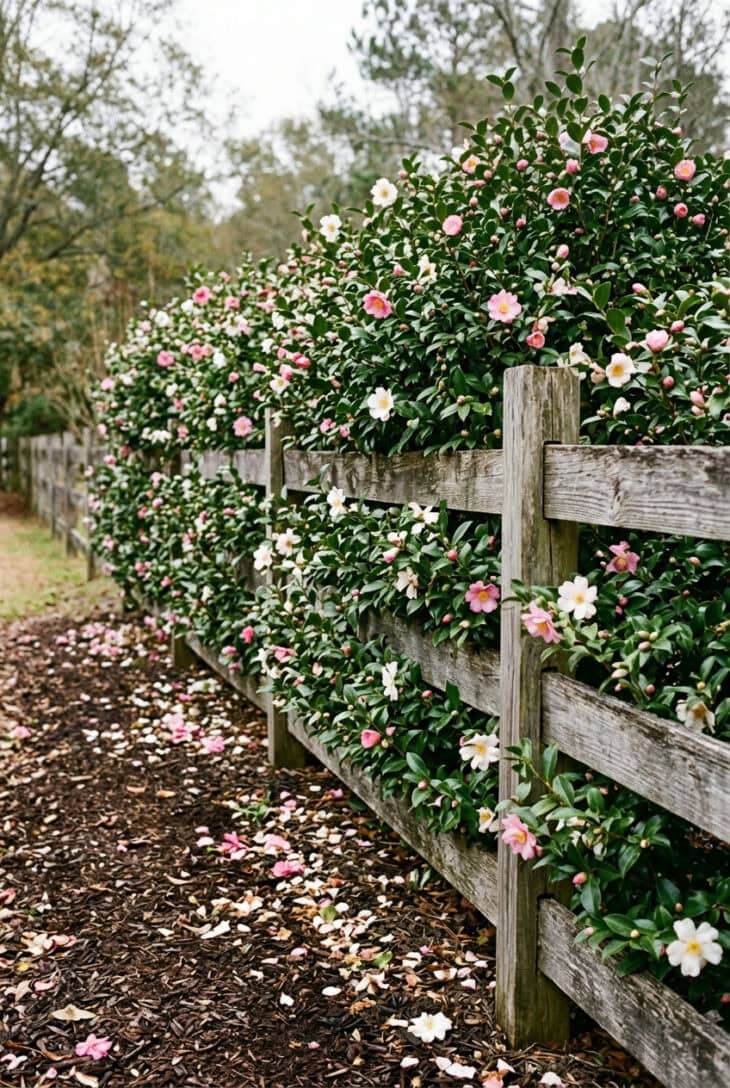
What you see A tall hedge of sasanqua camellia is in bloom along a wooden fence, with single pink and white flowers scattered among glossy dark green leaves. Fallen petals lie on the mulch, and the morning light is soft and mild. A few flowers are just opening, and many more buds follow.
Why it works Sasanqua camellias (Camellia sasanqua) bloom from fall into winter, earlier than the better-known japonica camellias, and they tolerate more sun. They are evergreen, so the hedge works as a screen all year and flowers when other shrubs are bare. They are hardy in Zones 7–9, which puts them in the South and along the Pacific coast, and they make a living screen alongside the garden privacy ideas we cover.
How to get it Plant in part sun to full sun (with afternoon shade in hot areas) in acidic, well-drained soil enriched with compost, spacing plants about 4ft (120cm) apart for a hedge. Set the root ball slightly high, because camellias dislike soggy roots. Prune right after flowering. Watch for tea scale, a sap-sucking insect that causes yellow blotches on the leaves, and for petal blight, and discard affected flowers. In Zone 7, a hard freeze can brown open flowers, but more buds keep coming.
19. Pansies and Ornamental Kale for Mild Winters
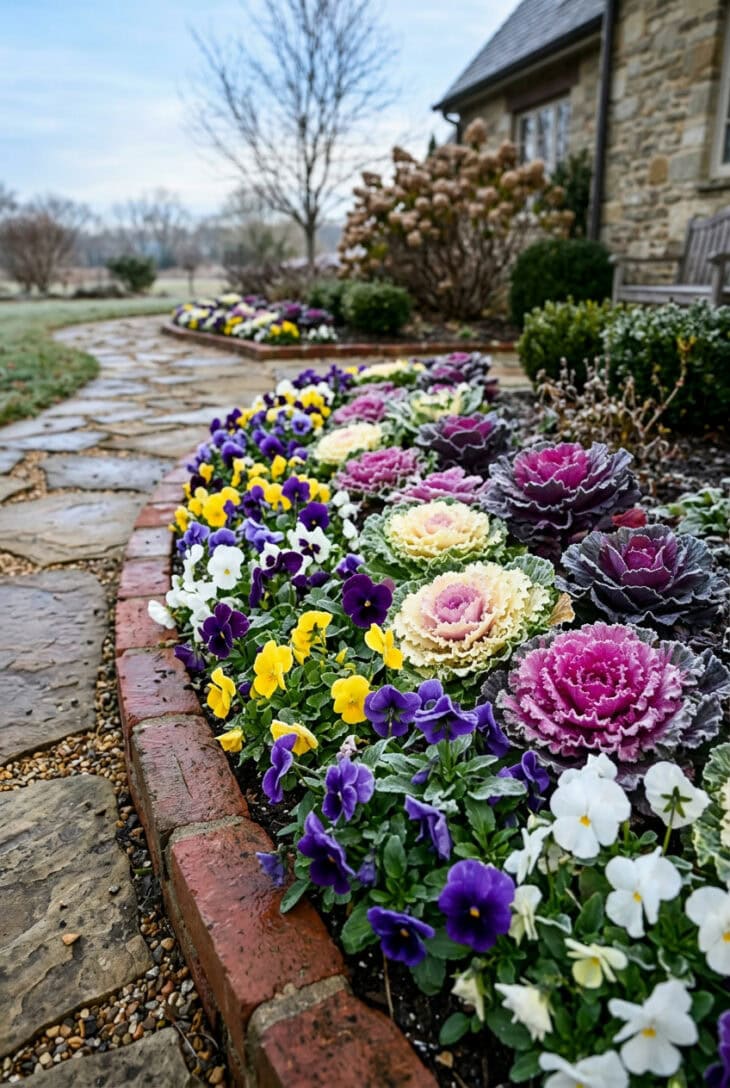
What you see A brick-edged front bed in a mild-winter yard is packed with purple, yellow and white pansies, and between them sit rosettes of ornamental kale in cream, pink and deep purple. Light frost sparkles on the kale leaves. A stone path runs beside the bed, and the plants look fresh in the early morning light.
Why it works In the South and along the Pacific coast, winter is a planting season, and pansies with ornamental kale fill the gap between summer annuals and spring. Pansies (Viola × wittrockiana) bloom through cool weather and are listed for Zones 6–10, though in the colder part of that range a hard freeze can finish them. Ornamental kale (Brassica oleracea) colors up as nights cool, and the pair works well in fall planter ideas too.
How to get it Plant in fall, early enough for roots to settle before hard freezes arrive, in full sun and well-drained soil enriched with compost. Space pansies 6 to 8in (15 to 20cm) apart and kale 12in (30cm) apart. Pansies droop in a freeze and recover when it warms, so wait a day before deciding they are dead. Pinch off spent flowers to keep them blooming, and feed lightly every few weeks. Ornamental kale is bred for looks rather than flavor, so grow an edible kale for the kitchen.
20. Oakleaf Hydrangea for Dried Blooms and Cinnamon Bark
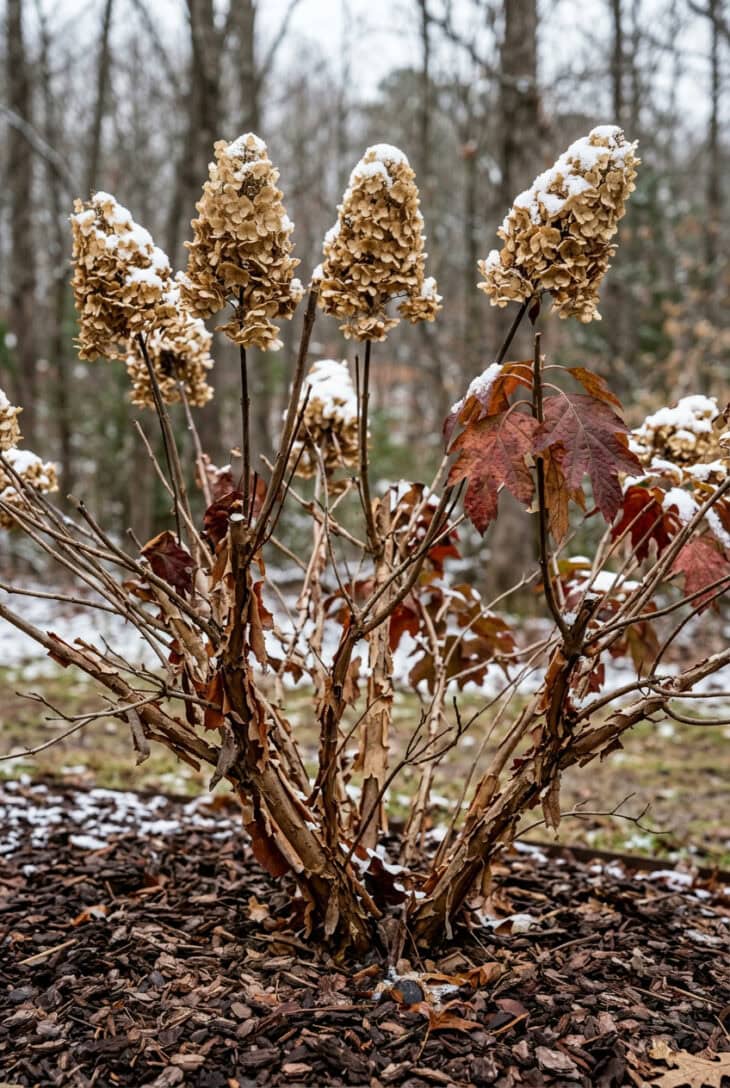
What you see An oakleaf hydrangea stands in a mulched bed under tall trees, its stems wrapped in cinnamon-colored bark that peels in thin strips. Tan dried flower heads still hold above the branches, with snow on top. A few russet leaves cling to the lower stems.
Why it works Oakleaf hydrangea (Hydrangea quercifolia) gives three winter features at once: peeling cinnamon bark, dried flower panicles that stay on the branches, and leaves that turn burgundy in fall and may hang on into early winter. It is hardy in Zones 5–9 and grows 4 to 8ft (120 to 240cm) tall. It asks little, which makes it one of the more low-maintenance garden ideas for a bed in part shade.
How to get it Plant it in part shade (or full sun in cooler areas) and moist, well-drained soil, 4 to 6ft (120 to 180cm) apart. It blooms on old wood, so prune only right after flowering and never in fall or winter, or you remove next summer’s flowers. Mulch deeply to keep the roots evenly moist. The leaves, flowers and bark are toxic to dogs, cats and people if eaten.
21. Winter-Blooming Aloes in a Dry Garden
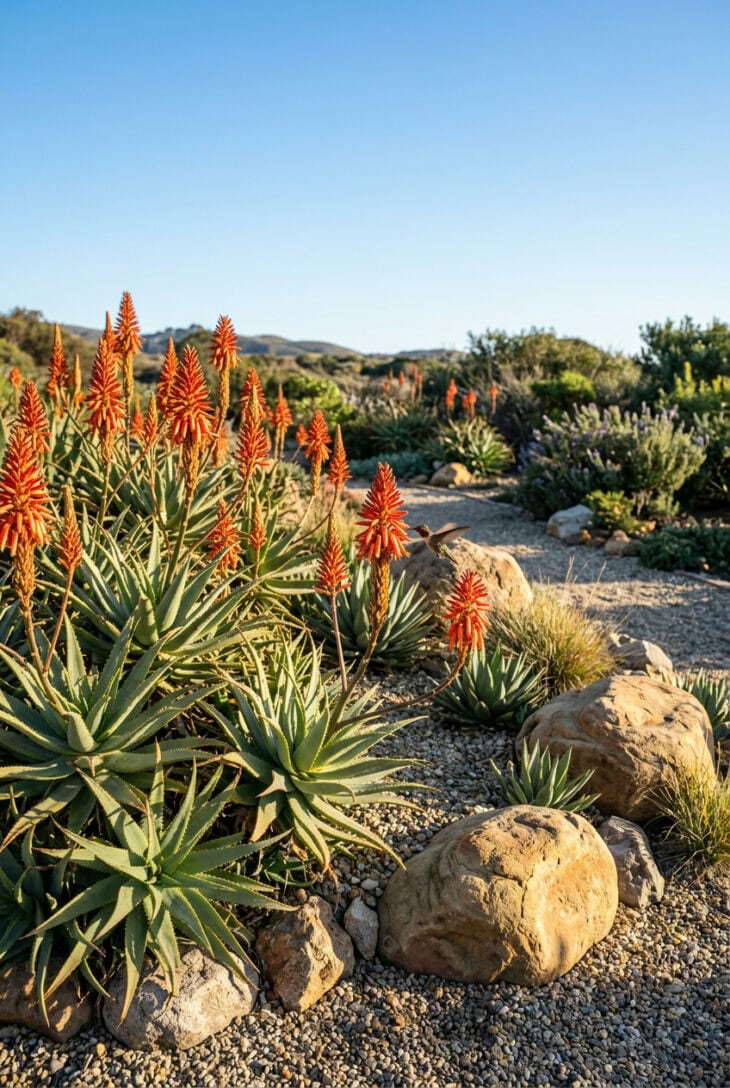
What you see A stand of torch aloes in a gravel garden carries tall spikes of orange-red tubular flowers above gray-green rosettes, under a clear winter sky. A hummingbird hovers at one spike. Large boulders and low sun give the scene a warm glow, and the gravel is dry underfoot.
Why it works For warm-winter gardeners, the best winter color arrives in the dry garden. Torch aloe (Aloe arborescens) blooms from late fall through winter in tall orange-red spikes, when hummingbirds and bees have little else to feed on. It is hardy in Zones 9–11 and needs almost no care once settled, which suits drought-tolerant garden ideas.
How to get it Plant in full sun and fast-draining soil or a raised mound, at least 4ft (120cm) apart, since it forms a large, branching clump over time. In Zone 9, cover it with frost cloth on freezing nights. Water sparingly, mostly in prolonged dry spells, because soggy soil rots the roots. The sap irritates skin and the leaves are toxic to dogs and cats if eaten, so wear gloves when cutting spent flower stems.
22. Cold Frame of Hardy Winter Greens
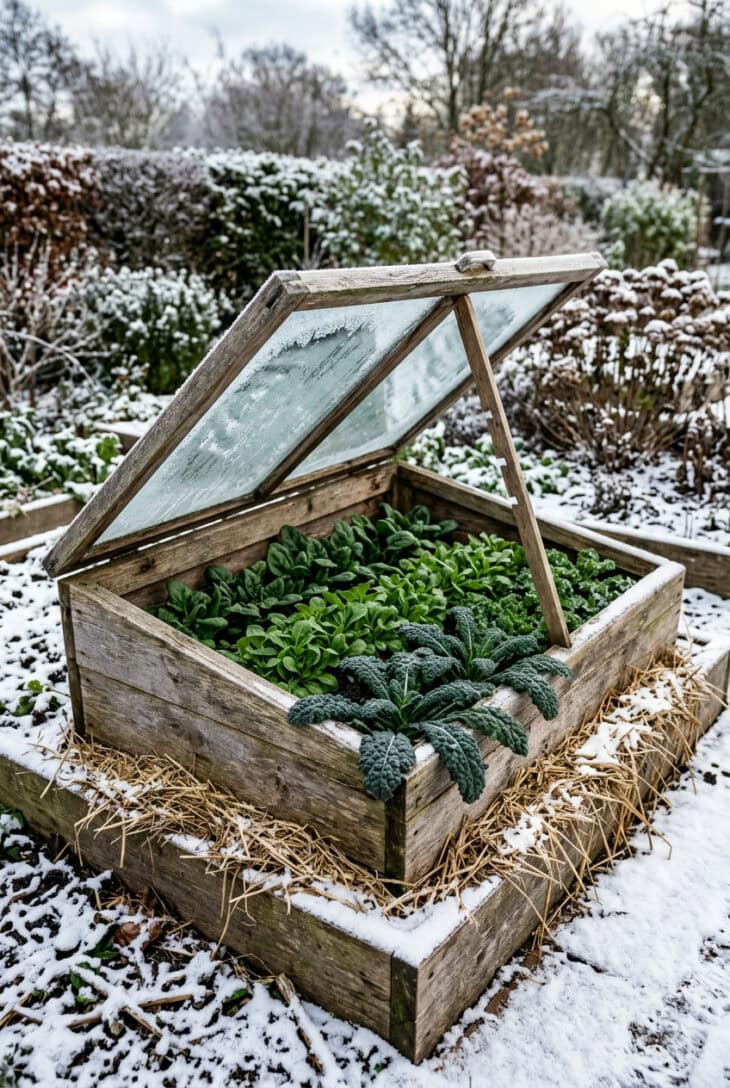
What you see A wooden cold frame with a clear lid propped open sits in a raised bed with snow around it. Inside, rows of spinach, lamb’s lettuce and kale grow green and lush, and a few dark kale leaves curl over the side. Frost clings to the edge of the glass, and straw is banked around the base.
Why it works A cold frame is a bottomless box with a clear lid that traps the sun’s warmth and shelters plants from wind. Hardy greens such as spinach, kale, mâche (Valerianella locusta) and claytonia can hold in good shape inside it, or keep growing slowly, through a cold winter. It is a small project that makes winter feel like a growing season, and it sits easily on top of one of our raised bed garden ideas.
How to get it Build it facing south with a sloped lid, and sow or plant in fall early enough that the plants are close to full size before the shortest days, when growth nearly stops. On sunny days, prop the lid open once the inside climbs past about 45°F (7°C), and close it before evening. Water lightly in the morning, because wet leaves overnight invite rot. A cold frame suits the late crops in fall vegetable garden ideas, and for a larger space, see our greenhouse ideas.
23. Evergreen Doorway Pot with Cut Stems
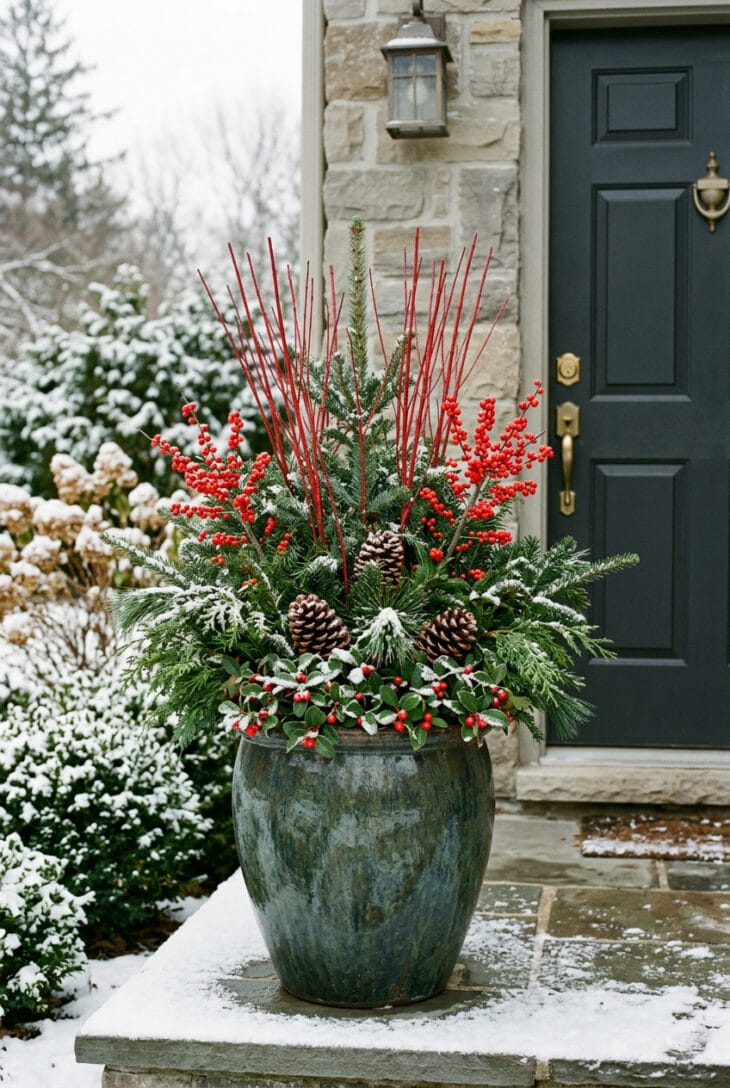
What you see A large frost-proof pot beside a dark front door is packed with fresh evergreen boughs, upright red dogwood stems, branches of red winterberry and a few pinecones. Wintergreen with red berries edges the base, and light snow dusts the greenery and the porch steps. The arrangement is full and tall and looks planted rather than decorated.
Why it works When summer annuals finish, an empty pot looks abandoned for months. A pot of cut stems costs little and looks good for weeks, because cold keeps cut evergreens fresh. You set the stems into moist potting mix, and the mix freezes and holds them in place. It is one of the easiest container garden ideas for a winter porch.
How to get it Choose a frost-proof pot, because terra-cotta that holds water can crack in freezing weather. Fill it with moist potting mix, then push in the stems, tallest in the center and boughs around the edge. Use fresh-cut cedar, fir or pine boughs, red-twig dogwood and winterberry stems. Tuck a few wintergreen plants (Gaultheria procumbens, hardy in Zones 3–7) around the base for glossy leaves and red berries. If you plant live shrubs in a pot instead, choose ones hardy to a zone or two colder than yours, since roots in a pot freeze harder than roots in the ground.
24. A Winter Bird Station with Open Water
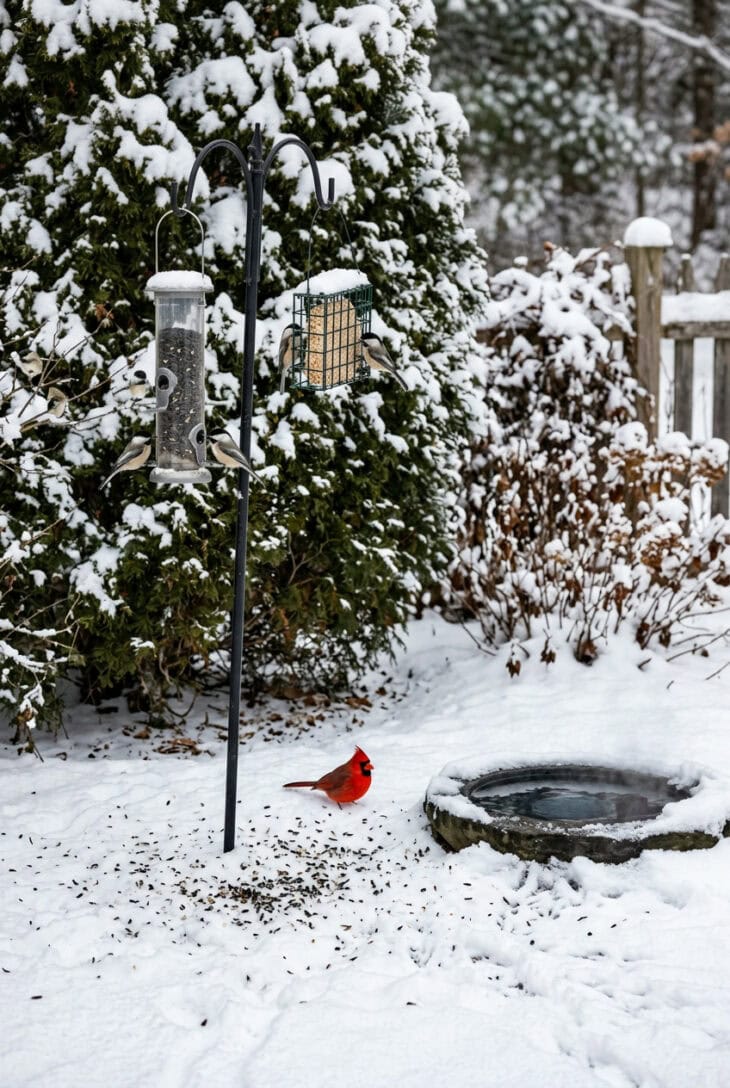
What you see A snowy corner of the yard holds a pole-mounted tube feeder and a suet cage beside a dense evergreen shrub. Chickadees sit on the perches, and a bright red male cardinal feeds on the ground below. A heated birdbath nearby keeps a patch of open water in the surrounding snow, and footprints crisscross the drift.
Why it works Birds work hardest in winter for food and unfrozen water, and a feeding station gives you the best view of them from a window. Black oil sunflower seed draws the widest range of species, suet feeds woodpeckers and chickadees, and open water draws birds that never visit feeders. Dense evergreens within a few yards give them shelter from wind and hawks. It fits any of our backyard garden ideas, from a tiny lot to a big one.
How to get it Place feeders either within 3ft (90cm) of a window or more than 30ft (900cm) away to reduce collisions, and about 10ft (300cm) from cover so birds can escape. Use a heated birdbath or a de-icer made for the purpose, and never add salt or antifreeze to the water. Keep seed dry, and clean feeders every couple of weeks with 1 part bleach to 9 parts water, then rinse and dry them. Take a feeder down for a while if you see sick birds or clumps of spoiled seed.
25. A Cleared Path with Lanterns and a Bench
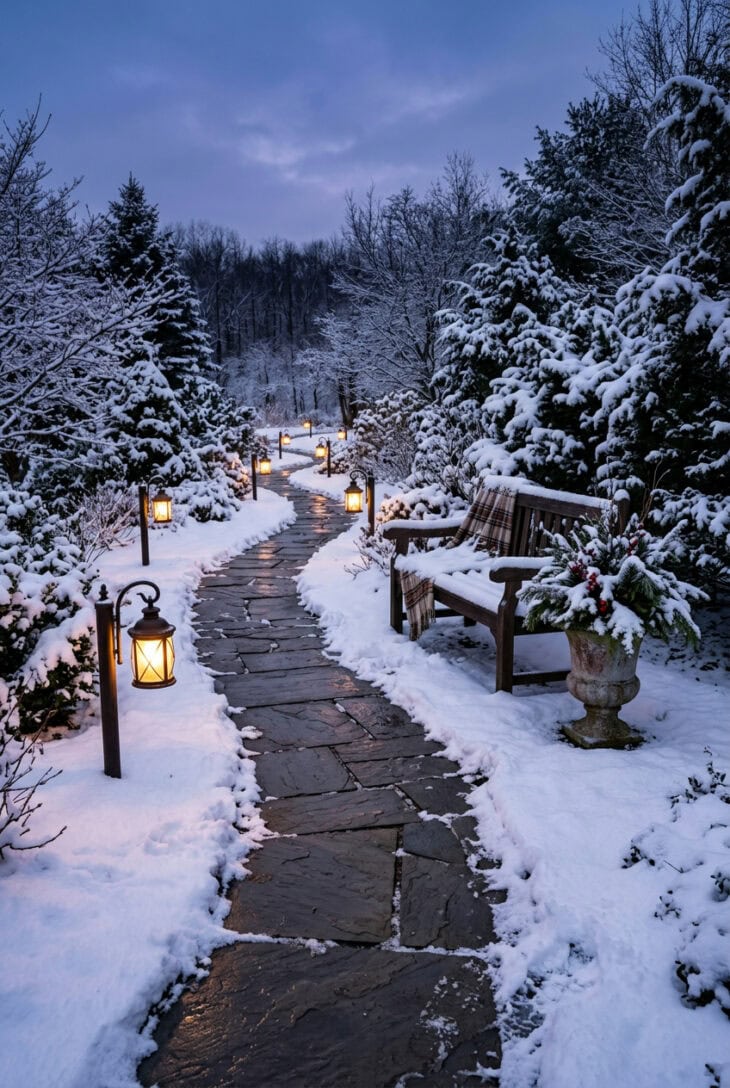
What you see A shoveled flagstone path runs through a snowy garden to a wooden bench beside a stone urn filled with evergreen boughs. Lanterns on low posts glow warm along the path at dusk, and snow-capped evergreen shrubs line both sides. The sky is deep blue, and the light is cool everywhere the lanterns do not reach.
Why it works Winter gardens are seen mostly from windows and doorways, so a clear path to a focal point makes the garden usable and gives the eye a destination. Light turns short afternoons into usable evenings, and a bench or urn anchors the scene when the beds are bare. Stone and brick clear easily, so the path stays open after snow. Our garden path ideas cover surfaces in detail, and our garden lighting ideas cover fixtures.
How to get it Choose a surface that can be shoveled, such as flagstone, brick or pavers set on a firm base, because loose gravel gets scraped away. Solar lights dim in the short days of winter, so use low-voltage LED lights on a timer for reliable evenings, and hire a licensed electrician for any mains-voltage wiring. Spread sand or traction grit rather than rock salt, which damages the plants along the path. Keep the path at least 3ft (90cm) wide so two people can walk it.