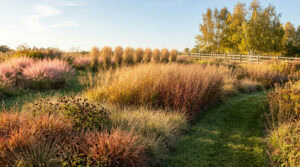
A sensory garden is planted to be experienced, not just looked at: the lavender you brush past, the grass you hear before you see it, the strawberry you pick on the way to the door. University of Illinois Extension describes these gardens as areas designed to stimulate one or more of the five senses. The ideas below put that into practice.
Contents
- 01. Lavender and Thyme Scent Path
- 02. Lamb’s Ear Touch Border
- 03. Feather Reed Grass Rustle Walk
- 04. Herb Tasting Bed by the Back Door
- 05. Hot Color Border for High Summer
- 06. Seated-Height Raised Bed
- 07. Thornless Rose Arbor
- 08. Bubbling Pebble Fountain Nook
- 09. Winter Scent Entry with Witch Hazel and Sweet Box
- 10. Edible Flower Bed
- 11. Moss and Fern Shade Corner
- 12. Bee Hum Bed with Anise Hyssop and Bee Balm
- 13. Evening Scent Patio
- 14. Sweet Pea Fence
- 15. Berry Snacking Path
- 16. Barefoot Texture Path
- 17. Songbird Corner with Serviceberry and a Birdbath
- 18. Lilac Hedge for a Spring Scent Screen
- 19. Rain Chain into a Gravel Basin
- 20. Seedpod Rattle Bed
- 21. Scented Geranium Pots by the Door
- 22. Sunflower House and Bean Teepee for Kids
- 23. Looped Path Garden for Familiar Scents
- 24. Fragrant Planting Beside an Open Window
- 25. Cool Blue Border for a Calm Corner
The range is wide. There are ideas for one pot by the door and for a whole side yard, for Zone 3 winters and Zone 9 summers, for toddlers, for seated gardeners and for older relatives who respond to familiar scents. Some lean on scent and taste, some on touch, and several are built for sound.
Sensory plants are handled, sniffed and sometimes tasted, so every idea names the safety catch where there is one: a toxic seed, an aggressive spreader, a path that suits some feet and not others. Pick the corner of your yard that gets the most foot traffic, choose the sense you most want there, and start with that idea.
01. Lavender and Thyme Scent Path
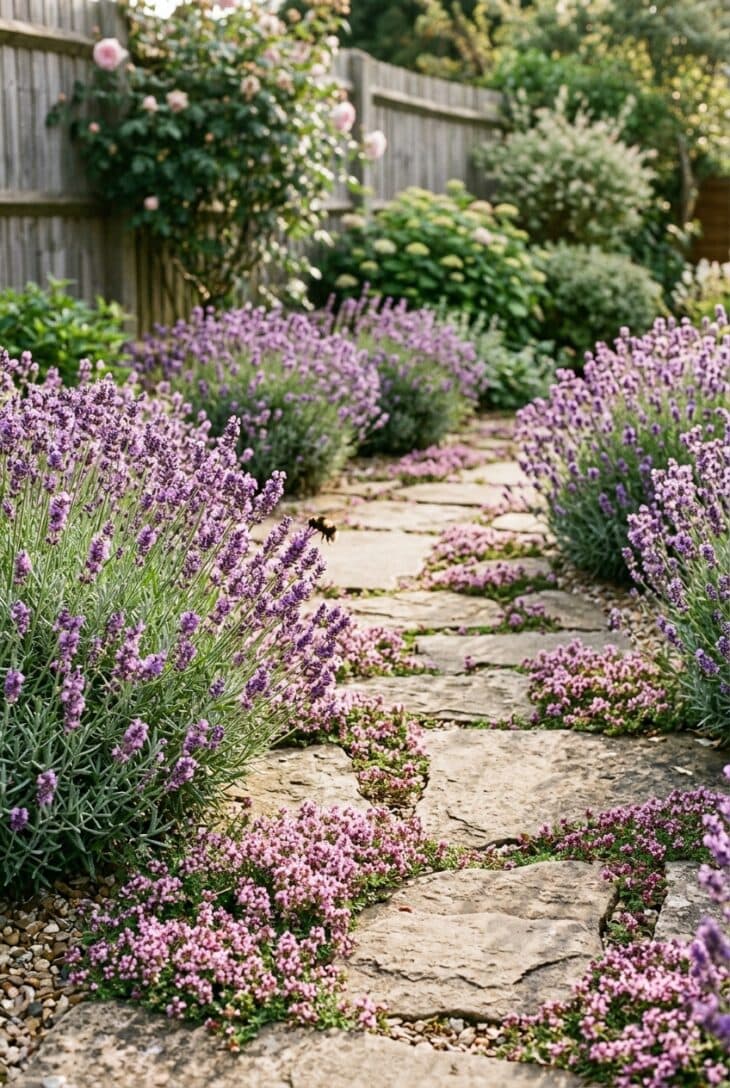
What you see A flagstone path curves through a sunny yard, edged on both sides by rounded mounds of purple lavender in full July bloom. Creeping thyme in pink-purple flower fills the gaps between the stones, and a bumblebee hovers over one flower spike. Gray-green foliage leans into the path, with a little gravel showing between the plants. Low golden light from the west warms the whole scene.
Why it works This is scent that asks nothing of the visitor. West Virginia University’s accessible gardening guide recommends planting scented herbs along walkways so they release fragrance when brushed, and names lavender as an example. Every step on this path bends a stem or crushes a leaf, so the smell arrives on its own. Three textures share one narrow strip: upright flower spikes, gray-green mounds and a flat mat of thyme.
How to get it English lavender (Lavandula angustifolia) grows in Zones 5–9 and needs full sun and perfectly drained soil, so raise the strip a few inches if your soil is heavy clay. Clemson Extension calls English lavender the least adapted to Southern heat and suggests raised beds and a mulch of stone, as in these gravel garden ideas, to keep disease down. In the humid East and South, choose lavandin (Lavandula × intermedia) instead: NC State lists ‘Provence’ as best for humid conditions, in Zones 5–8. Allow 12in to 3ft (30 to 90cm) of room per plant for airflow, and trim in spring, not fall. Creeping thyme (Thymus serpyllum) grows in Zones 4–9 and stays 2 to 3in (5 to 8cm) tall, but its minty leaves are not culinary quality, so keep it out of the kitchen.
02. Lamb’s Ear Touch Border
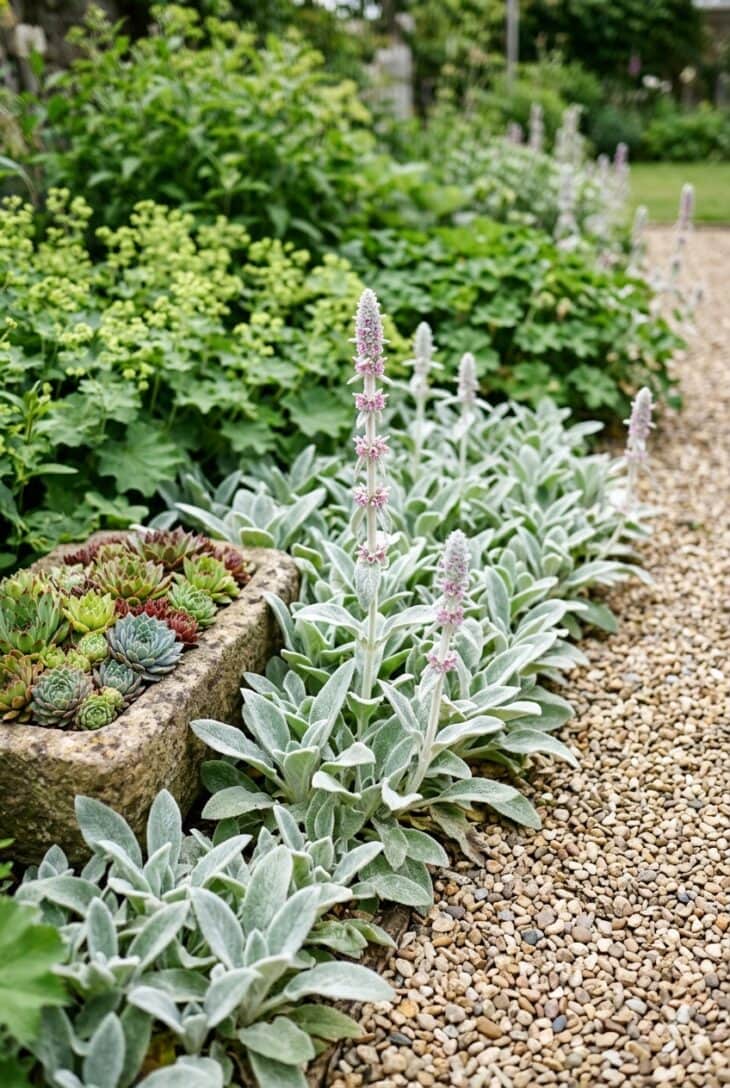
What you see A carpet of silver-gray lamb’s ear leaves spills over the edge of a gravel path, each leaf furred with fine white hairs that catch the soft light. A few upright stems carry small pink flowers. Beside them, a stone trough holds tight geometric rosettes of hens and chicks, and green foliage fills the space behind.
Why it works Touch is the sense gardens most often forget, and lamb’s ear is the plant that gets it right: velvety to the touch and sturdy enough to survive being handled, which University of Illinois Extension lists as a requirement for touch plants. Planted at the very edge of the bed, it sits within a child’s reach and a wheelchair user’s reach. The silver color also calms hot-colored neighbors. If you want more silver foliage to try, these lamb’s ear lookalikes are worth a look, though they are different plants with their own needs.
How to get it Lamb’s ear (Stachys byzantina) grows in Zones 4–9, reaches about 12 to 18in (30 to 45cm) tall and wide, and takes full sun to partial shade. NC State says it wants very well-drained soil, and that wet leaves and humid summers invite disease, so water at the base and give it some afternoon shade in hot climates. It spreads by stems rooting at the nodes and can be aggressive in good conditions, so set it where you can pull out the extra. Hens and chicks (Sempervivum tectorum) are hardy in Zones 3–8 and take full sun to partial shade, which suits them to a trough at the same sunny edge.
03. Feather Reed Grass Rustle Walk

What you see Tall clumps of feather reed grass line both sides of a gravel walk, their upright green blades topped with feathery pink-tan plumes. The plumes stand about 5ft tall and lean together in a light breeze. A plain wooden bench waits at the far end, with a low hedge behind it and a clear blue sky above. The low morning sun lights each plume from behind.
Why it works Clemson Extension notes that grasses sway easily in the wind, adding rustling sounds to the landscape, and a walk lined with tall, narrow clumps puts that sound at ear height. Feather reed grass grows upright and stays narrow, so the walk does not feel closed in. The effect lasts, because the seedheads and stalks stay attractive into winter. This is the planting at its simplest, and it is one of the sound ideas in the ornamental grass garden ideas collection.
How to get it Plant ‘Karl Foerster’ feather reed grass (Calamagrostis × acutiflora) in Zones 5–9, about 2ft (60cm) apart to match its 1.5 to 2.5ft (45 to 75cm) spread. It is sterile, so it does not self-seed, and it grows 3 to 5ft (90 to 150cm) tall. It is a cool-season grass, and Clemson says it grows best in the upper Piedmont of South Carolina, so in the hot, humid Southeast switch to switchgrass (Panicum virgatum) ‘Northwind’, which is a warm-season grass hardy in Zones 5–9 and 4 to 5ft (120 to 150cm) tall. Leave both standing through winter for looks and sound, then cut them back in late winter, just before new shoots appear. Missouri Botanical Garden suggests watching for rust after long rainy spells.
04. Herb Tasting Bed by the Back Door
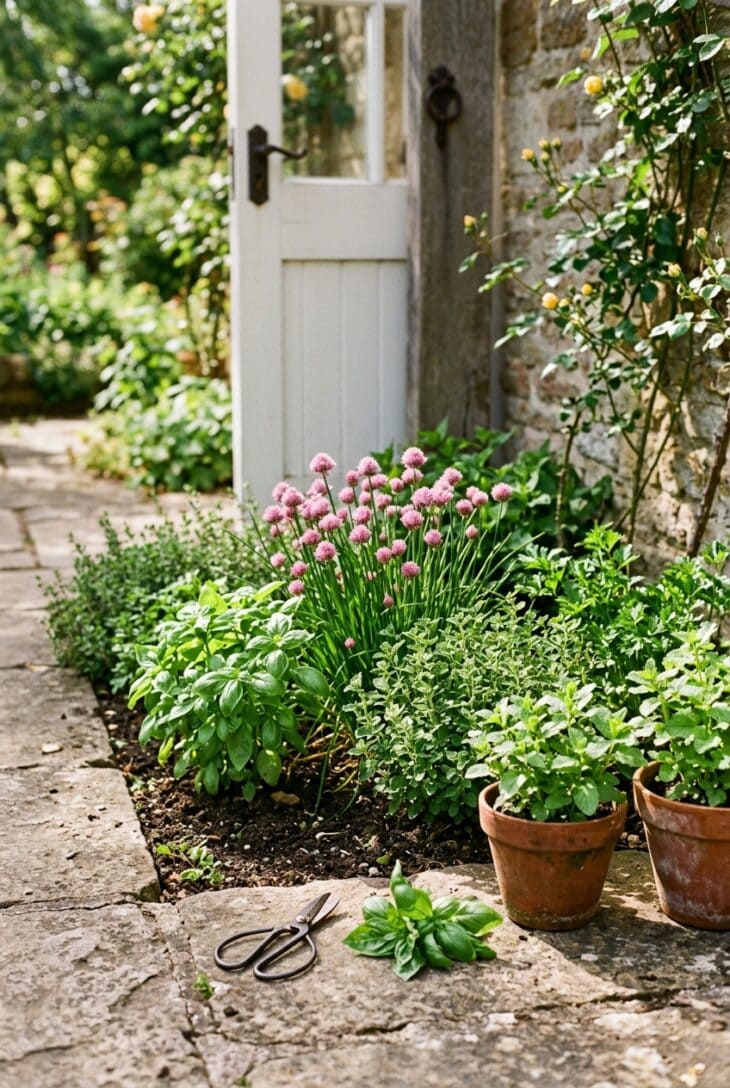
What you see A small sunny bed beside a back door holds herbs in neat patches: glossy green basil, a clump of chives topped with round pink flowers, and bushy oregano. Two terracotta pots at the edge of the patio hold mint and lemon balm. A pair of scissors and a handful of cut basil rest on the stone, ready to carry inside.
Why it works Taste is the sense most gardens skip, and a bed by the back door fixes that, because the herbs are close enough to be used and tasted every day. Rubbing a leaf gives scent and flavor together. The bed also splits the herbs by temperament: well-behaved clumps in the ground and the spreaders, mint and lemon balm, in pots. A full set of herb garden ideas goes further if you want a bigger plot.
How to get it Keep mint in a container on a paver or patio, as UC ANR advises, because mint stems that touch soil can root and escape. Peppermint (Mentha × piperita), listed for Zones 5–9, can be an aggressive spreader, and lemon balm (Melissa officinalis, Zones 3–7) also self-seeds and spreads by rhizomes, so NC State suggests growing it in a container too. Basil is a tender annual: Clemson says to set it out when nights stay above 50°F (10°C) and days are in the 70s. Chives (Allium schoenoprasum) are hardy in Zones 4–8 and their flowers are edible, and oregano (Origanum vulgare) grows 1 to 3ft (30 to 90cm) tall in the same zones. NC State lists chives as a problem for cats, dogs and horses if eaten, so keep pets out of the bed.
05. Hot Color Border for High Summer
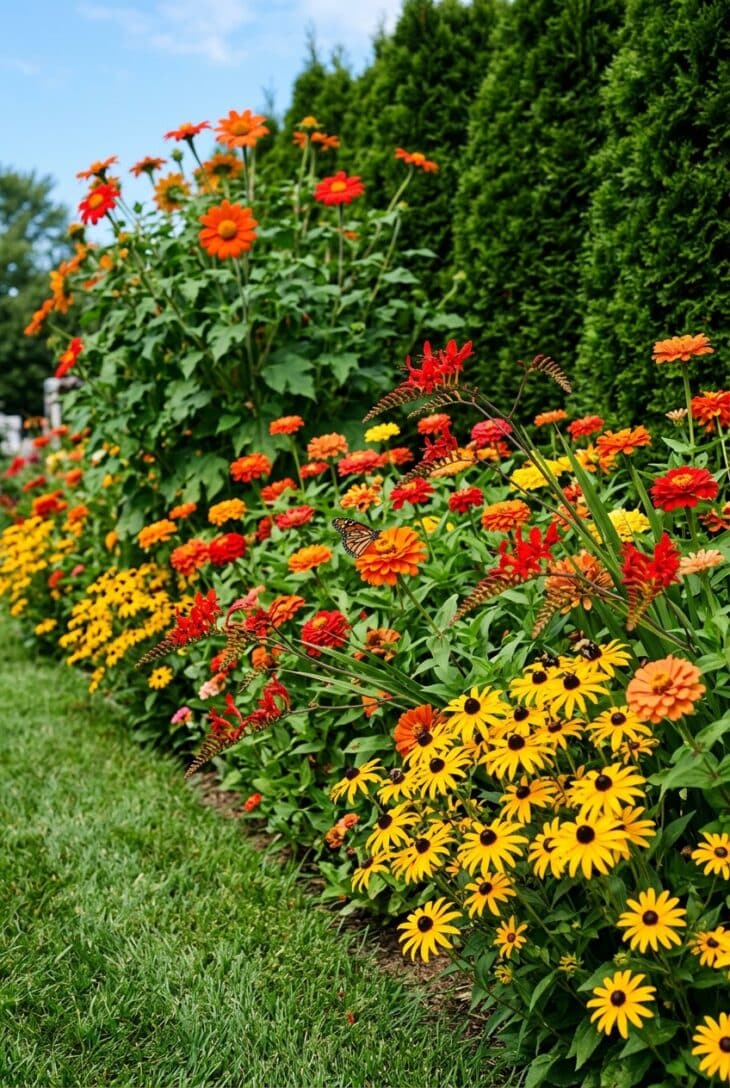
What you see A deep summer border blazes in orange, scarlet and yellow against a dark green hedge. Tall orange Mexican sunflowers stand at the back, zinnias in three hot shades fill the middle, and golden black-eyed Susans run along the front. Arching red crocosmia spikes break the line, and bees work the flowers in strong late-morning sun.
Why it works Sight is the sense this border plays loudest. Warm colors, packed together in the same sun, read as one block of heat, and the dark hedge makes them look brighter. The height steps from 6in to 6ft, so the eye climbs through it rather than skimming the top. It is a good fit for a bed you view from far away, like a flower bed along a property line.
How to get it Put Mexican sunflower (Tithonia rotundifolia) at the back, since it reaches 3 to 6ft (90 to 180cm) and needs full sun. Zinnia (Zinnia elegans) is an annual that grows from 6in to 3ft (15 to 90cm) tall, also in full sun, so sow it after your last frost date. Black-eyed Susan (Rudbeckia fulgida) is a Zones 3–9 perennial of 2 to 3ft (60 to 90cm) that stands up to hot, humid summers and tolerates drought once established, and it spreads by rhizomes into large clumps. Crocosmia is hardy in Zones 6–9, grows 2 to 3ft (60 to 90cm) tall from corms, and NC State suggests some afternoon shade in hotter climates so its blooms last longer. Skip heleniums here, because NC State lists them as poisonous to people.
06. Seated-Height Raised Bed
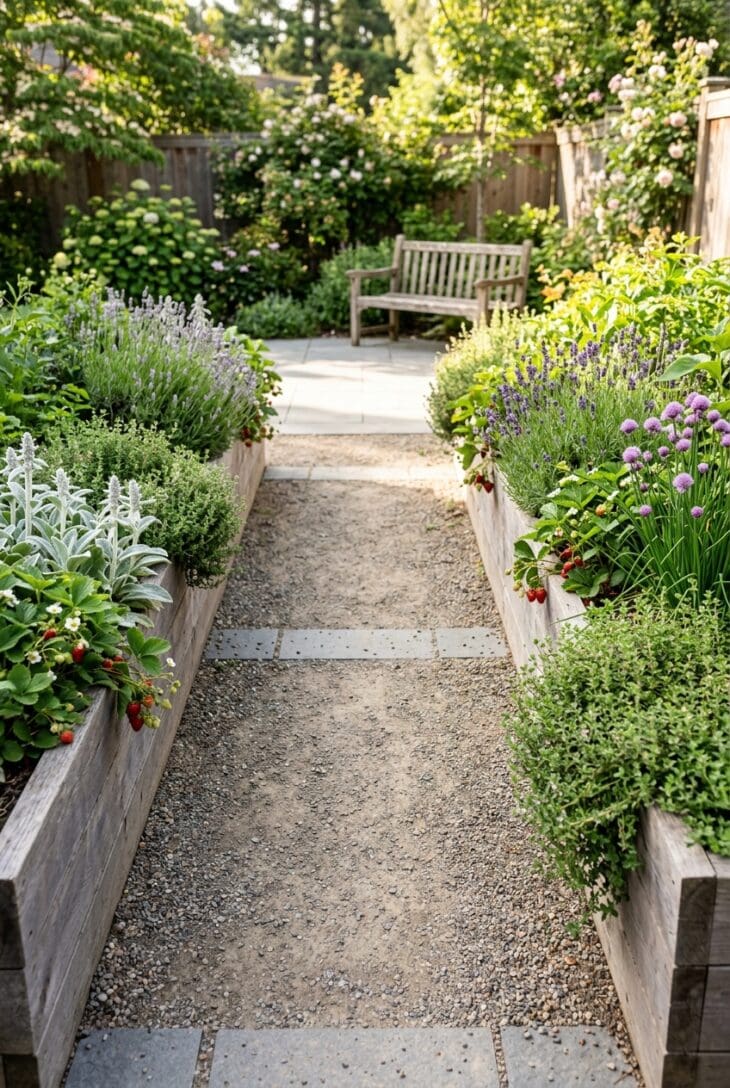
What you see Two long cedar beds, about 2ft tall, run either side of a wide, smooth path in a sunny yard. They are planted right to the rim with thyme, chives, strawberries, lavender and silver lamb’s ear, which spill over the edge within easy reach. The paving opens into a clear space at the end, beside a plain bench. Warm morning light falls across the plants.
Why it works A sensory garden is only sensory if people can reach it. University of Illinois Extension advises raised beds and wider paths so a sensory garden is accessible to everyone, and a bed at seated height puts the herbs and soft foliage at the level of a hand. The same bed suits anyone who would rather not bend or kneel. Put the sturdy, handleable plants along the front edge, where the touching happens. Anyone planning a larger layout can start with these raised bed garden ideas.
How to get it About 24in (60cm) is the height both University of Georgia and University of Illinois Extension give for a bed worked from a wheelchair, and Oregon State describes beds of about 2ft, or 3ft (90cm) on legs. Seattle’s ADA-based guide allows a top edge up to 34in (85cm) with at least 27in (70cm) of knee space below, if the gardener rolls up to the front. For width, Illinois says no more than 2ft (60cm) if you reach from one side and 4ft (120cm) if you reach from all sides, and Seattle caps a one-sided wheelchair bed at 18in (45cm), so aim for 18 to 24in (45 to 60cm) from a chair. Leave 4ft (120cm) between beds for a wheelchair, which UGA and Seattle both give as the minimum and Penn State puts at 5ft (150cm) preferred. Keep the path firm and smooth, and note that Seattle calls for angular gravel, not round pea gravel, on accessible routes.
07. Thornless Rose Arbor
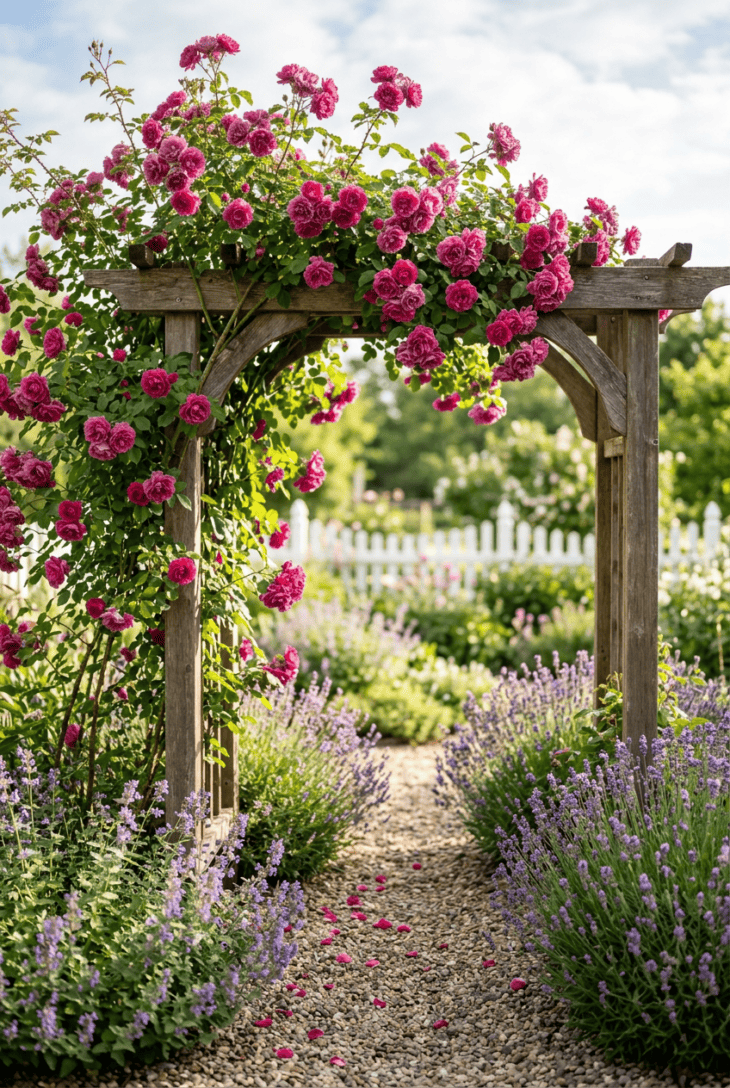
What you see A wooden arbor over a gravel path is covered in dark pink roses, their semi-double blooms opening along smooth green canes. A few petals have dropped onto the path below. Lavender and catmint edge the walkway in soft gray-green, and morning light filters through the flowers. A white picket fence blurs behind.
Why it works A rose arbor is scent at head height, and a thornless rose lets you actually lean into it. ‘Zephirine Drouhin’ is an old Bourbon climber that Missouri Botanical Garden describes as having sweetly scented flowers on prickle-free canes. Walking under the arch puts you inside the fragrance and among the flowers. It is also a good anchor for a cottage garden entrance.
How to get it ‘Zephirine Drouhin’ is hardy in Zones 5–9 and climbs to about 12ft (365cm) when tied to a pillar, fence or arbor, with 3.5 to 4in (9 to 10cm) dark pink blooms from May until frost, according to Missouri Botanical Garden. It tolerates shade, but both Missouri Botanical Garden and Chicago Botanic Garden tie its best flowering and mildew resistance to full sun. Missouri Botanical Garden says roses in general are prone to black spot, powdery mildew, rust and rose rosette, so give it good airflow and do not expect it to be disease-proof. In cold-winter areas, protect the crown over winter. Botanic gardens call the canes prickle-free, which is as close to thornless as roses get. For plants that grow well beside roses, see these companion plants for roses.
08. Bubbling Pebble Fountain Nook
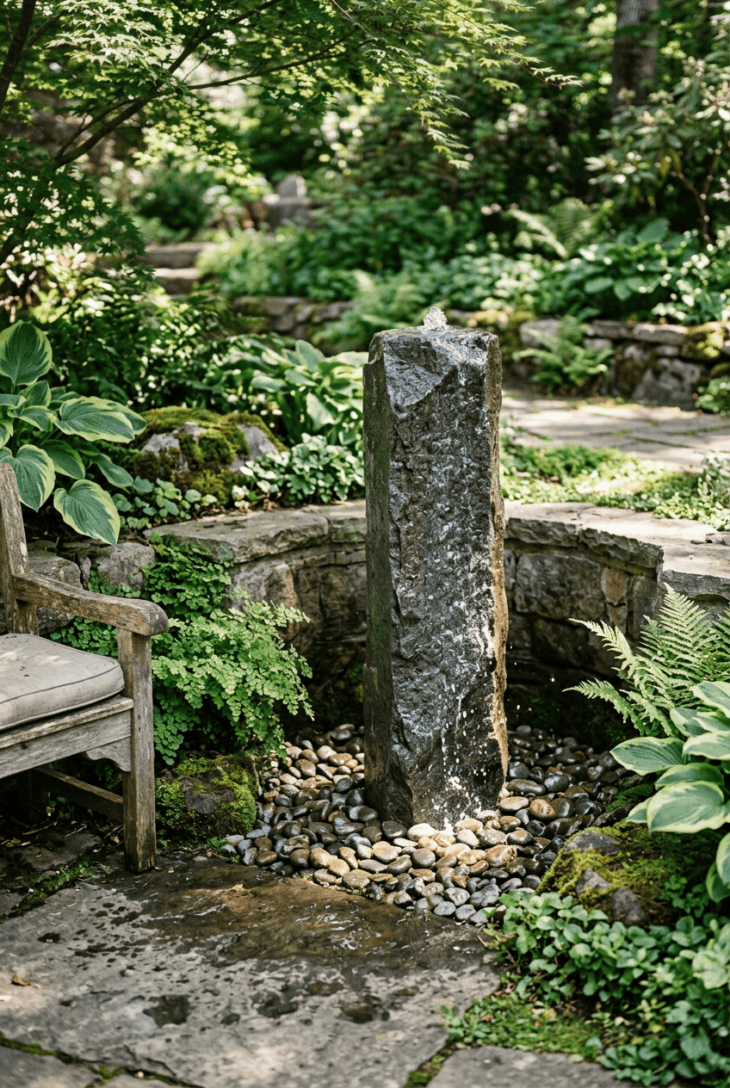
What you see A tall gray basalt column stands in a shaded corner, with water bubbling quietly from its top and sliding over the stone. It lands in a bed of smooth river pebbles set level with the ground, with no open pool in sight. Ferns and hostas soften the base, a low bench sits to one side, and dappled sunlight glints on the wet surface.
Why it works Water is the easiest garden sound to add, and it can soften the background noise of a road or a neighbor’s air conditioner. A pebble fountain gives you the sound without a pond to maintain. Moving water also helps with mosquitoes: Audubon notes that insects do not like to lay eggs in running water. For more ways to bring water into a garden, see these water garden ideas.
How to get it Be honest about toddlers first: the American Academy of Pediatrics says young children can drown in an inch or two of water and advises holding off on installing fountains and ponds until a child is older. If small children visit, wait, or choose a different sound idea from this list. Plug the pump into a GFCI-protected outdoor outlet, which the Consumer Product Safety Commission recommends for all outdoor receptacles, and hire a qualified electrician to add an outlet if you have none, as the Electrical Safety Foundation advises. If any water collects and sits, change it every 3 to 5 days, the window LSU AgCenter gives for mosquitoes to begin breeding. Set the fountain in a shaded or part-shaded spot, near a bench you will actually use.
09. Winter Scent Entry with Witch Hazel and Sweet Box
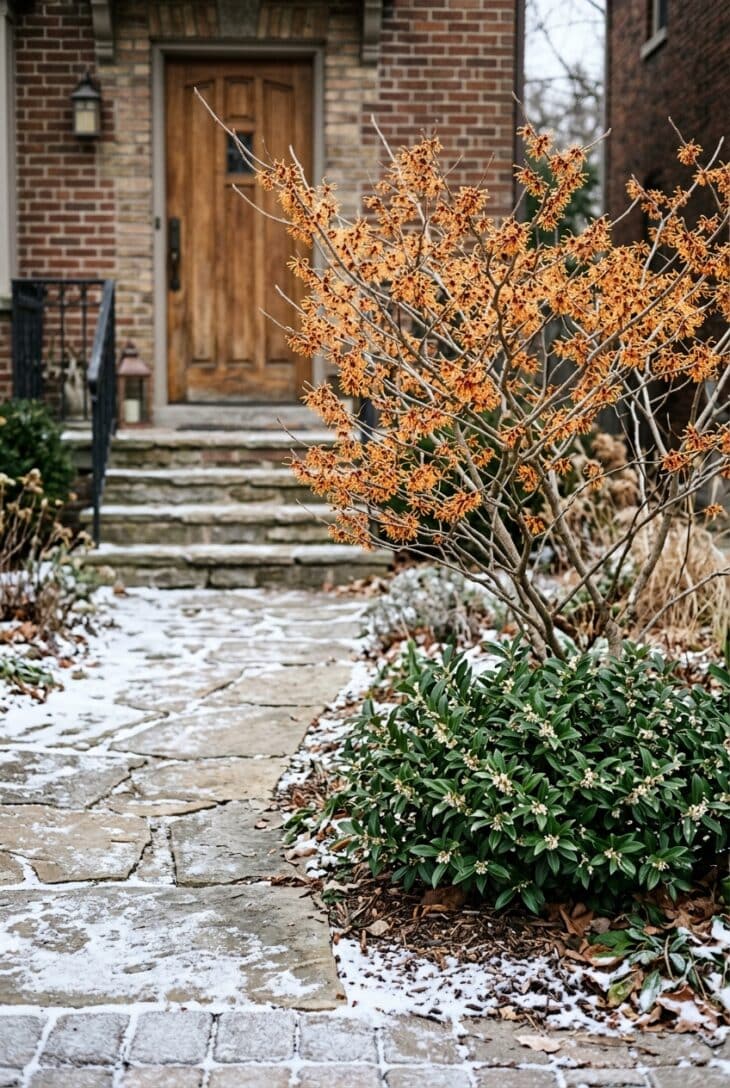
What you see A big vase-shaped witch hazel stands beside the front steps in late winter, its bare branches covered in spidery orange-yellow flowers. Low under it, glossy evergreen sweet box carries small white flowers among dark leaves. Frost dusts the path stones and patches of snow linger, all in soft gray light, with a wooden door blurred behind.
Why it works Winter is when a garden asks the least of us, and the front door is where we most want a reason to pause. Witch hazel flowers in winter or early spring before the leaves emerge, and NC State says its blooms are fragrant, so you meet the scent at the threshold. Sweet box (Sarcococca) adds an evergreen layer and small, fragrant white flowers that carry the scent into spring. Together they give the one season with almost no flowers a smell. More ideas for the cold months are in these winter garden ideas.
How to get it Hybrid witch hazel (Hamamelis × intermedia) is hardy in Zones 4–9 but grows large, 15 to 20ft (450 to 600cm) tall and 8 to 10ft (240 to 300cm) wide, so give it real space, at least a few feet from the walk. Choose a cultivar for its scent, since NC State says the fragrance and the yellow, orange or red color depend on the cultivar, and plant in moist, fertile, acidic, well-drained soil. Sweet box (Sarcococca hookeriana) is hardy in Zones 5–8, reaches 4 to 5ft (120 to 150cm) tall and 5 to 6ft (150 to 180cm) wide, and does best in shade, where its leaves keep their color. NC State rates it resistant to deer damage. Witch hazel leaves can turn brown and cling through winter, which hides the flowers a little.
10. Edible Flower Bed
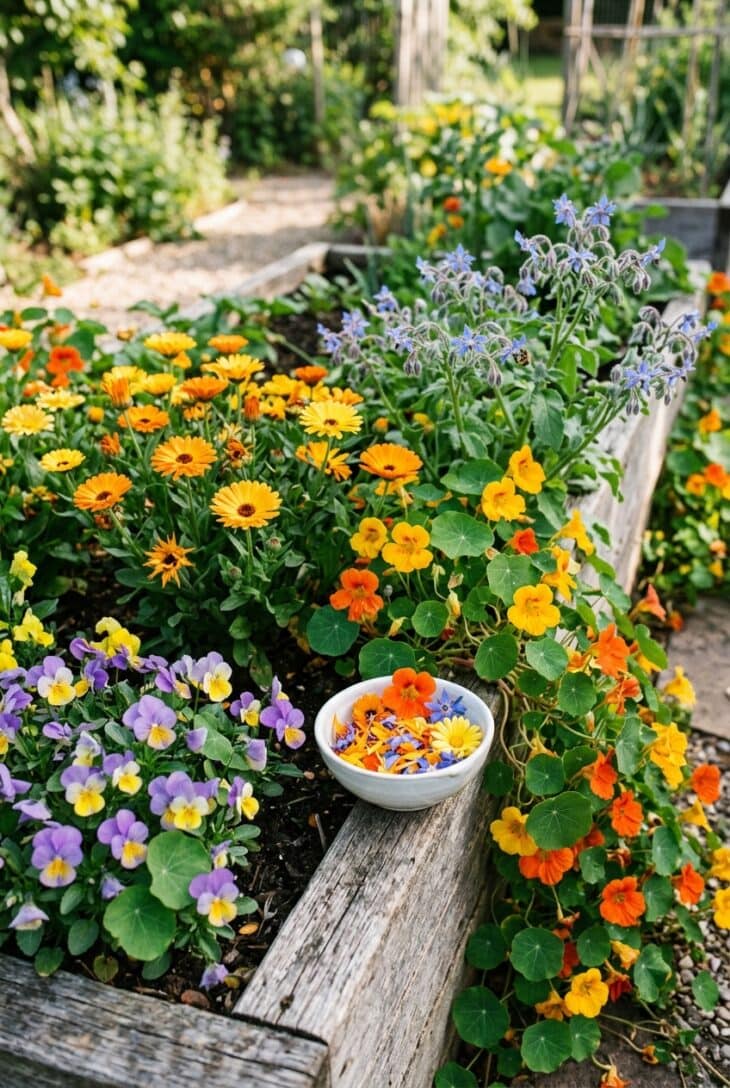
What you see A sunny raised bed overflows with flowers meant for the plate: orange and yellow nasturtiums trail over the wooden edge, bright calendula stands in the middle, and purple and yellow pansies line the front. Blue star-shaped borage flowers rise near the back. A white bowl of picked petals and a few whole blossoms sits on the rim in soft morning light.
Why it works Edible flowers put taste into a garden that is already about color. UF/IFAS describes nasturtium flowers as peppery, borage flowers as cucumber-flavored and calendula petals as a slightly bitter substitute for saffron, with pansies a milder, grassy green. The rule that matters more than the flavor is to eat only what you grew and can name. This fits naturally into a kitchen garden where flowers and vegetables share beds.
How to get it UF/IFAS advises growing edible flowers from seed, and Nebraska and Alaska Extension both say never to eat flowers from a florist, nursery or garden center, because they may carry pesticides not labeled for food. Sow nasturtium (Tropaeolum majus) once frost has passed, and plant pansies (Viola × wittrockiana) in fall or early spring, since NC State lists them as cool-weather bedding plants. Eat only calendula petals, and use borage sparingly: NC State warns it contains pyrrolizidine alkaloids that can damage the liver. Remove stamens before eating, try one flower type at a time if you have allergies, and skip the flowers entirely if you have asthma or hay fever, as UC Extension advises. Never mix them with toxic flowers: sweet pea and nicotiana are among the poisonous ones.
11. Moss and Fern Shade Corner

What you see A damp, shady corner under a tall tree is carpeted in bright green moss, with flat stepping stones set into it. Maidenhair ferns lift fine, rounded fronds on dark stems, silver-and-burgundy painted ferns sit nearby, and mounds of Japanese forest grass arch over a low stone edge. Dappled light slips through the leaves and a few water droplets sit on the moss.
Why it works This is the quietest idea in the collection, and the one most about touch. Moss, fern fronds and the soft arching blades of forest grass all feel like nothing else in the garden, and none of them asks for sun. It also makes use of the spot most gardeners write off, the dry dark corner under a tree. It builds on the same principle as these shade garden ideas, with texture doing the work flowers cannot do in shade.
How to get it Moss grows best on firm, bare, acidic soil, and University of Vermont Extension gives pH 5.0 to 5.5 for the mosses of dense shade. Lightly rough up the compacted soil, press moss pieces into it, firm them down, keep the area moist until it takes hold, and limit traffic for a year. Skip fertilizer, which Vermont and Arkansas Extension say moss does not need, and skip lime, which NC State’s Henderson County center says to avoid. Use stepping stones, because Brooklyn Botanic Garden says most ground-growing mosses tolerate only occasional foot traffic. Maidenhair fern (Adiantum pedatum) is hardy in Zones 3–8 and wants moist, humus-rich, acidic soil in part to full shade. Japanese painted fern (Athyrium niponicum) grows in Zones 4–9 and shows its best color in light shade, and Japanese forest grass (Hakonechloa macra) grows in Zones 5–9 as arching mounds 1 to 1.5ft (30 to 45cm) tall that die back in winter.
12. Bee Hum Bed with Anise Hyssop and Bee Balm
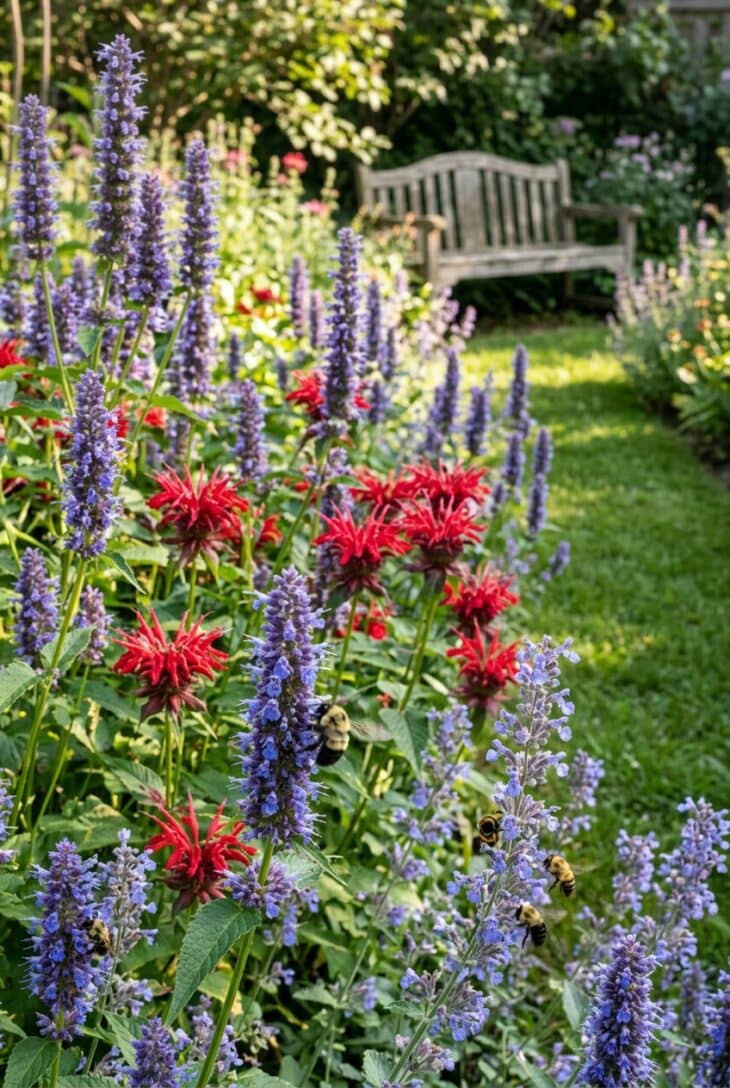
What you see Tall purple-blue anise hyssop spikes, scarlet bee balm and soft blue catmint fill a sunny bed, and bumblebees and honeybees crowd the flowers at eye level. A wooden bench sits a few steps back across a strip of mown grass. Warm July light picks out the fuzz on the bees and a blur of wing movement.
Why it works Sound does not have to be loud to count: a bed this busy hums. Anise hyssop is also scented, since NC State describes its foliage as fragrant, so you get scent, color and sound in one planting. The bench is placed a few steps away on purpose. University of California’s IPM program says bees and wasps are not likely to sting when gathering nectar and pollen, though they will defend if provoked. For a bigger version of this idea, see these pollinator garden ideas.
How to get it Anise hyssop (Agastache foeniculum) is hardy in Zones 4–8, grows 2 to 5ft (60 to 150cm) tall depending on the source, and Missouri Botanical Garden calls it attractive to bees, hummingbirds and butterflies. Bee balm (Monarda didyma) is hardy in Zones 4–9 and blooms for about 8 weeks, but powdery mildew can be serious in crowded plantings, so leave space for airflow. Catmint (Nepeta × faassenii ‘Walker’s Low’) grows in Zones 4–8 and draws pollinators, and the catmint profile covers its close relatives. Keep the seating a step or two from the flowers, skip perfume or scented soap when you sit there, and avoid going barefoot near blooming ground covers, as UC IPM advises. If anyone in the household has a bee allergy, choose a different idea for the spot closest to the door.
13. Evening Scent Patio
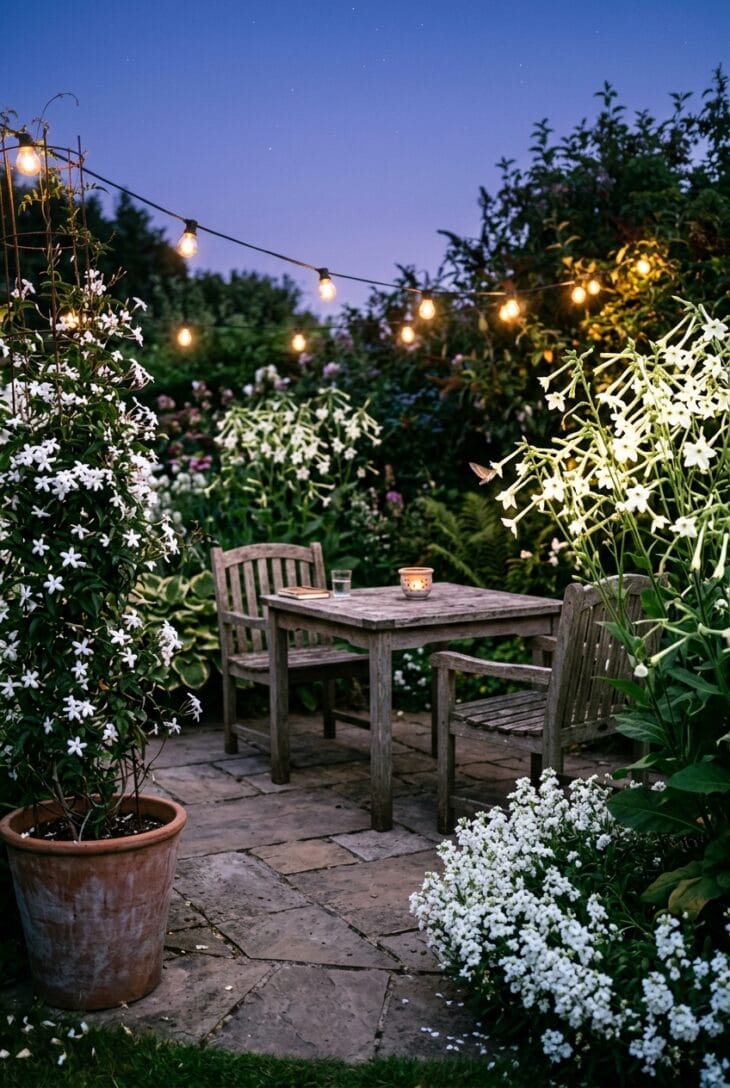
What you see A small stone patio at dusk holds a weathered table and two chairs. Tall white flowering tobacco with long tubular blooms glows in the fading light, a pot of white jasmine climbs a wire trellis, and a low drift of night-scented stock fills the edge. A moth hovers at one flower under a deep blue-violet sky and a string of warm bulbs.
Why it works Many people use the patio in the evening, which is exactly when these flowers release scent. A plant that smells strongest after dark rewards the hours you are actually outside. It pairs well with the pale flowers of a moon garden, and with the seating and lighting ideas in these patio garden ideas.
How to get it Check the label: Missouri Botanical Garden says the species Nicotiana alata has fragrant, night-opening flowers, but the compact bedding hybrids sold in most nurseries are mostly unscented and open by day. It is hardy only in Zones 10 to 11, so grow it as an annual, and its blooms fade in heat. Tobacco plants are listed as toxic by the ASPCA and should not be eaten, and Missouri Botanical Garden advises keeping it away from tomatoes and peppers, which share its virus problems. Common jasmine (Jasminum officinale) is hardy in Zones 7 to 10, needs to come indoors for winter farther north, and is listed as non-toxic to dogs, cats and horses by the ASPCA. For night-scented stock (Matthiola longipetala), UF/IFAS notes it is a plain annual that adds fragrance to the landscape at night, so tuck it in at the patio edge.
14. Sweet Pea Fence
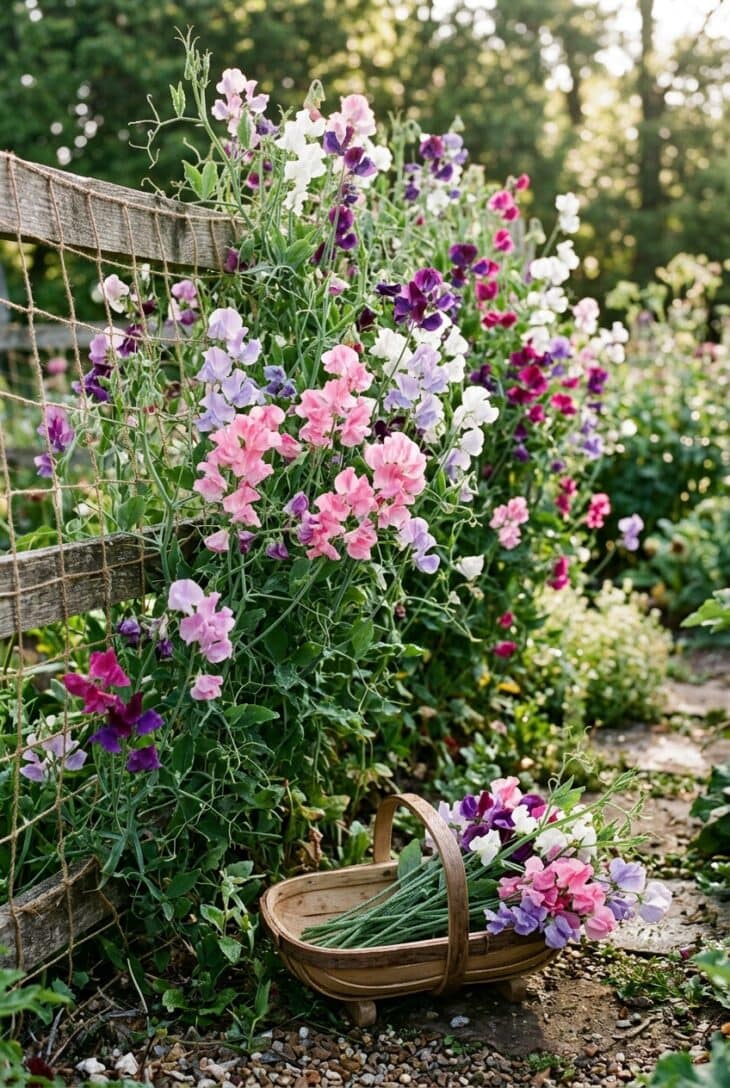
What you see A garden fence disappears under a curtain of ruffled sweet pea flowers in pink, lavender, white and deep purple. Green tendrils climb a taut net fixed to the boards, and dew sits on the petals. A small basket of freshly cut stems rests on the ground below. Soft morning light fills the whole scene.
Why it works Sweet peas earn their place in a sensory garden on scent alone, and a fence puts the fragrance at nose height. They are a cool-season annual, so the show comes in spring while other beds are still empty. They are also grown for cutting, as in these cut flower garden ideas, though cut stems should stay away from small children, for the reason below.
How to get it Sweet pea (Lathyrus odoratus) climbs to 6 to 8ft (180 to 240cm) with a net, string or trellis, and Missouri Botanical Garden says it does best in cool soil and cool summers and declines quickly in hot, humid ones. In mild-winter areas sow in fall for winter and spring bloom, and elsewhere start seeds indoors 6 to 8 weeks before your last frost. Deadhead to keep flowers coming. NC State lists ‘Mars’ as highly fragrant and ‘Old Spice’ as heat tolerant. Sweet pea fruits are inedible and poisonous to humans, according to both Missouri Botanical Garden and NC State, and Alaska and UC Extension both say not to eat the flowers.
15. Berry Snacking Path
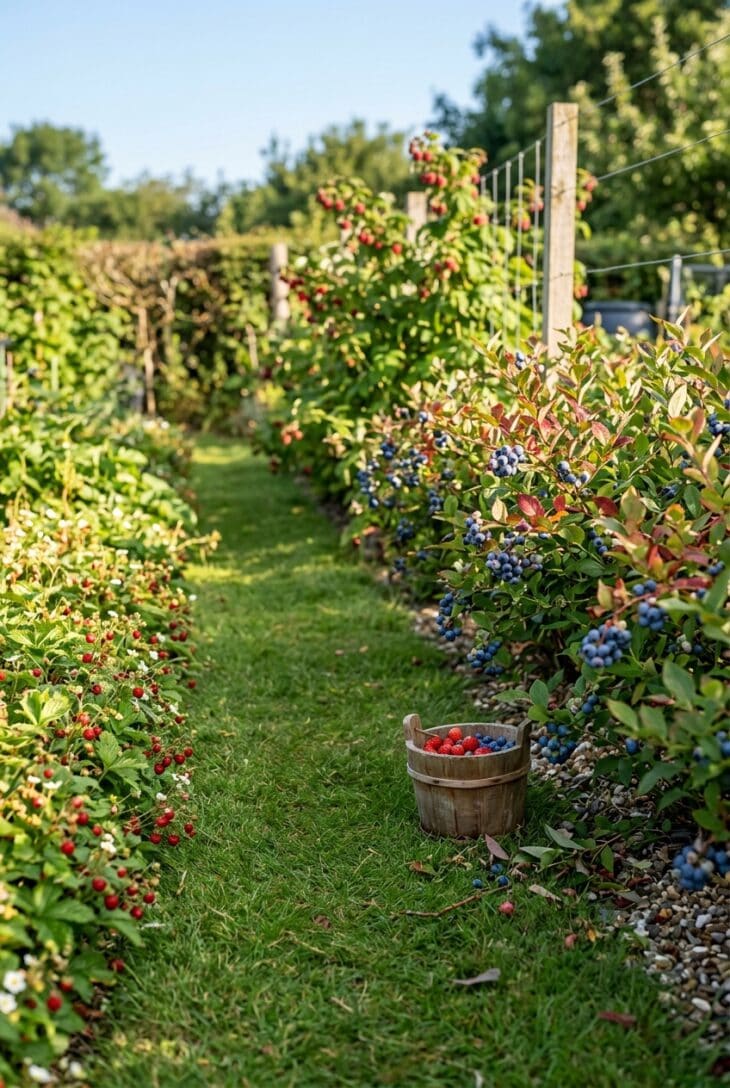
What you see A narrow grass path runs through a sunny yard, edged on one side with low alpine strawberries bearing tiny red berries and white flowers. On the other side, blueberry bushes hang heavy with ripe fruit. A small wooden bucket half full of berries sits at the path edge, and raspberry canes climb a wire support at the far end in warm morning light.
Why it works This is the taste idea that needs no instruction: a path where the fruit is at hand height, ripening in sequence, and every visitor eats as they walk. Alpine strawberry is the same species as wild strawberries (Fragaria vesca), and it edges a path well. Strawberries sit at ankle height, blueberries at waist height and raspberries higher, so there is fruit within reach of every age.
How to get it Alpine strawberry is hardy in Zones 5–9, 4 to 8in (10 to 20cm) tall, and takes sun to part shade, but Missouri Botanical Garden says the species spreads indefinitely by runners, so choose a runnerless cultivar such as ‘Alexandra’ for edging. Blueberries need acidic soil, around pH 4.5 to 5.5 (Mississippi State Extension), and Missouri Botanical Garden says highbush types (Vaccinium corymbosum, Zones 5–8) crop better when two varieties bloom together. Remove the flowers in the first two years, and expect to net the bushes, since birds love the fruit. Among raspberries, Penn State lists ‘Heritage’ as the standard fall-bearing variety, and ‘Nova’ and ‘Encore’ as nearly thornless summer-bearing types.
16. Barefoot Texture Path
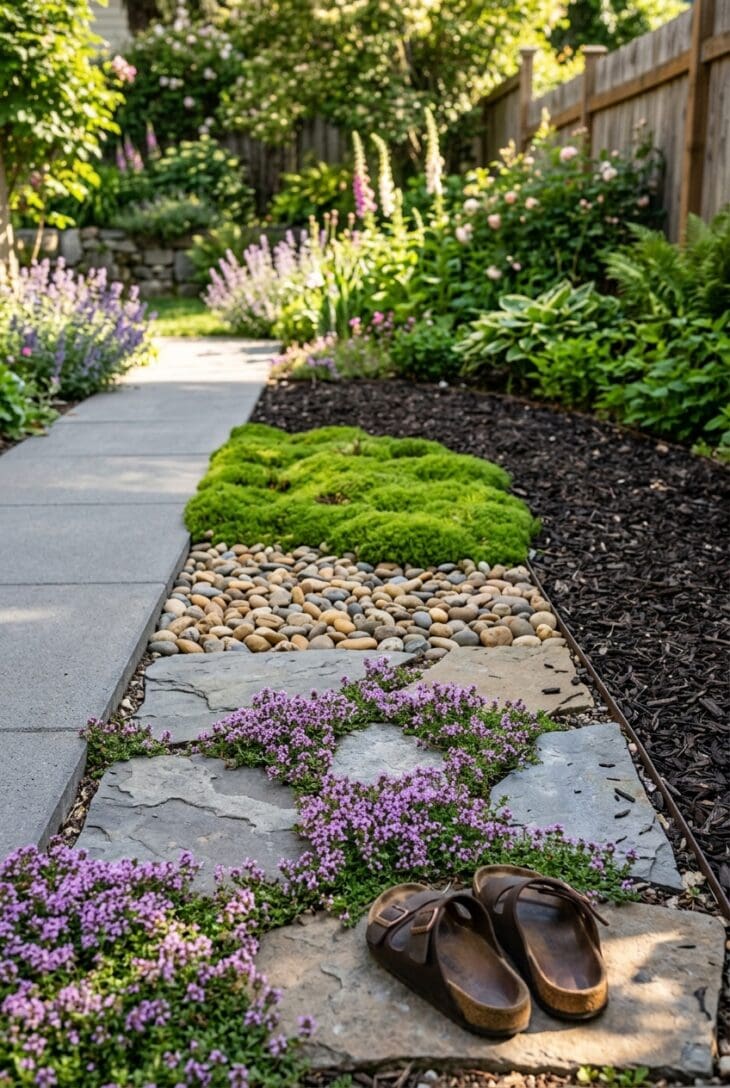
What you see A garden path changes surface every few steps: flat gray flagstones with creeping thyme between them, then a strip of smooth river pebbles, a soft green mat of Irish moss and a bed of fine shredded bark. A smooth paver walkway runs alongside the whole route. A pair of plain sandals waits at the start in warm early-summer light.
Why it works University of Illinois Extension notes that pathways of sand, woodchips, flagstone or flat stepping stones create distinct tactile and sound experiences, and that gravel adds crunch underfoot. Switching surfaces every few feet makes you notice each one. The paver strip alongside keeps the garden open to wheels and walkers, since Penn State Extension advises path surfaces that are firm and smooth. You can see more path layouts in these garden path ideas.
How to get it Creeping thyme (Thymus serpyllum) is hardy in Zones 4–9 and, per NC State, fills the crevices of stepping stones. Irish moss (Sagina subulata) is hardy in Zones 4–8 and tolerates moderate foot traffic, but it dislikes intense heat and drought, and overwatering can be a problem. Flowering ground covers draw bees, and University of California’s IPM program advises against going barefoot in vegetation, especially clover and blooming ground covers, so watch your step while thyme is in bloom from June to September. Seattle’s accessible-garden guide says gravel on a wheelchair route should be angular, not round, so keep any pebble section off the smooth route. Feel each material by hand first, since sharp stone or splintery bark is a poor surprise underfoot.
17. Songbird Corner with Serviceberry and a Birdbath
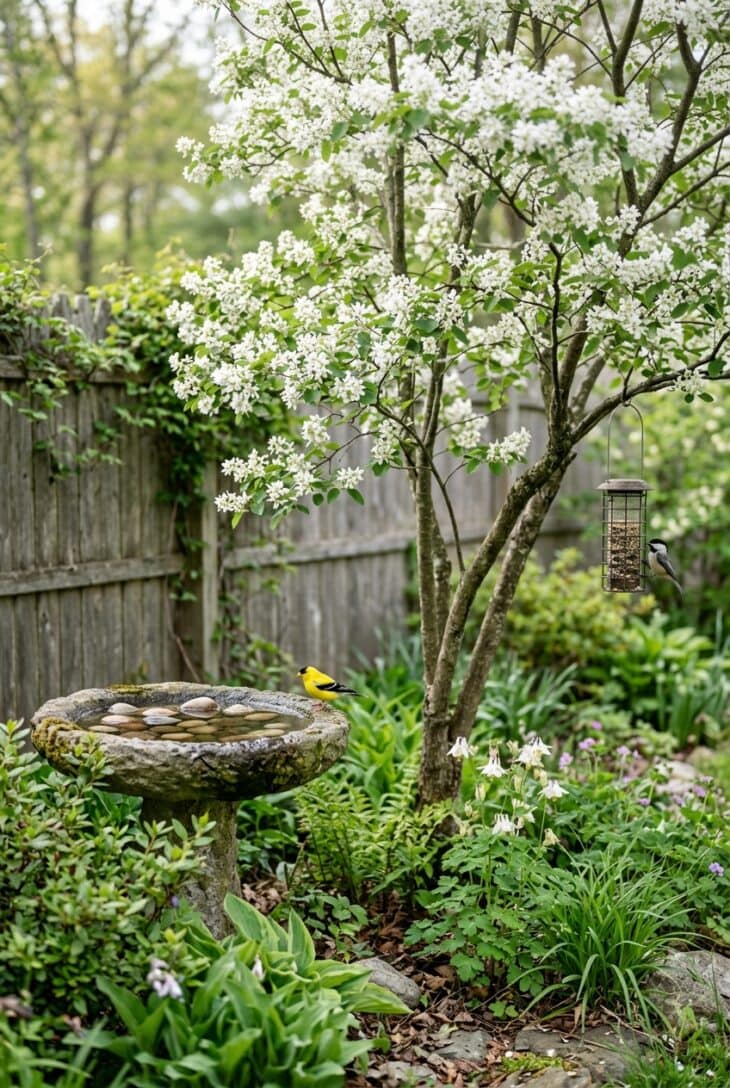
What you see A multi-stemmed serviceberry in full white bloom shades a corner of the yard on a spring morning. Below it, a shallow stone birdbath with a few pebbles in the water has a goldfinch on its rim, and a chickadee clings to a hanging seed feeder. Native shrubs fill the foreground in soft early light.
Why it works Birdsong is the one garden sound you cannot buy, and it arrives when you give birds food, water and cover. Iowa State Extension says serviceberry fruit is devoured by birds and wildlife in summer, and Audubon reports it may take 6,000 to 9,000 caterpillars in a season to raise a brood of five chickadees, and that native plants hold far more caterpillars than most introduced ones. Placing a bath near evergreens or shrubs gives birds somewhere to retreat. This idea works well alongside the wider wildlife garden ideas.
How to get it Allegheny serviceberry (Amelanchier laevis) is hardy in Zones 4–8, grows 15 to 25ft (450 to 750cm) as a multi-trunked tree, flowers in spring and ripens purple edible berries in June, per NC State. Audubon says to keep birdbath water about 1 to 1.5in (2.5 to 4cm) deep with pebbles to help birds judge depth, to refill every other day, and to scrub with a mix of 9 parts water to 1 part vinegar. Project FeederWatch advises marking windows with dots spaced no more than 2in (5cm) apart, and the American Bird Conservancy recommends keeping cats indoors, estimating they kill 2.4 billion birds a year in the US. Audubon also recommends cleaning feeders about every two weeks.
18. Lilac Hedge for a Spring Scent Screen
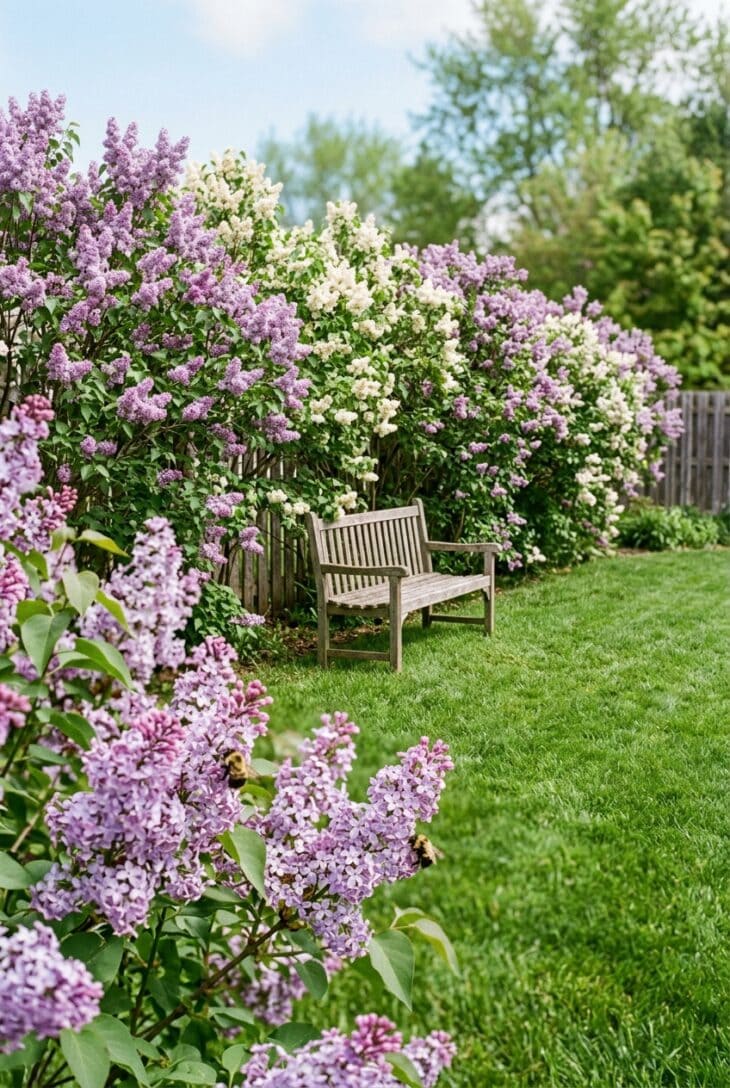
What you see A row of tall lilacs forms a loose hedge along the back of a yard in mid-May, every shrub carrying large cone-shaped clusters of lavender-purple and white flowers. A plain wooden bench sits in the middle of the row, with clipped lawn in front. Bees work the nearest blooms in hazy morning light.
Why it works Lilac is one of the strongest memory scents in the garden: University of Illinois Extension notes that scent can trigger memories of special places or people, and Penn State Extension names lilacs among the familiar plants that can call up positive memories. A hedge puts that scent along a whole boundary and doubles as screening. If privacy is your reason for planting, this pairs well with the options in these garden privacy ideas.
How to get it Common lilac (Syringa vulgaris) grows in Zones 3–7, reaches 8 to 16ft (240 to 500cm) tall and 6 to 12ft (180 to 360cm) wide, and needs a long winter chill, so Missouri Botanical Garden does not recommend it for hot, humid Zone 8 and above. Prune right after flowering, since the flower buds form the summer before and later pruning removes them, and Penn State suggests removing about a third of the oldest stems each year. Powdery mildew frequently attacks in summer, so give the shrubs airflow. Remove root suckers promptly. ‘Bloomerang Dark Purple’ reblooms and is rated Zones 3–7 by Missouri Botanical Garden and Proven Winners, at 4 to 6ft (120 to 180cm) tall, and Missouri Botanical Garden says not to prune it from fall until its spring bloom.
19. Rain Chain into a Gravel Basin
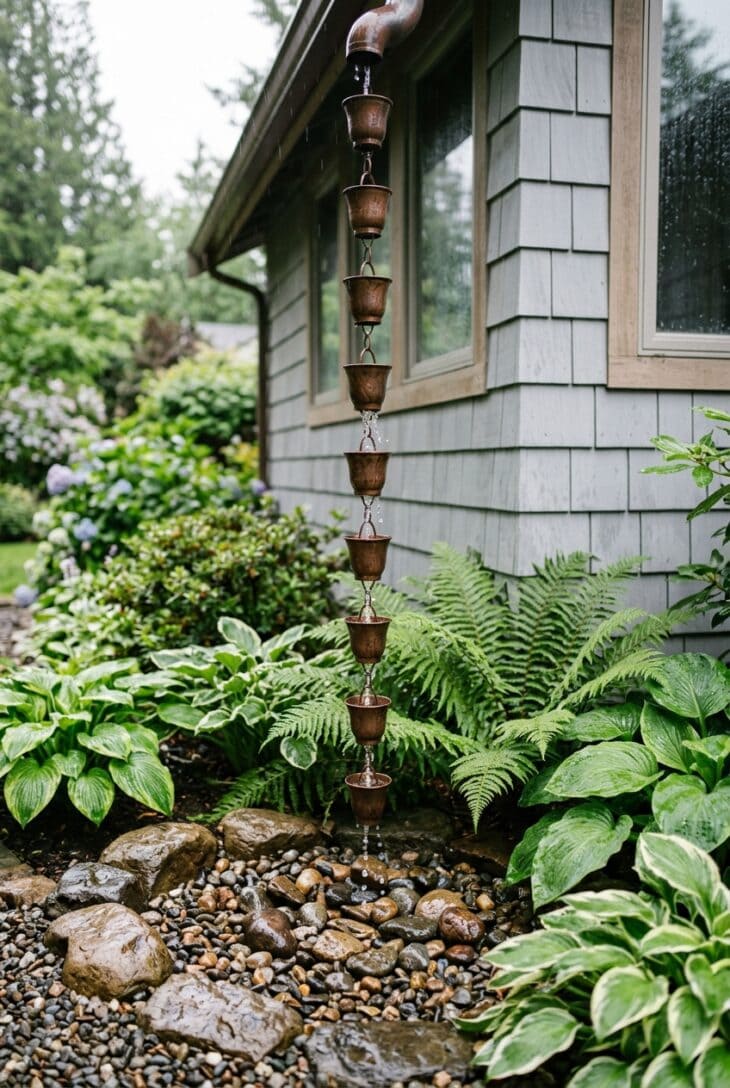
What you see A copper cup-style rain chain hangs from the corner of a gutter during a gentle spring rain, with water spilling from cup to cup. It lands in a shallow bed of river rocks and gravel edged with larger stones. Ferns and hostas line the edge, their wet leaves shining against soft gray siding.
Why it works A rain chain turns a downspout into something you can hear: water rings and trickles down the cups, and only during rain. According to This Old House, rain chains work through surface tension, and cup styles handle heavier rain better than link styles. The same article cautions that a plain downspout almost always has the higher capacity, so treat a rain chain as a feature, not a replacement for good drainage. Where the water ends up matters as much as the sound, and a rain garden is one way to use it.
How to get it University of Maryland Extension says downspout water should be sent at least 5ft (150cm) from a home with a crawlspace or 10ft (300cm) from one with a basement, onto ground that slopes no more than 5%, with a splash pad or loose rocks to slow it. Dig the basin as a buried pit of gravel and river rock, not a closed bowl, because LSU AgCenter says standing water can start producing mosquitoes within 3 to 5 days. Hanging a chain at the gutter means a ladder, so have a helper hold it, or hire a pro if the roof is high. A chain carries less than a downspout, so watch the gutter in a heavy storm for overflow, and check for clogs each fall.
20. Seedpod Rattle Bed
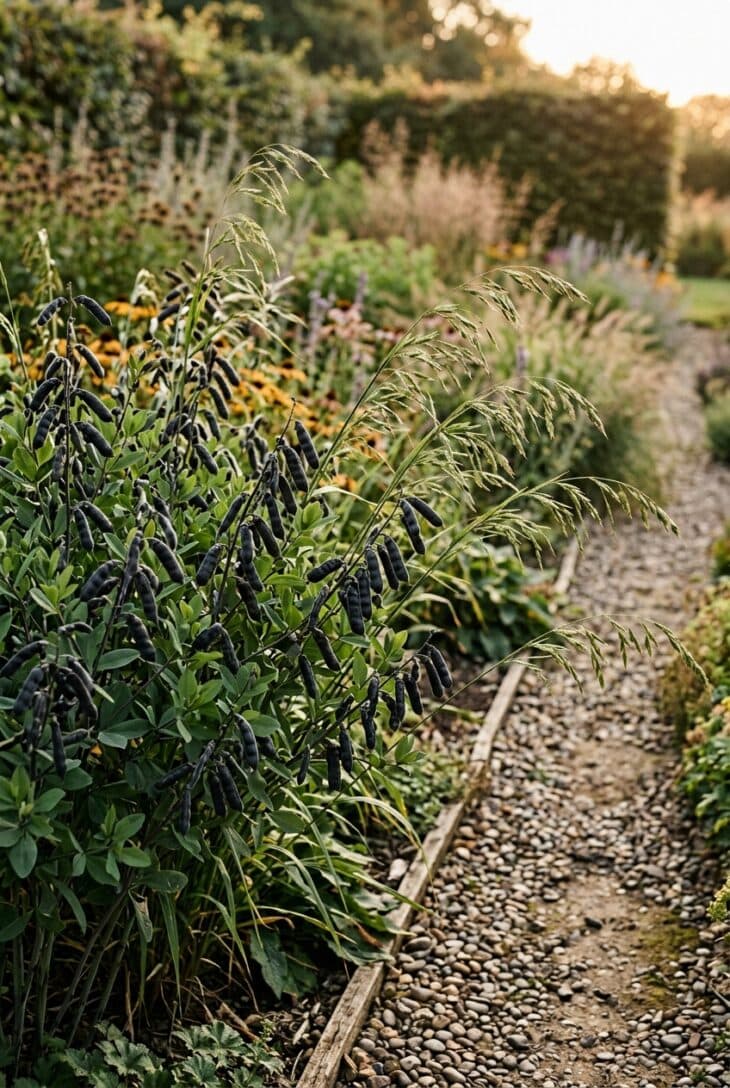
What you see Tall clumps of blue false indigo stand along a gravel path in late summer, their stems hung with inflated charcoal-black pods about 2in long. Beside them, northern sea oats carry flat, nodding seed heads in green and bronze that sway in a light breeze. Warm late-afternoon light picks out the glossy pods.
Why it works This is a sound that arrives late, when most flowers are finished: ripe false indigo pods hold loose seeds that rattle when the stems move. University of Illinois Extension lists false indigo among the plants for sound, and Missouri Botanical Garden notes the pods were once used as children’s rattles. Because it earns attention in late summer, after most perennials have faded, it fits well with the long-season thinking behind these perennial garden ideas.
How to get it Blue false indigo (Baptisia australis) is hardy in Zones 3–9 and grows 3 to 4ft (90 to 120cm) tall and wide in full sun to part shade, with pods up to 2.5in (6cm) long, per Missouri Botanical Garden. Do not shear it after bloom, because that removes the pods, and do not disturb it once planted, since it takes several years to establish from seed. NC State says all parts are poisonous if eaten, with low toxicity unless eaten in quantity, so tell children the pods are for shaking, not for eating. Northern sea oats (Chasmanthium latifolium) are hardy in Zones 3–8 and their seed heads flutter in the lightest breeze, but Missouri Botanical Garden says they self-seed and may spread aggressively, so use them only where that is welcome.
21. Scented Geranium Pots by the Door
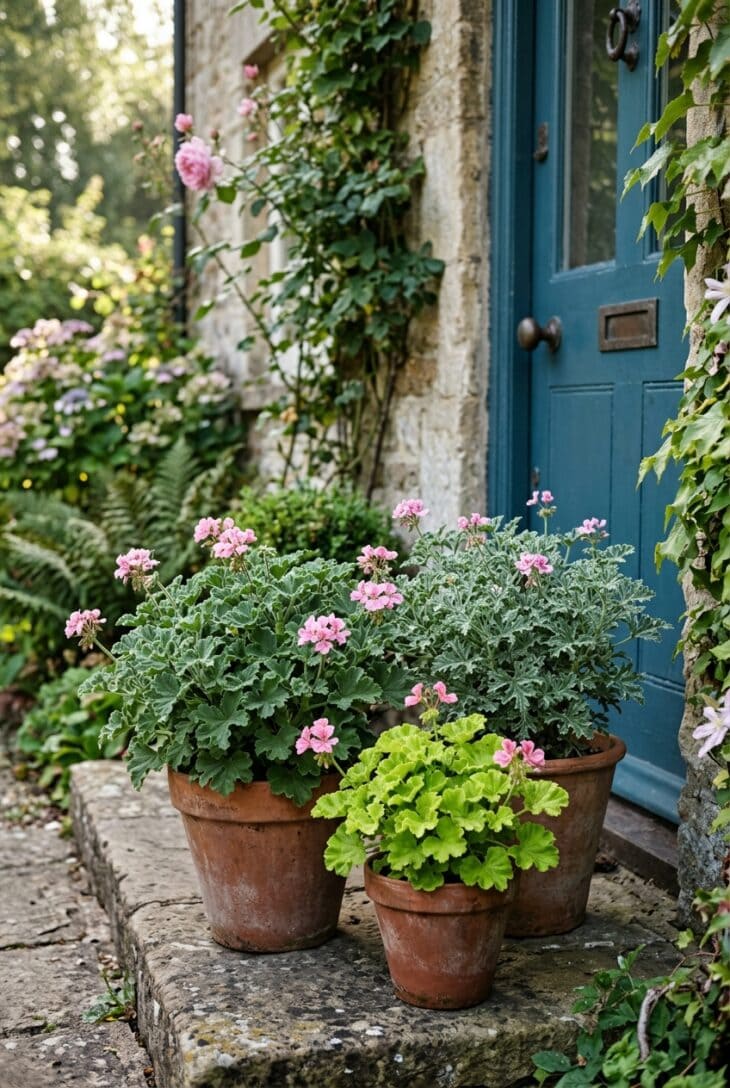
What you see Three terracotta pots of different sizes cluster beside a painted front door on a stone step. Each holds a bushy scented geranium with deeply lobed gray-green leaves and small pink flowers, and one has ruffled lime-green foliage. The leaves glisten slightly in soft morning light, and every plant sits at hand height.
Why it works Scented geraniums are the textbook rub-and-sniff plant: University of Illinois Extension notes that some plants, geraniums among them, release their scent only when rubbed or crushed. By the door, every visitor brushes one on the way in. Pots also keep the plants where you can bring them in for winter. If you like this approach, there are many more ways to use pots in these container garden ideas.
How to get it Rose-scented geranium (Pelargonium graveolens) grows 1 to 2ft (30 to 60cm) tall and wide, wants full sun and well-drained soil, and in containers can dry out between waterings, per NC State. It is a tender perennial, and Illinois Extension says it will not overwinter outdoors in cold climates: cut large plants back and bring them indoors to a bright spot before frost. Use a pot with drainage holes. The ASPCA lists scented geraniums as toxic to dogs and cats, mainly causing stomach upset, with cats the most sensitive, so skip this idea if a pet chews plants, or put the pots out of reach.
22. Sunflower House and Bean Teepee for Kids
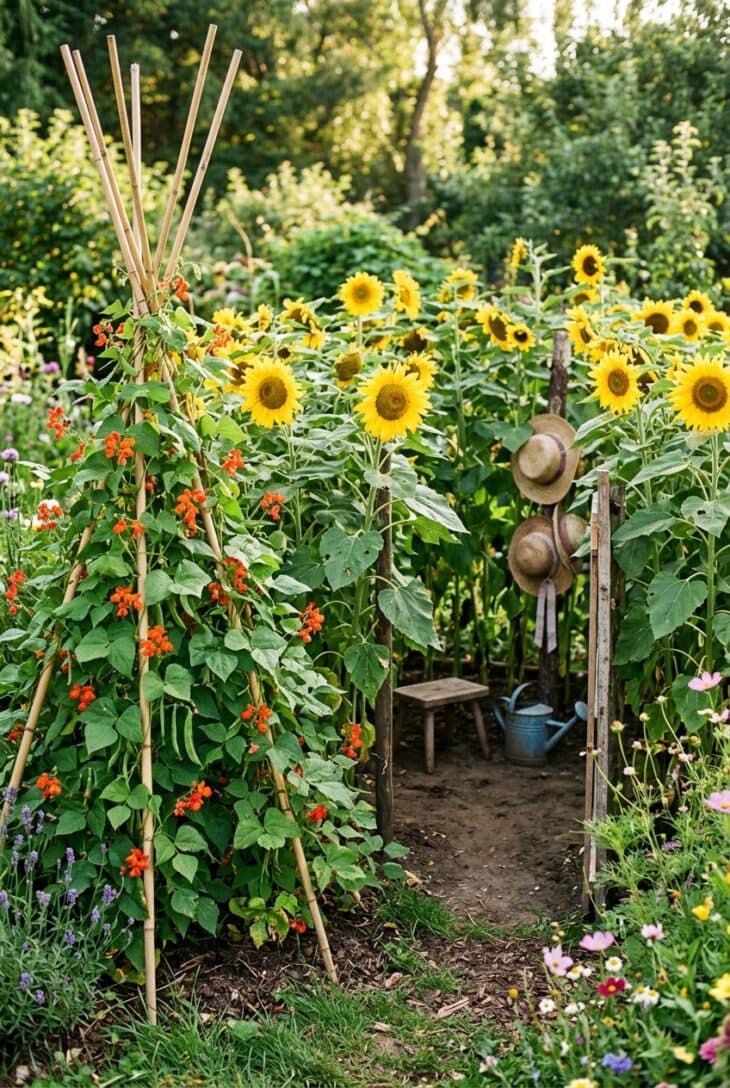
What you see A small square house made of tall sunflowers stands about 7ft high in midsummer, with a gap left for a doorway. Beside it, a teepee of tall poles is covered in scarlet runner beans carrying bright orange-red flowers and green pods. Inside the sunflower walls are a small stool and a watering can, and bees are working the flowers in warm afternoon sun.
Why it works Kids experience a garden by being inside it, and this idea gives them walls to walk through. University of Illinois Extension lists a sunflower fort and a bean teepee among the hide-away ideas for kids. It is cheap, grows in one season and uses the vertical growth that makes vertical gardens work. It also teaches timing, because both plants wait for frost to pass.
How to get it KidsGardening suggests starting with a 4ft by 4ft (120cm by 120cm) sunflower square and clearing a 6 to 12in (15 to 30cm) planting strip along the outline. Choose branching types such as ‘Autumn Beauty’, which Oregon State lists at 5 to 8ft (150 to 240cm), and sow after the last frost once soil reaches 50°F (10°C), about 18 to 24in (45 to 60cm) apart. For the teepee, Iowa State advises supports 6 to 7ft (180 to 215cm) tall, with seeds 1 to 1.5in (2.5 to 4cm) deep, about 3in (8cm) apart and thinned to 4 to 6in (10 to 15cm). Runner beans (Phaseolus coccineus) are frost-tender vines to 8 to 12ft (240 to 365cm), and NC State and Germany’s BfR both say raw or undercooked beans are poisonous, so cook every bean before anyone eats it.
23. Looped Path Garden for Familiar Scents
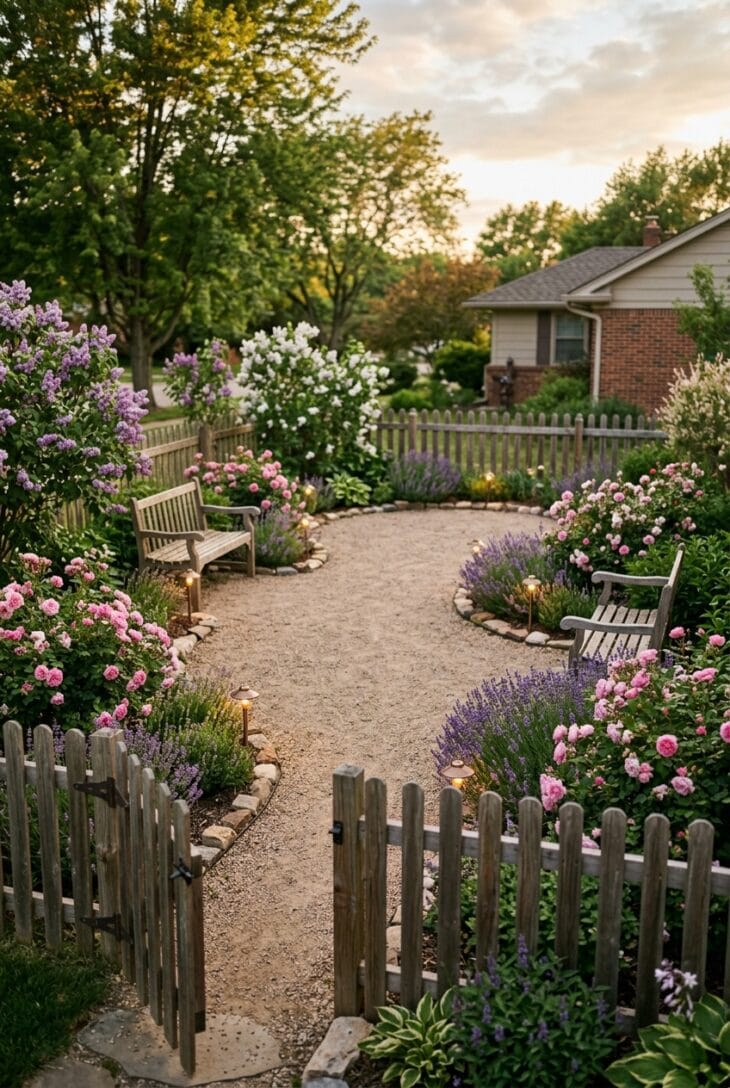
What you see A small fenced garden holds a smooth, wide path that loops back on itself like a figure eight, entered through a single gate. Lilacs, pink roses without thorns and lavender edge the route, and two wooden benches with arms sit at the bends. Low lamps along the path edge glow gently in warm late-afternoon light, and a low wooden fence surrounds it all.
Why it works Gardens designed for people living with dementia or Alzheimer’s often use looped paths. The American Society of Landscape Architects describes circular or figure-eight paths with a single entrance, which promote walking while limiting risk of wandering, and West Virginia University says looping removes dead ends, which can confuse people with cognitive disabilities. Familiar plants help too: Penn State Extension names old-fashioned hollyhocks and lilacs as the kind of plants that can bring back positive memories. This is a design approach, not medical care, so involve the person’s care team in the plan.
How to get it Keep the path firm, smooth and level, as Penn State and University of Florida IFAS both advise, and add chairs with arms at the bends for rest stops. Penn State says to avoid thorny and toxic plants, so choose lilac, a prickle-free rose such as ‘Zephirine Drouhin’ and herbs, and check every plant against a toxicity list. West Virginia University and the Alzheimer’s Association both recommend a fence or hedge around the space to keep a person from wandering off, without anyone feeling confined. Alzheimer’s Association guidance also says to keep walkways well lit and avoid sudden changes in light, which these garden lighting ideas can help with. For the boundary, see these garden fence ideas.
24. Fragrant Planting Beside an Open Window
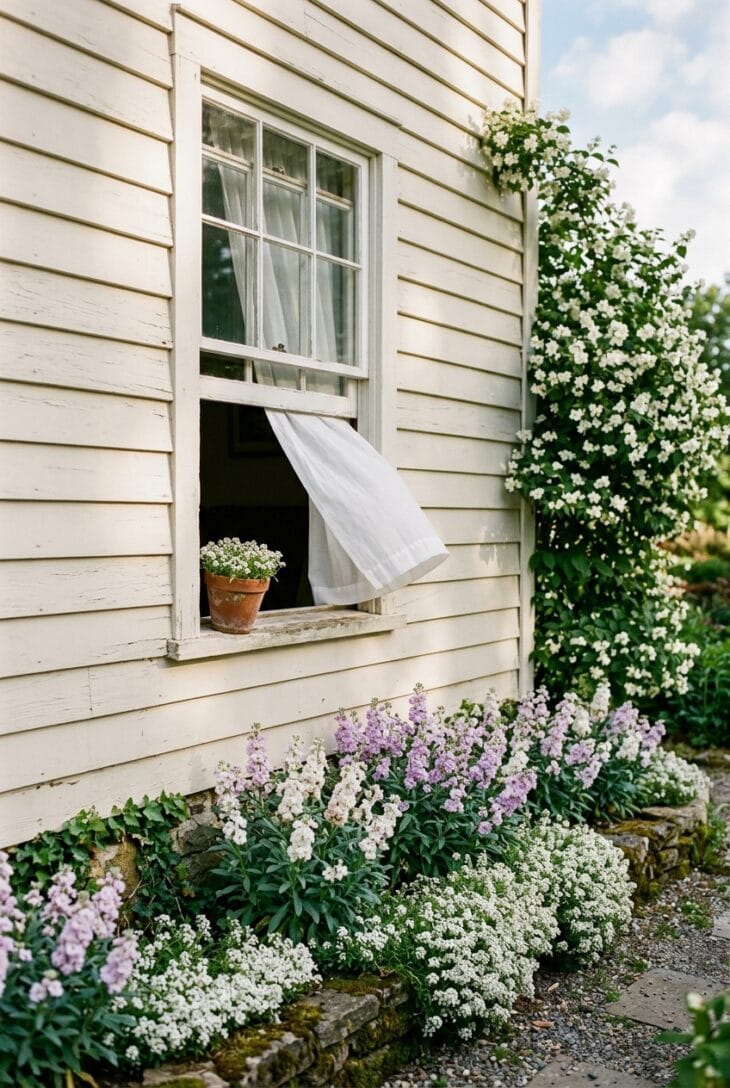
What you see A double-hung window stands open on a late-spring morning, its white curtain stirring. Below it, a low bed of white sweet alyssum edges the foundation beside stock in pale lilac and white. At the house corner, a tall mock orange shrub is covered in four-petaled white flowers, and a small pot of alyssum rests on the sill.
Why it works This idea puts scent where a breeze can carry it into the house. Alyssum stays low and stock reaches only about 3ft, so neither blocks the view, and the shrub sits at the corner, not under the glass. NC State suggests siting mock orange near a patio to enjoy its fragrance, especially in the evening. On a balcony, the same alyssum and stock work in a railing planter, as in these balcony garden ideas.
How to get it Sweet alyssum (Lobularia maritima) is hardy in Zones 5–9, 3 to 10in (8 to 25cm) tall, and blooms with fragrant white flowers from spring to first frost where summers are cool, though NC State says blooms decline in hot summers. Stock (Matthiola incana) is hardy in Zones 6–10, grows 1 to 3ft (30 to 90cm) tall, and has a clove-like fragrance, and NC State suggests sowing in several two-week intervals to prolong bloom. Mock orange (Philadelphus coronarius) is hardy in Zones 4–8 but grows 10 to 12ft (300 to 360cm) tall and 8 to 10ft (240 to 300cm) wide, and NC State calls it unremarkable outside bloom time, so plan the rest of the year around it. Keep it a few feet from the wall.
25. Cool Blue Border for a Calm Corner
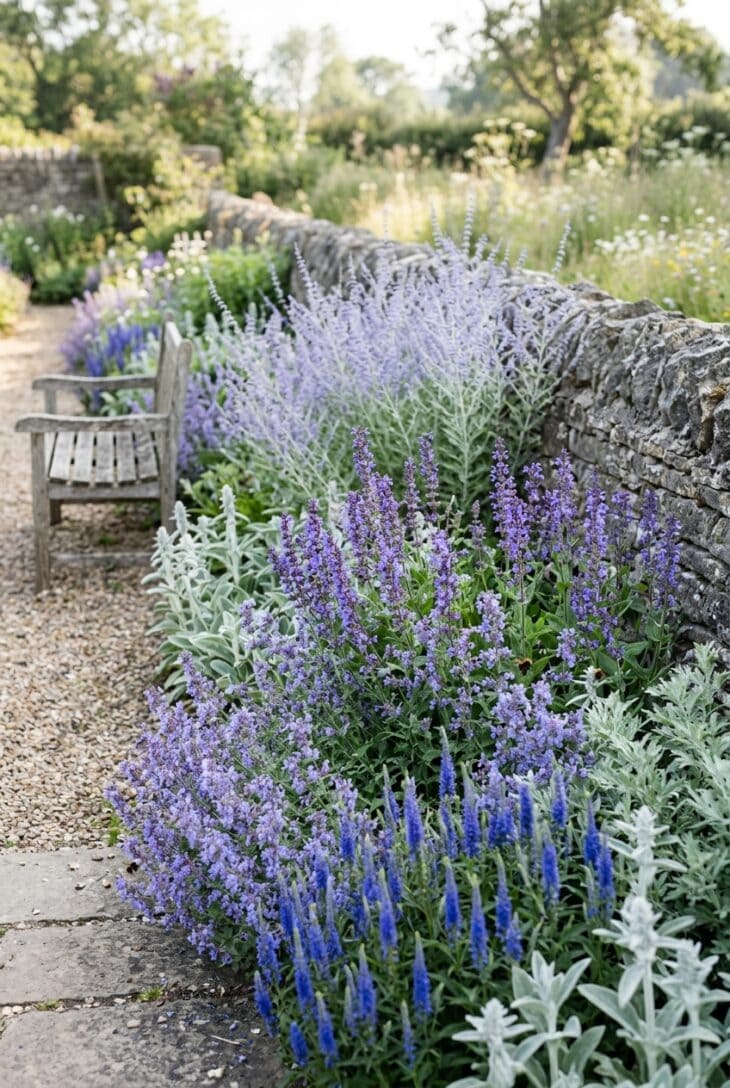
What you see A sunny border runs along a low gray stone wall in late June, planted only in blues and silver. Violet-blue wood sage spikes stand beside soft lavender-blue catmint, with airy silver-blue Russian sage plumes behind and blue speedwell spires in front. Silver-green foliage ties it together, and a simple wooden chair sits at one end in soft morning light.
Why it works After a run of ideas built on scent and sound, this one is for the eyes alone, and it is deliberately quiet. Limiting the palette to blue, violet and silver lets form and texture do the work, and the repeated spiky shapes read as one calm group. Catmint draws pollinators, so there is a little hum too. For more ways to plan a planting like this one, see these garden border ideas.
How to get it Wood sage (Salvia × sylvestris) is hardy in Zones 4–8, grows to about 2ft (60cm) tall, and NC State advises pruning it back after flowering. Catmint ‘Walker’s Low’ (Nepeta × faassenii) is hardy in Zones 4–8, and Missouri Botanical Garden says it grows 24 to 30in (60 to 75cm) tall, so it is not truly low. Russian sage (Perovskia atriplicifolia) is hardy in Zones 5–9, grows 2 to 4ft (60 to 120cm) tall, and wants full sun and well-drained soil. Speedwell (Veronica spicata) is hardy in Zones 3–8 and, per NC State, can be sheared after bloom for repeat flowers in fall. All four like full sun and well-drained soil, so they share a bed easily.