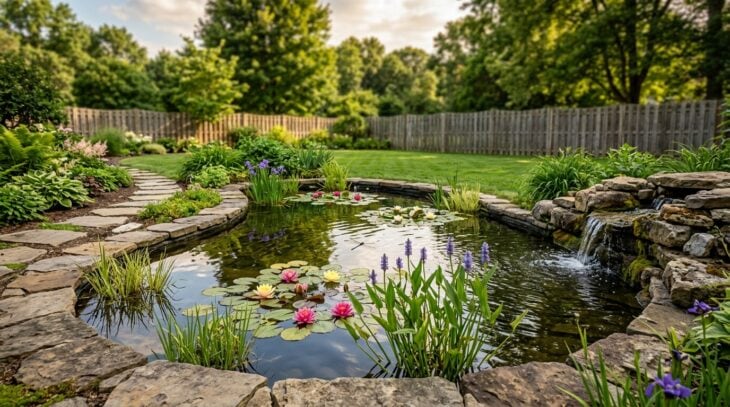
The sound of moving water and the sight of a lily opening on still water do something to a yard that no flower bed can. Water brings dragonflies, frogs and birds, and it turns a corner you walk past into one you stop at. It also puts plenty of gardeners off, because ponds sound like pumps, algae and liability.
Contents
- 01. A Backyard Pond with Planting Shelves
- 02. A Whiskey Barrel Water Garden on the Patio
- 03. A Pondless Waterfall with a Hidden Reservoir
- 04. A Bubbling Urn in a Pebble Basin
- 05. A Pond Blanketed in Hardy Water Lilies
- 06. A Deep Koi Pond with Filtration
- 07. A Wildlife Pond for Frogs and Dragonflies
- 08. A Pitcher Plant Bog
- 09. A Recirculating Stream Down a Slope
- 10. A Boulder Waterfall Spilling into a Pond
- 11. A Japanese Bamboo Spout and Stone Basin
- 12. A Black-Bottom Reflecting Pool
- 13. A Wall Fountain in a Courtyard
- 14. A Tropical Pond with Canna, Papyrus and Palms
- 15. A Cottage Pond Edged with Iris and Foxglove
- 16. A Shady Woodland Pool with Ferns and Hostas
- 17. A Desert Oasis with a Recirculating Bubbler
- 18. A Cold-Climate Pond That Survives Winter
- 19. A Galvanized Stock Tank Pond
- 20. A Solar Fountain in a Birdbath
- 21. A Rain Chain Spilling into a Stone Basin
- 22. A Narrow Rill Beside the Patio
- 23. A Stepping-Stone Crossing and Seating Nook
- 24. A Lotus Tub for Midsummer Drama
- 25. A Pond Lit for the Evening
The ideas below run from a 15-gallon (57L) barrel on a patio to a deep koi pond, from a pondless waterfall with no open water at all to a pitcher plant bog that needs no pump. There are options for sun and shade, hard winters and desert summers, and budgets from a stock tank and a few plants to a full boulder waterfall.
Scroll for the ones that fit your space, or start with the pump-free and open-water-free options if small children use the yard. Whatever you choose, check local rules on pond depth and fencing, plug pumps into a GFCI-protected outlet, and call 811 before you dig.
01. A Backyard Pond with Planting Shelves
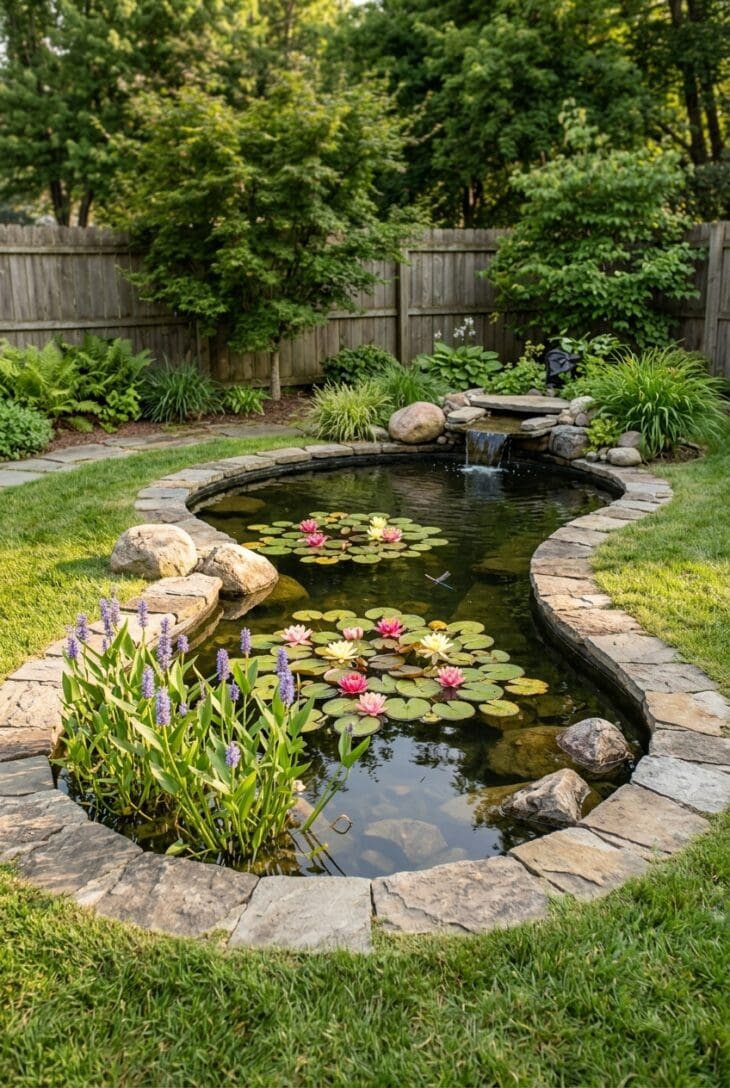
What you see A kidney-shaped pond sits low in the lawn, its edge laid with flat fieldstone and a few rounded boulders. Pink and yellow water lilies float on dark, clear water, and spikes of lavender-blue pickerel rush rise from a shallow shelf along the near bank. A thin spill from a hidden pump trickles in at the far end, and a dragonfly hangs over the surface in the late light.
Why it works Planting shelves are what make a pond look planted rather than merely dug. Each depth gets the plants that suit it: marginals in the shallows, lilies in the middle, open water in the deepest part. Leaves covering roughly half to two thirds of the surface shade the water and keep algae in check, which is the biggest maintenance saving a new pond can have. It is the template behind most backyard garden ideas that involve water.
How to get it Call 811 before you dig, then excavate a center about 24in (60cm) deep with a shelf 8 to 12in (20 to 30cm) deep and about 12in (30cm) wide around the edges. Check the rim is level with a long board and a spirit level, line the hole with underlay and a flexible EPDM pond liner, and hide the liner edge under stone. Set pickerel rush (Pontederia cordata, Zones 3–10), which grows in up to about 12in (30cm) of water, in perforated pots on the shelf. Put hardy water lilies (Nymphaea) in the deeper middle so their crowns sit 6 to 18in (15 to 45cm) under the surface, following each cultivar’s tag. Run the pump from a GFCI-protected outlet, and check local rules on pond depth and fencing before you dig, especially if children visit.
02. A Whiskey Barrel Water Garden on the Patio
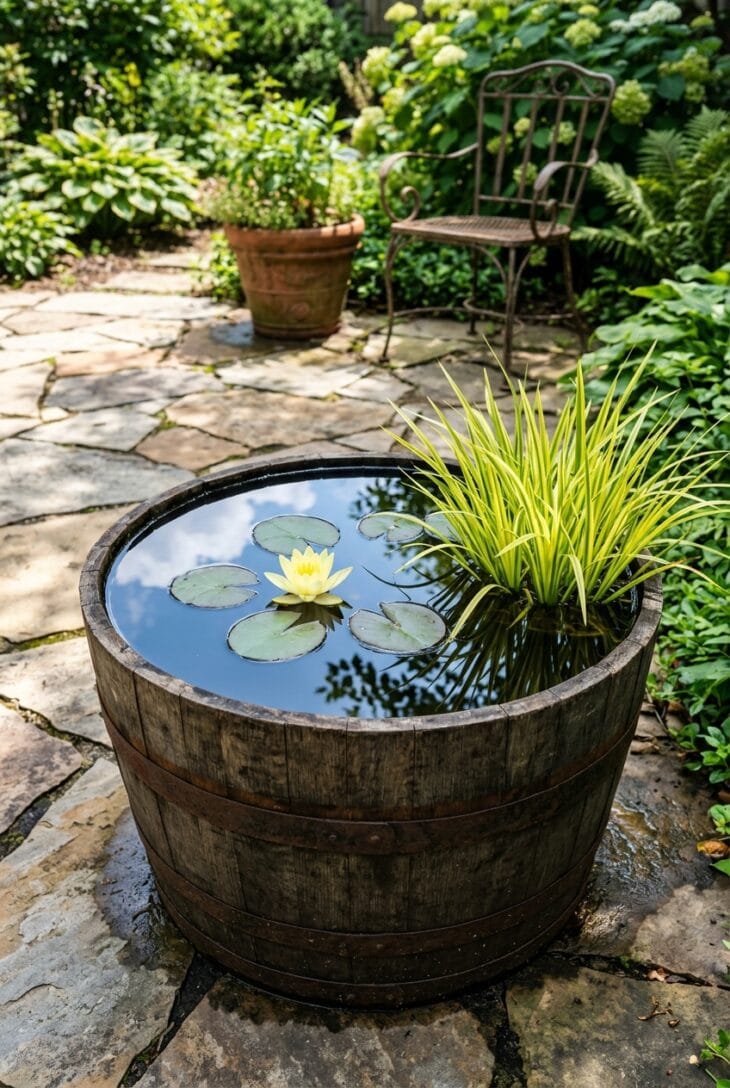
What you see A weathered half barrel on the patio stones is filled to the brim with still, dark water. A small yellow water lily spreads a handful of round pads across the surface and holds up a single open bloom, with a tuft of golden-striped, grass-like sweet flag at one side. The staves catch the morning sun, and the water mirrors the sky.
Why it works It is the smallest complete water garden you can make, and it fits a patio, a deck or a sunny balcony corner. A tub has none of the digging, plumbing or permits of a pond, so it suits renters and anyone testing whether they like the upkeep. It also makes a quiet focal point among your container garden ideas.
How to get it Use a half barrel or any watertight tub holding 15 to 25 gallons (57 to 95L), and line a wooden barrel with a pond liner or plastic insert so it does not leak. Put it where it gets at least 6 hours of sun, which most lilies need to bloom. Stand the potted lily on bricks so the crown sits 6 to 12in (15 to 30cm) under the water, and pick a miniature type such as ‘Pygmaea Helvola’ (Nymphaea), a small yellow hardy lily. Add golden sweet flag (Acorus gramineus ‘Ogon’, Zones 6–9) in a pot set so its rim is just under the water. In Zone 7 or colder the barrel can freeze solid, so move the lily pot to a frost-free garage in winter and keep the rhizome damp.
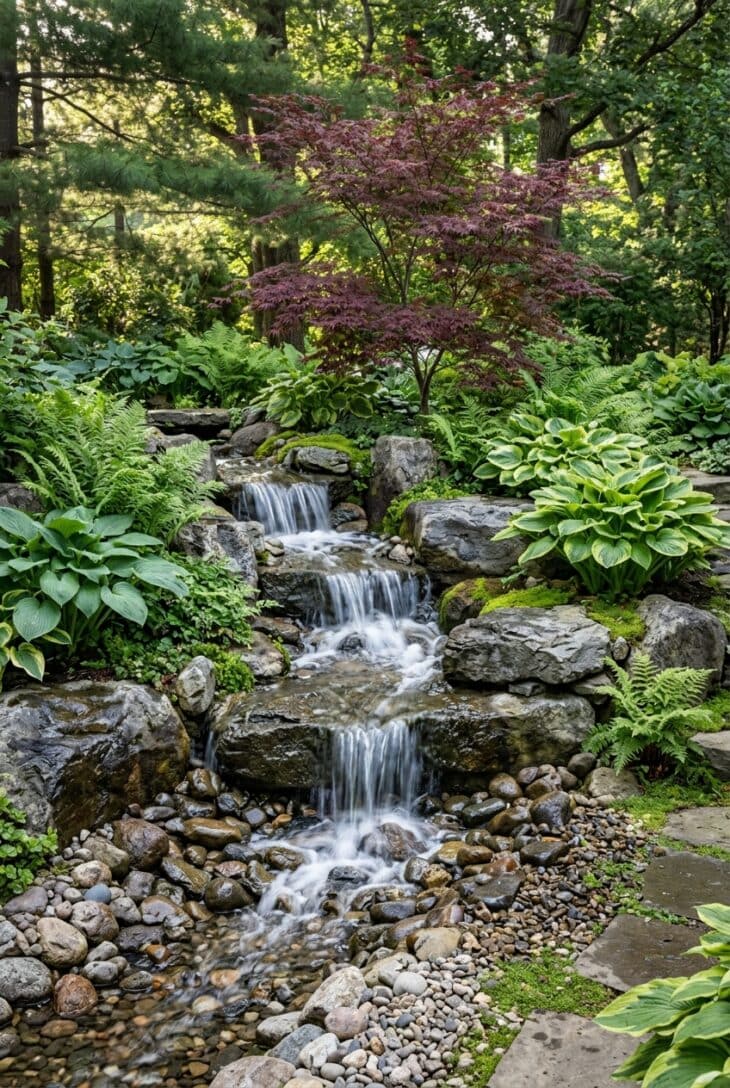
What you see Water tumbles over three tiers of gray fieldstone and vanishes into a bed of rounded river rock, with no pool in sight. Ferns and hostas crowd the gaps between boulders, and a small Japanese maple leans in from behind. Wet stones shine in the dappled shade, and the sound carries across the whole yard.
Why it works A pondless waterfall gives you the sound and movement of a stream without a visible pool. With no open water, the drowning risk for toddlers and pets is far lower, there is less surface for mosquitoes to lay eggs, and there is almost nothing to skim. That makes it one of the easiest ways to add water to a low-maintenance garden.
How to get it Dig a basin for the reservoir and set a pump vault or lined reservoir at the base, then cover it with a grate and a thick layer of river stones. Run tubing up the slope to the head of the falls, where the water spills over a stone lip and back down to the reservoir. Size the reservoir to hold the water that drains back from the streambed when the pump stops, or it will overflow every time you switch off. Add an auto-fill valve on a hose bib so the system tops itself up. Plug the pump into a GFCI outlet, and check the water level weekly in summer, since a pump that runs dry can burn out.
04. A Bubbling Urn in a Pebble Basin
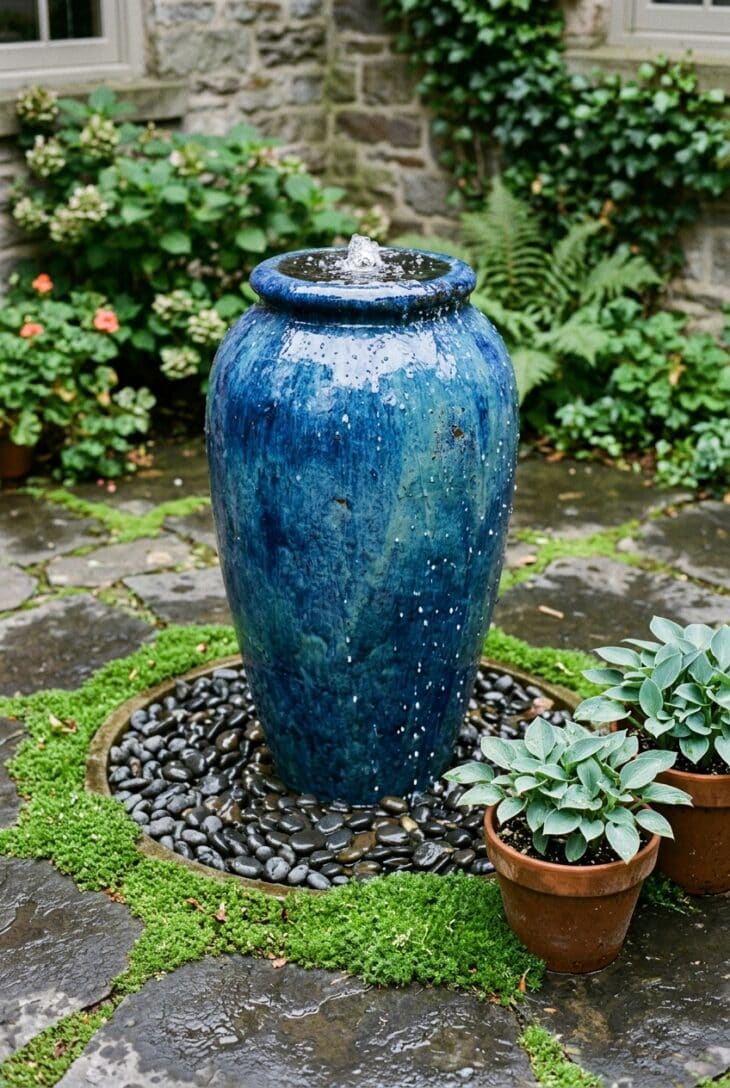
What you see A tall blue glazed urn burbles over its rim, and the water slips down the sides into a basin of dark pebbles. Irish moss fills the gaps between the pavers around it, and pots of small blue-green hostas sit at its base. Drops of water catch the light on the glaze, and no pool is visible.
Why it works A bubbling urn needs a footprint barely wider than the container, so it fits where a pond never could: a tiny yard, a front entry or a paved corner. The water sits in a hidden reservoir under the pebbles, so there is nothing to net, no plants to divide and little to clean. Water noise also helps mask traffic and neighbors, a trick that earns its keep in small garden ideas.
How to get it Buy a fountain kit with a reservoir basin, a submersible pump and a grate, or fit a pump hose through a drilled urn. Sink the basin until its rim sits flush with the paving, and fill it with cobbles to hide the grate. Plant Irish moss (Sagina subulata) between the pavers, where splashes keep it damp, and set pots of hosta (Hosta, Zones 3–9) in the shade of the urn. Plug the pump into an outdoor GFCI outlet, and top up the reservoir every week or two in hot weather. Drain the basin and switch off the pump before hard freezes so nothing cracks.
05. A Pond Blanketed in Hardy Water Lilies
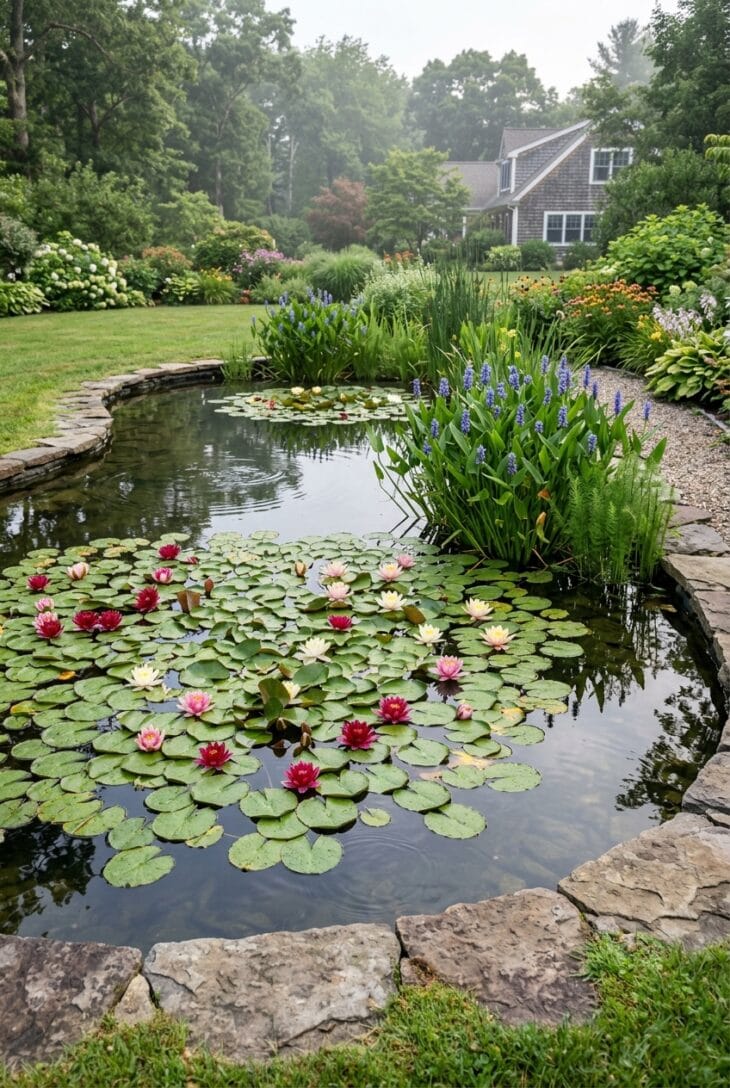
What you see Round green pads drift across a dark pond like stepping stones, and between them open lilies in garnet red, soft pink, cream and butter yellow. About two thirds of the water is covered, with clear gaps where trees are reflected. At the edge, a few spikes of blue pickerel rush add height.
Why it works Hardy water lilies do two jobs: they put on one of the best flower displays in the garden, and their pads shade the water, which cuts the sunlight that feeds algae. Covering roughly half to two thirds of the surface with leaves is the range extension sources suggest, enough for shade without choking the pond. Unlike tropical lilies, hardy types come back every year in Zones 3–9 as long as the roots stay below the ice.
How to get it Pick lilies by pond size, because spread and planting depth vary by cultivar: ‘Pygmaea Helvola’ stays small for tubs, ‘Marliacea Chromatella’ (yellow) suits a medium pond, and ‘Attraction’ (garnet red) wants a large, deep one. Plant each rhizome at an angle in heavy garden loam, not light potting mix, in a pot with no fertilizer mixed in, and top the soil with an inch of gravel to keep it from clouding the water. Set the pot so the growing point sits 6 to 18in (15 to 45cm) under the surface, as the tag directs, and raise it on bricks at first so the leaves reach the top. Give lilies at least 6 hours of sun, since most stop blooming in shade. Push an aquatic fertilizer tab into the soil monthly in summer.
06. A Deep Koi Pond with Filtration
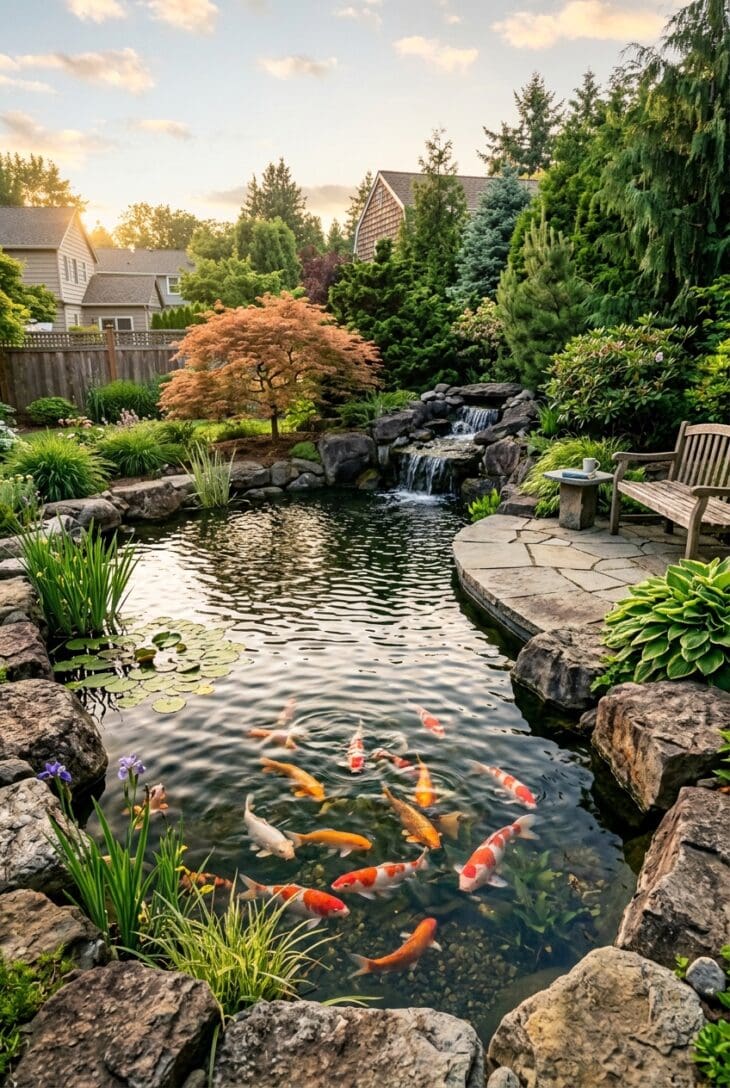
What you see Orange, white and red-and-white koi glide just under clear water, rising toward the surface. A boulder edge softens the pond’s outline, a small waterfall splashes in at one end, and a stone patio sits close by for watching. A Japanese maple and evergreens frame the far bank in warm evening light.
Why it works Koi turn a pond into something you interact with, because they learn to take food from your hand. Their needs shape the build, though: large fish need depth, strong filtration and room to swim, which makes a koi pond a project rather than a weekend job. If you want the look with less commitment, a smaller goldfish pond uses the same ideas with a lighter load.
How to get it Plan for a depth of at least 3ft (90cm), and 3 to 4ft (90 to 120cm) where winters are hard, so the fish have a pocket of unfrozen water under the ice. Koi can grow to 2ft (60cm) or more, so size the filter, pump and pond volume for the fish you plan to keep, and ask a koi dealer or pond contractor to confirm. Raccoons and herons will clean out a pond, so use netting, a steep edge without wading shelves, or both. Keep lilies in pots topped with gravel, because koi dig in soil, and leave plenty of open water. Never release koi or goldfish into a lake, stream or ditch, since released pond fish can harm local waters.
07. A Wildlife Pond for Frogs and Dragonflies
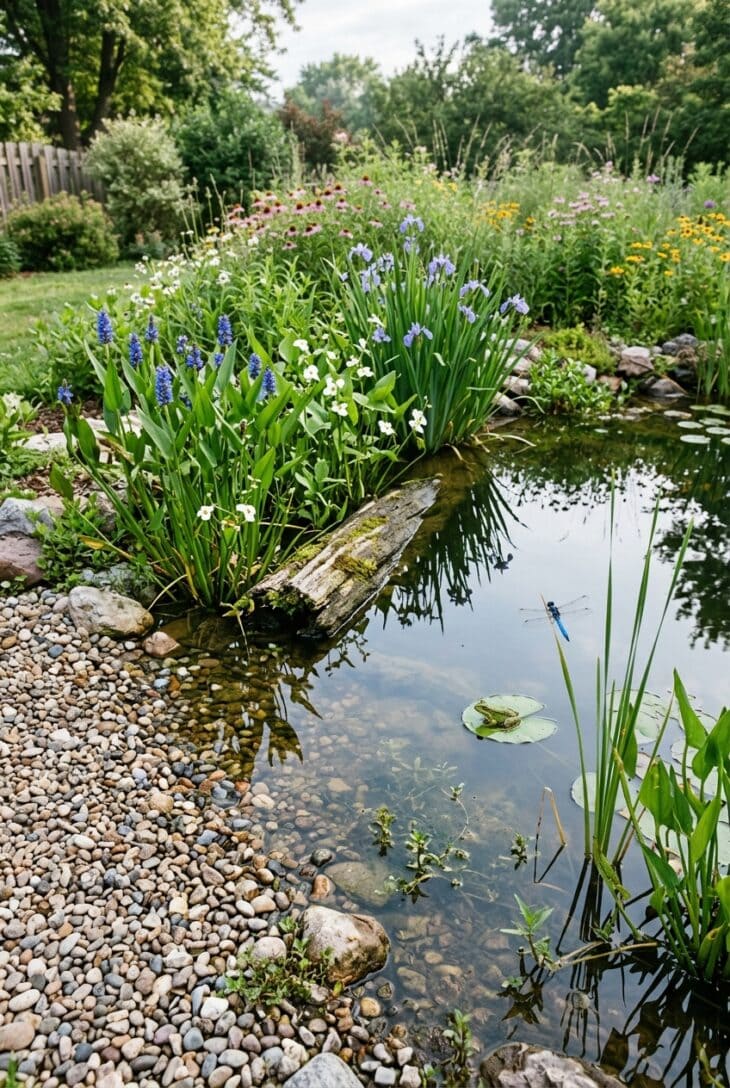
What you see A gravel and cobble beach slopes gently into clear water, and a half-sunk log makes a ramp for visitors. Blue flag iris, white-flowered arrowhead and spikes of pickerel rush fill the margins, a green frog sits on a lily pad, and a blue dragonfly rests on a reed. Native meadow plants rise behind in the soft morning light.
Why it works Fish eat tadpoles, frog eggs and dragonfly nymphs, so a pond without fish is where amphibians and insects can actually breed. The shallow edge matters as much as the water, because frogs, birds and small mammals need an easy way in and out. Pair it with the plantings in wildlife garden ideas and the pond becomes a habitat rather than a feature.
How to get it Dig a long, gently sloping shallow end and a deeper area of at least 2ft (60cm), which gives animals a cool refuge and carries the pond through dry spells. Line it, cover the beach with gravel and cobbles, and skip both the pump and the fish. Plant native marginals: blue flag iris (Iris versicolor, Zones 3–9), pickerel rush (Pontederia cordata) and broad-leaved arrowhead (Sagittaria latifolia, Zones 5–10), which spreads, so keep it in a pot. Choose the native blue flag, not yellow flag iris (Iris pseudacorus), which is invasive in American wetlands. Expect some green water in the first season, which clears as the plants fill in.
08. A Pitcher Plant Bog
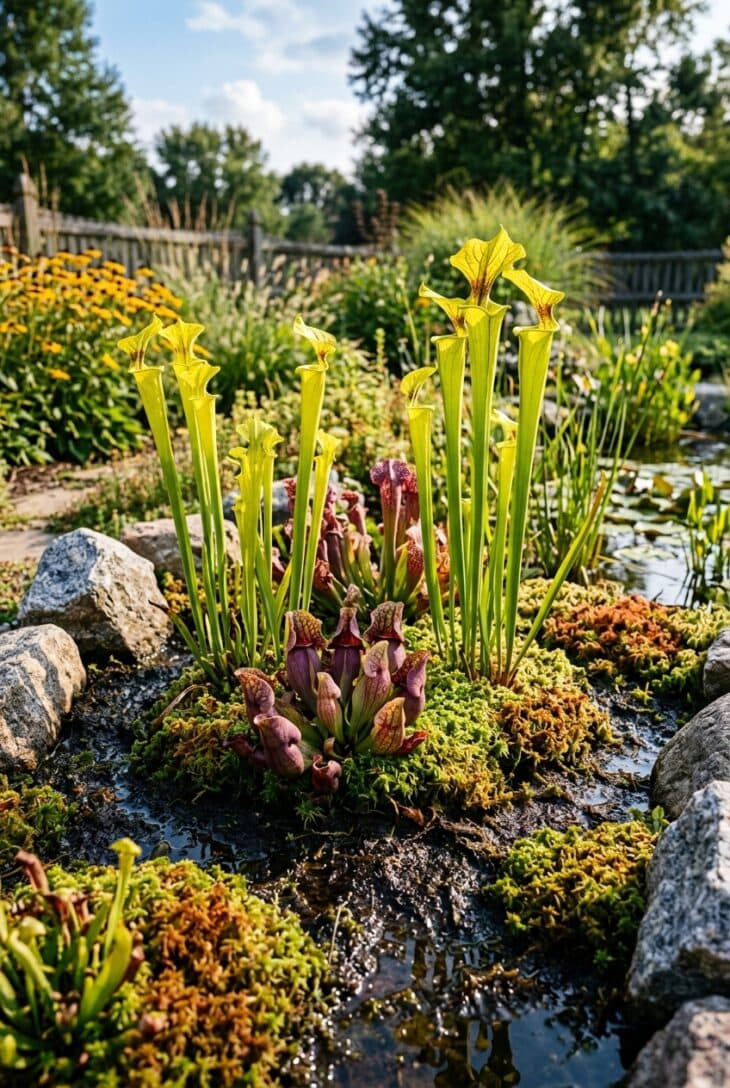
What you see Tall yellow trumpets and squat purple pitchers rise from a bed of damp sphagnum moss. Burgundy veins run through the hooded tops, and the soil underneath glistens wet. A few boulders edge the bog, with the shallow edge of a pond beyond, all in warm late-summer light.
Why it works A bog is a water garden without a pump, a pond or open water: just soil that never dries out. Pitcher plants make it more than a damp patch, because the carnivorous trumpets are among the most unusual plants an American gardener can grow, and they are native to eastern North America. The look suits a patch of wet clay that other plants refuse, or a sunny spot beside a pond.
How to get it Dig an area about 18in (45cm) deep, line it with pond liner, and punch a few drainage holes about 4in (10cm) below the top so the mix stays wet but not flooded. Fill it with roughly half sphagnum peat and half sand or perlite, using plain products with no added fertilizer. Water with rainwater, distilled or reverse-osmosis water, because the minerals in tap water harm the roots. Give it at least 4 to 6 hours of direct sun, and plant purple pitcher plant (Sarracenia purpurea, Zones 4–9) or yellow trumpet (Sarracenia flava, Zones 6–9). Buy only nursery-propagated plants from a carnivorous plant grower, because most pitcher plant bogs in the Southeast have been lost and wild digging is a real threat. Do not fertilize them.
09. A Recirculating Stream Down a Slope
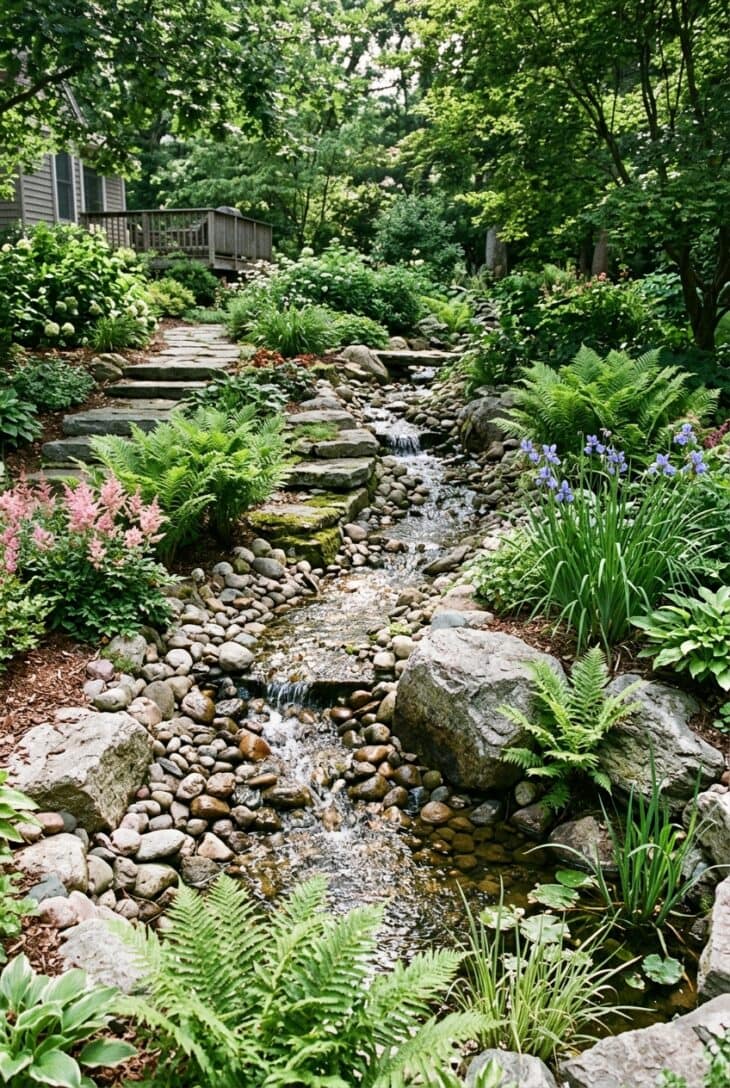
What you see A narrow ribbon of water winds down the slope, slipping over river stones and little ledges of gray fieldstone before settling into a small pool at the bottom. Cinnamon ferns, pink astilbe and blue Siberian iris crowd the banks, and a few boulders mark the bends. Light flickers on the water through the leaves above.
Why it works A hillside already has the one thing a stream needs, which is a fall. A recirculating stream turns a steep, hard-to-mow bank into the best feature of the yard, and the plants along its sides help hold the soil. Many sloped garden ideas lean on terraces, but a stream tames a bank with sound and movement.
How to get it Put the pump in the pool at the bottom and run tubing to a small header basin at the top, so water spills out and runs back down. Vary the stream’s width and drop with small ledges and a few narrow bends, since a straight, even channel looks like a drainpipe. Overlap the liner so each upper section lies over the one below, and set rocks along its edges so water cannot slip behind it. Ask the pump supplier to match the flow rate to the stream’s width and the height of the climb, and check the pool level weekly, since splash and leaks lower it. Plant cinnamon fern (Osmunda cinnamomea, Zones 4–9), astilbe and Siberian iris (Iris sibirica, Zones 3–8) along the banks in partial shade or morning sun.
10. A Boulder Waterfall Spilling into a Pond
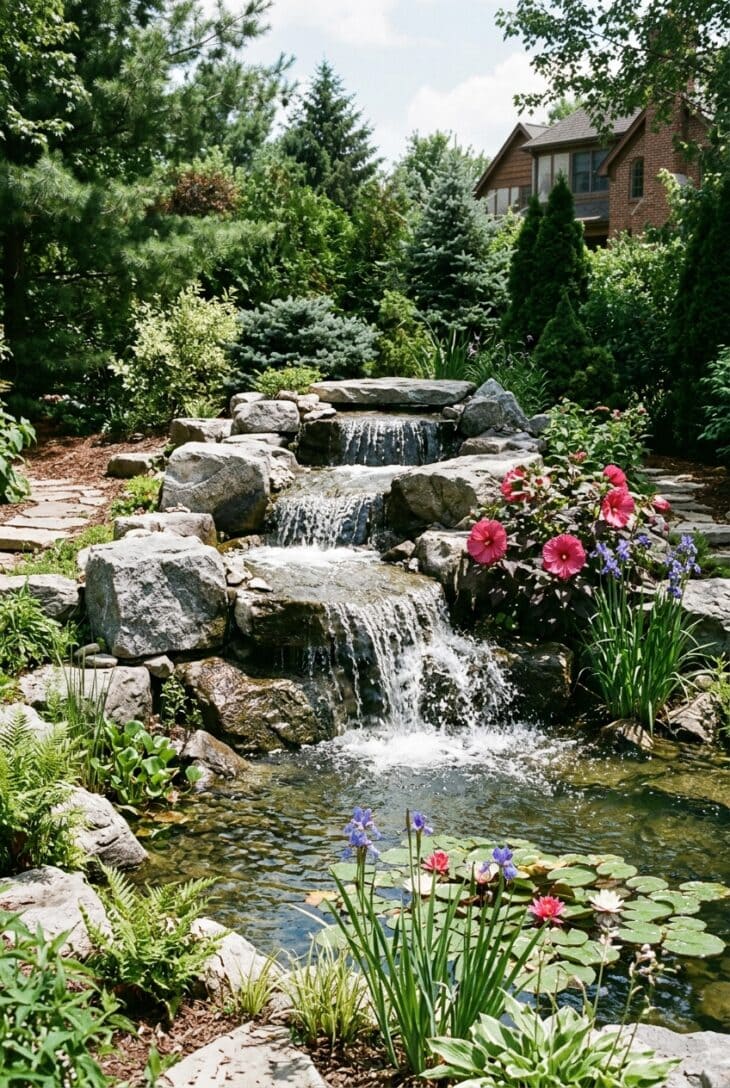
What you see Water falls in white sheets over three tiers of gray granite, then spreads into a clear pond with lilies on the surface. Dinner-plate pink hardy hibiscus and blue irises grow among the rocks, with a few evergreens behind. Spray catches the sunlight, and the whole pond ripples at the foot of the falls.
Why it works A waterfall adds sound, mixes oxygen into the water and gives the pond a backdrop that makes it look as if it has been there for years. Boulders also solve a practical problem, since they hide the liner and the pump line. The same approach suits a sunny, stony slope in a rock garden.
How to get it Build the falls on the soil you dig out of the pond, shaped into a low mound, and lay the liner over it so water runs back into the pond. Use a few large flat-topped stones for the lips, tilt them slightly forward, and seal the gaps behind them with smaller stones and foam so water goes over the front, not behind. Choose boulders in odd numbers and varied sizes, and bury about a third of each so they look natural. Large stones weigh hundreds of pounds, so hire or rent equipment and never lift them by hand. Plant hardy hibiscus (Hibiscus moscheutos, Zones 4–9) beside the falls in full sun and moist soil. Put the pump on a GFCI circuit, and have an electrician add one if needed.
11. A Japanese Bamboo Spout and Stone Basin
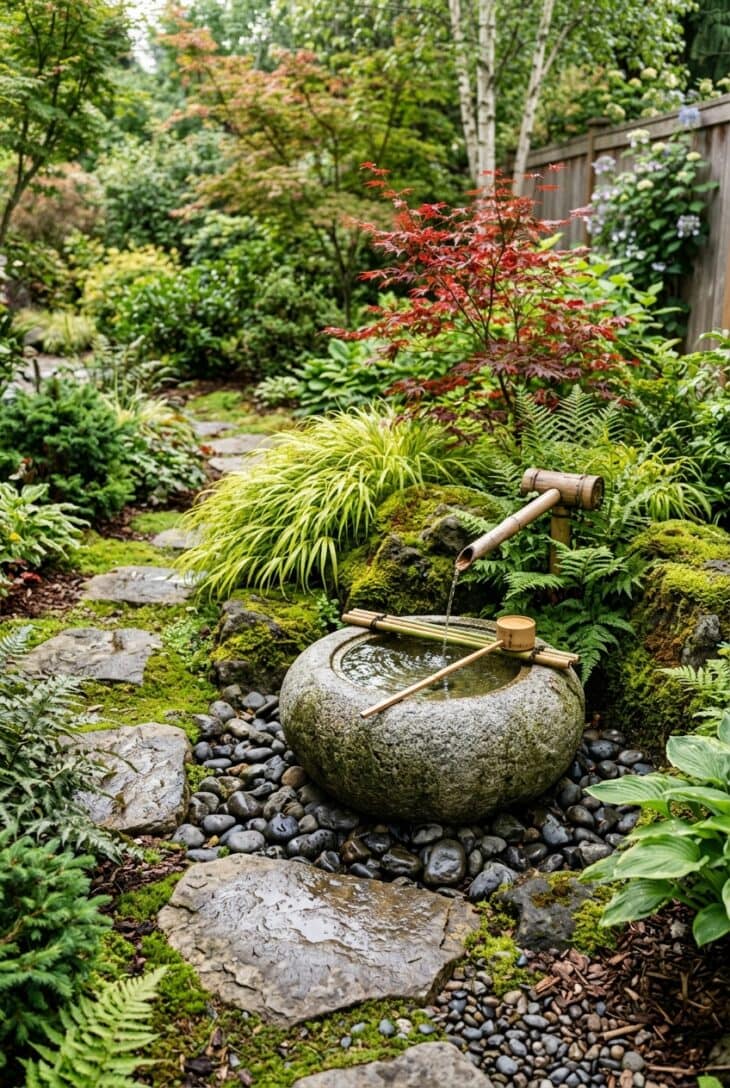
What you see Water trickles from a bamboo spout into a rounded gray stone basin, with a bamboo ladle resting across the rim. The basin sits on river stones, with golden-green Japanese forest grass arching over one edge and moss on the nearby rocks. A small Japanese maple with red leaves stands behind, and stepping stones lead the eye there in soft light.
Why it works This is the opposite of a big water feature. A single stream of water falling into a basin takes up about 2ft (60cm) of space and delivers calm rather than noise. The sound is quiet enough that you hear it only when you walk up to it, which suits the stillness of Japanese garden ideas.
How to get it Use a stone or glazed basin with a hidden reservoir beneath it, and run a small pump up through a hollow bamboo pipe or a copper tube to the spout. Bamboo rots in constant wet, so expect to replace the spout eventually. Plant Japanese forest grass (Hakonechloa macra, Zones 5–9) beside it and a Japanese maple (Acer palmatum, Zones 5–8) behind, both of which like part shade. Keep the basin topped up weekly, since small basins lose water quickly in summer. In hard-freeze climates, drain it and switch off the pump before winter so it cannot crack.
12. A Black-Bottom Reflecting Pool
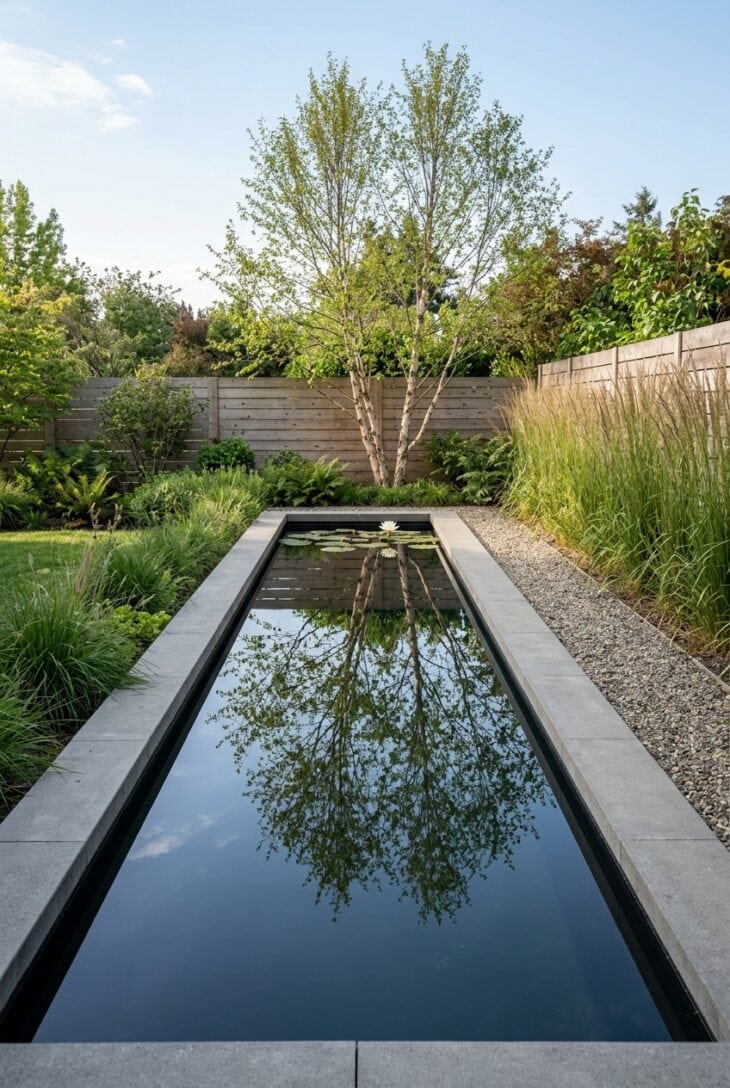
What you see A long rectangular pool holds water so dark and still that it mirrors the sky and a multi-stemmed tree. Smooth concrete coping sharpens the edge, and a border of tall feather reed grass leans over a gravel strip. A single white lily floats near one end in the crisp morning light.
Why it works A reflecting pool is architecture first and garden second. The still, dark surface doubles the sky, the trees and the house, which makes a small yard feel larger. It is a favorite in modern garden ideas because it needs so little: clean edges, one or two plants and nothing to clutter the water.
How to get it Keep it shallow, 12 to 18in (30 to 45cm) deep, with a black EPDM liner so the water reads as black. Set the edge exactly level, because any tilt shows on a still surface. A small pump, a skimmer or a gentle fountain keeps leaves out and the surface moving enough to discourage mosquitoes, and a pond-safe dye labeled safe for fish and wildlife deepens the color. Even shallow water is a drowning hazard for small children, so check local rules and consider a grate or cover where kids visit.
13. A Wall Fountain in a Courtyard
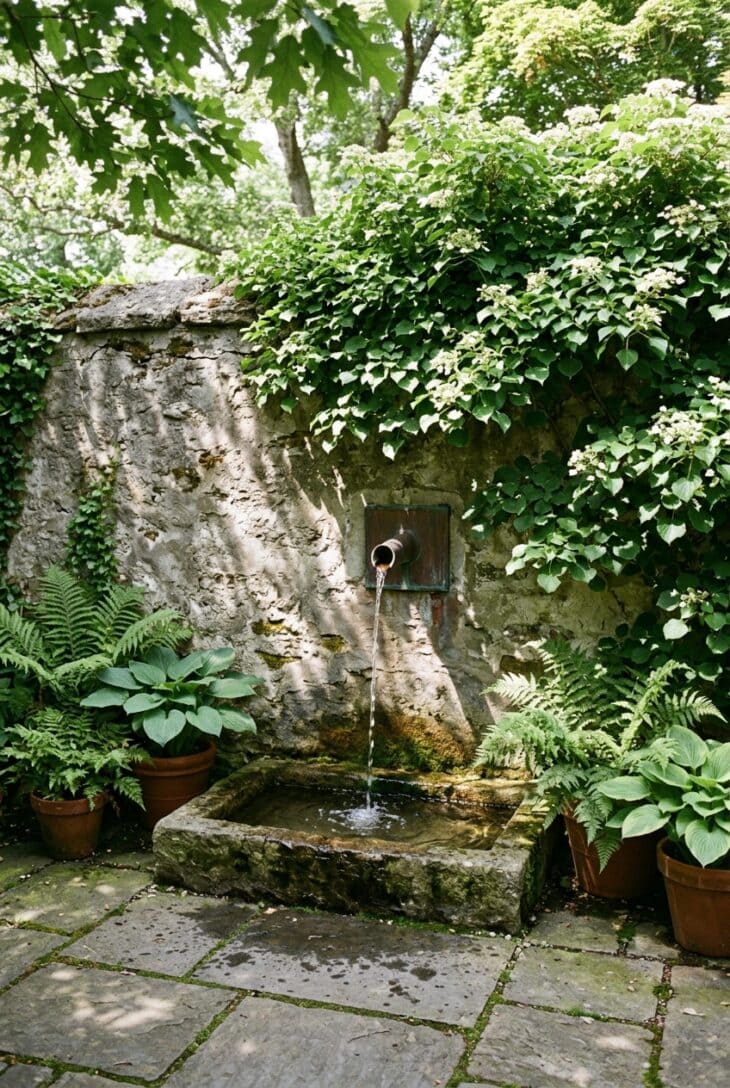
What you see A thin stream pours from a copper spout set in a weathered limestone wall and drops into a shallow stone basin. Potted ferns and hostas flank it on bluestone paving, and a climbing hydrangea spills over the top of the wall. The dappled shade and the quiet splash make the small space feel enclosed and calm.
Why it works In a courtyard the walls bounce sound back, so even a small trickle fills the space and masks street noise. A wall fountain also takes up no floor space, which matters when every foot of paving counts. It suits the intimate scale of courtyard garden ideas better than a freestanding pond could.
How to get it Choose a self-contained wall fountain kit with a reservoir and pump, or mount a spout on a wall and run the tubing down behind it to a basin on the ground. Fix it to masonry or another solid wall that can carry the weight of the filled basin. Plug the pump into an outdoor GFCI outlet, hiding the cord behind the basin or a planted pot. Top up the water weekly and scrub the basin every month or two to remove slime. Hosta (Hosta, Zones 3–9) and ferns in pots suit the shade and the splash.
14. A Tropical Pond with Canna, Papyrus and Palms
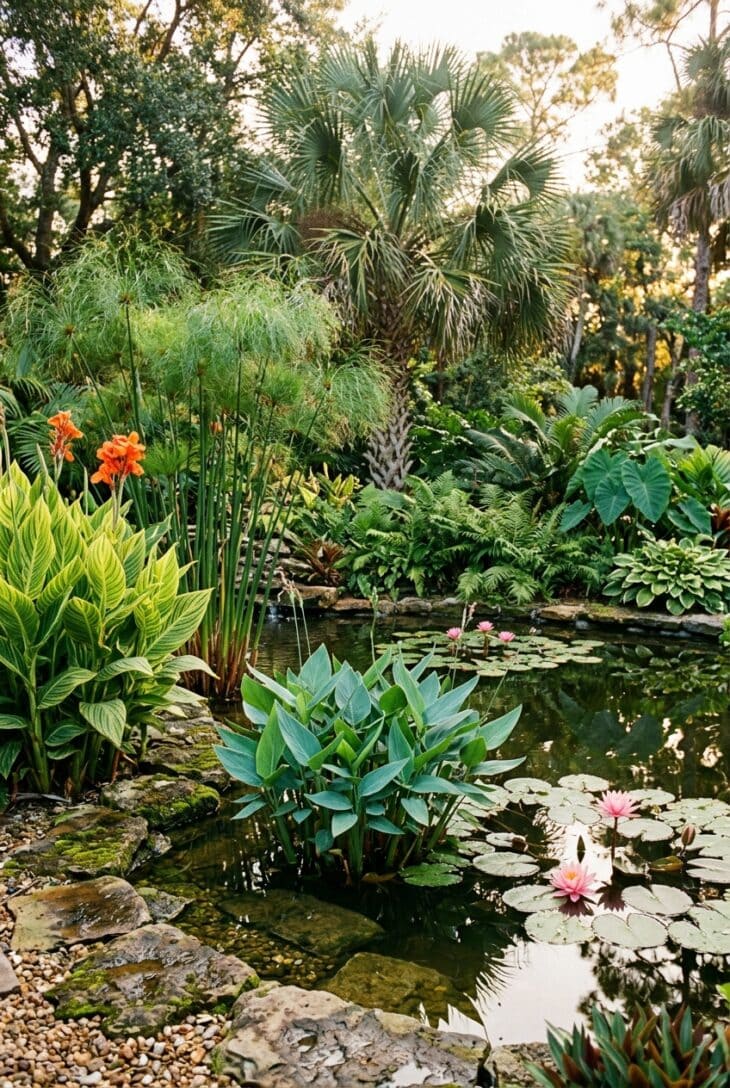
What you see Tall papyrus rises at the water’s edge with its green mop-top plumes, and orange-flowered canna blazes beside it. Big blue-green leaves of powdery alligator-flag stand in the shallows, a cabbage palm towers behind, and pink lilies float on the water. Humid golden light warms the wet stone edge.
Why it works Water and big leaves are a natural pair, and a pond is the fastest route to a tropical look. The bold foliage reflects in the surface, and all of these plants enjoy wet roots and heat. The look travels north when tender plants go in pots and come indoors for winter, which is how most tropical garden ideas work outside the South.
How to get it Grow powdery alligator-flag (Thalia dealbata, hardy to Zone 6) in a pot in the shallows, and cannas (Canna, Zones 6–10) at the edge in moist soil. Papyrus (Cyperus papyrus) is hardy only in Zones 9–12, so keep it in a pot and bring it indoors, or treat it as an annual, in cooler zones. For height behind the pond in the warm South, cabbage palm (Sabal palmetto, Zones 7b–11) is a native choice. Skip wild-type taro, or elephant ear (Colocasia esculenta), in the Southeast and along the Gulf Coast, where it is listed as invasive in Florida and has spread through waterways across the region. Cannas and alligator-flag give the same bold leaves without that risk.
15. A Cottage Pond Edged with Iris and Foxglove
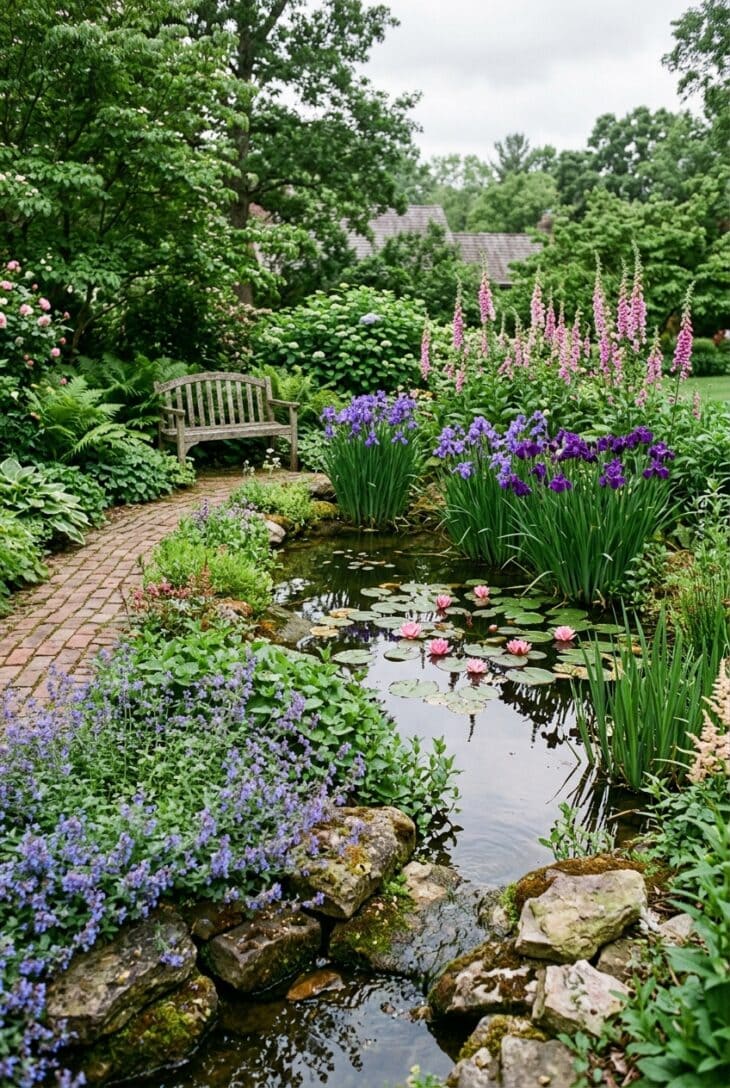
What you see An irregular pond sits in the middle of a soft planting. Violet Siberian iris and purple Japanese iris lean toward the water, tall pink foxgloves rise behind them, and blue catmint spills over the stones at the front. A wooden bench waits at the end of a brick path, and pink lilies float on the surface.
Why it works The informal edge is what sells it. Instead of a hard stone ring, plants overlap the water so the pond looks like part of the border, which is the heart of a cottage garden. Most of the plants here are ordinary perennials, so only the irises need damp soil.
How to get it Build the pond with a gentle bank on the planted side and a shallow shelf, and mulch the soil edge rather than finishing it with stone. Plant Siberian iris (Iris sibirica, Zones 3–8) and Japanese iris (Iris ensata, Zones 4–9) in moist soil at the water’s edge, and catmint (Nepeta) on the drier slope. Add foxglove (Digitalis purpurea, Zones 4–9) behind, a biennial that reseeds. Foxglove is listed as toxic to dogs, cats and horses and is dangerous to people too, so leave it out if children or pets use the yard.
16. A Shady Woodland Pool with Ferns and Hostas
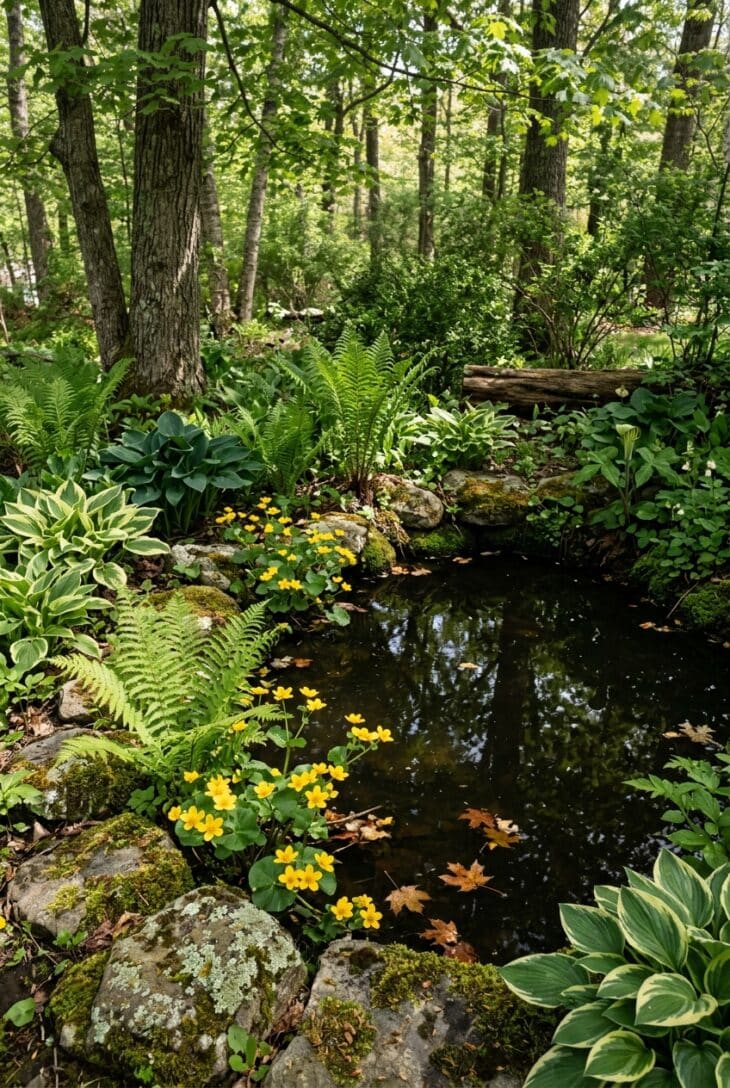
What you see A small pool lies dark and still beneath tall trees, its edge lined with mossy stones. Ostrich ferns and cinnamon ferns unfurl on one bank, variegated hostas fill the other, and yellow marsh marigolds flower at the waterline. A jack-in-the-pulpit stands at the shady margin in the green light.
Why it works Most water plants want sun, but shade has its own plant list, built on foliage, ferns and a spring flush of marsh marigold. A woodland pool is cool and quiet and shows off leaf shape, which makes it a good answer to the sunless gaps in shade garden ideas. Lilies will not flower well here, so the surrounding plants do the work.
How to get it Keep the pool small and shallow, and net it in fall, because tree leaves rot in water and feed algae. Plant ostrich fern (Matteuccia struthiopteris, Zones 3–8), which spreads, and cinnamon fern (Osmunda cinnamomea, Zones 4–9) along the bank, with hosta (Hosta, Zones 3–9) on the drier ground. Put marsh marigold (Caltha palustris, Zones 3–7) in the shallows or wet soil for spring flowers; its leaves are toxic if eaten. Add jack-in-the-pulpit (Arisaema triphyllum) in moist shade, and keep in mind that it is poisonous if eaten.
17. A Desert Oasis with a Recirculating Bubbler
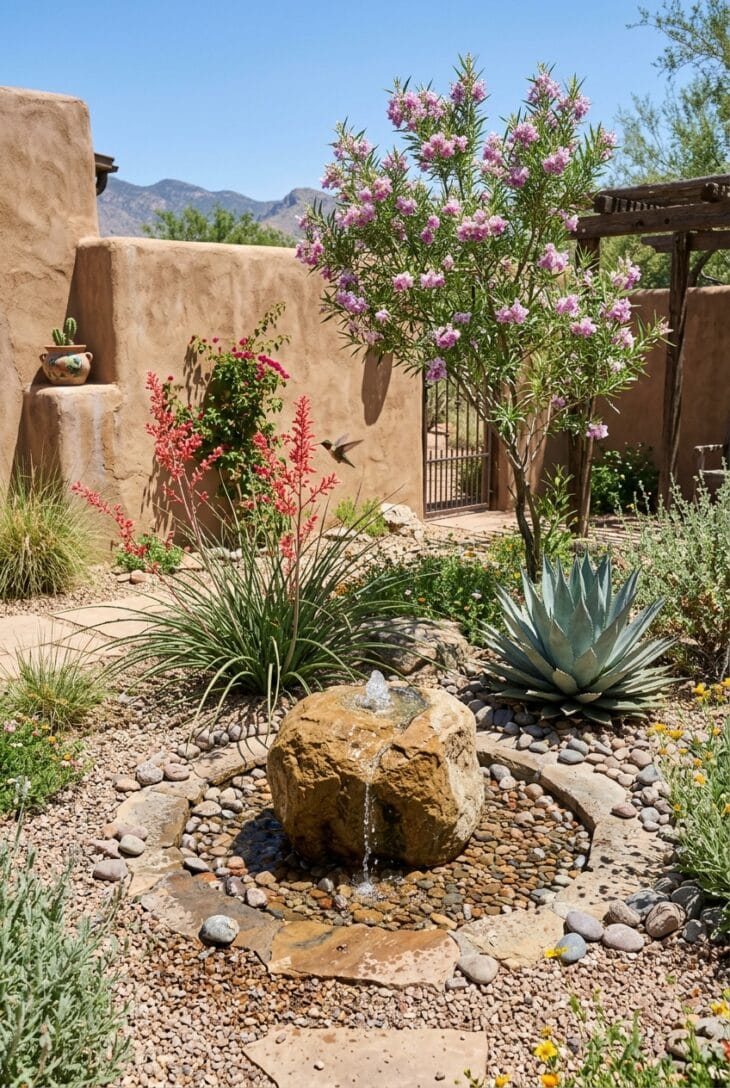
What you see A single boulder bubbles in the middle of a shallow stone basin, with a bed of gravel around it. Red yucca throws up coral flower spikes, a blue agave sits in front, and a desert willow in pink flower stands against an adobe wall. A hummingbird hovers at the yucca, the only motion beyond the water.
Why it works In dry country, a little water goes a long way, because the contrast is the whole effect. A bubbling boulder or shallow basin gives birds and hummingbirds a drink with far less surface, and so far less evaporation, than a pond. It pairs naturally with a drought-tolerant garden planting that needs no extra irrigation.
How to get it Keep the water surface small, put it in part shade if you can, and bury the reservoir under gravel so only the boulder shows. Evaporation is fast in dry heat, so install an auto-fill float valve on a hose bib and check the level often; some cities restrict filling water features, so check local water rules. Plant red yucca (Hesperaloe parviflora, Zones 6–10), century plant (Agave americana, Zones 8–11) and desert willow (Chilopsis linearis, Zones 7–11) around the basin, all of which tolerate dry soil once established. Give the century plant room, since it reaches 6 to 10ft (1.8 to 3m) across.
18. A Cold-Climate Pond That Survives Winter
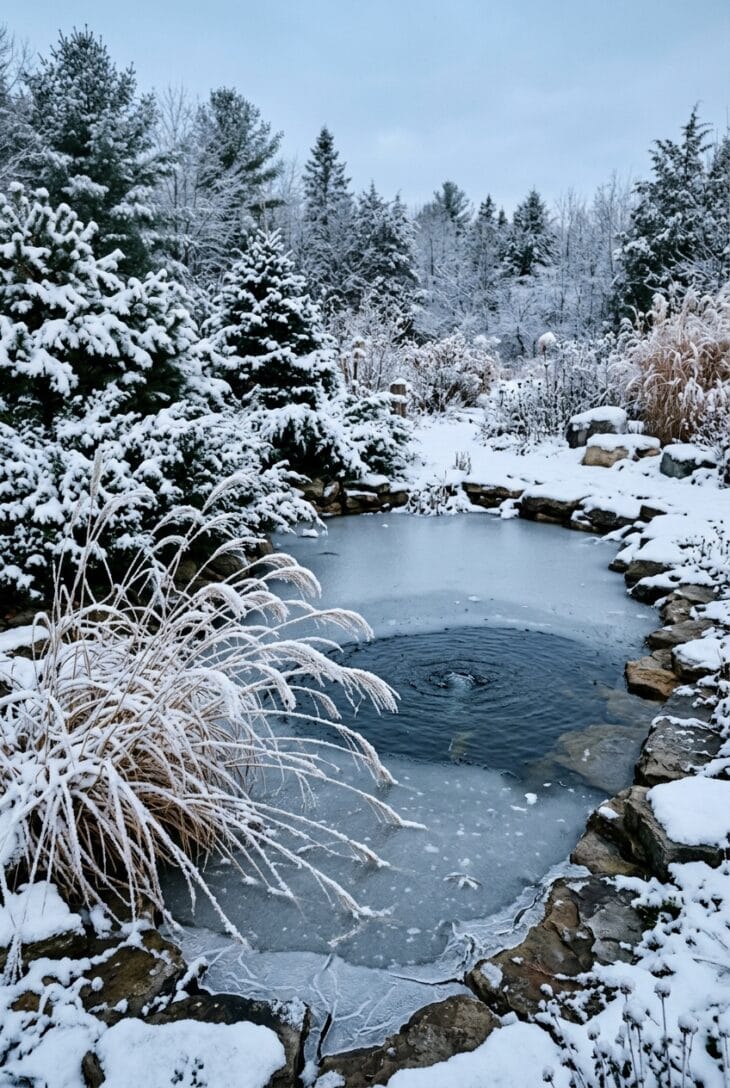
What you see A thin plate of ice rims the edges of the pond, and an open patch of dark water stays clear near the middle. Snow sits on the surrounding stones and the evergreens behind, and frosted grass seedheads lean over the bank. The lily pads have long since sunk, and the garden is quiet in cold blue-gray light.
Why it works Plenty of gardeners in cold zones assume a pond is a southern luxury. It is not, as long as it is deep enough, because the water near the bottom stays close to 40°F (4°C) under the ice, and koi can live in water down to 38°F (3°C). A pond that freezes over also keeps the yard interesting through the season, a quality shared with the best winter garden ideas.
How to get it Build in a section at least 3ft (90cm) deep, and 3 to 4ft (90 to 120cm) in the coldest areas, so the water at the bottom never freezes solid. Hardy water lilies (Zones 3–9) survive if their rhizomes sit below the ice, so cut off the dead leaves in fall and sink the pots to the deepest shelf. If you keep fish, float a pond de-icer near the surface to hold a hole open so gases can escape. Never smash the ice with a hammer, since the shock can stress fish; melt a hole with a pan of hot water instead. Net out fallen leaves before they rot, and cut back the marginal plants.
19. A Galvanized Stock Tank Pond
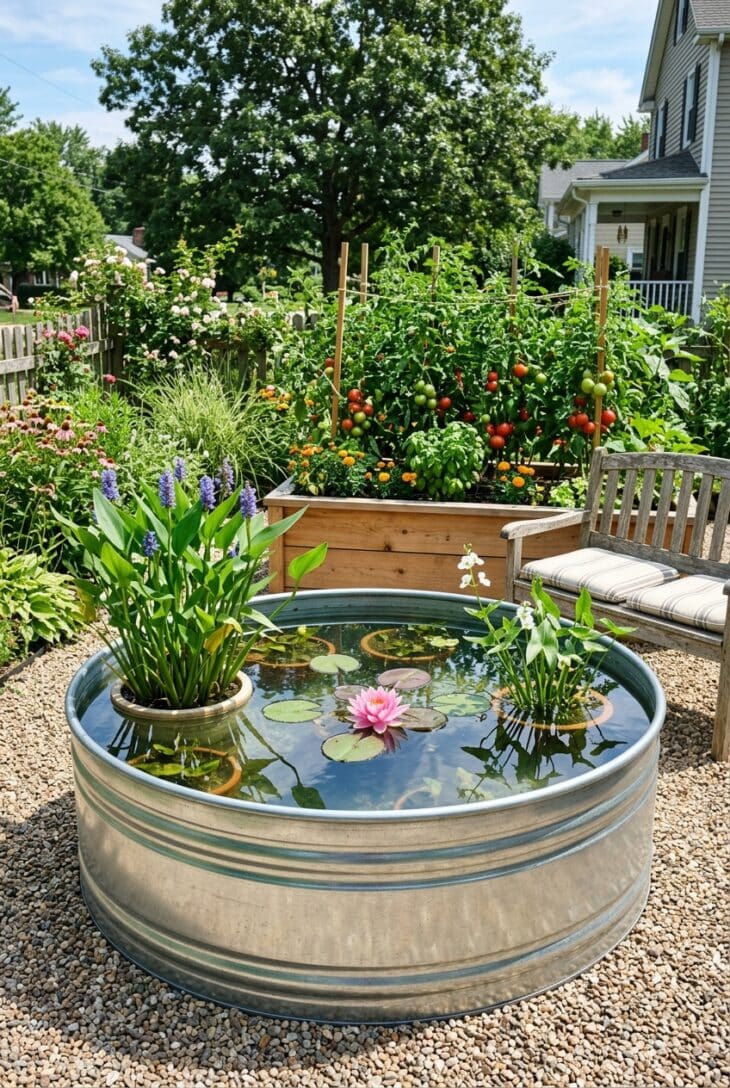
What you see A round galvanized tank sits on a gravel pad, brimming with clear water. A pink water lily blooms among its pads, and pots of blue-flowered pickerel rush and white arrowhead stand in the water beside it. A bench and a raised vegetable bed sit nearby in the bright light.
Why it works A stock tank is the cheapest ready-made pond you can buy at a farm store, and it needs no digging. It holds plenty of life in a small space and can be emptied or moved when you change your mind. That makes it a good way to try a pond before committing to a dig.
How to get it Choose a tank about 2ft (60cm) deep and set it on a level gravel or sand pad. A gallon of water weighs about 8.3 pounds (3.8kg), so a 100-gallon (380L) tank holds roughly 830 pounds (375kg) of water, and it should never go on a balcony or deck without checking the load rating. If you plan to keep fish, use a polyethylene tank or seal the inside of a galvanized one with a pond-safe sealant, because zinc from new galvanized steel can harm fish. Fill it, let it sit a few days, then add a potted lily and one or two marginals raised on bricks. To keep mosquitoes down, add a small bubbler or a Bti mosquito dunk, following the label.
20. A Solar Fountain in a Birdbath
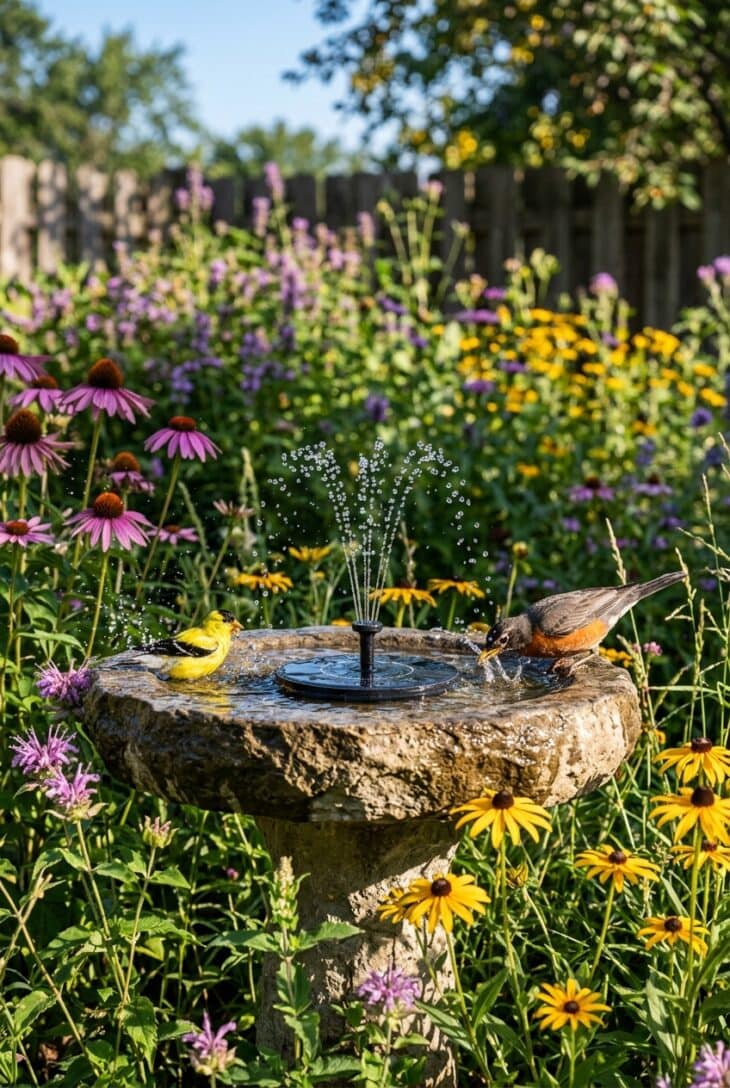
What you see A shallow stone bowl holds a small spout of water that arcs up and falls back in droplets. A goldfinch and a robin drink and splash at the rim, with purple coneflowers and black-eyed Susans around the base. Morning sun sparkles in the spray.
Why it works This is the quickest water feature in the list, and it takes ten minutes. Birds find moving water more readily than a still bowl, because they see and hear the ripples. Moving water also gives mosquitoes fewer places to lay eggs.
How to get it Float a solar fountain, which needs no cord or plug, in a birdbath that is no more than 2 to 3in (5 to 8cm) deep at the edge so small birds can stand. Place it where the panel gets full sun to run the pump. Scrub the bowl with a stiff brush and plain water every few days to prevent algae and disease, and refill it. Set the bath near shrubs or a tree where birds can perch, but about 10ft (3m) from dense cover where a cat could hide. Solar fountains are not made for freezing weather, so bring the unit indoors and use a heated bath in winter.
21. A Rain Chain Spilling into a Stone Basin
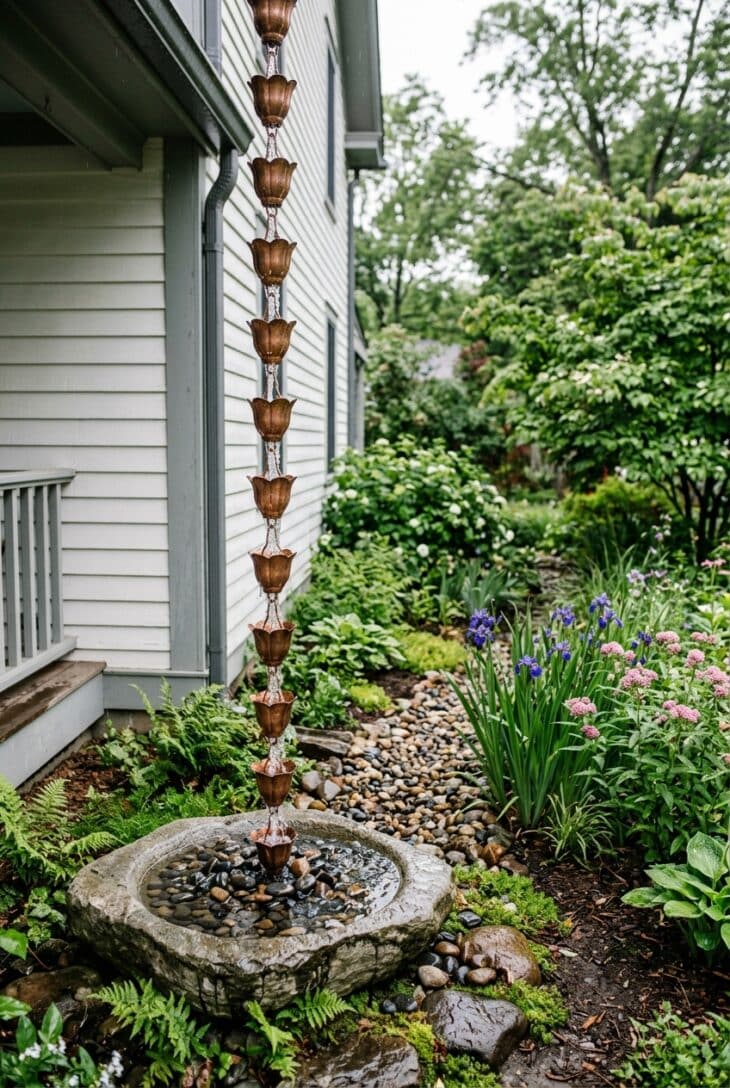
What you see A copper rain chain hangs from the gutter, its linked cups pouring water down in a string of small splashes into a wide, shallow stone basin. Pebbles fill the basin, and a channel of stones leads the overflow toward a planting of blue flag iris and pink swamp milkweed. Ferns soften the base of the wall, and the whole scene shines with fresh rain.
Why it works A rain chain replaces a downspout with something worth watching, and the water feature runs only when it rains, so there is no pump, no power and no upkeep. The basin catches the roof’s runoff and sends the overflow somewhere that can absorb it, which turns a drainage chore into a feature. Pair it with a rain garden and the whole system works as one.
How to get it Hang the chain from the gutter outlet using the maker’s clip, and anchor the bottom with a stake or weight so wind does not whip it against the siding. Set a basin at least 18in (45cm) across beneath it, filled with stones, and slope the ground away from the house so water runs off rather than toward the foundation. Plan an overflow route, such as a buried pipe or a channel of stones, for heavy storms. Rain chains handle lighter flow than a downspout, so keep a downspout on any roof section that sheds a lot of water. If water stands in the basin for more than a few days, fill it with stone above the waterline or add a Bti mosquito dunk, following the label.
22. A Narrow Rill Beside the Patio
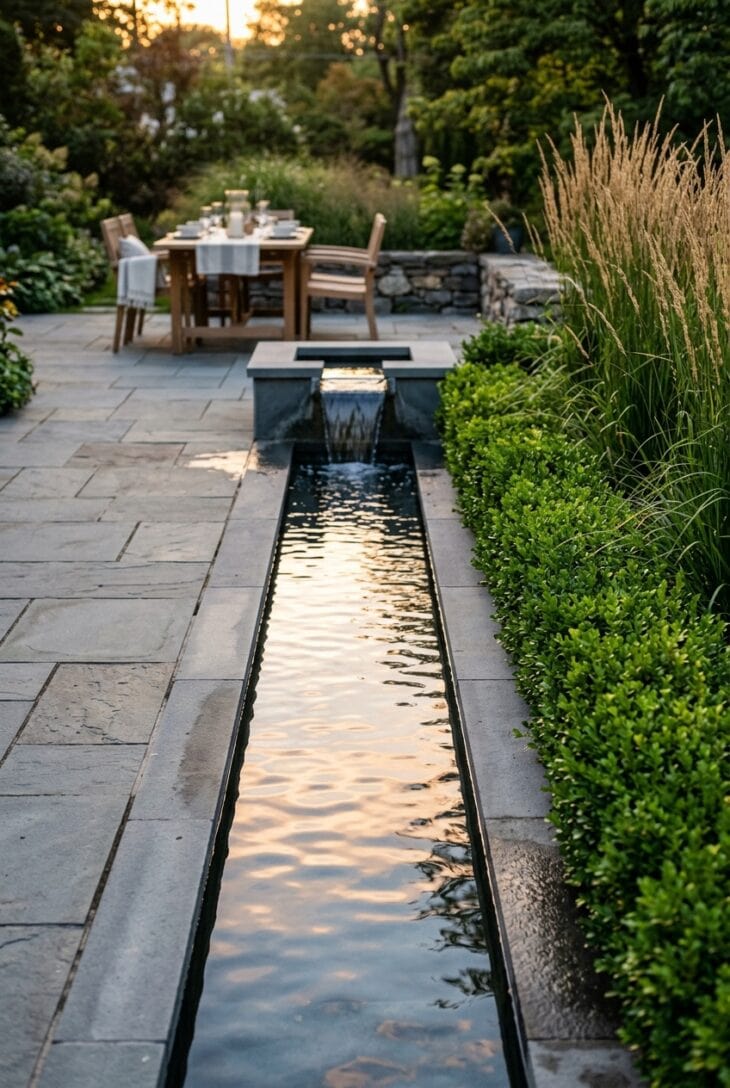
What you see A narrow channel of water runs straight through the bluestone paving, no wider than a foot, and ends in a small square basin. Water sheets over the end lip, and the surface reflects the evening sky. Feather reed grass and boxwood line the edge, with a dining table just out of focus beyond.
Why it works A rill brings movement and a clean line to a patio without taking up much space, and it works as a divider between the dining area and the planting. It is also very shallow, which keeps both the water volume and the safety risk low. The thin line suits any patio garden where a pond will not fit.
How to get it Make the channel 8 to 12in (20 to 30cm) wide and 3 to 4in (8 to 10cm) deep, set exactly level, with a sealed liner or a concrete trough, and hide a pump and reservoir at the end. A buried pipe sends the water back to the start. Because any tilt shows immediately, hire a mason or hardscape contractor unless you are confident. Line the edge with feather reed grass (Calamagrostis × acutiflora ‘Karl Foerster’) and low boxwood, and plug the pump into a GFCI outlet.
23. A Stepping-Stone Crossing and Seating Nook
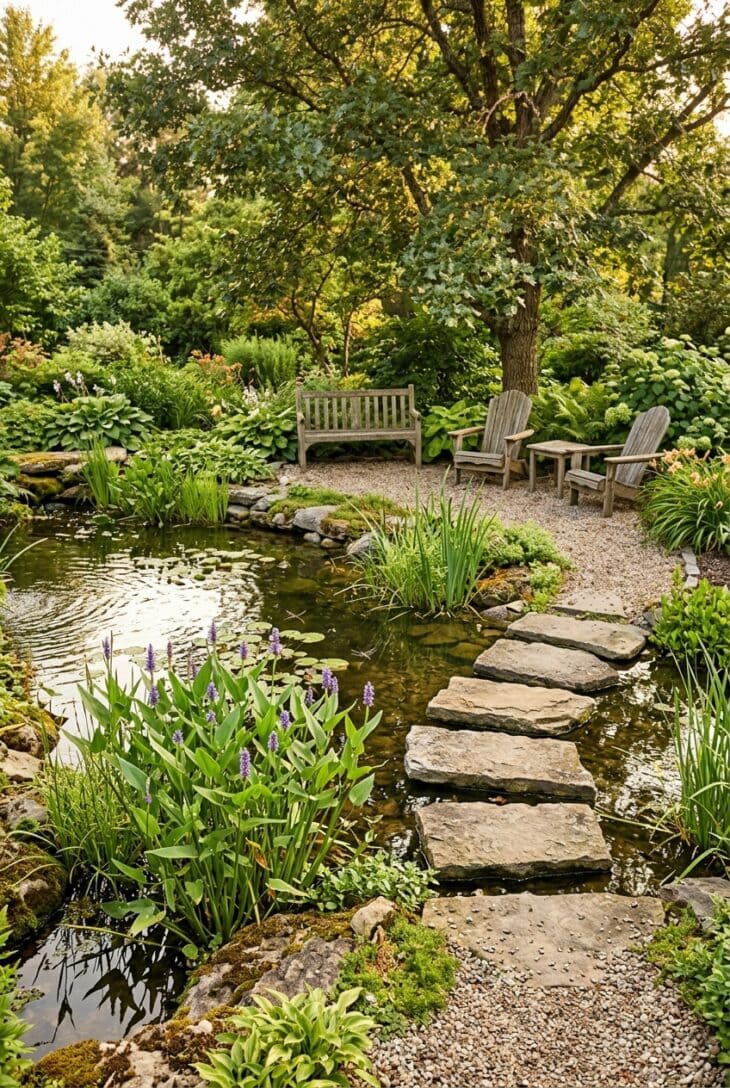
What you see Flat stones step across the shallow end of a pond to a gravel nook with a wooden bench and two chairs under a tree. Pickerel rush and green sedges soften the water’s edge, and dragonflies cruise over the surface in the late-afternoon light. The place invites you to cross and sit.
Why it works A pond you only look at from a distance gets forgotten. Giving it a destination, with a path across and a seat beside it, turns it into the heart of the yard. It is the same logic that makes a good garden path work: it leads somewhere worth going.
How to get it Build the crossing over a section only 4 to 8in (10 to 20cm) deep, with flat-topped stones set on a firm base over a protective layer of underlay on top of the liner. Space the stones about 24in (60cm) apart center to center, and choose wide, rough-surfaced stones that stay grippy when wet. Put the seating on a firm gravel or stone pad a few feet back from the water, not on the bank, where the ground can slump. Stepping stones in water are a slip hazard for children and older visitors, so keep the crossing shallow and check local rules on pond fencing.
24. A Lotus Tub for Midsummer Drama
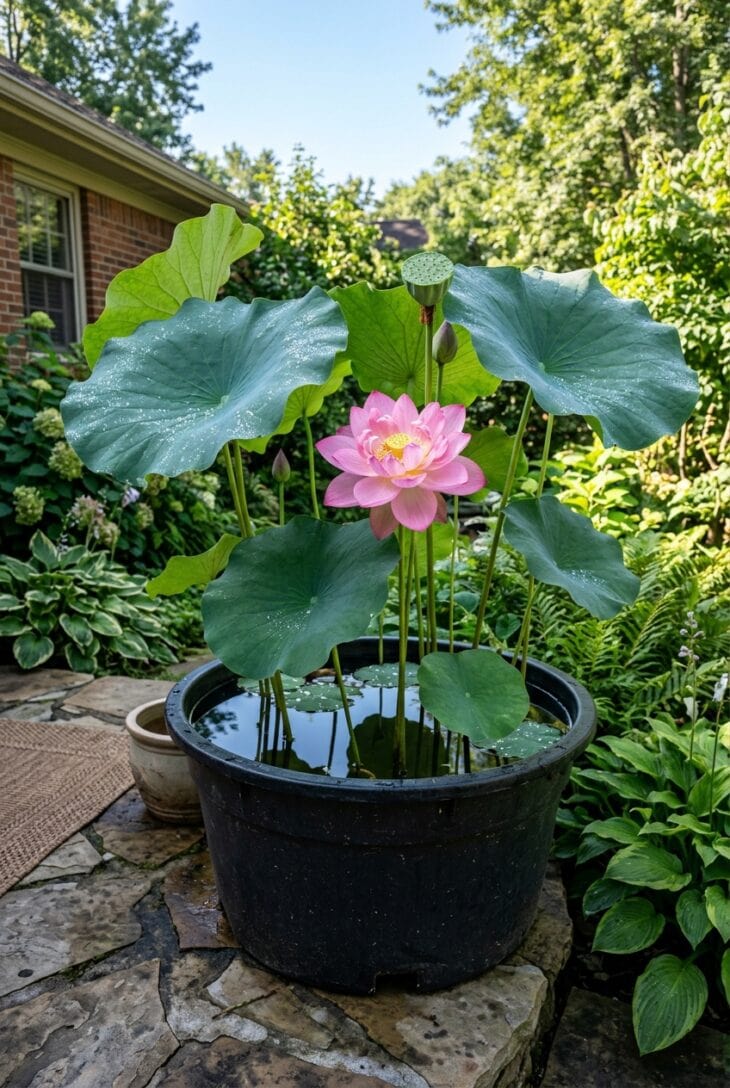
What you see Huge round blue-green leaves stand on tall stems above a black tub, and beads of water roll across their surfaces. A single large pink lotus flower opens beside an upright seed pod. Morning sun lights the petals, and the sky reflects in the water below.
Why it works Lotus (Nelumbo nucifera) is a plant people stop for, and it is easy to grow in a container if you give it sun and warmth. Unlike a lily, it lifts its leaves and flowers well above the water, so it adds height as well as bloom. A tub also keeps its spreading rhizomes contained, which in a pond they will not be.
How to get it Plant the tuber in a container at least 12in (30cm) deep, such as a 15-gallon (57L) tub, in heavy garden loam with no fertilizer mixed in, handling the fragile growing tip with care. Start with only about 2in (5cm) of water over the soil and raise the level as the plant grows. Give it at least 6 hours of sun and warm water. Lotus is hardy in Zones 4–10 as long as the tuber does not freeze, so in cold areas bring the container into a frost-free spot for winter and keep it just moist. Choose a compact cultivar for small tubs, and keep the native American lotus (Nelumbo lutea) in a pot, since it is a vigorous spreader.
25. A Pond Lit for the Evening
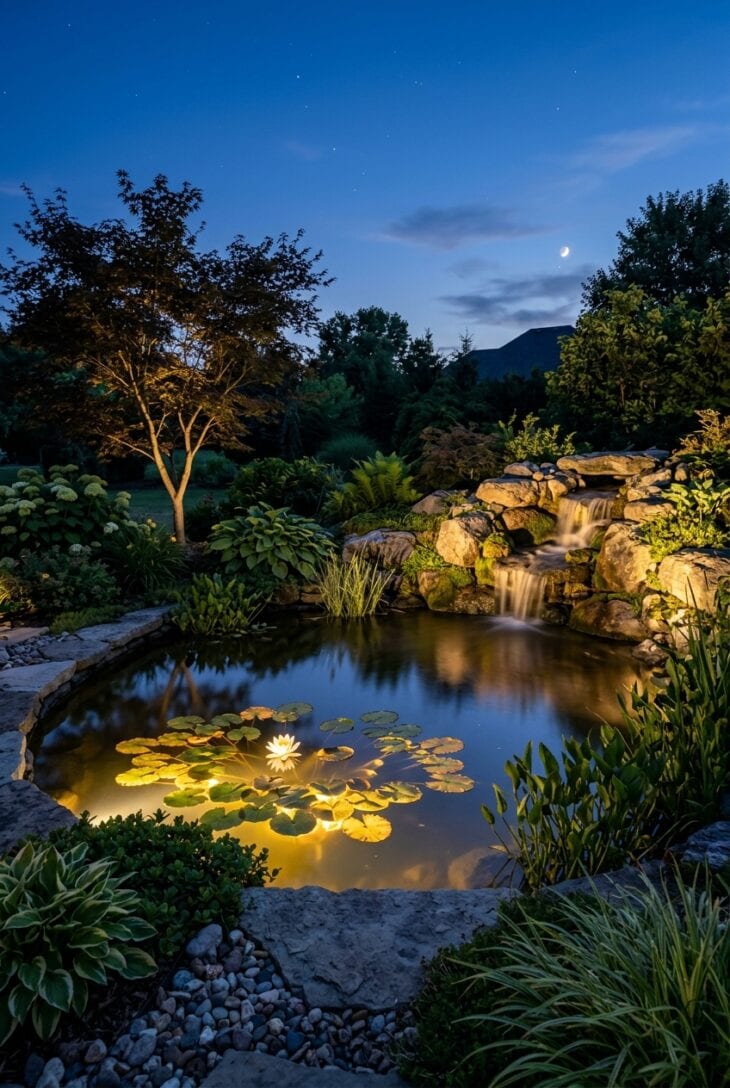
What you see At dusk the pond glows from below, with warm submerged lights picking out the lily pads and a single white bloom. Two small spotlights wash a boulder waterfall and the branches of a Japanese maple. The sky behind is deep blue, and a soft reflection shimmers across the surface.
Why it works Water is the best surface to light, because it doubles every lamp as a reflection. After sunset the pond becomes a different garden, with white flowers floating and moving water catching the glow. It is a natural step from garden lighting ideas, and white blooms glow after dark in the same way they do in a moon garden.
How to get it Use low-voltage LED lights rated for underwater use, run from a transformer on a GFCI-protected circuit, and have a licensed electrician install any new outdoor circuit. Choose warm white lamps, and aim them at plants and the falls rather than into the water at eye level. Use a few lights, because too many make a pond look like a runway. Put white-flowered plants, such as the white hardy lily ‘Gonnère’ (Nymphaea), where the lights can reach them. Clean the lenses of algae a few times a season so they stay bright.