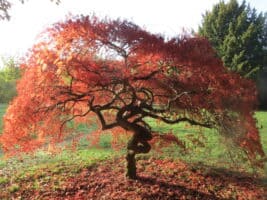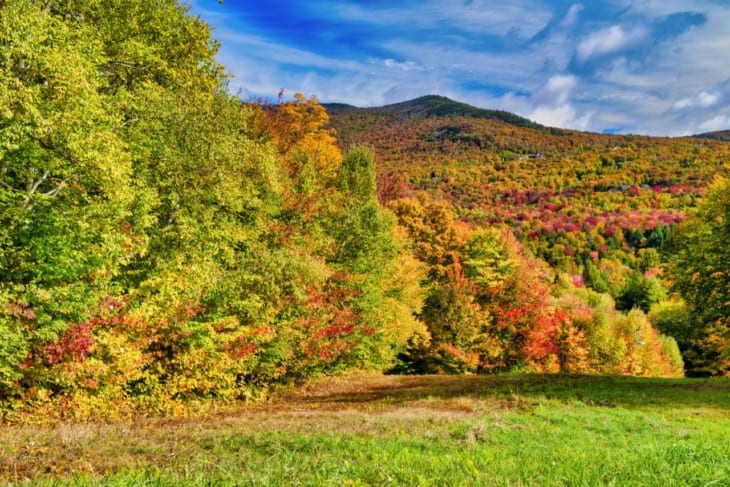
New England is the most heavily forested region in the United States. About 80% of the six states is covered in trees, and Maine, at close to 90%, is the most forested state in the country. It wasn’t always this way. By the mid-1800s farmers had cleared most of southern New England for pasture. When farms were abandoned, the forest grew back, and that’s why so many New England woods have old stone walls running through them.
Contents
- Maples, Birches and Other Northern Hardwoods
- Sugar Maple (Acer saccharum)
- Red Maple (Acer rubrum)
- Striped Maple (Acer pensylvanicum)
- American Beech (Fagus grandifolia)
- Yellow Birch (Betula alleghaniensis)
- Paper Birch (Betula papyrifera)
- Sweet Birch (Betula lenta)
- Gray Birch (Betula populifolia)
- Black Cherry (Prunus serotina)
- Pin Cherry (Prunus pensylvanica)
- White Ash (Fraxinus americana)
- American Basswood (Tilia americana)
- Quaking Aspen (Populus tremuloides)
- Oaks, Hickories and Southern New England Trees
- Northern Red Oak (Quercus rubra)
- White Oak (Quercus alba)
- Black Oak (Quercus velutina)
- Bear Oak (Quercus ilicifolia)
- Shagbark Hickory (Carya ovata)
- American Chestnut (Castanea dentata)
- Black Gum (Nyssa sylvatica)
- Tulip Tree (Liriodendron tulipifera)
- Sassafras (Sassafras albidum)
- Flowering Dogwood (Cornus florida)
- Pines, Spruces and Other Conifers
- Eastern White Pine (Pinus strobus)
- Red Pine (Pinus resinosa)
- Pitch Pine (Pinus rigida)
- Eastern Hemlock (Tsuga canadensis)
- Red Spruce (Picea rubens)
- White Spruce (Picea glauca)
- Black Spruce (Picea mariana)
- Balsam Fir (Abies balsamea)
- Tamarack (Larix laricina)
- Northern White-Cedar (Thuja occidentalis)
- Atlantic White Cedar (Chamaecyparis thyoides)
- Eastern Redcedar (Juniperus virginiana)
- Trees of Riverbanks and Wet Ground
- Small Trees and Understory
- State Trees of New England
- Trees of Massachusetts
- Invasive Trees to Avoid
- Pests and Diseases Changing New England’s Forests
The region’s trees fall into three broad zones. Spruce and fir dominate northern Maine and the high mountains. Maple, beech and birch forests cover most of Maine, New Hampshire, Vermont and western Massachusetts. Southern New England, including Connecticut, Rhode Island and eastern Massachusetts, is mostly oak, hickory and pine. Hardiness zones run from zone 3 in the far north to zone 7 along the southern coast.
This guide covers the trees you are most likely to see across New England, with a section on Massachusetts, each state’s official tree, and the invasive trees and pests changing the region’s forests.
- Maples, Birches and Other Northern Hardwoods
- Oaks, Hickories and Southern New England Trees
- Pines, Spruces and Other Conifers
- Trees of Riverbanks and Wet Ground
- Small Trees and Understory
- State Trees of New England
- Trees of Massachusetts
- Invasive Trees to Avoid
- Pests and Diseases Changing New England’s Forests
| Tree | Botanical name | Group | Native |
|---|---|---|---|
| Sugar Maple | Acer saccharum | Northern hardwood | Yes |
| Red Maple | Acer rubrum | Northern hardwood | Yes |
| Striped Maple | Acer pensylvanicum | Northern hardwood | Yes |
| American Beech | Fagus grandifolia | Northern hardwood | Yes |
| Yellow Birch | Betula alleghaniensis | Northern hardwood | Yes |
| Paper Birch | Betula papyrifera | Northern hardwood | Yes |
| Sweet Birch | Betula lenta | Northern hardwood | Yes |
| Gray Birch | Betula populifolia | Northern hardwood | Yes |
| Black Cherry | Prunus serotina | Northern hardwood | Yes |
| Pin Cherry | Prunus pensylvanica | Northern hardwood | Yes |
| White Ash | Fraxinus americana | Northern hardwood | Yes |
| American Basswood | Tilia americana | Northern hardwood | Yes |
| Quaking Aspen | Populus tremuloides | Northern hardwood | Yes |
| Northern Red Oak | Quercus rubra | Oak–hickory | Yes |
| White Oak | Quercus alba | Oak–hickory | Yes |
| Black Oak | Quercus velutina | Oak–hickory | Yes |
| Bear Oak | Quercus ilicifolia | Oak–hickory | Yes |
| Shagbark Hickory | Carya ovata | Oak–hickory | Yes |
| American Chestnut | Castanea dentata | Oak–hickory | Yes |
| Black Gum | Nyssa sylvatica | Oak–hickory | Yes |
| Tulip Tree | Liriodendron tulipifera | Oak–hickory | Yes |
| Sassafras | Sassafras albidum | Oak–hickory | Yes |
| Flowering Dogwood | Cornus florida | Oak–hickory | Yes |
| Eastern White Pine | Pinus strobus | Conifer | Yes |
| Red Pine | Pinus resinosa | Conifer | Yes |
| Pitch Pine | Pinus rigida | Conifer | Yes |
| Eastern Hemlock | Tsuga canadensis | Conifer | Yes |
| Red Spruce | Picea rubens | Conifer | Yes |
| White Spruce | Picea glauca | Conifer | Yes |
| Black Spruce | Picea mariana | Conifer | Yes |
| Balsam Fir | Abies balsamea | Conifer | Yes |
| Tamarack | Larix laricina | Conifer | Yes |
| Northern White-Cedar | Thuja occidentalis | Conifer | Yes |
| Atlantic White Cedar | Chamaecyparis thyoides | Conifer | Yes |
| Eastern Redcedar | Juniperus virginiana | Conifer | Yes |
| Silver Maple | Acer saccharinum | Riverside | Yes |
| American Elm | Ulmus americana | Riverside | Yes |
| American Sycamore | Platanus occidentalis | Riverside | Yes |
| Eastern Cottonwood | Populus deltoides | Riverside | Yes |
| Black Willow | Salix nigra | Riverside | Yes |
| Butternut | Juglans cinerea | Riverside | Yes |
| Eastern Hophornbeam | Ostrya virginiana | Small tree | Yes |
| American Hornbeam | Carpinus caroliniana | Small tree | Yes |
| Serviceberry | Amelanchier spp. | Small tree | Yes |
| Witch Hazel | Hamamelis virginiana | Small tree | Yes |
| American Mountain Ash | Sorbus americana | Small tree | Yes |
| Norway Maple | Acer platanoides | Invasive | No |
| Tree of Heaven | Ailanthus altissima | Invasive | No |
| Black Locust | Robinia pseudoacacia | Invasive | No |
Maples, Birches and Other Northern Hardwoods
Sugar Maple (Acer saccharum)
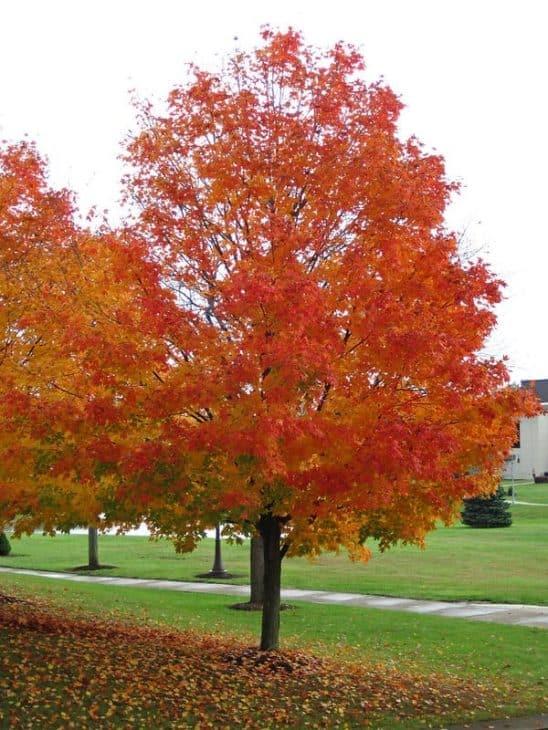
Sugar maple is Vermont’s state tree and the source of New England’s maple syrup. It takes about 40 gallons of sap to make one gallon of syrup, and Vermont produces about half of all the syrup made in the United States. Sugar maples grow 60 to 80 feet tall on rich, well-drained soils. Their five-lobed leaves have smooth edges between a few large teeth, and they turn orange, red and yellow in fall. The trees don’t tolerate road salt well, which is one reason many old roadside maples are in decline.
Red Maple (Acer rubrum)

Red maple is the most numerous tree in southern New England and one of the most common trees everywhere in the region. It grows in swamps and on dry ridges alike. It is also Rhode Island’s state tree. The tree shows some red in every season: small red flowers in March or April before the leaves, red leaf stalks and seeds, red winter buds, and scarlet fall color. Its leaves have three main lobes and sharply toothed edges. Red maple usually grows 40 to 60 feet tall.
Striped Maple (Acer pensylvanicum)

Striped maple, also called moosewood, is a small understory tree, usually 15 to 30 feet tall, in shady northern hardwood forests. The easiest way to recognize it is the smooth green bark with vertical white stripes. Its leaves are large and three-lobed, shaped a bit like a goose’s foot. Moose and deer browse the young bark and twigs.
American Beech (Fagus grandifolia)

American beech has smooth, silver-gray bark that stays smooth even on old trees. It grows 50 to 80 feet tall and often spreads by root sprouts, so beech thickets are common in northern hardwood stands. Its toothed, straight-veined leaves turn pale tan in fall and often stay on young trees all winter. Two diseases are killing beech across the region. Beech bark disease is caused by a scale insect and a fungus working together. Beech leaf disease, caused by a microscopic worm, reached southern New England around 2019 and is spreading north.
Yellow Birch (Betula alleghaniensis)

Yellow birch is the largest native birch in New England, often 60 to 80 feet tall. Its bark is golden-bronze and peels in thin, papery curls. Scratch a twig and it smells faintly of wintergreen. Yellow birch seeds often sprout on mossy stumps and fallen logs. When the log rots away, the tree is left standing on stilt-like roots.
Paper Birch (Betula papyrifera)

Paper birch, also called white birch or canoe birch, is New Hampshire’s state tree. Its chalk-white bark peels in wide horizontal sheets. Indigenous peoples of the region used the bark to build canoes. Please don’t peel it from living trees, because that leaves permanent black scars. Paper birch grows 50 to 70 feet tall and is fairly short-lived. It does best in cool northern and upland areas. In warmer yards, stressed trees are often killed by the bronze birch borer.
Sweet Birch (Betula lenta)

Sweet birch, or black birch, looks more like a cherry than a birch. Young trees have smooth, dark bark with horizontal lines, and older trees develop dark, scaly plates. Its twigs have the strongest wintergreen smell of any birch, and it was once distilled for oil of wintergreen. Sweet birch grows 50 to 60 feet tall and is especially common in southern New England, where it quickly fills in logged areas.
Gray Birch (Betula populifolia)
Gray birch is a small, short-lived birch, 20 to 30 feet tall, that often grows in clumps on abandoned fields, gravel pits and roadsides. Its chalky white bark does not peel, and dark triangular patches form below each branch. The leaves are triangular with a long, tapering tip. Heavy snow and ice often bend gray birches to the ground.
Black Cherry (Prunus serotina)

Black cherry grows 50 to 80 feet tall in woods, hedgerows and old fields. Mature bark breaks into dark, curling plates that look like burnt potato chips. Long clusters of white flowers in late spring become small dark cherries that birds love. The wilted leaves, twigs and seeds contain compounds that release cyanide, so fallen branches are dangerous to horses and cattle. Black knot fungus causes black, tar-like swellings on branches.
Pin Cherry (Prunus pensylvanica)
Pin cherry, also called fire cherry, is a short-lived tree, 20 to 40 feet tall, that springs up after fires and logging. Its seeds can lie dormant in the soil for decades and sprout once the canopy opens. It has shiny, reddish-brown bark with orange horizontal marks. Its small, sour red cherries hang on long stalks in small clusters.
White Ash (Fraxinus americana)

White ash was once common on rich soils across New England. It is the classic wood for baseball bats. It has opposite, compound leaves with five to nine leaflets, and mature bark with a diamond-shaped pattern of ridges. The emerald ash borer was first found in New England in 2012 and is now in all six states. It kills nearly every untreated ash tree it reaches, so don’t plant new ones.
American Basswood (Tilia americana)

American basswood, or American linden, grows 60 to 80 feet tall on rich, moist soils. Its large, heart-shaped leaves are lopsided at the base. In early summer it produces clusters of very fragrant, pale yellow flowers that bees love, which is why it is sometimes called bee tree. Each flower cluster hangs from a narrow, leaf-like bract. Basswood often sprouts from its base, so it is often found growing as a clump of several trunks.
Quaking Aspen (Populus tremuloides)
Read our guide to Quaking Aspen

Quaking aspen is the most widely distributed tree in North America. In New England it is one of the first trees to move into land that has been burned or cleared. Its round leaves sit on flattened stalks, so they tremble in the slightest breeze. The smooth bark is greenish-white. The closely related bigtooth aspen (Populus grandidentata) grows in the same places and has larger, coarsely toothed leaves. Both spread by root suckers and grow 40 to 60 feet tall.
Oaks, Hickories and Southern New England Trees
Northern Red Oak (Quercus rubra)

Northern red oak is the most common oak in New England and an important timber tree. Its leaves have seven to eleven pointed lobes, each tipped with a small bristle. The bark has shiny, flat-topped ridges that look like ski trails running down the trunk. Its acorns take two years to mature and feed deer, turkeys, squirrels and bears. It usually grows 60 to 80 feet tall.
White Oak (Quercus alba)

White oak is Connecticut’s state tree. In 1687, according to tradition, colonists hid the colony’s royal charter inside a hollow white oak in Hartford, the famous Charter Oak, which stood until a storm brought it down in 1856. White oak has rounded leaf lobes with no bristles, and pale gray bark that flakes in loose scales. It grows 60 to 80 feet tall, can live for centuries, and its less bitter acorns ripen in a single season.
Black Oak (Quercus velutina)

Black oak grows on dry, sandy and rocky ground in southern and central New England, usually reaching 50 to 60 feet. Its glossy leaves have bristle-tipped lobes, but their shape varies so much that it is easily confused with red oak. The surest test is the inner bark: cut a small nick and it shows bright yellow-orange. The outer bark is dark and blocky on old trees.
Bear Oak (Quercus ilicifolia)

Bear oak, also called scrub oak, is a shrubby oak, usually 3 to 15 feet tall, that forms dense thickets on sandy, fire-prone ground. It is common with pitch pine on Cape Cod, the Islands and inland pine barrens. Its small leaves have three to seven bristle-tipped lobes and are gray and fuzzy underneath. Its heavy crops of small acorns are an important food for wildlife.
Shagbark Hickory (Carya ovata)

Shagbark hickory is the easiest hickory to recognize: its gray bark peels away in long, curling strips that give the trunk a shaggy look. Its compound leaves usually have five leaflets, and its thick-husked nuts are sweet and edible. It grows 60 to 80 feet tall, mostly in southern New England. Bitternut hickory (Carya cordiformis), which has sulfur-yellow buds and bitter nuts, grows in moist valleys in the same area. Pignut hickory (Carya glabra) grows on dry, rocky slopes.
American Chestnut (Castanea dentata)

American chestnut was once one of the most important trees in southern New England’s forests. Chestnut blight, an Asian fungus first found in New York in 1904, killed nearly all of them by the 1950s. The roots survived, so chestnut sprouts are still common in New England woods, but they usually die back before they can produce nuts. You can recognize one by its long, narrow leaves with sharp, hooked teeth. Groups such as The American Chestnut Foundation are breeding blight-resistant trees.
Black Gum (Nyssa sylvatica)

Black gum, also called black tupelo or pepperidge, grows in swamps and wet woods and also on dry, rocky ridges. Its glossy leaves are among the first to change color in fall, turning brilliant scarlet by early September. Its branches stick out at nearly right angles from a straight trunk. Black gum is one of the longest-lived hardwoods in eastern North America. Some trees in New Hampshire have been dated at more than 500 years old.
Tulip Tree (Liriodendron tulipifera)

Tulip tree, also called tulip poplar or yellow poplar, is the tallest native hardwood in eastern North America. It is not related to tulips or poplars. It is a member of the magnolia family. Its leaves have four lobes and a notched, squared-off tip. In late spring it produces tulip-shaped green-yellow flowers with an orange band. New England is the northern edge of its range, and it grows naturally in Connecticut, Rhode Island and southern Massachusetts. It can reach 70 to 90 feet or more.
Sassafras (Sassafras albidum)

Sassafras is easy to identify because a single tree has three different leaf shapes: oval, mitten-shaped with one lobe, and three-lobed. Its twigs and roots smell spicy and sweet when crushed. The roots were once used to flavor root beer. The FDA banned safrole, the main aromatic compound, as a food additive in 1960 because it caused liver cancer in lab animals. Sassafras grows 30 to 60 feet tall, spreads by root suckers, and turns orange, red and yellow in fall. It grows north to southern Maine.
Flowering Dogwood (Cornus florida)

Flowering dogwood is a small understory tree, 15 to 30 feet tall, native to southern New England. What look like four white petals in May are bracts around a cluster of tiny flowers. They are followed by glossy red fruit that birds eat in fall. Dogwood anthracnose, a fungal disease, has killed many wild dogwoods in the Northeast since the late 1970s. In yards, plant it in part shade with good air circulation. The Asian kousa dogwood is a disease-resistant alternative, though it is not native.
Pines, Spruces and Other Conifers
Eastern White Pine (Pinus strobus)

Eastern white pine is Maine’s state tree and New England’s tallest tree. It usually grows 80 to 100 feet tall, and some white pines in Massachusetts’ Mohawk Trail State Forest are over 160 feet. It is the only native New England pine with soft, flexible needles in bundles of five. In colonial times the British Crown reserved the largest white pines for Royal Navy ship masts and marked them with the “King’s Broad Arrow.” White pine is common across the region, especially on old farmland and sandy soils.
Red Pine (Pinus resinosa)
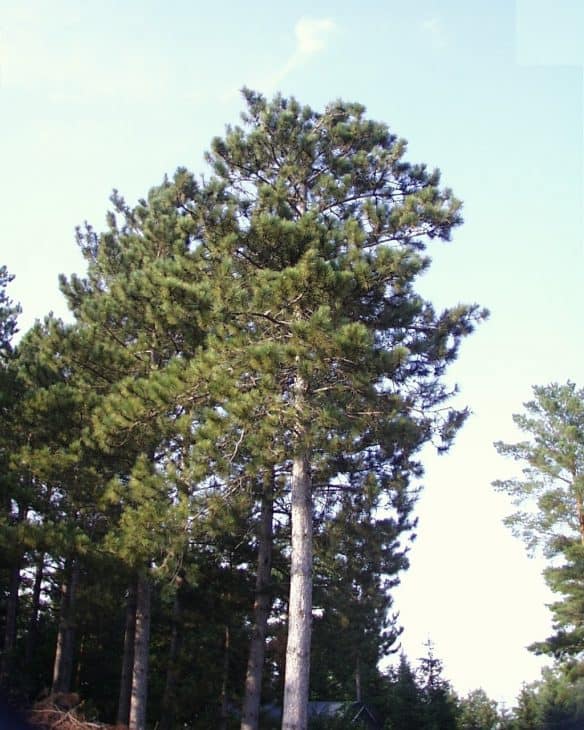
Red pine has long needles, 4 to 6 inches, in bundles of two, that snap cleanly when bent. Its bark is reddish and breaks into flat plates. It grows naturally in northern New England on dry, sandy soils, usually 50 to 80 feet tall. It was widely planted in rows in the 20th century, and many of those plantations in southern New England have been killed by the red pine scale.
Pitch Pine (Pinus rigida)

Pitch pine is the pine of Cape Cod, the Islands and New England’s sandy pine barrens. It has stiff needles in bundles of three and an often crooked, open shape, usually 40 to 60 feet tall. It is built for fire: thick bark protects the trunk, and the tree can sprout new shoots straight from its trunk and base after a fire. Tufts of needles growing directly out of the trunk are a good ID clue.
Eastern Hemlock (Tsuga canadensis)

Eastern hemlock is a long-lived, shade-tolerant conifer that grows in cool ravines and on north-facing slopes, usually 60 to 70 feet tall and sometimes over 100 feet. Its short, flat needles have two white lines underneath, and its cones are only about 3/4 inch long. Dense hemlock stands keep streams cool for trout. The hemlock woolly adelgid, an invasive insect first found in Connecticut in 1985, has killed many hemlocks in southern New England and is moving north.
Red Spruce (Picea rubens)

Red spruce grows in the mountains of western Massachusetts, Vermont and New Hampshire and across much of Maine, including the coast. Its stiff, four-sided needles are yellow-green, and its cones are 1 to 2 inches long and drop in the fall. Red spruce declined badly from acid rain in the 1970s and 1980s. It has recovered strongly since clean air rules cut sulfur pollution. It usually grows 60 to 70 feet tall.
White Spruce (Picea glauca)

White spruce grows in northern Maine, New Hampshire and Vermont and along the Maine coast. Its blue-green needles give off a sharp, unpleasant smell when crushed, which has earned it the nickname “cat spruce.” Its cones are 1.5 to 2.5 inches long, longer than those of red or black spruce. It usually reaches 40 to 60 feet.
Black Spruce (Picea mariana)
Read our guide to Black Spruce

Black spruce is a small, slow-growing spruce of cold bogs, usually 30 to 50 feet tall, with a narrow, often club-shaped top. It is common in northern New England but grows only in scattered bogs in Massachusetts and Connecticut. Its needles are short and blue-green, and its twigs are covered in fine hairs. Its small, round cones stay on the tree for years in clusters near the top.
Balsam Fir (Abies balsamea)

Balsam fir is the classic northern Christmas tree and the source of Maine’s balsam pillows and wreaths. Its flat needles have two white lines underneath and blunt tips, and its smooth gray bark is dotted with blisters of fragrant resin. Its purple cones stand upright on the upper branches and fall apart on the tree. It grows 40 to 60 feet tall in northern New England and on the region’s high peaks. It is the main host of the spruce budworm.
Tamarack (Larix laricina)

Tamarack, also called eastern larch, is a conifer that loses its needles every fall. Soft needles in clusters of 10 to 20 turn gold in October before they drop. It grows in bogs and wet ground, mostly in northern New England, and reaches 40 to 80 feet. Its small cones are only about 3/4 inch long.
Northern White-Cedar (Thuja occidentalis)

Northern white-cedar is the wild form of the arborvitae planted in hedges everywhere. Its scale-like leaves grow in flat, fan-shaped sprays. It grows naturally in swamps and on limestone soils in northern New England, especially in Maine and around Lake Champlain in Vermont, and usually reaches 30 to 50 feet. Wild trees can live for many centuries. Deer browse it heavily, especially in winter. If deer eat your arborvitae hedge, see our guide to arborvitae alternatives.
Atlantic White Cedar (Chamaecyparis thyoides)

Atlantic white cedar grows in freshwater swamps near the coast from southern Maine to Connecticut, often in pure, dense stands. It forms a narrow spire 40 to 50 feet tall. Its tiny scale-like leaves grow on slender, irregular sprays, and its round cones are only about 1/4 inch across. Heavy logging and drainage have destroyed many of its swamps, and the remaining stands are protected in many places.
Eastern Redcedar (Juniperus virginiana)

Eastern redcedar is actually a juniper. It is one of the first trees to move into old pastures and roadsides in southern New England. It grows 30 to 50 feet tall with a dense, narrow shape. Young growth has prickly needles, while older growth has small scale-like leaves. The blue, berry-like cones are eaten by birds. Redcedar is an alternate host for cedar-apple rust, so avoid planting it right next to apple trees.
Trees of Riverbanks and Wet Ground
Silver Maple (Acer saccharinum)
Silver maple grows on floodplains, especially along the Connecticut River. Its leaves are deeply cut into five lobes and silvery-white underneath. It is one of the first trees to flower, often in February or March. It grows fast, 50 to 80 feet tall, but its brittle wood breaks in storms and its shallow roots can lift sidewalks. Plant it only where it has plenty of room.
American Elm (Ulmus americana)

American elm is Massachusetts’ state tree. Its vase shape once arched over New England’s town greens and main streets. Dutch elm disease arrived in the 1930s and killed most of the big trees. Young elms are still common in wet woods and hedgerows, but few live long enough to reach full size. The leaves are rough, double-toothed and lopsided at the base. Disease-resistant cultivars such as ‘Princeton’, ‘Valley Forge’ and ‘Jefferson’ are now available for planting.
American Sycamore (Platanus occidentalis)

American sycamore grows along rivers and streams in southern and western New England and can reach 70 to 100 feet. It is easy to recognize from a distance: its bark peels away in patches to reveal white, cream and green underneath, especially on the upper branches. Its large, maple-like leaves are 4 to 8 inches wide. In cool, wet springs a leaf disease called anthracnose often browns the new leaves, but the tree usually leafs out again.
Eastern Cottonwood (Populus deltoides)
Read our guide to Eastern Cottonwood

Eastern cottonwood is a fast-growing tree of riverbanks and sandbars, mainly in western Vermont and along the Connecticut and Housatonic rivers. It can reach 70 to 100 feet. Its triangular leaves have coarse teeth and flattened stalks that make them rattle in the wind. In late spring female trees release seeds attached to fluffy white “cotton.”
Black Willow (Salix nigra)
Read our guide to Black Willow
Black willow is the largest native willow in New England. It usually grows 30 to 60 feet tall along riverbanks and pond edges, often with several leaning trunks. Its leaves are long, narrow and finely toothed, and its bark is dark and deeply furrowed. It is not the weeping willow planted around ponds, which is an Asian species.
Butternut (Juglans cinerea)
Butternut, or white walnut, is a native walnut of stream banks and rich slopes, usually 40 to 60 feet tall. It has compound leaves with 11 to 17 leaflets, light gray bark, and oblong, sticky-husked nuts. A fungal disease called butternut canker has killed most butternuts in New England since the 1960s. If you find a healthy one, forestry agencies are interested in knowing about it for breeding.
Small Trees and Understory
Eastern Hophornbeam (Ostrya virginiana)

Eastern hophornbeam is a small understory tree, usually 20 to 40 feet tall, on dry, rocky slopes. It is often called ironwood because its wood is extremely hard. Its brown bark breaks into narrow, shreddy strips, and in late summer it bears papery, hop-like fruit clusters.
American Hornbeam (Carpinus caroliniana)

American hornbeam, also called musclewood or blue beech, is a small tree, 20 to 30 feet tall, of shady stream banks. Its smooth, blue-gray bark is fluted like a flexed muscle, which makes it easy to tell apart from hophornbeam. Its seeds hang in clusters, each attached to a three-lobed, leaf-like wing.
Serviceberry (Amelanchier spp.)
Read our guide to Serviceberry

Several native serviceberries grow in New England, as small trees or large shrubs 15 to 30 feet tall. The name shadbush comes from their white flowers, which open in April just as shad swim upriver to spawn. Their small, purple berries ripen in June and are edible for people as well as birds. Serviceberries have smooth gray bark and good orange-red fall color.
Witch Hazel (Hamamelis virginiana)

Witch hazel is a small understory tree or large shrub, 15 to 20 feet tall, that blooms in October and November, often after its leaves have dropped. The fragrant yellow flowers have four thin, ribbon-like petals. Its seed capsules ripen a year later and shoot their seeds several yards. Most of the world’s witch hazel extract is still distilled in Connecticut.
American Mountain Ash (Sorbus americana)

American mountain ash is not a true ash. It belongs to the rose family. It is a small tree, 15 to 30 feet tall, of the northern forests and high mountains of New England. It has compound leaves with 11 to 17 leaflets, flat clusters of white flowers in early summer, and bright orange-red berries that feed birds into winter. The European mountain ash, or rowan, is often planted in yards and looks very similar.
State Trees of New England
Each New England state has an official state tree:
Maine: eastern white pine (Pinus strobus), adopted in 1945.
New Hampshire: paper (white) birch (Betula papyrifera), adopted in 1947.
Vermont: sugar maple (Acer saccharum), adopted in 1949.
Massachusetts: American elm (Ulmus americana), adopted in 1941.
Rhode Island: red maple (Acer rubrum), adopted in 1964.
Connecticut: white oak (Quercus alba), adopted in 1947.
Trees of Massachusetts
About 60% of Massachusetts, around 3 million acres, is forested. By number of trees, red maple is the most common species in the state. By volume of wood, eastern white pine comes first. Northern red oak, eastern hemlock, black birch, white oak and black oak are also among the most common trees.
The state tree is the American elm. According to tradition, George Washington took command of the Continental Army under an elm on Cambridge Common in 1775.
Massachusetts has several distinct forest regions:
The Berkshires and western hills have northern hardwood forests of sugar maple, American beech, yellow birch and black cherry, with red spruce and balsam fir on the highest ridges, including Mount Greylock. Mohawk Trail State Forest has the tallest known trees in New England, white pines over 160 feet.
The Connecticut River valley has floodplain forests of silver maple, eastern cottonwood and American sycamore, with tulip trees and hickories on the valley slopes.
Central Massachusetts, around the Quabbin Reservoir and Worcester hills, is mostly white pine, hemlock, red maple and oak.
Eastern Massachusetts, Cape Cod and the Islands are dominated by oaks and pitch pine. The sandy pine barrens of Cape Cod and Plymouth are pitch pine and bear oak. Atlantic white cedar grows in coastal swamps.
The biggest threats to Massachusetts trees are the same as in the rest of New England: the emerald ash borer, the hemlock woolly adelgid, beech leaf disease and spongy moth outbreaks. Worcester is also the site of one of the largest Asian longhorned beetle infestations ever found in the United States (see below).
Invasive Trees to Avoid
Several trees planted in New England yards and along streets have escaped into the wild. Massachusetts bans the sale of all three trees below, and conservation groups across New England list them as invasive. Glossy and common buckthorn, small invasive trees from Europe, are also widespread in New England woods.
Norway Maple (Acer platanoides)
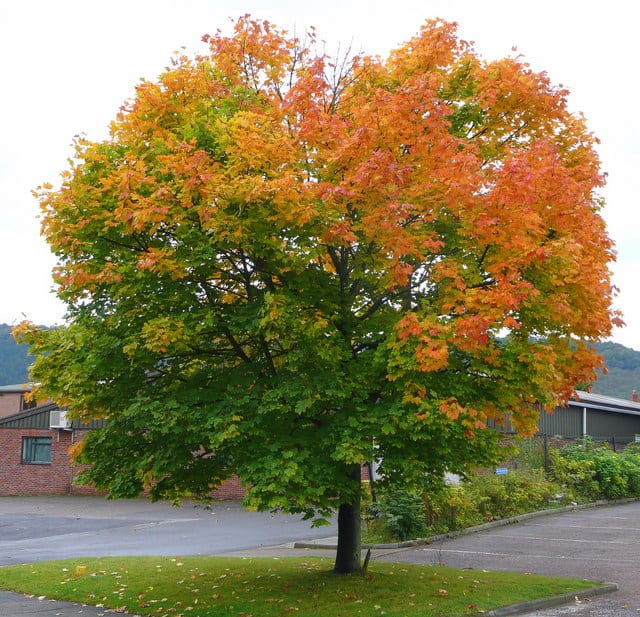
Norway maple was planted along New England streets for decades after Dutch elm disease killed the elms. It spreads readily into woods, and its dense shade kills off wildflowers and seedlings beneath it. It is easy to confuse with sugar maple. To tell them apart, break a leaf stalk: Norway maple oozes milky white sap, and sugar maple doesn’t. Norway maple also has wider leaves and holds them later in fall, turning yellow.
Tree of Heaven (Ailanthus altissima)

Tree of heaven is a fast-growing Chinese tree that springs up in vacant lots, along highways and at forest edges. Its long compound leaves look like sumac, but each leaflet has one or two small teeth near the base, and crushed leaves smell like rancid peanut butter. Cutting it down makes it sprout from the roots, so it has to be treated. It is also the favorite host of the spotted lanternfly, which has reached southern New England.
Black Locust (Robinia pseudoacacia)

Black locust is native to the Appalachians and Ozarks but has been planted in New England since colonial times for its rot-resistant wood. It spreads by root suckers into sandy fields and dunes and crowds out native plants. It has compound leaves, pairs of short thorns on the twigs and fragrant white flowers in late spring. Its bark, seeds and leaves are toxic to people and livestock.
Pests and Diseases Changing New England’s Forests
New England’s forests are changing because of introduced pests:
Emerald ash borer was first found in New England in 2012 and is now in all six states. It kills nearly all untreated ash trees.
Hemlock woolly adelgid has killed hemlocks in southern New England since the 1980s. Cold winters slow it down, but warming winters are helping it spread north.
Beech leaf disease, which darkens the leaves in stripes between the veins, reached southern New England around 2019 and is spreading quickly.
Spongy moth (formerly called gypsy moth) caterpillars stripped oak forests across Rhode Island, eastern Connecticut and southern and central Massachusetts from 2015 to 2018. Together with drought, the outbreak killed many oaks.
Asian longhorned beetle was found in Worcester, Massachusetts, in 2008. A federal and state eradication program has removed tens of thousands of infested and high-risk maples and other hardwoods. If you see a large black beetle with white spots and long, black-and-white banded antennae, report it to your state’s department of agriculture or through the USDA’s Asian longhorned beetle program.
For trees in neighboring areas, see our guides to the trees of New York, the trees of Canada and spring flowering trees.