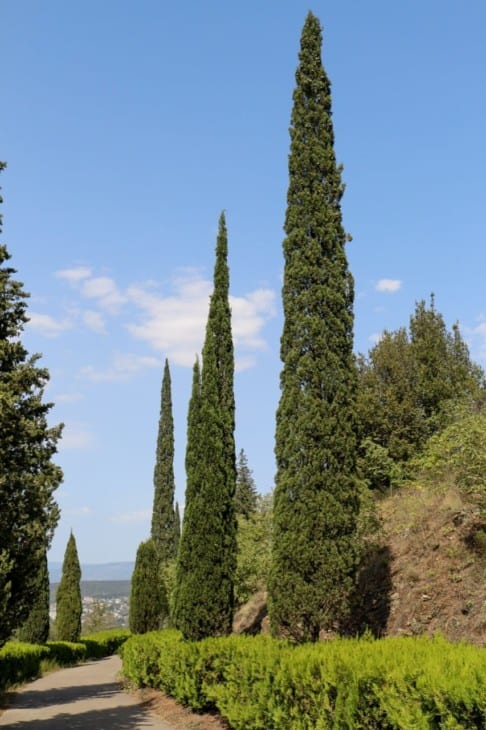
Italian cypress (Cupressus sempervirens) is hardy only in USDA zones 7 to 10, so most American gardeners need a substitute for that narrow exclamation-point shape. The closest matches are columnar junipers: ‘Taylor’ eastern red cedar and ‘Skyrocket’ or ‘Blue Arrow’ Rocky Mountain juniper are as narrow as an Italian cypress and hardy to zone 3 or 4. ‘Emerald Green’ arborvitae, ‘Spartan’ Chinese juniper and ‘Sky Pencil’ holly give the same look on a smaller scale, and for deciduous height there are columnar oaks, hornbeams and Lombardy poplar.
Contents
What makes the Italian cypress distinctive is the ratio: 40 to 60 feet tall in a garden and only 3 to 5 feet wide, with dense, dark, scale-like foliage right to the ground. When you shop for a substitute, that ratio matters more than the species. Check the mature width on the label, not just the height, and be skeptical of anything described as “pyramidal”, which usually means a wide base.
- The Closest Matches
- Bigger Evergreen Columns
- Deciduous Columns
- Small and Dwarf Options
- How to Choose and Plant One
| Tree | Botanical name | Mature size | Hardiness | Evergreen? |
|---|---|---|---|---|
| ‘Taylor’ Juniper | Juniperus virginiana ‘Taylor’ | 15–20 ft × 3–4 ft | Zones 3–9 | Yes |
| ‘Skyrocket’ and ‘Blue Arrow’ Juniper | Juniperus scopulorum | 15–20 ft × 2–3 ft | Zones 4–9 | Yes |
| ‘Spartan’ Chinese Juniper | Juniperus chinensis ‘Spartan’ | 15–20 ft × 4–5 ft | Zones 4–9 | Yes |
| ‘Emerald Green’ Arborvitae | Thuja occidentalis ‘Smaragd’ | 12–15 ft × 3–4 ft | Zones 3–8 | Yes |
| ‘Sky Pencil’ Holly | Ilex crenata ‘Sky Pencil’ | 8–10 ft × 2 ft | Zones 6–9 | Yes |
| Incense Cedar | Calocedrus decurrens | 40–60 ft × 8–12 ft | Zones 5–8 | Yes |
| Leyland Cypress | × Cuprocyparis leylandii | 40–60 ft × 15–20 ft | Zones 6–10 | Yes |
| Italian Cypress Itself, in a Pot | Cupressus sempervirens ‘Tiny Tower’ | 8–10 ft × 2–3 ft | Zones 7–10 in ground | Yes |
| Lombardy Poplar | Populus nigra ‘Italica’ | 40–60 ft × 10–12 ft | Zones 3–9 | No |
| Columnar English Oak and ‘Kindred Spirit’ | Quercus robur f. fastigiata, Q. × warei ‘Nadler’ | 30–50 ft × 6–15 ft | Zones 4–8 | No |
| Columnar European Hornbeam | Carpinus betulus ‘Fastigiata’ | 30–40 ft × 20–30 ft | Zones 4–8 | No |
| Dwarf Alberta Spruce | Picea glauca ‘Conica’ | 10–13 ft × 7–8 ft | Zones 2–6 | Yes |
| Clipped Yew Columns | Taxus × media ‘Hicksii’ | 10–12 ft × 3–4 ft | Zones 4–7 | Yes |
| Eastern Red Cedar | Juniperus virginiana | 30–40 ft × 8–20 ft | Zones 2–9 | Yes |
The Closest Matches
‘Taylor’ Juniper (Juniperus virginiana ‘Taylor’)

‘Taylor’ is the substitute to buy if you want one tree to do the job. It is a selection of eastern red cedar found in Taylor, Nebraska, and it holds a tight blue-green column 15 to 20 feet tall and only 3 to 4 feet wide with no pruning at all. It is hardy to zone 3, tolerates heat, drought, clay and alkaline soil, and it is far more cold-hardy than Italian cypress. Its one weakness is cedar-apple rust, so avoid it if you grow apples or crabapples nearby.
‘Skyrocket’ and ‘Blue Arrow’ Juniper (Juniperus scopulorum)
These two Rocky Mountain juniper cultivars are the narrowest conifers sold in North America. ‘Skyrocket’ reaches 15 to 20 feet and stays 2 to 3 feet wide; ‘Blue Arrow’ is similar but bluer and denser, and it holds its shape better under snow. Both want full sun and sharp drainage, and both hate humid, wet summers, so they do best in the West and the dry Midwest. In the humid Southeast they are prone to blight.
‘Spartan’ Chinese Juniper (Juniperus chinensis ‘Spartan’)

‘Spartan’ is the workhorse of the group: a dense, rich green column 15 to 20 feet tall and 4 to 5 feet wide that shears well and tolerates heat, drought and poor soil. It is slightly broader than ‘Taylor’ or ‘Skyrocket’, which makes it a better screen and a slightly less convincing Italian cypress. It handles Southern humidity better than the Rocky Mountain junipers do.
‘Emerald Green’ Arborvitae (Thuja occidentalis ‘Smaragd’)

‘Emerald Green’, sold in Europe as ‘Smaragd’, is the most widely planted narrow evergreen in the country, and a row of them along a drive reads much like a cypress avenue. It grows 12 to 15 feet tall and 3 to 4 feet wide, slowly, and keeps its bright green color through winter, which most arborvitae do not. It needs moist soil and will brown out in drought, and deer eat it, so fence it where deer are common.
‘Sky Pencil’ Holly (Ilex crenata ‘Sky Pencil’)

‘Sky Pencil’ is a miniature Italian cypress for a courtyard or a pair of pots by a door: a narrow column 8 to 10 feet tall and about 2 feet wide, with small, glossy, spineless leaves. It is broadleaf rather than needled, so it reads softer up close. It needs acidic, well-drained soil and afternoon shade in the hottest zones, and its branches splay open under heavy snow, so tie it loosely with twine before winter.
Bigger Evergreen Columns
Incense Cedar (Calocedrus decurrens)

Incense cedar is the best large-scale stand-in for Italian cypress in North America. It is a western native that holds a narrow, dense, dark green spire 40 to 60 feet tall, with fragrant, cinnamon-colored fissured bark, and its crushed foliage smells like a sharpened pencil, which is what the wood is used for. It is drought tolerant once established and long-lived, but it is slow and it is wider than a true cypress at 8 to 12 feet.
Leyland Cypress (× Cuprocyparis leylandii)

Leyland cypress is what gets sold to people asking for Italian cypress, and it is not the same plant at all. It is broadly conical rather than columnar, 15 to 20 feet wide, and it grows 3 feet a year, which is why hedges of it turn into problems. It is also prone to bagworms and to canker diseases that kill whole branches in the Southeast. Plant it only where you genuinely want a fast, wide screen, and give it 10 feet between plants.
Italian Cypress Itself, in a Pot (Cupressus sempervirens ‘Tiny Tower’)
If your heart is set on the real thing and you garden in zone 5 or 6, grow a dwarf selection such as ‘Tiny Tower’ or ‘Monshel’ in a large pot and move it into an unheated garage or a cold greenhouse for winter. It reaches 8 to 10 feet in a container. Keep it barely moist while it is dormant, and bring it back out as soon as hard frost has passed. In the ground north of zone 7 it will die in the first bad winter.
Deciduous Columns
Lombardy Poplar (Populus nigra ‘Italica’)

Lombardy poplar gives you a tall, narrow silhouette faster than anything else, 6 feet a year, which is exactly why it is planted and exactly why it disappoints. It is highly susceptible to cytospora canker, which kills the crown from the top down, and most trees are ugly by 15 years and dead by 20. The roots sucker into lawns and invade drains. Plant it only as a temporary screen while something better grows, and plant that something at the same time.
Columnar English Oak and ‘Kindred Spirit’ (Quercus robur f. fastigiata, Q. × warei ‘Nadler’)

Upright oaks are the long-lived deciduous answer. ‘Kindred Spirit’ is a hybrid of English and swamp white oak, about 30 feet tall and 6 feet wide, mildew-resistant and adaptable, with yellow-brown fall color rather than the bright red often claimed for it. ‘Crimson Spire’ is similar with red-brown autumn leaves. Both are true trees that will outlive you, and both leave a bare column of twigs in winter.
Columnar European Hornbeam (Carpinus betulus ‘Fastigiata’)
‘Fastigiata’ hornbeam is narrow and flame-shaped when young, which is when most photographs of it are taken, and it broadens into an oval 20 to 30 feet wide with age. Buy it for a formal, clipped, architectural presence rather than a permanent narrow column, because it takes shearing better than almost any other tree. It holds tan leaves through much of the winter, which gives it screening value the other deciduous options lack.
Small and Dwarf Options
Dwarf Alberta Spruce (Picea glauca ‘Conica’)

Dwarf Alberta spruce is a neat, dense cone rather than a column, and at 7 to 8 feet wide at maturity it is a poor Italian cypress impression unless you keep it sheared. It is worth knowing about because it is sold everywhere, it is hardy to zone 2 and it is the easiest of these plants to grow in a pot. Watch it for spider mites in hot, dry weather, which is its usual cause of death, and for reverted branches that grow fast and coarse.
Clipped Yew Columns (Taxus × media ‘Hicksii’)
If you want the cypress look in a cold, shady garden, clipped yew is the answer that English gardeners have used for centuries. ‘Hicksii’ grows naturally upright, 10 to 12 feet by 3 to 4 feet, takes hard shearing, tolerates shade better than any conifer here and lives for a very long time. It needs well-drained soil and will die in wet ground. Every part except the red flesh around the seed is poisonous to people, horses and dogs.
Eastern Red Cedar (Juniperus virginiana)

The wild species is worth mentioning because it is what the good cultivars are selected from, and because it is often sold simply as “red cedar”. Wild-type eastern red cedar is broadly conical and can be 20 feet wide, so it is not a cypress substitute; buy a named narrow clone such as ‘Taylor’ instead. It is North America’s most adaptable native conifer, growing in clay, sand, drought, salt and poor soil from Maine to Texas.
How to Choose and Plant One
- Check the mature width first. A tree sold as “columnar” at 8 feet wide is not going to look like an Italian cypress. Aim for a height-to-width ratio of at least 4:1.
- Match the climate, not the picture. Rocky Mountain junipers fail in humid Southern summers; arborvitae browns out in dry Western ones. Ask a local nursery what actually thrives, not what is in stock.
- Space them properly for an avenue. Italian cypresses in Tuscany are planted 8 to 12 feet apart. Copying that spacing matters more to the effect than the species you choose.
- Plant at the right depth. Set the root flare at or slightly above soil level, water deeply once a week through the first two summers, and mulch, keeping the mulch off the trunk.
- Tie up multi-stemmed plants before winter. Arborvitae, ‘Sky Pencil’ holly and narrow junipers splay open under wet snow. A loop of soft twine in November prevents a permanent split.
- Expect to prune very little. These plants hold their shape on their own. If you must reduce one, cut back to a side branch inside the canopy; conifers other than yew do not resprout from bare wood.
For more on conifers and their shapes, see our guides to the most common trees in North America and trees that look like Christmas trees.