A Japanese garden is the quietest garden there is, and the quiet is not an accident. Every element in it has been chosen, placed and then, crucially, left alone, and the calm you feel standing in one comes from the sheer amount of stuff that is not there. It is the one style where the hardest work is deciding what to leave out.
Contents
- 01. Design the Garden From One Viewpoint
- 02. Rake a Dry Gravel Garden
- 03. Set Rocks in Groups of Three
- 04. Plant One Japanese Maple and Give It Room
- 05. Grow Moss Instead of Grass
- 06. Lay Stepping Stones That Slow You Down
- 07. Add a Stone Water Basin
- 08. Clip Azaleas Into Soft Cloud Mounds
- 09. Build a Bamboo Fence
- 10. Cloud-Prune a Pine
- 11. Add a Deer Scarer for Sound
- 12. Place a Stone Lantern Where It Would Be Needed
- 13. Dig a Pond With an Irregular Edge
- 14. Cross the Water on a Simple Bridge
- 15. Hide the Garden From Itself
- 16. Restrict the Palette to Green
- 17. Use Camellia and Pieris for Winter Structure
- 18. Plant a Cherry for One Week a Year
- 19. Plant Iris and Ferns at the Water’s Edge
- 20. Make a Tiny Courtyard Garden
- 21. Run Mondo Grass Between the Stones
- 22. Build a Simple Timber Pavilion
- 23. Let Autumn Be the Big Event
- 24. Sweep, Prune, and Do Almost Nothing Else
- 25. Leave Empty Space
The 25 ideas below cover the whole range: a full pond-and-island garden, a dry gravel courtyard the size of a parking space, a single maple in a corner, a moss carpet under an old tree. Some are proper projects with rocks and machinery, others are an afternoon with a rake. Nearly all of them work as well in a small suburban plot as in an acre, because this style was largely invented for small enclosed spaces.
Take one or two rather than all of them. A garden with three of these ideas done properly will feel more Japanese than one with twenty crammed in, which is the whole lesson of the style in a sentence.
01. Design the Garden From One Viewpoint
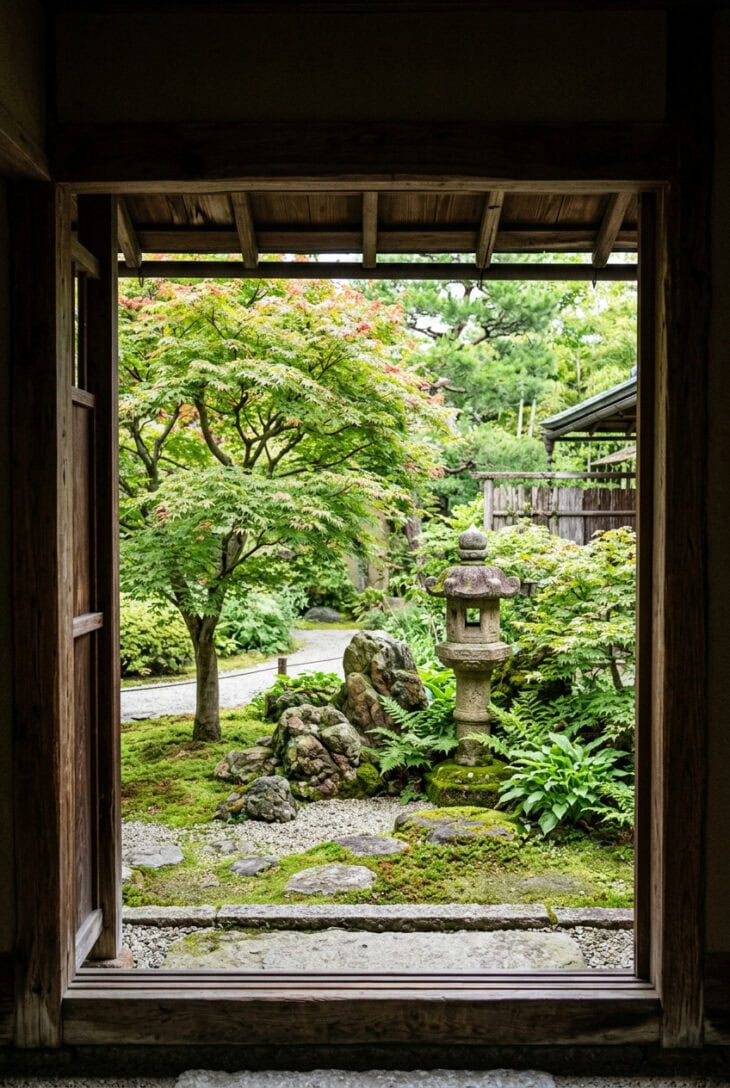
What you see The garden seen through an opening: a dark timber frame in the foreground, and beyond it a maple, a group of rocks and a stone lantern arranged as neatly as a painting. Nothing is out of place because nothing is out of frame. Move two steps to the left and the composition would fall apart, and it does not matter, because nobody stands there.
Why it works Western gardens are designed to be walked around and viewed from everywhere, which means every element has to work from every angle and none of them quite does. A Japanese garden is often composed for one seat, one window, one doorway. Choosing that viewpoint first and building the whole picture to be seen from it is the single most useful thing you can borrow from the style, and it costs nothing.
How to get it Find the place you actually look at the garden from: the kitchen window, the back step, one chair. Sit there, and treat the view as a frame with a foreground, a middle and a background. Put your best object (a rock group, a maple, a lantern) slightly off center, roughly a third of the way in, and keep the rest quiet. Then go and stand there again after every change you make. If it does not improve the view from that spot, it does not go in.
02. Rake a Dry Gravel Garden
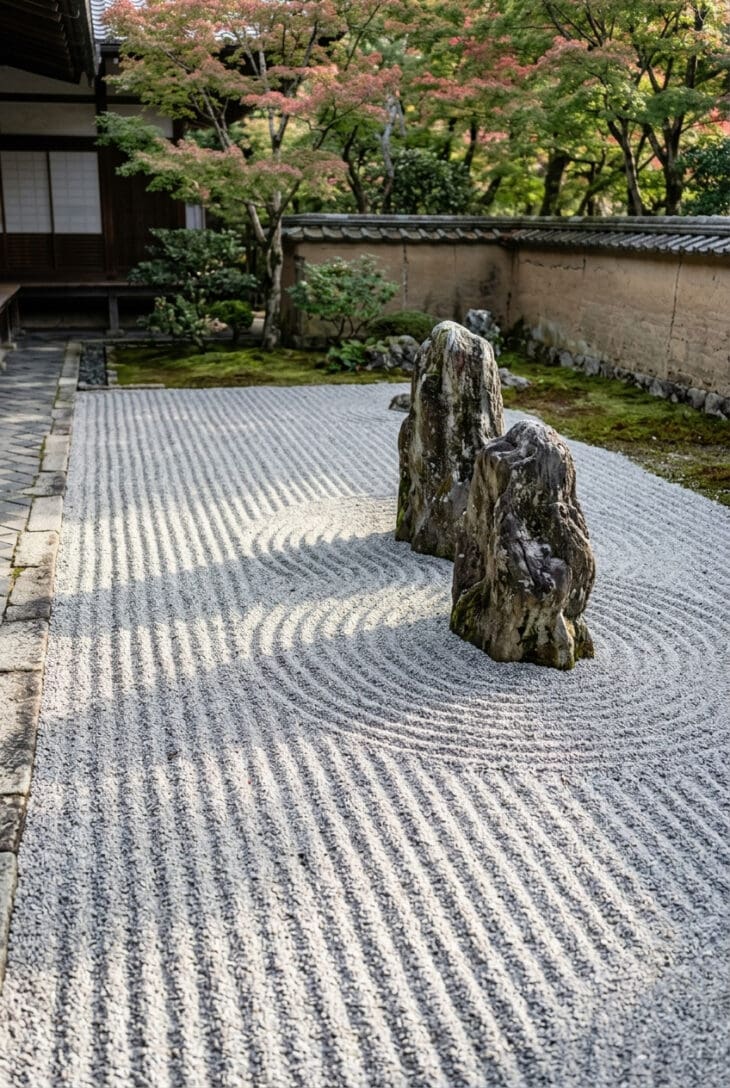
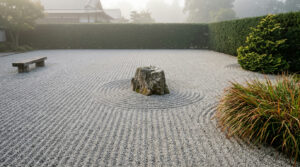
What you see A rectangle of pale grey grit, raked into dead straight parallel lines, with ripples circling out around two upright rocks that break the surface like islands in a sea. Low morning sun catches the edge of every groove. Nothing grows here, nothing moves, and it is the most arresting thing in the garden.
Why it works The dry garden (karesansui) is an abstraction: gravel stands for water, rocks stand for islands or mountains, and the rest is left to the person looking at it. Because it contains almost nothing, it survives being looked at every day for years without becoming boring, which no flower border manages. It also thrives in exactly the sites that defeat planting, such as deep shade under a wall or a hot dry courtyard.
How to get it Use angular crushed granite or grit around 3 to 5mm, never rounded pea gravel, which will not hold a rake line. Lay it 2 to 3in (5 to 8cm) deep over a compacted, weed-free base with a firm edge to contain it. Buy or make a wooden rake with wide teeth and rake the lines straight, working backwards so you do not walk on the finish. Expect to re-rake after wind and rain, and treat that as the point of the thing rather than a chore.
03. Set Rocks in Groups of Three
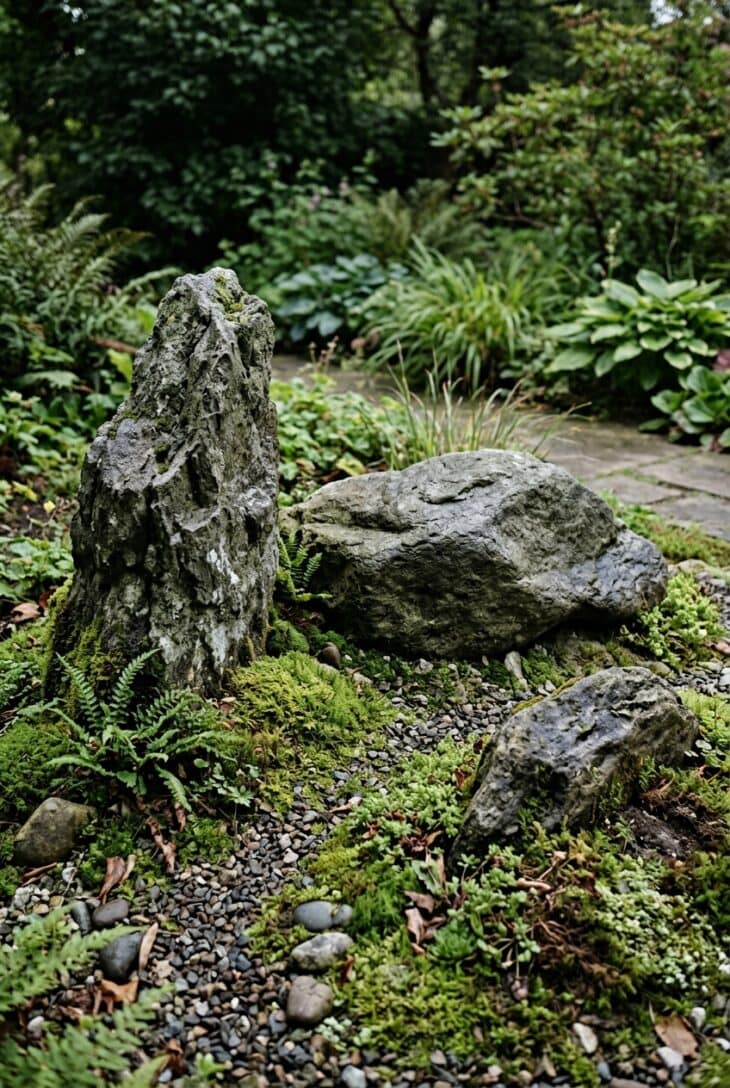
What you see Three rocks, and it takes a moment to realise somebody put them there. One stands tall, one lies broad and low, one is barely more than a shoulder breaking the surface. Moss has crept up around their bases. They are clearly related to each other, and just as clearly not arranged.
Why it works Rocks are the bones of a Japanese garden and they are set before anything is planted. Grouping them in odd numbers, most often threes, avoids the static symmetry of a pair and creates a relationship: a main stone, a supporting stone, and a third that connects them. It is the same principle as a good still life. The deeper point is that stone is the one element that will not change over the years, so it is the thing that gives the garden its permanence.
How to get it Buy local stone with weathered, lichened faces, and never anything with a sawn or fresh-blasted surface. Bury each rock by at least a third of its height, which is the rule that separates a placed rock from a dumped one, and set them so the grain or strata of every stone runs in the same direction, as it would in nature. Vary the sizes hard and never space them evenly. Look at the group from your main viewpoint before you backfill, because moving a half-ton rock afterwards is a different job entirely.
04. Plant One Japanese Maple and Give It Room
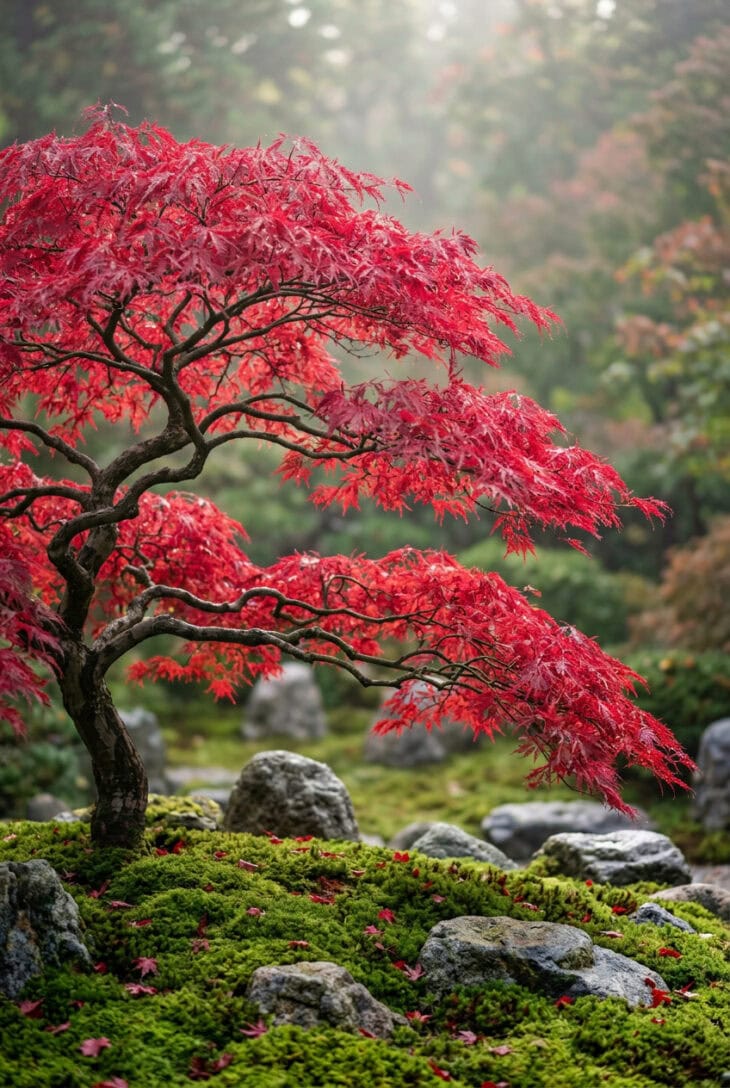
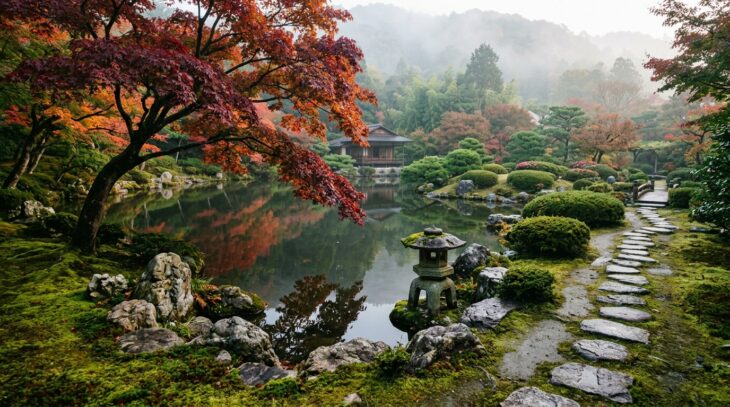
What you see One maple, its branches layered in horizontal tiers, its finely cut leaves burning crimson, arching out over moss and a few grey rocks. There is nothing else near it. In the soft damp light the leaves are almost luminous, and the tree is reflected in the wet ground beneath it.
Why it works The Japanese maple is the most generous small tree in cultivation: a fine leaf that casts dappled rather than heavy shade, a naturally layered branch structure that looks composed without any pruning, a spring flush, an autumn blaze, and a beautiful silhouette in winter. Giving it space is the whole idea. A maple in a crowded border is a shrub; a maple with a clear stage around it is the garden.
How to get it Japanese maple (Acer palmatum ‘Osakazuki’ for the best scarlet, ‘Bloodgood’ for a dark leaf all season, ‘Sango-kaku’ for coral winter bark) wants dappled shade, shelter from wind, and moist but well-drained acid to neutral soil. Two things ruin them: scorching wind, which crisps the leaf edges brown by July, and waterlogged ground. Do not prune except to remove a dead or crossing branch, and do that in midwinter, since maples bleed sap heavily if cut in spring.
05. Grow Moss Instead of Grass
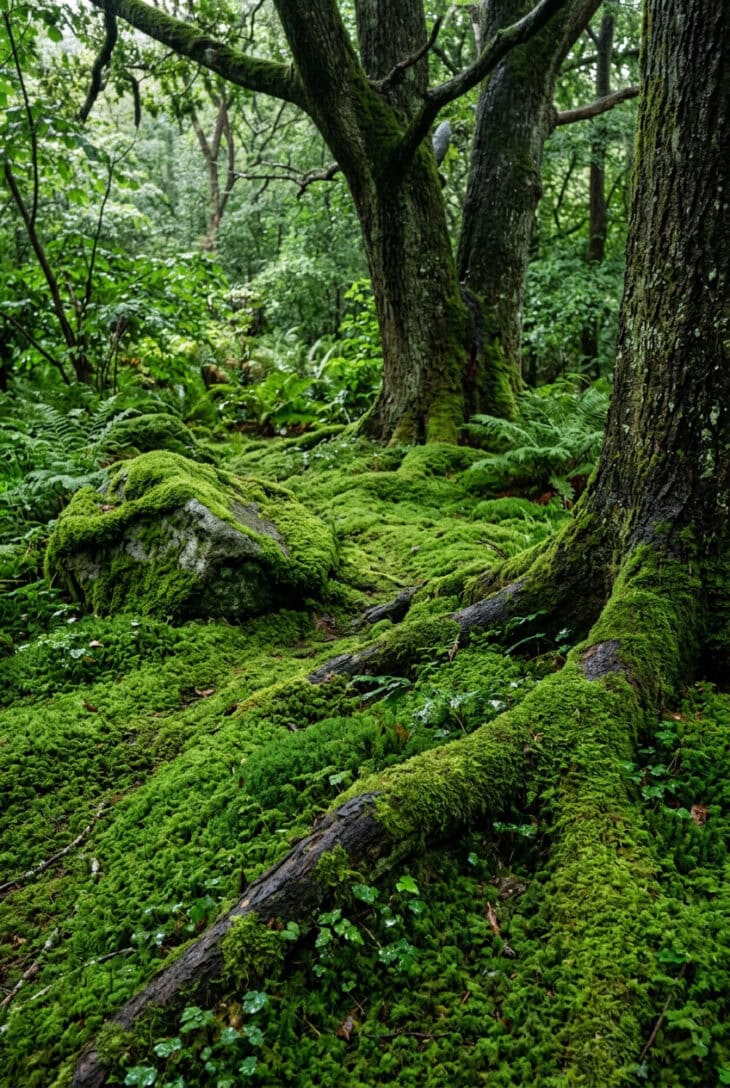
What you see A carpet of moss so deep and even it looks like green velvet thrown over the ground, flowing up over tree roots and around the base of a rock. It is damp, it is glowing, and it is silent to walk on. There is no grass anywhere, and the shade that would have killed a lawn is what has made this.
Why it works Moss is the answer to the problem every shady garden has. It wants damp, still, acidic, shaded ground with poor soil, which is precisely the site where grass turns thin and yellow and moss keeps being scraped out of it. Grow it deliberately and you get a ground cover that never needs mowing, feeding or watering once established, holds its color all winter, and gives the garden the aged, settled quality that takes a lawn decades to fake.
How to get it Moss needs shade, moisture and firm ground: clear the site of all weeds and debris, rake it level, and firm it hard, since moss will not colonise loose soil. Do not add compost. Press sheets or clumps of local moss down onto the surface, water daily for the first month, and keep leaves swept off with a soft brush rather than a rake. It cannot take heavy foot traffic, so run stepping stones through it. In drier climates, Irish moss (Sagina subulata) or mind-your-own-business gives a similar look with more tolerance.
06. Lay Stepping Stones That Slow You Down
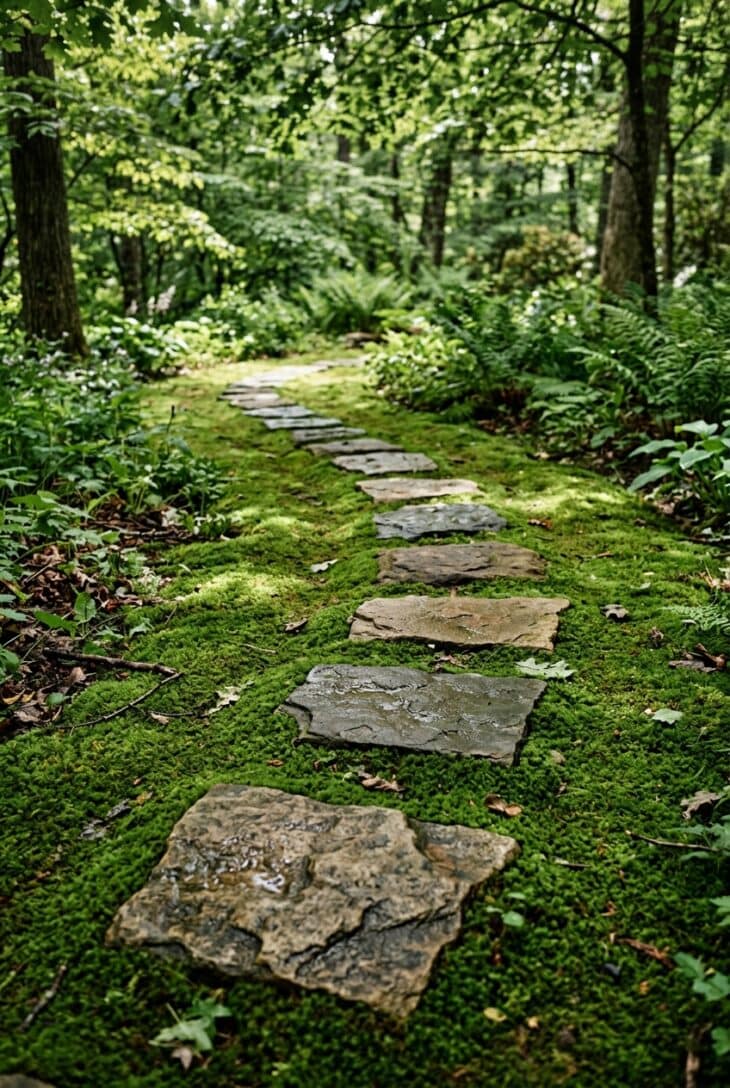
What you see Flat stones set into moss, each one a different shape, spaced unevenly, curving away. They sit flush with the moss so the surface reads as continuous. You find yourself watching your feet as you walk it, which means you are walking slowly, which means you are looking around.
Why it works Stepping stones in this tradition (tobi-ishi) are a device for controlling how somebody moves. Set close and even, they let you stride; set irregularly, they make you place each foot deliberately, slowing you to the pace at which the garden can actually be seen. Where the designer wants you to stop and look, the stones widen into a small platform. It is choreography, done in stone.
How to get it Use irregular natural stone, 16 to 20in (40 to 50cm) across, thick enough not to rock. Space the centers around 20 to 24in (50 to 60cm) apart, a comfortable natural stride, and vary it. Bed each stone on compacted hardcore and sand so it sits absolutely firm and just proud of the surrounding moss or gravel, since a stone that wobbles or floods ruins the effect. Set a noticeably larger stone at every junction and viewpoint, which is the traditional signal to pause.
07. Add a Stone Water Basin
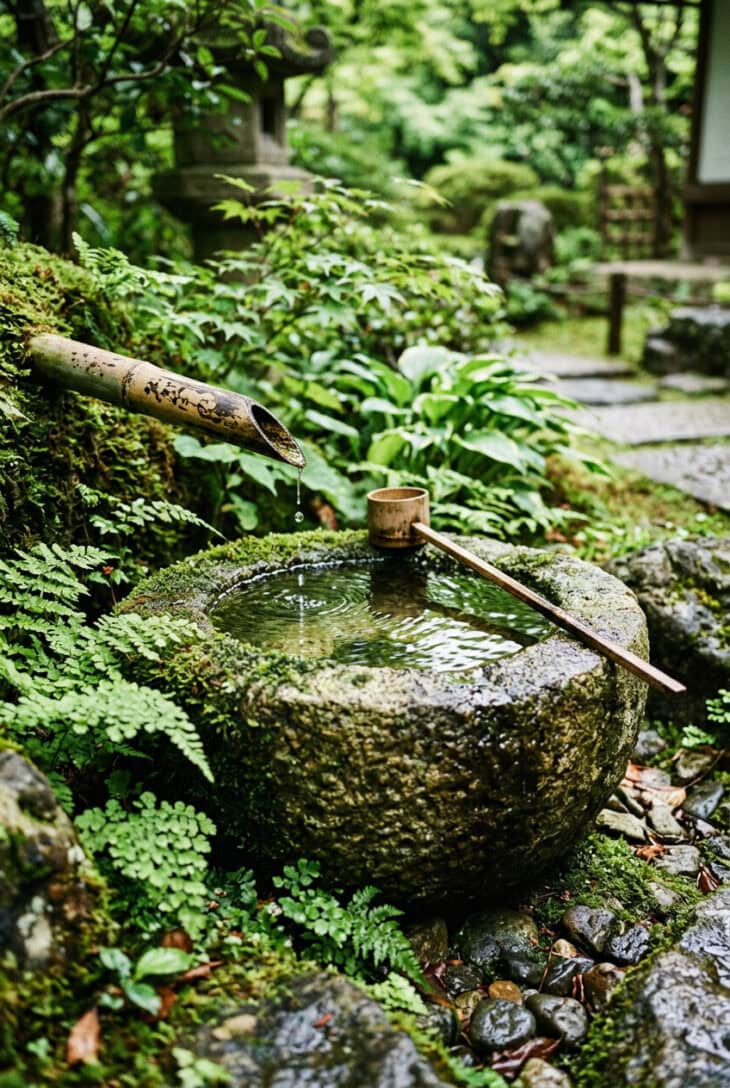
What you see A squat stone basin, hollowed out on top, mossy on its sides, brimming with perfectly clear water. A bamboo spout drips into it, slowly, and a bamboo ladle rests across the rim. It sits low to the ground, low enough that you would have to crouch to use it. Ferns crowd in around its base.
Why it works The basin (tsukubai) came from the tea garden, where guests crouched to rinse their hands and mouth before entering the tea house, and the low placement was deliberate: it forces a small bow, a moment of humility, before you go in. Even stripped of the ceremony, it does something to a garden that no other feature does. It gives you water at its quietest, a sound so slight that you have to be still to hear it.
How to get it Buy a weathered granite basin, or use any hollowed stone; a reclaimed millstone or trough works. Set it low, with the rim no more than 12 to 16in (30 to 40cm) off the ground, on a bed of cobbles that hides a small reservoir and pump beneath. Keep the water brimming, since a half-full basin looks abandoned. Site it in shade to slow the algae, top it up with rainwater, and let moss grow on the outside, which is the point of the whole thing.
08. Clip Azaleas Into Soft Cloud Mounds
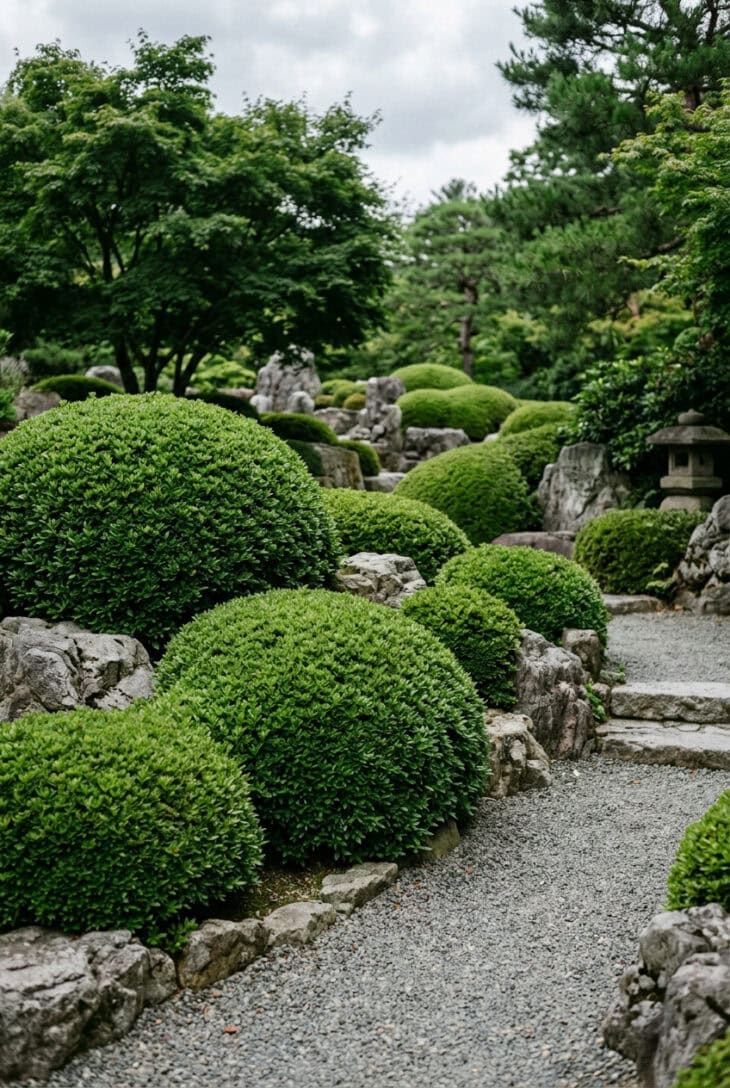
What you see Smooth rounded green mounds of different sizes, flowing into one another like a group of boulders or a bank of cloud, with grey rocks emerging between them. There is not a single flower on them. They are clipped so tightly that the surface reads as a solid skin, and they hold the whole composition down.
Why it works This is the technique (karikomi) that gives a Japanese garden its unmistakable soft geometry: not the cones and cubes of European topiary, but rounded organic forms that echo hills, rocks and clouds. The mounds provide the mass and structure a garden needs while remaining quiet, and because they are evergreen they hold the picture together through winter. That most gardeners grow azaleas for the flowers and then clip them off is not a mistake here, it is the tradition.
How to get it Evergreen Kurume or Satsuki azaleas are the classic choice, and box, Japanese holly (Ilex crenata) and yew all clip into the same forms. Plant several together at slightly different heights and clip them as a single flowing mass rather than as individual balls, letting the mounds merge. Clip immediately after flowering, using shears rather than a powered trimmer for a rounder finish, and remember azaleas need acid soil, so use ericaceous compost or grow them in raised beds if your ground is chalky.
09. Build a Bamboo Fence
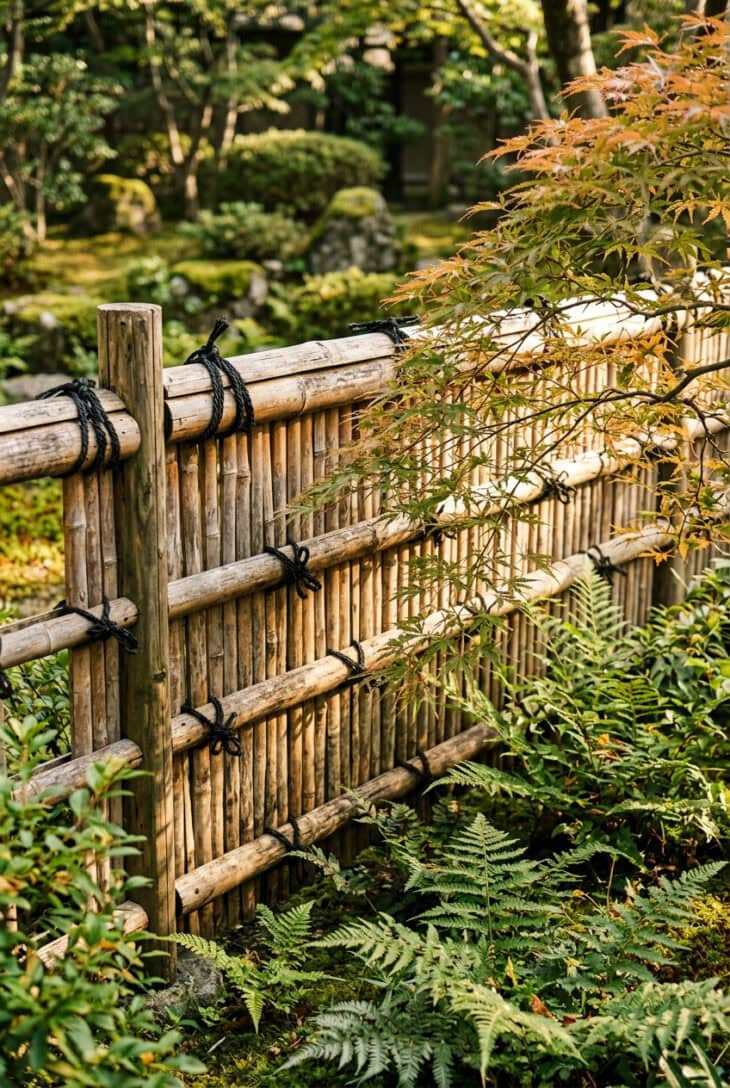
What you see A fence made of bamboo, split and whole poles set vertically and bound together at each crossing with black twine tied in neat, deliberate knots. The cane has weathered from green to honey to soft grey. A fern and the tip of a maple branch break the line in front of it, and the whole thing looks handmade, because it is.
Why it works A boundary is usually the least considered surface in a garden and the one you see most of. In this tradition it is a crafted object in its own right, and a bamboo fence brings three things at once: a warm natural material, a fine vertical rhythm that suits the planting in front of it, and visible handwork in the knots, which is what makes it feel made rather than bought. It also reads as unmistakably Japanese from across the garden, which few things do.
How to get it Buy treated bamboo poles and black tarred twine, and build against a simple pressure-treated timber frame rather than trying to make the bamboo structural. The knot is the detail everyone looks at, so learn the traditional ibo-musubi (male knot) from a video and take the time to make every one identical. Expect natural bamboo to last 5 to 10 years outdoors, less if it sits wet, so keep the poles clear of the soil. For a boundary you never want to rebuild, synthetic bamboo panels have improved a great deal.
10. Cloud-Prune a Pine
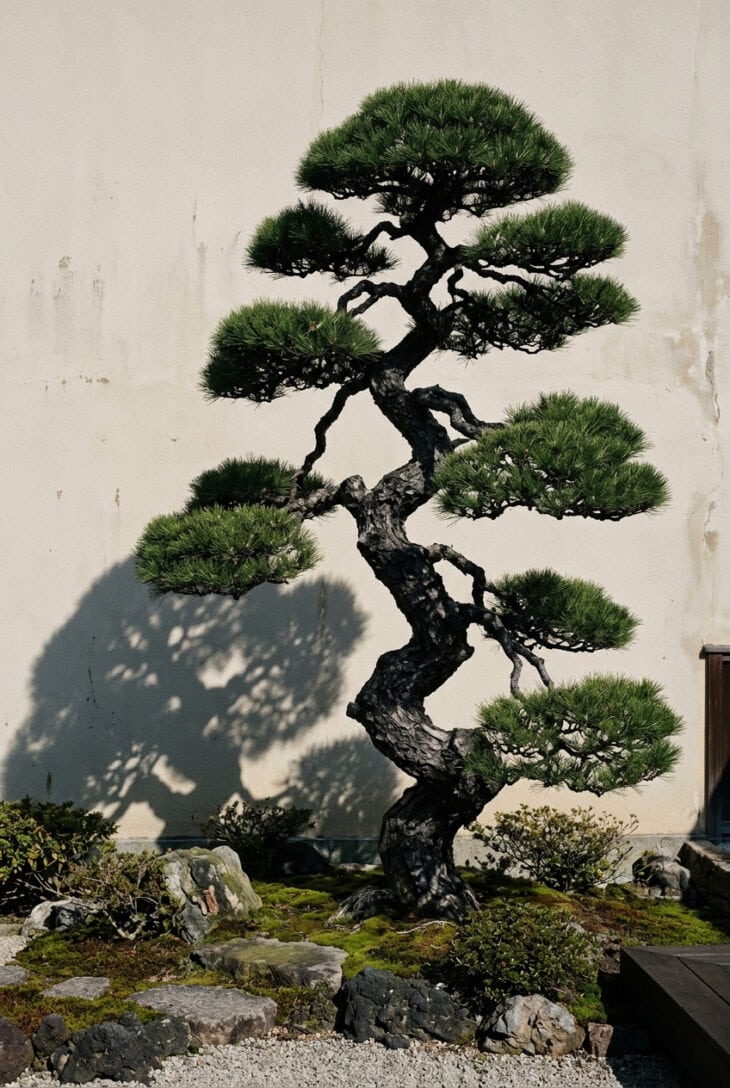
What you see A pine with a dark twisting trunk and its foliage held in distinct separated pads, layered like flat clouds, each one clearly detached from the next so you can see the branch structure between them. Against a plain wall it is pure silhouette. It looks two hundred years old and it is probably thirty.
Why it works Niwaki, the art of pruning garden trees into these forms, is about revealing a tree’s structure rather than imposing a shape on it. Separating the foliage into pads lets you see the trunk and branches, which is where a pine’s character lives, and it makes a young tree read as an ancient one. It also creates the effect these gardens depend on more than any other: air. The gaps between the pads are as important as the pads.
How to get it Japanese black pine (Pinus thunbergii) is the classic, and Scots pine or mugo pine work just as well. The technique has two annual steps: in late spring, snap off (do not cut) two thirds of the length of the soft new candles to keep growth short and dense, and in autumn, pull off the old needles by hand and thin the shoots so light reaches inside the pads. Work slowly over years rather than trying to carve the shape in one go, and take out whole branches rather than shortening everything.
11. Add a Deer Scarer for Sound
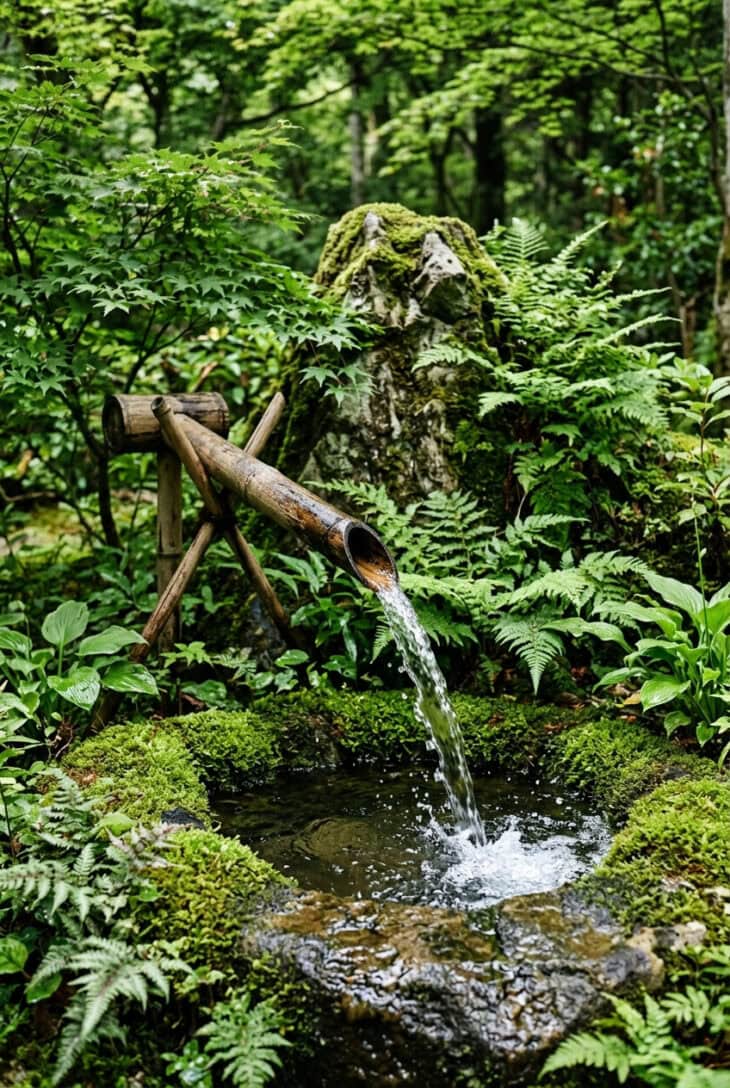
What you see A pivoted bamboo tube filling slowly from a spout, tipping over, spilling its water in an arc, and swinging back to strike a stone with a single hollow knock. Then silence, for another minute, while it fills again. Moss and ferns around it. The sound is the feature, not the object.
Why it works The shishi-odoshi was built to startle deer out of the crops, and it turned out to do something better: it marks time. Because it is silent for a minute and then makes one sharp noise, it does not fill the garden with sound the way a fountain does. It punctuates the silence, and you notice the quiet more because of it. That is a very different effect from continuous splashing, and a far more restful one.
How to get it The mechanism is simple: a bamboo tube pivoted off center, fed by a slow trickle, so it fills, over-balances, empties and swings back. The two things that make it good are the strike stone, which must be hard, flat and set solid to give a clean knock rather than a dull thud, and the flow rate, which should be slow enough that it fires roughly once a minute. Faster than that and it stops being a punctuation mark and becomes a nuisance.
12. Place a Stone Lantern Where It Would Be Needed
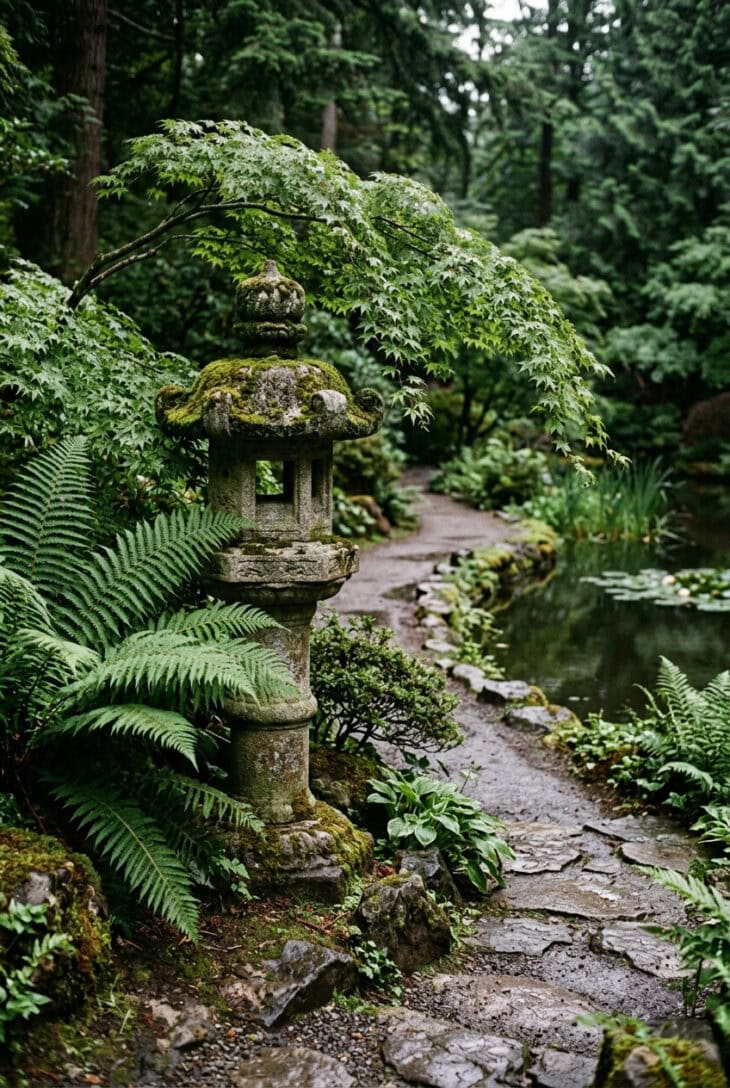
What you see A granite lantern, so weathered and mossed that it is nearly the same color as the rocks, standing where the path turns beside the water. A fern frond and a low maple branch half hide it. It is not on a plinth, not lit, and not centred on anything. You almost walk past it.
Why it works The stone lantern is the most misused object in Western Japanese gardens, planted dead center on a lawn like an ornament. Traditionally it is a light: it belongs where a light would actually be needed, at a path junction, beside a basin, at the water’s edge, and it should be partly obscured by planting. Placed like that it stops being a souvenir and becomes part of the garden’s logic, which is the difference between a Japanese garden and a garden with Japanese things in it.
How to get it Buy weathered granite rather than cast concrete, which never ages convincingly, and choose a size in proportion to the space, since most people buy one that is too small. Set it firmly on stone or compacted ground with its base slightly sunk, never on a manufactured plinth, and always tuck it partly behind planting. Encourage moss by painting the stone with a yoghurt or buttermilk wash. One lantern per garden, and nothing else ornamental.
13. Dig a Pond With an Irregular Edge
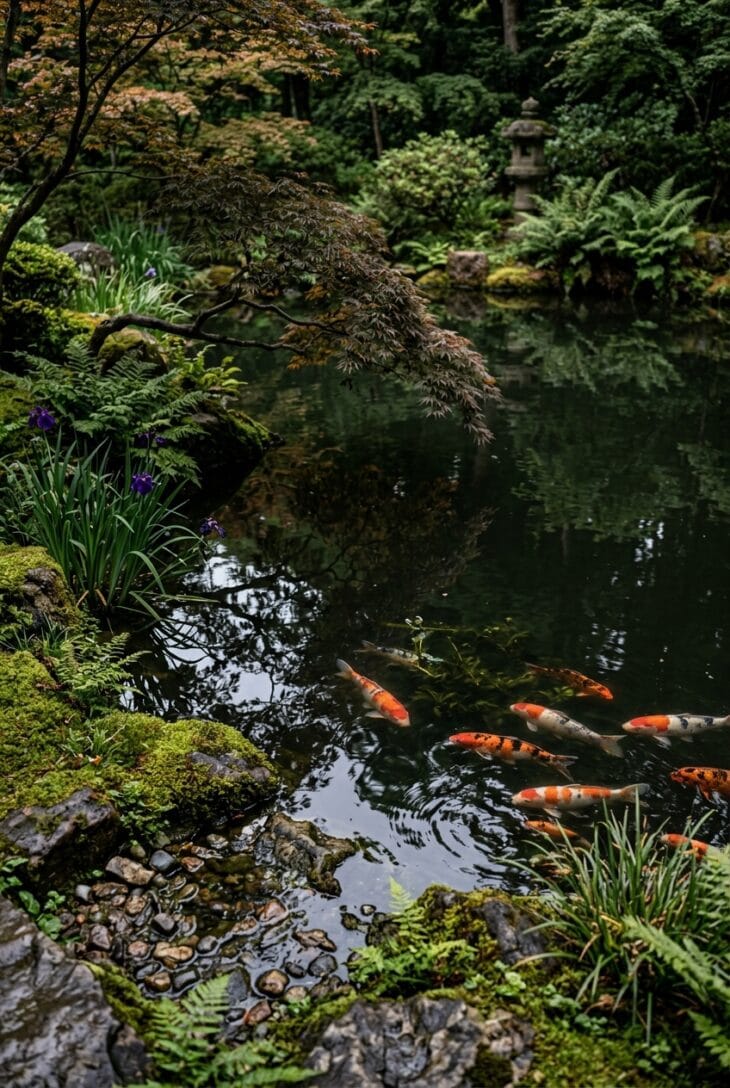
What you see Dark still water with an edge that wanders in and out, rocks and pebbles running down under the surface so you cannot see where the pond was made. Koi in orange, white and black move slowly just below. A maple branch reaches out over the water and is reproduced exactly in it. Iris and moss come right down to the margin.
Why it works A pond doubles the garden by reflecting it, and it is the one element that adds movement and life without adding noise. The edge is what makes or breaks it: a hard circular rim announces a swimming pool, while an irregular shoreline that dips in and out and disappears under overhanging planting reads as something the landscape did. Every hour of work here goes into hiding the fact that you built it.
How to get it Keep the water dark, either with a black liner or by letting the bottom silt naturally, since dark water reflects and clear water just shows you the liner. Vary the depth, running a shallow pebble beach on one side and at least 4ft (120cm) of depth if you want koi, which need the volume and a serious filter. Plant the margins with water iris (Iris ensata, Iris laevigata) and let moss run right to the edge. Site it where it will reflect a tree or the sky, and out of full midday sun to keep the algae down.
14. Cross the Water on a Simple Bridge
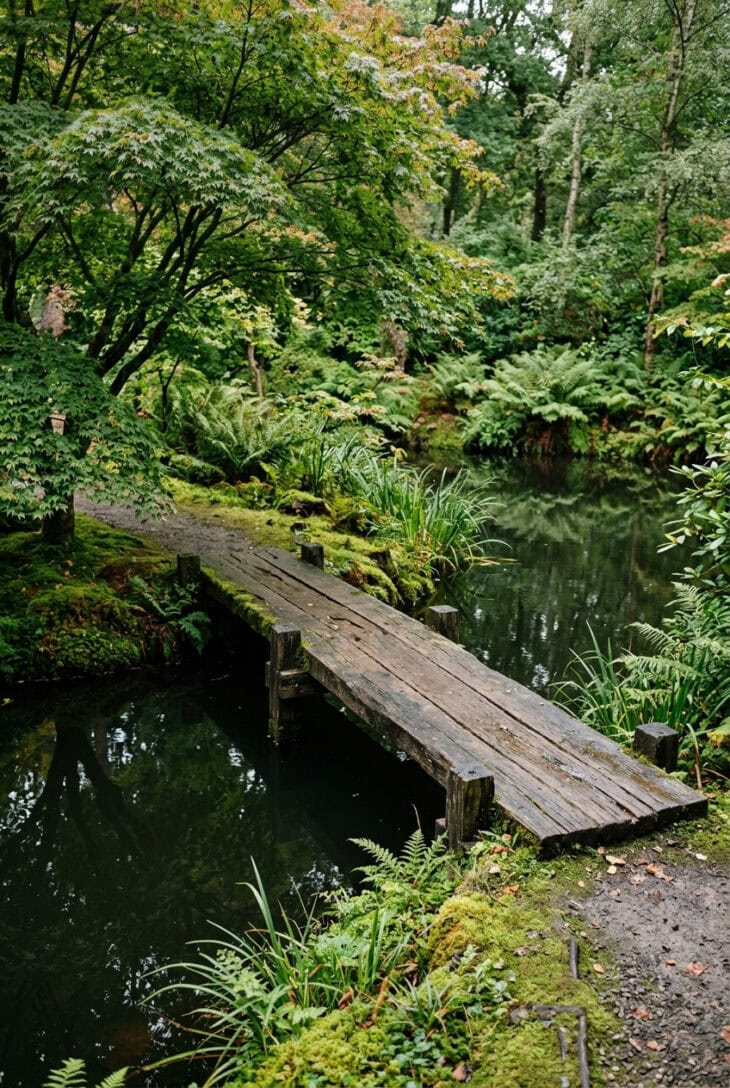
What you see Two dark weathered planks laid across the narrowest part of the pond, low to the water, with no rails and no arch. That is the entire bridge. It is barely above the surface, so crossing it puts you almost in the water, and it makes you look down.
Why it works The bright red arched bridge is the cliche, and it belongs to a very particular kind of grand temple garden rather than to a quiet domestic one. A plain plank bridge does the job better in a small garden: it is quiet, it does not compete with the planting, and by keeping you low and close to the water it changes the experience of crossing. Where a traditional yatsuhashi zigzags across a marsh, the offset planks even force you to turn your head as you walk.
How to get it Use thick hardwood planks (oak, or a durable modified timber), at least 2in (5cm) thick and spanning no more than about 6ft (180cm) without support. Set them just a few inches above the water on stone or timber bearers hidden below the surface. Leave the wood to weather grey rather than staining it, and add discreet grip strips or fine mesh, since wet timber over water is genuinely slippery. Cross at the narrowest point, not the widest, because a bridge should look necessary.
15. Hide the Garden From Itself
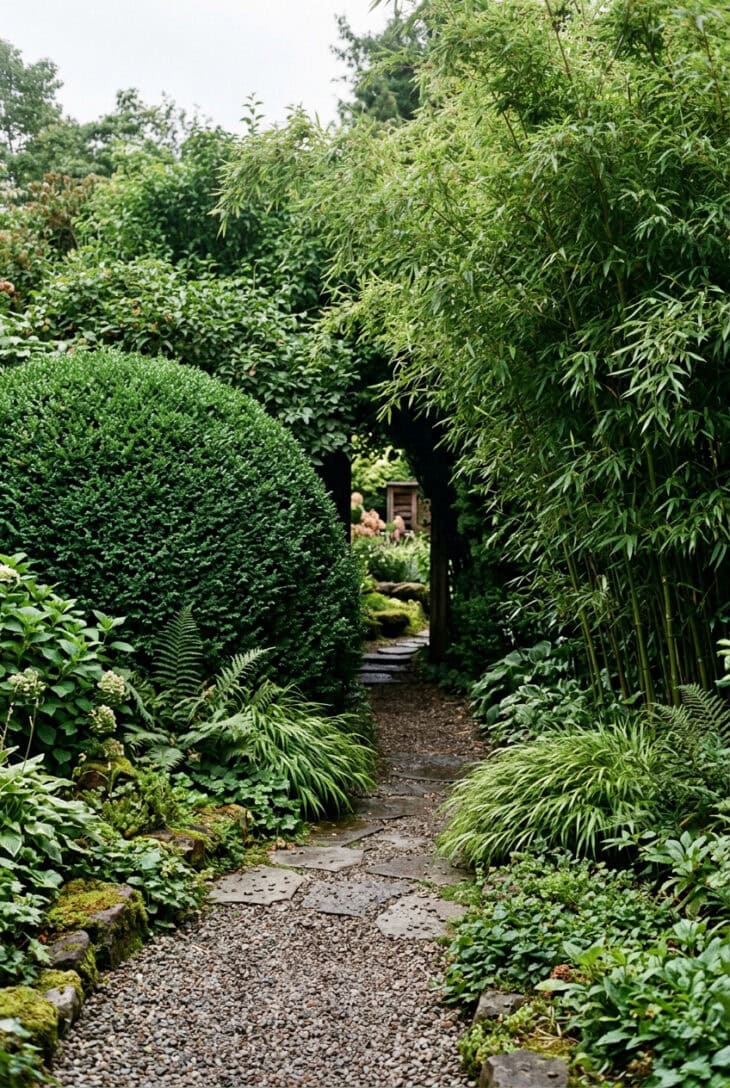
What you see The path goes behind a clipped evergreen mound and a stand of bamboo, and vanishes. Whatever is beyond is completely hidden except for one fragment glimpsed through a gap: a corner of stone, a flash of water. You have no idea how big this garden is, and it feels much larger than it can possibly be.
Why it works This is the principle called miegakure, hide and reveal, and it is the reason a small Japanese garden feels endless. Showing everything at once tells the visitor exactly how much garden there is, and the mind measures it and moves on. Concealing part of it means the space can never be fully counted, and the imagination fills in more than you actually own. It is the most powerful trick in the style, and it costs nothing but a well-placed shrub.
How to get it Stand at your main viewpoint and find the spot where you can see the far boundary. Block it, with a clipped mound, a group of bamboo, a maple, a screen. Route the path so that it bends out of sight rather than running straight to the end, and leave one small gap that shows a fragment of what is beyond. The related idea, shakkei or borrowed scenery, is the reverse: frame a distant tree or hill outside the garden so it reads as part of yours.
16. Restrict the Palette to Green
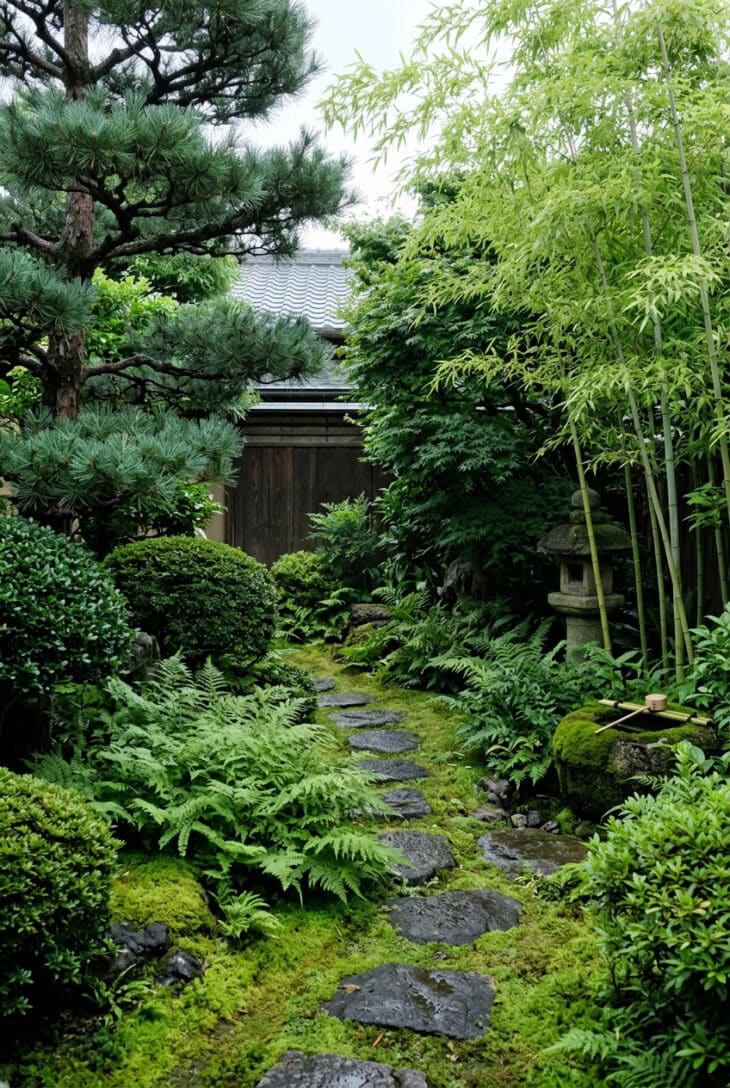
What you see Green, and then more green: near-black clipped evergreens, mid-green ferns, acid-green moss, the blue-green of pine needles, the pale green of new bamboo. Not one flower. Once you stop looking for color you start seeing texture, and there is more variety here than in any mixed border.
Why it works Flowers are noise. They demand attention, they change weekly, they die, and a garden built around them can never be still. Working almost entirely in green removes that fluctuation, so the composition you make is the composition you have all year, and the eye, freed from color, starts reading form and texture instead. This is the source of the calm people feel in these gardens, and it is a decision rather than an accident.
How to get it Build from evergreens and foliage: pine, yew, Japanese holly, azalea (clipped, not flowered), bamboo, ferns, moss, hakonechloa, mondo grass. Then allow yourself precisely two moments of color in the year and make them count: the cherry in spring and the maple in autumn. Repetition matters more than variety, so use fewer species and more of each. When you are tempted to add a flowering perennial, add another fern instead.
17. Use Camellia and Pieris for Winter Structure
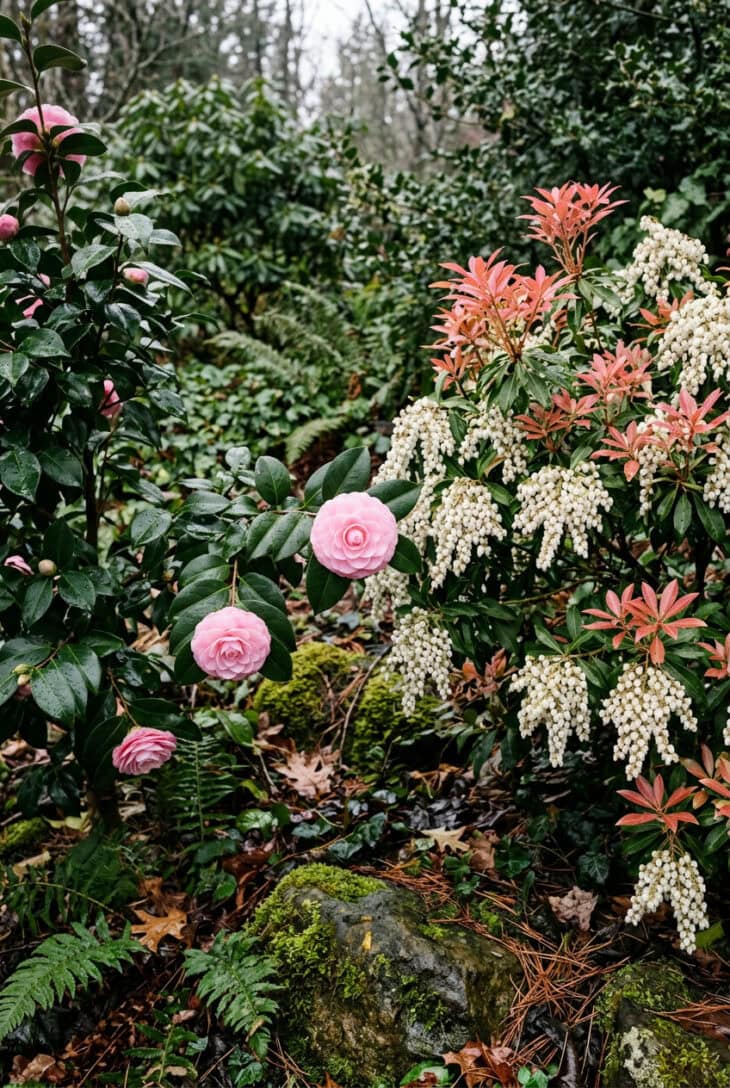
What you see Dark glossy camellia leaves with a few pink flowers, formal and precise as if they were carved. Beside it, a pieris hung with drooping sprays of small white bells, its new growth flushing scarlet. It is February and this corner is the only part of the garden doing anything, which is exactly what it is for.
Why it works A green garden needs its evergreens to be genuinely good, because they are what you look at for five months of the year. Camellia and pieris both have the glossy, dense, dark foliage this style wants, both hold their shape without clipping, and both flower in the dead of winter and early spring when nothing else is happening. In a garden that deliberately does without summer color, that timing is worth a great deal.
How to get it Camellia (Camellia japonica, or Camellia sasanqua for autumn flower and a lighter habit) and pieris (Pieris japonica ‘Forest Flame’) both need acid soil, dappled shade and shelter. One rule saves most camellias: never plant one facing east, because early morning sun on frosted buds thaws them too fast and turns the flowers brown. Mulch with pine needles or bark, never lime, and water with rainwater rather than hard tap water.
18. Plant a Cherry for One Week a Year
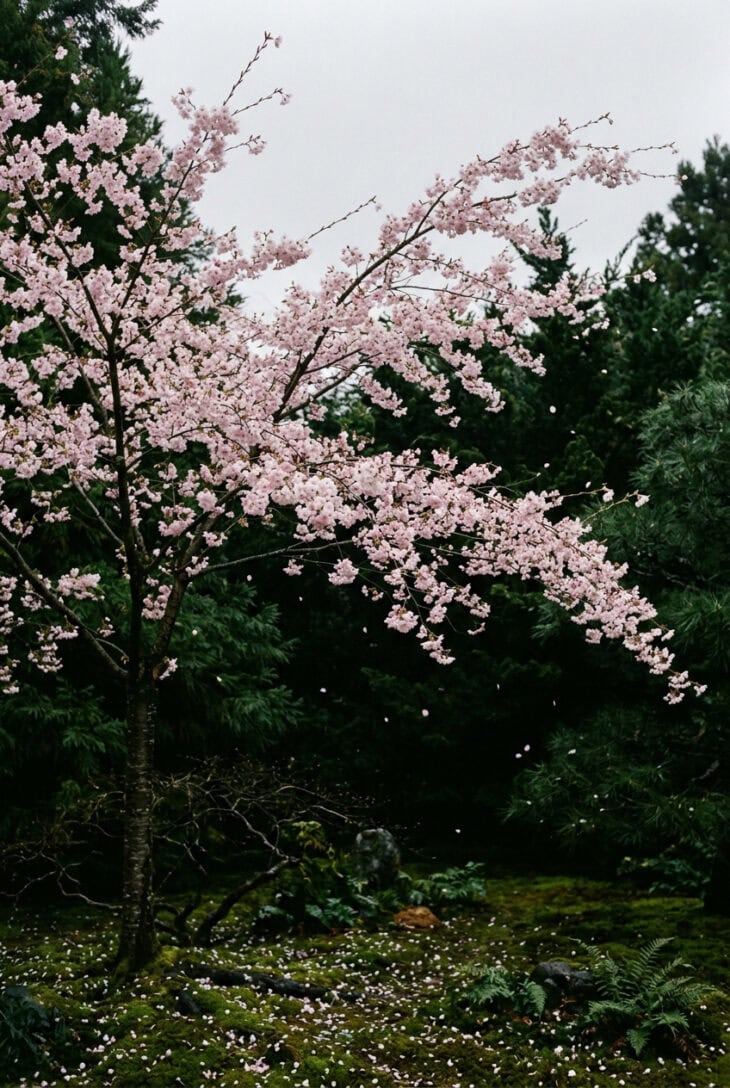
What you see A cherry in full flower, the branches solid with pale pink blossom, set against dark evergreens so the flowers read as light. Petals are already falling and lying scattered across the moss below. In a week there will be nothing left, and everybody who sees it knows that.
Why it works The cherry is not there in spite of being brief. It is there because it is brief. Hanami, the practice of going out to look at blossom, is built entirely on the idea that the flowering is beautiful precisely because it cannot be kept, and a garden that otherwise refuses seasonal drama gets its one great moment from it. Planted against dark evergreens rather than open sky, the blossom has something to read against and looks twice as bright.
How to get it Japanese cherry (Prunus serrulata ‘Tai-haku’, the great white cherry, or ‘Kanzan’ for a heavy pink) is the classic, and Prunus ‘Amanogawa’ is the one for a narrow space, growing upright like a column. Give it full sun and free-draining soil. Prune only in midsummer, never in winter, because cherries are vulnerable to silver leaf disease and bacterial canker when cut in cold wet weather. Do not underplant it heavily, since the fallen petals on bare moss or gravel are half the effect.
19. Plant Iris and Ferns at the Water’s Edge
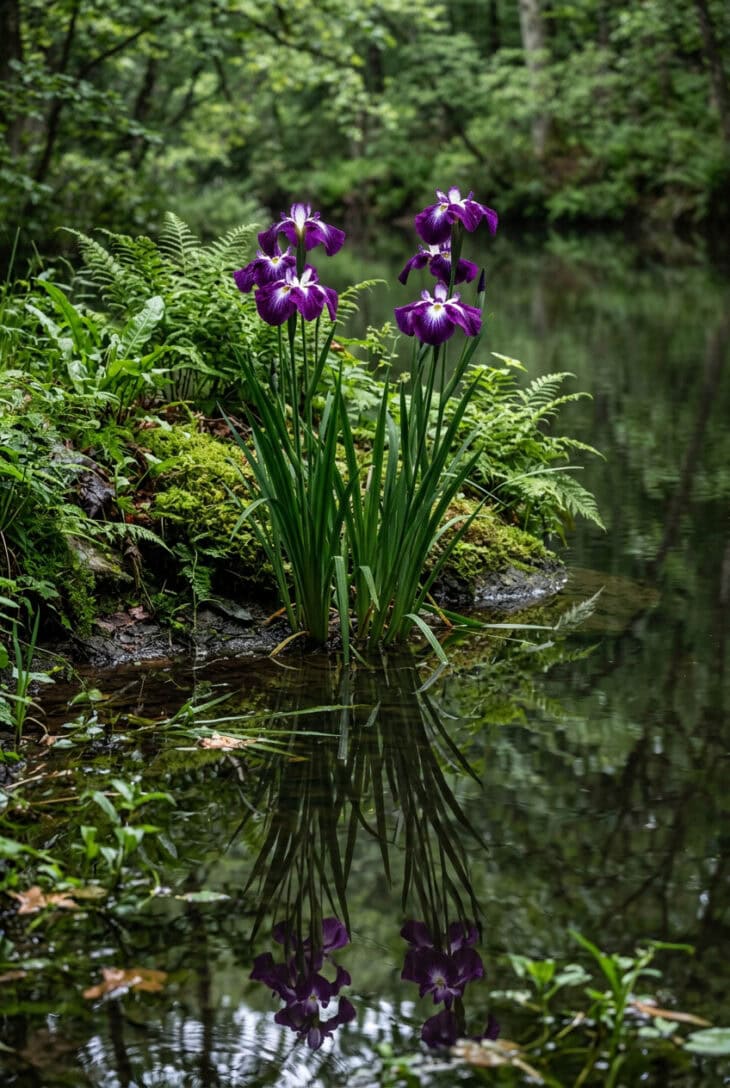
What you see Sword-shaped leaves standing straight up out of the shallow water at the pond’s edge, and above them iris flowers in deep purple and white, held flat and open like something folded rather than grown. Ferns fill the bank behind them. Everything is doubled in the water below.
Why it works The margin is the hardest part of a pond to get right, and it is where most garden ponds give themselves away. Iris solve it: their strong vertical leaves break the horizontal line of the water, they grow with their feet actually in it so the transition is blurred, and they hide the liner edge completely. The Japanese iris has been bred and revered for centuries for exactly this position, and it flowers in June when the garden’s other two moments are long past.
How to get it Japanese water iris (Iris ensata) wants to stand in a few inches of water in summer and in damp, not flooded, ground in winter, so plant it on the shelf rather than in the deep zone. Iris laevigata is happy submerged all year. Both want acid soil and full sun, and neither tolerates lime. Plant in aquatic baskets with heavy loam topped with gravel so the koi cannot root them out, and divide every three or four years after flowering.
20. Make a Tiny Courtyard Garden
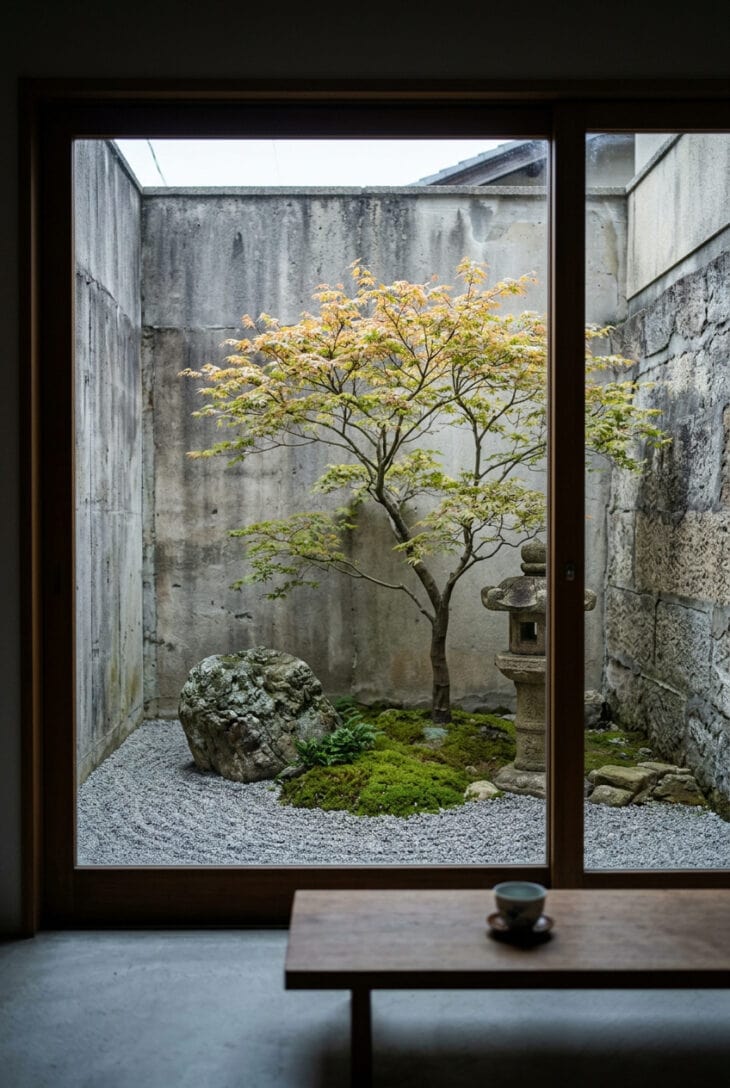
What you see A courtyard no bigger than a parking space, enclosed by plain walls, seen through a window. Raked gravel, one rock, one small maple, a low lantern, a patch of moss. That is everything. It does not feel sparse, it feels finished, and it is the best view in the house.
Why it works The tsuboniwa, the courtyard garden, was developed for exactly the plots people complain about: tiny, enclosed, overlooked, shaded by buildings. The response was not to cram more in but to reduce until only the essential remained, and to treat the space as something to be looked at from indoors rather than walked in. Any awkward side return, light well or paved yard can take this treatment, and shade is an asset rather than a problem.
How to get it Choose the window you will see it from and compose for that view alone. Limit yourself to about five elements in total, and place them asymmetrically, keeping one area deliberately empty, since the emptiness is doing as much work as the objects. Use shade-tolerant plants (moss, ferns, hakonechloa, aucuba, a maple) and keep every surface quiet: one gravel, one stone, one timber. Then stop. The temptation to add a sixth element is the thing to resist.
21. Run Mondo Grass Between the Stones
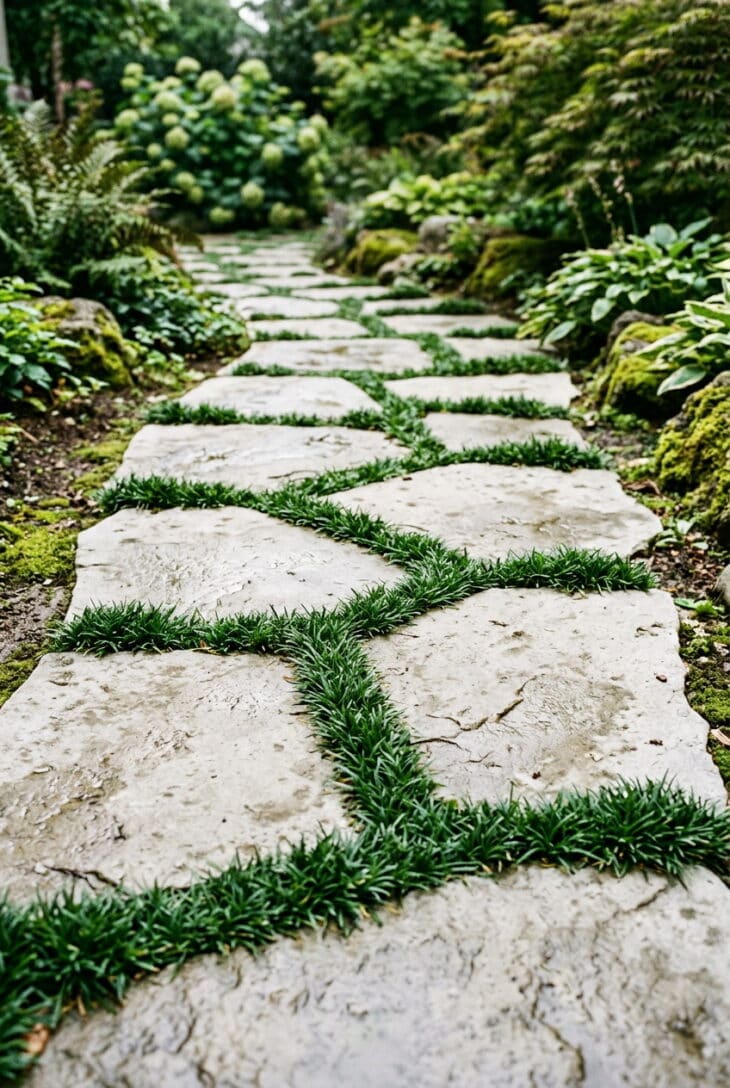
What you see Big flat pale stones with dark green grass growing tightly in every joint between them, so the path reads as a grid of stone with green lines drawn between. The tufts are fine and neat and exactly the same height. Nothing is spilling anywhere and nothing needs cutting.
Why it works A joint filled with mortar is dead, and a joint filled with gravel collects weeds. Green joints do something better: they soften the geometry of the paving, keep the surface visually cool, and blur the boundary between the built part of the garden and the grown part, which is the effect this whole style is chasing. Mondo grass in particular stays low and tidy without any maintenance at all, which is why it is used this way everywhere in Japan.
How to get it Dwarf mondo grass (Ophiopogon japonicus ‘Nanus’) grows to just 2 to 4in (5 to 10cm) and is the one to use in joints; the black-leaved Ophiopogon planiscapus ‘Nigrescens’ is stunning against pale stone but slower. Leave joints at least 2in (5cm) wide, fill them with a free-draining gritty soil, and plug in small divisions 4in (10cm) apart. They knit together in two seasons. In heavy shade with more moisture, Irish moss (Sagina subulata) or thyme in sun will do a similar job.
22. Build a Simple Timber Pavilion
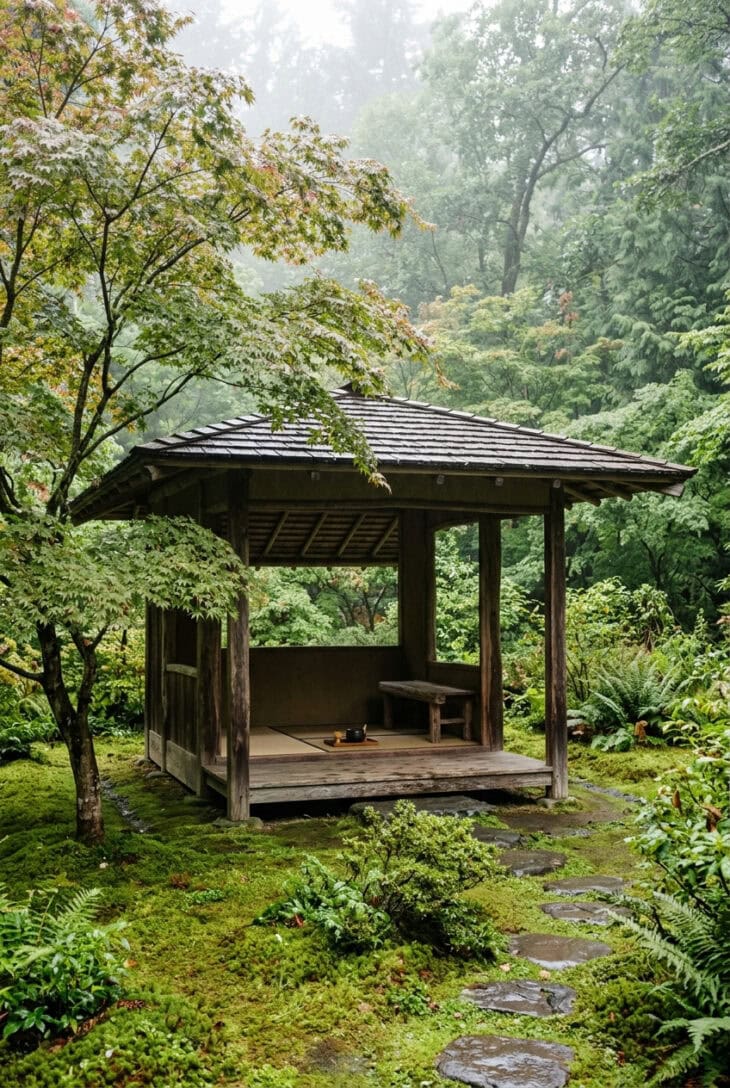
What you see A small open-fronted timber structure with dark posts and a low overhanging roof, sitting quietly at the edge of the moss with a maple leaning over it. There is nothing in it and nothing on it. It is a roof, a floor and four posts, and it is where you would sit out a rain shower.
Why it works A garden you can only look at is a garden you eventually stop going into. A simple shelter gives you a reason and a place to be still in it, and in this tradition that is the entire point: the tea house exists so that the garden can be contemplated from within. The deep overhanging roof is doing real work, letting you sit out in rain, which is when a moss and maple garden is at its absolute best.
How to get it Keep it small and plain: an 8ft (240cm) square is plenty. Use dark stained or charred timber, a deep roof overhang of at least 18in (45cm), and no ornament whatsoever, since a decorative pagoda-roofed kit undoes every other idea in this article. Site it at the edge looking back into the garden, not at the center, and orient it to your best view. A raised timber deck floor rather than a paved one gives the right feel and keeps the structure dry.
23. Let Autumn Be the Big Event
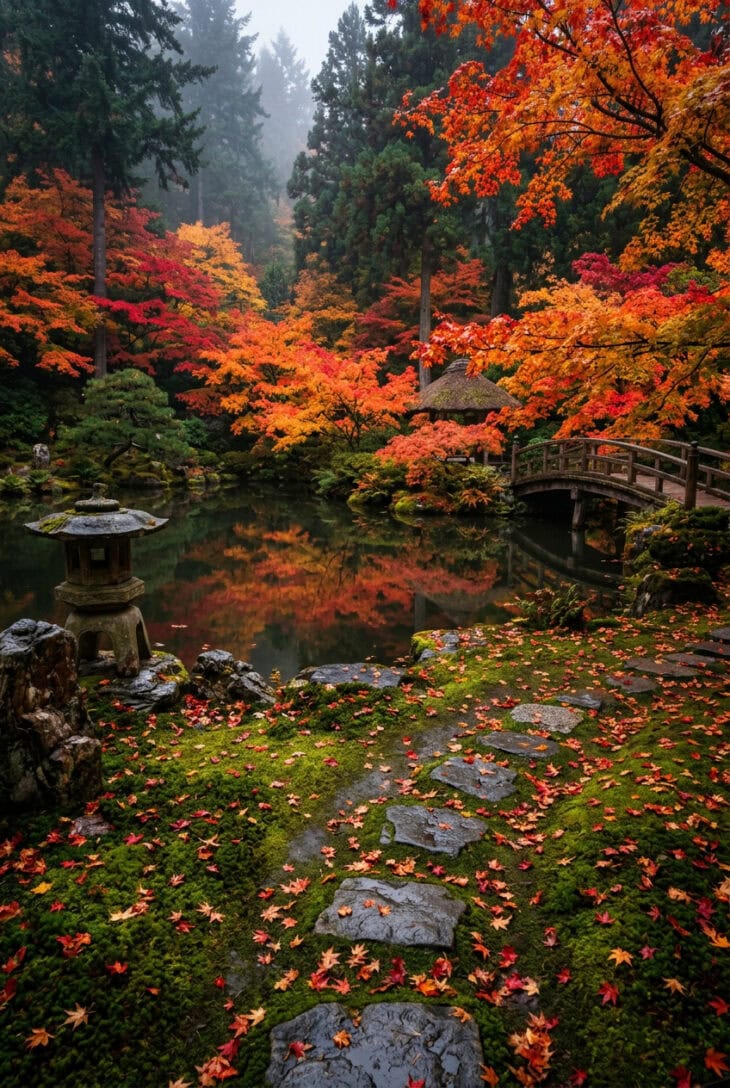
What you see The whole garden has caught fire. Maples in scarlet, orange and gold, doubled in the black water of the pond, with fallen leaves lying where they landed on the green moss and the grey stone. Against the dark evergreens the color is almost violent. Three weeks ago this garden was entirely green.
Why it works A garden that is quiet for eleven months earns the right to be spectacular for one. Because the palette is restricted to green all year, autumn color arrives with a force it could never have in a border that has been throwing out flowers since April, and the same restraint that makes the garden calm is what makes its one big moment land. Momijigari, going out to look at autumn leaves, is the mirror image of cherry blossom viewing, and this is the season these gardens are really built for.
How to get it Plant maples for the color and back them with evergreens, because red against green is what makes it sing, while red against a fence does nothing. Acer palmatum ‘Osakazuki’ turns the purest scarlet of any tree in cultivation, and Acer palmatum ‘Sango-kaku’ goes butter yellow and then holds coral-red bark all winter. Site them where the low autumn sun will come through the leaves from behind rather than land on them, and resist sweeping the fallen leaves off the moss too soon.
24. Sweep, Prune, and Do Almost Nothing Else
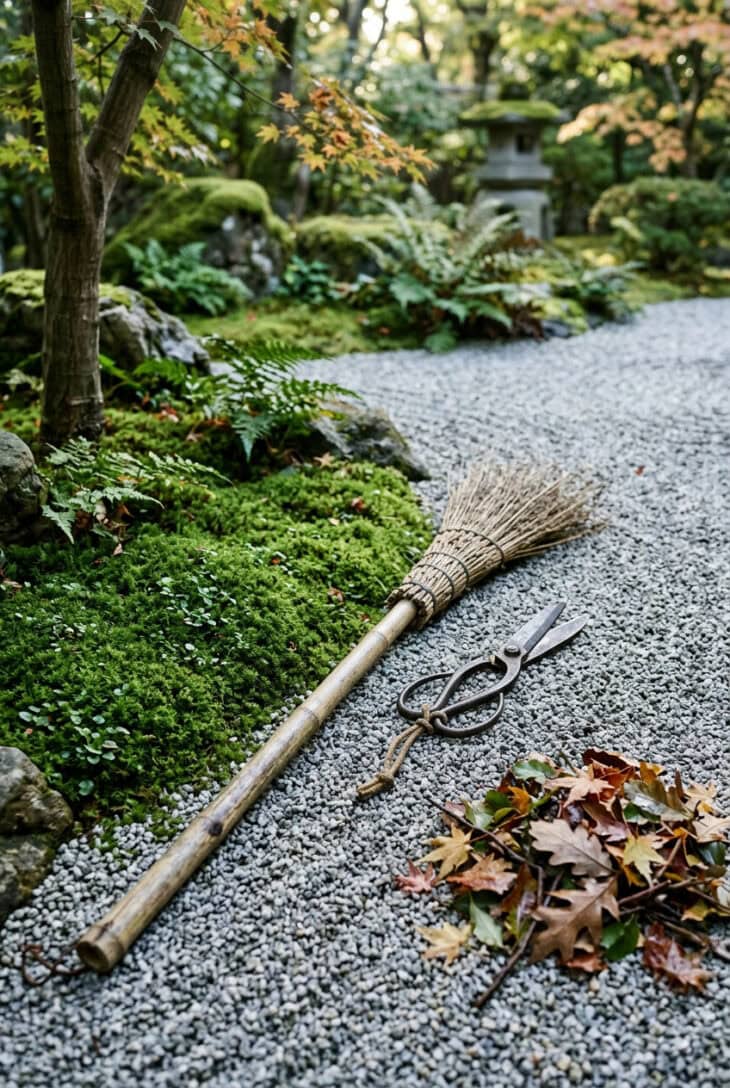
What you see A bamboo broom and a pair of hand shears lying on the swept gravel, with a small neat pile of leaves beside them. No mower, no strimmer, no leaf blower, no wheelbarrow of cuttings. The moss is immaculate. Somebody has been here for an hour and the only evidence is that the garden looks like nothing happened.
Why it works The maintenance of a Japanese garden is not a chore list, it is the practice that keeps the design intact. These gardens are built to be tended constantly and lightly rather than blitzed twice a year, and the work is nearly all sweeping, hand-pruning and removing: taking out the dead frond, the crossing branch, the leaf on the moss. Nothing is fed, nothing is forced, and the garden stays exactly as composed as the day it was made.
How to get it Work little and often, ideally half an hour a week rather than a whole Saturday a month. Use a soft bamboo broom on moss and a rake only on gravel, since a rake will tear a moss carpet apart. Prune by hand with shears or secateurs, never with a powered hedge trimmer, which shreds leaves and leaves brown edges. Learn to take a whole branch out rather than trimming every branch back, and when in doubt about whether to remove something, remove it.
25. Leave Empty Space
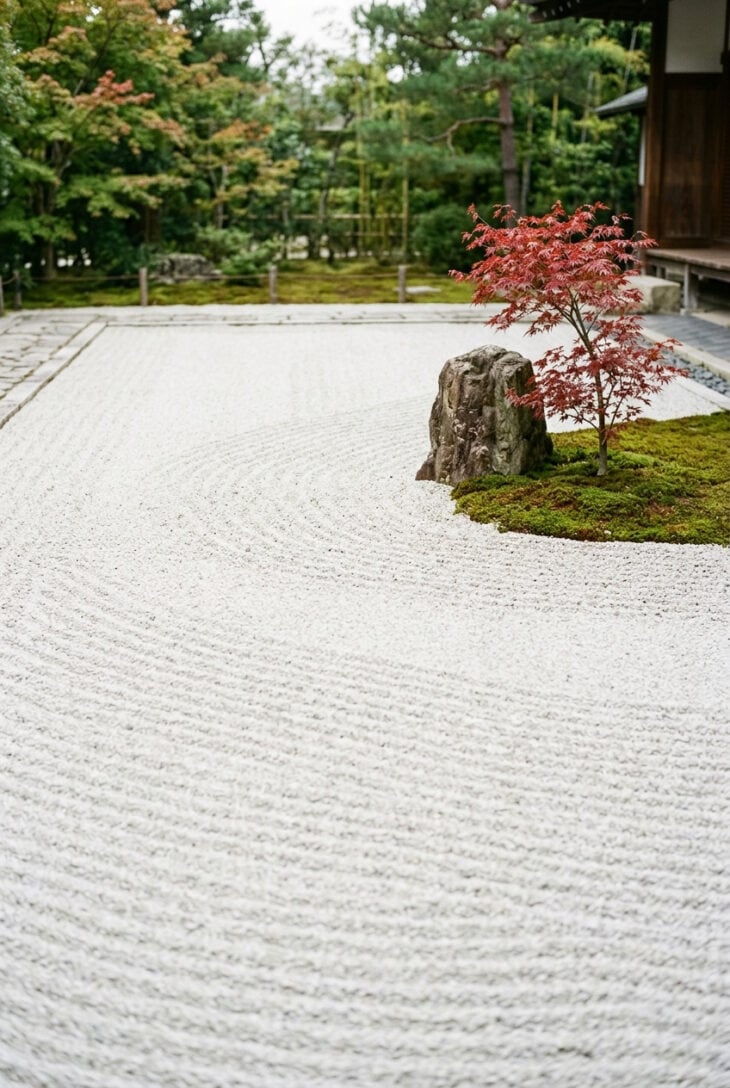
What you see Most of what you are looking at is nothing: a wide, calm expanse of raked gravel with a single rock and one small maple set over to one side. The empty part is far bigger than the planted part. It does not read as unfinished. It reads as the reason the rock and the tree are worth looking at.
Why it works Ma, the concept of meaningful empty space, is the idea that underlies every other one in this article, and it is the hardest for a gardener to accept, because our instinct is that a gap is a place that needs a plant. In this tradition the space between things is an element in its own right, and it is what gives everything else room to be seen. A garden with one beautiful object and a great deal of emptiness is quiet. Fill the emptiness and you have merely a collection.
How to get it This is a discipline, not a technique. When you finish a planting, take one thing out and see whether it improved. Resist filling gaps, resist buying a plant because you liked it in the nursery, and resist the second ornament. Keep a large area (gravel, moss, water, plain paving) genuinely empty, and place your few good objects off center so the emptiness balances them. If you can only afford one really good rock or one really good maple, that is not a limitation. That is the design.