
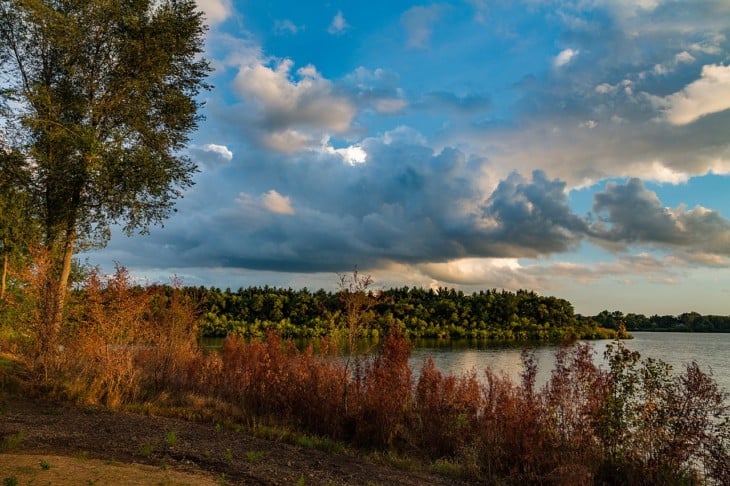
The most common trees in Iowa are silver maple, eastern cottonwood, bur oak, hackberry, American elm, green ash, black walnut, boxelder, bitternut hickory and eastern red cedar. Iowa is a prairie state, not a forest state: only about 8 percent of it is wooded, and most of that woodland runs in strips along rivers or covers the steep hills of northeast Iowa and the Loess Hills in the west. Oak is the state tree, and the state legislature chose the whole group in 1961 rather than one species, though bur oak and white oak are the ones people picture.
Contents
- Oaks, Hickories and Walnut
- Bur Oak (Quercus macrocarpa)
- White Oak (Quercus alba)
- Northern Red Oak (Quercus rubra)
- Black Oak (Quercus velutina)
- Pin Oak (Quercus palustris)
- Swamp White Oak (Quercus bicolor)
- Chinkapin Oak (Quercus muehlenbergii)
- Shagbark Hickory (Carya ovata)
- Bitternut Hickory (Carya cordiformis)
- Black Walnut (Juglans nigra)
- Butternut (Juglans cinerea)
- Trees of Rivers and Bottomlands
- Other Common Hardwoods
- Sugar Maple (Acer saccharum)
- American Basswood (Tilia americana)
- Ironwood (Hophornbeam) (Ostrya virginiana)
- Kentucky Coffeetree (Gymnocladus dioicus)
- Honey Locust (Gleditsia triacanthos)
- Black Cherry (Prunus serotina)
- Aspens (Populus grandidentata and P. tremuloides)
- Black Ash (Fraxinus nigra)
- Northern Catalpa (Catalpa speciosa)
- Osage Orange (Maclura pomifera)
- Ohio Buckeye (Aesculus glabra)
- Conifers
- Small Trees and Shrubs
- Don’t Plant These
- Where to See Iowa’s Trees
Before settlement, most of Iowa was tallgrass prairie, with forest along the rivers and oak savanna between. Fire suppression, farming and towns changed all of that, and today many of Iowa’s trees are in yards, windbreaks and river bottoms rather than in forests. This guide covers the trees you are most likely to meet in the state, wild or planted.

- Oaks, Hickories and Walnut
- Trees of Rivers and Bottomlands
- Other Common Hardwoods
- Conifers
- Small Trees and Shrubs
- Don’t Plant These
- Where to See Iowa’s Trees
| Tree | Botanical name | Native to Iowa | Where you’ll see it |
|---|---|---|---|
| Bur Oak | Quercus macrocarpa | Yes | Savannas, pastures, river bluffs and old farmyards statewide |
| White Oak | Quercus alba | Yes | Upland woods in eastern and southern Iowa |
| Northern Red Oak | Quercus rubra | Yes | Wooded slopes and towns statewide |
| Black Oak | Quercus velutina | Yes | Dry, sandy or gravelly ridges |
| Pin Oak | Quercus palustris | Yes, in southeast Iowa | Wet bottoms; widely planted as a street tree |
| Swamp White Oak | Quercus bicolor | Yes | River bottoms, wet prairies and streets |
| Chinkapin Oak | Quercus muehlenbergii | Yes | Limestone bluffs and dry hillsides |
| Shagbark Hickory | Carya ovata | Yes | Upland woods in eastern and southern Iowa |
| Bitternut Hickory | Carya cordiformis | Yes | Moist woods and bottomlands statewide |
| Black Walnut | Juglans nigra | Yes | Rich bottoms, fencerows and farmyards statewide |
| Butternut | Juglans cinerea | Yes | Moist woods and stream banks, mostly in eastern Iowa |
| Silver Maple | Acer saccharinum | Yes | Floodplains, river banks and older neighborhoods |
| Eastern Cottonwood | Populus deltoides | Yes | Sandbars and banks of every major river |
| Hackberry | Celtis occidentalis | Yes | Bottomlands, fencerows and city streets statewide |
| American Elm | Ulmus americana | Yes | Bottomlands, fencerows and towns |
| Green Ash | Fraxinus pennsylvanica | Yes | Bottomlands, windbreaks and streets |
| Boxelder | Acer negundo | Yes | Stream banks, fencerows and any disturbed ground |
| Black Willow | Salix nigra | Yes | Sandbars, ditches and pond edges |
| American Sycamore | Platanus occidentalis | Yes, in southern Iowa | River bottoms; planted in parks and yards |
| River Birch | Betula nigra | Yes, in southeast Iowa | Stream banks; widely planted in yards |
| Sugar Maple | Acer saccharum | Yes | Wooded slopes in eastern Iowa; planted statewide |
| American Basswood | Tilia americana | Yes | Moist wooded slopes and ravines |
| Ironwood (Hophornbeam) | Ostrya virginiana | Yes | Understory of upland woods statewide |
| Kentucky Coffeetree | Gymnocladus dioicus | Yes | Rich bottomlands and river valleys; planted in towns |
| Honey Locust | Gleditsia triacanthos | Yes | Pastures, fencerows and streets statewide |
| Black Cherry | Prunus serotina | Yes | Fencerows, woodland edges and old fields |
| Aspens | Populus grandidentata and P. tremuloides | Yes | Sandy and burned-over ground in northeast Iowa |
| Black Ash | Fraxinus nigra | Yes | Swampy woods and fens in northeast Iowa |
| Northern Catalpa | Catalpa speciosa | No (middle Mississippi Valley); widely planted | Farmyards, towns and roadsides |
| Osage Orange | Maclura pomifera | No (Texas, Oklahoma, Arkansas) | Old hedgerows and fencerows |
| Ohio Buckeye | Aesculus glabra | Yes | Wooded bottoms in western and southern Iowa |
| Eastern Red Cedar | Juniperus virginiana | Yes | Pastures, bluffs, fencerows and windbreaks statewide |
| Eastern White Pine | Pinus strobus | Yes, in northeast Iowa | Bluffs and cool ravines; planted statewide |
| Tamarack | Larix laricina | Yes, but very rare | A few fens in north-central Iowa |
| Chokecherry | Prunus virginiana | Yes | Fencerows, woodland edges and draws statewide |
| American Plum | Prunus americana | Yes | Fencerows, draws and roadsides statewide |
| Downy Hawthorn | Crataegus mollis | Yes | Pastures, savanna edges and open woods |
| Serviceberry | Amelanchier arborea | Yes | Woodland edges and bluffs; planted in yards |
| Pagoda Dogwood | Cornus alternifolia | Yes | Shaded ravines and woodland edges |
| Eastern Redbud | Cercis canadensis | Yes, in southern Iowa | Woodland edges; planted statewide |
| Siberian Elm | Ulmus pumila | No (Asia) | Fencerows, roadsides, vacant lots |
| Russian Olive | Elaeagnus angustifolia | No (Eurasia) | Windbreaks, roadsides and stream banks |
| White Mulberry | Morus alba | No (China) | Fencerows, alleys and under power lines |
| Callery Pear (Bradford Pear) | Pyrus calleryana | No (China) | Streets, parking lots and, increasingly, old fields |
Oaks, Hickories and Walnut
Bur Oak (Quercus macrocarpa)
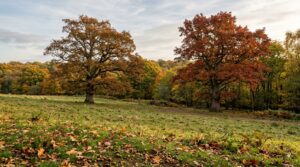
Bur oak is the classic Iowa oak: a wide, heavy-limbed tree, 60 to 80 feet tall, with corky, deeply furrowed bark and big acorns in fringed, mossy cups. Its thick bark lets it survive prairie fires, so open-grown bur oaks were often the only trees on the early prairie, and many pasture trees are 200 to 300 years old. Its leaves have a deep pair of notches near the middle, giving them a fiddle shape.
White Oak (Quercus alba)

White oak grows 60 to 80 feet tall, with pale gray, scaly bark and leaves with 7 to 9 rounded lobes that turn wine-red in fall. Its acorns ripen in a single year and are sweet enough that deer, turkeys and squirrels take them first. It is one of the most valuable timber trees in the state.
Northern Red Oak (Quercus rubra)

Northern red oak is the fastest-growing of Iowa’s oaks and the most widely planted as a shade tree. It reaches 60 to 80 feet, with leaves of 7 to 11 bristle-tipped lobes and bark with long, flat, shiny ridges. Its acorns take two years to ripen.
Black Oak (Quercus velutina)

Black oak grows 50 to 70 feet tall on the poorest, driest upland sites, often with bur oak. Its leaves are glossy above with shallow to deep lobes, its bark is dark and blocky, and its inner bark is bright orange-yellow.
Pin Oak (Quercus palustris)

Pin oak has deeply cut leaves with U-shaped gaps and a neat pyramid shape with drooping lower branches. It grows 60 to 70 feet tall, tolerates wet soil and transplants easily, which is why it is such a common street tree. In Iowa’s alkaline soils it often turns yellow from iron chlorosis, so swamp white oak is usually the better choice.
Swamp White Oak (Quercus bicolor)

Swamp white oak grows 50 to 70 feet tall, with leaves that are shiny dark green above and silvery-white beneath, so the whole crown flashes in the wind. Its bark peels in ragged, curling flakes on young branches. It handles both wet soil and the high-pH soils of Iowa towns far better than pin oak.
Chinkapin Oak (Quercus muehlenbergii)
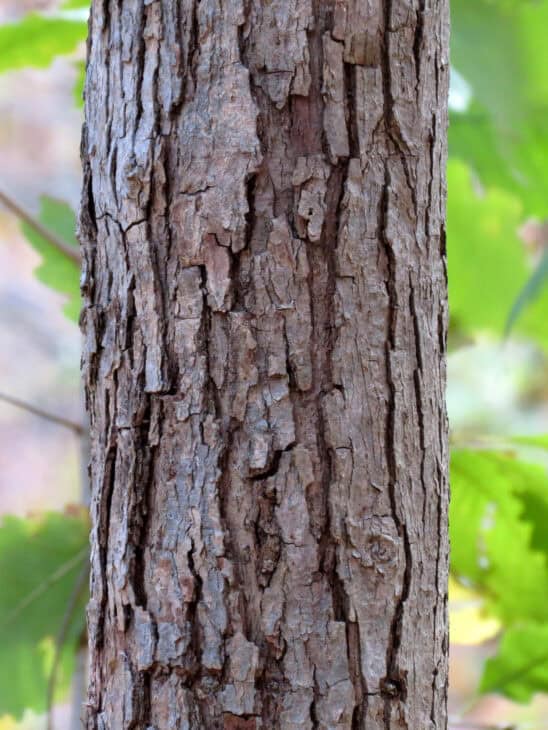
Chinkapin oak is the oak of Iowa’s limestone country, especially along the Mississippi and in the Loess Hills. It grows 40 to 60 feet tall and has narrow leaves with sharp, curved teeth instead of lobes, more like a chestnut leaf, and flaky, ash-gray bark. Its small acorns are among the sweetest of any oak.
Shagbark Hickory (Carya ovata)

Shagbark hickory is easy to know by its gray bark, which peels in long strips that curl away from the trunk. It grows 60 to 80 feet tall, with leaves of usually five leaflets that turn clear gold in fall, and it bears the best-tasting of all wild hickory nuts.
Bitternut Hickory (Carya cordiformis)

Bitternut is Iowa’s most common hickory. Unlike shagbark, its bark stays tight and shallowly ridged, and its winter buds are a bright sulfur yellow that no other tree has. It grows 50 to 75 feet tall, with leaves of 7 to 11 narrow leaflets. Its nuts are so bitter that even squirrels leave them, though the wood is prized for smoking meat.
Black Walnut (Juglans nigra)

Black walnut is Iowa’s most valuable timber tree, and single veneer-quality logs sell for thousands of dollars. It grows 50 to 75 feet tall, with long leaves of 15 to 23 leaflets and dark, deeply furrowed bark. Its round nuts, in thick green husks, stain everything they touch. Its roots release juglone, which stunts tomatoes, apples and many other plants nearby.
Butternut (Juglans cinerea)

Butternut, or white walnut, looks like a smaller, rougher black walnut, 40 to 60 feet tall, with sticky, football-shaped nuts and smooth gray ridges on the bark. Its sweet, oily nuts were a favorite of settlers. Butternut canker, a fungal disease that arrived in the 1960s, has killed most of Iowa’s butternuts, and the species is now uncommon.
Trees of Rivers and Bottomlands
Silver Maple (Acer saccharinum)
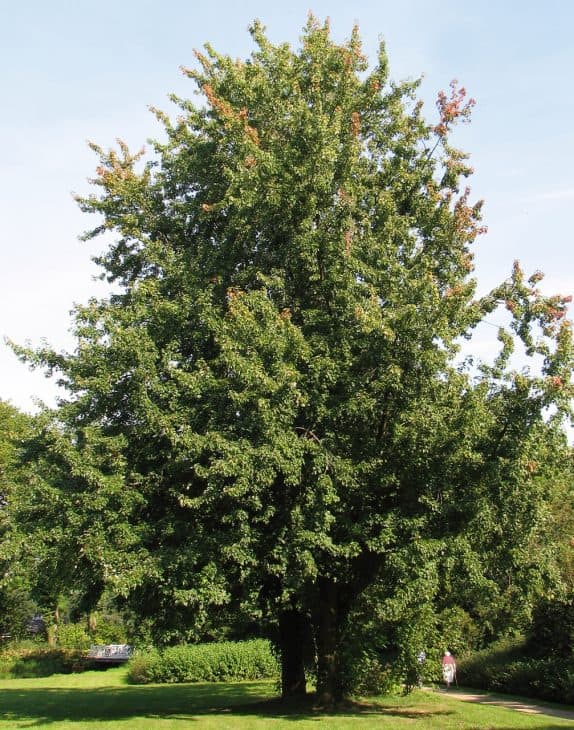
Silver maple is one of the most abundant trees in Iowa. It grows very fast to 60 to 80 feet, with deeply cut leaves that are silvery-white underneath and flash when the wind turns them. Its seeds ripen in late spring, earlier than any other maple. It was planted everywhere in towns a century ago, but its brittle limbs break in storms and its shallow roots lift sidewalks, so it isn’t recommended for small yards now.
Eastern Cottonwood (Populus deltoides)
Read our guide to Eastern Cottonwood

Eastern cottonwood is the giant of Iowa’s river bottoms, 80 to 100 feet tall with a massive trunk, and one of the fastest-growing trees in North America. Its triangular, coarsely toothed leaves grow singly along the twig, not in pairs, and their flattened stalks make them rustle constantly. In late spring, female trees release seeds in white cottony fluff.
Hackberry (Celtis occidentalis)

Hackberry is one of the toughest trees in Iowa, growing in drought, wind, heat and poor soil. It reaches 40 to 60 feet, with gray bark covered in corky warts and ridges and leaves with a lopsided base. Its small purple fruits stay on the tree into winter and feed cedar waxwings and robins. Nipple gall on the leaves and witches’ broom in the twigs are ugly but harmless.
American Elm (Ulmus americana)

American elm once lined nearly every main street in Iowa, with its unmistakable vase-shaped crown. Dutch elm disease, which reached the state in the late 1950s, killed most of the big ones. It is still a common tree, because it seeds heavily and grows fast, but trees usually die back before they get large. Disease-resistant varieties are now being planted again.
Green Ash (Fraxinus pennsylvanica)
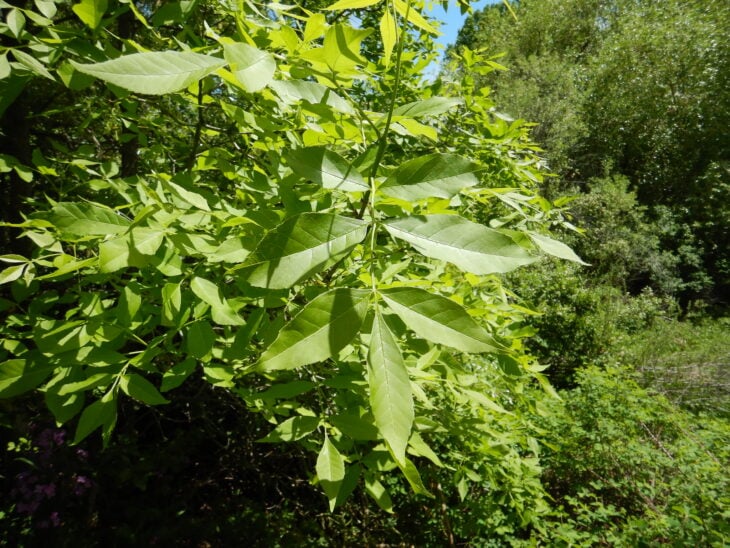
Green ash was one of the most planted street and farmstead trees in Iowa after the elms died. It grows 50 to 70 feet tall, with compound leaves of 5 to 9 leaflets in opposite pairs and diamond-patterned bark. The emerald ash borer, found in Iowa in 2010, has since killed ash trees in most counties, and untreated trees rarely survive.
Boxelder (Acer negundo)
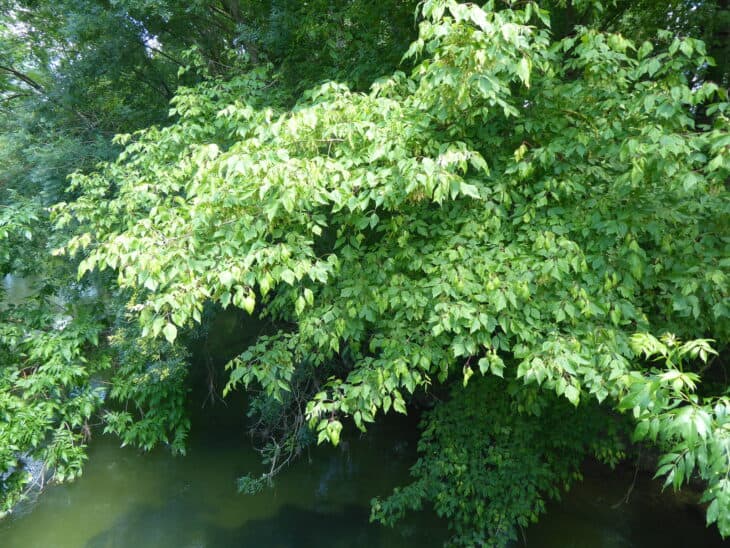
Boxelder is a maple with compound leaves of 3 to 5 leaflets, so people often mistake it for ash or poison ivy. It grows fast to 30 to 50 feet, usually leaning, with green twigs and paired winged seeds. It seeds into any bare ground. Boxelder bugs, the red and black insects that gather on sunny walls in fall, feed on female trees.
Black Willow (Salix nigra)

Black willow is the largest native willow in North America, 30 to 60 feet tall, usually with several leaning trunks. Its long, narrow leaves and fuzzy spring catkins are familiar along every Iowa creek. Its roots hold stream banks together, but its wood is weak and it is short-lived.
American Sycamore (Platanus occidentalis)

American sycamore is the tree with white, peeling bark on the upper trunk, big maple-like leaves and round seed balls hanging on long stalks. It grows 70 to 100 feet tall along rivers in the southern half of the state and is planted farther north. Cool, wet springs bring on anthracnose, which makes it drop leaves in early summer; it recovers.
River Birch (Betula nigra)
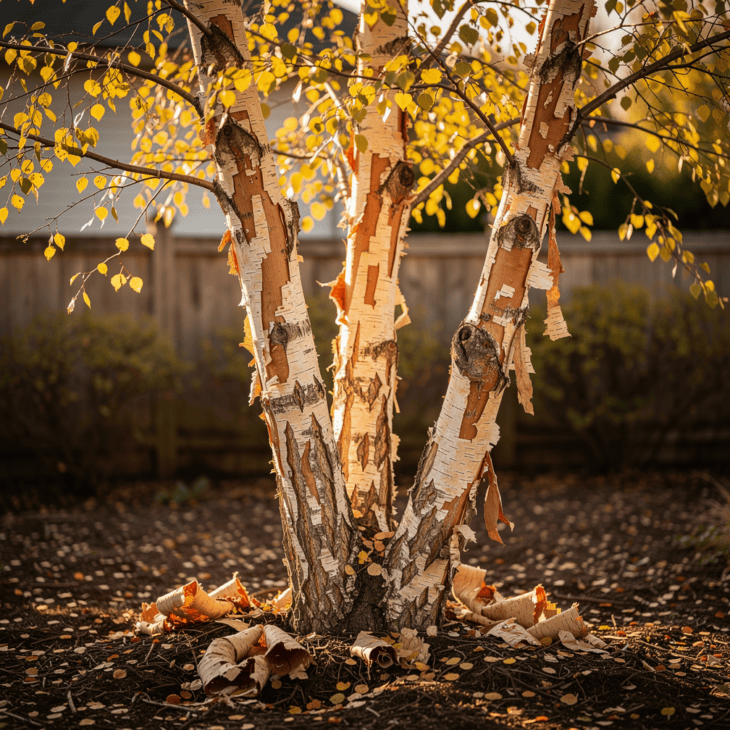
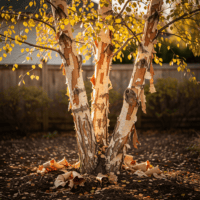
River birch is the only birch that thrives in hot summers. It grows 40 to 70 feet tall, often with several trunks, and its bark peels in papery curls of cinnamon, salmon and cream. It is the best birch for Iowa yards, though it needs acid soil and often yellows on high-pH ground.
Other Common Hardwoods
Sugar Maple (Acer saccharum)
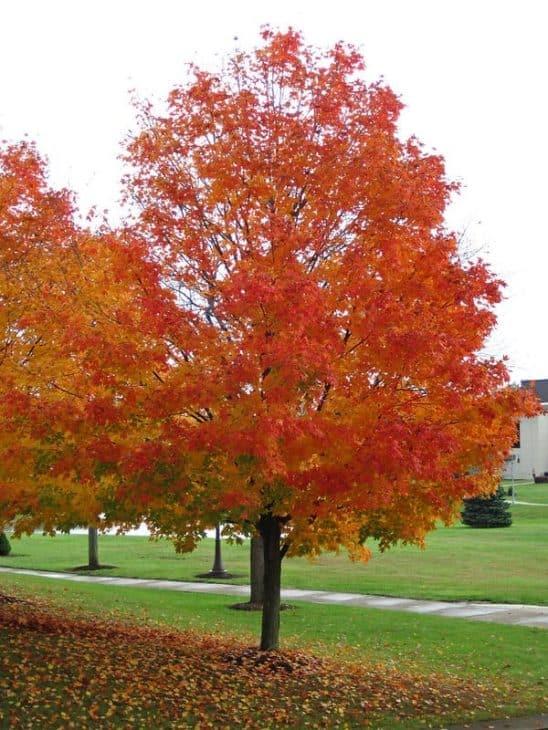
Sugar maple grows 60 to 80 feet tall, with five-lobed leaves and brilliant orange and red fall color. It is common in the shaded valleys of northeast Iowa and is widely planted as a shade tree. Iowa does have a small maple syrup season in late winter, though its sap runs are shorter than New England’s. Black maple, a close relative with drooping, dark green leaves, is the more common wild maple in much of Iowa.
American Basswood (Tilia americana)

Basswood, or linden, grows 60 to 80 feet tall, with large, heart-shaped, lopsided leaves. In early summer its small, creamy flowers hang from a narrow, leaf-like bract and fill the woods with scent, and bees make a prized honey from them. It sprouts in rings from old stumps, so it often grows in clumps of several trunks.
Ironwood (Hophornbeam) (Ostrya virginiana)

Ironwood is a small understory tree, 25 to 40 feet tall, with shreddy, gray-brown bark in narrow strips and birch-like leaves. Its fruits hang in papery, hop-like clusters. Its wood is one of the hardest and heaviest in North America. Blue beech, or musclewood (Carpinus caroliniana), is a similar small tree with smooth, gray, muscle-like bark that grows in moist bottoms.
Kentucky Coffeetree (Gymnocladus dioicus)

Kentucky coffeetree is one of Iowa’s most distinctive trees, 60 to 75 feet tall, with a coarse, bare-branched look in winter, chunky, scaly bark and huge twice-compound leaves that can be 3 feet long. Female trees carry thick, leathery brown pods all winter. Settlers roasted the seeds as a coffee substitute, but raw seeds and pulp are poisonous, so don’t try it.
Honey Locust (Gleditsia triacanthos)
Read our guide to Honey Locust

Honey locust grows 50 to 70 feet tall, with fern-like compound leaves that cast light shade and long, twisted brown pods with sweet pulp that cattle eat. Wild trees carry vicious branched thorns on the trunk. The thornless, podless varieties sold for streets and yards have been planted so widely that they are now overused.
Black Cherry (Prunus serotina)

Black cherry grows 50 to 70 feet tall, with dark, scaly bark like burnt cornflakes and narrow, glossy leaves. Birds spread its small black cherries everywhere, which is why seedlings appear under every fence and power line. Its wilted leaves are poisonous to cattle and horses.
Aspens (Populus grandidentata and P. tremuloides)
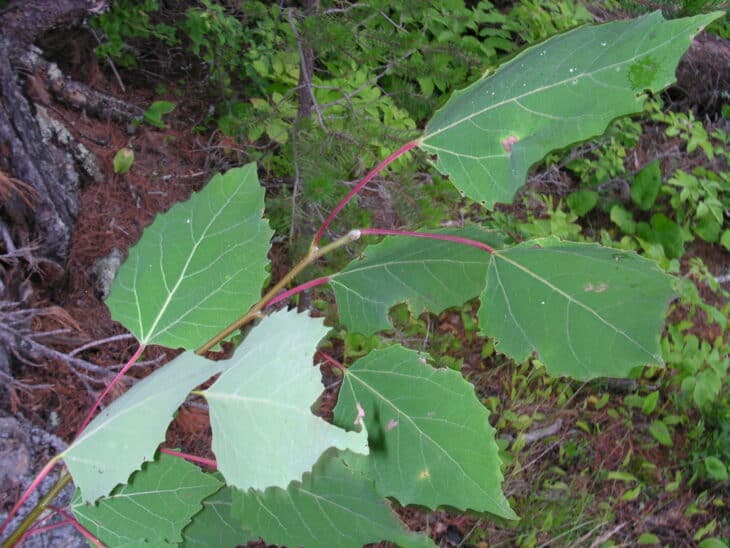
Bigtooth aspen and quaking aspen are fast-growing, short-lived pioneer trees, 40 to 60 feet tall, with smooth, pale greenish-gray bark and leaves that flutter on flattened stalks. Bigtooth aspen has large, coarse teeth on its leaves; quaking aspen’s are fine. Both spread by root suckers into groves and are far less common in Iowa than they were in the 1800s, because most burned or cut-over ground has since become farmland or closed forest.
Black Ash (Fraxinus nigra)

Black ash grows 40 to 60 feet tall in wet, mucky ground. Its wood splits into long, flexible strips along the annual rings when pounded, which is why Native basket makers prize it. It is rare in Iowa and, like all ash, it is being wiped out by emerald ash borer.
Northern Catalpa (Catalpa speciosa)
Read our guide to Northern Catalpa

Northern catalpa grows 40 to 60 feet tall, with huge heart-shaped leaves, showy clusters of white, orchid-like flowers in June and long, bean-like pods that hang all winter. It was planted across Iowa for fence posts, because its wood resists rot. It is messy and its branches break easily, but nothing else flowers like it in midsummer.
Osage Orange (Maclura pomifera)
Read our guide to Osage Orange

Osage orange, or hedge apple, was planted across Iowa in the 1800s as a living fence: “horse high, bull strong and hog tight”. Its thorny branches form impenetrable hedges, and its rot-proof wood became the fence posts that replaced the hedges once barbed wire arrived. It grows 30 to 50 feet tall, with glossy leaves and grapefruit-sized, wrinkled green fruits that only squirrels bother with.
Ohio Buckeye (Aesculus glabra)

Ohio buckeye is a small tree, 30 to 50 feet tall, with leaves of five leaflets that spread like fingers, upright clusters of yellow-green flowers in spring and spiny husks holding glossy brown seeds. The leaves come out very early and drop early, often scorched by August. All parts, including the seeds, are poisonous.
Conifers
Eastern Red Cedar (Juniperus virginiana)

Eastern red cedar is Iowa’s most common native conifer, a dense, narrow juniper 30 to 50 feet tall with scale-like leaves, shreddy bark and blue, berry-like cones on female trees. Without prairie fires to stop it, birds have spread it into pastures and prairies all over the state, where it shades out the grass, so land managers now cut and burn it. It also hosts cedar-apple rust, which spots the leaves of nearby apple trees.
Eastern White Pine (Pinus strobus)

Eastern white pine grows wild in Iowa only on the cool, steep bluffs of the northeast, most famously at White Pine Hollow State Preserve in Dubuque County, the largest natural white pine stand in the state. It has soft, blue-green needles in bundles of five and reaches 80 feet or more. It is widely planted in yards and windbreaks, where it grows fast but dislikes salt and high-pH soil.
Tamarack (Larix laricina)

Tamarack is a conifer that drops its needles each fall, after they turn gold. It grows in cold bogs and fens and reaches its southwestern limit in Iowa, where only a handful of natural stands survive in protected fens. It is worth knowing as a curiosity of Iowa’s Ice Age past.
Small Trees and Shrubs
Chokecherry (Prunus virginiana)

Chokecherry is a shrub or small tree, 15 to 25 feet tall, that spreads into thickets. In May it has upright, bottlebrush-like spikes of white flowers, followed in late summer by dark red to black cherries. They are mouth-puckeringly astringent raw, which is where the name comes from, but they make excellent jelly, syrup and wine. The leaves, twigs and pits are poisonous to livestock.
American Plum (Prunus americana)
Read our guide to American Plum
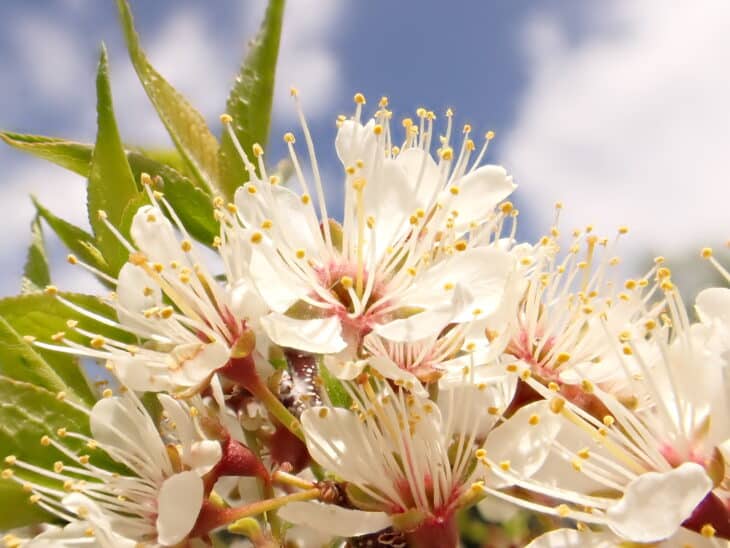
American plum is a thorny small tree, 15 to 25 feet tall, that forms thickets. It is covered in fragrant white flowers in early spring, before its leaves, and bears red to yellow plums about an inch across in late summer that make good jam. Its thickets are important cover and food for pheasants, songbirds and rabbits.
Downy Hawthorn (Crataegus mollis)

Downy hawthorn is a small, spreading tree, 20 to 30 feet tall, with stiff thorns 1 to 2 inches long, fuzzy leaves and flat clusters of white flowers in spring. Its red fruits, about ½ inch across, ripen in late summer and are eaten by birds and by people as jelly. It is the most common of Iowa’s many native hawthorns.
Serviceberry (Amelanchier arborea)

Serviceberry, or juneberry, is one of the first trees to flower in Iowa, with clusters of white flowers in April. It grows 15 to 25 feet tall, with smooth gray bark, and its purple, blueberry-like fruits ripen in June. It has good orange-red fall color and is an excellent small native yard tree.
Pagoda Dogwood (Cornus alternifolia)

Pagoda dogwood is a small tree, 15 to 25 feet tall, whose branches grow in distinct horizontal layers, like the tiers of a pagoda. It has flat clusters of creamy white flowers in late spring and blue-black berries on red stalks in late summer that birds strip quickly. It needs shade and moist soil.
Eastern Redbud (Cercis canadensis)

Eastern redbud is a small tree, 20 to 30 feet tall, that covers its bare branches in magenta-pink, pea-like flowers in April, followed by heart-shaped leaves. It is native to the southern counties and is planted in yards throughout the state, though northern Iowa winters can damage trees grown from southern seed.
Don’t Plant These
Siberian Elm (Ulmus pumila)
Siberian elm was planted across the Plains for windbreaks after the Dust Bowl, because it grows in drought and poor soil. It has small, single-toothed leaves and seeds so heavily that seedlings come up everywhere. Its wood is brittle and its shape is poor, and it now spreads into pastures and prairies. Don’t plant it, and don’t confuse it with the better Chinese elm.
Russian Olive (Elaeagnus angustifolia)
Read our guide to Russian Olive

Russian olive is a thorny tree, 20 to 30 feet tall, with narrow, silvery leaves and small, fragrant yellow flowers followed by silvery fruit. It was widely planted for windbreaks and wildlife, but birds spread it along streams, where it forms thickets and crowds out native willows and cottonwoods. Autumn olive (Elaeagnus umbellata), with red berries, is the same problem in woodlands.
White Mulberry (Morus alba)
White mulberry was imported for silkworm farming that never took hold. It grows fast to 30 to 50 feet, with glossy, variably lobed leaves and white to purple fruit that birds spread everywhere. It hybridizes with Iowa’s native red mulberry, which is now much less common as a result.
Callery Pear (Bradford Pear) (Pyrus calleryana)
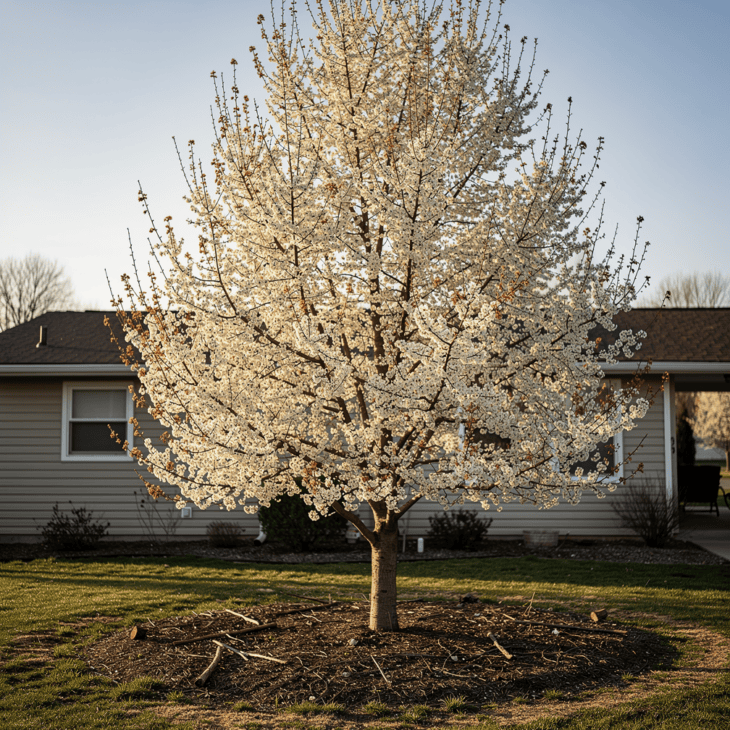
Callery pear was planted as a tidy street tree, but its branches split in storms, its spring flowers smell unpleasant, and different varieties cross-pollinate and produce seedlings that grow into thorny thickets in fields and along roads. Plant serviceberry, American plum or redbud instead. See the pros and cons of Bradford pear trees.
Where to See Iowa’s Trees
- Yellow River State Forest and Effigy Mounds: the steep, wooded valleys of northeast Iowa, with oak, maple, basswood and white pine.
- White Pine Hollow State Preserve: Iowa’s largest natural stand of eastern white pine.
- The Loess Hills: bur oak savanna and prairie on the wind-blown hills along the Missouri River.
- Any river bottom: cottonwood, silver maple, hackberry and willow along the Des Moines, Iowa, Cedar and Mississippi rivers.
- Planting your own: the Iowa DNR’s State Forest Nursery sells low-cost native seedlings in bundles each spring for conservation planting.
For trees in neighboring states, see our guides to the trees of Missouri and Indiana, and for the continent as a whole, the most common trees in North America.

,_Chicago,_IL.jpg)


_(Rosaceae)_Plant.JPG)
_in_Churchill_County,_Nevada.jpg)