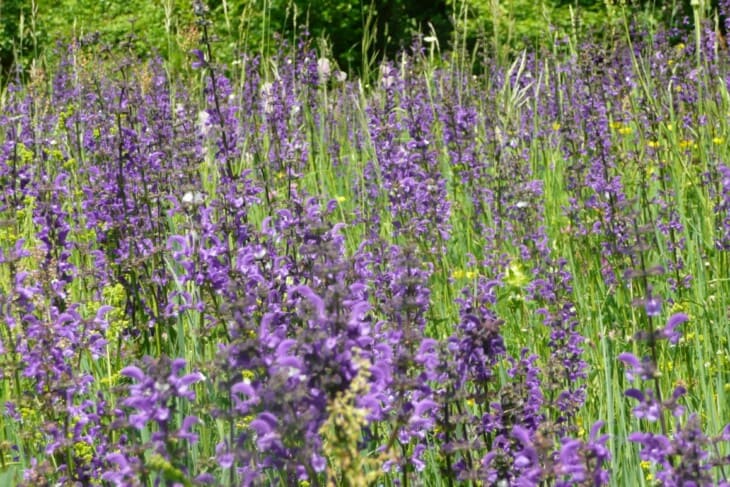
The plants most often mistaken for salvia are its relatives in the mint family: catmint, catnip, anise hyssop, hyssop, betony, bugleweed, lamb’s ear and basil, all with square stems and spikes of two-lipped flowers. Speedwell and English lavender look like salvia from a distance but belong to other families, and sagebrush and dusty miller get confused with the silver-leaved sages. Russian sage is the trick question: botanists moved it into Salvia in 2017, so it really is a salvia now. The quickest checks are the flower and the smell: a salvia flower has a hooded upper lip over a wide lower lip, and crushed leaves smell strongly of sage, mint or fruit.
Contents
- Plants With Salvia-Like Flower Spikes
- Catmint (Nepeta × faassenii)
- Catnip (Nepeta cataria)
- Russian Sage (Salvia yangii (Perovskia atriplicifolia))
- Anise Hyssop (Agastache foeniculum)
- Hyssop (Hyssopus officinalis)
- Betony (Stachys officinalis and S. monieri)
- Bugleweed (Ajuga) (Ajuga reptans)
- Speedwell (Veronica spicata and V. longifolia)
- English Lavender (Lavandula angustifolia)
- Basil (Ocimum basilicum)
- Plants With Silver, Sage-Like Leaves
- How to Tell a Salvia From a Lookalike
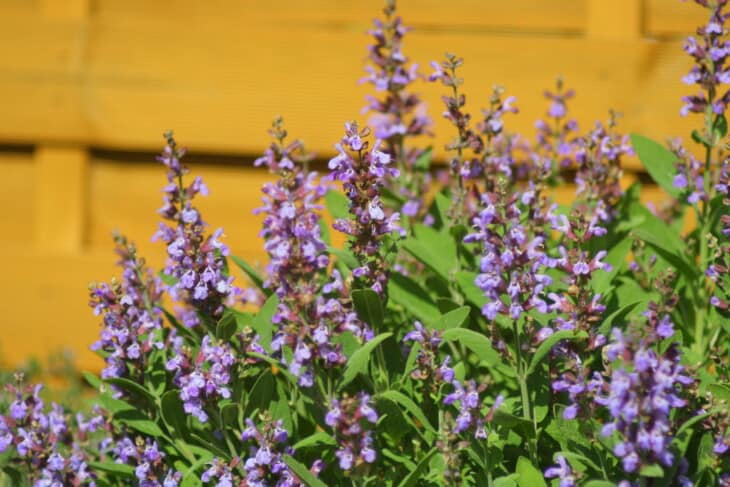
Salvia is the largest genus in the mint family, with roughly 1,000 species, from culinary sage (Salvia officinalis) to scarlet bedding salvia (S. splendens), mealycup sage (S. farinacea), the hardy perennial S. nemorosa and shrubby autumn sage (S. greggii). They share square stems, leaves in opposite pairs, whorls of tubular two-lipped flowers stacked up a spike, and a lever mechanism inside the flower that dabs pollen onto the back of a visiting bee. Most are aromatic, sun-loving and drought tolerant.
- Plants With Salvia-Like Flower Spikes
- Plants With Silver, Sage-Like Leaves
- How to Tell a Salvia From a Lookalike
| Plant | Botanical name | Looks like salvia because | How to tell it apart |
|---|---|---|---|
| Catmint | Nepeta × faassenii | Clouds of lavender-blue flower spikes on a bushy, gray-green plant | Softer, looser spikes; smaller flowers; leaves smell minty, not sage-like |
| Catnip | Nepeta cataria | Square stems, toothed leaves and whorls of small flowers | Coarser, gray-green, heart-shaped leaves; dull white flowers spotted purple |
| Russian Sage | Salvia yangii (Perovskia atriplicifolia) | Hazy blue flower spikes over silver foliage | It really is a salvia now; woody stems and finely cut, silver-gray leaves |
| Anise Hyssop | Agastache foeniculum | Dense purple flower spikes on a tall, square-stemmed plant | Fat, bottlebrush-like spikes; leaves smell of licorice |
| Hyssop | Hyssopus officinalis | Narrow spikes of deep blue flowers on a small, aromatic shrub | Small, narrow, unstalked leaves; a low, woody plant about 18 inches tall |
| Betony | Stachys officinalis and S. monieri | Upright spikes of magenta flowers over neat, dark green rosettes | Crinkled, scalloped, almost hairless leaves in a flat rosette |
| Bugleweed (Ajuga) | Ajuga reptans | Short blue-violet flower spikes over dark leaves | A creeping groundcover only 6 to 9 inches tall, spreading by runners |
| Speedwell | Veronica spicata and V. longifolia | Slim, upright spikes of purple-blue flowers | Round stems; tiny flat flowers with four petals, not two lips |
| English Lavender | Lavandula angustifolia | Purple flower spikes over narrow, gray-green leaves | Flowers in a tight block at the top of a long, bare stalk; unmistakable scent |
| Basil | Ocimum basilicum | Square stems, opposite leaves and small flower spikes | Glossy, tender, bright green leaves; a frost-tender annual; clove-like smell |
| Sagebrush | Artemisia tridentata | Silver-gray, aromatic foliage on a shrub called “sage” | Tiny, dull yellow, wind-pollinated flowers; leaves with three teeth at the tip |
| Dusty Miller | Jacobaea maritima | Felted, silver-white leaves like those of silver sage | Deeply cut, fern-like leaves; yellow daisy flowers |
| Lamb’s Ear | Stachys byzantina | Soft, silver, woolly leaves in a low mound | Thick, velvety, tongue-shaped leaves; woolly flower stalks |
Plants With Salvia-Like Flower Spikes
Catmint (Nepeta × faassenii)
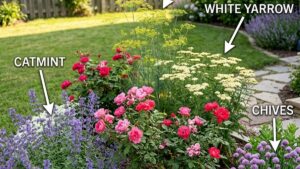
Catmint is the hardest plant to tell from perennial salvia, and garden centers often place them side by side. It grows 1 to 3 feet tall with small, gray-green, scalloped leaves and hazy lavender-blue flowers from late spring into fall if you shear it after the first flush. Compared with Salvia nemorosa, its spikes are looser and softer, its flowers are smaller, and its mound flops outward instead of standing in stiff spires. Crushed leaves smell of mint. Cats like it, though less than they like catnip. Read our guide to catmint.
Catnip (Nepeta cataria)

Catnip is catmint’s weedier cousin, from Europe and Asia and naturalized across North America. It grows 2 to 3 feet tall, with coarse, gray-green, heart-shaped leaves covered in fine hairs and whorls of small, dull white flowers speckled with purple. It is far less showy than salvia or catmint, seeds itself freely and is the one that sends cats rolling, thanks to the nepetalactone in its leaves.
Russian Sage (Salvia yangii (Perovskia atriplicifolia))

Russian sage was for a long time Perovskia atriplicifolia, but DNA studies moved it into Salvia in 2017, so it belongs in the genus after all. It is a woody-based perennial, 3 to 5 feet tall, with white stems, finely cut silver leaves that smell sharply of sage when crushed, and a haze of tiny lavender-blue flowers from midsummer to frost. It needs full sun, poor soil and sharp drainage, and it is hardy to zone 4. Cut it back hard in spring.
Anise Hyssop (Agastache foeniculum)
Anise hyssop is a North American prairie perennial, 2 to 4 feet tall, with dense, fat spikes of lavender-purple flowers from midsummer into fall. Its leaves are triangular with white undersides and smell strongly of anise or licorice when crushed, which no salvia does. It is one of the best pollinator plants you can grow, covered in bees all summer, and it self-seeds. It is hardy in zones 4 to 8.
Hyssop (Hyssopus officinalis)
Hyssop is a small, semi-woody herb from southern Europe, about 18 inches tall, with narrow, dark green leaves and narrow spikes of deep blue, pink or white flowers in summer. It is a traditional bitter herb, used sparingly in cooking and liqueurs, and it thrives in poor, chalky, well-drained soil. It is smaller and stiffer than most salvias, with much narrower leaves.
Betony (Stachys officinalis and S. monieri)
Betony, sold as ‘Hummelo’ or ‘Pink Cotton Candy’, makes a tidy rosette of dark green, deeply veined leaves with scalloped edges and sends up 18- to 24-inch stems topped with dense spikes of magenta-pink flowers in midsummer. From a distance the spikes look like a salvia’s, but the leaves sit in a low rosette rather than in pairs up the stem. It is a tough, long-lived perennial for zones 4 to 8 and the tidiest of all the salvia lookalikes.
Bugleweed (Ajuga) (Ajuga reptans)

Ajuga carpets shady ground with glossy, dark green, bronze or purple leaves, then throws up short spikes of blue-violet flowers in spring that look like miniature salvias. It is in the mint family too, with square stems, but it grows only 6 to 9 inches tall and spreads by above-ground runners, which can let it creep into a lawn. It is one of the few plants here that prefers shade.
Speedwell (Veronica spicata and V. longifolia)
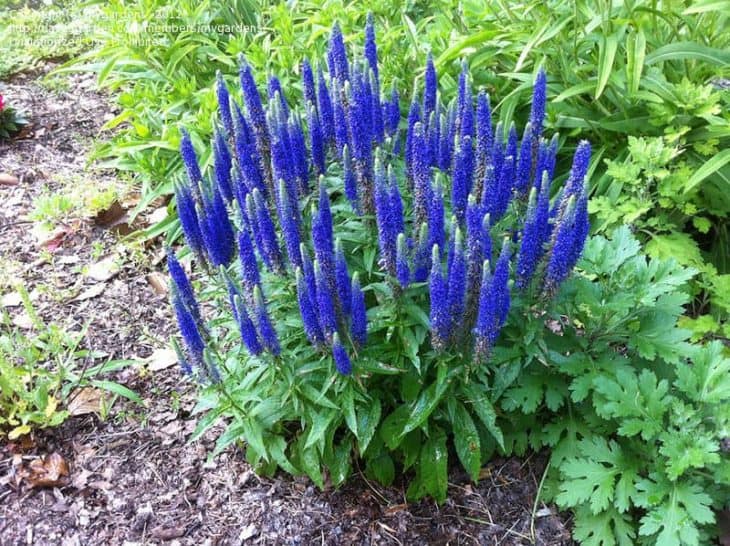
Speedwell is probably the closest match to perennial salvia in a summer border, with dense, narrow spires of purple, pink or white flowers 1 to 3 feet tall. The giveaways are the stems, which are round rather than square, and the individual flowers, which are small, flat and four-petaled instead of two-lipped. Its leaves have no scent. It is in the plantain family, and it flowers from early to midsummer in zones 3 to 8.
English Lavender (Lavandula angustifolia)
Read our guide to English Lavender

Lavender and salvia are both gray-leaved, sun-loving Mediterranean plants with purple flowers, and they are often planted together. But a lavender flower spike is a compact block of small flowers at the top of a long, leafless stalk, while a salvia’s flowers are spaced in whorls up a leafy stem. Lavender’s leaves are narrow, smooth-edged and silver, and the scent settles the question. English lavender grows 1 to 3 feet tall in zones 5 to 9 and needs sharp drainage.
Basil (Ocimum basilicum)

Basil is a mint-family annual and a close relative of salvia, with the same square stems, paired leaves and spikes of small two-lipped flowers, usually white or pale purple. Its leaves are much glossier, softer and more tender, and they smell of cloves and anise. Basil dies at the first frost, while most garden salvias are perennials or shrubs. Pinch out its flower spikes to keep the leaves coming.
Plants With Silver, Sage-Like Leaves
Sagebrush (Artemisia tridentata)

Sagebrush is the shrub that covers the dry basins of the American West, 3 to 10 feet tall, with narrow silver-gray leaves that end in three small teeth and a powerful, bitter smell. It isn’t a sage at all: it is in the daisy family, and its tiny yellowish flowers are wind-pollinated, not the showy spikes of a salvia. Don’t cook with it. White sage (Salvia apiana) of California is a true salvia, and the “sage” of Thanksgiving stuffing is Salvia officinalis.
Dusty Miller (Jacobaea maritima)
Read our guide to Dusty Miller
Dusty miller, or silver ragwort, is grown for its felted, silver-white leaves, which are often mistaken for silver sage (Salvia argentea). Its leaves are deeply cut and lacy, where silver sage’s are large, wavy and woolly, and it bears small yellow daisy flowers rather than flower spikes. It is a Mediterranean perennial in zones 8 to 10 and is grown as a bedding annual farther north.
Lamb’s Ear (Stachys byzantina)
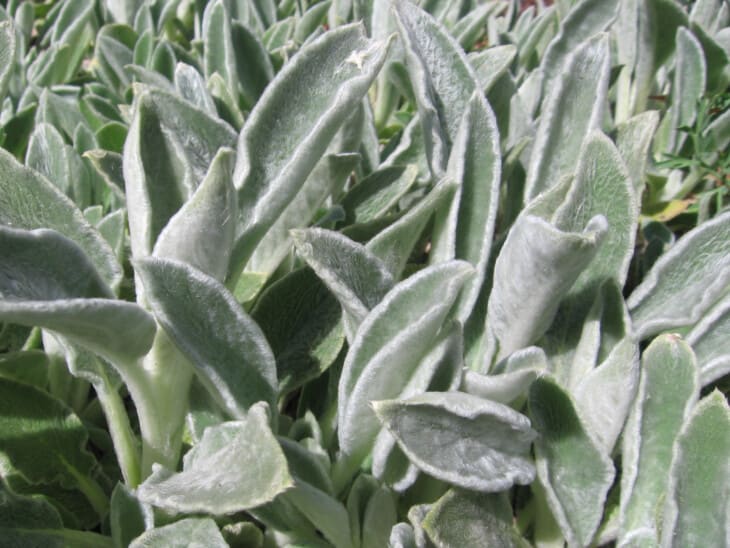
Lamb’s ear has the softest leaves in the garden: thick, silver-white and covered in dense wool, in a low mat about 8 inches tall. It is another mint-family plant, and it sends up woolly 12- to 18-inch stalks with small magenta flowers tucked among the hairs. Silver sage looks similar but has larger, greener, wavy-edged leaves and bigger white flowers. See our list of plants that look like lamb’s ear.
How to Tell a Salvia From a Lookalike
- Look at the flower: a salvia flower is tubular with a hooded upper lip over a spreading lower lip, and only two working stamens on a tiny lever. Four flat petals means speedwell.
- Roll the stem: square stems mean the mint family, which includes salvia, catmint, catnip, betony, ajuga, hyssop, anise hyssop and basil, but rules out speedwell, lavender, sagebrush and dusty miller.
- Crush a leaf: sage-scented means salvia, minty means catmint or catnip, licorice means anise hyssop, clove means basil, and camphor-bitter means sagebrush or wormwood.
- Check the spike: salvia flowers grow in spaced whorls up a leafy stem, lavender’s crowd into a block on a bare stalk, and anise hyssop’s pack into a fat bottlebrush.
- Remember Russian sage: it is now Salvia yangii, so if you thought it looked like a salvia, you were right.