A small garden is not a limitation — it is an invitation to be clever. Some of the most beautiful outdoor spaces in the world occupy no more than a few square metres, yet feel lush, considered, and completely alive. The secret is using every dimension: the ground, the walls, the overhead space, and the edges.
Contents
- 01. Vertical Living Wall
- 02. Stacked Raised Bed Kitchen Garden
- 03. Paved Courtyard with Statement Containers
- 04. Balcony Garden with Railing Planters
- 05. Garden Mirror Illusion
- 06. Herb Spiral
- 07. Window Box Display
- 08. Tiered Plant Stand Corner
- 09. Japanese-Inspired Gravel Garden
- 10. Pergola with Climbing Plants
- 11. Compact Water Feature
- 12. Side Passage Garden
- 13. Gravel Garden with Architectural Plants
- 14. Hanging Basket Canopy
- 15. Upcycled Container Garden
- 16. Moon Garden Seating Corner
- 17. Living Roof Shed
- 18. Espalier Fruit Wall
- 19. Micro Wildflower Patch
- 20. Outdoor Kitchen Corner
- 21. Tropical Corner in a Temperate Garden
- 22. Secret Garden Nook with Bench
- 23. Container Pond
- 24. Seasonal Bulb Display in Raised Pots
- 25. The Garden Room: Outdoor Living Space
These 25 ideas cover every kind of small space. From balcony gardens and paved courtyards to side passages and pocket-sized suburban front gardens. They span different budgets, styles, and skill levels, from the low-maintenance gravel garden to the high-impact living wall. Whether you have full sun, deep shade, or a single north-facing wall, there is an idea here for your situation.
Pick two or three ideas that suit your space and start there — most can be done in a weekend. Each entry includes the design thinking behind it, so you can adapt it rather than copy it exactly. Small gardens reward this kind of considered approach more than any other.
01. Vertical Living Wall
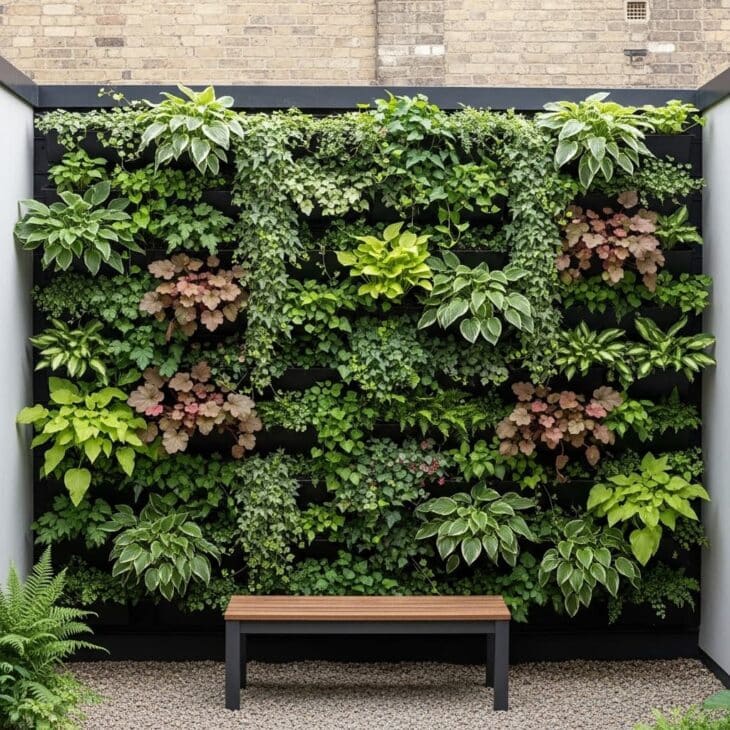
What you see A vertical living wall turns a bare fence or blank render into a garden in its own right, adding hundreds of plant positions without using a single square metre of floor space. Modular pocket planters, purpose-built wall frames, or even a row of staggered shelving can all support a thriving vertical display. In a small courtyard, a single green wall can become the entire garden — dramatic enough to need nothing else alongside it.
Why it works The most successful living walls mix foliage textures rather than relying on flowers, because foliage looks good all year. Trailing ivy, heuchera in bronze and lime, ferns, small hostas, and mind-your-own-business all work well in modular systems. Keep plants that need similar watering together — mixing drought-tolerant sedums with thirsty ferns always ends badly for one of them.
How to get it Feed and water consistently. Vertical walls dry out faster than ground-level planting, especially in summer. A simple drip irrigation line running behind the planters, connected to a tap timer, takes all the maintenance stress out of the wall and keeps it looking good through even the driest weeks.
02. Stacked Raised Bed Kitchen Garden
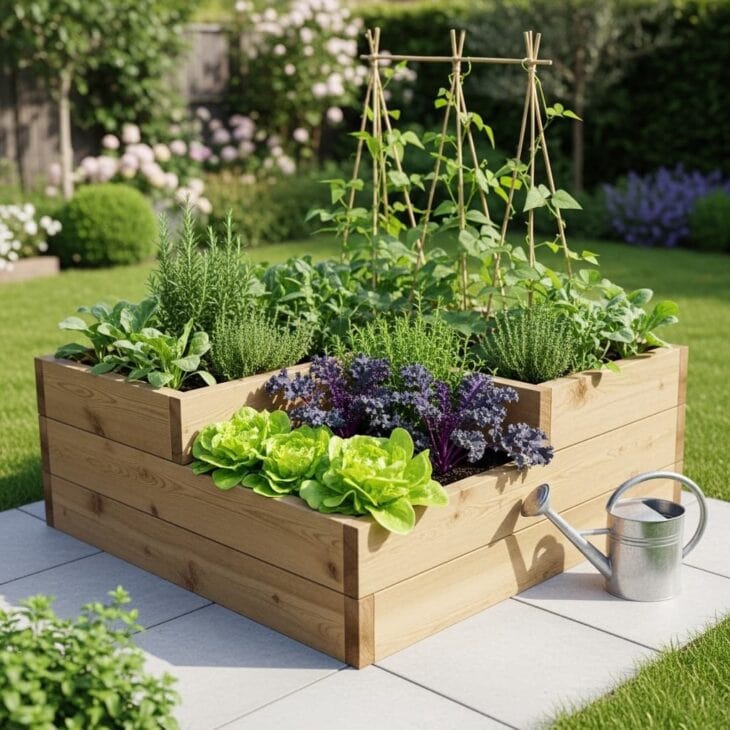
What you see Two raised beds arranged in an L-shape or stacked at different heights can produce an extraordinary amount of food in a space no bigger than a parking space. The height of a raised bed matters more than its footprint: a bed 45cm (18in) tall puts plants at a comfortable working height, eliminates the need to bend, and gives roots the deep, rich growing medium they need to perform well. Build from hardwood sleepers, treated timber, or galvanised steel — all last for years without maintenance.
Why it works Maximise production by thinking vertically within the beds. A bamboo wigwam for climbing beans, a trellis panel at the back for cucumbers, and a row of tall kale at the north end all add growing positions without adding footprint. Fill the remaining space with a cut-and-come-again mix of salad leaves, radishes, and herbs — all of which are harvested repeatedly over months from a very small area.
How to get it Fill raised beds with a 50:50 mix of topsoil and garden compost. This is significantly richer than typical garden soil and explains why raised beds outperform in-ground growing so consistently. Top-dress with a 5cm (2in) layer of compost every autumn and the beds will stay productive for years without additional feeding.
03. Paved Courtyard with Statement Containers
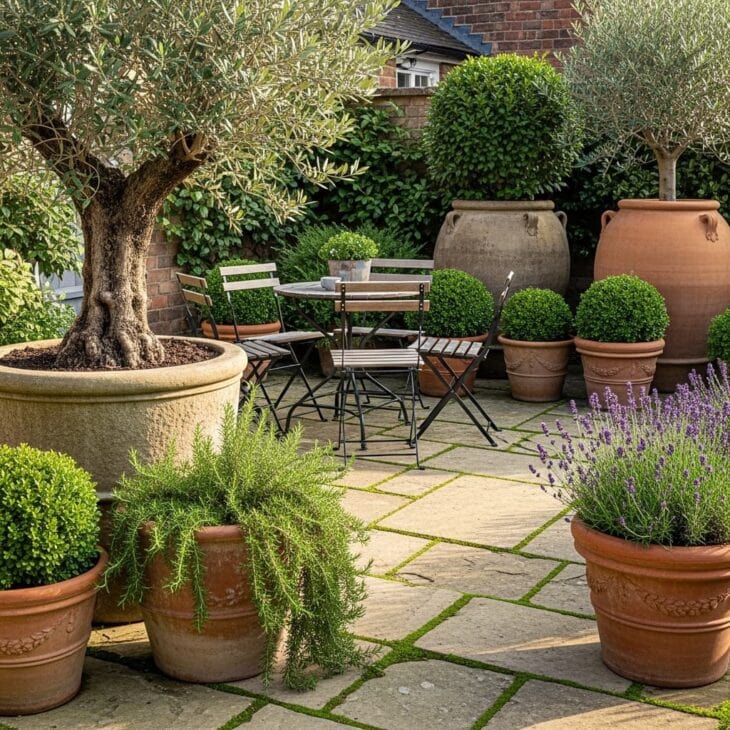
What you see A fully paved courtyard might seem like an unlikely garden, but with generous containers it becomes one of the most versatile and beautiful spaces possible. Paving solves the problems that plague small gardens — mud in winter, uneven ground, difficult soil — and replaces them with a clean, all-weather surface that works equally well as dining space, play area, or planting showcase. The containers become the garden: moveable, editable, and entirely under your control.
Why it works Choose containers that are large enough to matter. A single large terracotta pot with an olive tree or a clipped bay makes more visual impact than a dozen small pots and needs less frequent watering. Group containers in odd numbers — three or five — at different heights to create layered compositions. Aged terracotta, stone troughs, and galvanised metal all age beautifully and give the garden permanence.
How to get it Water is the main commitment in a container courtyard. In summer, large pots may need watering every day. A wall-mounted tap with a short hose makes this fast and easy, or invest in a drip system on a timer. A layer of fine gravel mulch over the compost in each pot cuts moisture loss significantly and gives the surface a clean, intentional look.
04. Balcony Garden with Railing Planters
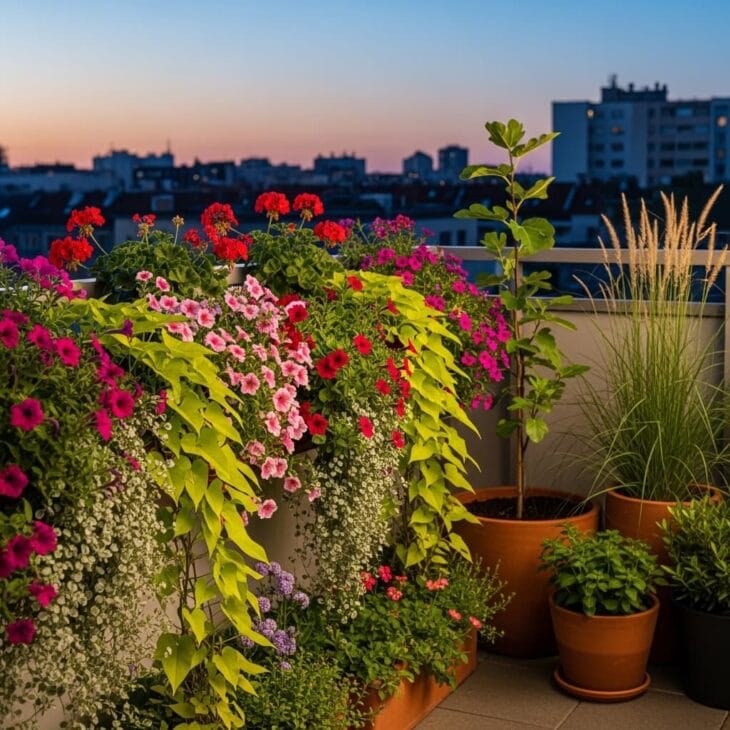
What you see A balcony is one of the most rewarding small garden spaces to plant because every element is visible from the living room — this is a garden you look at as much as use. Railing-mounted planters use the one space that would otherwise be entirely wasted, adding a full growing area along every edge without consuming any of the precious floor space. Fill them with trailing plants that hang downward: petunias, bacopa, calibrachoa, and trailing pelargoniums all perform brilliantly and keep flowering from May to October.
Why it works Anchor the balcony floor with two or three large pots containing structural plants — a small fig, a clipped standard bay, or a compact ornamental grass. These provide height, permanence, and a sense that the balcony is a real garden rather than a temporary arrangement. Keep the floor plants in scale: a pot that looks generously large in a garden centre will look exactly right against a wall or railing.
How to get it Always check your balcony’s weight limit before planting. Large pots full of damp compost are surprisingly heavy — a 50cm (20in) pot can weigh 40kg or more when wet. Use a lightweight, peat-free multipurpose compost mixed with perlite to reduce weight without compromising plant performance. Position the heaviest pots directly above a structural wall or beam, not in the centre of the balcony floor.
05. Garden Mirror Illusion
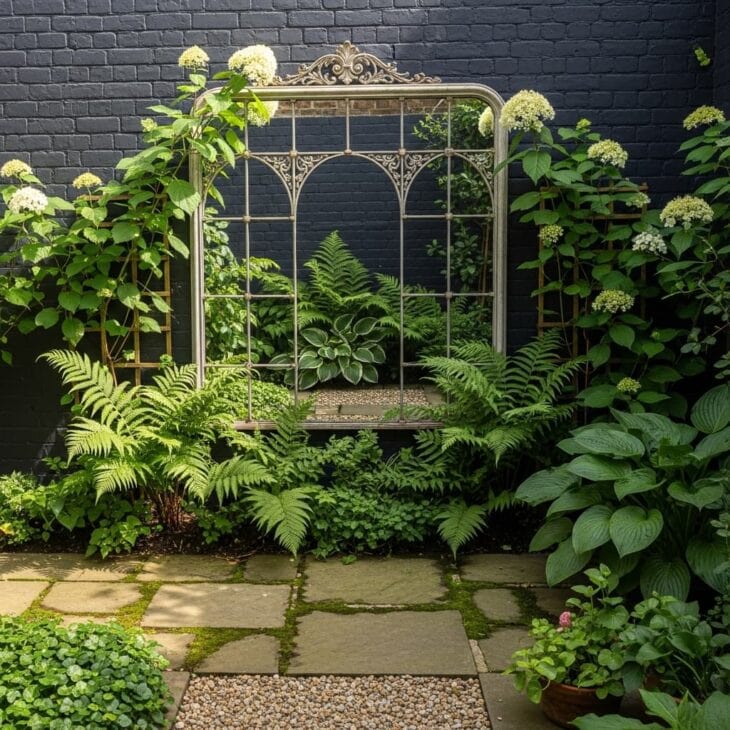
What you see A large mirror mounted on a garden wall is one of the oldest tricks in small garden design and still one of the most effective. It visually doubles the apparent depth of any space, creates the impression of a garden continuing beyond a boundary, and reflects light back into shadier corners. In a narrow side passage or a dark walled courtyard, a well-placed mirror can transform the entire feel of the space without touching the planting at all.
Why it works Frame the mirror with planting to make the illusion convincing. If the plants in front of the mirror continue in the reflection, the eye accepts the fiction readily. Ferns, hostas, and climbing hydrangea all work well as framing plants because their lush foliage leads the eye toward the mirror naturally. Avoid placing the mirror where it will reflect straight back at the viewer — an angled position that reflects a garden view is always more convincing than one that reflects the viewer themselves.
How to get it Use only mirrors designed for outdoor use. Ordinary glass mirrors are not weatherproof — they will delaminate and silver within a season or two in a damp garden. Purpose-built acrylic garden mirrors are lighter, safer (no sharp edges), and fully weatherproof. Fix them securely to a wall with appropriate fixings: a large mirror that falls can cause serious injury.
06. Herb Spiral
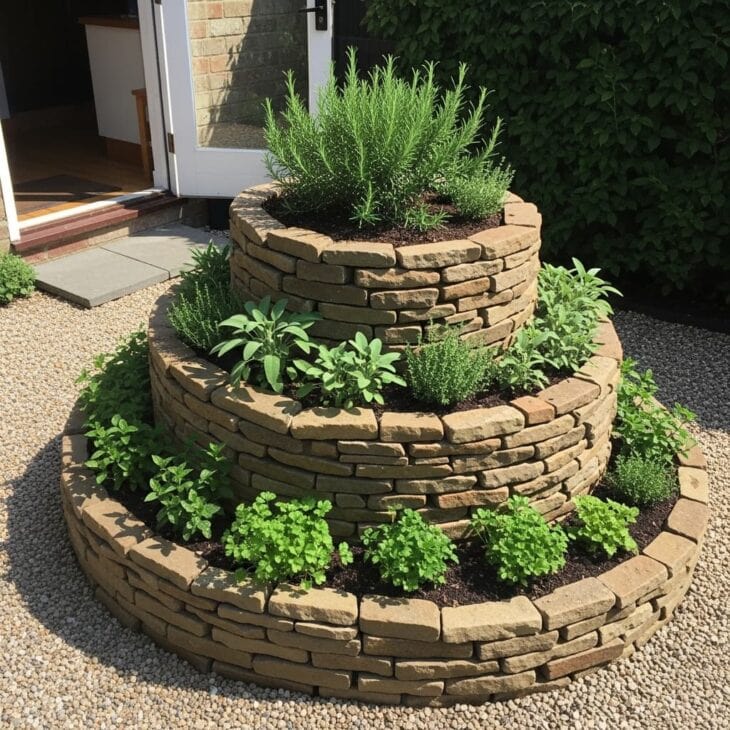
What you see A herb spiral is a raised growing structure that packs more planting area into less ground space than any flat bed, because the spiral form creates multiple distinct growing conditions within a single small footprint. The top of the spiral is warm, dry, and free-draining — perfect for Mediterranean herbs like rosemary, thyme, and oregano. The bottom is cooler and moister, where mint, parsley, and chives thrive. One structure, about 1.2m (4ft) in diameter, provides room for a dozen different herbs in conditions they each genuinely prefer.
Why it works Build the spiral from dry-stacked stone, reclaimed brick, or even wooden sleepers. The structure only needs to be about 60–90cm (2–3ft) tall at its highest point. Fill the interior with a free-draining mix: one part topsoil, one part garden compost, one part horticultural grit. The grit is important — Mediterranean herbs grown in heavy or wet compost will die over winter even in mild climates.
How to get it Place the herb spiral as close to the kitchen door as possible. The shorter the distance from spiral to chopping board, the more often you will actually use it. A herb garden that requires a coat and a walk to reach is a herb garden that gets ignored. At 1.2m (4ft) across, a spiral fits easily into a paved area, a corner of a patio, or a gap between raised beds.
07. Window Box Display
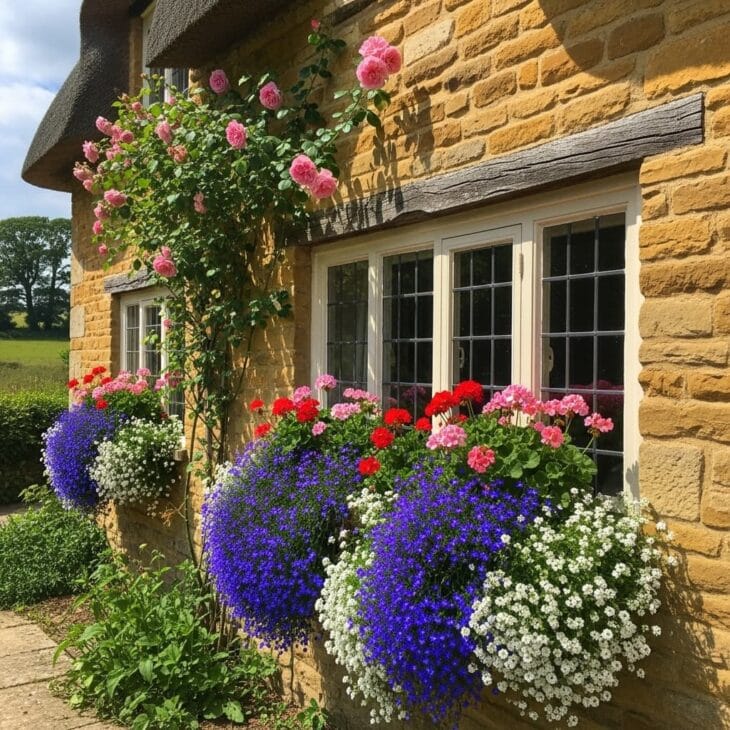
What you see Window boxes are the most visible garden in the world — they face outward onto the street and are seen by everyone who passes, not just the gardener. For homes with no front garden at all, they are often the only opportunity to garden the exterior, and a well-planted window box can completely transform the appearance of a house. A single deep box, 60cm (2ft) or longer, planted generously and topped up every few weeks, can produce a display as impressive as a full front garden border.
Why it works The classic combination for summer window boxes — trailing plants at the front, upright plants behind — works because it creates depth and movement. Trailing lobelia, bacopa, and calibrachoa spill forward and downward; upright pelargoniums, busy lizzies, or petunias fill the centre; and a single architectural plant like a small cordyline or spiky dracaena adds height at the back. Change the planting twice a year for a spring display of bulbs and pansies and a summer display of tropicals.
How to get it Fix window boxes securely. A fully planted, watered box can weigh 15–25kg (33–55lb), and a box that falls from an upper floor is genuinely dangerous. Use purpose-built window box brackets rated for at least twice the expected weight, fixed into masonry with appropriate anchors. Water daily in summer — window boxes dry out very fast in warm weather and will collapse within 48 hours if missed in a heat wave.
08. Tiered Plant Stand Corner
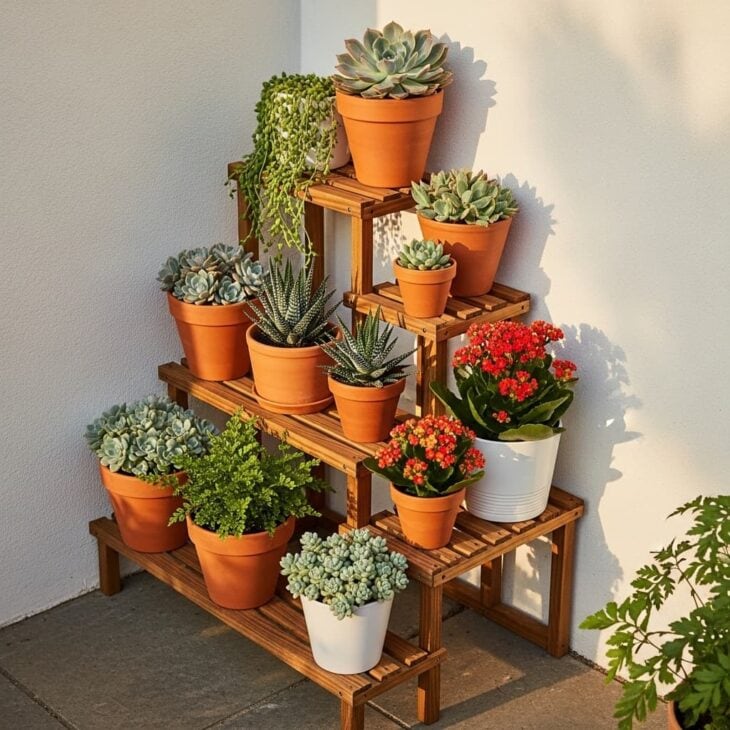
What you see A tiered plant stand is one of the simplest ways to create a designed focal point from a collection of pots. Instead of scattered containers that look like they have been placed without thought, a stand arranges them into a deliberate composition — and because each shelf sits at a different height, every pot is visible at once. In a corner, a well-stocked tiered stand can read as an entire garden feature: a destination, not just a collection of plants.
Why it works Stands work best when the pots on them follow a coherent theme. A set of terracotta pots in the same colour family with varying textures looks intentional and calm. A mix of glazed pots in contrasting colours works if the plants themselves are unified — all succulents, all ferns, or all herbs. Avoid mixing too many plant types, sizes, and pot styles on a single stand: the result looks busy rather than curated.
How to get it Move the stand with the seasons. In spring, fill it with forced bulbs as they come into flower. In summer, switch to trailing and flowering annuals. In autumn, replace with ornamental grasses and late-season sedums. In winter, bring tender plants indoors and let the stand hold evergreen architectural foliage. The portability of a plant stand is half its value — it goes wherever the light and the occasion demand.
09. Japanese-Inspired Gravel Garden
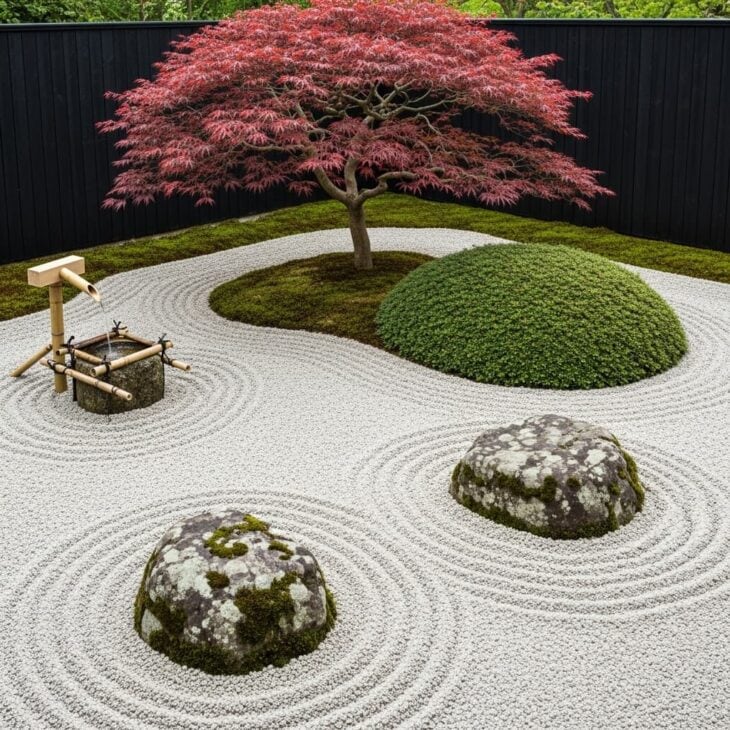
What you see A Japanese-inspired gravel garden is the style that rewards small spaces most generously. The entire aesthetic is built on restraint: fewer elements, more thought, and the deliberate use of empty space as a design tool in itself. A single Japanese maple, two or three carefully placed stones, raked gravel, and a low clipped shrub is enough to create a garden that looks composed and complete. Nothing is accidental. Nothing is temporary. Everything earns its place across all four seasons.
Why it works Use fine pale gravel — 10–14mm silver or Cotswold — raked in straight lines or concentric curves around the stones. The raking pattern gives the garden a meditative, hand-maintained quality that no other surface material achieves. Set stones individually rather than in groups: a single large, weathered stone always looks more intentional than three medium ones. Choose stones with interesting surface texture — sandstone, slate, or granite all weather beautifully over years.
How to get it The Japanese maple is the essential centrepiece. ‘Bloodgood’ and ‘Osakazuki’ are both reliable for deep autumn colour. ‘Dissectum’ varieties have finely cut leaves with a weeping habit that works beautifully in a contained space. Plant in a large container rather than directly into the gravel — it keeps the roots manageable, makes the maple moveable, and gives it the sharp drainage it needs to avoid root rot in wetter climates.
10. Pergola with Climbing Plants
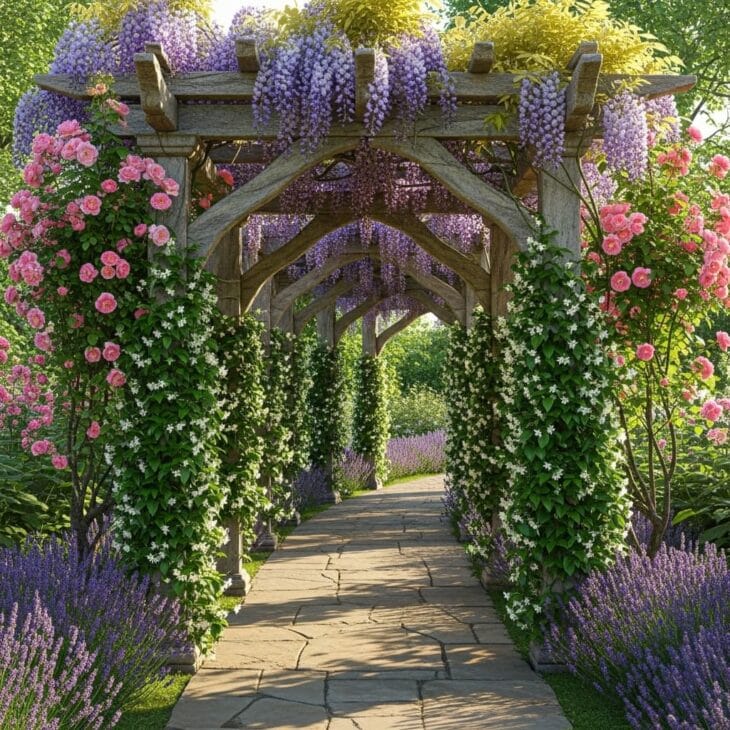
What you see A pergola does something no other garden structure can: it creates a ceiling. Once a garden has a ceiling — even a living, open-weave one made of climbing plants — it becomes a room, and rooms feel more intimate and sheltered than open spaces regardless of size. In a tiny garden, a pergola can turn a plain rectangle of paving into a genuinely magical outdoor dining space, providing dappled shade in summer and a framework for seasonal climbing plants throughout the year.
Why it works The best climbing plants for a pergola are those that offer multiple seasons of interest. Wisteria gives an unbeatable spring display and a woody, sculptural framework in winter. A climbing rose such as ‘Generous Gardener’ or ‘New Dawn’ provides fragrance and repeat blooms from June to October. Clematis fills the gaps and extends the flowering season. Plant one of each at alternate uprights and allow three to five years for the structure to become fully clothed.
How to get it Choose a pergola kit in steel or hardwood rather than softwood. Softwood pergolas look attractive initially but will need painting or treating every two to three years to prevent decay, and will eventually need replacing. A powder-coated steel or hardwood oak pergola, correctly specified, will outlast the garden itself. Buy the largest kit your space allows — a pergola that is too narrow feels more like a gate than a room.
11. Compact Water Feature
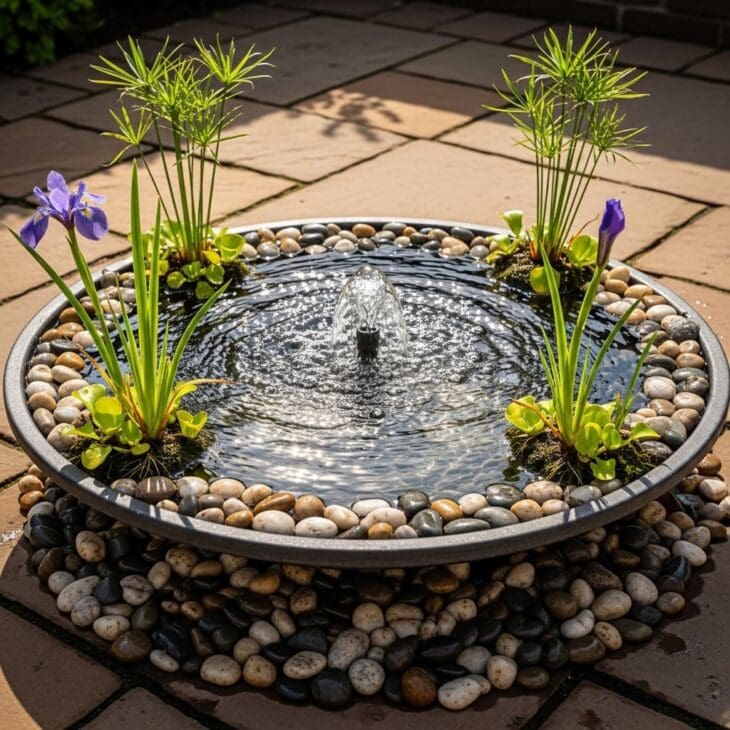
What you see A water feature adds something no plant can: sound. The gentle movement of water — even from a small bubble fountain or a trickle over pebbles — creates an ambient backdrop that makes a small garden feel larger and more serene. It also masks urban noise, which is one of the most underrated benefits of water in a city garden. A self-contained reservoir unit, which recirculates water rather than requiring a connection to drainage, needs only a nearby power socket and can be installed in an afternoon.
Why it works For small spaces, the most effective water features are horizontal rather than vertical — a wide shallow basin or a millstone-style feature reads as a ground-level element that doesn’t compete with the planting. A narrow upright feature tends to look apologetic in a tiny space. The surface area of the water matters more than the height of any jet: still or near-still water reflects sky and light in a way that a tall fountain never can.
How to get it Keep the water clean with a small submersible pump and filter combination, available at garden centres for under £50. Add a small amount of barley straw extract or a proprietary algae treatment in spring and top up the water level weekly in summer. A handful of aquatic oxygenating plants in a mesh basket at the bottom of the basin will naturally balance the water and reduce the need for chemical treatments.
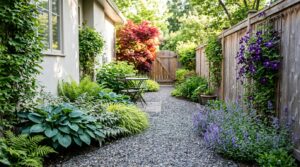
12. Side Passage Garden
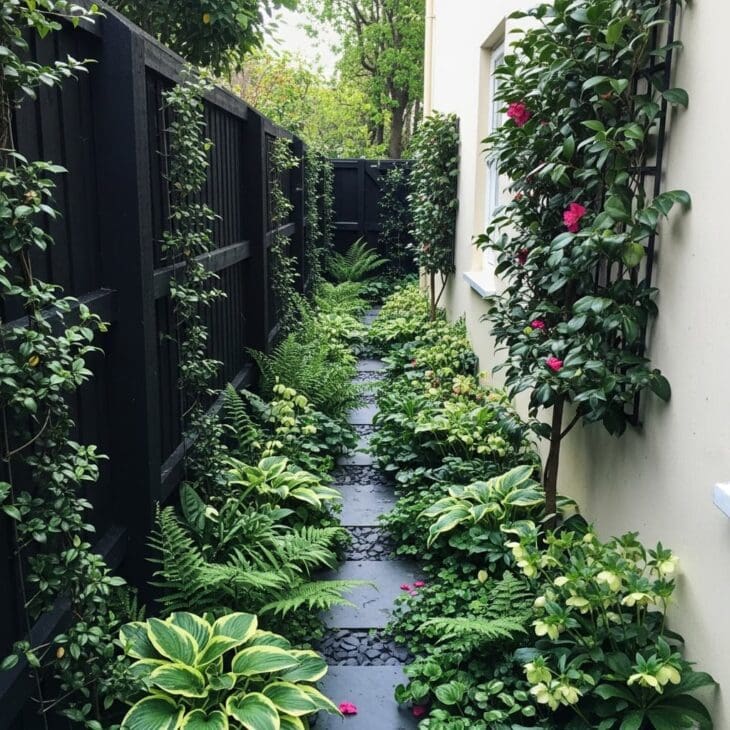
What you see A side passage is one of the most neglected spaces in domestic gardens — typically used to store bins and bikes, its potential as a lush green corridor is almost always ignored. Yet a passage as narrow as 90cm (3ft) can be transformed into a genuinely beautiful shaded planting, linking the front and back gardens with a journey through foliage and calm. The key is to treat it as a corridor rather than a border: the experience of walking through it matters more than how it looks from any single viewpoint.
Why it works Plant both sides with shade-tolerant species that work at different heights. Ferns, hostas, and hellebores cover the ground level. Camellias, Pieris, or Fatsia trained flat against the wall fill the middle height without extending into the walkway. A climbing hydrangea on the shadier wall provides spring and summer interest with minimal care. Keep the path surface simple and non-slip — slate stepping stones, compacted hoggin, or textured porcelain all work well.
How to get it Paint the fence or render the walls in a dark tone — near-black or deep green — to make the foliage pop and the passage feel deliberately designed rather than neglected. Lighting transforms side passages after dark: a row of low-voltage path lights or wall-mounted spotlights makes the passage feel like a feature of the garden rather than its back entrance. Add a simple wall hook for a hanging basket to bring a moment of colour at eye level.
13. Gravel Garden with Architectural Plants
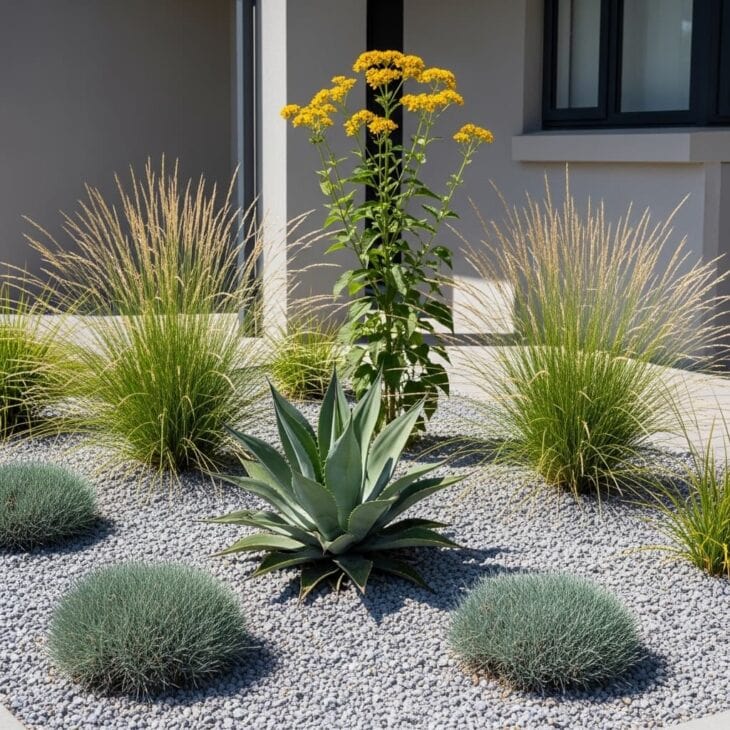
What you see Converting a small front garden from lawn to gravel is one of the most transformative low-maintenance improvements possible. Gravel requires no mowing, no edging, no watering once plants are established, and no feeding. It drains instantly, suppresses weeds when laid deep enough, and provides a neutral backdrop that makes architectural plants look exceptional. A well-designed gravel garden is at its best in the three seasons when a lawn looks its worst — late autumn, winter, and early spring — which is exactly when low-maintenance matters most.
Why it works Use 10–20mm silver or flint gravel at a depth of 5–8cm (2–3in) over a weed-suppressing membrane. Choose plants that earn their place as individual sculptures: Verbascum, Eryngium, Stipa gigantea, Euphorbia characias, and Agave or Yucca all look superb in gravel. Plant in odd-numbered groups — three Stipa, one Agave, five Eryngium — and leave meaningful space between plants. The negative space is deliberate, not unfinished: it shows off each plant’s form.
How to get it Top-dress the gravel each spring to refresh the surface and fill in any areas where plants have displaced stone. Pull any weeds that push through before they establish — in a properly laid gravel garden there will be very few, and they pull out easily from the loose surface. Avoid using organic mulch alongside gravel: the contrast looks untidy and bark chips migrate into the gravel within a season.
14. Hanging Basket Canopy
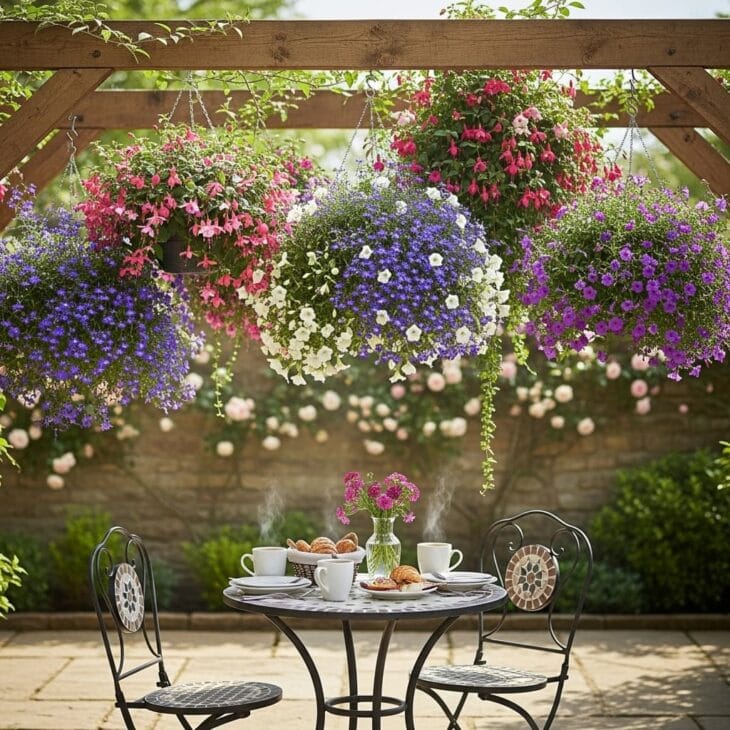
What you see Hanging baskets are too often treated as an afterthought — a single basket on a bracket either side of a door — when they can instead be used to create something approaching a garden ceiling. Suspend five or six large baskets at different heights from an overhead beam, a pergola, or a series of brackets along a wall, and the effect is a floating canopy of colour that transforms even the plainest patio into something lush and abundant. The baskets take up no floor space, no wall space, and no border space at all.
Why it works The largest baskets — 40cm (16in) or more — hold the most compost and therefore need watering less frequently. Plant them densely: a single 40cm basket can accommodate twelve or more plants if they are planted through the sides as well as the top. Use a slow-release fertiliser granule mixed into the compost at planting time and add a water-retaining gel to reduce watering frequency. A basket planted in late April will be fully established and overflowing by late June.
How to get it The best plants for a hanging canopy are those that trail enthusiastically downward: trailing fuchsias, million bells (calibrachoa), bacopa, ivy-leaf pelargoniums, and Sutera. Add verbena or trailing petunias for fragrance. Water daily in hot weather — a fully planted basket in full sun can need a litre of water every day in July. An overhead pulley system that allows the basket to be lowered for watering makes the routine much less demanding.
15. Upcycled Container Garden
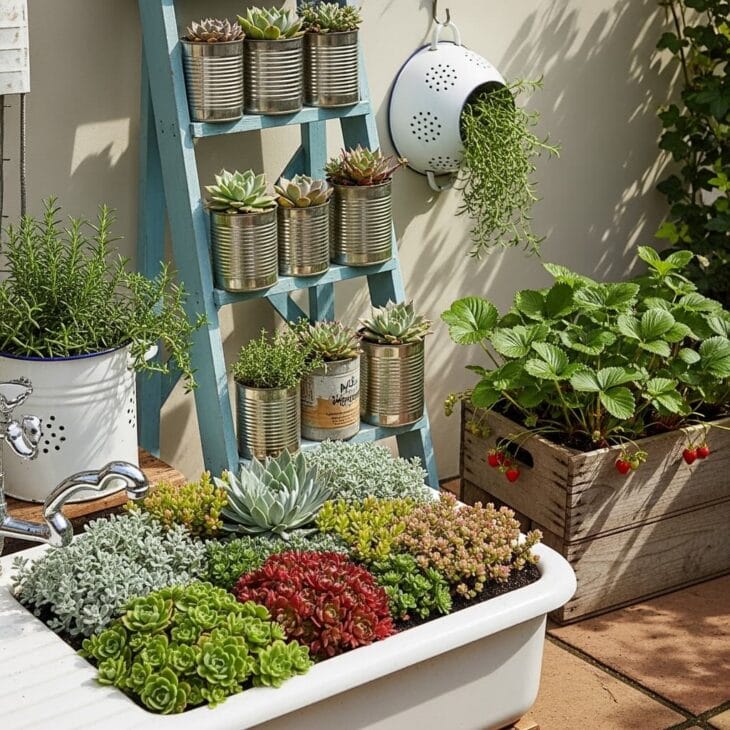
What you see Almost any watertight container can become a planter, and the most interesting small gardens often contain objects that have no business being in a garden at all: an old Belfast sink planted with alpines, a wooden crate of strawberries, an enamel colander overflowing with herbs. Upcycled containers give a garden character and individuality that no garden centre display can replicate, and they cost almost nothing if you are willing to look for them at car boot sales, skips, and charity shops.
Why it works Any container needs drainage — drill holes in the base if it does not already have them. A Belfast sink, a metal bath, a vintage wheelbarrow: all can be drilled with a standard masonry or metal bit. Fill with a compost appropriate to the plants you are growing: alpine grit mix for succulents and sedums, multipurpose for annuals, ericaceous for blueberries or heathers. The match between compost type and plant needs is what makes upcycled containers perform as well as purpose-built pots.
How to get it Group upcycled containers thoughtfully rather than scattering them. Three or four objects with a loose theme — all vintage metal, all painted the same colour, all planted with the same species — cohere into a display rather than looking like an accumulation of junk. A lick of paint in a single shade transforms mismatched objects into a collection. Choose a colour that sits well against your fence or wall: sage green, slate blue, and warm terracotta all work beautifully in a garden setting.
16. Moon Garden Seating Corner
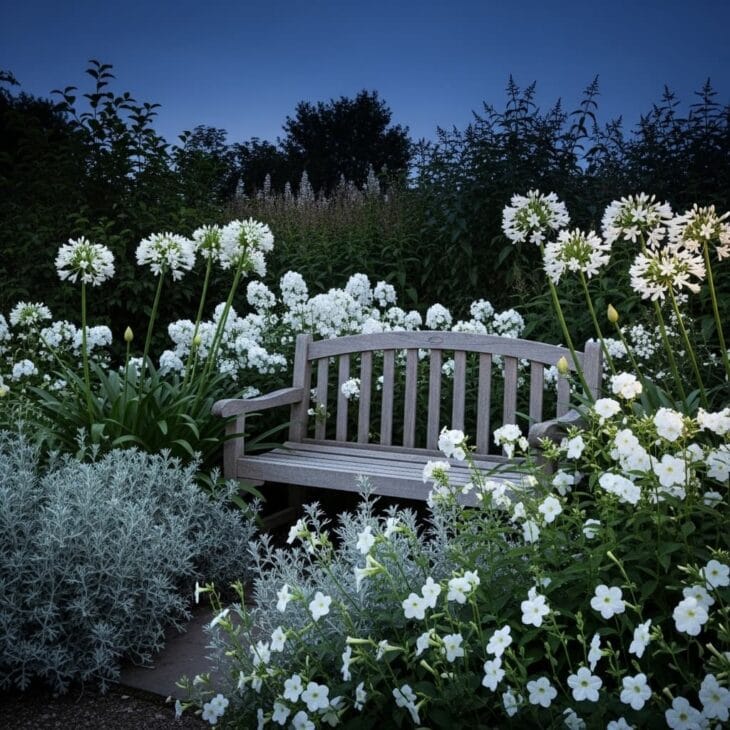
What you see A moon garden — planted entirely in white and silver — is specifically designed to be seen after dark, when white flowers seem to generate their own soft glow and silver foliage shimmers in ambient light. In a small garden where the most comfortable time to sit outside is a summer evening after work, a moon garden corner makes far more practical sense than a hot, colorful border that peaks at midday and needs constant deadheading. Plant once, enjoy every evening from June to September.
Why it works The most effective moon garden plants combine white flowers with interesting foliage textures. White agapanthus, phlox, shasta daisies, and cosmos provide bloom. Silver artemisia, Stachys byzantina (lamb’s ears), and white-variegated hostas provide year-round luminous foliage. White nicotiana — planted as an annual — releases a heavy, sweet fragrance specifically in the evening, making the corner smell extraordinary on still nights. Add a white-flowered jasmine or honeysuckle on the nearest wall for overhead fragrance.
How to get it Keep the colour scheme pure. A single warm cream or blush pink alongside the white is acceptable — these tones read as white in low light. Anything cooler or stronger — lilac, soft blue — also works because these colours also glow in dusk and moonlight. What breaks the illusion is red, orange, or hot pink: these colours simply disappear in low light, leaving gaps in the planting that look like failures rather than choices.
17. Living Roof Shed
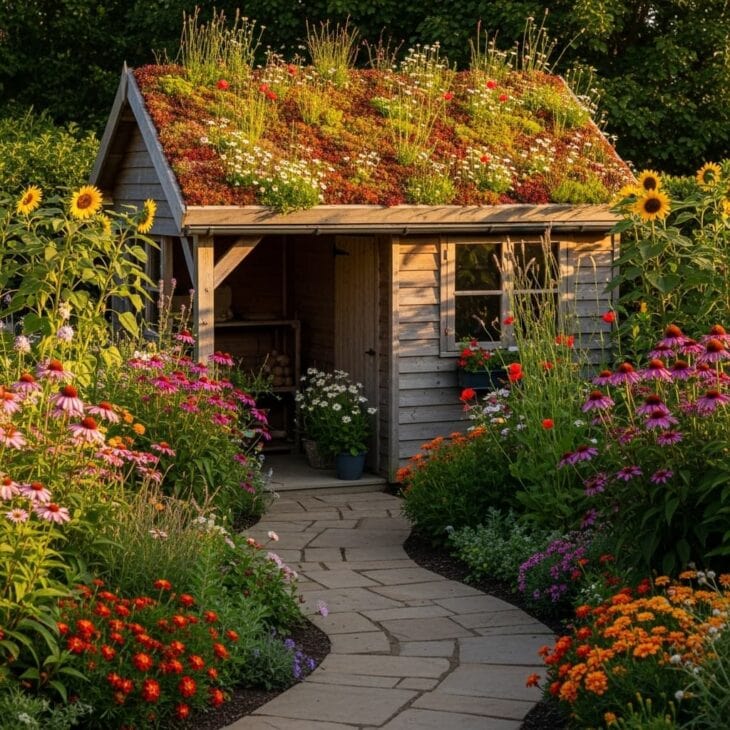
What you see A living roof turns the most neglected surface in a small garden into a genuine garden feature. A standard garden shed has a roof area of 4–6 square metres — planted with sedums, wildflowers, and grasses, that same area becomes a year-round garden that also insulates the shed, absorbs rainwater, and supports pollinators. In a tiny garden where every vertical and horizontal surface matters, a planted roof is not an extravagance but a logical use of otherwise wasted space.
Why it works The simplest living roofs use pre-grown sedum matting, available by the square metre from specialist suppliers. Lay the matting on a waterproof membrane over a lightweight drainage layer of 5–8cm (2–3in) of expanded clay aggregate or purpose-made green roof substrate. The total system adds approximately 70–100kg per square metre when saturated — check that your shed roof structure can take this load, or add additional bracing before installation.
How to get it Sedum matting requires almost no maintenance once established. Water it during the first summer if rainfall is scarce. Pull any tree seedlings that establish in the first year before their roots penetrate the waterproofing. Beyond this, the roof looks after itself — the sedums spread, self-repair any bare patches, and change colour through the seasons from fresh green in spring to deep bronze and burgundy in autumn. No mowing, no feeding, no deadheading.
18. Espalier Fruit Wall
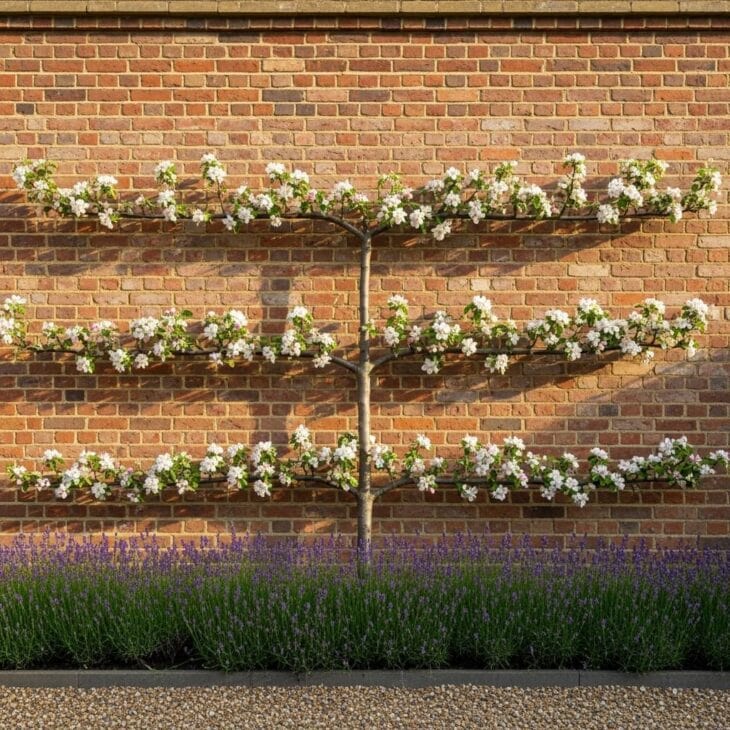
What you see An espalier is a fruit tree trained into a flat, two-dimensional form against a wall — a technique that allows a full-sized productive apple, pear, or quince tree to occupy the growing depth of a border while using only the vertical plane of a fence or wall. In a small garden where a free-standing fruit tree would consume significant floor space, an espalier delivers the same harvest in a fraction of the footprint. A south- or west-facing wall also provides warmth that brings the fruit on earlier and sweeter than a tree in the open garden.
Why it works Buy a part-trained espalier from a specialist fruit nursery — two or three tiers already established — rather than starting from a maiden whip. This saves three to four years of patient training and gives you a tree that will produce fruit within a season or two of planting. Fix horizontal wires at 40cm (16in) intervals up the wall before the tree arrives, and tie in each new tier as it develops. Apple varieties ‘Fiesta’, ‘James Grieve’, and ‘Discovery’ all respond well to espalier training.
How to get it Prune espaliers twice a year: in July or August to cut back the current season’s side-shoots to three or four leaves (summer pruning), and again in winter to remove crossing branches and maintain the form. This two-stage pruning keeps the tree flat, maximises fruit bud formation, and prevents the espalier from becoming a tangled mass of growth that obscures the wall. Underplant with low herbs — lavender, thyme, or marjoram — that enjoy the warmth reflected off the wall.
19. Micro Wildflower Patch
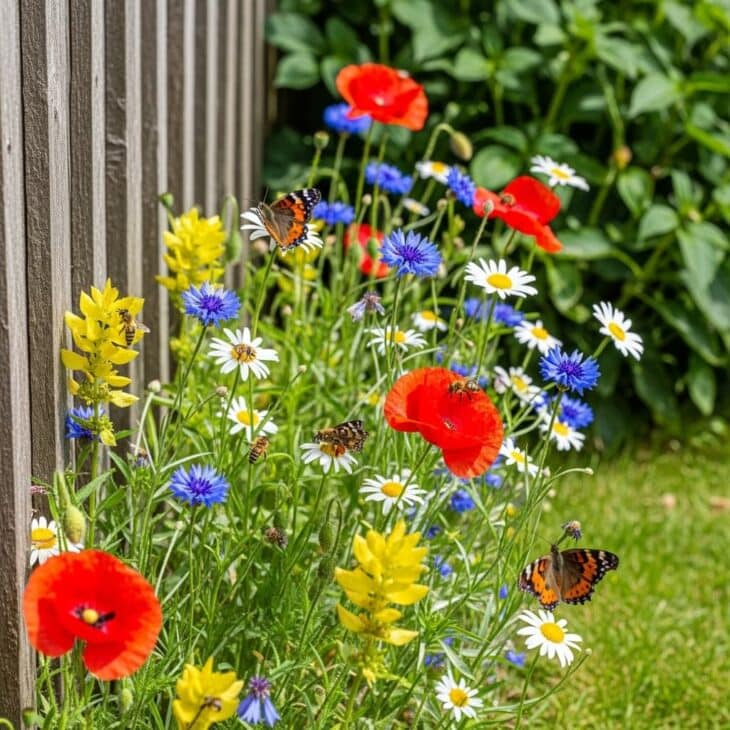
What you see A wildflower patch does not need to be large to be effective. A strip as narrow as 60cm (2ft) wide along a fence, or a single square metre cut out of a lawn, can establish a genuinely wild and biodiverse planting that supports bees, butterflies, and hoverflies from May through September. The contrast between a tidy surrounding garden and a deliberately wild patch makes the planting look intentional rather than neglected — the key is a clean edge between the wildflower area and everything around it.
Why it works The most reliable method is bare soil sowing in autumn. Scrape away all existing vegetation and topsoil to expose the subsoil, which is lower in fertility and therefore better for wildflowers — rich soil grows vigorous grasses that outcompete everything else. Scatter a native annual and perennial mix designed for your soil type at the recommended rate, rake gently, and leave it alone. The first summer will produce a good annual display; from the second year, perennials establish and the patch becomes self-sustaining.
How to get it Mow the patch once a year in late September or October, after seed has set. This is the only maintenance required. Remove the cut material from the patch to prevent it rotting down and enriching the soil — maintained poverty is what keeps the wildflowers in charge. A sign or a small slate label beside the patch tells visitors that the wildness is deliberate, which transforms the reading of the space entirely.
20. Outdoor Kitchen Corner
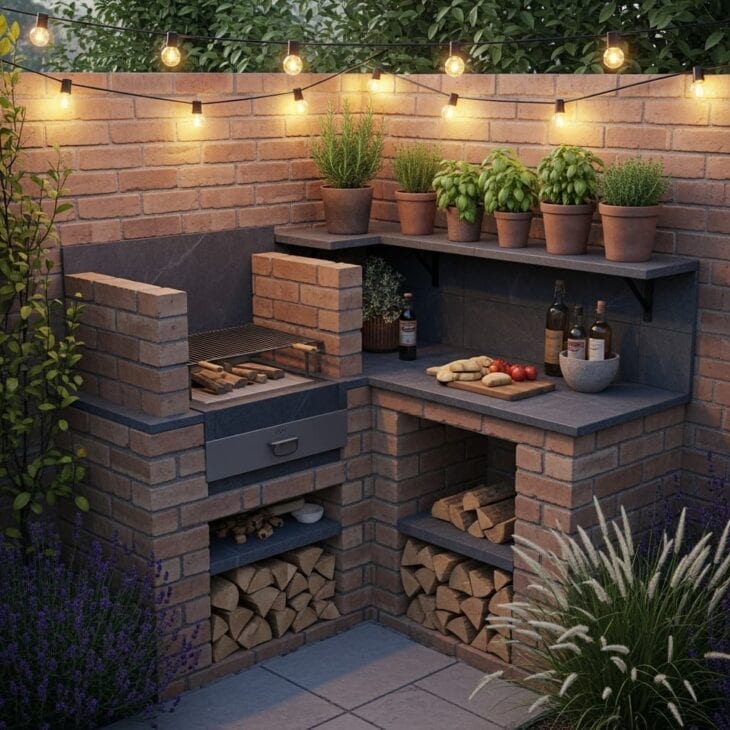
What you see A built-in outdoor kitchen corner transforms a small garden from a space you look at to a space you live in. It does not need to be elaborate: a brick base with a slate or concrete worktop, a built-in charcoal grill or gas burner, and a shelf for herbs is enough to create a dedicated cooking and entertaining zone that makes the garden genuinely functional. Built into a corner, it consumes very little floor area while making an enormous difference to how the garden is used throughout the summer.
Why it works The most practical material for a small outdoor kitchen base is engineering brick, which is hard, frost-proof, and requires no maintenance. Top with a 40mm (1.5in) slab of slate, granite, or poured concrete — all are heat-resistant and easy to clean. Build in a small shelf or cabinet beneath the worktop for storing charcoal, tools, and a gas canister. Wire in a weatherproof socket for a plug-in smoker or electric grill, and add string lights or wall-mounted LED spotlights for evening use.
How to get it Plant herbs directly beside the cooking area. A wall-mounted planter holding rosemary, thyme, and chives at arm’s reach from the grill is both practical and attractive. Add a small bay tree or standard rosemary in a pot at the end of the worktop. The combination of cooking smells and garden fragrance on a summer evening is one of the genuine pleasures of a well-designed small garden.
21. Tropical Corner in a Temperate Garden
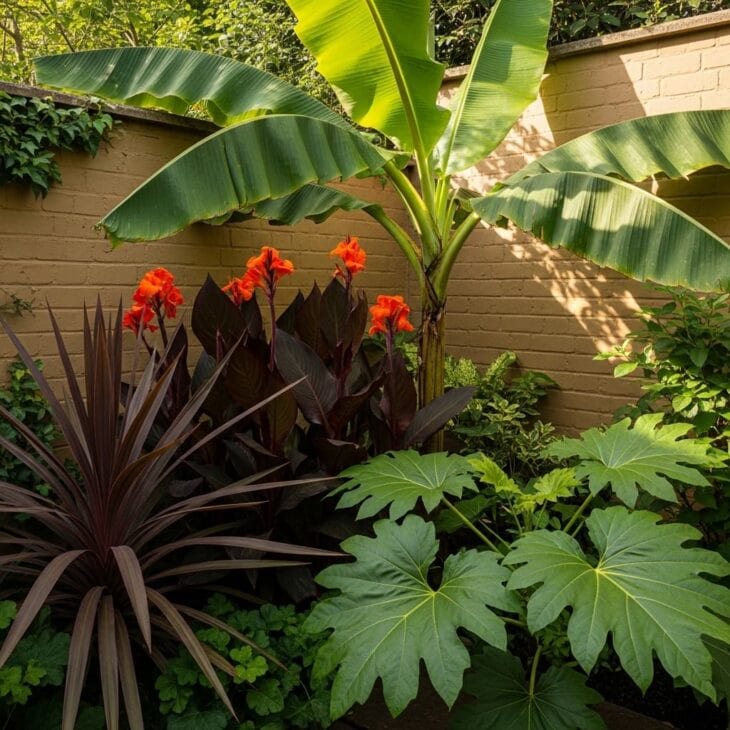
What you see A tropical corner works in a small garden because it is, by definition, a corner — a single concentrated area of drama that does not need to extend further to create its effect. Large leaves read as exotic and lush even when the plants behind them are entirely hardy, and a small space is where large leaves are most powerful: a single giant banana or Gunnera manicata changes the scale of the whole garden around it. In a 3m (10ft) square corner, a tropical planting feels genuinely immersive.
Why it works Build the backbone from hardy architectural plants that stay outdoors year-round: Fatsia japonica, Phormium tenax, Trachycarpus fortunei (the Chusan palm, hardy to -15°C / 5°F), and Tetrapanax papyrifer. Layer in tender summer performers that are lifted in autumn: cannas for vertical drama and exotic flowers, Musa basjoo (the hardiest banana) for the statement leaf, and Colocasia for dark, dramatic foliage. Plant everything against a south-facing wall to maximise warmth and protect against frost.
How to get it In October, cut cannas and Colocasia to the ground and mulch crowns with a deep layer of bark chippings or fleece. Musa basjoo can be left outdoors in most of the UK with the stem wrapped in horticultural fleece. Lift any non-hardy specimens into pots and move to a frost-free greenhouse or garage. By May, once the last frost has passed, the entire corner can be reinstated from the same plants in under an hour.
22. Secret Garden Nook with Bench
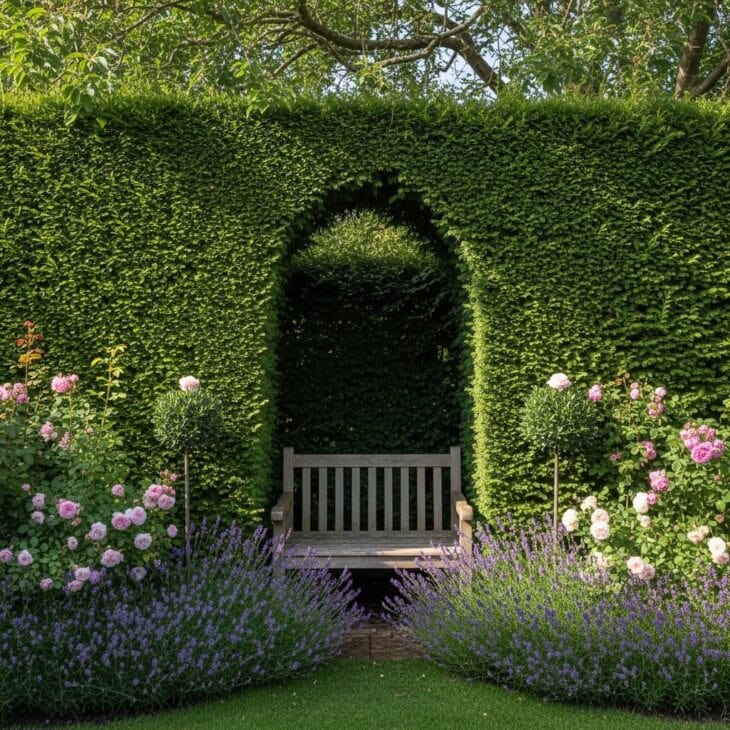
What you see Even the smallest garden benefits from a destination — somewhere to walk to, rather than simply a space to stand in. Carving a bench nook into a hedge or tight planting at the far end of a garden creates a sense of arrival and enclosure that a seat placed in the open never quite achieves. A simple wooden bench set into a U-shaped gap in a yew or hornbeam hedge, with roses on either side, creates a genuinely private and sheltered corner that feels much further from the house than it actually is.
Why it works The enclosure is what makes the nook work. Cut a recess of 60–90cm (2–3ft) into the hedge, just wide enough for the bench and a narrow planting strip on either side. The hedge should be at least 1.5m (5ft) tall to give a sense of being held in. Add a standard rose or a shaped Pittosporum at each corner of the recess to frame the view back toward the garden. Plant fragrant things within arm’s reach: a rose trained into the hedge above, rosemary at knee height, or a sweet-smelling thyme at foot level.
How to get it If no hedge exists, create the same effect with a simple trellis panel in a U-shape, planted with a fast-growing climber. Clematis montana will cover a trellis within two years and flowers profusely every spring. Fix the trellis panels to wooden posts concreted into the ground, paint them in a dark receding colour — near-black or deep forest green — and the nook will feel enclosed and private from its first season.
23. Container Pond
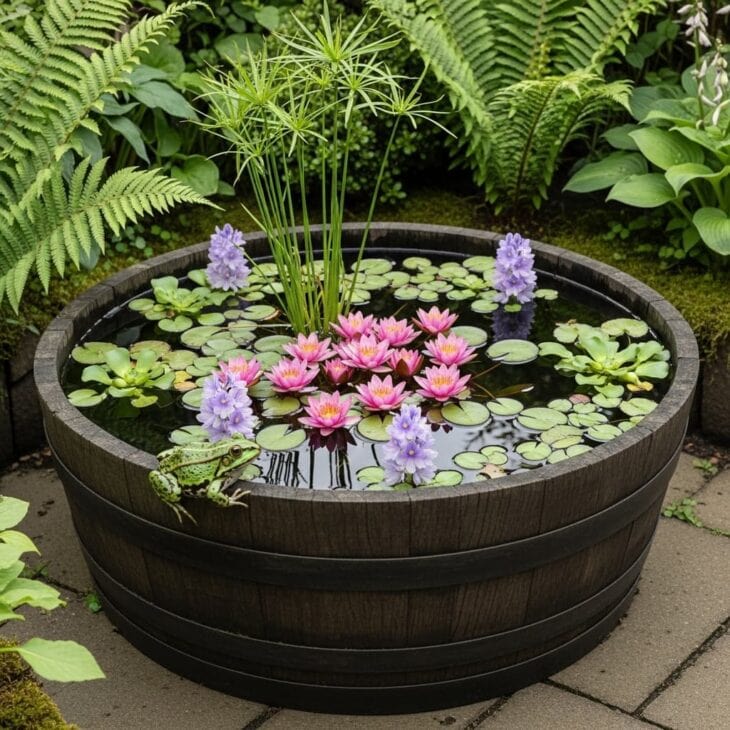
What you see A container pond brings wildlife into a garden without requiring a single square metre of excavation. A large half-barrel, a stock tank, a galvanised trough, or any deep watertight container can become a fully functioning miniature pond that attracts frogs, dragonflies, and water boatmen within weeks of being filled. Even a container 60cm (2ft) across provides enough surface area for a miniature water lily and two or three marginal plants, giving the garden the reflective surface and still-water calm of a full pond at a tiny fraction of the work.
Why it works For a container pond to support aquatic life, it needs three things: depth (at least 40cm / 16in), plants for oxygenation, and a way for wildlife to enter and exit. Position a submerged basket of oxygenating weed on a brick plinth at the bottom. Add a miniature water lily — ‘Pygmaea Helvola’ or ‘Froebeli’ are both excellent for containers. Stack bricks or stones on one side to create a ramp at the waterline so frogs and hedgehogs can climb in and out without drowning.
How to get it Site the container in a position that receives four to six hours of direct sun per day — this is enough for the water lily to flower but not so much that the water overheats and turns green. In prolonged hot spells, top up the water level with rainwater from a water butt rather than tap water, which contains chlorine and minerals that algae find very agreeable. Avoid placing the pond directly under a deciduous tree: fallen leaves rot in the water and deplete oxygen.
24. Seasonal Bulb Display in Raised Pots
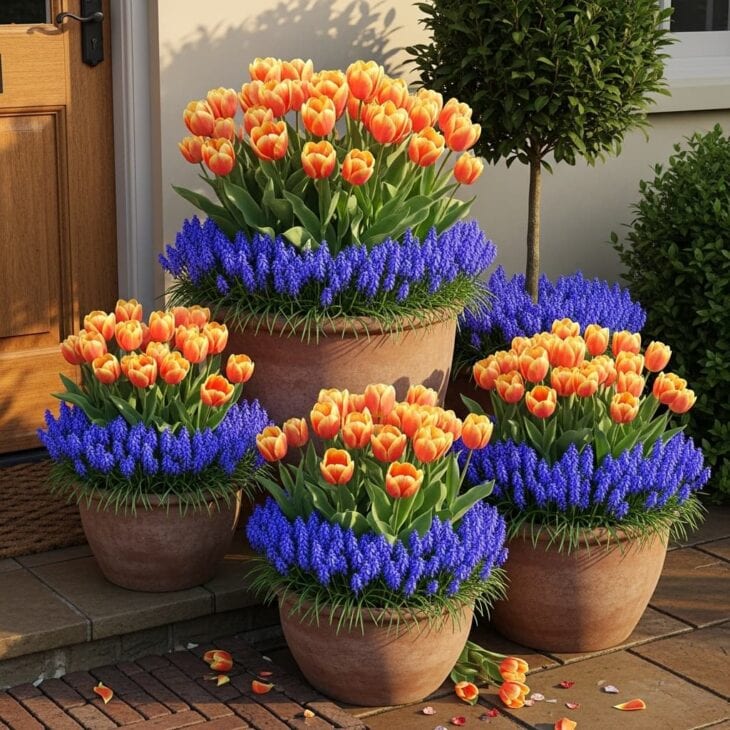
What you see A cluster of large terracotta pots planted with layered bulbs is one of the highest-return investments in a small garden. A single afternoon of planting in October delivers a rotating display that runs from the first snowdrops in January through narcissus and muscari in March, tulips in April and May, and finally alliums in June — all from the same containers, which then rest and are replanted for the following year. Nothing else in the gardening calendar delivers six months of changing display from a few hours of autumn planting.
Why it works The secret is layered planting — placing three different species at three different depths in the same pot. Large tulip bulbs go deepest, at 20cm (8in). Medium narcissus bulbs sit above them at 12cm (5in). Small muscari or crocus bulbs nestle near the surface at 5cm (2in). All three layers then flower at slightly different times, with the smallest earliest and the tallest last. Each pot becomes a three-act performance from January to June.
How to get it Use terracotta rather than plastic for bulb pots — terracotta is frost-hardy when used with free-draining compost and ages beautifully. Mix bulb compost with horticultural grit at a 3:1 ratio to ensure the sharp drainage that prevents bulb rot over the winter months. After flowering, allow the foliage to die back fully before removing it — the leaves are recharging the bulb underground for the following year. Tulips benefit from being lifted and stored dry over summer; narcissus and muscari can remain in the pot.
25. The Garden Room: Outdoor Living Space
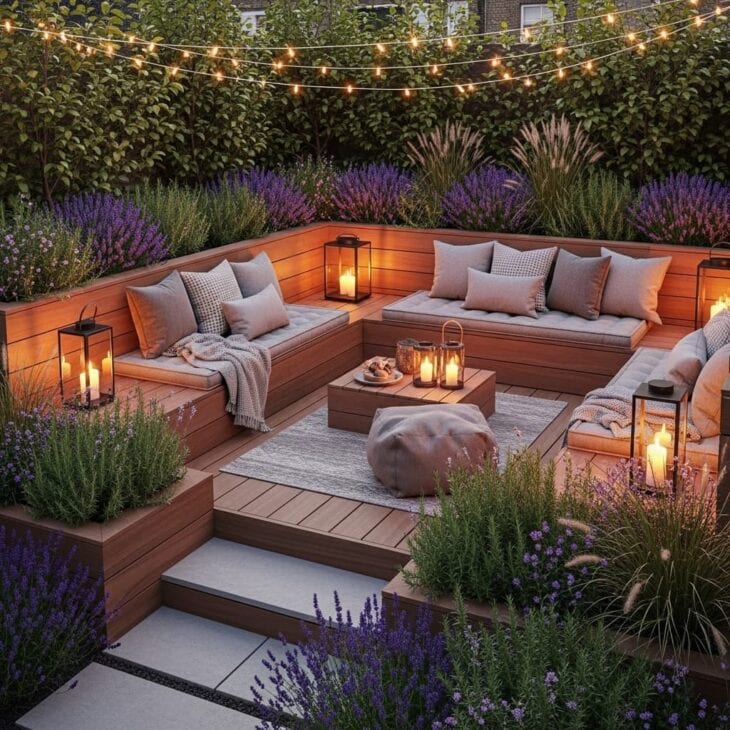
What you see The single most transformative idea for a small garden is to treat it not as a garden at all, but as an outdoor room. A room has furniture, lighting, a floor surface, and enclosure — and once these four elements are in place, even the smallest outdoor space begins to function as a genuinely usable extension of the house. Built-in bench seating along two or three sides of a decked area uses every metre of perimeter efficiently and creates a sense of enclosure that loose furniture in the centre of a space never achieves.
Why it works Built-in seating with storage beneath solves one of the constant problems of small gardens: where to put things. Cushions, candles, tools, and outdoor toys all disappear into the bench bases, leaving the deck surface clear. Line the inside of the bench frames with cedar or use a breathable liner to prevent moisture build-up. Build the deck from composite decking rather than hardwood — it will not need oiling, will not splinter, and looks as good after ten years as it did on day one.
How to get it Lighting is what extends the outdoor room into the evening and makes it genuinely habitable from April to October. String lights suspended overhead create an instant atmosphere at very low cost. Add wall-mounted directional LED spotlights to pick out specific plants or features. A single outdoor floor lamp beside the seating anchors the space and makes it feel furnished rather than lit. Once a small garden has this combination of seating, planting, and light, it stops being a garden you maintain and becomes a room you actually live in.