The front garden is the first thing anyone sees. A well-planted entrance communicates care, character, and a sense of welcome before anyone sets foot inside. Even a narrow strip between gate and door can be turned into something that stops people mid-stride.
Contents
- 01. Symmetrical Box-Edged Border
- 02. Gravel and Lavender Driveway
- 03. Cottage-Style Front Border
- 04. Japanese Entrance Garden
- 05. Minimalist Contemporary Front Garden
- 06. Climbing Roses on the House Front
- 07. Clipped Topiary Entrance Pair
- 08. Wildflower Lawn Replacement
- 09. Mediterranean Terracotta Display
- 10. Espalier Apple on the Front Wall
- 11. Prairie Planting Strip
- 12. All-White Front Garden
- 13. Low Formal Hedge
- 14. Ornamental Grass Border
- 15. Statement Front Door Containers
- 16. Window Box Collection
- 17. Evening-Scented Front Planting
- 18. Pollinator-Friendly Front Garden
- 19. Spring Bulb Display
- 20. Drought-Tolerant Front Garden
- 21. Brick Path with Planted Joints
- 22. Mixed Native Hedge Boundary
- 23. Raised Bed at the House Base
- 24. Rose Arch Entrance
- 25. Formal Clipped Yew Hedge
- 26. Ground Cover Lawn Alternative
- 27. Seasonal Container Display
- 28. Wisteria on the House Front
- 29. Herb Pocket Garden
- 30. Evergreen Year-Round Structure
These 30 ideas cover every kind of front garden: formal symmetrical planting and cottage-style borders, modern minimalist hard landscaping and wildlife-friendly meadows, grand climbers on house fronts and a single pair of matched containers beside a door. There is something here for every house style, every budget, and every level of enthusiasm for gardening.
Start with your conditions: aspect, soil type, and how much time you want to spend on upkeep. Then pick the one or two ideas that feel most like the garden you want to come home to.
01. Symmetrical Box-Edged Border
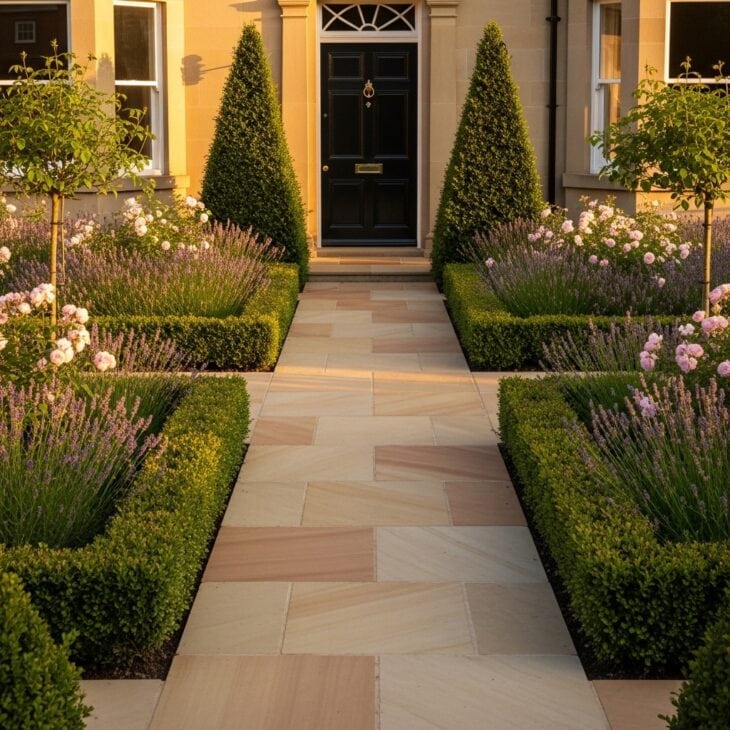
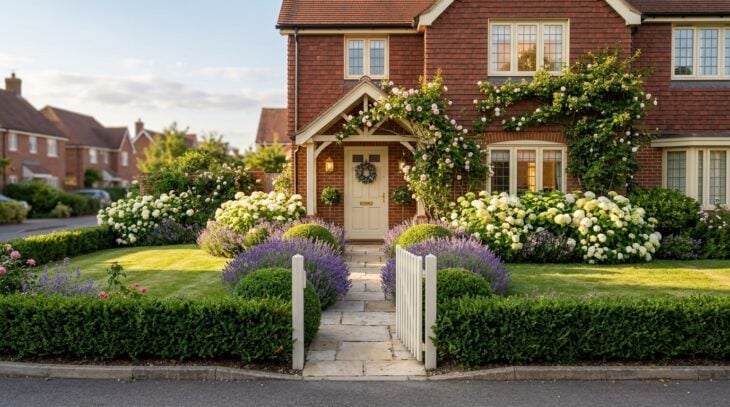
What you see Low box hedging runs in parallel lines on either side of a stone path, with matching plantings of lavender and pale pink roses in mirror image. The path leads to a painted front door, framed on both sides by clipped box pyramids. The whole arrangement reads from the street as deliberate and generous.
Why it works Symmetry in a front garden creates an immediate sense of order and welcome. It works particularly well on older or period properties where the door sits centrally in the facade. The repetition of shapes draws the eye directly to the entrance and makes even a modest house look cared for.
How to get it Use Buxus sempervirens for low edging or Ilex crenata ‘Dark Green’ as a box blight-resistant alternative. Keep edging at 30 to 40cm (12 to 16in) so it defines the border without blocking the planting behind. Fill beds with Lavandula angustifolia ‘Hidcote’, Rosa ‘Gertrude Jekyll’, or Nepeta x faassenii for colour from May to September. A path of sandstone flags 90cm (36in) wide gives enough space to carry bags without brushing the planting. Clip box in May and August each year.
02. Gravel and Lavender Driveway
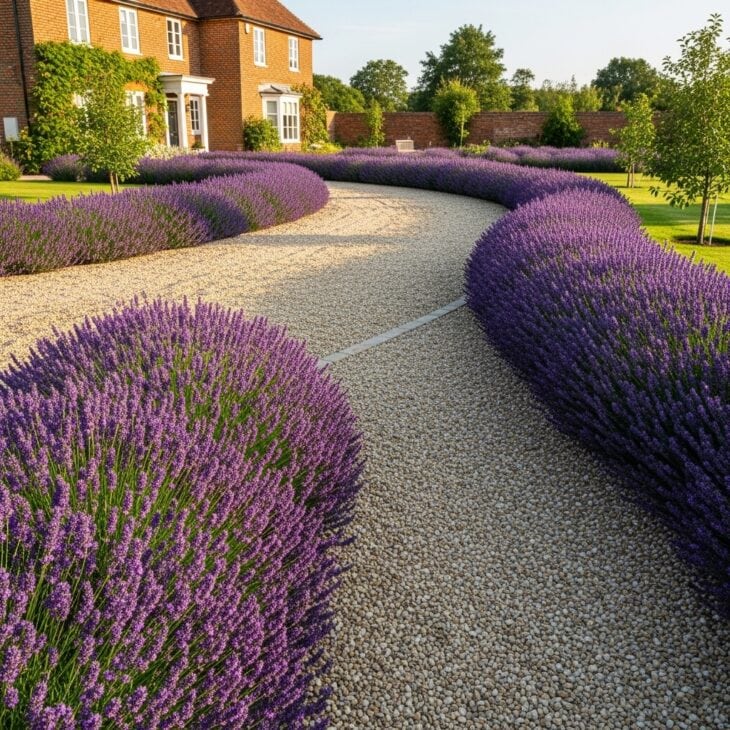
What you see A wide sweep of pale limestone gravel replaces the old tarmac driveway, with broad borders of lavender edging both sides in waves of purple. The house sits behind it looking cool and composed. From the road the effect is calm, fragrant, and entirely maintenance-free.
Why it works Replacing a grass or tarmac front garden with gravel is one of the most practical improvements for curb appeal. It solves the parking problem, eliminates weekly mowing, and creates a clean canvas for planting. Lavender borders give fragrance, colour, and structure with almost no effort once established.
How to get it Use 10 to 20mm pale limestone or granite chippings laid 7cm (3in) deep over compacted sub-base and weed membrane. Install a permeable surface under driveways where vehicles park to comply with planning regulations. Edge planted borders with steel or aluminium edging strips to keep gravel and soil separate. Plant Lavandula angustifolia ‘Hidcote’ or ‘Munstead’ at 45cm (18in) intervals. Clip hard each spring before new growth emerges to keep plants compact and prevent woody collapse.
03. Cottage-Style Front Border
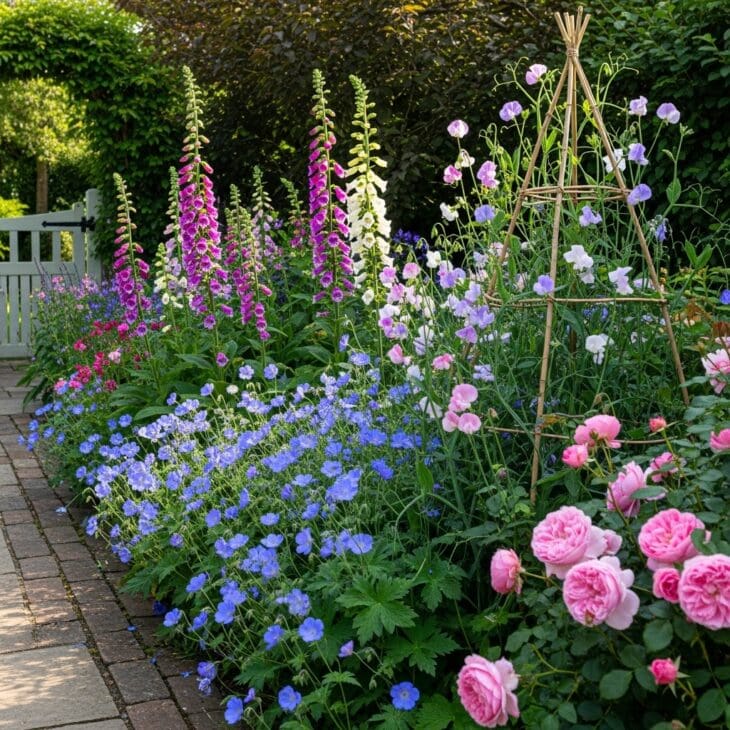
What you see Foxgloves rise above clouds of Geranium ‘Rozanne’ and soft pink roses along the front path, with sweet peas scrambling up a bamboo wigwam at the corner. The border is deliberately uncontained, with plants flopping gently over the path edges. It looks like a garden that loves growing things.
Why it works Cottage planting works in a front garden because it communicates warmth and personality. The mix of plants at different heights creates a layered, generous look that contrasts beautifully with harder urban surroundings. It softens a house front in a way that formal planting cannot match.
How to get it A good cottage front border mixes spring bulbs, early summer perennials, roses, and late-season fillers in the same space. Plant tulips in autumn beneath Alchemilla mollis, which covers the dying foliage in May. Add Rosa ‘Boscobel’, Digitalis purpurea, Geranium ‘Rozanne’, Astrantia major, and Verbena bonariensis for colour from May to October. Restrain the edge nearest the path with low-growing Alchemilla or Nepeta to soften without blocking access. Cut back in late February each year.
04. Japanese Entrance Garden
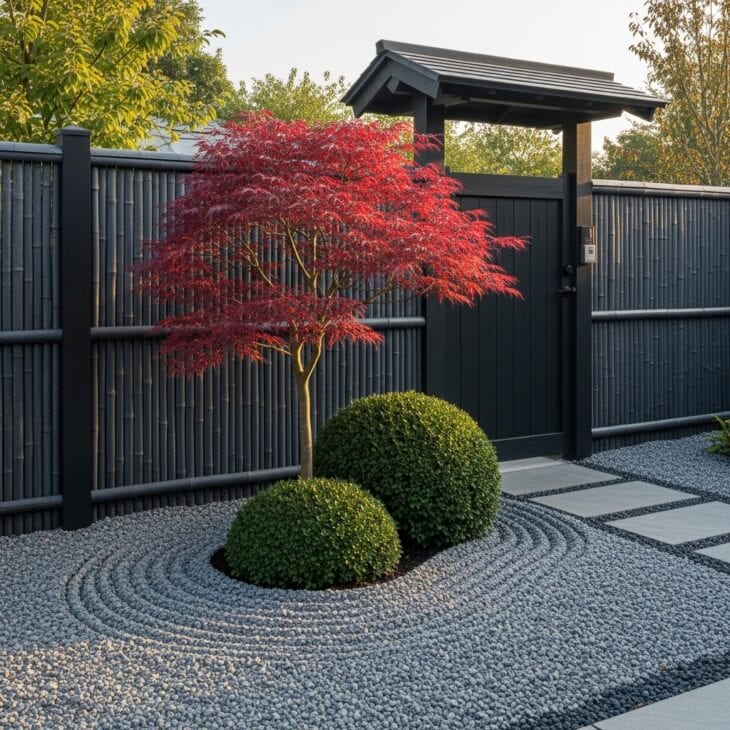
What you see A single Japanese maple in deep red stands in a bed of raked gravel, with a clipped box mound and a length of split bamboo fence framing the entrance. The gate is dark painted timber. The garden is quiet, precise, and impossible to walk past without pausing.
Why it works A Japanese-inspired entrance garden works because it uses restraint. Two or three carefully chosen elements, placed deliberately, create more impact than a border full of plants. The raked gravel surface requires almost nothing but occasional clearing of leaves, and the maple is at its best in both spring and autumn.
How to get it Use Acer palmatum ‘Bloodgood’ or ‘Osakazuki’ for reliable autumn colour and manageable size. Plant in humus-rich, slightly acid soil sheltered from strong winds, which scorch the delicate leaves. Lay raked angular granite gravel 5 to 7cm (2 to 3in) deep and clear leaves with a blower in autumn. A split bamboo or slatted timber fence painted dark grey or black completes the look. Keep plants to a minimum: in this style, addition is almost always a mistake.
05. Minimalist Contemporary Front Garden
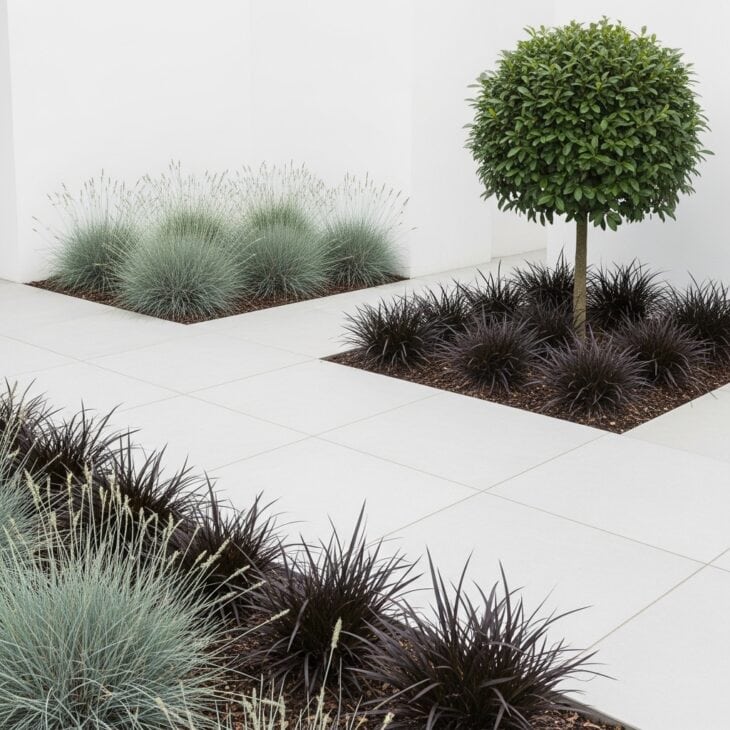
What you see A single large-format porcelain slab path cuts through a bed of Festuca glauca and black-stemmed Ophiopogon planiscapus, with a clipped Prunus lusitanica standard at the corner. Everything is precise. The palette is grey, silver, and green.
Why it works A minimalist front garden suits modern and new-build properties where the architecture is clean and geometric. The simplicity of the planting amplifies the quality of the materials. One perfect specimen plant does more work here than a full border ever could.
How to get it Choose large-format porcelain or concrete paving in a light or mid-grey tone, laid with tight joints. Combine Festuca glauca ‘Elijah Blue’ with Ophiopogon planiscapus ‘Nigrescens’ and Carex oshimensis ‘Evergold’ for a low-maintenance grass planting. Add a single specimen: a clipped olive, Prunus lusitanica standard, or Magnolia grandiflora against the wall. Steel edging strips keep the transition between paving and planting sharp. Repeat a single dark accent colour on fence, gate, and front door.
06. Climbing Roses on the House Front
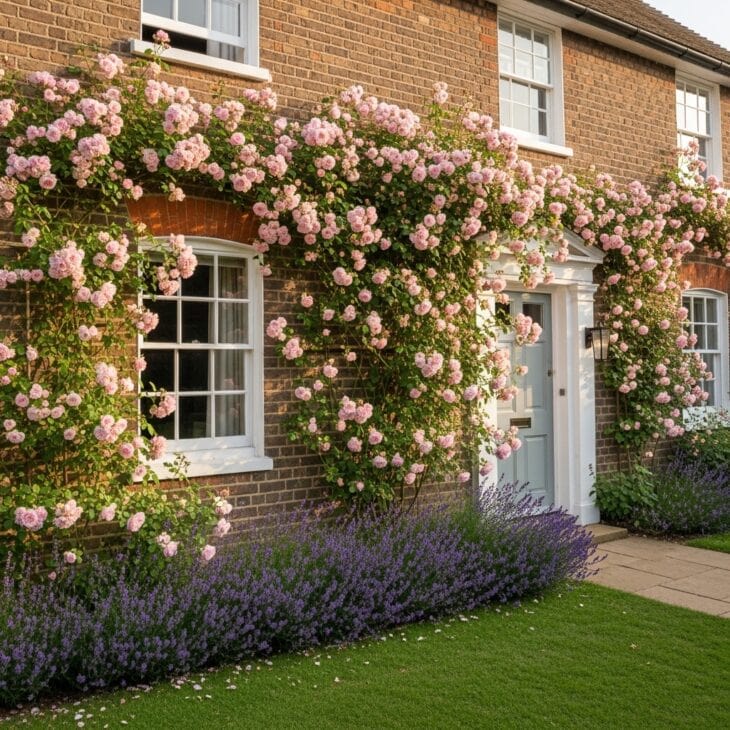
What you see A pale pink climbing rose covers the brick between the ground-floor windows and the eaves in mid-June, with blooms almost too many to count. The scent reaches halfway down the path. Below it, lavender and Nepeta carry the colour at ground level.
Why it works A climbing rose on a house front is one of the most powerful improvements to curb appeal available. It softens hard brick, adds colour and fragrance through summer, and creates a cottage character that takes years for other plants to achieve. Many modern varieties repeat-flower from June to the first frosts.
How to get it Choose a repeat-flowering climbing rose suited to your wall’s aspect. For south and west-facing walls, Rosa ‘Compassion’ (apricot-pink, fragrant), ‘The Generous Gardener’ (pale pink, strongly scented), or ‘Climbing Iceberg’ (white) all perform reliably. For north-facing walls, Rosa ‘Madame Alfred Carriere’ is the standard choice. Fix horizontal training wires 45cm (18in) apart into the wall with vine eyes. Prune in late autumn: remove dead and crossing stems, then tie new growth horizontally to encourage flowering shoots along the whole length.
07. Clipped Topiary Entrance Pair
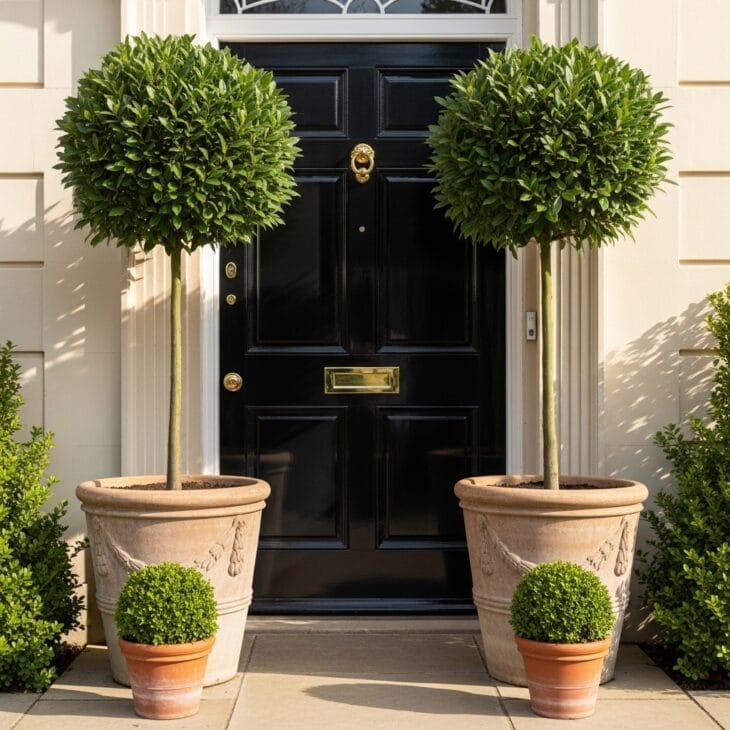
What you see Two bay trees clipped into lollipop standards stand in matching terracotta pots on either side of a painted front door, with box balls in smaller pots at their feet. The composition is tight, formal, and quietly expensive-looking. It takes two minutes a year to maintain with secateurs.
Why it works A matched pair of clipped specimens framing a front door is one of the oldest garden design devices, and it still works. The symmetry draws the eye to the entrance and gives the house an instant air of care. Bay and box are the traditional choices, but Prunus lusitanica and Ilex crenata perform just as well with greater disease resistance.
How to get it Buy lollipop standards already shaped rather than training from scratch; the cost is worth the years saved. Minimum pot size is 40cm (16in) diameter to give the root system enough room. Plant into John Innes No. 3 compost mixed with 20% perlite for drainage. Water weekly in summer and feed monthly with balanced liquid fertiliser from April to September. Clip once in late July with secateurs rather than shears to avoid browning the cut edges.
08. Wildflower Lawn Replacement
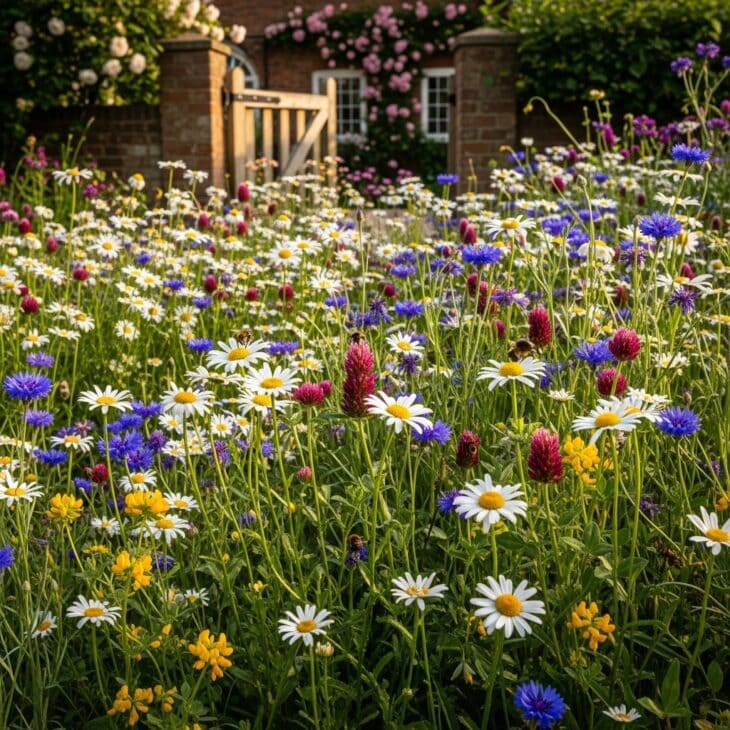
What you see Where a struggling patch of lawn once sat, ox-eye daisies, red clover, cornflowers, and bird’s-foot trefoil now cover the ground in June. Bees work the flowers from morning until dark. The garden looks like a fragment of countryside set between two houses.
Why it works Replacing a front lawn with a wildflower planting is increasingly common and increasingly admired. It signals environmental awareness, adds colour and wildlife interest, and removes the weekly mowing task entirely. One cut per year in autumn keeps the planting regenerating naturally from self-seeded plants.
How to get it Remove the existing lawn completely by skimming off the turf or using cardboard sheet mulch over winter. Prepare bare soil in spring by raking to a fine tilth. Sow a native annual and perennial mix in April: include Leucanthemum vulgare (ox-eye daisy), Centaurea cyanus (cornflower), Papaver rhoeas (field poppy), Trifolium pratense (red clover), and Lotus corniculatus (bird’s-foot trefoil). Cut once in October to 7cm (3in) and remove the cuttings. Water in dry spells only during the first season; after that, rainfall is sufficient.
09. Mediterranean Terracotta Display
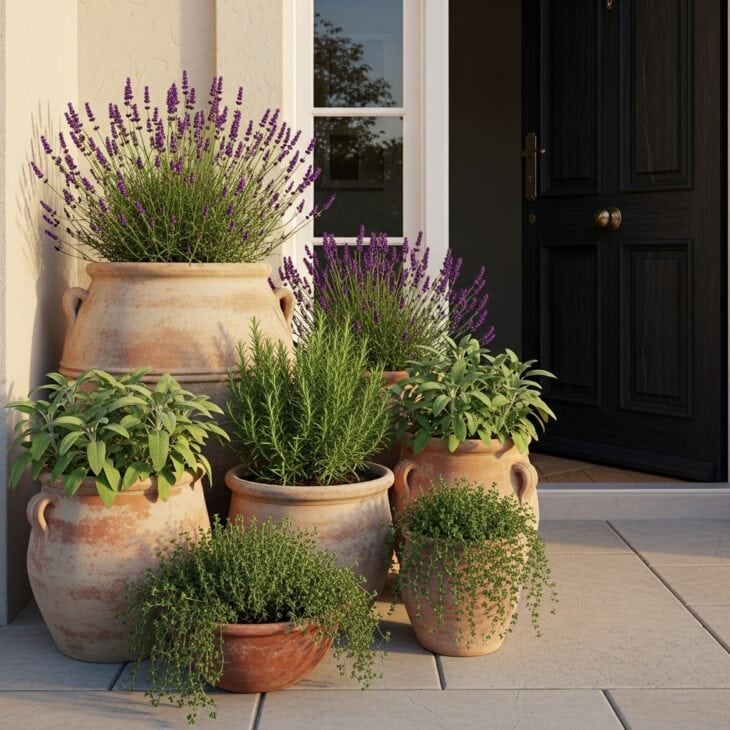
What you see A collection of terracotta pots of different heights crowds around a Mediterranean-style front door: lavender in the largest pots, rosemary and sage in the mid-size, and creeping thyme spilling over the smallest at ground level. The warm terracotta against pale render makes the whole entrance glow in afternoon sun.
Why it works A terracotta pot display works for front gardens because it adds colour and character without requiring any digging. Pots can be rearranged, replaced, or moved inside in hard winters. The Mediterranean palette of lavender, rosemary, and sage keeps the display fragrant, useful, and visually cohesive throughout the year.
How to get it Group pots in odd numbers and vary the heights for the best effect. Use genuine terracotta rather than plastic equivalents: the porous material keeps roots cooler and looks far better as it weathers. Choose frost-proof terracotta rated to minus 10C (14F) if leaving pots outside over winter. Plant into free-draining compost mixed with 20% grit. Water weekly in summer; Mediterranean plants tolerate drought far better than overwatering or poor drainage.
10. Espalier Apple on the Front Wall
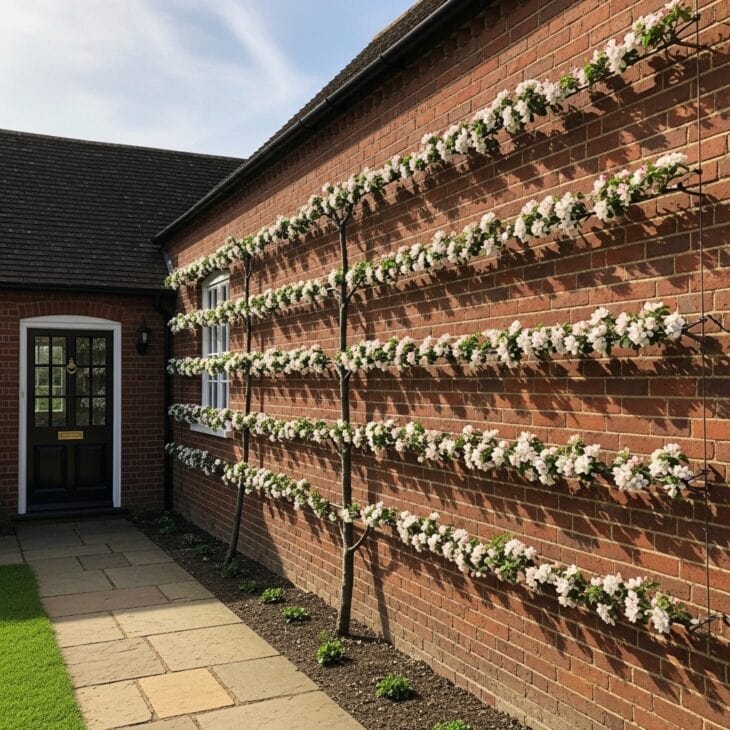
What you see A heritage apple trained as a flat espalier covers the front wall in blossom in April, with fruit colouring by September. The horizontal tiers of branches are held by wires fixed to the wall, and the whole structure is only 30cm (12in) deep. It is productive, ornamental, and completely unexpected in a front garden.
Why it works An espalier fruit tree on a house wall uses space that would otherwise hold nothing but brickwork. It is at its best twice a year: in blossom and in fruit. The formal, flat shape suits all architectural styles, from period cottages to modern houses, and provides excellent privacy and softening without projecting into the garden.
How to get it Fix horizontal wires 45cm (18in) apart along the wall with vine eyes, starting 45cm (18in) from the ground. Buy a partly-trained espalier on a dwarfing rootstock such as M9 or M26 for manageable size. Good varieties include ‘Cox’s Orange Pippin’, ‘Egremont Russet’, and ‘Discovery’. Plant 30 to 45cm (12 to 18in) from the wall base and water well in the first two summers. Prune trained side shoots in August each year to two or three leaves from the base to maintain the flat framework.
11. Prairie Planting Strip
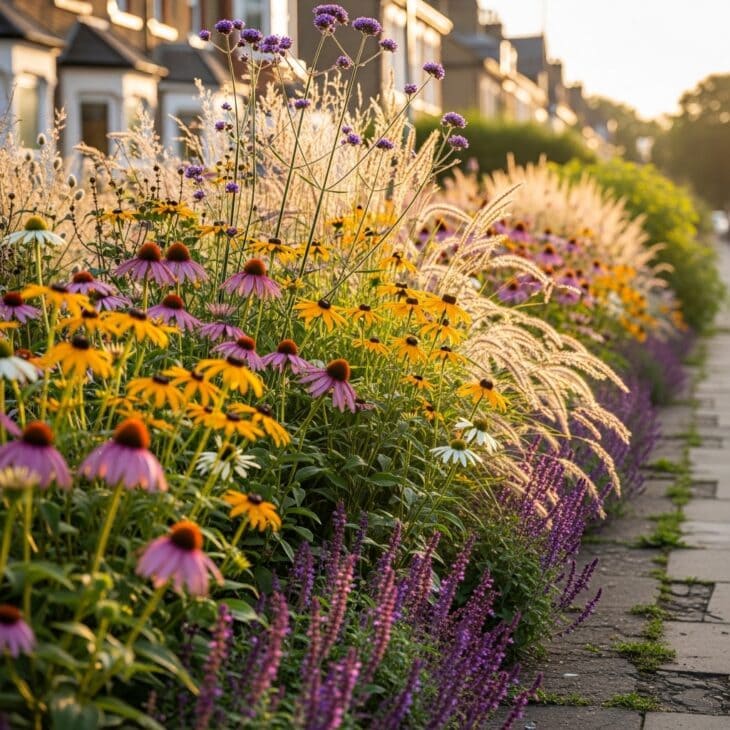
What you see A narrow strip between the front path and the pavement is planted with Echinacea, Rudbeckia, ornamental grasses, and Verbena bonariensis, rising from low Salvia nemorosa at the edge to taller grasses at the back. The strip is only 60cm (24in) wide but it stops the street in July.
Why it works A prairie-planted strip between a path and the pavement is one of the most effective uses of otherwise dead space in a front garden. The planting provides colour from June to October and acts as a living screen between the garden and the road. Dried seed heads extend the display through winter and need only one cut in late February.
How to get it Choose plants with strong vertical structure that look good even when dried: Pennisetum alopecuroides ‘Hameln’, Echinacea purpurea ‘Magnus’, Rudbeckia fulgida ‘Goldsturm’, Salvia nemorosa ‘Caradonna’, and Verbena bonariensis all work well in a narrow border. Plant at high density, five plants per square metre, to crowd out weeds from the start. Use a steel edging strip to define the front edge cleanly against the pavement. Cut back to 10cm (4in) in late February and mulch with bark to finish the look for the season.
12. All-White Front Garden
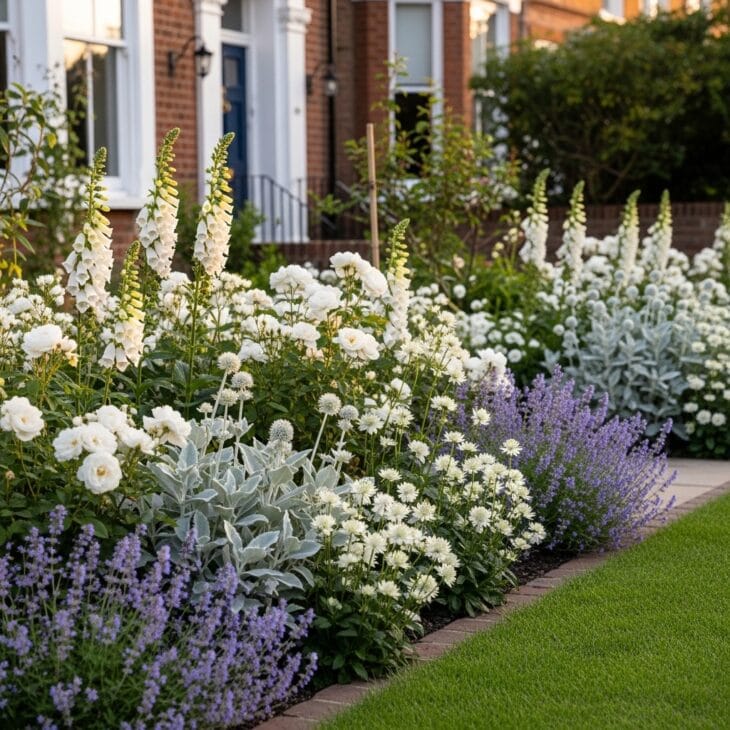
What you see White roses, white foxgloves, and white Astrantia run the length of the front border, with silver-leaved Stachys byzantina and pale blue Nepeta softening the edges. The planting is not quite white: there are creams, ivories, and the faintest pink. But from the road it reads as luminous and calm.
Why it works An all-white planting scheme works in a front garden because it is both striking and restrained. It photographs beautifully, works in evening light better than any other colour palette, and suits almost any house colour. The discipline of a single-colour scheme forces attention to texture and form instead.
How to get it Choose whites at different heights and seasons to keep the border interesting from May to October. Start with spring whites: Narcissus ‘Thalia’ and Tulipa ‘White Triumphator’. Move into summer with Rosa ‘Winchester Cathedral’, Digitalis purpurea f. albiflora, Astrantia major ‘White Giant’, and Phlox paniculata ‘David’. Add silver-leaved Stachys byzantina as underplanting throughout the border. Avoid pure white foliage or bark, which can look harsh; use creamy and soft grey-green tones for warmth.
13. Low Formal Hedge
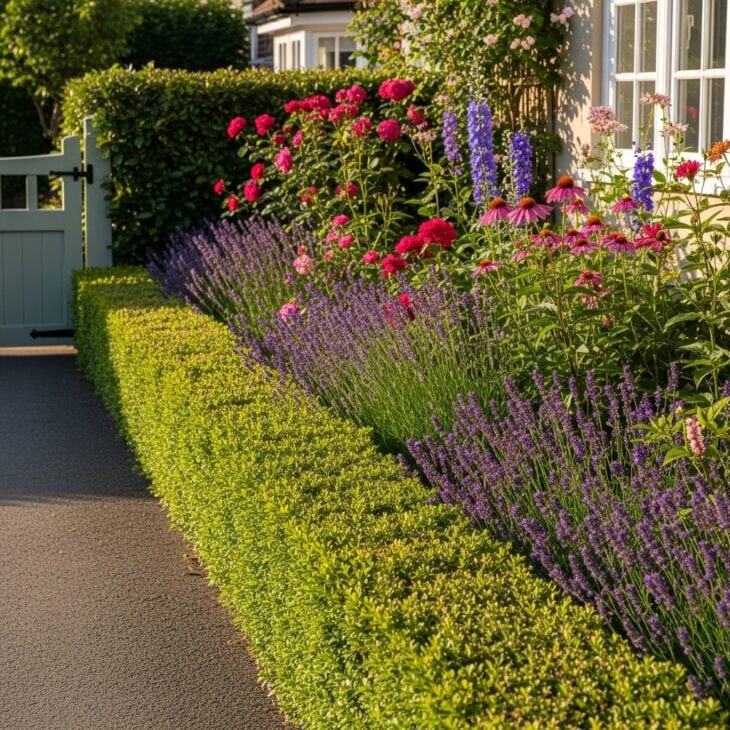
What you see A clipped hedge runs along the front boundary at knee height, creating a clean line between the garden and the pavement. Behind it, a mixed border of lavender, roses, and perennials rises to the window sill. The hedge does not block the view but it defines the space absolutely.
Why it works A low hedge transforms the character of a front garden by establishing a clear boundary. It frames the planting behind it, keeps the garden looking tended even in winter, and provides a year-round structural element that flower borders cannot. At knee height it is sociable rather than defensive.
How to get it Buxus sempervirens is the traditional choice but susceptibility to blight makes alternatives worth considering. Ilex crenata ‘Dark Green’, Lonicera nitida, and Berberis thunbergii f. atropurpurea all make tight, cuttable hedges. For a softer, more naturalistic low boundary, Lavandula angustifolia ‘Hidcote’ clipped to a consistent height works beautifully. Clip formal hedges twice a year in May and August. Plant at 30cm (12in) intervals for a hedge that fills in within two seasons.
14. Ornamental Grass Border
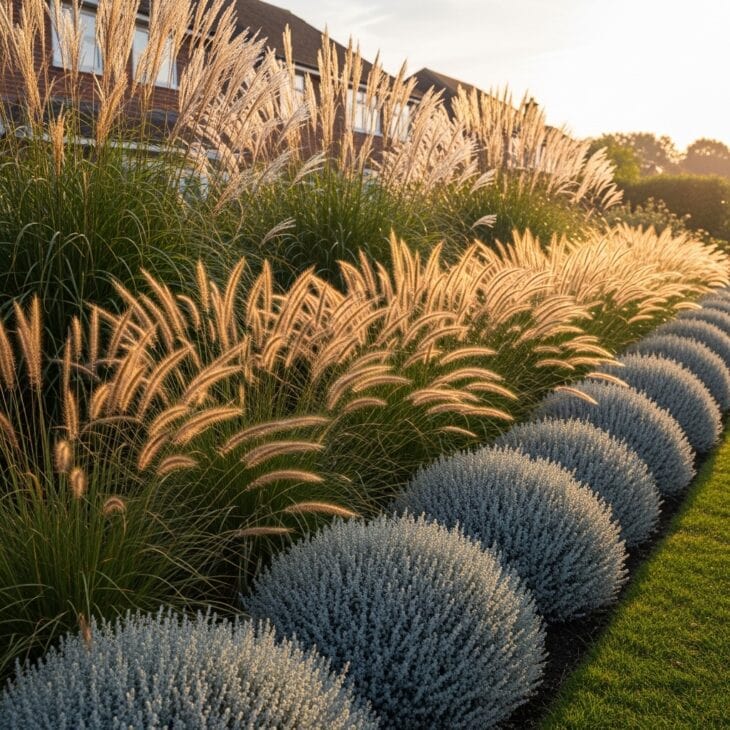
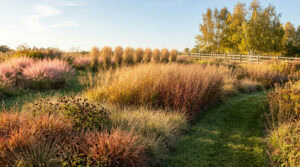
What you see A wide front border planted entirely with ornamental grasses catches the light in late afternoon, with Miscanthus plumes above Pennisetum seed heads and Festuca mounds at the edge. The border is silver and amber in September and rustles in every breeze. It looks nothing like any other front garden on the street.
Why it works Ornamental grasses in a front border provide year-round interest with almost no maintenance. They are at their best from August to February, when most other planting looks bare and tired. The dried seed heads catch frost in winter and the whole border comes to life in even the slightest wind.
How to get it Combine grasses of different heights and forms for the best result: Miscanthus sinensis ‘Gracillimus’ (tall, upright) at the back, Pennisetum alopecuroides ‘Hameln’ (mid-height, arching) in the middle, and Festuca glauca ‘Elijah Blue’ (low, silver-blue) at the front. Cut deciduous grasses back hard to 10cm (4in) in late February. Comb evergreen varieties through with a gloved hand to remove dead material. Plant in full sun in free-draining soil; most ornamental grasses perform poorly in heavy shade or waterlogged ground.
15. Statement Front Door Containers
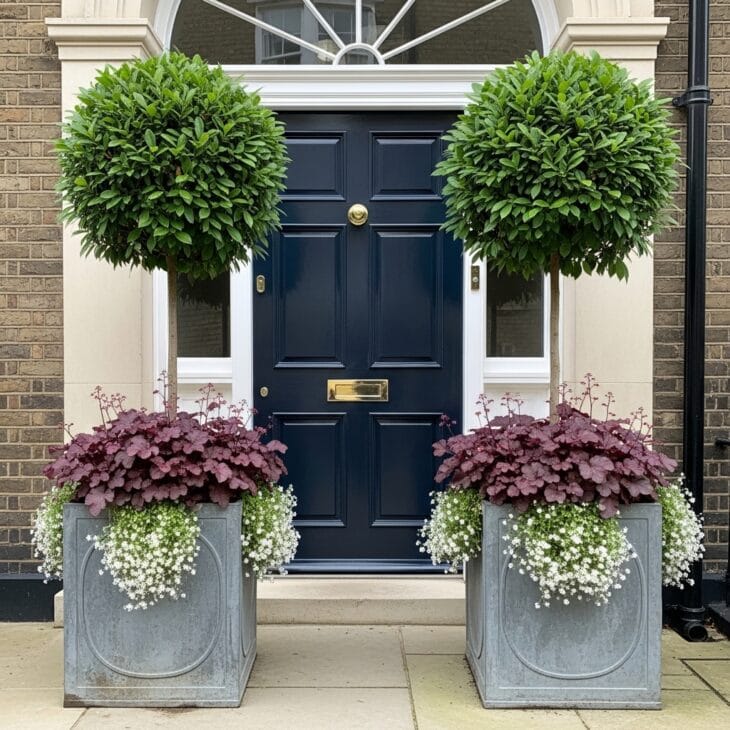
What you see Two large zinc containers flank a dark-painted front door, each planted with a clipped Prunus lusitanica standard underplanted with trailing Heuchera in deep burgundy and white Bacopa. The composition is tight, formal, and immediately welcoming. From the pavement the door looks like an entrance worth arriving at.
Why it works A matched pair of well-planted containers at a front door is the single highest-impact improvement that requires no garden at all. The effect is immediate, the commitment is manageable, and the arrangement can be changed seasonally to suit the time of year. One good pair of containers at the right scale does more for curb appeal than a full border.
How to get it Scale is everything: containers should be at least 40cm (16in) in diameter and proportionate to the door height. Choose a specimen that gives height, such as a clipped Laurus nobilis standard, bay lollipop, or slim Taxus column. Underplant with trailing foliage and seasonal flowers: Heuchera in dark tones with white Calibrachoa or Bacopa works year-round with seasonal swaps. Match the container material or colour to the door furniture for a coordinated look. Water daily in summer and feed weekly through the growing season.
16. Window Box Collection
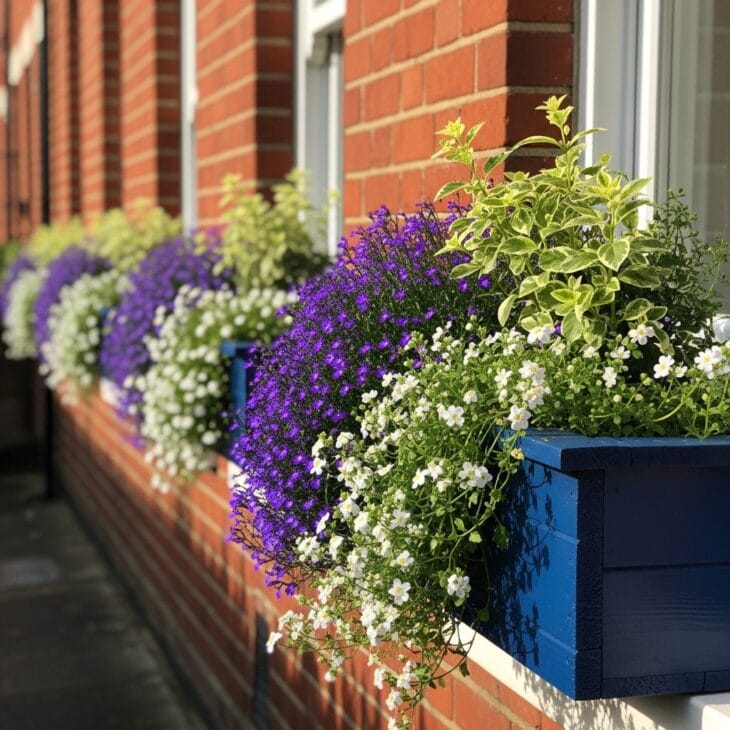
What you see Deep blue window boxes line the ground-floor windows of a red-brick terraced house, planted with trailing Lobelia, white Bacopa, and the bright variegated leaves of Plectranthus. The boxes make the windows look twice as large. From the pavement the house looks cared for and lived in.
Why it works Window boxes work in front gardens because they add colour at eye level, right where it is most visible from the street. They suit houses with no soil garden, or as a layer of colour above an existing border. A consistent colour scheme across all boxes creates a professional, coordinated look that lifts the whole facade.
How to get it Fix window boxes securely using purpose-made brackets rated for the weight of wet compost. Use lightweight compost to reduce the load on brackets and fixings. For sun, plant trailing Lobelia, Verbena, Calibrachoa, and Argyranthemum; for shade, use Fuchsia, Begonia, Impatiens, and trailing Ivy. Change planting twice a year: spring bedding in March and summer planting in May after the last frosts. Water daily in summer and include a slow-release fertiliser tablet in the compost to reduce feeding to once a fortnight.
17. Evening-Scented Front Planting
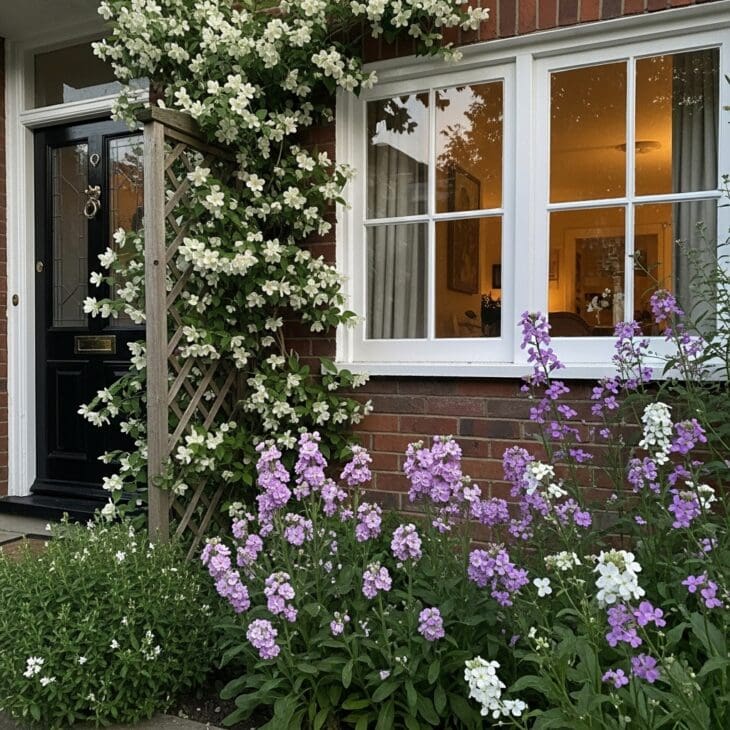
What you see As the light fades on a summer evening, the front garden releases fragrance along the whole path: jasmine from the trellis beside the door, stocks from the border below the window, and sweet rocket in pale lavender opening as the sun drops. The house announces itself through scent before you reach the door.
Why it works Evening-scented plants are particularly well suited to a front garden because the entrance path is used most at the end of the working day. Scents released at dusk reward the homeowner rather than the occasional passerby. Many evening-scented flowers are also white or pale, which makes them visible after dark and gives the planting a luminous quality in twilight.
How to get it Key evening-scented plants for a front garden include Jasminum officinale (trained on a trellis beside the door), Matthiola incana (stocks, annual, powerfully fragrant), Hesperis matronalis (sweet rocket, biennial, self-seeding), Nicotiana sylvestris (tall tobacco plant, white flowers, very fragrant), and Lonicera periclymenum (honeysuckle, on a wall or fence). Plant in a sheltered spot where fragrance can gather rather than blow away. Combine with pale or white perennials for maximum evening visibility.
18. Pollinator-Friendly Front Garden
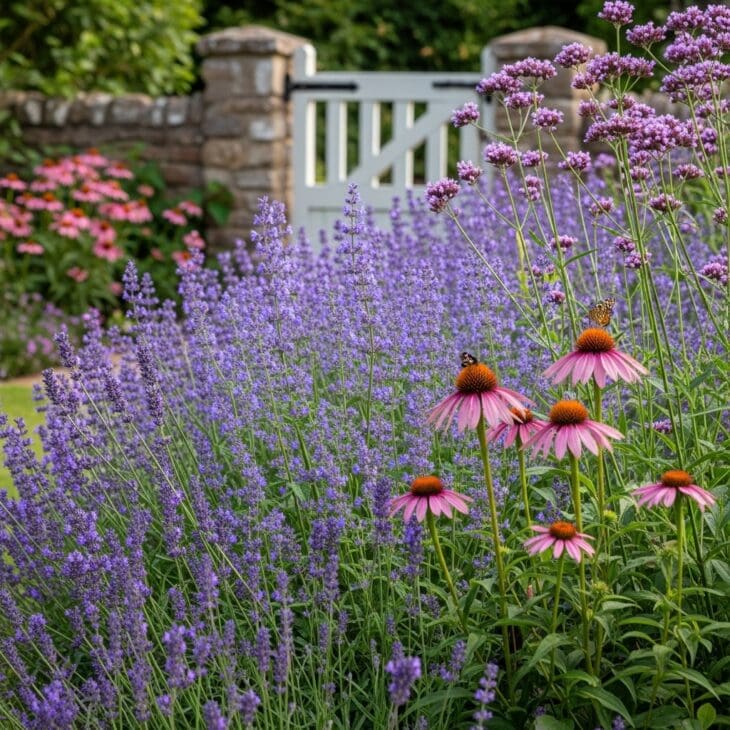
What you see Lavender, catmint, Echinacea, and Verbena bonariensis cover the front border from June to October, with bees and butterflies working the flowers from morning until evening. The garden hums. Neighbours stop to look on their way past.
Why it works A pollinator-friendly front garden is both ethically rewarding and visually beautiful. The plants that attract most insects tend to have open, single flowers in blues, purples, and yellows. A border like this costs no more to plant than a conventional one and asks for significantly less maintenance in return.
How to get it Prioritise single-flowered over double-flowered varieties: bees cannot access nectar from double blooms. Core plants include Lavandula angustifolia ‘Hidcote’, Nepeta x faassenii, Salvia nemorosa ‘Caradonna’, Echinacea purpurea ‘Magnus’, Rudbeckia fulgida, Verbena bonariensis, and Scabiosa caucasica. Add a patch of Phacelia tanacetifolia from seed for powerful bee attraction from spring. Avoid pesticides entirely. Leave seed heads standing over winter: they feed birds and provide shelter for overwintering insects.
19. Spring Bulb Display
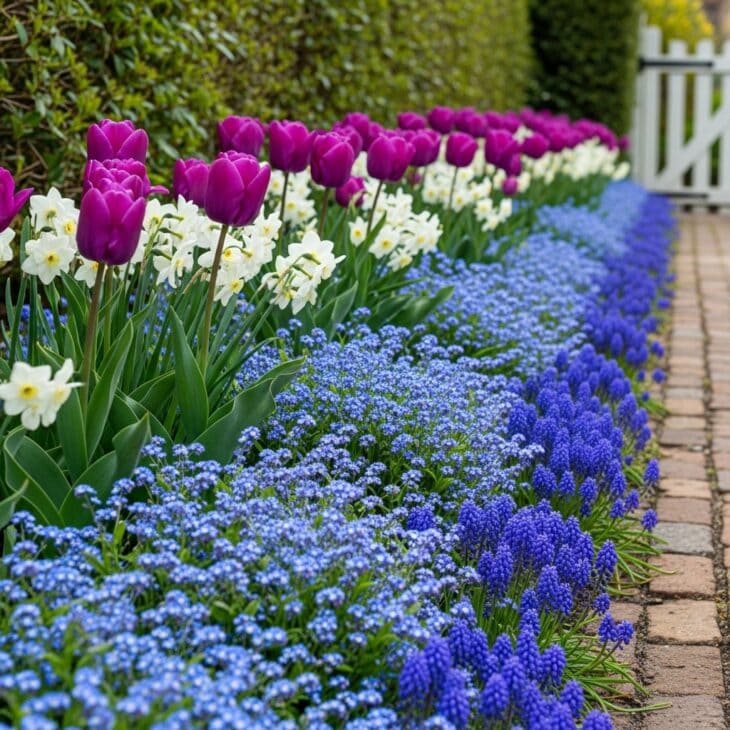
What you see Tulips rise through a carpet of forget-me-nots in the front border in April, with white narcissus behind them and deep purple grape hyacinths at the edge. The garden is bare for three months and then suddenly, entirely, this. Neighbours photograph it every year.
Why it works A spring bulb display gives maximum impact for minimum effort. Bulbs go in during October and do the rest themselves. Layering three types at different depths creates a succession of colour that runs from February to May, using the same ground twice over.
How to get it Plant in layers from October, deepest first. In a 30cm (12in) deep bed, plant Tulipa at 20cm (8in) depth, Narcissus at 15cm (6in), and Muscari at 8cm (3in). Good combinations include Tulipa ‘Queen of Night’ (deep purple) with Narcissus ‘Thalia’ (white) and Muscari armeniacum (bright blue). Underplant with Myosotis (forget-me-nots) sown the previous September for a classic spring combination. Allow foliage to die back naturally before cutting. Replace tulips every two or three years if flowering diminishes.
20. Drought-Tolerant Front Garden
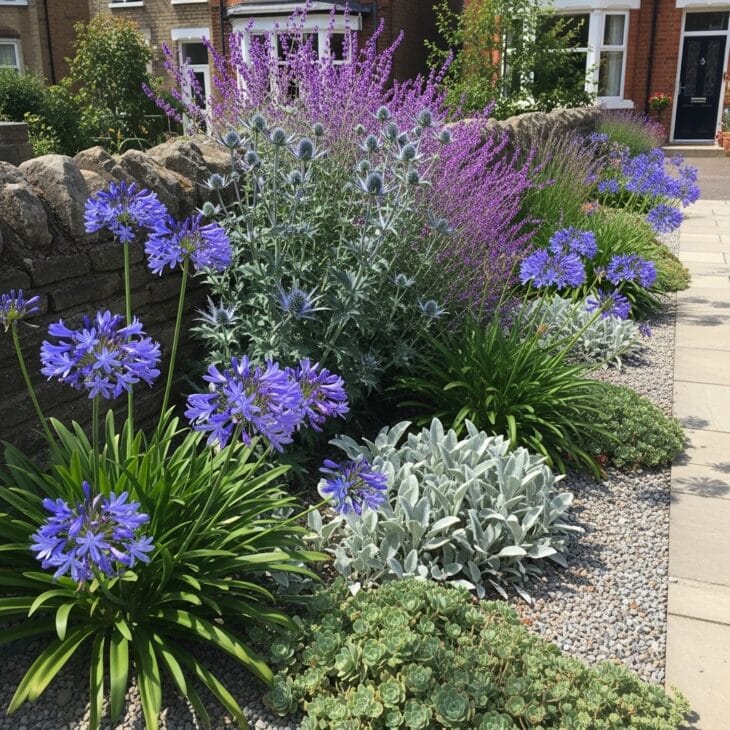
What you see In a south-facing front garden that bakes all day, Agapanthus, Salvia, and Eryngium flower through August without a drop of irrigation. The gravel mulch is pale and warm. The planting is blue, silver, and architectural in a way that conventional borders rarely achieve.
Why it works A drought-tolerant front garden is ideal for south-facing plots that get full sun and dry out quickly in summer. The plants need one season of watering to establish, but nothing after that. This is the most genuinely low-maintenance kind of front garden planting once it is through its first year.
How to get it Plant in spring when the soil is warming up. Good choices include Agapanthus ‘Headbourne Hybrids’, Salvia nemorosa ‘Caradonna’, Eryngium x tripartitum, Stachys byzantina, Sedum ‘Herbstfreude’, Perovskia atriplicifolia, and Phlomis russeliana. Mulch with pale gravel or grit 7cm (3in) deep to retain moisture and reflect heat. These plants need sharp drainage: avoid heavy clay. Water once a week for the first summer only, then leave entirely to rainfall and let the plants establish their own drought strategy.
21. Brick Path with Planted Joints
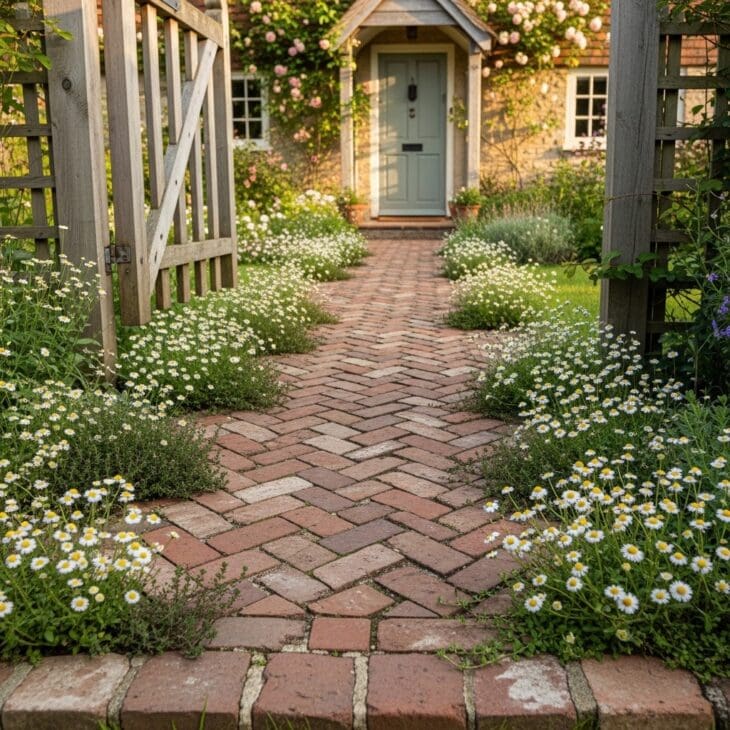
What you see A herringbone brick path leads from the gate to the front door, with creeping thyme and Erigeron karvinskianus filling the joints between bricks. The path is old reclaimed brick, soft red and slightly uneven, with flowers appearing along every crack. It looks as if the garden has been there for a hundred years.
Why it works Planting the joints of a brick or stone path transforms it from a functional surface into a garden feature. Creeping plants spill over the edges, soften the geometry, and add fragrance underfoot when stepped on. The effect looks established and costly, and it costs almost nothing to achieve in practice.
How to get it Remove existing mortar from joints to a depth of 3 to 4cm (1.5in) using a cold chisel or narrow grout saw. Brush in free-draining gritty compost and plant small plugs or sow seed directly into the joints in spring. Creeping thyme (Thymus serpyllum) releases scent when walked on and tolerates heavy foot traffic. Erigeron karvinskianus self-seeds into every gap and flowers from May to November. None of these plants needs watering after the first fortnight once it has taken hold in the joint.
22. Mixed Native Hedge Boundary
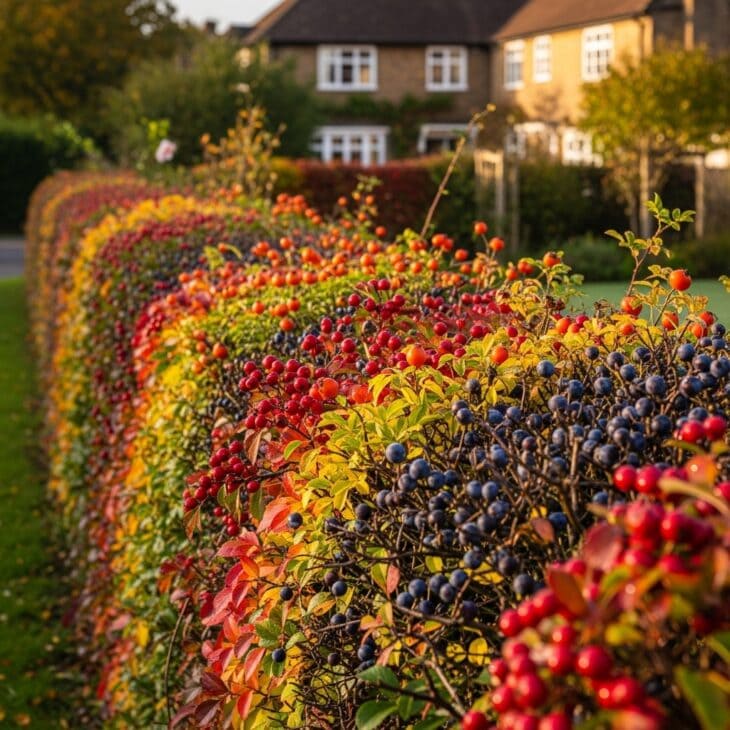
What you see A mixed boundary hedge of hawthorn, blackthorn, field rose, and hazel replaces the old panel fence in front of the house. By October it is full of berries in red, black, and orange. It is twice as wide as a fence and three times as alive.
Why it works A native hedge as a front boundary creates instant character and improves the house’s ecological contribution to the street. It is slower to establish than a fence but costs less in the long run, never needs replacing, and provides habitat for birds, hedgehogs, and insects throughout the year. In autumn it is one of the most beautiful things in any street.
How to get it Plant bare-root native whips between November and March at 30cm (12in) apart in a double staggered row. A mix of two-thirds hawthorn (Crataegus monogyna) with one-third hazel (Corylus avellana), field rose (Rosa arvensis), and blackthorn (Prunus spinosa) gives the best variety of flower, berry, and autumn colour. Cut back hard after planting to encourage bushy growth from the base. Leave a small gap at the bottom of the hedge for hedgehog access between gardens. Trim once a year in late winter, after birds have eaten the berries.
23. Raised Bed at the House Base
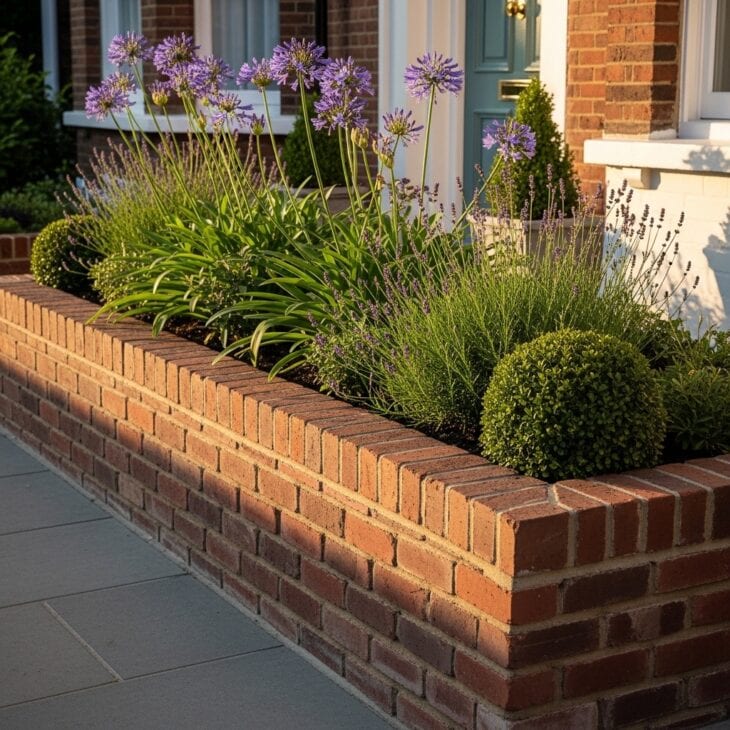
What you see A rendered brick raised bed runs along the base of the house front, 45cm (18in) high and 60cm (24in) deep, planted with Agapanthus, lavender, and clipped box balls. It lifts the planting off the pavement level, gives the house base a finished edge, and allows plants that would never survive in compacted pavement soil.
Why it works The strip of ground between a house wall and the pavement is often the most difficult area to plant in a front garden. Soil is compacted and dry, roots compete with building foundations, and plants rarely thrive. A raised bed with fresh imported soil solves all of this at once and gives the planting an immediate presence from the street.
How to get it Build the bed from brick, rendered blockwork, or corten steel to complement the house facade. Fill with imported topsoil and compost: the original ground-level soil is almost certainly too compacted and nutrient-poor to use. Minimum depth of growing medium is 40cm (16in). Good plants for a sunny raised front bed include Agapanthus ‘Headbourne Hybrids’, Lavandula stoechas ‘Anouk’, Salvia officinalis, clipped Buxus balls, and Erysimum ‘Bowles’s Mauve’. Water regularly through the first season to help the roots establish.
24. Rose Arch Entrance
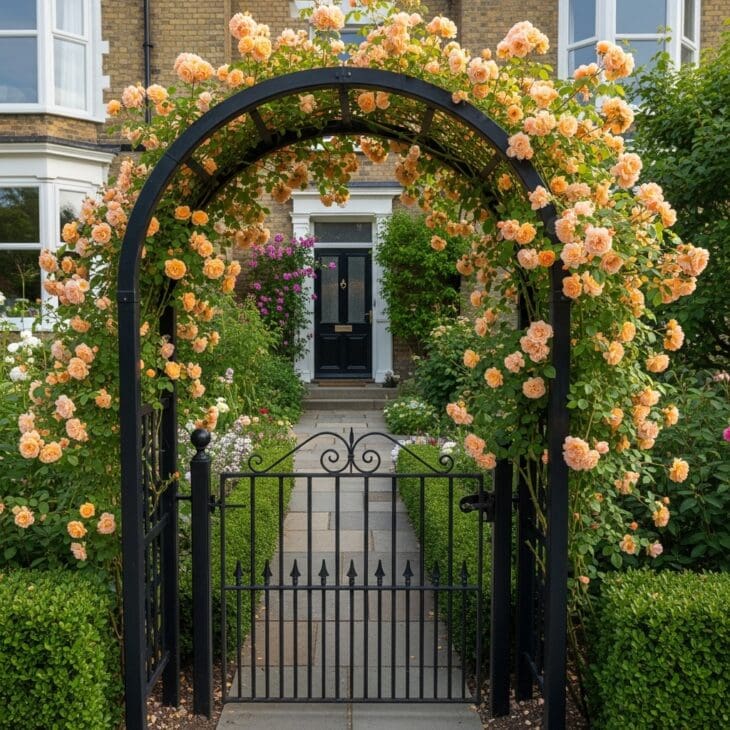
What you see A metal arch frames the entrance from pavement to front path, covered in early summer with a repeat-flowering climbing rose in pale apricot. The arch is dark painted steel, the rose is in full bloom, and the combination stops people mid-stride. The gate beneath it is wrought iron.
Why it works A rose arch at the entrance to a front garden is an immediate statement of welcome and romance. It creates a visual threshold between street and garden, frames the path below, and provides months of colour and fragrance. Modern repeat-flowering climbers bloom from June to the first frosts with straightforward annual pruning.
How to get it Choose an arch with a minimum span of 120cm (48in) and height of 230cm (90in) to allow comfortable passage when the rose is in full leaf. Fix into the ground with metal stakes or concrete footings for stability in wind. Good repeat-flowering climbers for an arch include Rosa ‘Warm Welcome’ (orange-apricot), ‘The Generous Gardener’ (pale pink, fragrant), ‘Veilchenblau’ (violet, old-rose scent), and ‘Climbing Iceberg’ (white). Plant one rose on each side and train stems over the top as they grow. Prune in late autumn by removing dead and old stems and tying in new growth.
25. Formal Clipped Yew Hedge
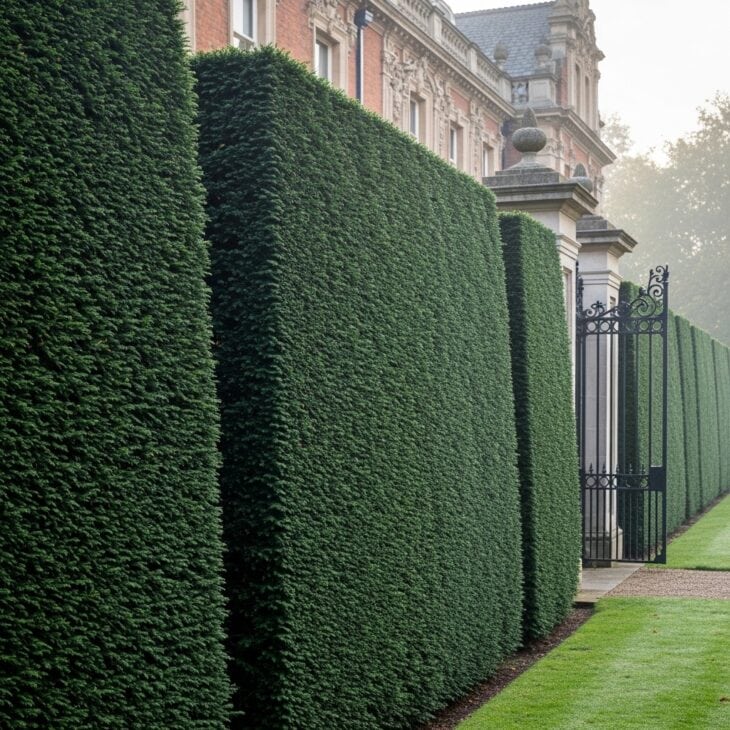
What you see A dark yew hedge runs along the entire front boundary, clipped to a sharp flat top and vertical sides at 150cm (60in) height. The house behind it is partly hidden, which makes the glimpsed garden beyond the gate more intriguing. Against the dark green, the front door is luminous.
Why it works Yew is the finest hedging plant in the temperate garden. Its dark colour makes every other colour sing against it, it tolerates very hard cutting, and it grows slowly enough to stay neat between clips. A formal yew hedge gives a front garden an authority that no fence or wall can match, and it improves with every decade.
How to get it Yew (Taxus baccata) grows around 20 to 30cm (8 to 12in) per year once established. Plant bare-root or container-grown specimens at 60cm (24in) apart in autumn or early spring. It tolerates most soils but must have adequate drainage: yew will not grow in waterlogged ground. Clip once a year in late August for a sharp shape that holds through winter. Do not cut back into old brown wood more than once every few years, as recovery is slow. Wear gloves when handling: all parts of yew are toxic to humans and animals.
26. Ground Cover Lawn Alternative
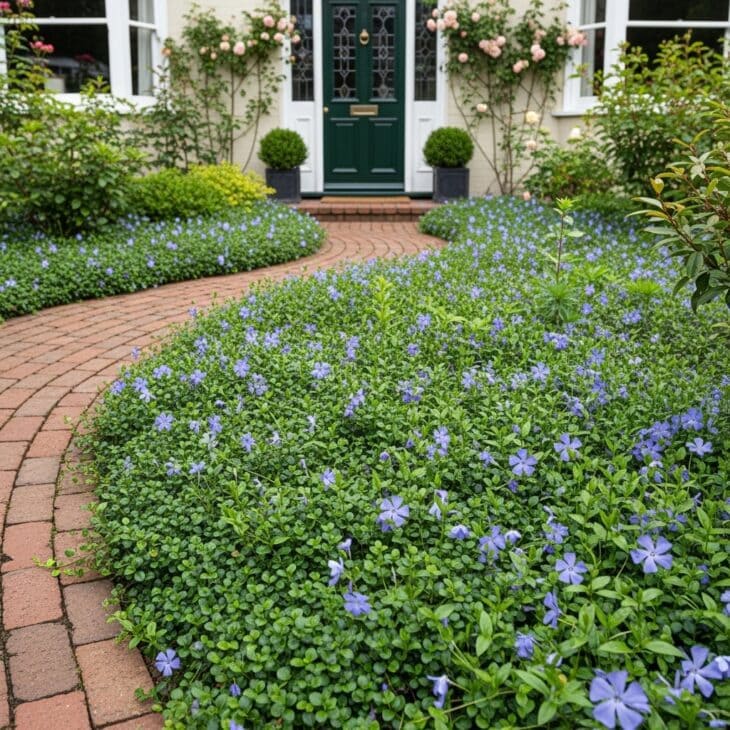
What you see A front garden with no lawn and no beds: just a continuous carpet of Cotoneaster dammeri and Vinca minor rolling from the boundary to the house, broken only by the path. It is evergreen, weed-suppressing, and requires a single cut once a year. It looks considered and low-key, like a garden that knows exactly what it is.
Why it works Replacing a struggling front lawn with ground cover is one of the most practical decisions available for a shady or difficult front garden. Ground cover plants establish quickly, suppress weeds once the canopy closes, and need no mowing. The result is greener and more textured than grass in difficult conditions.
How to get it Cotoneaster dammeri and Vinca minor are both excellent for dry or semi-shaded fronts: both are vigorous, evergreen, and virtually indestructible once established. For sunny fronts, Sedum acre or creeping Thymus serpyllum create a flower-rich low carpet from spring to autumn. Plant at 45cm (18in) intervals through a layer of bark mulch to suppress weeds while the ground cover establishes. Water through the first summer. Once the canopy closes between plants, no further watering or feeding is necessary.
27. Seasonal Container Display
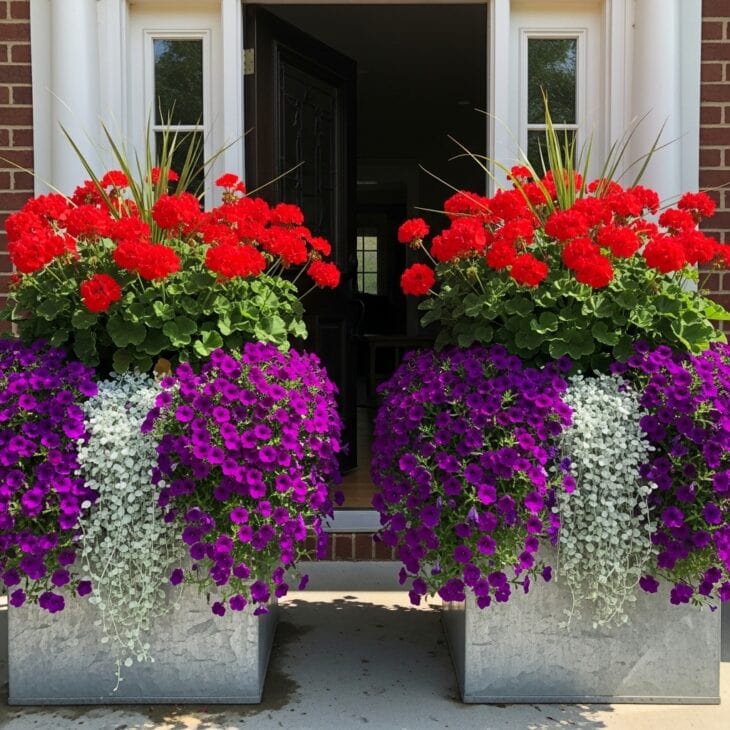
What you see At the front of the house, four large containers in matching grey zinc are replanted four times a year: tulips and wallflowers in spring, pelargoniums in summer, Cyclamen and ornamental cabbages in autumn, and evergreen winter boxes through January and February. The house front changes character with the seasons.
Why it works A seasonal container display keeps a front garden looking fresh and considered throughout the year. It suits houses with no soil garden or where the permanent planting is evergreen and needs seasonal colour. The investment is in good containers that earn their keep in every season.
How to get it Invest in large, frost-proof containers of a consistent style: terracotta, zinc, or Versailles planters all work well. The minimum useful diameter for a front-door display is 40cm (16in); larger reads better from the street. Replant in late March (spring), late May (summer), late September (autumn), and November (winter). Spring: Tulipa, Myosotis, wallflowers. Summer: upright Pelargonium, trailing Lobelia, Calibrachoa. Autumn: ornamental Brassica, Cyclamen, Heuchera. Winter: Skimmia japonica, Viola, dwarf conifers.
28. Wisteria on the House Front
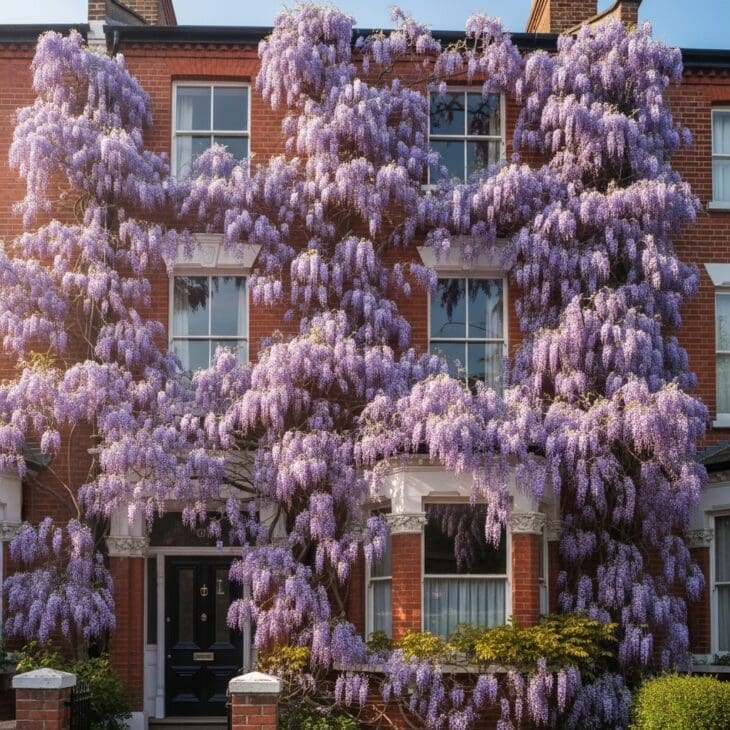
What you see In late May, a wisteria covers the entire front of a brick Victorian house in trailing racemes of lilac-blue, reaching the upstairs windows. The scent is overwhelming from the pavement. For three weeks in spring and a shorter repeat in August, the house is the most photographed on the street.
Why it works Wisteria on a house front is one of the most dramatic plant statements available in a temperate garden. It is slow to flower from establishment — allow five to seven years — but once it starts it never stops. The twice-yearly pruning routine is essential but takes no more than an hour each time.
How to get it Choose Wisteria sinensis for reliable vigorous flowering, or Wisteria floribunda ‘Multijuga’ for the longest flower racemes at up to 90cm (36in). Fix horizontal wires at 30cm (12in) intervals across the house front. Prune twice a year: in August, cut back all new green shoots to five leaves from the main framework; in February, cut back again to two or three buds. This twice-yearly pruning is essential to produce flower buds the following spring. Do not allow wisteria to grow under roof tiles, into gutters, or under window frames.
29. Herb Pocket Garden
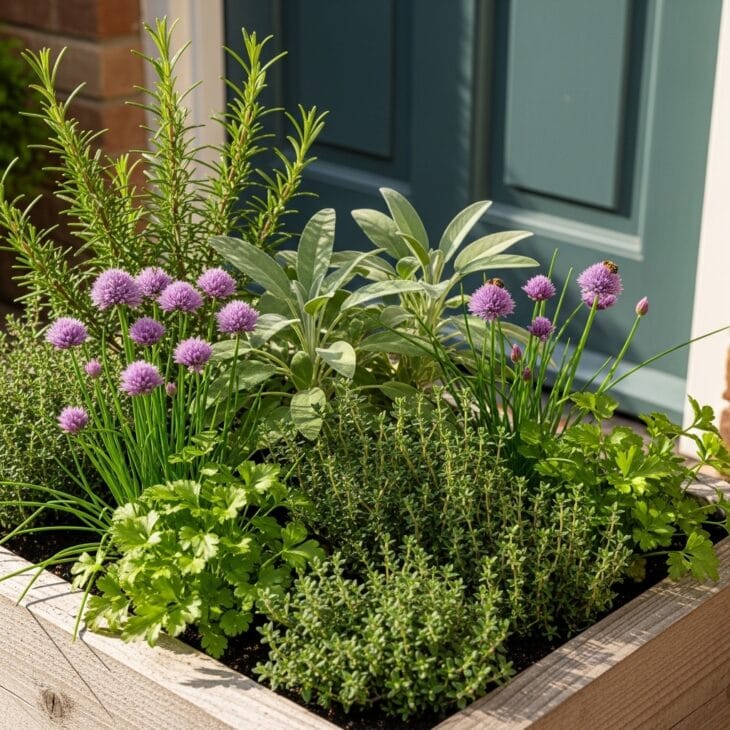
What you see A small raised bed sits immediately beside the front door, planted densely with rosemary, thyme, sage, chives, and flat-leaf parsley. Reaching for herbs on the way in from work, in the rain, without putting on boots: that is the entire point of this garden. It smells extraordinary from the moment the door opens.
Why it works A herb garden near the front door is one of the most functional improvements to a small front space. It makes herbs genuinely convenient to use, adds fragrance to the entrance throughout the year, and looks attractive year-round. Culinary herbs are largely evergreen, low-growing, and require almost no maintenance beyond occasional trimming.
How to get it Plant in a sunny, sheltered spot within arm’s reach of the front door. A raised bed 60cm (24in) deep and 90cm (36in) wide gives enough room for six to eight varieties. Fill with free-draining compost and 20% horticultural grit. Reliable front-door herbs include rosemary ‘Miss Jessopp’s Upright’, thyme ‘Silver Posie’, sage ‘Purpurascens’, Allium schoenoprasum (chives), flat-leaf parsley, and bronze fennel. Replace parsley annually; all others persist for several years. Clip lightly after flowering to prevent woody collapse and encourage fresh growth.
30. Evergreen Year-Round Structure
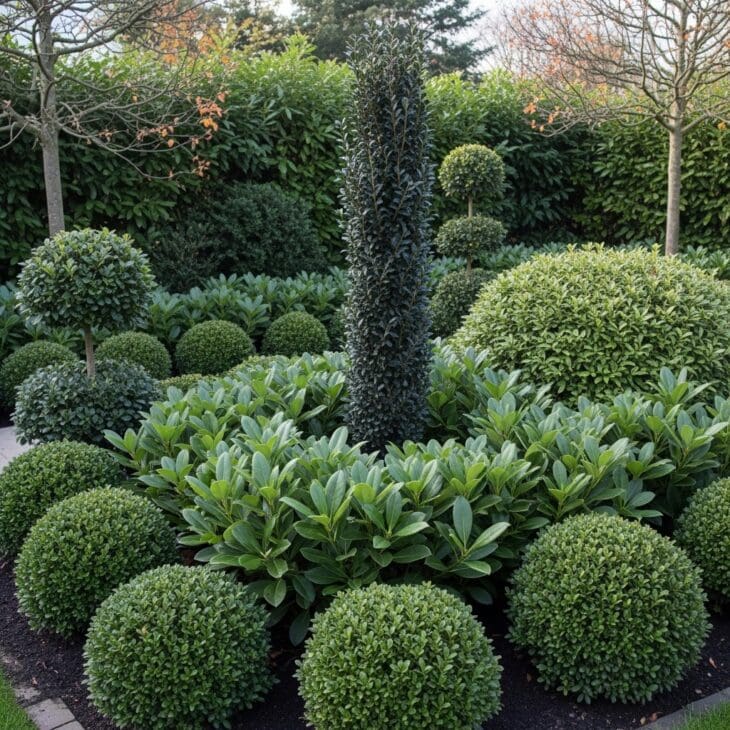
What you see Through every season, the front garden holds its shape: clipped spheres of Pittosporum, a dark column of Taxus, the glossy paddles of Viburnum davidii, and a broad mound of Choisya at the corner. In November it looks better than most front gardens do in June. That is the quiet ambition of a well-structured evergreen planting.
Why it works An evergreen-led front garden succeeds because it provides structure in the seasons when other planting fails. The discipline of choosing only evergreen or semi-evergreen plants forces good decisions about form and texture. One clip per year keeps everything looking intentional and cared-for even through the depths of winter.
How to get it Build the planting around three or four key species at different heights and textures. Tall: Pittosporum tenuifolium ‘Tom Thumb’ or Prunus lusitanica. Mid-height: Choisya ternata, Viburnum davidii, or Fatsia japonica for shadier fronts. Low: Sarcococca confusa (fragrant in January), Pachysandra terminalis, or Euonymus fortunei ‘Emerald Gaiety’. Clip structural plants once in June to maintain shape. Lay bark mulch 7cm (3in) deep to suppress weeds. No feeding is needed once plants are established and the canopy is closed.