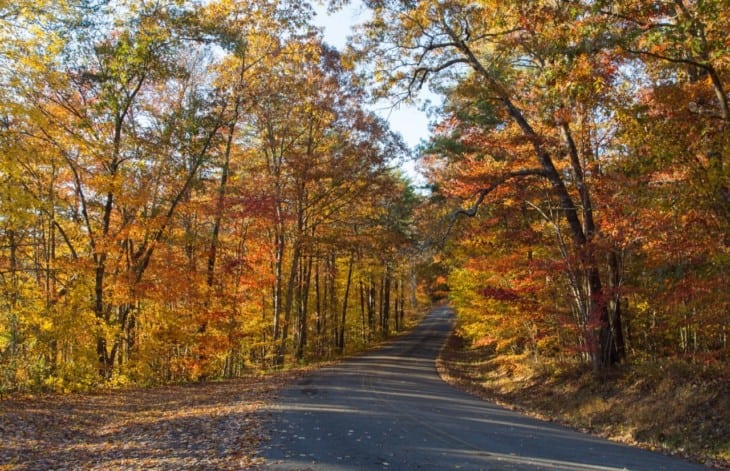
About 70 percent of Alabama is forest, roughly 23 million acres, and pines dominate it. Loblolly pine is by far the most common tree in the state, both in natural stands and in the timber plantations that cover much of the Coastal Plain. Longleaf pine, the state tree, once covered most of south Alabama and is being restored. Oak-hickory forests fill the hills and ridges of the north. River bottoms and the Mobile-Tensaw Delta grow sweetgum, water oak, tupelo and bald cypress, and live oaks and southern magnolias shade the coast.
Contents
- Pines
- Oaks, Hickories and Pecans
- Trees of River Bottoms and Swamps
- Bald Cypress (Taxodium distichum)
- Black Gum (Blackgum) (Nyssa sylvatica)
- Sweetgum (Liquidambar styraciflua)
- Red Maple (Acer rubrum)
- American Sycamore (Platanus occidentalis)
- Eastern Cottonwood (Populus deltoides)
- Black Willow (Salix nigra)
- River Birch (Betula nigra)
- Sugarberry (Celtis laevigata)
- Sweetbay Magnolia (Magnolia virginiana)
- Hardwoods of the Hills and Slopes
- Small Trees and Understory Trees
- Flowering Dogwood (Cornus florida)
- Eastern Redbud (Cercis canadensis)
- American Holly (Ilex opaca)
- Sassafras (Sassafras albidum)
- Sourwood (Oxydendrum arboreum)
- Common Persimmon (Diospyros virginiana)
- Red Mulberry (Morus rubra)
- American Hornbeam (Carpinus caroliniana)
- Red Buckeye (Aesculus pavia)
- Downy Serviceberry (Amelanchier arborea)
- Don’t Plant These Invasive Trees
- How to Identify Alabama’s Pines
This guide covers the 36 trees you are most likely to see in Alabama, grouped by where they grow, and 3 invasive trees you shouldn’t plant.
- Pines
- Oaks, Hickories and Pecans
- Trees of River Bottoms and Swamps
- Hardwoods of the Hills and Slopes
- Small Trees and Understory Trees
- Don’t Plant These Invasive Trees
- How to Identify Alabama’s Pines
| Tree | Botanical name | Native to AL | Where you’ll see it |
|---|---|---|---|
| Longleaf Pine | Pinus palustris | Yes | South Alabama sandhills and flatwoods; mountain longleaf in the Talladega Mountains |
| Loblolly Pine | Pinus taeda | Yes | Statewide; the main plantation pine |
| Shortleaf Pine | Pinus echinata | Yes | Dry uplands and ridges, mostly in the north and center |
| Slash Pine | Pinus elliottii | Yes | Far south Alabama; planted farther north |
| White Oak | Quercus alba | Yes | Upland forests statewide, most common in the north |
| Southern Red Oak | Quercus falcata | Yes | Dry uplands and pine-oak woods statewide |
| Water Oak | Quercus nigra | Yes | Bottomlands, stream banks and yards statewide |
| Live Oak | Quercus virginiana | Yes | Coastal Alabama; planted in towns across the south |
| Pecan | Carya illinoinensis | Mostly planted | Orchards, farms and yards, especially in the south |
| Bitternut Hickory | Carya cordiformis | Yes | Moist bottomlands and rich slopes |
| Bald Cypress | Taxodium distichum | Yes | Swamps, river bottoms and the Mobile-Tensaw Delta |
| Black Gum (Blackgum) | Nyssa sylvatica | Yes | Uplands and bottomlands statewide |
| Sweetgum | Liquidambar styraciflua | Yes | Bottomlands, old fields and forest edges statewide |
| Red Maple | Acer rubrum | Yes | Swamps, bottomlands and wet woods statewide |
| American Sycamore | Platanus occidentalis | Yes | Riverbanks and creek bottoms statewide |
| Eastern Cottonwood | Populus deltoides | Yes | Riverbanks and sandbars, especially along the larger rivers |
| Black Willow | Salix nigra | Yes | Riverbanks, pond edges and wet ditches |
| River Birch | Betula nigra | Yes | Stream banks and floodplains statewide |
| Sugarberry | Celtis laevigata | Yes | Bottomlands and floodplains statewide; also yards and fence rows |
| Sweetbay Magnolia | Magnolia virginiana | Yes | Wet flatwoods, bays and swamp edges in south Alabama |
| Yellow-Poplar (Tulip Tree) | Liriodendron tulipifera | Yes | Coves, moist slopes and bottomlands, especially in the north |
| American Beech | Fagus grandifolia | Yes | Moist slopes, ravines and stream terraces statewide |
| Black Cherry | Prunus serotina | Yes | Forest edges, old fields and fence rows statewide |
| Black Walnut | Juglans nigra | Yes | Bottomlands and rich soils, mostly in the north |
| American Elm | Ulmus americana | Yes | Bottomlands and moist slopes statewide |
| Southern Magnolia | Magnolia grandiflora | Yes | South Alabama forests; planted statewide |
| Flowering Dogwood | Cornus florida | Yes | Understory of pine and hardwood forests; yards |
| Eastern Redbud | Cercis canadensis | Yes | Forest edges and roadsides, especially on limestone soils |
| American Holly | Ilex opaca | Yes | Understory of moist forests statewide |
| Sassafras | Sassafras albidum | Yes | Old fields, forest edges and fence rows statewide |
| Sourwood | Oxydendrum arboreum | Yes | Dry slopes with oaks and pines, mostly in the north and center |
| Common Persimmon | Diospyros virginiana | Yes | Old fields, fence rows and forest edges statewide |
| Red Mulberry | Morus rubra | Yes | Bottomlands and moist forests statewide |
| American Hornbeam | Carpinus caroliniana | Yes | Stream banks and moist forest understories statewide |
| Red Buckeye | Aesculus pavia | Yes | Understory of moist forests, mostly in the Coastal Plain |
| Downy Serviceberry | Amelanchier arborea | Yes | Forest edges and slopes, mostly in the north |
| Chinese Tallow | Triadica sebifera | No, invasive | Wetlands, pastures and roadsides, mostly in south Alabama |
| Callery Pear (Bradford Pear) | Pyrus calleryana | No, invasive | Roadsides, old fields and yards statewide |
| Mimosa (Silk Tree) | Albizia julibrissin | No, invasive | Roadsides, forest edges and stream banks statewide |
Pines
Longleaf Pine (Pinus palustris)

Longleaf pine has been Alabama’s state tree since 1997. It grows 80 to 110 feet tall and has the longest needles of any eastern pine, 8 to 18 inches, in bundles of 3. Seedlings spend their first few years in a “grass stage”, a tuft of needles close to the ground that looks like a clump of grass, while they grow a deep taproot. Longleaf forests need regular low fires, which the thick bark survives. They once covered around 90 million acres of the Southeast, and less than 5 percent of that remains. Longleaf forests are home to the endangered red-cockaded woodpecker and the gopher tortoise.
Loblolly Pine (Pinus taeda)

Loblolly pine is the most common tree in Alabama and the backbone of its timber industry. It grows fast, 90 to 110 feet tall, and fills old fields and cut-over land on its own. Most pine plantations in the state are loblolly. Its needles are 6 to 9 inches long, in bundles of 3, and often slightly twisted. The cones are 3 to 6 inches long, with a sharp prickle on each scale. Loblolly is an old Southern word for a mudhole, after the low, wet places where it grows.
Shortleaf Pine (Pinus echinata)
Read our guide to Shortleaf Pine
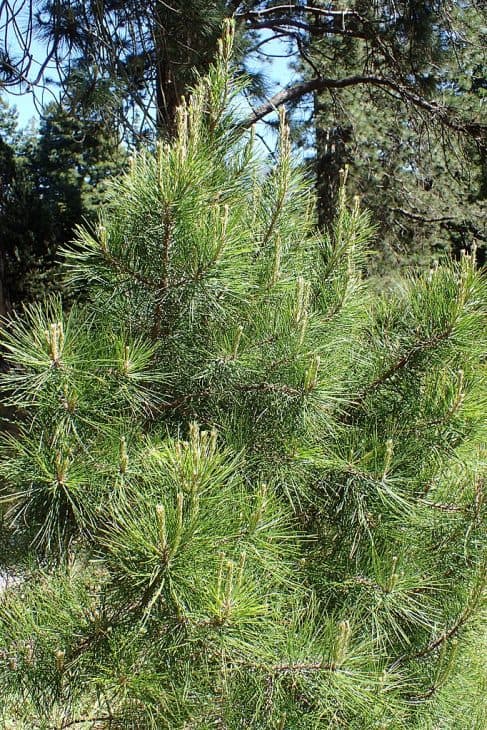
Shortleaf pine grows on dry, rocky ridges and poor soils in the northern two-thirds of the state. It grows 80 to 100 feet tall with short needles, 3 to 5 inches long, mostly in bundles of 2 but sometimes 3. The cones are small, only 1.5 to 2.5 inches. The bark on older trees has flat plates dotted with small pits of resin. Young trees can resprout from the base after fire, which few pines can do.
Slash Pine (Pinus elliottii)

Slash pine is native to the wet flatwoods and edges of swamps near the Gulf Coast in Mobile and Baldwin counties, and it is also planted for timber elsewhere. It grows 60 to 100 feet tall with long, stiff needles, 7 to 10 inches, in bundles of 2 and 3. The glossy brown cones are 3 to 6 inches long. It is a major source of pine straw and was once tapped for turpentine.
Oaks, Hickories and Pecans
White Oak (Quercus alba)

White oak grows 80 to 100 feet tall with a broad crown. Its leaves have 7 to 9 rounded lobes with no bristles, and they often turn a deep wine-red in fall. The light gray bark breaks into loose, scaly plates. Its sweet acorns are a favorite of deer, turkeys and squirrels, and its wood is used for flooring, furniture and whiskey barrels.
Southern Red Oak (Quercus falcata)
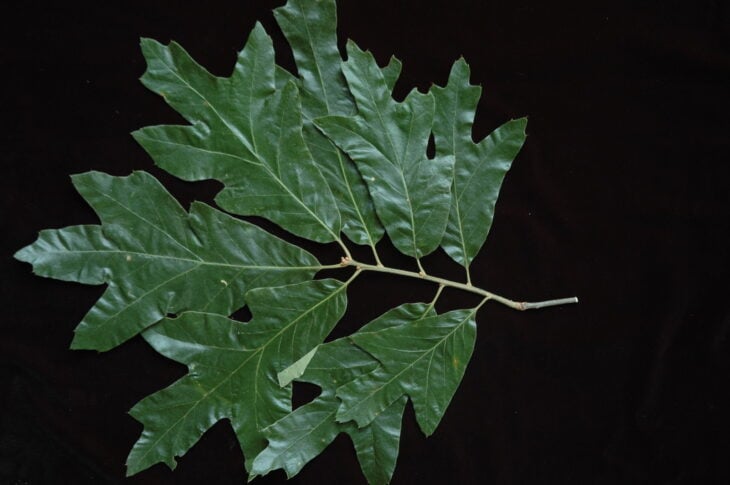
Southern red oak is one of the most common oaks on dry upland sites in Alabama, 60 to 80 feet tall. Its leaves are unusual: they have a rounded, bell-shaped base and 3 to 7 bristle-tipped lobes, with a long lobe at the tip. Many leaves have just 3 lobes, shaped like a turkey’s foot. The undersides are covered in soft, rusty-gray hairs. The dark bark has rough ridges.
Water Oak (Quercus nigra)

Water oak is common in bottomlands and is one of the most widely planted street and yard trees in the South. It grows fast, 50 to 80 feet tall. Its leaves are small, smooth and spoon-shaped, widest near the tip, and sometimes have 3 shallow lobes at the end. It holds many leaves into winter. It grows fast but is short-lived for an oak, often 60 to 80 years, and older trees are prone to rot and falling limbs.
Live Oak (Quercus virginiana)

Southern live oak is the great spreading oak of Mobile and the Gulf Coast. It grows 40 to 80 feet tall but can spread twice as wide, with huge, low, sweeping limbs that are often draped in Spanish moss and resurrection fern. Its small, leathery, oval leaves are evergreen, dark and glossy above and pale beneath. The wood is extremely hard and was used for the frames of wooden warships. It tolerates salt spray and hurricane winds better than most trees.
Pecan (Carya illinoinensis)

Pecan is a hickory and the largest one, 70 to 100 feet tall. Its native range is the Mississippi River Valley to the west, but it has been planted across Alabama for more than a century, and the pecan is Alabama’s official state nut. Its compound leaves have 9 to 17 slender, slightly curved leaflets. The oblong, thin-shelled nuts ripen in October and November in a husk that splits open along 4 seams.
Bitternut Hickory (Carya cordiformis)

Bitternut hickory grows 50 to 80 feet tall with a straight trunk and tight, gray bark. The easiest way to recognize it is in winter: its buds are bright sulfur-yellow. Its compound leaves have 7 to 11 slender leaflets. The nuts are small and so bitter that even squirrels eat them last. Alabama also has mockernut, pignut and shagbark hickories on upland sites.
Trees of River Bottoms and Swamps
Bald Cypress (Taxodium distichum)

Bald cypress grows in standing water in swamps, sloughs and along rivers, especially in the Mobile-Tensaw Delta. It is a conifer, 50 to 100 feet tall, with a broad, swollen base and woody “knees” that stick up from the roots around it. Its soft, flat needles turn rusty orange and fall off in autumn, which is where “bald” comes from. The rot-resistant wood was heavily logged for siding and boats. It also grows well in ordinary yards.
Black Gum (Blackgum) (Nyssa sylvatica)

Black gum, also called black tupelo, grows 40 to 70 feet tall with a straight trunk and short, horizontal branches. Its glossy, oval leaves turn some of the most brilliant scarlet of any tree in early fall. On old trees, the bark breaks into deep, blocky ridges like alligator hide. Female trees have small, dark blue fruits that birds eat. Its close relative, water tupelo (Nyssa aquatica), grows in the swamps of south Alabama and is the source of tupelo honey.
Sweetgum (Liquidambar styraciflua)

Sweetgum is one of the most common hardwoods in Alabama, 60 to 100 feet tall. Its glossy, star-shaped leaves have 5 to 7 pointed lobes and turn yellow, orange, red and purple in fall, often all on one tree. The spiky, round seed balls, called gumballs, drop all winter and are a nuisance in yards. Some twigs have corky wings. The resin from its bark was once chewed like gum.
Red Maple (Acer rubrum)

Red maple grows 40 to 70 feet tall and is one of the most widespread trees in the eastern U.S. In Alabama it is most common in wet ground. It is one of the first trees to bloom, with small red flowers on bare branches in January or February, followed by red winged seeds. The leaves have 3 main, toothed lobes and turn red, orange or yellow in fall.
American Sycamore (Platanus occidentalis)

American sycamore grows along rivers and creeks, 70 to 100 feet tall, and has the largest trunk diameter of any eastern hardwood. Its bark peels in patches, leaving a patchwork of brown, green and cream, and the upper branches are almost white, which makes it easy to spot along streams in winter. Its broad, maple-like leaves are 4 to 8 inches wide, and its round, bristly seed balls hang on long stalks.
Eastern Cottonwood (Populus deltoides)
Read our guide to Eastern Cottonwood

Eastern cottonwood is one of the fastest-growing trees in North America, 80 to 100 feet tall, on riverbanks and sandbars. Its triangular leaves have coarse, rounded teeth and flattened stalks, so they flutter in the slightest breeze. In late spring, female trees release seeds attached to white cottony fluff. Swamp cottonwood (Populus heterophylla), with rounder, heart-shaped leaves, grows in the swamps of the lower Mobile Delta.
Black Willow (Salix nigra)

Black willow is the largest native willow, usually 30 to 60 feet tall, and often grows with several leaning trunks along water. Its leaves are long, narrow and finely toothed, green on both sides. The dark bark has deep, interlacing ridges. In early spring it has yellow-green catkins. It grows very fast and helps hold stream banks together, but its wood is weak and brittle.
River Birch (Betula nigra)
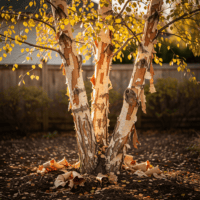
River birch is the only birch native to most of the Deep South. It grows 40 to 70 feet tall, often with several trunks. Its bark is its best feature: salmon-pink to cinnamon-brown, peeling in papery, curly layers. The diamond-shaped leaves are doubly toothed. It tolerates wet soil and heat and resists the bronze birch borer, so it is widely planted in yards.
Sugarberry (Celtis laevigata)

Sugarberry, or southern hackberry, grows 60 to 80 feet tall in bottomlands. Its smooth, light gray bark is covered in corky warts and ridges. The leaves are narrow, pointed and often lopsided at the base, with few or no teeth. The small, orange to purple fruits are sweet, and birds eat them all winter. Common hackberry (Celtis occidentalis), with rougher, more toothed leaves, replaces it in parts of north Alabama.
Sweetbay Magnolia (Magnolia virginiana)

Sweetbay is a small magnolia, usually 20 to 40 feet tall, of wet, acidic soils in south Alabama. Its leathery, oval leaves are bright green above and silvery-white underneath, so the tree flashes silver when the wind blows. From May to early summer it has creamy white, lemon-scented flowers 2 to 3 inches across. In the south of the state it keeps most of its leaves through winter.
Hardwoods of the Hills and Slopes
Yellow-Poplar (Tulip Tree) (Liriodendron tulipifera)

Yellow-poplar is one of the tallest hardwoods in the East, often 80 to 120 feet tall, with a long, straight trunk. It isn’t a poplar but a magnolia relative. Its leaves have 4 lobes and a square-cut, notched tip that makes them look like a tulip in outline. In April and May it has tulip-shaped flowers, green with an orange band, often high in the tree. It grows fast on moist, rich soils in the Appalachian foothills of north Alabama.
American Beech (Fagus grandifolia)

American beech grows 50 to 80 feet tall and is easy to recognize by its smooth, light gray bark, which stays smooth even on old trees. Its oval leaves have straight parallel veins, each ending in a small tooth. In fall they turn golden bronze, and young beeches hold many dry, tan leaves all winter. The small, three-sided nuts are an important food for wildlife.
Black Cherry (Prunus serotina)

Black cherry grows 50 to 80 feet tall in forests and 30 to 40 feet in the open. Its leaves are narrow, glossy and finely toothed. The bark on older trees breaks into small, dark, curled plates that look like burnt potato chips. In spring it has drooping clusters of small white flowers, followed by dark purple cherries that birds spread along fence rows. The wilted leaves are poisonous to livestock.
Black Walnut (Juglans nigra)

Black walnut grows 50 to 75 feet tall with a rounded crown. Its compound leaves have 15 to 23 leaflets, and the nuts come in a thick green husk that turns black and stains hands and pavement. Its roots release juglone, a chemical that stunts tomatoes and many other garden plants growing under it. The dark wood is among the most valuable in North America.
American Elm (Ulmus americana)

American elm grows 60 to 80 feet tall with a tall, vase-shaped crown. Its oval, double-toothed leaves have an uneven, lopsided base. Dutch elm disease has killed most large elms since the 1930s, but young trees are still common in bottomlands. On dry upland sites in Alabama, the smaller winged elm (Ulmus alata) is actually more common. It has tiny leaves and thin, corky wings along its twigs.
Southern Magnolia (Magnolia grandiflora)
Read our guide to Southern Magnolia

Southern magnolia is native to the forests of the Coastal Plain and planted in yards across the state. It grows 60 to 80 feet tall with large, stiff, evergreen leaves that are glossy dark green above and often rusty-brown and fuzzy beneath. From May to June it has huge, fragrant white flowers 8 to 12 inches across, followed by cone-like pods with bright red seeds. Its leaves drop all year and are slow to break down, so few plants grow beneath it.
Small Trees and Understory Trees
Flowering Dogwood (Cornus florida)

Flowering dogwood is a small tree, 15 to 30 feet tall, that blooms in March and April with four large, white bracts around a small cluster of true flowers. Its leaves have veins that curve toward the tip and turn red-purple in fall, and it has glossy red berries that birds eat. For the berries, see are dogwood berries poisonous?
Eastern Redbud (Cercis canadensis)

Eastern redbud covers its bare branches, and even its trunk, with small pink-purple flowers in late February and March, one of the first signs of spring in Alabama. It grows 20 to 30 feet tall with heart-shaped leaves and flat, bean-like pods. It is common everywhere except the lower Coastal Plain and grows best on limestone soils.
American Holly (Ilex opaca)

American holly is an evergreen tree, usually 20 to 40 feet tall, with a dense, pyramid shape. Its stiff, leathery leaves have sharp spines along the edges and are dull green, not glossy like English holly. Female trees have bright red berries in fall and winter, which are mildly poisonous to people and pets but eaten by birds. The smooth, light gray bark has small bumps.
Sassafras (Sassafras albidum)

Sassafras grows 30 to 60 feet tall and has three leaf shapes on the same tree: oval, mitten-shaped and three-lobed. Its leaves, twigs and roots smell spicy and citrusy when crushed. Its roots were once used to make root beer, until the FDA banned safrole, the main compound in its oil, as a food additive in 1960. The leaves turn orange, red and yellow in fall.
Sourwood (Oxydendrum arboreum)

Sourwood grows 20 to 50 feet tall, often with a leaning trunk. In early summer it has drooping sprays of small, white, bell-shaped flowers, and bees make a prized light honey from them. The leaves taste sour, which gives the tree its name, and they turn deep scarlet early in the fall.
Common Persimmon (Diospyros virginiana)

Common persimmon grows 30 to 60 feet tall, often in groves in old fields. Its bark breaks into small, square, dark blocks. The oval leaves are glossy and smooth-edged. In fall, female trees have round, orange fruits about 1 to 2 inches across. They are extremely astringent until they are fully ripe and soft, usually after the leaves drop, and then they are sweet. Deer, raccoons, opossums and foxes eat them.
Red Mulberry (Morus rubra)

Red mulberry is a small tree, 30 to 50 feet tall. Its leaves are large and rough, like sandpaper, on top, and vary in shape on one tree: some are unlobed and heart-shaped, others have 2 or 3 lobes, like a mitten. In early summer it has sweet, dark purple fruits that look like long blackberries. The Asian white mulberry, with smooth, glossy leaves, has spread widely and crosses with it.
American Hornbeam (Carpinus caroliniana)

American hornbeam is a small understory tree, 20 to 30 feet tall. Its smooth, gray, fluted trunk looks like a flexed muscle, which gives it the names musclewood and ironwood. The doubly toothed, oval leaves turn yellow, orange and red in fall. Its seeds hang in clusters, each attached to a small, three-lobed leafy wing.
Red Buckeye (Aesculus pavia)

Red buckeye is a large shrub or small tree, usually 10 to 20 feet tall. In March and April it has upright clusters of bright red, tubular flowers that are one of the first nectar sources for returning ruby-throated hummingbirds. Its leaves have 5 leaflets that spread like fingers. The shiny brown seeds, like the rest of the plant, are poisonous. Plants often drop their leaves by late summer.
Downy Serviceberry (Amelanchier arborea)

Downy serviceberry is a small tree, 15 to 30 feet tall, that blooms with clouds of white flowers in early spring, before its leaves come out. The young leaves are covered in soft, downy hairs. In late spring it has small, dark purple, edible berries that birds strip quickly. Its smooth gray bark has faint vertical stripes, and its leaves turn orange-red in fall.
Don’t Plant These Invasive Trees
Chinese Tallow (Triadica sebifera)

Chinese tallow, or popcorn tree, was planted for its bright red and orange fall color and its white, waxy seeds, which look like popcorn. It is now one of the worst invasive plants on the Gulf Coast. Birds spread the seeds into wetlands, marshes and pastures, where it grows into dense thickets that crowd out native plants. Its diamond-shaped leaves with a long tip make it easy to recognize. Remove seedlings and don’t plant it. The sap and leaves are also toxic to livestock.
Callery Pear (Bradford Pear) (Pyrus calleryana)

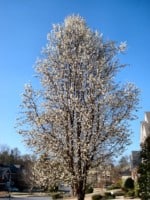
Callery pear, sold as Bradford pear and other cultivars, covers itself in white flowers in early spring, with a smell many people find unpleasant. The cultivars were thought to be sterile, but they cross with each other, and birds now spread the small fruits into fields and roadsides, where they grow into thorny thickets. Bradford pears also split apart easily in storms. See pros and cons of Bradford pear trees. Plant serviceberry or redbud for spring flowers instead.
Mimosa (Silk Tree) (Albizia julibrissin)

Mimosa is an Asian tree, 20 to 40 feet tall, with fern-like leaves and fluffy, pink, powder-puff flowers in early summer. It was widely planted in Southern yards, but it spreads by seed along roads, streams and forest edges and forms thickets that shade out native plants. The seeds stay viable in the soil for years. See types of mimosa trees for more.
How to Identify Alabama’s Pines
| If the needles… | It’s probably |
|---|---|
| Are 8 to 18 in. long, in bundles of 3, and seedlings look like clumps of grass | Longleaf pine |
| Are 6 to 9 in. long, in bundles of 3, and the cones have sharp prickles | Loblolly pine |
| Are 7 to 10 in. long, in bundles of 2 and 3, near the coast | Slash pine |
| Are 3 to 5 in. long, mostly in bundles of 2, and the cones are small | Shortleaf pine |
| Are soft, flat, and fall off in autumn, and the tree grows in water | Bald cypress (not a pine) |
Alabama’s neighbor to the east shares most of these trees; see our guide to trees in Georgia.