
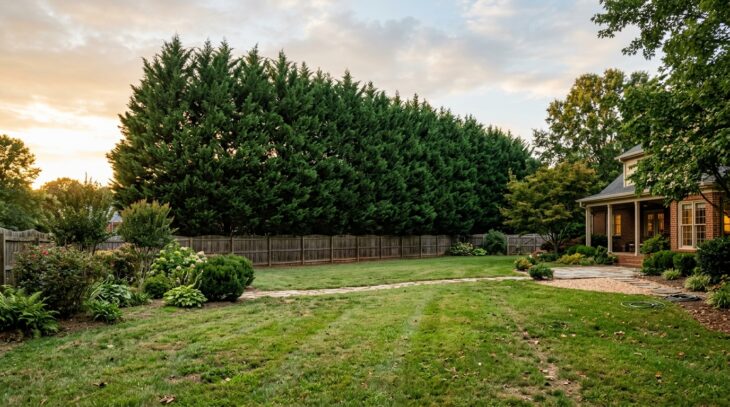
Leyland cypress (x Hesperotropsis leylandii) is a fast, upright evergreen that reaches 60 to 70 feet (18 to 21 m) tall, with flat sprays of soft blue-green to dark green foliage. It is a hybrid of two North American conifers, Monterey cypress and Nootka cypress, that crossed by accident on a property in England.
Contents
The short verdict: it is a good screen only if you have a lot of room, well-drained soil and the patience to watch for disease. NC State’s own plant profile says, “This plant is problematic and alternatives should be considered.”
That tension is speed against staying power. Leyland cypress needs full sun and drainage, grows 2 to 4 feet (60 to 120 cm) a year, and typically lives 20 to 50 years in Zones 6–10.
Pros Of Leyland Cypress Trees
Leyland Cypress Grows 2 to 4 Feet a Year
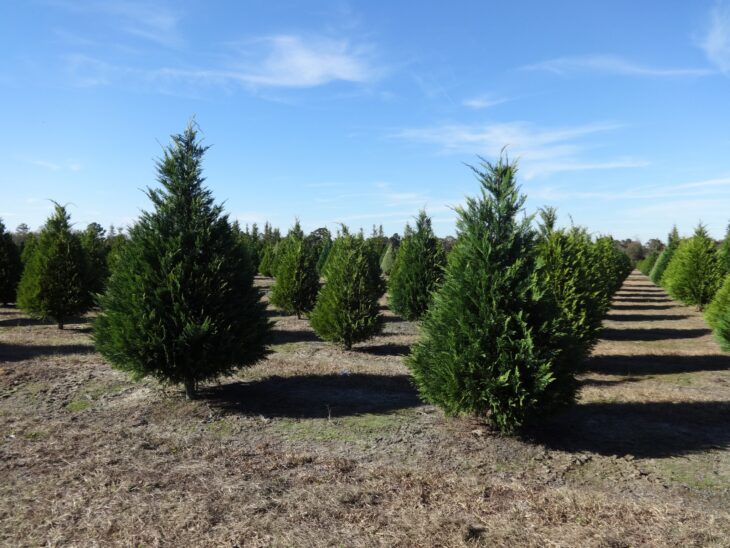
NC State says Leyland cypress can grow up to 3 feet (90 cm) a year and has reached 50 feet (15 m) in 15 years. Clemson Extension puts young trees at 3 to 4 feet (90 to 120 cm) a year, and Christmas tree growers harvest them at 3 to 6 years old.
Published rates vary, so expect roughly 2 to 4 feet (60 to 120 cm) a year on a decent site. That suits gardeners with a large lot who need a tall screen in years, not decades.
Leyland Cypress Makes a Dense Year-Round Screen and Windbreak
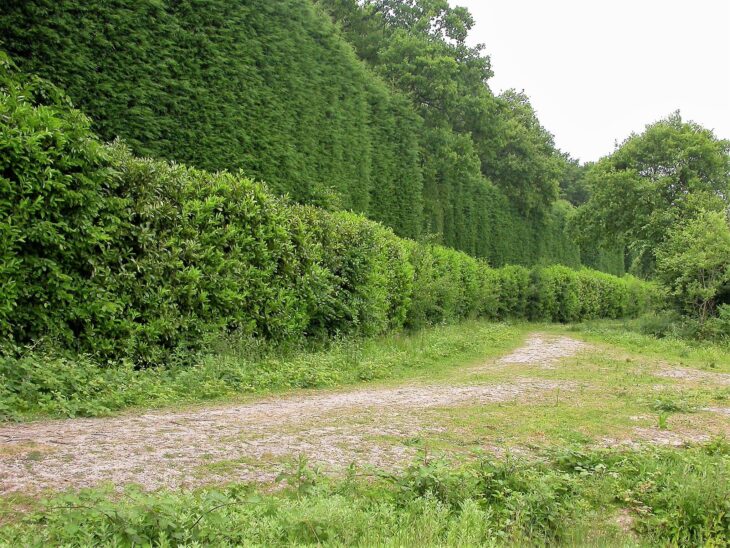
Clemson Extension recommends Leyland cypress for quick screens, hedges and groupings, especially on large properties. Virginia Tech notes that its tall, narrow conical form suits a privacy barrier or windbreak.
The foliage stays on through winter, and NC State lists the tree as winter cover for song and game birds. Large lots that need a year-round privacy screen get the most from it.
Leyland Cypress Tolerates Many Soils and Salt Spray
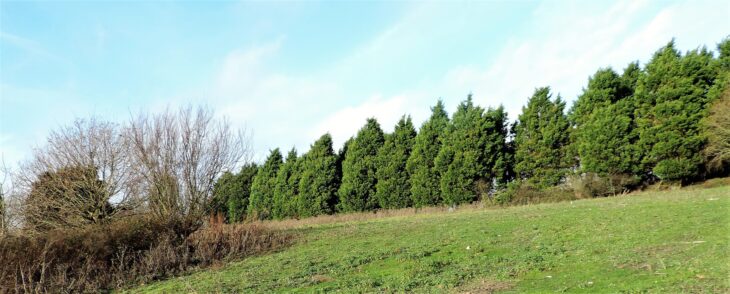
NC State lists Leyland cypress as growing in clay, loam or sand, across acid to alkaline soil, and as tolerating salt. Clemson Extension adds that it withstands salt spray, which makes it useful in coastal yards.
The catch is drainage. Mississippi State Extension says Leylands do not tolerate low-lying sites, and Virginia Tech calls the tree relatively drought tolerant even though drought stress makes its canker diseases worse.
This pro is best for coastal gardeners and for yards with difficult soil that still drains well.
Leyland Cypress Takes Shearing and Holds a Hedge Shape
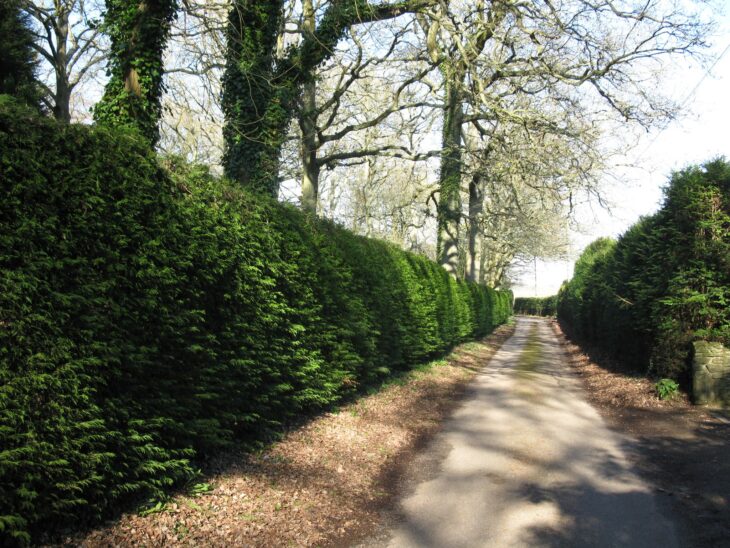
NC State says Leyland cypress takes well to severe pruning, and Clemson Extension says it tolerates severe trimming. Virginia Tech adds that it can be pruned as a hedge and topped to control height.
Prune only during dry periods to help prevent disease, and disinfect your tools between trees. NC State also warns that the foliage can irritate skin, so wear gloves.
That makes it a fit for gardeners who want a formal clipped hedge and will keep up with the trimming.
Cons Of Leyland Cypress Trees
Canker Diseases Have No Cure
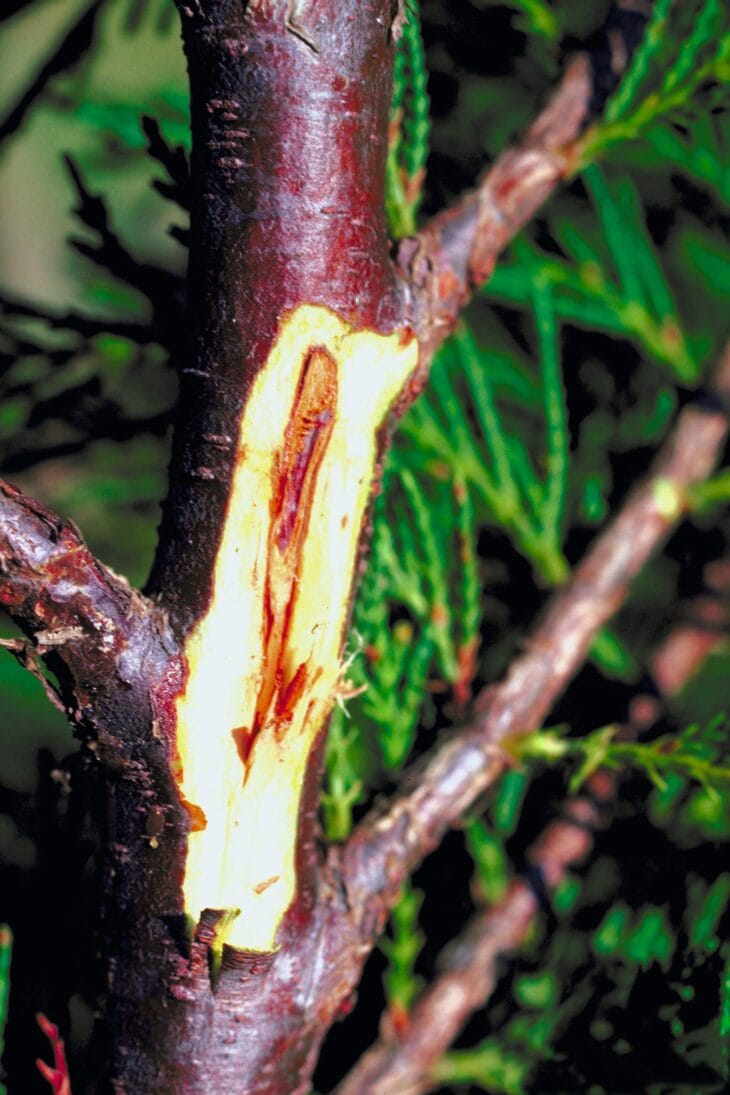
Two canker fungi hit Leyland cypress, according to the University of Georgia. Seiridium canker shows up as dying shoots, resin oozing from the bark and elongated cankers, while Botryosphaeria canker makes sunken cankers with little or no resin.
Both are tied to stress, especially drought. UGA says no resistant cultivars exist and fungicides do not control cankers once infection starts, and Mississippi State Extension rates the tree as highly susceptible to cypress canker.
The workaround is preventing stress. Plant in well-tilled soil, mulch out past the lowest limbs, water deeply every 7 to 14 days in hot, dry weather, and cut out cankered twigs, disinfecting your tools between cuts.
Bagworms Can Strip a Leyland Cypress in a Few Weeks
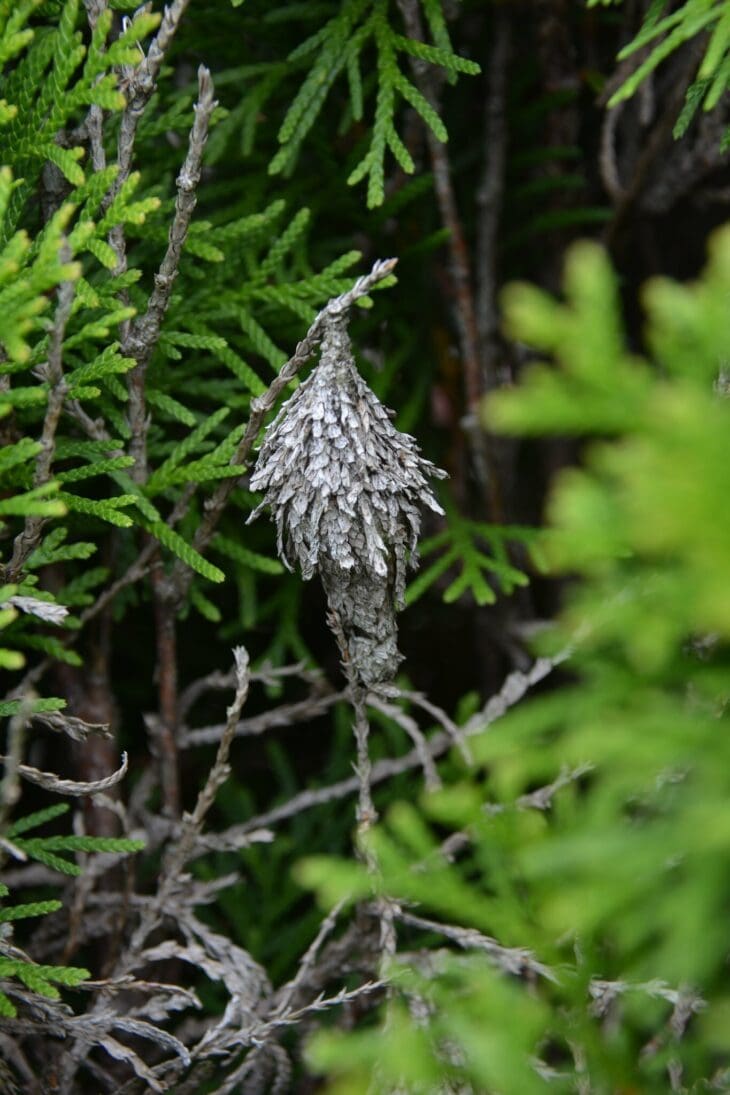
NC State says bagworms can defoliate an entire Leyland cypress in a matter of a few weeks, and large sections of evergreens may be killed outright. Several years of defoliation also reduce growth and leave the foliage sparse.
Arkansas Extension notes that bagworms prefer junipers, eastern red cedar, Leyland cypress and arborvitae. Eggs hatch in May and June.
Cut bags off by hand in fall, winter or early spring, using a sharp knife on the silk band instead of pulling the bag. Spray when caterpillars are tiny, in late May or early June, with Bt or a pyrethroid and follow the label, since insecticides can also harm pollinators.
Leyland Cypress Needs Far More Room Than Most Yards Offer
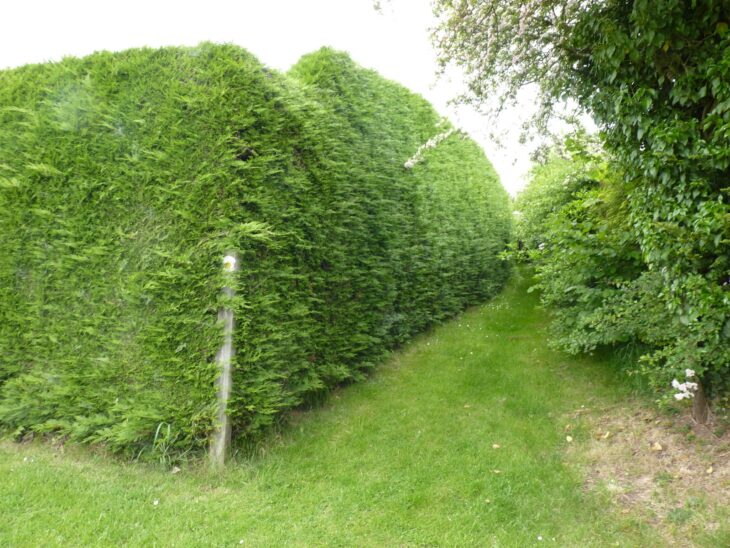
Leyland cypress reaches 60 to 70 feet (18 to 21 m) tall, and Clemson Extension says 70 to 100 feet (21 to 30 m) is not uncommon. Spread runs 10 to 20 feet (3 to 6 m), depending on the source.
Extension agents say to plant trees at least 10 to 15 feet (3 to 4.5 m) apart, yet NC State’s Caldwell County office reports that people often plant them with only a few inches between. Crowding cuts air circulation, and UGA links that to disease as trees mature.
The workaround is spacing: 10 to 15 feet (3 to 4.5 m) between trees, and well back from buildings. Anything growing near overhead power lines needs a professional.
Shallow Roots and Wet Soil Lead to Root Rot and Blow-Over
NC State notes that the roots are relatively shallow and that large specimens tend to topple over. After a 2017 storm, UGA Extension reported many wind-thrown Leylands and noted that saturated, soft soil lets shallow-rooted trees uproot.
Wet soil also feeds Phytophthora root rot, which Mississippi State describes as a disease of saturated soils. Virginia Tech adds that multiple trunks from nursery shearing can split in heavy snow or ice.
Plant on well-drained ground. Where drainage is poor, Mississippi State suggests raised beds, French drains or diverting water, and straightening or rejecting pot-bound root balls.
Leyland Cypress Lives 20 to 50 Years and Dislikes Heat and Cold Swings
NC State says Leyland cypress typically lives 20 to 50 years, depending on the environment, and is poorly adapted to areas with hot summers.
At the cold end, University of Maryland Extension says it is hardy to Zone 6 but does not tolerate sudden temperature swings. Virginia Tech notes damage in Zone 6a at -18°F (-28°C), and Maryland Extension links winter browning to wind and drying.
There is no treatment for winter damage, so wait for spring growth before pruning dead wood. If more than a third of the tree is damaged, replacement may be the better call.
Is Leyland Cypress Right For You?
Leyland cypress works best on a large property with full sun and well-drained soil. Plant it 10 to 15 feet (3 to 4.5 m) apart, water it through dry spells, and check it every year for bagworms and dieback.
It suits Zones 6–10, but NC State calls it poorly adapted to hot summers, so the warm end of that range is the hardest on it.
Skip it on a small or narrow lot, on low-lying or poorly drained ground, or where the trees would stand close to buildings or power lines. If Leylands have already died of canker in your yard, NC State’s Lee County office advises against replanting them in the same spot.
The usual swap is Green Giant arborvitae (Thuja standishii x plicata), which reaches 40 to 60 feet (12 to 18 m) in Zones 5–8. NC State says it resists most diseases, insects, drought and deer, with bagworms an occasional pest, but it still needs drainage, does not tolerate salt and can outgrow its space.
‘Nellie R. Stevens’ holly (Ilex x ‘Nellie R. Stevens’) grows 15 to 30 feet (4.5 to 9 m) in Zones 6–9, with dense, prickly foliage that works as a screen. It tolerates clay and drought but not wet sites.
Eastern red cedar (Juniperus virginiana) is a native for Zones 2–9 that reaches 30 to 40 feet (9 to 12 m) and resists deer, drought, poor soil and salt. It dislikes continuously wet soil, and bagworms favor it too.
Frequently Asked Questions
How far apart should you plant Leyland cypress?
Extension agents say at least 10 to 15 feet (3 to 4.5 m) apart. Wider spacing improves air circulation and reduces the humid conditions that favor needle blight. If a planting is already crowded, Mississippi State Extension suggests thinning it by removing every other tree.
How fast does Leyland cypress grow?
NC State says up to 3 feet (90 cm) a year, with 50 feet (15 m) reached in 15 years. Clemson Extension gives 3 to 4 feet (90 to 120 cm) a year for young trees. Plan on roughly 2 to 4 feet (60 to 120 cm) a year, depending on the site.
Why is my Leyland cypress turning brown?
Several things cause browning: canker (dying shoots, sometimes with resin), needle blight (browning that starts in the lower canopy and moves inward), root rot in saturated soil, bagworm feeding and winter damage. Check for bags and resin first, then ask whether the soil stays wet or the tree dried out in fall.
UGA says Phytophthora root rot needs laboratory diagnosis, so a sample to your county extension office is worth the trip.
How long do Leyland cypress trees live?
NC State says typically 20 to 50 years, depending on the environment. Canker and root rot, which NC State calls incurable, are the usual threats along the way.




.jpg)


