Your backyard is the one room of the house with a sky for a ceiling, and yet it is so often the last to get any attention. A patch of tired lawn, a forgotten corner, a fence you have stopped noticing — all of it is raw material for somewhere you actually want to spend time.
Contents
- 01. Zone the Yard into Outdoor Rooms
- 02. A Patio for Outdoor Dining
- 03. A Sunken Fire Pit Lounge
- 04. A Pergola Over the Seating Area
- 05. A Wooden Deck off the Back Door
- 06. A Winding Path Through the Garden
- 07. Deep Mixed Borders Along the Boundaries
- 08. A Productive Vegetable Garden with Raised Beds
- 09. A Wildlife Pond
- 10. A Backyard Studio or Garden Room
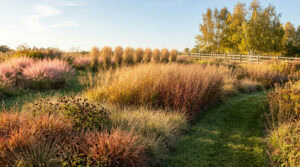
- 11. Replace Some Lawn with a Flower Meadow
- 12. Festoon Lights for Evening Ambiance
- 13. A Hammock Relaxation Corner
- 14. A Children’s Play Zone
- 15. A Pollinator-Friendly Border
- 16. A Living Wall or Vertical Garden
- 17. A Privacy Screen of Trees and Hedging
- 18. An Outdoor Kitchen and BBQ Station
- 19. A Gravel Courtyard Seating Area
- 20. A Multi-Stem Tree as a Focal Point
- 21. A Shady Retreat Under Existing Trees
- 22. Container Groupings on the Patio
- 23. A Cut Flower Bed for Bouquets
- 24. A Gravel Garden for Hot, Dry Spots
- 25. A Greenhouse for Year-Round Growing
- 26. A Hot Tub Nook
- 27. Crisp Lawn Edging and Shaped Beds
- 28. A Focal Sculpture or Water Bowl
- 29. Layered Lighting for Drama at Night
- 30. A Cozy Covered Seating Area
The 30 ideas below cover the whole yard, from the bones of the space to the finishing touches. There are hard-landscaping projects like patios, decks and fire pits; planting ideas from deep borders to wildflower meadows; and the comforts that make a garden livable — outdoor dining, shade, lighting and a quiet place to sit. Big plot or small, sunny or shaded, weekend project or long-term plan, there is something here to start with.
Read straight through to plan a whole-yard makeover, or scroll and pull out the ideas that fit your space and your weekend. Each one explains what you are looking at, why it works, and exactly how to make it happen.
01. Zone the Yard into Outdoor Rooms
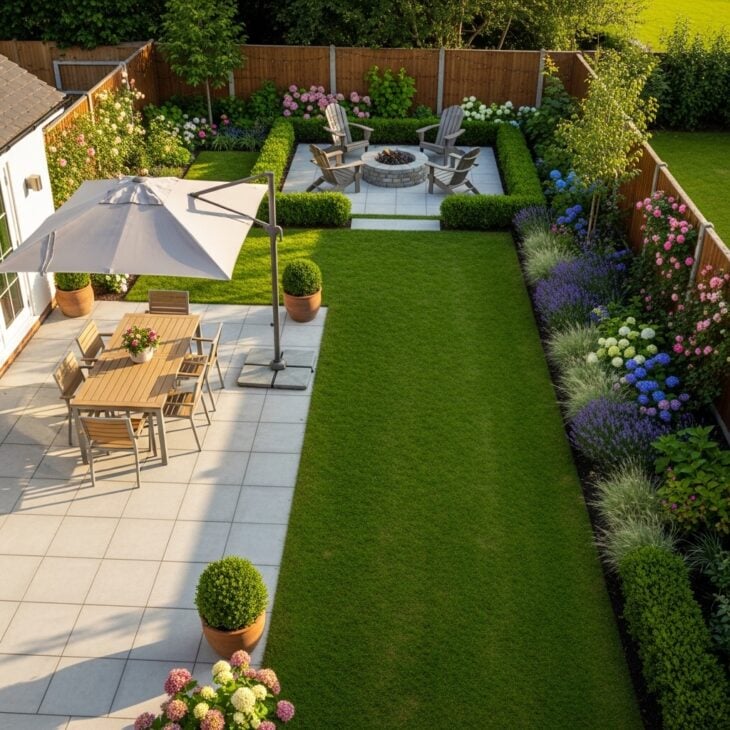
What you see The best backyards are not one big space but several smaller ones: a dining patio by the back door, a lawn for the kids, a quiet seating nook at the far end. Low hedges, a change of surface, or a simple archway mark where one “room” ends and the next begins, so the garden unfolds as you move through it.
Why it works Dividing a yard into zones makes even a modest plot feel bigger and more considered, because you cannot see everything at once — there is always somewhere else to go. It also lets each area do its own job well, rather than asking a single open space to be a dining room, playground and flower garden all at the same time. This is the single most useful design principle for a backyard.
How to get it Start by listing how you actually want to use the garden — eating, relaxing, growing, playing — and give each activity its own spot. Use a change of material to signal the shift: paving for dining, gravel for a seating area, lawn or planting between them. Divide the zones with something low and permeable, like a clipped hedge, a row of grasses or an open trellis, so the garden still feels connected. Link the rooms with a clear path so moving between them feels natural.
02. A Patio for Outdoor Dining
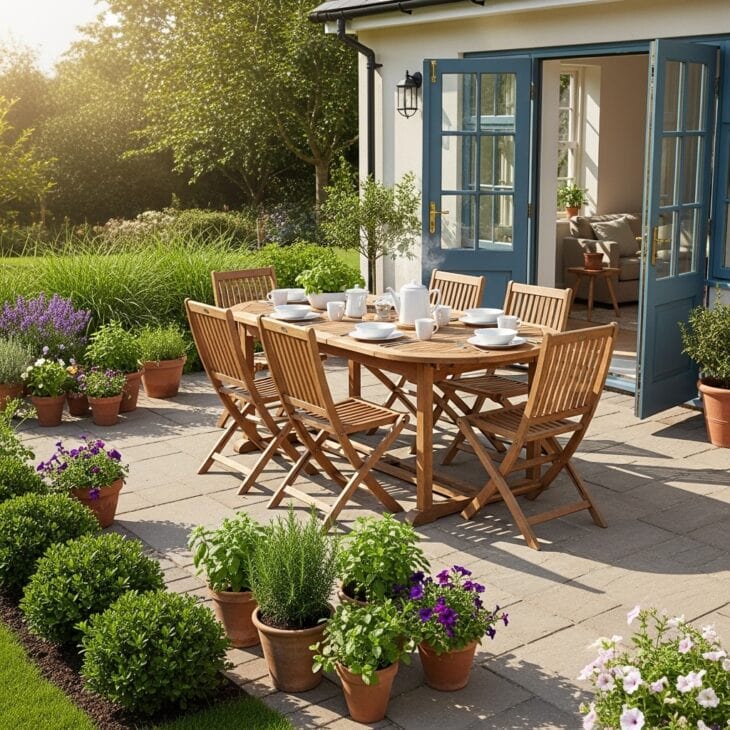
What you see A paved patio just outside the back doors, big enough for a proper table and chairs, is the heart of most backyards. Set for a meal, ringed with pots of herbs and flowers, it becomes an outdoor dining room you drift into the moment the weather turns.
Why it works Siting the dining area right by the kitchen is what makes it get used — every extra step you have to carry plates and drinks makes eating outside less likely. A hard, level surface means the table does not wobble and chairs do not sink into the lawn. Surrounding it with planting stops it feeling like a bare slab and ties it into the garden.
How to get it Size the patio properly: allow at least 10ft by 10ft (3m by 3m) for a six-seat table, so chairs can pull out without dropping off the edge. Choose a surface that suits the house — natural stone, porcelain pavers or warm clay brick all weather beautifully. Lay it on a well-prepared, free-draining base with a slight fall away from the building so rain runs off. Soften the edges with low planting, herbs, or pots so the paving feels embraced by the garden rather than marooned in it.
03. A Sunken Fire Pit Lounge
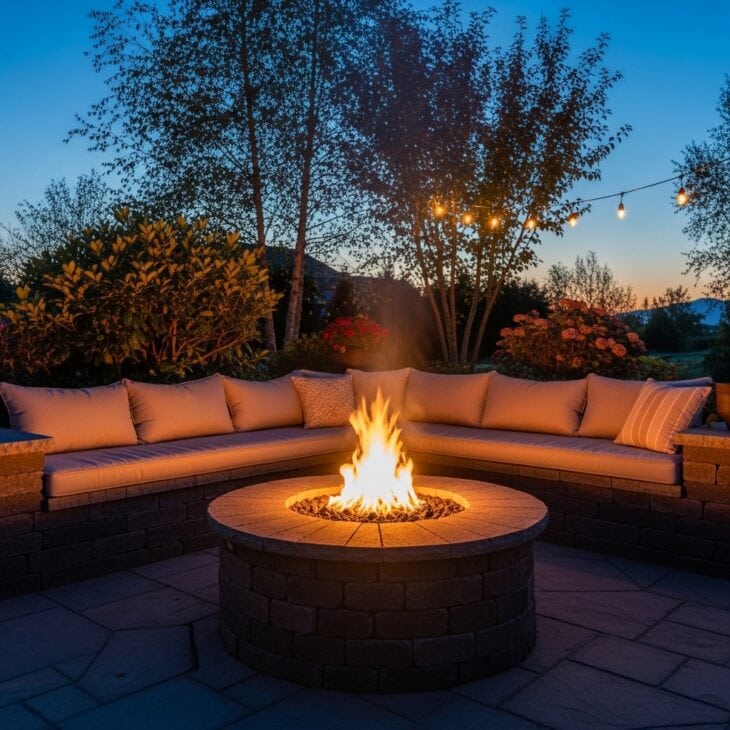
What you see A fire pit ringed with low seating turns the backyard into a place you use after dark and into the cooler months. As the flames catch and the cushions come out, a plain corner becomes the spot everyone gravitates to — drawn in by the warmth, the light and the simple pleasure of a fire.
Why it works Fire extends the gardening season at both ends, pulling people outside on spring and fall evenings that would otherwise drive them indoors. A circular layout is naturally sociable, turning everyone to face one another and the flames. Sinking the seating slightly, or building it in, gives the area a sense of shelter and permanence that stacking chairs never will.
How to get it Set the fire pit on a non-combustible surface — gravel, stone or paving — and keep it well clear of fences, overhanging branches and the house. Allow about 3 to 4ft (90 to 120cm) of clearance between the fire and the seating so it is warm but safe. A simple steel bowl is the cheapest start; a built stone or brick ring is a weekend project that lasts decades. Check local rules on open fires, keep water or sand to hand, and choose a gas fire pit instead if you want flames at the flick of a switch.
04. A Pergola Over the Seating Area
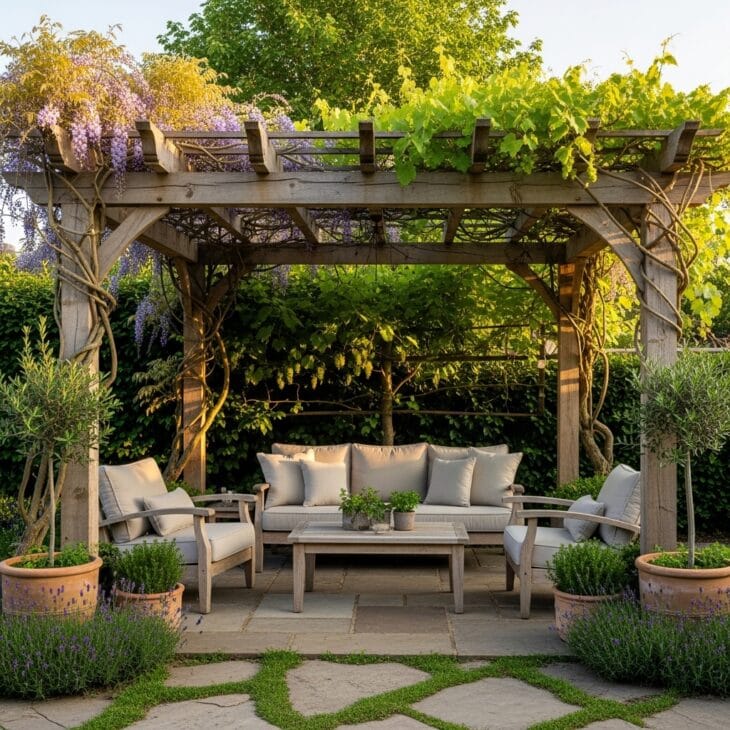
What you see A pergola raised over a seating area gives a backyard instant structure and a ceiling of dappled shade. Climbers scramble across the beams overhead — wisteria (Wisteria sinensis), grape vine or a rose — so you sit in filtered green light with scent drifting down.
Why it works A pergola defines an outdoor room without enclosing it, drawing the eye up and making the space beneath feel sheltered and intimate. The shade it casts makes a sunny patio usable through the hottest part of the day, while a deciduous climber lets winter sun back through once the leaves drop. It is also the perfect frame for lighting and hanging plants.
How to get it Build the pergola on solid posts set in concrete, and scale it generously — a structure that feels slightly too big from the ground usually looks just right once planted. Position the uprights clear of the seating so chairs are not jammed against a post. Train a vigorous climber up each leg and tie the leading stems across the top, choosing wisteria or grape for romance, or an evergreen like star jasmine (Trachelospermum jasminoides) for year-round cover. Be patient — a pergola comes into its own as the planting matures over a few seasons.
05. A Wooden Deck off the Back Door
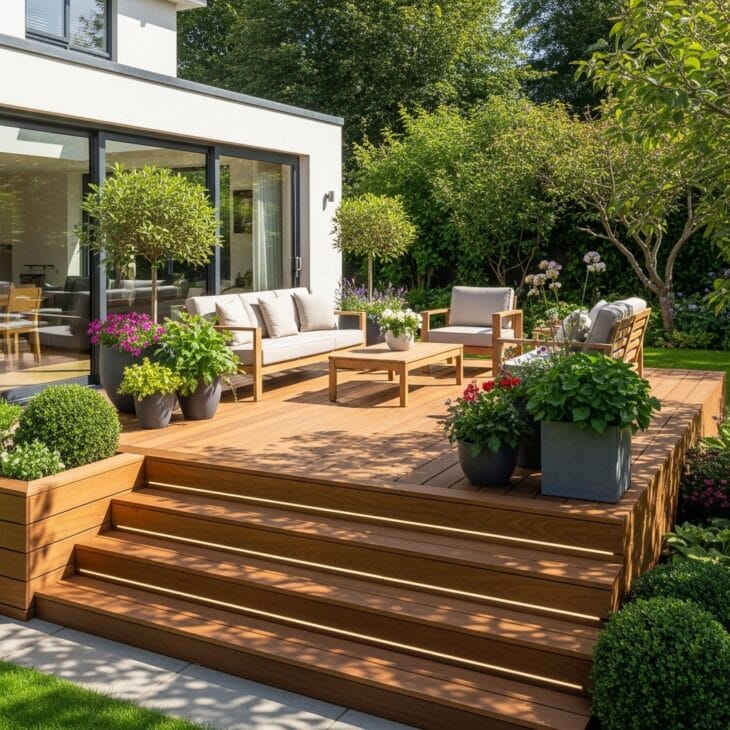
What you see A timber deck stepping down from the back door bridges house and garden in a way that feels effortless. Warm underfoot and level with the threshold, it extends the living space outward, so the garden begins the moment you step outside rather than down a flight of stairs.
Why it works Decking is the perfect answer where the ground slopes or sits below the house, letting you build out a level platform without major earthworks. Timber feels softer and warmer than stone, especially underfoot and in bare feet, which suits a relaxed family backyard. Raised slightly above the garden, a deck also gives you a small vantage point to look out over the planting.
How to get it Use a durable hardwood or a quality composite board if you want to avoid annual maintenance, and set joists on well-supported, ventilated footings to keep them dry. Run the boards in the direction that suits the space — lengthways tends to lead the eye down the garden. Leave small gaps between boards for drainage and airflow, and add a non-slip finish if the deck sits in shade where it can grow slippery. Skirt the sides with planting or trellis to hide the structure underneath.
06. A Winding Path Through the Garden
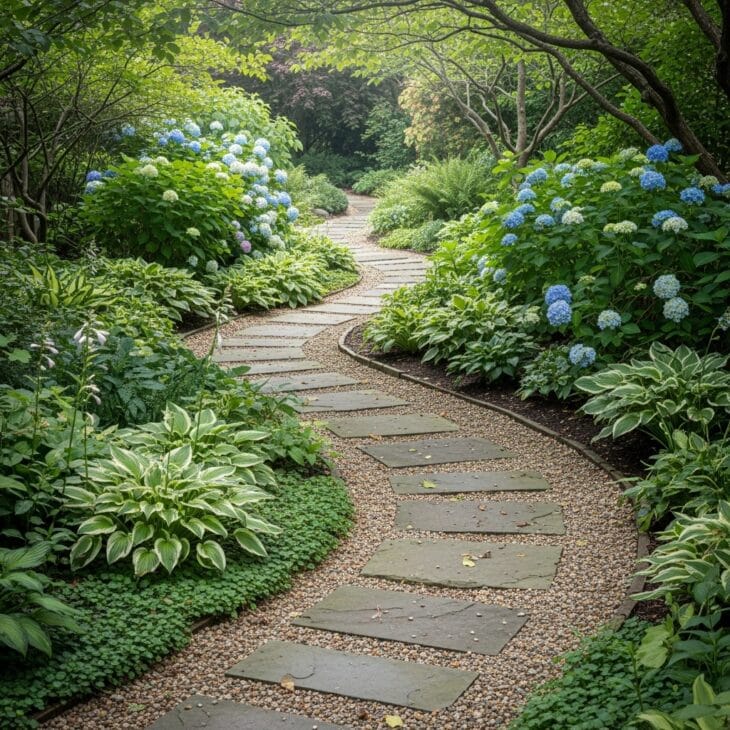
What you see A path that curves out of sight transforms how a backyard feels. Instead of taking in the whole garden in one glance, you follow the route around a bend, planting brushing your legs, with the promise of something just beyond view pulling you onward.
Why it works A gentle curve makes a garden feel larger and more mysterious than a straight line ever could, because it hides the destination and slows you down. A path also gives the whole design a backbone, organizing the beds and lawns on either side and showing you and your visitors where to walk. It turns a yard into a journey rather than a single static view.
How to get it Make the curve purposeful — route it around a tree, a bed or a feature so the bend has a reason, as aimless wiggles look contrived. Build the path at least 3ft (90cm) wide where you can, so two people can walk side by side or a wheelbarrow can pass. Choose a surface that fits the mood: gravel for an informal feel, stone or brick for something more solid. Let planting tumble over the edges to soften the line and make the path feel established.
07. Deep Mixed Borders Along the Boundaries
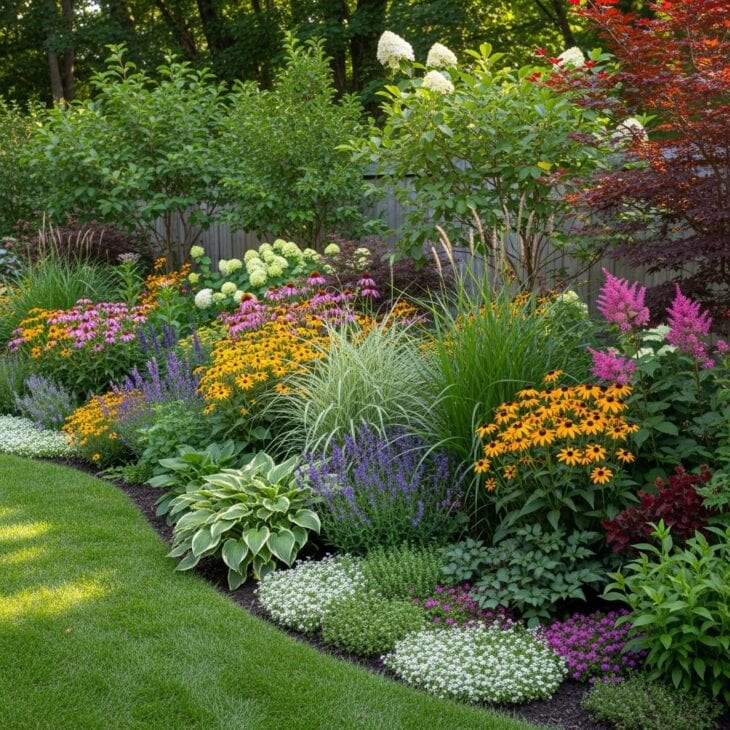
What you see Swap a thin strip of soil along the fence for a deep, generously planted border and the whole backyard changes character. Shrubs and small trees anchor the back, perennials and grasses fill the middle, and low planting spills onto the lawn, so the boundary disappears behind layers of green and flower.
Why it works Generous borders are what make a garden feel mature and immersive rather than a lawn with a fence around it. Depth is the secret — a border at least 4 to 6ft (120 to 180cm) deep has room for the layers that give planting its richness, while a narrow strip can only ever hold a single thin line of plants. The planting also hides the boundary, making you aware of the flowers and not the fence panels.
How to get it Plan in three layers: structural shrubs and a small tree at the back, a long-flowering middle tier of perennials such as salvia, coneflower (Echinacea) and ornamental grasses, and ground-covering plants at the front. Repeat a few key plants along the length to tie it together rather than planting one of everything. Improve the soil with compost before you start, and mulch each spring to keep weeds down and moisture in. Our wider garden border ideas have dozens of planting combinations to borrow.
08. A Productive Vegetable Garden with Raised Beds
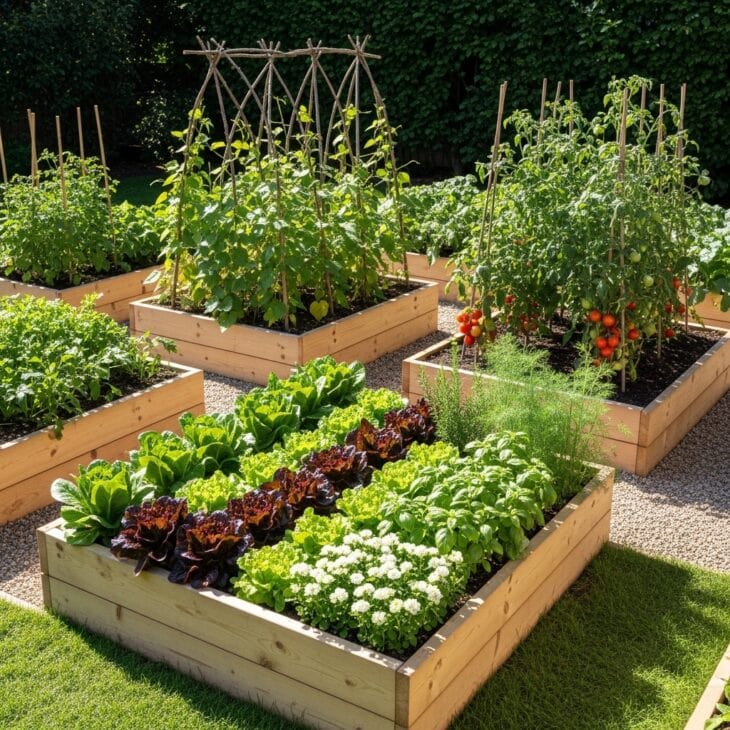
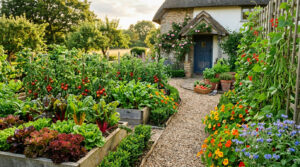
What you see A set of timber raised beds turns a sunny corner of the backyard into a working vegetable garden. Lettuces, beans climbing a wigwam, tomatoes and herbs grow in neat, reachable rows, with paths between so you can tend and harvest without ever treading on the soil.
Why it works Raised beds give you control: you fill them with exactly the rich, free-draining soil vegetables want, the soil warms earlier in spring, and the defined edges keep paths and crops separate. Not compacting the growing area means the soil stays light and roots thrive. Growing even a little of your own food is one of the most rewarding things a backyard can offer.
How to get it Site the beds in the sunniest spot you have — most vegetables need six or more hours of direct sun. Keep each bed no wider than 4ft (120cm) so you can reach the middle from either side without stepping in. Fill with a mix of good topsoil and compost, and leave paths of at least 18in (45cm) between beds for access and a wheelbarrow. Start with easy, productive crops like beans, lettuce, chard and zucchini, and see our raised bed garden ideas for more layouts and planting plans.
09. A Wildlife Pond
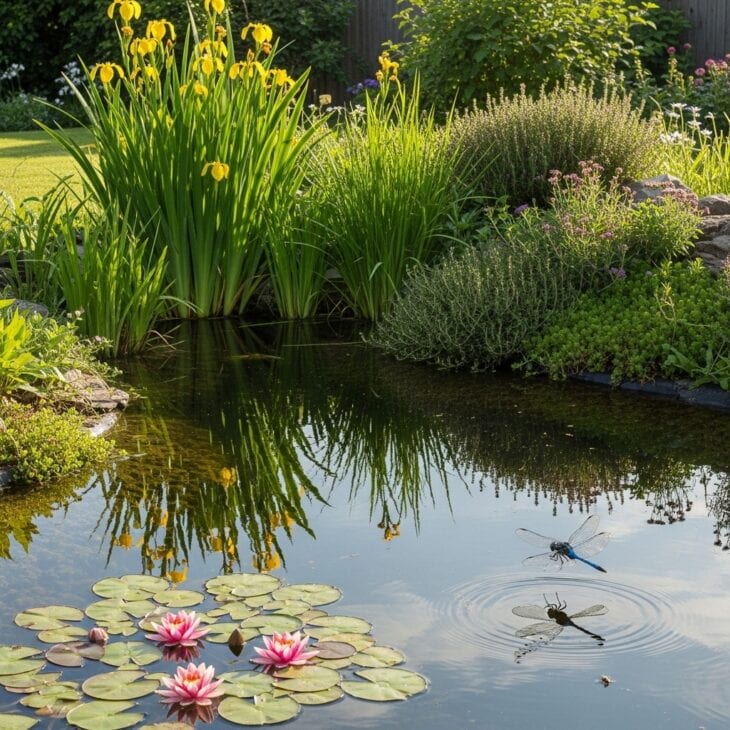
What you see A pond is the fastest way to bring a backyard to life. Edged with flag iris (Iris pseudacorus) and grasses, its surface scattered with lily pads, it draws in frogs, birds and dragonflies within weeks and adds the glint of reflected sky to the garden.
Why it works Water supports more wildlife than any other single feature you can add, and it brings movement, sound and reflection to a garden that is otherwise still. Even a small pond becomes a drinking and breeding station for a surprising range of creatures. It is endlessly absorbing to watch, which makes it a destination as much as a habitat.
How to get it Give the pond at least one gently sloping side or a beach of pebbles so animals — and any pet or child — can climb out easily. Include a shallow shelf around 9in (23cm) deep for marginal plants and a deeper zone of 24in (60cm) or more so it does not freeze solid. Fill with rainwater where you can, and skip fish if wildlife is the goal, since they eat tadpoles and insect larvae. Site it in sun, away from overhanging trees, and be patient through the green-water phase of its first spring as it finds its balance.
10. A Backyard Studio or Garden Room
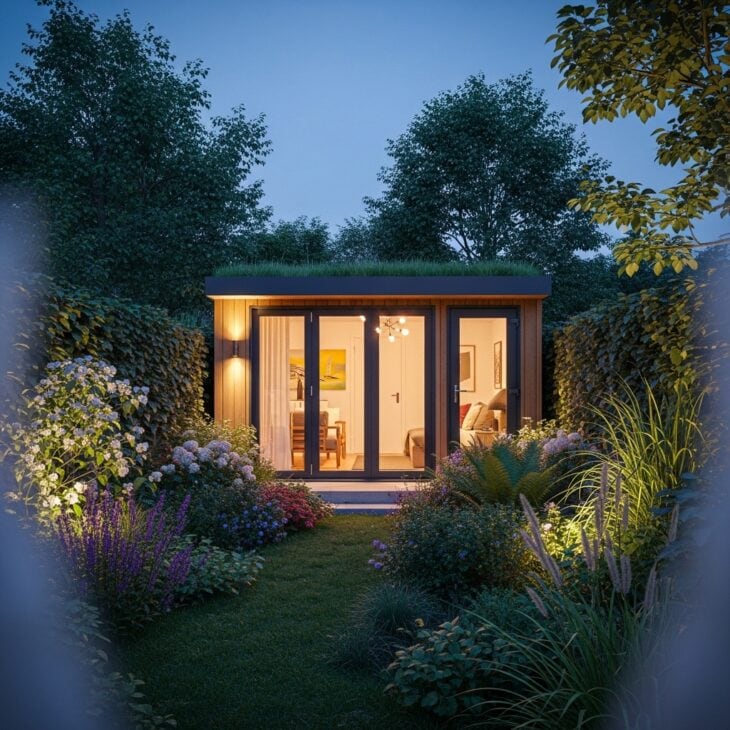
What you see A garden room at the foot of the backyard gives you a whole extra space — an office, a studio, a gym or simply a retreat — a few steps from the house but a world away from it. Glass doors open onto the garden, and at dusk its soft glow becomes a focal point at the end of the plot.
Why it works A standalone garden building gives you separation that a spare room never can, with the garden as the view from your desk or the threshold of your morning coffee. It also creates a destination at the end of the garden, a reason to walk down and a structure to design the planting around. For many people it has become the most-used room they own.
How to get it Position the studio to make the most of light and outlook, and check whether your local planning rules require permission for its size and use. Insulate it properly and add power if you want it usable year-round, not just in summer. Anchor it into the garden with planting around the base and a clear path leading to the door, so it feels part of the design rather than parked on the lawn. A green roof or timber cladding helps a modern box settle into a leafy setting.
11. Replace Some Lawn with a Flower Meadow
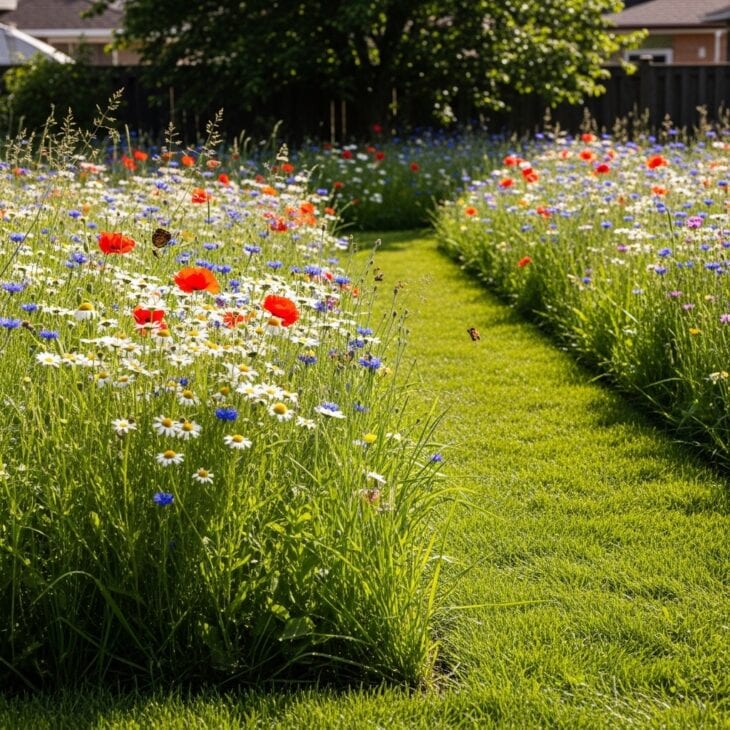
What you see Let part of the lawn grow long and seed it with wildflowers, and a flat green carpet becomes a living meadow of ox-eye daisies, poppies and cornflowers humming with bees. A mown path through it and a crisp mown edge around it keep the long grass reading as a deliberate choice rather than neglect.
Why it works A meadow patch is less work than mowing, far better for wildlife, and brings a softness and movement no lawn can match. Cutting the grass only once or twice a year saves hours and fuel while supporting pollinators, ground-nesting insects and the birds that feed on them. The mown frame is the trick that signals intent and keeps it looking cared for.
How to get it Meadows thrive on poor soil, so do not feed or improve the area — the leaner the ground, the better the flowers compete with grass. Sow a meadow mix suited to your conditions in spring or fall, and include yellow rattle (Rhinanthus minor), which weakens vigorous grass. Mow paths and edges regularly for a sharp outline, but leave the meadow itself until late summer, then cut it down and rake off the clippings. Repeat this cut-and-rake each year and the display improves as fertility slowly drops.
12. Festoon Lights for Evening Ambiance
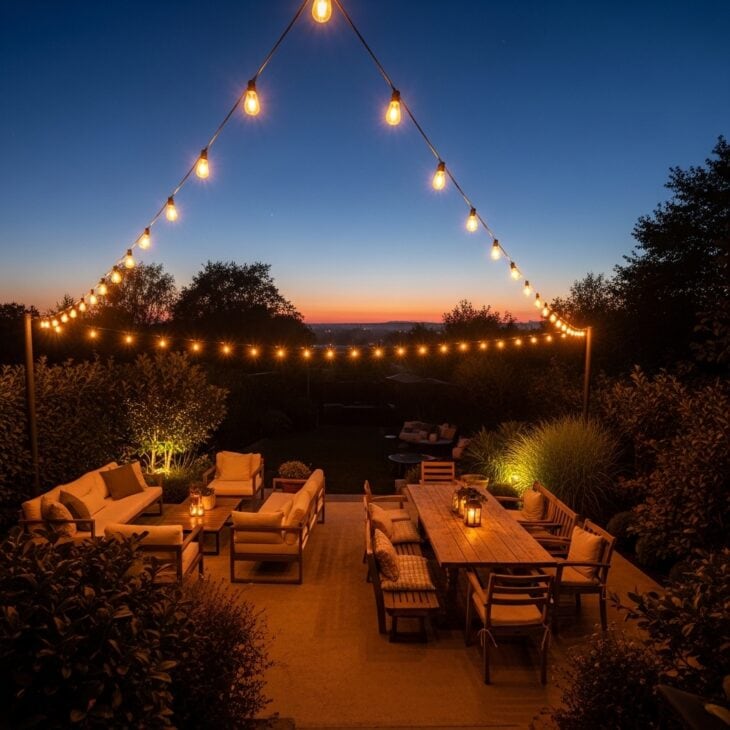
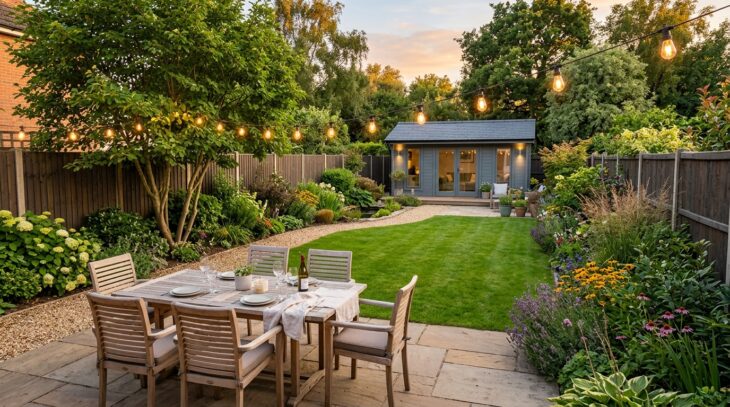
What you see A few strings of festoon lights crisscrossed overhead turn a backyard into somewhere magical the moment the sun goes down. The warm golden bulbs hang against the darkening sky, throwing a soft glow over the table and chairs and making the space feel like an outdoor room with a ceiling of stars.
Why it works Lighting is the cheapest, fastest way to change how a garden feels after dark, and overhead festoons are the friendliest, most flattering kind. Warm-white bulbs create atmosphere without the glare of a security floodlight, and stringing them overhead defines the seating area and keeps the light where you want it. It is the detail that makes people linger long after dinner.
How to get it Choose proper outdoor-rated festoon lights, and warm white (around 2700K) rather than cold blue-white for a cozy feel. String them between the house and a sturdy post, or zigzag them across a pergola, keeping the runs taut with a length of catenary wire so they do not sag. Use solar or low-voltage LED festoons to keep running costs and wiring to a minimum. Add a few lanterns or candles at table level to complete the layered, glowing effect.
13. A Hammock Relaxation Corner
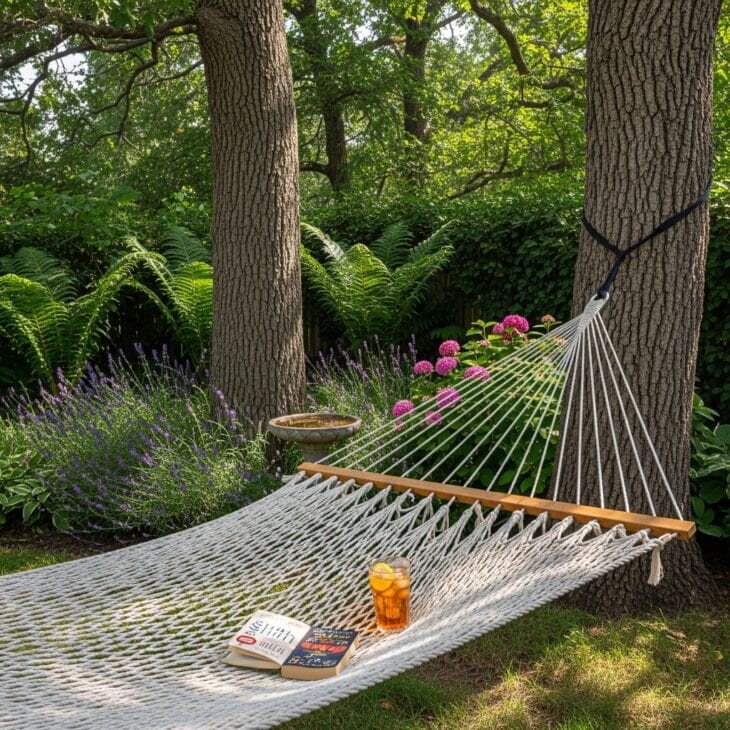
What you see A hammock slung in a shady corner is an invitation to do absolutely nothing. Strung between two trees with dappled light falling across it and planting closing in around, it becomes the spot you disappear to with a book on a warm afternoon.
Why it works Every backyard needs somewhere purely for rest, and a hammock is the most relaxing seat there is — gently swaying, half-shaded, tucked out of the way. Placing it in a quieter corner, away from the busier dining and play zones, gives the garden a contrast of moods. Surrounding it with planting makes it feel private and cocooned rather than exposed.
How to get it If you have two sturdy, well-spaced trees, hang the hammock from wide straps that will not bite into the bark, at a height that lets you sit and swing your legs in. No trees? A freestanding hammock frame works anywhere, including on a deck or patio. Choose a weatherproof fabric or be ready to bring it in, and site it for afternoon shade and a pleasant view. Soften the surroundings with fragrant or rustling plants — grasses, lavender or jasmine — to engage the senses while you laze.
14. A Children’s Play Zone
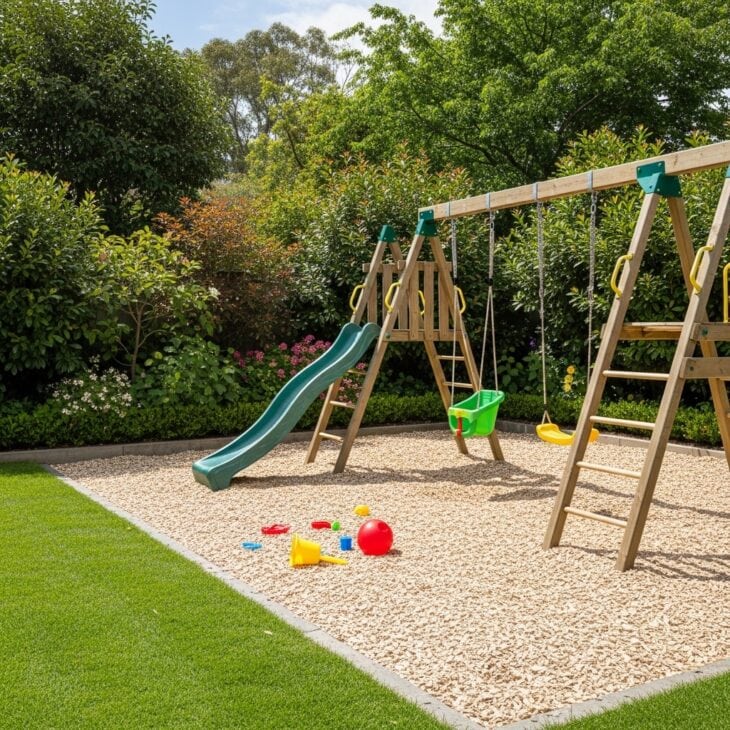
What you see A dedicated play zone keeps the rest of the backyard intact while giving children a place of their own. A wooden climbing frame and swing sit on a soft bark surface, partly screened by planting, so the play area is part of the garden rather than a primary-colored takeover of it.
Why it works Giving play its own corner means the kids get somewhere to let loose while the borders, dining area and your nerves all survive. Tucking it slightly out of sight, or behind planting, keeps equipment from dominating the view from the house. Built into the garden thoughtfully, a play area can look good and grow with the family.
How to get it Choose a level spot you can see from the house, and lay a soft, impact-absorbing surface like bark chips, rubber or play sand beneath climbing equipment. Screen it with robust, non-toxic planting rather than a solid fence, so you keep sightlines while softening the look — avoid spiny or poisonous plants where small children play. Leave a patch of tough lawn alongside for games and a paddling pool. Choose timber play equipment in natural tones, which ages far more gracefully in a garden than bright plastic.
15. A Pollinator-Friendly Border
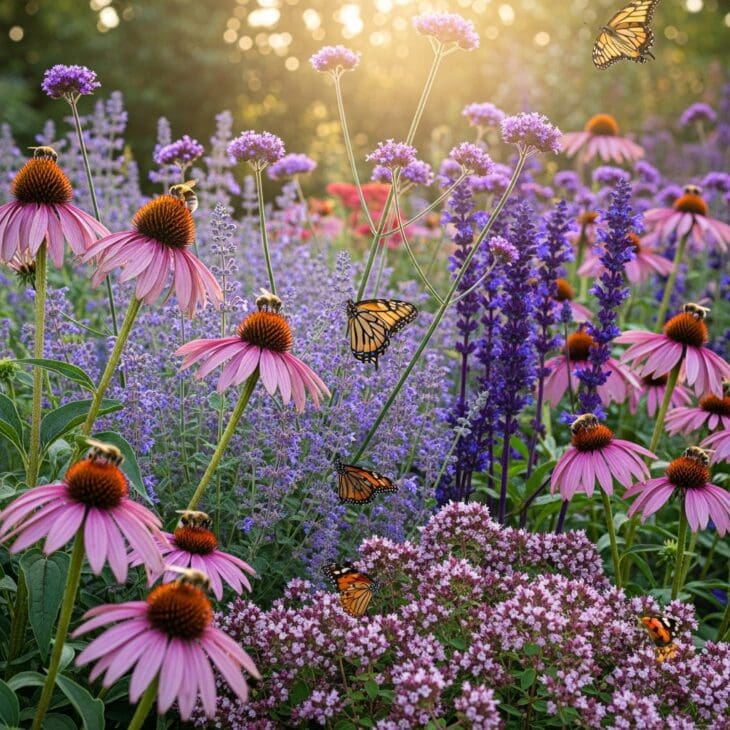
What you see A border planted for pollinators turns the backyard into a place that buzzes. Bees, butterflies and hoverflies work the open faces of coneflowers (Echinacea), catmint (Nepeta), salvia and oregano from morning to dusk, so the planting is never quite still and always full of life.
Why it works Designing for pollinators is good for the wider environment and makes the garden far more alive and absorbing to be in. Single, open flowers let insects reach the nectar that double blooms hide, and a long succession of flowering keeps food available from spring to fall. A buzzing border is a sign of a healthy garden that increasingly looks after itself.
How to get it Choose single-flowered varieties and aim for something in bloom every month from early spring to late fall. Plant in generous drifts so insects can forage efficiently, and weave in herbs like oregano, thyme and chives (Allium schoenoprasum), which bees adore once they flower. Leave seedheads standing over winter for food and shelter, and avoid pesticides entirely so the garden can build its own balance. Even a single well-chosen border makes a real difference to local insect life.
16. A Living Wall or Vertical Garden

What you see A living wall turns a bare fence or blank house wall into a tapestry of foliage. Ferns, heucheras, herbs and trailing plants grow from vertical pockets or panels, packing a remarkable amount of greenery into a space that takes up no ground at all.
Why it works Vertical surfaces are the most wasted space in most backyards, and a living wall is the boldest way to use them. It is ideal where there is no soil to plant into — a courtyard, a balcony, a paved side return — and it brings plant life right up to eye level. The mass of foliage also softens noise, cools the air, and hides an ugly wall completely.
How to get it Use a proper modular living-wall system with a built-in irrigation line, because hand-watering a vertical garden is hard to keep up with and the top dries fastest. Fix it to a wall that can take the weight when wet, and add a waterproof membrane to protect the structure behind. Choose plants suited to the aspect — shade-tolerant ferns and heucheras for a north wall, herbs and sedums for sun. Start with reliable, low-maintenance evergreens for year-round cover and add seasonal color among them.
17. A Privacy Screen of Trees and Hedging
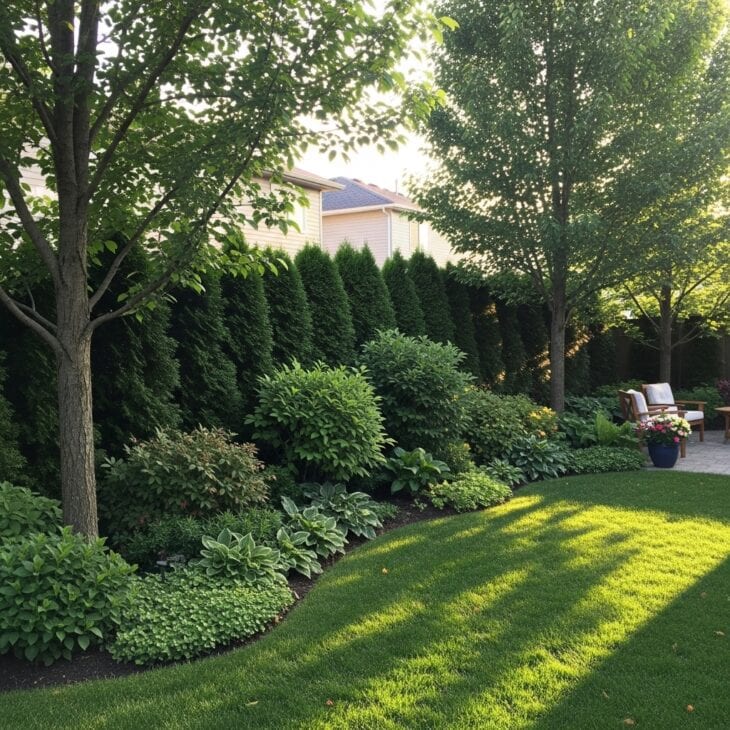
What you see A green screen of hedging and well-placed trees wraps a backyard in privacy and turns it into a retreat. Evergreen hedging forms a solid base while a few small trees rise above it, hiding neighboring windows and replacing the view of fences and rooftops with leaves and sky.
Why it works Privacy is what makes a garden somewhere you truly relax, and planting does the job far more beautifully than a tall fence. Greenery softens sound, filters wind, and screens overlooking windows without feeling like a barricade. A layered planting of hedge plus trees also gives the garden depth and a sense of enclosure that a flat fence never will.
How to get it For an evergreen base, plant yew (Taxus baccata) for a dense, formal screen or a mixed native hedge for wildlife, spacing plants according to the variety. To block a specific upstairs window, a single well-placed multi-stem tree such as amelanchier or birch (Betula) is often more effective and elegant than raising the whole boundary. Choose trees with a light, airy canopy so you screen the view without casting the whole garden into shade. Be considerate of neighbors and of how big everything will eventually grow before you plant.
18. An Outdoor Kitchen and BBQ Station
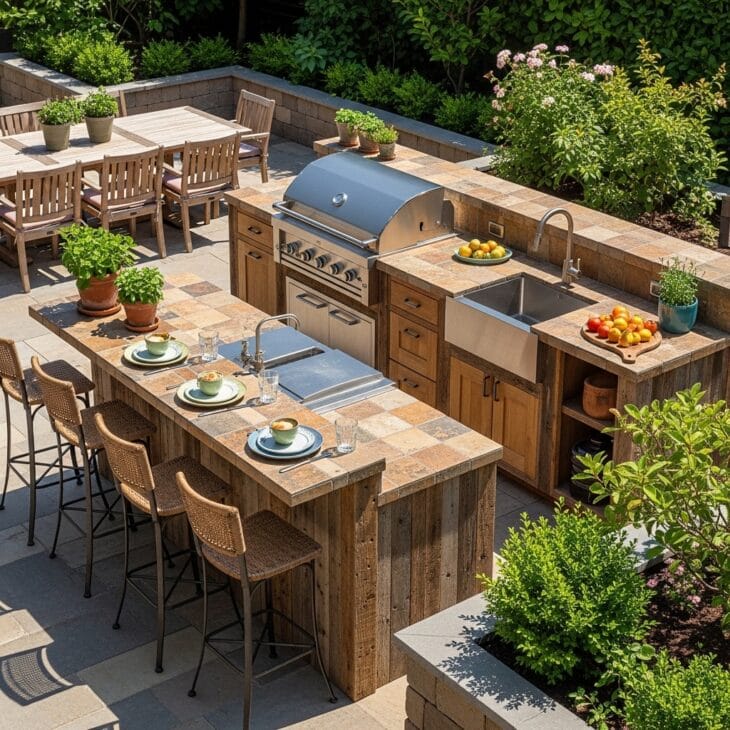
What you see An outdoor kitchen takes backyard cooking beyond a wobbly portable grill. A built-in barbecue set into a run of counter, with storage below and prep space alongside, means the cook stays out in the garden with everyone else instead of shuttling back and forth to the kitchen.
Why it works Keeping food preparation outside is what makes alfresco entertaining effortless and genuinely sociable. A proper counter gives you somewhere to work, rest plates and mix drinks, so the cook is part of the gathering rather than stuck indoors. Sited next to the dining area, it turns the whole corner into the hub of summer.
How to get it Position the kitchen close to the dining table but with the grill smoke blowing away from where people sit. Build the counter from weatherproof materials — stone, rendered block or treated timber with a stainless steel grill insert. Include shade and a little task lighting so it works in the evening, and run a water and power supply to it if your budget stretches that far. Start simple with a sturdy built-in grill and a single counter, and expand later if you find you use it.
19. A Gravel Courtyard Seating Area
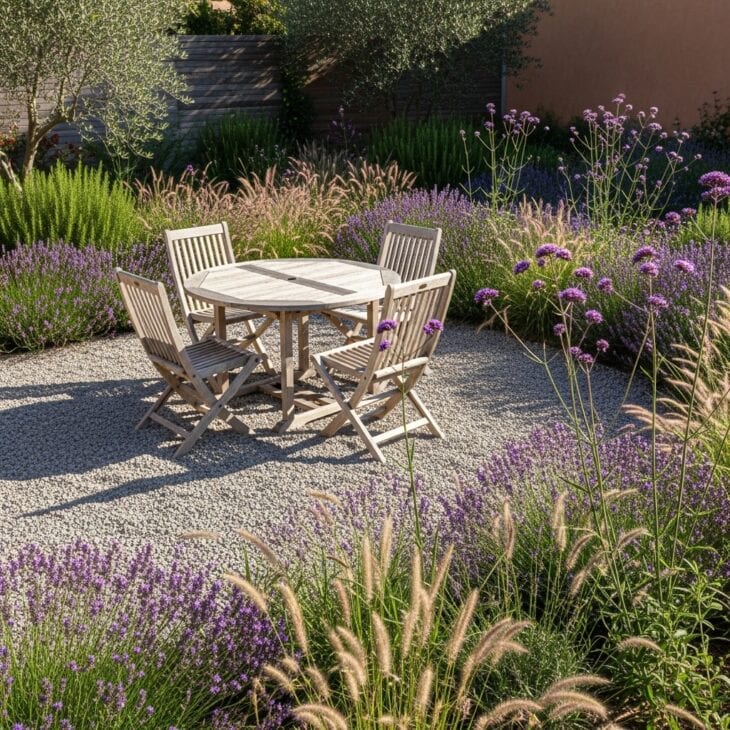
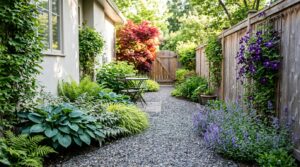
What you see A simple gravel seating area has a relaxed, sun-warmed charm that paving can lack. A table and chairs sit on pale gravel with lavender, grasses and verbena self-seeding around the edges, giving the spot an informal, almost Mediterranean feel that softens with every season.
Why it works Gravel is the most forgiving and affordable hard surface there is — quick to lay, easy to shape around obstacles, and free-draining so puddles never form. It also blurs the line between paving and planting, letting plants seed into it for a soft, settled look. For a low-budget, low-maintenance seating area it is hard to beat.
How to get it Lay gravel 2 to 3in (5 to 8cm) deep over a firm, weed-suppressed base; a self-binding gravel gives a firmer surface for chair legs than loose pea shingle. Edge the area to stop the gravel migrating into beds and lawn. Leave a few planting pockets so drought-tolerant plants like lavender, Verbena bonariensis and ornamental grasses can colonize the edges. Top up the gravel every few years and simply hoe or pull any weeds that appear before they establish.
20. A Multi-Stem Tree as a Focal Point
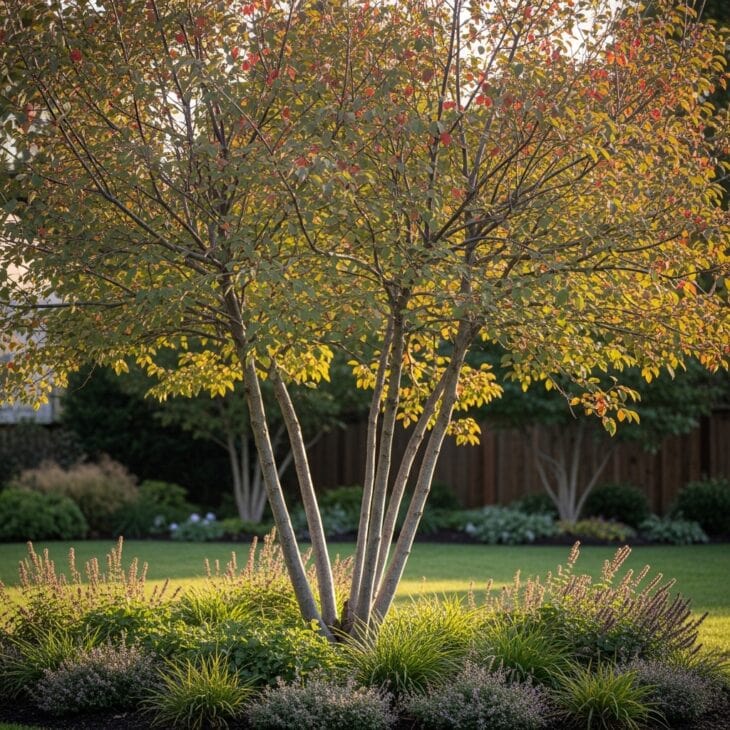
What you see One well-chosen tree can anchor an entire backyard. A multi-stem birch (Betula utilis var. jacquemontii) or amelanchier, with several slender trunks rising from the base and a light canopy above, becomes a living sculpture that draws the eye and gives the garden a center of gravity.
Why it works A specimen tree provides the height, structure and seasonal change that planting alone cannot, and a multi-stem form packs more character into a small space than a single trunk. It offers blossom, leaf, fall color or beautiful bark depending on the species, and its dappled shade creates a spot to plant beneath or sit under. As the one big, permanent element, it sets the scale for everything around it.
How to get it Choose a tree sized to your garden so you are not fighting it for decades — birch, amelanchier, crab apple (Malus) and Japanese maple (Acer palmatum) all stay manageable. Check its eventual height and spread, and keep it a sensible distance from the house and boundaries. Position it where it will be seen — framing a view, terminating a path, or standing alone in the lawn. Underplant with low, shade-tolerant planting and bulbs to make the most of the ground beneath the canopy.
21. A Shady Retreat Under Existing Trees
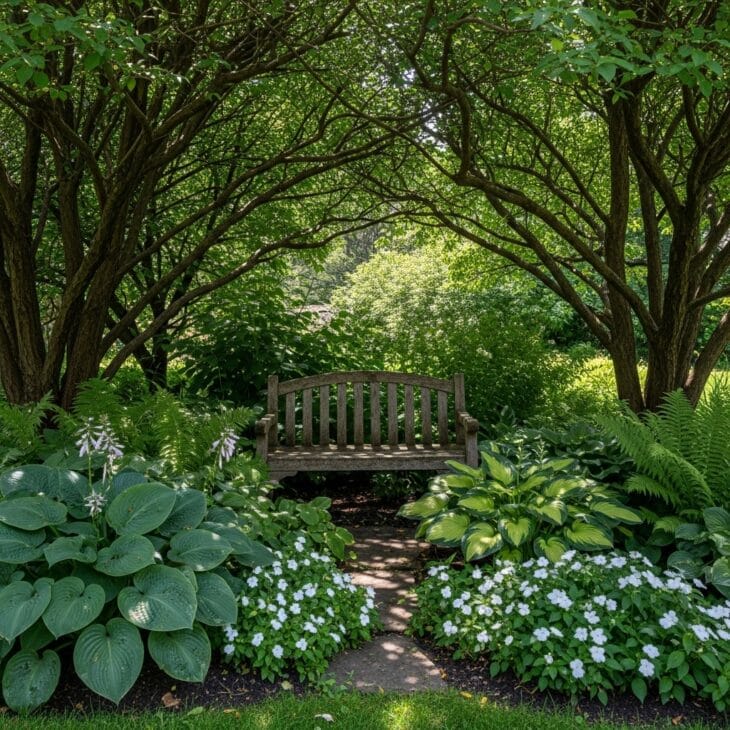
What you see The shade beneath established trees, so often written off as a problem, can become the coolest and most restful part of the backyard. A bench set among hostas, ferns and white-flowered shade plants, with light filtering through the leaves above, makes a green retreat to escape the midday heat.
Why it works On a hot day, shade is a luxury, and an existing tree gives you a ready-made canopy to sit under. Embracing the conditions with lush, leafy, woodland-style planting is far more rewarding than fighting to grow sun-lovers that will only sulk. Pale flowers and bold foliage seem to glow in low light, drawing you into the cool green calm.
How to get it Improve dry, root-filled soil under trees with plenty of compost and leaf mould before planting, as dryness is the real challenge of tree shade. Choose proven shade-lovers — hostas, ferns, astrantia, hardy geraniums and lily of the valley (Convallaria majalis) — and lean on foliage shape and texture as much as flower. Mulch every spring to lock in moisture, and water new plants well until they establish. For a fuller planting palette, see our shade garden ideas.
22. Container Groupings on the Patio
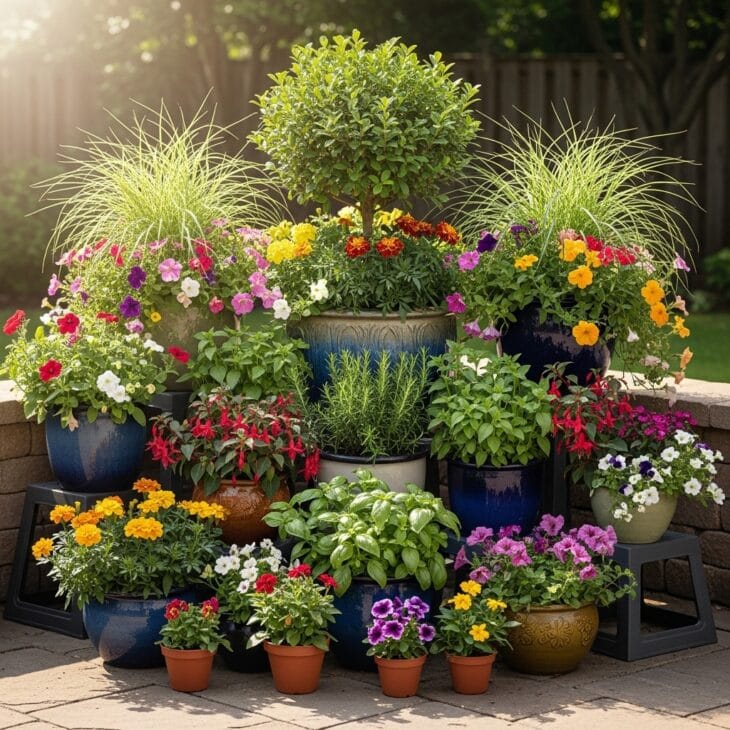
What you see A group of pots clustered in a corner of the patio is a garden you can build anywhere. Mixing sizes and heights — a small shrub, billowing grasses, trailing flowers and herbs — creates a layered, abundant display on hard surfaces where there is no soil to plant into.
Why it works Containers bring planting right up to the seating area and let you garden on paving, decking or a balcony. Grouped together, pots make far more impact than the same containers dotted about singly, and you can shuffle them around to refresh the look or move tender plants under cover for winter. They are the most flexible planting there is.
How to get it Cluster pots in odd numbers and vary the heights, standing smaller ones on bricks or stands so each plant is seen. Use the largest containers you can — big pots hold more moisture and need watering far less often than small ones, which dry out within hours in summer. Fill with a good peat-free compost, feed regularly through the growing season, and make sure every pot has drainage holes. Repeat a plant or a pot color through the group to tie it together rather than making it look like a random collection.
23. A Cut Flower Bed for Bouquets
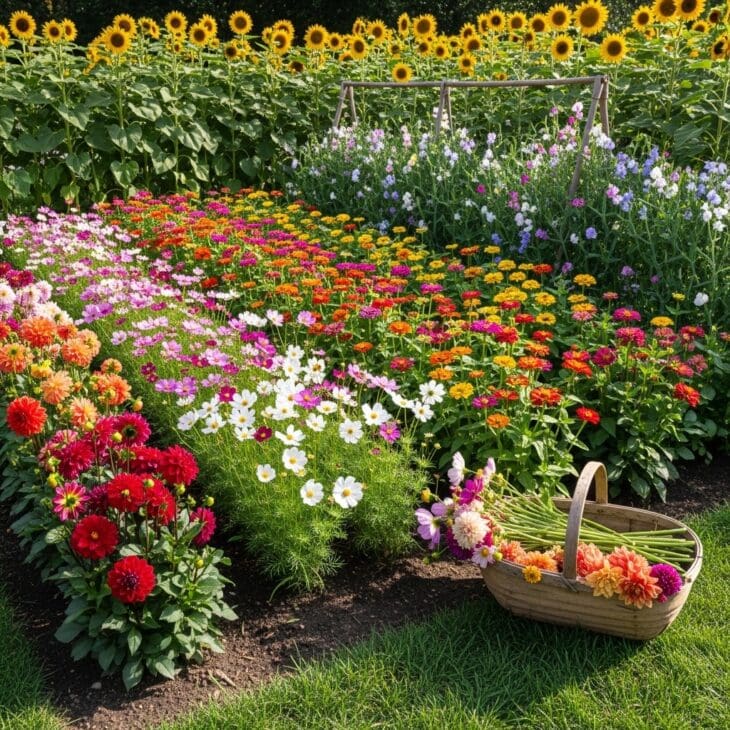
What you see A dedicated cut flower bed lets you fill the house with bouquets all summer without robbing the borders. Rows of dahlias, cosmos, zinnias, sweet peas (Lathyrus odoratus) and sunflowers (Helianthus annuus) grow purely to be picked, so you can cut armfuls guilt-free.
Why it works Growing flowers specifically for cutting means you never have to choose between a full vase and a full border. Planted in rows like a small crop, they are easy to tend, pick and replace, and many of them flower more the more you cut. It is one of the most generous and joyful things a backyard can give you.
How to get it Site the bed in full sun and good soil, and grow proven cut-and-come-again flowers: cosmos, zinnias, dahlias, sweet peas and cornflowers all keep producing if you keep picking. Sow or plant in straightforward rows for easy access, and support taller plants with netting or canes before they need it. Pick in the cool of the morning, plunge the stems straight into water, and remove spent blooms religiously so plants keep flowering. A row or two is enough to keep a kitchen table in flowers for months.
24. A Gravel Garden for Hot, Dry Spots
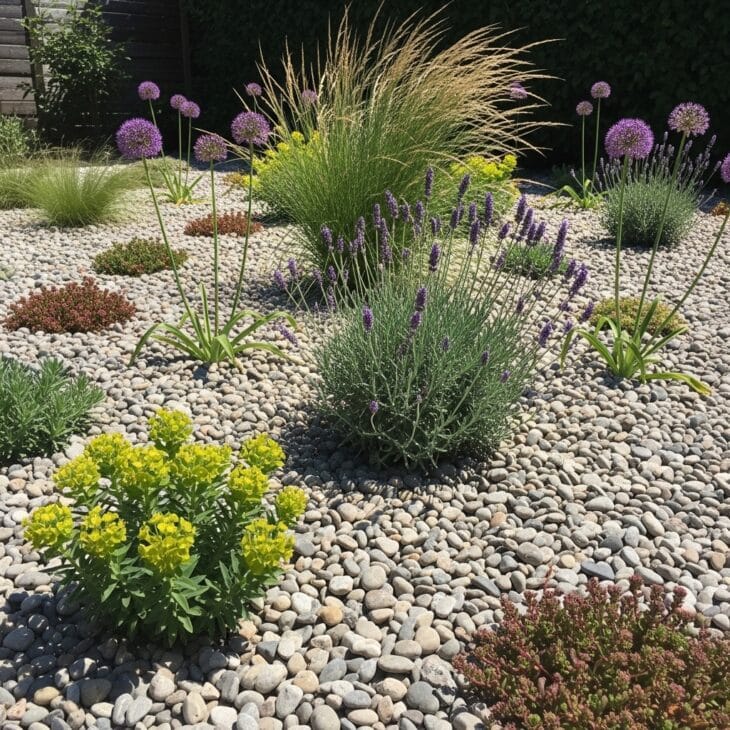
What you see A hot, dry corner where the lawn always scorches is the perfect place for a gravel garden. Drought-tolerant plants grow straight from the stone — silver lavender, architectural euphorbia, ornamental grasses and flat-headed sedum — thriving on the heat and the sharp drainage with barely any watering.
Why it works Rather than fighting a difficult spot, a gravel garden works with it, turning a problem area into a low-maintenance, water-wise feature. The gravel acts as a mulch that keeps roots cool and moisture in, while the plants that love these conditions are tough, sculptural and largely self-sufficient. With water becoming more precious, it is an increasingly sensible way to plant.
How to get it Improve heavy soil with plenty of grit first, since these plants hate sitting wet in winter, then lay a deep gravel mulch over the top. Choose sun-lovers that relish poor, dry ground: lavender, Euphorbia, Sedum, Verbascum, alliums and grasses like Stipa. Plant through the gravel into the soil below and water only until established, after which they should fend for themselves. Leave space between plants to show off their shapes, and let a few self-seed into the gravel for a natural look.
25. A Greenhouse for Year-Round Growing
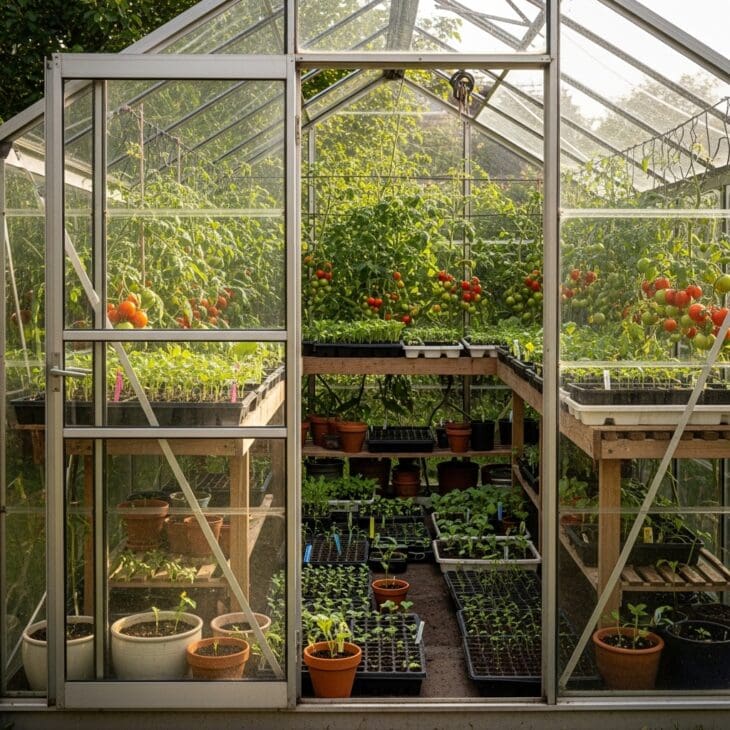
What you see A greenhouse extends the growing year at both ends and opens up a whole new range of crops. Inside, tomatoes ripen in the warmth, seedlings get an early start on staging, and tender plants shelter from frost, while the glass glints as a pretty feature in its own right.
Why it works Under cover, you can sow weeks earlier in spring, grow heat-loving crops like tomatoes, peppers and cucumbers that struggle outdoors, and keep tender plants alive through winter. It gives a keen gardener somewhere to potter in every season, rain or shine. For anyone serious about growing, it quickly becomes the engine room of the whole backyard.
How to get it Site the greenhouse in an open, sunny position away from overhanging trees and frost pockets, ideally running roughly north to south for even light. Make sure it has good ventilation — roof vents and a door, plus louvre vents — because overheating in summer is as much a risk as cold in winter. Add staging for pots and trays, and guttering with a water butt to collect rainwater. Even a small greenhouse or a lean-to against a sunny wall makes a big difference to what you can grow.
26. A Hot Tub Nook
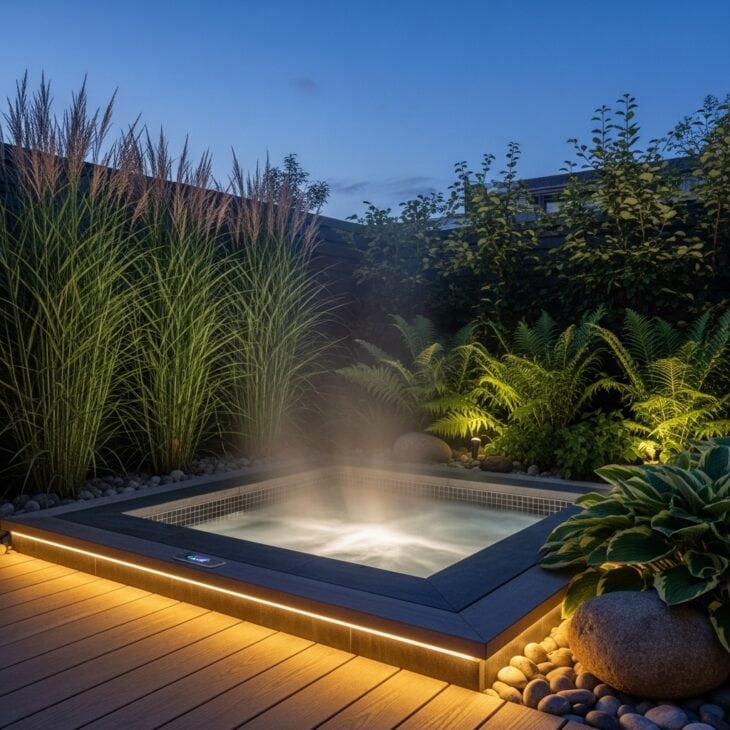
What you see A hot tub set into a screened corner brings a touch of the spa to the backyard. Tucked onto a deck behind tall grasses and planting, with steam rising and soft lighting glowing at dusk, it becomes a private, year-round retreat just outside the back door.
Why it works A hot tub is one of the few features that pulls you outside in the depths of winter, making the garden a place you use in every season. Screening it with planting turns an exposed unit into a secluded, restful nook rather than a plastic box on show. Surrounded by the right plants and lighting, it feels like a genuine escape.
How to get it Stand the hot tub on a base engineered to take its considerable filled weight — a reinforced deck or a concrete pad — and run a suitable electricity supply installed by a qualified electrician. Site it for privacy and a pleasant outlook, and screen it with evergreen planting or trellis, keeping foliage that drops leaves or needles at a sensible distance from the water. Add a path so you are not crossing wet grass to reach it, and soft, warm lighting for atmosphere. Allow easy access to the cover and the controls for the inevitable maintenance.
27. Crisp Lawn Edging and Shaped Beds
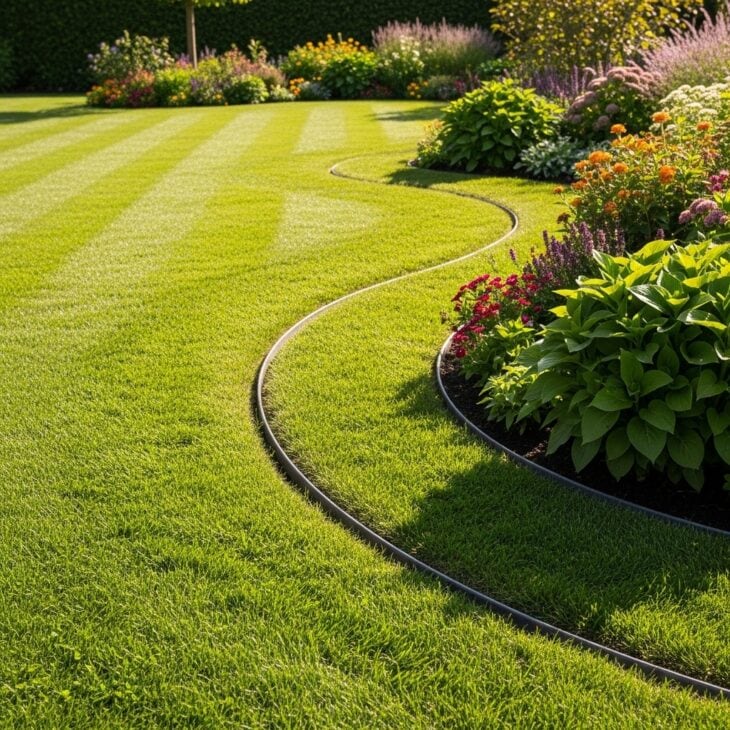
What you see Sometimes the biggest improvement to a backyard is simply a crisp edge. A clean, cut line between lawn and border, and beds with smooth, flowing shapes, makes the whole garden look cared for — the planting can be as relaxed as you like as long as the edges are sharp.
Why it works A defined edge is the cheapest, fastest way to make a garden look intentional and well-kept, framing loose planting so it reads as deliberate rather than overgrown. The shape of the lawn itself becomes a design element — a generous curve or a clean rectangle of green sets the tone for everything around it. It is the detail that makes an ordinary backyard look designed.
How to get it Cut a clean edge with a half-moon edging iron along a line marked with a hosepipe for curves or a plank for straight runs. To keep it sharp with less effort, install a permanent edge — flush steel edging, a brick mowing strip, or timber — set just below mower-blade height so you can mow right over it. Recut or trim the edges every few weeks in the growing season. Keep bed shapes simple and bold, as fussy wiggles are hard to mow around and rarely look better.
28. A Focal Sculpture or Water Bowl
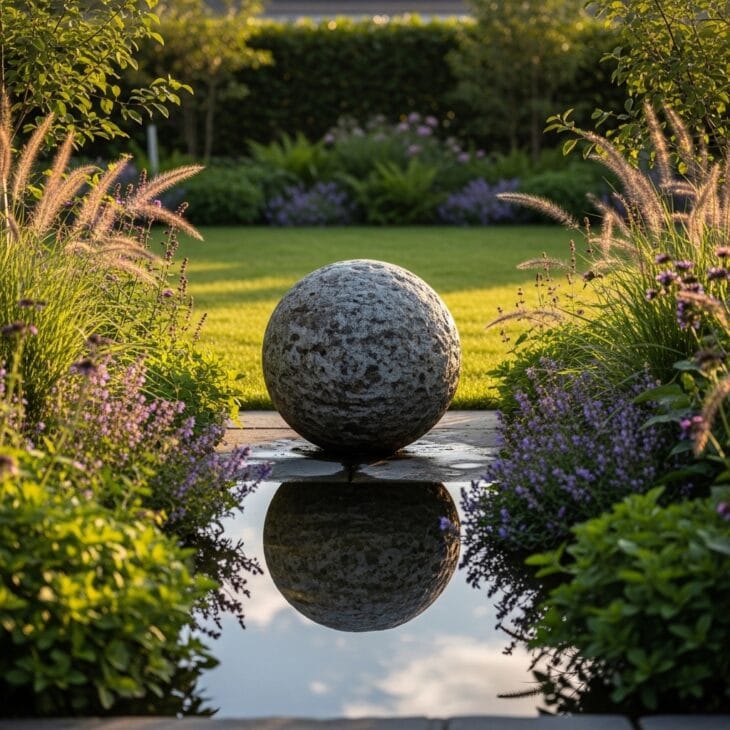
What you see A single well-placed object — a weathered stone sphere, a simple sculpture, or a still water bowl reflecting the sky — gives a backyard a focal point for the eye to settle on. Set within planting at the end of a path or sightline, it draws you down the garden and gives the design a clear sense of purpose.
Why it works A focal point organizes a space, giving the eye somewhere to rest and the garden a deliberate composition rather than a scattering of plants. Placed at the end of a view, it creates depth and leads you through the garden. A reflective water bowl adds the extra magic of catching the light and the sky, bringing a small, calm pool of stillness to the planting.
How to get it Choose one focal object and resist the temptation to add several, which only compete and cancel each other out. Position it where the eye naturally travels — closing a sightline, terminating a path, or centered in a key view from the house. Set it on a firm, level base so it sits properly, and frame it with planting that sets it off rather than swamping it. A simple shape in a natural material — stone, weathered steel, terracotta — usually settles into a garden far better than anything fussy.
29. Layered Lighting for Drama at Night
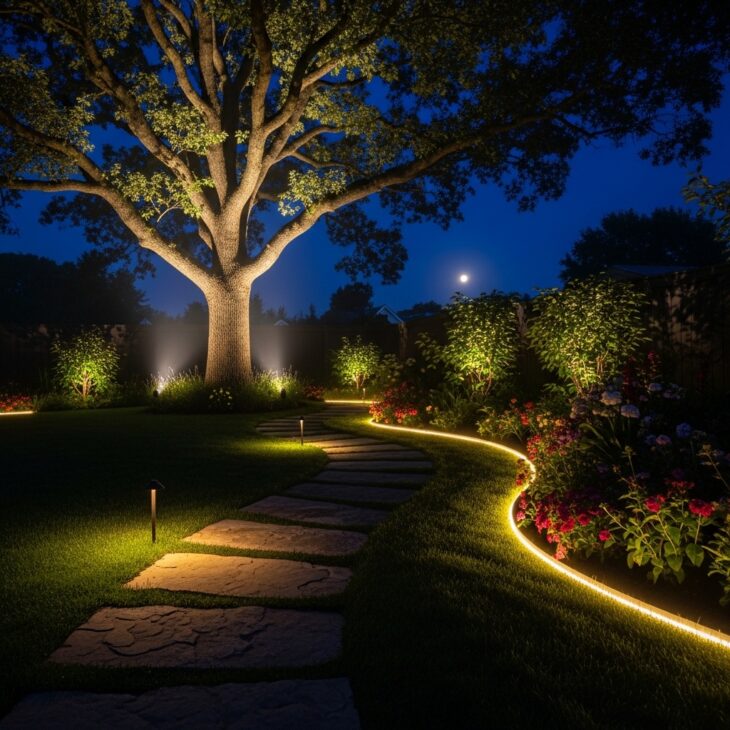
What you see Beyond ambient festoons, a layer or two of well-aimed garden lighting gives the backyard a second life after dark. A tree uplit from below, soft lights along a path, a glowing border — together they build depth and drama, so the garden looks just as good from the kitchen window at night as it does by day.
Why it works Lighting different elements at different levels creates the depth and theater that a single floodlight flattens. Uplighting a tree or wall throws beautiful shadows, path lights make the garden safe and navigable, and a touch of light in a border draws the eye out into the dark. Done with restraint, it doubles the hours you can enjoy the view.
How to get it Light only a few key features rather than flooding everything — the dark spaces between are what give the scene drama. Use warm-white, low-voltage LED fixtures, and conceal the sources so you see the effect, not the fitting. Uplight a specimen tree or textured wall, add discreet path lights for safety, and keep brightness low to protect the night sky and avoid disturbing wildlife. A simple plug-in low-voltage kit lets you build the scheme up gradually and adjust it as the planting grows.
30. A Cozy Covered Seating Area
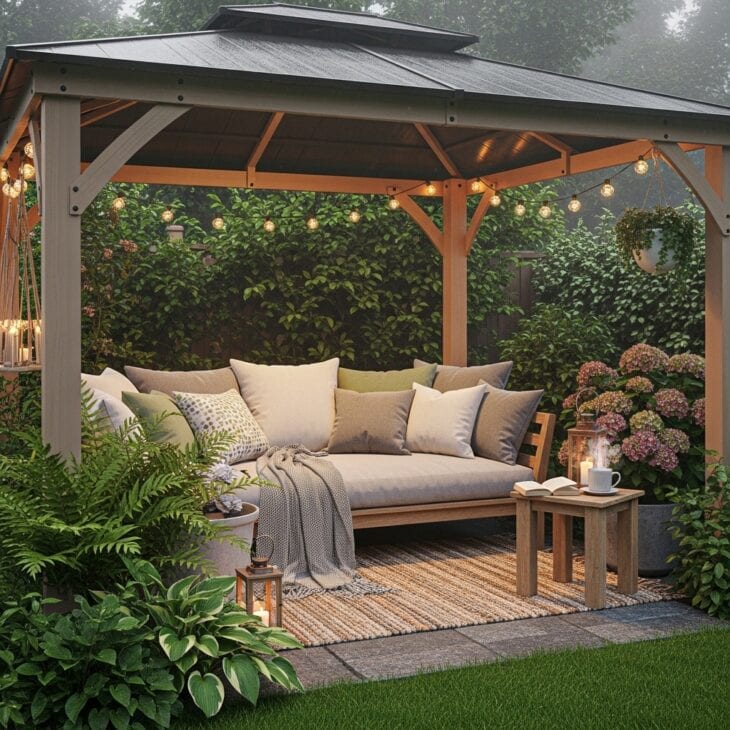
What you see A covered seating area — a gazebo, a roofed corner, or a simple canopy — lets you use the backyard whatever the weather. With a sofa, cushions and a rug tucked beneath the roof and planting wrapped around, it becomes a snug outdoor living room that shrugs off a passing shower or a strong midday sun.
Why it works A solid roof, rather than just dappled shade, is what makes a seating area usable in real weather, hugely extending the days and the seasons you spend outside. Furnishing it like an indoor room — proper seating, soft furnishings, a side table — tips it from a spot you pass through into one you settle into. It is the difference between a garden you look at and a garden you live in.
How to get it Choose a structure that suits the space, from a freestanding gazebo to a lean-to roof against the house or a sturdy canopy, and build it large enough for the furniture you have in mind. Site it to catch a good view and the best of the light, and consider how rain will run off and where it will go. Add outdoor-grade cushions and a weatherproof rug for comfort, and string lights or a heater to push the season further. Wrap the structure in planting or climbers so it feels embedded in the garden rather than bolted on, and you have somewhere to enjoy the backyard almost all year round.