There is a point every fall when the evenings turn cool enough that everyone heads indoors right after dinner. A fire pit changes that. Pull a few chairs around a real fire, hand out blankets, and the backyard stays in use well into October and November, long after the patio umbrella has been put away.
Contents
- 01. Stone Ring on a Pea Gravel Circle
- 02. Sunken Conversation Pit
- 03. Curved Seat Wall Around the Fire
- 04. Gas Fire Table on the Patio
- 05. Weekend Block Fire Pit with a Steel Liner
- 06. Corten Steel Bowl Among Prairie Grasses
- 07. Adirondack Chairs on a Lawn Clearing
- 08. Woodland Clearing with Log-Round Seats
- 09. Hillside Fire Pit Terrace
- 10. Smokeless Steel Pit for a Small Yard
- 11. Desert Fire Pit with Agaves and Gravel
- 12. Linear Fire Trough Beside Still Water
- 13. Mediterranean Gravel Terrace with Lavender
- 14. Coastal Fire Pit with Driftwood Benches
- 15. Fire Circle Under Café Lights
- 16. Outdoor Stone Fireplace as a Focal Wall
- 17. Cast-Iron Chiminea on a Small Patio
- 18. Fall Harvest Fire Pit with Mums and Pumpkins
- 19. Japanese-Inspired Fire Pit in Raked Gravel
- 20. Hanging Swing Seats Around the Fire
- 21. Firewood Store as a Garden Screen
- 22. Cooking Fire Pit with a Swing-Arm Grill
- 23. Round Brick Fire Pit on a Brick Circle
- 24. Flagstone Fire Patio with Planted Joints
- 25. Fire Pit Ringed by Fall-Color Trees
The ideas below run from a stone ring you can build in an afternoon for less than the cost of a patio chair, to sunken conversation pits, gas fire tables and outdoor fireplaces that are serious weekend or contractor projects. There are ideas for large lawns and tiny courtyards, for hillsides and beach towns, for wood smoke and cooking over coals, and for people who want the glow of a fire with the flick of a switch.
Each idea explains what you are looking at, why the design works, and how to build it, with sizes, materials and the safety clearances that matter. Before you dig anything, check your town’s rules on open burning, since some areas ban wood fires or set minimum distances from the house, and then scroll through for the setups that suit your yard.
01. Stone Ring on a Pea Gravel Circle
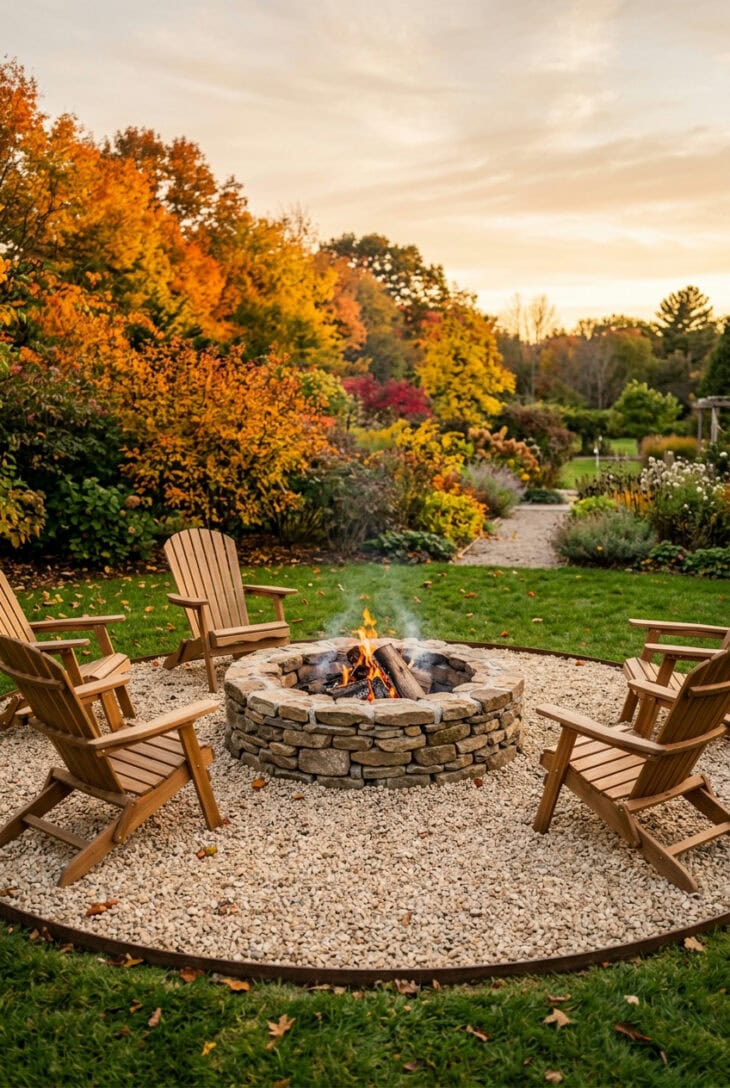
What you see A knee-high ring of stacked fieldstone with a small fire crackling inside, sitting in the middle of a pale pea gravel circle. A thin steel edge keeps the gravel off the surrounding lawn, and four wooden chairs are set around the ring at an easy distance. Behind, the shrubs are just turning orange, and the sky is going gold.
Why it works This is the fire pit most people picture, and it is popular for good reason: it is cheap, forgiving and looks at home in almost any yard. The gravel does the real work. It gives stray embers nothing to catch, it drains after rain so the chairs never sit in mud, and it spares the lawn from the scorched, trampled ring that a fire pit on grass always leaves behind.
How to get it Mark a circle about 14 to 16ft (4.3 to 4.9m) across, strip the turf, and dig out 4in (10cm). Lay landscape fabric, add a compacted layer of crushed stone, then top with 2in (5cm) of 3/8in (10mm) pea gravel, which is comfortable underfoot. Build the ring about 36in (90cm) across inside, and line it with a steel fire ring or fire brick, because ordinary fieldstone and river rock can hold moisture and crack or spit fragments when heated. Keep the ring at least 10ft (3m) from the house, fences and overhanging branches, and further if your local code asks: many towns follow the fire code’s 25ft (7.6m) rule for open wood fires. A gravel garden planting of drought-tolerant perennials around the outside edge will soften the circle without adding fuel near the fire.
02. Sunken Conversation Pit
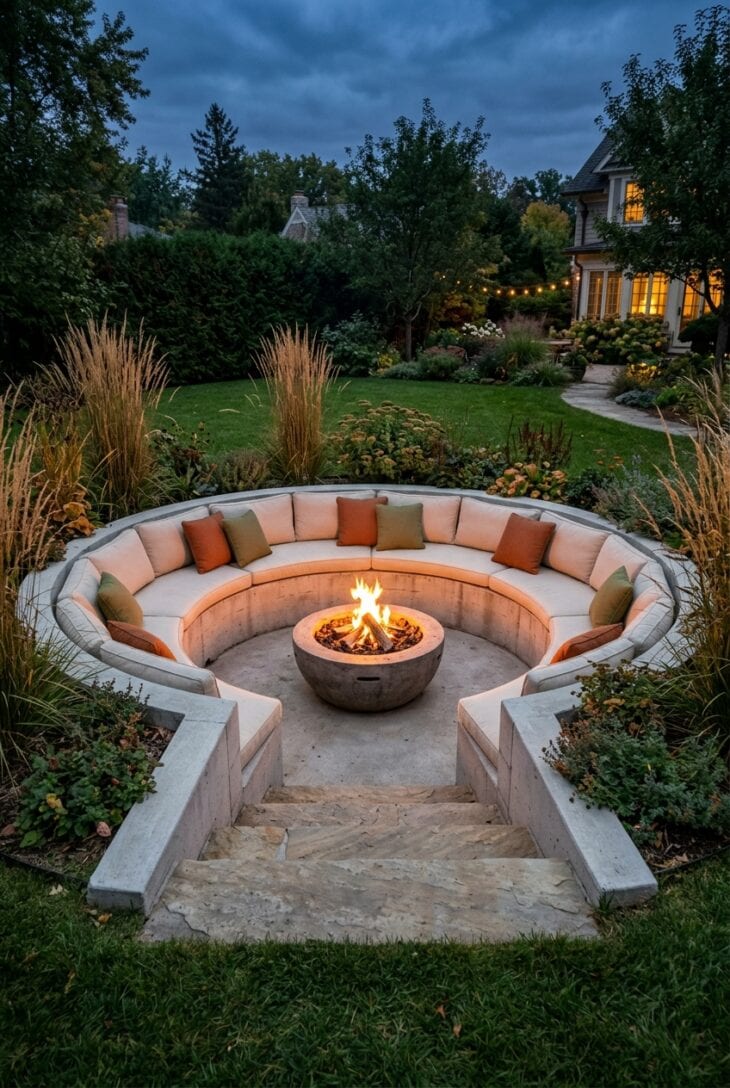
What you see A round room dropped into the lawn, about two feet deep, with a cushioned bench curving all the way around the inside wall. Three wide steps lead down, and in the center a low concrete fire pit burns quietly. At ground level, tawny grasses lean over the rim, and the dusk light makes the cushions glow orange from the fire.
Why it works Dropping the seating below grade does two things at once. It shelters everyone from the wind, which is the main thing that drives people away from a fire on a cold night, and it creates an enclosed, intimate room that feels completely separate from the rest of the yard. The continuous bench also seats far more people than a ring of chairs in the same space.
How to get it This is an advanced project, and on most sites a contractor’s job. Plan for an inside diameter of at least 14ft (4.3m) so there is a comfortable 3ft (90cm) between the bench front and the fire. Drainage decides whether it succeeds: without it you have built a pond, so dig below the floor for a deep bed of drainage gravel and a perforated pipe running out to daylight or a dry well. Check for buried utilities before digging (call 811), and keep the walls no taller than about 30in (75cm) unless an engineer signs off on them. A gas fire pit suits a sunken space well, since smoke tends to linger below grade, but a wood fire works if the pit is open and breezy.
03. Curved Seat Wall Around the Fire
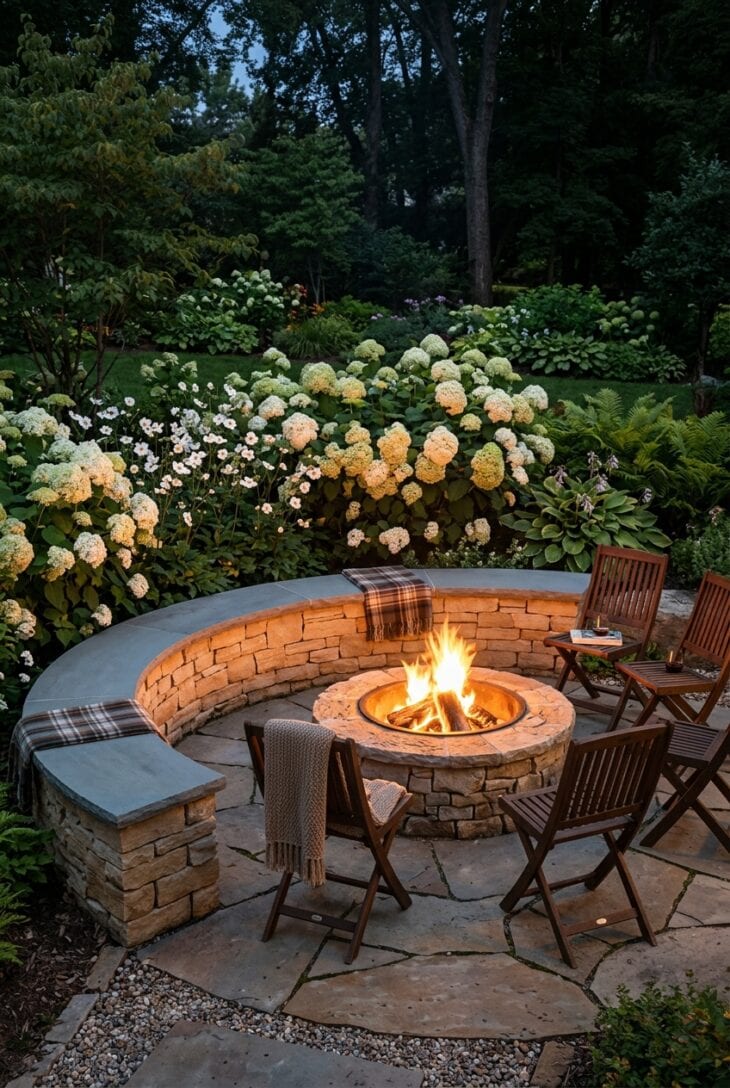
What you see A low stone wall with a smooth bluestone cap sweeps around one side of a round fire pit, doubling as a long bench. The open side holds a couple of chairs, so the circle closes without feeling boxed in. Behind the wall, big white hydrangea heads and pale Japanese anemones catch the last of the twilight and seem to hover above the stone.
Why it works A seat wall gives the fire pit permanent structure. It defines the space in winter when the furniture is stored, holds extra guests without anyone hunting for chairs, and acts as a low windbreak. Planting white flowers behind it is a trick borrowed from moon garden design: pale blooms reflect firelight and dusk, so the backdrop stays visible long after darker flowers have vanished into the night.
How to get it Build the wall 18 to 20in (45 to 50cm) high, the same as a chair seat, and 12 to 16in (30 to 40cm) deep so it is comfortable to sit on. Set it 5 to 6ft (1.5 to 1.8m) from the fire pit’s outer edge, measured to the front of the wall, so knees are warm but faces are not roasting. Segmental retaining wall block with a matching cap is the easiest DIY route, laid on a compacted gravel footing. For the white backdrop, plant smooth hydrangea (Hydrangea arborescens ‘Annabelle’) and Japanese anemone (Anemone × hybrida ‘Honorine Jobert’), which flowers from late summer into October. Keep the planting on the far side of the wall, at least 8ft (2.4m) from the fire.
04. Gas Fire Table on the Patio
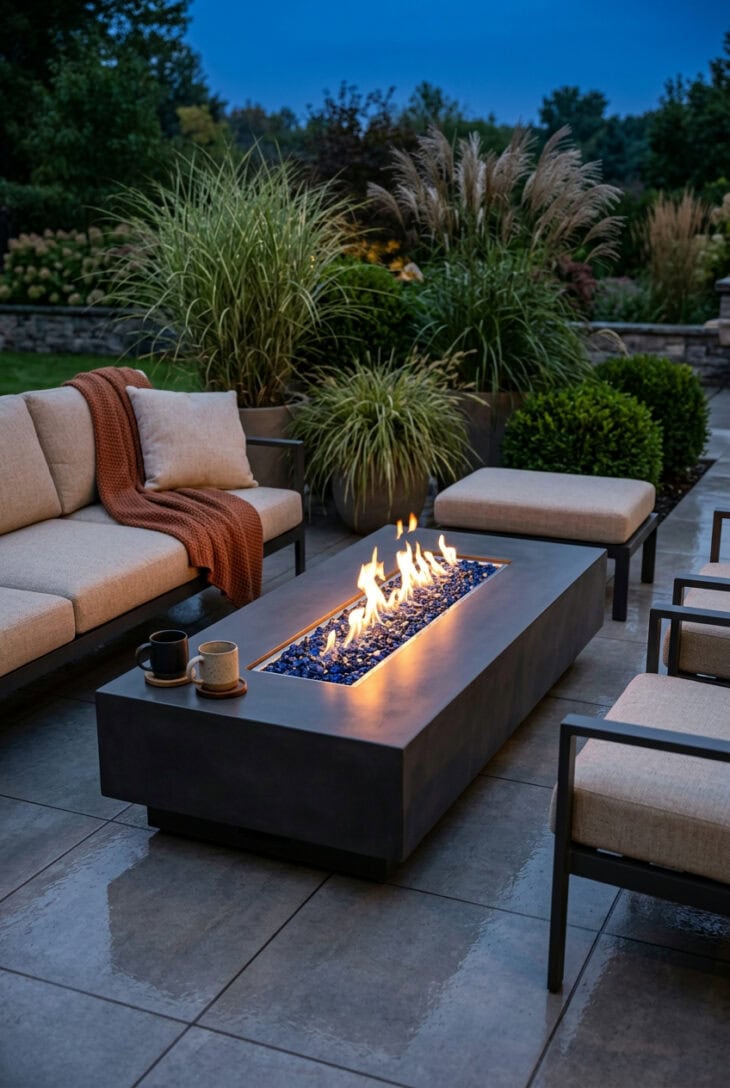
What you see A long charcoal fire table sits between a deep outdoor sofa and two lounge chairs, with a ribbon of low flame running across a bed of blue fire glass. The wide concrete ledge around the burner holds two mugs, and a rust throw lies over the sofa arm. Tall grasses in dark planters frame the scene against a blue evening sky.
Why it works A fire table is a coffee table and a fire in one piece of furniture, which makes it the natural choice for a patio seating area that is already furnished. There is no smoke drifting into anyone’s eyes or the neighbor’s windows, no ash to clean up, and the fire goes on and off with a knob. That convenience means it gets used on an ordinary Tuesday, not only when someone has time to build and tend a wood fire.
How to get it Choose between a propane model, with the 20lb tank hidden in the base, or a natural gas line, which never runs out but must be installed by a licensed gas fitter. A table height of 20 to 24in (50 to 60cm) suits lounge seating; a 12 to 16in (30 to 40cm) wide ledge around the burner is useful for drinks. Keep the manufacturer’s stated clearances to walls and overhead covers, and never convert a propane table to natural gas without the proper kit. A glass wind guard keeps the flame steady on breezy nights.
05. Weekend Block Fire Pit with a Steel Liner
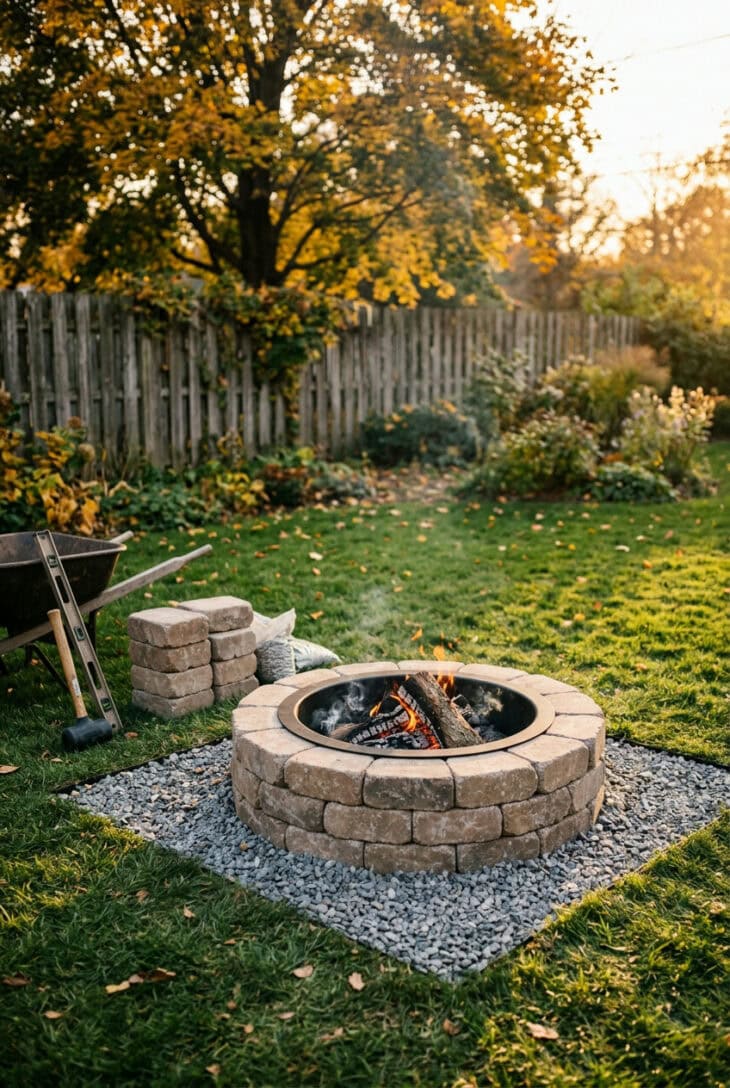
What you see A round fire pit that looks as if it was finished an hour ago: two courses of tumbled concrete wall block, a heavy black steel ring inside, and the first small fire burning. A wheelbarrow, a mallet and a level are still lying on the lawn beside a few spare blocks, and a maple is turning yellow over the fence.
Why it works This is the best value project on the list. Home centers sell the blocks and ring for well under the price of a single piece of patio furniture, the blocks are designed to lock together without mortar, and the whole thing can be built by one person in a Saturday. The steel liner is what makes it last, because it takes the direct heat and stops the blocks from cracking.
How to get it Buy the steel ring first, then count the blocks needed to circle it, usually 12 to 14 per course for a 36in (90cm) ring. Dig out a circle 6in (15cm) deep and a little wider than the pit, fill it with compacted paver base, and level the first course carefully, since every mistake is magnified on the course above. Stagger the joints on the second course and glue it down with masonry adhesive rated for landscape block. Do not skip the liner: ordinary concrete block and cinder block can spall and crack when exposed to direct flame. Leave a few small gaps in the bottom course, or drill drain holes, so rainwater does not pool inside.
06. Corten Steel Bowl Among Prairie Grasses
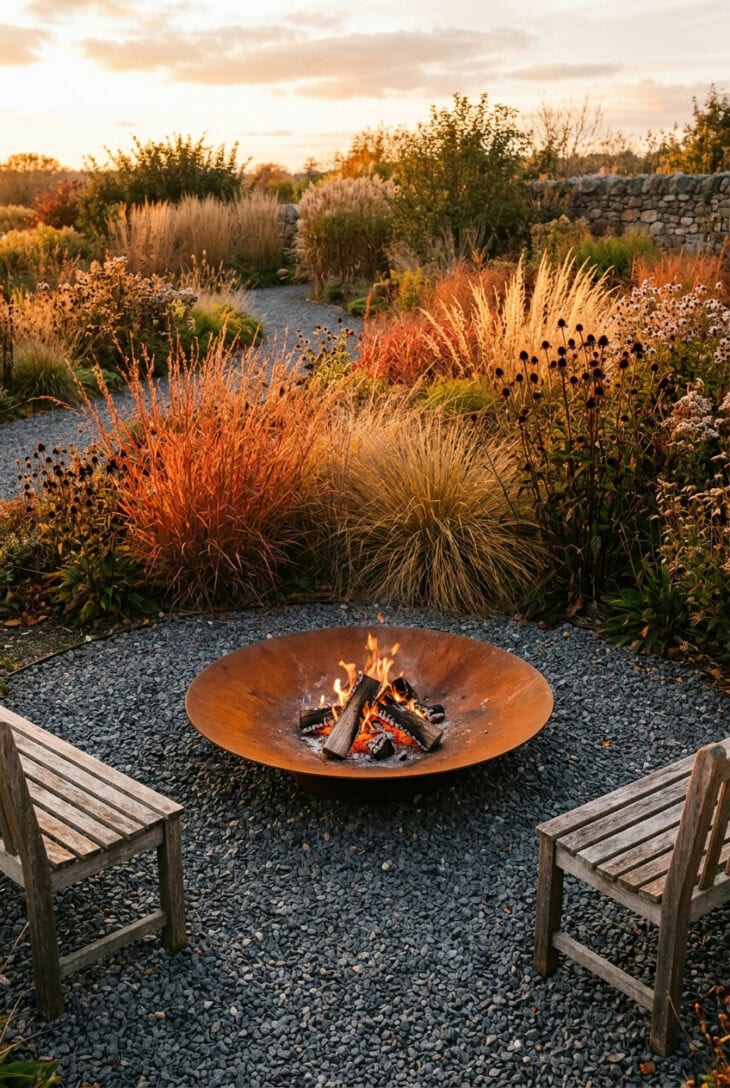
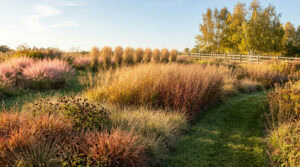
What you see A wide, shallow bowl of rust-brown steel holds a small fire on a circle of dark crushed stone. Beyond the gravel, a prairie planting glows in the sunset: copper and red little bluestem, soft tawny mounds of prairie dropseed, and the dark seedheads of coneflowers standing above them. Two plain wooden benches wait on the stone.
Why it works The rusted steel and the fall grasses share the same warm palette, so the fire bowl looks as though it belongs in the planting rather than being dropped into it. Prairie plants are also at their best exactly when fire pit season starts: they color up in October and stand all winter. The wide gravel apron matters here, because dry grass is excellent tinder.
How to get it Weathering (Corten) steel bowls come in 30 to 48in (75 to 120cm) diameters; set yours on gravel or stone, never on pale pavers, since the rust runs off and stains them permanently. Leave at least 10ft (3m) of gravel between the bowl and the nearest grasses. Plant little bluestem (Schizachyrium scoparium ‘Standing Ovation’), prairie dropseed (Sporobolus heterolepis) and purple coneflower (Echinacea purpurea) in drifts of odd numbers, 18 to 24in (45 to 60cm) apart. Cut the grasses back in late winter, before new growth starts, and in the meantime keep a hose within reach whenever the fire is lit.
07. Adirondack Chairs on a Lawn Clearing
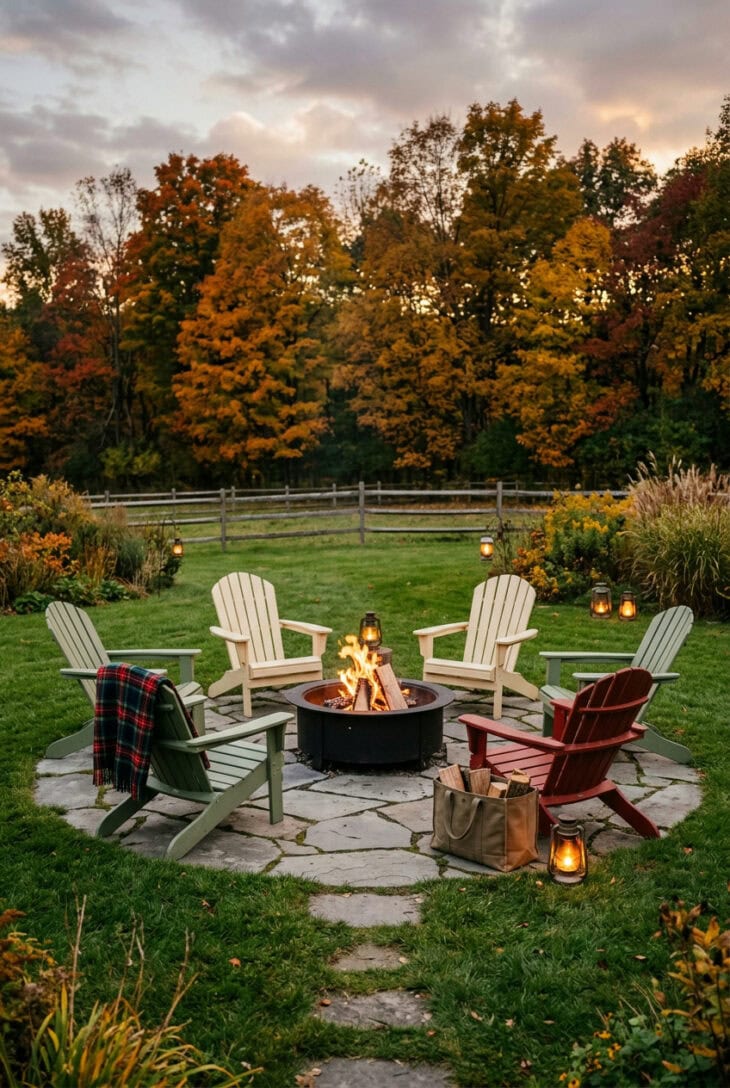
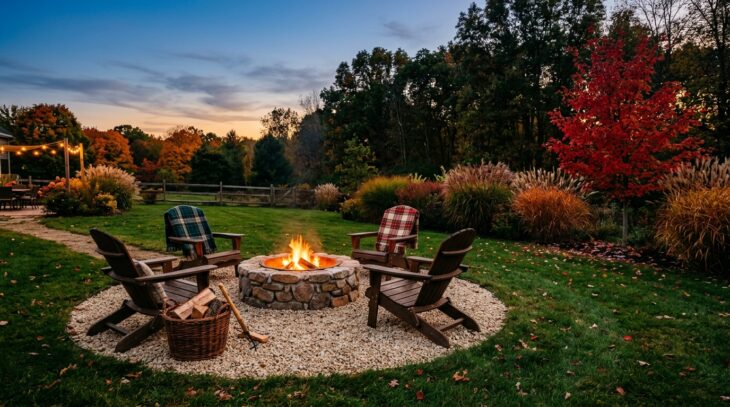
What you see Five Adirondack chairs in sage, cream and barn red sit in a loose ring on an open lawn, facing a black steel fire pit on a small flagstone pad. A plaid blanket hangs over one chair and a canvas bag of firewood leans against another. Lanterns glow on the grass, and the tree line behind has turned orange and gold.
Why it works Sometimes the best fire pit area in a family backyard is the simplest one: open lawn, good chairs and a view. Adirondack chairs are ideal around a fire because their low, reclined seats put your face below the smoke and your feet toward the warmth, and the wide arms hold a drink or a plate. The flagstone pad protects the grass from heat without the cost of a full patio.
How to get it Lay a flagstone pad 6 to 8ft (1.8 to 2.4m) across, set the stones flush with the lawn on a sand bed so the mower rolls straight over the edges, and place the steel fire pit in the center. Pick a spot away from the house and downwind of it, since smoke follows the prevailing breeze. Leave 3 to 4ft (90 to 120cm) between the fire and the front of the chairs. Move the chairs every few weeks so the lawn beneath them does not die back in patches.
08. Woodland Clearing with Log-Round Seats
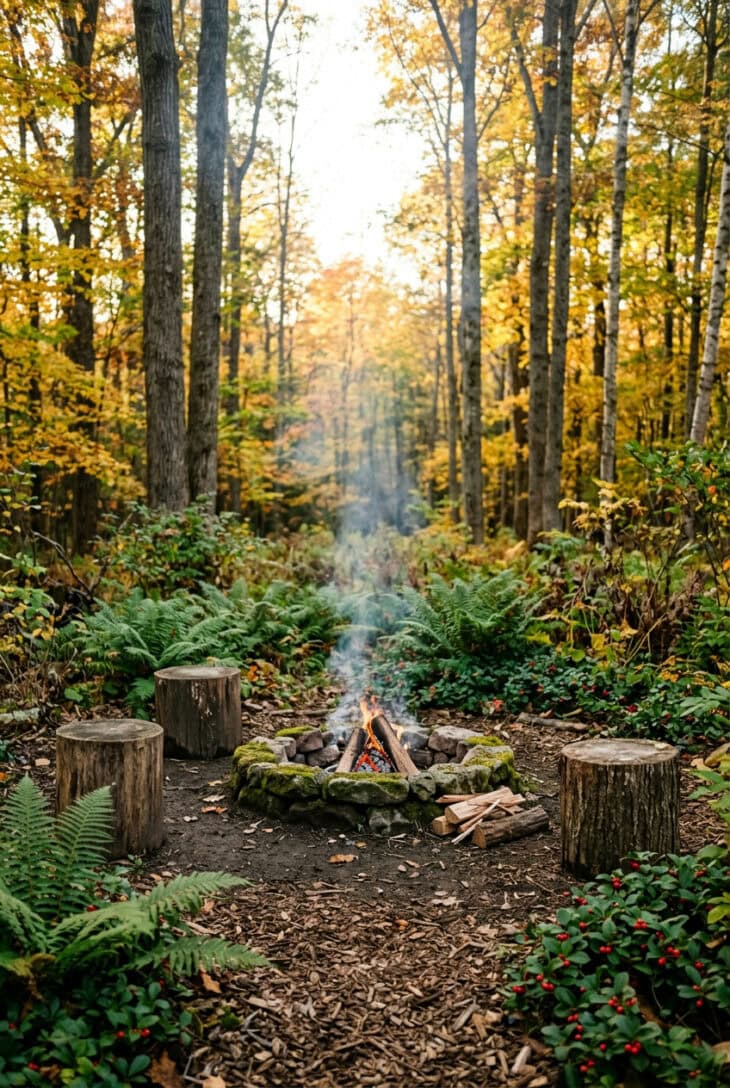
What you see A low ring of mossy stones holds a small campfire in a clearing where the yard meets the woods. Thick tree-trunk rounds serve as stools, and the forest floor beyond is carpeted with evergreen ferns and glossy wintergreen dotted with red berries. Yellow leaves hang overhead, but directly above the fire the sky is open, and a thin line of smoke drifts straight up.
Why it works This is the campfire experience without leaving home, and it makes use of a back corner that is often too shady for much else, though a shade garden planting around the edge suits it perfectly. Log rounds cost nothing if a tree has come down, they suit the setting perfectly, and they rot away gracefully when it is time to replace them. The shade-loving evergreens around the edge keep the clearing green all winter.
How to get it Choose a gap in the canopy, not a spot under branches, and clear a circle at least 20ft (6m) across down to bare soil, then cover it with wood chips or gravel, keeping chips well back from the ring itself. Rake up fallen leaves around the pit before every fire, because dry leaf litter is the biggest risk in a wooded setting. Cut log rounds 16 to 18in (40 to 45cm) tall from hardwood such as oak, which lasts longest. Around the edges, plant Christmas fern (Polystichum acrostichoides) and wintergreen (Gaultheria procumbens), which both hold their leaves through winter.
09. Hillside Fire Pit Terrace
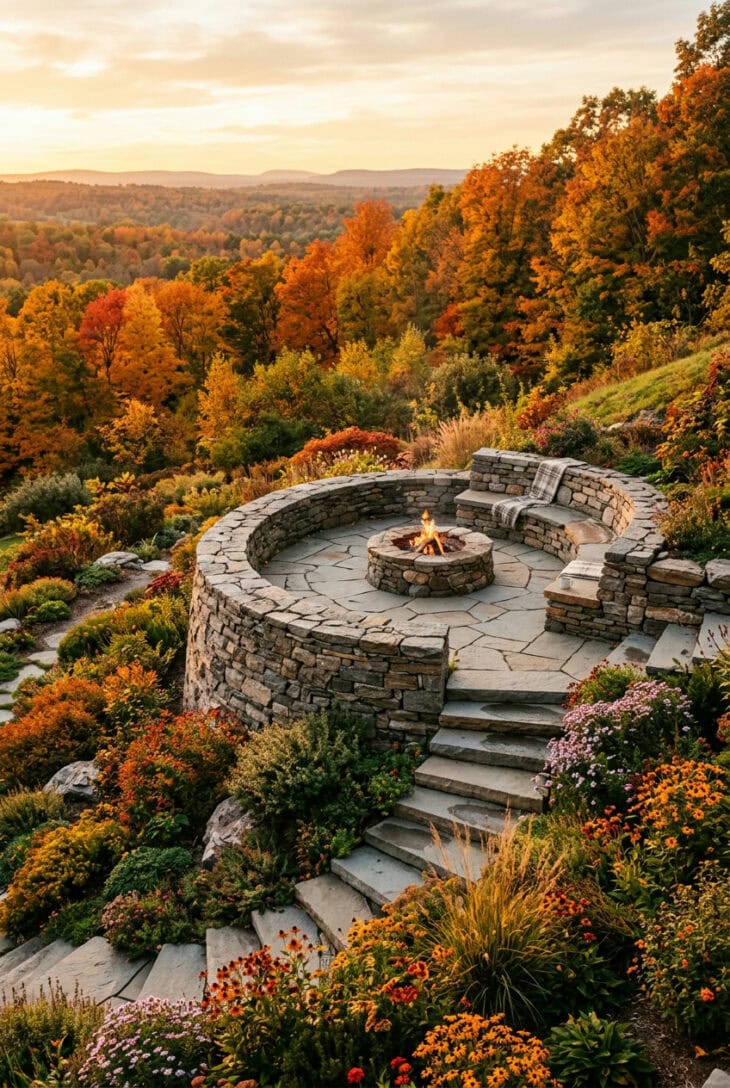
What you see A half-moon terrace carved into a slope, held up by a curved dry-stone wall on the downhill side. A stone fire pit sits in the middle, a built-in bench runs along the uphill wall, and wide steps climb to it through low shrubs and perennials. From the bench, the view drops away over treetops in red and orange to hills on the horizon.
Why it works A slope that seems useless becomes the best seat in the yard. Cutting a level terrace creates a flat spot where there was none, and the uphill wall provides a ready-made bench and windbreak. The elevation gives the fire a view, which a fire pit on flat ground in a fenced yard rarely has.
How to get it Make the terrace at least 14ft (4.3m) deep so there is room for the fire and for people to walk behind the chairs. Use cut-and-fill to create it: dig into the slope and use the soil to build up the front, but only behind a proper retaining wall with a gravel footing and drainage pipe. Walls over about 3 to 4ft (90 to 120cm) usually need an engineer and a permit. Mind the wind, since hillsides are breezier than hollows, and set the fire pit away from dry brush downhill. Our sloped garden ideas cover the steps, walls and planting that tie a terrace like this into the rest of the hill.
10. Smokeless Steel Pit for a Small Yard
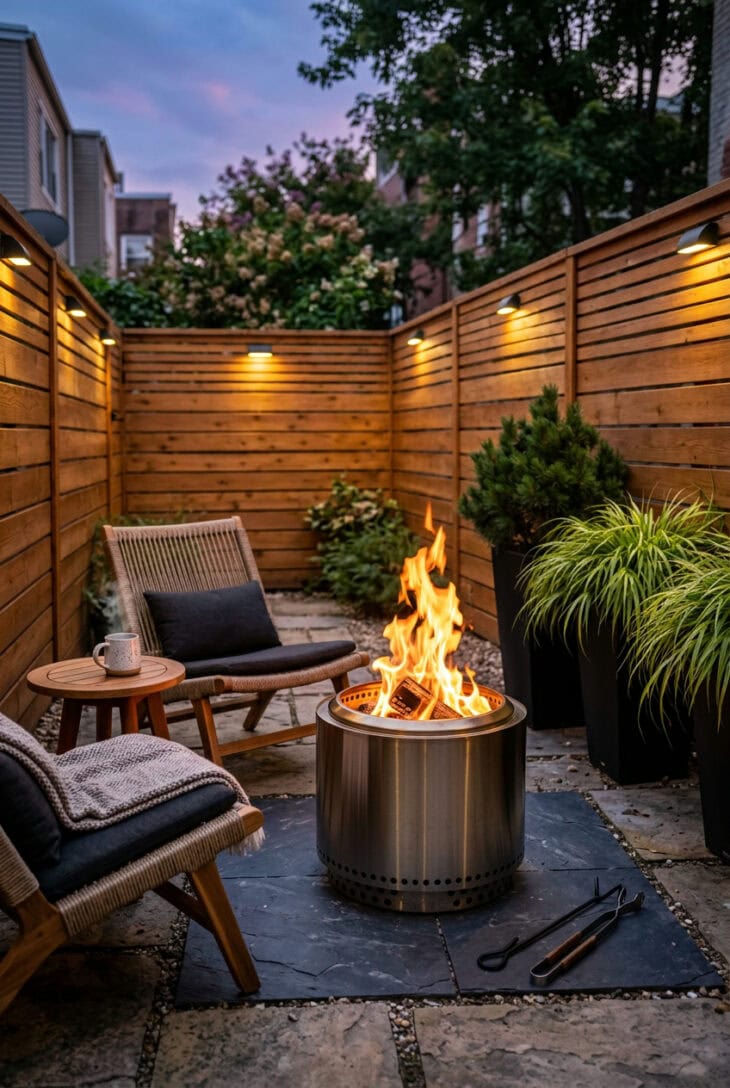
What you see A small, shiny steel cylinder burns with tall bright flames and almost no smoke, on a square of dark slate in a tiny walled yard. A horizontal cedar fence wraps around the space, with tall black planters of grass and a small evergreen against it. Two low rope chairs and a side table make a cozy corner for two.
Why it works In a small yard, the biggest problem with a wood fire is smoke: there is nowhere for it to go except into your eyes, your clothes and the neighbors’ open windows. Double-walled fire pits draw air through the walls and feed it back in near the top, burning off much of the smoke before it escapes. They are compact, portable and give a real wood fire in a space where a traditional pit would be unbearable.
How to get it A 19 to 22in (48 to 56cm) model is right for two to four people. They run very hot at the base, so set them on stone, pavers or a heat-resistant pad, never directly on a wood deck or on grass. Burn dry, seasoned hardwood cut to fit, since damp wood makes smoke even in a smokeless pit. Check the manufacturer’s clearance and your local code, as even small pits usually need 10ft (3m) or more from structures.
11. Desert Fire Pit with Agaves and Gravel
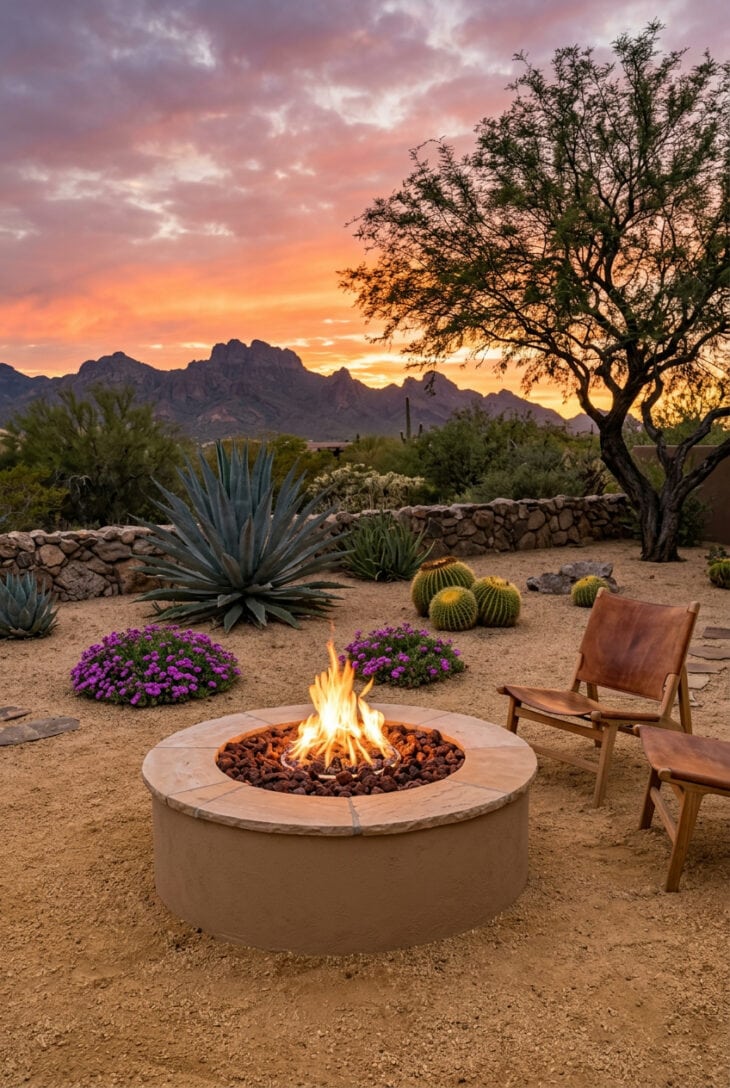
What you see A round tan stucco fire pit with a flagstone cap flickers in a wide field of golden decomposed granite. Big blue-gray agave rosettes, golden barrel cactus and low mats of purple ice plant are scattered well back from the fire, and a feathery mesquite stands in the corner. The sky behind is orange and violet, with mountains dark along the horizon.
Why it works In desert climates the fire pit comes into its own after sunset, when the temperature can drop 30 degrees in a few hours. The planting palette is naturally fire-wise: succulents hold so much water that they resist burning, and decomposed granite is a non-flammable groundcover that also drinks up whatever rain arrives. The sculptural shapes look even better lit from below by firelight.
How to get it Lay 3in (7.5cm) of stabilized decomposed granite over a compacted base. Plant century plant (Agave americana) at least 10ft (3m) from the fire and any path, because its leaf tips are needle sharp and it grows 6ft (1.8m) wide. Add golden barrel cactus (Echinocactus grusonii) and hardy ice plant (Delosperma cooperi) as a flowering groundcover. A velvet mesquite (Prosopis velutina) gives filtered shade by day; plant it where its mature canopy will stay well clear of the fire. Many desert towns restrict wood burning on high-pollution or high-fire-risk days, which makes gas the practical choice. Our drought-tolerant garden ideas have more plants that thrive in this kind of setting.
12. Linear Fire Trough Beside Still Water
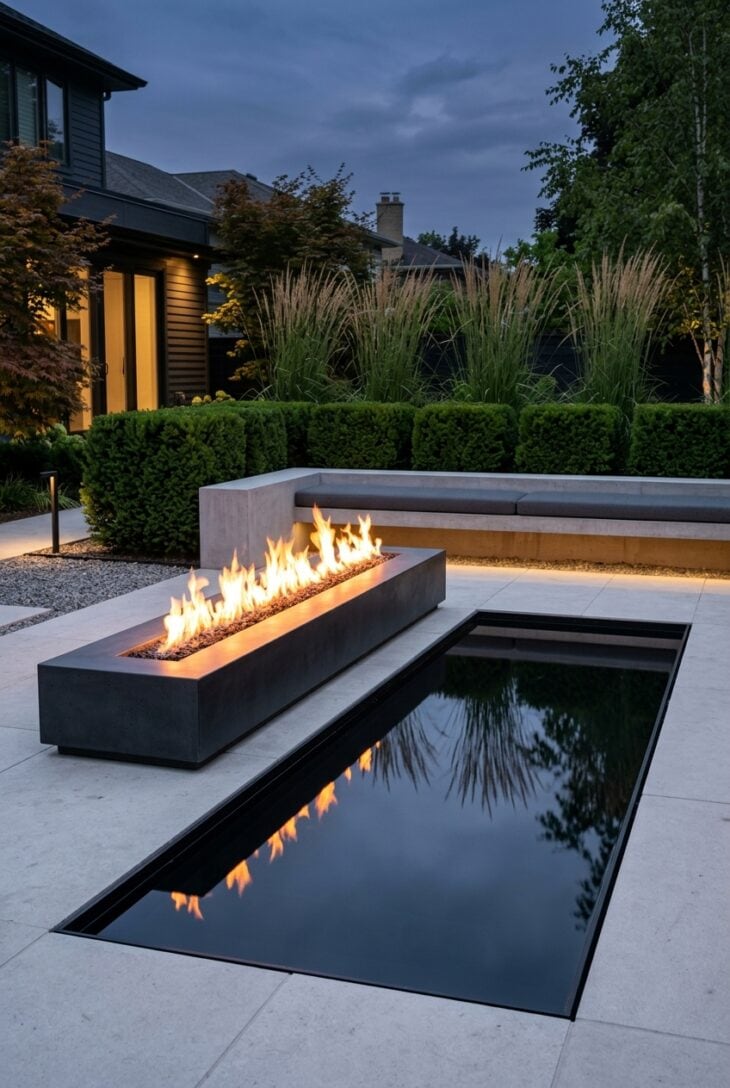
What you see A long, narrow trough of dark concrete runs parallel to a black reflecting pool, and a low line of flame stretches its full length. The still water mirrors every flicker, so the fire appears twice. Pale limestone pavers, a low cushioned bench and a backdrop of clipped yew and upright grasses keep everything calm and precise.
Why it works Fire and water side by side is one of the strongest contrasts you can build into a garden, and the reflection doubles the light at no extra cost. A linear shape suits a modern layout far better than a round pit: it lines up with the paving grid, the bench and the planting, and it can be read from inside the house as a single glowing line.
How to get it Linear fire features run on natural gas or propane and are sized by burner length, typically 4 to 8ft (1.2 to 2.4m). Have the gas line and burner installed by a professional, and specify an automatic shutoff that closes the valve if the flame goes out. A reflecting pool reflects best when it is shallow (about 12in or 30cm), lined in black or dark gray, and filled to the brim. Keep at least 18in (45cm) of paving between the flame and the water’s edge so no one steps into either. Clipped yew (Taxus × media ‘Hicksii’) and feather reed grass (Calamagrostis × acutiflora ‘Karl Foerster’) give the evergreen and vertical structure that modern garden design depends on.
13. Mediterranean Gravel Terrace with Lavender
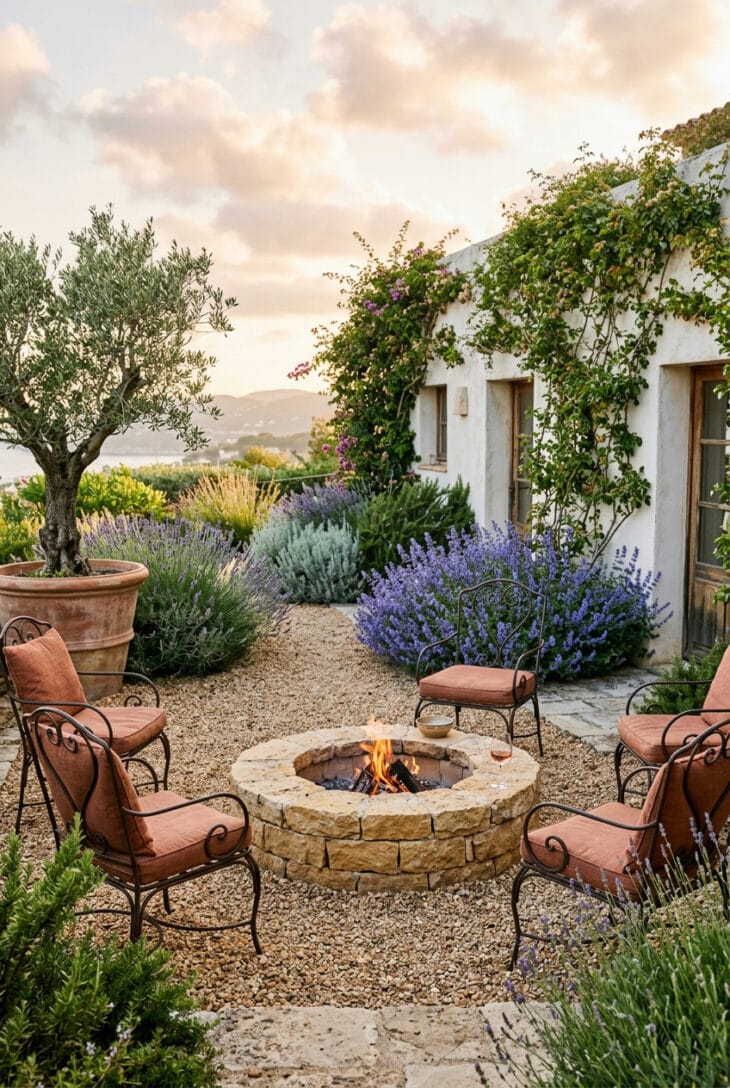
What you see A low round fire pit of rough honey-colored limestone sits on a sunny gravel terrace, ringed by wrought iron chairs with terracotta cushions. Mounds of silver lavender and blue catmint line the edges, a gnarled olive grows in a big clay pot, and a whitewashed wall behind catches the pink evening light.
Why it works Mediterranean gardens are built for evenings outdoors, and their materials already suit a fire: gravel underfoot, stone, clay and iron. The silver-leaved plants look as good by firelight as by day, and the whole scheme needs little water. It is the look of a long dinner on a terrace, moved into the cooler months.
How to get it Use a warm-toned gravel such as buff or honey pea gravel and a limestone or sandstone that picks up the same color. Plant English lavender (Lavandula angustifolia ‘Hidcote’ or ‘Munstead’) and catmint (Nepeta × faassenii ‘Walker’s Low’) 18 to 24in (45 to 60cm) apart along the edges, keeping them at least 8 to 10ft (2.4 to 3m) from the fire, since both are rich in aromatic oils. Olive (Olea europaea) is only hardy outdoors to about zone 8, so in colder areas grow it in a pot and bring it into a bright garage or porch for winter.
14. Coastal Fire Pit with Driftwood Benches
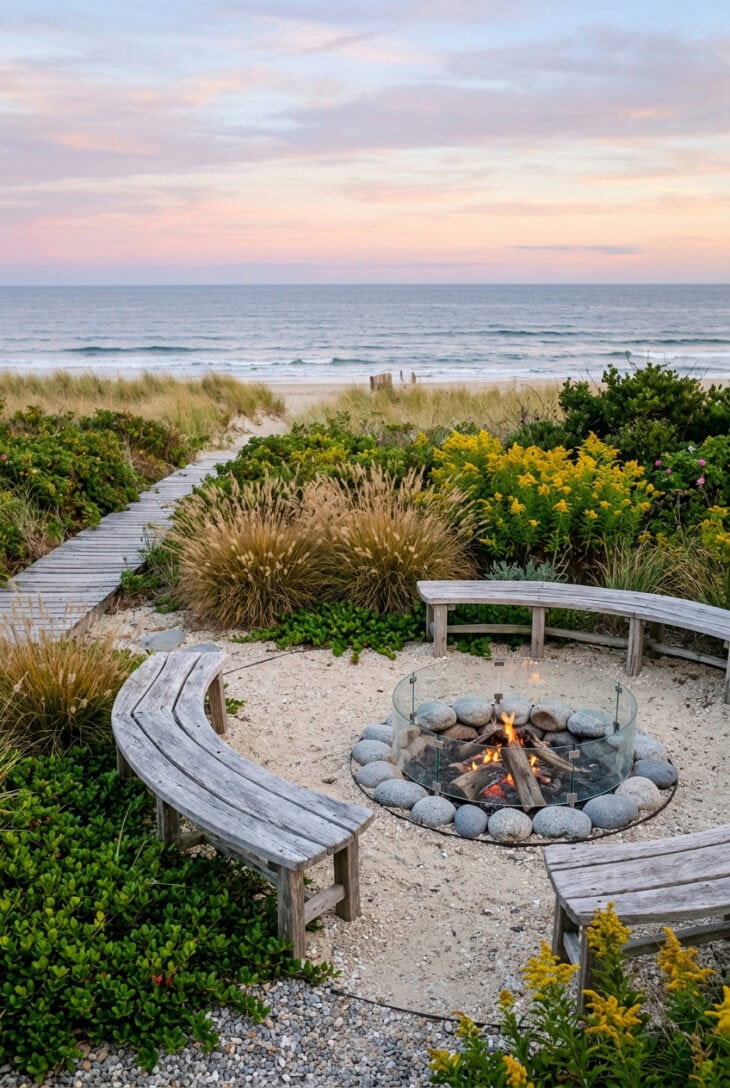
What you see A low granite fire pit is set into pale shell and gravel, with two long driftwood benches weathered to silver. Clumps of tawny grass and golden seaside goldenrod surround it, glossy bearberry creeps along the edges, and a cedar boardwalk leads toward the dunes. A glass screen shields the flame, and the sea shows faintly under a pastel sky.
Why it works A beach bonfire is one of summer’s great pleasures, and this brings it home for spring and fall evenings too. Coastal gardens face one enemy above all: wind. Setting the fire slightly below grade and adding a glass screen keeps the flame steady and the sparks down, while the salt-tolerant planting survives spray that would scorch most garden plants.
How to get it Sink the fire pit 6 to 12in (15 to 30cm) below the surrounding surface, or add a tempered-glass wind guard, which must be rated for fire pit use. Build benches from reclaimed timber or driftwood planks on concrete or stone supports, and set them 3 to 4ft (90 to 120cm) from the pit. Plant little bluestem (Schizachyrium scoparium), seaside goldenrod (Solidago sempervirens) and bearberry (Arctostaphylos uva-ursi), all of which take salt, sand and wind, at least 10ft (3m) from the fire. Stainless steel fittings last far longer in salt air than ordinary steel.
15. Fire Circle Under Café Lights
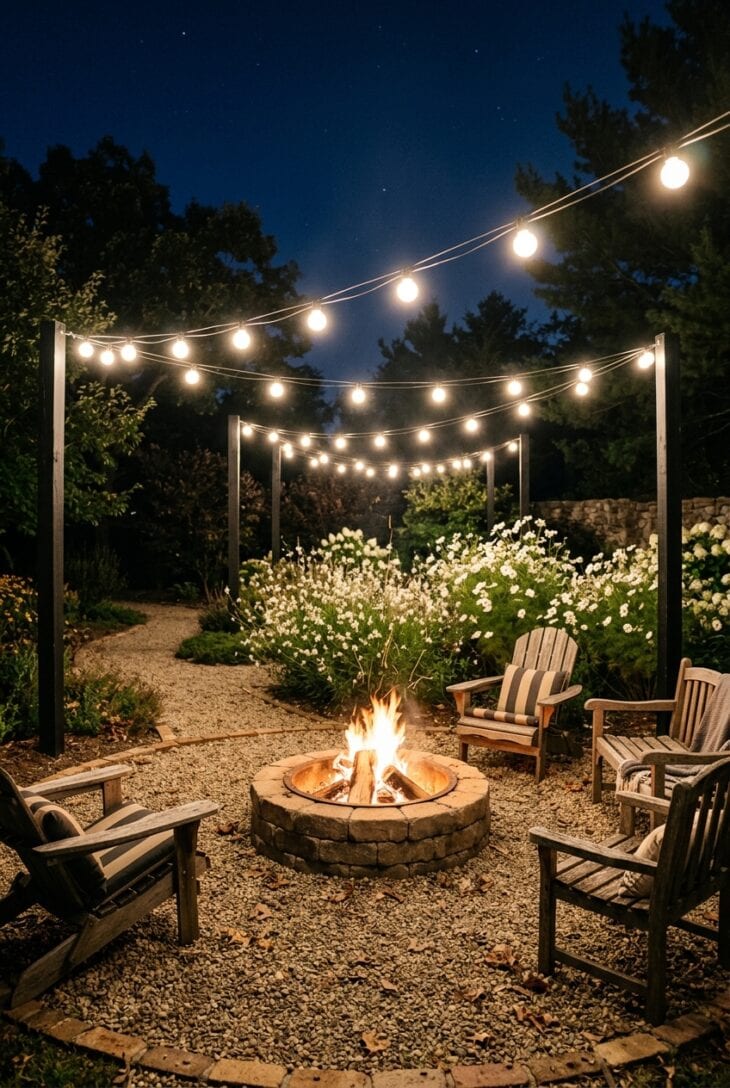
What you see Strings of warm globe lights zigzag between tall black posts around the edge of a gravel circle, forming a glowing ceiling over a stone fire pit. Wooden chairs and a small bench gather around the flames, and white gaura and cosmos in the border behind catch both kinds of light against a deep blue sky.
Why it works A fire lights the faces around it but leaves the rest of the yard black, so the moment someone stands up to fetch a drink they are stumbling in the dark. Café lights fix that, and they give the space an outdoor room’s ceiling, which makes it feel enclosed and intimate even in an open yard. The warm color of the bulbs matches the firelight, so nothing looks harsh.
How to get it Set 4×4 or 6×6 posts in concrete, or in heavy planters, around the outside of the seating area and run the strings between them at 9 to 10ft (2.7 to 3m) high. Keep the strings out over the seats and off to the sides, never draped directly over the flames, where rising heat and sparks can melt the cable. Choose outdoor-rated LED strings with a warm color temperature of 2200 to 2700K, and plug them into a GFCI outlet. White flowers in the border, such as gaura (Gaura lindheimeri ‘Whirling Butterflies’), glow under low light. Our garden lighting ideas have more ways to light paths and planting around the fire.
16. Outdoor Stone Fireplace as a Focal Wall
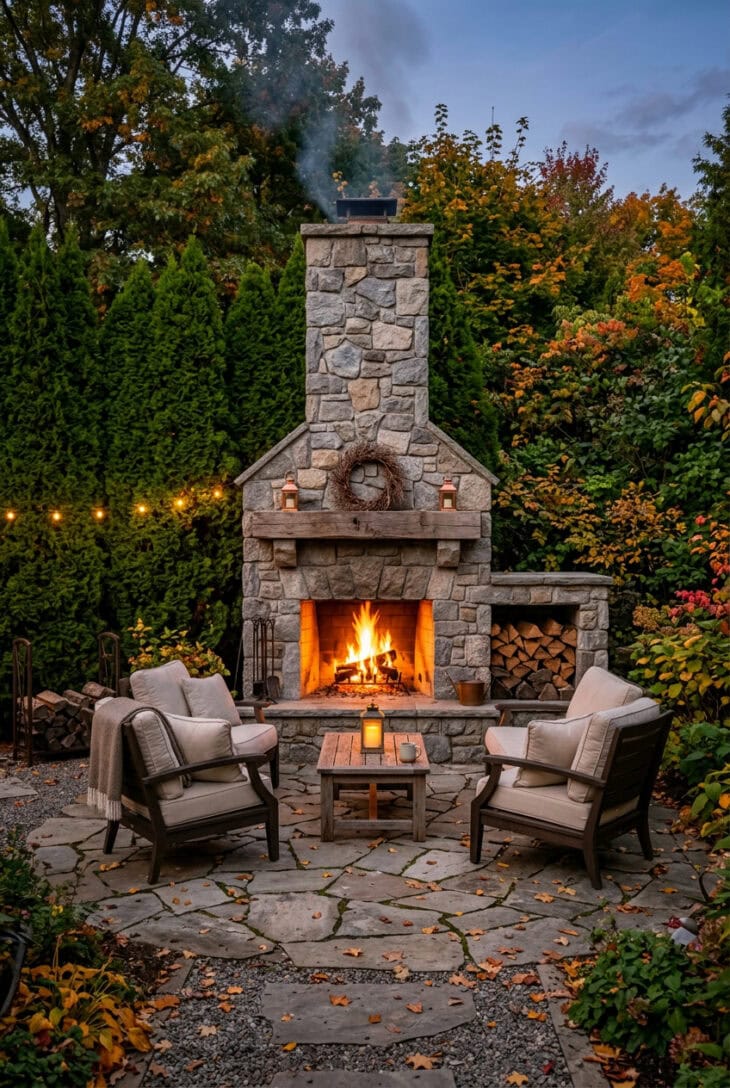
What you see A tall fieldstone fireplace with a timber mantel and chimney anchors the end of a flagstone patio, a fire roaring in the firebox. Two deep armchairs and a low table face it like a living room, split logs fill a niche built into the stone, and dark evergreens rise behind. Fallen leaves are scattered over the flagstones.
Why it works An outdoor fireplace does things a fire pit cannot. The chimney carries smoke up and away from the seating, the back wall throws heat forward toward the chairs, and the solid structure blocks wind and screens a view. It turns one end of a patio into a proper outdoor room, with a focal point that looks good even when the fire is out.
How to get it This is a masonry project that needs a reinforced concrete footing below the frost line, a firebox lined with fire brick, and a properly sized chimney; hire a mason, or build from a modular fireplace kit on a professional footing. Most towns require a permit, and codes typically call for 10ft (3m) or more from the house and from overhanging trees. Orient it so the prevailing wind blows from the seating toward the fireplace, not into your faces. Set chairs 6 to 8ft (1.8 to 2.4m) from the hearth. Keep resinous evergreens such as arborvitae and juniper well clear of the chimney top.
17. Cast-Iron Chiminea on a Small Patio
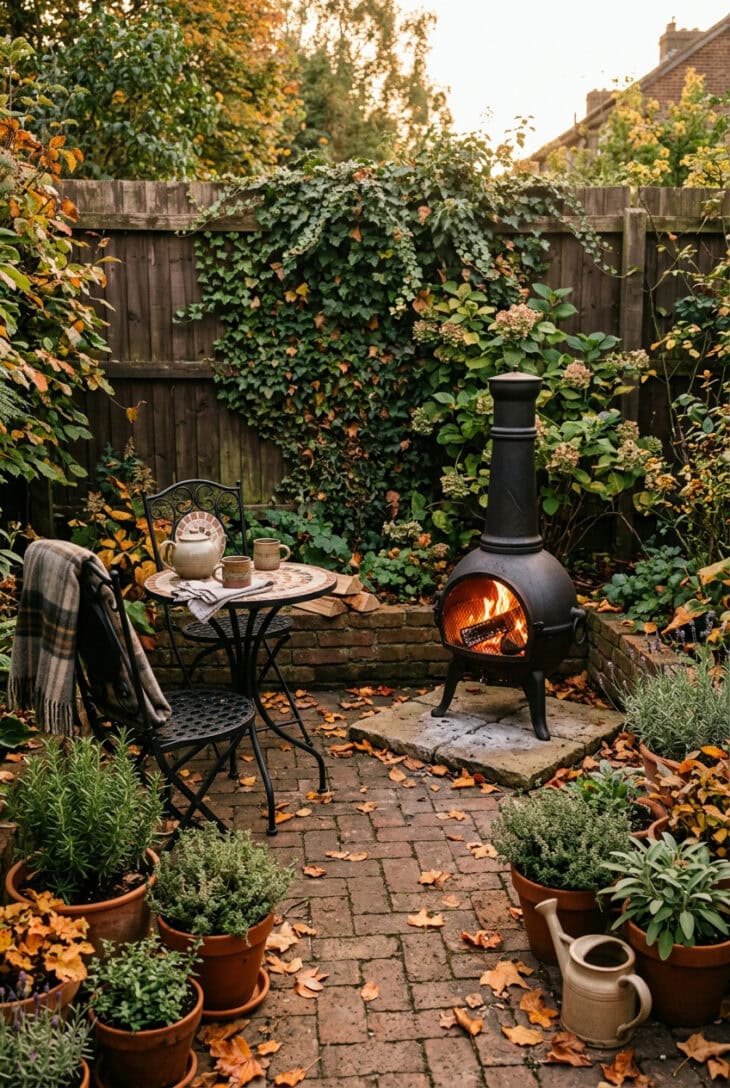
What you see A round-bellied black chiminea glows through its front opening in the corner of a small brick patio. Two bistro chairs pull up to a tiny table with a teapot, and clusters of terracotta pots of rosemary, thyme and sage line the edge of the brick. Ivy climbs the fence behind, and a few fallen leaves have blown in.
Why it works A chiminea is the fire pit for people who have no room for one. Its chimney draws smoke upward and away from faces, and the enclosed belly shields the fire from wind and keeps sparks in. It takes up about as much space as a large planter and can be moved or stored when you want the patio back.
How to get it Choose cast iron or steel over clay. Clay chimineas look charming but crack easily if they get wet and are then heated, or if a fire is built too big. Stand it on its own base on pavers or brick, never on a wood deck, and keep it well clear of fences, siding and overhangs, as the chimney top gets extremely hot. Burn small, split hardwood rather than big logs, and let the ashes cool completely before emptying. A cluster of potted kitchen herbs such as rosemary (Salvia rosmarinus) and thyme (Thymus vulgaris) around the edge makes the most of a small space.
18. Fall Harvest Fire Pit with Mums and Pumpkins
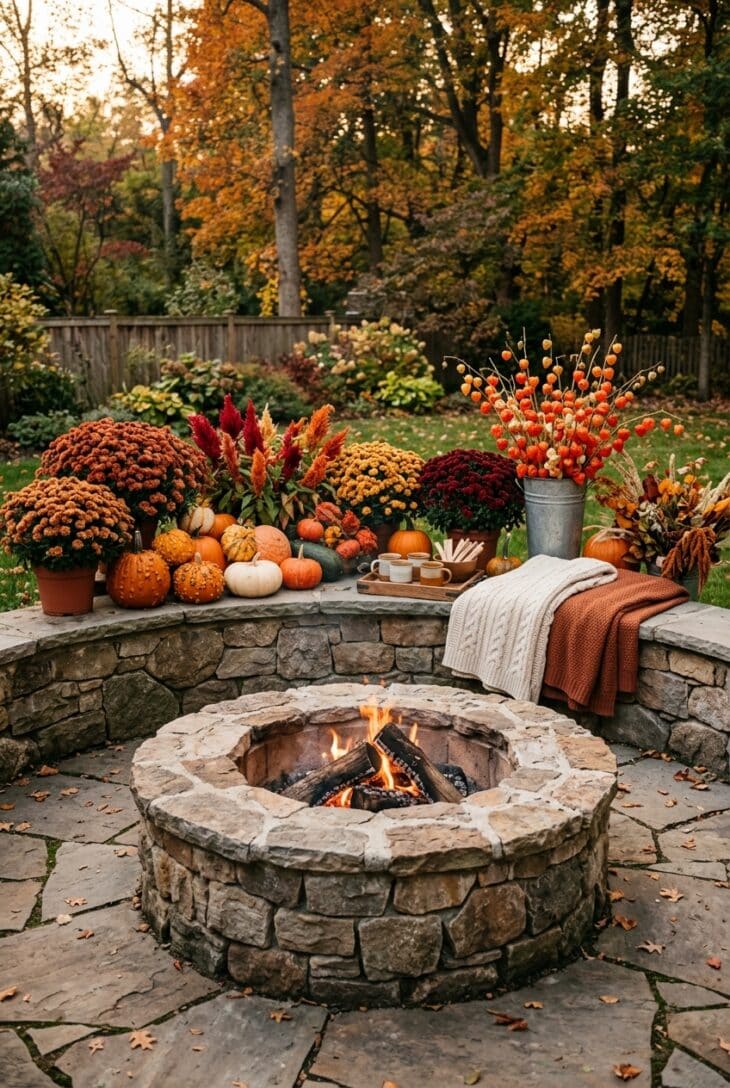
What you see A stone fire pit burns low in front of a seat wall draped with knit blankets. Behind the wall, bushy mums in rust, bronze and gold sit among piles of orange and cream pumpkins, flame-colored celosia plumes and a bucket of Chinese lantern stems hung with papery orange pods. A tray of mugs waits on the stone.
Why it works Fire pit season and harvest season arrive together, so it makes sense to dress the space for the moment. A few pots and pumpkins are all it takes to make a year-round fire pit feel seasonal, and they cost little and need no digging. The colors pick up the firelight and carry it out into the yard.
How to get it Group garden mums (Chrysanthemum × morifolium) in odd numbers and buy them in bud rather than full flower so they last into November. Add plumed celosia (Celosia argentea var. plumosa) for early fall, though it dies at the first frost. Pumpkins and gourds last for weeks on a dry surface; lift them off wet grass. Keep all the decoration, and especially anything dry such as straw bales, cornstalks or dried Chinese lantern (Physalis alkekengi) stems, at least 10ft (3m) from the flames. The same plants and props star in our fall porch ideas, so one shopping trip can dress both.
19. Japanese-Inspired Fire Pit in Raked Gravel
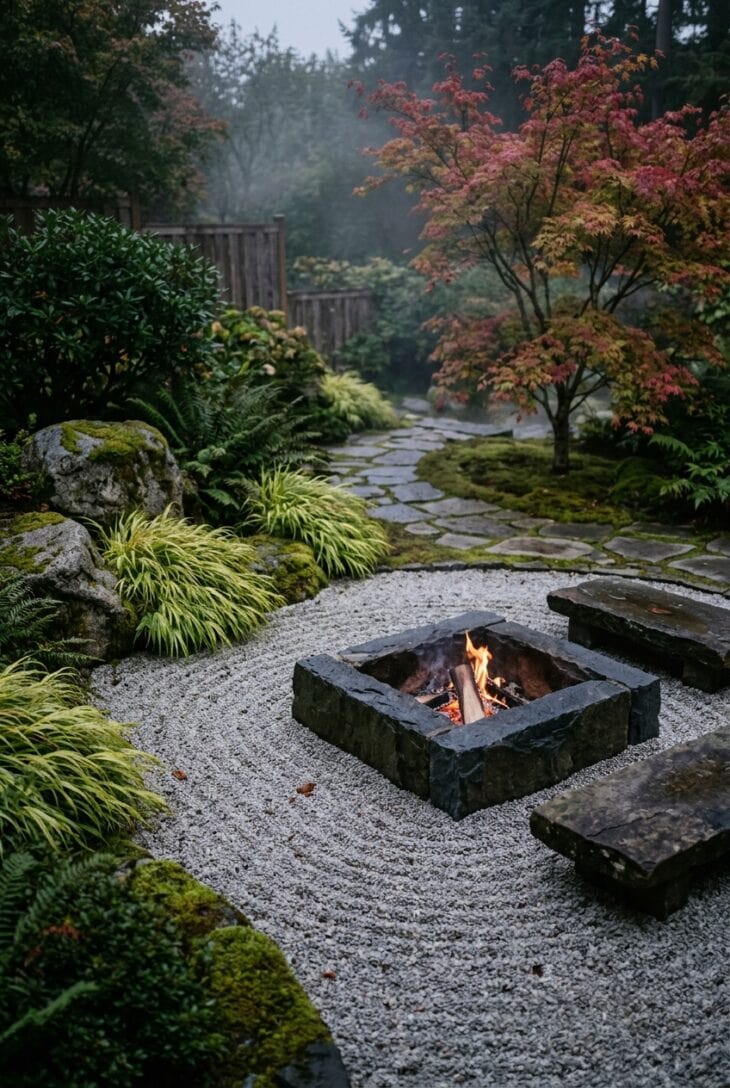
What you see A low square fire pit of dark basalt burns quietly in a bed of pale gravel raked into ripples around it. Mossy boulders sit like islands, a Japanese maple turns crimson behind, and mounds of golden forest grass spill over the edge of a stone path. Two flat stone slabs serve as seats in the soft, misty light.
Why it works Most fire pits are about gathering and noise; this one is about stillness. The square shape nods to the irori, the sunken hearth of traditional Japanese farmhouses, and the raked gravel sets the fire apart as something to contemplate. Restraint is the point: one fire, a few stones, a single maple, and nothing to distract from them.
How to get it Build a low square firebox, about 30in (75cm) across and 12in (30cm) high, from dark basalt or granite, lined with fire brick. Use angular granite gravel about 1/4in (6mm) in size; it holds raked patterns far better than rounded pea gravel, and it needs to be 2 to 3in (5 to 7.5cm) deep. Plant a Japanese maple (Acer palmatum ‘Bloodgood’) at least 15ft (4.5m) from the fire so the heat does not scorch its leaves, and edge the path with Japanese forest grass (Hakonechloa macra ‘Aureola’), which likes part shade. Our Japanese garden ideas go further into stone placement, moss and pruning.
20. Hanging Swing Seats Around the Fire
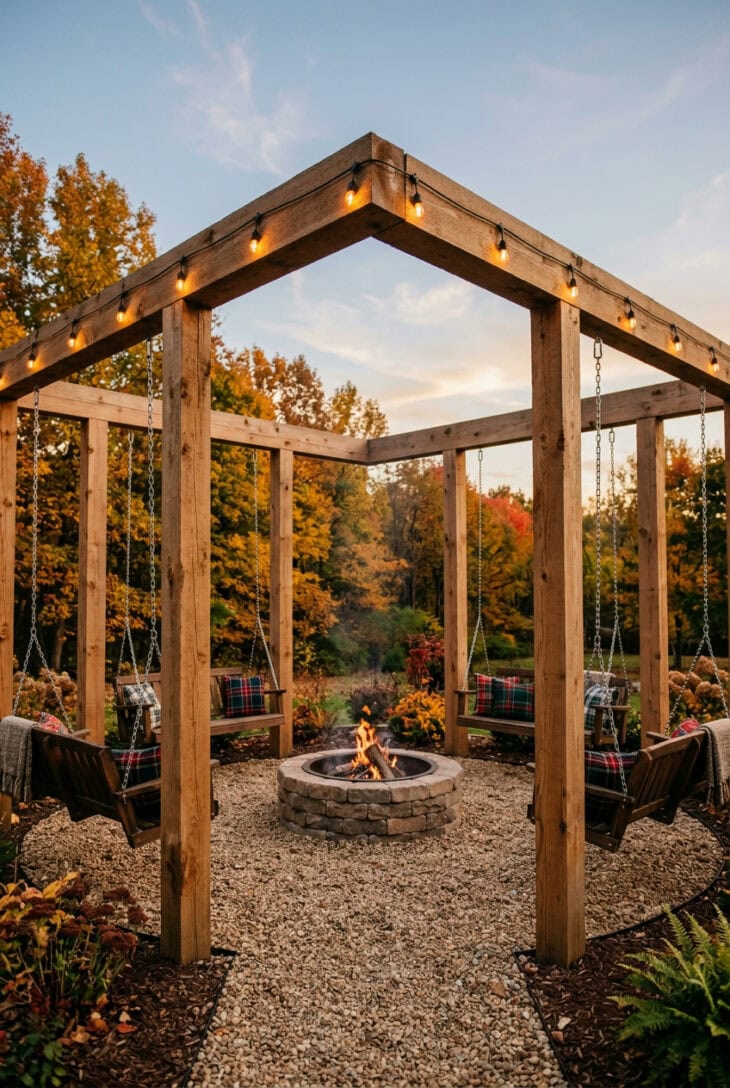
What you see A square frame of thick cedar posts and beams surrounds a gravel circle, with four wooden porch swings hanging from its outer edges, all turned toward a stone fire pit in the middle. The center of the frame is open to the sky above the flames. Plaid pillows sit on the swings, and warm lights run along the beams against the twilight.
Why it works Swings are the most requested seat at any fire pit, and it is easy to see why: the gentle rocking is relaxing, children love them, and they turn the fire circle into a destination. Building them into a frame gives the space a clear shape and a sense of enclosure, like a room with no walls.
How to get it The frame is a serious carpentry job: use 6×6 posts set in concrete below the frost line, doubled 2×10 or larger beams, and heavy-duty swing hangers rated for the load. Make the frame big enough that the front edge of each swing, at its furthest forward swing, stays 4 to 5ft (1.2 to 1.5m) from the fire, which usually means about 20ft (6m) square overall. Leave the center of the frame open, with no beams or roof over the fire. Use 4 or 5ft (1.2 or 1.5m) swings, and hang them so the seat sits 17 to 19in (43 to 48cm) off the ground. Check the chains and hangers every spring, since weather wears them.
21. Firewood Store as a Garden Screen
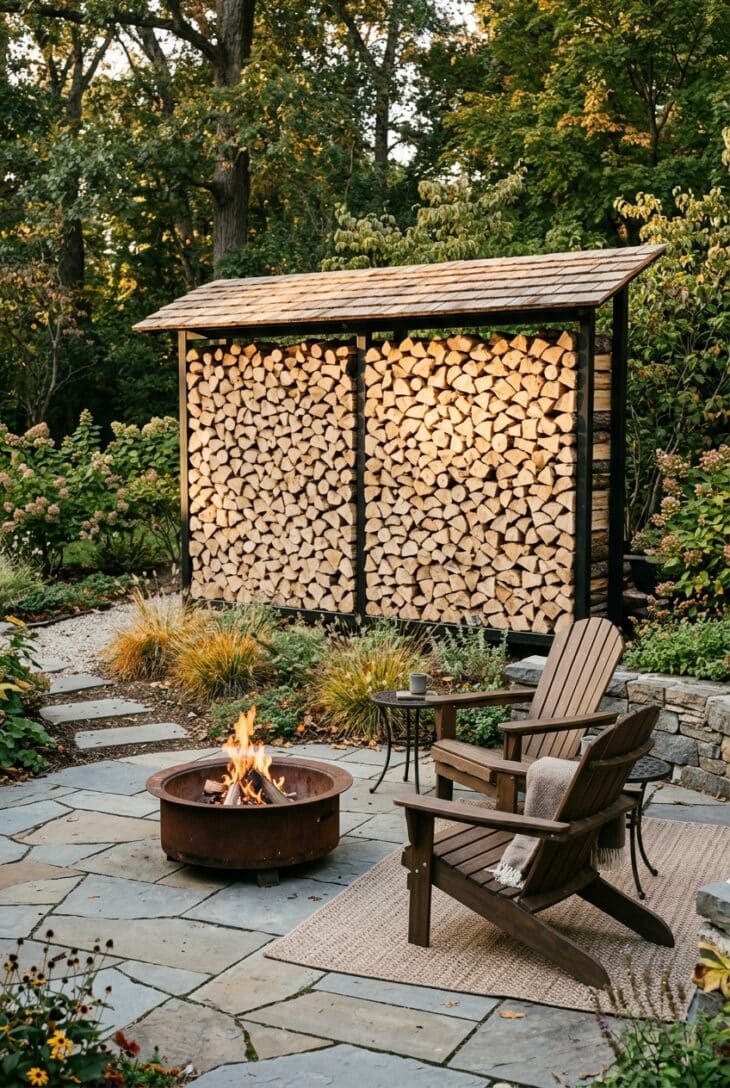
What you see At the back of a fire pit area stands a tall steel rack with a slanted cedar roof, packed with split oak so the pale log ends form a textured wall. Low grasses and shrubs soften its base. In front, at a comfortable distance, a small fire burns in a round pit on flagstones between two chairs.
Why it works Firewood has to live somewhere, and a neat stack is handsome in its own right. Designing the store as a wall gives it a second job: it screens a view, blocks the wind or marks the edge of the fire pit area. The texture of stacked log ends is especially beautiful in low, raking light.
How to get it Build or buy a rack with a roof to keep rain off the top, open sides so air can dry the wood, and a raised base to keep logs off damp ground. Set it at least 15ft (4.5m) from the fire so sparks cannot reach it, and away from the house: a woodpile against a wall invites termites and carpenter ants indoors. Keep only a basket of the evening’s supply near the fire. Stack wood bark side up and let it season 6 to 12 months, until it is below 20 percent moisture, which you can check with an inexpensive moisture meter. Seasoned oak, maple, hickory and fruitwoods such as apple burn hot and clean; avoid pressure-treated, painted or stained lumber, which releases toxic smoke.
22. Cooking Fire Pit with a Swing-Arm Grill
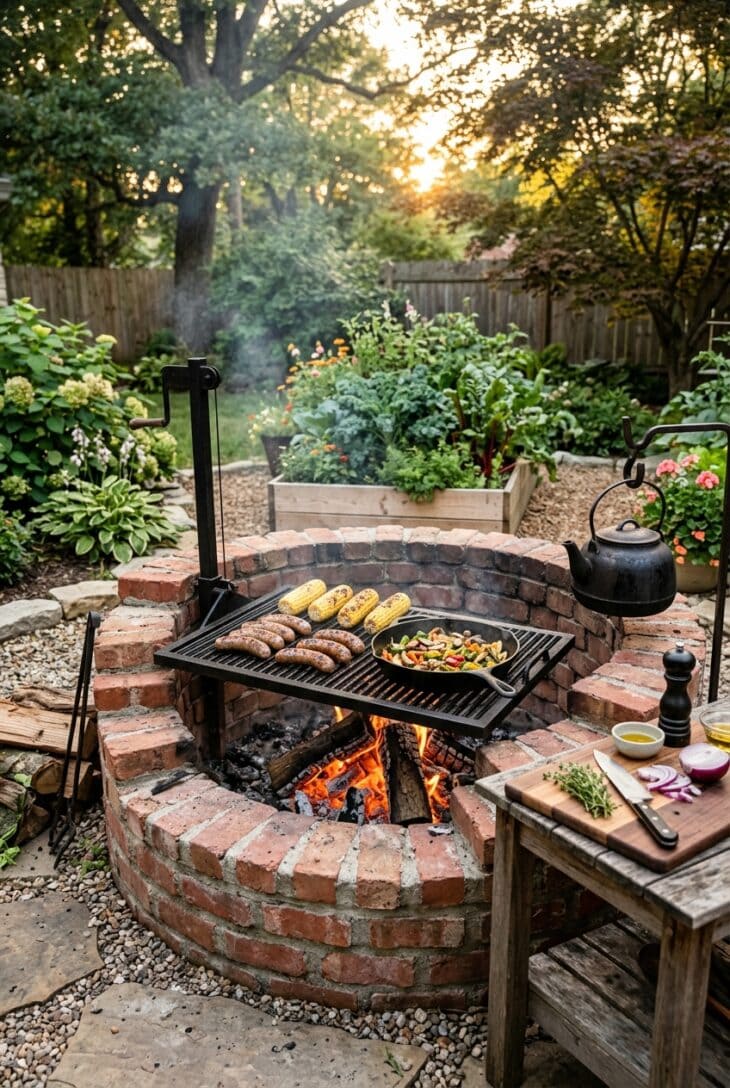
What you see A brick fire pit glows with a bed of hardwood coals under a heavy cast-iron grate on a swing arm. Sausages and corn cobs sizzle, and a skillet of vegetables sits at the edge. A wooden prep table holds a cutting board and fresh herbs, a black kettle hangs from a hook, and a bed of kale and chard grows just behind.
Why it works Cooking gives a fire a purpose and a rhythm. A swing-arm grate lets you move food on and off the heat without lifting anything hot, and the cooking fuel is the same wood that keeps everyone warm afterward. Putting the fire pit near the vegetable garden means dinner can go from bed to grill in a few steps.
How to get it Build the pit 30 to 36in (75 to 90cm) across, lined with fire brick, and bolt the swing-arm post into the masonry or set it in concrete beside the pit. Cook over coals, not flames: burn hardwood down for 30 to 45 minutes until it forms a glowing bed, then rake it level under the grate. Oak, hickory, maple and fruitwoods all give good flavor; never cook over softwoods such as pine, which leave a resinous, sooty taste. Keep a prep table within reach, a bucket of water or a hose nearby, and a lidded metal can for ashes, which stay hot for days. Plant a few vegetable garden beds nearby and the menu takes care of itself.
23. Round Brick Fire Pit on a Brick Circle
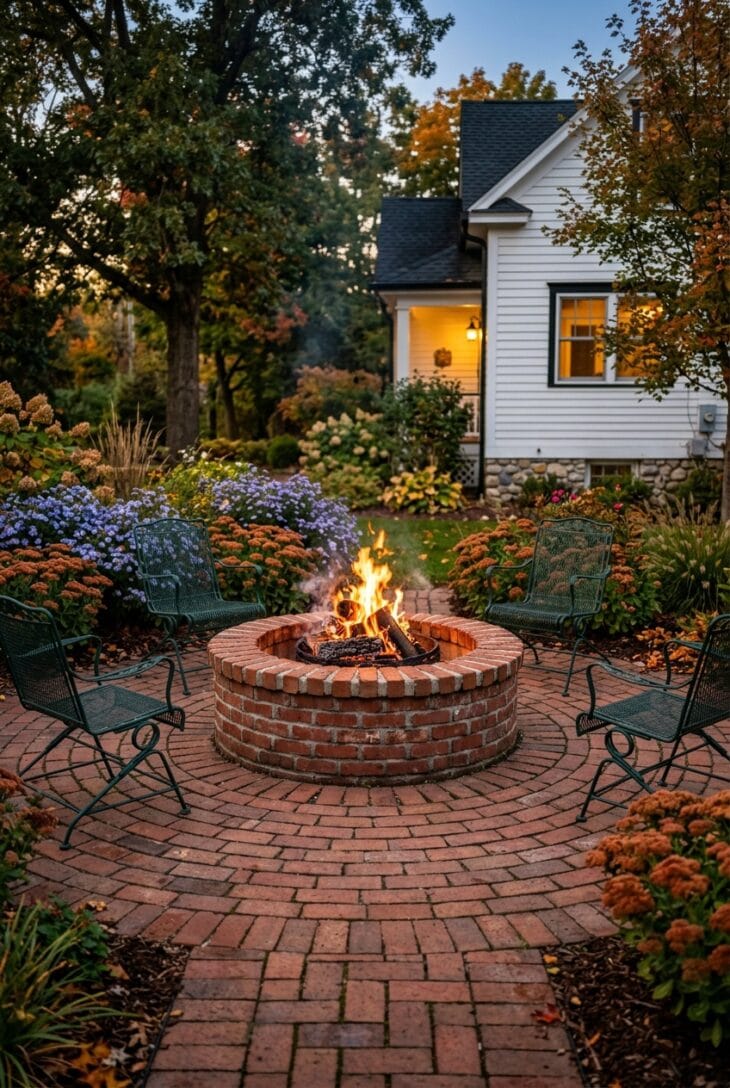
What you see A classic red brick fire pit with a neat rowlock cap sits at the center of a round brick patio, the bricks laid in rings that ripple outward from the fire. Green metal chairs circle the pit, and blue asters and rusty sedum fill the border around the edge. A white clapboard house and a porch light glow in the distance.
Why it works Brick is the natural partner for an older house or a traditional garden, and it ages beautifully. Laying the patio in concentric circles makes the fire pit the unmistakable center of the space: every ring leads the eye back to it. It is a formal look, but warm rather than stiff, and brick is naturally fire-safe.
How to get it Many brickyards sell circle kits with the tapered bricks needed for the inner rings, which saves a lot of cutting. Lay the patio on 4in (10cm) of compacted base and 1in (2.5cm) of sand, and choose paver bricks rated for freeze-thaw, not wall brick. Line the fire pit itself with fire brick and use refractory mortar for that inner course, since ordinary mortar breaks down under heat. A circle about 16ft (4.9m) across seats four to six comfortably. Plant New England aster (Symphyotrichum novae-angliae) and ‘Autumn Joy’ sedum (Hylotelephium ‘Herbstfreude’) around the edge for flowers that peak just as fire season begins.
24. Flagstone Fire Patio with Planted Joints
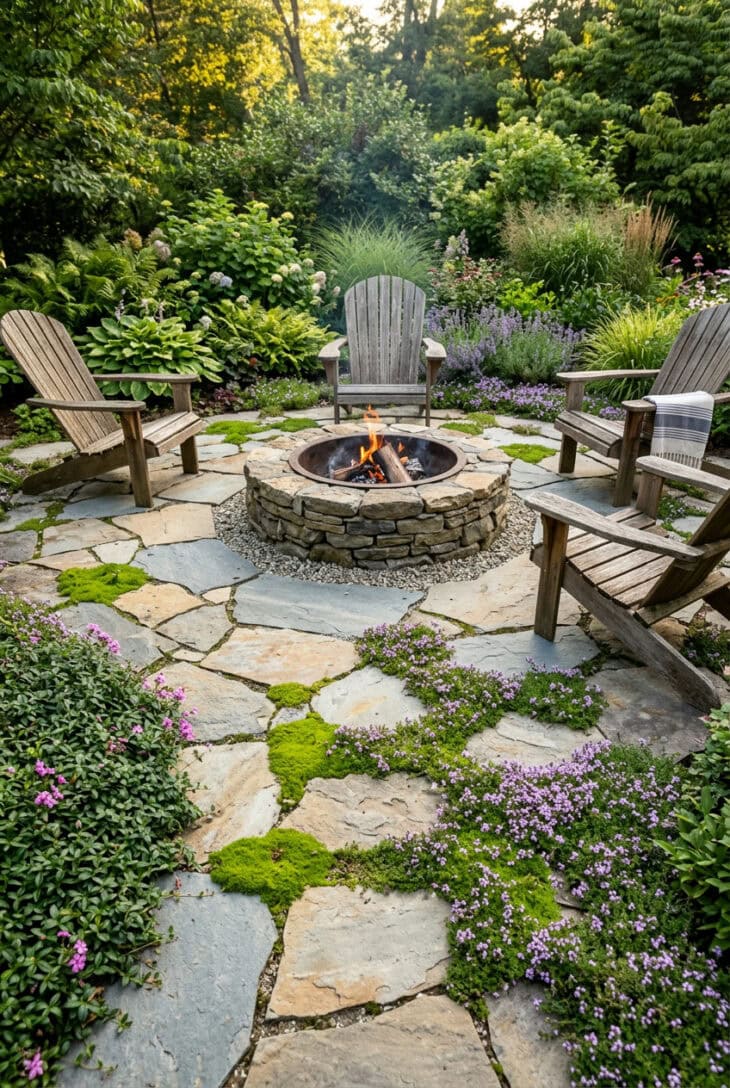
What you see An irregular patio of blue-gray and buff flagstone surrounds a low fire pit. Near the fire, the joints are packed with fine gravel; further out, they soften into bright green cushions of moss and creeping thyme dotted with tiny purple flowers. Creeping phlox spills over the edges, and three wooden chairs sit in the late-day light.
Why it works Planted joints make a hard patio feel like part of the garden. The key is where you put them: the ring nearest the fire gets gravel, which cannot burn or scorch, and the plants take over only where the heat does not reach. Creeping thyme releases a light scent when chairs are dragged across it.
How to get it Lay flagstones 1.5 to 2in (4 to 5cm) thick on compacted base and sand, leaving joints 1 to 2in (2.5 to 5cm) wide. Fill joints within 4ft (1.2m) of the fire pit with fine gravel or polymeric sand. Beyond that, fill joints with a sandy soil mix and plant creeping thyme (Thymus serpyllum) in sun or Irish moss (Sagina subulata) where there is part shade and steady moisture. Plant creeping phlox (Phlox subulata) along the outer edge for a flush of spring flowers. Water the joint plants through their first summer, then they need little care beyond an occasional trim.
25. Fire Pit Ringed by Fall-Color Trees
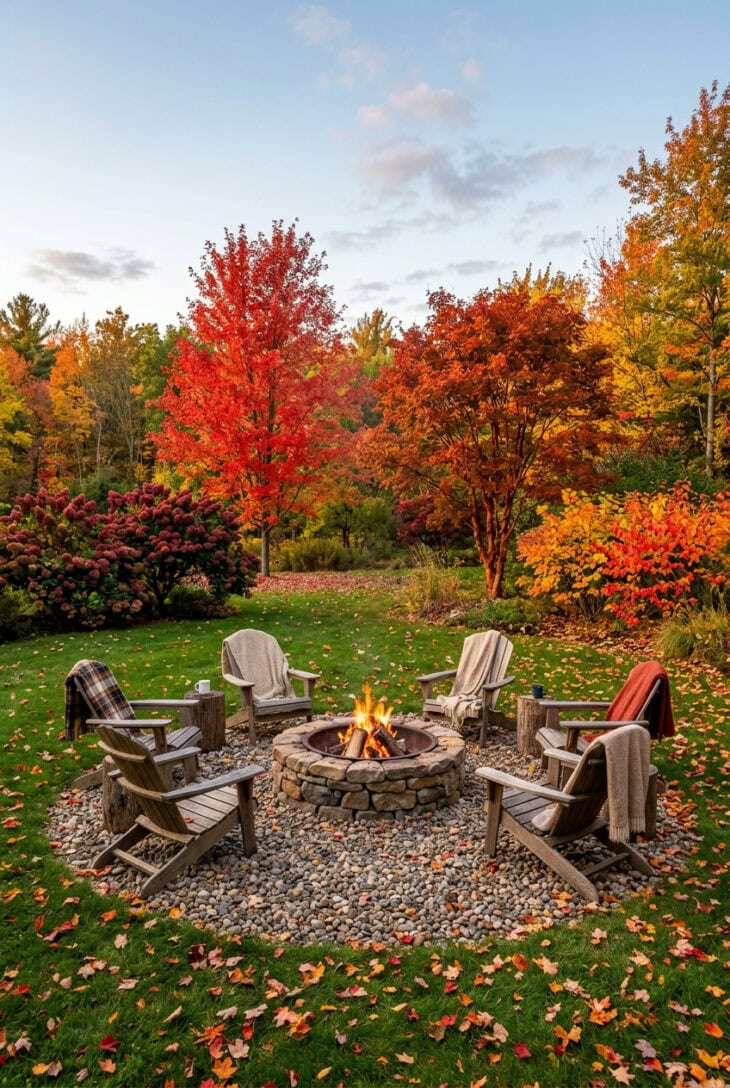
What you see A stone fire pit burns in a gravel circle at the center of a clearing, and all around it, at a generous distance, the trees and shrubs are at their peak. A red maple blazes scarlet, a paperbark maple shows cinnamon bark under orange leaves, and oakleaf hydrangea and fothergilla add burgundy, orange and yellow. The sky above the fire is open, and red leaves lie scattered on the grass.
Why it works Fire pit season and leaf season happen at the same time, so planting for fall color is the best way to give the fire a setting. A ring of trees and shrubs encloses the space, frames the view from every seat, and at dusk the leaves seem to glow in the firelight. Choosing plants with good bark and structure keeps the scene interesting after the leaves have dropped.
How to get it Plant trees far enough from the fire that their mature canopy will never reach over it: red maple (Acer rubrum ‘October Glory’) spreads 35ft (10.7m) or more, so it belongs at the edge of the yard, while paperbark maple (Acer griseum) stays about 20ft (6m) wide and can come closer. Fill the gaps with oakleaf hydrangea (Hydrangea quercifolia ‘Snow Queen’) and fothergilla (Fothergilla gardenii), both of which color reliably in part shade. Rake leaves away from the fire pit before every fire, since a dry pile is instant tinder.