A zen garden asks you to do one thing: look. There is no border to deadhead, no lawn to mow and no plant list to learn, just raked gravel, a stone or two and enough quiet to hear yourself think. That is why it has become the garden people build when the rest of life is loud.
Contents
- 01. Build a Raked Gravel Rectangle in a Weekend
- 02. Rake Three Patterns Until You Have a Favorite
- 03. Choose Gravel for the Lines You Want
- 04. Set One Boulder as the Island
- 05. Pile a Gravel Cone for Moon Viewing
- 06. Edge the Bed With Steel or Stone
- 07. Keep a Tabletop Zen Garden on the Patio Table
- 08. Fill a Shallow Bowl for a Balcony Corner
- 09. Build It at Table Height So You Can Rake Seated
- 10. Add a Seat at the Edge for Looking
- 11. Lay a Loop for Walking Meditation
- 12. Turn a Narrow Side Yard Into a Zen Corridor
- 13. Clip a Dark Evergreen Hedge Behind It
- 14. Anchor a Corner With a Dwarf Hinoki Cypress
- 15. Plant a Clump of Fountain Bamboo, Not a Running One
- 16. Swap in Native Plants for the Japanese Classics
- 17. Plant Grasses That Whisper in the Wind
- 18. Add One Fragrant Shrub for Winter Scent
- 19. Add a Bubbling Basalt Column Fountain
- 20. Hang a Rain Chain Over a Gravel Basin
- 21. Set a Shallow Water Bowl to Catch the Sky
- 22. Hang One Low-Toned Wind Chime
- 23. Build a Desert Version With Agave and Red Gravel
- 24. Light One Rock From Below
- 25. Keep Cats and Weeds Out of the Gravel
The 25 ideas below run from a tray you can set on a patio table to a whole side yard, and from an afternoon with a bag of sand to a weekend with a wheelbarrow. Some use no plants at all, some lean on slow evergreens and native grasses, and a few suit desert yards, shady corners, balconies and gardeners who rake from a chair.
Pick the one that fits your space and the time you have, and build it properly. A zen garden improves by subtraction, so one idea finished is worth more than five half-started. For the wider tradition of ponds, maples and lanterns, see our Japanese garden ideas.
01. Build a Raked Gravel Rectangle in a Weekend
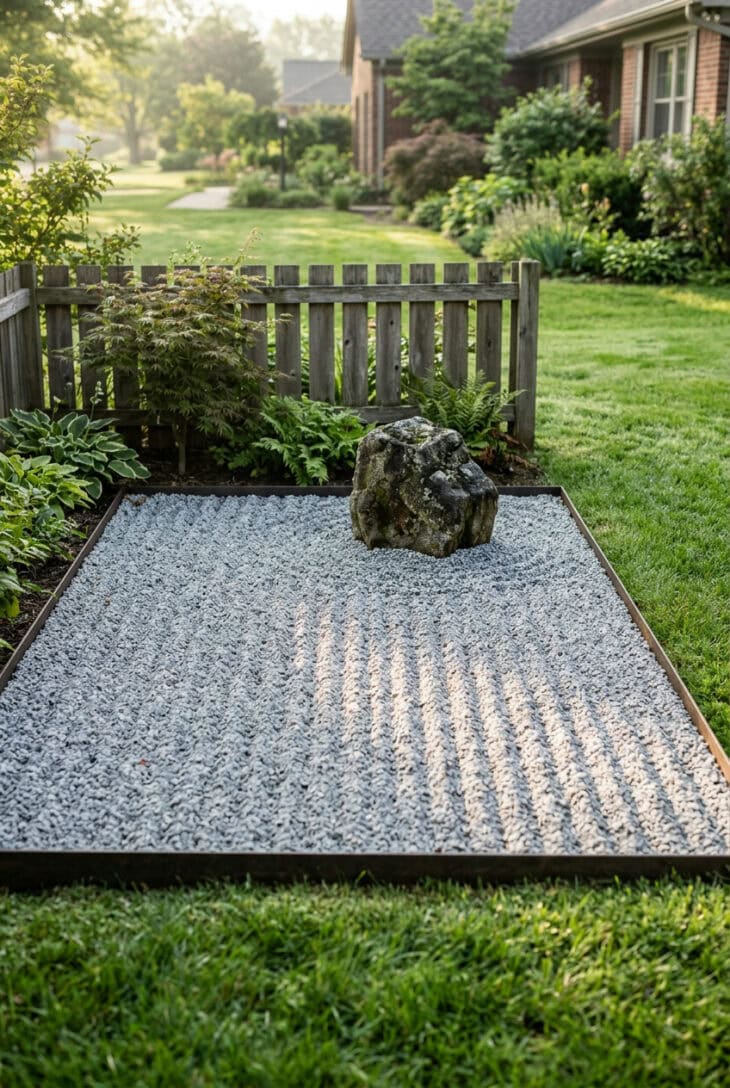
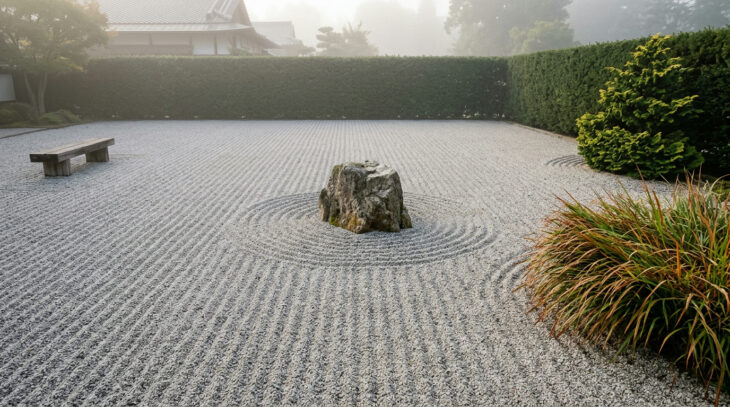
What you see A pale gray rectangle sits at the edge of an ordinary lawn, raked into long parallel lines that run toward one weathered boulder at the far end. A thin dark steel edge keeps the shape crisp. Low morning light picks out every groove, and the green lawn beside it makes the stillness look deliberate rather than unfinished.
Why it works A dry garden asks almost nothing of the site: no good soil, no irrigation, no minimum hours of sun. A rectangle is also the shape that reads as intentional at first glance, even in a yard with no other design. It is the cheapest honest way to try the style, because the whole garden is gravel, one stone and a rake.
How to get it Mark out a bed about 6 by 8ft (180 by 240cm), dig out 4in (10cm) of soil, and compact the base with a hand tamper. Lay woven landscape fabric over it, fix an edge of steel or stone, then fill with 3in (8cm) of 3/8in (1cm) crushed granite. That is about half a cubic yard (0.3 cubic meters), so have it delivered rather than hauling bags. Choose angular crushed stone over round pea gravel, because round stones roll out of their lines. Put the bed where you see it from a window or a favorite chair, since a garden you never look at is just a patch of gravel.
02. Rake Three Patterns Until You Have a Favorite
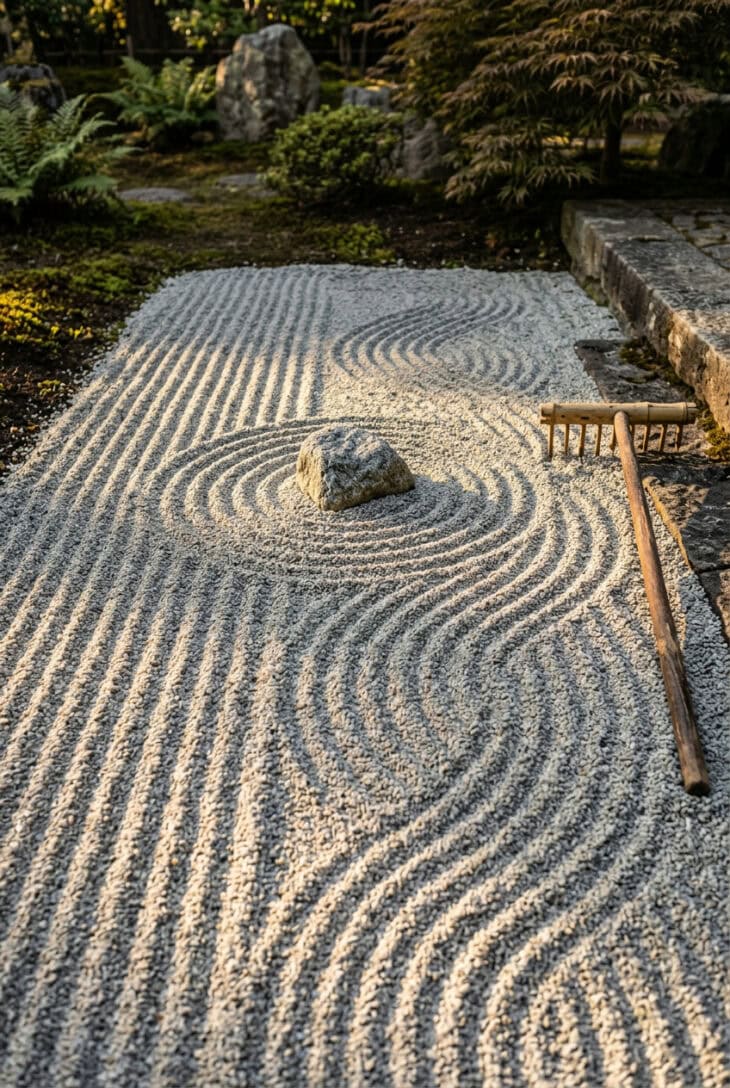
What you see Three patches of freshly raked gravel sit side by side: dead straight lines, rings circling a small rock, and overlapping arcs like waves. A wooden rake rests at the edge. Low sun throws a thin shadow into every groove, so the patterns look almost carved.
Why it works The pattern sets the mood. Straight lines suggest flat, calm water, rings read as ripples spreading from a stone, and overlapping arcs are livelier, like a rolling sea. Raking is also the point of the garden: in Zen temples it is treated as part of the practice, and because the pattern is temporary, a mistake costs a minute and nothing more.
How to get it A wide-toothed wooden rake gives cleaner lines than a garden rake, but a plastic leaf rake will do for a first try. Smooth the surface flat with the back of the rake, then start at the far end and pull one steady stroke toward you without stopping mid-line. For rings, rake the one nearest the stone first and work outward, and lay a plank down to stand on so you do not leave footprints. Re-rake after heavy rain, which flattens the grooves, and enjoy the fact that the garden is never quite finished.
03. Choose Gravel for the Lines You Want
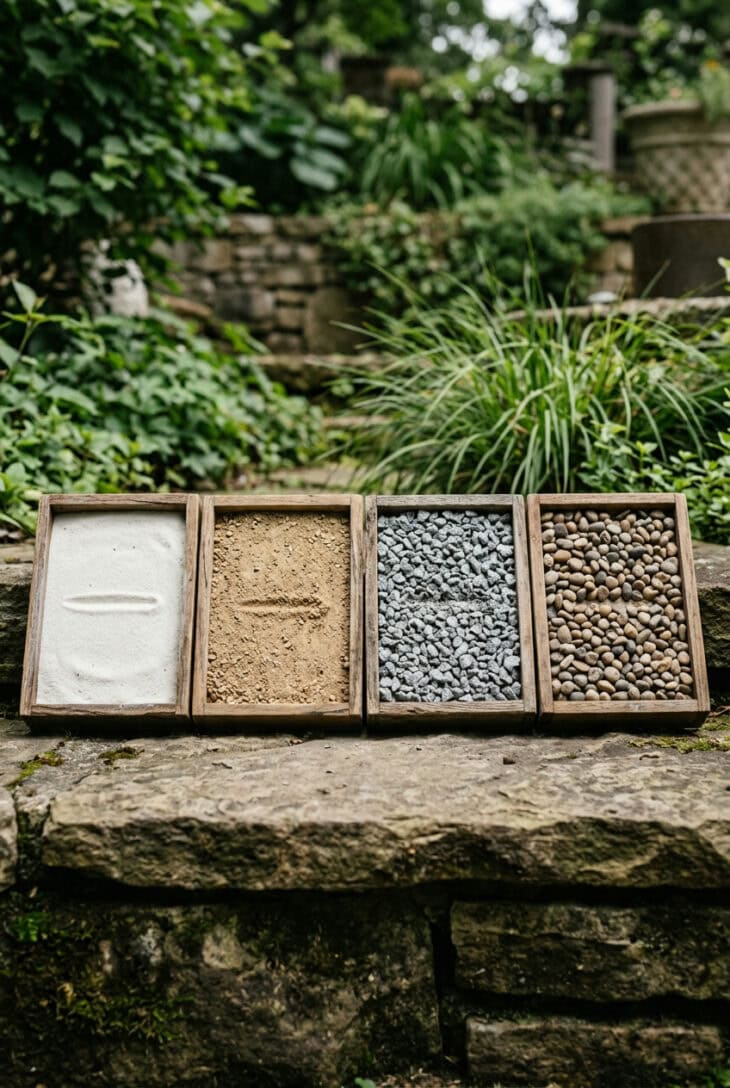
What you see Four shallow trays sit in a row on a stone ledge, each filled with a different material, from fine white sand to coarse round pea gravel. Each tray carries a short raked mark, and the finest ones hold crisp lines while the coarse one barely shows a groove.
Why it works The material decides how sharp the raking looks and how long it lasts. Fine sand holds thin, crisp lines but blows around, packs hard in rain and tempts cats. Coarse round gravel stays put but will not hold a pattern, so the middle ground of washed, angular crushed stone is where most people end up, much as in a classic gravel garden.
How to get it Ask a stone yard for 3/8in (1cm) crushed granite or granite chips, washed so the dust has been removed, and buy one bag first to test. Pale gray or buff stone shows shadow in the grooves better than dark stone. Wet a handful to see how the color changes, because it will look darker after every rain. Decomposed granite works if you like a softer, tan look, but it crusts over after rain and needs loosening with the rake before each session.
04. Set One Boulder as the Island
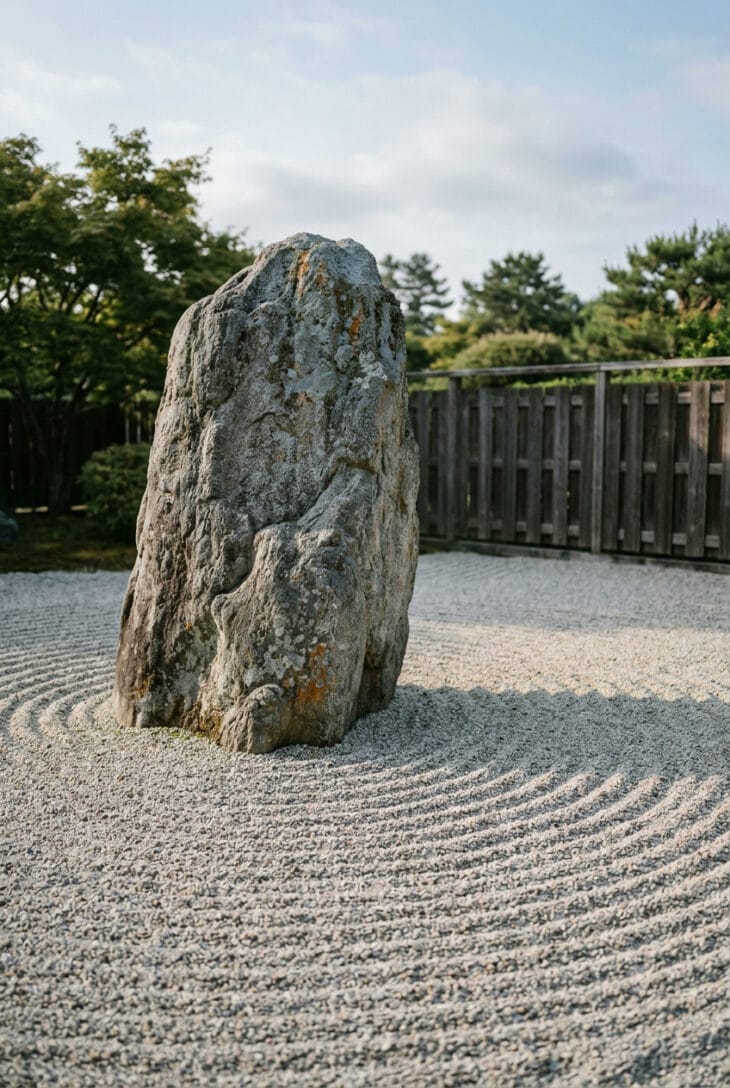
What you see One weathered granite boulder, taller than it is wide, rises out of pale raked gravel like an island. Ripples circle its base in neat concentric rings. Faint patches of lichen mark the rock face, and a plain dark fence behind it keeps the eye on the stone.
Why it works One strong object gives the eye a place to rest, and the empty gravel around it makes the stone look bigger. A boulder buried a third of the way into the ground looks as if it has always been there, while one sitting on top of the surface looks delivered. This is the same logic as a good rock garden: the stone should look like an outcrop, not a decoration.
How to get it Choose the stone in person at a stone yard, and look for a rough, weathered surface and a shape taller than it is wide. Dig the hole first, set the boulder a third to half deep, and tamp gravel around the base so it cannot rock. Place it off center and slightly back, roughly a third of the way into the bed. A 2ft (60cm) boulder can weigh several hundred pounds (well over 100kg), so use a dolly, pipe rollers or a stone yard that offers placement, and never lift it by hand.
05. Pile a Gravel Cone for Moon Viewing
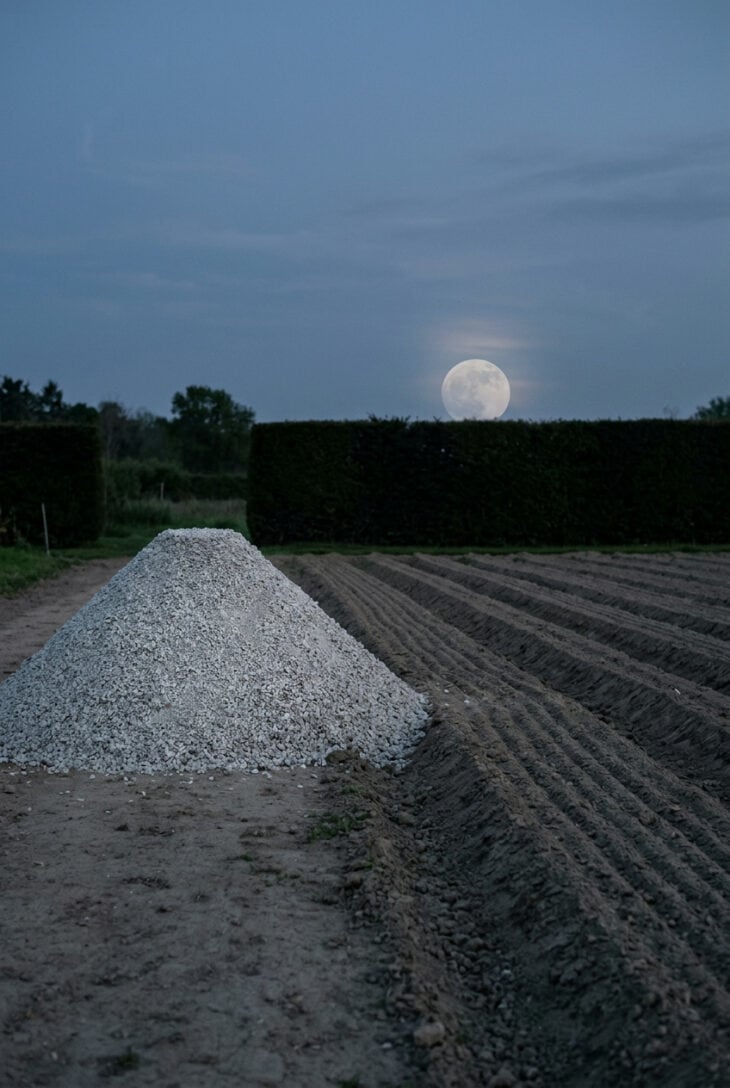
What you see A flat-topped cone of pale gravel, about knee high, stands beside a field of raked furrows at dusk. A full moon is rising over a dark clipped hedge behind it, and the pale stone glows faintly silver. The garden looks emptied of everything except light.
Why it works This idea comes from Ginkaku-ji in Kyoto, where a truncated cone of sand called the Kogetsudai, roughly translated as the moon-viewing platform, stands beside a raked sand garden. The cone adds the one thing a flat gravel bed lacks, which is height, and pale stone catches whatever light is left in the evening. It suits anyone drawn to a moon garden but short on white flowers.
How to get it Pour pale gravel from a bucket onto a flat patch of the bed and it will settle into a cone at its own natural angle, so you barely need to shape it. Flatten the top with a board and aim for a height of about 16 to 24in (40 to 60cm). Rake rings around the base to finish it. Gravel slumps after heavy rain, so expect to touch up the shoulders after storms.
06. Edge the Bed With Steel or Stone
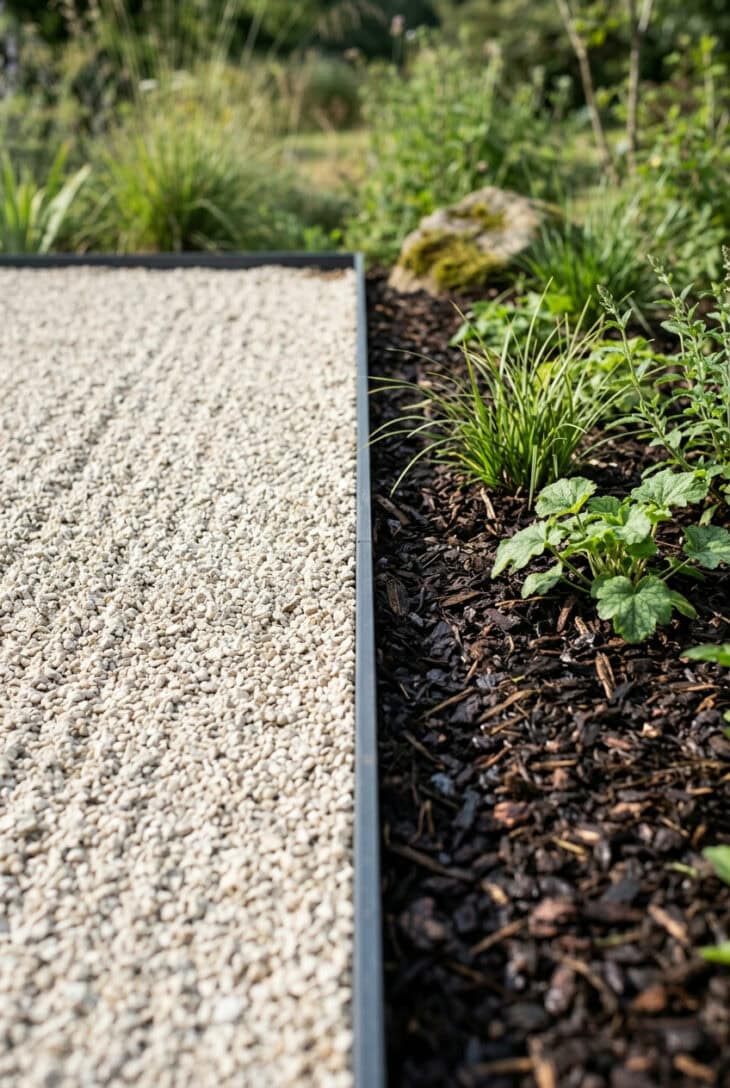
What you see A thin charcoal steel strip draws a clean line between pale raked gravel and a dark planted bed. The top edge of the steel runs level for the full length of the bed. Beyond it, a few rocks and soft grass blur into the background, and the contrast makes the gravel look sharper.
Why it works Without a hard edge, gravel creeps into the soil and soil creeps into the gravel, and within a year the clean rectangle has fuzzy borders. A crisp edge also works as a frame, so the raked area reads as a picture rather than a patch of ground. It is a quick upgrade for any bed, and our garden edging ideas cover other materials.
How to get it Use powder-coated or weathering steel edging about 4in (10cm) tall and stake it every 3 to 4ft (90 to 120cm). Set it so the top stands about 1in (3cm) above the finished gravel, which stops the gravel spilling out. Steel edge strips are sharp, so wear gloves and keep the cut ends at the back of the bed. If you prefer a softer look, a row of flat pavers set level with the soil does the same job and doubles as a mowing strip.
07. Keep a Tabletop Zen Garden on the Patio Table
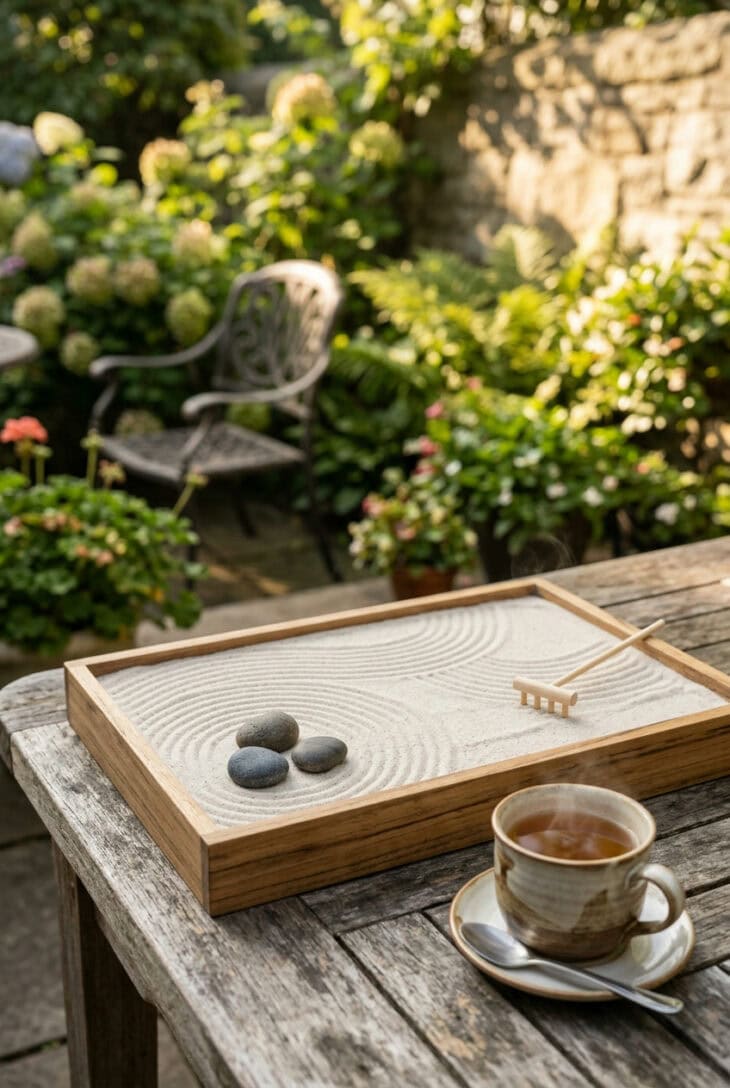
What you see A wooden tray the size of a placemat holds fine pale sand raked into neat lines, with three small stones set off center. A tiny rake lies beside it, next to a cup of tea. Behind it the patio blurs into green, and the whole scene fits on a single table.
Why it works This is the smallest version of the idea, and it works as a break rather than a project. It needs no digging, costs very little, and suits renters, apartments and anyone who wants to try raking before committing to a bed. Five minutes with the rake in the morning does what a longer walk would do, which is clear the head.
How to get it Use a tray about 12 by 18in (30 by 45cm) with a rim at least 1in (3cm) tall, in wood, slate or a shallow ceramic dish. Fill it with 1 to 1.5in (3 to 4cm) of fine, dry sand, such as kiln-dried play sand, and set three small stones in an uneven group. A table fork or a small comb makes a good rake. Store it under cover, since damp sand clumps and will not hold a line. It sits happily among other patio garden ideas, such as a bench and a few pots.
08. Fill a Shallow Bowl for a Balcony Corner
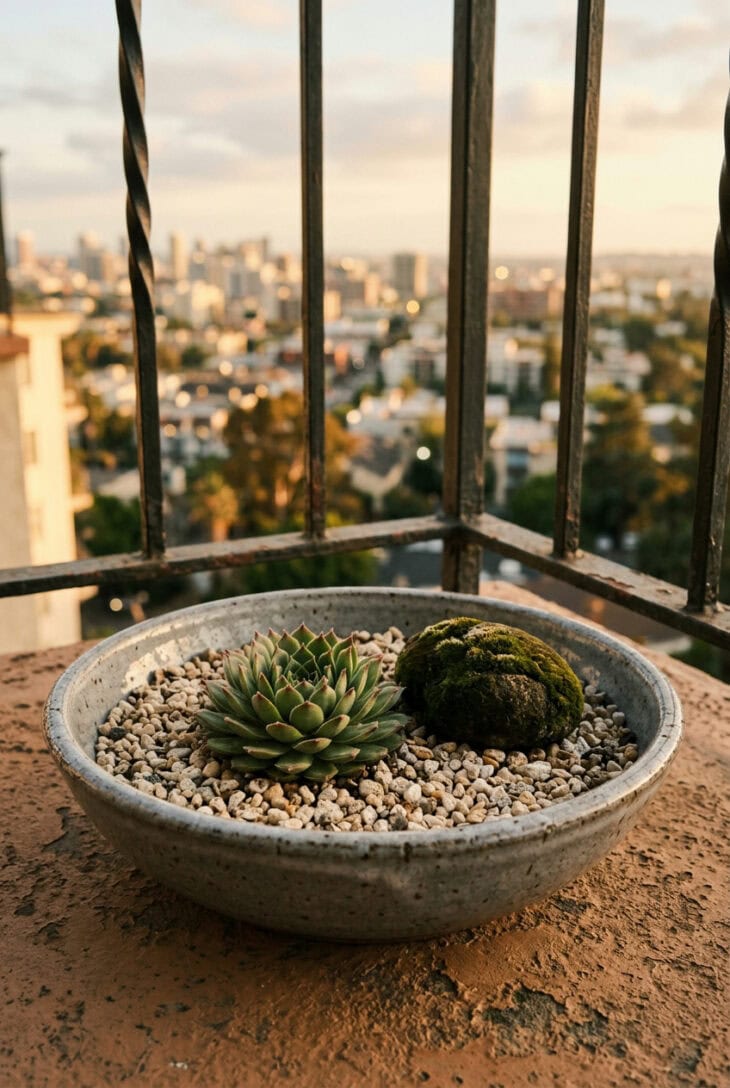
What you see A wide, shallow gray bowl sits on a balcony floor, filled with pale gravel, one dark stone and a single tight rosette of hens-and-chicks (Sempervivum tectorum). The metal railing and a blurred skyline sit behind it. In the low evening light the bowl reads as a miniature landscape with a horizon of its own.
Why it works A balcony has no ground to rake, but a wide, low container reads as a landscape in miniature. Limiting it to three elements, a stone, a plant and gravel, keeps it calm instead of cluttered. It is one of the easiest ways to bring the style to a balcony garden or a small container garden with almost no upkeep.
How to get it Choose a bowl 18 to 24in (45 to 60cm) wide that is frost-proof, such as fiberglass, concrete or thick glazed stoneware, with a drainage hole. Fill it with gritty cactus mix and top-dress with 1in (3cm) of gravel. Plant a single hens-and-chicks, which is hardy in Zones 3–8 in the ground and wants full sun and fast drainage. Roots in a pot freeze harder than roots in soil, so in Zone 5 and colder move the bowl against a wall or into an unheated garage for winter. Wet gravel and stone are heavy, so check your balcony’s load limit and never place loose stones where they could fall to the level below.
09. Build It at Table Height So You Can Rake Seated
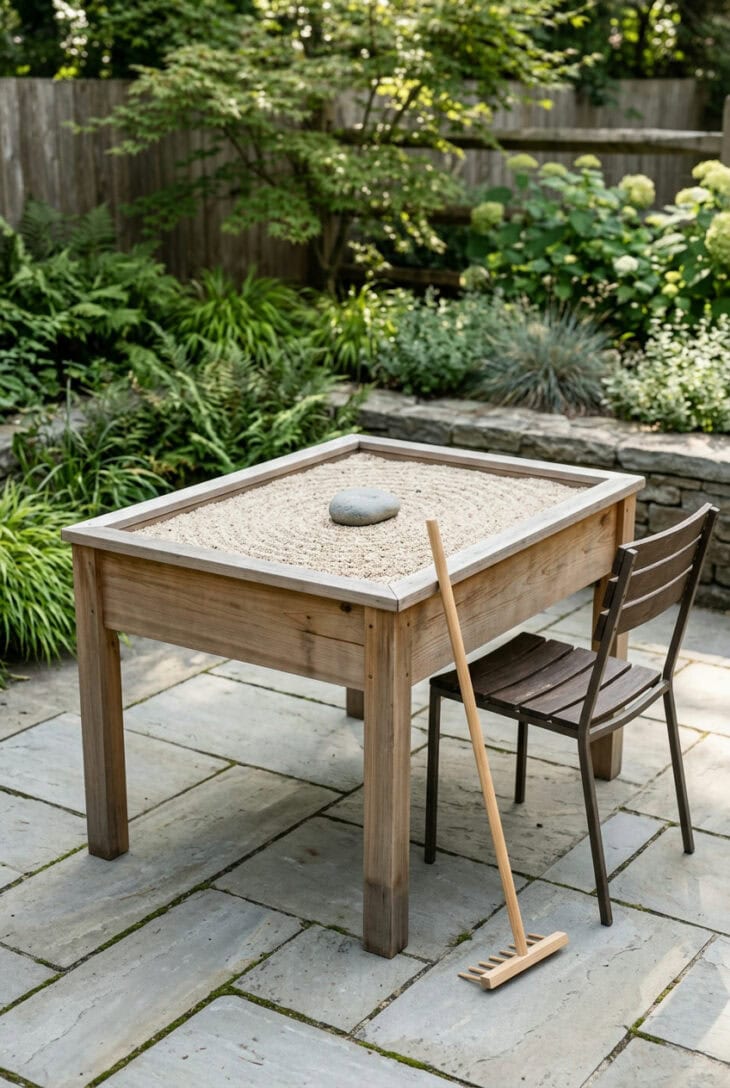
What you see A raised cedar box stands at table height on a paved patio, filled with finely raked pale gravel and a single smooth stone. A simple chair is pulled up to one side and a rake leans against the frame. At this height the raked lines sit right at eye level, as clear as a drawing.
Why it works Raking is the heart of the garden, and a bed at ground level quietly shuts out anyone who cannot kneel or bend. Lifting it to table height makes the practice open to people who sit or stand, and it brings the pattern up to eye level where you can see it. It is a small design change with a large effect on who gets to use the garden.
How to get it Build a cedar or steel trough about 24 to 30in (60 to 75cm) off the ground and about 3ft (90cm) across, so the middle is within reach from either side. Line it with landscape fabric, drill drainage holes in the base, and fill it with 3 to 4in (8 to 10cm) of fine crushed gravel. Put it on a flat, paved surface and use solid 4 by 4in legs, because damp gravel is heavy. Leave open space underneath if you want someone to roll a chair in close.
10. Add a Seat at the Edge for Looking
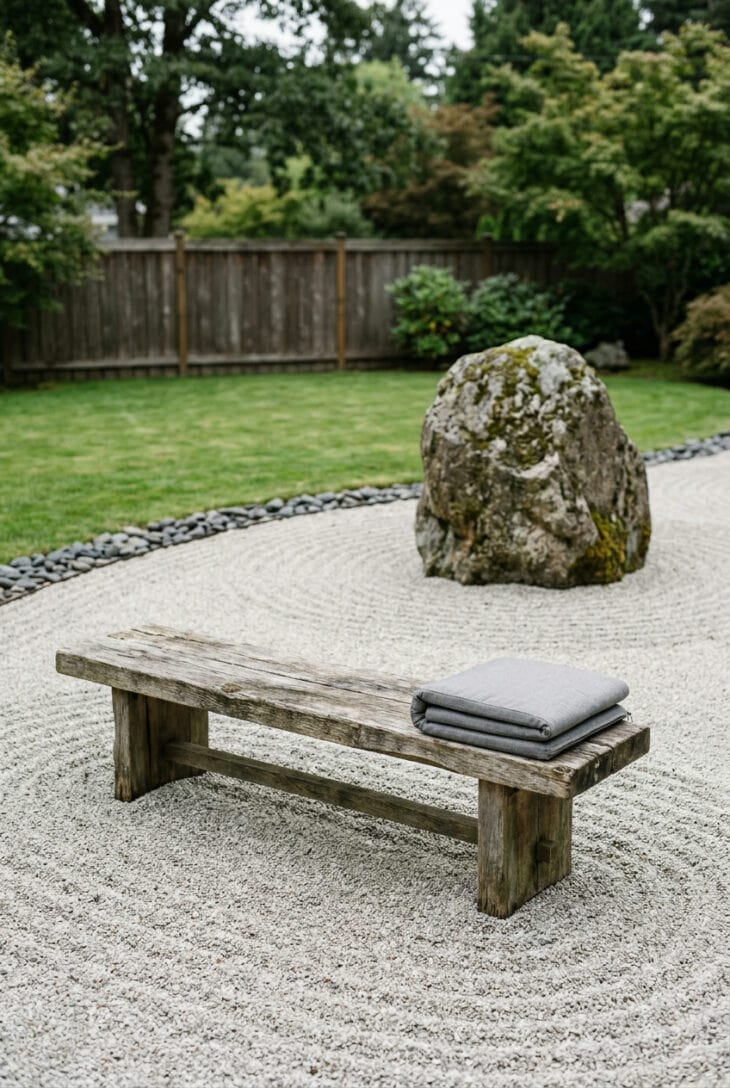
What you see A low weathered timber bench sits at the edge of a raked gravel garden, looking across the pale ripples to a single large boulder. A folded gray cushion rests at one end. The lawn and fence behind it are plain enough that nothing competes with the view.
Why it works A zen garden is made for looking, and without a place to sit most people give it ten seconds and walk on. A seat also settles the question of the viewpoint, which tells you where to put the best stone and what to hide. Once you know where the eyes will be, every other decision gets easier.
How to get it Aim for a seat height of 16 to 18in (40 to 45cm), either a plain hardwood bench or a flat stone slab set on two footings. Face it toward the main stone, with the house or street behind you so the only thing in front is the garden. Leave 4 to 6ft (120 to 180cm) between the seat and the boulder, which is far enough to see the whole raked pattern at once. Set the seat on compacted crushed stone so it cannot tilt, and keep a weatherproof cushion in a deck box nearby.
11. Lay a Loop for Walking Meditation
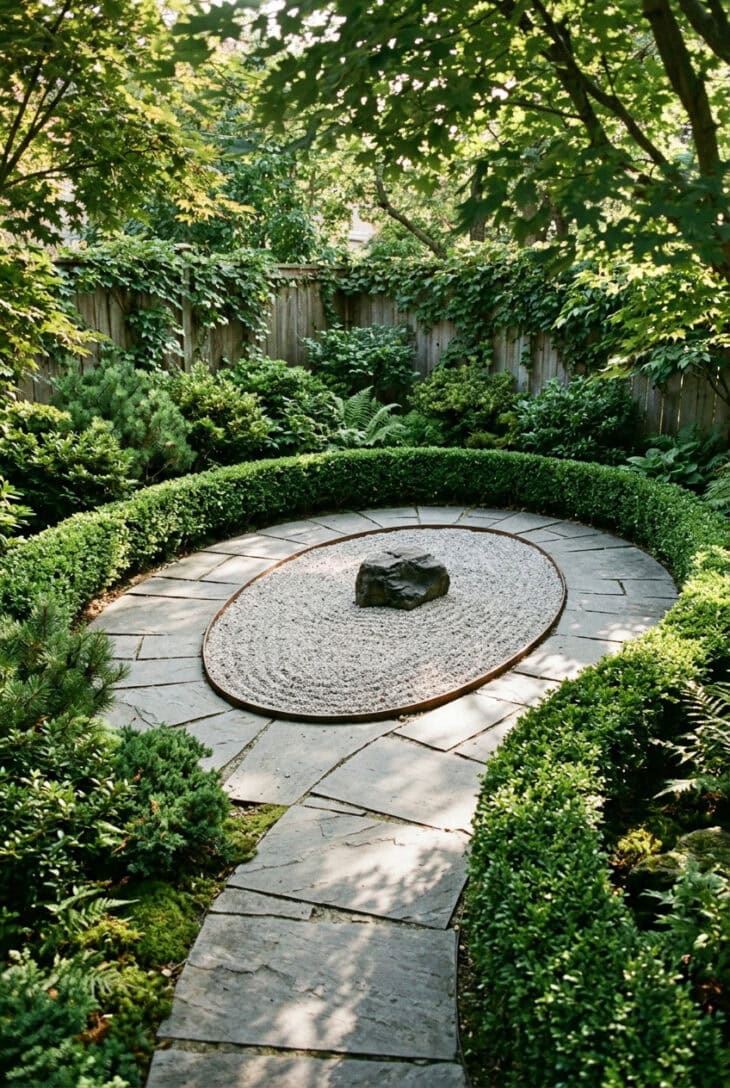
What you see A closed loop of flat gray stones curves around an island of raked gravel with a single dark rock at its heart. Low evergreen shrubs and a clipped hedge frame the path. Dappled afternoon light falls across the stones, and the loop has no beginning and no destination.
Why it works Walking meditation, called kinhin in Zen, is a slow walk between periods of sitting. A loop removes the question of where you are going, so you can pace it for ten minutes without arriving anywhere. It suits small yards well, because a circuit around a feature feels longer than a straight path of the same length.
How to get it Lay out a loop around 30 to 40ft (9 to 12m) long using flat stones 18 to 24in (45 to 60cm) wide. Set each one level with the soil on 2 to 3in (5 to 8cm) of compacted crushed stone, close enough that you can keep a slow, even step. A wobbling stone is a trip hazard, so test each one by standing on it before moving to the next. Fill the gaps with fine gravel, and see our garden path ideas for other surfaces.
12. Turn a Narrow Side Yard Into a Zen Corridor
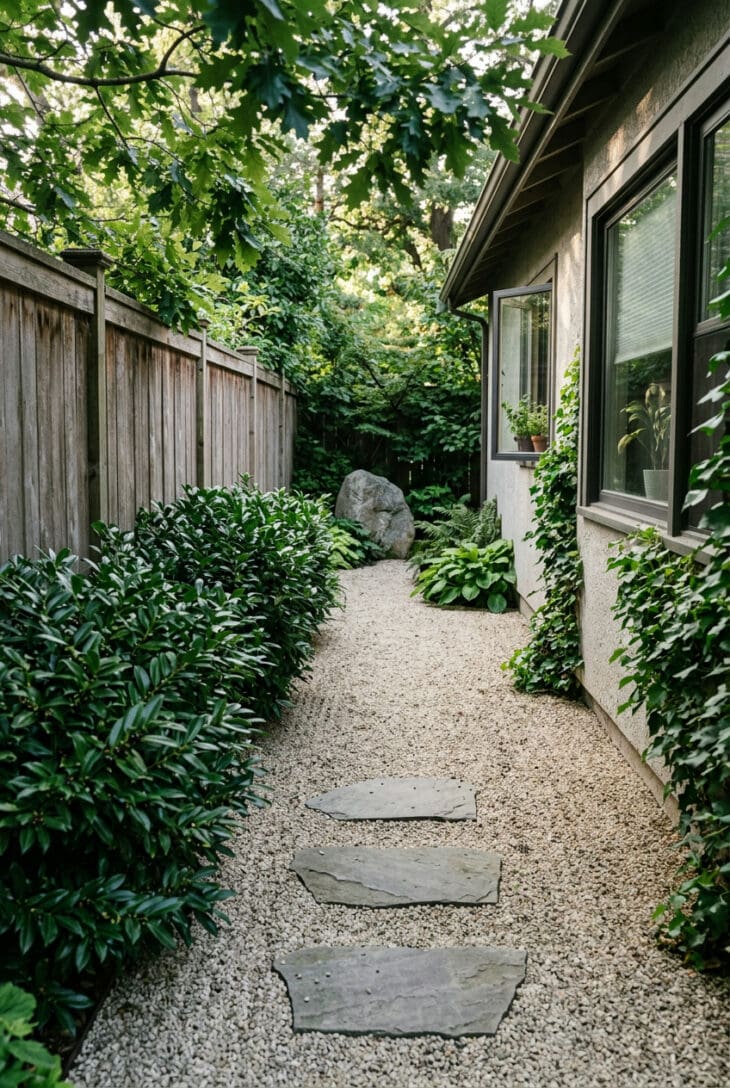
What you see A narrow strip between a fence and a house wall is floored with pale gravel raked lengthwise toward a single boulder at the far end. Dark glossy sweet box (Sarcococca hookeriana) shrubs line the fence, and three flat stones run down the middle. Soft dappled light at the far end pulls the eye all the way down.
Why it works A side yard is usually the most neglected space on the property, and it already has what a zen garden needs: enclosure, shade and no one watching. Raking the gravel lengthwise makes the strip look longer, and a single object at the far end gives the whole corridor a point. It works as a courtyard garden for people without a courtyard.
How to get it Before you start, keep the access to utility meters clear and make sure the ground still slopes away from the house so water can leave. Lay woven fabric and 2 to 3in (5 to 8cm) of crushed gravel, with the stepping stones set into it. Plant sweet box, hardy in Zones 5–8, along the fence in part to full shade with steady moisture. End the corridor with a boulder, a pot or a bench so the eye has somewhere to land.
13. Clip a Dark Evergreen Hedge Behind It
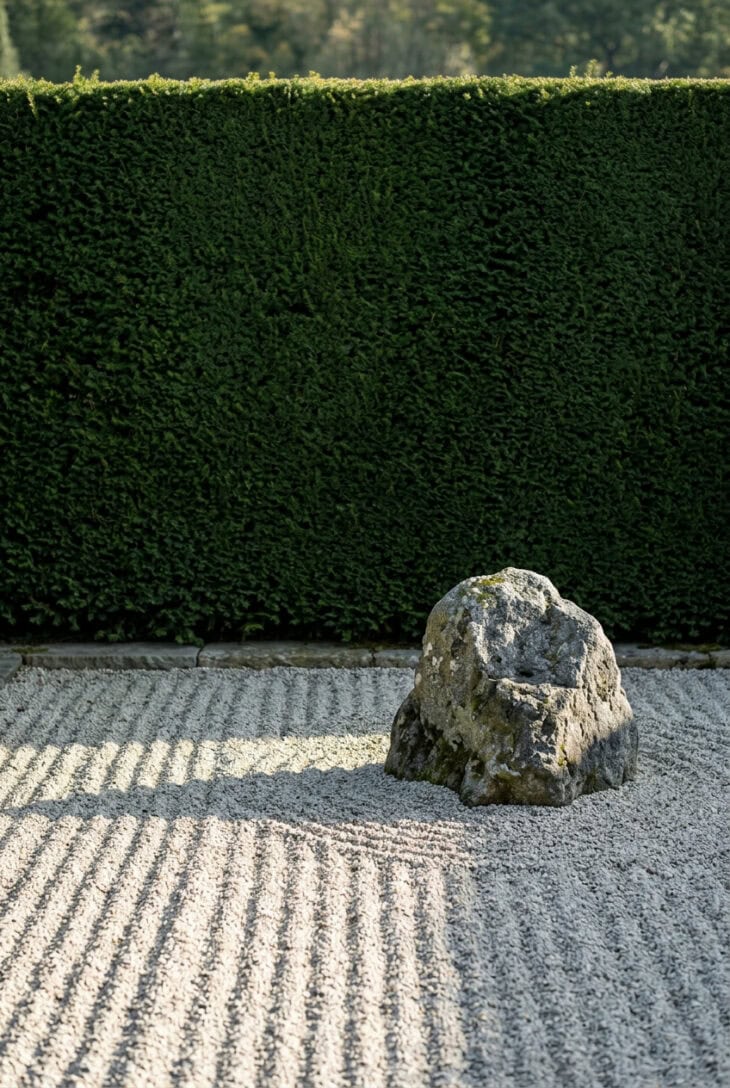
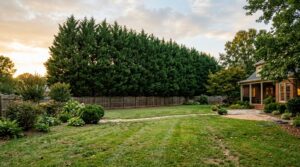
What you see A dense, tightly clipped hedge in a deep green stands behind a pale raked bed, its top as flat as a table. One gray boulder sits in front of it. The pale gravel glows against the dark green, and everything beyond the hedge has disappeared.
Why it works Pale gravel against a dark backdrop is the strongest contrast a quiet garden can have. A hedge also hides the fence, the neighbors and the clutter, which gives the garden the sense of enclosure that makes people relax. The garden stops competing with everything around it.
How to get it Yew (Taxus x media) is the classic dark hedge, hardy in Zones 4–7, and it takes clipping well in sun or part shade. The leaves, bark and seeds are poisonous to people, dogs, cats and horses, and NC State rates the severity as high, so skip it if pets or children use the yard. Japanese holly (Ilex crenata), hardy in Zones 5–8, is a dark green alternative that NC State lists as only low-severity poisonous to people. Plant either 2 to 3ft (60 to 90cm) apart and 2ft (60cm) back from the gravel, and clip in mid-summer once the new growth has firmed up.
14. Anchor a Corner With a Dwarf Hinoki Cypress
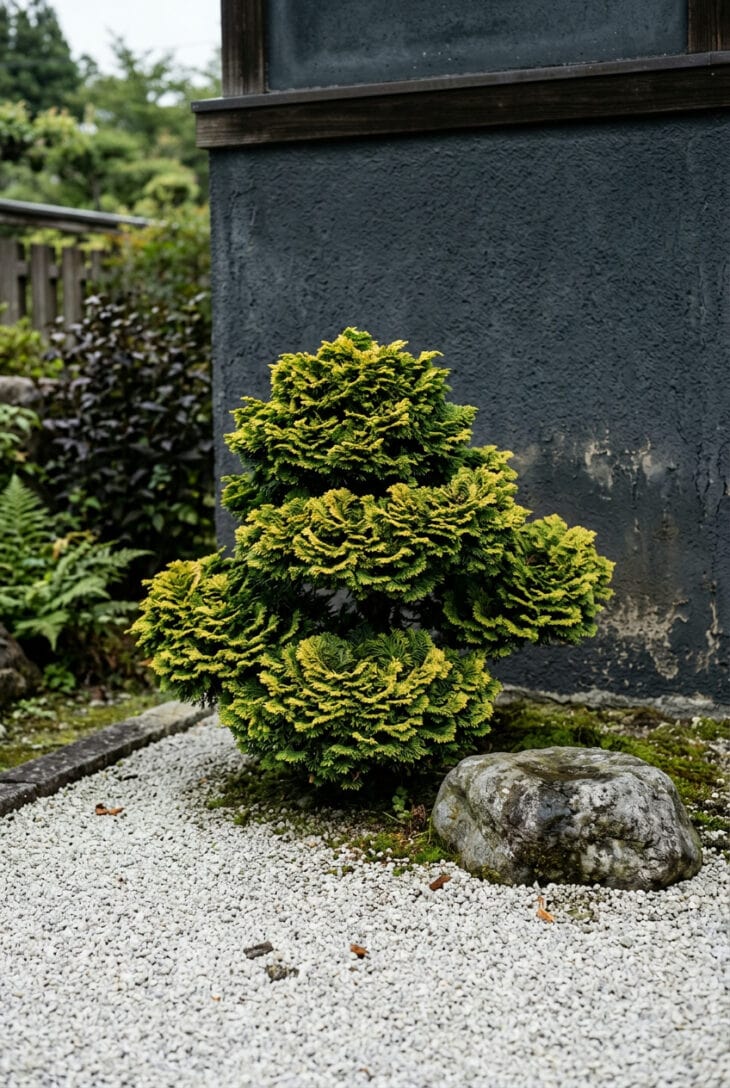
What you see A small golden-green hinoki cypress (Chamaecyparis obtusa) forms a dense, layered mound at the corner of a gravel bed, its foliage fanned out in flat sprays like folded fabric. A single gray stone sits beside it and a dark wall rises behind. The overcast light makes the color glow without glare.
Why it works Zen gardens use few plants and choose slow, evergreen ones that hold their shape. Hinoki cypress has layered, fan-like sprays that look sculpted without any pruning, and a dwarf form stays small for years. It gives the gravel year-round green without the leaf fall of a deciduous tree.
How to get it Hinoki cypress is hardy in Zones 4–8, but the species grows 50 to 75ft (15 to 23m) tall, so buy a named dwarf such as ‘Nana Gracilis’ or the golden ‘Nana Lutea’ and check the tag for its ten-year size. It wants moist, well-drained soil and shelter from the wind, which dries it out. Plant it 3ft (90cm) back from the gravel edge and water deeply once a week through its first summer. At the warm end of its range, in Zone 8, afternoon shade helps.
15. Plant a Clump of Fountain Bamboo, Not a Running One
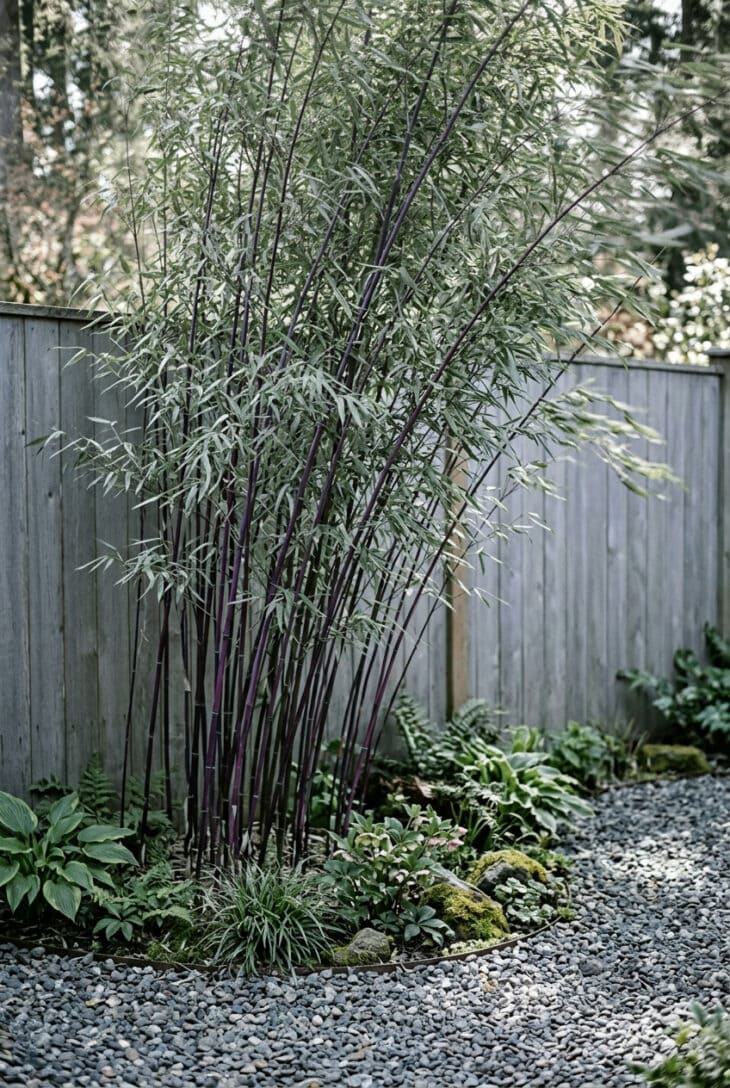
What you see A tall clump of slender bamboo arches over the corner of a gravel garden, its purplish canes bending under the weight of narrow gray-green leaves. Light filters through the foliage onto the stones below. A plain gray fence behind the clump makes every leaf stand out.
Why it works Bamboo adds height, a screen and the soft sound of leaves in a light wind, all in a footprint of a few square feet. The catch is that running bamboos escape and become invasive, so only a clumping type is safe to plant. NC State describes golden bamboo (Phyllostachys aurea) as invasive, and says it tends to escape even when contained in hardscape.
How to get it Choose a clumping bamboo such as fountain bamboo (Fargesia nitida), hardy in Zones 5–9, which reaches 10 to 15ft (3 to 4.5m) tall and 3 to 5ft (90 to 150cm) wide. It prefers part shade, moist, well-drained soil and shelter from hot afternoon sun and wind. Water it steadily through dry spells. It flowers very rarely, but a clump can die after flowering. Avoid Phyllostachys species, and check your state’s invasive plant list if you are unsure.
16. Swap in Native Plants for the Japanese Classics
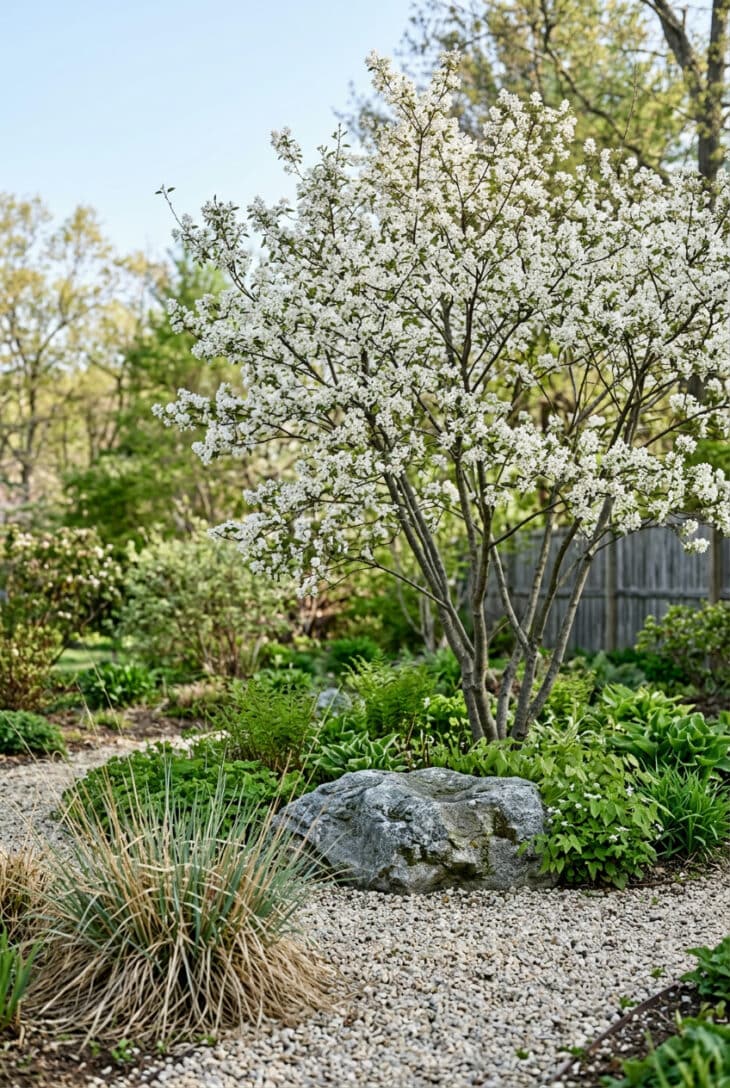
What you see A multi-stemmed Allegheny serviceberry (Amelanchier laevis) in full white bloom rises behind a pale gravel bed, with a gray boulder at its feet and a clump of little bluestem (Schizachyrium scoparium) leaning in from the front. Fresh green leaves are just opening around the base. The pale sky makes the blossom look weightless.
Why it works The zen look comes from restraint, not from a species list, so you can get the same slow seasonal rhythm from plants that belong where you live. Native trees and grasses cope with your climate, usually need less water once established and feed local wildlife. They also sidestep the problem of Japanese maples scorching in hot, dry summers.
How to get it In the East and Midwest, plant Allegheny serviceberry, hardy in Zones 4–8, for white spring blossom and good fall color, or eastern redbud (Cercis canadensis), hardy in Zones 4–9. In the West, Western redbud (Cercis occidentalis), hardy in Zones 6–9, does the same job. Choose one tree, set it off center, and keep the planting underneath sparse. Your state extension service or native plant society can tell you which local species suit your soil.
17. Plant Grasses That Whisper in the Wind
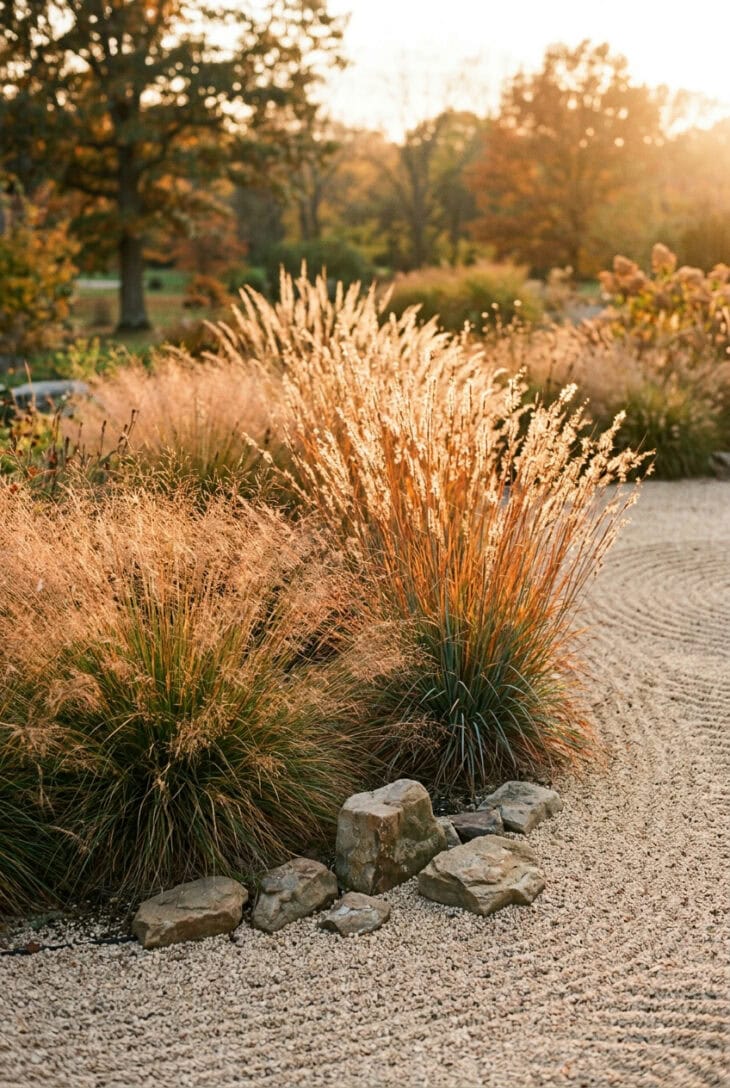
What you see Mounds of fine-leaved grass glow copper and orange in the low fall sun, rising from a bed of pale gravel. Backlight lights up every seedhead, and a raked pattern runs past them. A few stones sit nearby. The only movement in the picture is the grass itself.
Why it works A still garden needs one thing that moves, and grasses do it without any fuss. Their sound is soft and constant, and their color shifts from green to copper through fall and winter. They stay put in gravel, don’t need fertilizer, and require only a single cut a year.
How to get it Prairie dropseed (Sporobolus heterolepis), hardy in Zones 3–9, forms 2 to 3ft (60 to 90cm) mounds and prefers full sun and dry, well-drained soil. Little bluestem (Schizachyrium scoparium), also Zones 3–9, has bluish summer leaves and copper fall color. Dropseed is slow to settle but long-lived, and its flowers are said to smell like buttered popcorn. Plant about 2ft (60cm) apart through slits cut in the fabric, and cut them back in late winter or early spring. In shade, Japanese forest grass (Hakonechloa macra), Zones 5–9, does the same job, but it may struggle in the hot summers of Zones 8–9.
18. Add One Fragrant Shrub for Winter Scent
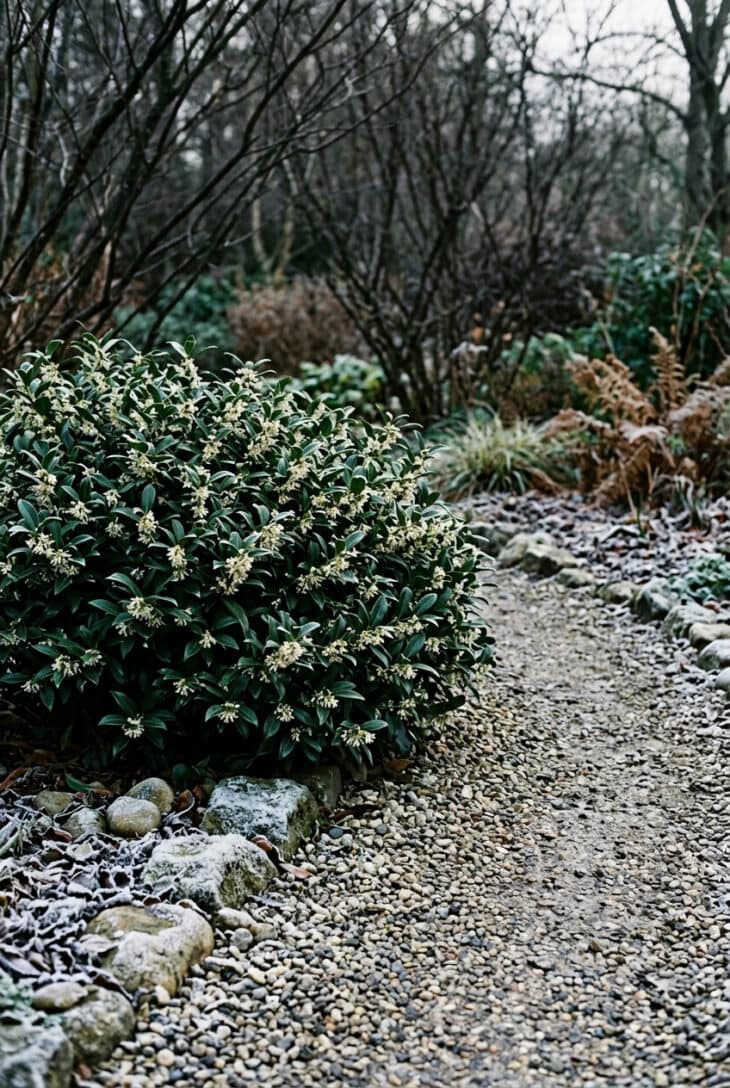
What you see A low, dense shrub with dark glossy leaves is covered in small white flowers beside a gravel path. A light dusting of frost sits on the stones nearby, and a few bare branches blur in the background. The garden is almost empty, and the shrub is the only thing in it that is awake.
Why it works Scent is the layer most gardens skip, and a quiet garden is where you notice it. A shrub that flowers in late winter gives you something to find on a cold day, when everything else is bare. Put it beside the seat or the entry, where you pass slowly enough to catch it.
How to get it Sweet box (Sarcococca hookeriana) is hardy in Zones 5–8, grows to about 5ft (150cm) tall and 6ft (180cm) wide, and flowers in late winter to early spring. It wants part to full shade, moist, rich, well-drained soil, and prunes well after flowering. In Zones 8 to 11, sweet olive (Osmanthus fragrans) has the same role, with fragrant flowers in fall and a mature height of 10 to 20ft (3 to 6m). Neither is a plant for the middle of the gravel, so keep them at the edges.
19. Add a Bubbling Basalt Column Fountain
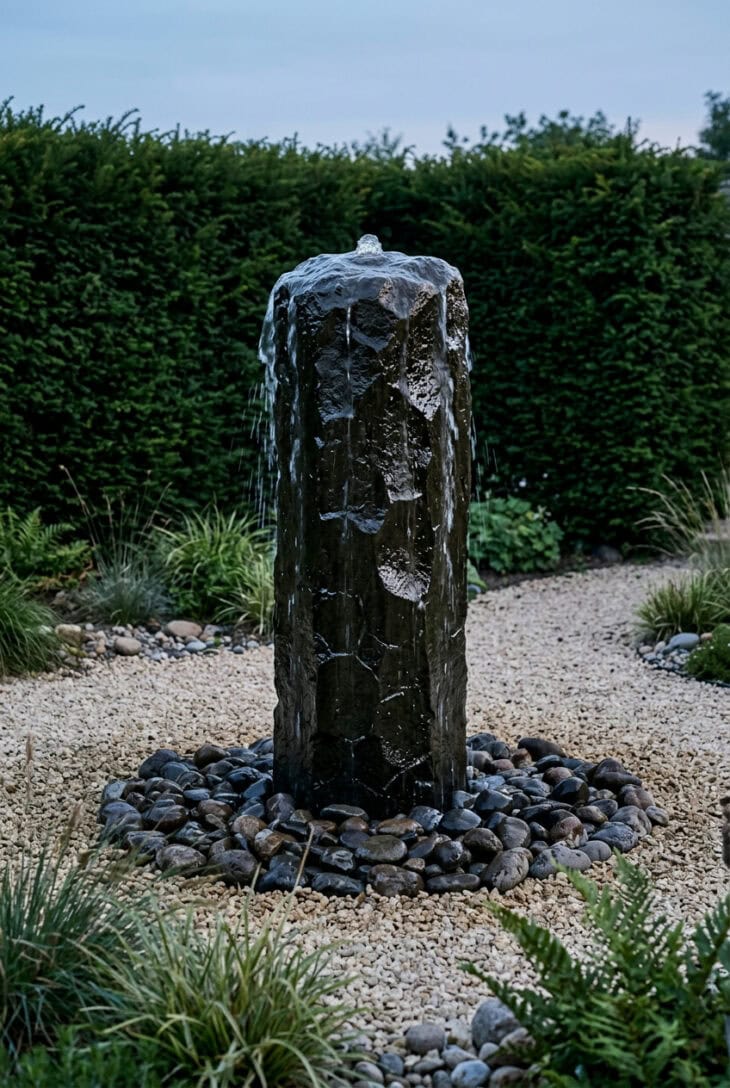
What you see A tall, dark basalt column stands in a bed of river cobbles, with water welling gently over its top and sliding down its sides. The wet stone shines in the dusk light. A deep green hedge behind it holds the scene together, and the pale gravel runs right up to the cobbles.
Why it works Water is the one thing a dry garden cannot supply, and sound is the quietest way to bring it in. A bubbling column masks road noise, and because the water collects in a hidden reservoir, there is no open pool, which is a plus around small children.
How to get it A kit with a pre-drilled column 24 to 36in (60 to 90cm) tall, a pump and a buried reservoir is the simplest route. Set the reservoir level and cover it with cobbles so it disappears. Check the water level weekly in summer, because evaporation will drain it faster than you expect. Plug the pump into a GFCI-protected outdoor outlet, and hire an electrician to add one rather than running an extension cord across the yard. In freezing climates, drain it before winter.
20. Hang a Rain Chain Over a Gravel Basin
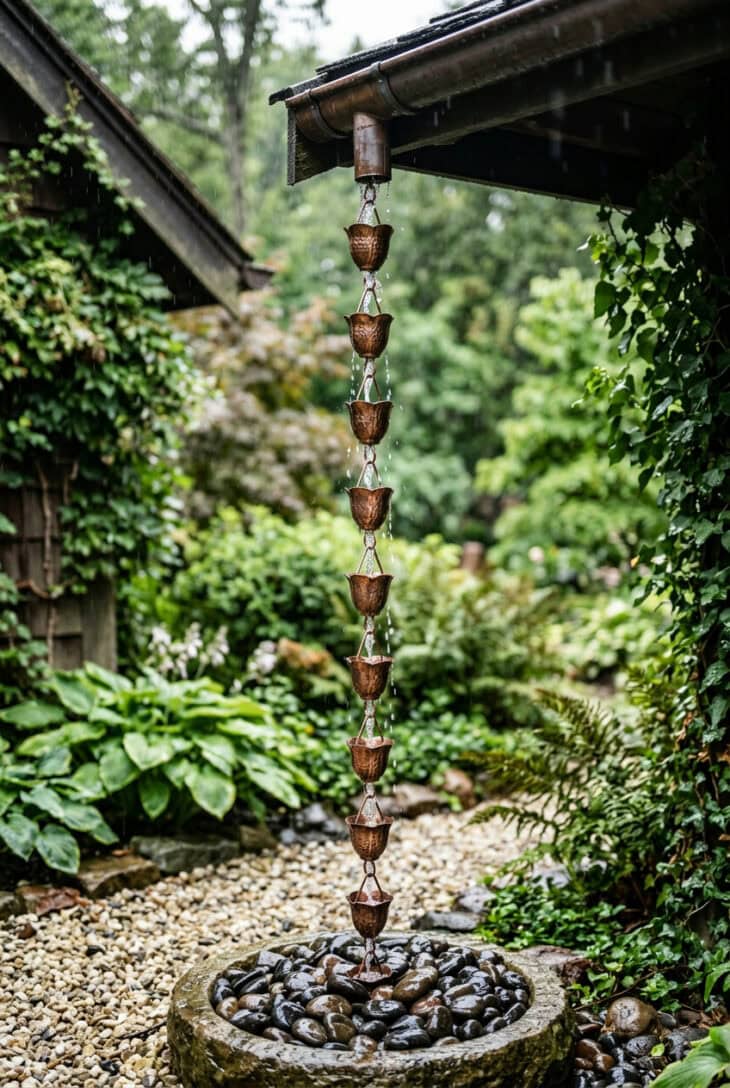
What you see A copper rain chain with cup-shaped links hangs from the corner of a gutter, and water spills from cup to cup into a round basin of dark river cobbles. The wet stones shine. Behind it the green planting blurs in the gray rain light.
Why it works A rain chain is the one water feature that runs only when it rains, which is exactly when you want to hear it. It replaces a plain downspout with something worth looking at, and the basin below slows the runoff instead of sending it straight to the drain. It also sits well beside a rain garden for a wetter corner.
How to get it Replace the bottom section of a downspout with a rain chain with cups, which tend to carry water more cleanly than link-style chains. Dig a basin 2 to 3ft (60 to 90cm) wide and 6 to 8in (15 to 20cm) deep, and fill it with washed river stone. Make sure the overflow runs at least 5 to 6ft (150 to 180cm) from the foundation and downhill from the house, because water pooling at the wall is a real problem. Anchor the bottom of the chain with a stake so the wind cannot swing it into the siding.
21. Set a Shallow Water Bowl to Catch the Sky
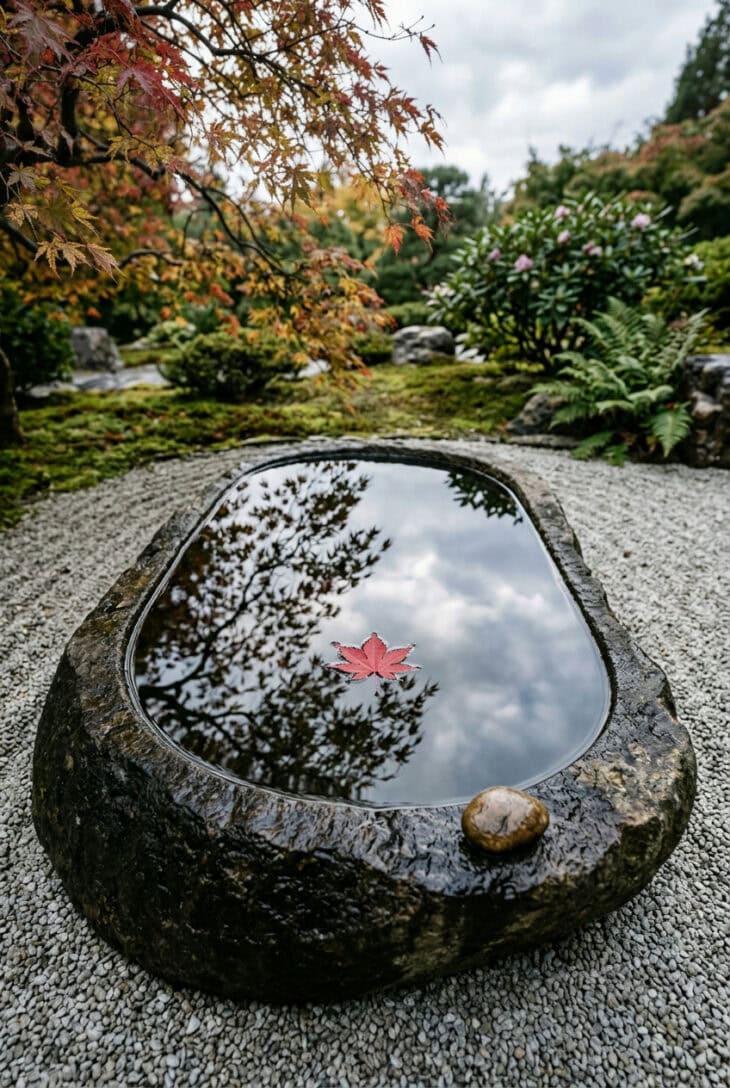
What you see A wide, low stone basin sits in raked gravel, filled to the brim with water so still it holds a perfect mirror of the clouds. One small pebble rests on the rim and a single leaf floats near the middle. The dark stone makes the reflection deeper.
Why it works Still water doubles the sky, and the garden changes by the minute as the clouds move across it. A single basin costs very little and does the job of a pond, and birds will use it. The contrast between hard dry gravel and a flat, bright sheet of water is the whole design.
How to get it Use any waterproof basin 18 to 24in (45 to 60cm) across and keep the water 2 to 4in (5 to 10cm) deep. A dark interior reflects best, so paint a pale basin black with a pond-safe paint. Empty and refill it at least weekly in warm weather, because mosquito larvae take about a week or more to mature, so a weekly change breaks the cycle. Clean it with a brush rather than soap, and keep it away from trees that drop leaves. A flat rock in the water gives birds a safe place to stand.
22. Hang One Low-Toned Wind Chime
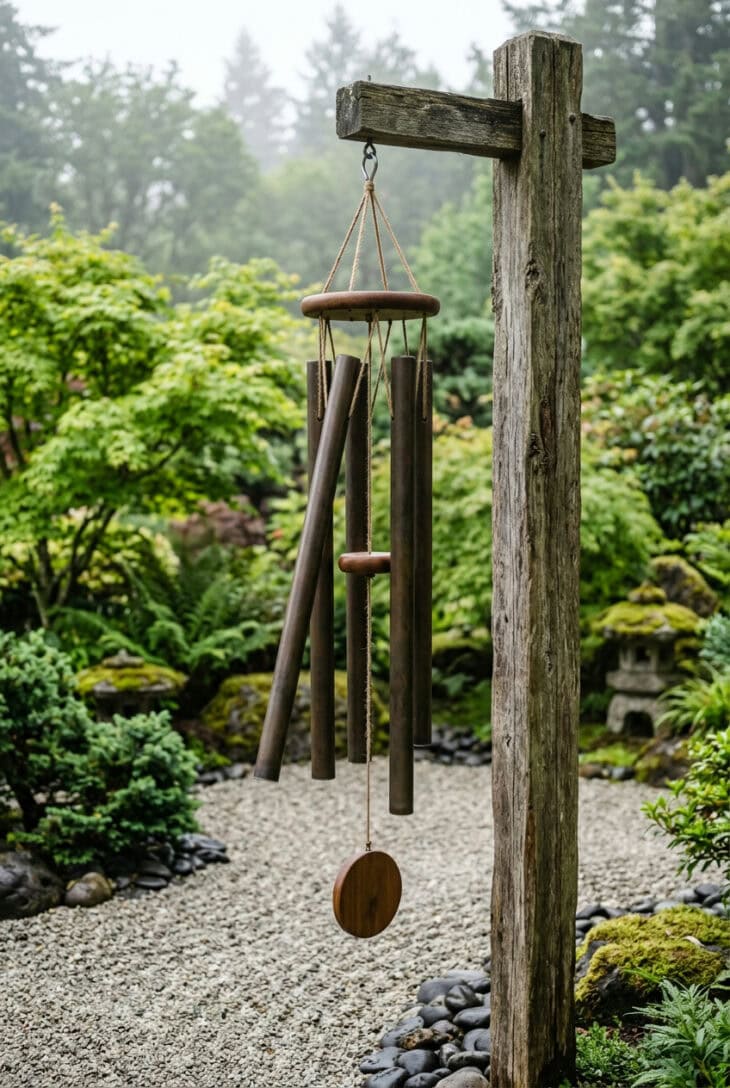
What you see A single wind chime of long, hollow metal tubes hangs from a weathered timber post at the edge of the gravel. One tube is caught mid-swing. Morning haze softens the background, and the chime is the only object in the picture that is not still.
Why it works A quiet garden should have sparse sound, and one chime tuned to a low note gives a single soft tone every so often rather than a jangle. It costs very little and takes minutes to hang. Sound is also the one layer that reaches you when you are not looking at the garden.
How to get it Look for a chime with four or five hollow tubes, aluminum or bronze, at least 30in (75cm) long, because longer tubes sound lower. Many are tuned to a pentatonic scale, which stops the notes from clashing. Hang it where the breeze actually reaches, away from bedroom windows and the neighbor’s fence line. Live with it for a week: if you stop noticing it, it is working, and if it irritates you, take it down.
23. Build a Desert Version With Agave and Red Gravel
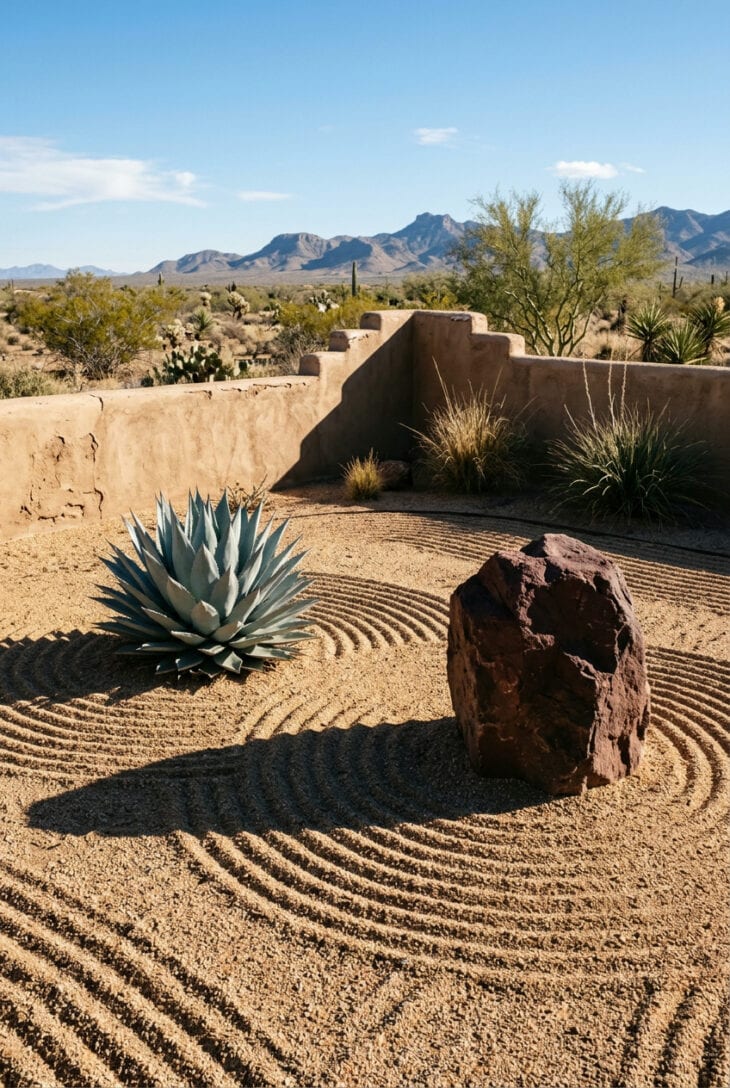
What you see Warm tan gravel is raked in sweeping curves around a single blue-gray agave and a dark red rock, with a low adobe wall behind. The hard desert light throws long shadows across the grooves. The plant’s spiny rosette is the only living thing in the picture.
Why it works In a dry-summer climate, a gravel garden is the natural fit, and the sculptural rosette of an agave stands in for the pine or maple of a classic zen garden. Using local stone and warm local gravel usually costs less than imported gray and looks like it belongs. It is also a good fit for anyone planning drought-tolerant garden ideas or a rock garden.
How to get it Parry’s agave (Agave parryi) is hardy in Zones 6–10, grows 1 to 3ft (30 to 90cm) tall and wide, and wants full sun and fast drainage. It tolerates cold if kept dry, so do not water it in winter. The leaf tips carry sharp spines and the sap can irritate skin, so wear gloves and keep it back from paths and seating. Blue grama grass (Bouteloua gracilis), Zones 3–10, makes a native companion. Use stone that is quarried near you.
24. Light One Rock From Below
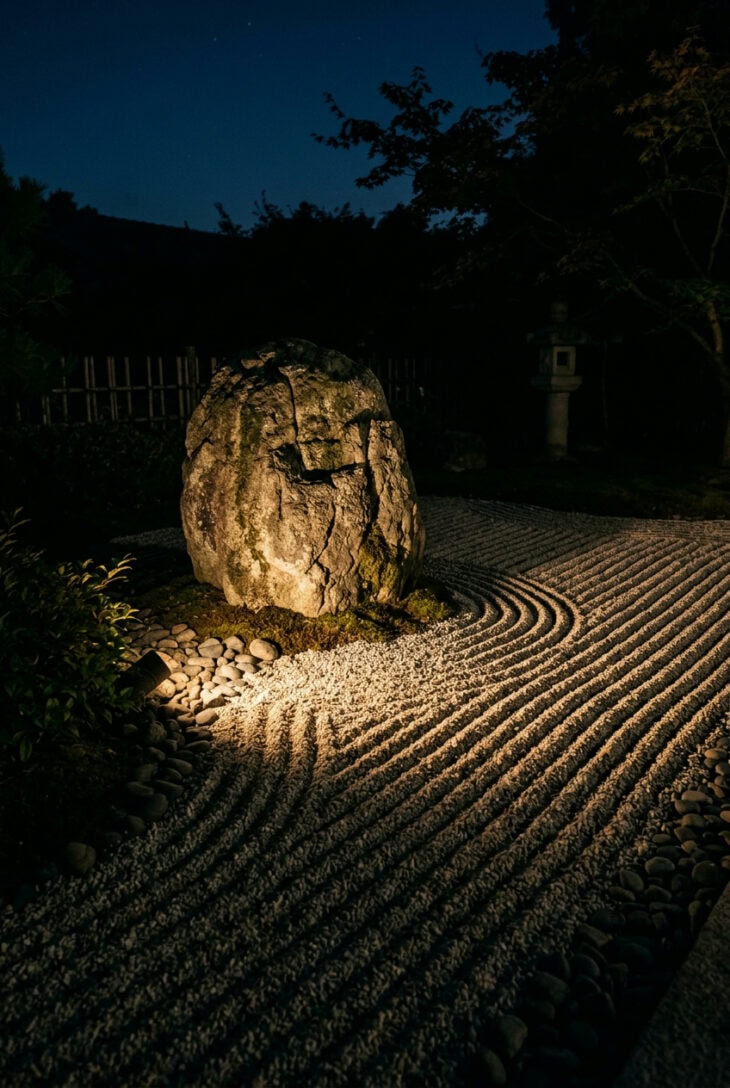
What you see A single boulder glows against a dark night garden, lit from below by one hidden warm light. The raked lines in the gravel catch the glow in thin gold stripes. Everything else fades into the dark, and the stone seems to float.
Why it works One fixture does more than six, because restraint is the point. Light from a low angle turns the rake grooves into tiny shadows and gives the boulder weight. It also lets you use the garden after work, which for many people is the only time they are home.
How to get it Use a low-voltage LED spotlight in warm white, around 2700K, placed low and partly hidden behind a stone or in the gravel. Plug the transformer into a GFCI-protected outdoor outlet and put it on a timer or photocell. Bury the cable about 6in (15cm) deep along the edge of the bed. Choose the lowest brightness the kit offers, and shield the lamp so it never shines into your eyes or the neighbor’s window.
25. Keep Cats and Weeds Out of the Gravel
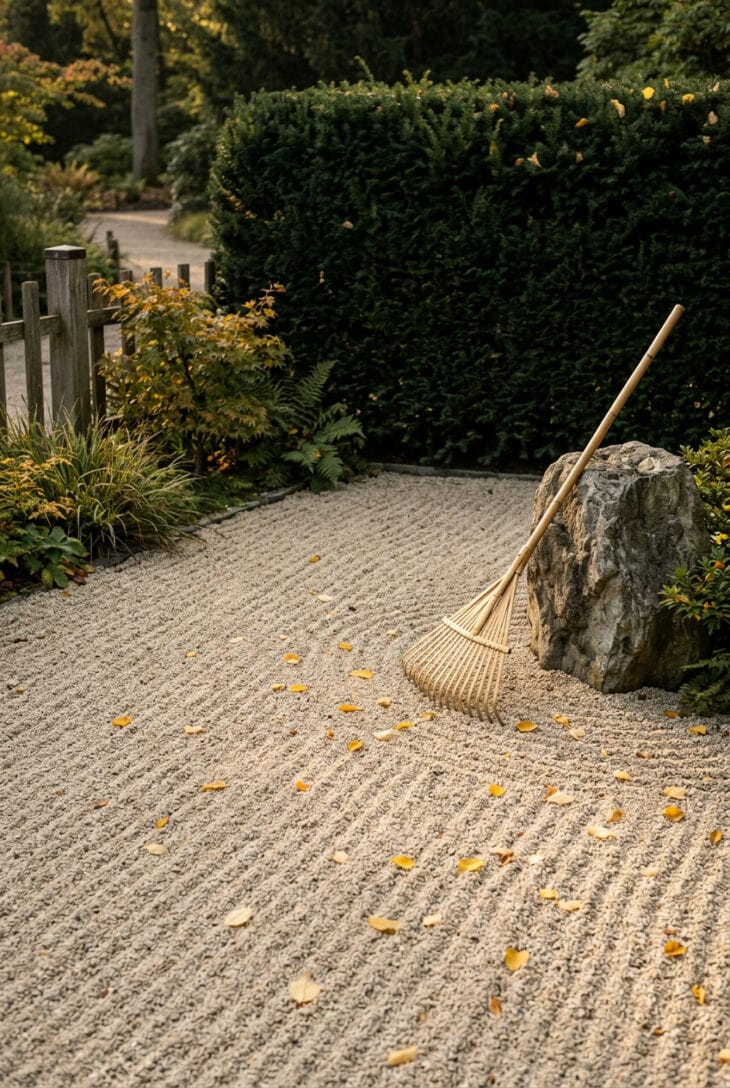
What you see A pristine raked bed sits in the quiet of early morning, with a flexible bamboo leaf rake leaning on a gray boulder. A few fallen yellow leaves rest on the gravel, and a dark hedge frames the scene. Nothing is out of place yet.
Why it works The two enemies of a gravel garden are weeds and cats, and both are easy to underestimate. A weedy zen garden looks neglected, and a garden used as a litter box makes it hard to love. Dealing with both early keeps the garden as low-maintenance as the style promises, and our low-maintenance garden ideas cover more of the same.
How to get it Under the gravel, use woven fabric and at least 2in (5cm) of stone, and pull any seedlings as soon as you see them while the roots are still shallow. Sweep leaves off with a flexible leaf rake rather than a stiff one, so you do not drag the gravel. Gardeners widely report that cats treat fine, loose sand like a litter box, and that coarser, angular gravel is less appealing. Gardeners also report good results with a motion-activated sprinkler. Never use mothballs, which are toxic to pets and wildlife and not labeled for this use.