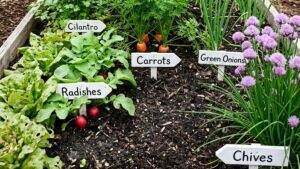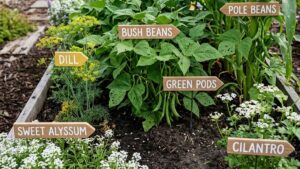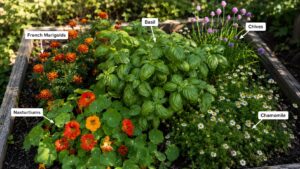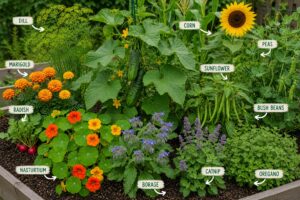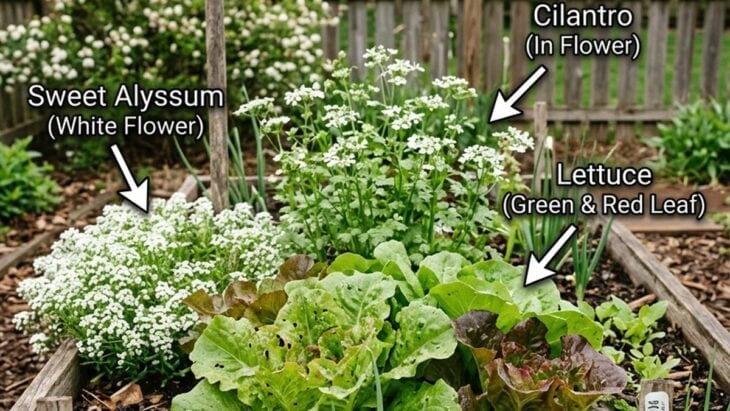
Slugs, aphids and summer heat do most of the damage in a lettuce bed, and companion plants can help with only two of those three. No companion is documented to keep slugs off lettuce, and UC IPM lists physical controls instead: drier ground, fewer hiding places, handpicking, traps, copper bands and iron phosphate bait.
Contents
- Best companion plants for lettuce
- Sweet alyssum (Lobularia maritima)
- Cilantro (Coriandrum sativum)
- Dill (Anethum graveolens)
- Onions (Allium cepa)
- Garlic (Allium sativum)
- Radishes (Raphanus sativus)
- Carrots (Daucus carota subsp. sativus)
- Strawberries (Fragaria × ananassa)
- Tomatoes (Solanum lycopersicum), with peppers
- Cucumbers (Cucumis sativus)
- Plants to avoid with lettuce
Companion planting means growing different plants close together so one helps the other. Lettuce (Lactuca sativa) is mostly bothered by aphids, slugs and snails, and cutworms, with gray mold, bottom rot and Sclerotinia drop as the main diseases.
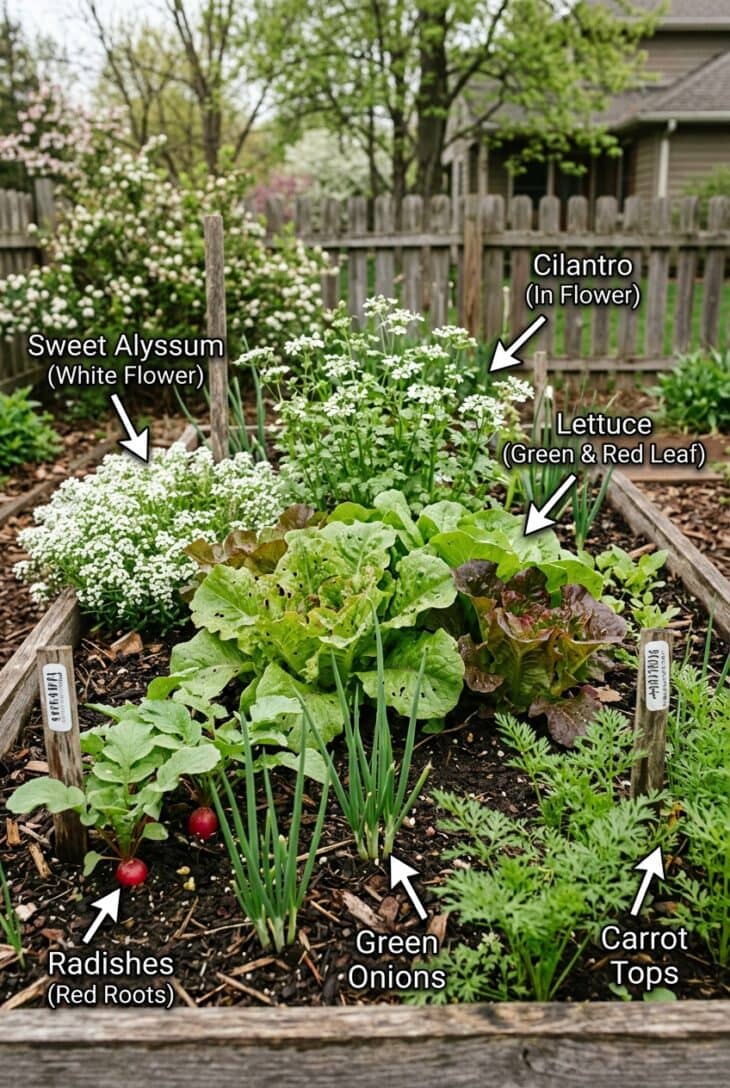
The best-documented help comes from flowers that feed aphid-eating insects, led by sweet alyssum, with cilantro and dill as extension-backed options. Onions and garlic are gardener tradition, and the rest of the list (radishes, carrots, strawberries, tomatoes, cucumbers) is mostly about sharing space and shade.
Pick companions that like the same conditions. Lettuce grows best at 55 to 65°F (13 to 18°C), turns bitter as it heats past 75°F (24°C), and wants soil at pH 6.0 to 6.5. Above 85°F (29°C) it needs afternoon shade.
Best companion plants for lettuce
Sweet alyssum (Lobularia maritima)
What it helps with
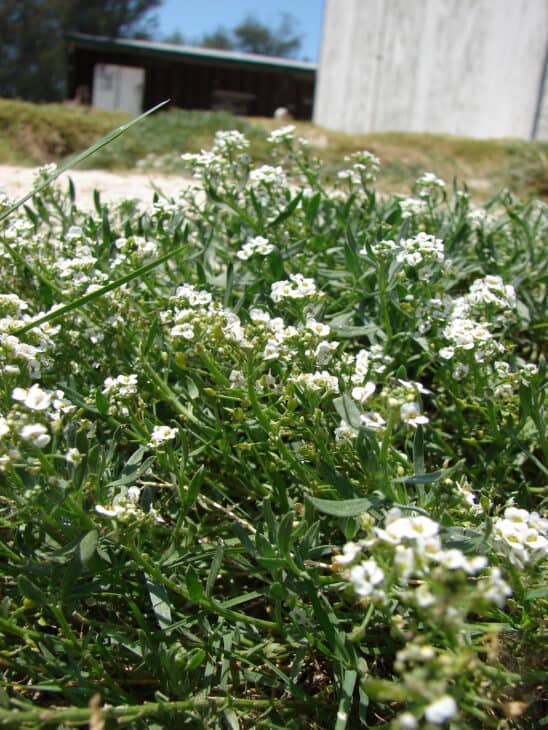
Sweet alyssum flowers feed adult hoverflies, whose larvae eat the aphids that infest lettuce.
Why it works with lettuce
This is the best-documented lettuce companion. USDA researcher Brennan grew romaine with alyssum for nine years on a California organic farm and reported excellent aphid control throughout, even after cutting alyssum from 4,420 to 605 plants per acre. Adult hoverflies feed on the flowers, then lay eggs on aphid-infested lettuce, and larvae of some species eat up to 150 aphids a day.
Planting notes
Use transplants, not seed: they are often flowering when planted, while seedlings can take about a month to bloom. Brennan estimated 500 to 1,000 transplants per acre was enough, about one plant per 45 to 90 square feet (4 to 8 m²). Home beds are untested, so a few plants among the lettuce and along the edge is a reasonable translation.
Possible drawback or limit
The research used commercial romaine in California’s cool Salinas Valley, so results in your yard are an extrapolation. Buy sweet alyssum by name, because Brennan found it far more vigorous and bushy than the ornamental varieties he compared.
Cilantro (Coriandrum sativum)
What it helps with
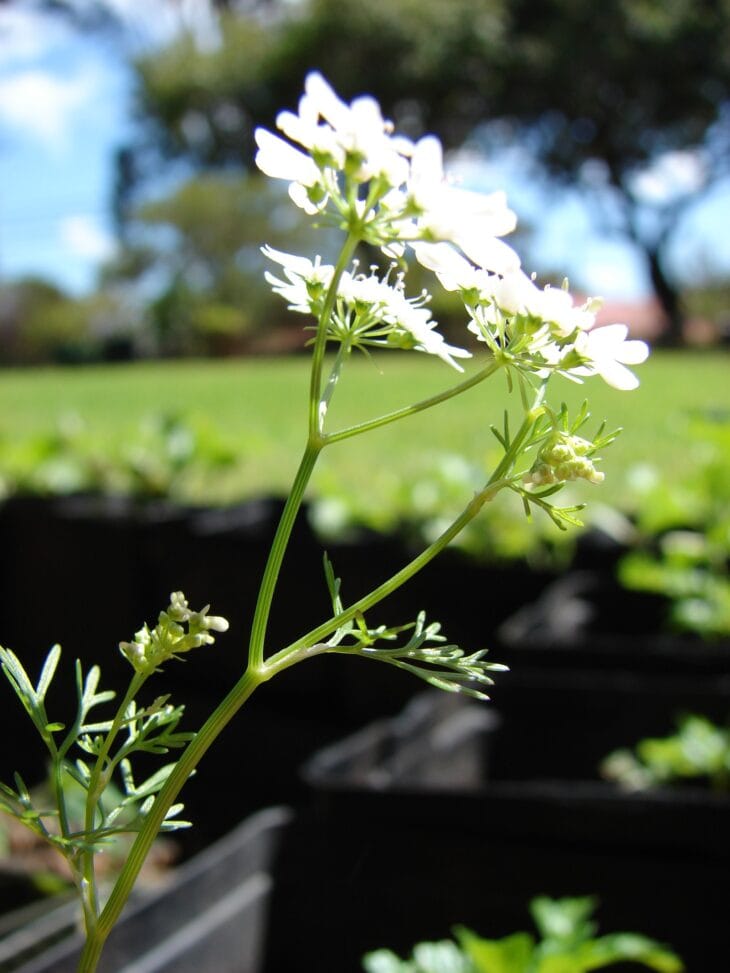
Cilantro flowers draw aphid-eating insects to lettuce and other greens.
Why it works with lettuce
Penn State Extension recommends cilantro near lettuce and greens to attract lacewings, ladybugs, parasitic wasps, spiders and syrphid flies, all of which eat aphids. That is an extension recommendation, not a lettuce trial. It works the same way as alyssum: the flowers feed the adult predators.
Planting notes
Plant cilantro between lettuce plants or along the bed edge, and let some go to flower, because the blooms are what feed the predators. Both are cool-season crops, so they share a planting window. Resow every few weeks to keep flowers coming.
Possible drawback or limit
Cilantro bolts quickly once the weather turns hot, so the flowers come and go fast. An Illinois Extension write-up of an Iowa State herb study that included lettuce also warns you may need many more companion plants than you expect for the effect to last.
Dill (Anethum graveolens)
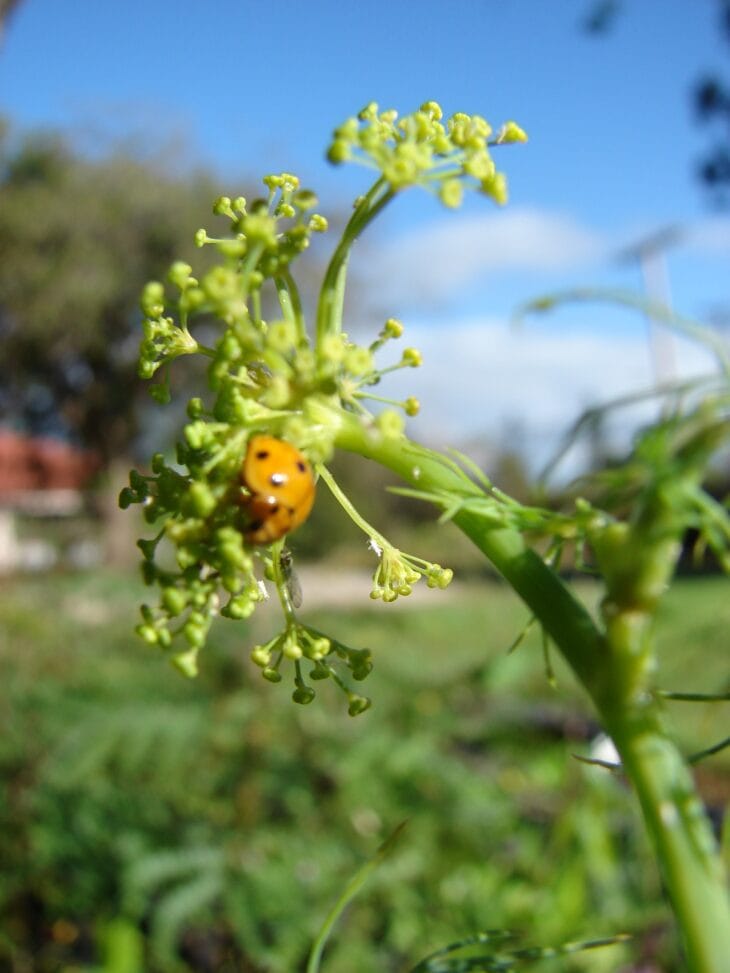
What it helps with
Dill flowers attract the same aphid-eating insects as cilantro.
Why it works with lettuce
Penn State names dill with cilantro as an herb that brings lacewings, ladybugs, parasitic wasps and syrphid flies to lettuce and greens. As with cilantro, the support is an extension recommendation rather than a lettuce trial. The ladybug on the dill flowers above is the kind of visitor you are after.
Planting notes
Plant dill at the end or edge of the bed, because it grows much taller than lettuce and will shade the plants beside it. Let a few plants flower so the insects have something to feed on. Both crops like cool weather, so they can go in together in spring.
Possible drawback or limit
Dill has to flower to feed predators, and a spring lettuce crop may be picked before it does. The recommendation rests on one extension publication, with no lettuce trial behind it.
Onions (Allium cepa)
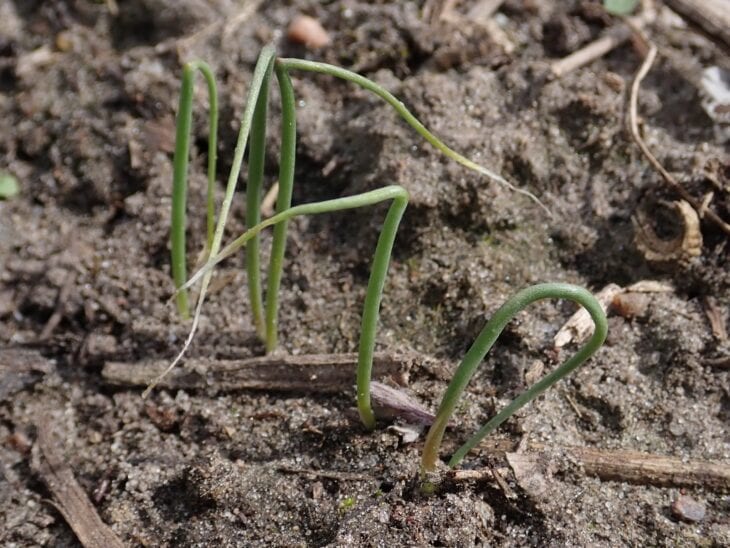
What it helps with
Onions are one of the most consistently listed lettuce neighbors, and gardeners use them to confuse pests.
Why it works with lettuce
Extension charts from WVU, WSU and UF/IFAS all list onions as a lettuce companion, and UF/IFAS puts them among the best. The idea that their smell masks lettuce from pests is gardener tradition, and no lettuce trial turned up for this article.
Planting notes
Tuck green onions or sets into the gaps between lettuce plants, or grow a row alongside. Both are cool-season crops that go in early in spring.
Possible drawback or limit
The charts give no mechanism, so treat onions as a tidy space-sharing partner rather than a pest control. Pull them as green onions to keep the bed turning over.
Garlic (Allium sativum)

What it helps with
Garlic is listed as a lettuce companion, and gardeners use it to deter pests.
Why it works with lettuce
UF/IFAS lists garlic among the best lettuce companions, and Utah State Extension cites a 2022 source saying mint or garlic planted between rows of potatoes and lettuce can deter pests. An Oregon State article credits garlic with deterring aphids, snails and other pests, but those claims come from a master gardener’s experience, not research.
Planting notes
Plant garlic along the bed edge or between lettuce rows. Fall-planted garlic is already up when spring lettuce goes in.
Possible drawback or limit
This is tradition, not trial: no study opened for this article tested garlic with lettuce. Garlic also holds its spot for months, so it suits a bed edge better than a lettuce succession row.
Radishes (Raphanus sativus)
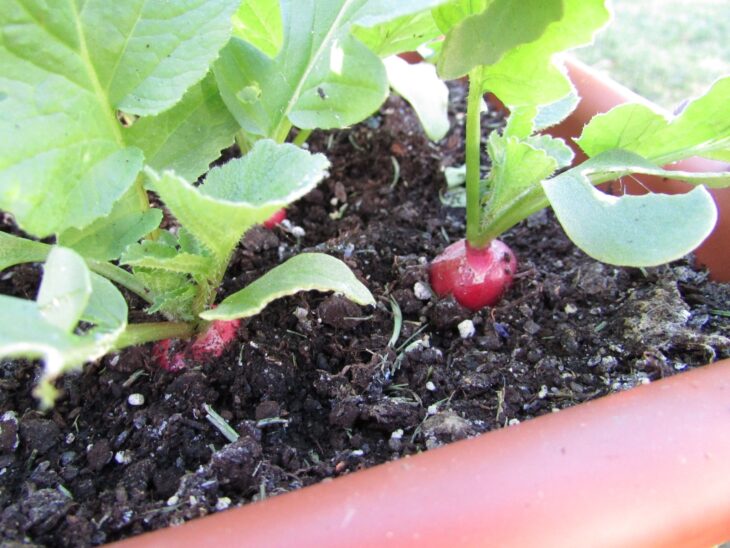
What it helps with
Radishes share the bed with lettuce and are harvested before the lettuce needs the room.
Why it works with lettuce
WVU, WSU and UF/IFAS all list radishes as a lettuce companion, and UF/IFAS puts them among the best. No chart gives a reason, so this is space sharing rather than pest control. The likely logic is timing: radishes are quick and shallow, while lettuce is slower and leafy.
Planting notes
Sow radish seed in the gaps between lettuce plants, or in the same row, at the same time. Pull the radishes before the lettuce crowds them. Both do well in cool weather.
Possible drawback or limit
No chart documents any pest benefit from radishes. UC IPM notes that damp soil surfaces encourage snails, slugs and root diseases, so thin radishes promptly instead of leaving a dense mat.
Carrots (Daucus carota subsp. sativus)
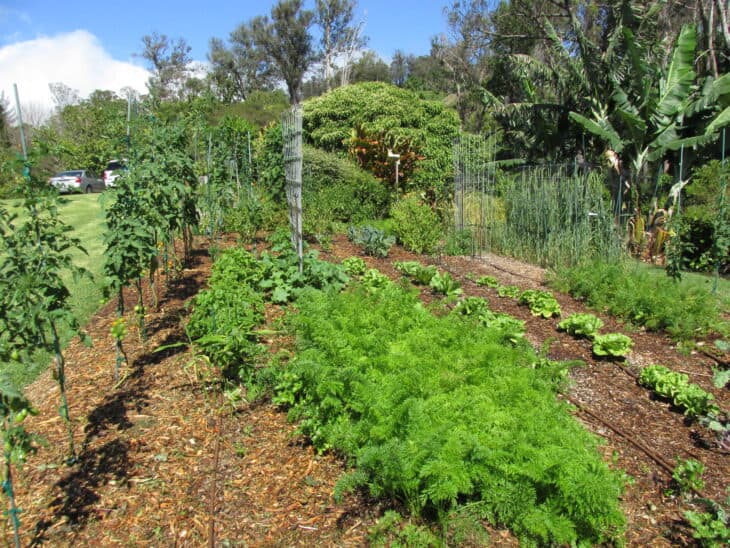
What it helps with
Carrots and lettuce share a bed because one grows down and the other grows out.
Why it works with lettuce
WVU, WSU and UF/IFAS all list carrots as a lettuce companion, and UF/IFAS puts them among the best. None explains why. The root-versus-leaf difference is the usual reasoning, and it is an inference rather than a finding.
Planting notes
Sow lettuce in the gaps between young carrots, or grow a lettuce row beside the carrot row, as in the photo. Onions, cilantro and radishes also appear in our list of companion plants for carrots, so one bed can serve both crops.
Possible drawback or limit
This is another chart listing with no mechanism or trial behind it. Lettuce left to grow large will shade carrot seedlings, so keep it picked.
Strawberries (Fragaria × ananassa)
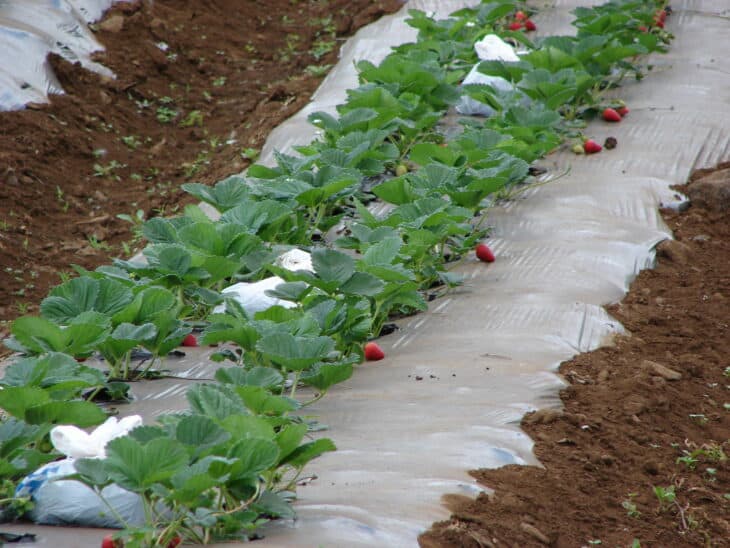
What it helps with
Lettuce makes a quick edging row along a strawberry bed, and the two are listed as neighbors.
Why it works with lettuce
WVU lists strawberries as a lettuce companion and lists lettuce as a border for strawberries, and WSU and UF/IFAS also pair them. No source gives a mechanism.
Planting notes
Plant a row of lettuce along the edge of a bed of strawberry plants, as WVU suggests. Strawberries are perennial and lettuce is a short crop, so replace the lettuce row as you harvest it.
Possible drawback or limit
UC IPM lists both lettuce and strawberries among the plants slugs and snails damage seriously, so this pairing puts two favorites side by side. Use drip irrigation and clear hiding places along the border.
Tomatoes (Solanum lycopersicum), with peppers
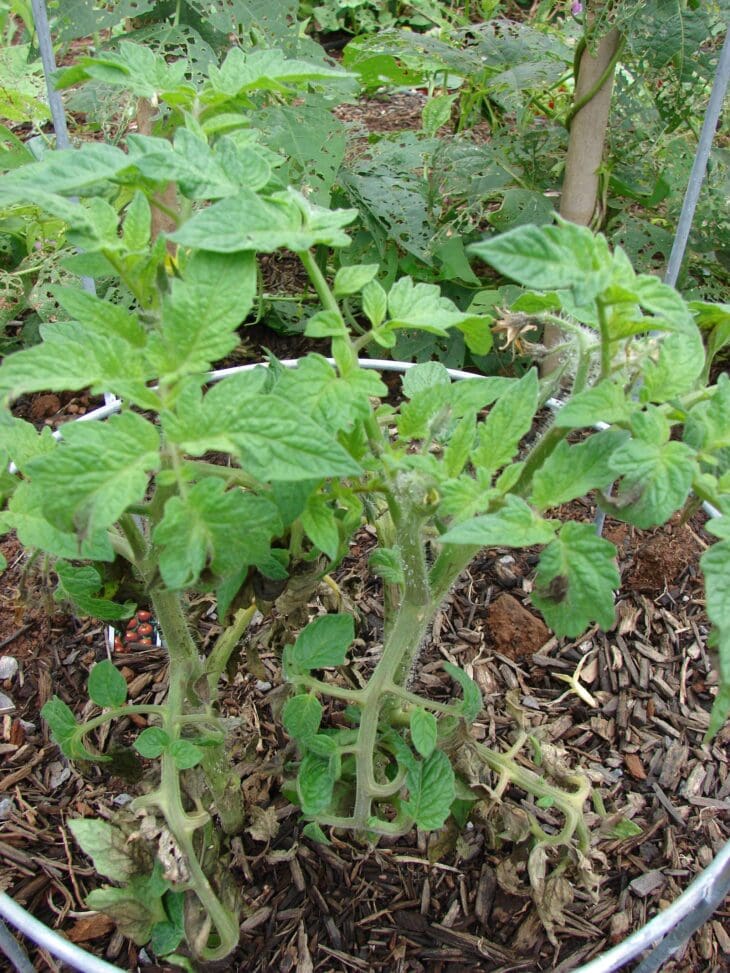
What it helps with
Planting lettuce between young tomato or pepper plants uses the bed twice, and the growing plants later shade the lettuce.
Why it works with lettuce
WVU recommends interplanting lettuce, spinach or beets between larger, slow-growing vegetables such as tomatoes or peppers, because the canopy shades the smaller crop once it matures. UC master gardeners give the same example: leaf lettuce planted between or alongside pepper, eggplant, tomato or corn. UF/IFAS advises afternoon shade for lettuce above 85°F (29°C).
Planting notes
Plant lettuce in the gaps while tomato or pepper transplants are small, with the tomatoes at their normal spacing. Lettuce can go in once soil is above 40°F (4°C), so it is usually up before tomato transplants go out after frost. Tomatoes and peppers have their own lists in our guides to companion plants for tomatoes and companion plants for peppers.
Possible drawback or limit
Lettuce drop (Sclerotinia) also infects peppers, potatoes, cucumbers and onions, and NC State says that broad host range limits what crop rotation can do. A crowded mixed bed does not lower the risk, and the disease likes cool, wet soil.
Cucumbers (Cucumis sativus)
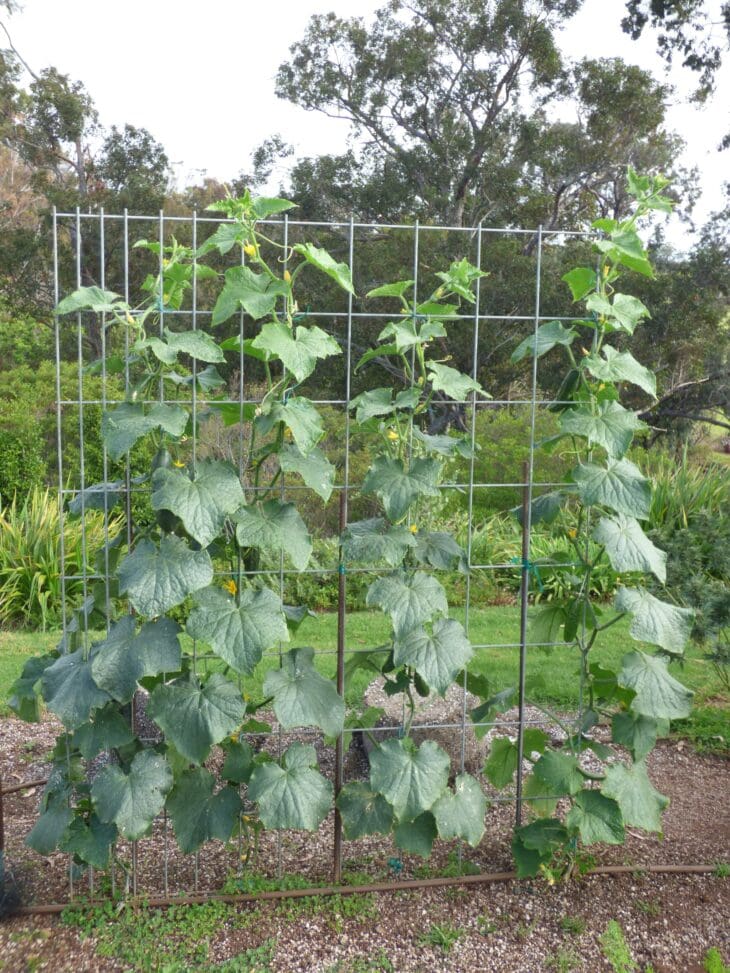
What it helps with
A trellised cucumber can shade the lettuce at its foot in late spring and early summer.
Why it works with lettuce
WVU, WSU and UF/IFAS list cucumbers as a lettuce companion, and WSU suggests growing leaf lettuce below tall plants that can give it shade in summer. No chart names a cucumber trellis as that shade, so the shade link is an inference.
Planting notes
Sow lettuce at the foot of a trellis, on the side that gets afternoon shade. Cucumbers are a warm-season crop planted after frost, so they overlap with lettuce only in late spring, which is when shade starts to matter. Cucumbers have companions of their own in our guide to companion plants for cucumber.
Possible drawback or limit
Cucumbers are also among the Sclerotinia hosts NC State lists. In warm climates lettuce bolts just as the cucumbers hit their stride, so the pairing may last only a few weeks.
Plants to avoid with lettuce
Fennel (Foeniculum vulgare) is listed by UC master gardeners among plants whose compounds harm nearby plants, and they advise keeping it several feet from vegetables. Penn State, by contrast, names fennel among herbs that attract aphid predators near lettuce, so the advice conflicts. Cilantro or dill can do that job instead.
Celery (Apium graveolens) and parsley (Petroselinum crispum) are listed by WSU’s cool-season chart as non-companions of leaf lettuce, with no reason given. UF/IFAS’s chart lists no bad companions for lettuce at all, so treat this as a low-confidence caution. If you want to be safe, give both their own row.