Some of the best flowering trees for Ohio are native: eastern redbud, flowering dogwood, serviceberry, pagoda dogwood and fringe tree. The state tree, the Ohio buckeye, also flowers. Reliable non-native choices include saucer and star magnolias, crabapples, Okame cherry, Kousa dogwood and Japanese tree lilac. Ohio is in USDA zones 5b to 7a, mostly 6a and 6b, so every tree below is hardy across the state. One popular flowering tree you can’t plant any more is the Callery or Bradford pear. It is invasive, and Ohio banned its sale in 2023.
Contents
- Pink, Purple and Red Flowering Trees
- White Flowering Trees
- Flowering Dogwood (Cornus florida)
- Kousa Dogwood (Cornus kousa)
- Star Magnolia (Magnolia stellata)
- Serviceberry (Amelanchier spp.)
- Hawthorn (Crataegus spp.)
- Japanese Tree Lilac (Syringa reticulata)
- Pagoda Dogwood (Cornus alternifolia)
- Fringe Tree (Chionanthus virginicus)
- Carolina Silverbell (Halesia tetraptera)
- Yellow and Green Flowering Trees
- Don’t Plant: Callery (Bradford) Pear
- Tips for Planting Flowering Trees in Ohio
- Pink, Purple and Red Flowering Trees
- White Flowering Trees
- Yellow and Green Flowering Trees
- Don’t Plant: Callery (Bradford) Pear
- Tips for Planting Flowering Trees in Ohio
| Tree | Botanical name | Blooms | Height | Native to Ohio |
|---|---|---|---|---|
| Eastern Redbud | Cercis canadensis | April | 20–30 ft | Yes |
| Saucer Magnolia | Magnolia × soulangeana | April | 20–25 ft | No |
| Okame Cherry | Prunus ‘Okame’ | Late March–April | 20–25 ft | No |
| Weeping Higan Cherry | Prunus subhirtella ‘Pendula’ | April | 20–30 ft | No |
| ‘Krauter Vesuvius’ Purple-Leaf Plum | Prunus cerasifera ‘Krauter Vesuvius’ | Early April | 15–20 ft | No |
| Flowering Crabapple | Malus spp. | Late April–May | 15–25 ft | Some species |
| Red Buckeye | Aesculus pavia | May | 10–20 ft | No (native farther south) |
| Flowering Dogwood | Cornus florida | Late April–May | 15–25 ft | Yes |
| Kousa Dogwood | Cornus kousa | June | 15–30 ft | No |
| Star Magnolia | Magnolia stellata | Late March–April | 15–20 ft | No |
| Serviceberry | Amelanchier spp. | April | 15–25 ft | Yes |
| Hawthorn | Crataegus spp. | May | 20–30 ft | Yes (many species) |
| Japanese Tree Lilac | Syringa reticulata | June | 20–30 ft | No |
| Pagoda Dogwood | Cornus alternifolia | May–June | 15–25 ft | Yes |
| Fringe Tree | Chionanthus virginicus | May–June | 12–20 ft | Yes (southern Ohio) |
| Carolina Silverbell | Halesia tetraptera | April–May | 20–40 ft | No (native farther south) |
| Ohio Buckeye | Aesculus glabra | April–May | 20–40 ft | Yes |
| Tulip Tree | Liriodendron tulipifera | May–June | 70–90 ft | Yes |
| Sassafras | Sassafras albidum | April | 30–60 ft | Yes |
| Witch Hazel | Hamamelis virginiana and H. × intermedia | Oct–Nov (native); Feb–Mar (hybrids) | 15–20 ft | Native species, yes |
Pink, Purple and Red Flowering Trees
Eastern Redbud (Cercis canadensis)

Redbud is one of Ohio’s first native trees to flower. In April, before the leaves open, its bare branches and even its trunk are covered in small, rosy-purple, pea-like flowers. The heart-shaped leaves turn yellow in fall. It grows 20 to 30 feet tall with a wide, rounded crown and does well in sun or partial shade. It is short-lived, often 20 to 30 years. ‘Forest Pansy’ has purple leaves and ‘Lavender Twist’ is weeping.
Saucer Magnolia (Magnolia × soulangeana)

Saucer magnolia is the pink-and-white magnolia seen in front yards all over Ohio. In early to mid-April it opens large, goblet-shaped flowers, pink to purple outside and white inside, on bare branches. It grows 20 to 25 feet tall and wide. It blooms so early that a late frost can turn the flowers brown overnight. Later-blooming varieties such as ‘Ann’ and ‘Jane’ avoid most frost damage. See the pros and cons of magnolia trees.
Okame Cherry (Prunus ‘Okame’)

Okame is a hybrid flowering cherry bred in England by Collingwood Ingram from Fuji cherry and Taiwan cherry. It is one of the earliest cherries to bloom, with masses of small, deep pink flowers in late March or early April. It grows 20 to 25 feet tall with an upright, oval crown, and its leaves turn orange-red in fall. It is more heat- and pest-tolerant than many ornamental cherries.
Weeping Higan Cherry (Prunus subhirtella ‘Pendula’)

Weeping Higan cherry is the classic weeping cherry, with long, hanging branches covered in pale pink flowers in April. It is usually sold grafted on a straight trunk. It grows 20 to 30 feet tall and wide. It has small black fruit, not much bigger than a pea, which birds eat. It needs full sun and well-drained soil.
‘Krauter Vesuvius’ Purple-Leaf Plum (Prunus cerasifera ‘Krauter Vesuvius’)
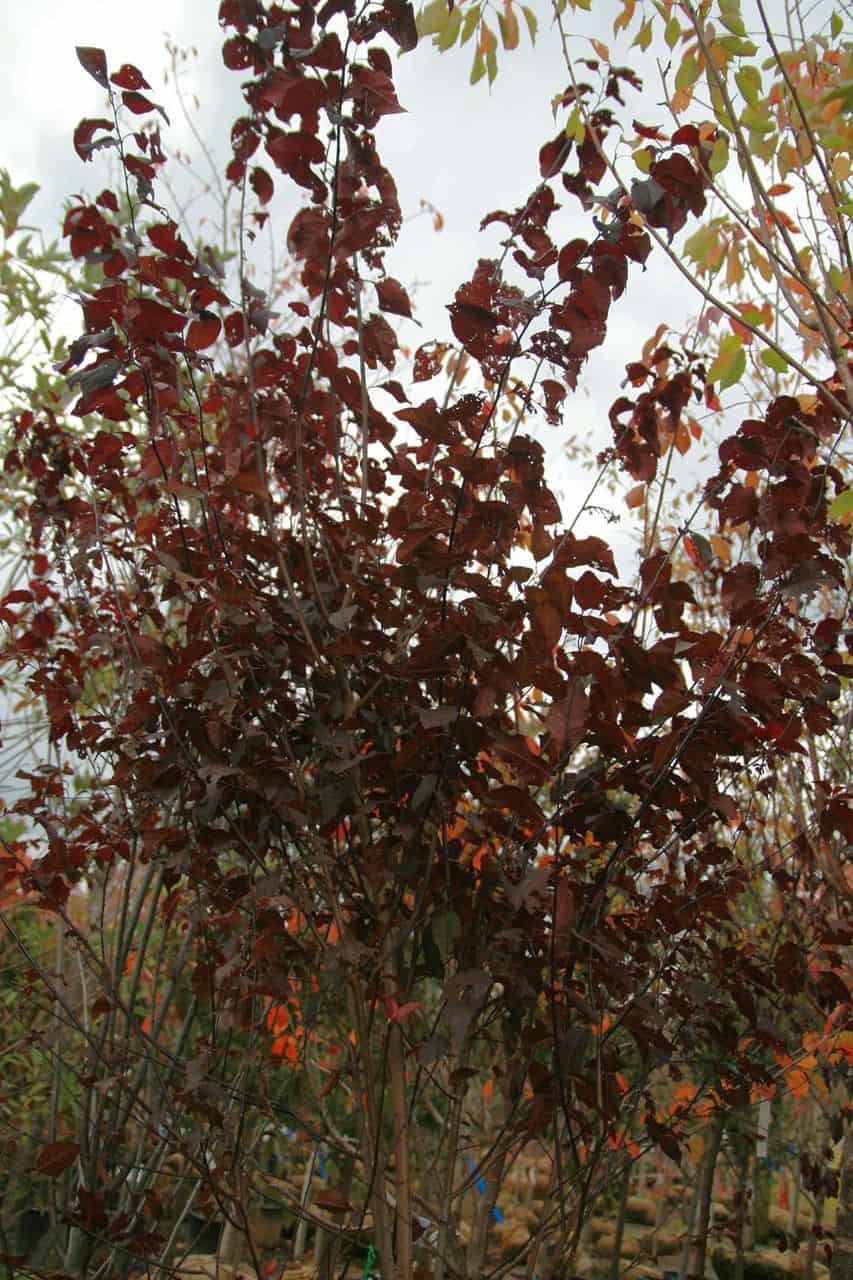
‘Krauter Vesuvius’ is a purple-leaf plum grown for its dark, purple-black leaves, which hold their color all summer. In early April it is covered in small, light pink flowers, and it rarely sets fruit. It grows 15 to 20 feet tall. Like most flowering plums, it is short-lived, often 15 to 20 years.
Flowering Crabapple (Malus spp.)
Read our guide to Flowering Crabapple

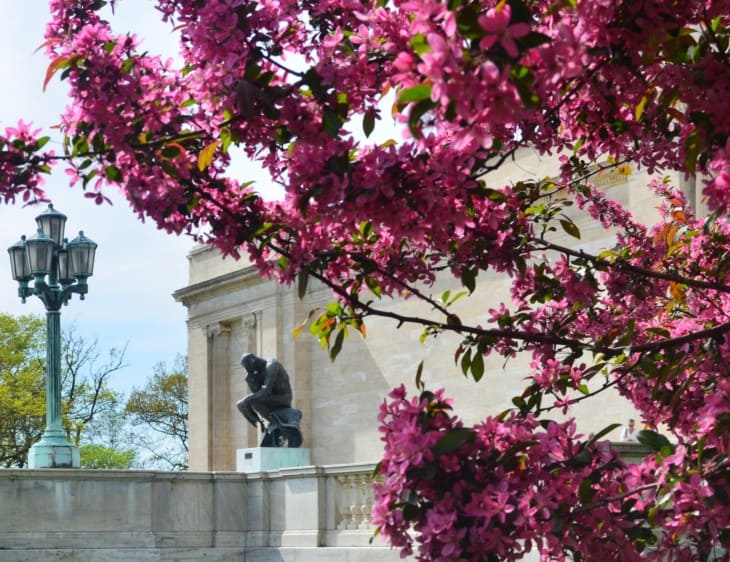
Crabapples are among the most reliable flowering trees for Ohio, with white, pink or red flowers in late April and May and small fruit that feeds birds into winter. Choose a disease-resistant variety, because apple scab and fire blight make older varieties drop their leaves in summer. Good choices include ‘Prairifire’ and ‘Purple Prince’ (red-purple flowers), ‘Sugar Tyme’ (white) and Sargent crabapple (white, shrubby). The sweet crabapple, Malus coronaria, is native to Ohio.
Red Buckeye (Aesculus pavia)

Red buckeye is a small tree or large shrub with upright spikes of bright red, tubular flowers in May, which bring hummingbirds. It grows 10 to 20 feet tall and does best in partial shade and moist soil. It is native to the Southeast but is hardy in all of Ohio. The seeds are poisonous. Its leaves often drop by late summer.
White Flowering Trees
Flowering Dogwood (Cornus florida)

Flowering dogwood is native to the woods of southern and eastern Ohio. What look like its four big, white petals are bracts around a cluster of tiny, greenish-yellow flowers. It blooms in late April and May, has red berries for birds and red-purple fall color. It grows 15 to 25 feet tall and likes partial shade and moist, acidic soil. It is prone to dogwood anthracnose, so give it good air flow and don’t let it dry out.
Kousa Dogwood (Cornus kousa)
Read our guide to Kousa Dogwood

Kousa dogwood is an Asian dogwood that blooms in June, about a month after flowering dogwood, with pointed, star-shaped white bracts on top of the leaves. It has raspberry-like red fruit in late summer and red fall color. It resists anthracnose and tolerates more sun than the native dogwood.
Star Magnolia (Magnolia stellata)

Star magnolia is a small, shrubby magnolia from Japan with fragrant, white, star-shaped flowers made of a dozen or more narrow petals. It is one of the first trees to bloom, often in late March, so frost sometimes damages the flowers. It grows 15 to 20 feet tall and fits small yards. ‘Royal Star’ and ‘Centennial’ are popular varieties.
Serviceberry (Amelanchier spp.)
Read our guide to Serviceberry

Serviceberries are native small trees with clouds of white flowers in April, before the leaves fully open. In June they have small, sweet, blueberry-like fruit that people and birds both eat, and in fall they turn orange and red. Downy and Allegheny serviceberry are native to Ohio, and ‘Autumn Brilliance’ is a popular hybrid.
Hawthorn (Crataegus spp.)

Hawthorns are small, thorny trees with clusters of white flowers in May, followed by red fruit that birds eat through winter. Ohio has many native species. The best garden choices are the thornless cockspur hawthorn and ‘Winter King’, a green hawthorn with few thorns and good disease resistance. See our guide to hawthorn tree varieties.
Japanese Tree Lilac (Syringa reticulata)
Read our guide to Japanese Tree Lilac

Japanese tree lilac is a small tree that blooms in June, after the shrub lilacs have finished, with big, creamy-white flower clusters. The flowers have a musky scent, more like privet than lilac. It has shiny, cherry-like bark and is tough enough for street planting. ‘Ivory Silk’ is the most common variety.
Pagoda Dogwood (Cornus alternifolia)
Read our guide to Pagoda Dogwood

Pagoda dogwood is a native understory tree with layered, horizontal branches that give it a tiered look. In late spring it has flat clusters of small, creamy-white flowers, followed by blue-black berries on red stalks. It needs partial shade and moist, cool soil. The variegated form shown here is ‘Argentea’.
Fringe Tree (Chionanthus virginicus)
Fringe tree is a small native tree, wild in southern Ohio, with hanging clusters of fragrant, white, fringe-like flowers in late May and June. Female trees have dark blue fruit that birds eat. It grows slowly to 12 to 20 feet and tolerates city conditions.
Carolina Silverbell (Halesia tetraptera)
Read our guide to Carolina Silverbell
Carolina silverbell is a southern Appalachian tree with rows of white, bell-shaped flowers hanging under its branches in late April and May, as the leaves open. It grows 20 to 40 feet tall and does best in partial shade and moist, acidic soil, like a dogwood. It is hardy throughout Ohio and has few pest problems.
Yellow and Green Flowering Trees
Ohio Buckeye (Aesculus glabra)

The Ohio buckeye is the state tree. It is one of the first trees to leaf out in spring, and in April and May it has upright clusters of pale yellow-green flowers. The shiny brown nuts, or buckeyes, are poisonous to people and livestock. The leaves often scorch and drop by late summer, so plant it for its history and wildlife value rather than as a showpiece.
Tulip Tree (Liriodendron tulipifera)

Tulip tree is Ohio’s tallest native hardwood. In May and June it has tulip-shaped, greenish-yellow flowers with an orange band, though they are often high up and hidden by the leaves. The four-lobed leaves turn golden yellow in fall. It needs plenty of room.
Sassafras (Sassafras albidum)

Sassafras is a native tree with small clusters of yellow-green flowers in April, before the leaves. The leaves come in three shapes, oval, mitten-shaped and three-lobed, and turn orange, red and purple in fall. Female trees have dark blue fruit on red stalks. It spreads by root suckers into small groves.
Witch Hazel (Hamamelis virginiana and H. × intermedia)

Common witch hazel is a native small tree or large shrub that flowers in October and November, with spidery, yellow, fragrant flowers after the leaves fall. The hybrid witch hazels (H. × intermedia), bred from Asian species, bloom in February and March in yellow, orange or red, and are the first flowers of the year in many Ohio gardens.
Don’t Plant: Callery (Bradford) Pear
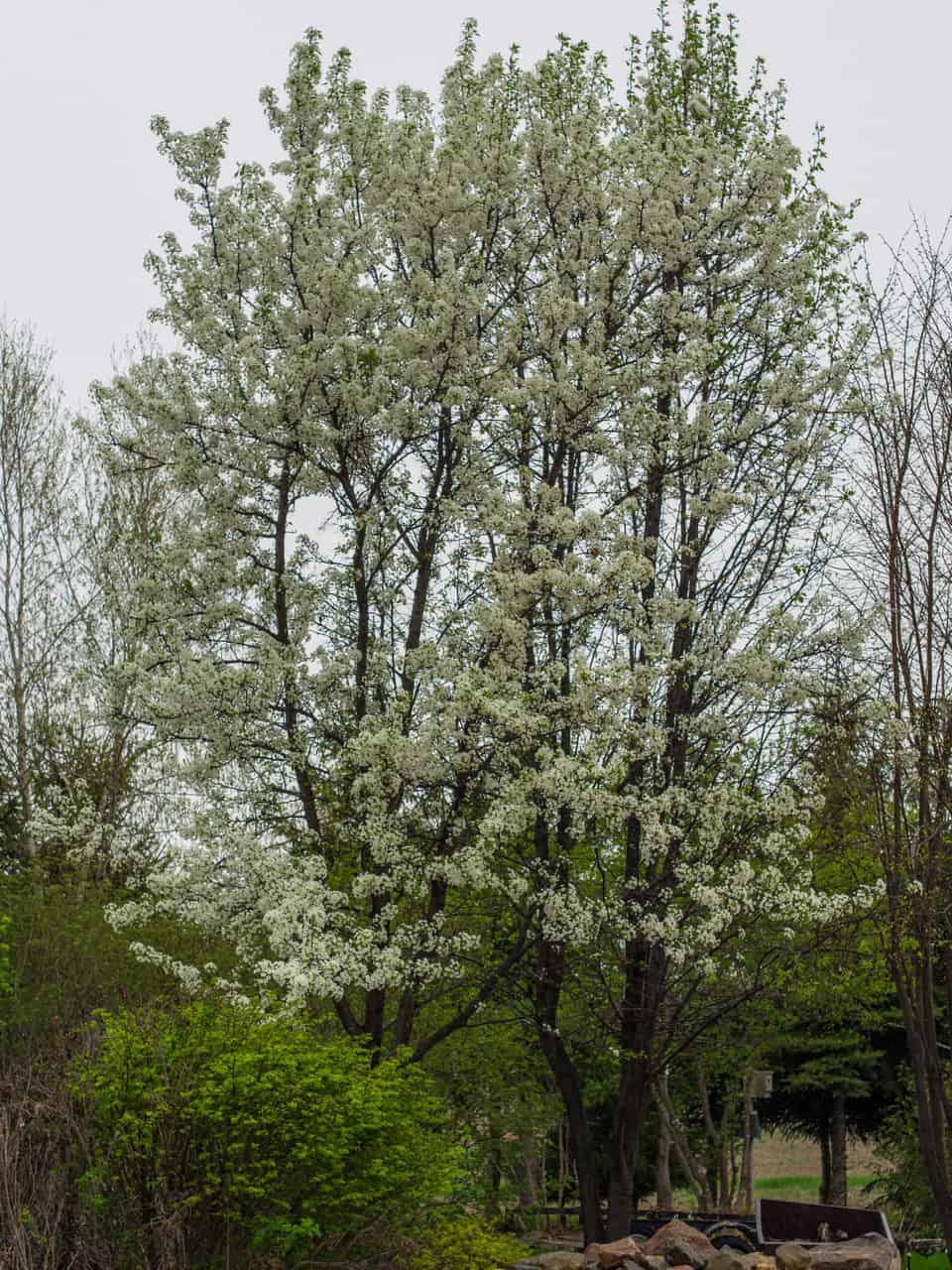
Callery pear (Pyrus calleryana), including ‘Bradford’, ‘Cleveland Select’ and ‘Aristocrat’, was one of the most planted flowering trees in Ohio. Its white flowers smell unpleasant, and the trees split apart in storms. The varieties cross-pollinate and spread by seed into fields and roadsides, where they form thorny thickets. Ohio added Callery pear to its invasive plant list, and its sale has been banned since January 2023. Serviceberry, native dogwood and crabapple give the same white spring display. See the pros and cons of Bradford pear trees.
Tips for Planting Flowering Trees in Ohio
- Plan for late frost. Magnolias and early cherries often lose their flowers to an April freeze. Plant them where they are sheltered from the wind, or choose later-blooming varieties.
- Heavy clay soil. Much of Ohio has clay soil. Plant a little higher than the surrounding ground and don’t bury the root flare. Dogwoods, serviceberries and redbuds don’t tolerate standing water.
- Plant in spring or fall. Early fall is the best time in Ohio, because the soil is still warm and roots grow before winter.
- Go native where you can. Native trees such as redbud, dogwood and serviceberry support far more insects and birds than non-native ones.
See also spring flowering trees, and poisonous plants in Ohio if you have children or pets.