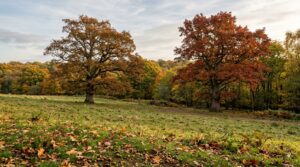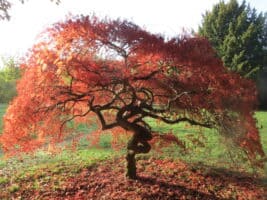
The most common trees in Tennessee are red maple, tulip poplar (the state tree), white oak, chestnut oak, sugar maple, hickories, sweetgum and Virginia pine, with eastern red cedar, the official state evergreen tree, on old fields and limestone glades all over Middle Tennessee. About half of Tennessee is forested, and most of that forest is oak and hickory. Pines grow on the dry ridges of the Cumberland Plateau, red spruce and Fraser fir on the highest peaks of the Smokies, and bald cypress in the swamps of West Tennessee.
Contents
- Pines and Other Conifers
- Oaks, Hickories and Pecans
- Other Upland Hardwoods
- Tulip Poplar (State Tree) (Liriodendron tulipifera)
- Red Maple (Acer rubrum)
- Sugar Maple (Acer saccharum)
- American Beech (Fagus grandifolia)
- Black Walnut (Juglans nigra)
- Black Cherry (Prunus serotina)
- White Ash and Green Ash (Fraxinus americana and F. pennsylvanica)
- Black Gum (Nyssa sylvatica)
- Sassafras (Sassafras albidum)
- Sourwood (Oxydendrum arboreum)
- Trees of Rivers and Bottomlands
- Sweetgum (Liquidambar styraciflua)
- American Sycamore (Platanus occidentalis)
- River Birch (Betula nigra)
- Hackberry and Sugarberry (Celtis occidentalis and C. laevigata)
- Eastern Cottonwood (Populus deltoides)
- Boxelder (Acer negundo)
- Willow Oak and Water Oak (Quercus phellos and Q. nigra)
- Honey Locust (Gleditsia triacanthos)
- Small Flowering and Understory Trees
- Don’t Plant These Invasive Trees
- Where to See Tennessee’s Trees
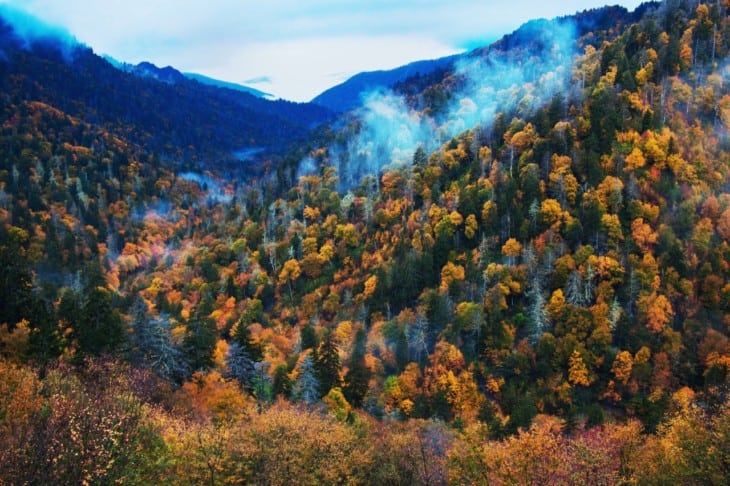
Tennessee runs from the Blue Ridge Mountains in the east, through the Ridge and Valley, the Cumberland Plateau, the Highland Rim and the Central Basin, to the Mississippi River floodplain in the west. The mountains alone have more than 100 native tree species, and the rich, sheltered coves of the Great Smoky Mountains hold some of the largest hardwood trees in the eastern U.S.

- Pines and Other Conifers
- Oaks, Hickories and Pecans
- Other Upland Hardwoods
- Trees of Rivers and Bottomlands
- Small Flowering and Understory Trees
- Don’t Plant These Invasive Trees
- Where to See Tennessee’s Trees
| Tree | Botanical name | Native to TN | Where you’ll see it |
|---|---|---|---|
| Shortleaf Pine | Pinus echinata | Yes | Dry ridges of the Cumberland Plateau and Highland Rim |
| Virginia Pine | Pinus virginiana | Yes | Old fields and poor soils in East and Middle Tennessee |
| Loblolly Pine | Pinus taeda | Yes, in the south; widely planted | Timber plantations across the state |
| Eastern White Pine | Pinus strobus | Yes | Mountains of East Tennessee and gorges of the Cumberland Plateau |
| Eastern Red Cedar | Juniperus virginiana | Yes | Old fields, fencerows and the cedar glades of Middle Tennessee |
| Eastern Hemlock | Tsuga canadensis | Yes | Cool, shady ravines and stream banks in East Tennessee |
| Red Spruce and Fraser Fir | Picea rubens and Abies fraseri | Yes | Highest peaks of the Great Smoky Mountains |
| Bald Cypress | Taxodium distichum | Yes | Swamps, sloughs and Reelfoot Lake in West Tennessee |
| White Oak | Quercus alba | Yes | Upland forests statewide |
| Northern Red Oak | Quercus rubra | Yes | Moist slopes and coves, especially in East Tennessee |
| Chestnut Oak | Quercus montana | Yes | Dry, rocky ridges and slopes |
| Black Oak | Quercus velutina | Yes | Dry upland forests statewide |
| Scarlet Oak | Quercus coccinea | Yes | Dry ridges and slopes in East and Middle Tennessee |
| Southern Red Oak | Quercus falcata | Yes | Dry uplands in Middle and West Tennessee |
| Hickories | Carya ovata, C. tomentosa and C. glabra | Yes | Upland forests statewide |
| Pecan | Carya illinoinensis | Yes, in West Tennessee | Mississippi River bottoms; planted in yards statewide |
| Tulip Poplar (State Tree) | Liriodendron tulipifera | Yes | Everywhere, especially on moist slopes and in old fields |
| Red Maple | Acer rubrum | Yes | Everywhere, from swamps to dry ridges |
| Sugar Maple | Acer saccharum | Yes | Rich, moist slopes and coves, especially in Middle and East Tennessee |
| American Beech | Fagus grandifolia | Yes | Moist, rich slopes and coves |
| Black Walnut | Juglans nigra | Yes | Rich bottoms, slopes and farm fields |
| Black Cherry | Prunus serotina | Yes | Forest edges, fencerows and old fields |
| White Ash and Green Ash | Fraxinus americana and F. pennsylvanica | Yes | Upland forests (white ash) and bottomlands (green ash) |
| Black Gum | Nyssa sylvatica | Yes | Upland forests and swamps statewide |
| Sassafras | Sassafras albidum | Yes | Old fields, fencerows and forest edges |
| Sourwood | Oxydendrum arboreum | Yes | Dry slopes and ridges in East and Middle Tennessee |
| Sweetgum | Liquidambar styraciflua | Yes | Bottomlands, old fields and yards, especially in Middle and West Tennessee |
| American Sycamore | Platanus occidentalis | Yes | Along almost every stream and river |
| River Birch | Betula nigra | Yes | Stream banks and floodplains |
| Hackberry and Sugarberry | Celtis occidentalis and C. laevigata | Yes | Bottomlands, fencerows and limestone soils |
| Eastern Cottonwood | Populus deltoides | Yes | Riverbanks and sandbars, especially along the Mississippi |
| Boxelder | Acer negundo | Yes | Stream banks, floodplains and disturbed ground |
| Willow Oak and Water Oak | Quercus phellos and Q. nigra | Yes | Bottomlands; planted as street trees |
| Honey Locust | Gleditsia triacanthos | Yes | Bottomlands and limestone pastures |
| Flowering Dogwood | Cornus florida | Yes | Forest understory and yards statewide |
| Eastern Redbud | Cercis canadensis | Yes | Forest edges, limestone soils and yards |
| American Persimmon | Diospyros virginiana | Yes | Old fields, fencerows and forest edges |
| Red Mulberry | Morus rubra | Yes | Moist woods, stream banks and fencerows |
| Serviceberry | Amelanchier arborea | Yes | Forest edges and slopes; planted in yards |
| American Holly | Ilex opaca | Yes | Forest understory statewide |
| Pawpaw | Asimina triloba | Yes | Moist bottomlands and ravines, often in colonies |
| Carolina Silverbell | Halesia carolina | Yes | Moist coves and stream banks in East Tennessee |
| Callery Pear (Bradford Pear) | Pyrus calleryana | No (China) | Roadsides, fields and yards |
| Tree of Heaven | Ailanthus altissima | No (China) | Roadsides, vacant lots and forest edges |
| Mimosa | Albizia julibrissin | No (Asia) | Roadsides, stream banks and yards |
| Princess Tree | Paulownia tomentosa | No (China) | Roadsides, rocky slopes and disturbed ground in East Tennessee |
Pines and Other Conifers
Shortleaf Pine (Pinus echinata)
Read our guide to Shortleaf Pine
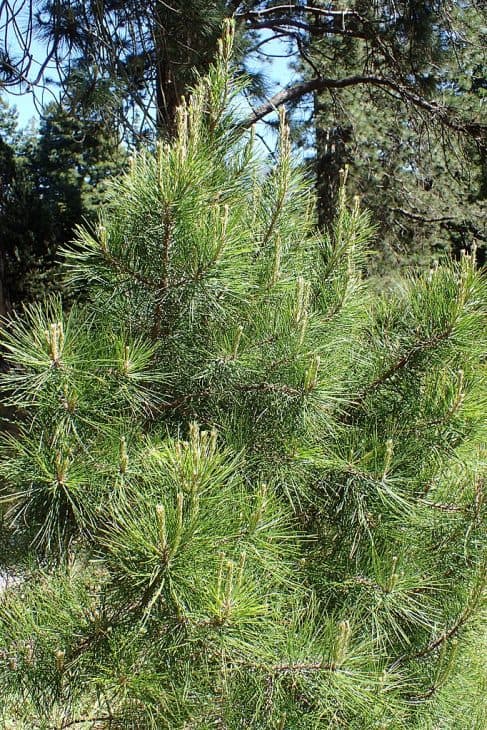
Shortleaf pine has the widest range of any Southern pine and is the main native pine of Tennessee’s dry uplands. It grows 50 to 100 feet tall, with needles 3 to 5 inches long in bundles of two and three, small cones with a tiny prickle on each scale, and reddish-brown bark in flat, scaly plates. It sprouts back after fire, which once kept its open woodlands free of hardwoods.
Virginia Pine (Pinus virginiana)

Virginia pine is a scruffy, small pine, 30 to 60 feet tall, that quickly fills abandoned fields and road cuts on poor, dry soil. Its needles are short, 1.5 to 3 inches, twisted and in pairs, and its small cones stay on the branches for years. It is short-lived and is gradually replaced by hardwoods. In the South it is also grown as a Christmas tree.
Loblolly Pine (Pinus taeda)

Loblolly pine is the most important timber tree of the South. It is native only along Tennessee’s southern edge, but it has been planted on a large scale across the state because it grows so fast. It grows 60 to 100 feet tall, with needles 6 to 9 inches long in bundles of three and 3- to 6-inch cones with sharp prickles. It is often hit by southern pine beetle outbreaks.
Eastern White Pine (Pinus strobus)

Eastern white pine is the only native five-needle pine in the East. Its soft, blue-green needles are 3 to 5 inches long, in bundles of five, and its cones are long, slender and resinous. It grows 80 to 100 feet or taller, with layered, horizontal branches, and some old trees in the Smokies are among the tallest trees in the eastern U.S. It is also a popular yard and screen tree.
Eastern Red Cedar (Juniperus virginiana)

Eastern red cedar became Tennessee’s official state evergreen tree in 2012. It is a dense, pyramid-shaped juniper, 30 to 50 feet tall, with scale-like leaves and blue, berry-like cones on female trees that feed many birds. It thrives on thin, rocky limestone soil, especially in the cedar glades around Lebanon, which is named after the cedars of Lebanon in the Bible. It hosts cedar-apple rust, which damages nearby apple trees.
Eastern Hemlock (Tsuga canadensis)

Eastern hemlock is a graceful evergreen with drooping branch tips, short, flat needles with two white lines underneath and tiny cones about ¾ inch long. It grows 60 to 100 feet tall in cool, moist coves and along mountain streams, which it keeps shaded and cool. Since 2002, when the hemlock woolly adelgid reached the Smokies, the insect has killed many of the park’s hemlocks. The rare Carolina hemlock, with needles arranged all around the twig, grows on a few rocky ridges in northeastern Tennessee.
Red Spruce and Fraser Fir (Picea rubens and Abies fraseri)

Above about 4,500 feet in the Smokies, on peaks such as Clingmans Dome and Mount Le Conte, the hardwoods give way to a dark forest of red spruce and Fraser fir, like the forests of Canada. Red spruce has sharp, four-sided needles and hanging cones. Fraser fir, found only in the southern Appalachians, has flat, soft needles and upright cones. Since the 1960s the balsam woolly adelgid has killed most mature Fraser firs, leaving many peaks covered in gray snags. Fraser fir is one of the most popular Christmas trees.
Bald Cypress (Taxodium distichum)

Bald cypress is a deciduous conifer: its soft, feathery needles turn rusty orange and drop in fall. It grows 50 to 100 feet tall, with a swollen, buttressed base and woody “knees” that rise from the roots around it in water. The best place to see it in Tennessee is Reelfoot Lake, formed by the New Madrid earthquakes of 1811 and 1812, where old cypresses stand in open water. It also grows well in ordinary yards.
Oaks, Hickories and Pecans
White Oak (Quercus alba)

White oak is one of the most common and valuable trees in Tennessee. It grows 60 to 100 feet tall, with a broad, spreading crown, pale gray, scaly bark and leaves with 7 to 9 rounded lobes. Its sweet acorns ripen in one year and are a favorite food of deer, turkeys and squirrels. White oak wood is used for the charred barrels that Tennessee whiskey and bourbon are aged in.
Northern Red Oak (Quercus rubra)

Northern red oak grows 60 to 80 feet tall and has leaves with 7 to 11 pointed, bristle-tipped lobes. Its bark has long, flat, shiny ridges that look like ski trails running down the trunk. The acorns take two years to ripen. It is a fast-growing, valuable timber tree and a good shade tree for large yards.
Chestnut Oak (Quercus montana)

Chestnut oak is one of the most common trees on dry, rocky ridgetops in East Tennessee and on the Cumberland Plateau. It grows 50 to 70 feet tall and is easy to recognize by its leaves, which have wavy, rounded teeth instead of lobes, and by its very thick, deeply furrowed, dark bark. Its large acorns ripen in one year. It took over many ridges after chestnut blight killed the American chestnut in the early 1900s.
Black Oak (Quercus velutina)

Black oak grows 50 to 80 feet tall, with dark, blocky bark. Its leaves are glossy, dark green above and paler, with tufts of hair, below, and vary from deeply to shallowly lobed. The easiest way to tell it from other red oaks is its inner bark, which is bright yellow-orange; it was once used to make a yellow dye.
Scarlet Oak (Quercus coccinea)

Scarlet oak grows 50 to 70 feet tall on dry, poor, acidic soil. Its leaves are cut almost to the middle into 5 to 9 bristle-tipped lobes, with deep, C-shaped gaps between them, and turn bright scarlet in fall. Its acorns have a small ring of concentric circles at the tip. It is a good shade tree for dry sites.
Southern Red Oak (Quercus falcata)
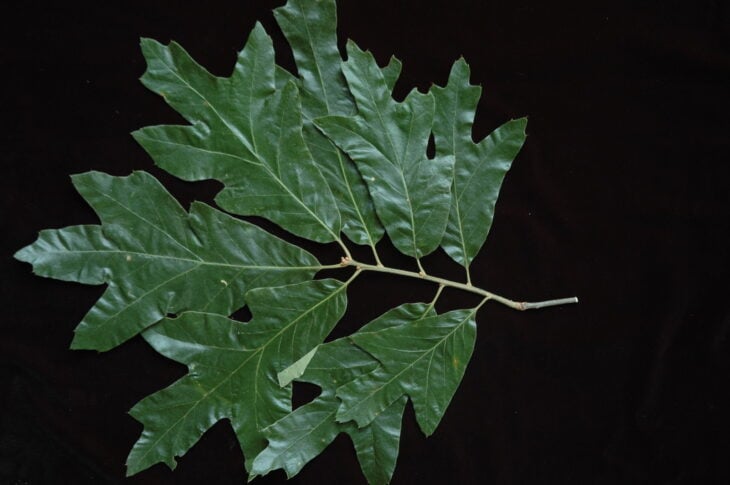
Southern red oak grows 60 to 80 feet tall and has distinctive leaves: a long, narrow end lobe and 3 to 5 bristle-tipped lobes, with a rounded, bell-shaped base. The undersides are covered in soft, rusty hairs. It grows on dry, sandy or clay soils and is more common in the western half of the state.
Hickories (Carya ovata, C. tomentosa and C. glabra)

Tennessee has several native hickories. Shagbark hickory is easy to spot by its bark, which peels in long, curling strips. Mockernut hickory has leaves of 7 to 9 leaflets with hairy undersides, and pignut hickory has smooth leaves of usually 5 leaflets. All grow 60 to 80 feet tall, have compound leaves that turn golden yellow in fall and bear hard-shelled nuts eaten by squirrels, bears and other wildlife. Hickory wood is prized for tool handles and for smoking meat.
Pecan (Carya illinoinensis)

Pecan is the largest hickory, 70 to 100 feet tall, with leaves of 9 to 17 slightly curved leaflets. In Tennessee it grows wild only in the bottomlands of the Mississippi River and its tributaries in the far west, but it is planted in yards all over the state. Named varieties bear much larger nuts than wild trees, and most need a second variety nearby for good crops.
Other Upland Hardwoods
Tulip Poplar (State Tree) (Liriodendron tulipifera)
Tulip poplar has been Tennessee’s state tree since 1947. It isn’t a poplar at all but a member of the magnolia family. It is one of the tallest hardwoods in eastern North America: 70 to 120 feet tall, with a long, straight trunk, and some trees in the Smokies are much taller. It has four-lobed leaves with a flat, notched tip and, in May, tulip-shaped, greenish-yellow flowers with an orange band. It grows fast and quickly fills cleared land. Early settlers used its straight logs for cabins.
Red Maple (Acer rubrum)

Red maple is one of the most common and adaptable trees in Tennessee and in the whole eastern U.S. It grows 40 to 70 feet tall, with three-lobed, toothed leaves that turn red, orange or yellow in fall. Its tiny red flowers appear on bare branches in late winter, and its red, winged seeds follow in early spring. It is a popular, fast-growing shade tree.
Sugar Maple (Acer saccharum)
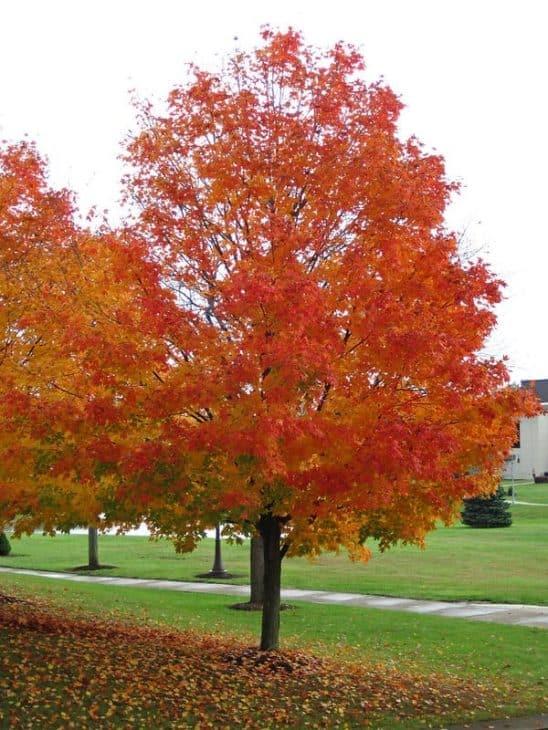
Sugar maple grows 60 to 80 feet tall, with a dense, rounded crown and five-lobed leaves with smooth, pointed lobes. It has some of the best fall color of any tree, in brilliant orange, red and gold. Its sap can be boiled down into maple syrup, though Tennessee’s winters are too mild for a big syrup industry. The similar southern sugar maple, or Florida maple, grows in the western and southern parts of the state.
American Beech (Fagus grandifolia)

American beech is easy to recognize by its smooth, light gray bark, which stays smooth even on old trees. It grows 50 to 80 feet tall, with toothed, strongly veined leaves that turn copper in fall. Young trees keep their dead, papery leaves through winter. Its small, triangular nuts, in spiny husks, feed bears, turkeys and many other animals.
Black Walnut (Juglans nigra)

Black walnut grows 50 to 75 feet tall, with long leaves of 15 to 23 leaflets and dark, deeply furrowed bark. Its round nuts are in thick, green husks that stain hands and sidewalks dark brown. Its roots release juglone, a chemical that stunts tomatoes and many other plants growing nearby. Black walnut wood is one of the most valuable hardwoods in North America.
Black Cherry (Prunus serotina)

Black cherry grows 50 to 80 feet tall. Young trees have smooth, reddish bark with horizontal lines, and old trees have dark, scaly bark that looks like burnt potato chips. Its narrow, glossy leaves have fine, curved teeth. Long clusters of small white flowers in spring are followed by dark purple cherries in late summer that birds love. Its wilted leaves are poisonous to cattle and horses.
White Ash and Green Ash (Fraxinus americana and F. pennsylvanica)

Ash trees have compound leaves of 5 to 9 leaflets that grow in opposite pairs, and gray bark with interlacing, diamond-shaped ridges. They grow 50 to 80 feet tall and turn yellow or purple in fall. Since the emerald ash borer was found in Tennessee in 2010, it has spread across most of the state and killed many ash trees. The blue ash of Middle Tennessee’s limestone soils, with square twigs, has held up better.
Black Gum (Nyssa sylvatica)

Black gum, or blackgum, grows 40 to 60 feet tall, with a straight trunk, horizontal branches and glossy, oval leaves that are among the first to turn brilliant scarlet in early fall. Female trees bear small, blue-black fruits that birds love. Old trees are often hollow, and people once used the hollow trunks as beehives, called bee gums. It is a native tupelo, not the Australian eucalyptus of the same name.
Sassafras (Sassafras albidum)

Sassafras grows 30 to 60 feet tall and often spreads into thickets from its roots. It has three different leaf shapes on the same tree: oval, mitten-shaped and three-lobed. Crushed leaves, twigs and roots have a spicy, root beer smell. It flowers in early spring, with small yellow flowers, and female trees bear blue fruits on red stalks. Its leaves turn orange, red and yellow in fall.
Sourwood (Oxydendrum arboreum)

Sourwood is a small tree, usually 20 to 30 feet tall, with sour-tasting leaves that turn brilliant scarlet in early fall. In early summer it has long, drooping sprays of small, white, bell-shaped flowers, like lily of the valley, that are a favorite of bees. Sourwood honey, made in the mountains of Tennessee and North Carolina, is one of the most prized honeys in the U.S.
Trees of Rivers and Bottomlands
Sweetgum (Liquidambar styraciflua)

Sweetgum grows 60 to 80 feet tall, with glossy, star-shaped leaves that turn purple, red, orange and yellow in fall, often all on one tree. Its spiky, round seed balls, called gumballs, fall all winter and are a nuisance in lawns. It grows fast and quickly takes over abandoned fields. Crushed leaves have a sweet, resinous smell.
American Sycamore (Platanus occidentalis)

American sycamore is one of the largest hardwoods in eastern North America, 70 to 100 feet tall, with a massive trunk. Its bark peels off in patches, leaving the upper trunk and branches smooth and white, which makes sycamores easy to spot along creeks in winter. It has large, maple-like leaves and round seed balls that hang on long stalks through winter.
River Birch (Betula nigra)
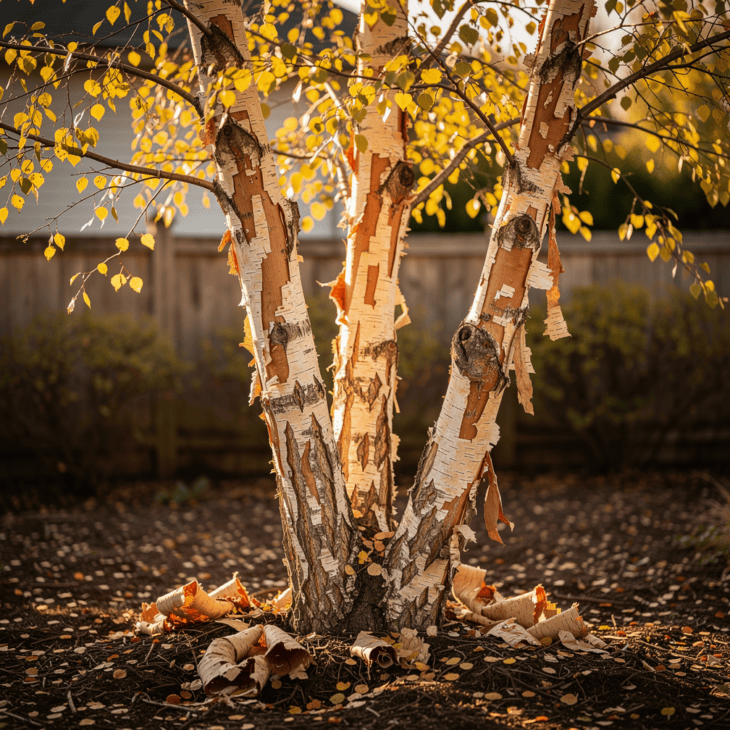
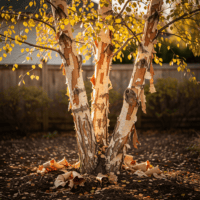
River birch is the only birch native to the lowlands of the South. It grows 40 to 70 feet tall, often with several trunks, and its bark peels in papery, curling sheets of salmon, cinnamon and cream. Its leaves are diamond-shaped, with double teeth. It handles heat, wet soil and occasional flooding, and it is one of the best birches for yards in Tennessee.
Hackberry and Sugarberry (Celtis occidentalis and C. laevigata)

Hackberry grows 40 to 60 feet tall, with gray bark covered in corky warts and ridges and leaves with a lopsided base. Its small, purple, berry-like fruits feed birds through winter. Sugarberry is its southern twin, more common in West Tennessee bottomlands, with narrower leaves and smoother bark. Both are tough city trees and host the caterpillars of hackberry emperor butterflies.
Eastern Cottonwood (Populus deltoides)
Read our guide to Eastern Cottonwood

Eastern cottonwood is one of the fastest-growing trees in North America, reaching 80 to 100 feet tall. Its triangular leaves have flattened stalks, so they flutter in the slightest breeze. In late spring, female trees release seeds covered in white, cottony fluff. It grows mainly along rivers, especially in West Tennessee.
Boxelder (Acer negundo)
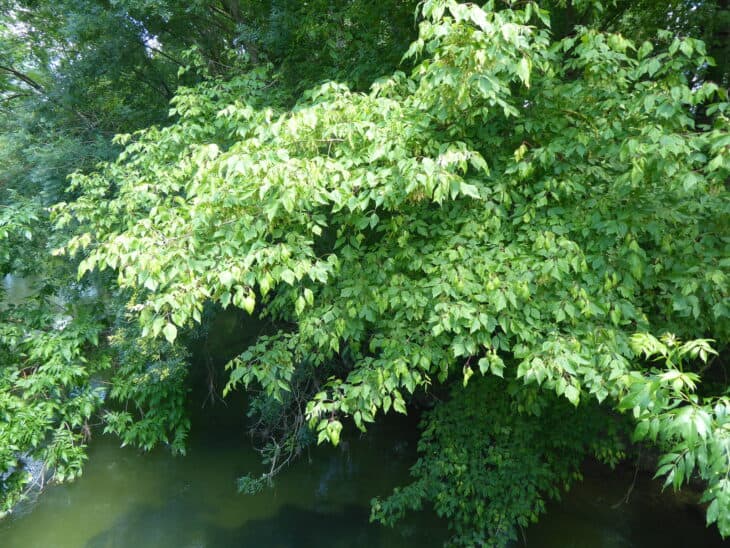
Boxelder is a maple with compound leaves of 3 to 5 leaflets, so it is often mistaken for poison ivy or ash. It grows fast to 30 to 50 feet, often with several leaning trunks, and has green twigs and winged seeds in pairs. Its weak wood breaks easily in storms. Boxelder bugs, red and black insects that gather on warm walls in fall, feed on its seeds.
Willow Oak and Water Oak (Quercus phellos and Q. nigra)

Willow oak is an oak with narrow, smooth-edged, willow-like leaves. It grows 60 to 80 feet tall, tolerates wet soil and is a popular street and shade tree across the South. Water oak has spoon-shaped leaves, wider at the tip, that often stay green into winter. It grows fast in bottomlands and old fields but is short-lived and prone to rot. Both bear small acorns eaten by ducks and other wildlife.
Honey Locust (Gleditsia triacanthos)
Read our guide to Honey Locust

Honey locust grows 30 to 70 feet tall, with fern-like leaves of many small leaflets and long, flat, twisted seed pods with a sweet pulp that cattle and deer eat. Wild trees have large, branched thorns on the trunk and branches. Thornless, seedless varieties are common street trees, because their light shade lets grass grow underneath.
Small Flowering and Understory Trees
Flowering Dogwood (Cornus florida)

Flowering dogwood is Tennessee’s best-loved spring-flowering tree, 15 to 30 feet tall. In April its white “petals”, which are actually bracts around tiny green flowers, cover the branches. In fall it has red leaves and glossy red berries that feed birds. Knoxville’s Dogwood Arts Festival celebrates it every April. In the mountains, dogwood anthracnose, a fungal disease, has killed many wild trees.
Eastern Redbud (Cercis canadensis)

Eastern redbud is a small tree, 20 to 30 feet tall, that covers its bare branches in small, magenta-pink, pea-like flowers in March and April. Its heart-shaped leaves follow, then flat, brown seed pods. It is very common on the limestone soils of Middle Tennessee and is often planted in yards.
American Persimmon (Diospyros virginiana)

American persimmon grows 30 to 60 feet tall, with thick, dark bark broken into small, square blocks. Male and female flowers grow on separate trees, so only female trees bear fruit. The round, orange fruit, 1 to 2 inches across, is very astringent until it is fully ripe and soft, usually in fall. Raccoons, opossums, deer and foxes eat it, and it makes good pudding.
Red Mulberry (Morus rubra)

Red mulberry is the native mulberry, a small tree 30 to 50 feet tall with large leaves, rough like sandpaper above, that may be unlobed or mitten-shaped. In early summer it bears dark purple, blackberry-like fruit that is good for pies, jams and eating fresh. The white mulberry from Asia, with glossy leaves, is more common in towns and hybridizes with the native tree.
Serviceberry (Amelanchier arborea)

Serviceberry is one of the first trees to flower in spring, covering its branches in clusters of white flowers in March. It grows 15 to 30 feet tall and has small, purple-red, blueberry-like fruits in early summer that are edible and loved by birds. Its smooth gray bark and orange-red fall color make it a good small yard tree.
American Holly (Ilex opaca)

American holly is a slow-growing evergreen, 15 to 50 feet tall, with stiff, spiny leaves and smooth, pale gray bark. Female trees bear bright red berries in fall and winter, if a male holly grows nearby. It tolerates shade and is a common understory tree in Tennessee’s forests.
Pawpaw (Asimina triloba)

Pawpaw is a small understory tree, 15 to 30 feet tall, with large, drooping leaves that smell like green peppers when crushed. In spring it has dark maroon flowers. In September it bears the largest edible fruit native to North America, 3 to 6 inches long, with custard-like flesh that tastes of banana and mango. It spreads by root suckers into patches, and its leaves are the only food of zebra swallowtail caterpillars.
Carolina Silverbell (Halesia carolina)
Read our guide to Carolina Silverbell
Carolina silverbell covers itself in hanging, white, bell-shaped flowers in April. It is a small tree of 30 to 40 feet in yards, but in the rich coves of the Smokies the mountain form grows much taller. Its fruits are dry, with four papery wings. It makes an excellent small tree for a shady yard.
Don’t Plant These Invasive Trees
These trees from Asia are common in Tennessee but spread into fields, forests and roadsides, where they crowd out native trees.
Callery Pear (Bradford Pear) (Pyrus calleryana)
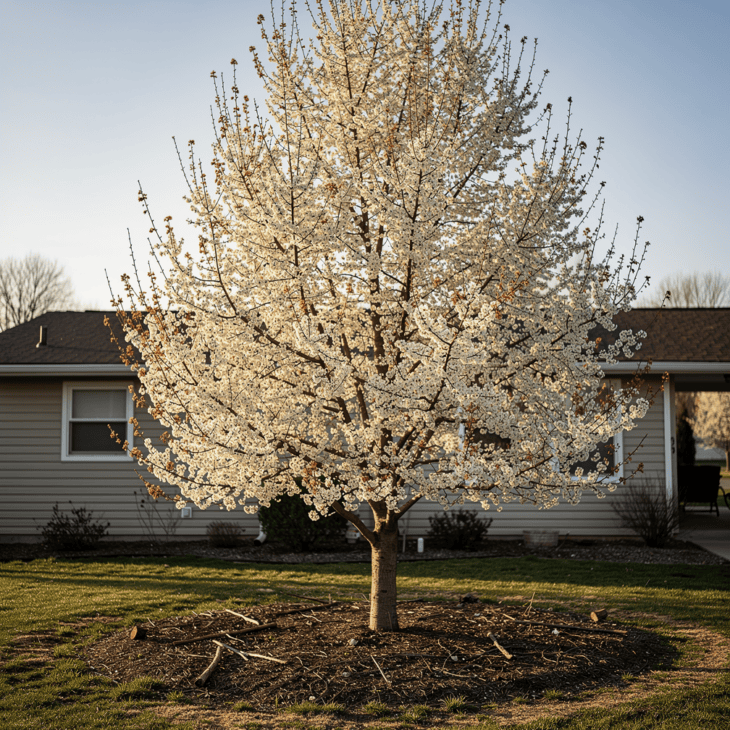
Callery pear, sold as Bradford, Cleveland Select and other varieties, covers itself in smelly white flowers in March. Its branches split easily in storms, and different varieties cross-pollinate and spread by seed into thorny thickets that take over fields and roadsides. Plant a native serviceberry or redbud instead. See the pros and cons of Bradford pear trees.
Tree of Heaven (Ailanthus altissima)

Tree of heaven grows extremely fast, up to 60 feet tall, and spreads by seed and by root suckers that come up after cutting. It has long compound leaves, with a small, gland-tipped tooth at the base of each leaflet, and a strong, unpleasant smell when crushed. It is also the favorite host of the spotted lanternfly, an invasive pest.
Mimosa (Albizia julibrissin)

Mimosa is a small tree, 20 to 40 feet tall, with fern-like leaves and fluffy, pink, powder-puff flowers in early summer. It was once a favorite Southern yard tree, but it spreads by seed along roads and streams, and its seeds stay viable in the soil for years. See types of mimosa trees.
Princess Tree (Paulownia tomentosa)

Princess tree, also called empress tree or royal paulownia, grows very fast and has huge, heart-shaped leaves and clusters of violet, foxglove-like flowers in April. Each tree makes millions of tiny, winged seeds, which have spread it along roads, rock outcrops and burned or logged land in the mountains, including around the Smokies.
Where to See Tennessee’s Trees
- Great Smoky Mountains National Park: old-growth cove forests of tulip poplar, hemlock, silverbell and buckeye, and spruce-fir forest on the highest peaks.
- Reelfoot Lake State Park: bald cypress standing in open water.
- Cedars of Lebanon State Park: eastern red cedar and the rare plants of the cedar glades.
- Savage Gulf and Fall Creek Falls: the oak, hickory, pine and hemlock forests of the Cumberland Plateau.
- Planting your own: the Tennessee Division of Forestry sells native tree seedlings each winter from its state nursery.
For the plants to watch out for in the same woods, see our guide to poisonous plants in Tennessee. Tennessee’s neighbors share many of these trees: see our guides to the trees of North Carolina, Georgia, Alabama and Missouri.