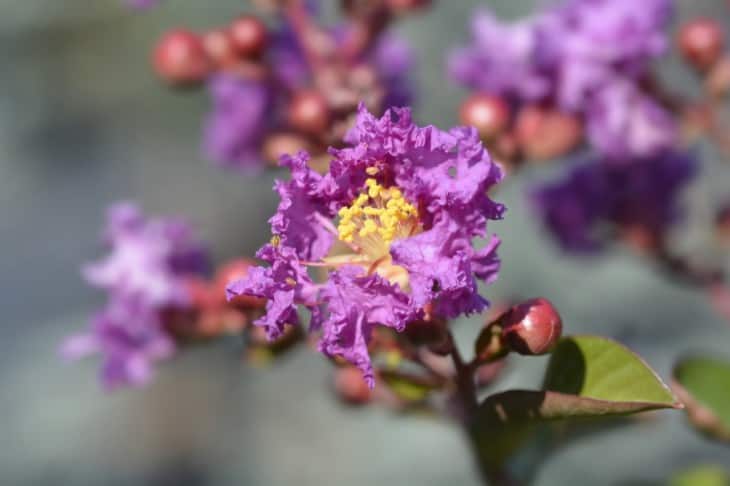
Crepe myrtles (also spelled crape myrtle) come in sizes from 3-foot dwarfs to 30-foot trees, so the most useful way to choose one is by mature height, then flower color. Most of the varieties sold today are hybrids of common crepe myrtle (Lagerstroemia indica) and Japanese crepe myrtle (L. fauriei), and the hybrids with Native American tribal names, bred at the U.S. National Arboretum, add strong resistance to powdery mildew and colorful, peeling bark.
Contents
All crepe myrtles need full sun, at least 6 hours a day, to flower well. They bloom from midsummer into fall, and many turn orange or red before they drop their leaves. Most are reliably hardy in zones 7 to 9. The tougher hybrids survive in zone 6, but hard winters can kill them to the ground there, and they regrow from the roots as shrubs.
- Tree-Sized Crepe Myrtles (20 Feet and Up)
- Medium Crepe Myrtles (10 to 20 Feet)
- Semi-Dwarf and Dwarf Crepe Myrtles (Under 12 Feet)
- How to Choose and Grow Crepe Myrtles
| Variety | Botanical name | Flowers | Mature height | Mildew resistance |
|---|---|---|---|---|
| Natchez | L. indica × fauriei ‘Natchez’ | Pure white | 20 to 30 ft | High |
| Muskogee | L. indica × fauriei ‘Muskogee’ | Light lavender | 20 to 25 ft | High |
| Japanese Crepe Myrtle | Lagerstroemia fauriei | White | 20 to 40 ft | Very high |
| Arapaho | L. indica × fauriei ‘Arapaho’ | True red | 20 to 25 ft | High |
| Tuscarora | L. indica × fauriei ‘Tuscarora’ | Dark coral-pink | 15 to 20 ft | High |
| Sioux | L. indica × fauriei ‘Sioux’ | Intense pink | 12 to 20 ft | High |
| Dynamite | L. indica ‘Whit II’ | Cherry red | 15 to 20 ft | Moderate |
| Catawba | L. indica ‘Catawba’ | Dark purple | 10 to 15 ft | Good |
| Pink Velour | L. indica ‘Whit III’ | Bright pink | 10 to 12 ft | Moderate |
| Tonto | L. indica × fauriei ‘Tonto’ | Fuchsia to red | 8 to 12 ft | High |
| Acoma | L. indica × fauriei ‘Acoma’ | White | 10 to 14 ft | High |
| Pocomoke | L. indica × fauriei ‘Pocomoke’ | Deep rose-pink | 2 to 3 ft | High |
Tree-Sized Crepe Myrtles (20 Feet and Up)
These are the ones to plant as a single specimen or a small shade tree. Give them room: a variety that wants to be 25 feet tall will need hard pruning every year if you put it under a window.
Natchez (L. indica × fauriei ‘Natchez’)

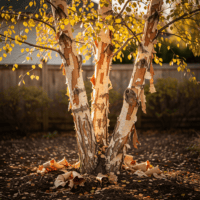
Natchez is the most widely planted white crepe myrtle and one of the largest, growing 20 to 30 feet tall and about as wide, with a broad, vase-shaped crown. The U.S. National Arboretum released it in 1978 as one of its first hybrids with Japanese crepe myrtle. Its white flowers cover the tree from early summer into fall. The main reason to grow it is the bark: it peels in patches to show smooth cinnamon-brown and cream trunks that stand out all winter. Fall color is yellow to orange-red.
Muskogee (L. indica × fauriei ‘Muskogee’)

Muskogee was released alongside Natchez in 1978 and is just as vigorous, reaching 20 to 25 feet, sometimes more. It has pale lavender-pink flowers and one of the longest bloom seasons of any crepe myrtle, often 3 months or more. The bark is light gray to tan, and the leaves turn orange-red in fall. Because it grows so fast, Muskogee is a good choice when you want a tree-sized crepe myrtle quickly.
Japanese Crepe Myrtle (Lagerstroemia fauriei)

Japanese crepe myrtle is the wild species from southern Japan that the breeders crossed with common crepe myrtle. It is the tallest and hardiest of the group, 20 to 40 feet tall, with small white flowers in early summer. It is grown mainly for its bark, which is a rich cinnamon to red-brown and very smooth. The cultivar ‘Fantasy’ is the one you will usually find for sale. It hardly ever gets powdery mildew, and it is the reason the hybrids resist it too.
Arapaho (L. indica × fauriei ‘Arapaho’)

Arapaho is one of the few tall crepe myrtles with true red flowers, not the dark pink that many red varieties turn out to be. It grows about 20 to 25 feet tall with an upright habit. It is one of the newer releases from the National Arboretum, so it is less common in nurseries than Natchez or Muskogee. The new leaves come out tinged purple before turning dark green, and they turn red-orange in fall.
Medium Crepe Myrtles (10 to 20 Feet)
These fit most yards. They make good small trees along a driveway or in a mixed border, and they can be kept multi-stemmed or trained to a single trunk.
Tuscarora (L. indica × fauriei ‘Tuscarora’)

Tuscarora has dark coral-pink flowers, a color few other crepe myrtles have. It grows 15 to 20 feet tall with a vase shape and mottled light-brown bark. It was released in 1981 and has good mildew resistance and orange-red fall color. It is one of the most reliable medium-sized crepe myrtles in the Southeast.
Sioux (L. indica × fauriei ‘Sioux’)

Sioux has bright, dark pink flowers and an upright, fairly narrow shape, which makes it a good choice for tighter spots than the wide-spreading varieties. It grows 12 to 20 feet tall. The leaves are dark green in summer and turn maroon to red-purple in fall, and the bark is gray-brown.
Dynamite (L. indica ‘Whit II’)

Dynamite has some of the brightest red flowers of any crepe myrtle, and the new leaves in spring are crimson before they turn green. It grows 15 to 20 feet tall and about 10 to 15 feet wide. It was bred by Carl Whitcomb in Oklahoma and is hardy in zones 7 to 9. Its mildew resistance is good but not as strong as the fauriei hybrids, so plant it where air moves freely.
Catawba (L. indica ‘Catawba’)

Catawba is one of the best purple crepe myrtles. The National Arboretum released it in 1967, and it is still widely sold. It grows 10 to 15 feet tall with a rounded shape and glossy leaves that turn orange-red in fall. That makes it one of the better choices for fall color. It fits well as a small tree near a patio or as a screen.
Semi-Dwarf and Dwarf Crepe Myrtles (Under 12 Feet)
These stay small without pruning. Use them as shrubs, hedges, foundation plants or in large containers.
Pink Velour (L. indica ‘Whit III’)

Pink Velour, another Carl Whitcomb variety, has bright pink flowers set off by leaves that come out wine-red in spring and stay dark burgundy-green through summer. It grows 10 to 12 feet tall and flowers heavily for a long season.
Tonto (L. indica × fauriei ‘Tonto’)

Tonto is a semi-dwarf with fuchsia to deep red-pink flowers. It stays 8 to 12 feet tall, so it works as a large shrub or a small multi-stemmed tree. It has good mildew resistance, maroon fall color and cream to taupe bark. Once established, it tolerates drought well.
Acoma (L. indica × fauriei ‘Acoma’)
Acoma is a semi-dwarf white crepe myrtle with a spreading, slightly weeping shape, often wider than it is tall. It grows 10 to 14 feet tall and has pale gray bark and purple-red fall color. It is a good choice for small gardens where Natchez would be too big.
Pocomoke (L. indica × fauriei ‘Pocomoke’)
Pocomoke is a true dwarf, forming a dense mound only 2 to 3 feet tall and a little wider. It has deep rose-pink flowers and bronze-tinged new leaves. Use it at the front of a border, as a low hedge or in a container. Dwarf series such as Petite and Razzle Dazzle fill the same role in other colors.
How to Choose and Grow Crepe Myrtles
- Choose by mature height. Buy a variety whose natural size fits the spot. Then you never need to cut it back hard.
- Don’t top it. Chopping crepe myrtles back to thick stumps every winter (“crape murder”) leaves ugly knobs and weak, floppy shoots. Only remove dead wood, crossing branches and suckers from the base.
- Full sun is essential. In shade, crepe myrtles flower poorly and get more powdery mildew.
- Pick mildew-resistant hybrids in humid areas. The indica × fauriei varieties above resist powdery mildew best.
- Be patient in spring. Crepe myrtles are among the last trees to leaf out, often not until May. A tree that still looks dead in April is usually fine.
- Watch for crape myrtle bark scale. This insect has spread across the South since 2004. It shows up as white, felt-like patches on the bark and black sooty mold on the trunk and leaves.