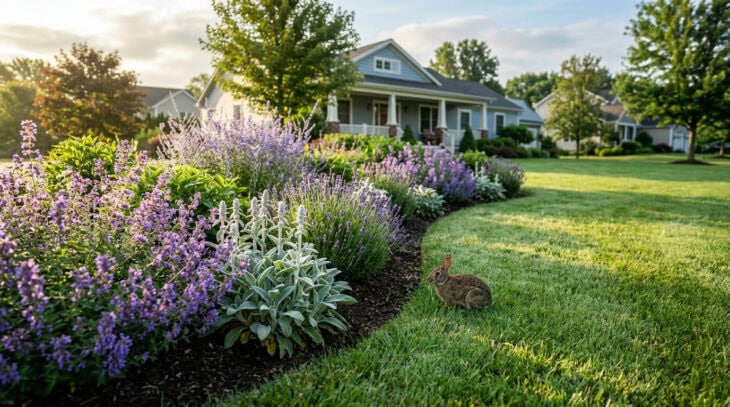
Lavender, catmint, Russian sage, lamb’s ear and daffodils are the easiest rabbit resistant plants to start with, and astilbe, barrenwort, boxwood and yew cover shade and evergreen needs. All 20 plants below are rated resistant by more than one university list.
Contents
- How We Chose These Plants
- Rabbit Resistant Plants at a Glance
- 1. Lavender (Lavandula angustifolia)
- 2. Catmint (Nepeta × faassenii)
- 3. Russian Sage (Perovskia atriplicifolia)
- 4. Yarrow (Achillea millefolium)
- 5. Lamb’s Ear (Stachys byzantina)
- 6. Red-Hot Poker (Kniphofia uvaria)
- 7. Stonecrop (Hylotelephium spectabile)
- 8. Ornamental Onion (Allium giganteum)
- 9. Daffodil (Narcissus)
- 10. Astilbe (Astilbe × arendsii)
- 11. Lady’s Mantle (Alchemilla mollis)
- 12. Barrenwort (Epimedium × versicolor)
- 13. Bleeding Heart (Dicentra spectabilis)
- 14. Foxglove (Digitalis purpurea)
- 15. Monkshood (Aconitum napellus)
- 16. Cushion Spurge (Euphorbia polychroma)
- 17. Hardy Geranium (Geranium sanguineum)
- 18. Boxwood (Buxus sempervirens)
- 19. Yew (Taxus × media)
- 20. Inkberry (Ilex glabra)
- Annuals Rabbits Usually Leave Alone
- Popular Plants Rabbits Do Eat
- Why Rabbit Resistant Plant Lists Disagree
- Frequently Asked Questions
No plant is rabbit proof. Iowa State says no plant is guaranteed to escape browsing, and NMSU adds that rabbits tend to eat resistant plants only in times of stress, drought or heavy rabbit pressure.
Treat this list as the odds in your favor, not a guarantee. If rabbits are a constant problem, pair it with a fence (see the FAQ).
How We Chose These Plants
Extension lists disagree more than nursery pages admit. A plant is on this list only if at least two of Penn State, Iowa State, Colorado State and NMSU rate it resistant and none rates it damaged.
NC State’s Plant Toolbox, our source for zones and sizes, also flags rabbit resistance for 18 of the 20. Lavender and catmint are the two it does not.
That rule left out some popular plants. Marigolds, zinnias, snapdragons and black-eyed Susans show up on some resistant lists, but Iowa State rates all four as damaged by rabbits, so they are in the myth section below, not the list.
Rabbit resistance and toxicity travel together. At least ten of these 20 plants are poisonous to dogs or cats, so check each caveat if you have pets.
Rabbit Resistant Plants at a Glance
| Plant | Botanical name | Zones | Size | Light | Listed as resistant by |
|---|---|---|---|---|---|
| Lavender | Lavandula angustifolia | 5–9 | 12–24 in (30–60 cm) | Full sun | Penn State, NMSU |
| Catmint | Nepeta × faassenii | 5–9 | 18–24 in (45–60 cm) | Full sun to part shade | Penn State, Colorado State, NMSU |
| Russian sage | Perovskia atriplicifolia | 5–9 | 2–4 ft (60–120 cm) | Full sun | Iowa State, NMSU, NC State |
| Yarrow | Achillea millefolium | 3–9 | 1–3 ft (30–90 cm) | Full sun | Penn State, Colorado State, NC State |
| Lamb’s ear | Stachys byzantina | 4–9 | 12–18 in (30–45 cm) | Full sun to part shade | Penn State, Iowa State, Colorado State |
| Red-hot poker | Kniphofia uvaria | 5–9 | 2 ft (60 cm), spikes 4 ft (1.2 m) | Full sun | Penn State, Iowa State, Colorado State |
| Stonecrop | Hylotelephium spectabile | 4–9 | 12–24 in (30–60 cm) | Full sun to part shade | Iowa State, Colorado State, NC State |
| Ornamental onion | Allium giganteum | 4–8 | Stems to 6 ft (1.8 m) | Full sun | Penn State, Iowa State, Colorado State |
| Daffodil | Narcissus | 4–8 | 8–30 in (20–75 cm) | Full sun to part shade | Penn State, Iowa State, Colorado State |
| Astilbe | Astilbe × arendsii | 3–9 | 1.5–4.5 ft (45–135 cm) | Part shade | Penn State, Iowa State, NC State |
| Lady’s mantle | Alchemilla mollis | 3–8 | 12–18 in (30–45 cm) | Sun to deep shade | Penn State, Iowa State, NC State |
| Barrenwort | Epimedium × versicolor | 5–8 | 8–10 in (20–25 cm) | Part to deep shade | Penn State, Iowa State, NC State |
| Bleeding heart | Dicentra spectabilis | 3–9 | 2–3 ft (60–90 cm) | Part to deep shade | Penn State, Iowa State, Colorado State |
| Foxglove | Digitalis purpurea | 4–9 | 2–5 ft (60–150 cm) | Full sun to part shade | Penn State, Iowa State, Colorado State |
| Monkshood | Aconitum napellus | 3–7 | 3–4 ft (90–120 cm) | Full sun to part shade | Penn State, Iowa State, Colorado State |
| Cushion spurge | Euphorbia polychroma | 5–11 | 12–18 in (30–45 cm) | Part shade | Penn State, Iowa State, NC State |
| Hardy geranium | Geranium sanguineum | 3–9 | 10–20 in (25–50 cm) | Full sun to part shade | Iowa State, Colorado State, NC State |
| Boxwood | Buxus sempervirens | 5–8 | 5–20 ft (1.5–6 m) | Full sun to part shade | Penn State, Iowa State, NC State |
| Yew | Taxus × media | 4–7 | 2–20 ft (0.6–6 m) | Full sun to part shade | Penn State, Iowa State, NC State |
| Inkberry | Ilex glabra | 4–11 | 5–10 ft (1.5–3 m) | Full sun to part shade | Iowa State, Penn State, NC State |
1. Lavender (Lavandula angustifolia)

Zones: 5–9 · Size: 12 to 24 inches (30 to 60 cm) tall, 24 to 36 inches (60 to 90 cm) wide · Light: full sun · Soil: neutral to alkaline, perfectly drained, on the dry side
Aromatic leaves and flowers put lavender on the lists from Penn State and NMSU, and NMSU names strong odor as the deterrent. Plant English lavender where water drains fast and you get a fragrant edge rabbits tend to walk past.
It does not like wet feet and dies out in heavy clay, and NC State says it is at times difficult to grow in North Carolina. It is also toxic to dogs, cats and horses (ASPCA).
2. Catmint (Nepeta × faassenii)
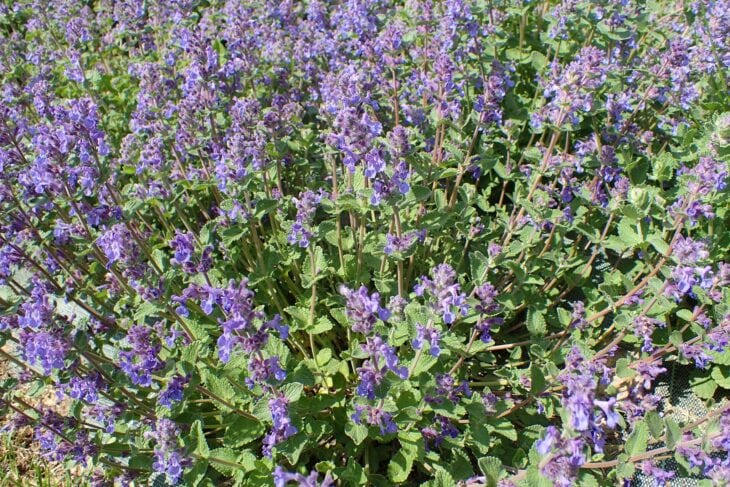
Zones: 5–9 · Size: 18 to 24 inches (45 to 60 cm) tall, 24 to 36 inches (60 to 90 cm) wide · Light: full sun to part shade · Soil: well-drained, tolerates clay and dry soil
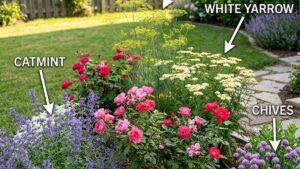
Three university sources list catmint: Penn State, Colorado State and NMSU, and NMSU groups it with plants whose strong odors and flavors rabbits dislike. The catmint profile covers care.
Blue catmint is a sterile hybrid, and NC State does not list rabbit resistance for it, which is why it ranks as a good bet rather than a sure one.
The ASPCA lists the related catnip (Nepeta cataria) as toxic to cats. It has no separate listing for this hybrid, so use some care around cats.
3. Russian Sage (Perovskia atriplicifolia)

Zones: 5–9 · Size: 2 to 4 feet (60 to 120 cm) tall and wide · Light: full sun · Soil: well-drained, occasionally dry
The silvery leaves smell pungent when brushed, and Iowa State, NMSU and NC State all list it as rabbit resistant. It blooms from June to October, so it carries a border long after spring bulbs fade.
Grow it in full sun and avoid wet soil, or it flops. Cut stems back to several inches above the ground in early spring.
NC State rates the cultivars ‘Longin’, ‘Blue Spire’ and ‘Blue Mist’ above seed-grown plants.
4. Yarrow (Achillea millefolium)

Zones: 3–9 · Size: 1 to 3 feet (30 to 90 cm) tall · Light: full sun · Soil: well-drained, tolerates dry spells
Penn State and Colorado State both list yarrow, and NC State describes it as deer and rabbit resistant. NC State lists it as tolerant of drought, heat and salt, which makes it a low-effort filler for the dry side of the yard.
NC State calls it weedy and lists contact dermatitis as a problem. The ASPCA lists it as toxic to dogs, cats and horses.
5. Lamb’s Ear (Stachys byzantina)
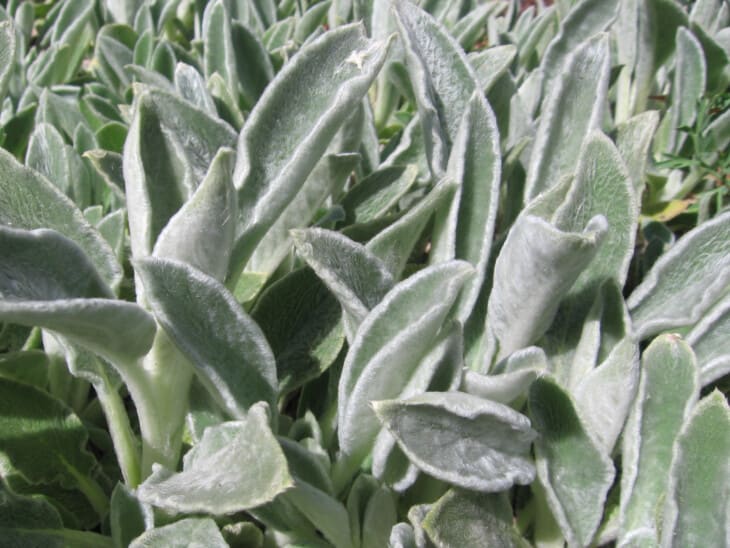
Zones: 4–9 · Size: 12 to 18 inches (30 to 45 cm) tall and wide · Light: full sun to part shade · Soil: dry to average, very well-drained
The leaves are silvery and densely woolly, the dense hairy texture Iowa State says rabbits tend to avoid. Penn State, Iowa State and Colorado State all list it.
NC State flags it as weedy. If you are comparing it with similar silver foliage, see these lookalikes for lamb’s ear.
6. Red-Hot Poker (Kniphofia uvaria)
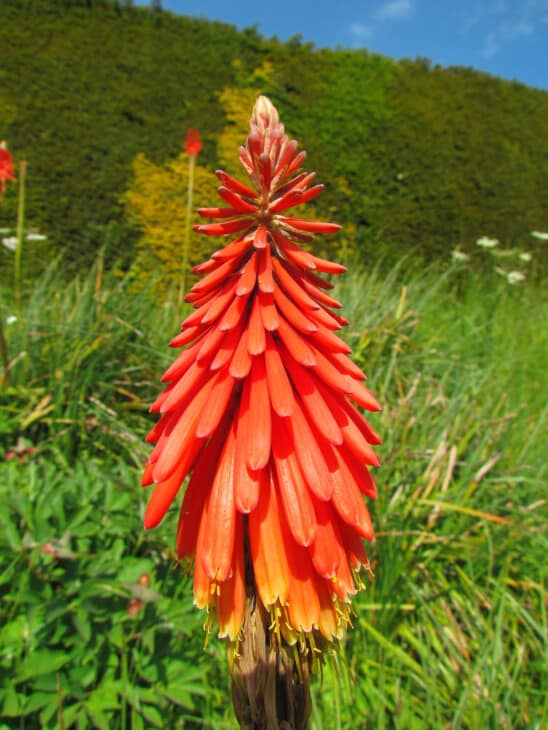
Zones: 5–9 · Size: leaf clump about 2 feet (60 cm) tall, flower spikes to about 4 feet (1.2 m) · Light: full sun · Soil: average to sandy, well-drained
Penn State, Iowa State, Colorado State and NC State list it, so it is one of the better-agreed picks here. The torch-shaped spikes open red and turn yellow from late summer into early fall.
It will not tolerate wet, heavy soil, and NC State says it does not do well in cold winters and benefits from mulch. The ASPCA lists it as non-toxic to dogs, cats and horses (as Kniphofia), which helps in a yard with pets.
7. Stonecrop (Hylotelephium spectabile)
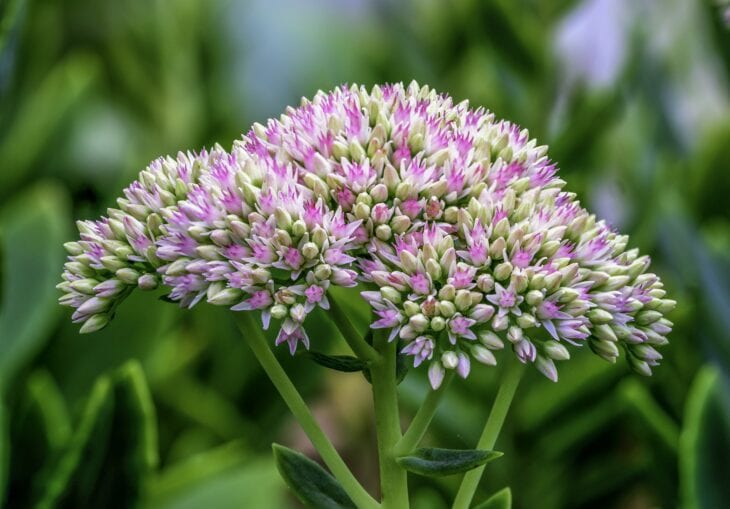
Zones: 4–9 · Size: 12 to 24 inches (30 to 60 cm) tall and wide · Light: full sun to part shade · Soil: well-drained or gravelly, average to low fertility
Iowa State lists tall stonecrop, Colorado State lists sedum, and NC State describes it as resistant to browsing by rabbits. The flat pink flower heads in late summer age to reddish-brown and attract butterflies and songbirds.
NC State says it resists rabbits but not deer, so it is a poor pick where both browse. It also suffers in overly moist or fertile soil, and NC State lists it as poisonous to people.
8. Ornamental Onion (Allium giganteum)

Zones: 4–8 · Size: flower stems 1 to 6 feet (30 cm to 1.8 m) tall, 1 to 2 feet (30 to 60 cm) wide · Light: full sun · Soil: well-drained
The leaves smell of garlic or onion, and the bulbs are on the Penn State, Iowa State and Colorado State lists. Iowa State rates tulips and crocus as moderately to severely damaged but alliums as seldom damaged.
NC State lists it as poisonous to people and a problem for cats and dogs, and notes it can be short-lived and weedy in disturbed areas.
9. Daffodil (Narcissus)

Zones: 4–8 · Size: 8 to 30 inches (20 to 75 cm) tall by cultivar · Light: full sun to part shade · Soil: well-drained
Daffodils are the most widely agreed rabbit resistant plant on this list: Penn State, Iowa State, Colorado State (twice) and NC State all list them. Iowa State rates tulips as moderately to severely damaged but daffodils as seldom damaged.
All parts are poisonous, and NC State warns of severe skin irritation from handling bulbs. The ASPCA lists them as toxic to dogs, cats and horses.
10. Astilbe (Astilbe × arendsii)
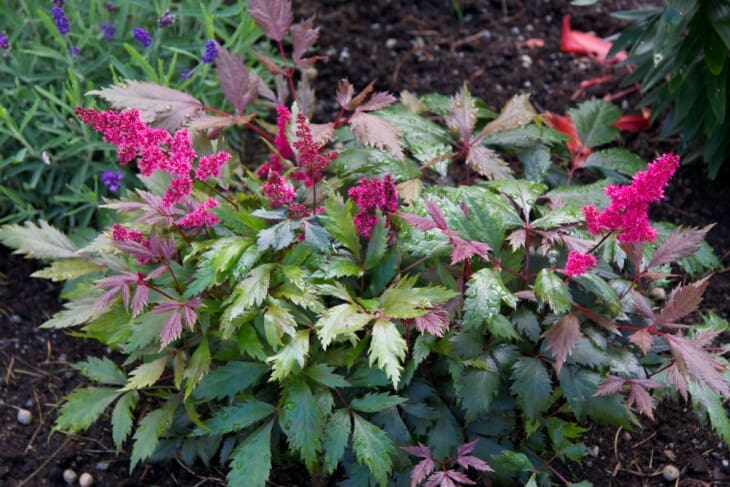
Zones: 3–9 · Size: 1.5 to 4.5 feet (45 to 135 cm) tall, 1 to 2 feet (30 to 60 cm) wide · Light: part shade, or full sun with steady moisture · Soil: moist, rich in organic matter
Penn State and Iowa State list astilbe, and NC State calls it deer and rabbit resistant. It is a reliable shade-border plant, and our shade garden ideas show it in use.
It needs consistently moist soil. In dry shade it struggles however resistant it is.
11. Lady’s Mantle (Alchemilla mollis)
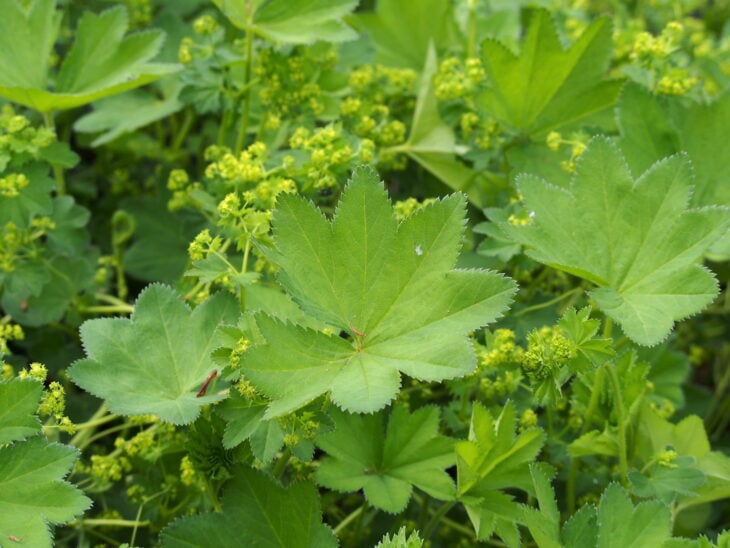
Zones: 3–8 · Size: 12 to 18 inches (30 to 45 cm) tall and wide · Light: sun to deep shade · Soil: moist, well-drained, acidic
The soft, downy leaves fit the hairy-texture pattern Iowa State describes, and both Penn State and Iowa State list it. Pale chartreuse flowers appear in June above a tidy mound.
NC State flags it as weedy, so deadhead before the seed ripens if you do not want seedlings.
12. Barrenwort (Epimedium × versicolor)
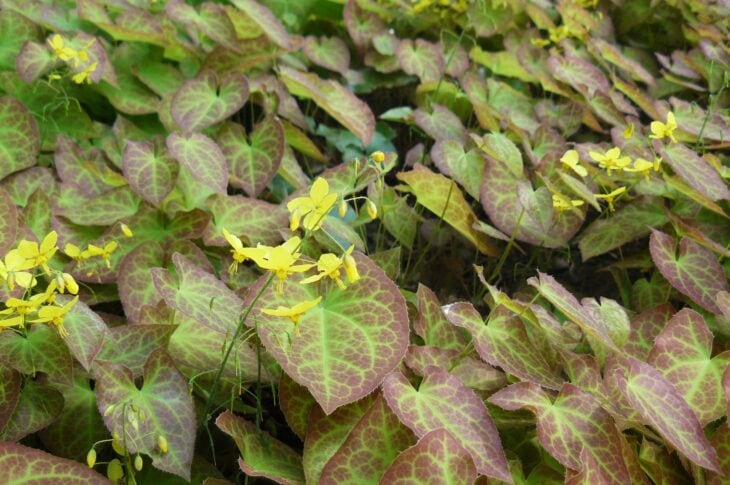
Zones: 5–8 · Size: 8 to 10 inches (20 to 25 cm) tall, 12 to 18 inches (30 to 45 cm) wide · Light: part to deep shade · Soil: moist, well-drained
Penn State and Iowa State list barrenwort, and NC State adds that it handles heavy shade and dry soil. That covers the dry, heavy shade under mature trees.
NC State lists it for Zones 5–8 only, so colder yards should choose astilbe or bleeding heart (both Zone 3).
13. Bleeding Heart (Dicentra spectabilis)
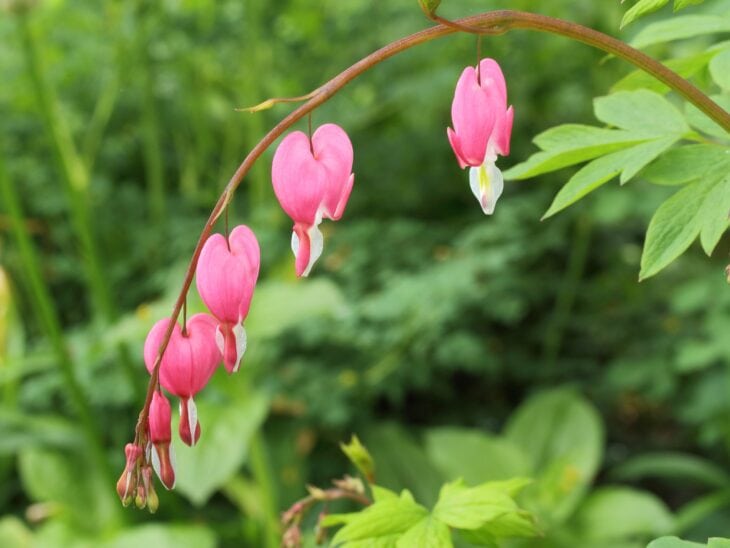
Zones: 3–9 · Size: 2 to 3 feet (60 to 90 cm) tall and wide · Light: part to deep shade · Soil: moist, well-drained
Penn State lists both old-fashioned and fringed bleeding heart, Iowa State and Colorado State list it, and NC State calls it deer and rabbit resistant. It flowers from spring into early summer.
Every part is poisonous to people, cats and dogs, and the sap can irritate skin. Wear gloves when dividing it.
14. Foxglove (Digitalis purpurea)

Zones: 4–9 · Size: 2 to 5 feet (60 to 150 cm) tall, 1 to 2.5 feet (30 to 75 cm) wide · Light: full sun to part shade · Soil: moist, well-drained, rich in organic matter
It is on the Penn State, Iowa State and Colorado State lists, and Colorado State names toxic plants among the traits that discourage animals. Our foxglove profile covers growing it.
Foxglove is a biennial: it forms a leaf rosette the first year and flowers the second. It is poisonous to people, children and pets, and the ASPCA lists it as toxic to dogs, cats and horses.
15. Monkshood (Aconitum napellus)

Zones: 3–7 · Size: 3 to 4 feet (90 to 120 cm) tall, 1 to 1.5 feet (30 to 45 cm) wide · Light: full sun to part shade · Soil: moist, well-drained, rich in organic matter
Monkshood is on the Penn State, Iowa State and both Colorado State lists, and NC State agrees. It blooms in summer with blue, violet or white hooded flowers.
Warning: NC State says most of the genus is extremely poisonous, and every part is toxic to people, children, cats and dogs. Keep it away from play areas and wear gloves when handling it.
16. Cushion Spurge (Euphorbia polychroma)
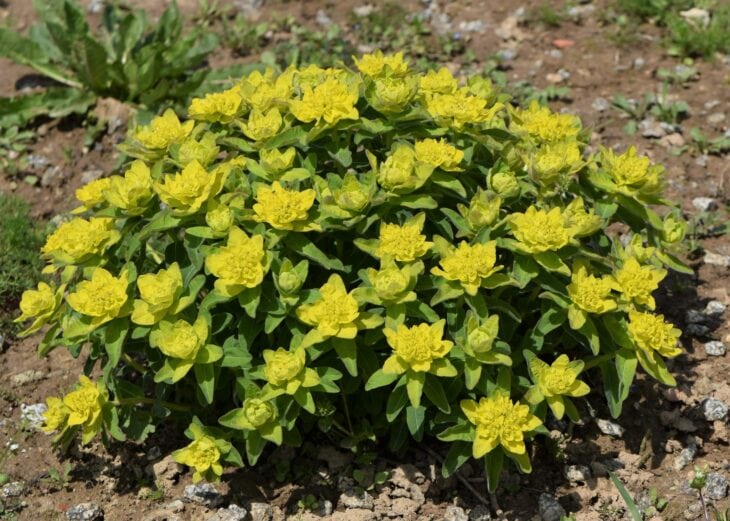
Zones: 5–11 · Size: 12 to 18 inches (30 to 45 cm) tall, 12 to 24 inches (30 to 60 cm) wide · Light: part shade (NC State) · Soil: well-drained
Penn State and Iowa State list euphorbia, and NC State lists this species as rabbit resistant. Milky sap is one of the traits Colorado State says discourages animals, and spurge carries it.
All euphorbias carry a toxic milky latex. NC State lists this species as poisonous to people, children, cats and dogs, and the sap can irritate skin.
17. Hardy Geranium (Geranium sanguineum)
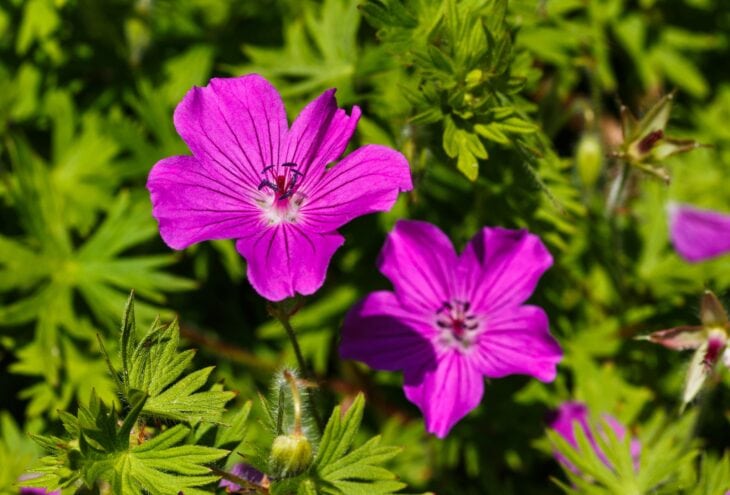
Zones: 3–9 · Size: 10 to 20 inches (25 to 50 cm) tall, 12 to 24 inches (30 to 60 cm) wide · Light: full sun to part shade · Soil: moist, well-drained
Iowa State and Colorado State list hardy geraniums, and NC State lists this species as rabbit resistant. It makes a mounding edge with magenta flowers in May and June, and it may bloom again in summer.
This is the perennial cranesbill, not the annual ‘geranium’ (Pelargonium) sold in pots. They are different plants, so facts about one do not carry over to the other.
18. Boxwood (Buxus sempervirens)

Zones: 5–8 · Size: 5 to 20 feet (1.5 to 6 m) tall and 5 to 15 feet (1.5 to 4.5 m) wide unpruned, much smaller when clipped · Light: full sun to part shade · Soil: well-drained
Penn State and Iowa State list boxwood, and NC State lists it as rabbit resistant. It is the classic evergreen hedge for a yard with rabbits.
Shelter it from winter wind and full winter sun, which can dry and bronze the leaves. It is toxic to dogs, cats and horses (ASPCA).
19. Yew (Taxus × media)
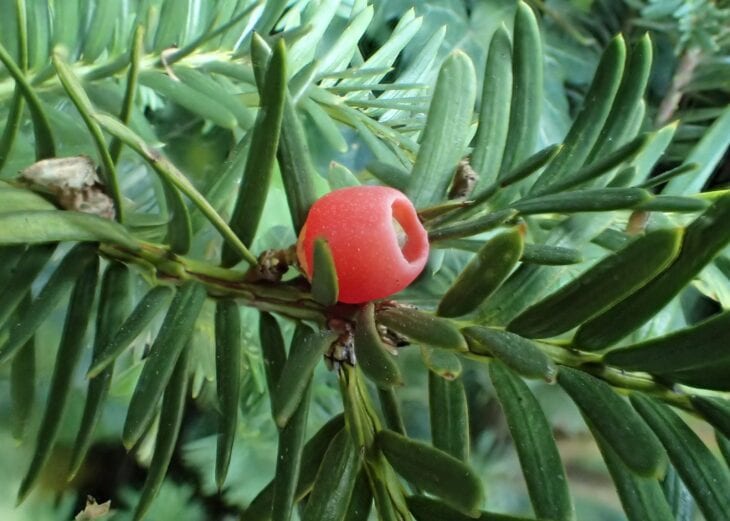
Zones: 4–7 · Size: 2 to 20 feet (0.6 to 6 m) tall and 2 to 12 feet (0.6 to 3.5 m) wide, depending on cultivar · Light: full sun to part shade · Soil: well-drained, never wet
Penn State and Iowa State list yew, and NC State does too. It tolerates severe pruning, so it works as a hedge, foundation plant or topiary that rabbits skip.
Warning: NC State says yew poisoning may be fatal, with seizures reported in dogs. The ASPCA lists it as toxic to dogs, cats and horses.
20. Inkberry (Ilex glabra)
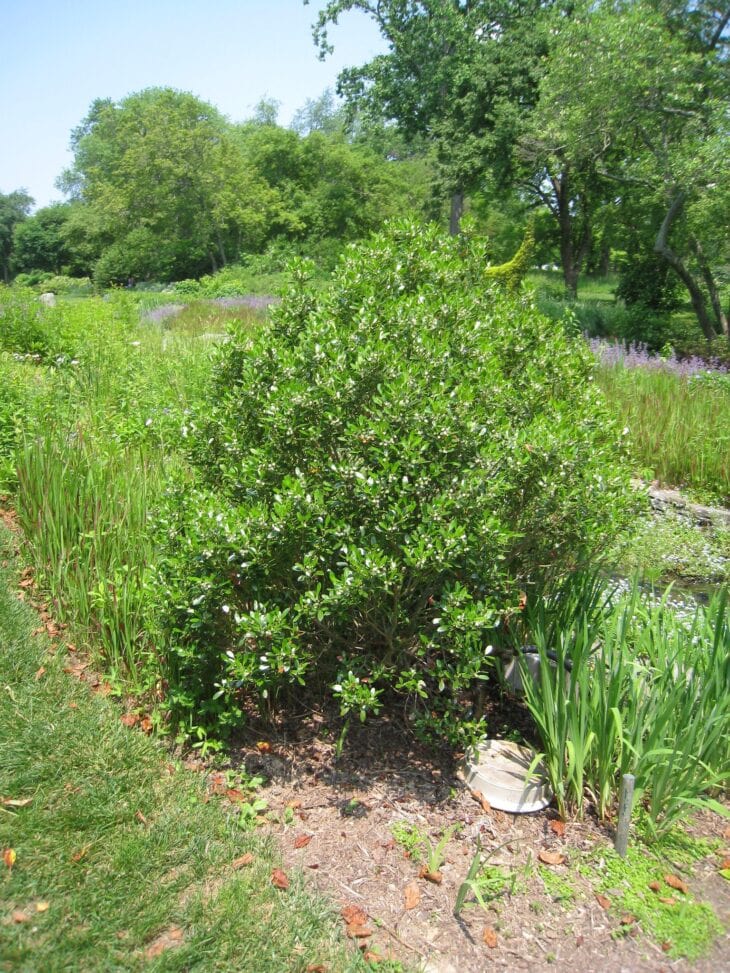
Zones: 4–11 (NC State) · Size: 5 to 10 feet (1.5 to 3 m) tall, 5 to 8 feet (1.5 to 2.5 m) wide · Light: full sun to part shade · Soil: acidic, moist to occasionally wet, clay or sand
Iowa State lists inkberry, Penn State lists holly, and NC State lists it as rabbit resistant. It is a native evergreen that tolerates wet soil and clay.
Plants are male or female, and you need both to get the berries. NC State lists the holly leafminer, Japanese wax scale and southern red mites as the common pests.
Annuals Rabbits Usually Leave Alone
Iowa State’s seldom-damaged annuals are ageratum, wax begonia, pot marigold (Calendula officinalis), vinca (Catharanthus roseus), spider flower (Cleome), four-o’clock and the potted ‘geranium’ (Pelargonium). Penn State and Colorado State also list cleome.
Pot marigold is a different plant from the marigolds (Tagetes) that Iowa State rates as damaged. The ASPCA lists Pelargonium as toxic to dogs, cats and horses.
Popular Plants Rabbits Do Eat
Iowa State rates these common garden plants as moderately to severely damaged by rabbits:
- Perennials: hosta, purple coneflower, black-eyed Susan, garden phlox, balloon flower and New England aster
- Annuals: petunia, pansy, zinnia, snapdragon, marigold, impatiens and nasturtium
- Bulbs: tulip, crocus, lily and grape hyacinth
- Shrubs and trees: rose, forsythia, redbud, burning bush, spirea and oakleaf hydrangea
Plant these inside a fence or cage, or expect to replace them.
Why Rabbit Resistant Plant Lists Disagree
Penn State lists marigolds, zinnias, snapdragons and black-eyed Susans as rabbit resistant. Iowa State puts all four in its moderately to severely damaged group.
Both are real extension lists, and the sources explain why they can differ. Iowa State says feeding habits shift with the rabbit population and the availability of other food, and Colorado State PlantTalk notes that rabbits have taste preferences and that methods working in one place may fail in another.
Two details help in practice. Colorado State says newly transplanted plants are more likely to be eaten, and bigger plants stand up to nibbling better, so cage new plantings for their first season. NMSU adds that healthy plants can regrow from the roots after heavy browsing.
The traits behind most of these picks are the ones Colorado State lists: strong aroma, prickles, tough leaves, toxicity and milky sap. Iowa State adds dense hairy leaves.
Frequently Asked Questions
What plants do rabbits hate the most?
There is no single hated plant, but rabbits tend to skip strongly aromatic plants (lavender, Russian sage, catmint), plants with dense hairy leaves (lamb’s ear), toxic plants (daffodil, foxglove, monkshood) and plants with milky sap (euphorbia). Those are the traits Iowa State and Colorado State name.
Are there any rabbit resistant perennials?
Yes. Most of the plants above are perennials or bulbs, from sun lovers such as red-hot poker and yarrow to shade plants such as astilbe, barrenwort and bleeding heart. For borders, see our perennial garden ideas.
What is the best rabbit deterrent for plants?
A fence. Oregon State recommends welded wire with openings of about 1 inch (2.5 cm), about 2 feet (60 cm) high, with the wire extending 4 to 6 inches (10 to 15 cm) below ground. Bending the buried wire outward in an L-shaped apron 6 to 12 inches (15 to 30 cm) wide helps against digging.
For single plants, Oregon State suggests tree wraps or welded-wire cages. It says repellents may help briefly but are usually not effective over the long term, because sun, rain and new growth reduce their effect.
Are rabbit resistant plants also deer resistant?
Often, but not always. NC State lists many of these plants as deer resistant too, but it describes stonecrop as resistant to rabbits and not to deer, so check each plant if both animals visit.
Will rabbits eat new plants even if they are resistant?
They are more likely to. Colorado State says newly transplanted plants, especially ones just bought from a nursery, get eaten more often than established plants. Colorado State marks columbine as marginal and especially bad when newly planted, which is why we left it off the list.