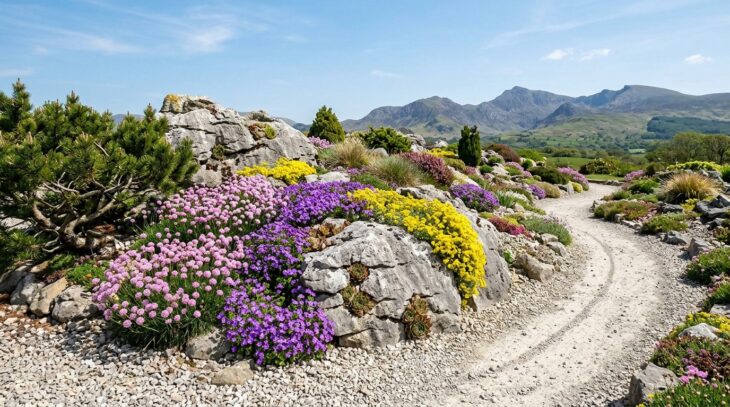
Rock gardens have an image problem. Most people picture the sad 1970s version: a heap of soil with some rocks dropped on top and a struggling conifer in the middle. Done properly, though, this is one of the most rewarding styles there is, because it is built around plants that ask for nothing, look good all year, and pack an extraordinary amount of detail into a very small area.
Contents
- 01. Build a Raised Scree Bed
- 02. Set the Rocks Like an Outcrop, Not a Pile
- 03. Turn a Slope Into a Classic Rockery
- 04. Try a Crevice Garden
- 05. Carpet the Ground With Sedum and Houseleeks
- 06. Plant an Alpine Trough
- 07. Anchor It With Dwarf Conifers
- 08. Scatter Small Bulbs Through the Gravel
- 09. Let Creeping Phlox Cascade Over a Rock
- 10. Mulch Everything With Gravel
- 11. Plant a Dry Stone Wall in Its Joints
- 12. Give the Shady Side to Saxifrage and Ferns
- 13. Grow a Thyme Lawn Between the Stones
- 14. Cut Steps Straight Through the Rocks
- 15. Use One Big Boulder as the Focal Point
- 16. Try an Alpine Meadow Effect
- 17. Use Tufa for the Choosiest Alpines
- 18. Blaze in Spring With Aubrieta and Alyssum
- 19. Add Pinks for Scent and Silver Foliage
- 20. Keep It Going With Ice Plants
- 21. Run a Dry Streambed Through It
- 22. Make a Rock Garden in a Pot
- 23. Beat Winter Wet, Not Winter Cold
- 24. Let Things Seed Into the Gravel
- 25. Weed It Little and Often
The 25 ideas below run from a full alpine slope with real boulders to a single stone trough on a patio table. Some are engineering projects (a crevice bed, a dry stone wall, a scree slope), others take an afternoon. Nearly all of them share the same underlying requirement, which is drainage, and once you understand why, the whole style stops being fussy and starts being easy.
Read the first two before anything else, because they explain the difference between a rock garden and a pile of rocks. After that, take whatever suits your site, your soil and the amount of stone you can physically move.
01. Build a Raised Scree Bed
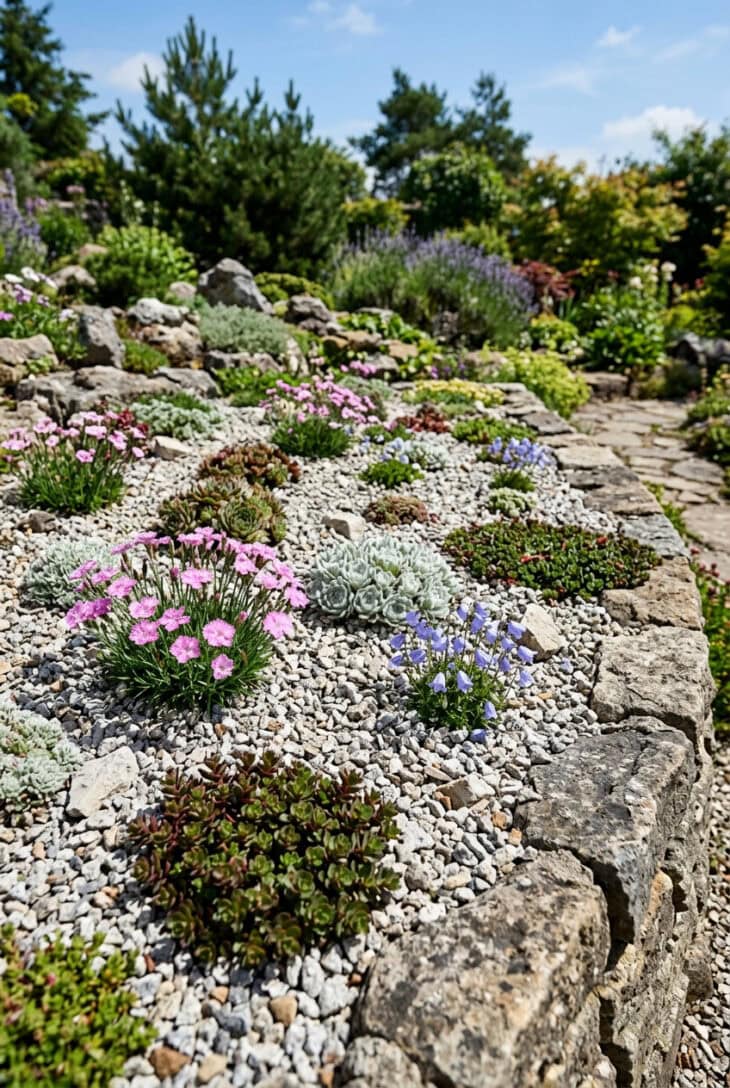
What you see A low bed lifted a foot or so above the surrounding ground, edged with rough stone and filled to the brim with pale grey grit rather than soil. Cushions of pink dianthus, silver rosettes, blue bellflowers and mats of sedum grow out of it, each one separate, with gravel showing between them. It looks like a piece of mountainside that somebody carried home.
Why it works Alpine plants are not killed by cold. In the mountains they spend the winter under a dry blanket of snow, and what kills them in a garden is sitting in cold wet soil from November to March. A raised bed of pure grit solves that in one move, because the water simply falls through it. Raising it also brings the plants closer to eye level, which matters when the flowers are the size of a shirt button.
How to get it Build the retaining edge 12 to 18in (30 to 45cm) high from stone, brick or sleepers. Fill the bottom third with rubble or coarse stone for drainage, then fill the rest with a gritty mix of roughly equal parts sharp grit, coarse sand and topsoil or loam, and top with 2in (5cm) of gravel mulch. Do not add compost or manure, which produces soft, floppy growth. Site it in full sun and away from the drip line of any tree.
02. Set the Rocks Like an Outcrop, Not a Pile
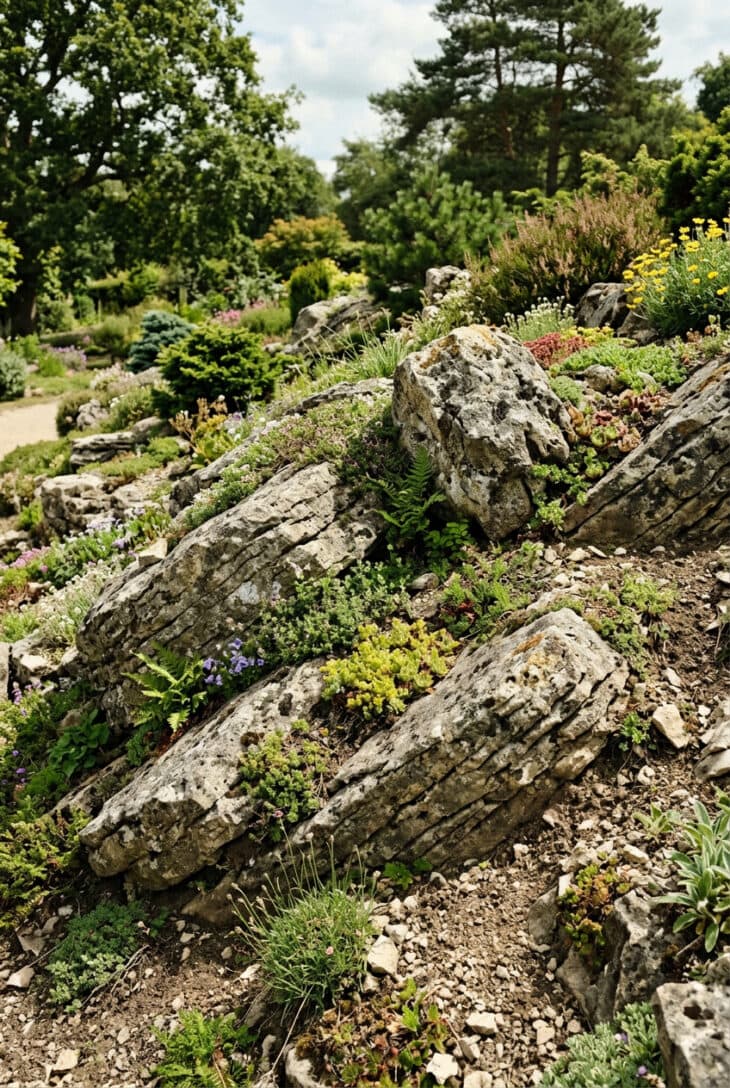
What you see Rocks that look like they were always there. They are large, weathered, mostly buried, and the lines of strata running across their faces all point the same way, as if a single bed of stone runs under the whole garden and is surfacing here and there. Plants have colonised the gaps between them.
Why it works This is the single idea that separates a real rock garden from the thing people mock, and it comes down to three rules: use one type of stone, bury most of each rock, and align the strata. Rocks scattered on the surface like currants in a bun look like what they are, whereas rocks set deep with their grain aligned read as geology. Your brain knows what bedrock looks like even if you have never thought about it, and it notices immediately when the rocks are lying.
How to get it Buy one stone type from as local a quarry as you can, since mixing limestone with sandstone with granite destroys the illusion instantly. Bury each rock by a third to a half of its depth, tilting the faces back slightly into the slope so rain runs into the bed rather than off it. Set the strata lines parallel across every rock and roughly level. Use fewer, larger rocks rather than many small ones, and buy the biggest you can move with a bar and rollers.
03. Turn a Slope Into a Classic Rockery
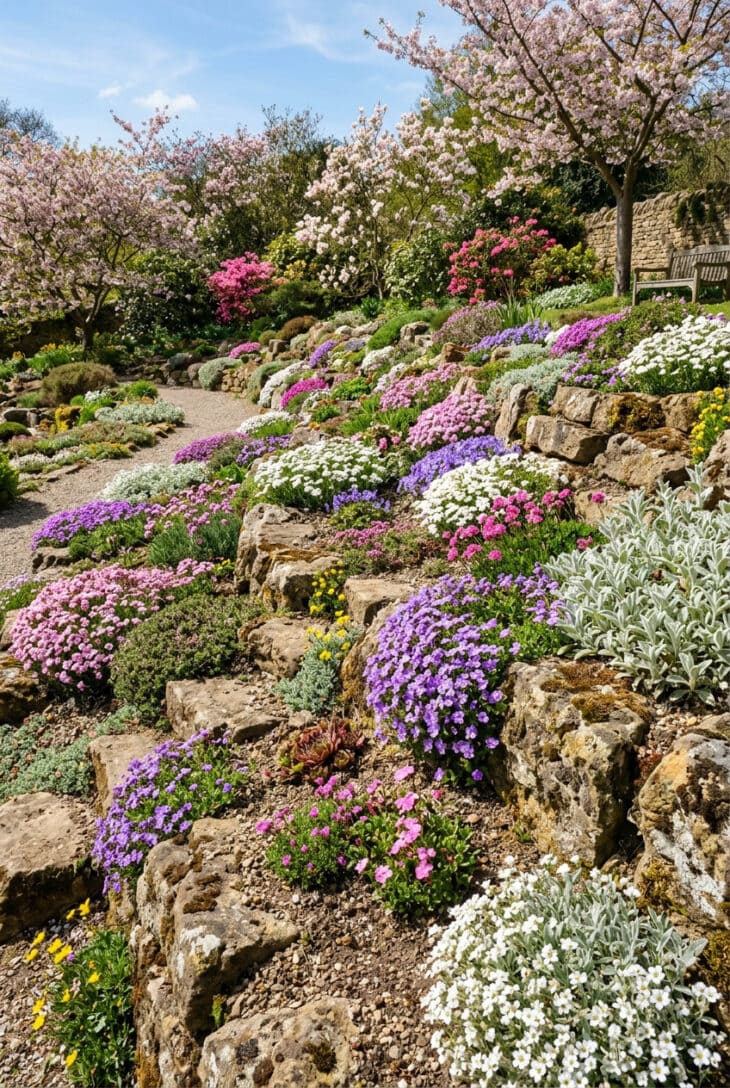
What you see A bank that used to be an awkward strip of mowable grass, now stepped with rock outcrops holding back pockets of gritty soil, with alpines tumbling down between them in pink, purple, white and silver. In April it is a tapestry. Nobody has to mow a slope any more.
Why it works A slope is the natural home of a rock garden, and not just for looks. Water drains off it, which is exactly what these plants want; the ground faces the sun at a better angle; and the planting is presented to you at eye level rather than being looked down on. It is also the single best answer to a bank that is too steep to mow safely and too visible to leave rough.
How to get it Work from the bottom up, setting the lowest rocks first so each course supports the one above. Cut small level pockets behind each outcrop and fill them with gritty mix, since planting on a bare slope means the soil washes away. Choose a sunny slope facing south or west if you have the choice. If the bank is steep, lay in a few large anchor rocks first and build around them. Strip every scrap of perennial weed out before you start, because digging bindweed out from under a half-ton rock is not a job you want.
04. Try a Crevice Garden
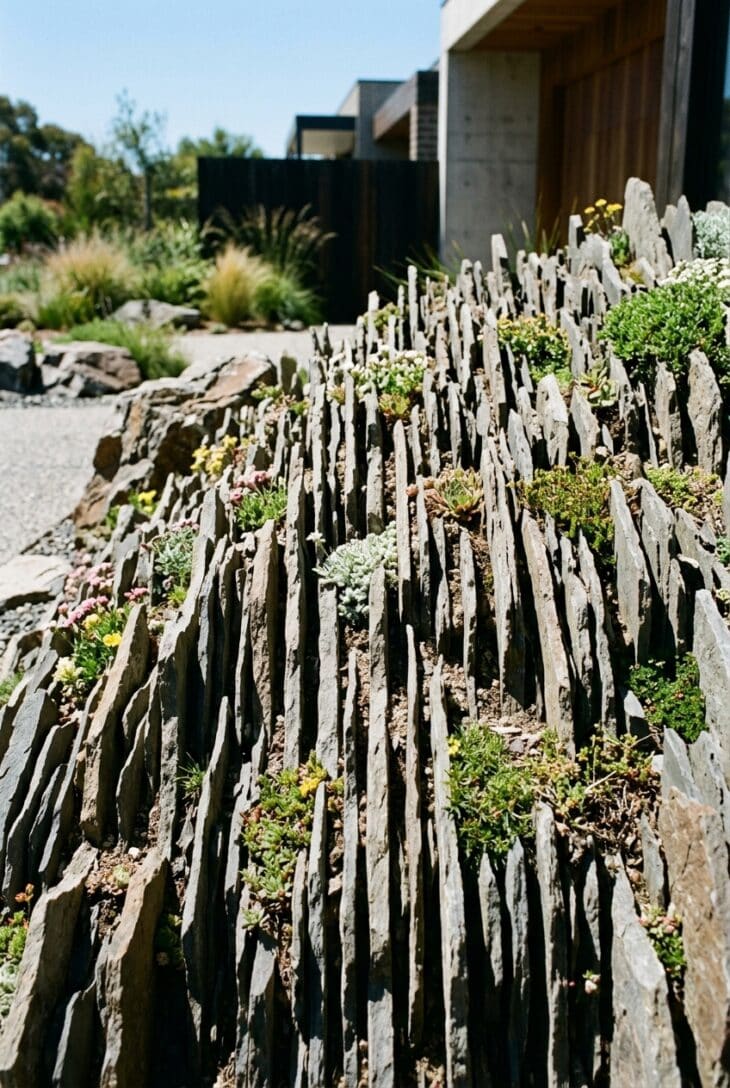
What you see Thin slabs of stone set on edge and packed tightly together, standing vertically like the pages of a half-open book, with narrow dark cracks running between them. Out of those cracks, tiny tight cushions of alpine plants are growing, some of them barely an inch across. It looks more like a sculpture than a border.
Why it works The crevice garden is the modern answer to growing the difficult high-alpine plants that sulk and rot in an ordinary rockery. A vertical crack is the perfect root run: the surface dries instantly so the plant’s neck never sits wet, while deep down between the slabs the soil stays cool and evenly moist all summer. It is also the most striking way to build with stone, and it packs an enormous number of plants into a very small footprint.
How to get it Use thin flat stone (slate, schist, flagstone offcuts) and set the slabs vertically, or tilted at a consistent angle, with gaps of 1 to 2in (2.5 to 5cm) between them. Bury at least half of each slab, and pack the crevices with a very lean mix of grit and sand with only a little loam. Plant tiny young plants as you build, working from the bottom up, because you cannot get a root ball into a finished crevice. Aim every slab in the same direction, as with any outcrop.
05. Carpet the Ground With Sedum and Houseleeks
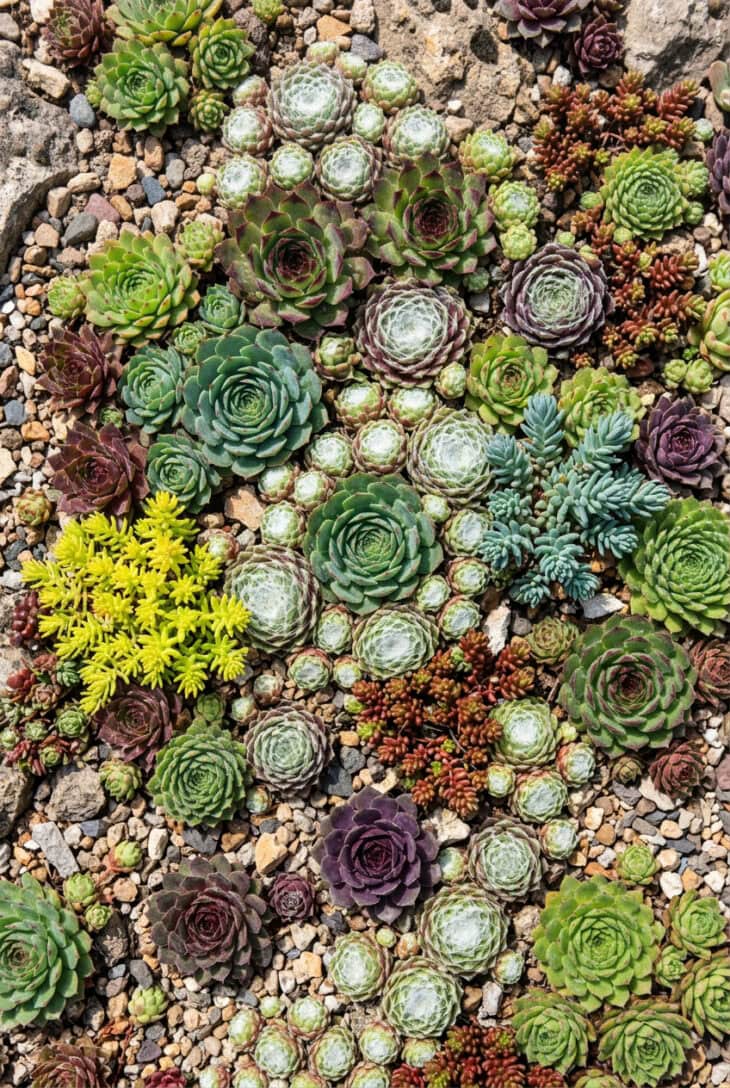
What you see The ground has vanished under a tapestry of succulent rosettes: blue-green, red-tipped, silver, deep purple, some flat as coins and some fat as artichokes, all packed together with a little gravel showing between. Looked at from above it is more like a mosaic than a planting, and every one of these plants is thriving on pure grit.
Why it works If you want a rock garden that genuinely looks after itself, this is it. Sedums and houseleeks store their own water, so they shrug off drought entirely, they are hardy to serious cold, they spread to cover ground and suppress weeds, and they hold their color and form all twelve months, including through winter when the rest of the garden is bare. They also propagate themselves, so a small planting becomes a large one for free.
How to get it Houseleeks (Sempervivum) and stonecrops (Sedum spathulifolium, Sedum acre) want full sun and pure sharp drainage, and they will genuinely grow in a 2in (5cm) layer of grit over rubble. Plant a mixture of textures and colors rather than a single species, and space them 4 to 6in (10 to 15cm) apart to let them knit. The one thing that kills them is shade combined with winter wet, so keep them out from under overhanging plants and pull fallen leaves off in autumn.
06. Plant an Alpine Trough
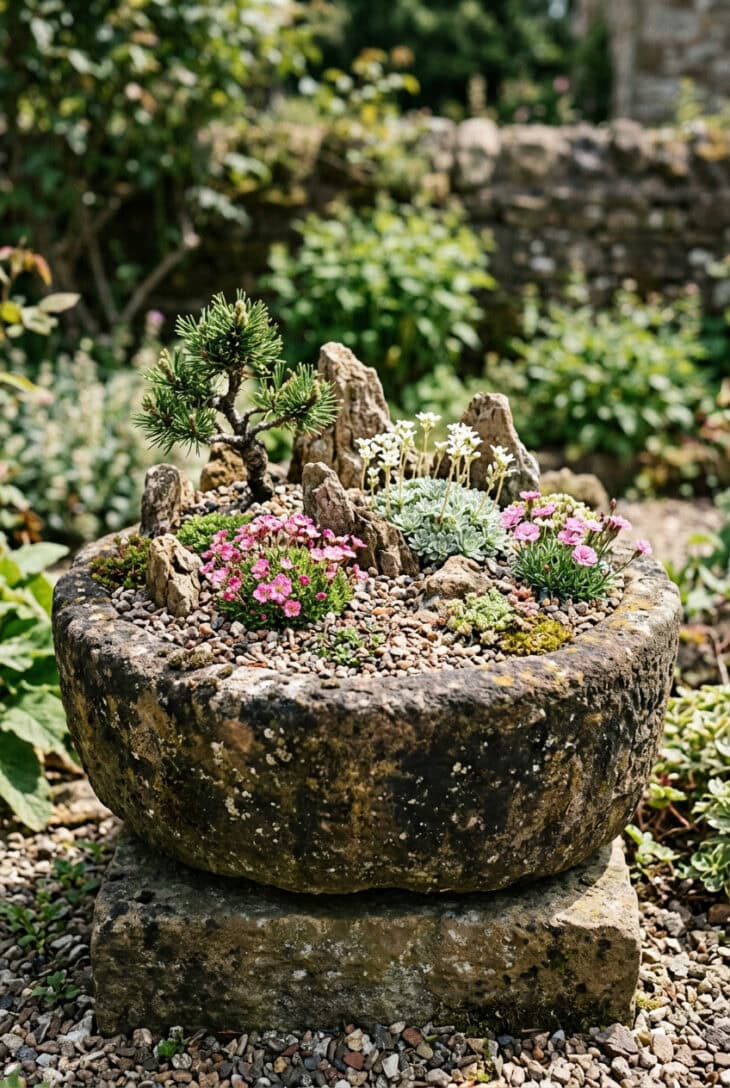
What you see An old stone trough raised on a low plinth, and inside it an entire mountain landscape in miniature: two small upright rocks, one tiny conifer no higher than your hand, cushions of saxifrage and dianthus, all mulched in fine grit. Everything is in scale with everything else. It is a garden you can walk around in ten seconds and look at for twenty minutes.
Why it works A trough is the whole style distilled into one object, and it is the perfect entry point: you can build it in an afternoon, you control the compost absolutely, and you can put it where you will actually look at it closely, which is what these small-flowered plants deserve. It also solves the two hardest problems in one go, since a raised container drains perfectly and lifts the plants to eye level, and it works on a balcony or a paved yard with no garden at all.
How to get it An old glazed sink coated in hypertufa (a mix of cement, sand and coir that ages to look like stone) is the traditional route, and reproduction troughs are widely sold. Drainage holes are non-negotiable: cover them with mesh, add 2in (5cm) of crocks, then a gritty alpine compost, and top with grit. Raise it on feet or a plinth so water runs out freely and slugs have further to climb. Plant one small dwarf conifer for height, a couple of rocks for structure, and no more than five or six tiny plants, since crowding it ruins the scale.
07. Anchor It With Dwarf Conifers
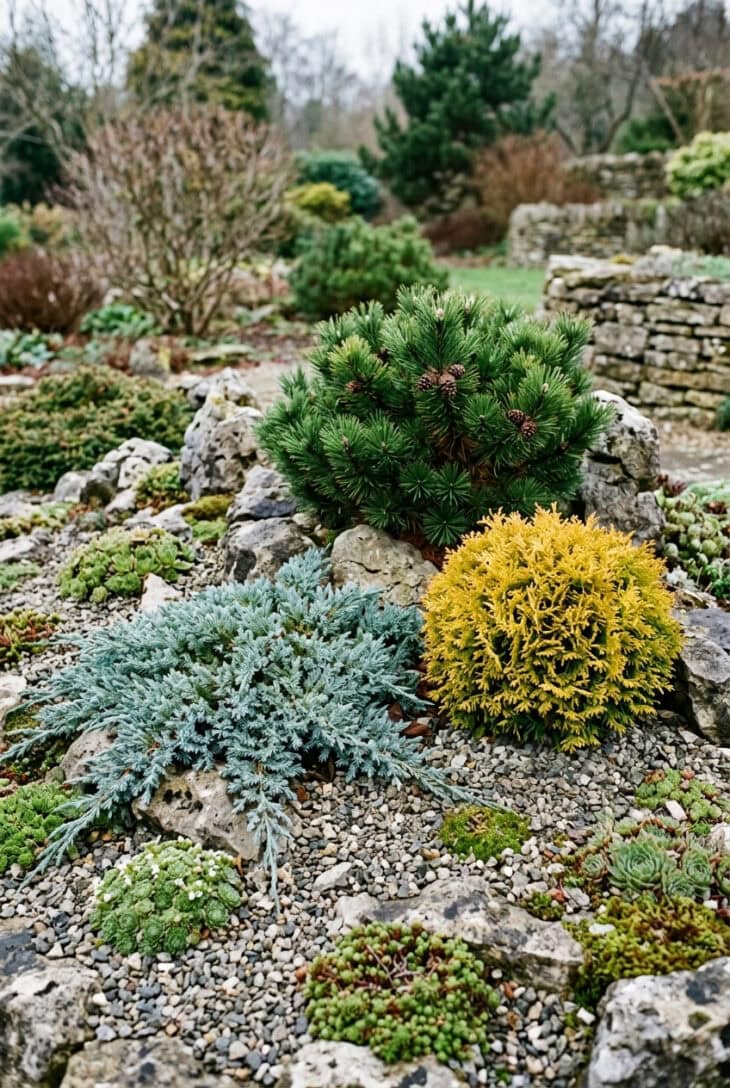
What you see Three small conifers holding the composition together: a blue-green juniper spreading flat over a rock, a tight golden ball, a dark mounded pine. Alpine cushions fill in around them. It is February, everything else has retreated into the gravel, and this corner still looks like a garden.
Why it works A rock garden is a landscape of low mounds and mats, and without something with height and mass it reads as flat. Dwarf conifers supply that, and unlike a shrub they do it without ever outgrowing the space or casting a spreading shade over the plants beneath. They also carry the garden through winter, which matters here more than in most styles, since the alpines are at their most dormant and least interesting exactly when you want structure.
How to get it Buy true dwarfs and check the ten-year size on the label, because “dwarf” is used very loosely and a small nursery plant can become a 15ft (4.5m) tree. Reliable ones include dwarf mountain pine (Pinus mugo ‘Mops’), creeping juniper (Juniperus horizontalis ‘Blue Chip’) and dwarf Hinoki cypress (Chamaecyparis obtusa ‘Nana Gracilis’). Vary the forms hard, using one upright, one rounded and one prostrate, and resist a golden one next to a blue one next to a green one, which is how the 1970s rockery got its reputation.
08. Scatter Small Bulbs Through the Gravel
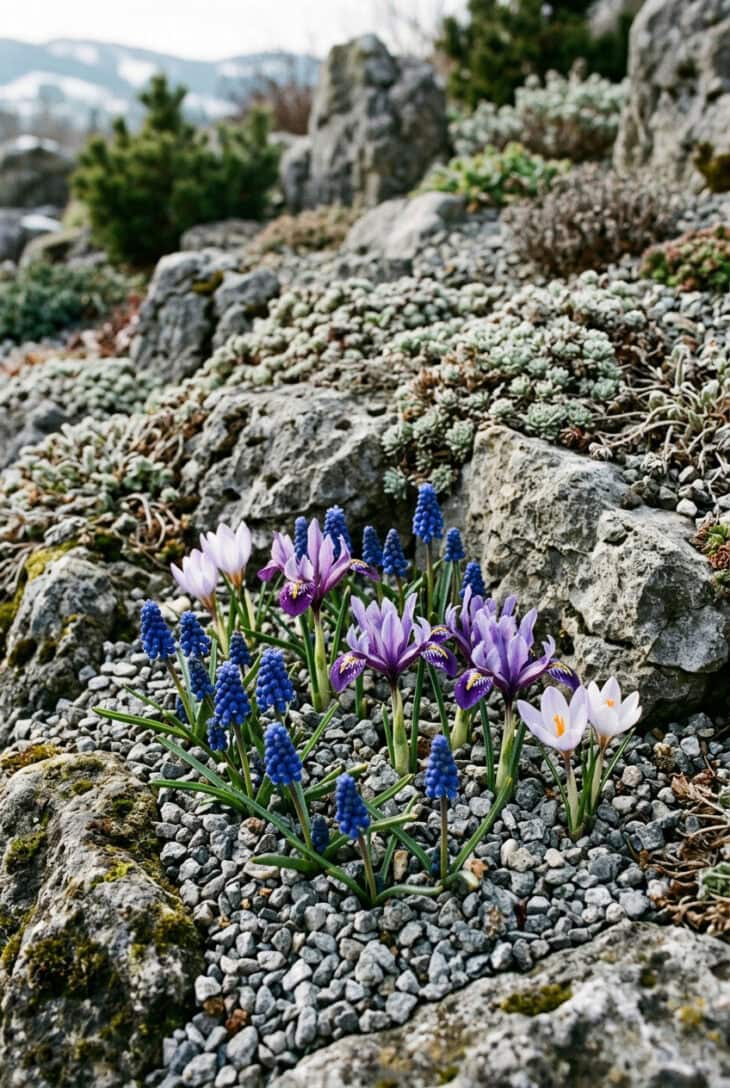
What you see It is early March, the alpines are still tight and dormant, and small bulbs are coming straight up through the gravel: deep blue grape hyacinths, dwarf irises in purple and white with their yellow flashes, a scatter of crocus. They are only a few inches tall, and against the bare grey stone they look like something spilled.
Why it works The rock garden’s weak moment is late winter, and small bulbs land exactly in it. They are also, in habitat, the same kind of plant as everything else here: mountain and steppe species that grow fast in a wet spring, flower, and then want to be baked bone dry all summer. A rock garden bakes bone dry all summer, which is why bulbs that rot away in a border thrive here and come back stronger every year.
How to get it Plant in autumn, in generous drifts rather than in ones and twos, at roughly three times the depth of the bulb. Use dwarf iris (Iris reticulata ‘Harmony’), grape hyacinth (Muscari armeniacum), Crocus tommasinianus, Chionodoxa and dwarf narcissus (Narcissus ‘Tete-a-Tete’). Let the foliage die back completely before you tidy it away, since cutting it green starves the bulb for next year. Then leave them alone: the summer drought is not neglect, it is the ripening they need.
09. Let Creeping Phlox Cascade Over a Rock
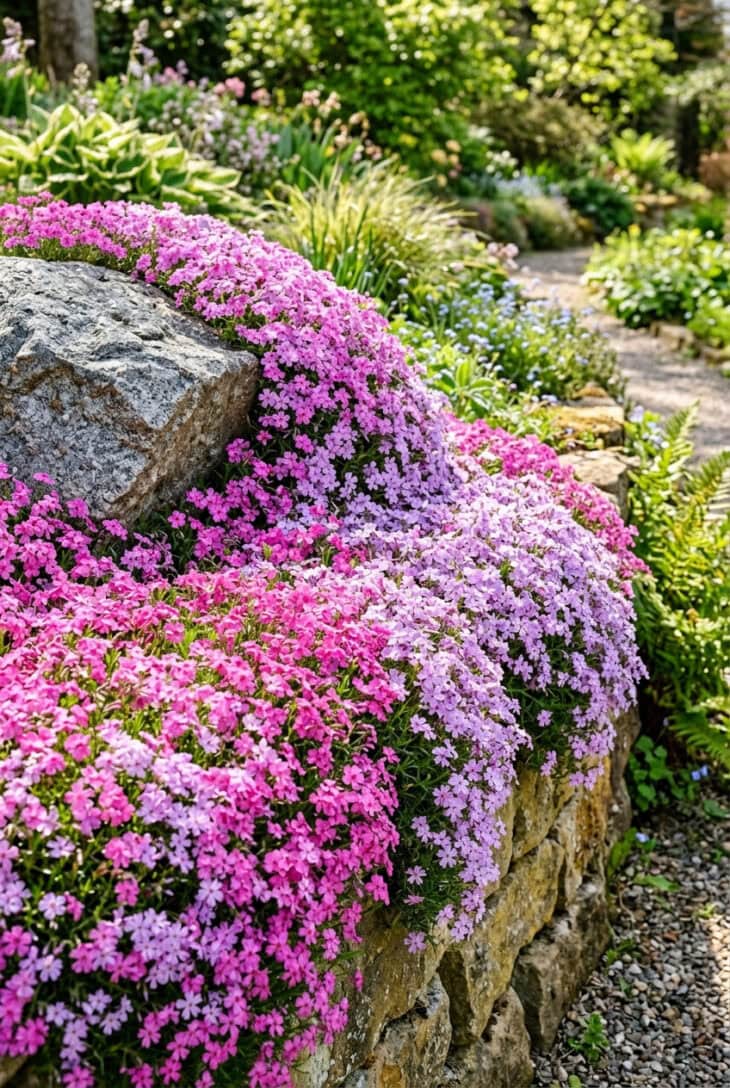
What you see A waterfall of flower. Creeping phlox has poured over the top of a large rock and down the wall below it, and for about three weeks in April the stone has completely disappeared under a sheet of pink and lilac. The green needle foliage underneath is invisible. It is the loudest thing the rock garden does all year.
Why it works Rock gardens are full of neat little mounds that stay where they are put, and the composition needs something that breaks out and spills. A trailing plant flowing over the edge of a rock or a wall softens the hard line of the stone, links the vertical and horizontal, and creates the single most photographed effect in this style. Phlox is the best of them because it is genuinely tough, evergreen, and flowers so hard that it hides itself.
How to get it Creeping phlox (Phlox subulata ‘Emerald Blue’, ‘Candy Stripe’) needs full sun and free-draining soil, and it must be planted at the top of the rock or wall so it can fall, not at the bottom to climb. Shear it back by about a third immediately after flowering, which keeps it dense and stops the middle going bare and woody. Aubrieta and rock cress (Arabis) do the same job in purple and white and can be treated exactly the same way.
10. Mulch Everything With Gravel
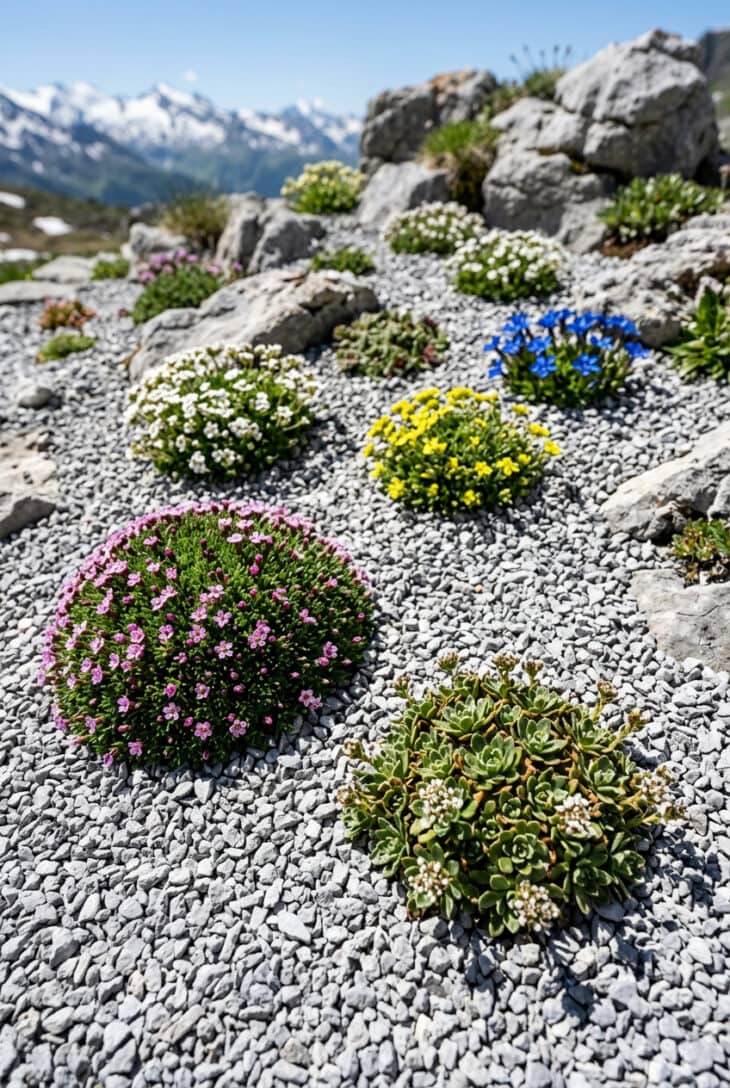
What you see Clean pale gravel running right up to and under the collar of every plant, so that no soil is visible anywhere. The cushions sit on the gravel rather than in soil, their leaves clear of the ground. Everything looks dry, sharp and deliberate, and after a downpour there is not a speck of mud on a single leaf.
Why it works The gravel mulch is not decoration, it is the thing that keeps the plants alive, and it is the step people skip. It keeps the collar of each plant, which is the part that rots, dry and well ventilated all winter. It keeps the soil beneath cool and moist in summer. It stops rain splashing mud onto tight cushion foliage, which is how much of it dies. And it suppresses weed seedlings, which is the difference between a rock garden that is easy and one that is a nightmare.
How to get it Use an angular grit or chippings 5 to 10mm, ideally matching your rock, and never rounded pea shingle, which rolls and never settles. Lay it 1 to 2in (2.5 to 5cm) deep, and take real care to work it in under the leaves and right up to the neck of every plant, tucking it beneath the cushions with your fingers. Skip the weed membrane, since it blocks the self-seeding that makes an established rock garden look natural.
11. Plant a Dry Stone Wall in Its Joints
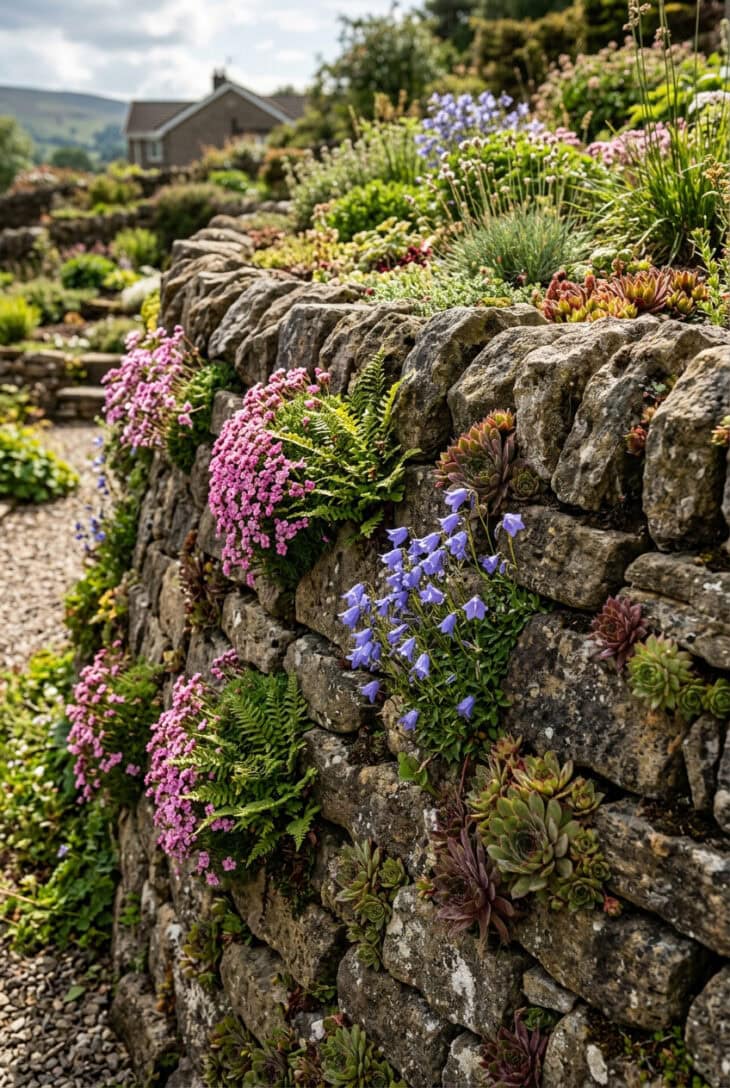
What you see A dry stone retaining wall with plants growing sideways straight out of its face. Pink cushions, blue bellflowers, a tiny fern, rosettes of houseleeks, all rooted in the joints between the stones with no soil in sight. The wall has stopped being a piece of construction and turned into a vertical garden.
Why it works A wall face is the driest, sharpest-drained, most sun-baked position in the entire garden, and it is a nightmare for almost every plant except the ones this style is built around. Alpines growing in a wall are in their element, rooted deep in the cool damp core while their crowns sit permanently dry. It is also free planting space: the wall is already there, holding back the bank, and you get a whole extra garden on its face.
How to get it It is far easier to plant a wall as you build it, tucking small plants into the joints with a little gritty soil as each course goes on. To plant an existing wall, poke soil deep into a joint with a stick, wrap a young plant’s roots in damp moss, push it in as far as it will go, and wedge it with a small stone. Water it faithfully until it takes. Use bellflower (Campanula portenschlagiana), houseleeks, aubrieta, wall daisy (Erigeron karvinskianus) and rusty-back fern.
12. Give the Shady Side to Saxifrage and Ferns
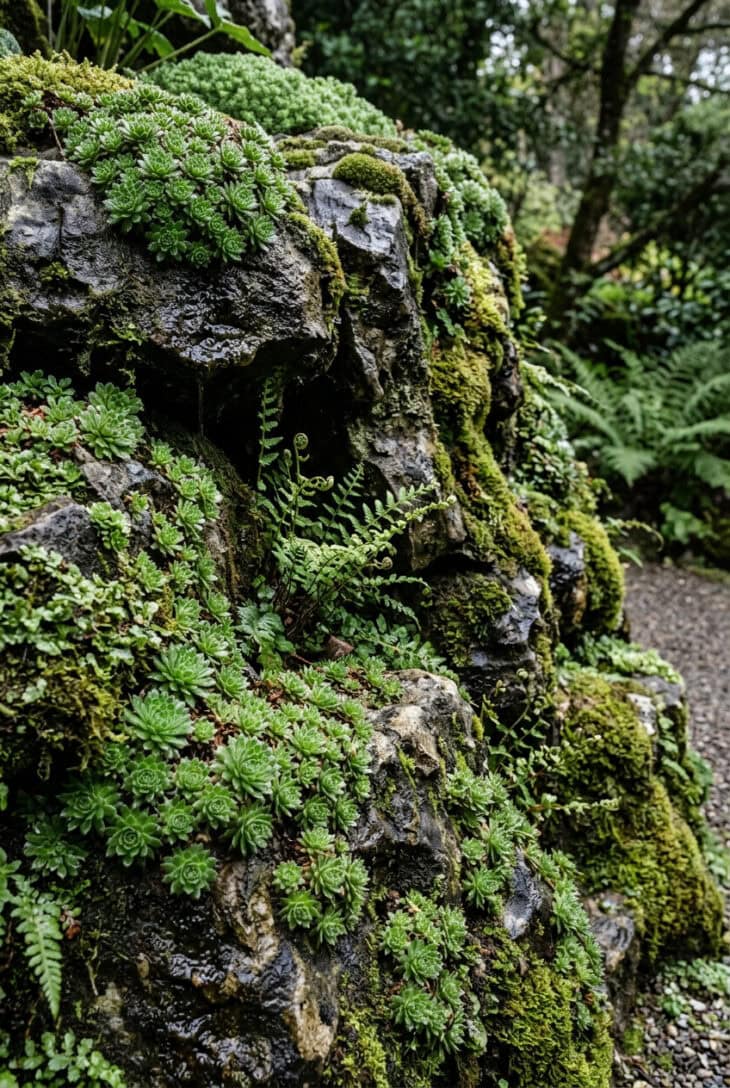
What you see The cool side of the outcrop, where the sun never quite reaches. Tight green rosettes of saxifrage are pressed against the damp stone, small ferns unfurl out of the crevices, and moss has taken the shaded faces. It is quieter than the sunny side and considerably more subtle, and the detail is extraordinary up close.
Why it works Every rock garden has a shady side, because every rock casts a shadow, and treating it as a failure is a mistake. In the mountains, the north face of a boulder is a distinct habitat with its own flora, cooler and damper than the sun-baked side a few feet away. Planting it accordingly gives you two gardens in one, doubles the range of what you can grow, and provides a cool contrast that makes the hot sunny side look brighter.
How to get it Use the mossy or encrusted saxifrages (Saxifraga x urbium, London pride, is bombproof), small ferns (Asplenium trichomanes, the maidenhair spleenwort, and hart’s tongue), Ramonda, and hardy cyclamen for autumn flower. Keep the drainage just as sharp as on the sunny side, since shade plus wet is still fatal, but expect to water occasionally in a dry summer, because the rain shadow beside a big rock is real.
13. Grow a Thyme Lawn Between the Stones
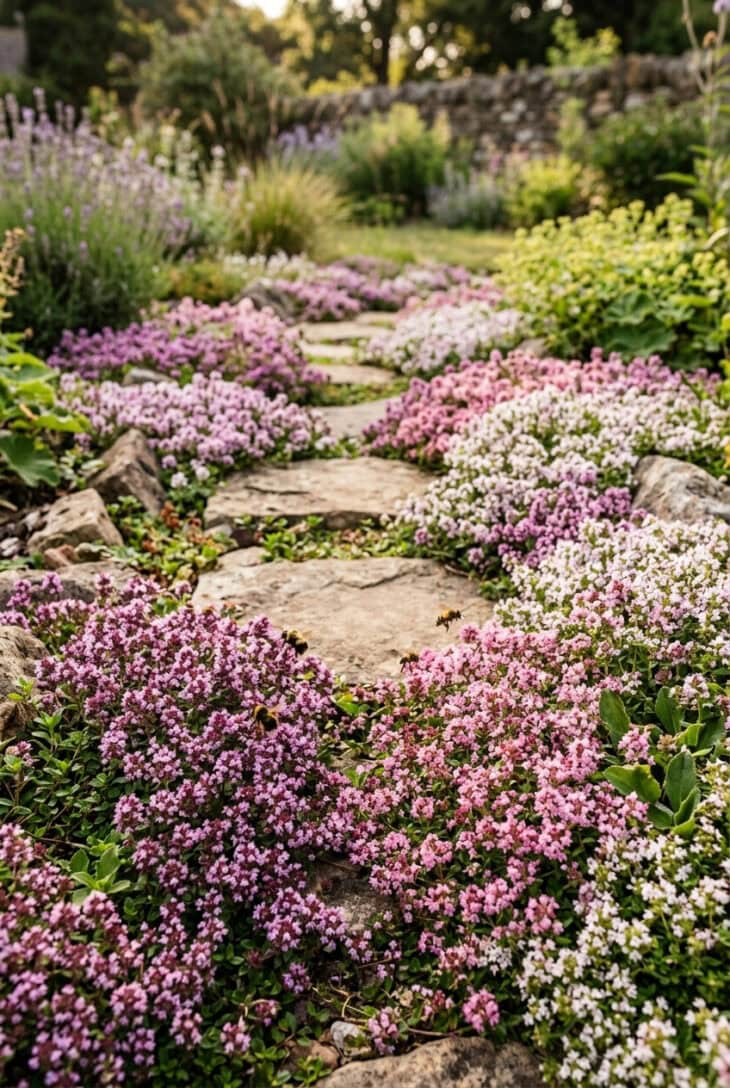
What you see Thyme has filled every space between the stones and flowered, so the ground is a low haze of pink, mauve and white. Bees are all over it, and the sound is noticeable from a few feet away. Step on it and the scent comes straight up at you.
Why it works Thyme is the ideal ground cover for hot, dry, poor, stony ground, which is the exact description of every rock garden, and it does three jobs at once. It suppresses weeds by covering the soil completely, it releases scent when trodden on so the garden engages a sense other than sight, and it is one of the best plants in cultivation for bees. It also takes light foot traffic, which almost nothing else in this style does.
How to get it Creeping thyme (Thymus serpyllum) and woolly thyme (Thymus pseudolanuginosus) are the mat-formers to use; ordinary culinary thyme makes a bush and is wrong for this. Plant into gritty, poor soil in full sun, at 8 to 10in (20 to 25cm) spacing, and mulch between them with grit until they meet. Shear the whole carpet over lightly after flowering. It hates being waterlogged and it hates shade, and in either it will go bare and woody in the middle within two years.
14. Cut Steps Straight Through the Rocks
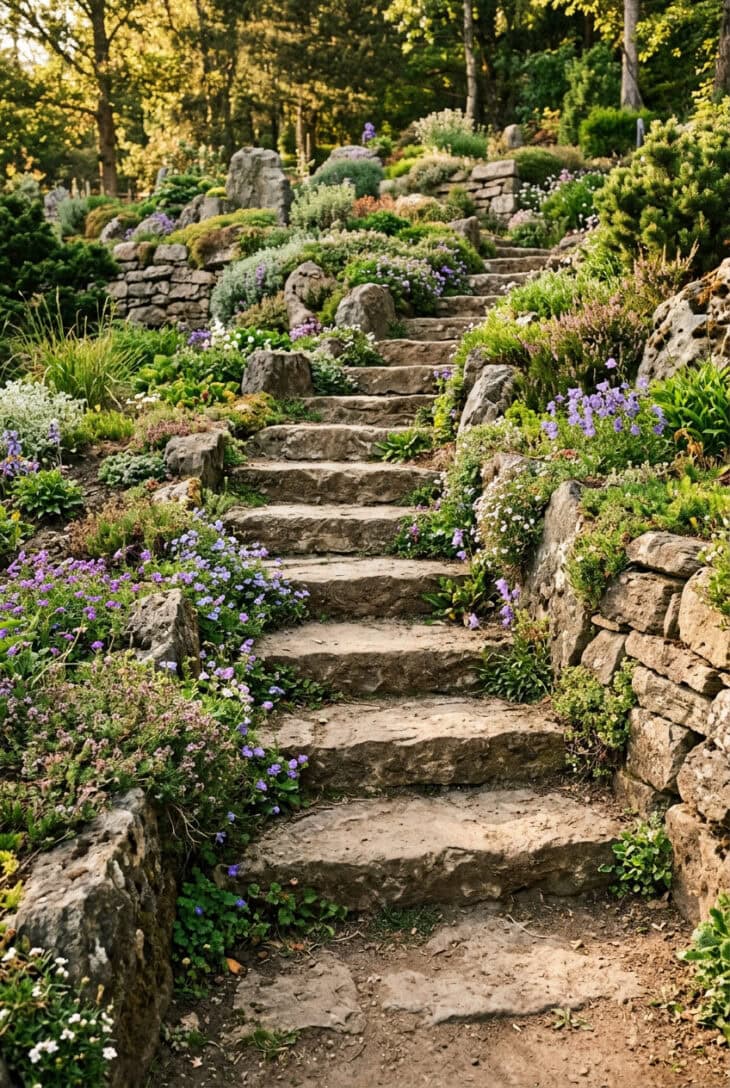
What you see Steps made of thick rough slabs of the same stone as the outcrops around them, climbing the slope, with alpines leaning in over the treads from both sides. They are not a path bolted onto the rock garden, they are part of it, and the plants are already colonising the joints.
Why it works A rock garden on a slope is a place you look at until you can walk into it. Steps let you get up among the planting to see it, weed it, and enjoy the small flowers that are invisible from the bottom of the bank, and they turn the rockery from a picture into a place. Using the same stone as the outcrops is what makes them read as part of the geology rather than as construction.
How to get it Use thick slabs, at least 2in (5cm) and preferably more, bedded solid on compacted hardcore so nothing rocks underfoot. Keep the risers low, around 5 to 6in (13 to 15cm), and the treads generous at 14in (35cm) or more, which suits a garden where you are meant to be dawdling. Let the steps wander rather than running straight up the fall line, and leave planting pockets at the sides of each tread for thyme and low cushions to spill into.
15. Use One Big Boulder as the Focal Point
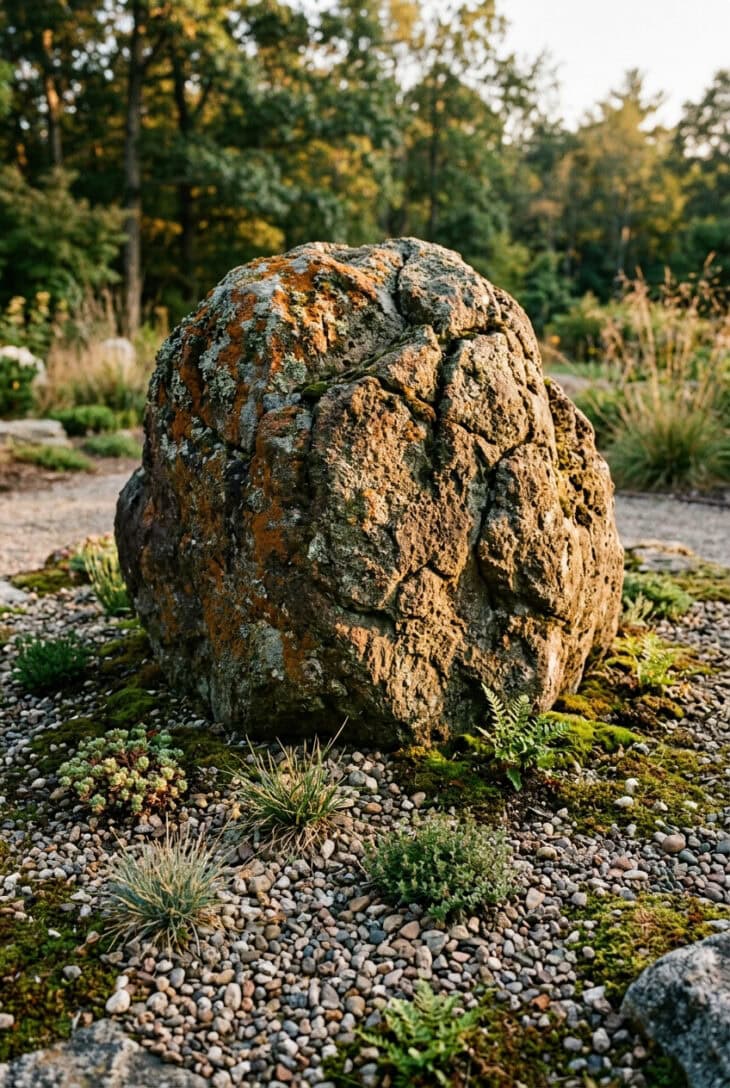
What you see One boulder, big, weathered, covered in lichen, set deep into the gravel so it looks half-buried, with the planting around it kept deliberately thin. Low raking light picks out every crack and crust on its surface. It is the biggest object in the garden and it is doing nothing at all, which is exactly the point.
Why it works Rock gardens tend to be busy, full of small plants competing for attention at the same scale, and what they usually lack is one big quiet thing to hold it all together. A single substantial boulder gives the eye somewhere to rest and provides a sense of scale that makes every tiny cushion around it read as small. One good rock will do more for the composition than twenty more plants.
How to get it Buy the biggest single stone you can get delivered and placed, and spend the money on character (lichen, weathering, an interesting profile) rather than on size alone. Bury it by a third at least, tilt it so its most interesting face is turned toward your main viewpoint, and keep the planting around it sparse. Do not ring it with a circle of small plants, which turns it into an ornament on a doily. Get the delivery driver to place it with the crane, because you will not move it afterwards.
16. Try an Alpine Meadow Effect
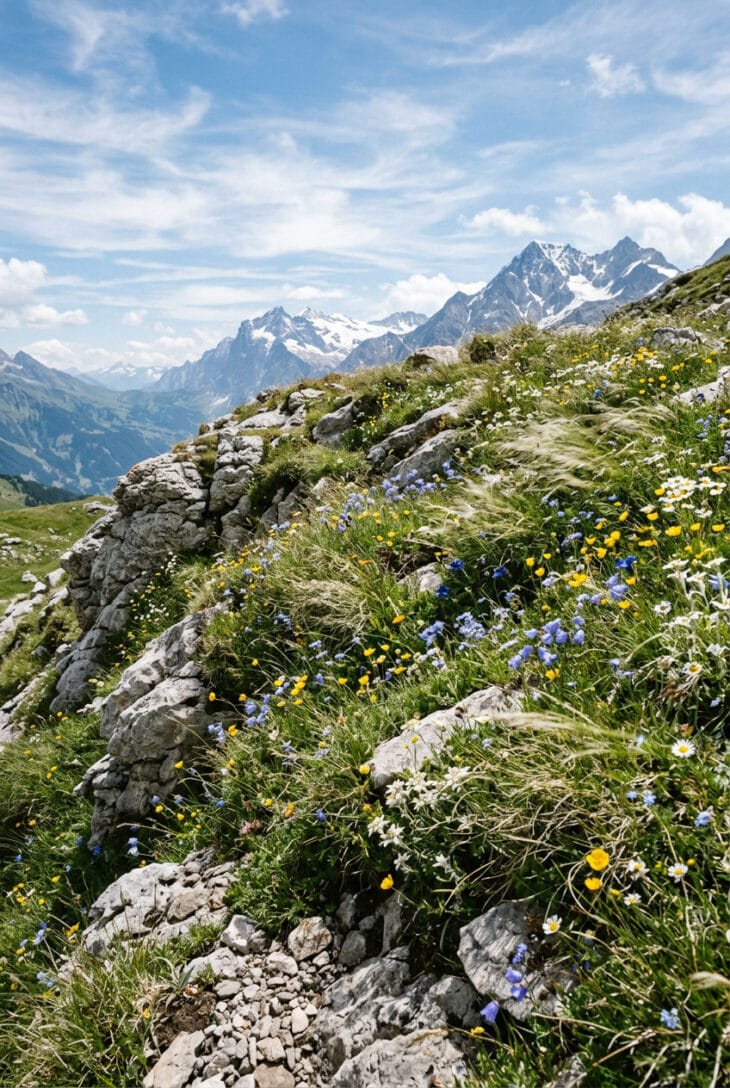
What you see Fine grasses moving in the breeze with small flowers threaded through them in blue, yellow and white, all growing over a rocky bank with the tops of rocks emerging through the turf. It is much looser than a conventional rockery, less arranged, and it looks like something you might walk through at two thousand metres.
Why it works The alpine meadow is the other half of the mountain, the grassy sward between the outcrops, and it is a far more relaxed look than the cushion-by-cushion precision of a classic rockery. Mixing fine grasses with the flowers introduces movement, which a rock garden otherwise completely lacks, and it hides the gaps in a way that suits a larger area where planting every square foot with individual alpines would be ruinous.
How to get it Keep the soil poor and thin, because fertility lets coarse grass swamp the flowers. Use fine, low grasses (blue fescue, Sesleria) rather than big ornamental ones, and thread through small perennials: alpine aster, pasque flower (Pulsatilla vulgaris), Geranium cinereum, pinks, and low campanula. Cut the whole thing over once in late summer after the seed has dropped and rake the clippings off, exactly as you would a wildflower meadow.
17. Use Tufa for the Choosiest Alpines
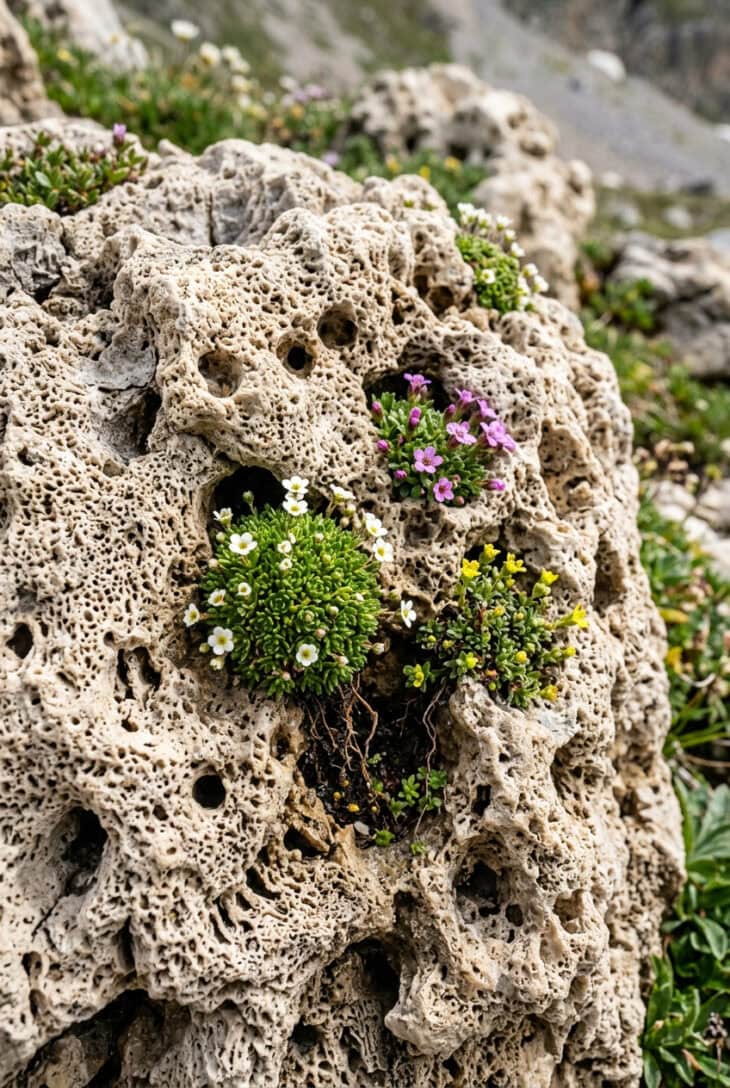
What you see A pale, pitted, honeycombed lump of rock with plants growing directly out of it. Not beside it, not around it: out of it, their roots inside the stone. The cushions are tiny, tight and perfect, the kind that die in a week in an ordinary border, and they are visibly thriving in what looks like solid rock.
Why it works Tufa is a soft, porous limestone laid down by mineral springs, and it behaves like nothing else: it is soft enough to drill with a hand tool, it holds moisture like a sponge, and it drains instantly. That combination is a perfect root run for the high-alpine cushion plants that are almost impossible to keep any other way, because their crowns stay dry while their roots stay cool and damp. For a specialist grower it is the closest thing to a cheat code.
How to get it Buy tufa from a reputable supplier who quarries it responsibly, since it is a slow-forming and locally scarce rock. Drill holes about 1in (2.5cm) across and 2 to 3in (5 to 8cm) deep, angled slightly upward into the face. Wash the roots of a very small plant, poke them in with a pencil, and pack the hole with a slurry of tufa dust and gritty soil. Water regularly for the first season, since the rock must be kept damp until the roots take hold, and site it in full sun.
18. Blaze in Spring With Aubrieta and Alyssum
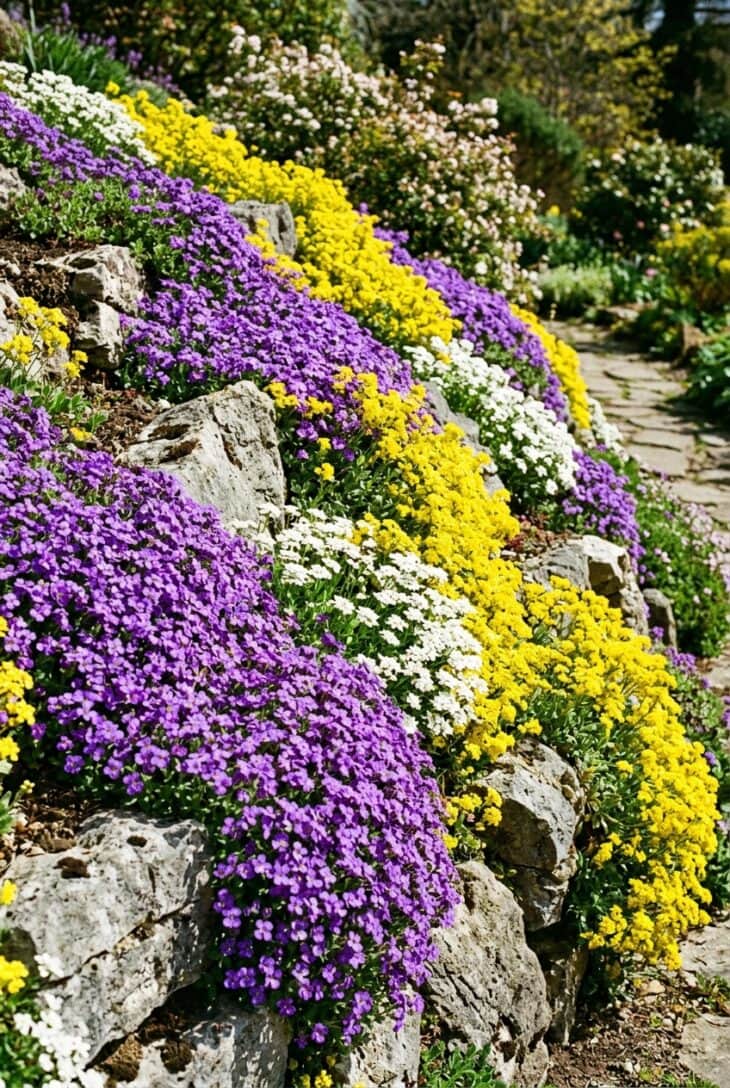
What you see Purple and gold, side by side, pouring over the rocks in solid sheets, with white candytuft packed between them. It is April and the color is almost aggressive. Three weeks ago this bank was grey stone and green cushions, and in six weeks it will be quiet again.
Why it works These three are the old reliables of the spring rockery, and they are dismissed as common precisely because they are so easy and so effective. Purple and yellow sit opposite each other on the color wheel, which is why the combination hits as hard as it does, and white between them stops it becoming a fight. Nothing else gives you this much color for this little effort in a poor, dry, stony bed.
How to get it Aubrieta (Aubrieta deltoidea), basket of gold (Aurinia saxatilis) and candytuft (Iberis sempervirens) all want full sun and sharp drainage, and all three are hardy and long-lived. The one job that matters is shearing them back hard, by up to half, straight after flowering: skip it and each one turns into a sprawling ring of bare woody stems with a fringe of green, which is how the rockery got its dowdy reputation in the first place.
19. Add Pinks for Scent and Silver Foliage
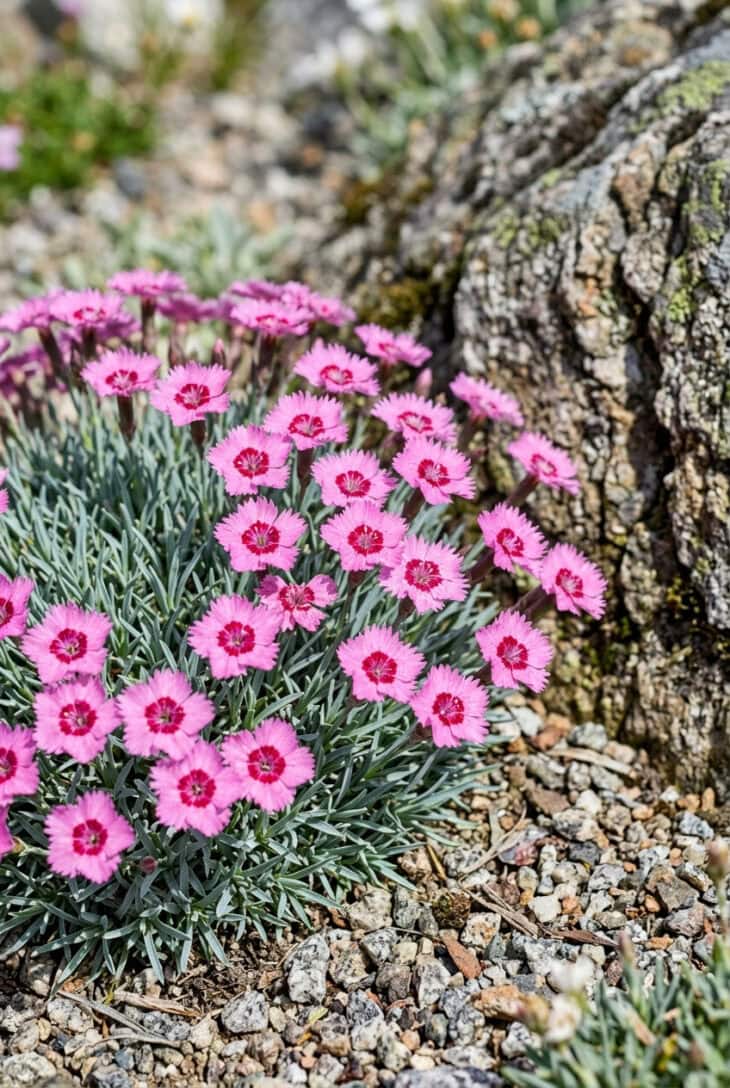
What you see A neat mound of narrow blue-grey foliage, so tight and so silver it would be worth growing with no flowers at all, and above it a scatter of small fringed pink flowers with darker eyes. Bend down to them and there is a strong clove scent, which is not what you expect from something this small.
Why it works Pinks earn their space three times over. The silver-blue cushion is a permanent piece of structure that looks good in every month including January, the flowers come in early summer just as the spring rush is finishing, and the clove scent is the only real perfume in a rock garden. Silver foliage also does something useful next to grey stone, picking up its color and tying the planting to the rock.
How to get it Use the alpine species and cultivars (Dianthus alpinus, Dianthus deltoides, or the tight silver cushion of Dianthus ‘Whatfield Magenta’) rather than the tall florist’s carnations. They want full sun, sharp drainage and, unusually for this style, they genuinely prefer alkaline soil, so a handful of limestone chippings or garden lime around them pays off on acid ground. Deadhead after flowering, and never mulch them with anything organic, which rots the cushion from below.
20. Keep It Going With Ice Plants
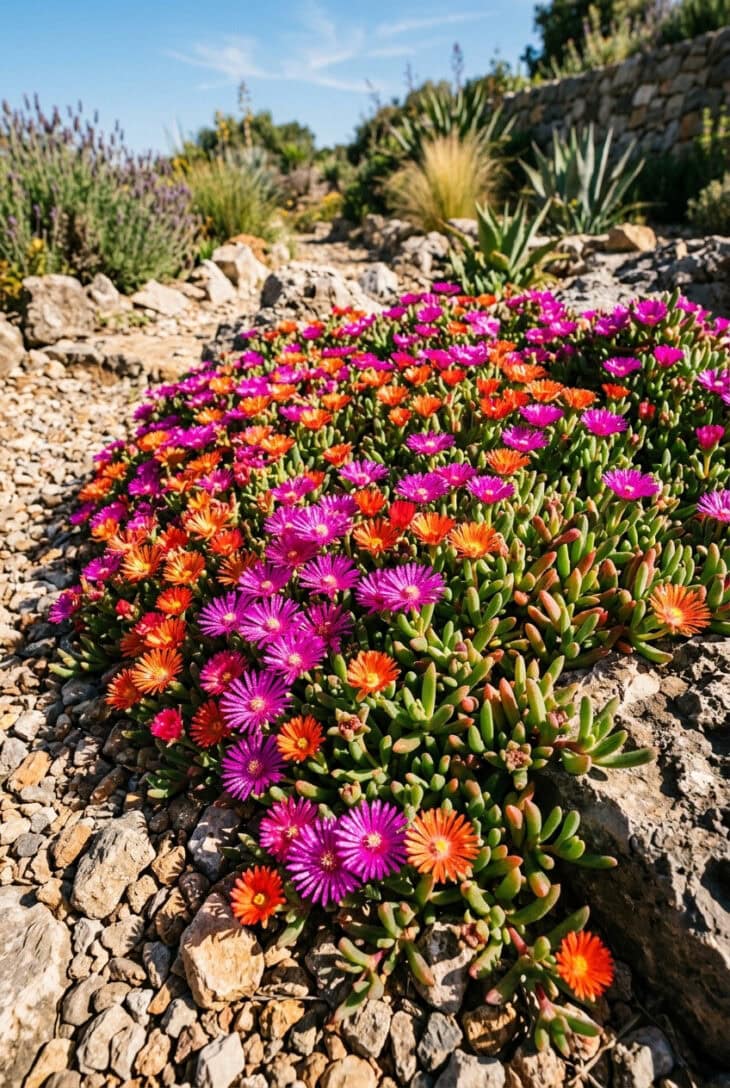
What you see It is August, the rest of the rock garden has gone quiet and grey, and a mat of ice plant is covered in daisy-like flowers of an almost fluorescent magenta, each petal glistening as if it were wet. The fleshy leaves beneath are barely visible. It is sprawling across hot gravel in full sun and it could not be happier.
Why it works Rock gardens front-load their season. Almost everything flowers between March and June, and by high summer the bed is a tidy collection of green cushions and nothing more. Ice plant flowers from midsummer to the frosts, in colors so saturated they carry from the other end of the garden, and it does it in the hottest, driest, most exposed position you own. It fills the gap that the whole style has.
How to get it Ice plant (Delosperma cooperi for magenta, Delosperma nubigenum for a hardier yellow) is hardy to around -10F (-23C) provided the drainage is perfect, and it is winter wet rather than winter cold that will kill it. Plant on a slope or the top of a wall where water cannot collect, in pure grit if you can, and give it full sun. Autumn-flowering stonecrops (Sedum sieboldii, Hylotelephium) extend the season further still.
21. Run a Dry Streambed Through It
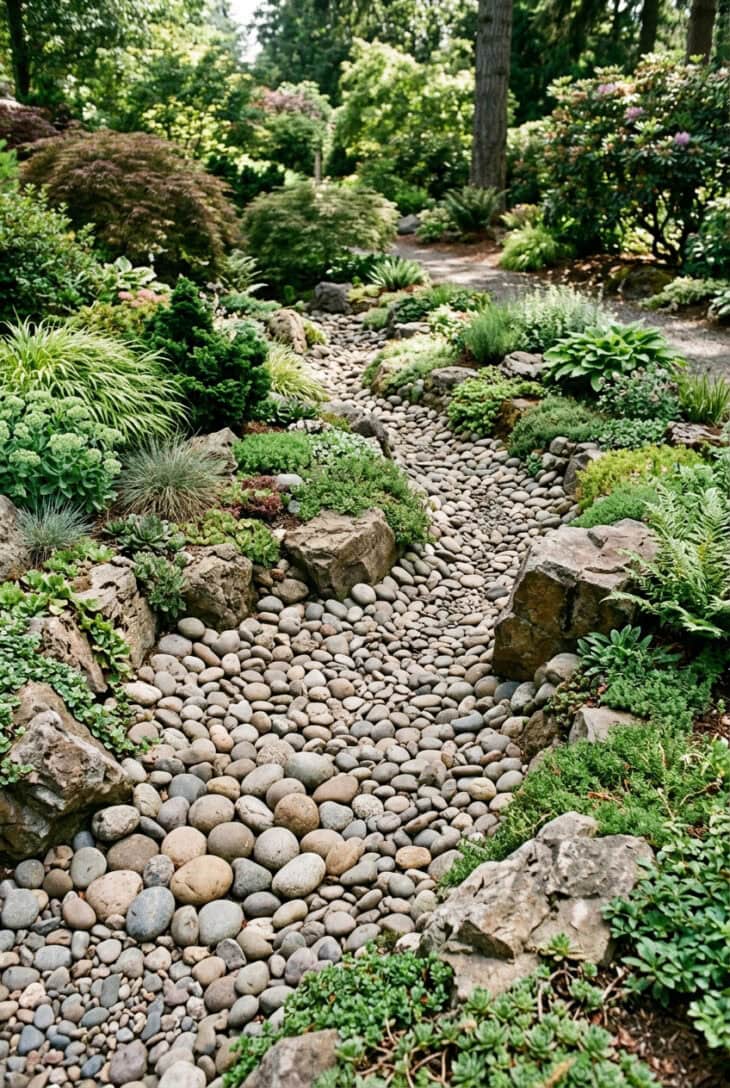
What you see A watercourse with no water in it. Rounded cobbles and pebbles wind through the planting, widening at the bends and narrowing between, with bigger rocks set where the current would have cut against the bank. Plants spill over its edges. It looks exactly like a stream that dried up last month.
Why it works A dry streambed gives a rock garden the one thing it is usually missing, which is a sense of movement and a line that carries your eye through the composition. It suggests water without any of the cost, maintenance or safety issues of the real thing. And it can be entirely practical as well, since a properly built one doubles as a soakaway that takes surface runoff from a downpipe or a slope and drains it harmlessly away.
How to get it Study a real stream before you build one. Water erodes the outside of a bend, so that is where the biggest rocks and the steepest bank belong, while the inside of the bend gets a shallow beach of finer gravel. Vary the width, never make it uniform, and dish the profile rather than digging a straight-sided trench. Use rounded, water-worn cobbles of mixed sizes, not angular chippings, and bury the larger stones so they look bedded rather than dropped.
22. Make a Rock Garden in a Pot
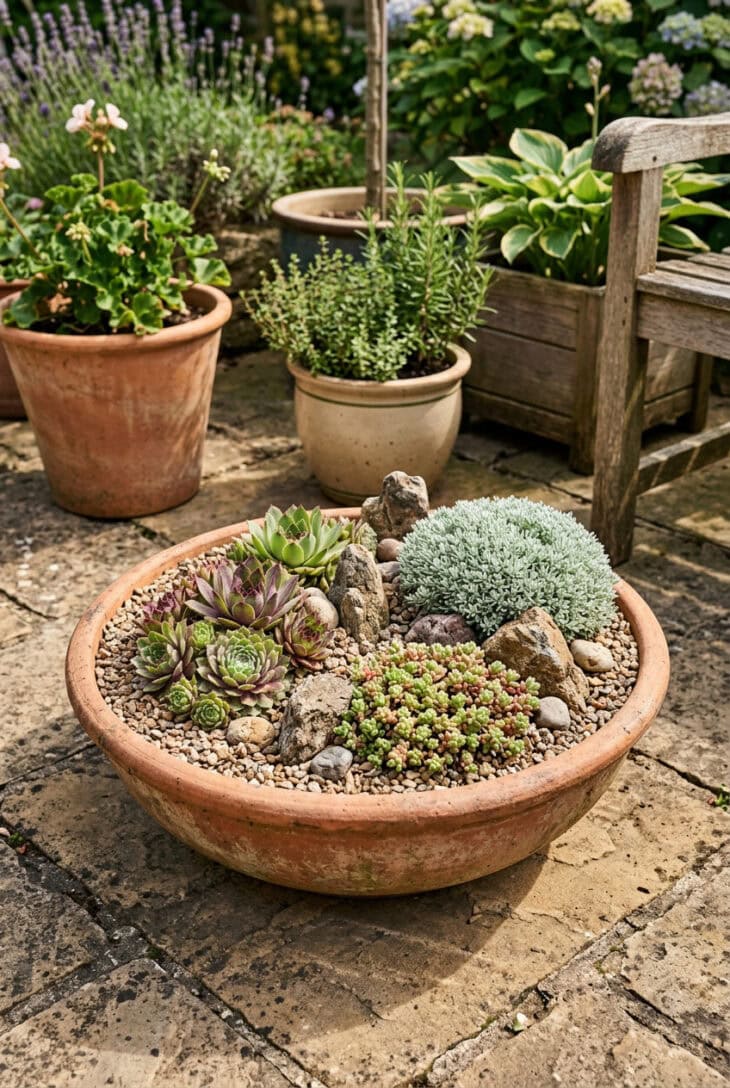
What you see A wide shallow terracotta pan on a paved terrace, with two small rocks, a group of houseleeks, one tiny sedum and a silver cushion, all mulched in fine grit. It is about the size of a dinner plate and it contains a complete landscape. It is sitting in full sun on a hot patio and it has not been watered in three weeks.
Why it works Alpines are the ideal container plants for anyone who forgets to water, which is most of us. They want the sharp drainage a pot naturally provides, they are small enough that a shallow pan is a whole garden, and they survive the baking heat of a paved terrace that kills conventional bedding by July. It is also the way to grow this style with no garden at all, on a balcony, a windowsill or a doorstep.
How to get it Use a wide, shallow pan rather than a deep pot, since alpines are surface-rooting and a deep column of compost just stays wet at the bottom. Ensure a generous drainage hole, cover it with mesh and crocks, use a gritty alpine compost, and top with grit. Frostproof terracotta is ideal because it breathes and dries. Water sparingly, feed almost never, and in a very wet winter tip the pot at a slight angle or move it under the eaves so it does not fill with rain.
23. Beat Winter Wet, Not Winter Cold
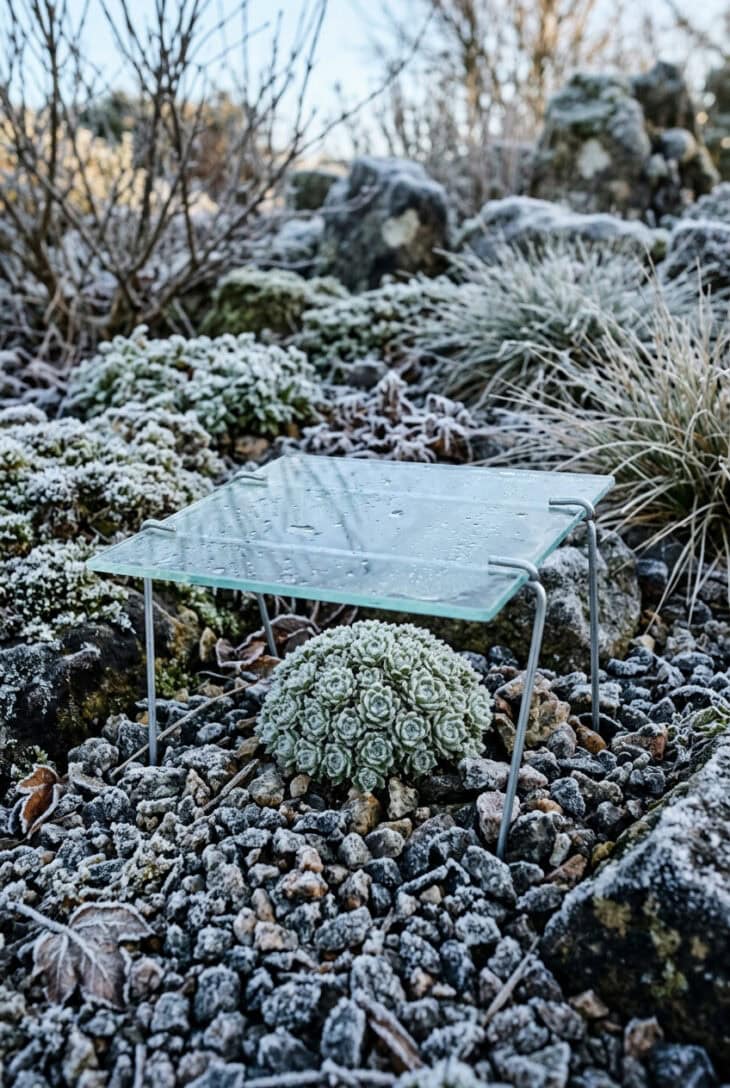
What you see A small pane of glass propped up on wire legs a few inches above one particular woolly-leaved cushion, like a tiny open-sided roof. Frost lies on the gravel all around it. The sides are completely open to the wind, and the plant beneath is bone dry and perfectly happy at 20F.
Why it works This is the piece of knowledge that changes everything about growing alpines, and it is worth saying as plainly as possible: cold does not kill these plants, wet does. They evolved under a dry insulating snowpack, not in a mild, drizzling, grey winter, and the water that sits in the crown of a hairy or woolly-leaved cushion for four months is what rots it. Keep the rain off the leaves while leaving the air moving, and plants that “cannot be grown here” suddenly can be.
How to get it For the woolly-leaved specialists, prop a pane of glass or clear acrylic 4 to 6in (10 to 15cm) above the plant from November to March, keeping all four sides open, since an enclosed cloche traps damp air and does more harm than good. For everything else, the answer is structural: a deep gravel collar tucked right under the leaves, a bed raised above the surrounding ground, and never an organic mulch anywhere near the crown.
24. Let Things Seed Into the Gravel
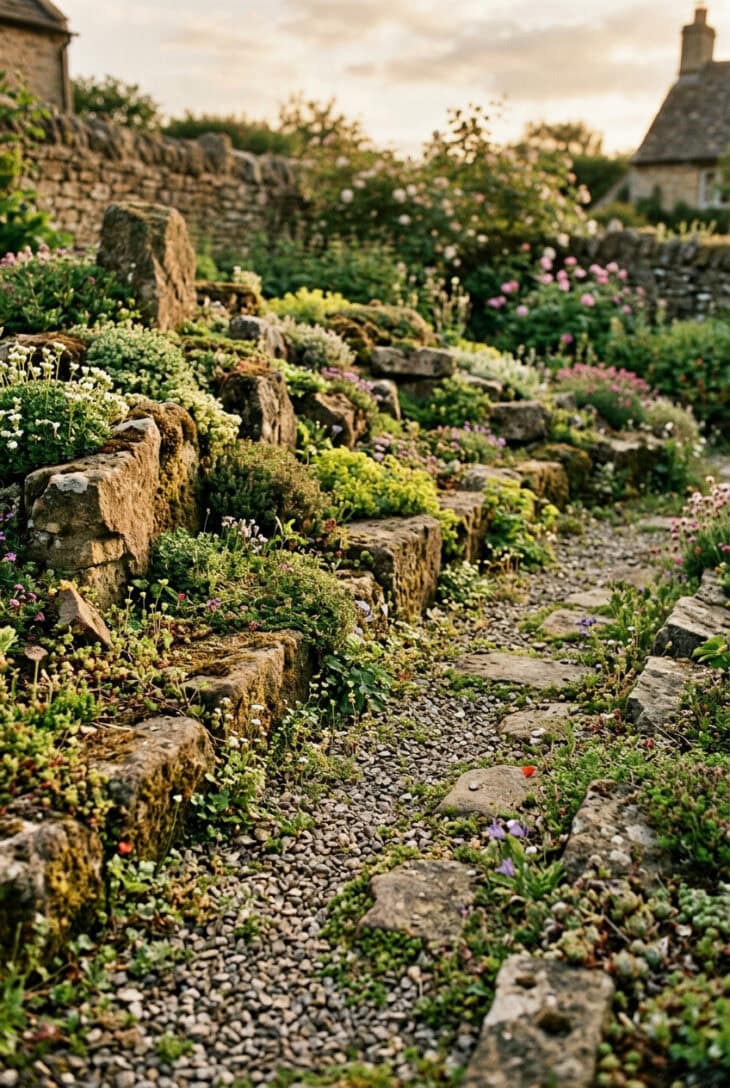
What you see Plants growing where nobody put them: a seedling wedged in a crack halfway up a rock, a drift of something small that has colonised the gravel path edge, a self-sown cushion tucked against a stone. The hard edges have all gone soft. This rock garden is eight years old and it no longer looks planted.
Why it works A young rock garden always looks slightly artificial, with each plant sitting alone on its patch of gravel like an exhibit. Self-seeding is what cures that, because seedlings land in the places that genuinely suit them, which are almost always places you would not have chosen, and the resulting slight randomness is exactly what makes an old rock garden look like a piece of mountainside. It is also free plants, arriving where they will thrive.
How to get it This is the reason for laying no weed membrane under your gravel, since a seed cannot germinate through plastic. Introduce reliable self-seeders (Erigeron karvinskianus, Erinus alpinus, Aquilegia, alpine poppies, Campanula) and then simply leave them to it. Your job becomes editing rather than planting: walk the garden every few weeks and pull out what you do not want, keeping roughly one seedling in five. Learn what your alpines’ seedlings look like, or you will weed them out by mistake.
25. Weed It Little and Often
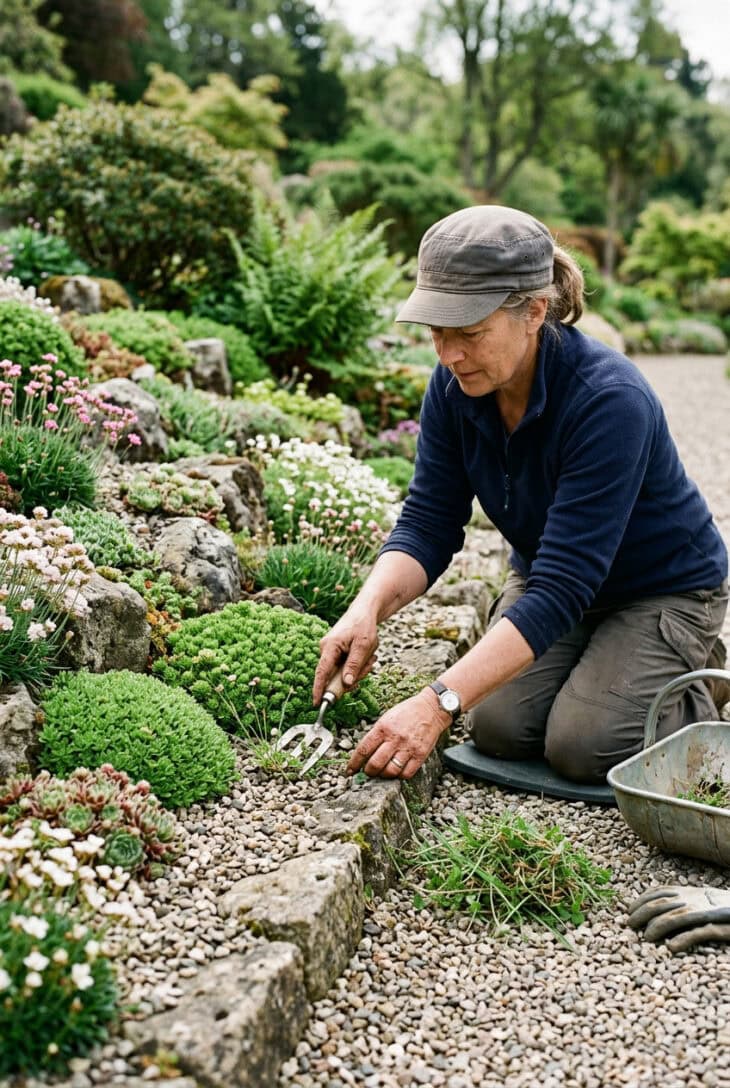
What you see Somebody kneeling at the edge of the bed with a narrow hand fork, picking weeds out from between the cushions one at a time, with a small pile of them on the gravel. It is twenty minutes of work, not a whole day. The bed behind them is immaculate, and it looks like it has never needed doing.
Why it works This is the honest one. A rock garden needs almost no watering, no feeding, no staking, no lifting and no dividing, which makes it one of the genuinely low-effort styles, and it has exactly one real chore. Weeds seed into open gravel, and a weed that gets its roots into the middle of a tight cushion or deep into a crevice cannot be removed without destroying the plant or dismantling the rock. Caught at seedling stage it takes two seconds.
How to get it Clear every scrap of perennial weed, especially bindweed, couch and ground elder, before a single rock goes down, because there is no fixing it later. Then go over the bed for twenty minutes every couple of weeks in the growing season rather than blitzing it twice a year, pulling seedlings by hand while they are tiny. Never hoe, which scatters gravel and slices cushions. Top up the gravel mulch every few years, since it is the mulch that keeps the weeding down to twenty minutes in the first place.