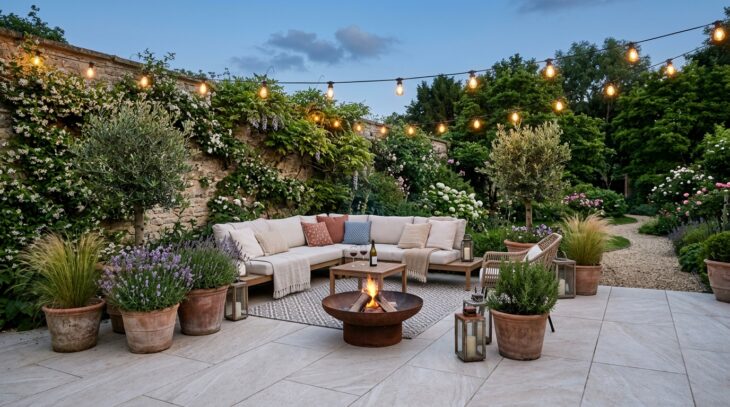
A patio is where the house spills out into the garden. The spot you eat breakfast in summer, gather around a fire in fall, and drift onto the moment the sun comes out. Get it right and it becomes the most-used room you have, even though it has no walls.
Contents
- 01. Choose a Paving Material That Sets the Tone
- 02. Center It on an Outdoor Dining Set
- 03. Add a Cozy Outdoor Sofa Lounge
- 04. Frame the Patio with Raised Beds
- 05. Soften Hard Edges with Billowing Planting
- 06. Build a Container Garden in Pots
- 07. Add a Pergola for Dappled Shade
- 08. Hang a Shade Sail or Retractable Awning
- 09. Build In Bench Seating to Save Space
- 10. Gather Around a Patio Fire Pit
- 11. String Festoon Lights Overhead
- 12. Add a Water Feature for Calm
- 13. Lay an Outdoor Rug to Define the Zone
- 14. Screen for Privacy with a Green Wall
- 15. Mix Materials for Texture
- 16. Sink the Patio for Shelter
- 17. Split a Sloping Plot into Level Terraces
- 18. Grow a Patio Herb and Salad Garden
- 19. Train Climbers up a Trellis Screen
- 20. Install an Outdoor Kitchen or Bar
- 21. Anchor the Corners with Potted Trees
- 22. Layer in Color with Cushions and Textiles
- 23. Choose Permeable Paving for Drainage
- 24. Make the Most of a Tiny Balcony Patio
- 25. Go for a Mediterranean Courtyard Feel
- 26. Keep It Modern and Minimalist
- 27. Add a Reflective Patio Pool or Rill
- 28. Warm Cool Nights with a Fire Table or Heater
- 29. Plant for Evening Scent and Pollinators
- 30. Keep It Green Year-Round with Evergreens
The 30 ideas below cover everything that makes a patio work: the paving underfoot, the furniture you relax into, the planting that softens the hard edges, and the shade, lighting and features that make you want to stay. There are projects for grand terraces and tiny balconies, sunny suntraps and shady corners, big budgets and small ones.
Read straight through to plan a patio from the ground up, or scroll and pick the ideas that suit your space. Each one explains what you are looking at, why it works, and exactly how to pull it off.
01. Choose a Paving Material That Sets the Tone
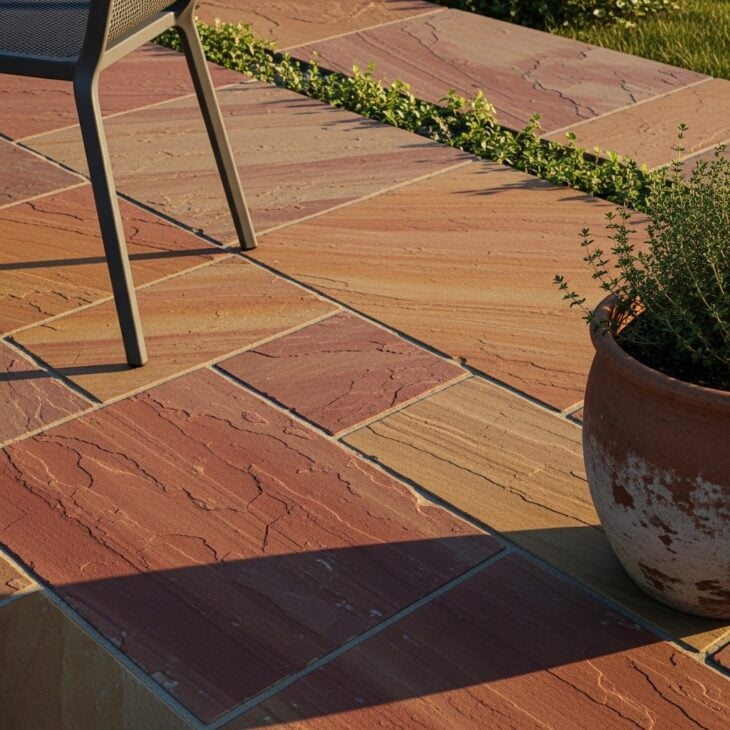
What you see The surface underfoot sets the entire mood of a patio before you place a single chair. Warm sandstone feels mellow and traditional, pale porcelain crisp and contemporary, clay brick cottagey and characterful — the material you choose quietly decides whether the space reads as rustic, modern or formal.
Why it works Because paving covers the largest area and lasts for decades, it is the one decision worth getting right first. It also needs to relate to the house: echoing a material or color from the building ties the patio to the architecture so it looks built-in rather than bolted on. Everything else you add will sit on top of this choice.
How to get it Pick up a tone from the house — the brick, the render, the window frames — and choose paving that complements it. Order samples and look at them wet as well as dry, since many stones darken dramatically in rain. Natural stone and porcelain are the most durable; choose a riven or textured finish in shade, where smooth surfaces grow slippery. Lay it on a proper mortar bed with a slight fall away from the house, and buy 10% extra for cuts and future repairs.
02. Center It on an Outdoor Dining Set
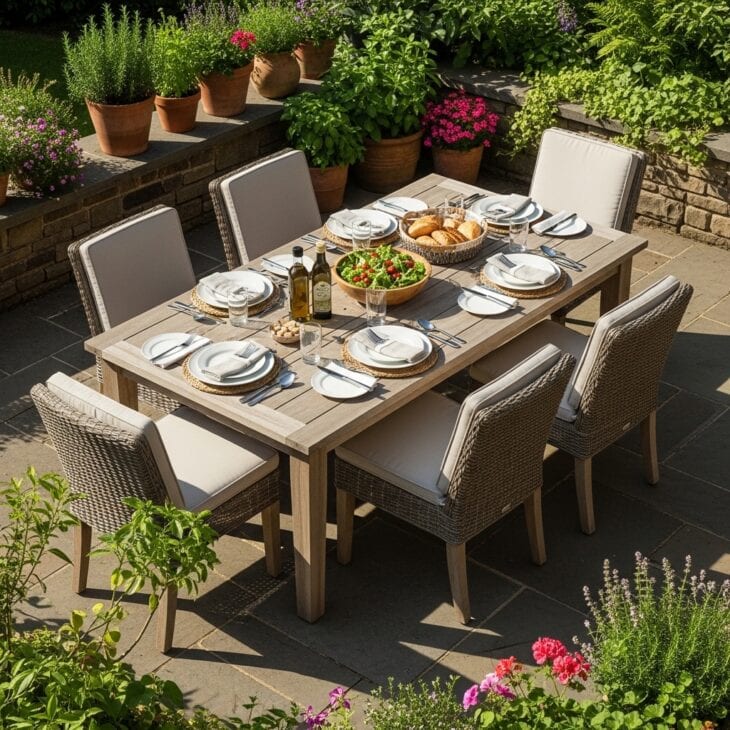
What you see For most people the patio is, above all, a place to eat outside, and a proper dining set anchors the whole space. A generous table and comfortable chairs, set close to the kitchen and ringed with pots of herbs and flowers, turn a slab of paving into an outdoor dining room.
Why it works Eating outdoors is the activity a patio earns its keep on, so sizing and siting the table well matters more than almost anything. Placing it near the kitchen door means meals actually make it outside, while a table scaled to the space leaves room to move around without anyone climbing over a planter. The dining set quickly becomes the heart of summer.
How to get it Allow at least 3ft (90cm) all around the table so chairs can pull out and people can pass behind them — for a six-seater that means a patio of roughly 12ft by 12ft (3.6m by 3.6m). Choose weatherproof materials: powder-coated aluminum, teak or all-weather rattan all last outdoors with little fuss. Add a parasol or overhead shade for midday meals, and store or cover cushions to keep them fresh. Buy the largest table the space sensibly allows, as outdoor gatherings always grow.
03. Add a Cozy Outdoor Sofa Lounge
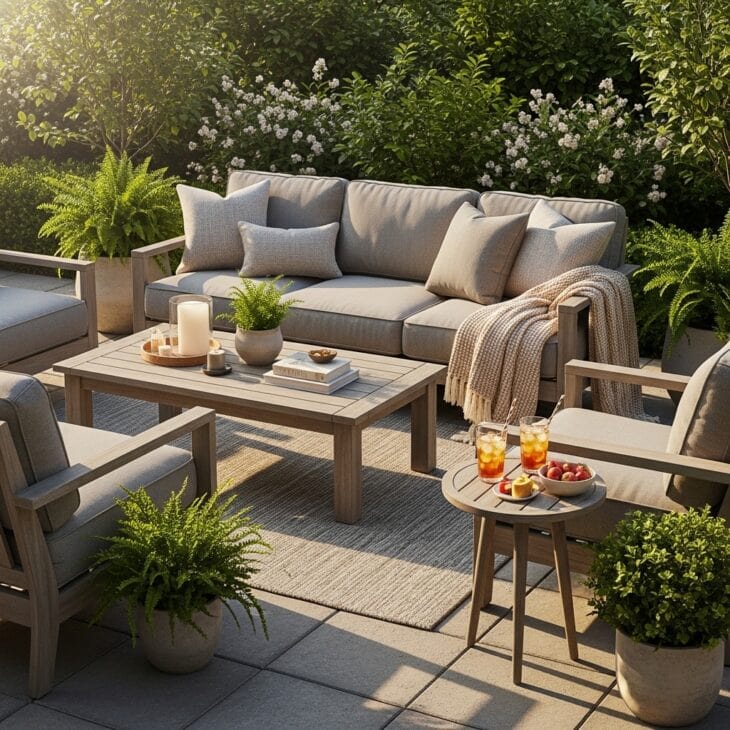
What you see A dining set is for meals; a sofa lounge is for lingering. Deep-cushioned outdoor seating gathered around a low table, with a throw to hand and drinks within reach, invites you to sink in and stay long after the plates are cleared.
Why it works Comfortable lounge seating is what tips a patio from somewhere you pass through into somewhere you relax, read and unwind. Grouping the furniture around a focal point — a coffee table, a fire pit, a view — makes the area feel sociable and intentional. It treats the outdoors as a genuine living room rather than an overflow space.
How to get it Choose proper outdoor lounge furniture with quick-dry foam and weatherproof fabric, not indoor pieces that will rot. Arrange sofas and chairs to face each other across a low table, leaving clear routes through. Site the lounge to catch the part of the day you most want to use it — afternoon sun or evening shade — and add an outdoor rug beneath to pull the grouping together. Keep cushions in a weatherproof storage box so they are always dry and ready.
04. Frame the Patio with Raised Beds
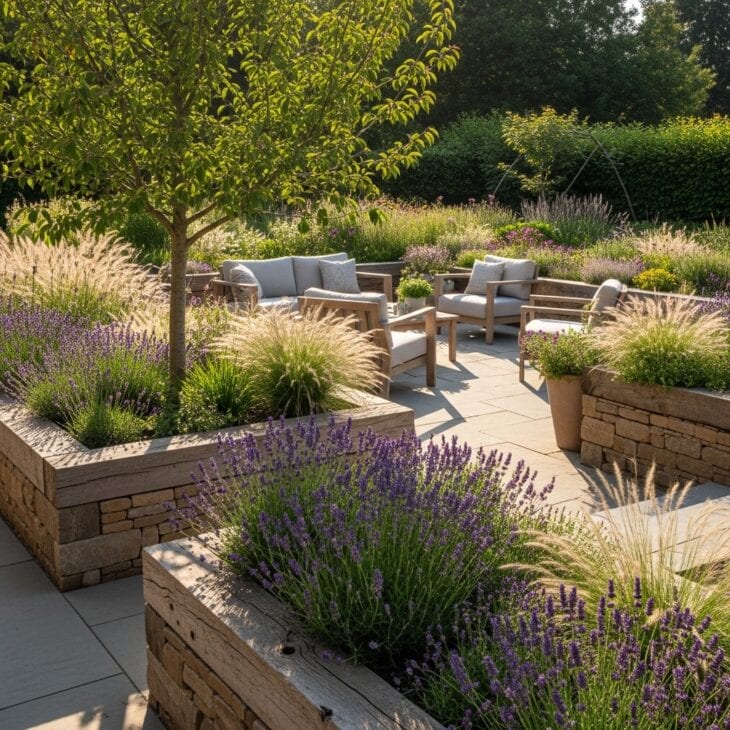
What you see Built-in raised beds around the edge of a patio wrap the seating area in greenery and give it a sense of enclosure. Planted with lavender (Lavandula angustifolia), grasses and a small tree, they frame the space and ease the transition from hard paving to the garden beyond.
Why it works Raised beds bring planting up to a height where you can see, smell and touch it from your seat, and their walls double as casual extra seating or a place to rest a drink. Framing the patio with greenery on two or three sides makes it feel like an outdoor room rather than an exposed platform. The structure also defines the edge cleanly where patio meets lawn or border.
How to get it Build the beds from a material that ties in with the paving or the house — matching stone, rendered block, or timber sleepers. Make the walls a comfortable perching height of around 18in (45cm) and at least 12in (30cm) wide on top if you want to sit on them. Line timber beds and ensure good drainage, then fill with quality topsoil and compost. Plant a mix of evergreen structure, long-flowering perennials and something scented near the seating, and check our raised bed garden ideas for more planting combinations.
05. Soften Hard Edges with Billowing Planting
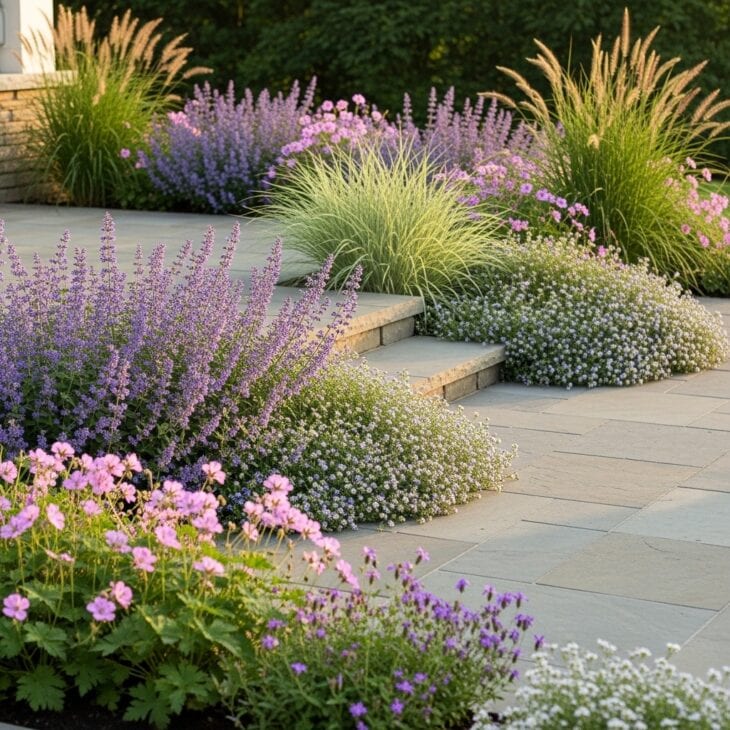
What you see The fastest way to take the newness off a patio is to let planting spill over its edges. Mounds of catmint (Nepeta), hardy geraniums and grasses flopping onto the paving blur the hard line between stone and soil, so the patio looks settled into the garden rather than dropped onto it.
Why it works A crisp paved edge can feel stark, but a few plants tumbling over it instantly reads as relaxed and established. Soft, mounding plants are perfect for the job, breaking up straight lines and bringing scent and movement right to the patio’s edge. It is a small touch that makes a brand-new patio look like it has always been there.
How to get it Leave planting pockets along the patio edge, or set deep beds right against it, and choose plants that naturally flop and spread — catmint, hardy geraniums, lady’s mantle (Alchemilla mollis) and low grasses all do it beautifully. Plant them close to the edge so they lean out over the stone. Shear them back after the first flush to keep them fresh, and accept a little informality, since that softness is exactly the point. A few self-seeders in the paving joints complete the effect.
06. Build a Container Garden in Pots
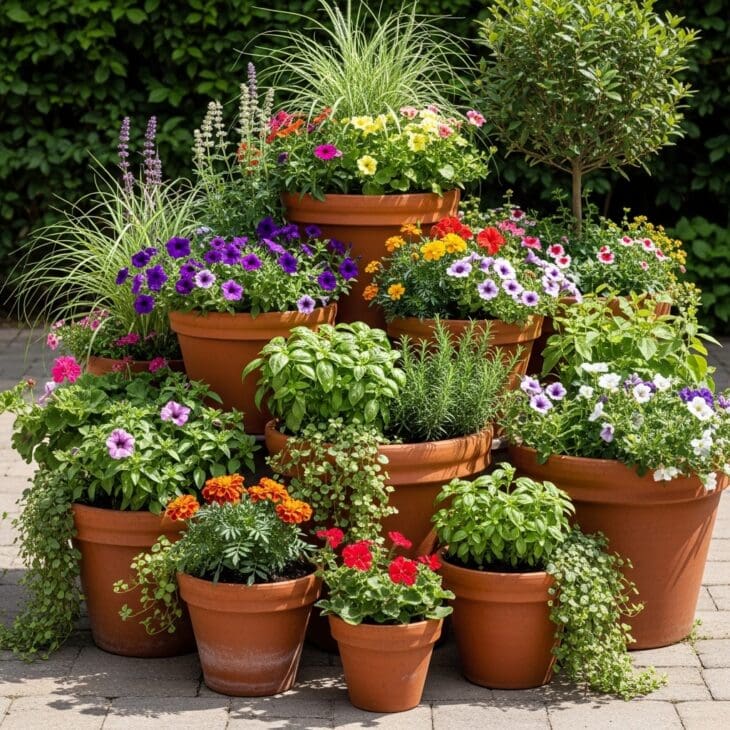
What you see When the patio is paved and there is no soil to plant into, pots are the answer. A cluster of containers in varied sizes — a small shrub, billowing grasses, trailing flowers and herbs — builds a whole garden on the hard surface, full of color and easy to change with the seasons.
Why it works Containers bring planting right into the heart of the patio and let you garden where the ground is solid. Grouped together, pots make far more impact than the same containers scattered singly, and you can rearrange them, swap in seasonal stars, or move tender plants under cover for winter. They are the most flexible planting there is.
How to get it Group pots in odd numbers and vary the heights, raising smaller ones on stands so each is seen. Use the biggest containers you can — large pots hold moisture far longer than small ones, which can dry out within hours in summer sun. Fill with a good peat-free compost, make sure every pot drains freely, and feed regularly through the growing season. Repeat a plant or a pot color through the group to tie it together rather than letting it look like a random collection.
07. Add a Pergola for Dappled Shade
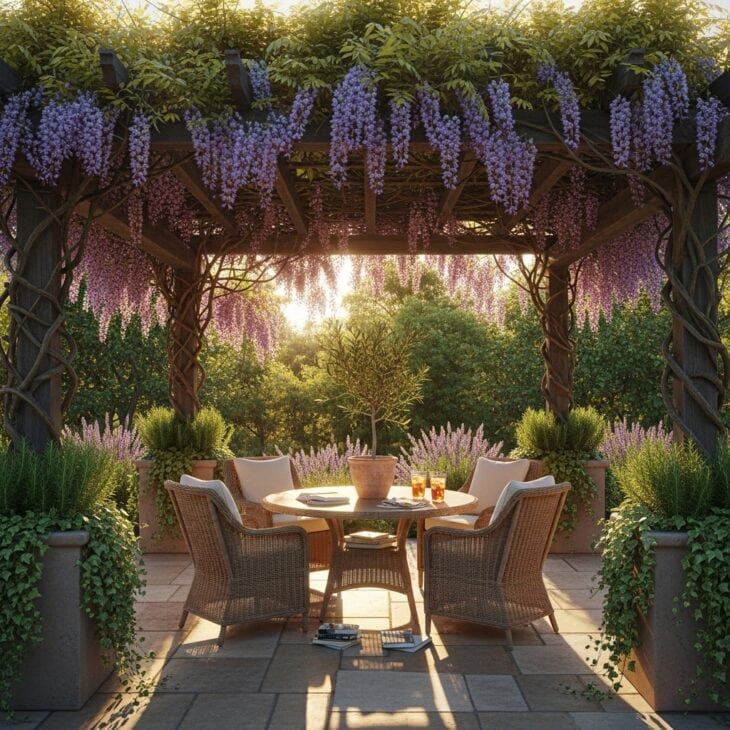
What you see A pergola raised over the patio gives it a ceiling of dappled shade and a real sense of structure. Climbers scramble across the beams overhead — wisteria (Wisteria sinensis), a grape vine or a rose — so you sit in filtered green light with scent drifting down.
Why it works A pergola defines an outdoor room without closing it in, drawing the eye up and making the space beneath feel sheltered and intimate. The shade it casts makes a sun-baked patio usable through the hottest hours, while a deciduous climber lets winter sun back through once the leaves fall. It also makes the perfect frame for hanging lights and plants.
How to get it Set the posts on solid footings in concrete and scale the structure generously — a pergola that looks slightly oversized bare usually looks right once clothed in growth. Position the uprights clear of the furniture so chairs are not jammed against a leg. Train a climber up each post and across the top, choosing wisteria or grape for romance, or evergreen star jasmine (Trachelospermum jasminoides) for year-round cover and scent. Be patient, as a pergola truly comes into its own as the planting matures.
08. Hang a Shade Sail or Retractable Awning
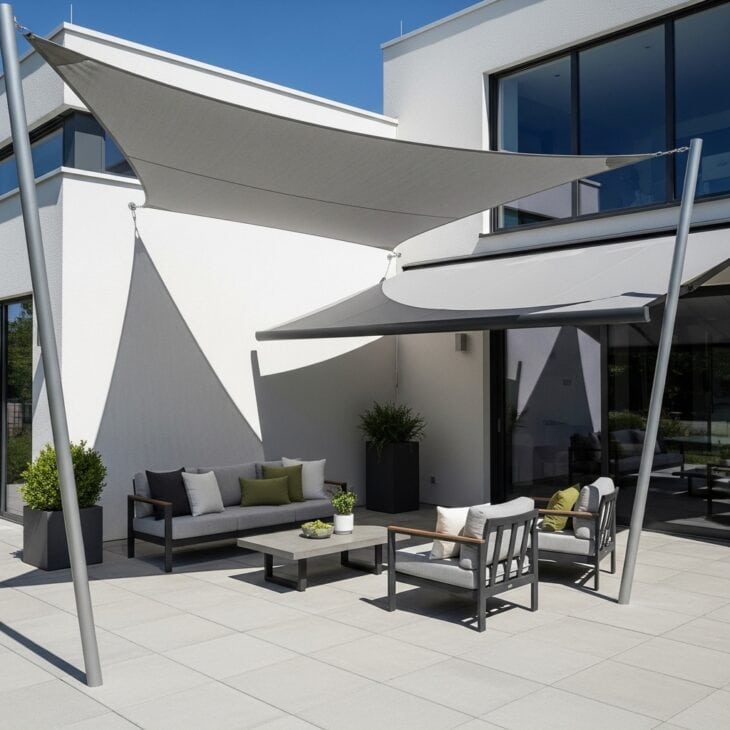
What you see For instant shade without waiting years for a climber to grow, a fabric shade sail or a retractable awning does the job at once. Stretched overhead, it throws cool shade across the seating area on the hottest days and gives a modern patio a crisp, architectural line.
Why it works Shade is what makes a sunny patio usable in high summer, and fabric is the quickest, most affordable way to get it. A retractable awning has the advantage of folding away, so you keep the shade on scorching afternoons but let the sun and warmth back in when you want them. Both work where there is no room or time for a pergola.
How to get it Fix shade sails to sturdy anchor points — the house wall, stout posts set in concrete — and tension them properly, with a slight slope so rain runs off rather than pooling. Choose a breathable, UV-stable fabric and a size that actually covers the seating when the sun is at an angle, not just overhead. A retractable awning bolts to the house and winds out over the patio at the turn of a handle or a switch. Take fabric sails down over winter to extend their life and avoid storm damage.
09. Build In Bench Seating to Save Space
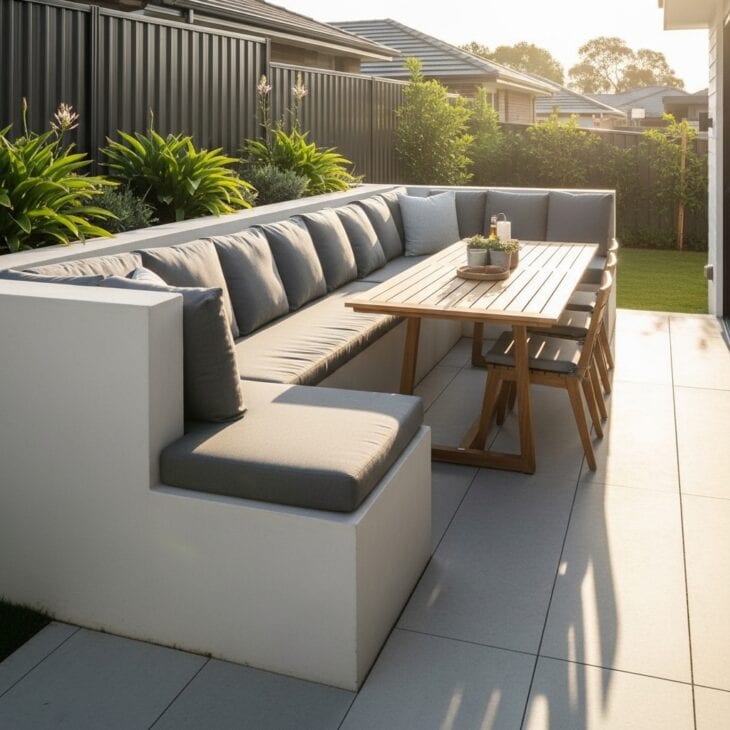
What you see Built-in bench seating wrapped along a wall or raised bed is a clever way to seat a crowd without filling the patio with bulky chairs. Topped with cushions and tucked into a corner around a table, it makes the most of every inch — especially on a small patio.
Why it works Fixed seating hugs the edges of the space, freeing the center and seating more people than loose furniture in the same footprint. A corner bench creates a sociable, booth-like nook, and the structure beneath can hide valuable storage for cushions and tools. It gives a patio a permanent, considered look that stacking chairs never will.
How to get it Build benches at seat height — around 17 to 18in (43 to 45cm) — from materials that match the patio or raised beds. Use weatherproof construction, and either slatted tops that let rain drain or hinged lids over a dry storage box below. Add deep outdoor cushions for comfort, since a bare bench is hard to linger on. Wrap the seating around a corner or a fixed table to create that snug, gather-round feel.
10. Gather Around a Patio Fire Pit
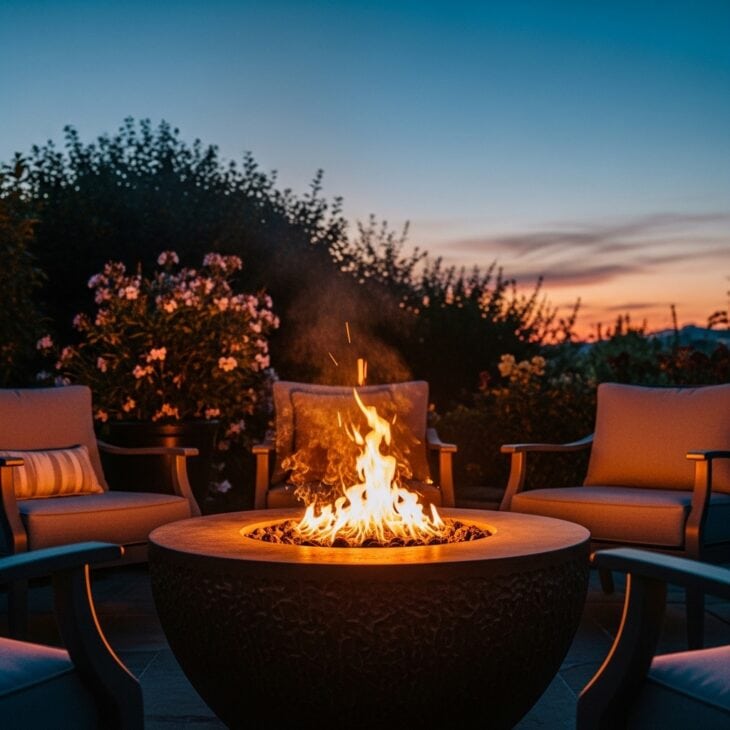
What you see A fire pit gives a patio a glowing heart and a reason to stay out after dark. As the flames catch and the chairs draw in close, the paved area becomes the spot everyone gravitates to — warm, flickering and quietly mesmerizing.
Why it works Fire extends the hours and the seasons you use the patio, pulling people outside on cool spring and fall evenings that would otherwise send them indoors. Arranged in a circle, the seating becomes naturally sociable, everyone turned toward the flames. A patio’s hard, non-combustible surface is also the safest possible place to site one.
How to get it Stand the fire pit on the paving, well clear of the house, fences and any overhead pergola or sail. Leave about 3 to 4ft (90 to 120cm) between the fire and the seating so it is warm but safe, and keep a heatproof mat under a metal bowl to protect the stone from scorching. A simple steel bowl is the cheapest start; a gas fire pit or fire table gives flames at the flick of a switch with no smoke or ash. Check local rules on open fires and keep water or sand close by.
11. String Festoon Lights Overhead
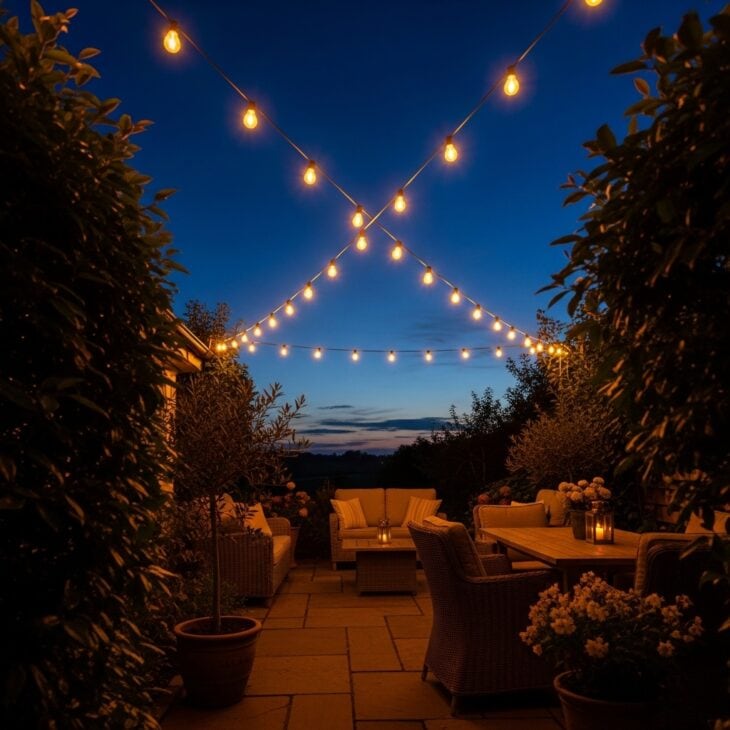
What you see A few strings of festoon lights crisscrossed overhead transform a patio the moment the sun goes down. The warm golden bulbs hang against the darkening sky, casting a soft glow over the table and chairs and turning the space into an outdoor room with a ceiling of light.
Why it works Lighting is the cheapest, fastest way to change how a patio feels after dark, and overhead festoons give the friendliest, most flattering light of all. Warm-white bulbs create atmosphere without the glare of a security floodlight, and stringing them overhead defines the seating area and keeps the glow where you want it. It is the detail that makes people linger long after dinner.
How to get it Use proper outdoor-rated festoon lights in warm white — around 2700K — rather than cold blue-white. String them between the house and a sturdy post, or zigzag them across a pergola, running them along a length of taut catenary wire so they do not sag. Solar or low-voltage LED festoons keep running costs and wiring to a minimum. Add a few lanterns or candles at table level to complete the layered, glowing effect.
12. Add a Water Feature for Calm
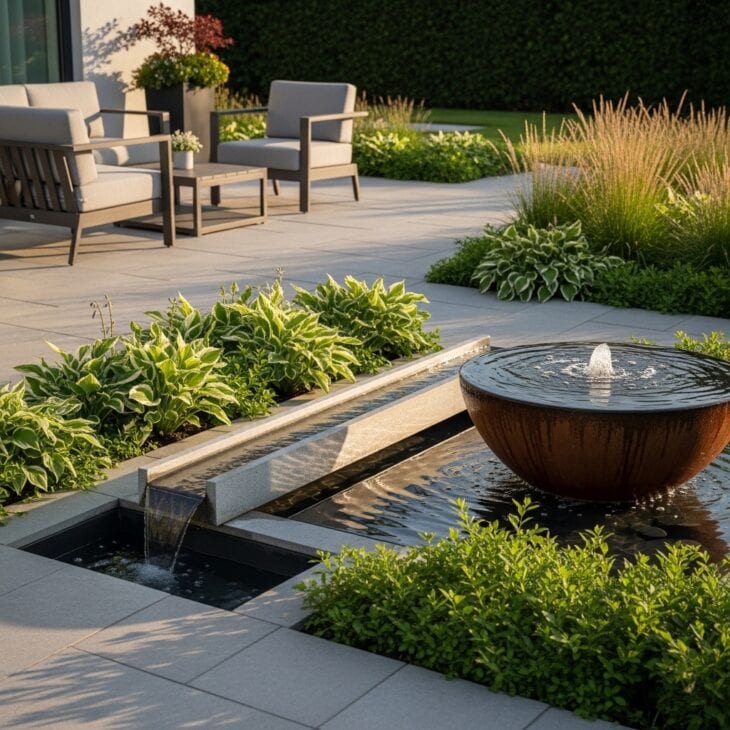
What you see The gentle trickle of a water feature brings a patio to life in a way nothing else can. A simple bubbling bowl or a sheet of water spilling down a stone blade adds sound, movement and a cool, calming presence to the seating area.
Why it works Moving water masks traffic noise and next-door chatter, replacing it with a soothing sound that makes a patio feel like a retreat. It draws birds and insects in to drink, and the play of light on the surface adds a focal point that holds the eye. Even a small self-contained feature has an effect out of all proportion to its size.
How to get it For a patio, a self-contained or reservoir feature — where water recirculates from a hidden underground tank — is simplest, with no open pool to keep clean or to worry about around children. Site it near the seating so you can hear it, and where there is access to a power supply for the pump, ideally on a weatherproof outdoor socket. Choose a material that suits the patio, from natural stone to weathered corten steel. Top up the reservoir in hot weather and tuck the pump away over winter in cold climates.
13. Lay an Outdoor Rug to Define the Zone
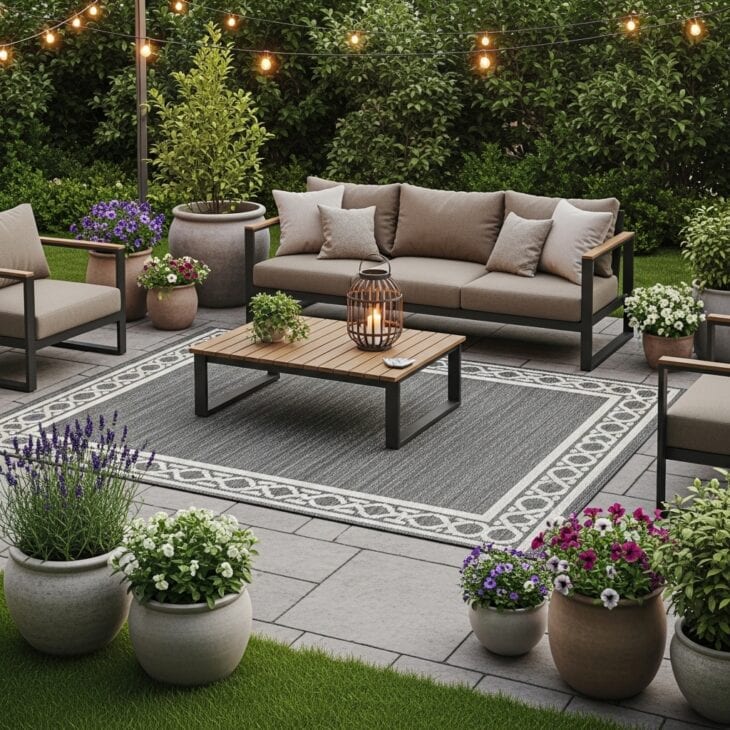
What you see A large outdoor rug laid beneath the furniture instantly grounds a patio seating area. It adds pattern, color and a touch of softness underfoot, pulling the sofa, chairs and table together into one cohesive, room-like group.
Why it works A rug does for a patio what it does indoors: it defines a zone and signals “this is a room”, making a loose arrangement of furniture feel deliberate. On a large patio it can carve out a distinct lounge or dining area within the wider space. It is one of the easiest, most affordable ways to make outdoor living feel finished and cozy.
How to get it Choose a proper outdoor rug made from polypropylene or recycled plastic, which shrugs off rain, sun and mud and can be hosed clean. Size it so the front legs of the furniture sit on it at least, anchoring the whole grouping rather than floating in the middle. Lift it to dry out after heavy rain to stop damp marks on the paving beneath. Pick a pattern that complements your cushions and pots to tie the scheme together.
14. Screen for Privacy with a Green Wall
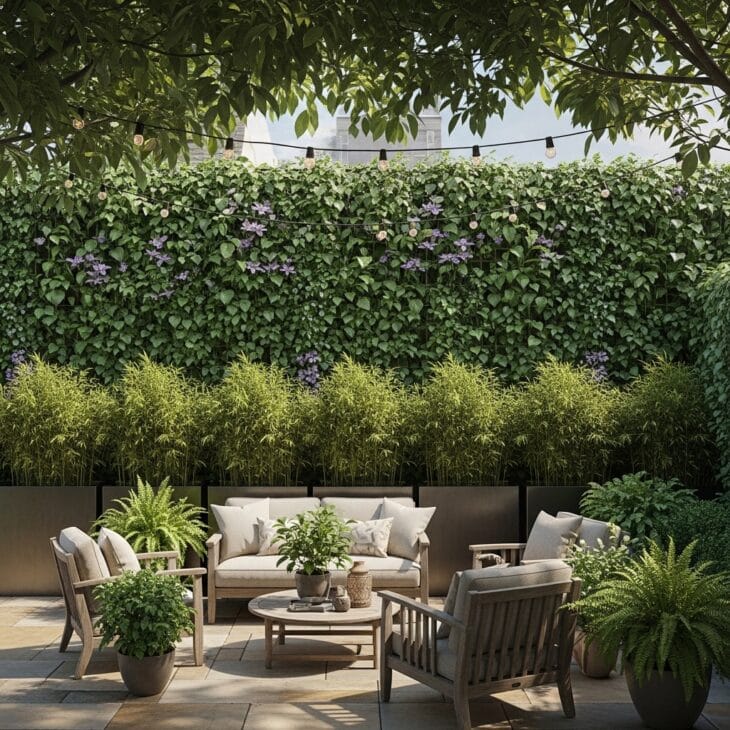
What you see Few things spoil a patio like feeling overlooked. A green screen — a living wall, a trellis of climbers, or a row of tall planters filled with bamboo or grasses — wraps the seating area in leaves and turns an exposed corner into a private retreat.
Why it works Privacy is what lets you truly relax on a patio, and planting does the job far more beautifully than a bare fence. Greenery softens sound, filters wind and screens a neighbor’s window without feeling like a barricade. Because a patio sits close to the house, even a modest, well-placed screen blocks the key sightlines that matter most.
How to get it Work out exactly which view you want to block — often it is a single upstairs window — and screen just that, rather than walling yourself in. Tall planters of bamboo (choose a well-behaved clumping type), grasses or slim trees give instant height where there is no soil. A trellis topper on an existing fence, clothed in evergreen climbers, raises the screen without the bulk of a taller fence. Keep some openness too, so the patio feels secluded rather than boxed in.
15. Mix Materials for Texture
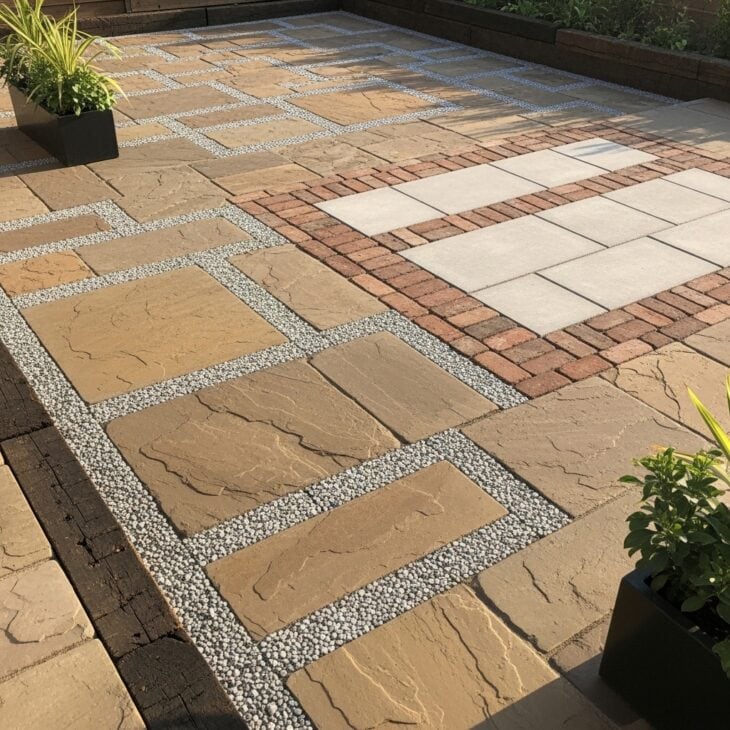
What you see A single expanse of paving can feel flat, but combining materials brings a patio alive. Stone slabs threaded with strips of gravel, edged in brick or broken up with timber inserts create texture and pattern underfoot and lift the whole surface from plain to designed.
Why it works Mixing materials adds visual interest and can define zones within a patio — a gravel band marking the edge of the dining area, say, or timber decking for a lounge corner. It is also practical, letting you use gravel for drainage or to flow around an awkward shape that would be hard to pave. Used with restraint, the contrast makes the space feel considered and bespoke.
How to get it Limit yourself to two or three complementary materials so the effect is rich rather than chaotic. Keep one as the main surface and use the others as accents — inset strips, borders or a contrasting band. Make sure levels stay flush and even, especially under furniture, so tables do not rock and there is nothing to trip on. Choose materials that share a tone or era — stone with gravel, brick with clay pavers — so they read as a family rather than a clash.
16. Sink the Patio for Shelter
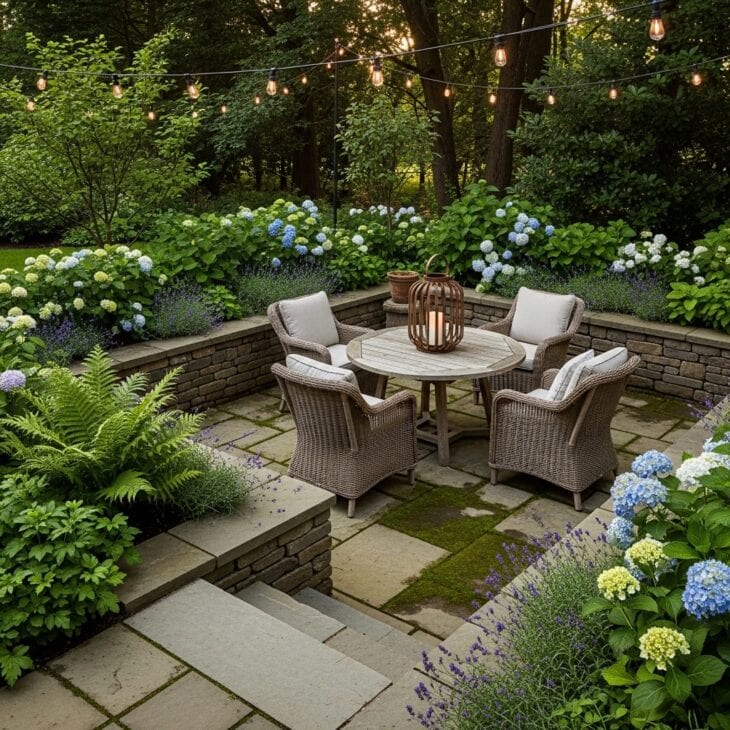
What you see A sunken patio, set a step or two below the surrounding garden, feels instantly sheltered and special. With planting rising at eye level around its edges, the seating area becomes a snug hollow — out of the wind and gently separated from the rest of the garden.
Why it works Dropping a patio even a little creates a sense of enclosure and intimacy that a flat, exposed area lacks. The raised planting around it screens the space, shelters it from wind, and brings flowers and foliage up to where you can see them from your seat. It turns a simple seating area into a destination, a sunken garden room you step down into.
How to get it This is a bigger project, so it suits a new build or a full redesign rather than a quick weekend job. Plan drainage carefully — a sunken area can collect water, so include a soakaway or drain and slope the surface to it. Retain the surrounding soil with low walls that double as planting beds and casual seating. A single step down is often enough to create the effect without major excavation, and it keeps the change in level safe and easy to navigate.
17. Split a Sloping Plot into Level Terraces
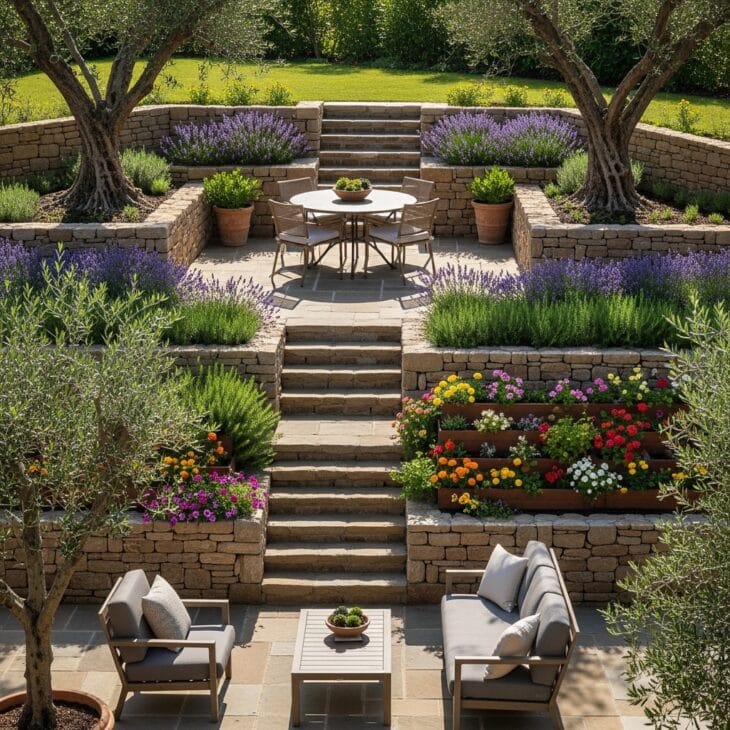
What you see A slope that seems to rule out a patio is really an opportunity. Cut into two or three level terraces linked by steps, a sloping plot gains a series of usable patios — perhaps dining on one level and lounging on another — each with its own outlook.
Why it works Terracing turns unusable gradient into flat, functional space, which is the only way to get a level patio on a hillside. Splitting the garden into levels also creates distinct zones and a real sense of journey as you move up or down through it. The retaining walls add structure and extra seating, and the changes of level make even a small sloping garden feel dynamic and generous.
How to get it Retaining walls do serious structural work, so build them properly — for anything more than about 3ft (90cm), or where a wall holds back a lot of soil, get professional engineering advice. Include drainage behind every retaining wall so water pressure cannot build up and push it over. Make steps generous, even and well-lit for safe use after dark. Repeating a material or planting style across the levels keeps the terraced garden feeling like one connected design.
18. Grow a Patio Herb and Salad Garden
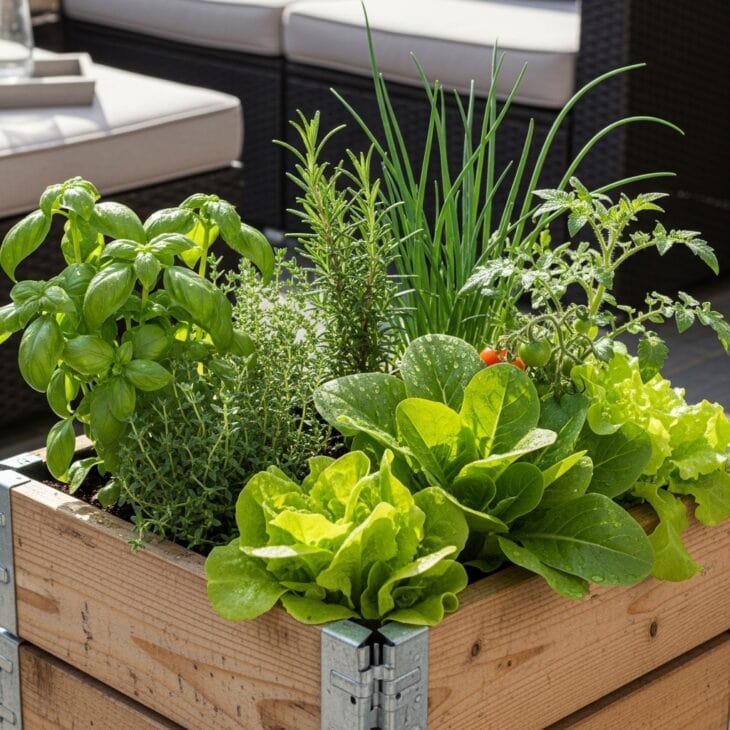
What you see A patio is the perfect place for a pick-and-eat herb and salad garden, just steps from the kitchen. Pots of basil, thyme, rosemary and chives (Allium schoenoprasum) alongside lettuces and a tomato plant put fresh flavor within arm’s reach of the table.
Why it works Growing edibles on the patio means you snip herbs as you cook and pick salad as you eat, at their freshest and most flavorful. Most herbs and salads are happy in containers and need little space, so even a tiny patio can be productive. Many of them — silvery rosemary, purple-flowered chives, trailing thyme — are genuinely pretty, so the planting earns its place on looks as well as taste.
How to get it Site edible pots in the sunniest spot, as most herbs and tomatoes want six or more hours of sun. Group Mediterranean herbs like rosemary, thyme and oregano together, since they share a love of free-draining, gritty compost and dislike sitting wet. Keep thirstier basil, lettuce and tomatoes separate where you can water them more freely, and feed tomatoes once they flower. Pick and harvest often — regular cropping keeps herbs bushy and salads coming.
19. Train Climbers up a Trellis Screen
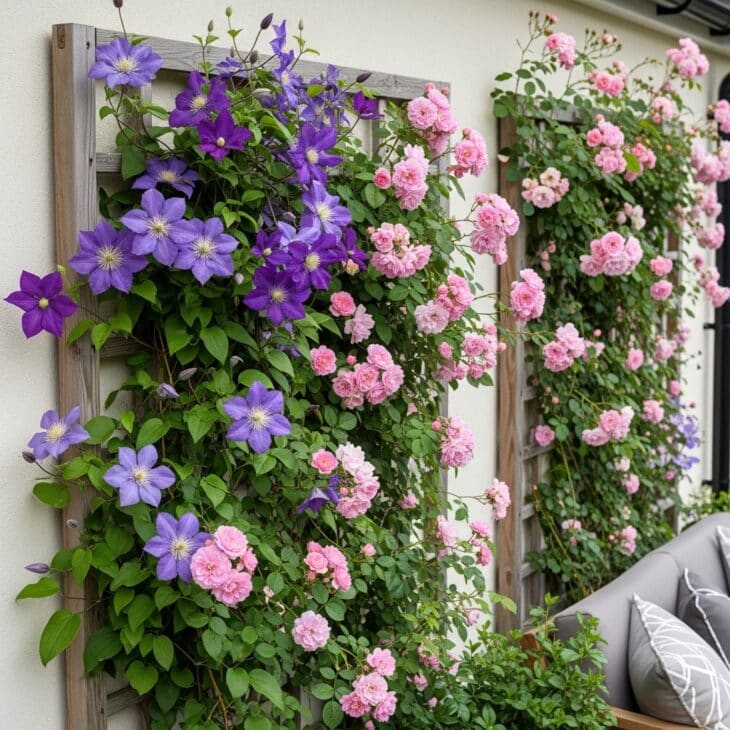
What you see The walls and fences around a patio are valuable growing space waiting to be used. A trellis clothed in climbers — clematis (Clematis) twining through a climbing rose — turns a flat vertical surface beside the seating into a tapestry of flowers and leaves.
Why it works Going vertical brings greenery and color to a patio without sacrificing any precious floor space. Climbers soften hard boundaries, add height and scent, and can screen an ugly wall or an overlooking window. Choosing varieties that flower at different times keeps the patio’s vertical surfaces interesting for much of the year.
How to get it Fix a trellis or horizontal wires to the wall, holding them about 2in (5cm) clear of the surface so stems can twine and air can circulate. Plant climbers in a generous bed or a large pot at the base, and lead the stems onto the support, tying them in as they grow. Pair a clematis with a rose for two layers of bloom, and check each clematis’s pruning group so you cut it correctly. For scent by the seating, add honeysuckle (Lonicera periclymenum) or star jasmine where they will perfume the air on warm evenings.
20. Install an Outdoor Kitchen or Bar
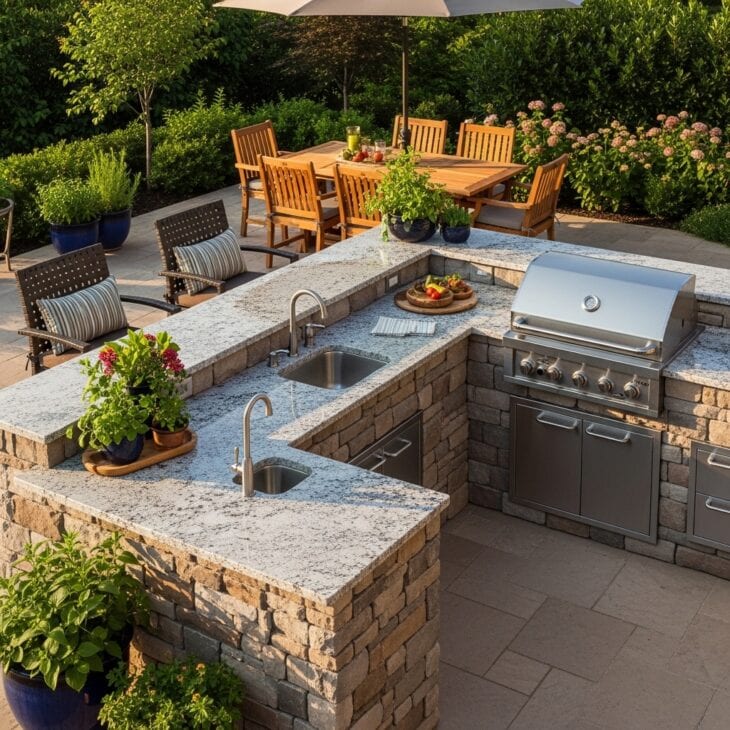
What you see An outdoor kitchen or bar built into the patio takes entertaining to another level. A run of counter with a built-in grill, storage below and a couple of bar stools means the cook stays out with the guests instead of shuttling back and forth to the kitchen.
Why it works Keeping food and drink preparation on the patio is what makes outdoor entertaining effortless and genuinely sociable. A proper counter gives you somewhere to work, rest plates and mix drinks, so the host is part of the gathering rather than stuck indoors. Sited beside the dining area, it turns the whole patio into the hub of summer.
How to get it Position the kitchen close to the table but with grill smoke blowing away from where people sit. Build the counter from weatherproof materials. Stone, rendered block or treated timber with a stainless steel grill insert. Add a little task lighting and, if budget allows, a water supply and a small fridge. Start simple with a sturdy built-in grill and a single run of counter, then expand once you know how you use it.
21. Anchor the Corners with Potted Trees
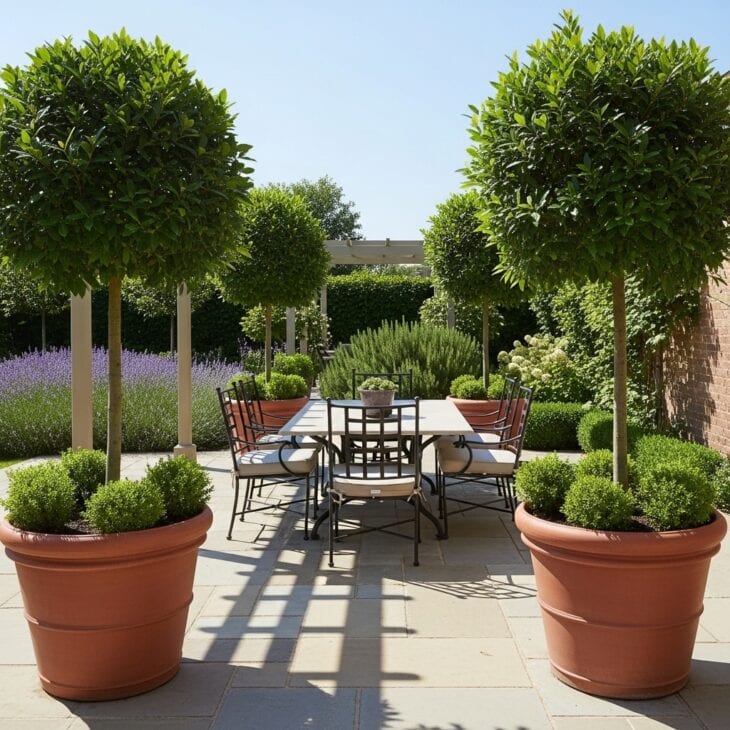
What you see A pair of trees in large pots brings height, structure and a touch of formality to a patio. Clipped bay (Laurus nobilis), a silvery olive (Olea europaea) or a small Japanese maple (Acer palmatum) in matching containers anchors the corners and frames the seating area like living bookends.
Why it works Most patio planting sits low, so a potted tree adds the vertical structure and presence that pots of flowers cannot. A matching pair flanking an entrance, a doorway or the seating creates instant symmetry and a sense of arrival. Evergreens like bay and olive hold that structure right through winter, when the rest of the patio is bare.
How to get it Choose trees that cope well with container life. Bay, olive, Japanese maple, and small ornamentals all work in big pots. Use the largest containers you can, with excellent drainage, and a loam-based compost that holds moisture and weight steadily. Water consistently and feed through the growing season, since potted trees rely entirely on you. In hard-winter areas, protect the roots of olives and other tender trees, or move them to shelter, as the rootball is far more frost-vulnerable in a pot than in the ground.
22. Layer in Color with Cushions and Textiles
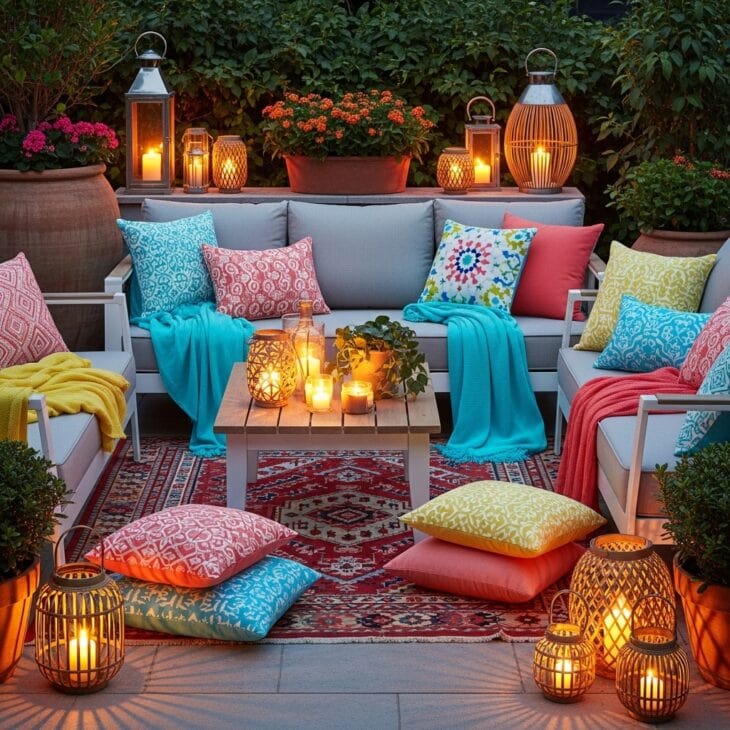
What you see The quickest, cheapest way to give a patio personality is with soft furnishings. A scatter of colorful outdoor cushions, a throw over the sofa arm and a patterned rug bring warmth and character to plain furniture and paving in an afternoon.
Why it works Textiles are to a patio what they are to a living room: the layer that makes it feel comfortable, finished and personal. They let you introduce color and pattern without commitment, and refresh the whole look each season by simply swapping the cushion covers. On a budget, this is the single most transformative thing you can do.
How to get it Choose fade- and water-resistant outdoor fabrics so colors last and showers do not ruin them. Pick a simple palette — two or three colors that pick up tones from your pots and planting — and repeat it across cushions, throws and rug to tie the scheme together. Mix a few patterns with plenty of plain to keep it from looking busy. Store everything in a weatherproof box so it stays dry and ready, and bring the most precious pieces in over winter.
23. Choose Permeable Paving for Drainage
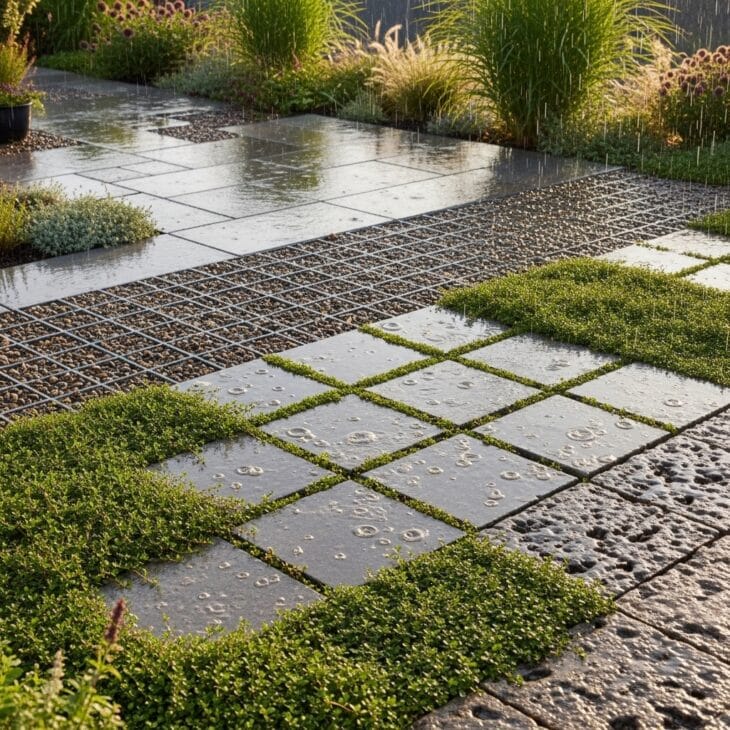
What you see Permeable paving lets rain soak straight through the surface instead of running off it. Spaced pavers with planted or gravel-filled joints, porous stone or a gravel-grid system keep a patio dry and puddle-free while quietly doing the environment a favor.
Why it works Letting water drain through the patio rather than sheeting off it eases the load on drains, reduces local flooding and recharges the ground beneath. It avoids the puddles that collect on solid paving after a downpour, and the planted joints add little ribbons of green and a softer look. As storms grow heavier, permeable surfaces are an increasingly sensible choice.
How to get it Lay permeable paving over a free-draining sub-base of open-graded stone that can hold and release water, rather than the compacted base used for solid paving. Leave open joints filled with grit or fine gravel, or plant them with tough, low creepers like creeping thyme (Thymus serpyllum) for a living surface. Keep the joints clear of silt over time so they keep draining freely. It is especially worth considering if you are replacing a lawn with hard surface, where it helps offset the lost drainage.
24. Make the Most of a Tiny Balcony Patio
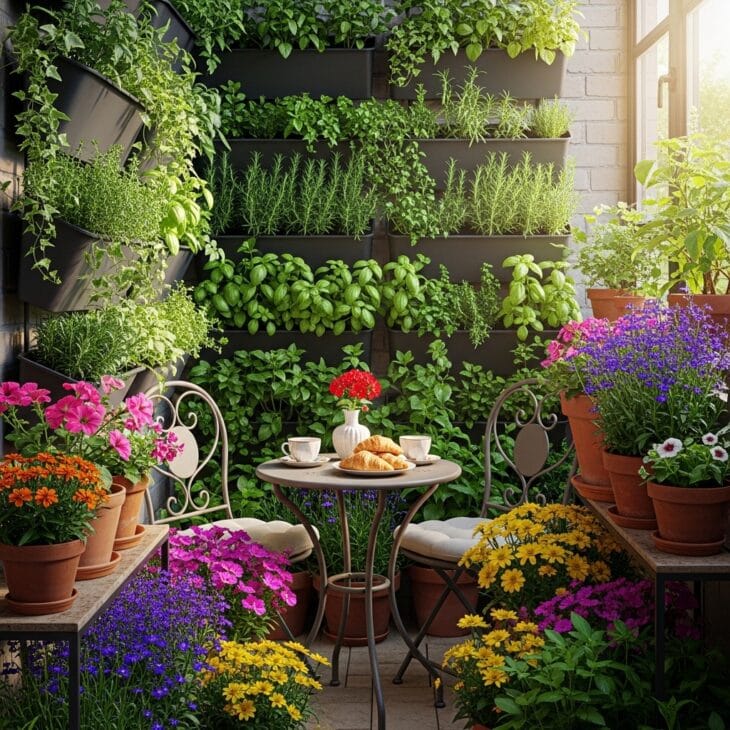
What you see Even the smallest balcony or courtyard can be a proper patio. A bistro table and two chairs, walls clothed in vertical planting and every corner crowded with pots of flowers and herbs prove that a tiny footprint is no barrier to outdoor living.
Why it works A small space forces good decisions: choose carefully and a tiny patio can feel just as rich and welcoming as a large one. Growing upward on walls and railings frees the floor, while folding or slimline furniture keeps it usable. Packing the space with greenery, rather than leaving it bare, is exactly what makes a small patio feel lush and intimate rather than cramped.
How to get it Use the walls and railings for hanging pots, wall planters and a small trellis so the floor stays clear. Choose folding bistro furniture you can move aside, and one or two larger pots rather than many tiny ones, which dry out fast and look cluttered. Stick to a tight color palette to keep a small space calm, and check weight limits and drainage if it is a balcony. For more on squeezing the most from a small footprint, see our small garden ideas.
25. Go for a Mediterranean Courtyard Feel
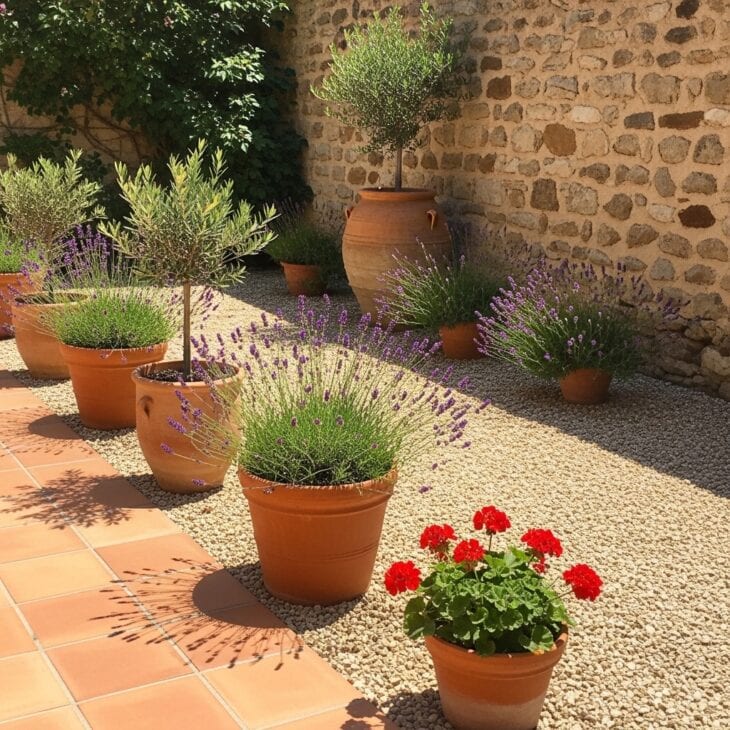
What you see A Mediterranean patio brings a holiday feel home. Terracotta tiles and pots, gravel underfoot, a sun-warmed wall and planting of olive (Olea europaea), lavender and scented pelargoniums conjure the relaxed, sun-baked mood of a courtyard in Italy or Spain.
Why it works The Mediterranean look suits a hot, dry, sunny patio perfectly, because the plants that create it actively thrive on heat, drought and sharp drainage. The warm earthy palette of terracotta and gravel soaks up the sun and ages beautifully, while the aromatic planting releases scent in the heat. It is a style that turns a suntrap from a problem into the whole point.
How to get it Build the scheme on warm materials — terracotta, gravel, lime-washed or rendered walls — and plant in terracotta pots for authenticity. Choose sun-loving, drought-tolerant plants: olive, lavender, rosemary, pelargoniums, and architectural agave or phormium for structure. Use gritty, free-draining compost and resist overwatering, since these plants hate wet feet. Add a shady corner with a vine overhead and a simple bistro set, and the holiday illusion is complete.
26. Keep It Modern and Minimalist
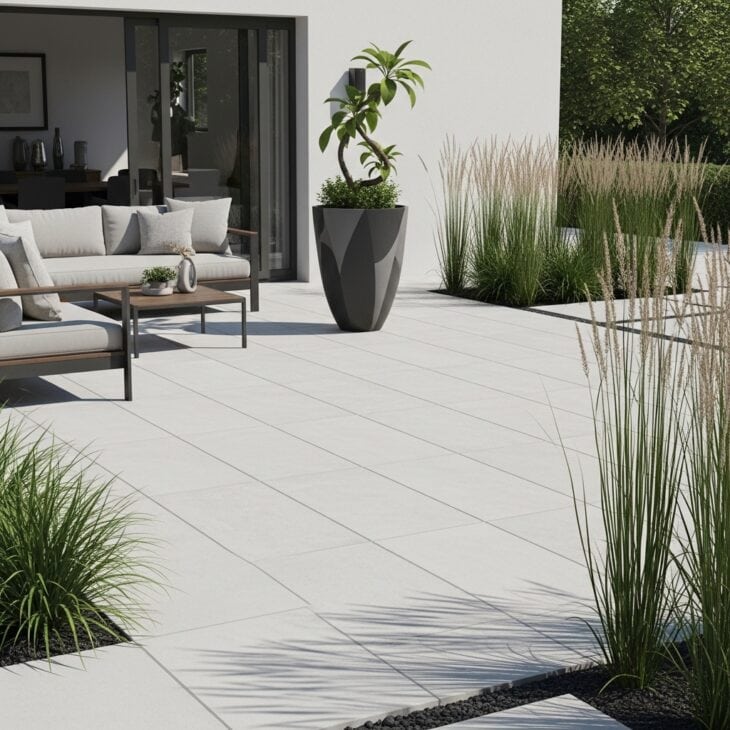
What you see A modern patio finds its beauty in restraint. Large-format porcelain pavers, clean lines, a low sofa and a few architectural grasses in a single sculptural planter create a calm, uncluttered space where every element earns its place.
Why it works Minimalism suits contemporary homes and small spaces alike, because simplicity reads as calm and makes an area feel larger and more ordered. A restrained material and color palette lets the architecture, the light and a few well-chosen plants do the talking. Done well, it feels serene and deliberate rather than empty.
How to get it Choose large-format pavers with narrow joints for a seamless, contemporary surface, and stick to a tight palette of two or three materials and colors. Keep furniture low and simple, and resist clutter — a few large planters have far more impact than many small pots. Lean on foliage and form over flower: grasses, clipped evergreens, phormium and the play of light and shadow. A single specimen plant or sculpture as a focal point completes the look.
27. Add a Reflective Patio Pool or Rill
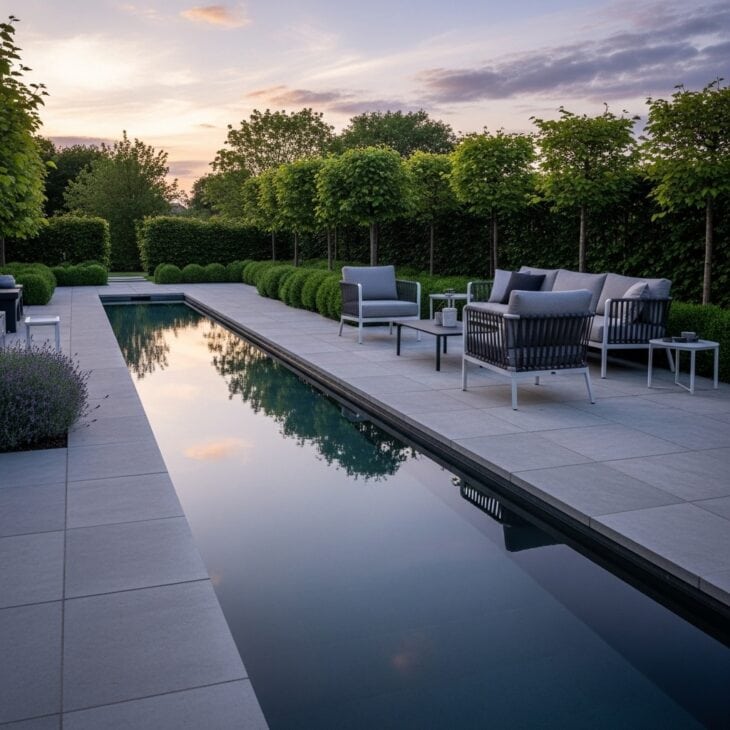
What you see A still pool or a narrow rill set into the paving gives a patio a moment of pure calm. Mirroring the sky and the surrounding planting, the clean-edged water doubles the light and brings a serene, reflective stillness to the space.
Why it works Where a bubbling feature adds sound, a still pool adds light, reflection and a sense of cool composure that suits a formal or modern patio beautifully. A rill — a slim channel of water — can lead the eye through the space or link different areas. Water at ground level, framed by crisp paving, feels intentional and architectural rather than naturalistic.
How to get it A formal pool needs careful, watertight construction and a crisp, level edge, so it is a project worth planning properly or handing to a professional. Keep the water moving gently with a small circulation pump to stop it stagnating and to limit algae. Position it to reflect something worth seeing — the sky, a specimen plant, the house — and keep the surrounds simple so the water remains the star. Think carefully about safety and depth if young children use the patio, and consider a shallow rill instead of an open pool.
28. Warm Cool Nights with a Fire Table or Heater
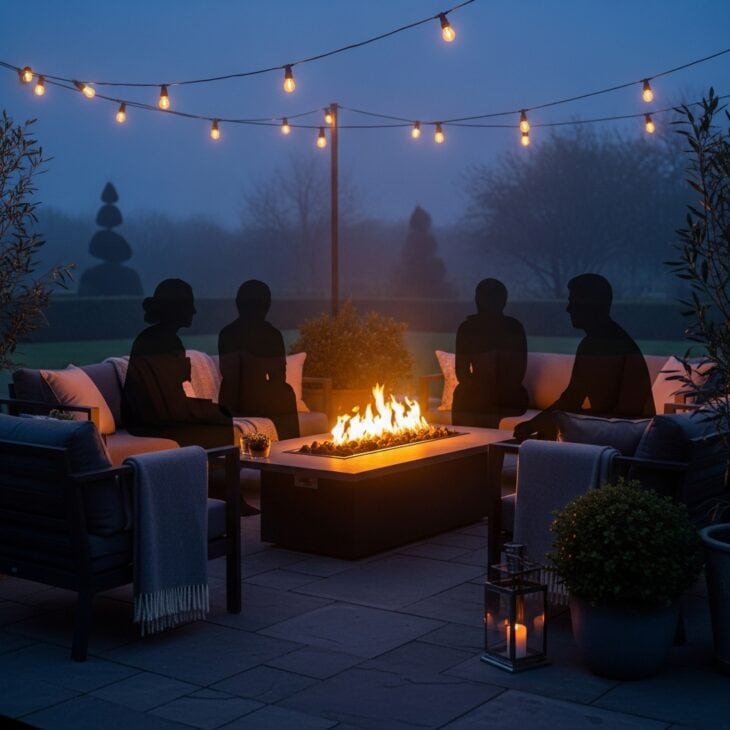
What you see A source of warmth is what keeps a patio in use once the sun drops and the air cools. A gas fire table glowing at the center of the seating, or a sleek heater nearby, takes the chill off the evening and lets everyone stay out long past dusk.
Why it works Heat dramatically extends the hours and the seasons you can enjoy a patio, carrying you comfortably through cool spring and fall evenings. A fire table adds the warmth and the flicker of flames combined with a surface for drinks, while a heater delivers warmth on demand with no smoke or ash. Either turns a chilly evening from the end of the night into the best part of it.
How to get it A gas fire table is a popular patio choice — flames at the press of a button, a usable tabletop, and no smoke drifting over guests. Freestanding electric or gas patio heaters warm a wider area and tuck away when not needed; wall- or pergola-mounted infrared heaters save floor space. Site any heat source on the stable, non-combustible paving, clear of fabric awnings and overhanging planting. As with any fire feature, follow the maker’s clearances and never use fuel-burning heaters in an enclosed space.
29. Plant for Evening Scent and Pollinators
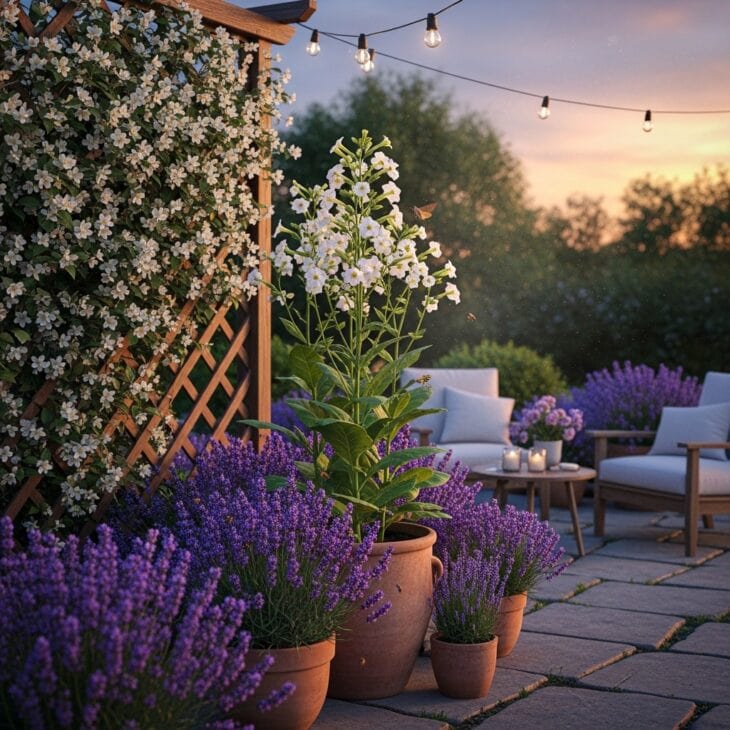
What you see A patio is exactly where scent matters most, because you sit among the planting in the cool of the evening. Jasmine trained over a trellis, lavender in pots and tobacco plants (Nicotiana) near the seating release their perfume as the light fades, while bees and moths work the flowers around you.
Why it works Planting deliberately for fragrance adds a whole extra dimension to a patio that is purely about looks otherwise, and it rewards you most in the evenings when you are most likely to be sitting out. Many of the best-scented plants are also magnets for bees, butterflies and night-flying moths, so the planting hums with life. It engages the senses in a way that hard landscaping never can.
How to get it Concentrate scented plants right beside the seating and along paths where you brush past them, not in some far corner. Choose a succession of fragrance: lavender and pinks for summer days, star jasmine and honeysuckle climbing nearby, and evening specialists like tobacco plants and night-scented stock (Matthiola longipetala) that come into their own after dark. Favor single, open flowers, which let pollinators reach the nectar that double blooms hide. A patio that smells wonderful is one you never want to leave.
30. Keep It Green Year-Round with Evergreens

What you see Because a patio sits right outside the back door, you see it every day of the year — including the bleak ones. A backbone of evergreens — clipped box (Buxus sempervirens) balls, ferns, phormium and a potted bay — keeps the space green, structured and furnished long after the summer flowers have gone.
Why it works Evergreen structure is what stops a patio looking bleak and abandoned in winter, when it is most on view from indoors. Strong shapes and reliable foliage hold the design together through the cold months and act as a calm green backdrop for seasonal flowers in summer. Planning for all twelve months, not just the warm ones, is what separates a good patio from a great one.
How to get it Build in a framework of evergreens before adding seasonal color: clipped box or its tougher alternatives, hardy ferns, phormium, hebe and a structural potted bay or olive. Use evergreen climbers like star jasmine on the walls so the vertical surfaces stay clothed too. Add a few plants with winter interest — colored stems, berries or early flowers — and some lighting, so the patio earns its keep even in January. A little evergreen structure makes every other plant on the patio look better all year.