Peppers are a magnet for aphids and thrips from the moment they go in the ground, and a plant this slow to establish cannot afford to lose weeks of growth to pest pressure. The good news is that a handful of well-chosen companions can pull those pests off your pepper plants and bring in the predatory insects that keep them in check.
Contents
Companion planting works by deliberately placing plants near peppers to address their specific vulnerabilities. Aphids, thrips, spider mites, flea beetles, and European corn borers are the pests that hit peppers hardest, while bacterial leaf spot, Phytophthora blight, and tobacco mosaic virus are the disease pressures growers deal with most. Companions can interrupt all of these threats, but they work through different routes depending on the plant.
The companions in this article provide four main types of protection: pest repellents that mask or confuse insects trying to locate your peppers, trap crops that draw aphids onto sacrificial plants instead, beneficial insect attractors that bring predatory wasps and hoverflies into the bed, and ground covers that suppress weeds and hold moisture early in the season. Several plants do more than one of these jobs at once.
When choosing companions, stick to plants that can handle the same conditions peppers need: full sun, at least 6–8 hours per day, temperatures between 70–85°F (21–29°C) during the day, and a soil pH in the 6.0–6.8 range. Companions that thrive in different conditions, or that grow fast enough to shade slow-maturing pepper plants, will create problems rather than solve them.
Best companion plants for peppers
Basil (Ocimum basilicum)
What it helps with
Basil is widely believed to repel aphids, thrips, and spider mites through volatile aromatic compounds released from its foliage.
Why it works with peppers
Basil produces linalool, eugenol, and other aromatic volatiles that gardeners widely report as deterring aphids and thrips near pepper plants. Some laboratory studies show basil volatiles affect insect host-finding behavior, but field evidence for significant pest reduction specific to peppers is inconsistently demonstrated in controlled trials. The benefit rests substantially on gardener experience and tradition. Basil and peppers share nearly identical temperature and moisture needs, which makes them natural seasonal companions regardless of whether the repellent effect is confirmed.
Planting notes
Plant basil 12–18 inches (30–45 cm) from pepper stems, interplanted throughout the bed or along its edges. Both go out after last frost when soil temperatures have warmed above 60°F (15°C). Avoid positioning basil so close that its bushy growth shades the lower foliage of small pepper transplants early in the season.
Possible drawback or limit
The pest-deterrent effect of basil on peppers is not consistently proven in field conditions. If you are dealing with a serious aphid or thrips infestation, basil alone is unlikely to resolve it — use it as a supporting layer alongside a more reliable trap crop or pest repellent.
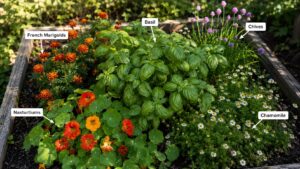
French Marigolds (Tagetes patula)
What it helps with
French marigolds suppress soil nematodes, deter aphids, and attract beneficial predatory insects to the pepper bed.
Why it works with peppers
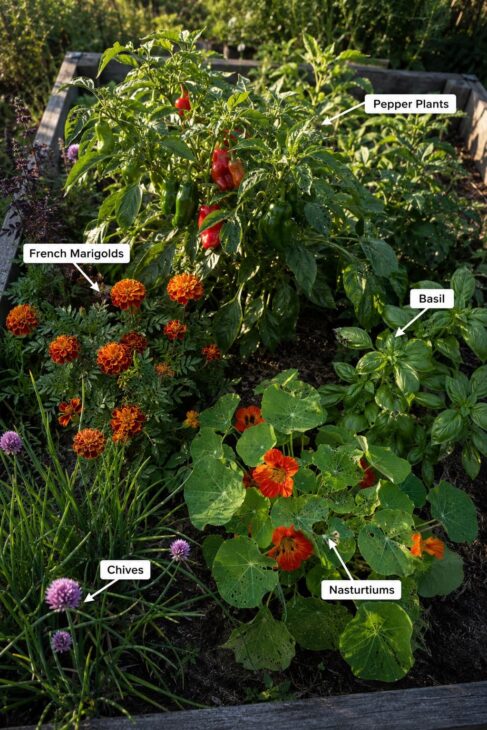
Tagetes patula roots produce alpha-terthienyl and related thiophene compounds that suppress root-knot nematodes (Meloidogyne spp.) — this is well documented in scientific literature and makes French marigolds one of the most evidence-backed companions for any warm-season crop. Marigold flowers attract hoverflies and parasitic wasps that prey on aphids and thrips. Spider mites may also colonize marigolds as a trap crop, pulling pressure away from your pepper plants. For nematode suppression, dense planting and leaving roots in the soil at season end is most effective.
Planting notes
Plant French marigolds as a border around the pepper bed, spaced 12–18 inches (30–45 cm) from pepper stems, or interplant them throughout. Start seeds indoors 4–6 weeks before last frost, or transplant nursery starts at the same time as your peppers. Make sure to choose Tagetes patula specifically — African marigolds (Tagetes erecta) have less evidence for nematode suppression.
Possible drawback or limit
French marigolds need to be grown densely and their roots left in the soil at season end to build up meaningful nematode suppression — a light planting or single-season effort delivers weaker results. They also attract spider mites, which can be a drawback if mite pressure is already high and populations on the marigolds are not monitored.
Nasturtiums (Tropaeolum majus)
What it helps with
Nasturtiums act as a trap crop for aphids, drawing them away from pepper plants, while their flowers attract beneficial predatory insects.
Why it works with peppers
Nasturtiums are highly attractive to aphids, particularly the black bean aphid and peach/potato aphid, which colonize nasturtium foliage in preference over nearby crops. This trap crop effect is well documented in companion planting literature. Nasturtium flowers also attract hoverflies and other predatory insects that feed on aphids and thrips. Gardeners widely report significant aphid diversion when nasturtiums are planted near susceptible crops including peppers.
Planting notes
Plant nasturtiums 12–18 inches (30–45 cm) from pepper plants, in small clusters at the periphery of the bed. Direct sow after last frost or start indoors a few weeks early. Monitor the nasturtiums for aphid buildup: a moderate colony is doing its job, but if the population grows very large, remove or knock off heavily infested stems before aphids spread back to your peppers.
Possible drawback or limit
Nasturtiums may slow in extreme summer heat above 90°F (32°C), which is exactly when pepper pest pressure often peaks. In hot climates, they may need replacing with a mid-season succession sowing to stay effective as a trap crop through the full season.
Chives (Allium schoenoprasum)
What it helps with
Chives repel aphids and spider mites near pepper plants through sulfur-containing volatile compounds produced by their foliage.
Why it works with peppers
Chives and other alliums produce sulfur compounds including allicin and diallyl disulfide that interfere with aphid host-finding behavior. This is documented in several laboratory studies and is consistent with the broader body of allium companion planting evidence against aphids. Spider mites are also reportedly deterred. Chives’ purple flowers additionally attract pollinators and predatory insects during the pepper growing season, adding a beneficial insect dimension to their primary role as a scent barrier.
Planting notes
Plant chives 6–10 inches (15–25 cm) from pepper plants, interplanted throughout the bed or along edges. As perennials, they can be divided and spread to increase coverage year over year. Allow chives to flower rather than cutting them back aggressively during pepper season: the blooms are what attract predatory and pollinating insects, and they produce no timing conflict with peppers.
Possible drawback or limit
Chives are low-growing and will not deter pests that arrive from above or from a distance. They work best as one layer of an integrated companion strategy, not as a standalone solution for heavy aphid pressure.
Parsley (Petroselinum crispum)
What it helps with
Parsley allowed to bolt and flower attracts parasitic wasps and hoverflies that help control aphids and caterpillar pests on nearby pepper plants.
Why it works with peppers
Parsley’s tiny umbel flowers are highly attractive to parasitic wasps and hoverflies. This is well documented for umbellifers as a plant family in insectary planting literature. These beneficial insects prey on or parasitize aphids, thrips larvae, and caterpillar eggs — all significant pepper pests. The benefit requires parsley to reach its flowering stage, which only happens in the plant’s second year. First-year transplants will not flower and deliver minimal insectary effect.
Planting notes
Plant parsley 8–12 inches (20–30 cm) from pepper plants along the bed border or interplanted. To get flowering plants during the pepper season, either overwinter a patch from the previous year or source established second-year plants from a nursery. Allow at least some plants to bolt and produce flower umbels rather than harvesting them back repeatedly.
Possible drawback or limit
Fresh first-year parsley transplants provide no insectary benefit in the same season. If you are planting parsley and peppers simultaneously from scratch, you will need to wait until the following year before parsley delivers the beneficial insect effect.
Spinach (Spinacia oleracea)
What it helps with
Spinach provides living mulch that suppresses weeds and conserves soil moisture under pepper plants during the early season, before summer heat arrives.
Why it works with peppers
Spinach’s low, broad leaf canopy covers soil between pepper transplants, reducing evaporation and suppressing weed germination. As a cool-season crop, it can be planted before peppers go out and used as a sacrificial ground cover that naturally declines when summer heat arrives — precisely when peppers enter their peak growth phase. There is no known allelopathic interaction between spinach and peppers. Gardeners widely use this succession planting approach, and the mechanism is straightforward and consistent with how living mulches function.
Planting notes
Plant spinach densely between the spots where pepper transplants will go in, spacing at 4–6 inches (10–15 cm). When pepper transplants go out, they will be surrounded by an established spinach ground cover. Allow the spinach to decline naturally in summer heat rather than pulling it: the decomposing foliage adds organic matter to the soil as peppers take over.
Possible drawback or limit
Spinach provides no pest deterrence and offers no benefit to peppers once summer heat causes it to bolt. In very hot climates where spring is short, the window for spinach as a ground cover may be narrow, and it may bolt before peppers are established enough to benefit.
Borage (Borago officinalis)
What it helps with
Borage attracts bees and other pollinators to improve pepper fruit set and draws beneficial predatory insects to the bed throughout the season.
Why it works with peppers
Borage produces continuous bright blue flowers that are highly attractive to bumblebees and honeybees — this is well documented. Improved pollinator activity near peppers can improve fruit set, particularly in years when bee populations are low or when peppers are grown under structures that limit insect access. Borage also reportedly deters tomato hornworm, which attacks peppers as well as tomatoes, but this claim is based on gardener tradition rather than controlled scientific evidence, so treat the hornworm deterrence as a possible bonus rather than a reliable outcome.
Planting notes
Plant borage 18–24 inches (45–60 cm) from pepper plants — it grows large (24–36 inches / 60–90 cm tall and wide) and needs room to avoid shading smaller pepper plants. One or two borage plants in or near the pepper bed is sufficient. Direct sow after last frost; borage flowers quickly and self-seeds readily, making it a low-maintenance presence that returns each year.
Possible drawback or limit
Borage grows large and can crowd pepper plants if positioned too close. The hornworm deterrence that makes it popular in companion planting lists has no controlled trial support for peppers, so do not rely on it as a primary hornworm management strategy.
Dill (Anethum graveolens)
What it helps with
Flowering dill attracts parasitic wasps, hoverflies, and lacewings that prey on aphids, thrips, and caterpillar eggs on nearby pepper plants.
Why it works with peppers
Dill flowers are among the most effective attractors of beneficial insects in the vegetable garden — this is well documented in insectary planting literature. Parasitic wasps, hoverflies, and lacewings attracted by dill prey on or parasitize the most damaging pepper pests. The key qualifier is that dill must be flowering to deliver this effect: pre-flowering plants provide little benefit. There is also evidence that mature dill planted very close to Solanaceae crops may have mild allelopathic effects, so the planting distance matters.
Planting notes
Plant dill 18–24 inches (45–60 cm) from pepper plants — this distance delivers the insectary benefit while staying outside the range where potential allelopathic effects could affect peppers. Allow dill to flower rather than harvesting it aggressively. Succession sow every 3–4 weeks from late spring onward to maintain flowering plants through the full pepper growing season, since individual plants bolt and finish quickly in summer heat.
Possible drawback or limit
Dill bolts quickly in summer heat above 85°F (29°C), shortening its effective window as a flowering insectary plant. Without succession sowing, a single planting may finish flowering before aphid and thrips pressure peaks in midsummer.
Plants to avoid with peppers
Fennel (Foeniculum vulgare) is broadly allelopathic, releasing compounds from its roots and foliage that inhibit the growth of most vegetable crops. Peppers are among the plants sensitive to these compounds, and the effect is well documented in horticultural literature. Keep fennel out of the vegetable garden entirely and give it its own isolated bed.
Brassicas (Brassica spp.) including cabbage, broccoli, and kale may negatively affect pepper growth when grown nearby, likely due to differences in nutrient and moisture needs and mild allelopathic interactions. Brassicas also attract distinct pest suites, including cabbage aphids and cabbage loopers, that can spread to adjacent pepper plants and add to the pest pressure peppers already face.
Tobacco (Nicotiana tabacum) is in the Solanaceae family and shares many of the same diseases as peppers, most critically tobacco mosaic virus. Planting tobacco anywhere near peppers significantly increases the risk of viral transmission. This is a well-established risk and there is no safe proximity between the two crops.
Apricot (Prunus armeniaca) trees produce allelopathic compounds that suppress growth of many vegetables in the Solanaceae family, including peppers, when grown in proximity. If you have an established apricot tree in the garden, avoid siting pepper beds within its root zone or drip line. This allelopathic effect is documented in horticultural literature on Prunus species.