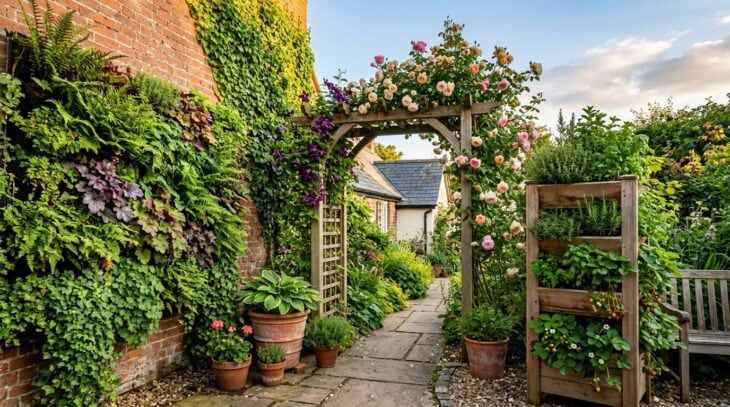
When you run out of floor, look at your walls. A bare fence, a blank side return, a balcony rail, even a stretch of brick beside the back door is growing space waiting to be planted, and a vertical garden turns all of it green.
Contents
- 01. Modular Living Wall Panels
- 02. Reclaimed Pallet Planter
- 03. Trellis of Climbing Roses
- 04. Kitchen-Door Herb Wall
- 05. Stacked Terracotta Pot Tower
- 06. Shady Fern and Moss Wall
- 07. Hanging Gutter Garden
- 08. Cascading Strawberry Tower
- 09. Felt Pocket Planters
- 10. Espalier Fruit Against a Wall
- 11. Obelisk of Sweet Peas
- 12. Bean and Cucumber Grid
- 13. Living Succulent Picture
- 14. Cattle Panel Arch Tunnel
- 15. Tiered Ladder of Pots
- 16. Curtain of Hanging Baskets
- 17. Green Privacy Screen
- 18. Renter’s Shoe-Organizer Planter
- 19. Kokedama String Garden
- 20. Wall of Trailing Nasturtiums
- 21. Bamboo Screen Trellis
- 22. Vertical Salad Wall
- 23. Clematis-Clad Wall Panel
- 24. Vertical Pollinator Wall
- 25. Freestanding Living Wall Divider
The ideas below span every budget and skill level: quick renter-friendly hacks with pockets and pallets, weekend builds with trellis and cable, and full modular living walls on irrigation. Some grow flowers, some grow dinner, and some exist purely to screen a view or soften a hard boundary.
Read through and pick the ideas that match your wall, your light, and how much you want to fuss over them. Most combine happily, and even a single well-planted vertical surface can change how a whole space feels.
01. Modular Living Wall Panels
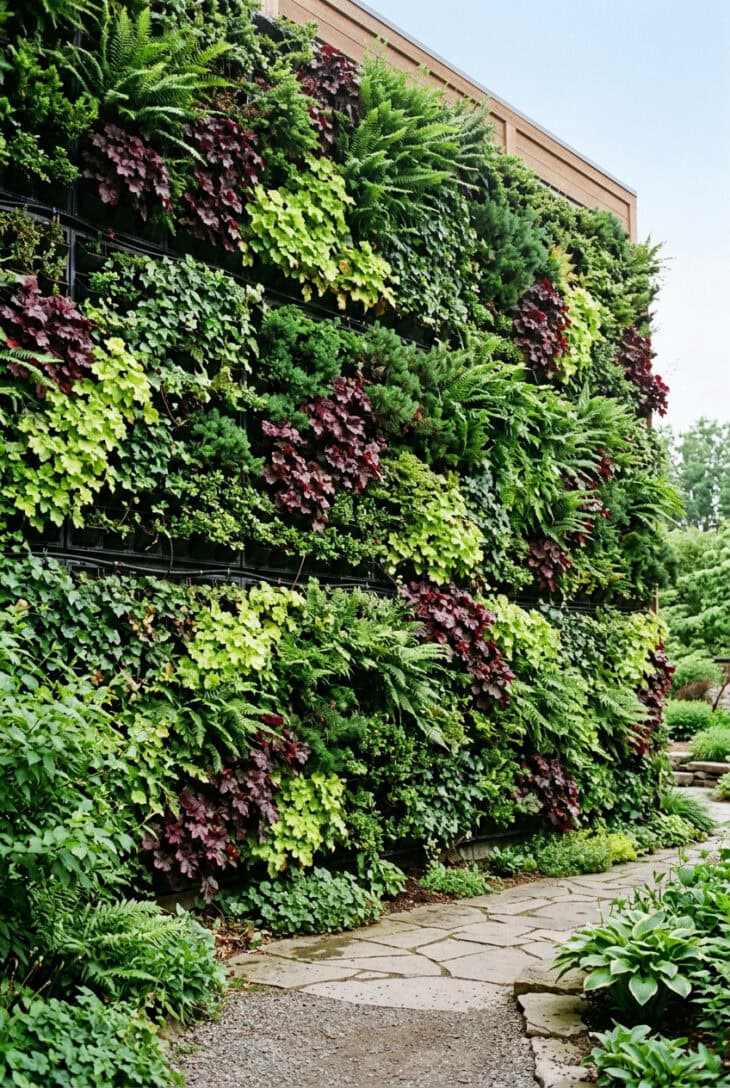
What you see A whole wall turned into a tapestry of green: feathery ferns, ruffled heuchera (Heuchera) in wine and lime, threads of trailing ivy (Hedera helix) and neat evergreens set into a grid of planted panels. From a few steps back it reads as one living surface rather than a collection of pots.
Why it works A modular system is the most reliable way to green a large vertical area, because each panel holds its own soil and roots and locks into the next. It insulates the wall behind it, muffles noise, and delivers a dramatic amount of foliage from a footprint of almost nothing.
How to get it Mount the panels on a frame held off the wall on battens so the masonry can breathe and drain. Fit a drip irrigation line on a timer from the start, because hand-watering a large wall evenly is close to impossible. Choose shallow-rooted, forgiving plants such as ferns, heuchera, small evergreens and ivy, and mix leaf shapes so the wall stays interesting even out of flower.
02. Reclaimed Pallet Planter
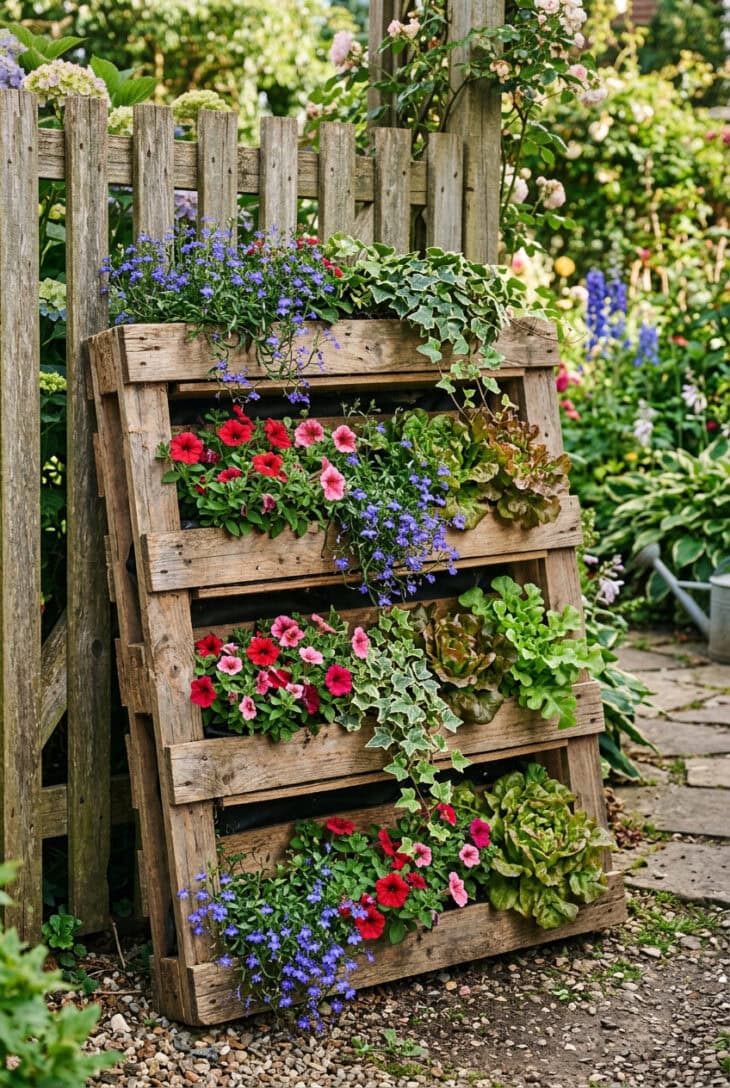
What you see A humble shipping pallet stood on end against the fence, its gaps turned into shallow troughs that overflow with trailing blue lobelia (Lobelia erinus), pink petunias, variegated ivy and a few loose heads of lettuce. It is scruffy in the best way, full and generous and clearly homemade.
Why it works A pallet is close to free, and once it is lined and filled it holds a surprising volume of soil for its slim profile. It is the classic first vertical project: no special hardware, no irrigation, and if it falls apart in a couple of seasons you have lost nothing.
How to get it Choose a heat-treated pallet (stamped HT, never MB for chemical treatment), sand off splinters, and staple landscape fabric across the back and base of each slat to make troughs. Fill with a peat-free multipurpose compost, plant densely while it lies flat, then leave it horizontal for two or three weeks so roots knit before you stand it up. Lean it at a slight backward angle and screw it to the fence so it cannot topple.
03. Trellis of Climbing Roses
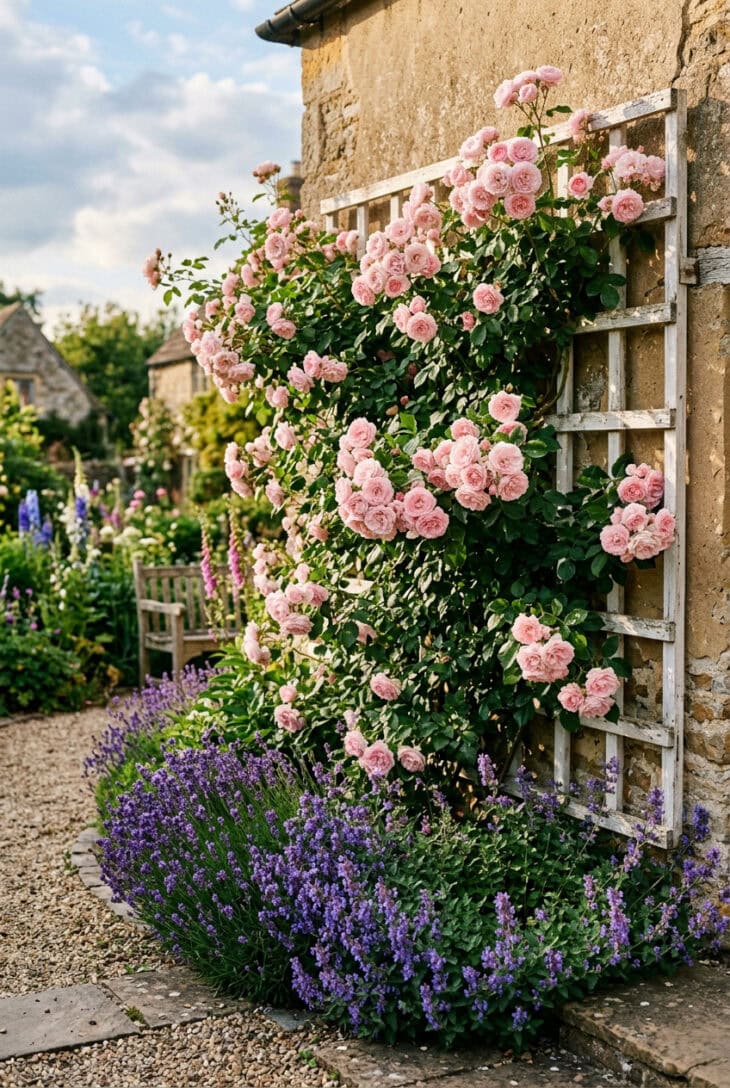
What you see A climbing rose fanned out across a white timber trellis, soft pink blooms held in loose clusters against dark leaves, with lavender (Lavandula angustifolia) and catmint (Nepeta) frothing at its feet. The wall behind has all but disappeared under flower.
Why it works Roses want to climb, and a trellis simply gives them a shape to do it in. Training the stems sideways rather than straight up forces flowering along the whole length instead of just at the top, so you get a full curtain of bloom at eye level rather than a bare-legged plant.
How to get it Fix trellis on battens 2in (5cm) off the wall so air moves behind the stems and reduces mildew. Plant a repeat-flowering climber such as rose (Rosa ‘New Dawn’ or ‘Gertrude Jekyll’) 18in (45cm) out from the base and lean it back toward the support. Tie the main stems in a fan and bend them as near to horizontal as they will go, then feed in spring and deadhead through summer to keep the flush coming.
04. Kitchen-Door Herb Wall
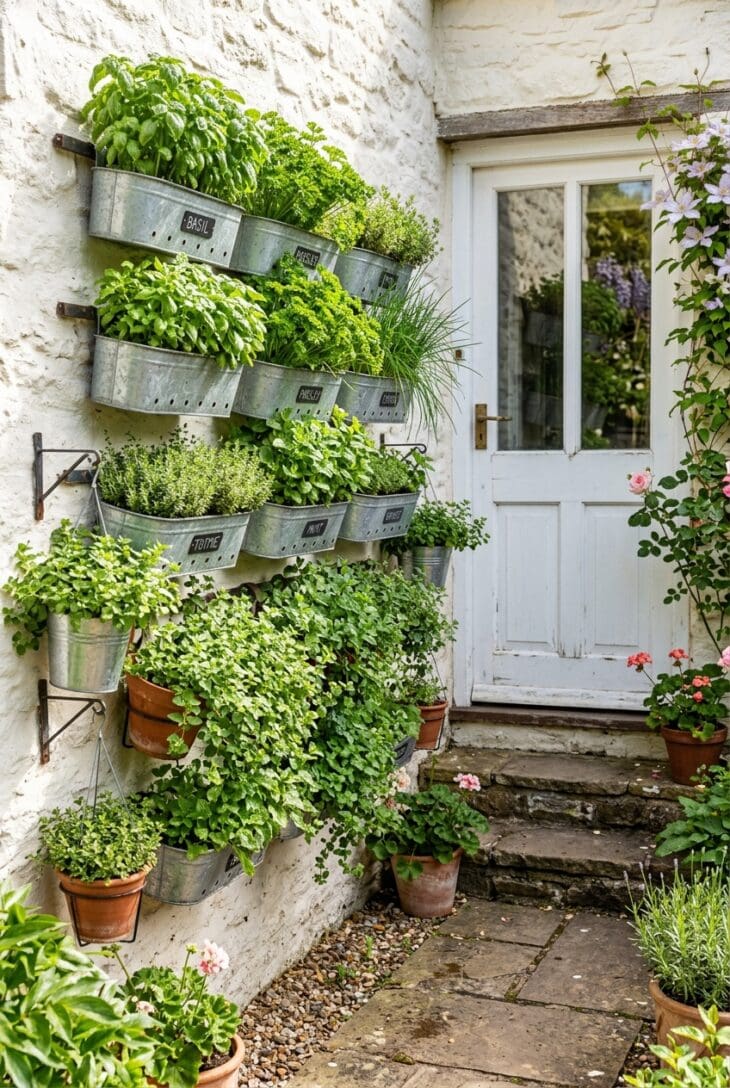
What you see The wall by the back door lined with galvanized planters and hanging pots, each brimming with a different herb: bushy basil (Ocimum basilicum), flat-leaf parsley (Petroselinum crispum), spiky chives (Allium schoenoprasum), low thyme (Thymus vulgaris) and mint (Mentha) tumbling over its rim. It is a larder you can reach without stepping into the garden.
Why it works Herbs are small, shallow-rooted and picked constantly, which makes them ideal for a wall right where you cook. Growing them vertically by the door means you actually use them, and keeping vigorous spreaders like mint in separate pots stops them swamping everything else.
How to get it Pick the sunniest wall within a few steps of the kitchen, ideally facing south or west for at least six hours of light. Use planters with drainage holes and drip trays so water does not run down the render, and group herbs by need: sun-loving Mediterranean thyme, rosemary and oregano together, thirstier basil and parsley together. Pinch tips often to keep them bushy, and there are plenty more compact herb garden ideas that suit a wall like this.
05. Stacked Terracotta Pot Tower
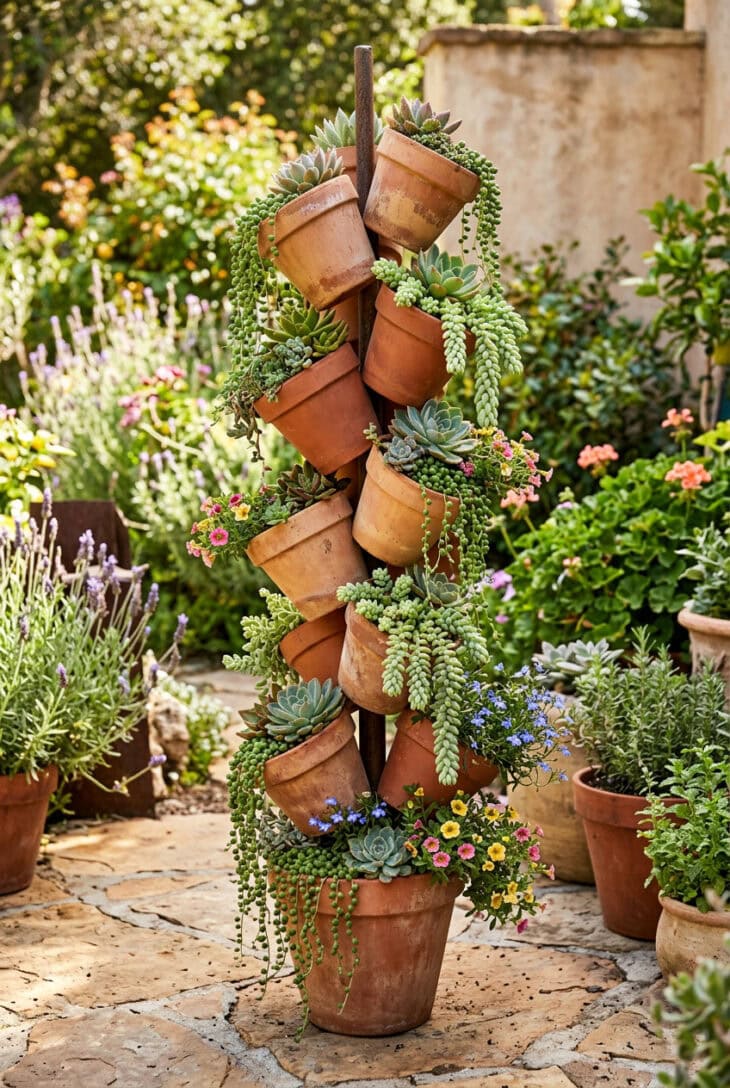
What you see A stack of terracotta pots threaded onto a central stake, each one tipped outward at an angle so it becomes its own little planting shelf, spilling sedum, houseleeks and trailing succulents down the sides. It stands on the patio like a small planted sculpture.
Why it works Stacking pots multiplies planting space on a single small footprint, and the staggered tilt gives every layer its own light and room to trail. Terracotta breathes and drains fast, which suits the drought-tolerant plants that look best cascading down a tower.
How to get it Drive a sturdy stake or length of rebar into a large base pot filled with gritty compost, then thread progressively smaller pots down it, each tilted and wedged with soil. Use free-draining cactus compost mixed with grit, and plant sun-lovers such as sedum, sempervivum and trailing thyme that shrug off dry spells. Water into the top pot and let it filter down, and turn the tower every week or two so all sides get sun.
06. Shady Fern and Moss Wall
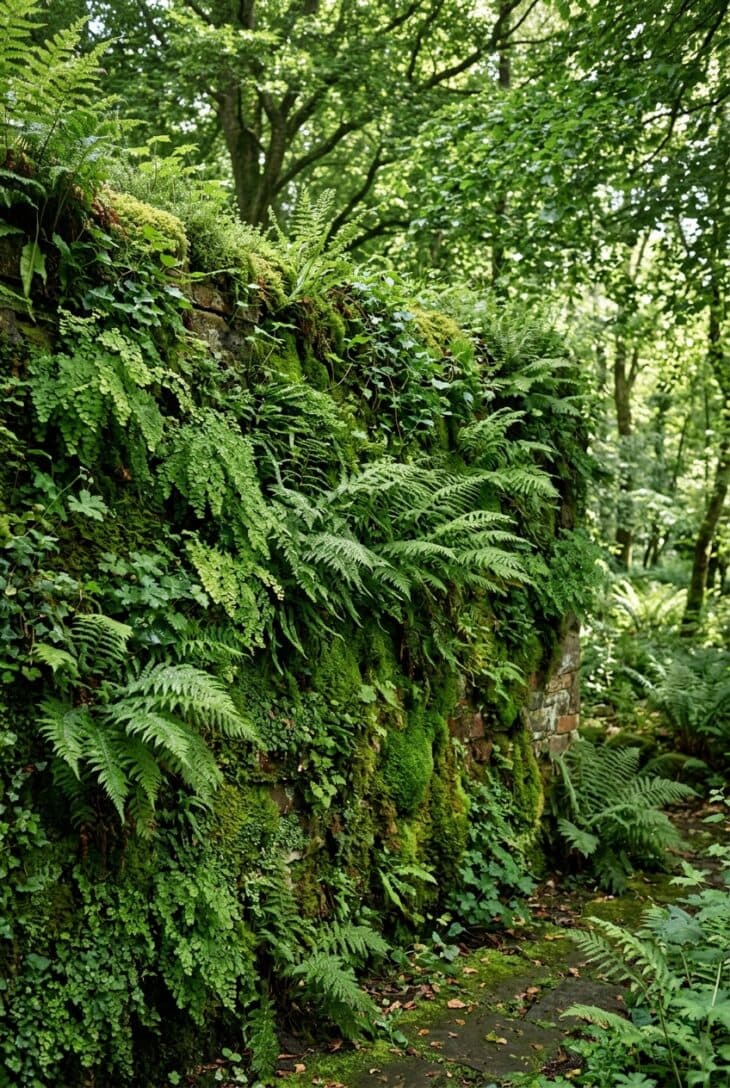
What you see A cool, north-facing wall clothed entirely in green: soft mosses, unfurling ferns and low woodland foliage layered in every shade from lime to deep bottle, with dappled light sliding across the surface. There is not a flower in sight, and it does not need one.
Why it works A shady damp wall defeats most sun-loving planting, but it is exactly what ferns and moss crave, so the difficult aspect becomes the whole point. A green-on-green wall reads as calm and forest-like, and foliage textures carry it right through the year without relying on bloom.
How to get it Use a felt-pocket or modular system kept reliably moist, ideally on automatic irrigation since these plants hate drying out. Plant hardy ferns such as hart’s tongue (Asplenium scolopendrium) and soft shield fern (Polystichum setiferum) with heuchera and creeping woodland plants for contrast. This is one of the best shade garden ideas for a wall that never sees direct sun, and the more leaf shapes you mix, the richer it looks.
07. Hanging Gutter Garden
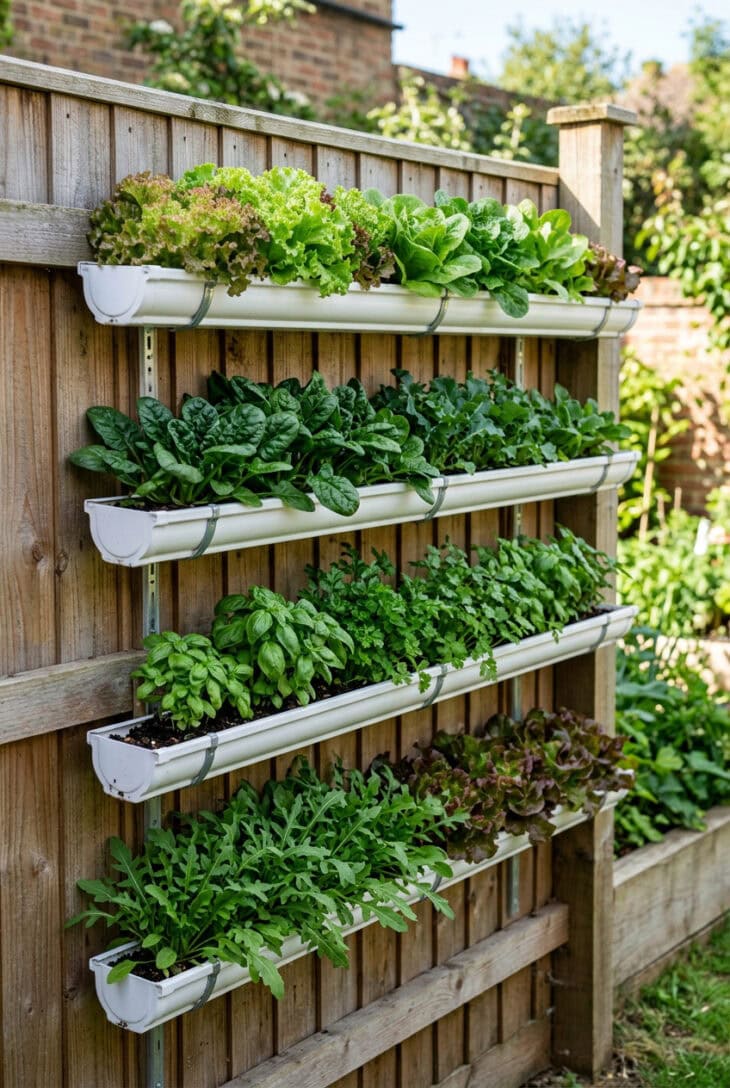
What you see Lengths of rain gutter fixed in tidy horizontal rows up a fence, each one a shallow trough of salad: ruffled lettuce, upright spinach and low herbs marching along like shelves in a green pantry. It is neat, practical and productive, more allotment than showpiece.
Why it works Leafy salads have shallow roots and short seasons, so the meager soil depth of a gutter is plenty. Raising them off the ground puts crops at picking height, keeps slugs at a disadvantage, and turns an unproductive fence into rows of cut-and-come-again greens.
How to get it Cut standard guttering into lengths, cap the ends, and drill drainage holes every 12in (30cm). Mount the rows on brackets with a slight fall so water drains rather than stagnates, and space them so the row above does not shade the one below. Fill with fresh compost, sow lettuce, spinach, rocket and cut-and-come-again mixes, and resow every few weeks for a steady supply, much as you would in shallow raised bed planting.
08. Cascading Strawberry Tower
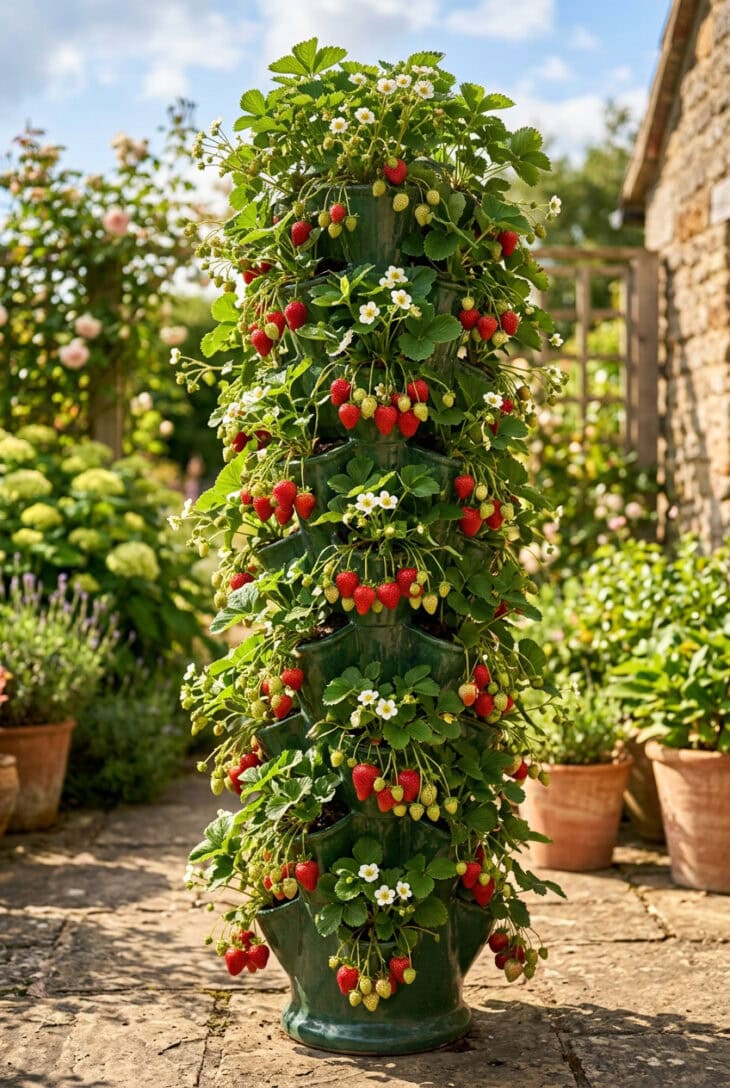
What you see A tall planting column on the patio hung with strawberries, ripe red fruit and white flowers spilling from pockets all the way down a curtain of bright green leaves. Every side carries berries, and they dangle clean and clear of the soil.
Why it works Strawberries (Fragaria x ananassa) are naturally trailing and shallow-rooted, so they take to a tower without complaint. Growing them vertically keeps the fruit off wet ground where it would rot, lifts it away from slugs, and fits a whole bed’s worth of plants onto a single sunny corner.
How to get it Use a purpose-made strawberry tower or a stacked pocket planter in the sunniest spot you have. Plant everbearing varieties such as ‘Albion’ or ‘Mara des Bois’ for fruit through the season, one plant per pocket in free-draining compost. Water daily in summer since vertical planters dry fast, feed with a high-potash tomato feed once flowers appear, and net the tower as the berries color up or the birds will beat you to them.
09. Felt Pocket Planters
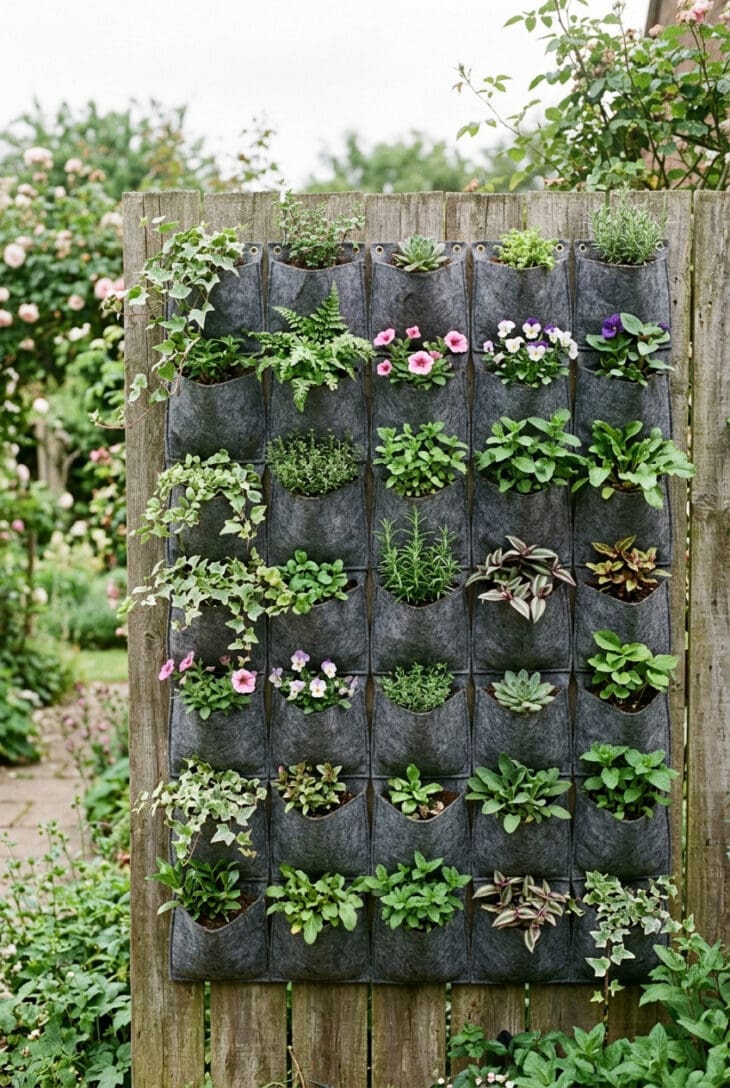
What you see A soft grid of fabric pockets hung on the fence, each cradling one small plant, the whole panel reading as a patchwork of mixed foliage and little flowers. It is loose and textural where a rigid living wall is architectural.
Why it works Felt pocket planters are light, cheap and hung on a few screws, which makes them the most accessible way into vertical growing. Each pocket is its own little pot you can replant on a whim, so the wall can change with the seasons without any rebuilding.
How to get it Hang the panel on a batten so air passes behind the felt and the wall stays dry. Line each pocket with a little extra fabric or coir to slow moisture loss, since felt dries quickly, and plant compact, forgiving things such as heuchera, small ferns, trailing lobelia and salad leaves. Water gently from the top row down, and add a liquid feed every couple of weeks because the small volume of compost runs out of nutrients fast.
10. Espalier Fruit Against a Wall
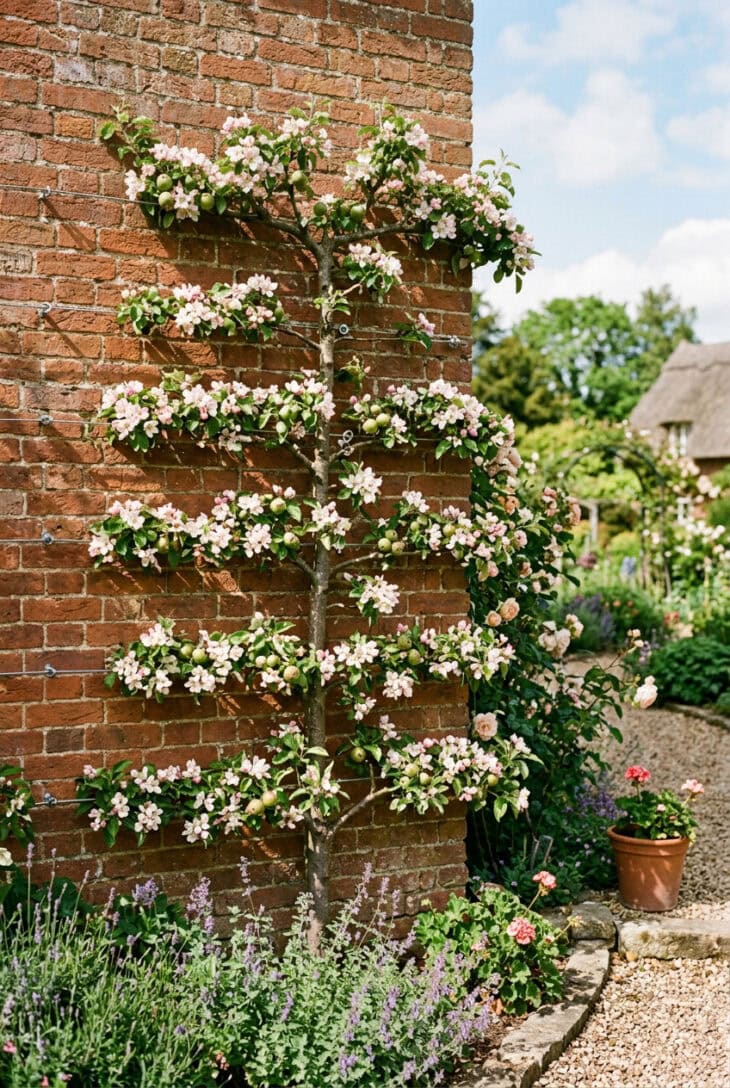
What you see An apple tree pressed flat against warm brick and trained into formal horizontal tiers, its branches running dead level along wires, carrying blossom in spring and fruit by late summer. It is part tree, part living architecture.
Why it works An espalier grows a full fruit tree in a slab of space barely a foot deep, which is how walled kitchen gardens fed households for centuries. The wall soaks up heat and releases it slowly, ripening fruit earlier and better, while the flat form makes pruning, spraying and picking simple.
How to get it Fix horizontal wires 18in (45cm) apart on vine eyes, held 3in (7cm) off the wall. Buy a ready-started espalier apple (Malus domestica) or pear (Pyrus communis) on a dwarfing rootstock, or train a maiden whip yourself over a few winters. Tie new growth to the wires, prune in late summer to build the tiers and keep it flat, and choose a self-fertile variety or a compatible pollination partner nearby.
11. Obelisk of Sweet Peas
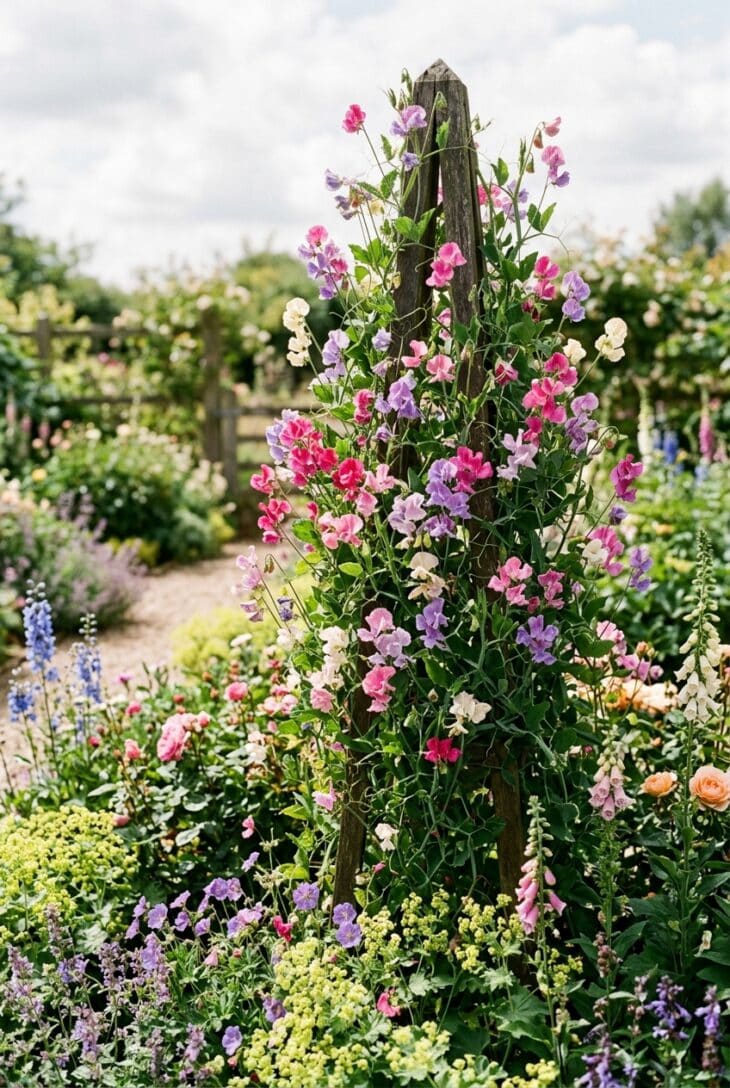
What you see A wooden obelisk rising out of a border, wrapped from base to tip in sweet peas, their ruffled blooms in pink, purple and cream tumbling over the frame and scenting the air around it. It lifts a mass of flower up into the middle of the planting where nothing else reaches.
Why it works A freestanding obelisk brings vertical growing into an open bed, no wall required, and gives climbers a strong shape to scramble up. It adds height and structure to a flat border while sweet peas turn it into a fragrant, cut-and-come-again column of bloom.
How to get it Sink the obelisk feet firmly into the soil so summer growth cannot catch the wind and topple it. Sow sweet peas (Lathyrus odoratus) in autumn or early spring, plant three or four seedlings around each leg, and guide the young tendrils onto the frame until they grip. Pick the flowers every few days, because the more you cut the more it produces, and it will keep flowering into late summer if you never let it set seed. Obelisks like this suit both borders and larger container displays.
12. Bean and Cucumber Grid
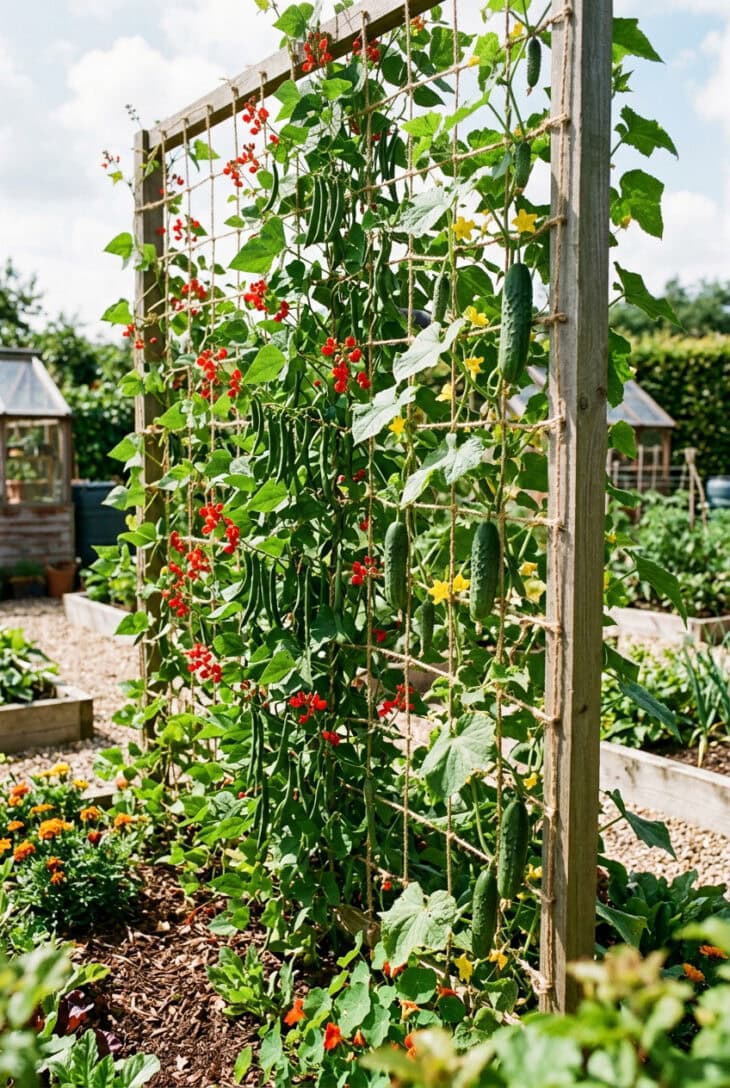
What you see A grid of netting stretched between posts, alive with climbing runner beans in scarlet flower and cucumbers dangling straight and green from their vines. The whole crop hangs in the air, easy to see and easy to pick.
Why it works Beans, cucumbers, squash and peas all want to climb, and giving them a grid rather than the ground keeps fruit clean, straight and well aired, which cuts disease. Growing them upward frees the soil below for a second, low crop, doubling what a small plot produces.
How to get it Drive two stout posts in and stretch jute or plastic netting tight between them, tall enough to reach over. Sow or plant climbing beans (Phaseolus coccineus) and cordon cucumbers (Cucumis sativus) at the base once frost has passed, and guide the first shoots onto the mesh. Water deeply at the roots, feed weekly once fruiting starts, and underplant with lettuce or radish in the shaded strip below. It is one of the most space-efficient ways to crop a small bed.
13. Living Succulent Picture
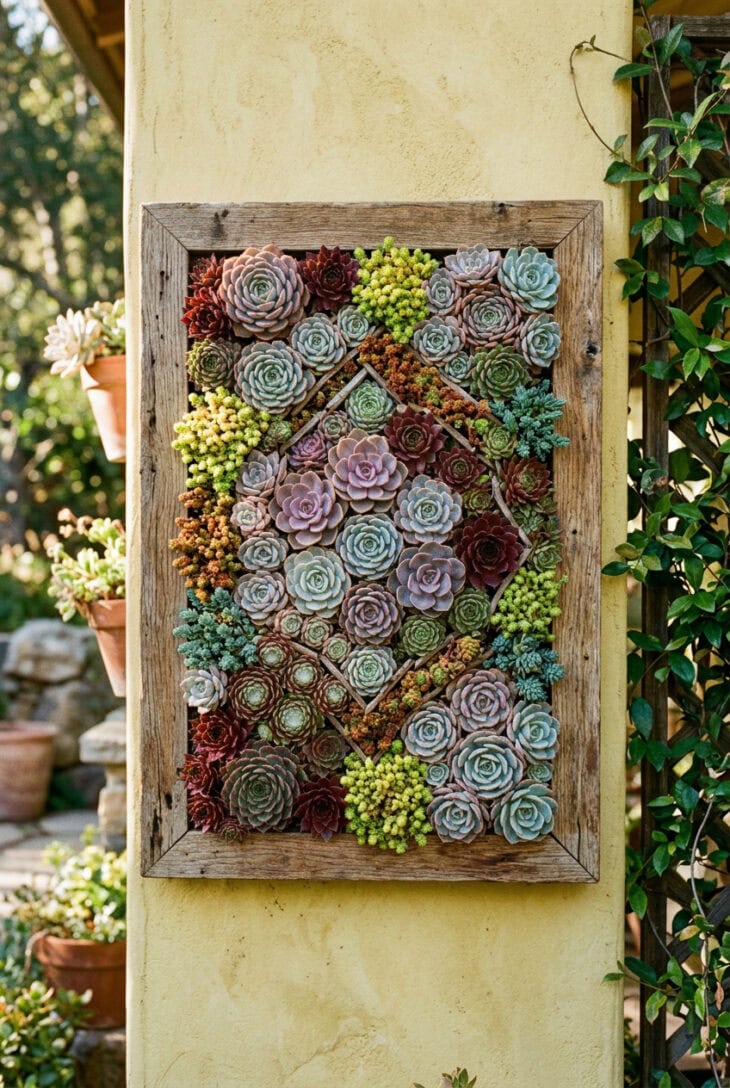
What you see A shallow frame hung on the wall like a picture, but the picture is made of living succulents: tight rosettes of echeveria and houseleeks in sea greens, chalky blues and dusky pink, packed edge to edge into a geometric mosaic. It is as much artwork as planting.
Why it works Succulents store their own water and root in almost nothing, so they can survive mounted vertically where thirstier plants would collapse. Their dense rosettes hold a pattern beautifully, which is why a succulent frame stays looking composed for months with barely any care.
How to get it Fill a purpose-made frame with a shallow tray of cactus compost and a mesh face, then push in cuttings and let them root flat for a few weeks before hanging. Use echeveria (Echeveria), sempervivum (Sempervivum) and low sedum in a mix of colors and sizes, packed tight so no soil shows. Keep it in bright light, take it down to water it thoroughly then let it drain fully, and water only when the compost is properly dry.
14. Cattle Panel Arch Tunnel
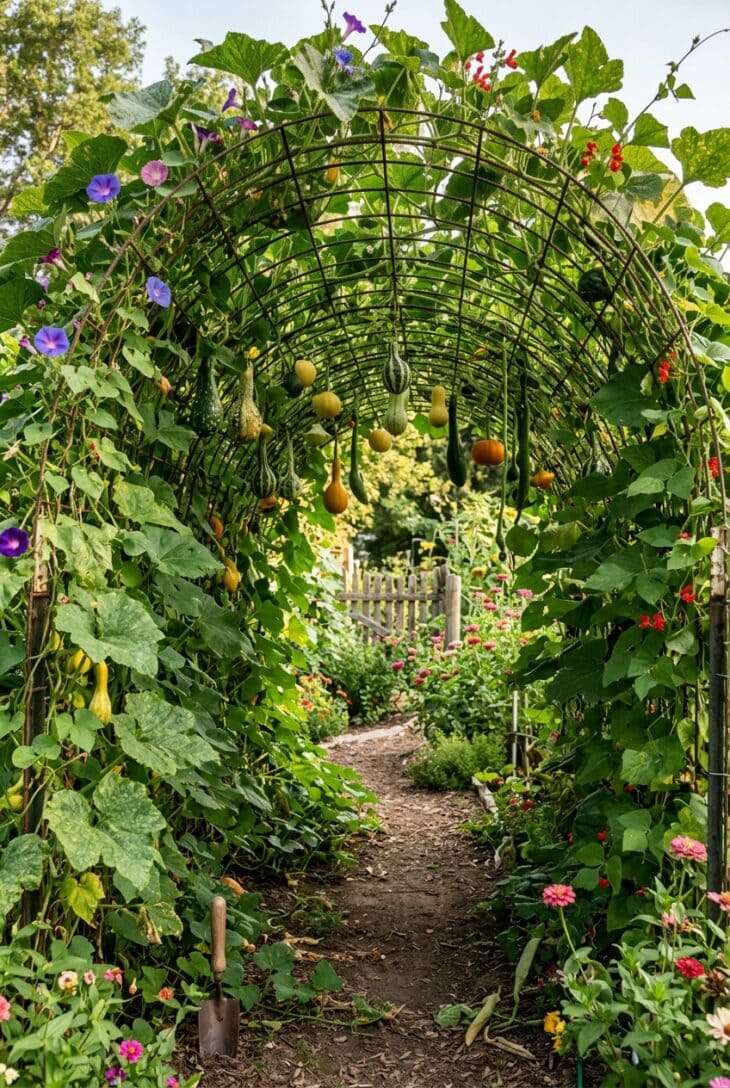
What you see A path running beneath an arched tunnel of curved metal mesh, smothered in climbing squash and flowering vines, with gourds and beans hanging down inside a cool green corridor. You walk through the harvest rather than past it.
Why it works A single rigid cattle panel bent into an arch makes an instant, sturdy tunnel that doubles as growing space and garden feature. Vertical fruit hangs clear and clean, the shaded path stays cool underfoot, and the whole structure turns a walkway into the most productive strip in the garden.
How to get it Set two rows of posts either side of a path, bow a 16ft (5m) galvanized cattle panel between them and wire it fast to form the arch. Plant vigorous climbers at each foot: winter squash, gourds, climbing beans or an ornamental vine, and tuck the first shoots through the mesh. Feed and water generously since these are hungry, thirsty plants, and support any heavy fruit in slings of soft netting so it does not tear away from the vine. It makes a striking, edible garden path.
15. Tiered Ladder of Pots
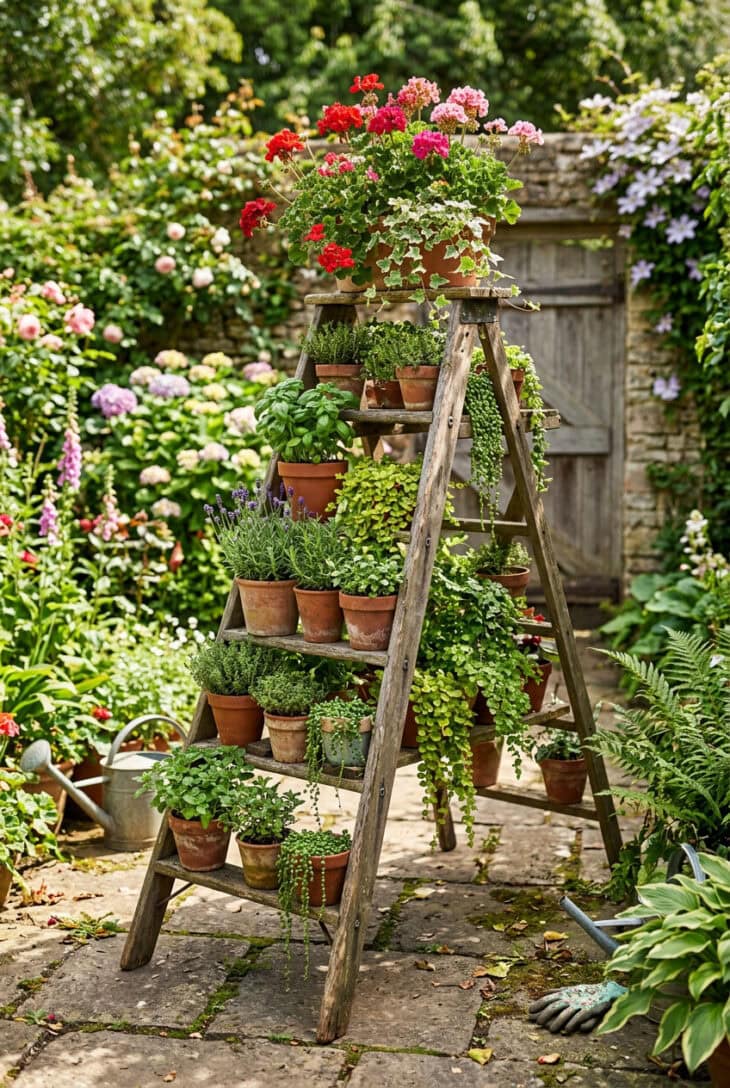
What you see An old wooden stepladder pressed into service as plant staging, each step and shelf loaded with pots of scarlet geraniums, culinary herbs and trailing greenery stepping up in tiers. It leans casually against a sunny wall, part junk-shop find, part flower stand.
Why it works A ladder gives you instant vertical layers without fixing a single thing to the wall, which makes it perfect for renters and for anyone who likes to rearrange. Raising pots into tiers lets every plant catch the light and be seen, and lets you move the whole display in an afternoon.
How to get it Use a stable wooden stepladder or a purpose-built tiered plant stand, and add planks across the rungs to widen the shelves if needed. Stand it on level ground and place the heaviest pots low for stability, with trailing plants like ivy-leaf pelargonium up top to spill down. Group pots that share the same watering needs on each level, and this is a quick win for a small garden that has run out of ground.
16. Curtain of Hanging Baskets
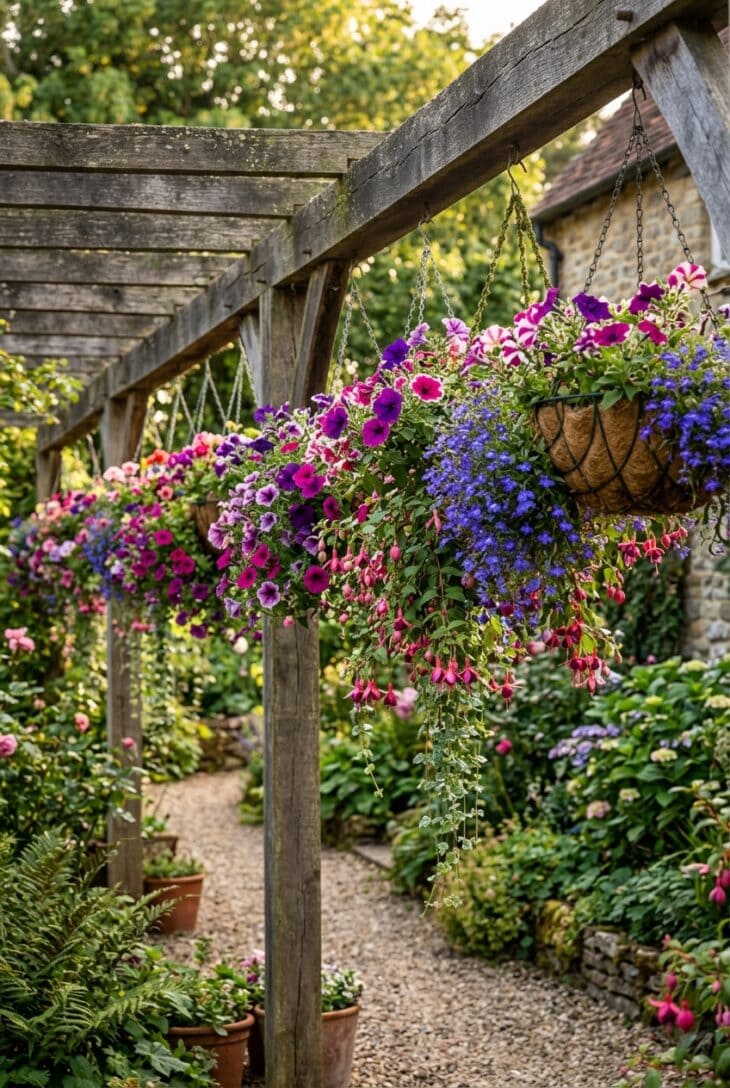
What you see A run of hanging baskets strung along a beam at staggered heights, each one overflowing with trailing petunias, dangling fuchsia bells and clouds of blue lobelia, together forming a soft curtain of color at head height. The flowers hang in the air with nothing beneath them but shadow.
Why it works Hanging baskets are the simplest vertical planting of all: no wall build, no frame, just a bracket and a hook. Suspended in a staggered row they turn empty air into a wall of bloom, softening a pergola or the edge of a patio without taking up any ground.
How to get it Hang baskets from strong brackets or beams that can take the weight of wet compost, which is considerable. Line them well, add water-retaining compost, and plant densely with trailing fuchsia (Fuchsia), surfinia petunias and lobelia for a full cascade. Water daily in summer, ideally with an inline drip system since baskets dry out fast, and feed weekly to keep them flowering. Staggering the heights reads far better than a straight level line.
17. Green Privacy Screen
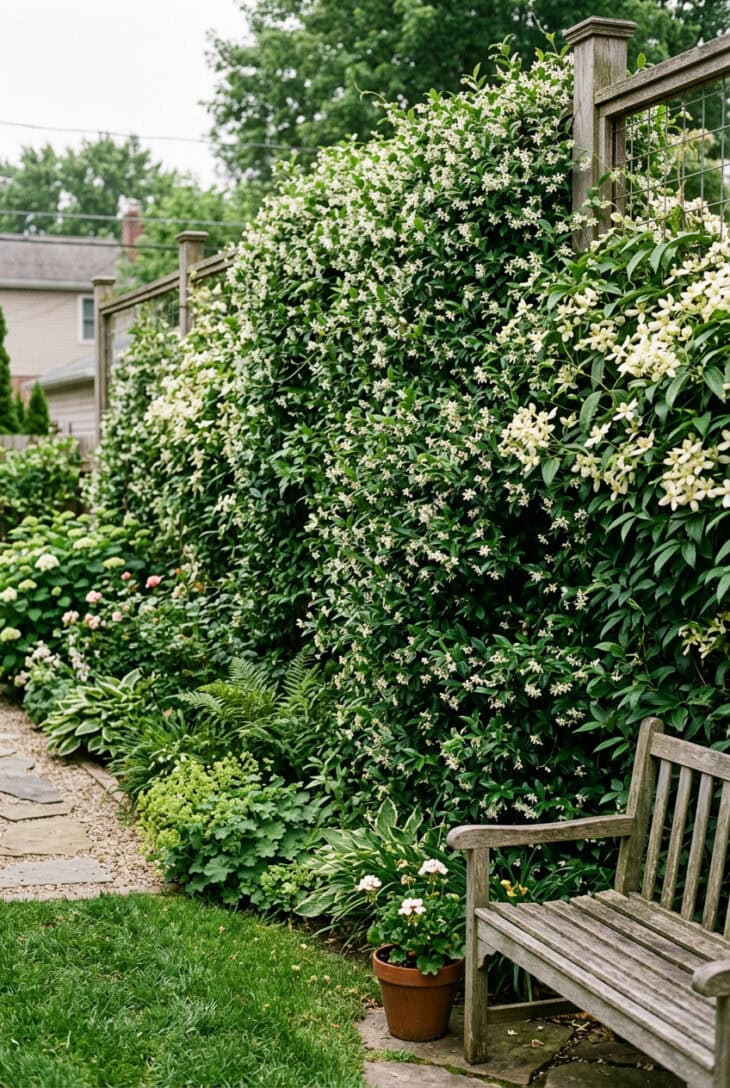
What you see A tall run of wires along the boundary vanished under evergreen climbers, star jasmine and clematis woven into a solid green wall that blocks the view without a single fence panel showing. It reads as a hedge, but one only a few inches deep.
Why it works A wire trellis planted with climbers gives you privacy in the thickness of a wall, ideal where a full hedge would steal too much room. Evergreen climbers screen all year, soften the boundary far better than bare timber, and add height that a low fence alone cannot reach.
How to get it Run tensioned horizontal wires up posts or an existing fence, spaced about 18in (45cm) apart. Plant evergreen star jasmine (Trachelospermum jasminoides) for scent and year-round cover, or mix in clematis (Clematis armandii) for spring flower, setting them 3ft (90cm) apart. Tie in the leading shoots and spread them sideways to fill gaps, and clip lightly once established to keep the screen dense. There are plenty more garden privacy ideas that pair well with a green screen like this.
18. Renter’s Shoe-Organizer Planter
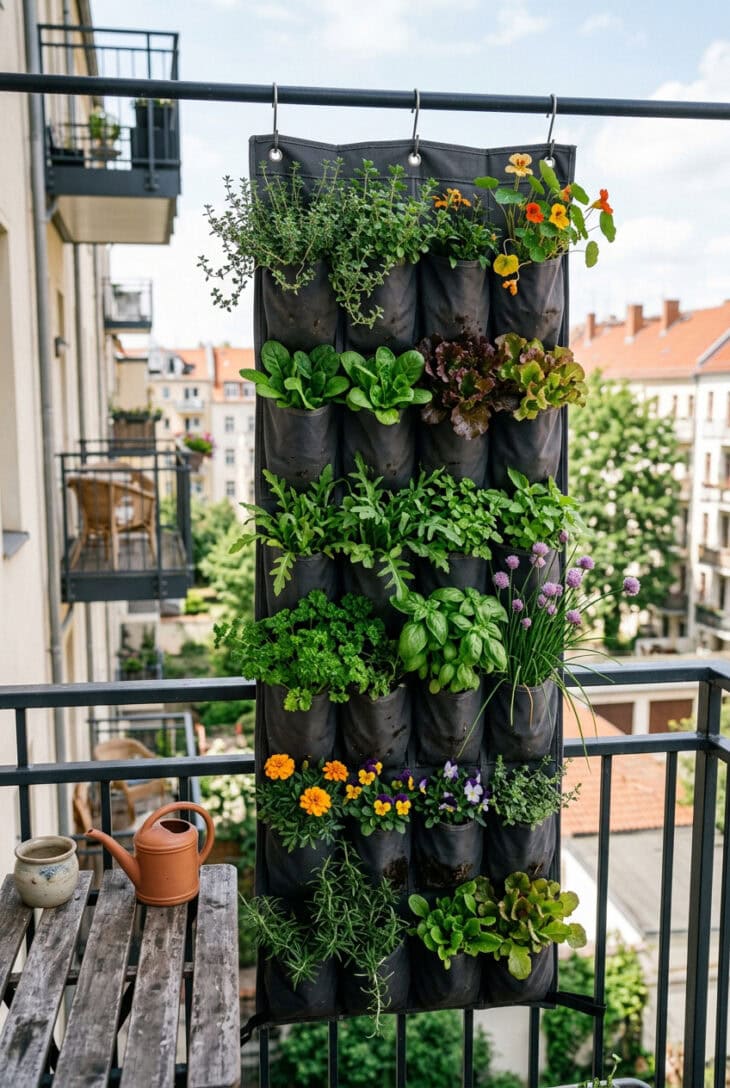
What you see A hanging fabric shoe organizer clipped to a balcony rail, but every pocket now holds a plant instead of a shoe: tufts of herbs, salad leaves and little flowers filling the grid. It is thrifty and clever, a full vertical garden made from something that cost almost nothing.
Why it works A shoe organizer is the ultimate no-drill vertical planter: it hangs from a rail or hook, needs no tools, and comes down when you move. For renters and balcony gardeners with no wall to fix into, its ready-made pockets turn a few square feet of rail into dozens of planting spaces.
How to get it Choose a sturdy canvas or felt organizer rather than flimsy plastic, and punch a couple of drainage holes in the base of each pocket. Hang it where it gets good light, fill with compost, and plant shallow-rooted herbs, lettuce, strawberries and compact annuals. Water the top row and let it trickle down, feed regularly since the pockets hold little soil, and it is one of the easiest balcony garden ideas to start with.
19. Kokedama String Garden
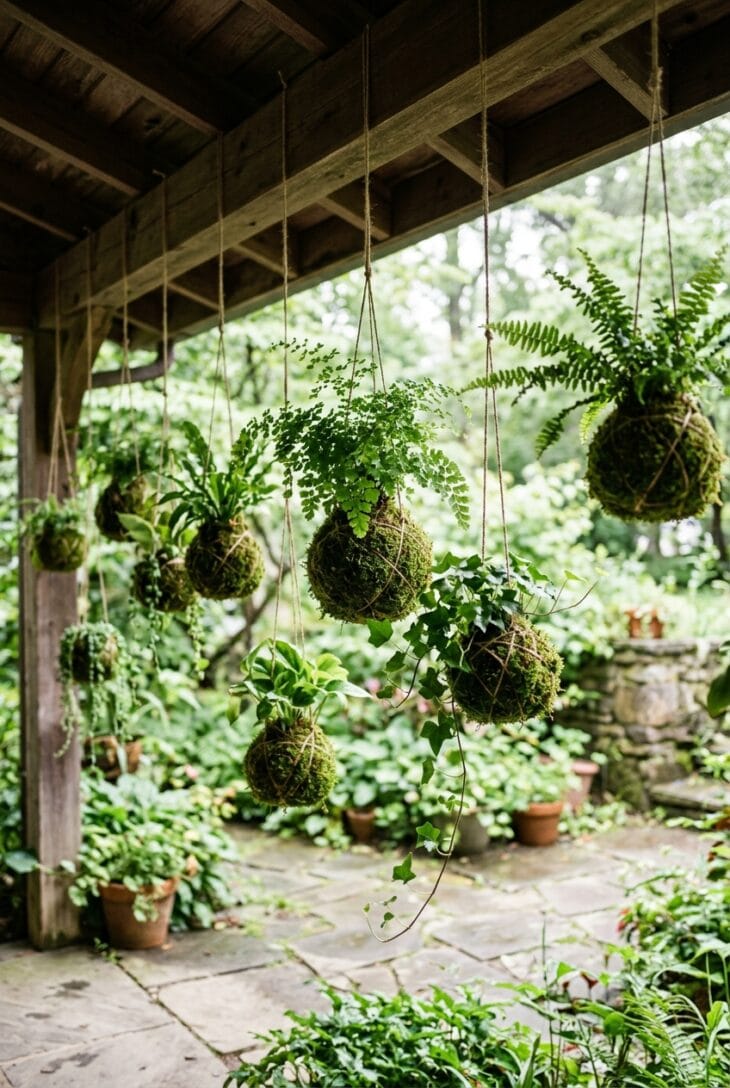
What you see A cluster of moss balls hanging on strings under a shaded porch, each one a fern or trailing plant rooted in its own mossy sphere, floating at different heights like a small green mobile. There are no pots at all, just plants suspended in mid-air.
Why it works Kokedama, the Japanese art of the moss ball, does away with the container entirely and hangs the rootball itself. Grouped as a string garden it brings greenery into vertical space with real delicacy, perfect for a sheltered spot where a heavy planter would feel clumsy.
How to get it Wrap a plant’s rootball in a mix of clay-rich soil and moss, bind it into a firm ball with twine, then hang it from a hook. Choose shade-tolerant ferns, ivy or trailing plants for a covered, humid position out of harsh sun and wind. Water by dunking each ball in a bucket until it stops bubbling, then let it drip and rehang, roughly when it feels light, and mist in dry spells to keep the moss green.
20. Wall of Trailing Nasturtiums
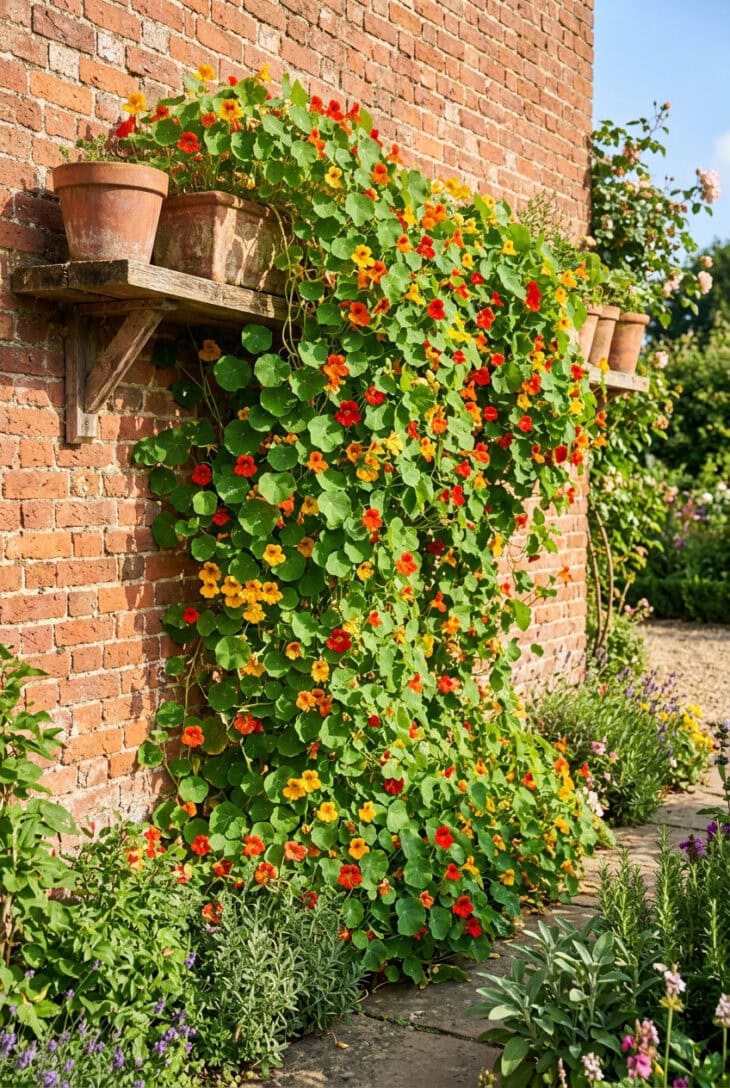
What you see A shelf of containers set high on a sunny wall, pouring a sheet of nasturtiums down the brick, round lily-pad leaves and vivid orange, red and yellow flowers cascading several feet toward the ground. The whole wall glows warm in the afternoon light.
Why it works Trailing nasturtiums are among the fastest, cheapest ways to green a wall from the top down, growing feet of stem in a single season from a packet of seed. They thrive on poor soil and neglect, flower all summer, and every leaf and bloom is edible with a peppery bite, so the wall doubles as salad.
How to get it Set a sturdy shelf, trough or run of pots high on a sunny wall and sow trailing nasturtiums (Tropaeolum majus) direct in late spring, a couple of seeds per station. Use ordinary, un-enriched compost, because rich soil gives leaves at the expense of flowers, and water only in real drought. Let the stems tumble down the brick, pick flowers and leaves for the kitchen, and pull the odd stem back if it wanders too far. It is one of the most rewarding container garden ideas for a hot wall.
21. Bamboo Screen Trellis
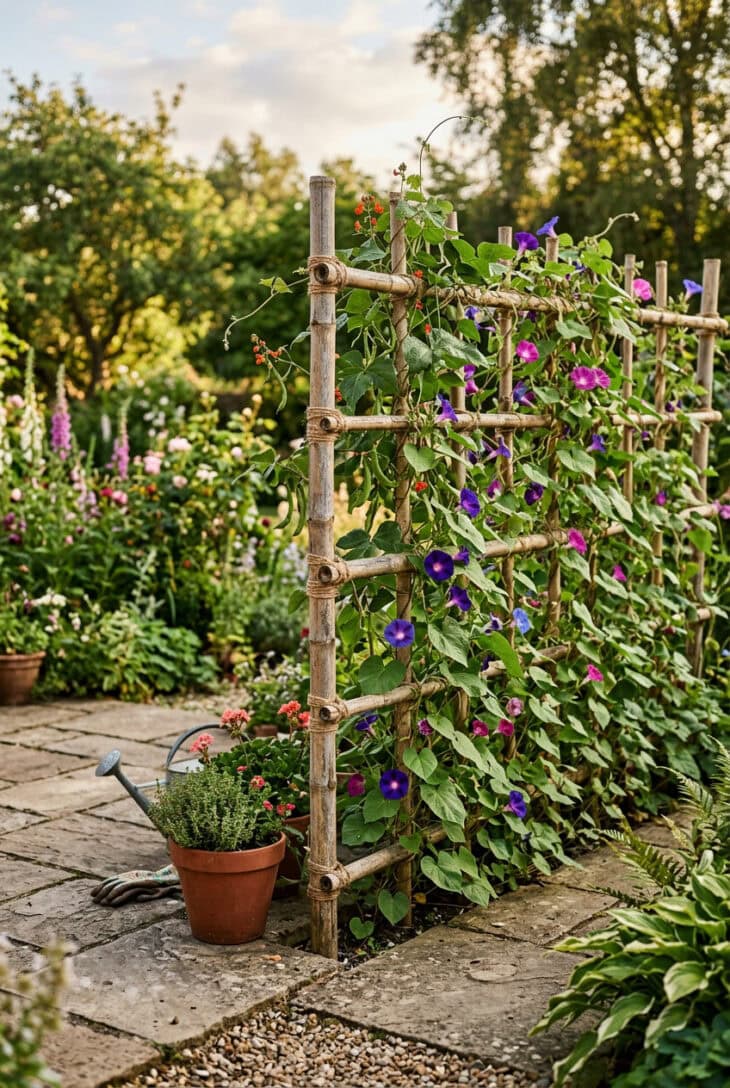
What you see A screen of bamboo canes lashed into a lattice with twine, standing at the edge of the patio with climbing beans and morning glory spiraling up it. It is loose, handmade and honey-colored, an unforced piece of garden carpentry.
Why it works Bamboo is light, cheap, strong and endlessly renewable, which makes it a natural for a quick vertical support or a light screen. Lashed into a grid it gives twining climbers a foothold and creates a warm, organic backdrop that suits informal and productive gardens alike.
How to get it Lash thick canes into a grid with garden twine or jute, using a diagonal square lashing at each joint for strength, and sink the uprights firmly or tie them to posts. Plant twining annual climbers such as morning glory (Ipomoea) or climbing beans at the base, or a light perennial like a herbaceous clematis. Keep the structure out of the fiercest wind, since bamboo lattice flexes, and replace canes every few years as they weather. It makes an easy, natural divider for a courtyard garden.
22. Vertical Salad Wall
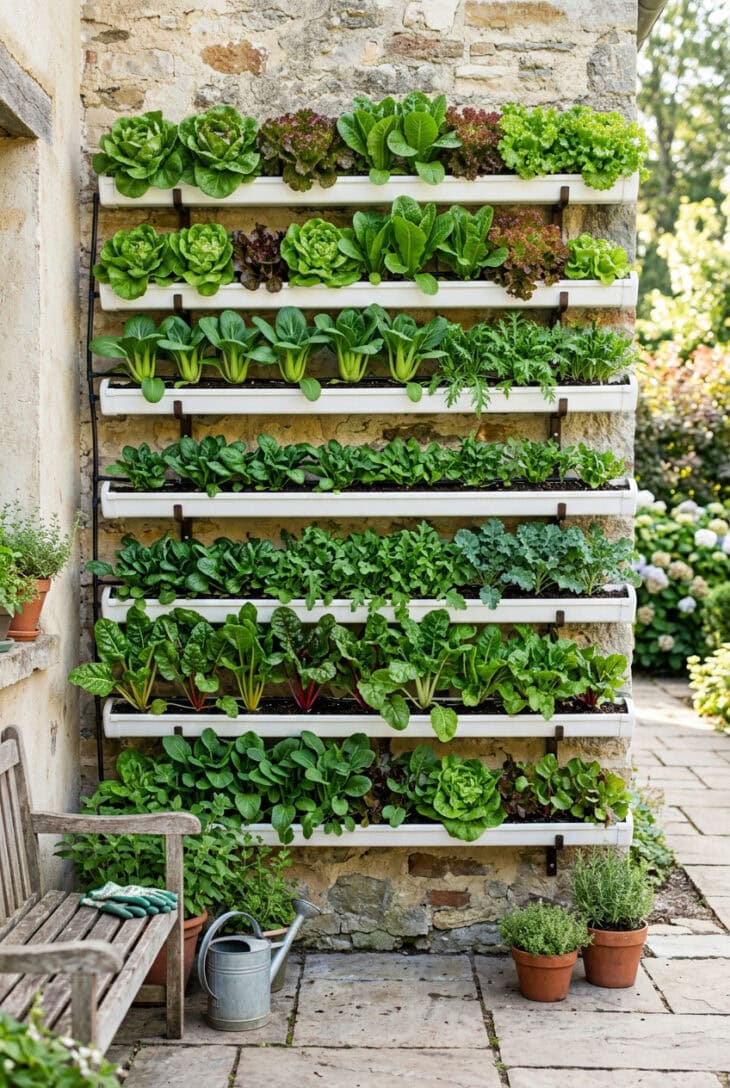
What you see A neat stack of planting channels fixed to the patio wall, each running row after row of lettuce, pak choi and leafy greens in glossy health. It looks like a vertical market garden, clean and productive and all within arm’s reach.
Why it works Dedicated vertical growing systems are engineered so water flows from the top channel down through each layer, keeping every plant fed with minimal effort. Fast, shallow-rooted salads suit them perfectly, and a small wall can crop enough leaves to keep a household in salad through the season.
How to get it Fix a stacking channel system or a run of self-watering troughs to a sunny, sheltered wall with a reservoir at the base. Fill with fresh compost or run it hydroponically, and sow quick crops: loose-leaf lettuce, rocket, pak choi, spinach and cut-and-come-again mixes. Harvest the outer leaves and resow gaps every couple of weeks for a constant supply, and rotate what grows where to keep the wall cropping. It brings genuine vegetable garden productivity to a paved space with no beds at all.
23. Clematis-Clad Wall Panel
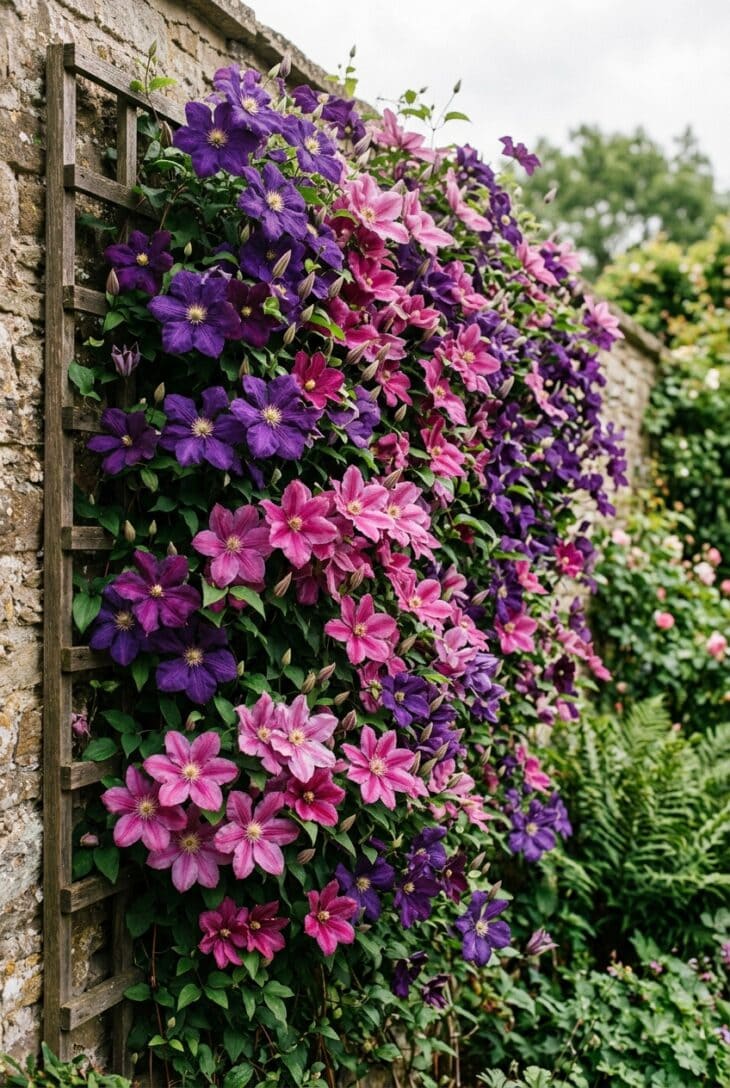
What you see A single trellis panel on the wall completely swallowed by clematis, big saucer flowers in deep purple and pink pressed flat against the lattice in an unbroken sheet of color. For a few weeks the panel is nothing but bloom.
Why it works Clematis climbs by curling leaf-stalks around thin supports, so a trellis panel is exactly what it wants, and a single well-chosen plant can cover a large area with flower. Growing it flat on a panel concentrates the display at eye level and turns a blank patch of wall into a seasonal focal point.
How to get it Fix a trellis panel on battens 2in (5cm) clear of the wall and plant a large-flowered clematis (Clematis ‘Jackmanii’ or ‘Nelly Moser’) at its foot, setting the crown 3in (7cm) deeper than it grew in the pot to guard against wilt. Keep the roots cool and shaded with a slab or low planting while the top climbs into sun. Learn which pruning group your plant belongs to, because cutting the wrong one at the wrong time costs you a year of flower, and tie in stray shoots as it grows.
24. Vertical Pollinator Wall
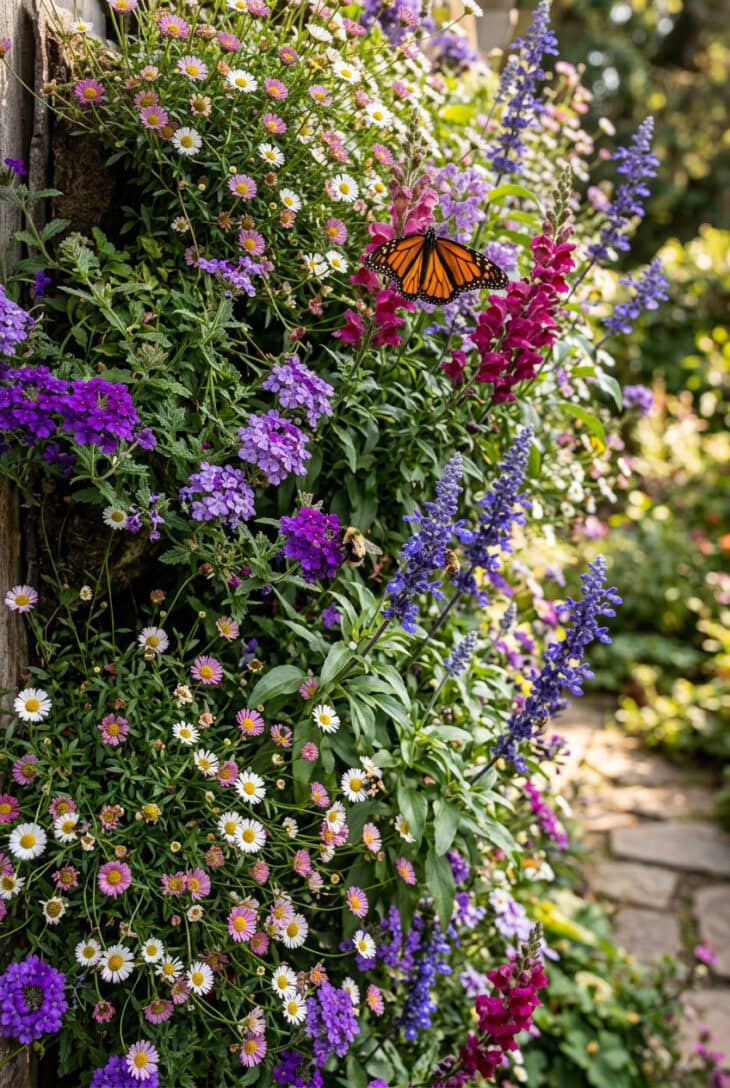
What you see A living wall planted not for foliage but for nectar, trailing verbena, spikes of salvia and small daisies in purple, blue and pink, with bees working the flowers and a butterfly resting open-winged among them. The whole panel hums.
Why it works Pollinators forage vertically as happily as they do at ground level, so a flowering wall adds a whole extra layer of nectar to a small garden. Packed with the right blooms it becomes a feeding station on a surface that was doing nothing, and it proves a living wall can be as useful to wildlife as it is beautiful.
How to get it Plant a modular or pocket wall with nectar-rich, long-flowering plants: trailing verbena (Verbena), salvia (Salvia), erysimum and small hardy geraniums, choosing single rather than double flowers so the pollen is reachable. Aim for a succession of bloom from spring to autumn, and avoid any spraying so the wall stays safe to forage. Keep it watered through summer, and it slots neatly alongside ground-level pollinator garden planting to give bees a fuller table.
25. Freestanding Living Wall Divider
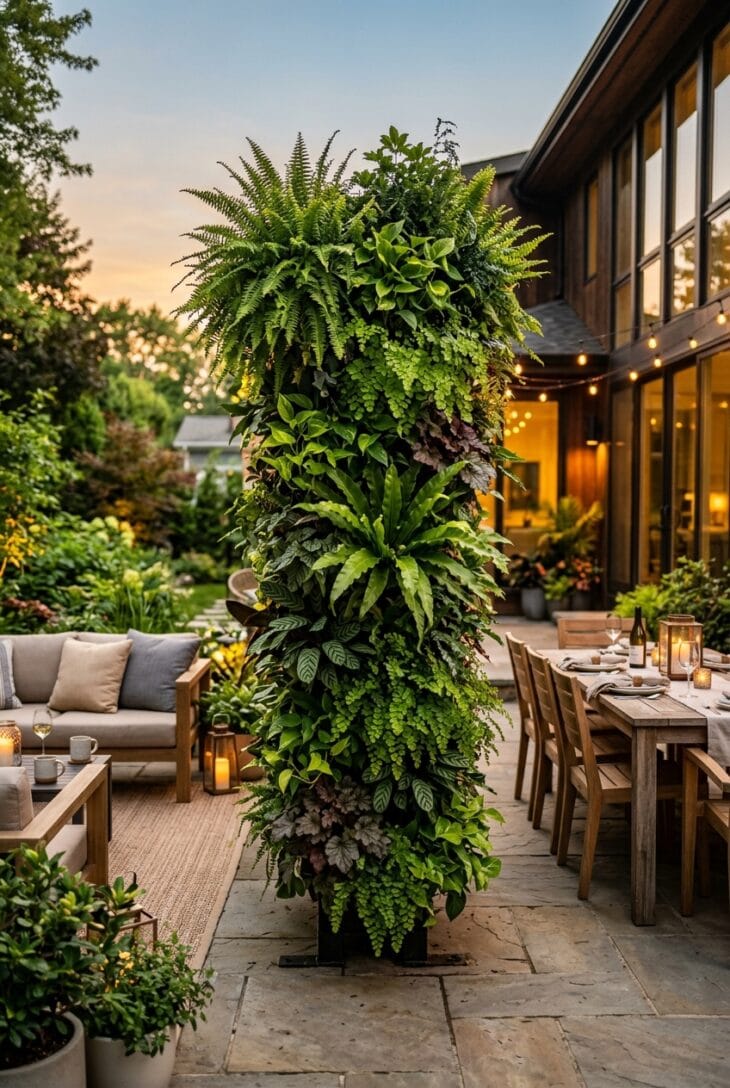
What you see A tall planted panel standing free on the patio, green on both faces with ferns and foliage, dividing a dining corner from a lounging one without a solid wall between them. It reads as a hedge you could pick up and move.
Why it works A freestanding living wall does two jobs at once: it zones an open space into rooms and it delivers a dense slab of greenery with no fixing to any building. Being double-sided, it looks planted from wherever you sit, which makes it far friendlier than a fence panel for breaking up a patio or terrace.
How to get it Use a purpose-built double-sided living-wall frame on a weighted or castored base so it stays stable and can be repositioned. Plant both faces with tough, shade-tolerant foliage such as ferns, heuchera and evergreen grasses, and fit a small reservoir or drip line since a freestanding unit dries from both sides. Site it out of strong wind, top up water in summer, and use it to carve one of the more generous patio garden layouts into intimate zones.