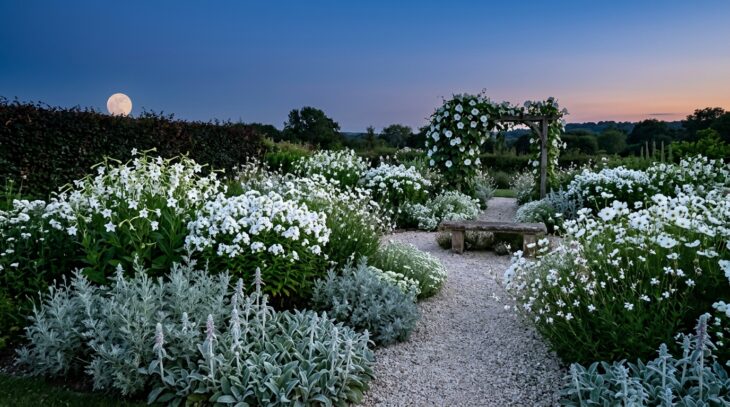
Most gardens go to sleep at sunset. A moon garden wakes up. As the light drains away, red and purple flowers sink into the dark, but white petals and silver leaves hold onto every scrap of light, and night-scented flowers start pouring out perfume just as you finally sit down outside.
Contents
- 01. Classic White and Silver Border
- 02. Moonflower Arbor
- 03. Moon Gate Entrance
- 04. Night-Scented Patio Pots
- 05. Silver Foliage Carpet
- 06. Moth-Friendly Night Border
- 07. Pale Gravel Path Edged in White
- 08. Shade Moon Garden Under Trees
- 09. White Flowering Tree as the Anchor
- 10. White Hydrangea Walk
- 11. Balcony Moon Garden in Containers
- 12. Reflecting Pool with Night-Blooming Water Lilies
- 13. Fragrance Bed Beneath the Bedroom Window
- 14. Seed-Sown Moon Garden on a Budget
- 15. White Climbing Rose Pergola
- 16. Spring Bulb Moon Garden
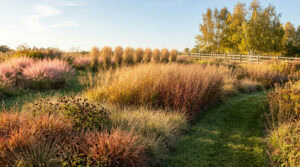
- 17. Native White Prairie Moon Garden
- 18. Silver Grass Moon Garden
- 19. Moon-Viewing Deck
- 20. Desert Moon Garden
- 21. Southern Night Garden
- 22. Whitewashed Courtyard with Star Jasmine
- 23. Soft Moonlighting Among the Plants
- 24. Winter Moon Garden of White Bark
- 25. Formal White Garden Room
The ideas below cover the whole range: a single pot of flowering tobacco by the back door, a balcony, a shady corner under trees, a desert yard, a Southern porch and a formal white garden room. Some cost little more than a few packets of seed, while others, like a moon gate or a reflecting pool, are weekend-or-longer projects. There are plans for spring, high summer, autumn and even the bare months of winter.
Scroll through for inspiration, or jump to the ideas that suit your light, climate and space. Each one explains what makes it work after dark and gives you the specific plants and steps to build it.
01. Classic White and Silver Border
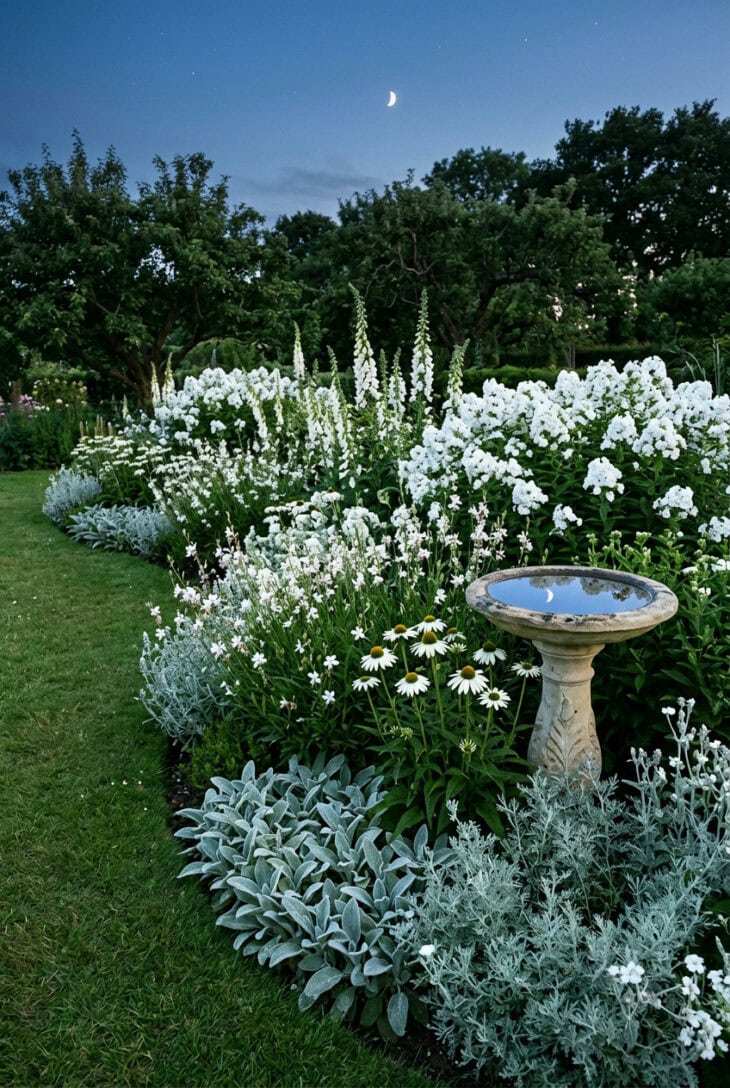
What you see A long, curving border planted in nothing but white and silver. Tall white phlox and foxgloves stand at the back, airy wands of gaura dance through the middle, and velvety lamb’s ears pool over the lawn edge. A stone birdbath catches the last of the sky, and as dusk deepens the whole border seems to float.
Why it works Our eyes switch to low-light vision at dusk, and in that mode pale colors and silver leaves stay visible long after reds, oranges and purples have faded to black. Limiting the palette also forces you to design with height and texture instead of color, which is what keeps an all-white border from looking flat. It is the simplest possible moon garden, and it follows the same tiered rules as any good garden border design.
How to get it Site the border where you actually sit in the evening, ideally with a dark hedge or fence behind it for contrast. Plant garden phlox (Phlox paniculata ‘David’), which is fragrant and resists mildew, at the back, spaced 18in (45cm) apart. Weave gaura (Gaura lindheimeri ‘Whirling Butterflies’) and white coneflower (Echinacea purpurea ‘White Swan’) through the middle, and edge with lamb’s ears (Stachys byzantina ‘Helen von Stein’). Repeat each plant in groups of three or five along the length, because single white plants dotted about look like scattered litter at night. A shallow birdbath or dish of water doubles the light by reflecting the sky.
02. Moonflower Arbor
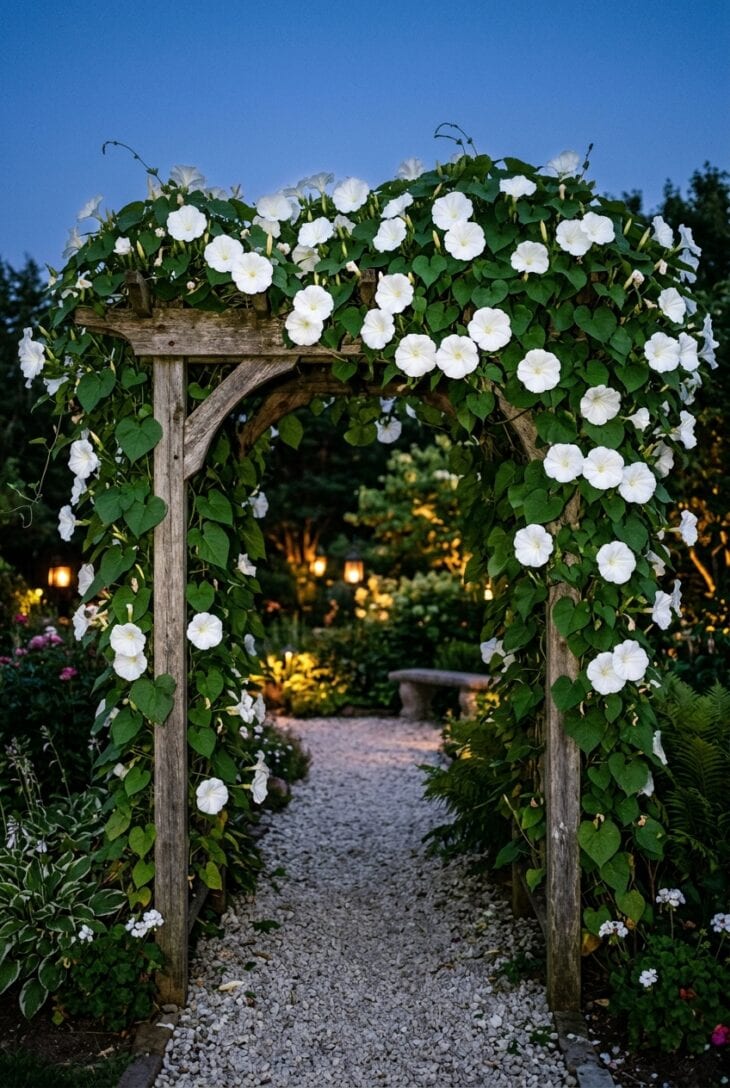
What you see A plain wooden arbor has disappeared under heart-shaped leaves, and dozens of white flowers the size of saucers have opened across it. They glow against the dark foliage like a string of lamps, and walking through the arch you catch a soft, sweet scent drifting down from above.
Why it works Moonflower is the plant the whole idea is named for. Its buds unfurl at dusk quickly enough to watch, which turns an ordinary evening into a small event, especially for children. Growing it overhead puts the flowers and their fragrance right at face height, and a single vine covers an arch in one season.
How to get it Moonflower (Ipomoea alba) is grown as an annual everywhere colder than zone 10, and it needs a long, warm season to flower. Nick each seed with a nail file and soak it overnight, then sow outdoors once the soil is warm, two weeks after your last frost, or start them indoors in biodegradable pots 6 weeks earlier, since the roots resent disturbance. Plant 12in (30cm) apart at the base of a sturdy arch and tie the young shoots in, after which they climb 10 to 15ft (3 to 4.5m) on their own. Go easy on fertilizer, which gives you leaves instead of flowers. The seeds are toxic, so keep them away from small children and pets.
03. Moon Gate Entrance
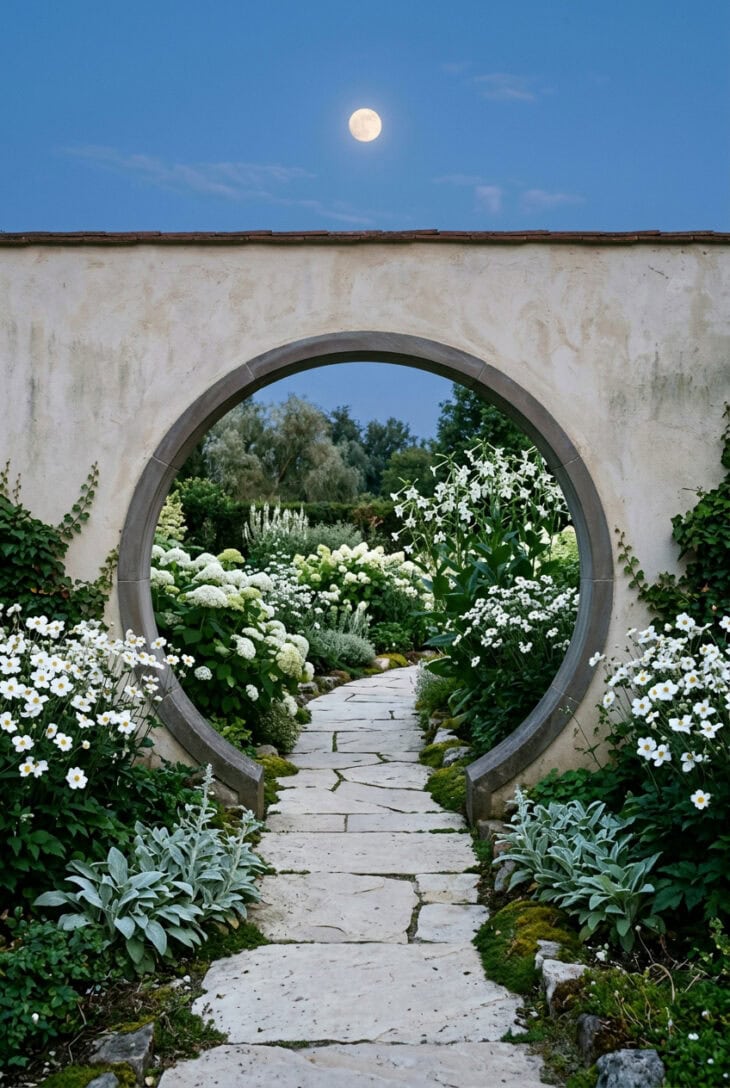
What you see A perfect circle opens through a pale wall, and through it a stone path runs into a garden of white hydrangeas and flowering tobacco. White anemones cluster at the foot of the wall, and above it all a full moon echoes the round opening below.
Why it works Moon gates come from the Chinese garden tradition, where a round opening frames the view beyond like a painting. The circle is the most restful shape there is, and it makes whatever lies behind it feel like a separate, secret place. It is also a clever trick in a small garden, because a framed glimpse makes the space beyond seem bigger than it is.
How to get it Make the opening at least 6ft (180cm) across so adults can walk through without ducking, and set the bottom of the circle 6 to 12in (15 to 30cm) above the path so you step over the rim. A masonry gate needs a formed arch and a proper footing, so for most people the easier route is a steel moon gate hoop set into a new hedge or trellis fence. Plant the hedge of yew (Taxus x media ‘Hicksii’) or hornbeam 18in (45cm) apart right up to the hoop and clip it to the curve as it grows. Put your brightest white planting beyond the gate, not in front of it, so the eye is pulled through.
04. Night-Scented Patio Pots
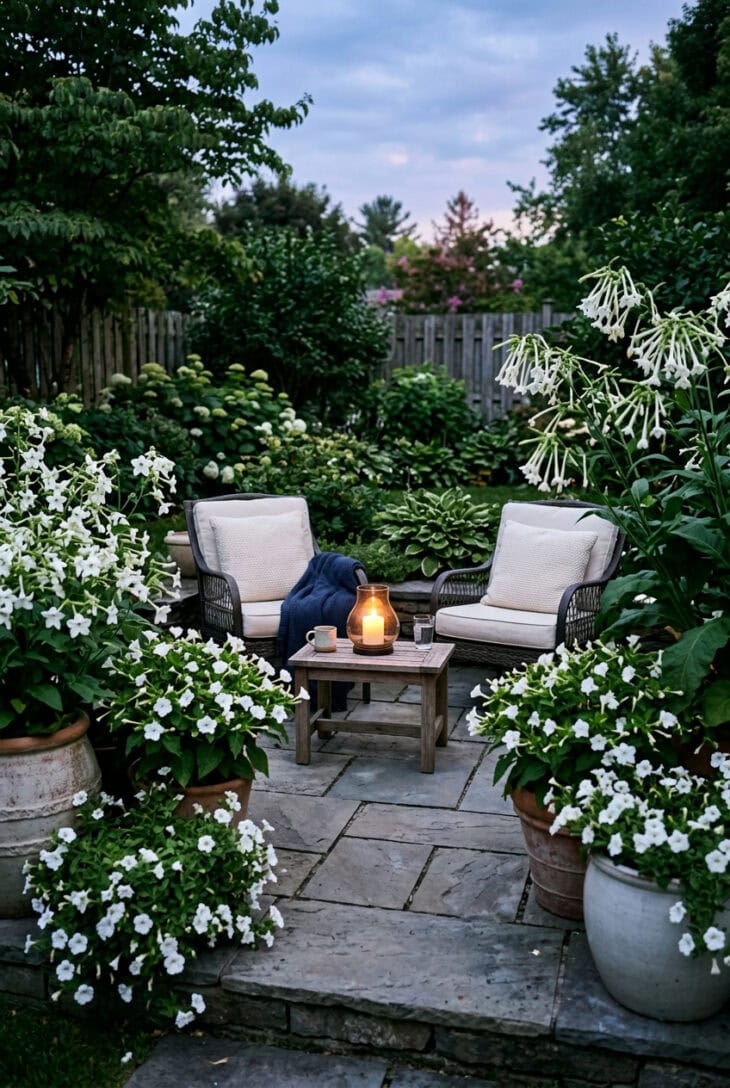
What you see Two chairs, a candle and a ring of generous pots crowd close around a small stone patio. Tall woodland tobacco hangs its long white trumpets above head height, four o’clocks and petunias fill in below, and in the blue evening light the white flowers glow brighter than the candle.
Why it works Night fragrance is strongest in still air, and a patio wrapped in pots traps it right where you sit. Pots also let you start a moon garden without digging a single bed, and move the plants closer to the chairs as each one comes into flower. It is the fastest way to add evening life to any of your patio garden ideas.
How to get it Use pots at least 16in (40cm) across so they do not dry out by evening. Plant woodland tobacco (Nicotiana sylvestris), which reaches 4 to 5ft (120 to 150cm), in the largest pot, and jasmine tobacco (Nicotiana alata) in smaller ones, since both release their scent at dusk. Choose older, fragrant types over compact bedding hybrids, which often have little or no scent. Fill in with four o’clocks (Mirabilis jalapa), which open in late afternoon, and a white petunia for the trailing edge. Water in the morning so the pots are not soggy when you sit out.
05. Silver Foliage Carpet
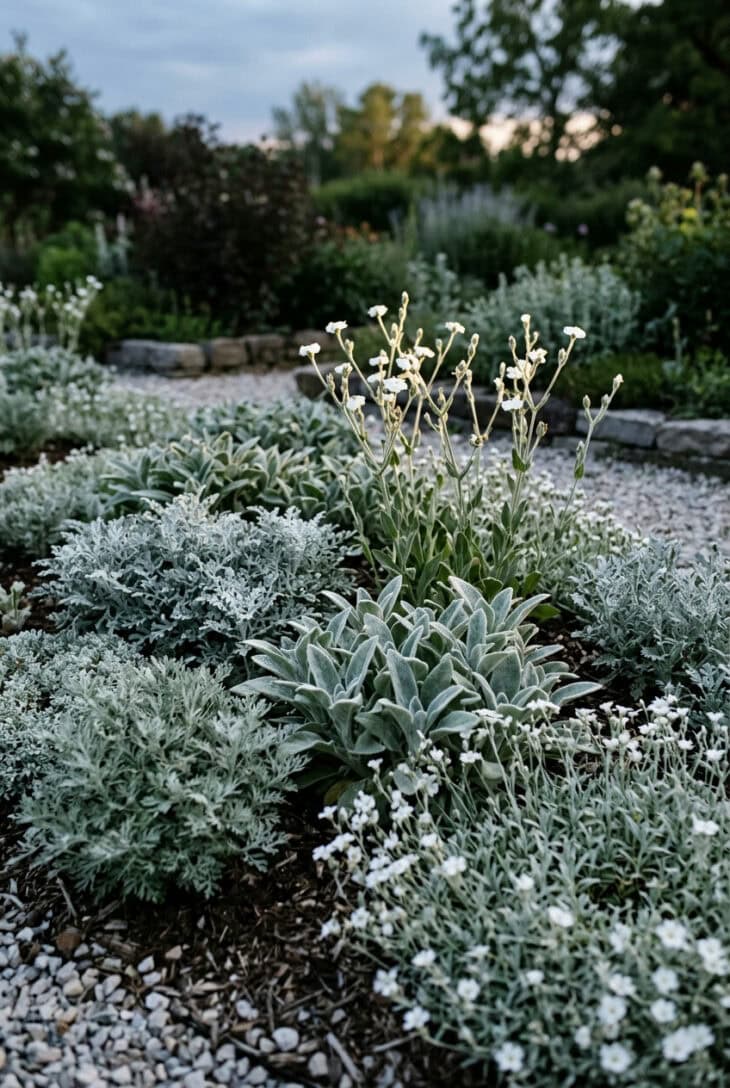
What you see A low, soft carpet of silver in every texture: velvety lamb’s ears, lacy dusty miller, feathery mounds of artemisia and a mat of snow-in-summer sprinkled with tiny white flowers. In the fading light the whole bed shimmers like frost, even though there is barely a bloom in it.
Why it works Flowers come and go, but silver foliage glows every night from spring to frost. The fine hairs and waxy coatings that make these leaves pale are there to reflect sun and hold moisture, so the same plants that light up a moon garden also shrug off heat and drought. That makes a silver carpet one of the lowest-effort ways to keep a moon garden looking good all season.
How to get it Give silver plants full sun and sharp drainage, and mulch with pale gravel rather than bark, which holds moisture against their crowns. Mix textures: lamb’s ears (Stachys byzantina ‘Silver Carpet’, which rarely flowers), dusty miller (Jacobaea maritima), artemisia (Artemisia ‘Powis Castle’) and snow-in-summer (Cerastium tomentosum). For height, add rose campion (Lychnis coronaria ‘Alba’), whose white flowers sit on silver stems. Skip artemisia ‘Silver Mound’ in humid regions, where it melts into a soggy mess by midsummer. Space plants 12 to 18in (30 to 45cm) apart so they knit together within a season.
06. Moth-Friendly Night Border
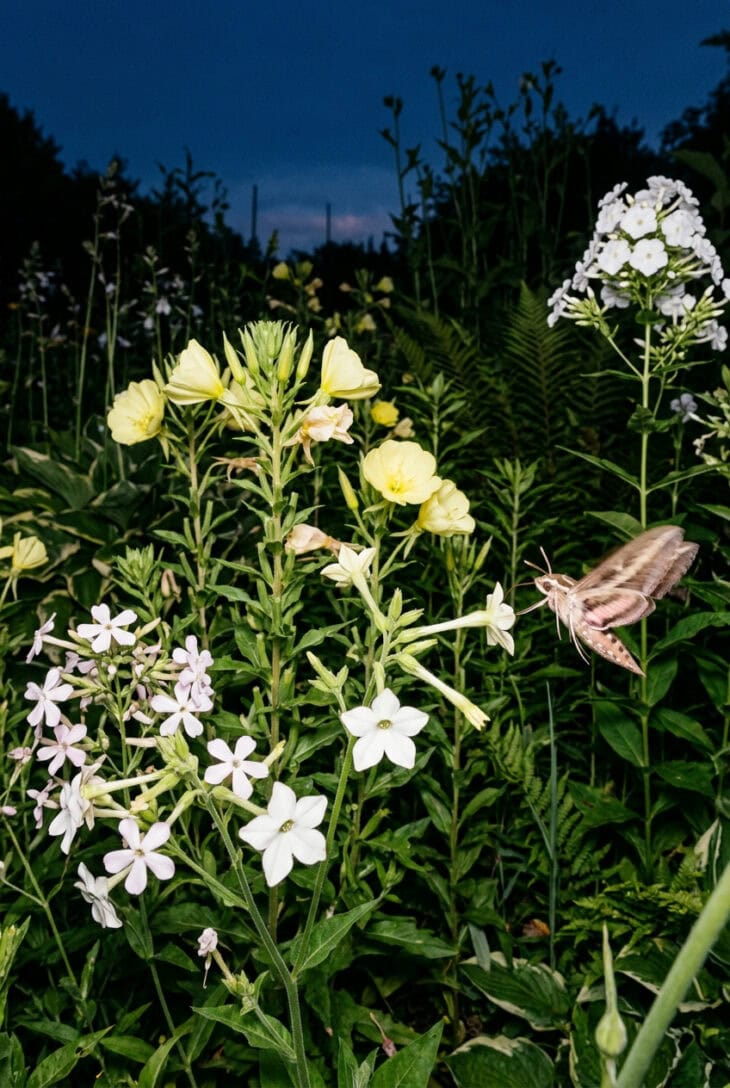
What you see A loose, meadowy border where pale yellow evening primroses have just popped open, white tobacco flowers hang heavy with scent and soapwort froths along the front. A big sphinx moth hovers at one of the trumpets like a hummingbird, its wings a blur in the twilight.
Why it works Pale color and night fragrance did not evolve for us. They are signals to moths, which pollinate after dark and outnumber butterflies many times over. Plant for them and the garden fills with life at the exact hour you are out there to see it, and you extend your pollinator garden into the night shift.
How to get it Build the border around common evening primrose (Oenothera biennis), a native biennial whose flowers open at dusk, plus woodland tobacco and white garden phlox, both favorites of sphinx moths. Add soapwort (Saponaria officinalis) for its clove-scented evening flowers, but plant it in a bottomless pot sunk in the soil, because it spreads hard. Moths also need places to breed, so leave some leaf litter under shrubs and hold off on tidying stems until spring. Skip pesticides entirely, and keep bright lights off this part of the garden, since lights draw moths away from the flowers.
07. Pale Gravel Path Edged in White
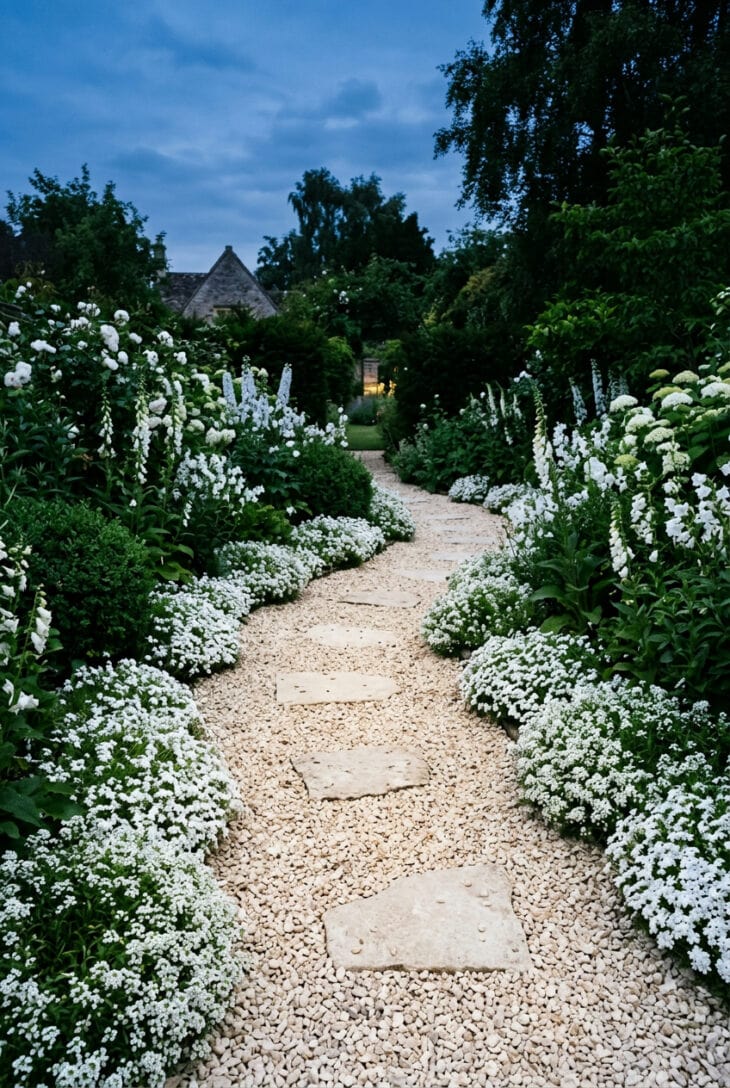
What you see A ribbon of pale crushed stone winds away into the garden, clearly visible long after the lawn beside it has gone dark. Low cushions of white candytuft, creeping phlox and sweet alyssum spill over both edges, so the path is outlined in white all the way to the far bench.
Why it works A moon garden is only enjoyable if you can walk through it safely. A light-colored path reflects moonlight and even the glow from a window, so you can see your footing without switching anything on, and the white edging plants mark the boundary like low-voltage lights that cost nothing to run. It is one of the most practical garden path ideas for evening use.
How to get it Use crushed limestone, pale decomposed granite or light gray pea gravel over a compacted base of 3 to 4in (8 to 10cm), with a steel or stone edge to keep it in place. Edge with evergreen candytuft (Iberis sempervirens), which flowers in spring, and creeping phlox (Phlox subulata ‘White Delight’). Tuck sweet alyssum (Lobularia maritima ‘Snow Princess’) between them for honey-scented flowers from late spring until frost. Plant everything 12in (30cm) back from the edge so it spills over rather than smothering the path.
08. Shade Moon Garden Under Trees
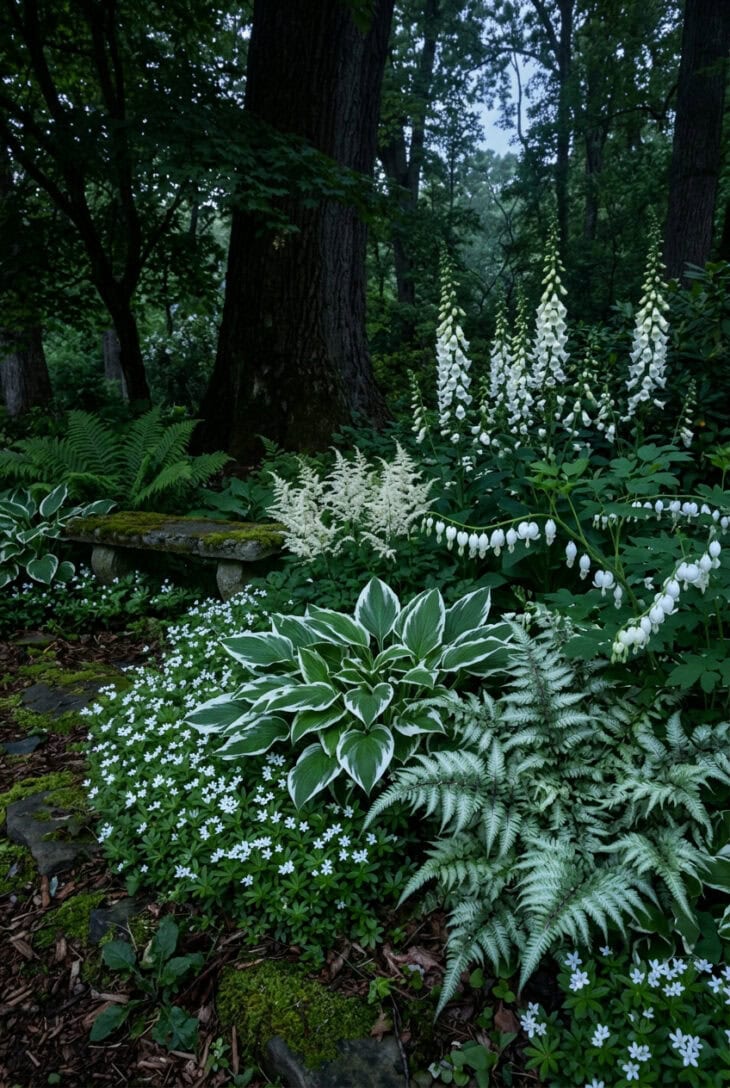
What you see Under a canopy of trees, a dim corner glows. Hosta leaves are rimmed in white, painted ferns shine silver, plumes of white astilbe float at knee height and white foxgloves rise at the back. A mossy bench sits half hidden among them, the kind of place you only find by following the pale leaves in.
Why it works Shade is where white and variegated plants earn their keep, because in low light they are the only things your eye can pick out. The same trick that lights up a moon garden at night makes a dark corner feel bright at noon, so this planting pays off around the clock. For more ways to handle deep shade, see our shade garden ideas.
How to get it Anchor the planting with a white-edged hosta such as ‘Patriot’, spaced 24in (60cm) apart, and weave Japanese painted fern (Athyrium niponicum var. pictum) and Siberian bugloss (Brunnera macrophylla ‘Jack Frost’) between them. Add white astilbe (Astilbe x arendsii ‘Bridal Veil’) where the soil stays moist, and white bleeding heart (Lamprocapnos spectabilis ‘Alba’) for spring. White foxgloves (Digitalis purpurea ‘Alba’) self-seed happily at the back, but every part is toxic, so place them away from where children play. Tree roots compete hard for water, so dig in compost at planting and water weekly through the first summer.
09. White Flowering Tree as the Anchor
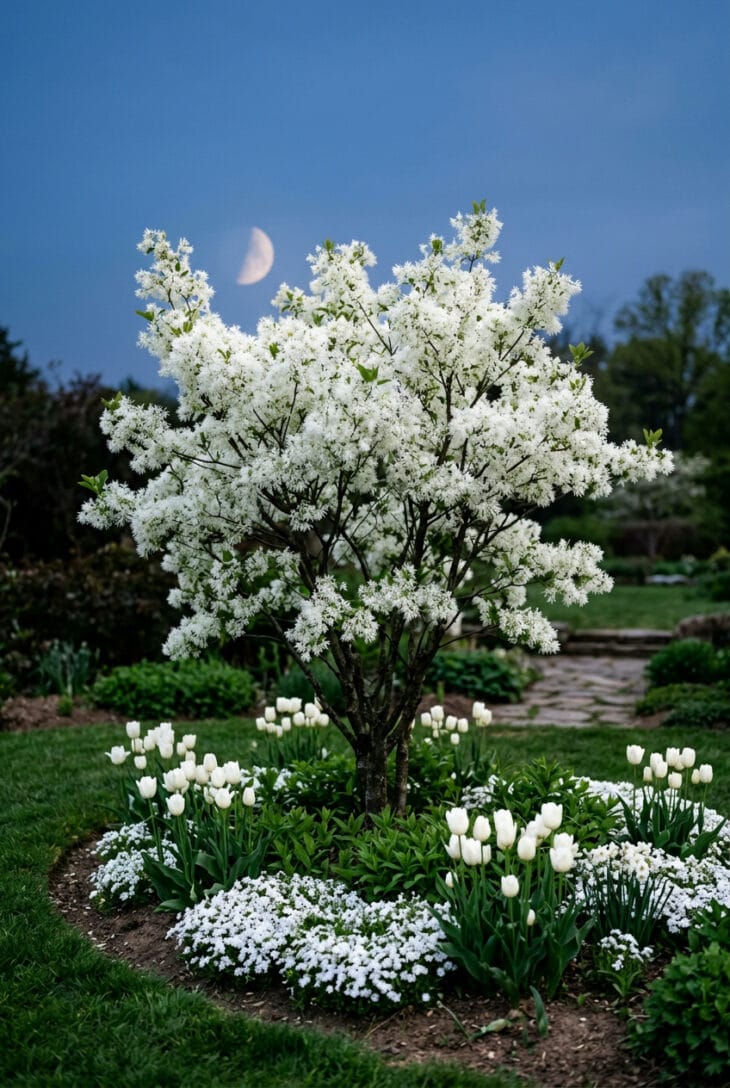
What you see A small multi-stemmed tree stands in a cloud of white, every branch hung with fluffy, fringe-like flowers. The froth glows against a darkening sky as the moon comes up behind it, and at its feet a pool of white tulips and creeping phlox carries the color down to the ground.
Why it works A moon garden made only of perennials sits low to the ground. A white-flowering tree lifts the glow to eye level and above, gives the design a focal point you can see from the house, and supplies structure through winter. Choosing a small tree keeps the canopy light enough for plants to grow underneath.
How to get it Our favorite is the native fringe tree (Chionanthus virginicus), which grows 12 to 20ft (3.5 to 6m), is hardy in zones 3 to 9 and has faintly fragrant flowers in late spring. It is slow to leaf out, so do not give up on it in April. Japanese tree lilac (Syringa reticulata ‘Ivory Silk’) and kousa dogwood (Cornus kousa) are good alternatives for June flowers, and our guide to white spring-flowering trees has more options. Plant in fall or early spring, at least 10ft (3m) from the house, and keep a mulched ring 3ft (90cm) wide around the trunk for the first few years.
10. White Hydrangea Walk
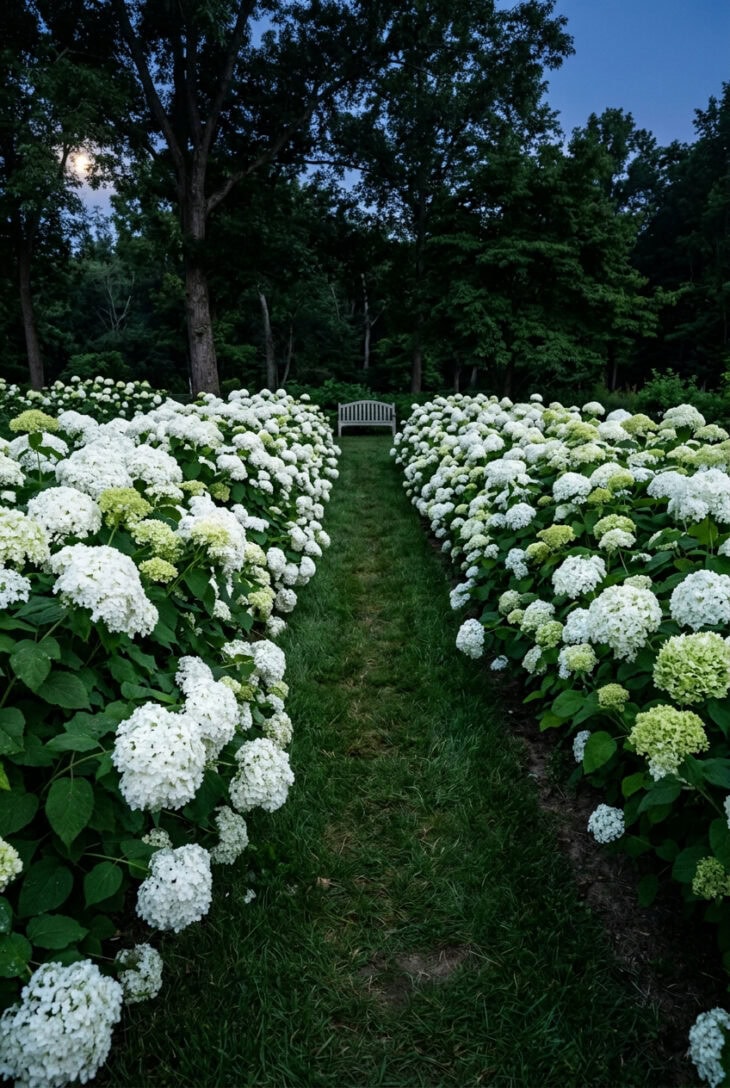
What you see A grass path runs between two rows of hydrangeas, each shrub loaded with round white flower heads as big as dinner plates. In the blue light of evening they look almost lit from inside, and they lead the eye straight to a pale bench at the end.
Why it works Few plants deliver as much white per square foot as a hydrangea in full bloom, and the heads last for weeks, fading to lime and parchment rather than dropping. Planting them in a double row turns a simple path into an avenue, and because they flower in the long evenings of midsummer, the walk is at its best when you are most likely to be outside.
How to get it Use smooth hydrangea (Hydrangea arborescens ‘Annabelle’ or the sturdier ‘Incrediball’) in part shade, or panicle hydrangea (Hydrangea paniculata ‘Limelight’) in sun. Both bloom on new wood, so a hard cut back to 12 to 18in (30 to 45cm) in late winter will not cost you flowers. Space them 4ft (120cm) apart in each row with a path at least 4ft (120cm) wide between. In warmer zones, the Chinese snowball viburnum (Viburnum macrocephalum) gives a similar effect in spring on a much larger shrub. Water deeply during dry spells, since hydrangeas wilt quickly in drought.
11. Balcony Moon Garden in Containers
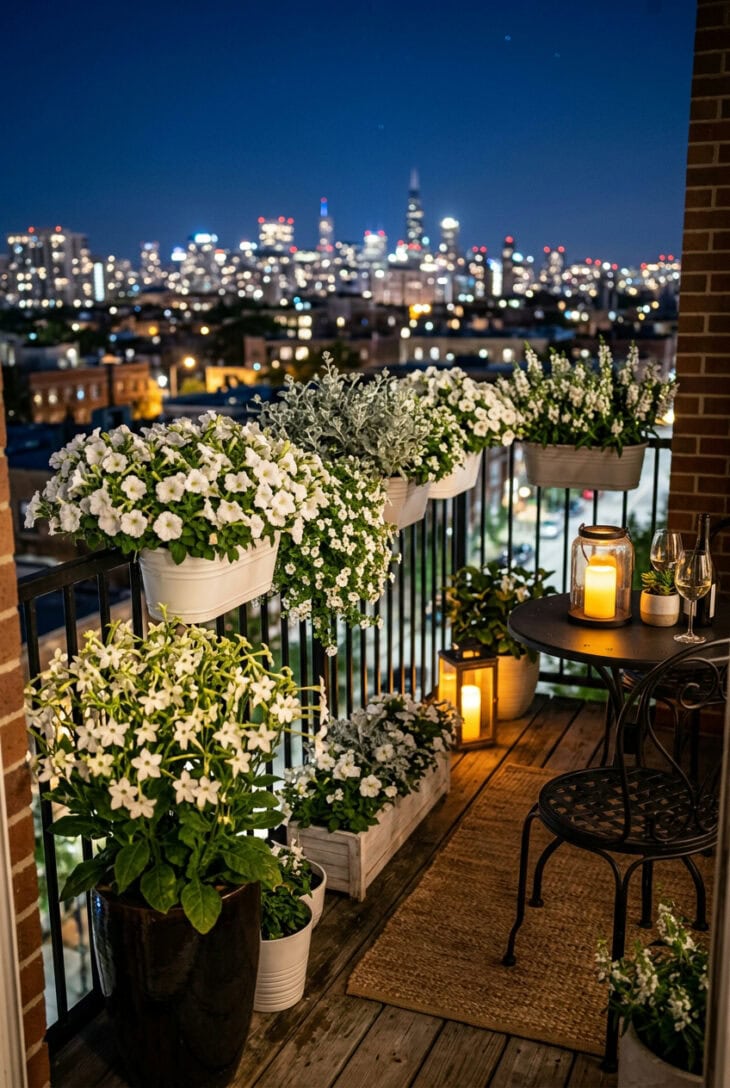
What you see A small city balcony with the skyline glittering beyond it. Pale pots line the railing, spilling white petunias, tiny-flowered bacopa and silver licorice plant, while spikes of white angelonia and a tall flowering tobacco stand in the corner beside a bistro table and lantern.
Why it works Apartment dwellers usually get home after dark, so a moon garden is one of the few styles they actually see at its best. White flowers stand out against the city glow as well as against moonlight, and a single color keeps a small space calm instead of busy. It is an easy win among our balcony garden ideas.
How to get it Use lightweight resin or fiberglass pots in pale gray or cream, which reflect light themselves, and check your balcony’s weight limit before adding large ones. Plant each pot with one upright, one filler and one trailer: angelonia (Angelonia angustifolia) in white for height, a white petunia to fill and bacopa (Sutera cordata) to trail. Licorice plant (Helichrysum petiolare) or angel wings (Senecio candicans) adds silver. Wind dries balcony pots fast, so use a potting mix with water-retaining crystals and check daily in summer.
12. Reflecting Pool with Night-Blooming Water Lilies
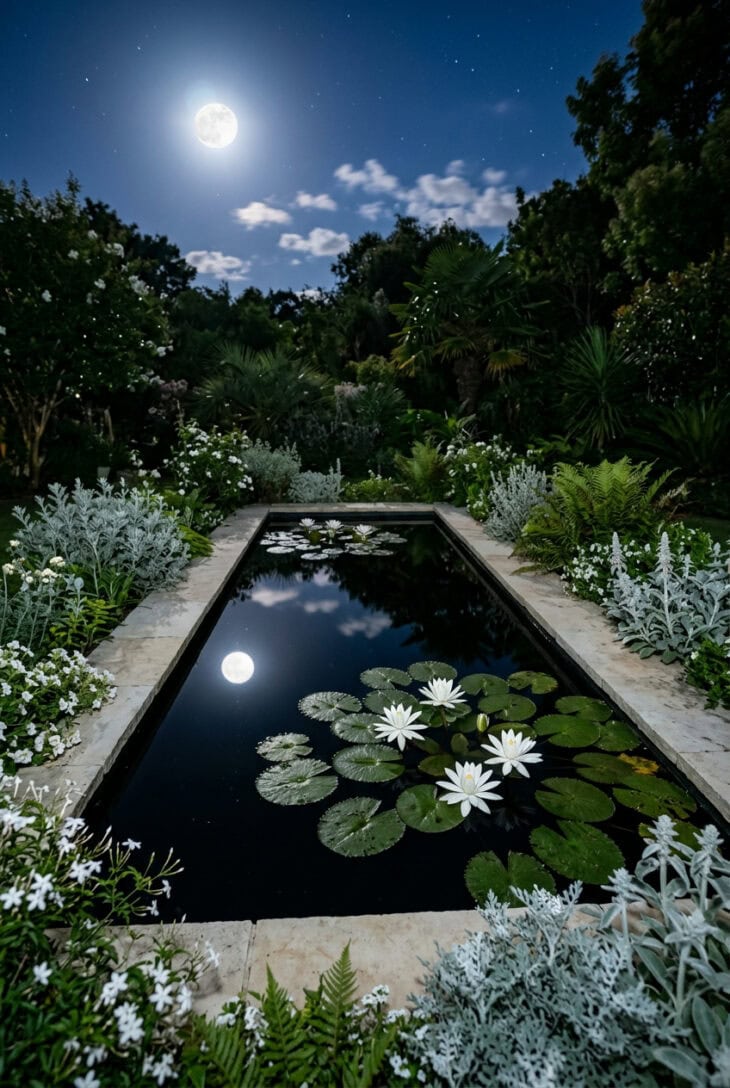
What you see A still, stone-edged pool holds the full moon on its black surface. Large white water lilies float open among the pads, catching the light, and along the rim pale flowers and silver leaves double themselves in the reflection.
Why it works Still water is the one feature that literally puts the moon in your garden. Dark water also makes the most dramatic backdrop there is for white flowers. Most water lilies close at dusk, but the tropical night-blooming kinds do the reverse, opening in the evening and closing late the next morning, so the pool is at its peak exactly when a moon garden should be.
How to get it Keep the pool simple and formal, and dye the water black with a pond-safe dye if you have no lilies yet, since dark water reflects best. Night-blooming tropical lilies such as Nymphaea ‘Wood’s White Knight’ need full sun and water above 70°F (21°C), so plant them in early summer and treat them as annuals or overwinter the tubers indoors. In a pot sunk 12 to 18in (30 to 45cm) below the surface, one plant covers about 6 to 10sq ft (0.5 to 1sq m). Edge the pool with white and silver plants that stay low, so they do not block the reflection.
13. Fragrance Bed Beneath the Bedroom Window
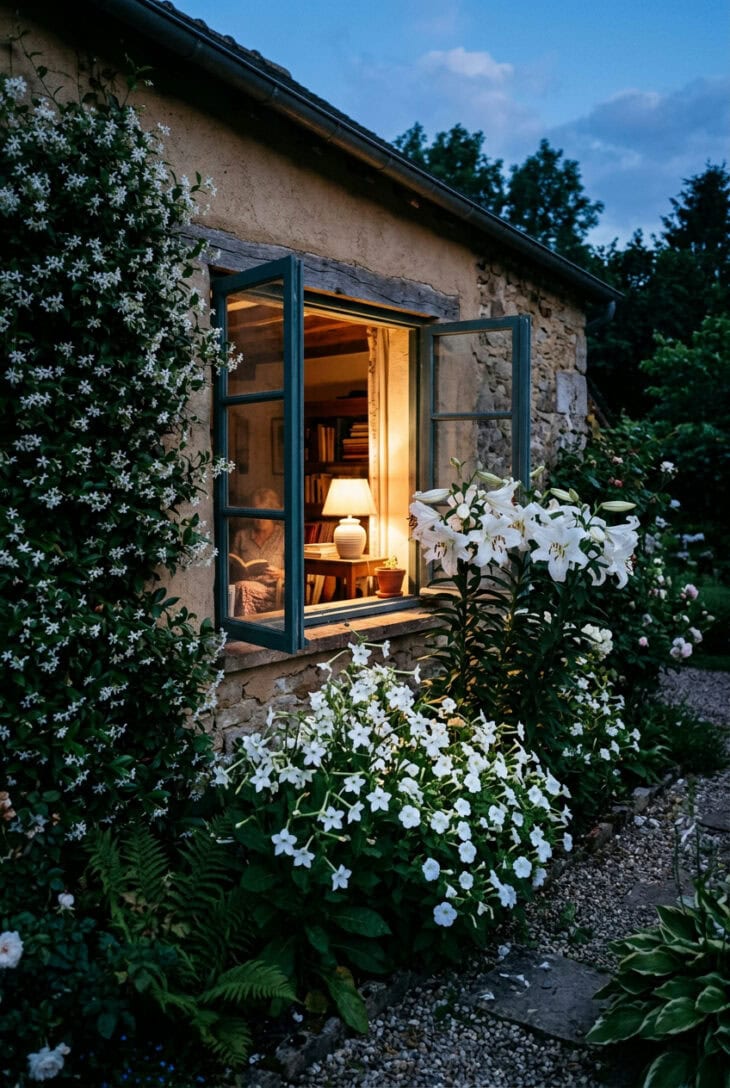
What you see An open window glows with lamplight, and right below it a narrow bed of tall white lilies, four o’clocks and flowering tobacco rises to meet the sill. Star jasmine climbs the wall beside the frame, and on a warm night the room fills with scent without anyone stepping outside.
Why it works Many night-scented flowers are plain to look at, so the best place for them is not where you see them but where you smell them. A bed under a window you open on summer nights lets the fragrance drift indoors, and the house wall shelters the bed, holding still, warm air where the scent can pool.
How to get it Plant Oriental lily bulbs (Lilium ‘Casa Blanca’) in fall or early spring, 6 to 8in (15 to 20cm) deep and 12in (30cm) apart, for huge white flowers whose perfume peaks after dark. Sow night-scented stock (Matthiola longipetala) at the front in spring: the flowers are small and drab, but their evening scent is extraordinary. Add four o’clocks and jasmine tobacco for late summer. Keep the bed 18in (45cm) out from the wall so rain reaches it, and choose a window you really do open.
14. Seed-Sown Moon Garden on a Budget
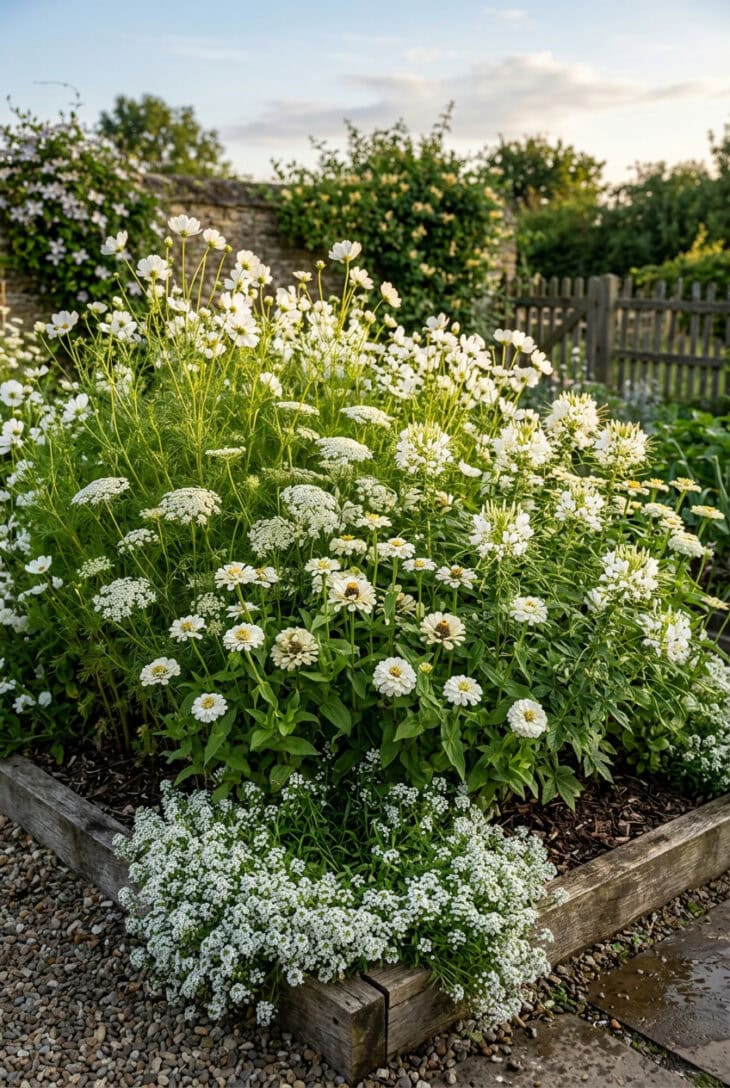
What you see A bed spilling over with white flowers in every form: feathery cosmos waving at shoulder height, lacy umbels of bishop’s flower, neat white zinnias, spidery cleome and a low froth of sweet alyssum along the front. Every plant here started as a seed a few months ago.
Why it works A moon garden does not need expensive perennials to get going. Annual flowers grow fast, bloom for months and pack more white into a first season than anything else, all for the price of a few seed packets. It is the ideal way to test a spot before you commit to a permanent planting, and it slots easily into any of our flower bed ideas.
How to get it Sow directly after your last frost, once the soil has warmed, in a sunny bed you have weeded and raked fine. Good choices are cosmos (Cosmos bipinnatus ‘Purity’), bishop’s flower (Ammi majus), zinnia (Zinnia elegans ‘Polar Bear’), cleome (Cleome hassleriana ‘Helen Campbell’) and sweet alyssum at the front. Sow in loose drifts, then thin the seedlings to 9 to 12in (23 to 30cm) apart, which feels brutal but gives you far more flowers. Deadhead the cosmos and zinnias weekly to keep them blooming until frost. Save seed from the cosmos and cleome in fall, and next year’s bed costs nothing.
15. White Climbing Rose Pergola
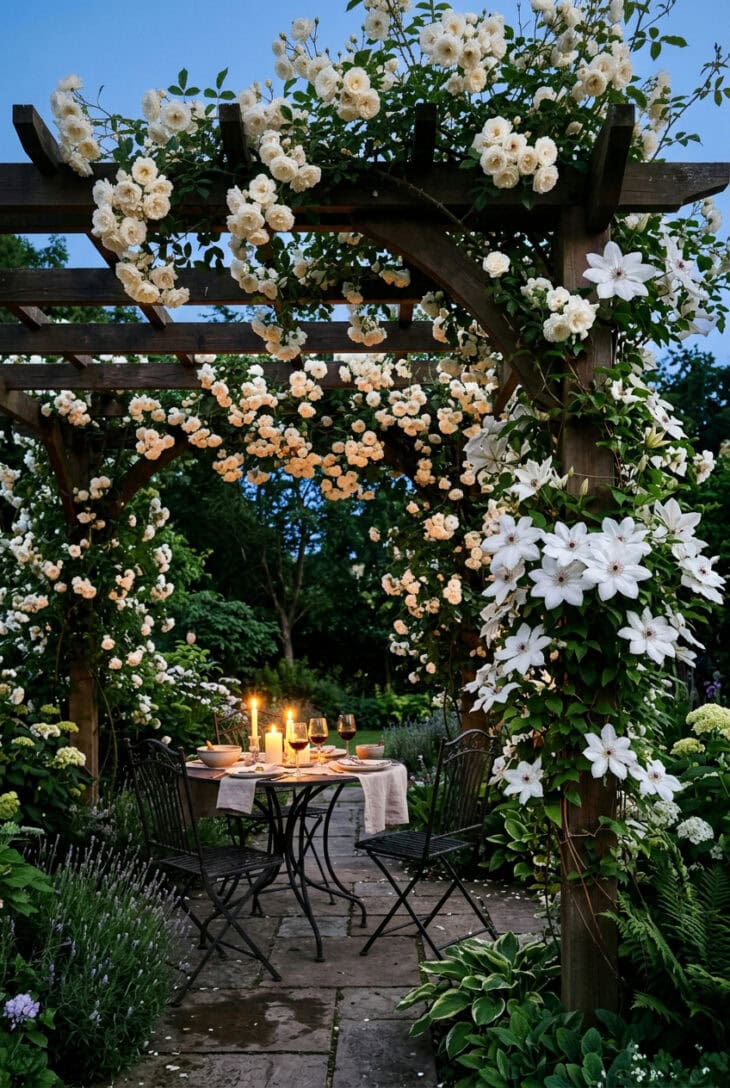
What you see Above a candlelit table, a pergola has vanished under white climbing roses, clusters of creamy flowers hanging down between the beams. A white clematis twines up one post, and through the gaps overhead the sky fades from blue to indigo.
Why it works A pergola turns an eating area into a room with a flowering ceiling, and white roses are the one climber visible from the table long after sunset. Pairing a rose with a clematis extends the season and fills gaps in the rose’s bare lower stems. It is the moon garden version of the classic cottage garden rose arbor.
How to get it Choose a repeat-flowering climber: ‘Iceberg’ (climbing form) is tough and reliable in zones 5 to 9, while ‘Madame Alfred Carrière’ offers a strong fragrance and tolerates some shade in zones 7 and warmer. Plant 18in (45cm) out from each post, lean the canes in and tie them horizontally where you can, which triggers more flowering shoots. Add clematis (Clematis ‘Henryi’) on the opposite side of each post. Avoid sweet autumn clematis (Clematis terniflora), which is invasive in much of the eastern US.
16. Spring Bulb Moon Garden
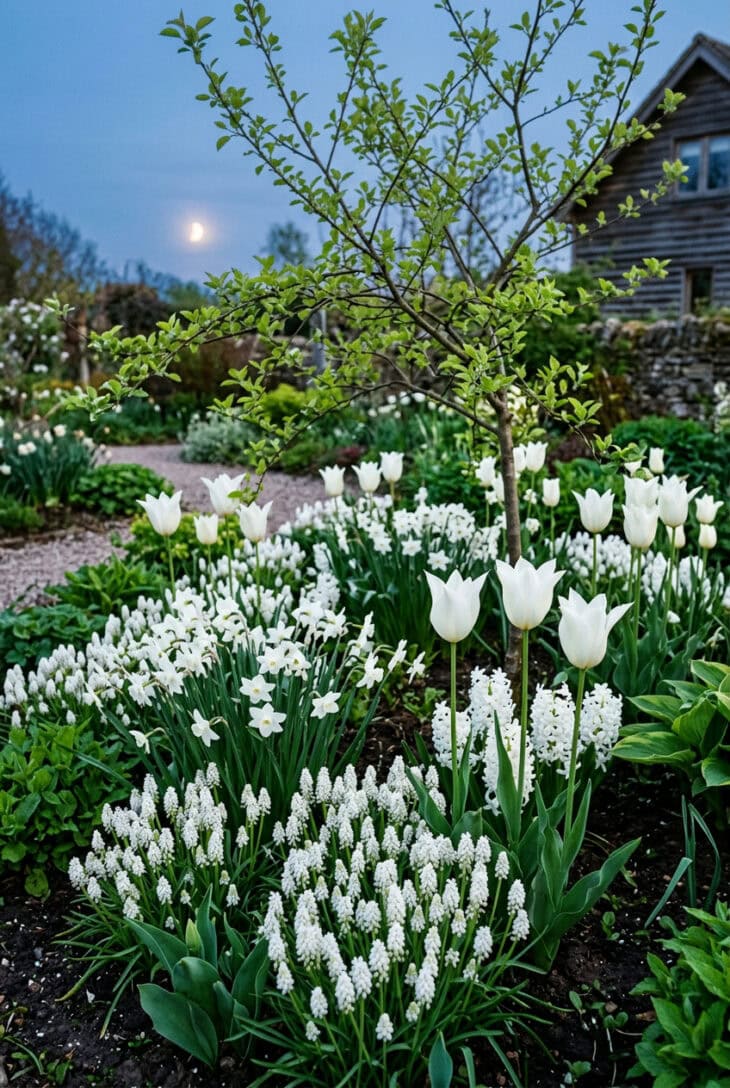
What you see A spring bed at dusk, filled with white: pointed lily-flowered tulips, nodding clusters of small daffodils, plump hyacinths and a carpet of white grape hyacinths underneath. Above them a small tree is just breaking into leaf, and a pale moon sits low in the cool evening sky.
Why it works Most moon gardens peak in summer, but spring evenings get longer every week, and white bulbs give you something to glow at when the perennials are still underground. Bulbs take almost no space, sit beneath later plants and come back for years, so a single afternoon of planting in fall adds an entire extra season.
How to get it Plant in fall, before the ground freezes, at roughly three times the bulb’s height in depth. For a long show, layer early, mid and late bloomers: white grape hyacinth (Muscari botryoides ‘Album’) and daffodil (Narcissus ‘Thalia’), which is fragrant and has several flowers per stem, then hyacinth (Hyacinthus orientalis ‘Carnegie’) and tulip (Tulipa ‘White Triumphator’). Plant in clusters of 10 or more rather than in lines. Leave the foliage for six weeks after flowering to feed next year’s bulb, and hide it behind emerging perennials.
17. Native White Prairie Moon Garden
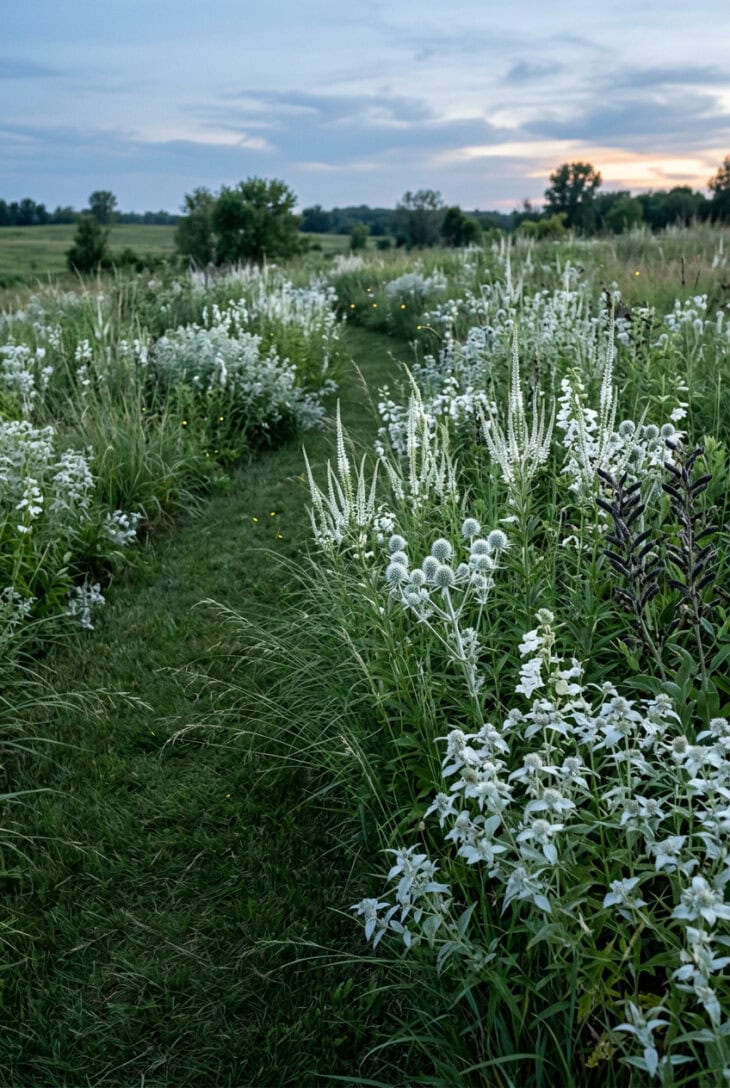
What you see A mown path curves through a sweep of native wildflowers at dusk: tall candelabras of Culver’s root, spiky silvery globes of rattlesnake master and the frosted tops of mountain mint, all laced with fine prairie grasses. Fireflies drift up out of the planting as the light goes.
Why it works Many native prairie plants happen to be white or silver, so you can build a moon garden that also feeds local insects and asks for almost no watering once established. The grasses give the planting movement and hold up the taller flowers, and leaving the stems standing in winter shelters the very fireflies that light it up in summer. It is a natural fit with our wildlife garden ideas.
How to get it In full sun, plant Culver’s root (Veronicastrum virginicum), rattlesnake master (Eryngium yuccifolium), foxglove beardtongue (Penstemon digitalis) and white wild indigo (Baptisia alba), with prairie dropseed (Sporobolus heterolepis) woven between at 18 to 24in (45 to 60cm) spacing. Short-toothed mountain mint (Pycnanthemum muticum) is a pollinator magnet but spreads, so give it room. Leave out Queen Anne’s lace (Daucus carota), a noxious weed in several states, and choose one of the Queen Anne’s lace lookalikes instead. Cut the whole planting down in late spring, not fall.
18. Silver Grass Moon Garden
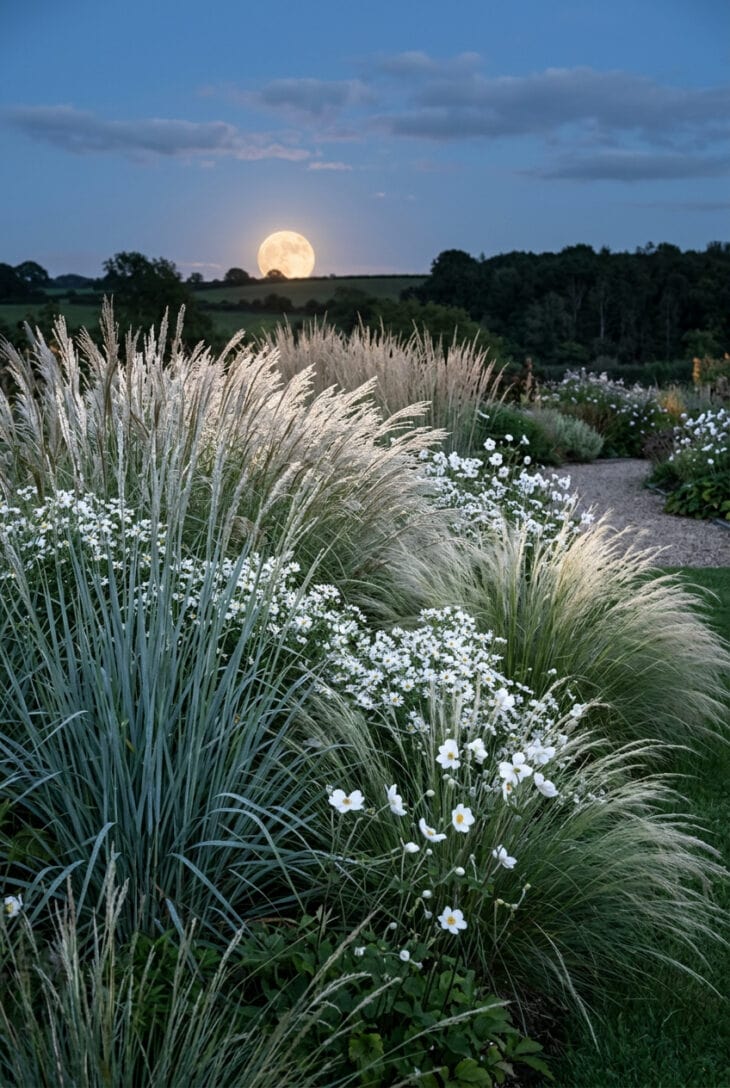
What you see A full moon rises behind a sweep of ornamental grasses, turning their plumes into silver thread. Upright blue-gray switchgrass, pale feather reed grass and fine, hair-like tufts sway together, with white asters and anemones tucked among them at the edges.
Why it works Grasses are the only plants that catch moonlight from behind. When the moon is low, their seed heads light up like fiber optics and every breeze sends a ripple across the planting. They also peak in late summer and fall, just as flower-based moon gardens fade, and stay handsome through winter with almost no care.
How to get it Plant where you can see the grasses against the eastern sky, since that is where the moon rises. Use switchgrass (Panicum virgatum ‘Heavy Metal’) for blue-gray upright clumps, feather reed grass (Calamagrostis x acutiflora ‘Karl Foerster’) for early plumes and little bluestem (Schizachyrium scoparium ‘The Blues’) for a shorter layer, spaced 24 to 36in (60 to 90cm) apart. Mexican feather grass (Nassella tenuissima) is the silkiest of all, but it seeds into wildlands in California and the Southwest, so only plant it where it is not invasive. Cut the grasses to 4 to 6in (10 to 15cm) in late winter.
19. Moon-Viewing Deck
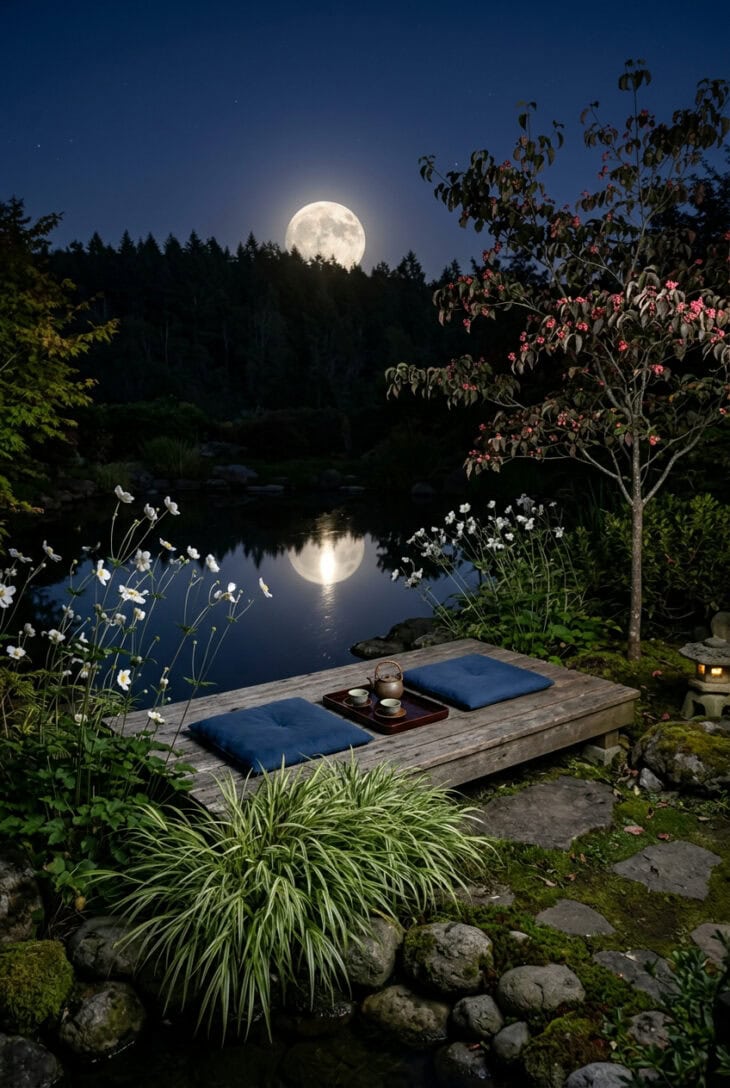
What you see A low wooden platform sits just above the ground, two cushions and a teapot set out on it, all facing a huge full moon lifting over the trees. White Japanese anemones nod on tall stems around the edge, striped forest grass spills over the stones and still water nearby holds a second moon.
Why it works In Japan, autumn moon viewing, or tsukimi, is an old tradition, and the Katsura Imperial Villa in Kyoto has a bamboo platform built for exactly that purpose. A deck turned to face the moonrise gives the whole moon garden a point: somewhere to sit and look at the sky, not just the plants. It borrows directly from our Japanese garden ideas.
How to get it Face the platform east to southeast, where the full moon rises, and keep it low, 6 to 12in (15 to 30cm) high, so sitting on it feels grounded. A deck 6 by 6ft (180 by 180cm) is enough for two. Surround it with Japanese anemone (Anemone x hybrida ‘Honorine Jobert’), which flowers white from late summer into fall, right on time for the harvest moon, and edge it with Japanese forest grass (Hakonechloa macra ‘Albostriata’). A kousa dogwood nearby adds white bracts in June and red fall color for the autumn viewing season.
20. Desert Moon Garden
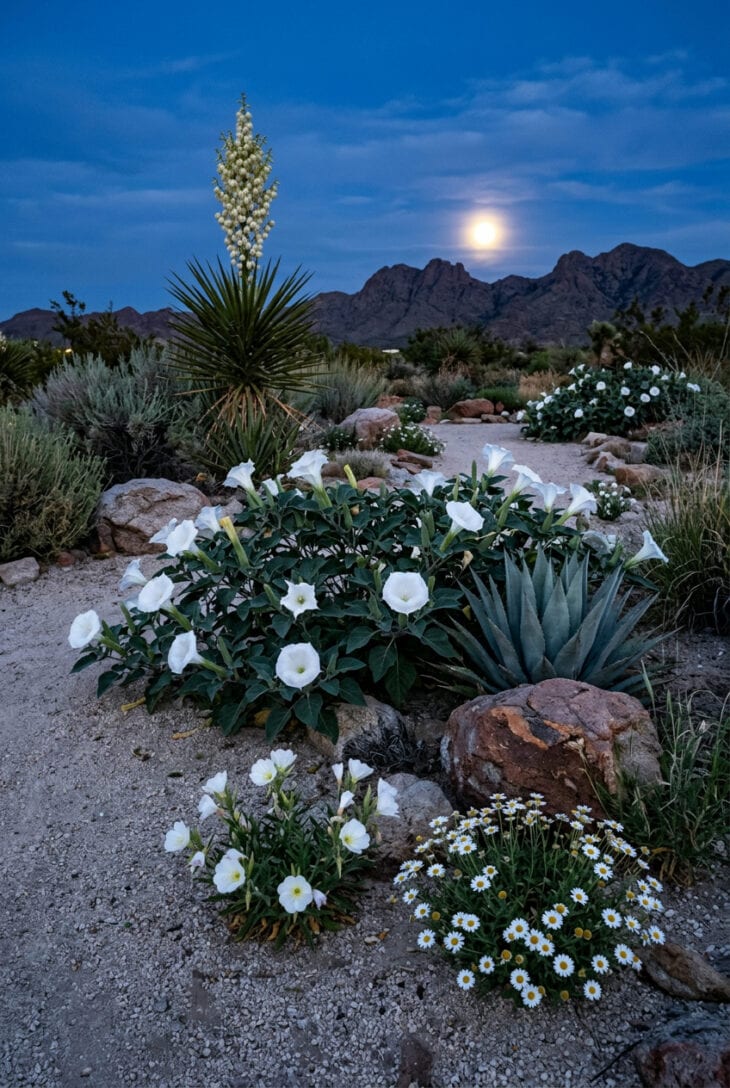
What you see A desert yard of pale gravel and boulders, lit by a moon rising over the mountains. Huge white datura trumpets sprawl across the ground, evening primroses open at its feet, and a yucca holds up a tall spike of creamy bells beside a blue-gray agave.
Why it works In the desert, night is when the action happens. Many native plants flower after dark to spare their pollinators the heat, and the yucca relies entirely on a tiny night-flying moth. A pale gravel ground plane bounces moonlight back up, and you get a moon garden that thrives on almost no water, a perfect match for our drought-tolerant garden ideas.
How to get it Build on pale decomposed granite over well-drained soil in full sun. Anchor with sacred datura (Datura wrightii), whose 6 to 8in (15 to 20cm) trumpets open at dusk, but note that every part of it is highly toxic. Add tufted evening primrose (Oenothera caespitosa) and blackfoot daisy (Melampodium leucanthum) at ground level, and a soaptree yucca (Yucca elata) or century plant (Agave americana) for structure, keeping spiny plants 4ft (120cm) back from paths. Water deeply once every week or two during establishment, then only in long dry spells.
21. Southern Night Garden
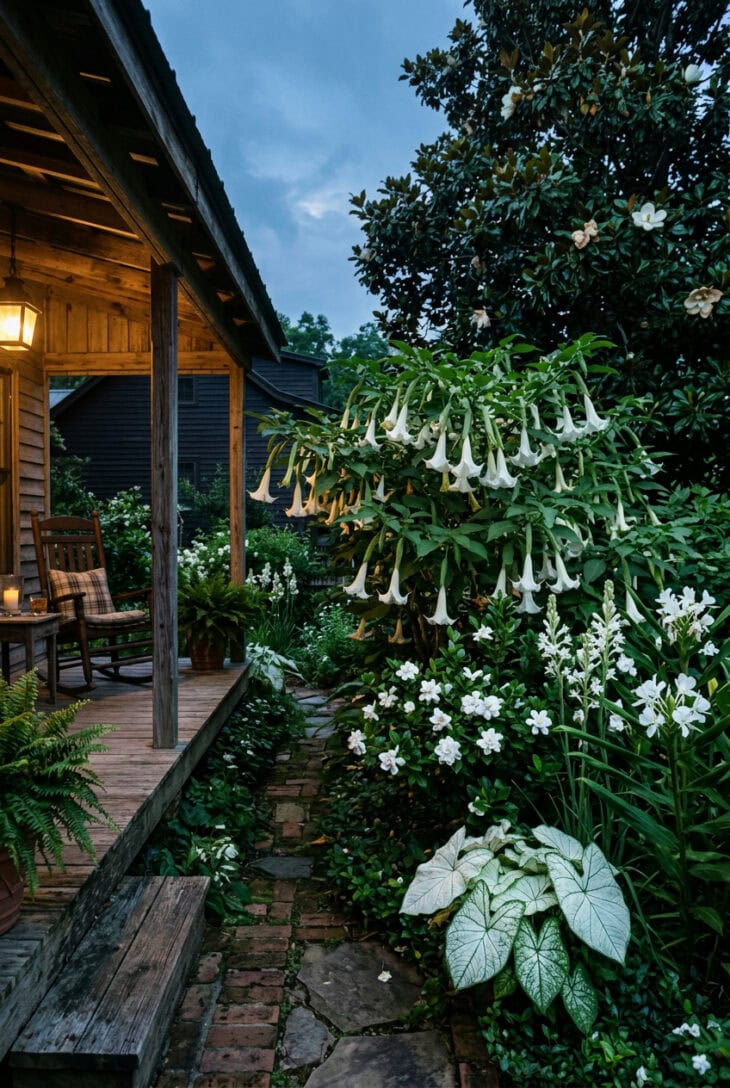
What you see Beside an old porch with a rocking chair, long white angel’s trumpets hang from a big shrub, gardenias are in full flower and tall stems of tuberose rise between white ginger lilies. Below, white caladium leaves glow in the shade, and a glossy magnolia fills the sky behind.
Why it works Warm, humid nights hold fragrance in the air far longer than cool, dry ones, and the South has the richest range of night-scented plants in the country. Angel’s trumpet, tuberose and gardenia all pour out perfume after dark, and the heavy leaves of the caladiums keep the planting looking lush in the heat. It borrows the bold foliage of our tropical garden ideas but keeps the palette cool.
How to get it In zones 8 to 11, plant angel’s trumpet (Brugmansia x candida) and gardenia (Gardenia jasminoides ‘August Beauty’) in part shade with rich, moist soil. Further north, grow the angel’s trumpet in a large pot and overwinter it in a cool garage. Plant tuberose (Polianthes tuberosa) bulbs 2in (5cm) deep after the soil warms, and fill shady gaps with caladium (Caladium ‘Candidum’). All parts of angel’s trumpet are highly toxic. If you have room, a Southern magnolia (Magnolia grandiflora) adds huge lemon-scented flowers, but it grows 60ft (18m) tall, so give it plenty of space.
22. Whitewashed Courtyard with Star Jasmine
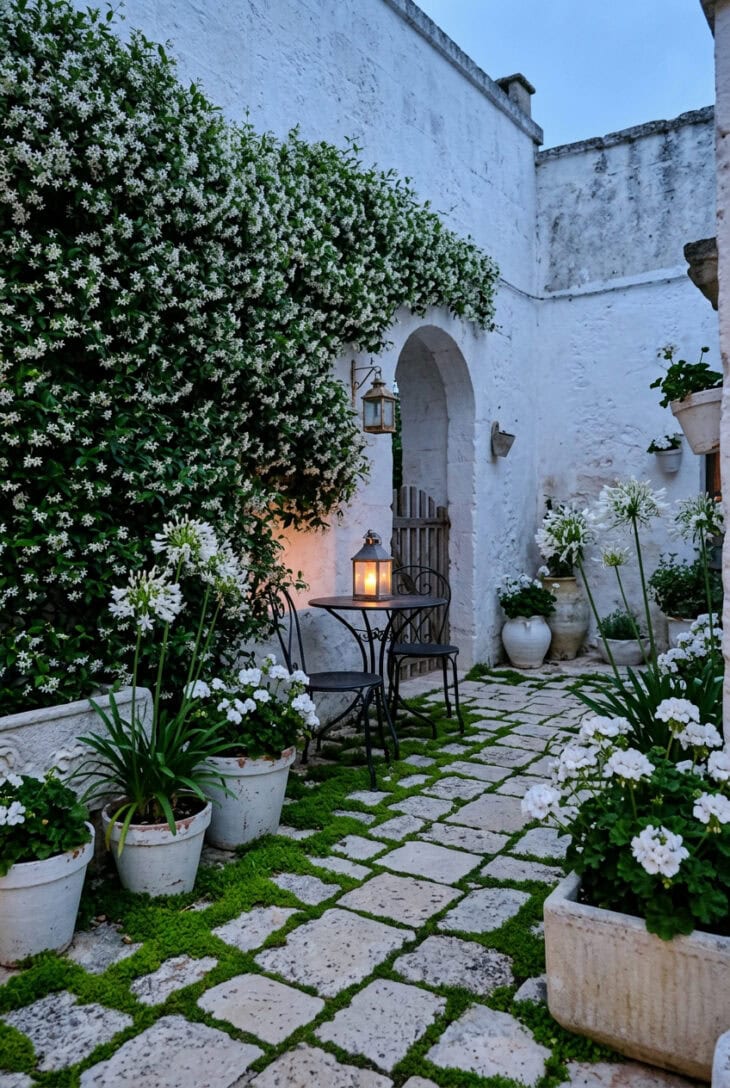
What you see A small courtyard where the walls are painted white and one of them has vanished under star jasmine, its tiny pinwheel flowers scenting the whole space. Pale pots of white agapanthus and geraniums line the paving, soft green moss fills the joints, and a lantern glows on a wrought-iron table.
Why it works In an enclosed space, the walls matter more than the plants. White walls act as giant reflectors, bouncing every bit of moonlight and lamplight around so the courtyard stays softly lit long after dark. The enclosure also traps fragrance, which makes one jasmine smell like ten. Our courtyard garden ideas have more ways to work with high walls.
How to get it Paint walls with limewash or white masonry paint. Star jasmine (Trachelospermum jasminoides) is evergreen and hardy to about 10°F (-12°C), roughly zone 8; plant it 3ft (90cm) apart along the wall on horizontal wires. In colder regions, climbing hydrangea (Hydrangea anomala subsp. petiolaris) covers a shady wall in white instead, though more slowly. Fill the paving joints with Irish moss (Sagina subulata) where they stay moist, and group pots of white Agapanthus and white geraniums near the seating.
23. Soft Moonlighting Among the Plants
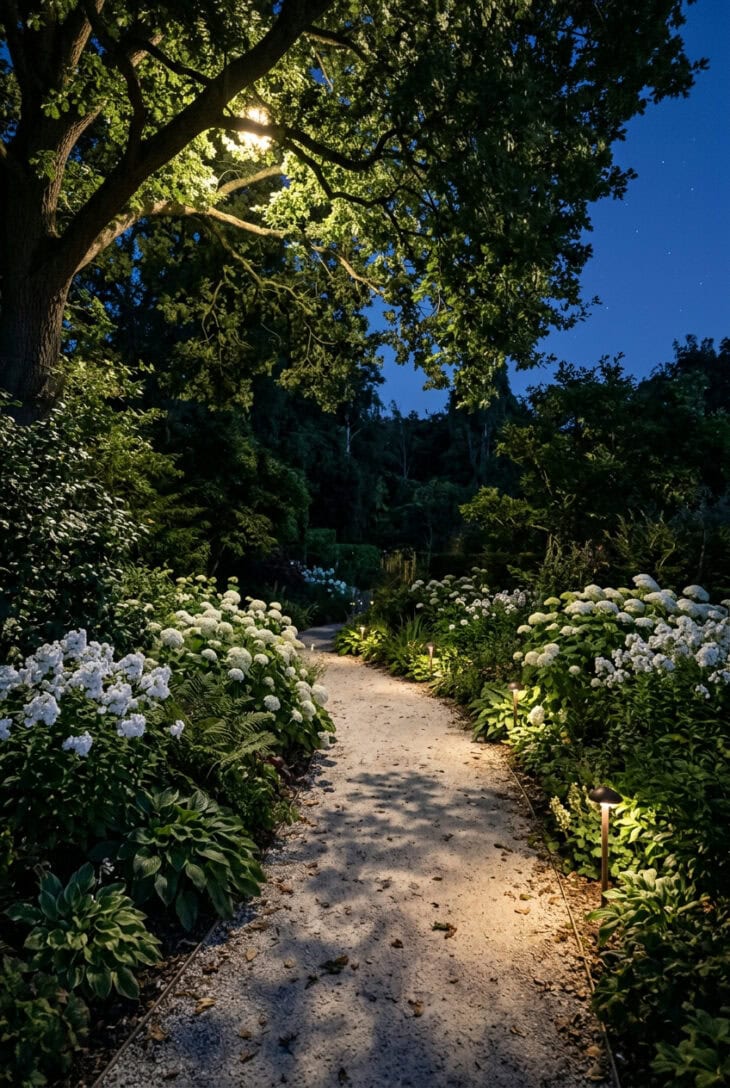
What you see A soft, silvery light falls from somewhere high in a tree, scattering dappled leaf shadows across a pale path and a border of white hydrangeas and phlox. A few low lamps mark the path edge, but the scene looks lit by the moon, not by electricity.
Why it works The moon is not always full, and it is not always clear. “Moonlighting,” a lighting design technique where fixtures are mounted high and aimed down through branches, recreates the look of moonlight on cloudy or moonless nights. Because the light is soft and comes from above, your eyes stay adjusted to the dark and the white flowers keep glowing. For more techniques, see our garden lighting ideas.
How to get it Mount one or two low-voltage LED fixtures 20 to 30ft (6 to 9m) up in a sturdy tree, aimed down through the canopy, and hide them behind a branch. Choose warm white at 2700K to 3000K and a low output; cool white makes white flowers look blue and harsh. Add shielded path lights only where you need to see your footing, spaced 6 to 8ft (180 to 240cm) apart. Put everything on a timer that switches off by midnight, which saves power and gives night-flying moths the dark they need.
24. Winter Moon Garden of White Bark
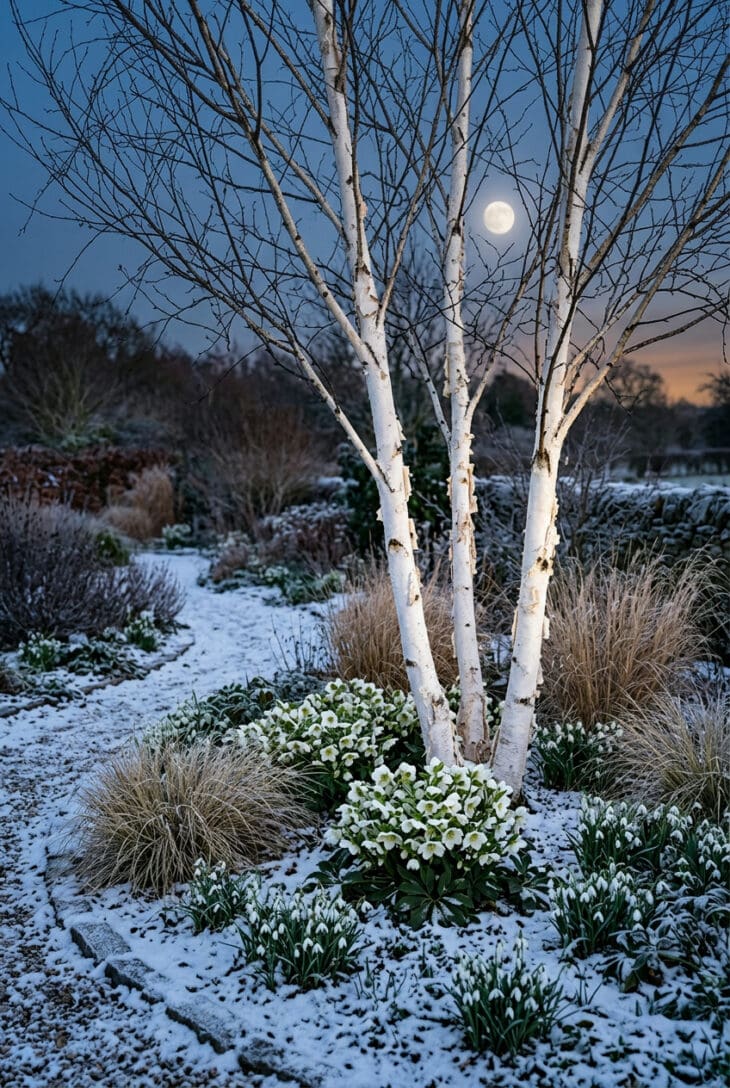
What you see A light snow covers the ground, and a small grove of birches rises from it with trunks as white as chalk. White hellebores and snowdrops push up through the snow at their feet, pale grasses stand in tan clumps and the winter moon hangs between the bare branches.
Why it works Winter has the longest nights and often the clearest skies, so it is actually prime time for a moon garden, and snow makes everything brighter still. White bark is the backbone here: it glows every evening from leaf fall to spring, when the rest of the garden has nothing to offer. The early-flowering bulbs and hellebores add fresh white just when you most need it.
How to get it Himalayan birch (Betula utilis var. jacquemontii) has the whitest bark but struggles in hot summers, so it suits zones 5 to 7. In warmer regions, use river birch (Betula nigra ‘Dura-Heat’), whose peeling cream bark tolerates heat and resists bronze birch borer; our birch pros and cons covers the trade-offs. Plant three in a loose triangle 6 to 8ft (180 to 240cm) apart. Underplant with Christmas rose (Helleborus niger) and snowdrops (Galanthus nivalis), and leave your grasses standing until spring. Wash the lower trunks with a soft brush and water in late fall to bring up the white.
25. Formal White Garden Room
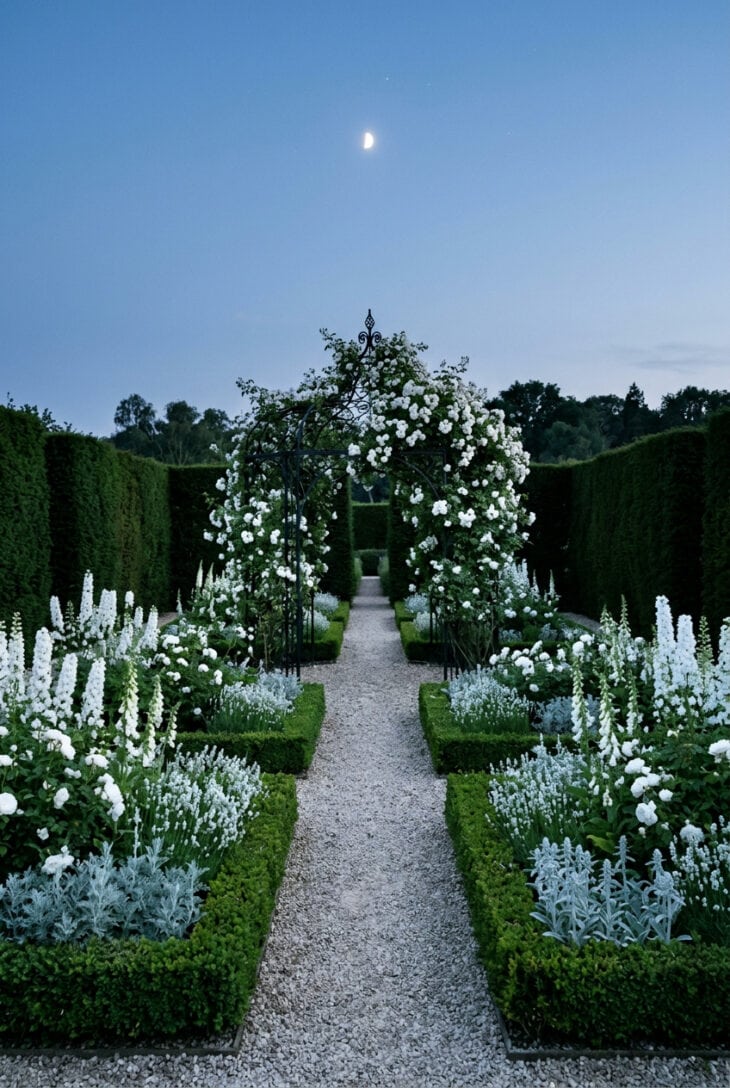
What you see Dark yew hedges enclose a garden room where every bed is edged in clipped box and filled with white: roses, delphiniums, foxgloves and lavender, softened by drifts of silver artemisia. Pale gravel paths meet at an iron arbor draped in a rambling white rose, which glows at the center as the evening deepens.
Why it works This is the moon garden in its grandest form, modeled on the White Garden at Sissinghurst Castle in Kent, which Vita Sackville-West planted in the 1950s. The dark hedges and clipped box give the loose white planting a strong frame, so the design holds together even on a moonless night, and the enclosure makes it feel like a world apart. It is the high point of the English garden tradition.
How to get it Divide a square plot into four beds with 3ft (90cm) gravel paths meeting at a central arbor, and enclose it with yew planted 18in (45cm) apart. Edge the beds with boxwood (Buxus ‘Green Velvet’) or, where box blight is a problem, inkberry holly (Ilex glabra ‘Shamrock’). Fill them with shrub roses (Rosa ‘Iceberg’), white foxgloves, white peach-leaved bellflower (Campanula persicifolia ‘Alba’) and white English lavender (Lavandula angustifolia ‘Nana Alba’), knitted together with silver artemisia. Clip the hedges and box once a year in early summer. Expect the hedges to take five to seven years to enclose the room fully.