
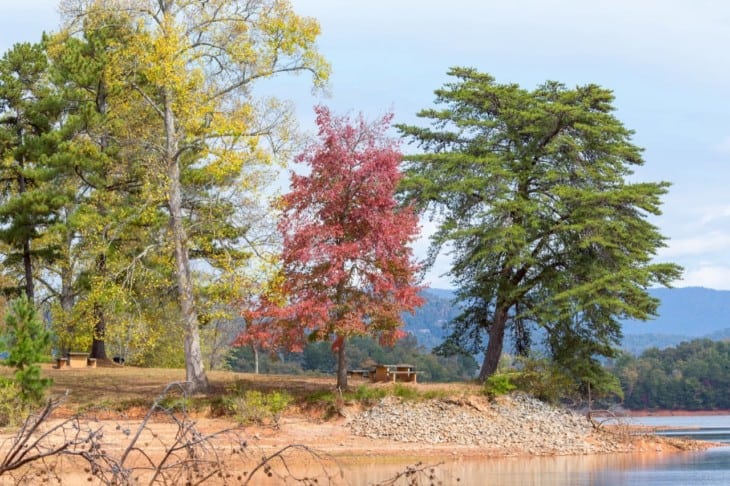
North Carolina has three distinct regions, the Mountains, the Piedmont and the Coastal Plain, and each has its own tree cover. Oak-hickory forest dominates the mountains, mixed hardwoods and loblolly pine fill the Piedmont, and the Coastal Plain holds pine flatwoods, live oaks and cypress swamps. One of those swamps, along the Black River, holds a bald cypress at least 2,624 years old, the oldest known living tree in eastern North America.
Contents
- Common Trees in North Carolina
- Black Gum (Nyssa sylvatica)
- Green Hawthorn (Crataegus viridis)
- Pawpaw (Asimina triloba)
- Sassafras (Sassafras albidum)
- Serviceberry (Amelanchier arborea)
- Carolina Silverbell (Halesia carolina)
- Eastern Red Cedar (Juniperus virginiana)
- Tulip Tree (Liriodendron tulipifera)
- Carolina Cherry Laurel (Prunus caroliniana)
- Loblolly Pine (Pinus taeda)
- Red Maple (Acer rubrum)
- Sweetgum (Liquidambar styraciflua)
- Hickory (Carya spp.)
- River Birch (Betula nigra)
- American Beech (Fagus grandifolia)
- Hackberry (Celtis occidentalis)
- Basswood (Tilia americana)
- White Ash (Fraxinus americana)
- Oak Trees in North Carolina
- Bluejack Oak (Quercus incana)
- Swamp Chestnut Oak (Quercus michauxii)
- Chinkapin Oak (Quercus muehlenbergii)
- Laurel Oak (Quercus laurifolia)
- Live Oak (Quercus virginiana)
- Overcup Oak (Quercus lyrata)
- Pin Oak (Quercus palustris)
- Post Oak (Quercus stellata)
- Scarlet Oak (Quercus coccinea)
- Southern Red Oak (Quercus falcata)
- Shumard Oak (Quercus shumardii)
- Water Oak (Quercus nigra)
- White Oak (Quercus alba)
- Willow Oak (Quercus phellos)
- Flowering Trees for North Carolina Gardens
- Invasive Trees to Avoid
This guide covers the trees you are most likely to meet in North Carolina: the common native trees, the state’s oaks, the best flowering trees for NC gardens, and two invasive trees you will see everywhere but should not plant.
- Common Trees in North Carolina
- Oak Trees in North Carolina
- Flowering Trees for North Carolina Gardens
- Invasive Trees to Avoid
| Tree | Botanical name | Group | Native |
|---|---|---|---|
| Black Gum | Nyssa sylvatica | Common | Yes |
| Green Hawthorn | Crataegus viridis | Common | Yes |
| Pawpaw | Asimina triloba | Common | Yes |
| Sassafras | Sassafras albidum | Common | Yes |
| Serviceberry | Amelanchier arborea | Common | Yes |
| Carolina Silverbell | Halesia carolina | Common | Yes |
| Eastern Red Cedar | Juniperus virginiana | Common | Yes |
| Tulip Tree | Liriodendron tulipifera | Common | Yes |
| Carolina Cherry Laurel | Prunus caroliniana | Common | Yes |
| Loblolly Pine | Pinus taeda | Common | Yes |
| Red Maple | Acer rubrum | Common | Yes |
| Sweetgum | Liquidambar styraciflua | Common | Yes |
| Hickory | Carya spp. | Common | Yes |
| River Birch | Betula nigra | Common | Yes |
| American Beech | Fagus grandifolia | Common | Yes |
| Hackberry | Celtis occidentalis | Common | Yes |
| Basswood | Tilia americana | Common | Yes |
| White Ash | Fraxinus americana | Common | Yes |
| Bluejack Oak | Quercus incana | Oak | Yes |
| Swamp Chestnut Oak | Quercus michauxii | Oak | Yes |
| Chinkapin Oak | Quercus muehlenbergii | Oak | Yes |
| Laurel Oak | Quercus laurifolia | Oak | Yes |
| Live Oak | Quercus virginiana | Oak | Yes |
| Overcup Oak | Quercus lyrata | Oak | Yes |
| Pin Oak | Quercus palustris | Oak | Yes (uncommon) |
| Post Oak | Quercus stellata | Oak | Yes |
| Scarlet Oak | Quercus coccinea | Oak | Yes |
| Southern Red Oak | Quercus falcata | Oak | Yes |
| Shumard Oak | Quercus shumardii | Oak | Yes |
| Water Oak | Quercus nigra | Oak | Yes |
| White Oak | Quercus alba | Oak | Yes |
| Willow Oak | Quercus phellos | Oak | Yes |
| Flowering Dogwood | Cornus florida | Flowering | Yes |
| Southern Magnolia | Magnolia grandiflora | Flowering | Yes |
| Eastern Redbud | Cercis canadensis | Flowering | Yes |
| Crape Myrtle | Lagerstroemia | Flowering | No |
| Lily Magnolia | Magnolia liliiflora | Flowering | No |
| Sasanqua Camellia | Camellia sasanqua | Flowering | No |
| Callery Pear (Bradford Pear) | Pyrus calleryana | Invasive | No |
| Princess Tree | Paulownia tomentosa | Invasive | No |
Common Trees in North Carolina
About 60% of North Carolina is forested, and hardwoods make up most of it. Native trees are the best choice for a yard here: they are adapted to local soils and weather, need less fertilizer and water once established, and feed native birds and insects.
Black Gum (Nyssa sylvatica)

Black gum (also called black tupelo) grows statewide, from swamp edges to dry ridges. It is a deciduous tree, usually 30 to 60 feet tall, with glossy oval leaves that turn one of the brightest scarlets of any fall tree. The small greenish spring flowers are an important nectar source for bees, and the dark blue fruits are eaten by robins, woodpeckers, cedar waxwings and bluebirds.
Green Hawthorn (Crataegus viridis)

Green hawthorn grows in swamps, bottomlands and other wet ground, usually 20 to 35 feet tall. It is a small, often thorny tree with clusters of white flowers in spring and red fruits that hang on into winter. Insects work the spring blossoms and the fruit feeds birds through the cold months.
Pawpaw (Asimina triloba)

Pawpaw is a small understory tree, 12 to 25 feet tall, native across the eastern United States. Its fruit is the largest native fruit in North America and tastes like a mix of mango and banana. Seedlings take 5 to 8 years to fruit. The leaves are the only food of the zebra swallowtail caterpillar.
Sassafras (Sassafras albidum)

Sassafras grows 30 to 50 feet tall and is easy to identify by its leaves, which come in three shapes on the same tree: unlobed, mitten-shaped and three-lobed. They turn yellow, orange and red in fall. Yellow-green flowers appear in early spring before the leaves. The bark is thick, ridged and reddish-brown.
Serviceberry (Amelanchier arborea)

Serviceberry, called “sarvis” in the North Carolina mountains, grows statewide but is most common on mountain slopes. It is usually 15 to 25 feet tall, occasionally up to 40 feet. Its white flowers are among the first to open in spring, followed by small reddish-purple berries in early summer.
Carolina Silverbell (Halesia carolina)
Read our guide to Carolina Silverbell

Carolina silverbell grows in rich, moist soil on lower mountain slopes, coves and stream banks. In gardens it stays 30 to 40 feet tall, but in the coves of the Smokies the mountain form can pass 80 feet. White bell-shaped flowers hang from the branches in April, and the leaves turn yellow in fall.
Eastern Red Cedar (Juniperus virginiana)

Eastern red cedar is a slow-growing, drought-tolerant evergreen, usually 20 to 60 feet tall, and a common sight along old fields and fencerows. It makes a good privacy screen. The bark is reddish-brown and peels in long strips, and the blue berry-like cones are a winter food for birds.
Tulip Tree (Liriodendron tulipifera)

The tulip tree (also called tulip poplar or yellow poplar) is one of the tallest hardwoods in the East. It usually reaches 70 to 90 feet and can top 150 feet. It is named for its tulip-shaped yellow-green and orange flowers, which bees use to make honey. It grows across all of North Carolina and needs plenty of room above and below ground.
Carolina Cherry Laurel (Prunus caroliniana)

Carolina cherry laurel is a fast-growing evergreen, often grown as a large shrub or hedge, that can reach 35 feet as a tree. The glossy, dark green leaves smell of cherry when crushed, and small, fragrant white flowers appear in early spring. It is easy to transplant and makes a quick privacy screen.
Loblolly Pine (Pinus taeda)

Loblolly pine is the most common tree in North Carolina’s forests and, by US Forest Service counts, the most common tree in the country. It is native to about 15 southeastern states and grows fastest in lowlands and moist sites. Mature trees reach about 100 feet, with dark green needles in bundles of three and grey-brown, plated bark.
Red Maple (Acer rubrum)

Red maple grows in every county of North Carolina. It is usually under 40 feet in yards but can reach 100 feet in the forest. Red flowers appear in late winter, before the leaves, and the fall color is some of the best of any native tree. It is widely planted in parks and along streets. Watch for gloomy scale, a common pest of red maples in the Southeast.
Sweetgum (Liquidambar styraciflua)

Sweetgum grows straight and tall, up to 120 feet, with a trunk 4 feet or more across. It is common across the Southeast, especially in wet, flood-prone ground along rivers and swamps, and prefers sun and non-alkaline soil. It is easy to recognize by its star-shaped leaves and the spiky round seed balls it drops in fall.
Hickory (Carya spp.)

About a dozen hickory species are native to the United States, and several of them are common in North Carolina’s oak-hickory forests. Hickories have compound leaves with 5 to 17 toothed leaflets and produce hard-shelled nuts. Their long taproot makes them slow to establish and one of the hardest trees to transplant.
River Birch (Betula nigra)

River birch grows along floodplains and riverbanks and can reach 80 feet. It is a popular landscape tree because of its peeling reddish-brown bark and its tolerance of both wet soil and dry spells. It is also easy to transplant. Thin catkins appear in early spring.
American Beech (Fagus grandifolia)

American beech is known by its smooth, pale grey bark and its oval, sharply toothed leaves. It tolerates shade and often grows alongside sugar maple on rich, moist soils. Farmers once took a stand of beech as a sign of good farmland, because the tree needs deep, fertile ground.
Hackberry (Celtis occidentalis)

Hackberry is a tough, long-lived tree, 30 to 50 feet tall, with light grey bark covered in corky warts and ridges. Its leaves turn yellow in fall. Small dark purple fruits ripen in autumn and stay on the tree into winter, where birds eat them. On the Coastal Plain its close relative, sugarberry (Celtis laevigata), is more common.
Basswood (Tilia americana)

American basswood grows 70 to 80 feet tall, mostly in the mountains, on rich slopes and in coves. In the Piedmont and Coastal Plain it is replaced by Carolina basswood, a variety with slightly smaller leaves that are fuzzy underneath. Basswood flowers are a major source of summer nectar for bees.
White Ash (Fraxinus americana)

White ash grows 60 to 90 feet tall in river bottoms and rich, moist soils across the state. It has grey, diamond-ridged bark and compound leaves that turn yellow to purple in fall. The emerald ash borer has been killing ash trees in North Carolina since it was found here in 2013, so do not plant new ash trees.
Oak Trees in North Carolina
North Carolina has more than 30 native oak species, and Raleigh calls itself the “City of Oaks”. Oaks belong to the beech family. They fall into two groups: white oaks, whose acorns mature in one season, and red oaks, whose acorns take two. Many oaks live 200 to 300 years, and their acorns are a staple food for deer, turkeys, squirrels and jays.
Bluejack Oak (Quercus incana)

Bluejack oak is a small oak of the dry, sandy Coastal Plain, averaging about 30 feet tall. Its leaves are oval, glossy blue-green on top and woolly underneath. The acorns are under an inch long. The wood is used only for posts and firewood.
Swamp Chestnut Oak (Quercus michauxii)

Swamp chestnut oak is a white oak of bottomlands and floodplains, usually around 65 feet tall. Its leaves are 4 to 11 inches long with wavy, rounded teeth, and they turn red in fall. The large, sweet acorns are a favorite of wildlife and cattle, which earned it the name “cow oak”. The wood was once split for baskets.
Chinkapin Oak (Quercus muehlenbergii)

Chinkapin oak is a white oak that tolerates many soils, including rocky slopes and limestone. Its acorns ripen in September or October of their first year and are sweet enough for people as well as wildlife to eat. It has grey, flaky bark and very hard wood.
Laurel Oak (Quercus laurifolia)

Laurel oak (also called swamp laurel oak or diamond-leaf oak) grows 65 to 80 feet tall with a broad, rounded crown. Its narrow leaves are 1 to 5 inches long and stay on the tree well into winter. It grows fast and produces heavy acorn crops, but it is also short-lived for an oak, at around 50 to 70 years.
Live Oak (Quercus virginiana)

Southern live oak is the broad, spreading oak of the North Carolina coast. It is called “live” because it keeps its leaves through winter, replacing them in spring. The leathery leaves are shiny green on top and pale grey underneath. Its dense, strong wood was prized for shipbuilding: the hull of the USS Constitution was framed with live oak.
Overcup Oak (Quercus lyrata)

Overcup oak grows in the wet lowlands of eastern North Carolina and reaches about 65 feet. Its lobed leaves are shaped like a lyre, which gives it its Latin name. The acorn is almost entirely enclosed by its cap, which helps it float and spread on flood water.
Pin Oak (Quercus palustris)

Pin oak is native but uncommon in North Carolina’s forests. It is much more often planted as a street and yard tree because it tolerates urban conditions. It grows 60 to 70 feet tall, with lower branches that angle downward. It lives around 100 to 120 years, which is short for an oak. It needs acidic soil and turns yellow (chlorotic) in alkaline ground.
Post Oak (Quercus stellata)

Post oak is a white oak that thrives on poor, dry soils where other oaks struggle. It rarely grows past 50 feet. The leaves have two large square-ended middle lobes that give them a cross-like shape, and the small acorns mature in their first summer. Its rot-resistant wood was traditionally used for fence posts.
Scarlet Oak (Quercus coccinea)

Scarlet oak is a red oak of dry, sandy or acidic ridges, 65 to 100 feet tall. Its deeply cut leaves are up to 7 inches long and turn a brilliant scarlet in fall. The small acorns take about 18 months to mature.
Southern Red Oak (Quercus falcata)

Southern red oak, also called Spanish oak, is one of the most common upland oaks of the Piedmont and Coastal Plain. It grows in dry, sandy soils and can reach nearly 100 feet. The leaves usually have three to five bristle-tipped lobes with a long middle lobe. The small orange-brown acorns ripen at the end of their second season.
Shumard Oak (Quercus shumardii)

Shumard oak is a large red oak of moist bottomlands that can reach 115 feet. Young trees have smooth bark, which becomes ridged with age. The deeply lobed leaves reach 8 inches long, dark green on top and paler underneath, and turn red to russet in fall. Its tolerance of heat and drought makes it a good shade tree.
Water Oak (Quercus nigra)

Water oak is a red oak of the eastern and south-central US that commonly grows to 100 feet with a trunk about 3 feet across. Its small, spatula-shaped leaves are dull blue-green. The acorns are only about half an inch long and ripen in the fall of their second year. It grows fast but is relatively short-lived and prone to heart rot.
White Oak (Quercus alba)

White oak is named for its light grey bark and pale wood. It can reach 100 feet tall with a crown nearly as wide in the open, and it often lives 300 years or more. Its tight-grained wood is the classic material for whiskey and wine barrels.
Willow Oak (Quercus phellos)

Willow oak is a red oak with narrow, willow-like leaves 2 to 4 inches long. It grows 65 to 100 feet tall and fast for an oak, and it tolerates wet soil. That makes it one of the most planted street trees in Raleigh and across the Southeast. Its roots can lift sidewalks when it is planted too close.
Flowering Trees for North Carolina Gardens
North Carolina’s humid subtropical climate, with hot summers and mild winters, suits a wide range of flowering trees. The native trees above include several good ones: serviceberry, Carolina silverbell, pawpaw and tulip tree. These are the other flowering trees most often grown in the state. Tropical trees such as jacaranda and orchid tree are sometimes recommended for NC, but they will not survive its winters.
Flowering Dogwood (Cornus florida)
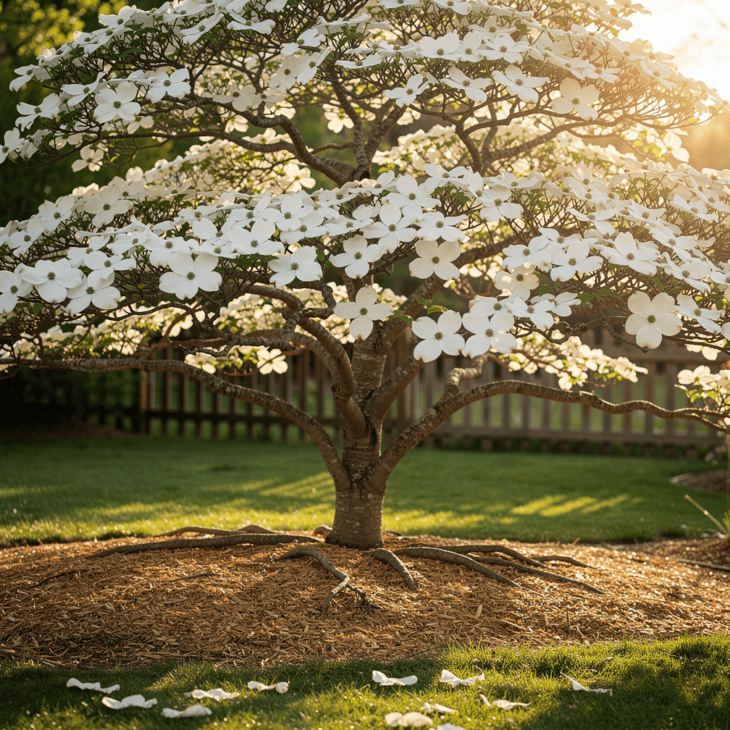
The flowering dogwood is North Carolina’s state flower. It is a small tree, 15 to 30 feet tall, native throughout the state. The white “petals” that open in April are really bracts around a cluster of tiny flowers. Red berries and red-purple foliage follow in fall. It does best in part shade and moist, acidic, well-drained soil.
Southern Magnolia (Magnolia grandiflora)
Read our guide to Southern Magnolia

Southern magnolia is native to the Coastal Plain and widely planted across the state for its large, glossy evergreen leaves. Huge, fragrant white flowers open in late spring and early summer. It grows best in full sun to part shade and tolerates both moist and well-drained soils, including occasional flooding.
Eastern Redbud (Cercis canadensis)

Eastern redbud is a native understory tree, 20 to 30 feet tall, with a rounded crown of horizontal branches. Clusters of rosy-pink flowers cover the bare branches in early spring. The heart-shaped leaves emerge reddish, turn dark green, then yellow in fall. It grows in sun or part shade and most soils.
Crape Myrtle (Lagerstroemia)

Crape myrtle is the South’s signature summer-flowering tree, with crinkly flowers in white, pink, red or purple and smooth, peeling bark. ‘Lipan’ is a mildew-resistant hybrid that grows 15 to 20 feet tall, with lavender flowers and pale bark. Plant crape myrtles in full sun and well-drained soil. Avoid topping them (“crape murder”): it weakens the tree. See our guide to crepe myrtle varieties.
Lily Magnolia (Magnolia liliiflora)

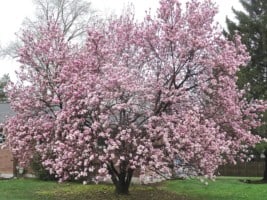
Lily magnolia (also sold as Japanese magnolia, although it comes from China) is a multi-stemmed shrub or small tree, 8 to 12 feet tall. Its upright, slightly fragrant flowers are reddish-purple outside and pale inside, and open in mid-spring. It blooms later than most magnolias, so its flowers are less often caught by frost. It prefers full sun to part shade and moist, rich, slightly acidic soil.
Sasanqua Camellia (Camellia sasanqua)

Sasanqua camellias bloom in late fall and early winter, when little else flowers. ‘Yuletide’ is a compact evergreen, 8 to 10 feet tall, with single bright red flowers and golden stamens around Christmas. Grow it in part shade and moist, rich, acidic, well-drained soil.
Invasive Trees to Avoid
Two non-native flowering trees are now common along North Carolina roadsides and woodland edges. Both are listed as invasive by the NC Invasive Plant Council. Do not plant them, and remove them if you can.
Callery Pear (Bradford Pear) (Pyrus calleryana)

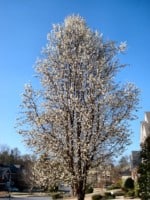
Bradford and other Callery pears cover roadsides with white blossoms in early spring, and the flowers have an unpleasant fishy smell. Named cultivars cross-pollinate and spread thorny wild seedlings that crowd out native trees, and the trees split easily in storms. North Carolina has run bounty programs that give residents a free native tree for each Bradford pear they cut down.
Princess Tree (Paulownia tomentosa)
Read our guide to Princess Tree

Princess tree (also called empress tree) is from East Asia. It grows extremely fast, has huge heart-shaped leaves and bears upright clusters of fragrant lilac flowers in spring. Each tree releases millions of seeds and sprouts back from its roots, so it spreads quickly into disturbed ground and along roads.


.jpg)


