Gardening by the sea is a trade. You get light that no inland garden can match, mild winters, and a view worth every penny, and in exchange the wind flattens your delphiniums and the salt spray browns off anything soft-leaved by August. Fight it and you lose. Work with it and you end up with a garden that looks like it grew there on its own.
Contents
- 01. Plant a Salt-Tolerant Shelter Belt First
- 02. Filter the Wind Instead of Blocking It
- 03. Grow a Dune Garden of Marram and Sea Grasses
- 04. Make a Shingle Bed With No Edges
- 05. Build the Whole Border From Silver Foliage
- 06. Let Sea Holly and Thrift Colonize the Cobbles
- 07. Use Driftwood and Beachcombed Finds as Sculpture
- 08. Carve Out a Sheltered Sun Trap for Sitting
- 09. Plant Grasses in Waves So the Wind Does the Work
- 10. Commit to a Blue, White and Silver Color Scheme
- 11. Let the Timber Weather to Driftwood Grey
- 12. Use Heavy Pots and Low, Tough Planting
- 13. Run a Boardwalk Through the Planting
- 14. Screen With Tamarisk for a Soft, Feathery Wall
- 15. Bank Hydrangeas in the Lee of the House
- 16. Sink a Rock Pool Water Feature
- 17. Grow Vegetables Behind a Windbreak
- 18. Mark the Boundary With Rope and Posts
- 19. Put a Sedum and Thrift Roof on the Shed
- 20. Line a Sunny Wall With Agapanthus
- 21. Group Phormium and Grasses for Architecture
- 22. Sow a Clifftop Wildflower Bank
- 23. Give the Front Garden Shingle and Succulents
- 24. Paint the Shed in Beach Hut Stripes
- 25. Light It Low for Windy Evenings
The 25 ideas below cover the whole range of seaside plots: exposed clifftop gardens that take the full brunt of a gale, sheltered courtyards two streets back from the front, sandy plots that drain in minutes, and small town gardens where the salt arrives on the wind rather than the tide. Some are structural projects (a shelter belt, a boardwalk, a terraced bank), others are a weekend and a bag of shingle.
Read them in order if you are starting from scratch, because the first few solve the problems that make everything else possible. Otherwise, pick the ideas that match the corner of the plot that is giving you trouble.
01. Plant a Salt-Tolerant Shelter Belt First
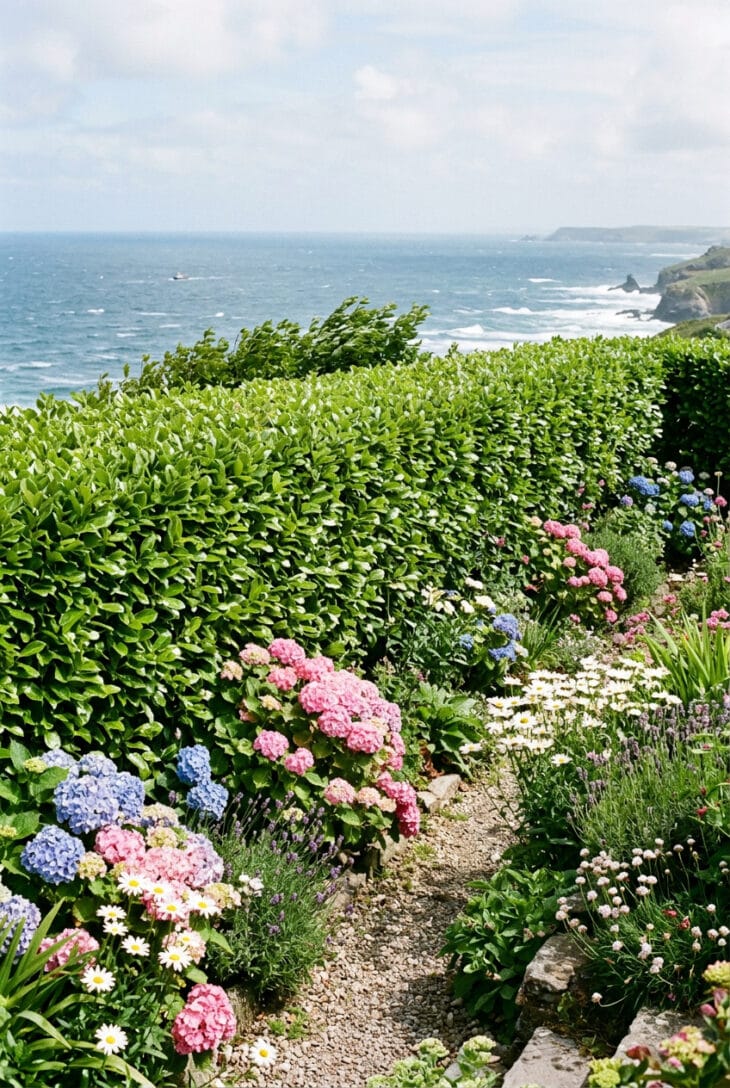
What you see A wall of glossy apple-green leaves along the seaward boundary, chest to head height, with the sea glinting above it. Behind that green wall the garden changes character completely: hydrangeas in pink and blue, white daisies, soft leaves that would be shredded on the other side. The hedge takes the beating so the garden does not have to.
Why it works Almost every coastal planting failure traces back to one thing: the wind arrives loaded with salt, and salt burns leaf tissue on contact. A tough evergreen screen on the windward side strips most of that salt out of the air before it reaches anything precious, and drops wind speed for a distance of roughly ten times the hedge’s height behind it. Everything else in this article gets easier once this is in.
How to get it Griselinia (Griselinia littoralis) is the standard for mild coasts and takes salt spray without flinching. In colder zones use sea buckthorn (Hippophae rhamnoides) or a mixed line of tamarisk (Tamarix ramosissima) and Escallonia. Plant at 24 to 30in (60 to 75cm) spacing, use two-year-old plants rather than large specimens (they establish faster and rock less in wind), and stake nothing that you can instead plant small. Water through the first two summers even in a wet climate, because sandy coastal soil drains faster than you think.
02. Filter the Wind Instead of Blocking It
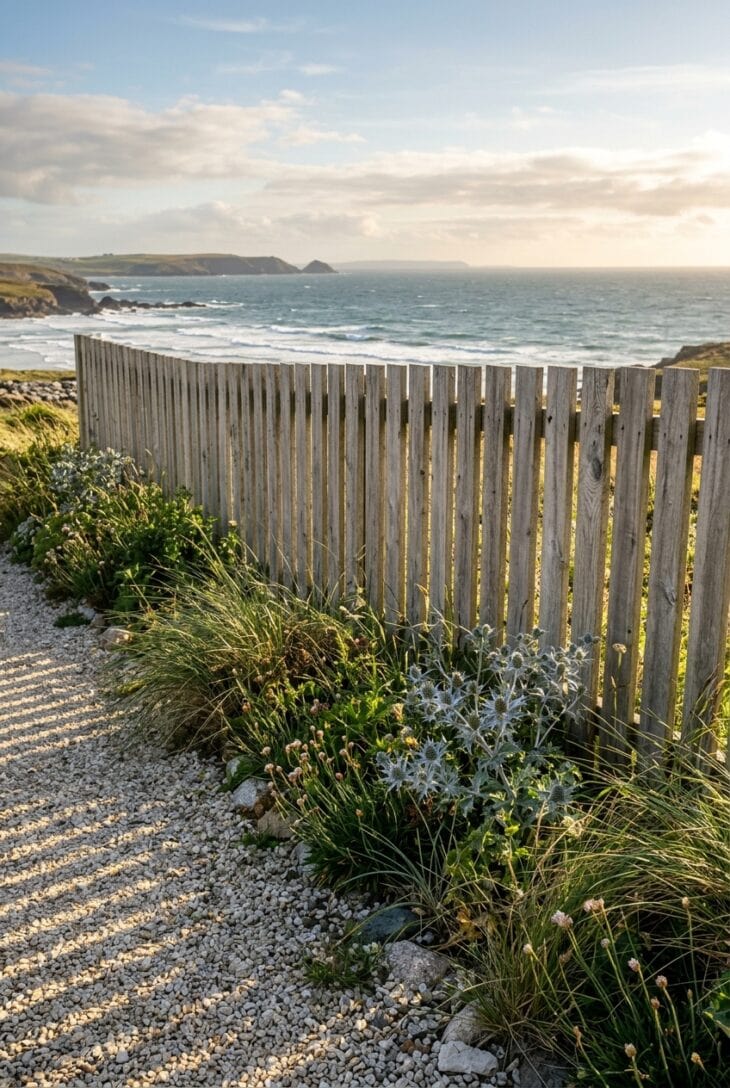
What you see A fence of silver-grey timber slats with a finger’s width of daylight between each board, standing where you would expect a solid panel. Low sun rakes through the gaps and lays stripes of shadow across the gravel. The grasses growing against it lean and recover, lean and recover, but nothing thrashes.
Why it works A solid fence at the coast is a mistake that looks like a solution. Wind hits it, lifts over the top, and slams back down in a violent rolling eddy a few feet behind, which is exactly where you have just planted. A permeable barrier with about 50 percent gap area breaks the wind up instead of deflecting it, and the calm zone behind it is both larger and genuinely calm.
How to get it Aim for boards with gaps roughly equal to the board width. Set posts in concrete and go one size heavier than you would inland, because the loads at the coast are real: 4x4in (10x10cm) posts minimum, 6ft (180cm) into the ground for anything over head height. Use a durable timber (western red cedar, larch, or thermally modified pine) and let it silver rather than fighting it with stain. Woven willow or chestnut hurdles do the same job for less money and look right immediately, but expect to replace them every 7 to 10 years.
03. Grow a Dune Garden of Marram and Sea Grasses
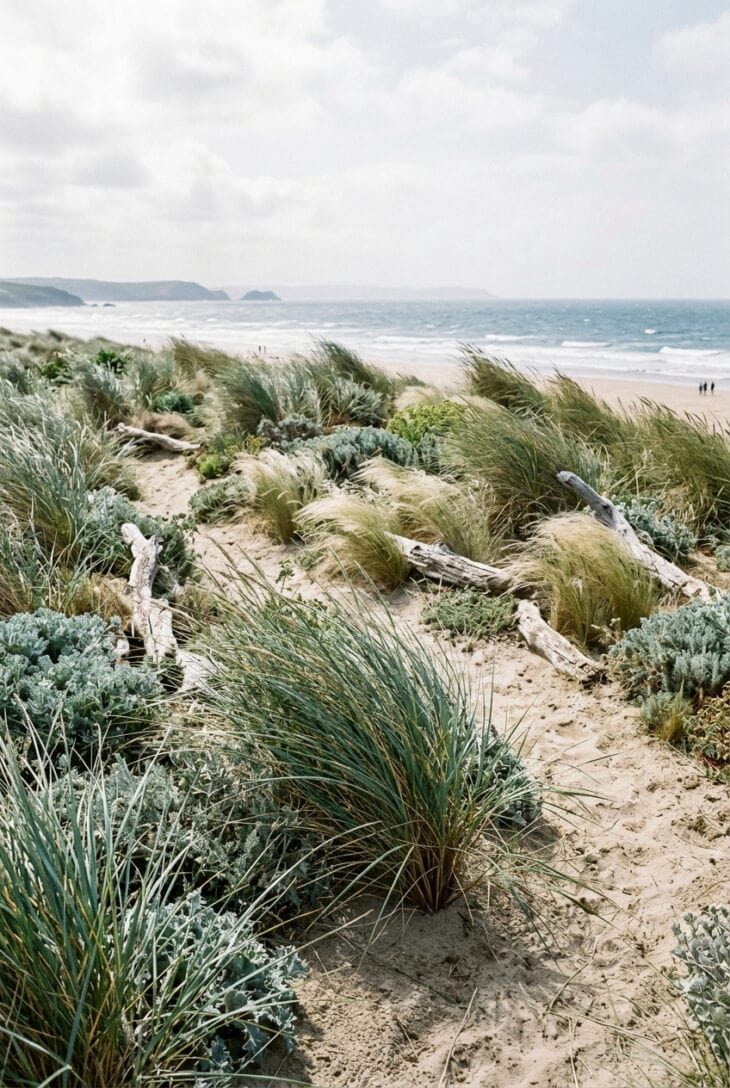
What you see Low mounds of pale sandy soil with grasses growing straight out of them, all leaning the same way in the breeze. Blue-green marram, blond wispy stems that catch the light, and grey mats hugging the ground between. A piece of driftwood lies half buried, as if the sea left it there. It reads as dune, not as border.
Why it works Dune plants evolved for exactly your conditions: sand that holds no water, salt in every breath of wind, and constant movement. Copying the habitat rather than a garden style means the planting is genuinely happy instead of merely surviving, and the movement of grasses turns your worst problem (the wind) into the main event. It also needs no irrigation and no feeding at all.
How to get it Shape gentle mounds 12 to 18in (30 to 45cm) high with sharp sand and grit rather than topsoil, because rich soil will make these plants flop. Plant marram (Ammophila arenaria) or blue lyme grass (Leymus arenarius) as the backbone, with Mexican feather grass (Nassella tenuissima) for movement and sea kale (Crambe maritima) for its glaucous cabbage leaves. Space in irregular drifts, never rows. Note that lyme grass runs hard, so give it room or contain it, and check local rules before planting marram in a genuine dune system.
04. Make a Shingle Bed With No Edges
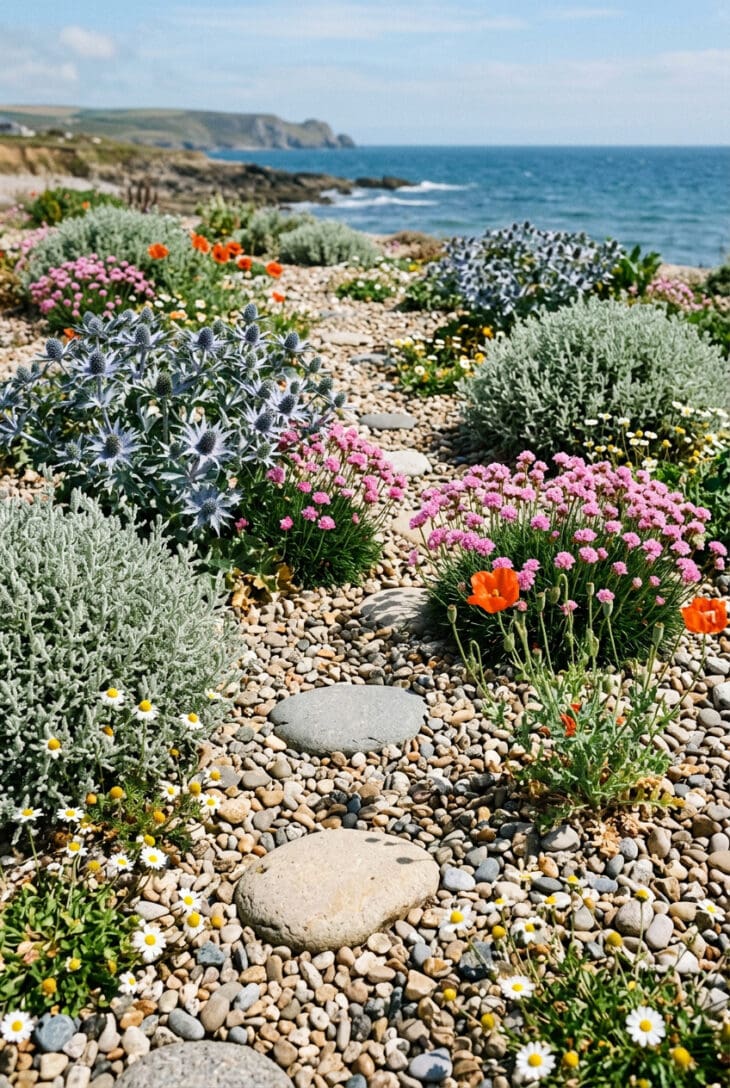
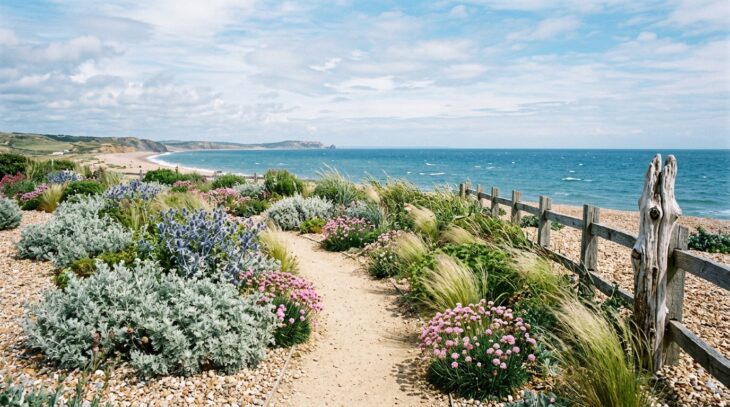
What you see A sheet of grey and buff pebbles with plants pushing up through it and no line anywhere to say where the bed stops. Steel-blue sea holly, tight pink cushions of thrift, silver domes of santolina, an orange-red horned poppy leaning over the stones. Nothing is edged, nothing is staked, and self-sown seedlings are appearing in the gaps.
Why it works Shingle is the coast’s native mulch. It keeps the crown of each plant bone dry (which is what actually kills most of these species in winter, not cold), holds moisture in the cool layer beneath, and stops salt-laden wind from scouring bare soil. Losing the edges is the part that makes it look natural rather than municipal: a bed with a crisp line reads as a bed, and this should read as beach.
How to get it Do not lay membrane. It stops the self-seeding that makes this style work, and weeds root into the shingle on top of it anyway. Instead, spread 3 to 4in (8 to 10cm) of washed shingle straight onto free-draining soil, and plant through it by scraping the stones aside. Use sea holly (Eryngium maritimum), thrift (Armeria maritima), santolina (Santolina chamaecyparissus) and red valerian (Centranthus ruber), and let the plants drift into each other. Weed by hand for the first two years, and after that the shingle largely does it for you.
05. Build the Whole Border From Silver Foliage
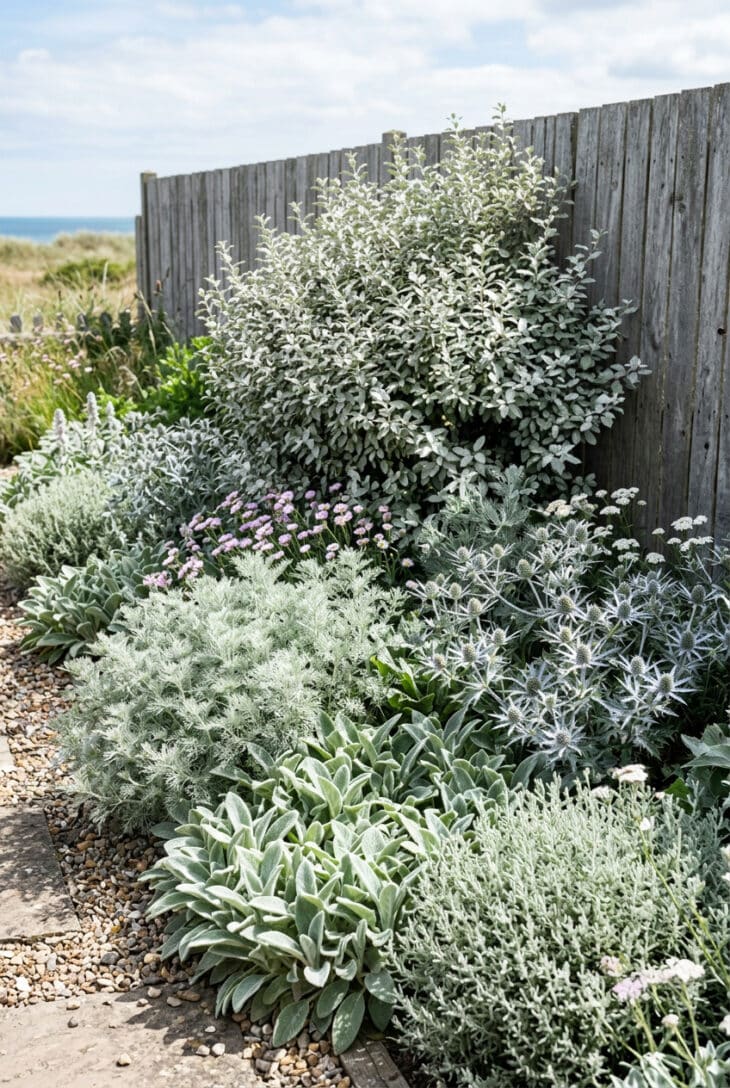
What you see A border with almost no green in it. Felted lamb’s ear at the front, filigree artemisia behind, woolly cotton lavender in mounds, and a big silver-leaved shrub anchoring the back. The flowers are almost an afterthought: small, white, pale mauve. In full sun the whole thing shimmers rather than glows.
Why it works Silver leaves are silver because they are covered in fine hairs or a waxy bloom, and those exist to reduce water loss and reflect fierce light. In other words, every silver plant is already adapted to exactly what a coastal garden throws at it: sun, wind, drought, and salt. The look is a happy accident of the biology, and it sits beautifully against sea, sky and bleached timber.
How to get it Build it from lamb’s ear (Stachys byzantina ‘Big Ears’), artemisia (Artemisia ‘Powis Castle’), cotton lavender (Santolina chamaecyparissus), curry plant (Helichrysum italicum) and, at the back, a silver-leaved shrub such as sea buckthorn or Elaeagnus. Grit the soil hard before planting, because silver plants rot in wet feet far more readily than they burn in drought. Cut artemisia and santolina back by half in mid spring to stop them going woody and splitting open in the middle.
06. Let Sea Holly and Thrift Colonize the Cobbles
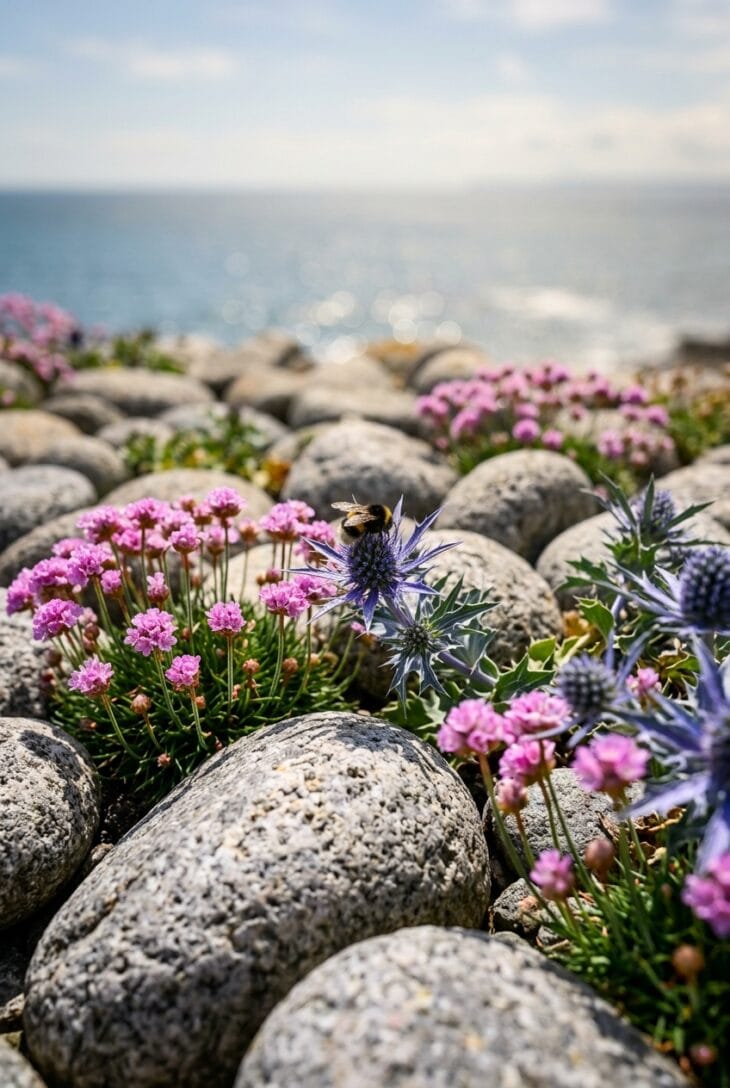
What you see Big rounded cobbles, the kind the tide rolls, with plants living in the cracks between them. Metallic blue sea holly stands up hard and spiky, pink thrift makes tight buttons at ground level, and a bumblebee works the flowers. Behind it all, the sea is a soft blue blur. There is no soil visible anywhere.
Why it works These two are the signature plants of the shingle beach, and putting them where they actually grow in the wild makes the planting look inevitable. The contrast does the design work for you: rigid architectural spikes against soft cushions, cold metallic blue against warm pink, both at a scale that suits the boulders around them. It is also functionally clever, because the cobbles keep the crowns dry all winter.
How to get it Sea holly (Eryngium maritimum) hates being moved: it makes a deep taproot and sulks or dies if you disturb it, so buy small plants or raise from seed and plant them where they will stay. For a taller, showier version use Miss Willmott’s Ghost (Eryngium giganteum), which self-seeds around generously. Thrift (Armeria maritima ‘Splendens’) is far easier and can be split every third spring when the cushions go bald in the center. Bed the cobbles into grit, not soil, and plant into deep pockets between them.
07. Use Driftwood and Beachcombed Finds as Sculpture
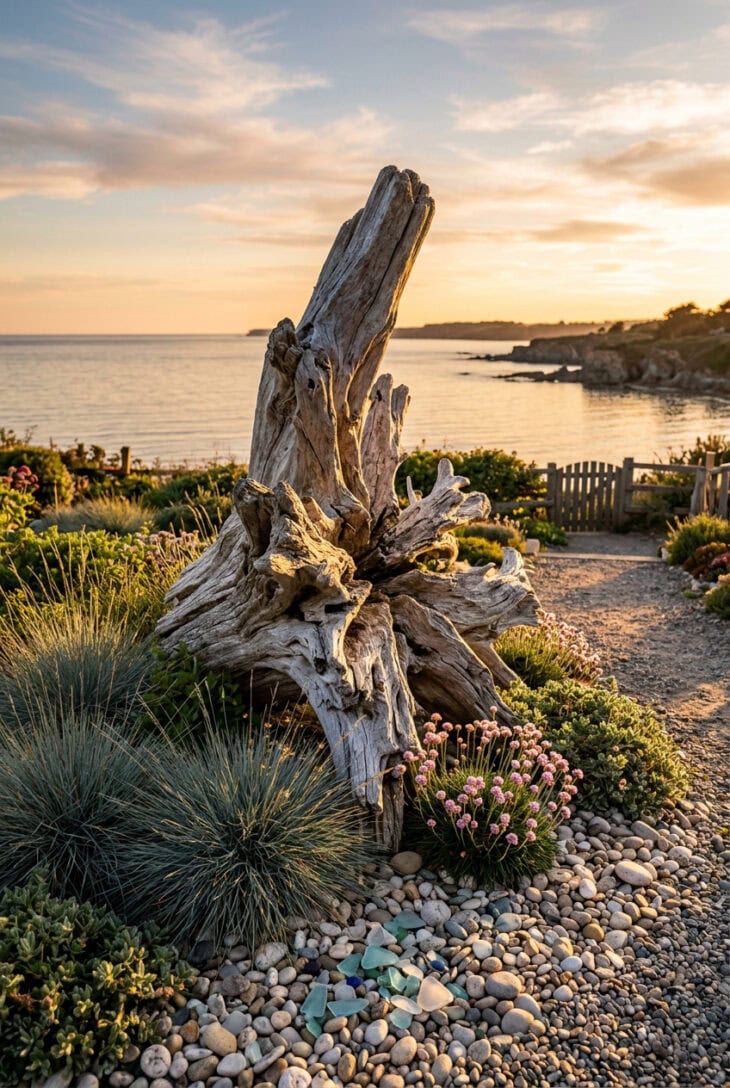
What you see A twisted, silvered root standing upright in the planting like a piece of abstract sculpture, lit gold by the evening sun. Grasses move around its base, thrift cushions sit at its feet, and worn pebbles are scattered around it. It costs nothing and it is the most looked-at thing in the garden.
Why it works A coastal garden is mostly low and horizontal, and it badly needs a few vertical accents that will not be blown apart. Driftwood gives you height with no wind resistance and no maintenance, and its silvered surface echoes exactly the palette of the planting around it. It also carries the one thing money cannot buy in a garden, which is the sense that the place made it rather than a catalogue.
How to get it Collect below the high tide line only, take nothing from a nature reserve or protected shore, and check local collection rules, because many beaches restrict it. Choose pieces with a wide base or a fork you can bury: sink at least a third of the height into the ground and pack grit around it, or it will go over in the first gale. Hose the salt off and let it dry for a few weeks. Do not varnish it. The grey is the point.
08. Carve Out a Sheltered Sun Trap for Sitting
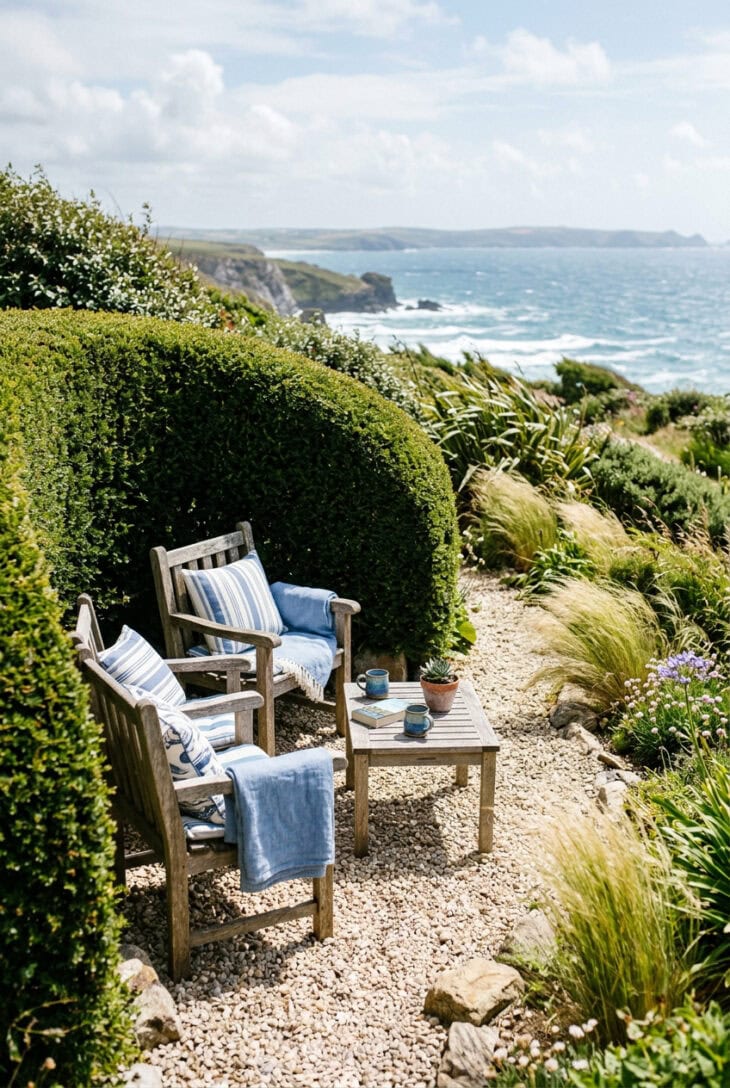
What you see A horseshoe of clipped evergreen wrapped around two weathered chairs and a low table on gravel. Inside the horseshoe the air is still and warm and the cushions are not going anywhere. Outside it, six feet away, the grasses are bending hard. The one gap in the hedge is aimed straight at the sea.
Why it works Most seaside gardens have plenty of view and nowhere you can actually bear to sit for an hour. Enclosing a seat on three sides raises the perceived temperature enormously, often by the equivalent of several degrees, simply by removing wind chill. Framing the view through a single gap makes it stronger, not weaker: a controlled slot of blue beats a panoramic wall of it, because your eye has something to aim at.
How to get it Site it by standing in the garden on a windy day and finding where you naturally want to stand. Build the enclosure from Griselinia, Escallonia or New Zealand holly (Olearia macrodonta), clipped to about 5ft (150cm), which is high enough to shelter a seated person and low enough not to feel like a box. Leave the gap on the leeward side facing the view. Surface with self-binding gravel so chairs sit level, and use furniture heavy enough to stay put unweighted.
09. Plant Grasses in Waves So the Wind Does the Work
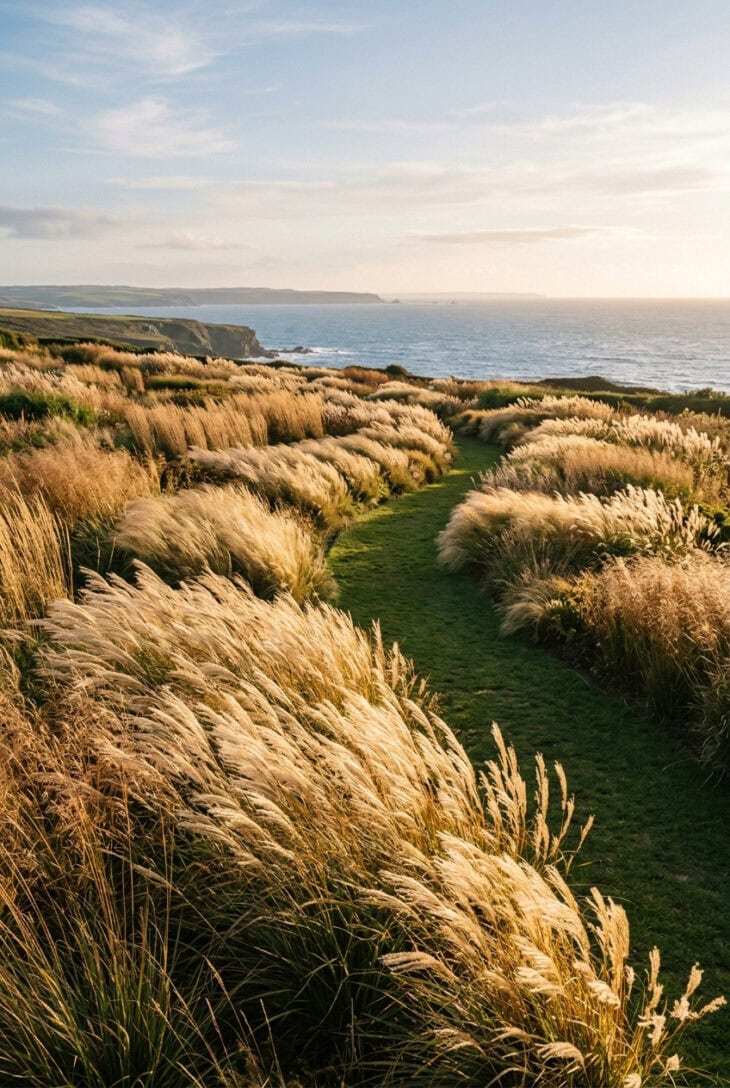
What you see Long curving bands of grass rolling across the plot, one height flowing into the next, every seed head lit from behind and glowing. The wind pushes a ripple across the whole planting and you watch it travel. A mown path cuts a clean line between the drifts. It behaves like water, which is the whole idea.
Why it works Grasses are the one plant group that gets better in wind rather than worse, and at the coast you have an endless supply of it. Planting them in long sweeping drifts rather than dots gives the wind something big enough to visibly move, so the garden animates itself. Backlighting is the other half: site the drifts so you look at them with the low sun behind them, and the seed heads turn to light.
How to get it Use tough, salt-tolerant species: switch grass (Panicum virgatum ‘Heavy Metal’), feather reed grass (Calamagrostis x acutiflora ‘Karl Foerster’) for a strict vertical, and Mexican feather grass (Nassella tenuissima) at the front for the softest movement. Plant in blocks of 5, 7 or 9 of one species, never one of each, at around 18in (45cm) spacing. Cut the deciduous ones to the ground in late February, and simply comb the evergreen ones through with gloved hands. Avoid pampas grass (Cortaderia selloana) unless you have real space, because it is far bigger and sharper than the label admits.
10. Commit to a Blue, White and Silver Color Scheme
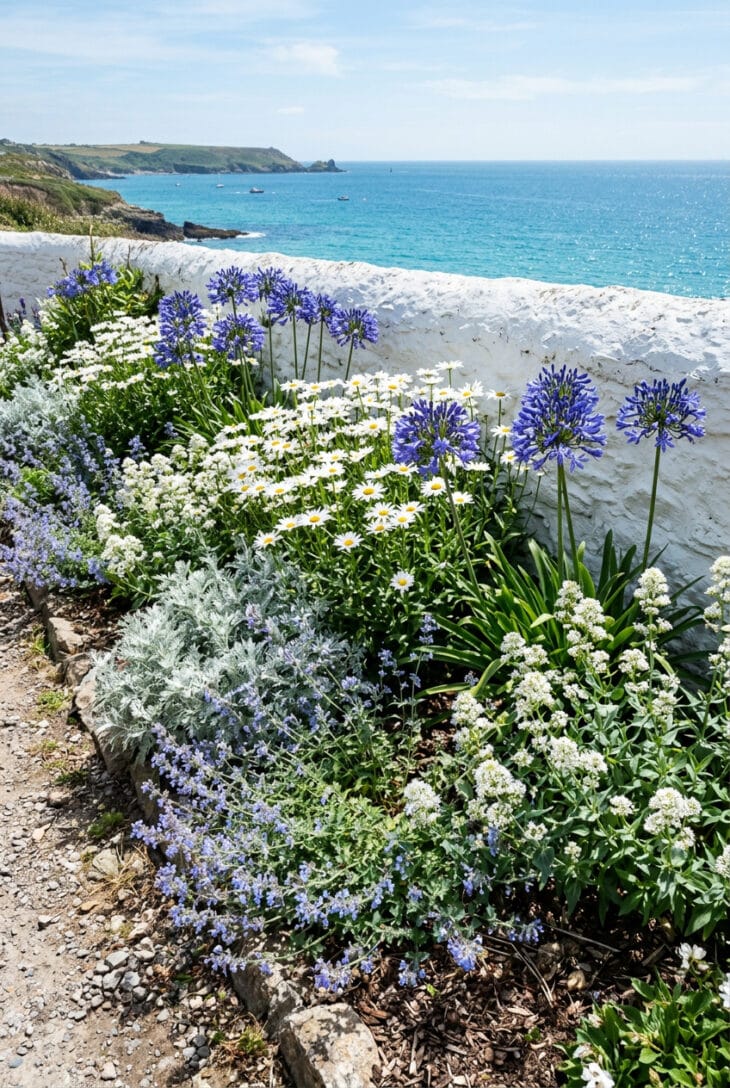
What you see Deep blue agapanthus heads, white daisies, hazy blue catmint and silver leaves, all set against a chalky white wall with the sea behind it. There is no yellow, no orange, no hot pink anywhere. The planting and the water look like they were mixed from the same three tins of paint.
Why it works Coastal light is brutally clear and bright, and it bleaches warm colors to nothing by midday while making cool ones sing. Restricting the palette to blue, white and silver means the garden is working with that light instead of losing to it, and tying the planting to the color of the sea makes a small plot feel like it continues out over the water. Restraint reads as confidence.
How to get it Build it from agapanthus (Agapanthus ‘Northern Star’), catmint (Nepeta racemosa ‘Walker’s Low’), Shasta daisy (Leucanthemum x superbum), white valerian (Centranthus ruber ‘Albus’) and sea holly, with silver artemisia and lamb’s ear as the connective tissue. One rule keeps it honest: allow yourself a single accent color and use it no more than three times in the whole garden. Paint walls and timber in an off-white or pale grey rather than brilliant white, which goes glaring in strong sun.
11. Let the Timber Weather to Driftwood Grey
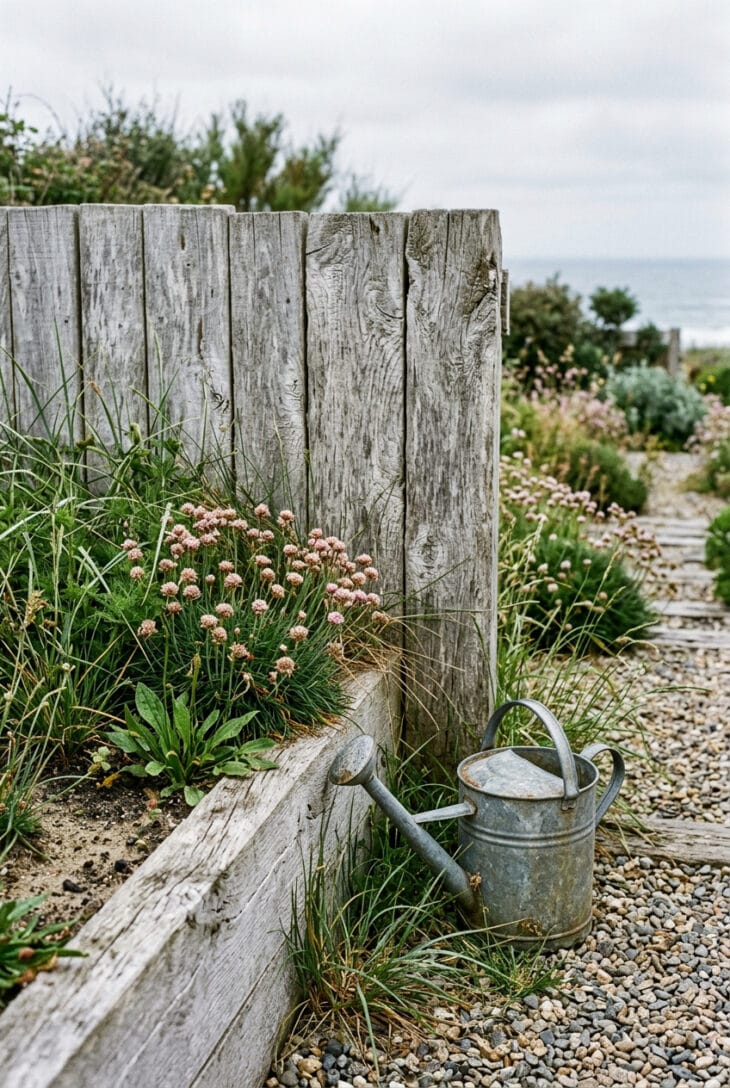
What you see Timber that has gone completely silver, its grain lifted and softened by years of salt and sun, used for both the fence and a low raised bed. Grasses lean against it. A galvanised can sits at the base. Nothing has been painted, stained or protected, and it looks better than anything that has been.
Why it works Salt air destroys paint and stain faster than almost any other environment, so a coastal garden with a painted fence is a garden with a repainting job every second summer. Letting timber silver naturally turns that decay into the finish, and the resulting grey is the exact color of driftwood, shingle and a winter sea. It is the one maintenance decision that saves you work and improves the look at the same time.
How to get it The wood has to be naturally durable, because you are giving up all surface protection: western red cedar, larch, sweet chestnut, oak or thermally modified pine. Avoid softwood that relies on pressure treatment for its life, since it goes a blotchy green-grey rather than silver. Use stainless steel or hot-dip galvanised fixings without exception, as ordinary screws bleed rust streaks within a season. If you cannot wait the two or three years, a grey weathering stain gets you most of the way there immediately.
12. Use Heavy Pots and Low, Tough Planting
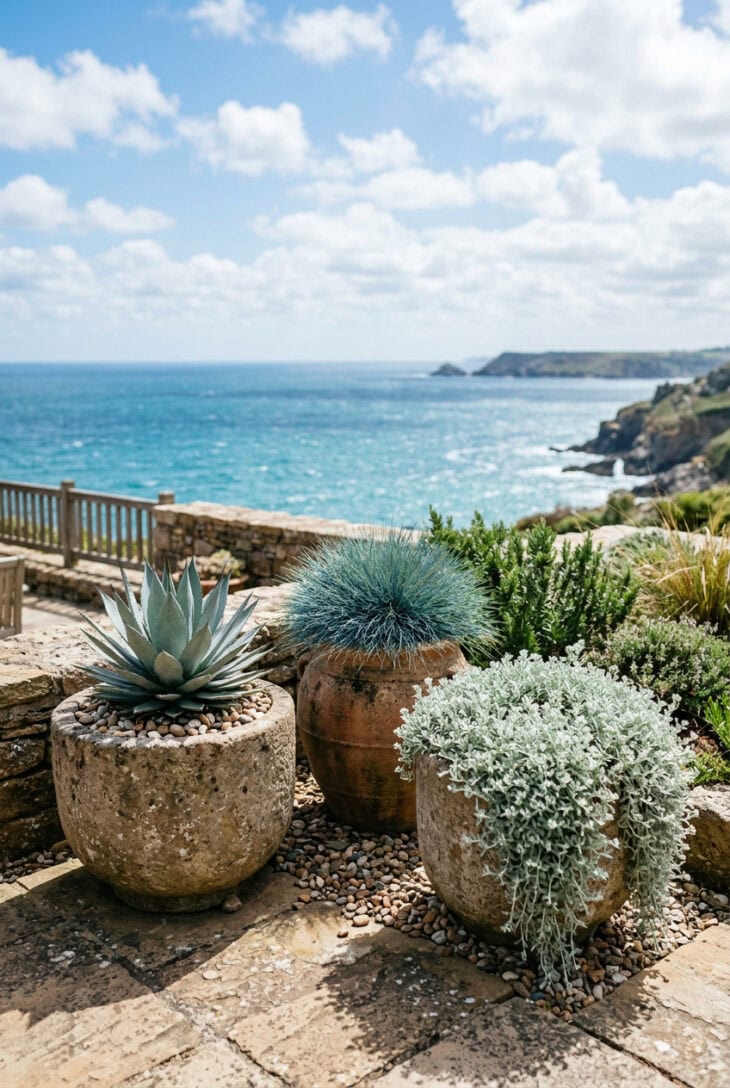
What you see Three squat, wide-bottomed pots in stone and terracotta, grouped on a terrace with the sea behind them. One holds a silver-blue agave, one a tight blue-green mound of fescue, one a trailing silver curtain spilling over the rim. Each is topped with pebbles. Nothing tall, nothing top-heavy, nothing about to go over.
Why it works Containers are the fastest way to plant a paved coastal terrace, and also the fastest way to lose a plant, because a tall pot with a tall plant is a sail on a pedestal. Choosing squat, heavy, wide-based pots and low, wind-tolerant plants removes the leverage entirely. The pebble mulch is not decoration either: it stops the wind stripping the compost surface and slows evaporation on a terrace that bakes.
How to get it Choose pots wider than they are tall, and put a 2in (5cm) layer of gravel or cobbles in the base for ballast before the compost. Use a gritty mix (two parts peat-free compost to one part horticultural grit) because coastal containers dry fast but must never sit wet in winter. Plant agave (Agave americana), blue fescue (Festuca glauca), houseleeks (Sempervivum), New Zealand flax (Phormium ‘Platt’s Black’) and trailing helichrysum. Group pots in threes so they shelter each other, and never place a lone tall pot at a corner where wind accelerates.
13. Run a Boardwalk Through the Planting
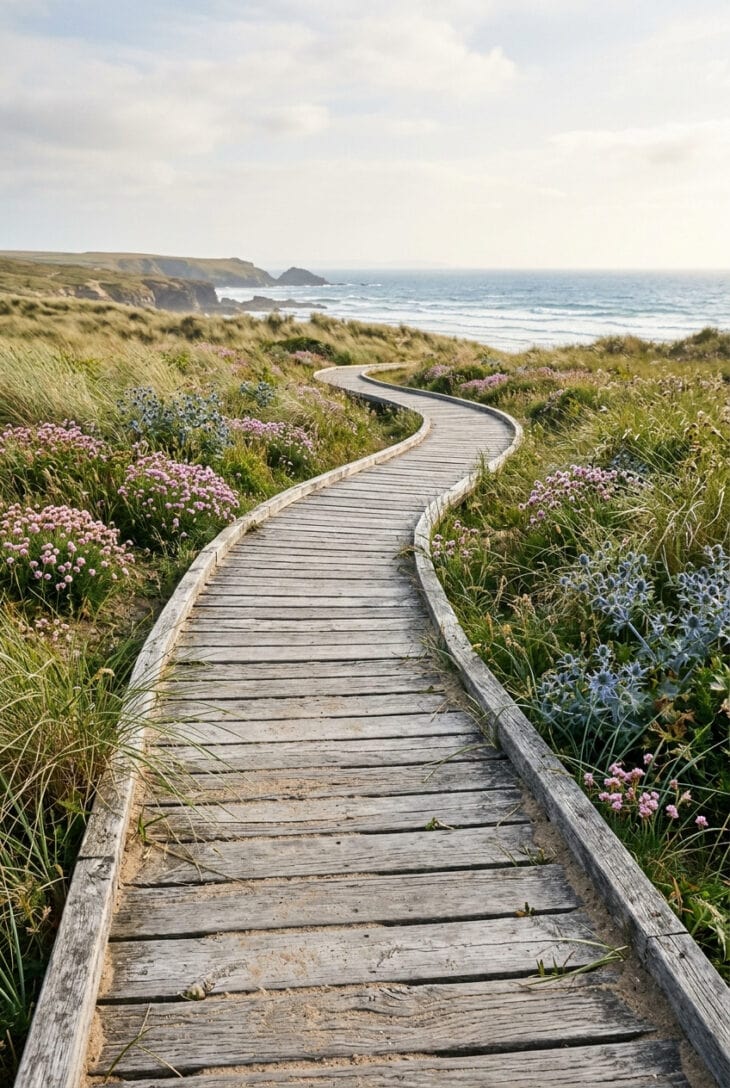
What you see A low timber boardwalk, silvered and slightly sandy, curving away through grasses that lean in over its edges. It sits just clear of the ground, so you walk slightly above the planting. It is pointed at the sea, and it is impossible not to follow it.
Why it works A boardwalk carries every coastal association there is (dunes, jetties, beach access) so it sets the whole garden’s tone with one move. Practically, it is also the right surface for sandy or shifting ground, where a gravel path simply migrates and a paved one cracks as the ground settles. Raising it a few inches lets planting spill over the edges and blur the line, which stops it looking like a walkway bolted onto a garden.
How to get it Build it 36 to 42in (90 to 105cm) wide so two people can pass, on pressure-treated bearers set on gravel pads. Lay the deck boards across the direction of travel, leaving a 1/4in (6mm) gap between them for drainage and sand fall-through. Grooved decking is a trap at the coast because the grooves hold water and grow algae, so use smooth boards and add a strip of grip tape or fine mesh if the site is shaded. Curve it, always: a straight boardwalk shows you everything at once and kills the walk.
14. Screen With Tamarisk for a Soft, Feathery Wall
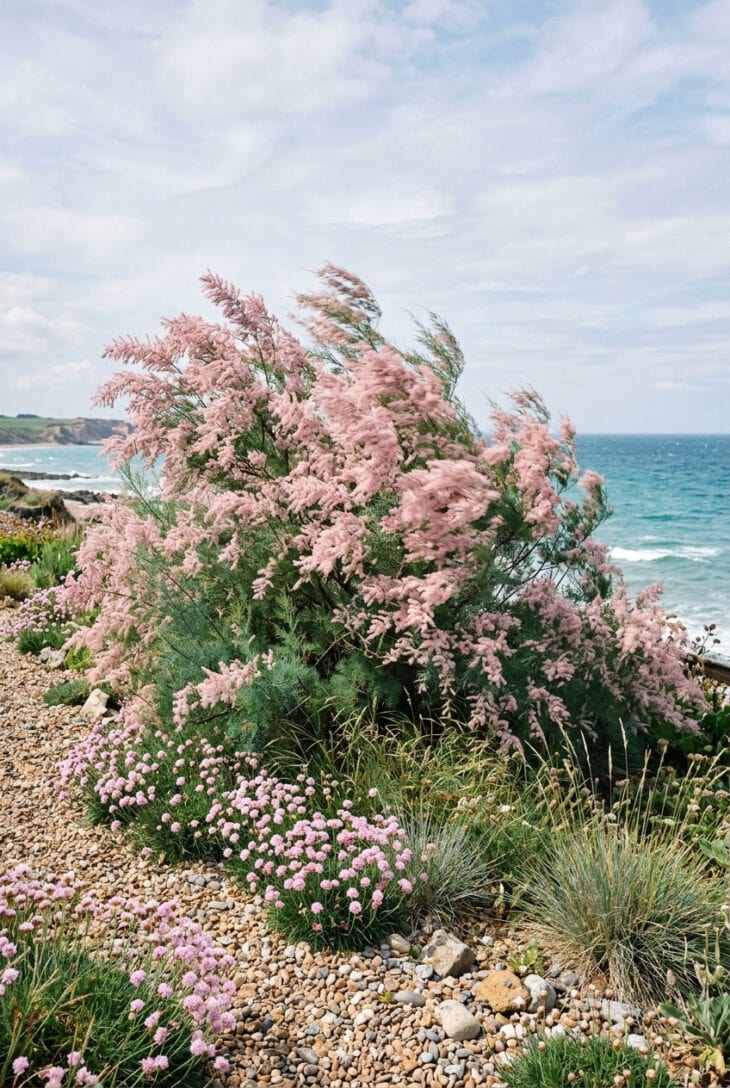
What you see A big airy shrub covered in fluffy pink plumes, so fine that you can see the sea straight through it. The blue-green foliage is barely there, more haze than leaf, and the whole plant moves constantly. Below it, shingle, thrift and grasses. It screens without ever feeling solid.
Why it works Tamarisk is one of the very toughest coastal shrubs, genuinely unbothered by salt-laden gales, and yet it is the least heavy-looking screen you can plant. That combination is rare: most things that survive the front line at the coast are dense and dark. It filters wind exactly as a slatted fence does, softens a boundary, and gives you a long season of pink haze that reads as ornamental rather than defensive.
How to get it Plant tamarisk (Tamarix ramosissima ‘Pink Cascade’) for late summer flower, or Tamarix tetrandra if you want it in May. It will reach 10 to 12ft (3 to 3.6m) and can look gaunt and leggy if left alone, so prune hard: cut late-flowering species back by half to two thirds in early spring, and prune spring-flowering ones straight after they finish. It is happiest in poor sandy soil and resents rich ground. Be aware that some Tamarix species are invasive in the US southwest, so check your state list before buying.
15. Bank Hydrangeas in the Lee of the House
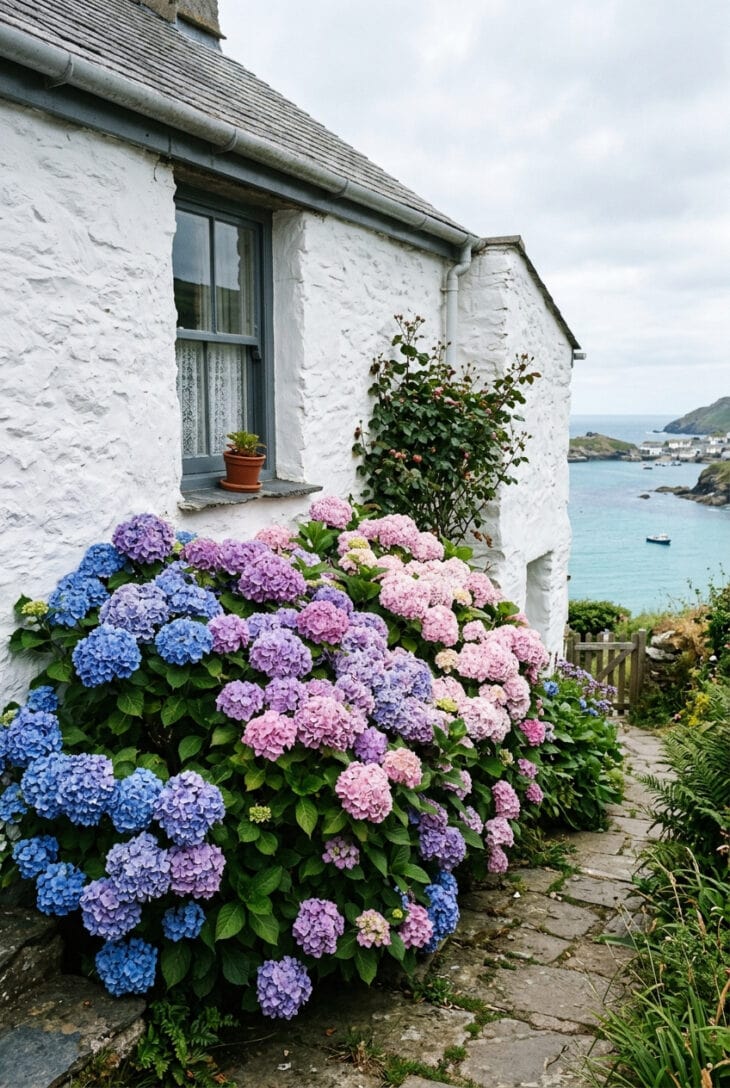
What you see A deep, lush bank of mophead hydrangeas pressed up against the sheltered side of a white house, the flower heads enormous and the leaves a rich green that appears nowhere else in this garden. Blue fades into lilac into soft pink. Around the corner, the bright hard light of the exposed side is visible, and the contrast is startling.
Why it works Hydrangeas are the classic seaside town plant for a reason: they love the mild winters and humid air of a coast, and they are surprisingly salt-tolerant. What they cannot take is a scouring wind on those big soft leaves. Putting them in the wind shadow of the house gives you the one place in a coastal garden where you can grow something genuinely lush, and that contrast with the tough silver planting elsewhere is what makes both look intentional.
How to get it Use mopheads (Hydrangea macrophylla ‘Endless Summer’) for the classic seaside look, or panicle hydrangeas (Hydrangea paniculata ‘Limelight’) if the spot gets more sun, since they take it better. Blue flowers need acid soil below about pH 5.5, so on chalk or limestone expect pink whatever you do, and grow them in pots with ericaceous compost if blue is non-negotiable. Plant 3ft (90cm) apart, mulch thickly, and leave the dead heads on all winter as frost protection, cutting back to the first fat bud pair in early spring.
16. Sink a Rock Pool Water Feature
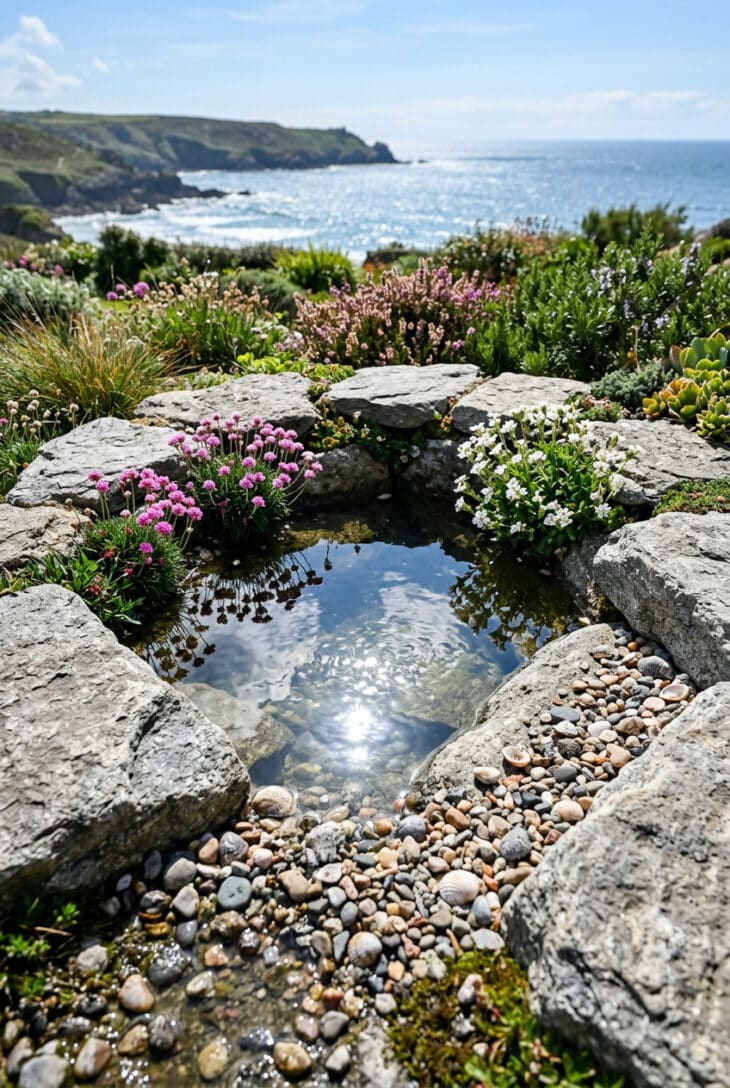
What you see A hollow among big flat grey rocks holding a few inches of clear water, with the sky reflected in it. Pebbles and a few shells are scattered around the rim, and thrift and sea campion have taken root in the crevices. Sunlight breaks into sparkles across the surface. It looks like something the tide left behind.
Why it works A conventional pond is a poor fit for an exposed coastal garden: the wind chops the surface, strips the water, and makes a mess of marginal planting. A shallow rock pool is the coastal answer, reading as a natural feature rather than a garden pond, and it gives you the reflected light and the wildlife (birds bathing, insects drinking) without the fight. It also costs a fraction of a pond and takes an afternoon.
How to get it Either buy a pre-formed shallow stone basin, or make one: dig a saucer 6 to 8in (15 to 20cm) deep, line it with butyl over underlay, and hide the liner edge completely under large flat stones that overhang the water by an inch or two. Slope one side to a shallow beach so birds can bathe and anything that falls in can climb out. Top it up with rainwater from a butt rather than tap water, and lift out fallen leaves rather than treating the water with anything.
17. Grow Vegetables Behind a Windbreak
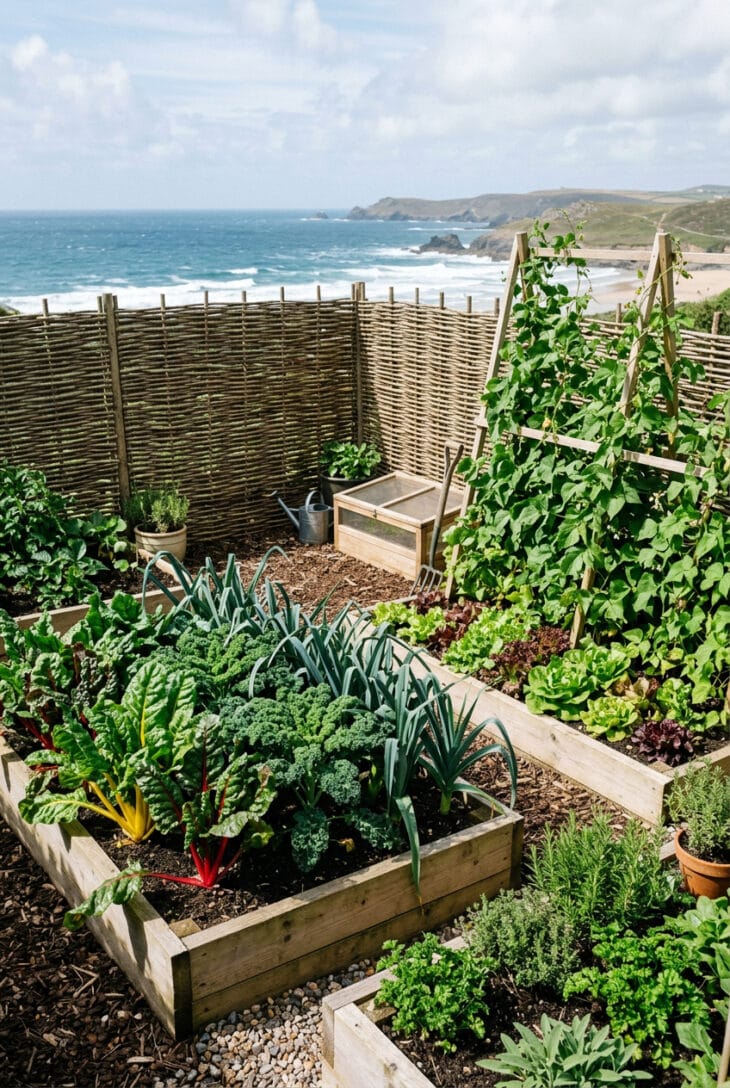
What you see Timber raised beds packed with chard, kale, leeks and climbing beans, all inside a woven willow hurdle screen. The leaves are whole and unblemished, which is the surprising part. Over the top of the windbreak, the sea. This garden is producing food a hundred yards from the water.
Why it works Coastal growing conditions are genuinely excellent for vegetables once the wind is handled: long hours of light, a longer season thanks to the sea’s moderating effect on frost, and free-draining soil that warms early. Wind is the only thing standing between you and a very productive plot, because it shreds leaves, snaps stems and dries the surface faster than you can water. Fix that one variable and coastal veg outperforms inland veg.
How to get it Ring the plot with 5 to 6ft (150 to 180cm) permeable hurdles or a hedge, not a solid fence. Use raised beds to lift roots out of sand and to hold the compost and seaweed you add, and build them 4ft (120cm) wide so you can reach the middle. Grow the naturally tough crops first: kale, chard, leeks, beetroot, broad beans and potatoes all take coastal conditions in their stride. Sandy coastal soil leaches nutrients fast, so feed more often than you would inland, and mulch every bed.
18. Mark the Boundary With Rope and Posts
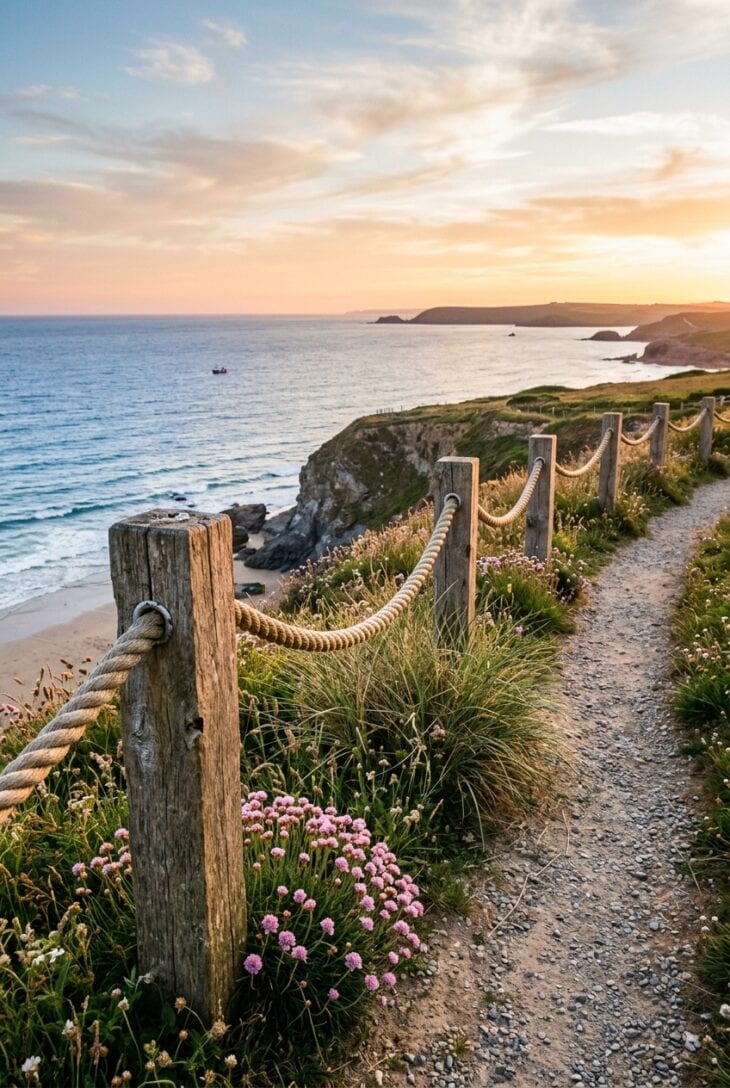
What you see Chunky silvered posts at intervals along the seaward edge, with thick natural rope swagging in easy curves between them. Grasses and thrift grow at their feet. Nothing is blocked, nothing is hidden, and the horizon runs uninterrupted straight through the middle of it.
Why it works When you have a view, the worst thing you can do to a boundary is make it opaque. A rope and post line does everything a boundary needs to do (it says where the garden ends, it stops people wandering off an edge, it gives the eye a rhythm) while taking up almost no visual space and offering the wind nothing to push against. The nautical reference is obvious, which is why it needs a light touch.
How to get it Use posts 6 to 8in (15 to 20cm) in diameter set 6ft (180cm) apart, sunk at least 24in (60cm) into the ground and concreted if the soil is sandy. Natural manila rope looks right but rots at the coast within a few years, so use a synthetic hemp-look rope if you want to fit it once. Let it swag: a taut rope looks like a fence, a hanging curve looks like a harbor. Resist adding lifebuoys, anchors and ship’s lanterns, or the whole garden tips over into theme park.
19. Put a Sedum and Thrift Roof on the Shed
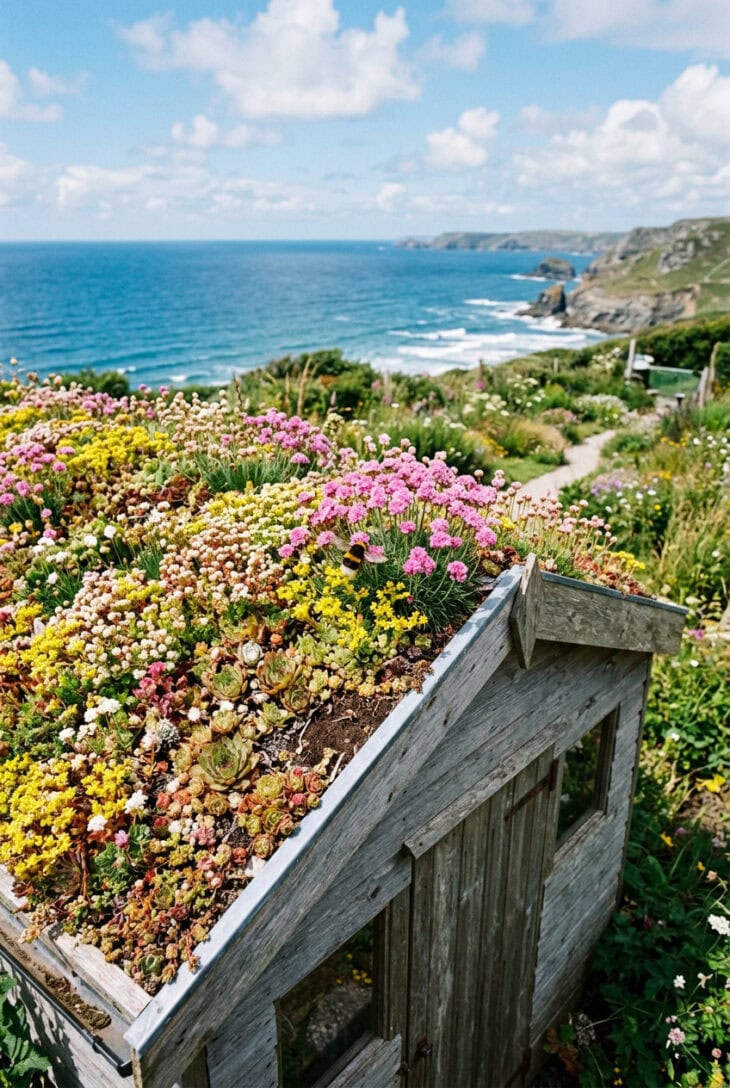
What you see A grey timber shed with its roof completely covered in a low tapestry of fleshy sedums, rosettes of houseleeks and pink thrift in flower. Bees are working the flowers. Looked at from the house, the shed has stopped being a shed and become another piece of planting.
Why it works A green roof is a hostile place to be a plant: thin substrate, blazing sun, no water, constant wind. That is precisely the coastal plant brief, which is why sedums and thrift, which struggle to look happy in a normal border, thrive up there. It also hides the least attractive object in most gardens, insulates the shed, and soaks up rain that would otherwise sheet off the roof onto the ground below.
How to get it Check the structure first: a saturated green roof weighs around 15 to 25lb per square foot (70 to 120kg per square metre), so most sheds need extra rafters or a doubled-up roof deck. Build up a waterproof layer, a root barrier, a drainage layer and 3 to 4in (8 to 10cm) of lightweight substrate (crushed brick and compost, not topsoil), with a timber lip around the edge to hold it in. Lay pre-grown sedum matting for an instant result, then plug in thrift and houseleeks. Water it through the first summer only, then leave it alone.
20. Line a Sunny Wall With Agapanthus
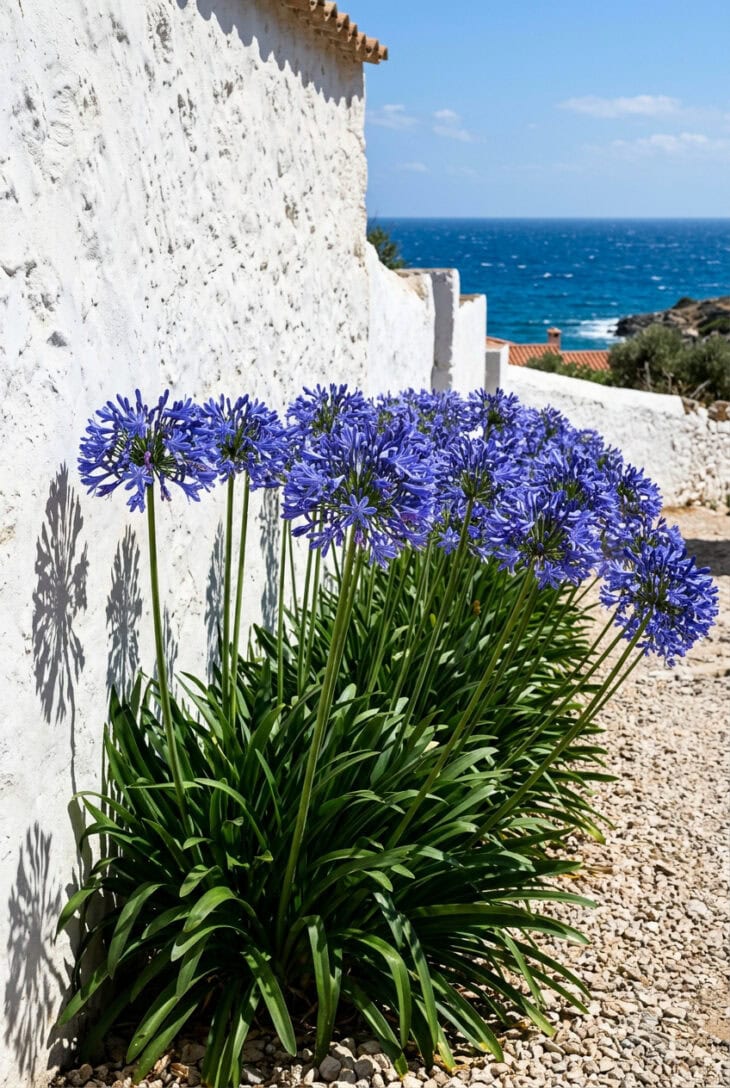
What you see Perfect blue spheres on straight stems, standing in a line along the foot of a whitewashed wall, with strappy green leaves below them and gravel at their feet. The sun is hard and the shadows on the wall are hard, and the blue is the deepest color in the garden. It is the most photographed six feet of many a seaside plot.
Why it works Agapanthus is a coastal plant in every sense: it comes from South African cliffs and slopes, it thrives on baked, sharply drained ground, it is unbothered by salt wind, and it actively flowers better when its roots are crowded and slightly starved. A wall base is usually the driest, hottest, most root-restricted strip in the garden, which is why most plants sulk there and this one performs.
How to get it Deciduous varieties (Agapanthus ‘Headbourne Hybrids’, ‘Northern Star’) are far hardier than the evergreen types and are the ones to grow anywhere with a real winter. Plant with the crown just at soil level in gritty, poor soil, and space at 18in (45cm) so they knit into a solid line. Do not feed with anything high in nitrogen, which gives you a mountain of leaves and no flowers, and do not divide them until they are visibly congested, because they flower best when tight.
21. Group Phormium and Grasses for Architecture
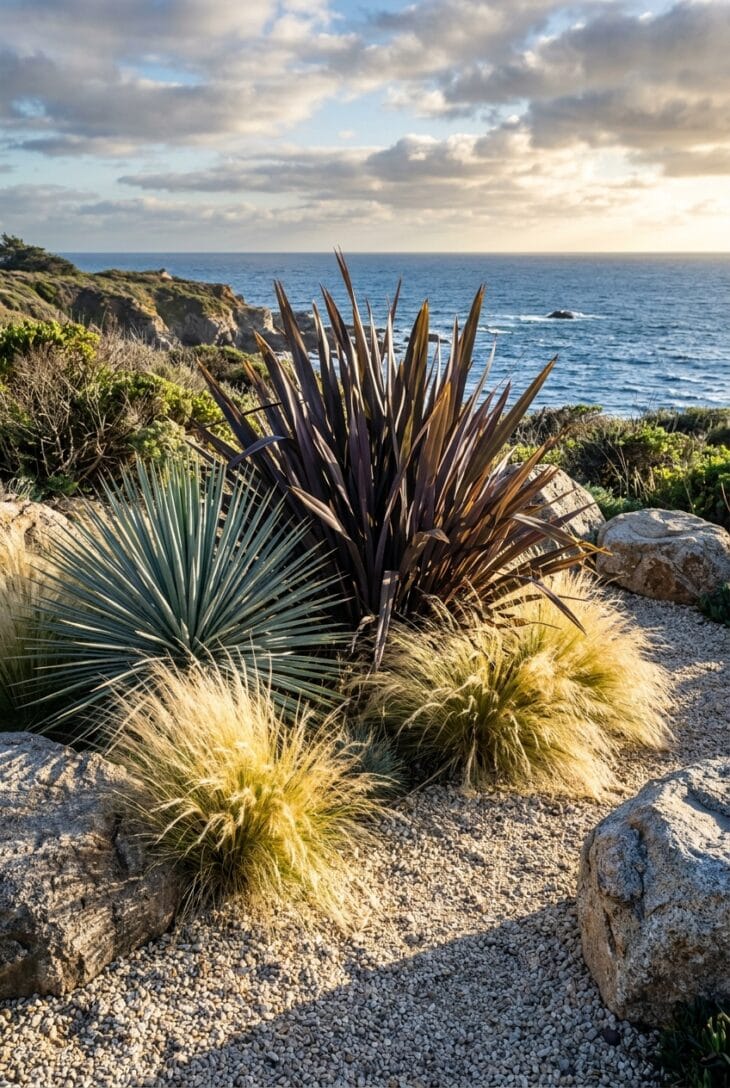
What you see A fan of bronze-purple sword-shaped leaves standing five feet tall, with a spiky silver-blue yucca beside it and a cloud of fine blond grass frothing around both. The whole group sits in pale gravel among a few boulders, throwing hard shadows in the side light. It looks sculpted rather than planted.
Why it works Coastal gardens tend towards mounds, cushions and haze, which is beautiful and can also read as formless. A few strong architectural shapes give the eye somewhere to land and hold the composition together through winter, when the soft stuff has gone. Phormium and yucca are the right plants for the job because their rigid, waxy, narrow leaves are built to shed both wind and salt: they are structural without being fragile.
How to get it Use New Zealand flax (Phormium tenax ‘Purpureum’) for scale or ‘Yellow Wave’ for lighter color, and Yucca gloriosa or Yucca filamentosa ‘Bright Edge’ for the spikes. Plant in sharply drained soil raised slightly above grade, because winter wet at the crown kills far more of these than cold does. Give each one clear space so its silhouette reads, and place them at intervals rather than in a row. Pull dead phormium leaves out from the base by hand rather than cutting them, which leaves an ugly stub.
22. Sow a Clifftop Wildflower Bank
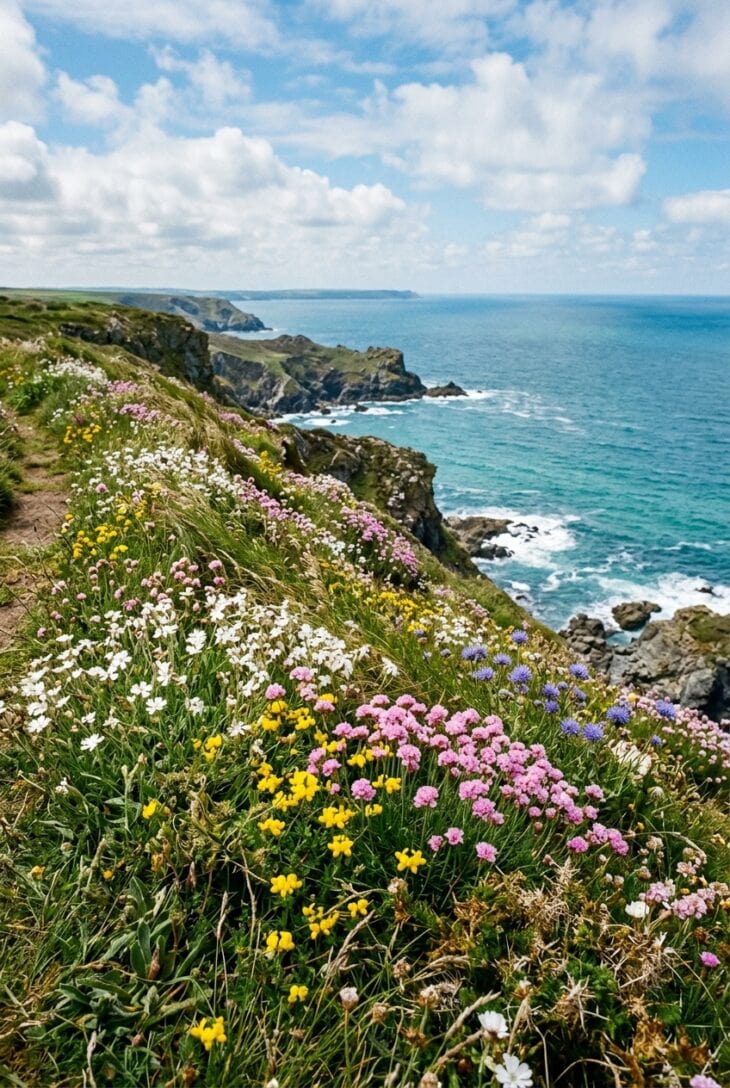
What you see A sloping bank of fine grass shot through with white sea campion, pink thrift, yellow trefoil and little blue scabious heads, all moving in the wind, with the sea a long way below. Nothing is in a group, nothing is in a drift. It is a mixture, and it looks entirely unplanned.
Why it works On a slope, in poor sandy soil, exposed to the full wind, a conventional border is a losing proposition and a lawn is worse. A coastal wildflower turf is the one planting that genuinely wants those conditions, and the poorer the soil the better it performs, because the grasses that would otherwise smother the flowers cannot get going. It also asks for one cut a year and gives you skylarks and bees.
How to get it Success depends entirely on low fertility, so strip off any topsoil rather than improving it, and never feed. Sow a coastal or cliff-specific seed mix in autumn at around 0.15oz per square yard (5g per square metre), rake in, and roll or tread it firm. Add yellow rattle (Rhinanthus minor) to the mix, which parasitizes vigorous grasses and is the single most useful thing you can do for a young meadow. Cut once in late summer after seed has dropped, and rake off all the clippings so the fertility stays low.
23. Give the Front Garden Shingle and Succulents
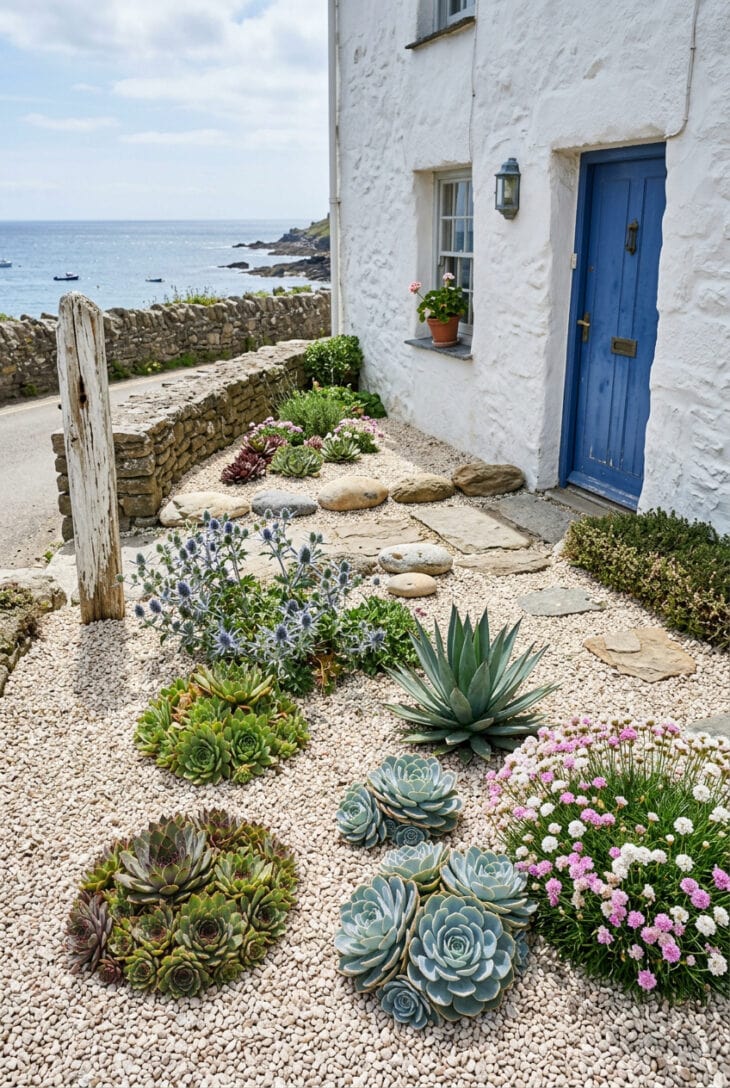
What you see The whole front garden is shingle, with plants set into it like objects on a shelf: rosettes of houseleeks, blue-grey echeveria, one small agave, a few spikes of sea holly, cushions of thrift. A bleached post and some large pebbles give it weight. Behind, a whitewashed wall and a blue door.
Why it works A seaside front garden is usually small, exposed, salty and paved right up to the wall, which is a brief that defeats conventional planting. Shingle plus succulents turns every one of those constraints into an advantage: the plants want the drainage, they want the reflected heat, they are unbothered by salt, and their sculptural forms read clearly at small scale in the way that a fussy mixed border never does. It is also very close to zero maintenance.
How to get it Excavate 6in (15cm), lay 3in (8cm) of coarse grit or crushed shell as a drainage layer, then plant into a gritty mix and top with 2in (5cm) of shingle. Houseleeks (Sempervivum) and stonecrop (Sedum spathulifolium) are reliably hardy; echeveria and aeonium are not, so treat them as summer plants or lift them under cover. Space plants further apart than feels right, because in this style the gravel between is part of the design and closing it up loses the whole effect.
24. Paint the Shed in Beach Hut Stripes
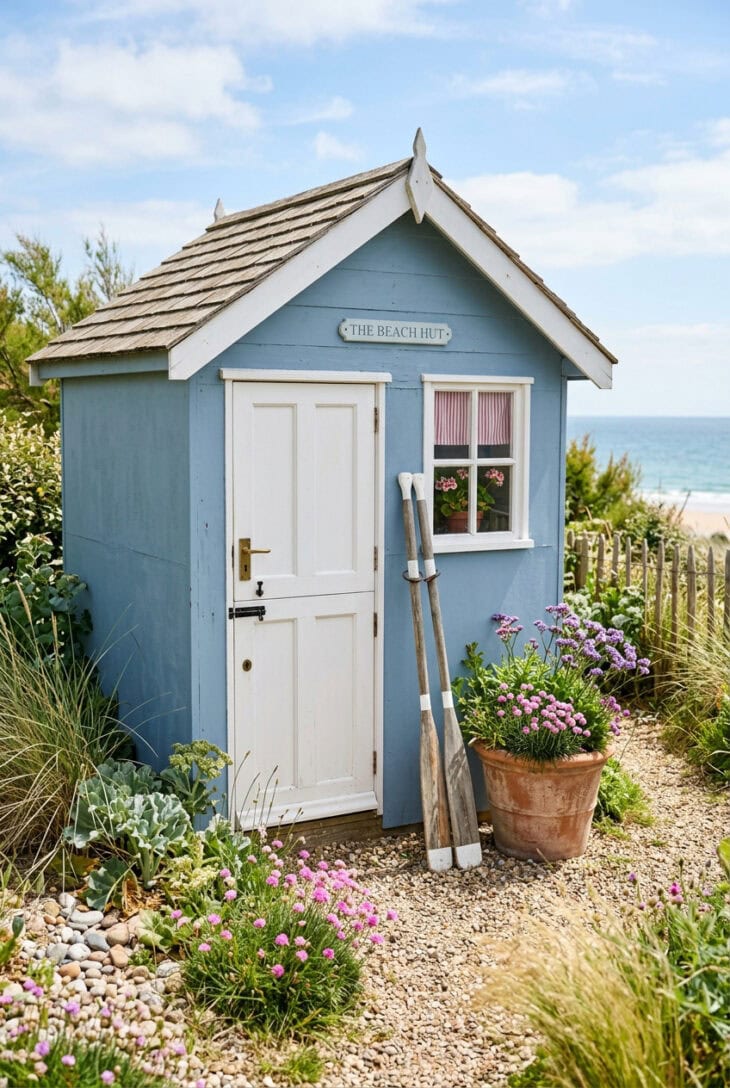
What you see A small shed in chalky pale blue with white door and trim, standing among grasses with a terracotta pot beside it and a pair of oars leaning on the wall. It is unmistakably a beach hut, and it is doing the same job as a beige shed with none of the apology.
Why it works Coastal planting is deliberately muted (silver, blond, grey, blue) and a garden built entirely from those colors can go flat under an overcast sky. One painted structure gives the whole plot an anchor of solid color and a focal point that works in every season, including the six weeks in February when nothing is happening. Picking a color from the sea and sky rather than a jolly primary is what keeps it out of gift shop territory.
How to get it Choose chalky, greyed shades: a soft blue, a pale sage, a warm off-white, or the dark charcoal-blue that looks superb against blond grasses. Use exterior eggshell rather than gloss, which shows every flaw in strong coastal light. Prepare properly, since salt air will find any gap: prime bare timber, paint all six faces of any board before fixing, and expect to repaint every 3 to 4 years on the seaward face and twice as rarely elsewhere. Pick up the same color once more somewhere small (a bench, a gate, a pot) to tie it in.
25. Light It Low for Windy Evenings
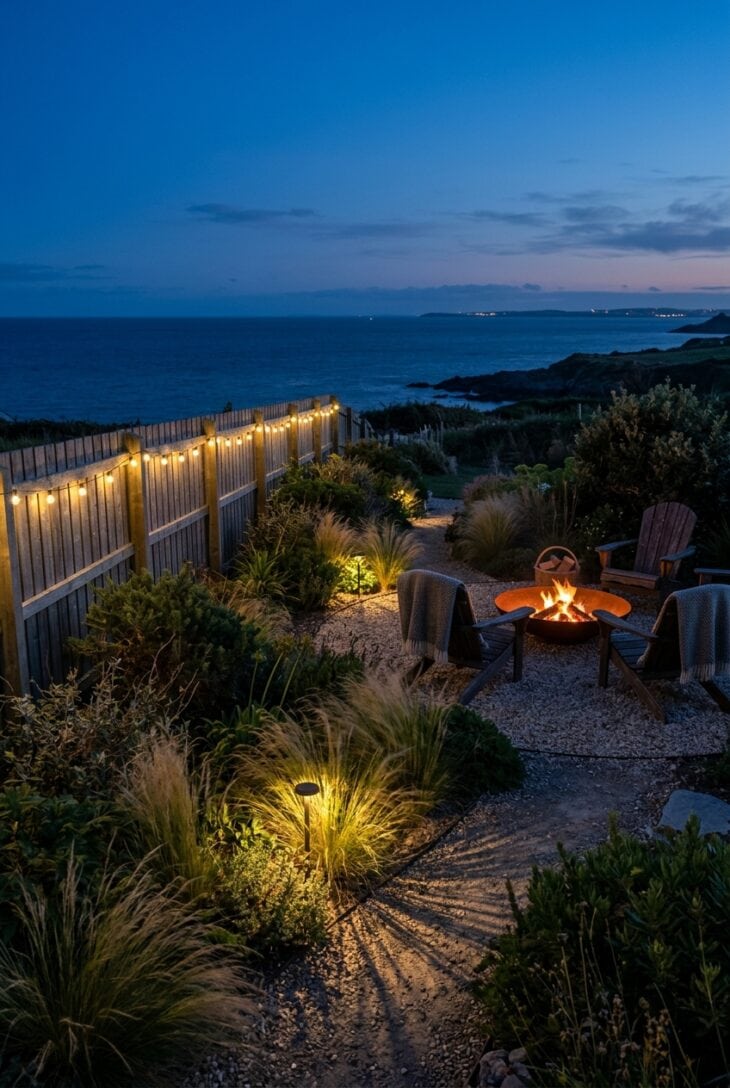
What you see Dusk, a deep blue sky, and the sea gone dark. Small lights sit at ground level and rake sideways across the grasses, throwing their moving shadows up and out. A fire bowl glows in a sheltered gravel circle with two chairs pulled in close. Nothing is bright, nothing glares, and you can still see the stars.
Why it works The best coastal evenings are the ones that are just slightly too cold and windy to be comfortable, and low light plus radiant heat is what tips them over into being lovely. Grazing the light sideways across grasses uses the wind, because everything the light touches is moving. Keeping every fitting low and shielded protects the thing you actually came for, which is a dark sky and a horizon.
How to get it Use warm white (2700K or lower), low-output fittings, and mount them low and aimed away from the eye. Marine-grade 316 stainless or solid brass are the only finishes worth buying at the coast, since ordinary 304 stainless pits and streaks within a couple of seasons. Sink the fire bowl into a sheltered gravel circle so it is out of the wind, keep it well clear of any timber or grasses, and store a fitted cover for it, because salt and rain wreck an uncovered steel bowl in a single winter.