Every yard seems to have one: the low corner that turns to mud, the patch by the downspout that never quite dries, the stretch of lawn that puddles after every storm. A rain garden turns that problem into a planted hollow that catches the water, holds it for a day or two and lets it soak slowly into the ground. Done well, it looks like a flower bed that simply happens to be in the right place.
Contents
- 01. A Downspout-Fed Front-Yard Rain Garden
- 02. A River-Rock Channel from the Downspout
- 03. A Dry Creek Bed That Runs in Storms
- 04. A Prairie Rain Garden in Full Sun
- 05. A Shady Fern Hollow Under Trees
- 06. A Hummingbird Basin of Cardinal Flower and Bee Balm
- 07. A Rain Garden in the Hellstrip
- 08. A Rain Barrel That Overflows into the Garden
- 09. A Pocket Rain Garden for One Downspout
- 10. Stepping Stones Across the Basin
- 11. A Driveway Swale with a Stone Forebay
- 12. Terraced Rain Garden Cells on a Slope
- 13. A Modern Stormwater Planter Beside the Patio
- 14. A Cottage-Style Rain Garden
- 15. A Sedge Meadow That Needs One Mow a Year
- 16. A Four-Season Shrub Rain Garden
- 17. A Rain Garden Anchored by a River Birch
- 18. A Pacific Northwest Rain Garden
- 19. A Southern Basin of Louisiana Iris and Swamp Hibiscus
- 20. A Sunken Desert Basin for Monsoon Rain
- 21. A Pitcher Plant Bog for Ground That Never Dries
- 22. A Rain Chain into a Pebble Basin
- 23. An Edible Rain Garden
- 24. A First-Year Rain Garden from Plugs
- 25. A Fall Finale of Asters and Swamp Sunflowers
The ideas below range from a single downspout basin in a tiny yard to dry creek beds, terraced slopes and street-side strips. There are plantings for sun and for deep shade, for the Midwest, the Pacific Northwest, the Gulf Coast and the desert Southwest, plus a pitcher plant bog for ground that never drains at all. Some cost little more than a tray of plugs and a weekend of digging, while others are bigger projects worth planning over a season.
Scroll through for inspiration, or jump to the ideas that match your light, soil and region. Each one explains why it works and gives you the plants, spacing and digging details to build it, starting with the simple drainage test every rain garden needs.
01. A Downspout-Fed Front-Yard Rain Garden
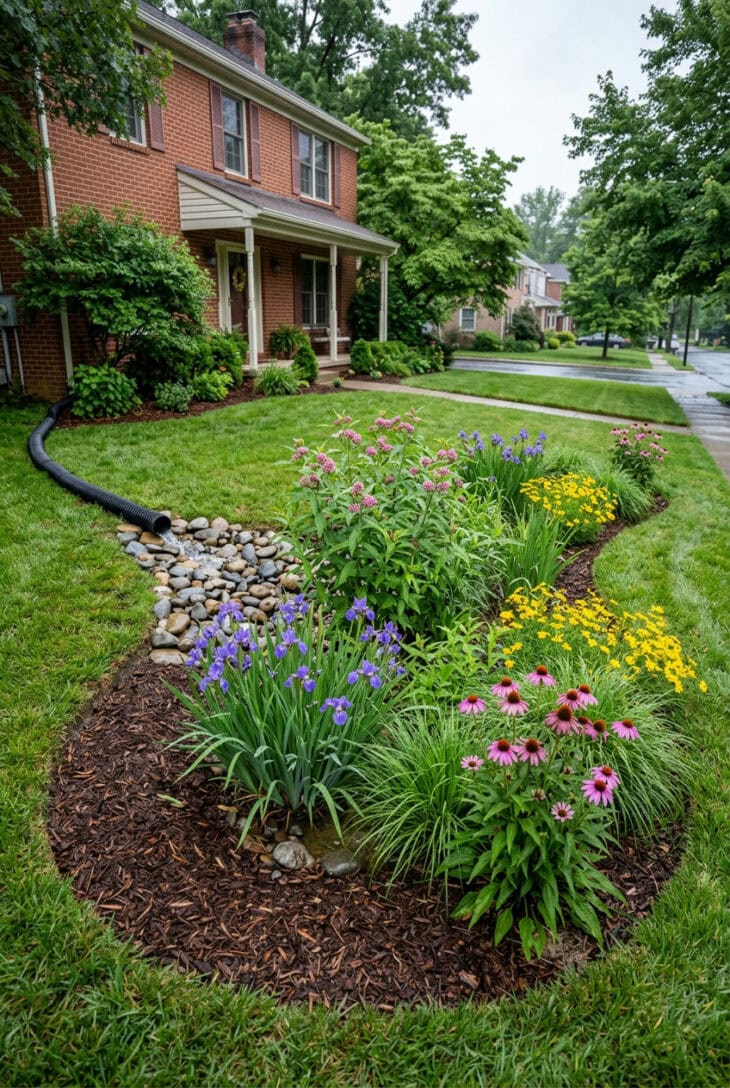
What you see A shallow, kidney-shaped dish in the front lawn catches everything the roof sheds. The downspout disappears under the grass and reappears in a spill of smooth river rock at the top of the basin, where the water slows and spreads. Violet flag irises and pink swamp milkweed stand in the low middle, sedges fill the slopes, and coneflowers and yellow coreopsis line the raised grassy lip on the downhill side.
Why it works A rain garden is simply a planted hollow that holds a storm’s runoff for a day or two while it soaks into the ground, instead of letting it rush down the driveway and into the storm drain. Putting one in the front yard earns twice: it dries out the soggy strip by the foundation and gives the house a flowering bed that looks deliberate rather than like a drainage fix. It is one of the most useful front garden ideas for any house with a downspout aimed at the lawn.
How to get it Site the basin at least 10ft (3m) from the foundation and well away from a septic field, and call 811 before you dig so utility lines get marked. Test the drainage first: dig a hole about 8in (20cm) deep, fill it with water and check that it empties within 24 hours. Make the garden roughly a fifth to a third of the roof area draining into it (the larger figure for clay), dig it 4 to 8in (10 to 20cm) deep with a level floor, and use the spoil to build a low berm on the downhill side. Put the most wet-tolerant plants, such as blue flag iris (Iris versicolor) and swamp milkweed (Asclepias incarnata), in the bottom, and tougher, drier plants like threadleaf tickseed (Coreopsis verticillata) on the berm. Choose the native blue flag, not yellow flag iris (Iris pseudacorus), which is invasive in American wetlands.
02. A River-Rock Channel from the Downspout
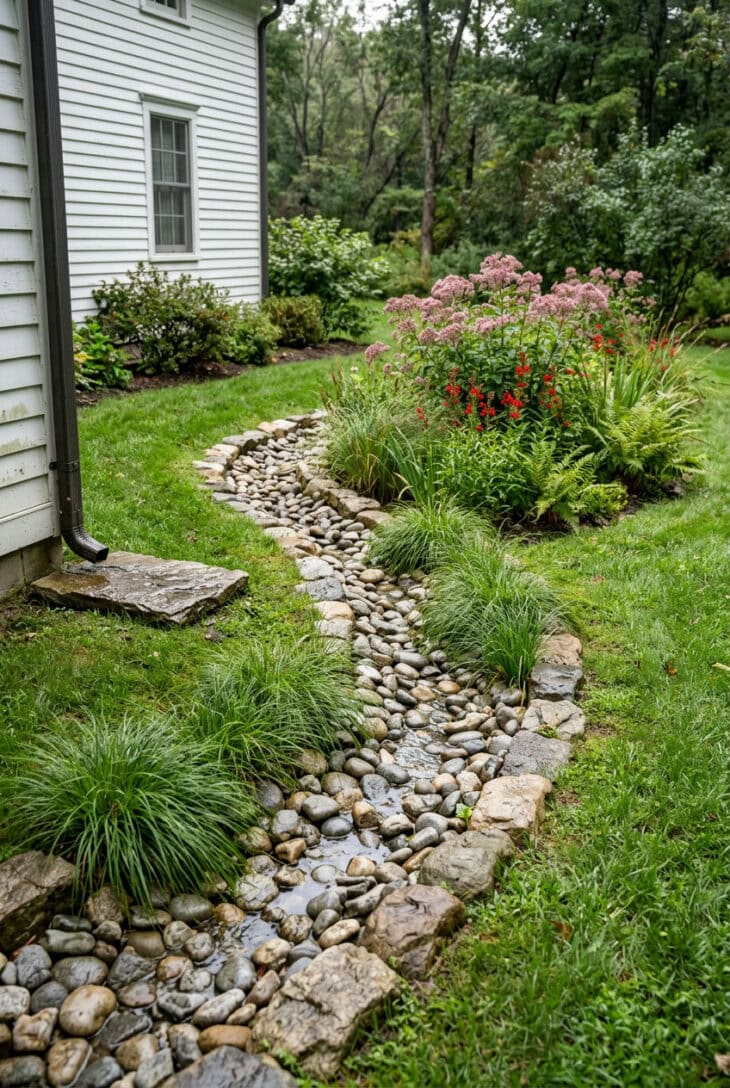
What you see Instead of a buried pipe, the downspout empties onto a flat splash stone, and the water runs off through a shallow channel of rounded river rock. Fine sedges soften its edges as it crosses the lawn, and at the far end it opens into a basin of tall pink Joe Pye weed and scarlet cardinal flower. After a storm the stones glisten, and you can see the water going exactly where you sent it.
Why it works A rock channel shows off its job, which is half its charm, and the stones do real work: they slow the water, stop it cutting a gully and let grit settle out before it reaches the planting. It is also cheaper and easier to fix than a buried pipe, which can clog with leaves and has to be dug up to clear. On dry days it reads as a little stream bed winding across the grass.
How to get it Dig a trough 6 to 8in (15 to 20cm) deep and 12 to 18in (30 to 45cm) wide, with a steady fall of at least 1in over 8ft (2.5cm over 2.4m) toward the garden. Line it with woven landscape fabric so the stones do not sink into the soil, set cobbles of 4 to 8in (10 to 20cm) along both sides, and fill the middle with 2 to 3in (5 to 8cm) river rock. Put a big flat stone under the downspout to take the force of the water. Where the channel meets the basin, add a small apron of larger stones so the flow fans out instead of scouring the mulch. Rake leaves out of the channel each fall, since a leaf dam will send water straight back toward the house.
03. A Dry Creek Bed That Runs in Storms
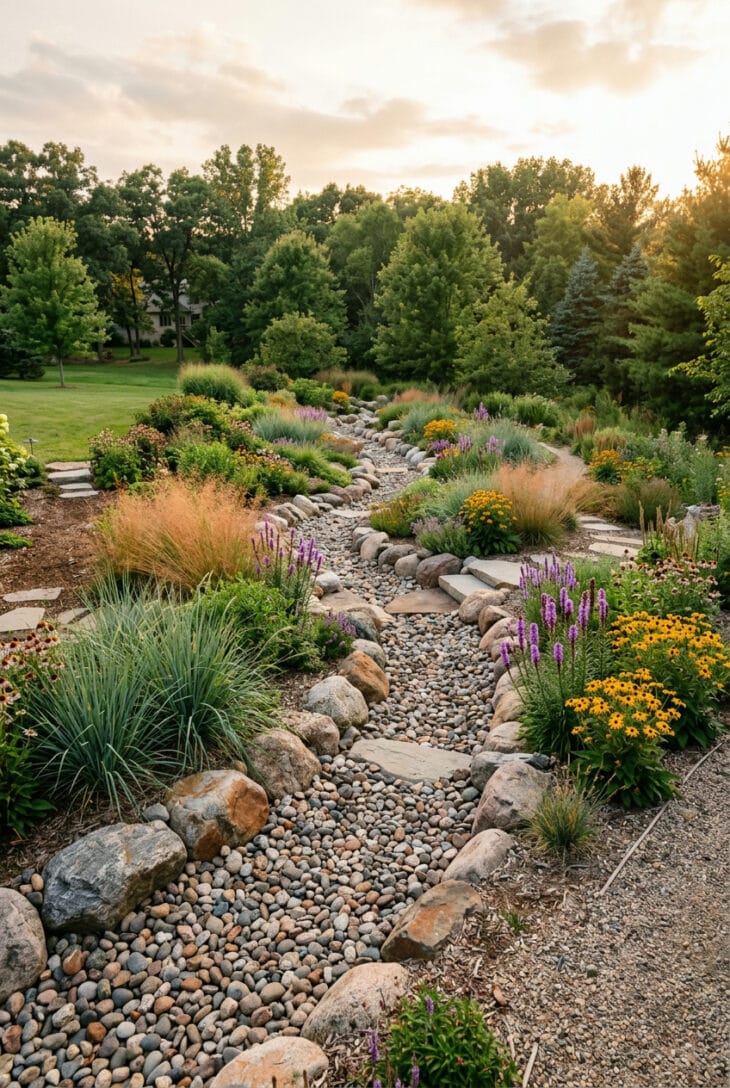
What you see A stream bed of gray, rust and tan river rock snakes down the yard, widening at the bends where rounded boulders sit half-buried in the stones. Switchgrass and little bluestem lean over its banks, with purple blazing star and gold black-eyed Susans in between. Most days it is dry and simply handsome; in a thunderstorm, it runs.
Why it works A dry creek carries runoff across a long stretch of yard, which suits a property where water sheets across the lawn rather than pouring out of one downspout. The curves slow the flow, and the boulders at each bend take the force where the water would otherwise cut into the bank. It is the most natural-looking of all the drainage fixes, and it draws on the same stone and grass palette as a gravel garden.
How to get it Follow the route the water already takes, then dig a shallow trough about 2 to 3ft (60 to 90cm) wide and 8 to 12in (20 to 30cm) deep. Mix your stone sizes, from pea gravel up to boulders of 18in (45cm) or more, because a creek of uniform stones looks like a driveway. Bury each boulder by about a third of its height so it looks settled rather than dropped in place. End the creek in a planted basin or an open spot where water can soak in, never against a neighbor’s fence. Hold the banks with deep-rooted natives such as switchgrass (Panicum virgatum ‘Shenandoah’) and little bluestem (Schizachyrium scoparium), with blazing star (Liatris spicata) for summer color.
04. A Prairie Rain Garden in Full Sun
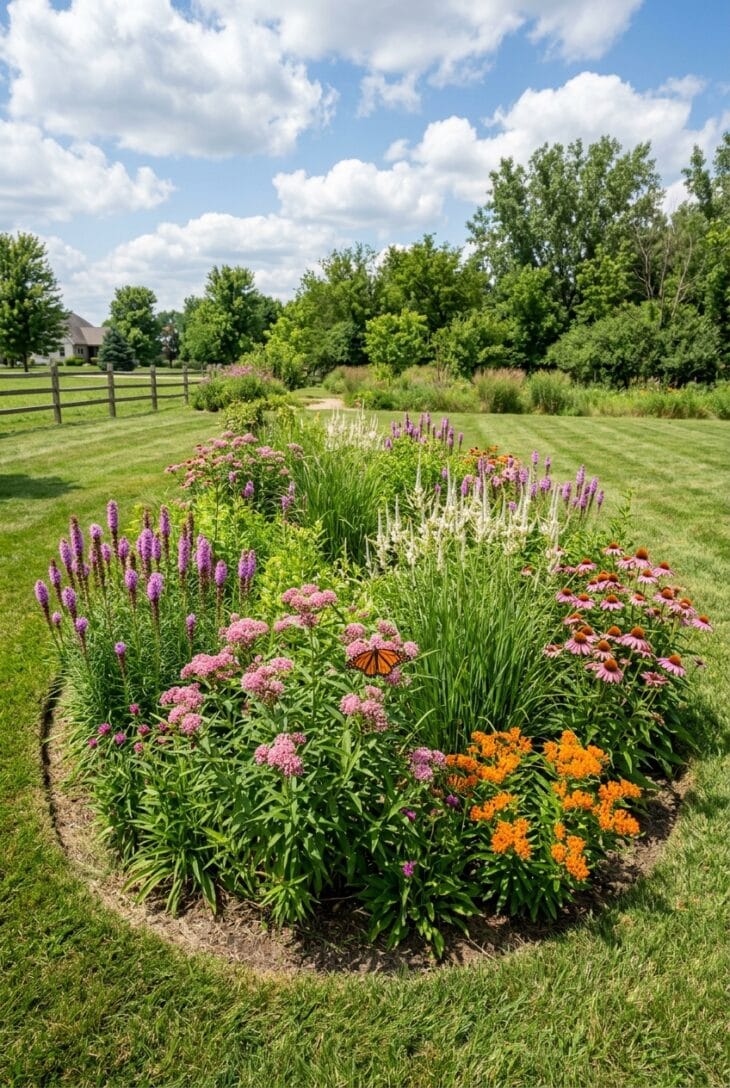
What you see Out in the open lawn, an oval of wet prairie stands chest-high in July. Rosy spikes of prairie blazing star, white candelabras of Culver’s root and pink swamp milkweed rise from the low middle, while coneflowers and orange butterfly weed crowd the drier rim. Monarchs work the milkweed, and clumps of switchgrass sway in the wind.
Why it works Prairie plants are the backbone of Midwest rain gardens because their roots reach several feet down, opening channels that help water sink into heavy soil. They shrug off both a soaking spring and a bone-dry August, which is exactly the swing a rain garden goes through every year. And because nearly every flower here is native, the basin doubles as a pollinator garden for bees and butterflies.
How to get it Plant in zones: prairie blazing star (Liatris pycnostachya), swamp milkweed and Culver’s root (Veronicastrum virginicum) in the bottom, switchgrass (Panicum virgatum ‘Northwind’) on the side slopes, and purple coneflowers (Echinacea purpurea) with butterfly weed (Asclepias tuberosa) on the rim, where the soil dries fastest. Set perennials 12 to 18in (30 to 45cm) apart and grasses 24in (60cm) apart. Expect a thin first year while the natives build roots; they fill in fast in years two and three. Leave the stems standing over winter and cut everything down to 4 to 6in (10 to 15cm) in early spring. Skip prairie cordgrass (Spartina pectinata) in anything but a very large garden, because it spreads hard by runners.
05. A Shady Fern Hollow Under Trees
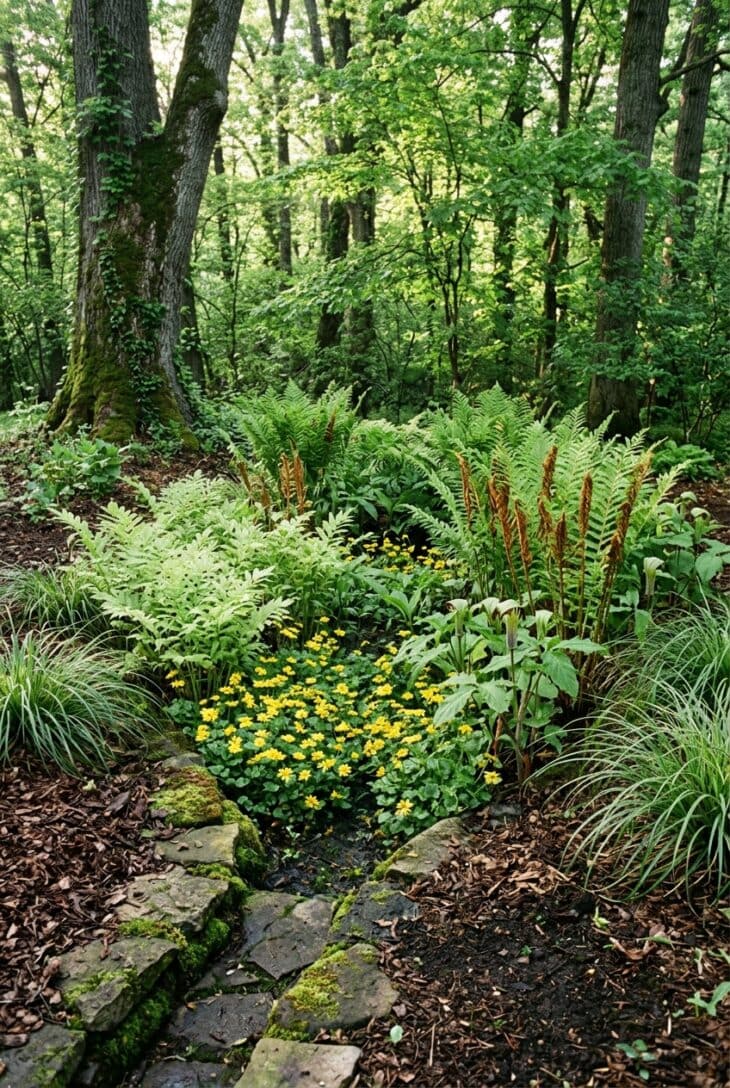
What you see Under the oaks, a shallow hollow is thick with ferns: pale sensitive fern, upright cinnamon fern with its rusty fertile fronds, and arching sedges spilling over the edge. In late spring the low middle turns yellow with golden ragwort, and a few hooded Jack-in-the-pulpits hide among the fronds. Mossy stones mark the spot where the water comes in.
Why it works Rain gardens do not need sun. Woodland plants that grow along streams and in wet hollows are made for this cycle of flood and dry, and the trees help too, drinking water from the surrounding soil between storms. The result turns a damp, dark corner where nothing else grows into one of the calmest spots on the property, and it fits right in with other shade garden ideas.
How to get it Dig by hand and keep the basin shallow, 4 to 6in (10 to 15cm), so you cut as few tree roots as possible; never sever a root thicker than 2in (5cm), and keep outside the drip line where you can. Plant sensitive fern (Onoclea sensibilis) and cinnamon fern (Osmundastrum cinnamomeum) in the bottom, with golden ragwort (Packera aurea) as a spreading groundcover that flowers in April and May. Tuck Jack-in-the-pulpit (Arisaema triphyllum) and palm sedge (Carex muskingumensis) along the slopes. Mulch with shredded leaves, which suit the setting and feed the soil as they break down. Sensitive fern spreads freely, so give it room or pair it with clump-formers.
06. A Hummingbird Basin of Cardinal Flower and Bee Balm
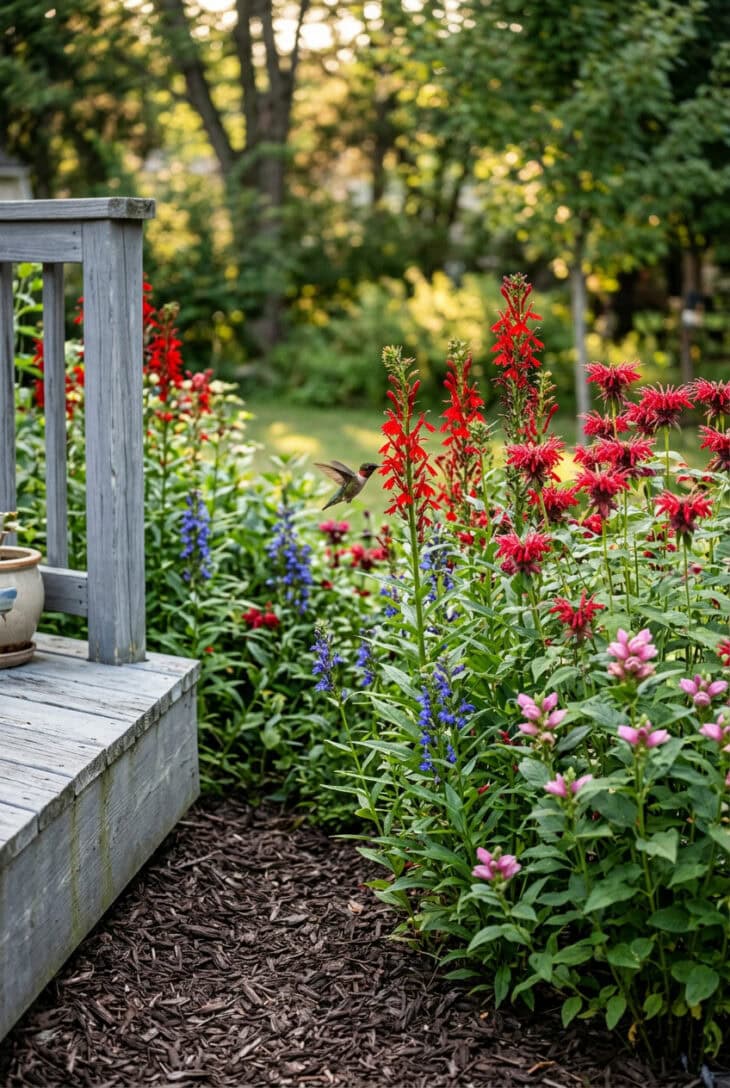
What you see Scarlet spikes of cardinal flower and shaggy red bee balm fill a small basin beside the deck, cut through with the deep blue of great blue lobelia and the pink, snapdragon-like hoods of turtlehead. A hummingbird works down each red spike one tubular flower at a time. From July into September the bed is rarely without visitors.
Why it works Several of the best hummingbird flowers in North America grow naturally in wet ground, so a rain garden is the one spot where they thrive without constant watering. Red, tubular blooms are shaped for a hummingbird’s bill, and the blues and pinks feed bumblebees at the same time. Because the plants bloom in a relay, the basin keeps feeding birds through fall migration, which makes it one of the easiest wildlife garden ideas to watch from the house.
How to get it Plant cardinal flower (Lobelia cardinalis) and great blue lobelia (Lobelia siphilitica) in the wettest part of the basin, 12in (30cm) apart, with pink turtlehead (Chelone lyonii ‘Hot Lips’) alongside. Put bee balm (Monarda didyma ‘Jacob Cline’) on the slopes, where it gets moisture without sitting in water, and give it good air flow to limit powdery mildew. Cardinal flower is short-lived, often only three or four years, so let some seed heads ripen and keep the mulch thin in a few patches so seedlings can take hold. Site the basin where you can see it from a window or a seat, because the whole point is to watch.
07. A Rain Garden in the Hellstrip
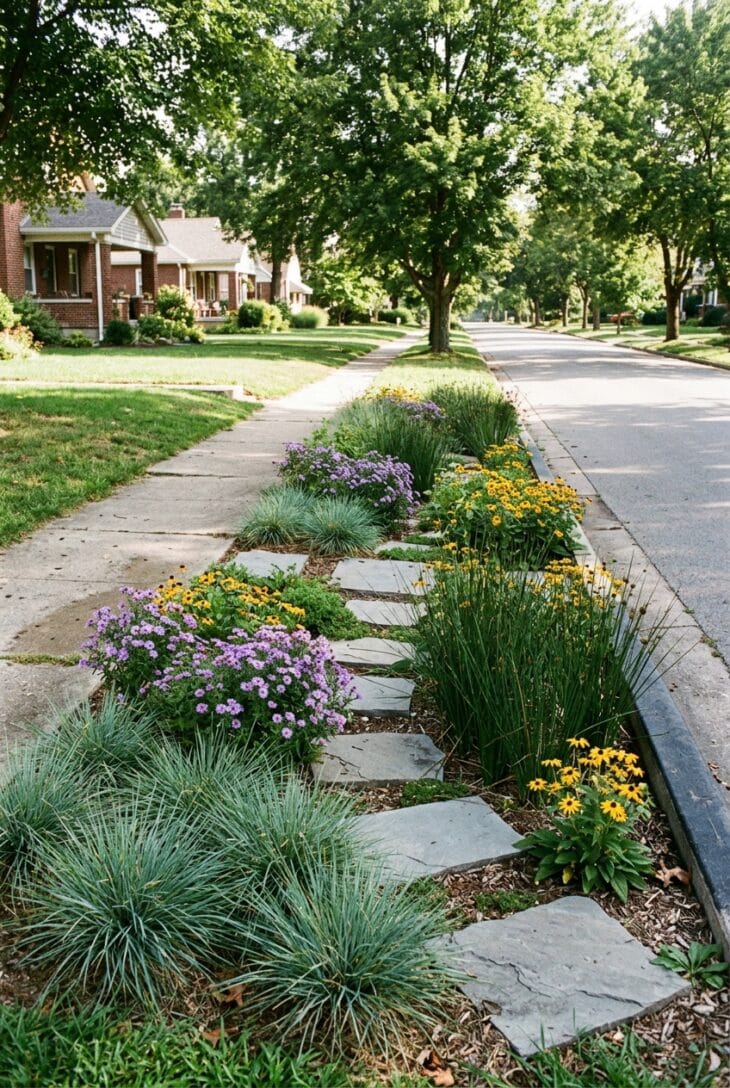
What you see The strip between sidewalk and street, usually a patch of struggling grass, is dished a few inches low and planted like a miniature meadow. Low switchgrass and dark soft rush hold the middle, with black-eyed Susans and purple asters along the edges, and nothing rises much above knee height. Flat stepping stones cross it every few yards so passengers can climb out of parked cars.
Why it works The hellstrip is hot, trampled, salted in winter and awkward to mow, and it already sits in the path of water running off the sidewalk. Dishing it slightly and planting tough natives turns a maintenance chore into something the whole street notices. Many cities and water utilities now encourage these plantings, and some offer rebates to help pay for them.
How to get it Check with your city before you dig: the strip usually belongs to the municipality, and cutting the curb to let street water in always needs a permit. Keep the plants under about 30in (75cm) so drivers can see past them, and choose species that cope with road salt and reflected heat, such as switchgrass (Panicum virgatum ‘Shenandoah’), soft rush (Juncus effusus) and New England aster (Symphyotrichum novae-angliae ‘Purple Dome’), with black-eyed Susans (Rudbeckia fulgida) on the higher edges. Keep the dip shallow, 3 to 4in (8 to 10cm), and set stepping stones every 6 to 8ft (1.8 to 2.4m) where cars park. Mulch with shredded hardwood, which knits together and stays put in a downpour, rather than bark nuggets that float into the gutter.
08. A Rain Barrel That Overflows into the Garden
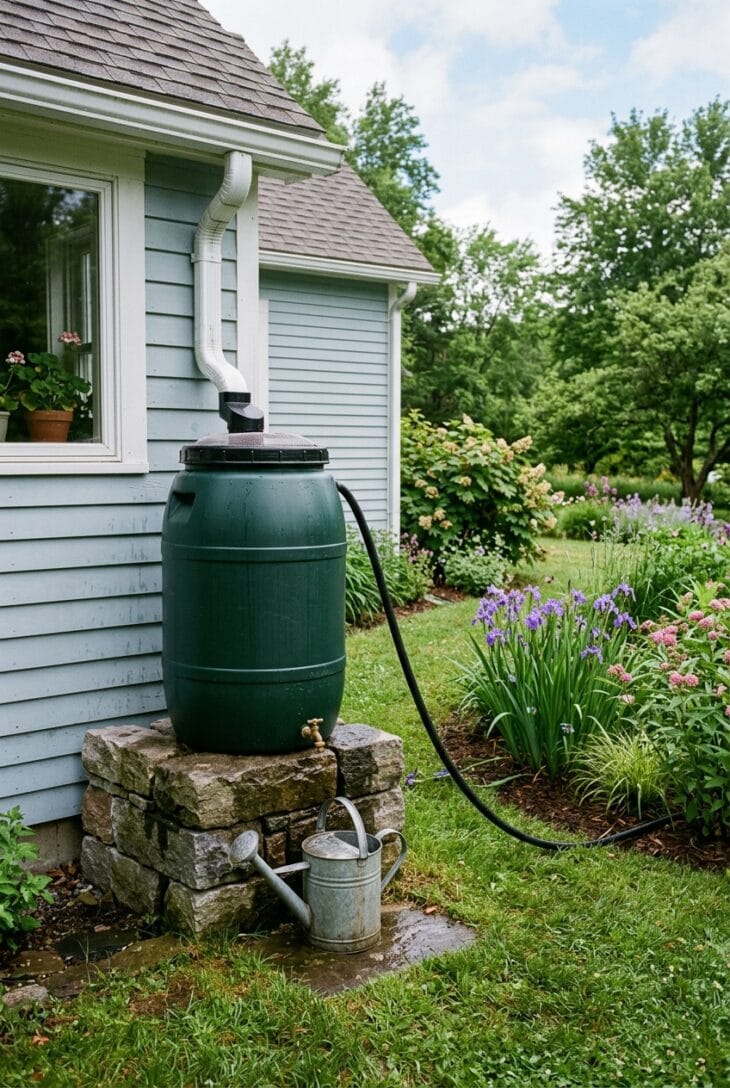
What you see A green barrel sits on a stone platform under the downspout, its tap at watering-can height. From the top, a flexible overflow hose snakes a few yards across the grass into a small basin of blue flag iris, swamp milkweed and sedge. On a wet morning the barrel is full and the garden beyond is drinking up the rest.
Why it works A rain barrel fills alarmingly fast: 1in (25mm) of rain on just 90 sq ft (8 sq m) of roof fills a 55-gallon (208-liter) barrel. Without somewhere to send the overflow, it spills at the foundation, which is the problem you set out to fix. Pairing the two means you store soft, chlorine-free water for dry spells and still have a safe place for the flood, and the barrel water is handy for pots and the vegetable garden.
How to get it Raise the barrel on blocks 12 to 16in (30 to 40cm) high so a watering can fits under the tap and gravity gives a little pressure. Fit a fine screen over the inlet to keep out mosquitoes and leaves, and attach a hose to the overflow port that runs at least 10ft (3m) from the house into the rain garden. Size the basin as if the barrel were not there, because in a big storm the barrel fills in minutes and every drop after that goes to the garden. Use or empty the barrel between storms so it has room for the next one, and drain and disconnect it before the first hard freeze.
09. A Pocket Rain Garden for One Downspout
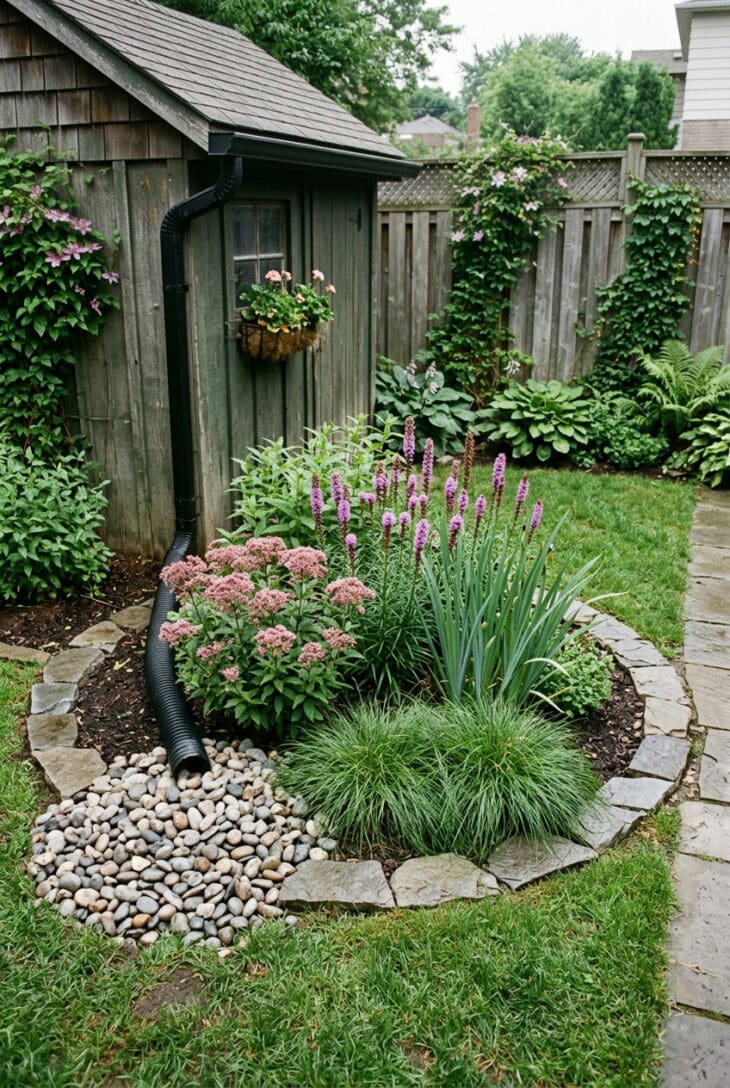
What you see In the corner of a small fenced yard, a round bed no more than 6ft (1.8m) across does the job of a much bigger garden. A short downspout extension from the shed ends in a heap of smooth pebbles, and compact plants crowd the dish: dwarf Joe Pye weed, spikes of blazing star, the straps of blue flag iris and a skirt of fine sedge. A ring of flat stones gives it a crisp, finished edge.
Why it works You do not need a big lot to manage roof water. A shed, a garage or one section of the house roof often feeds a single downspout, and a small basin sized for just that runoff can soak it all up. Compact cultivars keep the planting in scale so it reads as a flower bed rather than a hole, which matters in a yard where every square foot is on show, as with most small garden ideas.
How to get it Measure the roof area feeding the downspout (length times width of that section) and make the basin about a fifth of that in sandy soil or a third in clay; a 120 sq ft (11 sq m) shed roof needs only about 25 to 40 sq ft (2 to 4 sq m) of garden. Dig it 6in (15cm) deep with a level floor, and keep it at least 10ft (3m) from the house. Choose short plants: Joe Pye weed (Eutrochium dubium ‘Little Joe’), which stays around 4ft (120cm), dwarf blazing star (Liatris spicata ‘Kobold’), blue flag iris and Pennsylvania sedge (Carex pensylvanica) on the dry rim. Set the pebble heap exactly where the water lands so it cannot wash out the mulch.
10. Stepping Stones Across the Basin
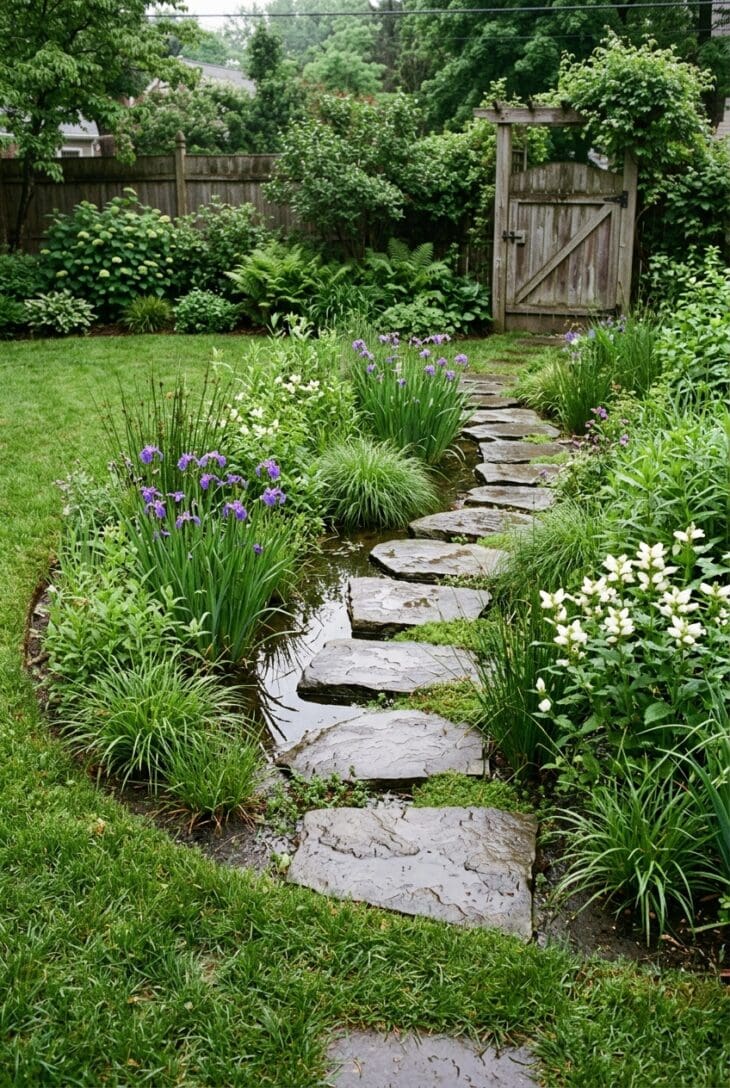
What you see A string of broad, flat fieldstones crosses the rain garden where a path would otherwise have to detour around it. Soft rush, blue flag iris and white turtlehead grow right up to the edges of each stone, and after a shower a thin sheet of water lies in the lowest part of the basin, reflecting the sky. You walk over the wettest part of the garden without getting your feet wet.
Why it works Rain gardens often end up exactly where people want to walk, between the back door and the shed or the gate. Stepping stones settle the conflict and add a small thrill, since crossing water, even a shallow sheet of it, is one of the pleasures of any garden. They also give you footholds for weeding the middle without compacting the soil, which keeps the basin draining, and they follow the same rules as any of the best garden path ideas: a comfortable stride and solid footing.
How to get it Use stones at least 18 to 24in (45 to 60cm) across and 2 to 3in (5 to 8cm) thick, spaced 24in (60cm) center to center for an easy stride. Set each one on a compacted base of crushed gravel so its top sits a couple of inches above the highest level the water reaches; stones that flood get slippery, and people stop using them. Choose stone with a textured, non-slip surface rather than anything polished. Keep the basin floor between the stones planted or mulched rather than bare, so the water cannot scour it.
11. A Driveway Swale with a Stone Forebay

What you see A long, narrow bed runs down the side of the driveway, a few inches lower than the concrete. At the top, a small cobble-lined pocket catches the first rush of water, and below it the swale fills with blue-green switchgrass, clumps of soft rush, purple asters and yellow sneezeweed. A short stone spillway at the far end sends any extra water onto the lawn.
Why it works A driveway sheds water fast, and that water carries grit, leaf litter, tire dust and oil. The cobble pocket, which engineers call a forebay, lets most of that settle out in one place where you can shovel it clean, so the planted part stays open and draining. The long, narrow shape also fits the strip between driveway and property line that nobody else wants.
How to get it Slope the driveway edge, or cut gaps in an existing edging, so water can sheet off into the swale, and lay a line of cobbles along the paving so the soil does not wash out. Make the forebay about 2ft (60cm) square and 6 to 8in (15 to 20cm) deep, and clear the sediment out each spring. Plant tough, salt-tolerant species such as switchgrass (Panicum virgatum), soft rush (Juncus effusus) and sneezeweed (Helenium autumnale), because winter road salt ends up here. Do not grow food in a driveway swale, and avoid piling salted snow on it all winter.
12. Terraced Rain Garden Cells on a Slope
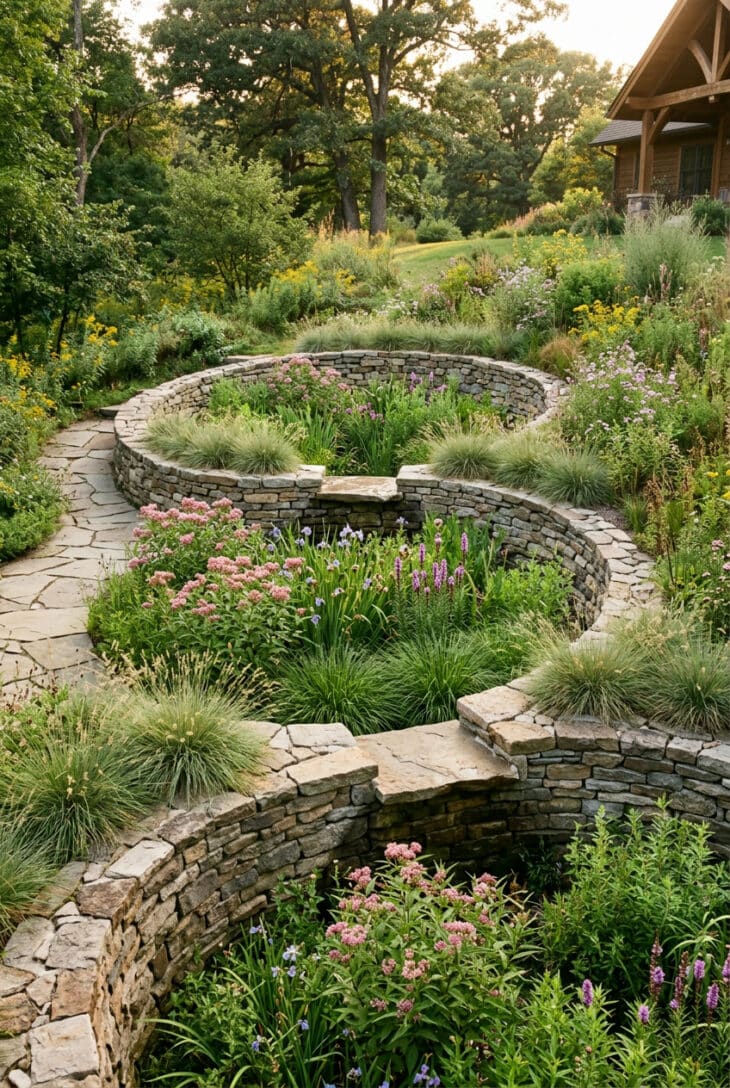
What you see Instead of one big basin, a hillside holds three small ones, stepped down like rice terraces. Each is held by a low curve of stacked stone, and in a storm the water fills the top cell, slips over a flat stone lip and fills the next. Swamp milkweed, iris and blazing star grow in the basins, with fine prairie dropseed along the tops of the walls.
Why it works On a slope, a single rain garden needs a huge berm on the downhill side to hold a level floor, which looks awkward and can wash out. Splitting the job into a chain of small cells keeps each wall low, spreads the water over more ground and turns a bank that is hard to mow into a feature. It is one of the neatest answers to the runoff problems that come with sloped gardens.
How to get it A single rain garden works best on slopes under about 12 percent, a drop of roughly 1ft for every 8ft (30cm per 2.4m); beyond that, terraces like these become essential, and on a very steep bank it pays to hire a landscape contractor. Keep each wall 12 to 18in (30 to 45cm) high, set the first course of stone below ground for stability, and make each cell’s floor level. Line every spillway with a flat stone so overflow cannot erode the wall below it. Plant the wall tops with drought-tolerant grasses such as prairie dropseed (Sporobolus heterolepis), since they drain fast and dry out first.
13. A Modern Stormwater Planter Beside the Patio

What you see Board-formed concrete walls about 2ft (60cm) high hold a long, narrow bed right beside the house. A dark steel downspout drops into it over a bed of black pebbles, and the planting is strict and graphic: upright blue rush in rows, clumps of palm sedge and Louisiana iris flowering deep purple in late spring. It looks like a designer planter, which it is, but it is also handling the roof water.
Why it works A standard rain garden has to sit 10ft (3m) from the house, which is impossible on a tight urban lot. A flow-through planter gets around this: it is lined and fitted with a drain at the bottom, so water filters through the soil, is slowed and cleaned, and then leaves in a controlled way rather than soaking in beside the foundation. Cities such as Portland, Oregon, have built them for years, and they suit the clean lines of modern garden ideas.
How to get it Build the planter with a waterproof liner, 18in (45cm) of free-draining soil mix over 12in (30cm) of gravel, and a perforated underdrain pipe that leads to the storm drain or another safe outlet. Leave about 6in (15cm) of space at the top for water to pond, and add an overflow pipe at that height so a cloudburst never tops the walls. Plant in bold blocks of a few species: blue rush (Juncus inflexus ‘Blue Arrows’), palm sedge (Carex muskingumensis) and Louisiana iris, which takes both standing water and summer heat. Check local codes before you connect to any drain, since some cities require a permit.
14. A Cottage-Style Rain Garden
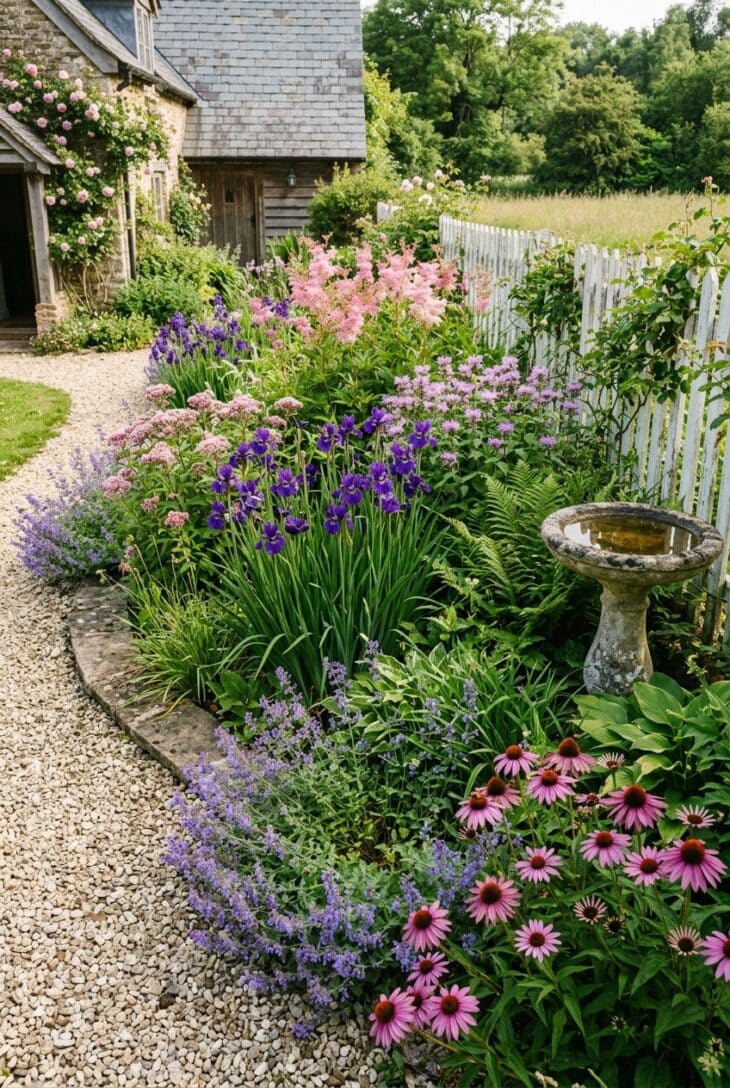
What you see Beside a picket fence, the rain garden looks like any generous cottage border, just set slightly lower than the lawn. Purple Siberian iris, frothy pink plumes of queen of the prairie and lavender bee balm crowd the dip, while blue catmint and coneflowers tumble over the raised rim onto the path. There is no bare soil anywhere, and nothing about it says drainage.
Why it works Cottage planting and rain gardens share a secret: both rely on dense, mixed, loosely layered perennials that cover the ground. Plenty of classic cottage plants, from irises to bee balm, actually prefer damp soil, so the wetter basin lets them grow bigger and flower longer than they would in an ordinary border. It is an easy way to give the romantic look behind cottage garden ideas a practical job.
How to get it Fill the bottom of the basin with Siberian iris (Iris sibirica ‘Caesar’s Brother’), queen of the prairie (Filipendula rubra ‘Venusta’) and swamp milkweed (Asclepias incarnata ‘Cinderella’), and put bee balm (Monarda didyma) and white turtlehead (Chelone glabra) on the side slopes. Keep the dry rim for plants that dislike wet feet, such as catmint (Nepeta racemosa) and coneflowers. Plant closer than usual, 12in (30cm) apart, for the full cottage look. Queen of the prairie spreads into large colonies over time, so give it space at the back or divide it every few years. Cut the iris foliage back in fall, but leave the other stems standing for winter seed and shelter.
15. A Sedge Meadow That Needs One Mow a Year
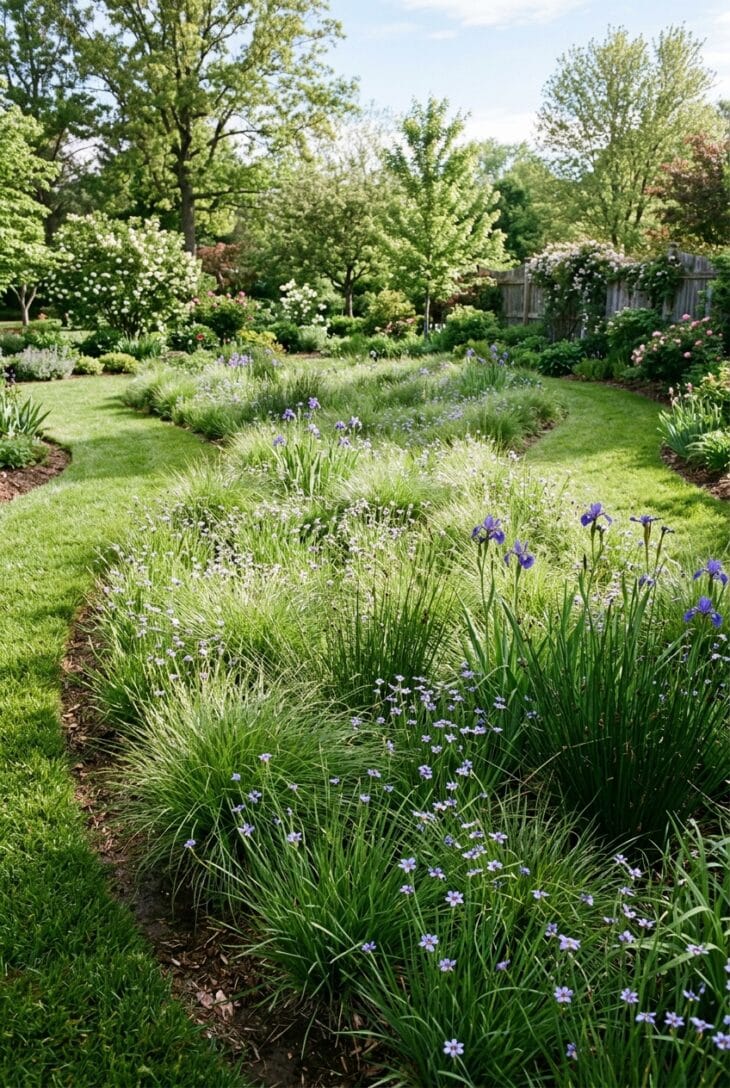
What you see Low and soft, a meadow of sedges and rushes fills a wide dip in the lawn, its fine blades glowing in the morning light. Tiny violet stars of blue-eyed grass are scattered through it in late spring, with a few flag irises standing taller. A mown path traces its edge.
Why it works Sedges are the unsung workhorses of wet ground. They stay green from spring into late fall, knit into a dense mat that shuts out weeds and never flop, so there is no deadheading or staking. For anyone who wants a rain garden with the least possible work, a sedge meadow is the answer, and it deserves a place among the best low-maintenance garden ideas.
How to get it Plant tussock sedge (Carex stricta) and fox sedge (Carex vulpinoidea) in the bottom and Bebb’s sedge (Carex bebbii) or soft rush (Juncus effusus) on the slopes, as plugs set 12in (30cm) apart. Scatter blue-eyed grass (Sisyrinchium angustifolium) and blue flag iris through the mix for flowers. Weed diligently for the first two summers until the sedges close ranks. After that, the only job is to cut or mow the whole meadow down to about 4in (10cm) in early spring. In a larger basin, tussock sedge slowly builds tall hummocks with age, which is part of its charm.
16. A Four-Season Shrub Rain Garden

What you see In January, this rain garden is the brightest thing in the yard. Coral-red stems of red twig dogwood glow against the snow, winterberry branches are packed with scarlet berries, and a cardinal pauses among them. The papery heads of hydrangea and the seed spikes of summersweet still hold their shape, with tawny switchgrass behind.
Why it works A basin of shrubs gives more year-round than one of perennials that vanish in winter. Many native shrubs come from swamp edges and stream banks and handle wet feet better than most flowers, and their woody roots keep working the soil year after year. Planted as a group, they also grow into a loose, informal screen, one of the gentler garden privacy ideas for a boundary that stays damp.
How to get it Put red twig dogwood (Cornus sericea ‘Arctic Fire’, which stays around 3 to 4ft or 90 to 120cm) and winterberry (Ilex verticillata ‘Red Sprite’) in the wettest zones. Winterberry plants are male or female, and the berrying females need a male such as ‘Jim Dandy’ within about 50ft (15m). Summersweet (Clethra alnifolia ‘Hummingbird’) and smooth hydrangea (Hydrangea arborescens ‘Annabelle’) go on the slopes, where they get moisture without constant flooding. Space the shrubs 3 to 5ft (90 to 150cm) apart and mulch well for the first two years. Each spring, cut the oldest third of the dogwood stems to the ground, since the young stems carry the brightest color.
17. A Rain Garden Anchored by a River Birch

What you see A multi-stemmed river birch rises from a wide basin, its bark peeling in curls of cinnamon, cream and salmon. Beneath its light canopy, fine sedges and sensitive ferns carpet the ground, and cardinal flowers light up the low spots in late summer. A single big boulder sits at the edge, and the whole scene feels like a quiet stream bank.
Why it works Trees are the heavy lifters of any rain garden: a large tree can pull 100 gallons (380 liters) or more from the soil on a hot summer day. River birch grows naturally on floodplains and handles both wet springs and dry summers, and it gives the basin height, dappled shade and structure through winter. A tree is the easiest way to make a big rain garden feel like part of the landscape rather than a hole in the lawn.
How to get it River birch (Betula nigra ‘Heritage’) reaches 40 to 70ft (12 to 21m), so plant it at least 20ft (6m) from the house; for a smaller yard, ‘Little King’ (sold as Fox Valley) stays around 10 to 12ft (3 to 3.6m). Red maple (Acer rubrum) is another flood-tolerant choice for a large property. Set the tree on the side of the basin rather than the lowest point, so its root flare never sits in standing water. Underplant with sedges and ferns instead of lawn, which competes with the roots and needs mowing around the trunk. Keep willows away from rain gardens near the house, because their roots seek out drains and sewer lines.
18. A Pacific Northwest Rain Garden
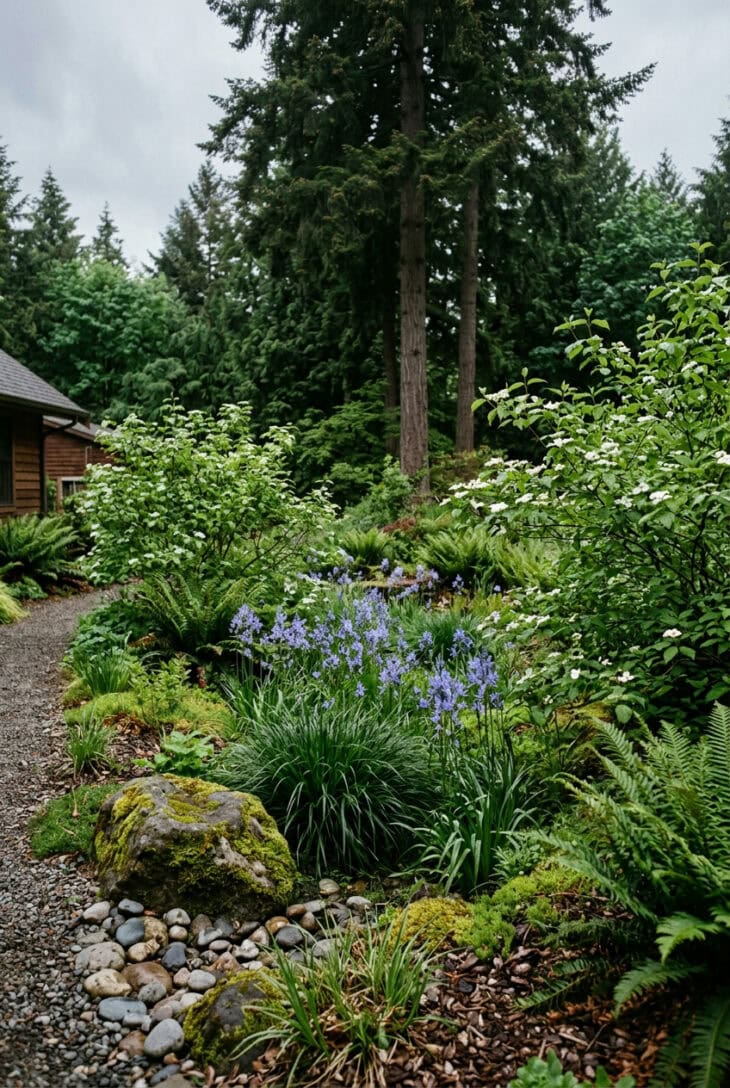
What you see Under a soft gray sky, a front-yard basin turns blue with camas in late spring, the starry flowers rising through clumps of dark slough sedge. Red-osier dogwood is in fresh leaf and flower behind them, sword ferns line the rim, and a mossy boulder anchors the inlet. Douglas firs fill the background.
Why it works West of the Cascades, rain arrives in long, soaking months and then all but stops for summer, so the plants have to handle both extremes. Natives such as camas evolved for exactly that: meadows that are wet in spring and bake dry by July. Cities across the region, including Seattle and Portland, have built thousands of rain gardens, so the plant lists are well tested.
How to get it Plant slough sedge (Carex obnupta), small-fruited bulrush (Scirpus microcarpus) and red-osier dogwood (Cornus sericea) in the bottom, and set camas (Camassia quamash) bulbs about 4in (10cm) deep among the sedge in fall. Put Pacific ninebark (Physocarpus capitatus) and Douglas spiraea (Spiraea douglasii) on the slopes, but remember that the spiraea suckers hard and will take over a small garden. Sword fern (Polystichum munitum) and Oregon grape (Mahonia aquifolium) belong on the dry rim. Look for your state or county’s rain garden handbook; Washington State University publishes one for western Washington with sizing charts and plant lists.
19. A Southern Basin of Louisiana Iris and Swamp Hibiscus
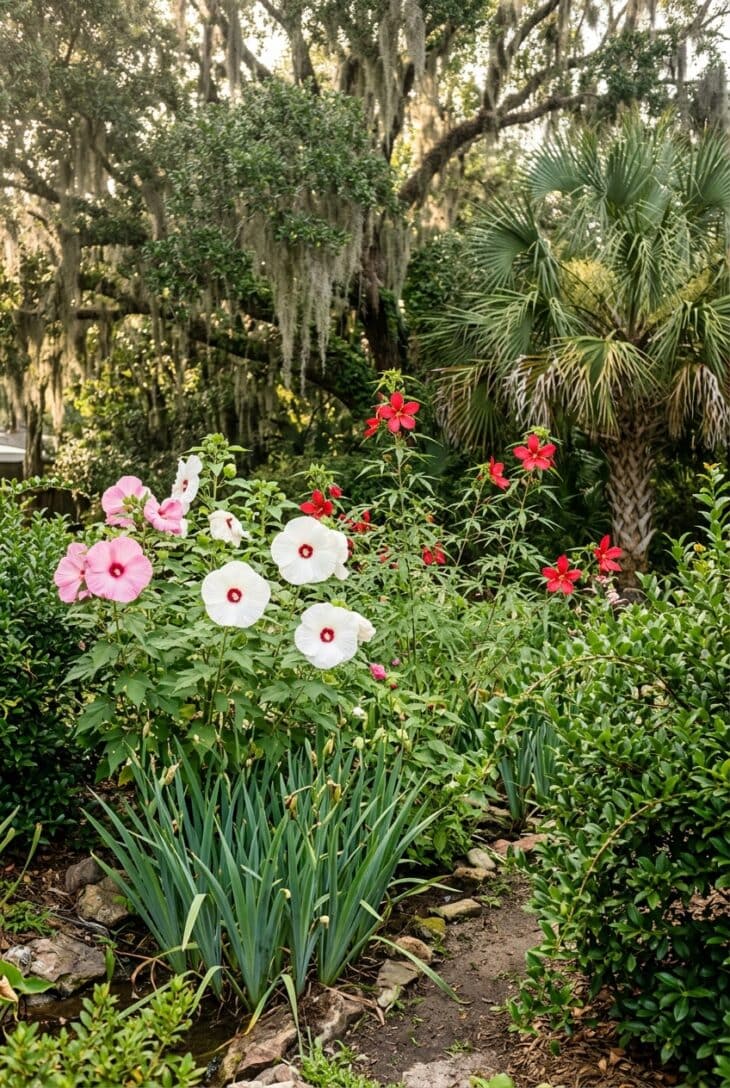
What you see Giant saucers of swamp rose mallow, some white with a red eye and some clear pink, open above a basin of sword-like Louisiana iris leaves. Scarlet rose mallow adds starry red flowers on stems taller than a person, glossy fetterbush fills the edges, and a cabbage palm fans out behind. A live oak hung with Spanish moss sets the scene.
Why it works Across the Southeast, rain comes in huge summer cloudbursts, often onto heavy clay or flat ground that drains slowly. The native plants of Gulf Coast marshes and swamps thrive in exactly that, and many of them carry big, tropical-looking flowers, so a rain garden here can look lush rather than scrubby. The irises flower in spring, the mallows in high summer, and the palm and shrubs hold the scene for the rest of the year.
How to get it In the bottom, plant Louisiana iris (such as ‘Black Gamecock’) and swamp rose mallow (Hibiscus moscheutos) about 3ft (90cm) apart, with scarlet rose mallow (Hibiscus coccineus) behind. Line the slopes with fetterbush (Lyonia lucida) and Virginia sweetspire (Itea virginica), and put a cabbage palm (Sabal palmetto) on the rim, where it shrugs off brief flooding, heat and hurricane winds. Both hibiscus die to the ground in winter and are late to reappear in spring, so mark their spots before you dig nearby. Watch for hibiscus sawfly larvae in early summer, which can strip the leaves to lace; pick them off by hand rather than spraying. Add muhly grass (Muhlenbergia capillaris) along the rim for a pink haze in fall.
20. A Sunken Desert Basin for Monsoon Rain

What you see In a desert front yard, a wide, shallow basin sits a few inches below the gravel, fed by a rock-lined channel from the roof. A desert willow hangs pale pink trumpets over it, fountains of deergrass fill the sides, and orange globe mallow and yellow brittlebush crowd the raised rim. Most of the year it is dry; after a monsoon storm, it fills and then drains within hours.
Why it works Rain gardens are not only for wet climates. In the Southwest they work in reverse: instead of getting rid of water, they capture every drop the roof sheds and hold it where plants can use it, a practice long championed in places such as Tucson. A few summer storms can soak a basin deeply enough to carry a tree through weeks of drought on far less irrigation, which makes this one of the smartest drought-tolerant garden ideas there is.
How to get it Dig basins 4 to 8in (10 to 20cm) deep and wide enough to reach each tree’s eventual drip line, and mulch with gravel or wood chips to slow evaporation. Plant trees and shrubs on the sides or rim rather than the very bottom, since most desert plants dislike sitting in water. Good choices include desert willow (Chilopsis linearis), deergrass (Muhlenbergia rigens) and velvet mesquite (Prosopis velutina), which grows into a 20 to 30ft (6 to 9m) shade tree, so give it room. Water new plants regularly for the first two summers while their roots go deep. Bring the roof water in along a rock-lined channel so the first rush of a monsoon storm cannot cut a gully.
21. A Pitcher Plant Bog for Ground That Never Dries
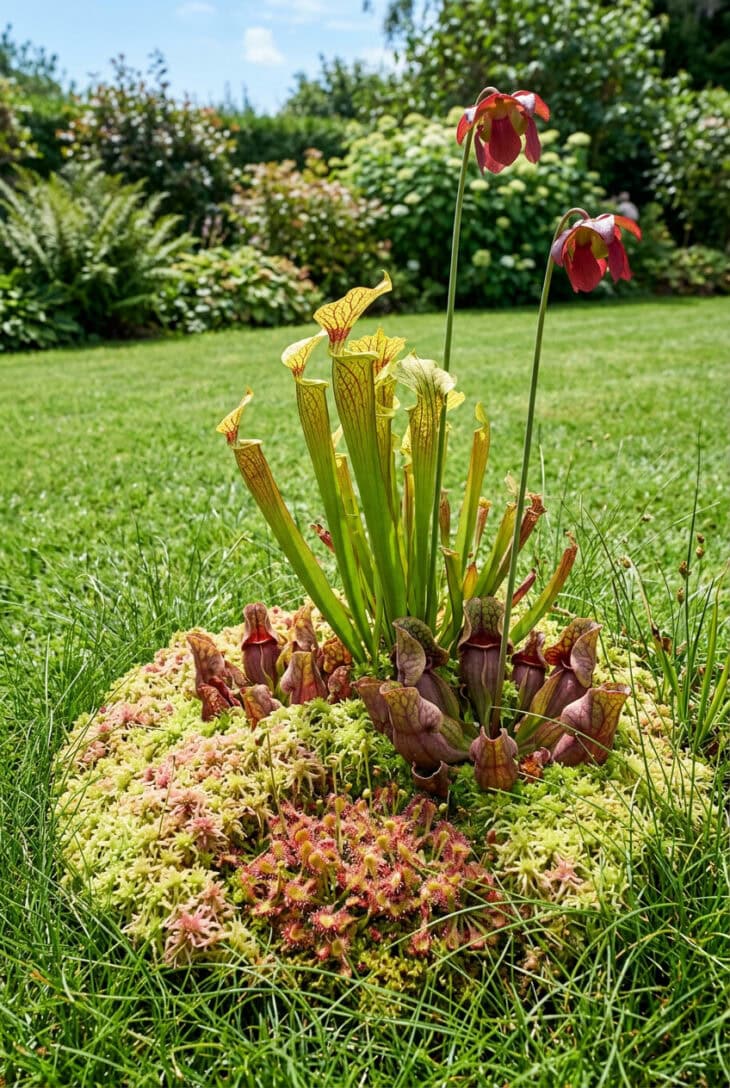
What you see Where the ground never quite dries, a small bog glows with carnivorous plants. Tall yellow-green trumpet pitchers veined in red stand in a cushion of sphagnum moss, with squat burgundy purple pitcher plants at their feet and tiny red sundews glittering with sticky dew. In spring, odd nodding flowers rise on stalks above the traps.
Why it works A true rain garden must drain within a day or two, so a spot that stays waterlogged for weeks is the wrong place for one. Rather than fight it, lean in: a bog is the one garden that wants permanently wet, acidic, low-nutrient conditions. Pitcher plants are some of the most striking natives in North America, and because they catch their own food, they never need fertilizer.
How to get it Dig out an area about 18in (45cm) deep, lay a pond liner pierced with a few small holes so water seeps out slowly instead of stagnating, and fill it with roughly 2 parts sphagnum peat to 1 part washed sand. Plant purple pitcher plant (Sarracenia purpurea), which is hardy to zone 3, and add yellow trumpet (Sarracenia flava) only where winters are no colder than zone 6. Give the bog full sun and top it up only with rainwater or distilled water, because the minerals in tap water slowly kill carnivorous plants. Never feed them or add compost. On a patio, the same mix works in a large glazed pot without drainage holes, a quirky twist on container garden ideas.
22. A Rain Chain into a Pebble Basin
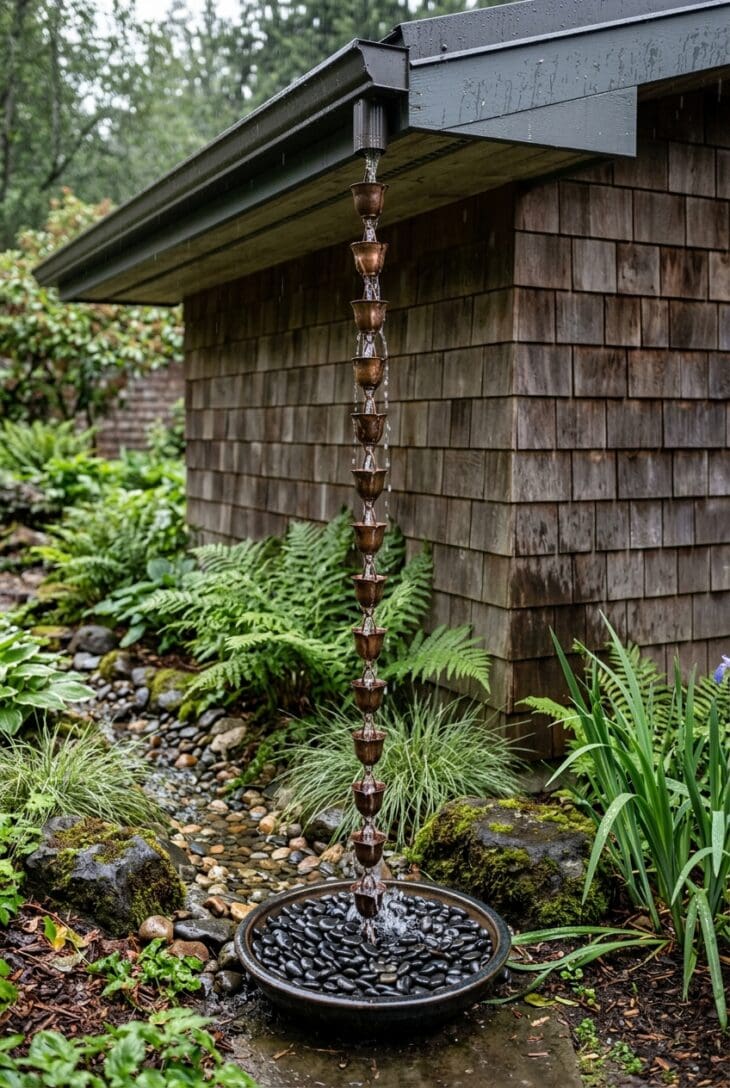
What you see At the corner of the house, a copper rain chain replaces the downspout, and water tumbles from cup to cup in a light, musical stream. It lands in a shallow bowl of smooth black pebbles, then slips away along a short pebble channel into a small bed of ferns, sedges and iris. On a gray afternoon, it is worth pulling up a chair by the window.
Why it works A rain chain turns the least lovely fixture on the house into something you want to watch and listen to. Rain chains, called kusari-doi, come from Japanese temple architecture, and the chain and pebble basin bring the quiet, contemplative mood of Japanese garden ideas to an ordinary downspout. The water still needs somewhere to go, which is why a small rain garden is its natural partner.
How to get it Rain chains carry less water than a downspout and splash in heavy rain, so use them on small roof sections such as a porch or bay window, and choose a cup style, which controls the flow better than open links. Anchor the bottom of the chain to a ground stake so wind cannot swing it into the siding. Set it into a basin 18 to 24in (45 to 60cm) across, filled with 1 to 2in (2.5 to 5cm) pebbles over a gravel sump, and grade the basin so its overflow runs away along a pebble channel to a planted bed at least 10ft (3m) from the foundation. Copper weathers to a deep brown within months and, much later, to a green patina.
23. An Edible Rain Garden
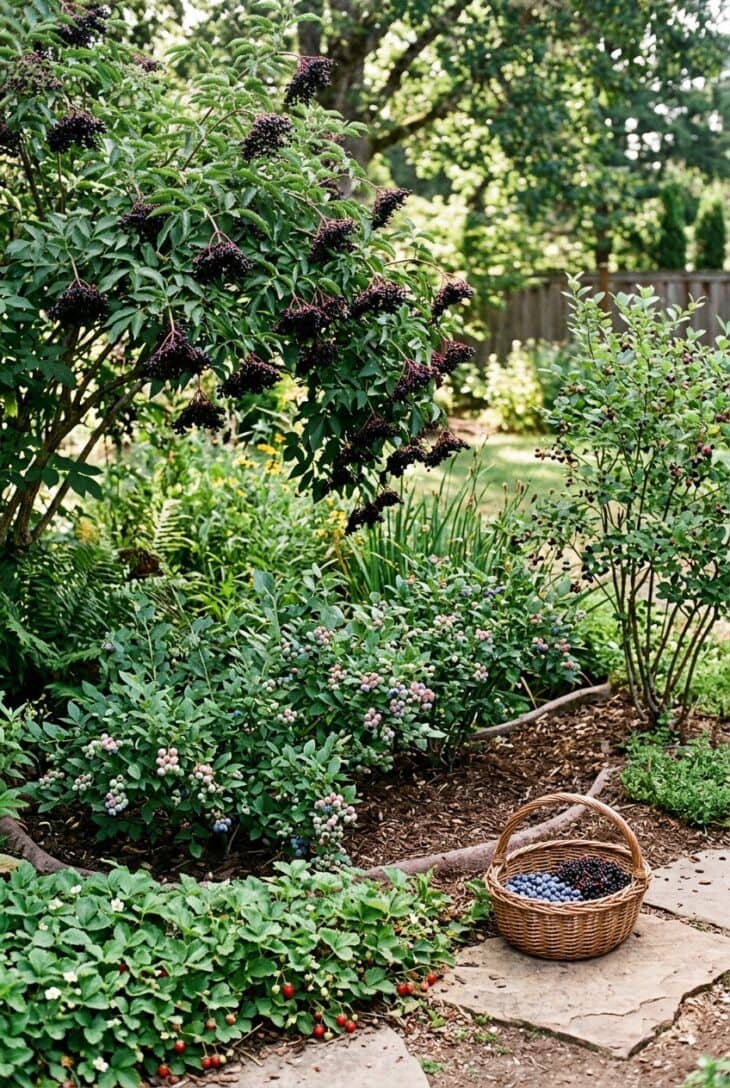
What you see The slopes of this rain garden are heavy with fruit. Elderberry branches bow under drooping clusters of near-black berries, highbush blueberries ripen from green to dusty blue along the rim, and a small serviceberry arches over one end. Wild strawberries run along the edge, and a basket on a flat stone is already half full.
Why it works Several of North America’s best fruiting shrubs grow wild along stream banks and in damp woods, so a rain garden gives them the moisture they crave. You get the usual benefits for drainage and wildlife, plus a harvest that runs all summer: serviceberries in June, blueberries in July and elderberries in late summer. The birds will want their share, which is part of the deal.
How to get it Plant American elderberry (Sambucus canadensis ‘Adams’) on the lower slopes, where it tolerates wet soil, and highbush blueberries (Vaccinium corymbosum ‘Bluecrop’ with ‘Patriot’ for better pollination) on the rim, because blueberries want acidic soil that is moist but never waterlogged. Add an Allegheny serviceberry (Amelanchier laevis) at the drier end, with a groundcover of wild strawberries (Fragaria vesca) along the edge. Feed this garden from the roof only, never from a driveway or street, since runoff from paving carries oil and metals. Cook elderberries before eating them, because raw berries can upset the stomach. Net the blueberries before they color up if the birds are taking everything.
24. A First-Year Rain Garden from Plugs
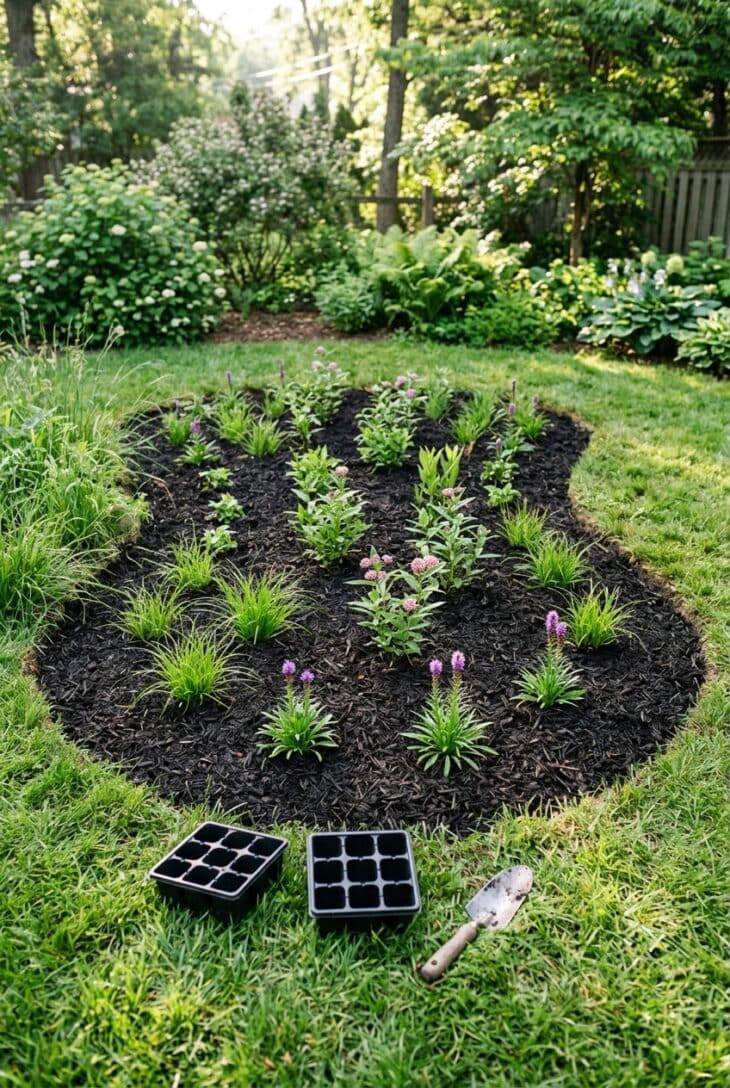
What you see It does not look like much yet: a tidy kidney of fresh dark mulch, dotted every foot with small plants. A few swamp milkweeds and blazing stars are already putting up their first flowers, the sedges are filling out, and a couple of empty plug trays sit on the berm next to a trowel. In two years, you will not see the mulch at all.
Why it works Plugs, the small plants sold by the tray, cost a fraction of the price of gallon pots, which puts a whole rain garden within reach in a single weekend. Young plants settle into new soil quickly, and natives grown from plugs soon catch up with bigger nursery stock. The old saying holds here as in any perennial garden: the first year they sleep, the second they creep and the third they leap.
How to get it Plant plugs 12in (30cm) apart, about one per square foot, in spring or early fall so they root in before summer heat or winter frost. Group each species in drifts of 5 to 15 rather than dotting them singly, so the garden reads as a design while it fills in. Water once a week through the first season whenever the rain does not do it for you, and pull weeds every couple of weeks until the plants close over. Spread 2 to 3in (5 to 8cm) of shredded hardwood mulch, keeping it an inch back from each crown. Many native plant nurseries sell ready-made rain garden plug kits with the zones already worked out.
25. A Fall Finale of Asters and Swamp Sunflowers
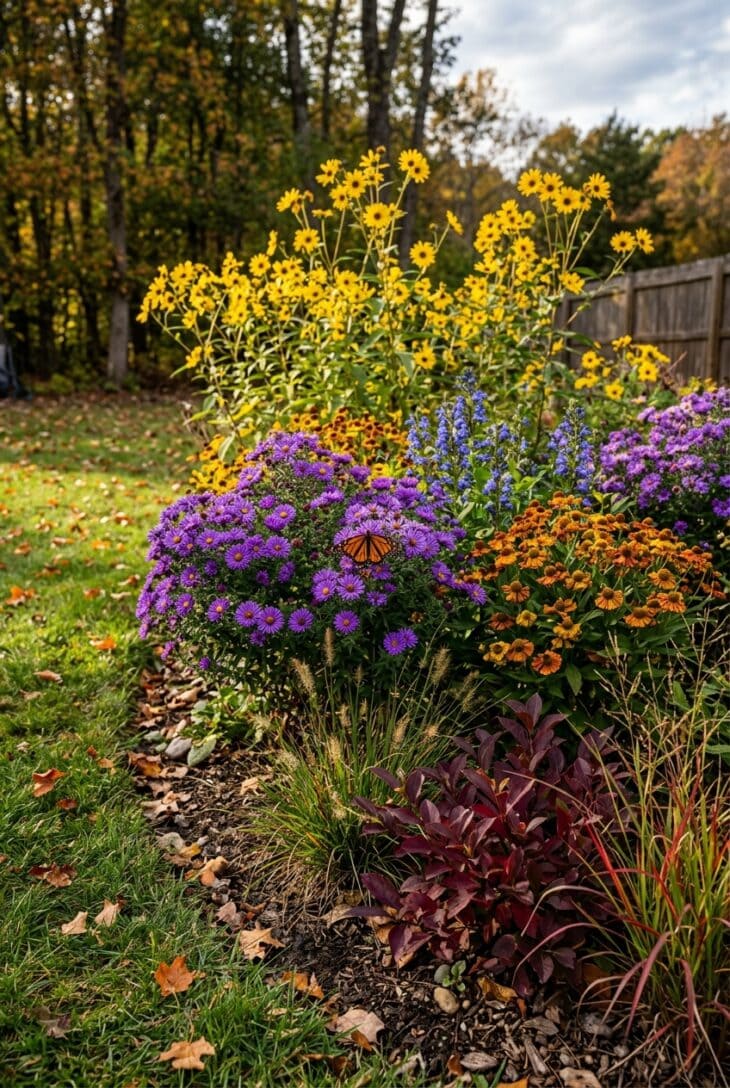
What you see In October, the rain garden peaks. Swamp sunflowers tower at the back in a wall of gold, New England asters glow purple beneath them, and coppery sneezeweed and the last blue lobelias fill the gaps. Switchgrass has turned red at the tips, Virginia sweetspire has gone deep burgundy, and a migrating monarch stops to feed.
Why it works Many of the best fall flowers are wet-ground natives, so a rain garden is the natural home for an autumn finale. Late nectar matters, too: migrating monarchs and bumblebee queens fattening up for winter rely on asters and sunflowers when little else is in bloom, which is why they turn up in nearly every list of butterfly garden ideas. While summer borders fade, this one gets better every week until frost.
How to get it Plant swamp sunflower (Helianthus angustifolius, hardy in zones 6 to 9) at the back, where its 5 to 8ft (1.5 to 2.4m) stems have room, and cut it back by half in early June to keep it shorter and sturdier. Put New England aster (Symphyotrichum novae-angliae ‘Purple Dome’, a compact 18 to 24in or 45 to 60cm) and sneezeweed (Helenium autumnale) on the slopes. Virginia sweetspire (Itea virginica ‘Henry’s Garnet’) and switchgrass (Panicum virgatum ‘Shenandoah’) supply the foliage color and hold the rim. Leave the seed heads standing into winter for goldfinches and other seed-eating birds.