Halloween is the one time of year when a garden is allowed to look a little sinister. Black leaves, rattling seedheads, twisted branches and a pumpkin on every step all start to feel exactly right as the nights draw in. If you love the season but are tired of inflatable ghosts and plastic tombstones, the garden itself can do most of the work.
Contents
- 01. A Gothic Border of Black Foliage
- 02. Grow a Giant Pumpkin Patch
- 03. Heirloom Pumpkins Stacked on the Front Steps
- 04. Drifts of Chinese Lanterns
- 05. A Victorian Graveyard Corner in the Shade
- 06. A Poison Garden Behind Iron Railings
- 07. A Path Lined with Glowing Jack-o’-Lanterns
- 08. Orange and Purple Planters by the Door
- 09. A White Ghost Garden That Glows at Dusk
- 10. Blood-Red Fall Foliage
- 11. A Haunted-House Wall of Boston Ivy
- 12. A Tunnel of Gourds and Purple Beans
- 13. A Woodland Bed of Creepy Native Plants
- 14. A Carnivorous Bog in a Cauldron
- 15. A Witch’s Herb Garden
- 16. A Cutting Bed of Near-Black Dahlias
- 17. Grass and Seedhead Silhouettes at Dusk
- 18. Leave the Orb Weaver Webs
- 19. A Night Garden for Bats
- 20. Twisted Branches and Contorted Trees
- 21. An Uplit Gnarled Tree
- 22. A Cornstalk and Straw Bale Harvest Fence
- 23. A Scarecrow in the Fall Vegetable Patch
- 24. A Halloween Balcony
- 25. Plant Black Tulips on Halloween
The ideas below mix planting and decorating. Some are permanent, like a gothic border of near-black perennials or a woodland bed of poisonous native oddities, while others take a weekend in October and a trip to the farm stand. There are projects for a balcony, a front porch and a big backyard, for sun and for shade, and for families with young kids as well as grown-ups who want something properly eerie.
Scroll through for inspiration, or pick the ideas that suit your space and how far ahead you like to plan. Several need planting in spring or early summer to peak in October, so bookmark those now, and a few (the pumpkins, the dahlias and the tulips) come with timing notes so you can count back from the big night.
01. A Gothic Border of Black Foliage
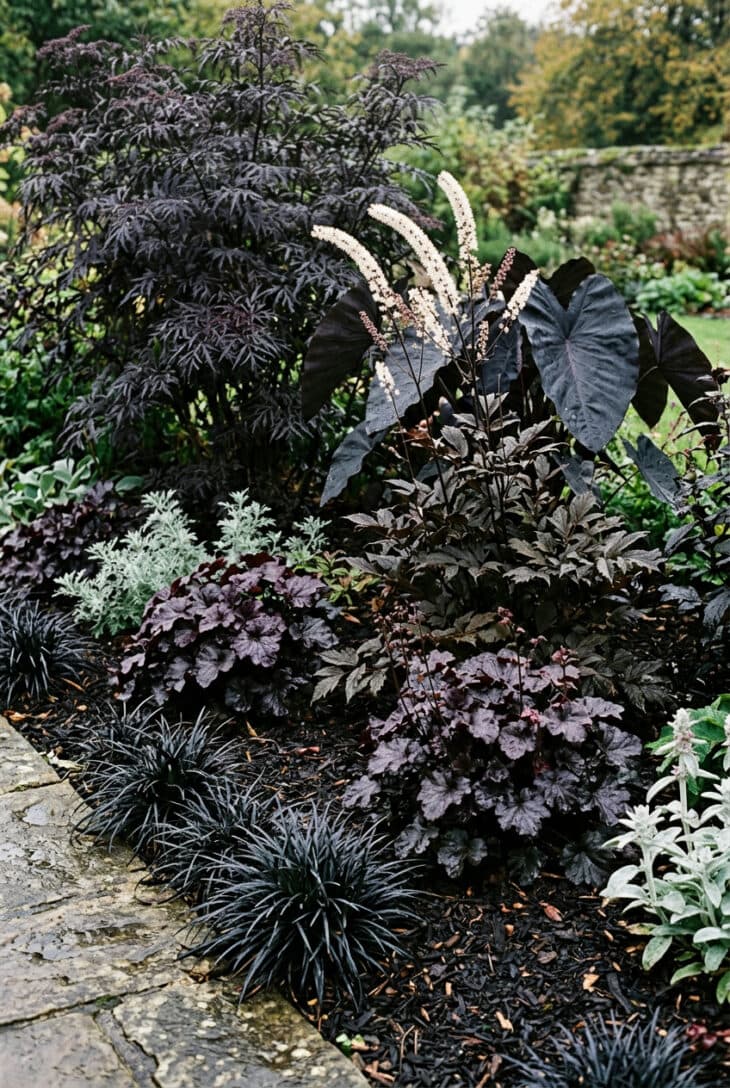
What you see A border that seems to swallow the light. Lacy purple-black elderberry rises at the back, giant dusky elephant ears fan out in the middle, and glossy heuchera mounds sit in front of them like pools of ink. Black mondo grass spills over a gray stone edge, while tall white bugbane wands float above bronze-black leaves and give off a sweet scent on a cool October afternoon.
Why it works Dark foliage carries a gothic mood all season, not just for one week, and it looks richest in the low, slanting light of fall. The trick is contrast: black leaves beside more black leaves turn into a shapeless hole, so the border mixes textures (lacy, huge, glossy, grassy) and threads in a little silver and white to outline each plant. It is the same layering you would use in any of our garden border ideas, just played in a darker key.
How to get it Plant black elderberry (Sambucus nigra ‘Black Lace’) at the back in full sun, since it fades toward green in shade; it reaches about 6 to 8ft (1.8 to 2.4m) and suits zones 4 to 7. In front, add bugbane (Actaea simplex ‘Black Negligee’), which holds its white spikes into October, and heuchera (Heuchera ‘Obsidian’) spaced 12 to 15in (30 to 38cm) apart. Edge the bed with black mondo grass (Ophiopogon planiscapus ‘Nigrescens’), which is slow, so buy more plants than you think and set them 6in (15cm) apart. For summer drama, tuck in elephant ear (Colocasia esculenta ‘Black Magic’) and lift the corms before frost north of zone 8. Finish with a few silver plants such as lamb’s ear (Stachys byzantina) so the dark shapes read clearly.
02. Grow a Giant Pumpkin Patch
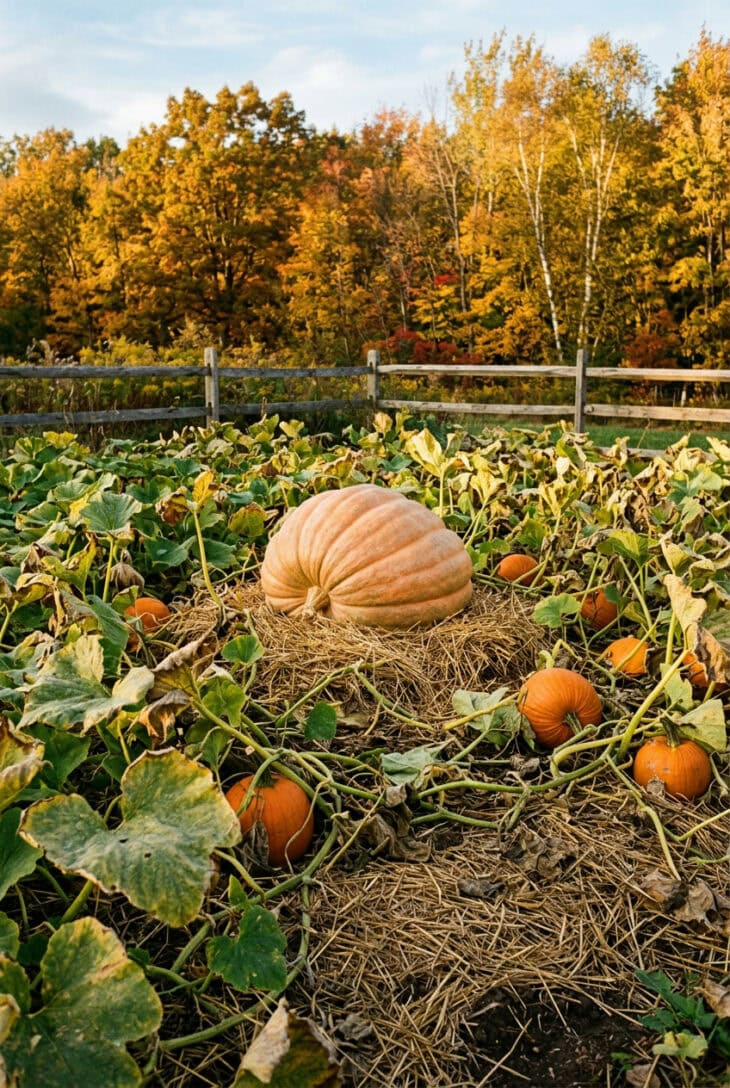
What you see A backyard patch at the end of its season, with big leaves turning yellow and thick vines snaking over golden straw. In the middle sits one enormous, slumped, pale orange pumpkin, far too big to lift, with smaller carving pumpkins scattered around it like its offspring. A split-rail fence and the first fall color close off the scene.
Why it works Growing your own pumpkins turns Halloween into a project that runs all summer, which is half the fun for kids. A single giant is a talking point on the block, and the carving pumpkins from the same patch cost a fraction of the farm-stand price. It fits neatly into the rotation of any vegetable garden plot, since pumpkins love the rich soil left behind by earlier crops.
How to get it Count back from Halloween: giant pumpkin (Cucurbita maxima ‘Dill’s Atlantic Giant’) needs 120 to 130 days, so sow it indoors in late April or early May and plant out after the last frost. Carving types such as ‘Howden’ (Cucurbita pepo) need about 110 days and can be sown direct in late May or early June once the soil reaches 70°F (21°C). Give a giant a patch roughly 20ft (6m) square, work in plenty of compost, and water deeply and evenly. Hand-pollinate early in the morning, keep only one fruit per vine once it reaches softball size, and slide a board or straw under it to prevent rot. Harvest carving pumpkins with 3 to 4in (8 to 10cm) of stem left on, and never carry them by the stem.
03. Heirloom Pumpkins Stacked on the Front Steps
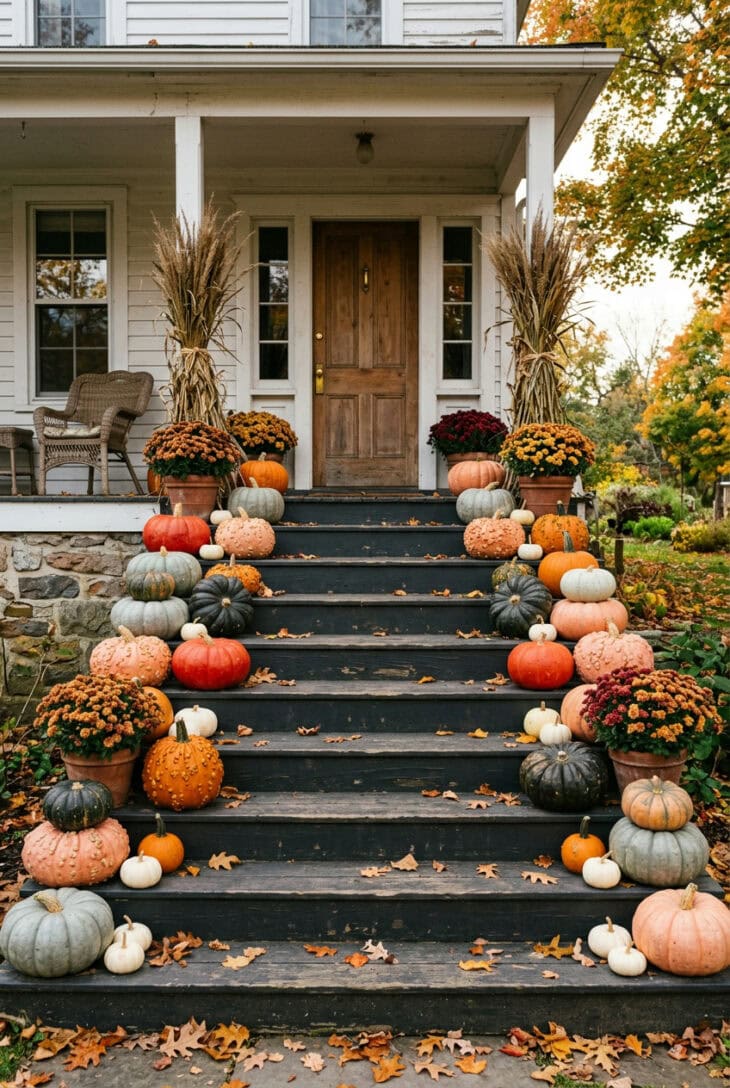
What you see Charcoal porch steps crowded with pumpkins that look nothing like the usual orange globe. Flat blue-gray ones sit beside deep red Cinderella pumpkins, a salmon pumpkin crusted in peanut-like warts, and a ribbed squash so dark green it reads as black. Pots of bronze mums fill the gaps and fallen leaves gather on the treads.
Why it works Heirloom pumpkins bring color and texture that ordinary jack-o’-lanterns cannot, and a mix of sizes stacked at different heights looks abundant rather than lined up. Because they are left uncarved, they last from early October through Thanksgiving, so one display covers two holidays. It is the quickest way to add seasonal curb appeal, and it pairs well with our front garden ideas for the rest of the year.
How to get it Look for ‘Jarrahdale’ (blue-gray), ‘Rouge Vif d’Etampes’ (the red Cinderella pumpkin), ‘Galeux d’Eysines’ (salmon with warts) and ‘Black Futsu’ (dark green, warty, ripening to chestnut), all forms of winter squash (Cucurbita maxima or Cucurbita moschata). Put the largest on the bottom step and work up to small ones near the door, grouping in threes and fives. Set pumpkins on the steps, not on soil or damp mulch, where the bottoms rot quickly. If you grow your own, cure them in a warm, sunny spot for 7 to 10 days after harvest to harden the skin. Bring them inside or cover them on nights forecast below freezing, because frost turns them soft within days.
04. Drifts of Chinese Lanterns
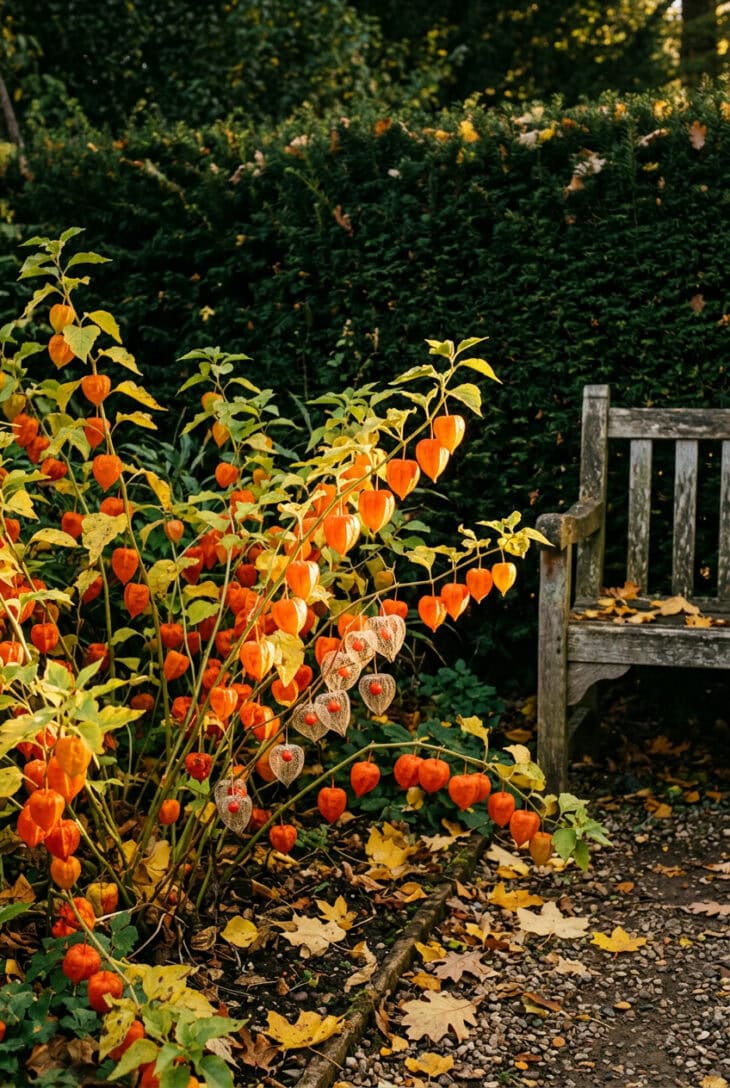
What you see Arching stems hung with dozens of papery orange lanterns, lit from behind by the low sun so they glow like tiny jack-o’-lanterns. A few have weathered into delicate net skeletons with a red berry caged inside. The dark yew hedge behind makes the orange look even brighter.
Why it works Few hardy plants produce true Halloween orange on their own, and the lanterns hold their color for weeks outdoors and for years once dried. The lace-skeleton stage adds an eerie, decaying beauty that fits the season perfectly. Cut stems also make the easiest possible indoor decoration.
How to get it Chinese lantern (Physalis alkekengi) is hardy in zones 3 to 9 and grows in sun or light shade, but it spreads aggressively by underground runners. Plant it inside a bottomless 5-gallon bucket sunk to the rim, or in a bed edged with a deep root barrier, and never next to a lawn or border you care about. Space plants about 18in (45cm) apart and stake them lightly so the stems do not flop. Cut stems for drying as soon as the husks turn orange, strip the leaves and hang them upside down somewhere dry. The unripe berries and foliage are toxic, so keep it away from where small children play.
05. A Victorian Graveyard Corner in the Shade
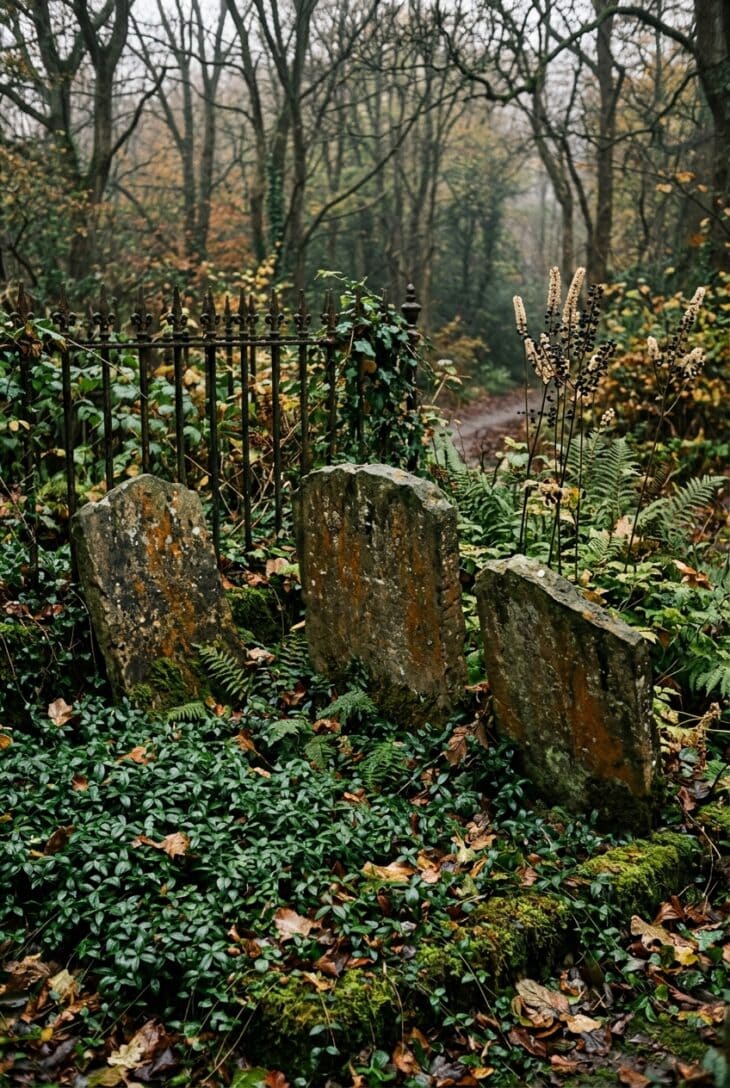
What you see A misty, shaded corner where three weathered stone slabs lean at tired angles, crusted with lichen and sinking into a carpet of glossy periwinkle. Ferns and moss soften the ground, a stretch of rusted iron railing stands guard behind, and the dark seed stalks of a tall woodland plant rise out of the gloom.
Why it works This is a Halloween scene that looks better every year, because moss, lichen and ground cover age it in a way no store-bought prop can match. It also solves a common problem: the damp, shady corner where nothing flowers well. Plants that thrive there, like ferns and periwinkle, happen to be exactly what grows in old cemeteries, and it is one of the moodier shade garden ideas you can build.
How to get it Use reclaimed flagstone, broken paving slabs or cast concrete for the “headstones,” burying the bottom third so they lean naturally, and brush them with yogurt or buttermilk to encourage moss and lichen. Common periwinkle (Vinca minor) is the classic cemetery ground cover, but it is invasive in parts of the eastern US, so only use it where it is hemmed in by paving, or choose native Allegheny spurge (Pachysandra procumbens) or wild ginger (Asarum canadense) instead. Add Christmas fern (Polystichum acrostichoides), which stays green all winter. For height, plant black snakeroot (Actaea racemosa), whose dry seed capsules rattle in the wind in fall and earned it the old name rattletop. A salvaged length of iron railing, even just 4ft (120cm) of it, finishes the look.
06. A Poison Garden Behind Iron Railings
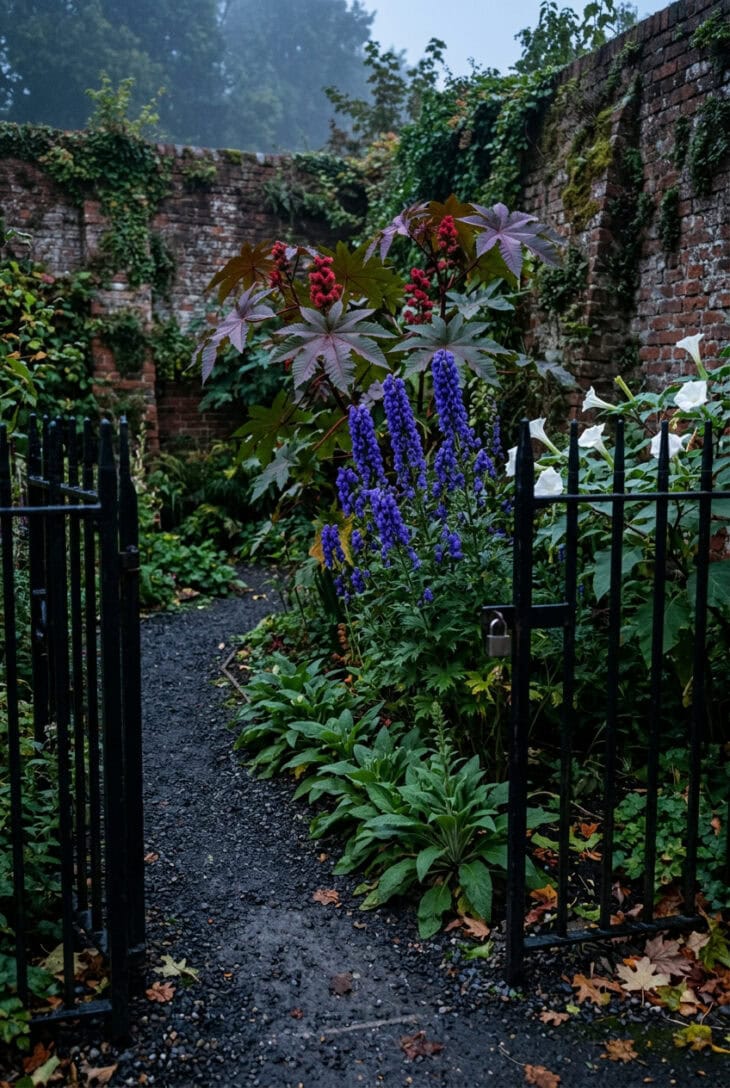
What you see A small walled plot behind black railings and a locked iron gate. Violet monkshood spires rise in the dusk, a castor bean towers overhead with glossy bronze-red leaves and spiny scarlet seed pods, and white datura trumpets unfurl as the light fades. Low rosettes of foxglove leaves sit quietly at the front.
Why it works Plenty of well-loved garden plants are dangerously toxic, and gathering them together behind a gate turns that fact into a story. Famous poison gardens draw crowds because the planting is beautiful first and menacing second. Many of these plants also peak in fall, so the garden is at its most dramatic in late October.
How to get it Only build this where children and pets cannot get in, and keep the gate latched or locked. Plant monkshood (Aconitum carmichaelii ‘Arendsii’), which flowers in September and October in zones 3 to 7, and always wear gloves to handle it, because its toxins can pass through skin. Sow castor bean (Ricinus communis ‘Carmencita’) after frost; it reaches 6ft (1.8m) or more in a single summer, and its seeds contain ricin, so cut off the pods if anyone could reach them. Add night-flowering datura (Datura wrightii) and foxglove (Digitalis purpurea), which spends its first year as a leafy rosette before flowering the next June. Keep the space to about 8 by 10ft (2.4 by 3m) so it feels like a secret room, and wash your hands after every session.
07. A Path Lined with Glowing Jack-o’-Lanterns
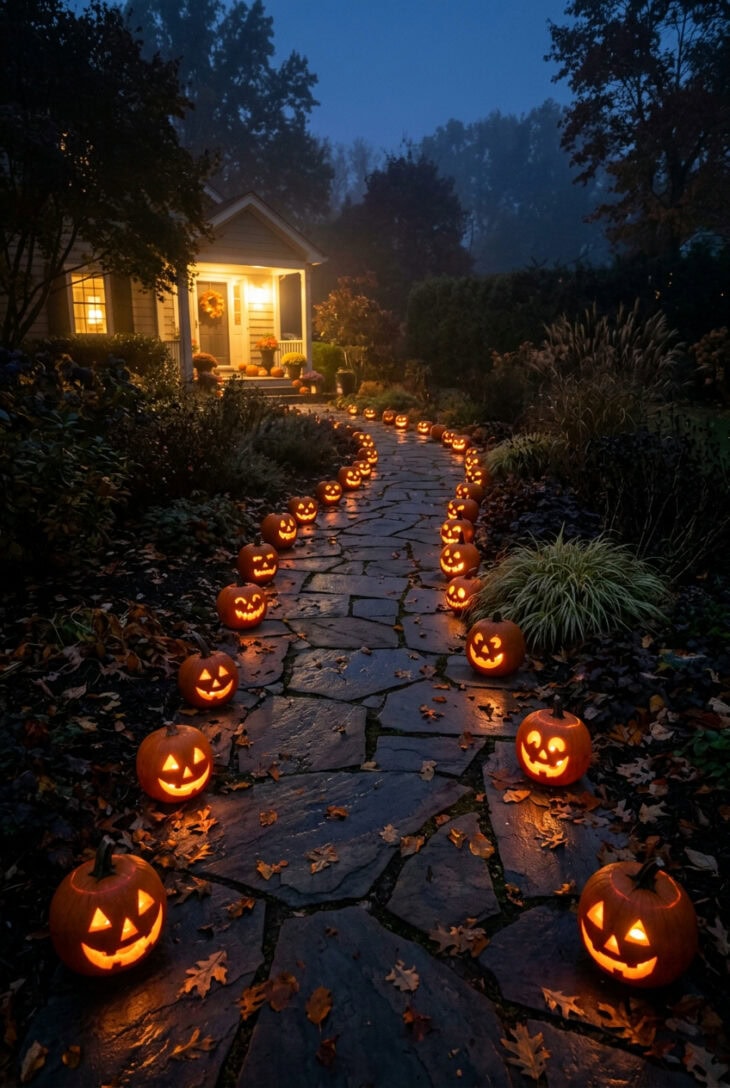
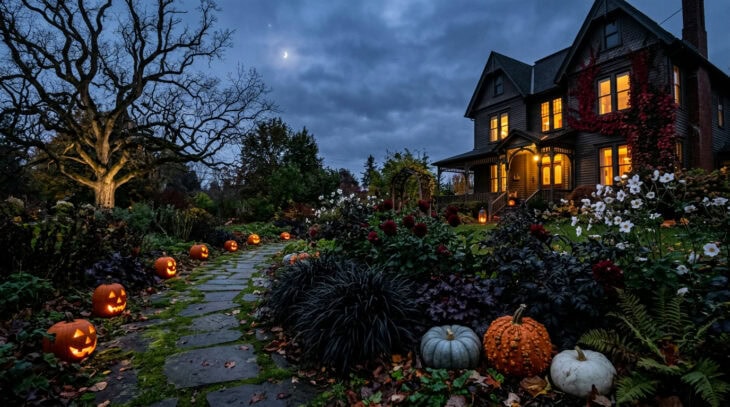
What you see A curving flagstone path in the dark, lit only by a double row of grinning jack-o’-lanterns. Each one glows warm orange, their light pooling on fallen leaves and catching a thin mist, and the line of faces leads the eye straight to a softly lit front door.
Why it works A row of repeated lights is one of the most effective tricks in garden lighting, because it draws a line through the dark and tells visitors exactly where to walk. On Halloween night it doubles as a welcome sign for trick-or-treaters. It shows how the right edging turns any route into one of the more memorable garden path ideas, even for a single week.
How to get it Space pumpkins every 3 to 4ft (90 to 120cm) on both sides, staggered so the faces do not line up exactly. Carve no more than two or three days before Halloween, since carved pumpkins last only a few days in warm weather, and rub petroleum jelly on the cut edges to slow shriveling. Use battery LED candles rather than flames near dry leaves, costumes and ornamental grasses. Stand each pumpkin on paving or a saucer, not on grass or soil, so it does not rot from below. For a display that goes up in early October, mix a few foam craft pumpkins into the line and carve the real ones later.
08. Orange and Purple Planters by the Door
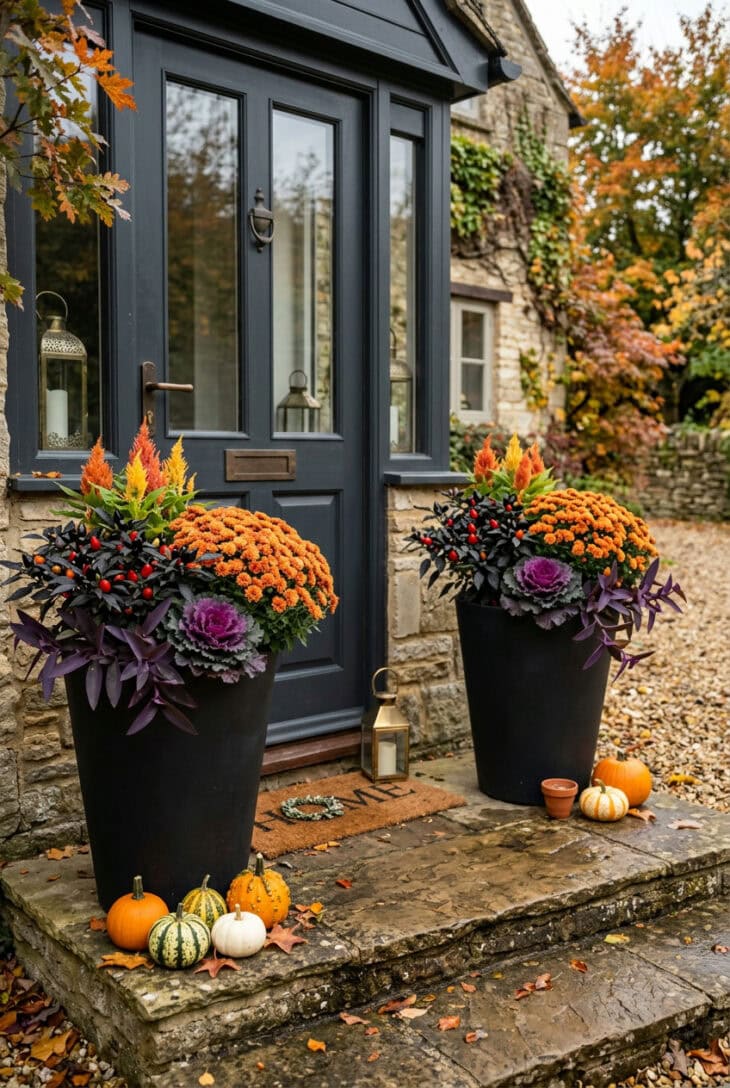
What you see Two tall black planters on either side of a dark front door, each one a bundle of Halloween color. Orange mums form the base, flame-shaped orange celosia rises behind them, and a dark pepper plant is studded with little black and red fruits. Purple foliage trails over the rims and a frilly purple kale anchors the front.
Why it works Orange and purple are Halloween’s own palette, but used in plants rather than plastic, they look stylish instead of kitschy. Black pots make both colors glow and read as elegant through November. Swapping the fillings seasonally is one of the most useful container garden ideas for a front entrance.
How to get it Choose planters at least 18in (45cm) wide so you can pack in five plants. Start with an orange garden mum (Chrysanthemum × morifolium) bought with buds just showing color, which will flower for four weeks or more. Add ornamental pepper (Capsicum annuum ‘Black Pearl’), whose black leaves and fruit ripen to red, plus plumed cockscomb (Celosia argentea var. plumosa) in orange for height. Let purple heart (Tradescantia pallida) trail over the edge, and tuck in ornamental kale (Brassica oleracea ‘Redbor’), whose color deepens once nights fall below 50°F (10°C). The pepper, celosia and purple heart die at first frost, so pull them then and let the kale carry the pots into winter.
09. A White Ghost Garden That Glows at Dusk
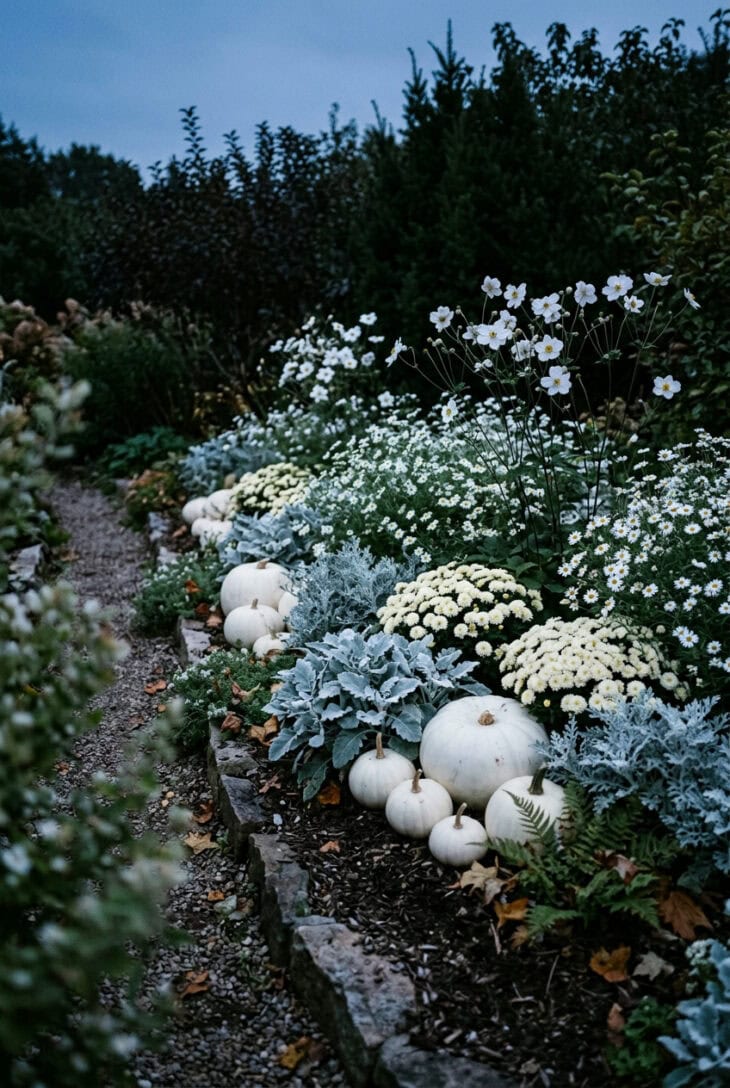
What you see A bed of pale shapes floating in the blue twilight. Chalk-white pumpkins nestle among felted silver dusty miller and soft gray artemisia, white mums and wiry Japanese anemones stand above them, and a haze of tiny white daisies drifts through the back. As the dark shrubs behind disappear, the whole planting seems to glow like a gathering of ghosts.
Why it works White and silver reflect the last of the light long after colors have faded to gray, which is why they are the backbone of any night garden. In late October, when trick-or-treating happens after dark, this is the planting people actually see. It borrows directly from our moon garden ideas, with white pumpkins added for the season.
How to get it Build the permanent frame with Japanese anemone (Anemone × hybrida ‘Honorine Jobert’), which flowers from August to October in zones 4 to 8, and false aster (Boltonia asteroides ‘Snowbank’) for a cloud of late white daisies. Fill the front with dusty miller (Jacobaea maritima) and artemisia (Artemisia ‘Powis Castle’), both of which need sharp drainage. In October, add white mums and white pumpkins such as ‘Lumina’, ‘Casper’ or the mini ‘Baby Boo’ (Cucurbita pepo), which need about 90 to 100 days from sowing. Harvest white pumpkins as soon as they ripen and cure them out of strong sun, which can tint the skin yellow. Plant in groups of at least three, since single white plants look like gaps at night rather than ghosts.
10. Blood-Red Fall Foliage
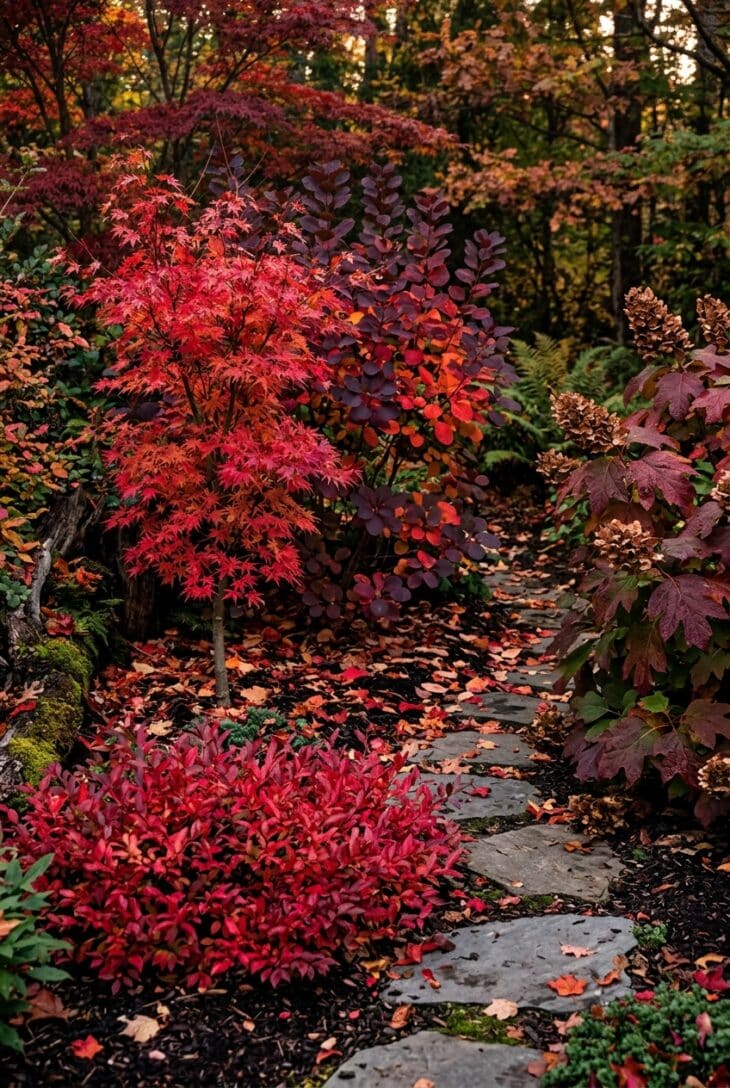
What you see A corner of the yard soaked in red. A small Japanese maple burns scarlet, a smokebush darkens to wine, an oakleaf hydrangea turns burgundy under its papery dried flowers, and a low sweetspire glows ruby at the front. Fallen red leaves pile up on dark mulch between the stepping stones.
Why it works Deep red is the most dramatic fall color and it lands right on Halloween in most of the country. Grouping several red shrubs of different leaf shapes creates one saturated scene rather than dotted color, and each shrub earns its keep in other seasons with flowers or dark summer leaves.
How to get it Anchor the group with a Japanese maple (Acer palmatum ‘Bloodgood’), which is dark red all summer and crimson in fall, hardy in zones 5 to 8 and happiest with some afternoon shade. Add smokebush (Cotinus coggygria ‘Royal Purple’), cut hard in early spring for larger leaves, and oakleaf hydrangea (Hydrangea quercifolia) for burgundy color in shade. At the front, plant native sweetspire (Itea virginica ‘Henry’s Garnet’) about 3ft (90cm) apart. Skip burning bush (Euonymus alatus), however bright it looks: it is invasive in much of the Northeast and Midwest, and several states restrict its sale.
11. A Haunted-House Wall of Boston Ivy
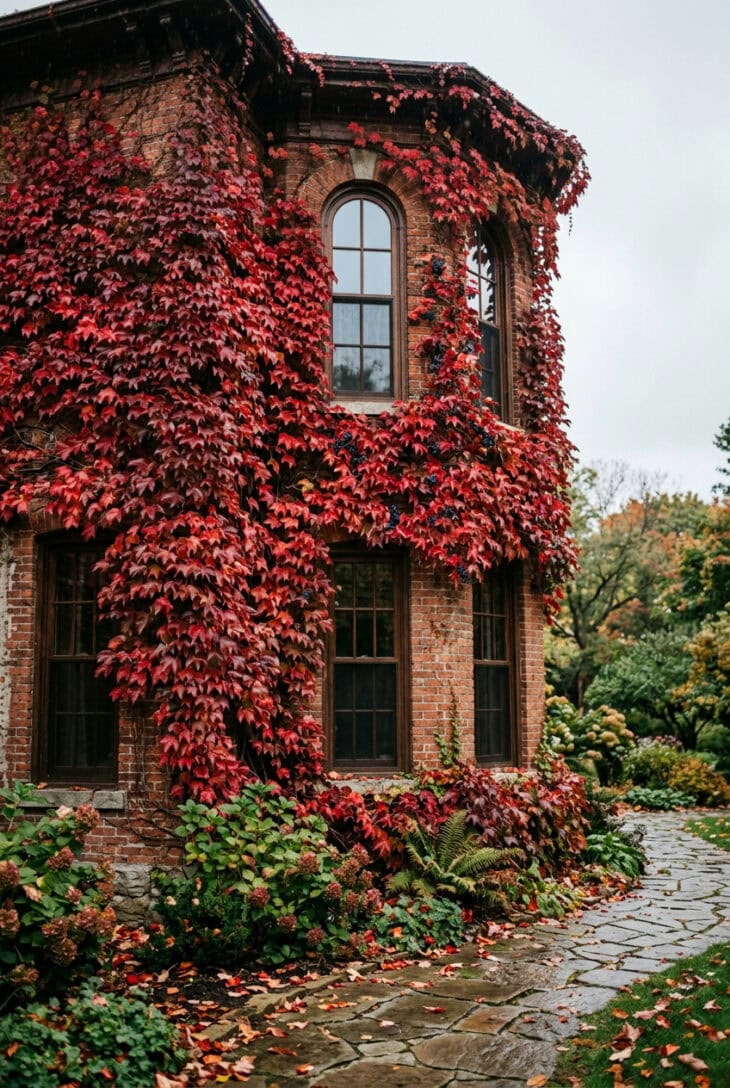
What you see An old brick wall swallowed by crimson and burgundy leaves, with tall dark windows peering out through the foliage like the eyes of a haunted house. Clusters of blue-black berries hang between the leaves, and the first ones to fall have landed on the flagstones below.
Why it works A house wrapped in red vines is the classic image of an old, slightly spooky home, and this plant produces it in just a few seasons. It cloaks plain masonry in green all summer, turns blood red in October, and the berries feed birds into winter. It is one of the most effective vertical garden ideas for a blank wall, needing no trellis at all.
How to get it Boston ivy (Parthenocissus tricuspidata) climbs by sticky pads, is hardy in zones 4 to 8, and can grow 6 to 10ft (1.8 to 3m) a year once established. Grow it only on sound brick, stone or concrete: the pads grip paint and soft mortar and leave marks, so keep it off wood siding. Plant 18in (45cm) out from the wall and lean the young stems in toward it. Trim it back from windows, gutters and roof edges every summer. For a native alternative, Virginia creeper (Parthenocissus quinquefolia) gives the same crimson color with five-part leaves.
12. A Tunnel of Gourds and Purple Beans
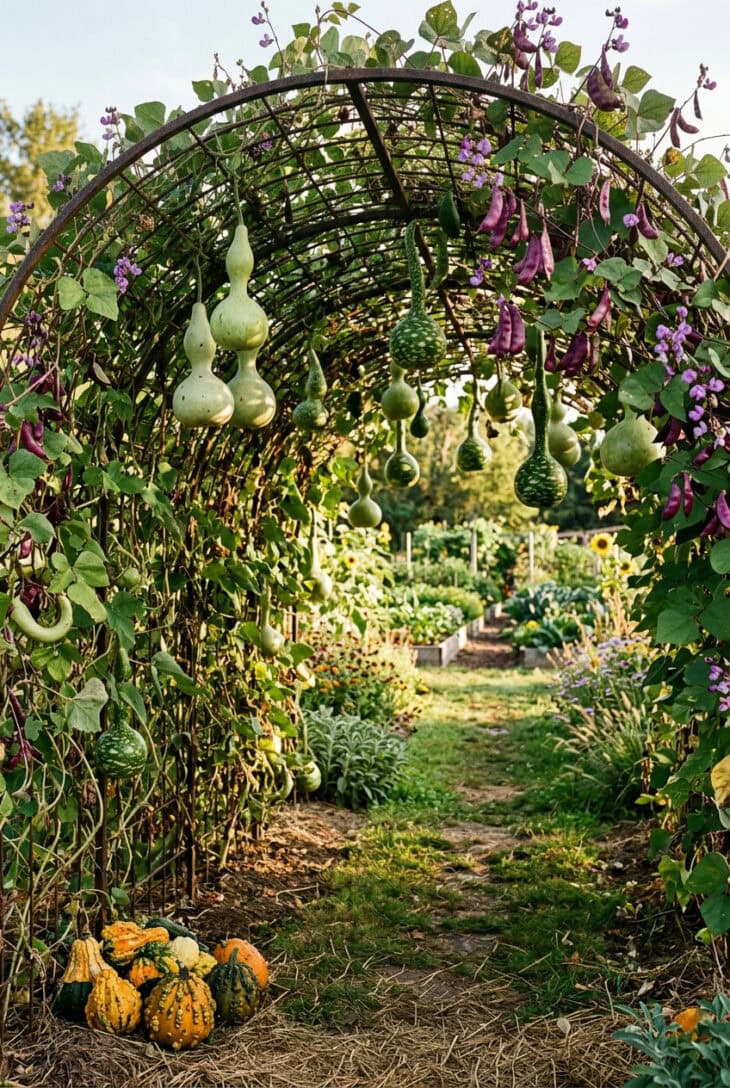
What you see A walk-through tunnel of vines where strange shapes dangle overhead: curved pale bottle gourds, speckled swan gourds with long necks, and bunches of glossy purple bean pods. Warty yellow and orange gourds lie in the straw at your feet, and dappled light falls through the leaves onto a grass path.
Why it works Gourds look slightly otherworldly when they hang in the air instead of lying on the ground, and walking under them feels like stepping into a storybook. Growing up rather than out also saves space and keeps the fruit clean and unblemished. Bottle gourds add a late-night bonus, because their white flowers open at dusk for moths.
How to get it Use a sturdy cattle-panel or metal arch at least 7ft (2.1m) tall, anchored well, since a full crop of gourds is heavy. Plant bottle gourd (Lagenaria siceraria) and ornamental gourds (Cucurbita pepo var. ovifera) after frost, 2 to 3ft (60 to 90cm) apart along both sides; bottle gourds need 120 days or more, so start them indoors in short-season areas. Add hyacinth bean (Lablab purpureus) for its purple pods, but treat it as ornamental, since the raw beans are toxic. Harvest ornamental gourds when the stems turn brown and dry, and leave hard-shelled bottle gourds on the vine until the vine dies back.
13. A Woodland Bed of Creepy Native Plants
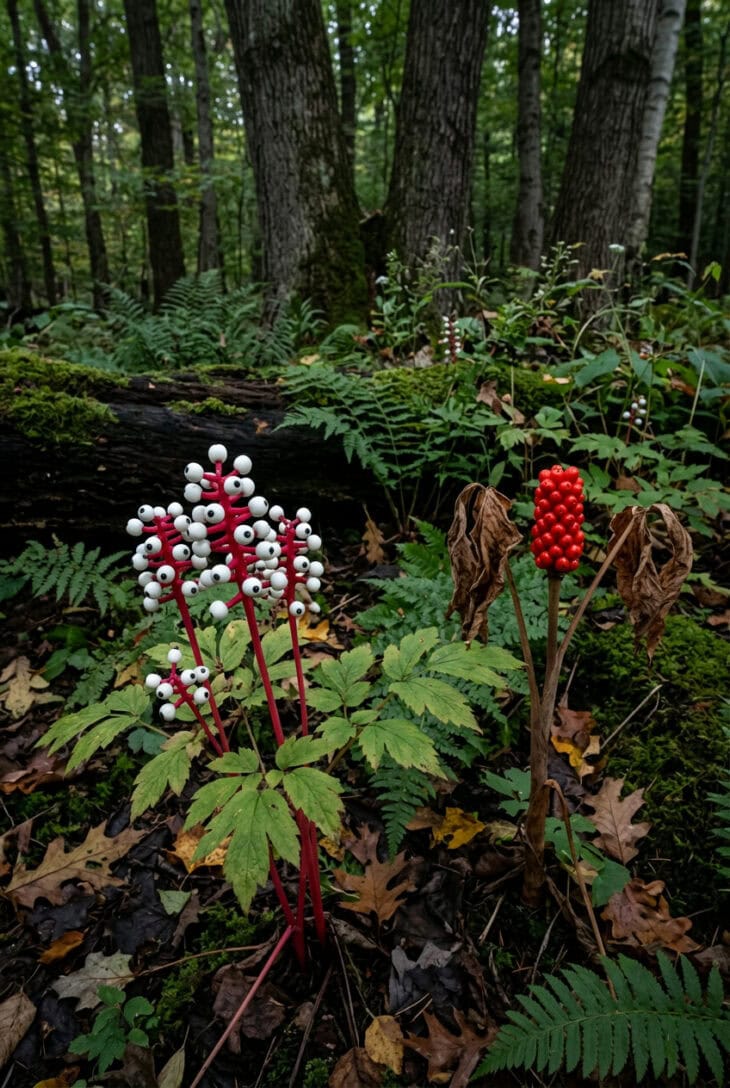
What you see A dim woodland floor where clusters of white berries stare back at you, each one marked with a single black pupil and held up on a thick red stalk. Beside them, a club of glossy scarlet berries sits where a jack-in-the-pulpit has faded away. Ferns, dark leaf litter and a mossy log complete the scene.
Why it works These are native plants with genuinely unsettling looks, so the garden is creepy without a single prop. They thrive in the dry to moist shade under trees, where lawns fail, and they support native wildlife the rest of the year. The berries are the showpiece, and they ripen right as Halloween approaches.
How to get it Plant doll’s eyes (Actaea pachypoda), hardy in zones 3 to 8, in moist, humus-rich shade about 2ft (60cm) apart; its berries ripen from late summer into fall. Add jack-in-the-pulpit (Arisaema triphyllum), whose hooded spring flowers turn into scarlet berry clubs by September. Both plants are poisonous, including the berries, so this is not a bed for a yard where toddlers explore. Buy nursery-propagated plants rather than anything dug from the wild, and mulch with shredded leaves to mimic a forest floor. Underplant with ferns so the bed stays full once the berries are gone.
14. A Carnivorous Bog in a Cauldron
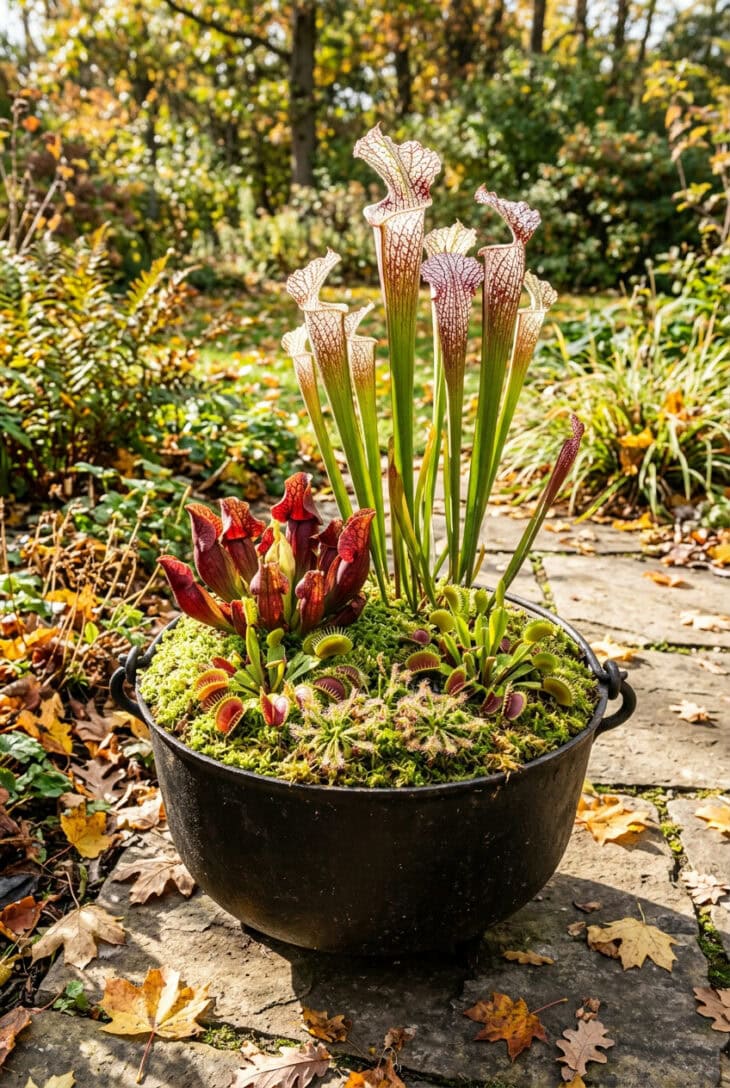
What you see A black cauldron on a sunny patio, brimming with plants that eat insects. Tall white-topped pitchers veined in blood red rise from a bed of sphagnum moss, Venus flytraps gape open with red-lined jaws, and sundews glitter with sticky droplets at the front.
Why it works Carnivorous plants are fascinating to kids and adults alike, and a witch’s cauldron is the obvious container for them. The white-topped pitcher plant is at its best in fall, when it produces its tallest, most colorful pitchers, so this display actually peaks for Halloween. It is the patio version of the pitcher plant bog in our rain garden ideas.
How to get it Use a plastic or fiberglass cauldron, or line a real cast-iron one with a plastic pot, because metal and minerals harm these plants. Leave no drainage holes, or stand the pot in a tray, and fill it with a 50/50 mix of peat moss and perlite with no fertilizer. Plant white-topped pitcher plant (Sarracenia leucophylla), Venus flytrap (Dionaea muscipula) and sundews (Drosera), and give them full sun for at least six hours a day. Water only with rainwater or distilled water, keeping the mix constantly wet. They need a cold winter dormancy, so leave the pot outdoors until hard freezes arrive, then move it to an unheated garage or shed below 50°F (10°C).
15. A Witch’s Herb Garden
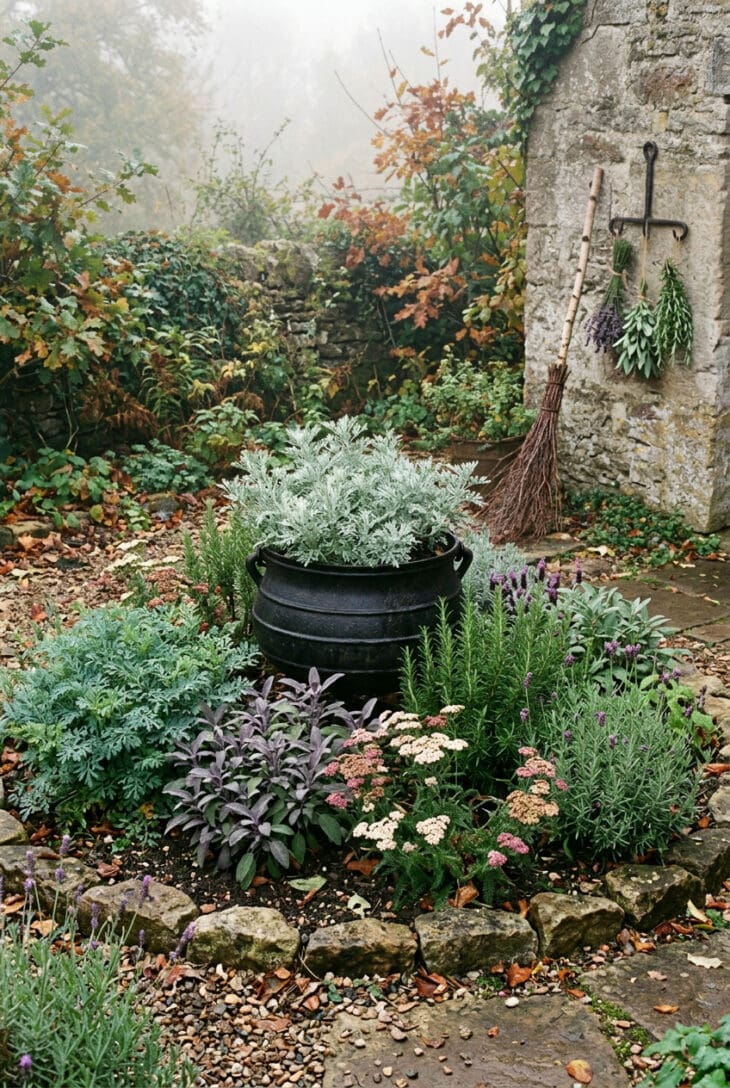
What you see A small round herb garden with a black cauldron at its heart, overflowing with silvery wormwood. Stone-edged beds of blue-green rue, dusky purple sage, rosemary, yarrow and lavender circle it, and against the old wall behind, an old broom leans beside bundles of herbs hung up to dry.
Why it works Every one of these herbs has centuries of folklore attached, from protection charms to potions, which gives the garden a story that fits Halloween perfectly. Most are also tough, drought-tolerant Mediterranean plants that look good well into fall. It is a playful twist on our herb garden ideas, and most of it is still useful in the kitchen.
How to get it Drill drainage holes in the cauldron and fill it with gritty mix for wormwood (Artemisia absinthium), which is best kept in a pot because it can suppress the growth of plants around it. In the beds, grow purple sage (Salvia officinalis ‘Purpurascens’), rosemary (Salvia rosmarinus), yarrow (Achillea millefolium) and English lavender (Lavandula angustifolia), about 18in (45cm) apart in full sun and sharply drained soil. Add rue (Ruta graveolens) for its blue foliage, but handle it with gloves, because its sap causes blistering rashes in sunlight. Avoid mugwort (Artemisia vulgaris), which spreads invasively. Hang cut bundles to dry on a hook or rafter in September.
16. A Cutting Bed of Near-Black Dahlias
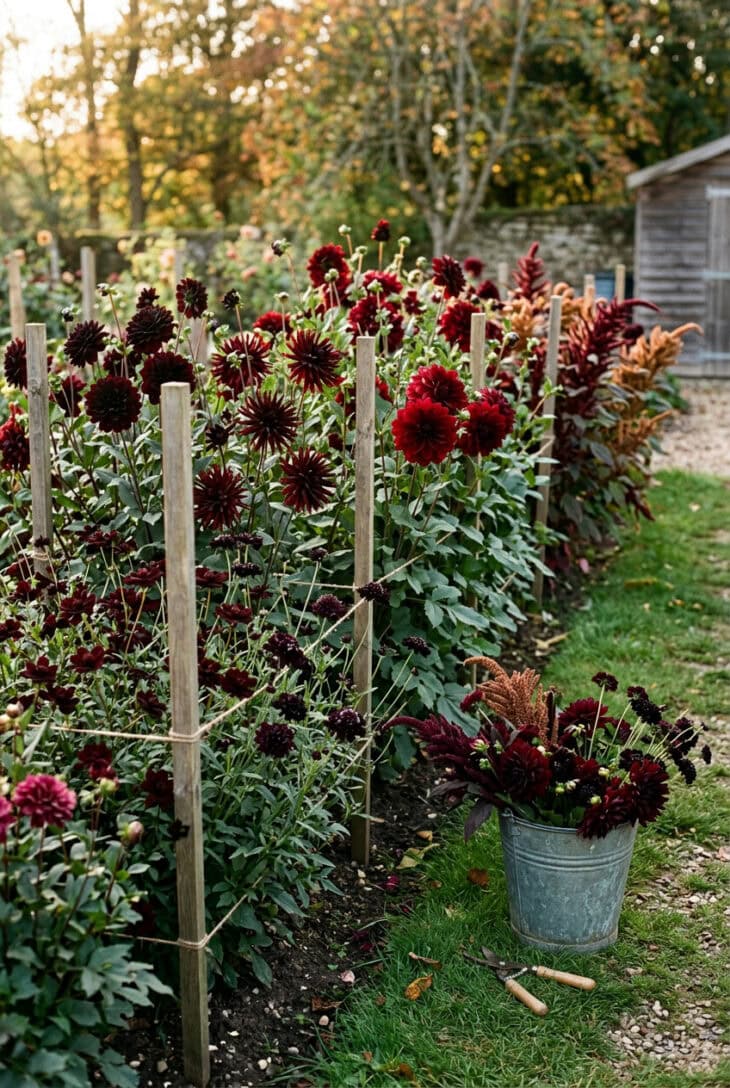
What you see Rows of velvety dahlias in the darkest shades a flower can manage: deep maroon doubles, spiky black-red cactus forms and big blood-red blooms. Dark chocolate cosmos, near-black pincushion flowers and tall red amaranth plumes weave between them, and a bucket of freshly cut blooms waits on the path.
Why it works Dahlias peak in September and October and keep going right up to the first frost, which makes them one of the few flowers you can count on for a Halloween table. The darkest varieties give arrangements a gothic drama that orange and yellow never can. It is the moody corner of our cut flower garden ideas.
How to get it Plant dahlia tubers (Dahlia ‘Karma Choc’, ‘Arabian Night’ and ‘Rip City’) after the last frost, 18 to 24in (45 to 60cm) apart in full sun, and stake each one at planting time. Pinch out the central tip when plants reach about 12in (30cm) for more stems. Add chocolate cosmos (Cosmos atrosanguineus), which smells faintly of cocoa, and pincushion flower (Scabiosa atropurpurea ‘Black Knight’). Cut dahlias in the cool of the morning when they are about three-quarters open, since they do not open further in the vase. North of zone 8, lift the tubers after frost blackens the leaves and store them in barely damp peat or vermiculite at around 40 to 50°F (4 to 10°C).
17. Grass and Seedhead Silhouettes at Dusk

What you see Tall grasses and bare-stemmed seedheads turned to black cut-outs against a sunset of orange and violet. Spiky coneflower heads bristle like tiny skulls on sticks, feathery grass plumes sway above them, and a thin crescent moon hangs overhead.
Why it works A garden left standing in fall has a skeletal beauty that tidied beds cannot match, and at dusk it becomes pure silhouette. It is also the easiest idea here: the work is simply not cutting things down. Goldfinches and other birds feed on the seeds all winter, which is why this approach belongs among the best low-maintenance garden ideas.
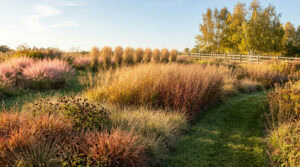
How to get it Plant where you see the evening sky, such as on the west side of the yard, so the grasses are backlit at sunset. Use native switchgrass (Panicum virgatum ‘Shenandoah’), which tints burgundy by late summer, and little bluestem (Schizachyrium scoparium), which turns copper in fall; both are hardy to zone 3 or 4. In the eastern US, avoid Japanese silver grass (Miscanthus sinensis), which self-seeds into natural areas. Add purple coneflower (Echinacea purpurea) and black-eyed Susan (Rudbeckia hirta) and skip deadheading after August. Cut everything back in late winter, before new growth starts.
18. Leave the Orb Weaver Webs
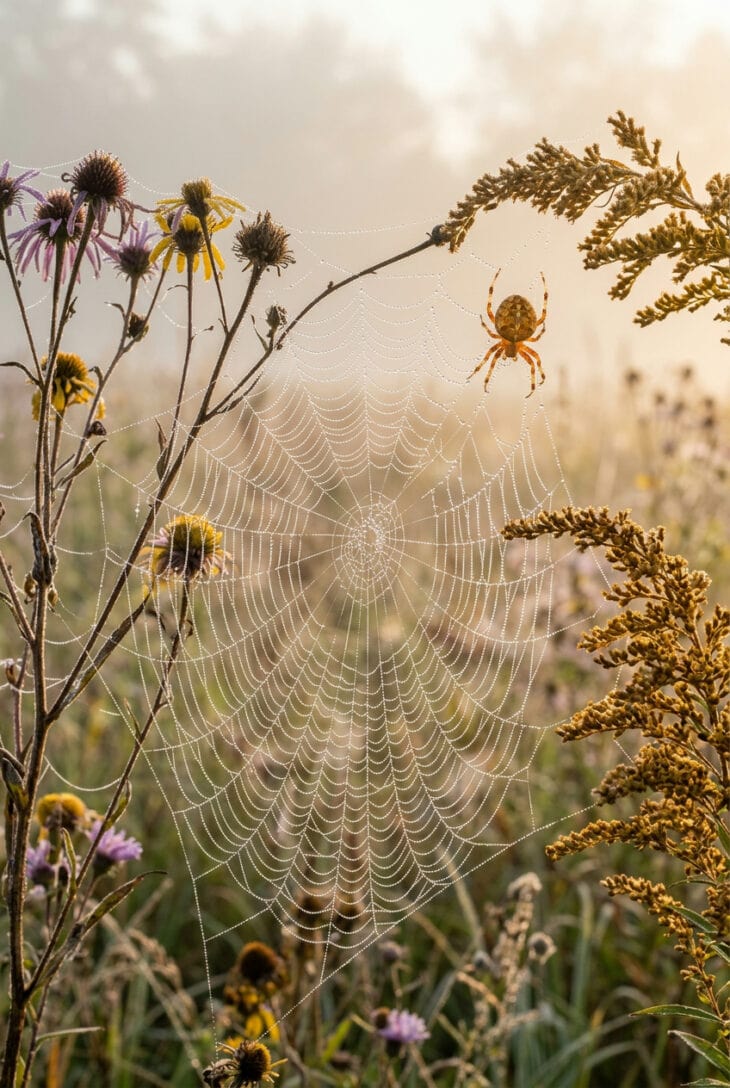
What you see A perfect orb web strung between asters and goldenrod, every thread beaded with dew and glittering in the dawn light. A plump orange spider waits at its edge, and a soft mist hangs over the meadow garden behind.
Why it works Real webs are far more beautiful than stretchy fake cobwebs, and they cost nothing. Orb weavers reach full size in September and October, so their webs are at their biggest right on schedule. The spiders also catch pests all season, and they are harmless to people.
How to get it Stop spraying insecticides and leave some stems and seedheads standing into fall to give spiders anchor points. Look out for the yellow garden spider (Argiope aurantia), the cross orb weaver (Araneus diadematus) and the marbled orb weaver (Araneus marmoreus), whose round orange abdomen has earned it the nickname pumpkin spider. Go out on a foggy morning, or mist a web lightly with a spray bottle, to see it sparkle. If you decorate, skip synthetic stretchy cobwebs outdoors, because birds, bats and bees get tangled in them.
19. A Night Garden for Bats
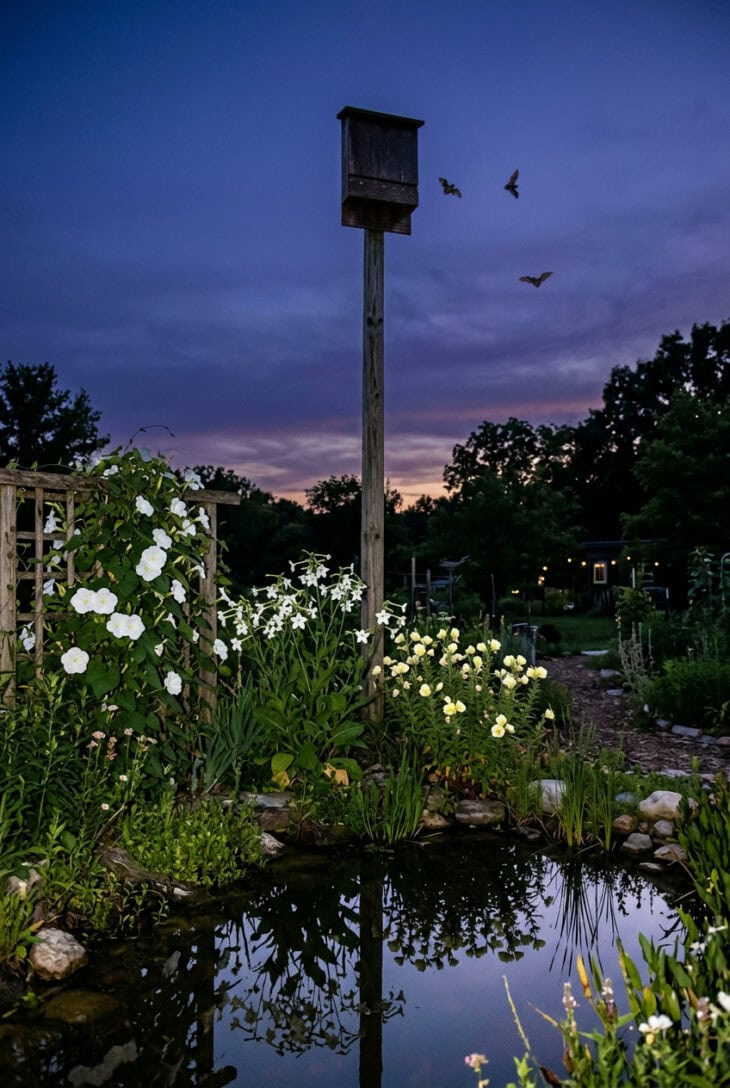
What you see A bat house stands high on a pole against a violet twilight sky, while two or three bats flicker overhead. Below, a small pond holds the last of the light, ringed by tall white flowering tobacco, pale evening primrose and big white moonflowers opening on a trellis.
Why it works Bats are Halloween’s mascot, and real ones are far more welcome than you might think: they eat huge numbers of night-flying insects, including mosquitoes and crop-damaging moths. Night-scented flowers pull in moths, the pond draws insects, and the bats follow. It is one of the most rewarding wildlife garden ideas for a yard with open sky.
How to get it Mount a bat house at least 12ft (3.7m) high on a pole or the side of a building, not on a tree, where predators can reach it and shade keeps it too cool. In most regions it needs six or more hours of direct sun a day, facing south or southeast, and works best within a quarter mile of water. Plant flowering tobacco (Nicotiana sylvestris), evening primrose (Oenothera biennis) and moonflower (Ipomoea alba) nearby to attract moths. Avoid pesticides and bright all-night security lights, which drive bats away. Be patient: many bat houses take a season or two to be occupied.
20. Twisted Branches and Contorted Trees
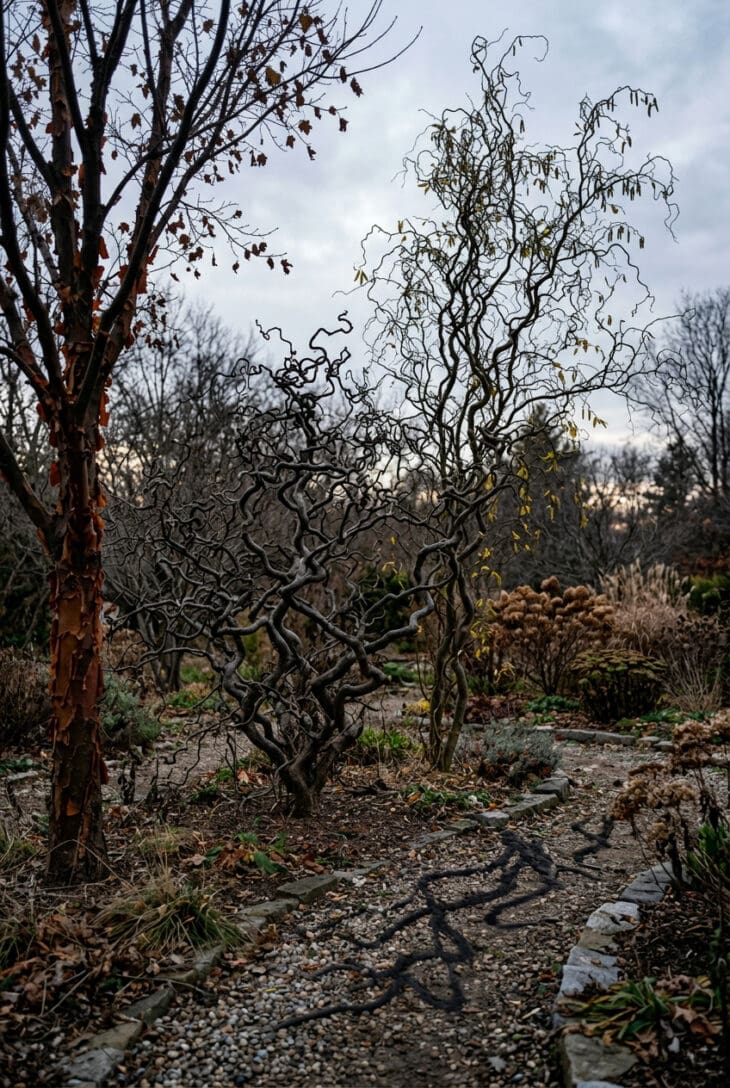
What you see Branches that twist and knot like witches’ fingers. A leafless Harry Lauder’s walking stick corkscrews in every direction, a corkscrew willow curls behind it with a few last yellow leaves, and a paperbark maple sheds its cinnamon bark to one side. The low sun throws their tangled shadows across the gravel.
Why it works Twisted shapes read as eerie the moment the leaves drop, and they stay that way all winter. Unlike Halloween decorations, these plants are structural: they give a garden a focal point from October to March, when flowers are long gone. Cut branches are prized by florists for fall and winter arrangements too.
How to get it Harry Lauder’s walking stick (Corylus avellana ‘Contorta’) grows slowly to 8 to 10ft (2.4 to 3m) in zones 4 to 8; it is often grafted, so remove any straight suckers from the base as soon as they appear. Corkscrew willow (Salix matsudana ‘Tortuosa’) grows fast but is short-lived and has brittle wood, so plant it well away from the house and power lines. For bark interest, add a paperbark maple (Acer griseum), which peels year-round and turns red in fall. Site all three where they will be backlit by the low sun or a garden light, since silhouette is the whole point.
21. An Uplit Gnarled Tree
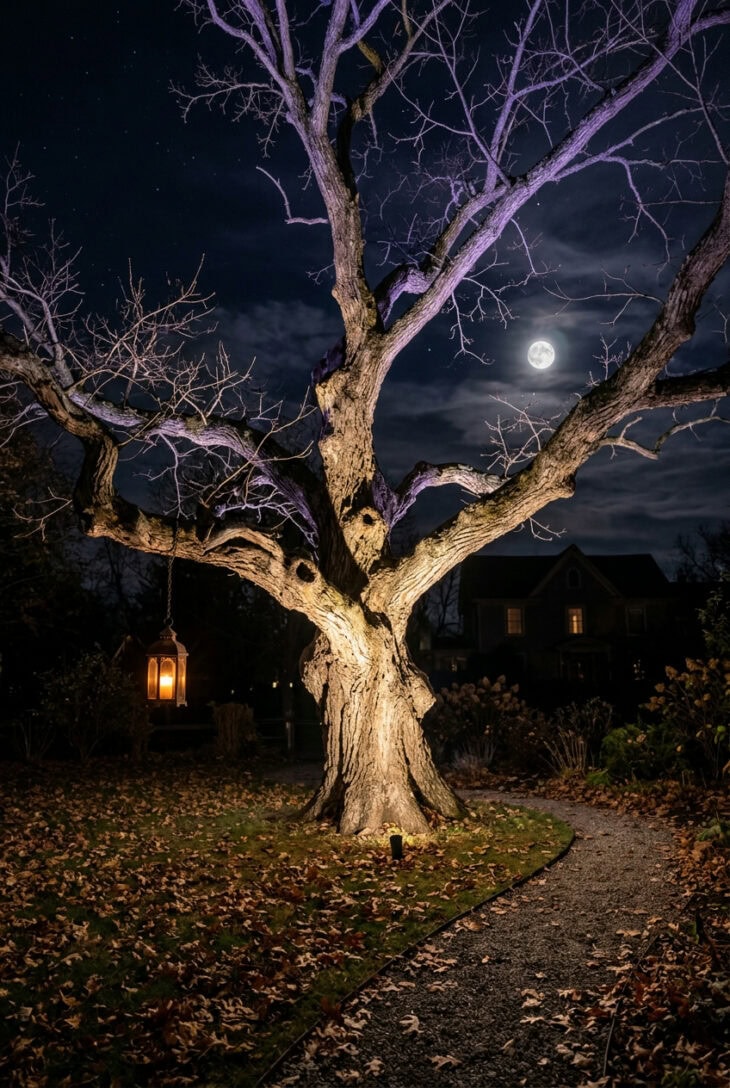
What you see An old oak in the front yard at night, its gnarled trunk lit from below so every twist and scar stands out. A cool violet glow washes the upper branches, an iron lantern swings from a low limb, and a nearly full moon hangs above the bare crown.
Why it works Lighting a tree from below creates shadows we rarely see in daylight, which is exactly what makes a familiar tree look haunted. One or two well-placed fixtures do more than a yard full of decorations, and the same lights make the tree a year-round focal point. It is the simplest of our garden lighting ideas to adapt for the season.
How to get it Place a low-voltage LED spotlight 2 to 3ft (60 to 90cm) from the trunk, angled up the bark, and use warm white (2700 to 3000K) as your permanent light. For Halloween week, add a second fixture with a violet or amber lens, or a color-changing smart bulb, aimed into the canopy. Pick the tree with the most character, even if it is not the biggest; an old oak, sycamore or apple with a leaning trunk works beautifully. Keep cables shallow and away from roots, and hang lanterns with battery candles only.
22. A Cornstalk and Straw Bale Harvest Fence
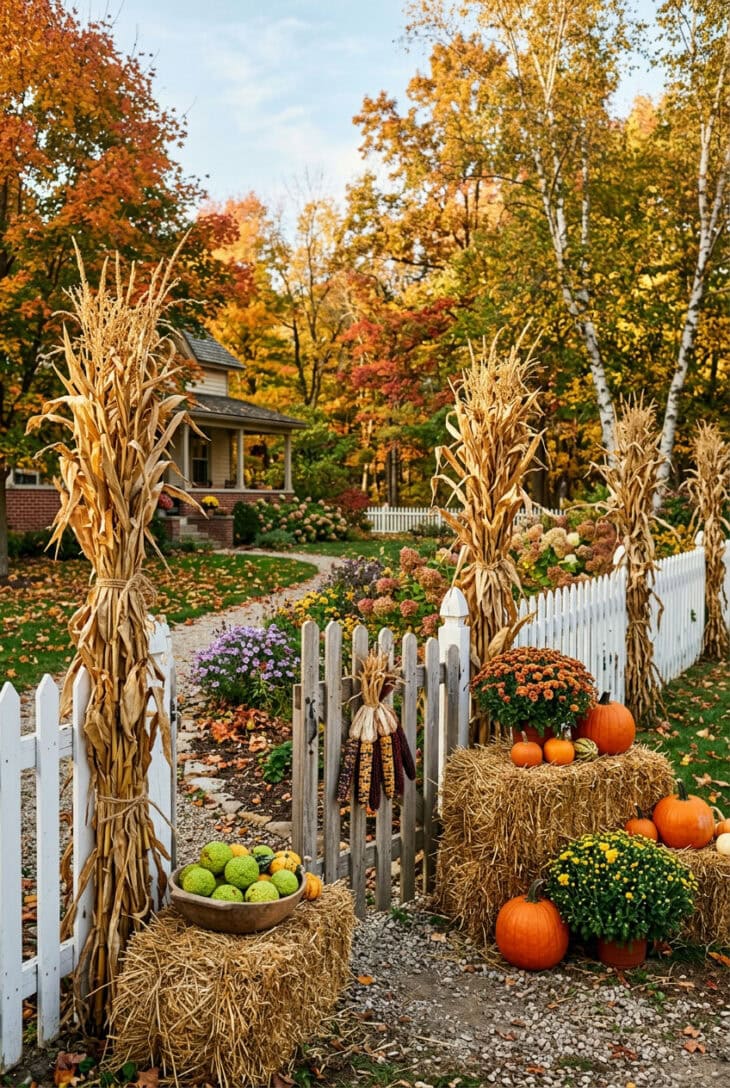
What you see A picket fence dressed for harvest, with tall golden cornstalk bundles tied to every post. Straw bales stacked by the gate carry pumpkins and bronze mums, a bowl of bumpy green fruits that look uncannily like brains sits beside them, and jewel-colored corn cobs hang from the gate.
Why it works Cornstalks and straw bring height and rustic texture to a front yard in minutes, and they work from late September through Thanksgiving. Repeating a bundle on every post creates rhythm along the boundary, much like a well-planted fence line. It is a quick seasonal dressing for any of our garden fence ideas.
How to get it Buy cornstalk bundles from a farm stand or garden center, or save your own after the sweet corn harvest, and tie them to posts with jute twine at two heights. Set straw bales on a pallet or pavers so they do not rot the lawn, then reuse them as mulch or a straw bale garden in spring. For the “brains,” collect the fallen fruit of osage orange (Maclura pomifera), known as hedge apples, which drop from female trees in September and October; wear gloves, since the milky sap can irritate skin. Hang ornamental corn such as ‘Glass Gem’ (Zea mays) from the gate.
23. A Scarecrow in the Fall Vegetable Patch
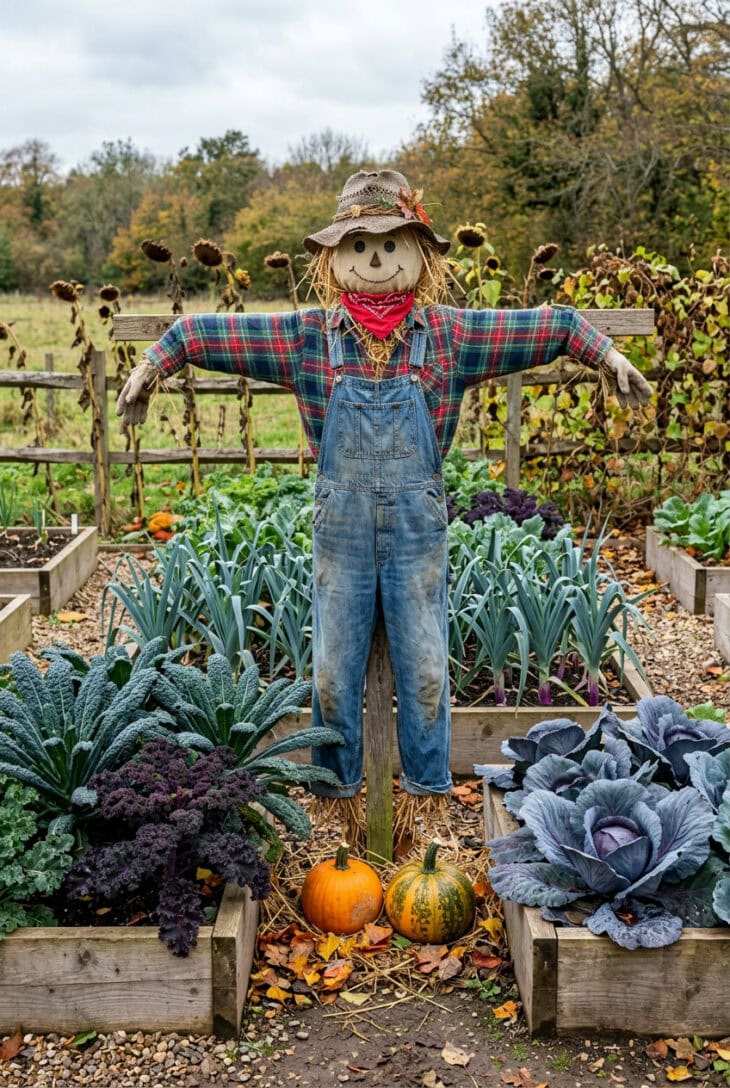
What you see A straw-stuffed scarecrow in a plaid shirt and battered hat stands guard over raised beds that are still full in late fall. Dark, blistered lacinato kale, frilly purple kale, deep red cabbages and rows of blue-green leeks fill the beds, and bowed sunflower heads line the fence behind.
Why it works A scarecrow is the most family-friendly Halloween figure there is, and building one is a perfect weekend project with kids. Setting it among fall crops shows that the vegetable garden does not have to end in September. Dark kales and purple-tinged leeks also look properly moody next to straw and pumpkins.
How to get it Build the scarecrow on a T-shaped frame of two 2×2 stakes, the upright sunk about 18in (45cm) deep, and stuff old clothes with straw. Birds get used to a scarecrow within a week or two, so move it every few days if you want it to work. For the raised beds, sow lacinato kale (Brassica oleracea ‘Lacinato’) and red Russian kale in mid to late summer so they mature in fall; frost makes both sweeter. Plant leeks (Allium ampeloprasum ‘Bleu de Solaise’) in spring, whose leaves turn violet in cold weather.
24. A Halloween Balcony
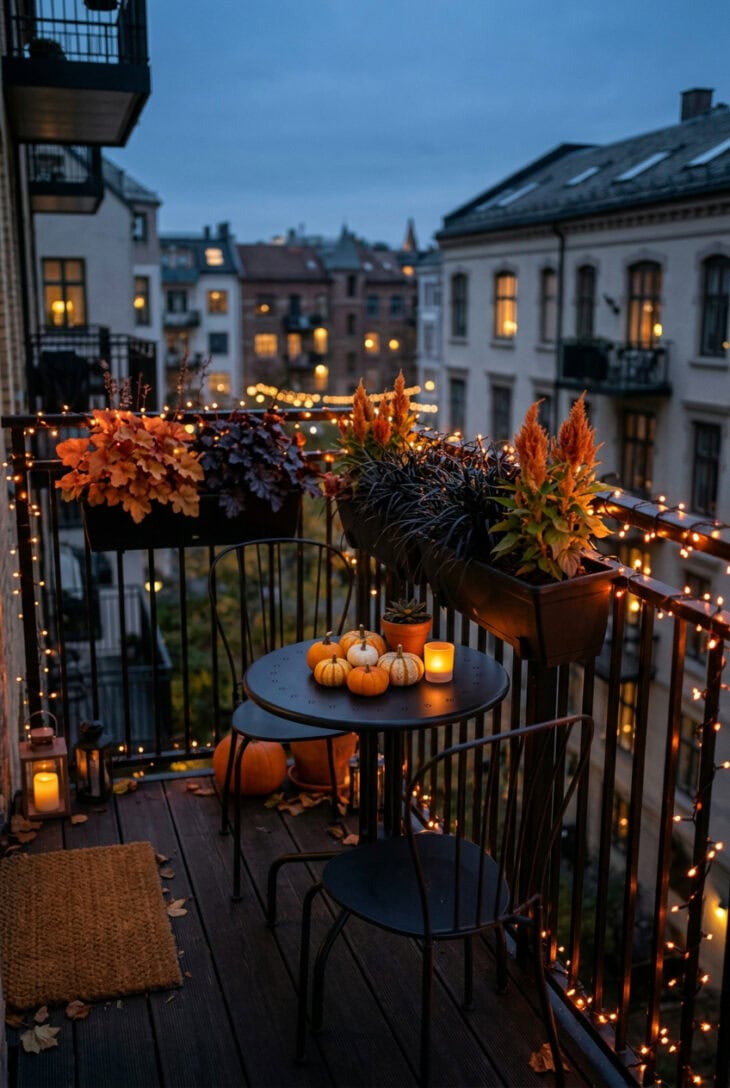
What you see A tiny city balcony at dusk, dressed for the season with plants rather than props. Black rail planters hold orange and near-black heuchera with tufts of black grass and a spark of orange celosia. Mini pumpkins crowd a bistro table and a strand of orange fairy lights glows along the railing.
Why it works You do not need a yard to celebrate. A tight orange and black palette looks deliberate in a small space, and heuchera and mondo grass stay attractive long after Halloween, so the planters carry on into winter. It shows how our balcony garden ideas can shift with the seasons.
How to get it Use lightweight fiberglass or plastic rail planters and check your building’s rules and weight limits before adding soil. Plant heuchera in orange (Heuchera ‘Marmalade’) and near-black (Heuchera ‘Obsidian’) about 8in (20cm) apart, edged with black mondo grass (Ophiopogon planiscapus ‘Nigrescens’), and add orange celosia for a few weeks of color until frost. Scatter mini pumpkins such as ‘Jack Be Little’ and ‘Baby Boo’ (Cucurbita pepo), which keep for weeks uncarved. Use battery or solar fairy lights so you are not running cords through the door.
25. Plant Black Tulips on Halloween
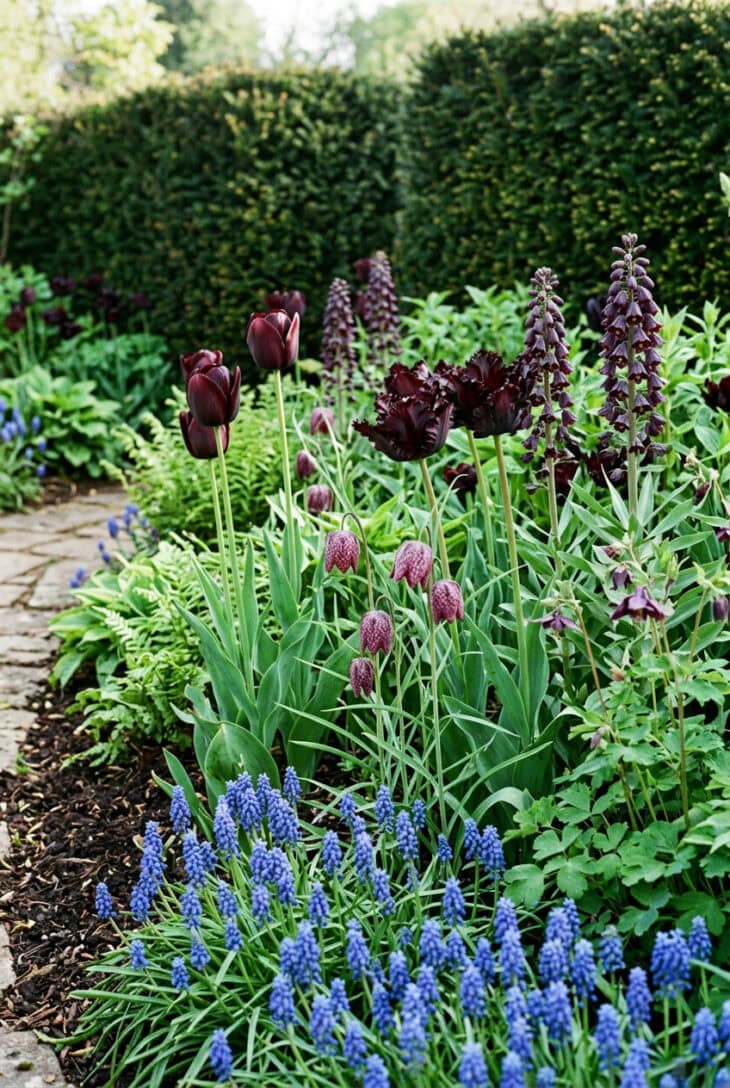
What you see The payoff, six months later: a May bed of glossy maroon-black tulips, ruffled near-black parrot tulips and nodding checkered fritillary bells, with tall spires of dark plum fritillaria rising behind. A carpet of blue grape hyacinths runs along the front.
Why it works Late October is the perfect time to plant spring bulbs across most of the country, so Halloween becomes a planting date as well as a party. Choosing the darkest tulips and fritillaries carries the gothic mood into spring, when every other bed is pastel. Planting on Halloween weekend also makes it a tradition you are unlikely to forget.
How to get it Plant once the soil has cooled below 60°F (16°C), usually October or November in zones 4 to 7. Set tulip bulbs (Tulipa ‘Queen of Night’ and ‘Black Parrot’) 6 to 8in (15 to 20cm) deep and about 4 to 6in (10 to 15cm) apart, in groups of at least 15 rather than in lines; ‘Queen of Night’ is one of the better tulips for returning in later years. Add snake’s head fritillary (Fritillaria meleagris) for moist spots and Persian lily (Fritillaria persica) for sharply drained ones. Edge the bed with grape hyacinth (Muscari armeniacum) planted 3in (8cm) deep. If squirrels dig up bulbs in your yard, lay chicken wire over the planting under the mulch until spring.