A pollinator garden is not a special kind of garden so much as an ordinary one planted with a little more thought. The same border that pleases you from the kitchen window can be feeding two hundred bees a day, and you would barely know unless you crouched down and listened. Once you plant for them on purpose, the hum arrives within weeks.
Contents
- 01. A Three-Season Bloom Calendar
- 02. Plant in Drifts, Not Singles
- 03. The Sun-Baked Nectar Border
- 04. A Milkweed Patch for Monarch Caterpillars
- 05. Early Bulbs and Willow for the First Bees
- 06. Let the Herbs Flower
- 07. Flat Umbels for Hoverflies and Tiny Wasps
- 08. Single Flowers Over Frilly Doubles
- 09. Tubular Reds for Hummingbirds
- 10. Foxglove and Comfrey for the Shady Side
- 11. A Night-Scented Border for Moths
- 12. A Bee Hotel on a Warm South Wall
- 13. A Bare Sunny Bank for Ground-Nesting Bees
- 14. Leave the Stems Standing Until Late Spring
- 15. A Puddling Dish for Butterflies
- 16. A Flat Basking Stone in Full Sun
- 17. Late-Season Fuel: Asters, Sedum and Goldenrod
- 18. A Clover Lawn Instead of Perfect Turf
- 19. A Mini Meadow Strip Along the Fence
- 20. A Pollinator Container Trio for a Balcony
- 21. A Nectar Shrub Backbone
- 22. A Flower Alley Through the Vegetable Beds
- 23. An Annual Nectar Patch From Seed
- 24. Put the Sprayer Down
- 25. Join the Patches Into a Corridor
The ideas below range from a pot of herbs left to flower on a balcony to a full sun-baked nectar border, and from free changes like mowing less to weekend projects like building a bee bank. Some feed adult butterflies, some feed their caterpillars, and a few give bees a place to nest, which is the part almost everyone forgets.
You do not need to do all of this, and you certainly do not need to do it in one season. Read through, pick two or three that suit your light, your soil and the time you actually have, and start there. Pollinators find new food fast, often the same summer you plant it.
01. A Three-Season Bloom Calendar
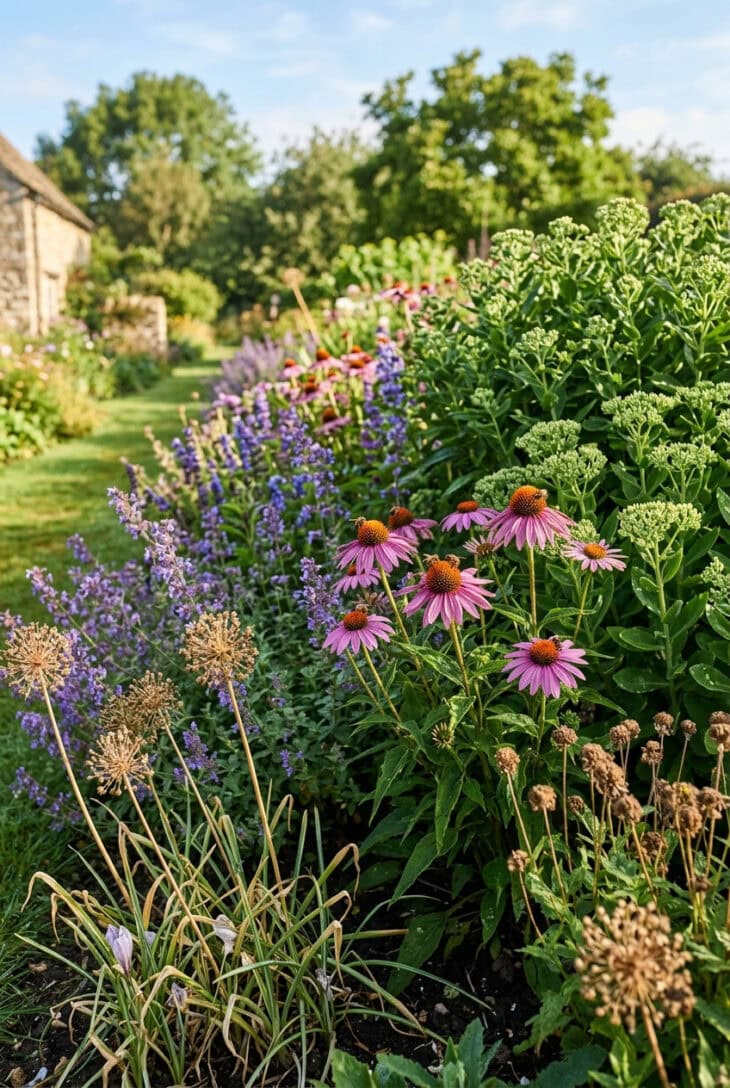
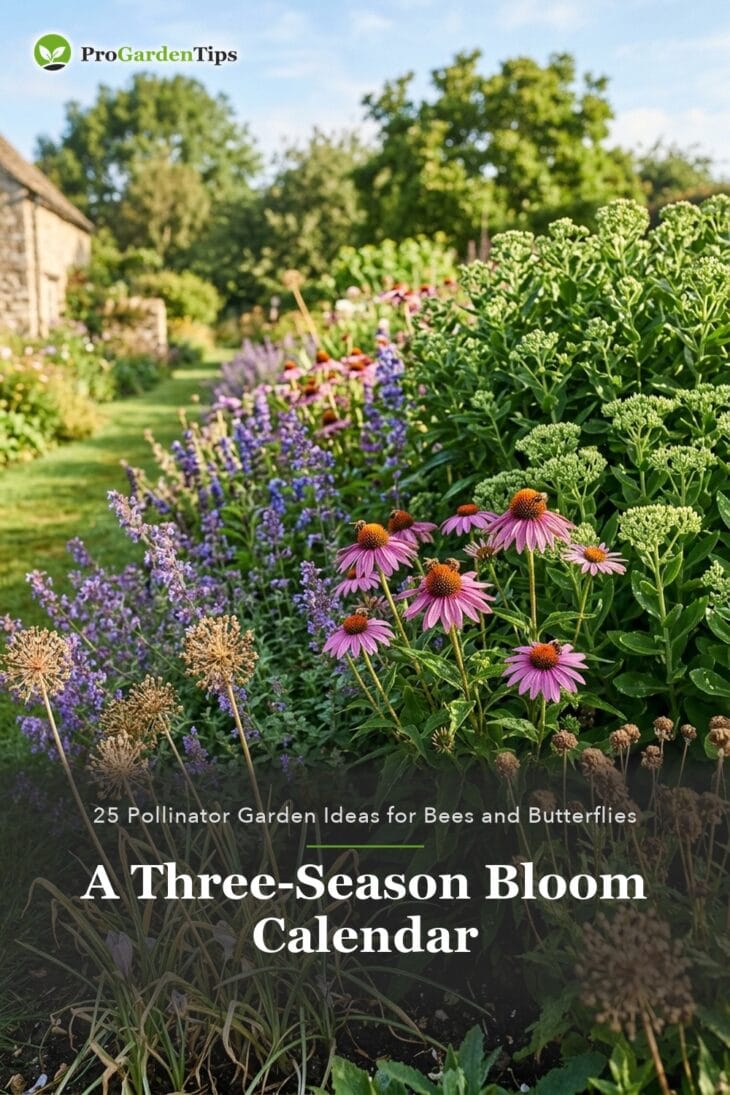
What you see One border, three seasons visible at once. At the front, the papery seedheads of alliums stand over the collapsing straps of old crocus leaves. In the middle, purple coneflowers and blue catmint are at their peak, loud with honeybees. Behind them, asters and sedum are still tight green buds, holding back for September, and that staggered timing is the entire point of the picture.
Why it works Most gardens have a hungry gap, and it is usually in early spring and again in early fall. A queen bumblebee waking in March finds nothing to eat, and a late monarch fueling up for migration in September finds nothing either. Bloom in July is easy and almost every garden has it. What separates a pretty border from a genuine pollinator garden is whether something is in flower in the two shoulder seasons.
How to get it Write down the twelve months and fill in what you already have, honestly, month by month. Then plug the holes: crocus, hellebore and pussy willow for February and March, alliums and catmint for May and June, coneflower and bee balm for high summer, then aster, sedum and goldenrod for September and October. Aim for at least three species in flower at any moment from March to October. Buy in fall for spring bulbs and in spring for the fall perennials, since that is when each is actually available.
02. Plant in Drifts, Not Singles
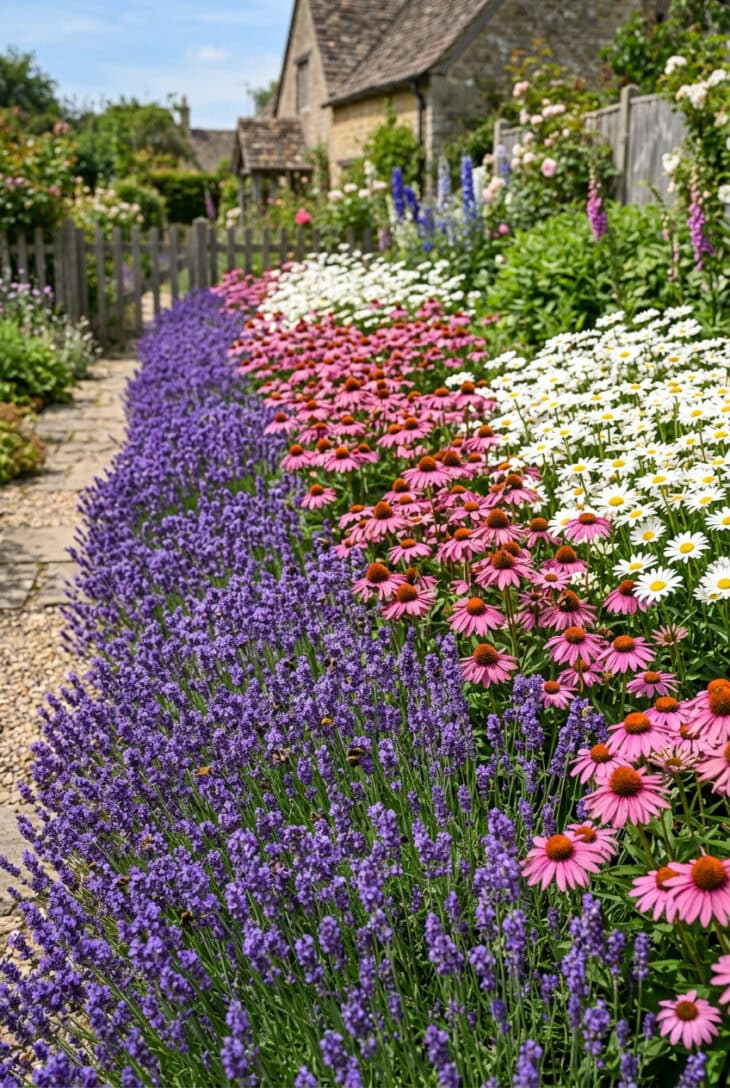
What you see Color arriving in ribbons rather than confetti. A river of lavender flows along the front of the bed, nine or ten plants deep enough to read as one mass, with a block of pink coneflower behind it and drifts of white daisies beyond. Bumblebees work along the lavender in a straight line, moving flower to flower without ever lifting more than a few inches.
Why it works Bees forage by flower constancy: once they find a species that pays, they work it over and over until it stops paying. A single plant on its own costs a bee more energy to find than it returns, so it gets skipped. Group the same plant into a patch roughly 3ft (90cm) across and suddenly it is worth a visit, and the bee can strip it methodically without wasting flight. It also happens to be how the best cottage garden planting looks anyway, so you lose nothing on style.
How to get it Buy in odd numbers, three at minimum and five or seven where you have room, and plant them touching in a loose diamond rather than a straight row. For low front-of-border drifts, lavender (Lavandula angustifolia ‘Hidcote’) spaced 15in (38cm) apart knits into a solid block in two seasons. Repeat the same drift two or three times along a long border to lead the eye and give bees a route. Resist the garden center habit of buying one of everything: three plants each of six species will feed far more than one each of eighteen.
03. The Sun-Baked Nectar Border
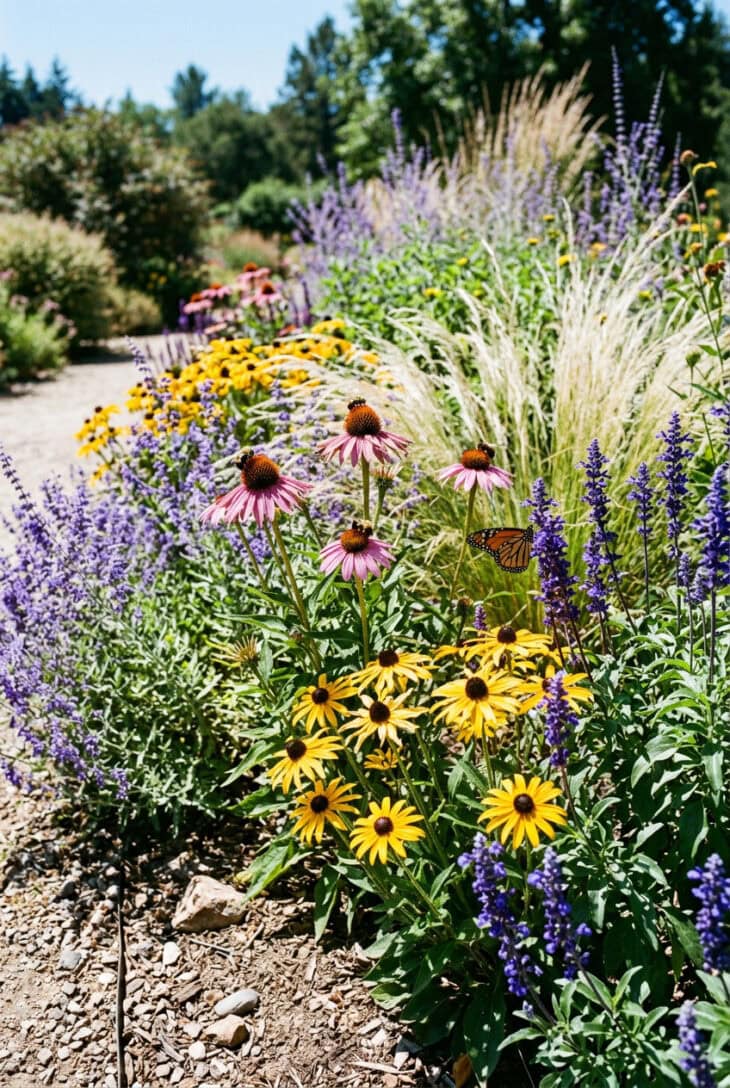
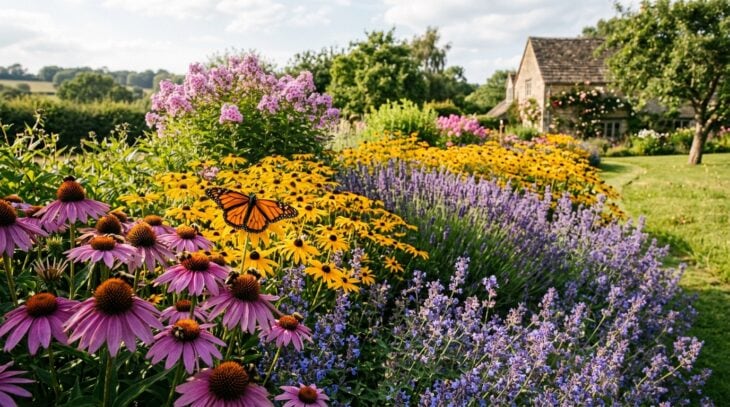
What you see The hottest, driest strip of the yard turned into the busiest one. Purple coneflowers and golden black-eyed susans stand shoulder to shoulder with the hazy violet of Russian sage and deep blue salvia spikes, all of it backed by pale grasses that catch the low light. Bumblebees are on the coneflowers, a butterfly is holding its wings open on a daisy face, and the soil underneath is dry gravel.
Why it works Nectar production is powered by sun and warmth, and a flower in a hot open spot simply yields more than the same flower in a cool shaded one. Insects also fly better when warm, so a sunny south-facing bed gets far more traffic than a sheltered one under trees. Better still, the classic prairie and Mediterranean nectar plants all want exactly these conditions: lean soil, sharp drainage, full sun. The place you thought was your worst garden border is really your best one.
How to get it Pick a bed that gets six hours of sun or more and resist improving it. Do not add rich compost or manure, which pushes soft leafy growth and fewer flowers; if anything, work in grit. Plant purple coneflower (Echinacea purpurea ‘Magnus’), black-eyed susan (Rudbeckia fulgida ‘Goldsturm’), Russian sage (Perovskia atriplicifolia) and salvia (Salvia nemorosa ‘Caradonna’) in drifts, spacing perennials 18in (45cm) apart. Cut the salvia back hard after its first flush in June and it will bloom again by August, doubling the nectar from the same plant.
04. A Milkweed Patch for Monarch Caterpillars
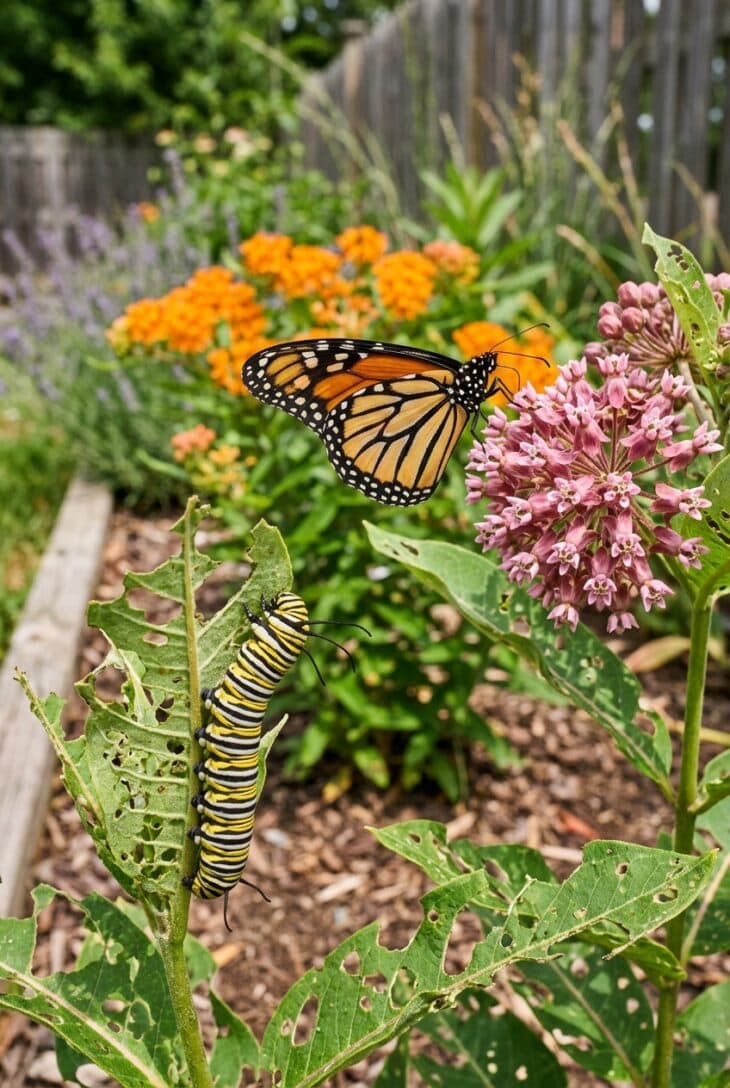
What you see A patch of milkweed with holes chewed in it, and that damage is the whole reward. A banded monarch caterpillar, fat as a finger joint, grazes along the edge of a leaf, while above it an adult monarch feeds from a dome of dusty pink flowers. Orange butterfly weed burns bright at the front of the patch. Nothing here is tidy, and everything here is working.
Why it works Nectar feeds adult butterflies, but it does not make more butterflies. Caterpillars are specialists, and monarch caterpillars can eat one thing only: milkweed. A garden full of buddleia and zinnias is a diner for passing adults, while a garden with milkweed is a nursery. This is the single highest-leverage plant you can put in the ground if you care about monarchs, and it is the reason a chewed leaf should make you happy rather than reach for a spray.
How to get it Plant the milkweed (Asclepias) species native to your region: butterfly weed (Asclepias tuberosa) for dry sunny soil, swamp milkweed (Asclepias incarnata) for damp ground, common milkweed (Asclepias syriaca) where it has room to run. Put in at least six plants, since two will be stripped bare by a single brood. Give them full sun and be patient, because butterfly weed is slow to emerge in spring and is often weeded out by mistake in April. Do not plant tropical milkweed (Asclepias curassavica) in warm climates, where it stays evergreen and disrupts migration by hosting disease.
05. Early Bulbs and Willow for the First Bees
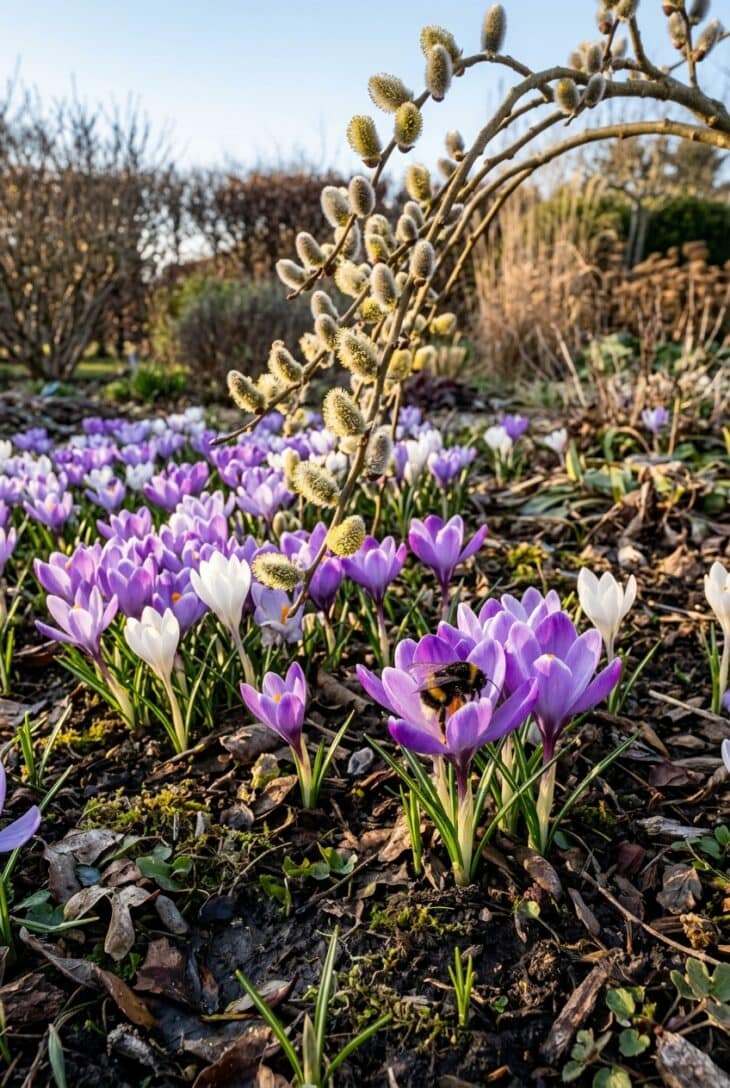
What you see A cold, bare garden with two things going on in it. A drift of crocus has thrown its cups wide open in the thin February sun, and a queen bumblebee, huge and slow after months underground, is shouldering her way into one of them. Behind, a pussy willow is hung with silver catkins turning yellow with pollen. Everything else is still asleep.
Why it works Every bumblebee colony you see in July started as one queen who survived February. She emerges with almost no fat left, and she has days, not weeks, to find enough pollen to start a nest. Miss that window and there is no colony at all. Early bulbs and willow catkins are the two richest things you can offer in that gap, and willow in particular is one of the most important pollen sources in the whole calendar.
How to get it Plant crocus (Crocus tommasinianus) in fall, 3in (8cm) deep, in generous groups of fifty or more scattered through the lawn or the front of a border, where they will naturalize and spread. Add winter aconite and single snowdrops for even earlier pollen. If you have room, a goat willow or pussy willow (Salix caprea) coppiced every few years stays shrub-sized and produces catkins in profusion. Later in spring, ornamental alliums (Allium hollandicum ‘Purple Sensation’) carry the load into May. Do not mow lawn crocus until the foliage has yellowed, or you get no flowers next year.
06. Let the Herbs Flower
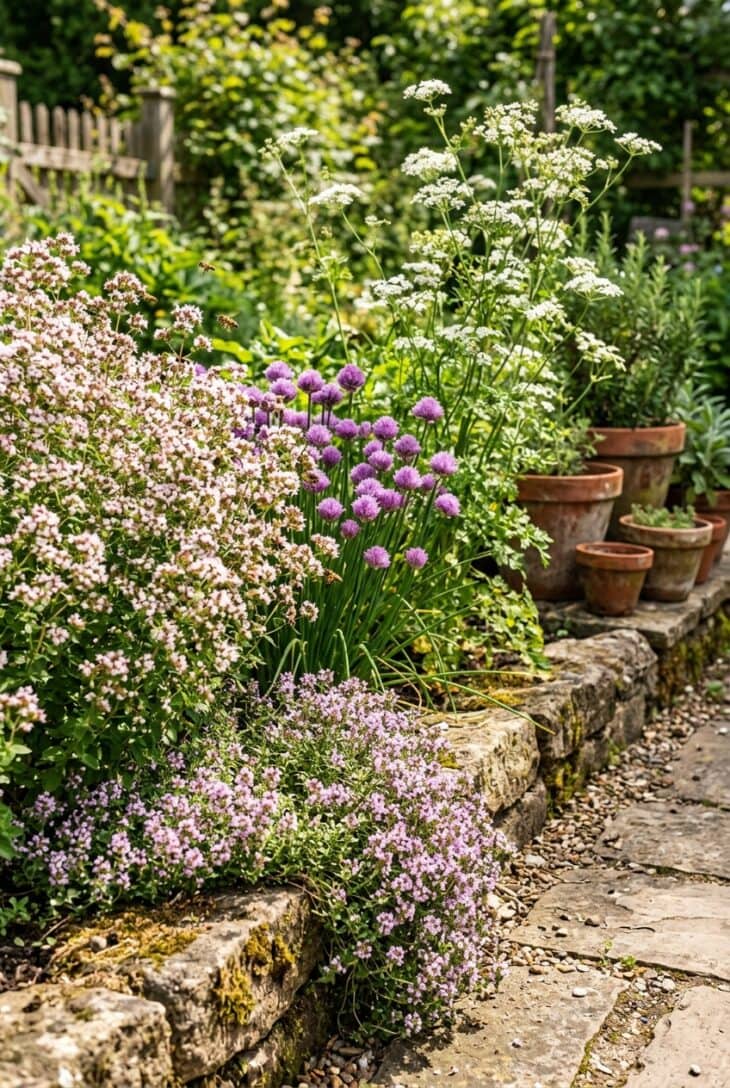
What you see The herb bed that got away from you, and is all the better for it. Oregano has thrown up a cloud of tiny pink flowers and is so loud with honeybees the whole plant seems to vibrate. Chives hold up purple drumsticks, thyme has turned into a lilac mat over the stone edge, and the cilantro has bolted into lacy white umbels that hoverflies are crawling all over.
Why it works Culinary herbs are, almost without exception, superb nectar plants: they come from hot dry hillsides where they had to pay insects well to get pollinated. We just never let them flower, because we harvest the leaves and pinch out the buds. Letting even half your herbs bloom costs you very little kitchen produce and turns a small herb garden into one of the densest nectar sources you can own, right next to the back door where you will actually see the bees.
How to get it Grow doubles: one plant you cut for the kitchen, one you let run to flower. Oregano (Origanum vulgare) is the standout and will be covered in bees for six weeks; thyme (Thymus vulgaris), chives (Allium schoenoprasum), marjoram, hyssop and sage all follow. Shear the flowered stems back by a third afterwards to keep the plants tight and often to get a second flush. Let a few cilantro, dill and fennel plants bolt rather than pulling them, since their flat umbels feed hoverflies and small wasps that nothing else reaches.
07. Flat Umbels for Hoverflies and Tiny Wasps
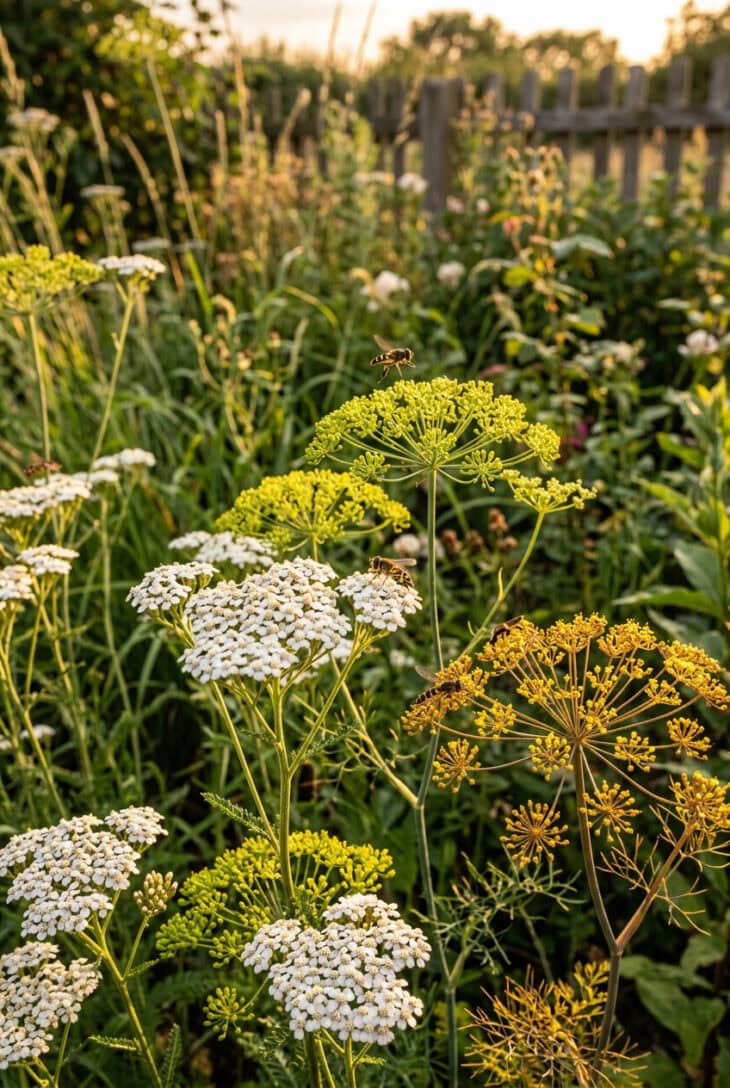
What you see Flowers built like landing pads. White yarrow plates, acid-green dill heads and bronze fennel umbels hold themselves flat and open, glowing where the evening sun comes through them, and hoverflies hang in the air above them like tiny helicopters before dropping onto the surface to feed.
Why it works Bees and butterflies get all the attention, but a huge share of pollination is done by hoverflies, small solitary wasps and beetles, and most of them have very short tongues. They cannot reach into a deep tubular flower, so the nectar in your salvias is invisible to them. Flat umbels serve nectar in an open dish at the surface, which is exactly what a short-tongued insect needs. Hoverfly larvae also eat aphids by the hundred, so this planting quietly does your pest control too.
How to get it Include at least three umbellifers: common yarrow (Achillea millefolium), fennel (Foeniculum vulgare ‘Purpureum’), dill (Anethum graveolens) and the long-flowering Ammi majus are all easy. Sow dill and Ammi direct in April and again in June for succession, since each plant flowers only briefly. Give fennel a back-of-border spot because it reaches 5ft (150cm), and cut its seedheads off in fall unless you want a hundred seedlings. Angelica and wild carrot are the taller, more architectural options if you have space.
08. Single Flowers Over Frilly Doubles
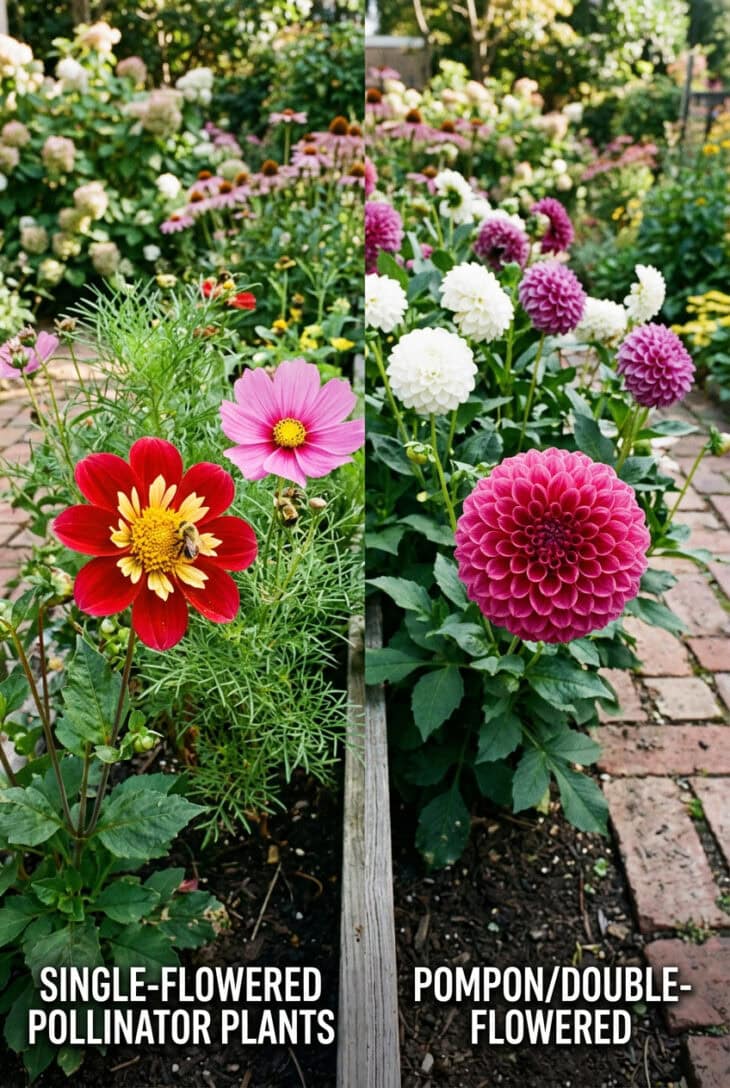
What you see Two flowers in the same bed, in the same light, and only one of them has a customer. The single dahlia holds its face open, a wide gold boss of pollen at the center with a bee sitting square in the middle of it. Beside it, a fat double pompom, frilled and flawless and packed tight to the core, sits entirely untouched.
Why it works Double flowers are made by breeding the reproductive parts of a flower into extra petals. That is not a metaphor: the stamens literally become petals, so there is often no pollen at all, and even where nectar survives it is buried under so many layers that an insect cannot physically reach it. A garden of doubles can be spectacular and completely empty of food. Choosing singles costs nothing and instantly doubles the useful flowering area of your beds.
How to get it When buying, look into the flower: if you can see the center clearly, insects can reach it. Choose single dahlias such as ‘Bishop of Llandaff’ or the Bishop’s Children seed strain over pompom and cactus types, single cosmos over doubles, and open-faced roses (Rosa rugosa or a single species rose) over tight hybrid tea buds. Avoid anything sold as “fully double”, “pompom” or “frilled”. Old-fashioned species and heirloom forms are almost always the better bet, and they usually self-seed too.
09. Tubular Reds for Hummingbirds
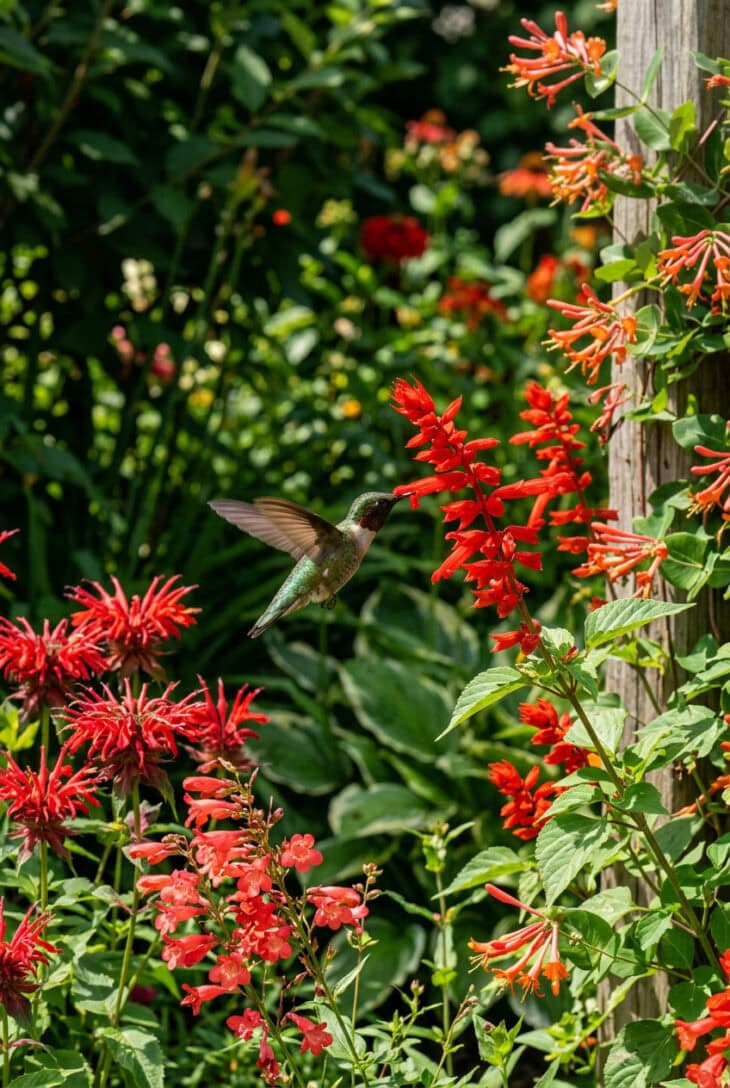
What you see A corner of the garden turned up to full volume in red and orange. Scarlet salvia spikes, shaggy red bee balm and coral penstemon crowd together, with trumpet honeysuckle climbing a post behind them, and a hummingbird hangs in the air at one of the salvia flowers, wings a gray blur, beak buried to the hilt.
Why it works Hummingbirds see red vividly and most insects barely see it at all, which is exactly why so many bird-pollinated flowers are red and tubular: the shape locks out short-tongued competition and reserves the nectar for a long beak. Give them a run of these and you are not competing with your bee planting, you are adding a whole second layer of visitors to the same border. They are also territorial, so a dense patch will often be claimed and defended by one bird you can watch all summer.
How to get it Plant in a sunny spot you can see from a window, and go heavy on tubular reds: salvia (Salvia coccinea or the hardy Salvia ‘Amistad’), bee balm (Monarda didyma ‘Jacob Cline’), cardinal flower (Lobelia cardinalis) for damper ground, and trumpet honeysuckle (Lonicera sempervirens) on a fence. Aim for something in flower from May to first frost, since hummingbirds return to a reliable route. Keep a small perch nearby, a bare twig or thin branch, because they spend most of the day sitting and watching rather than flying.
10. Foxglove and Comfrey for the Shady Side
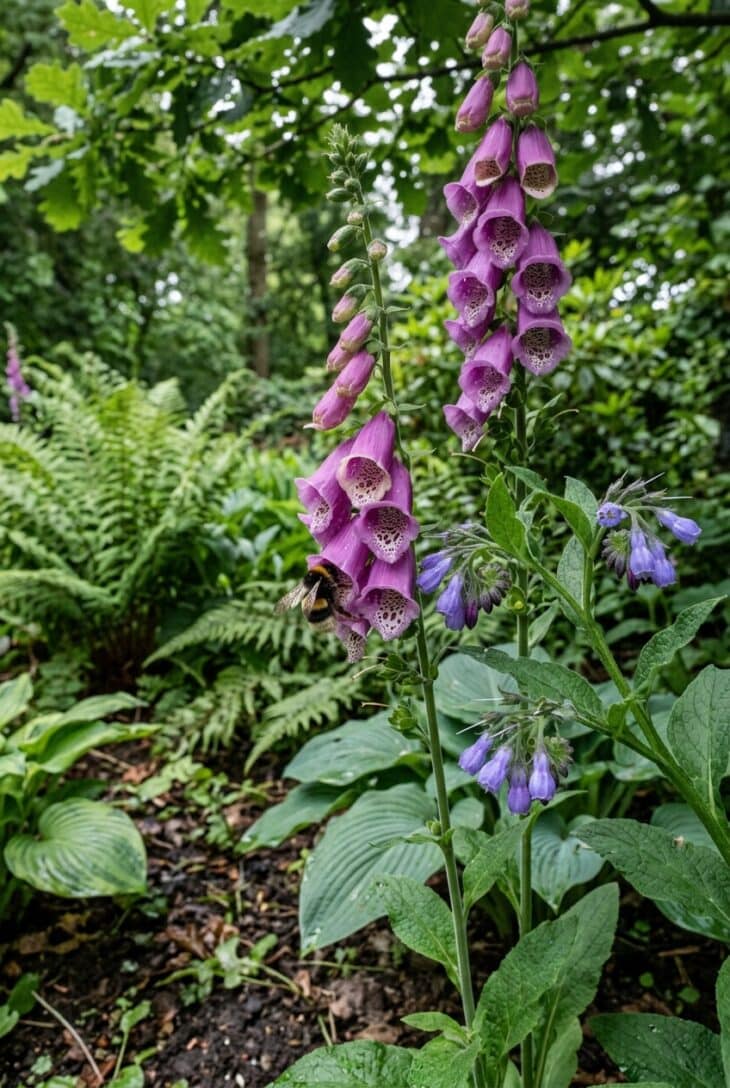
What you see The cool side of the house, where you assumed nothing would happen. Purple foxglove spires rise out of ferns and hostas in dappled green light, and a bumblebee has disappeared headfirst into one of the freckled bells, only her back legs showing. Nodding comfrey flowers hang beside her in dusky blue.
Why it works Long-tongued bumblebees are the only insects that can properly work a deep bell like a foxglove, and they will travel for it. It happens that most of these deep-throated plants are woodland natives that are perfectly happy in the half-light, so the shady strip everyone writes off as dead space can carry a specialist food source the sunny border cannot. If you already have a shade garden full of foliage, adding three flowering plants turns it into a feeding station.
How to get it Foxglove (Digitalis purpurea) is a biennial, so sow or plant two years running to get flowers every year from then on, and let it self-seed freely once established. Add comfrey (Symphytum officinale, or the non-seeding ‘Bocking 14’ if you want it to stay put), lungwort (Pulmonaria) for very early bumblebee food, and hardy geranium (Geranium macrorrhizum) as a groundcover that flowers in shade. All prefer soil that holds moisture, so mulch with leaf mold in fall. Foxglove is toxic if eaten, so site it away from where small children graze.
11. A Night-Scented Border for Moths
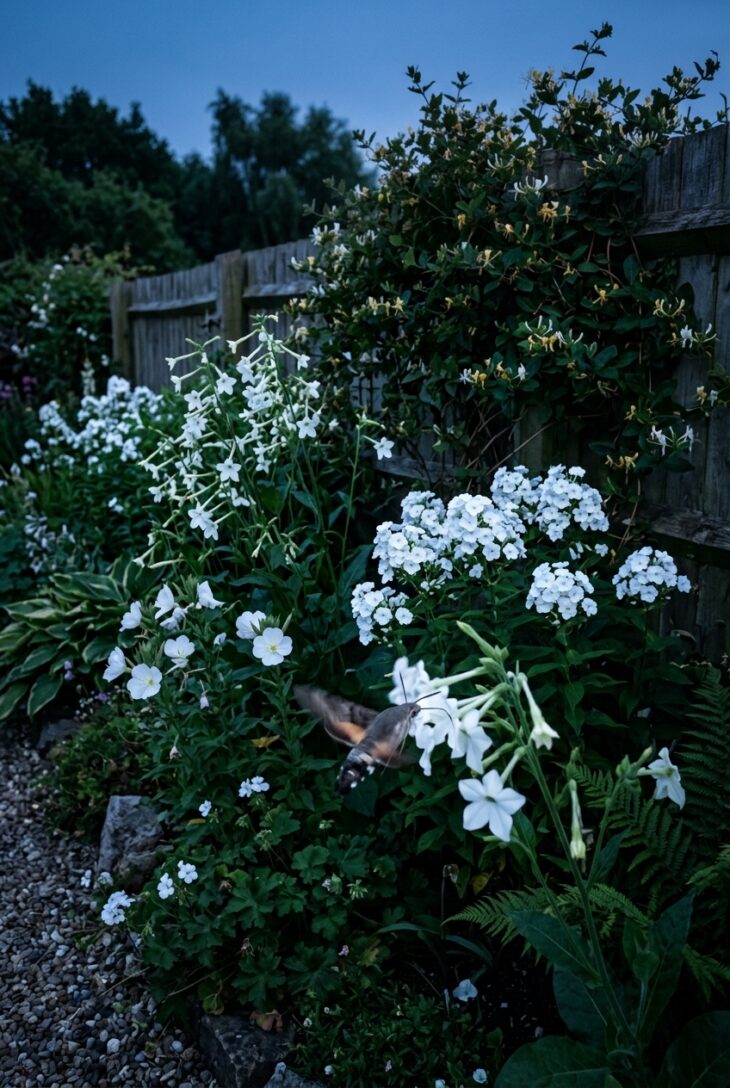
What you see The garden after everyone has gone inside. In the blue half-light the white flowers are the only things left visible: flowering tobacco, evening primrose and phlox seem to hold light long after the reds and purples have gone black. The scent is much stronger than it was at noon, and a hawk moth hangs at one white trumpet, wings a blur.
Why it works Moths do at least as much pollinating as butterflies and almost nobody plants for them. They hunt by scent, not sight, which is why night-pollinated flowers pour out perfume at dusk and are usually white or pale, since a pale flower is what a moth can pick out at low light. The bonus is entirely selfish: the strongest scents in the whole garden happen exactly when you are most likely to be sitting out.
How to get it Plant near where you sit in the evening, since scent is wasted at the bottom of the garden. Use flowering tobacco (Nicotiana sylvestris or N. alata, not the scentless bedding types), evening primrose (Oenothera biennis), night-scented stock (Matthiola longipetala) sown direct in a pot by the door, sweet rocket (Hesperis matronalis) and honeysuckle (Lonicera periclymenum ‘Serotina’) on a wall. Keep outdoor lighting low, warm and shielded, because bright white security lights pull moths off the flowers all night and are the fastest way to undo the whole idea.
12. A Bee Hotel on a Warm South Wall
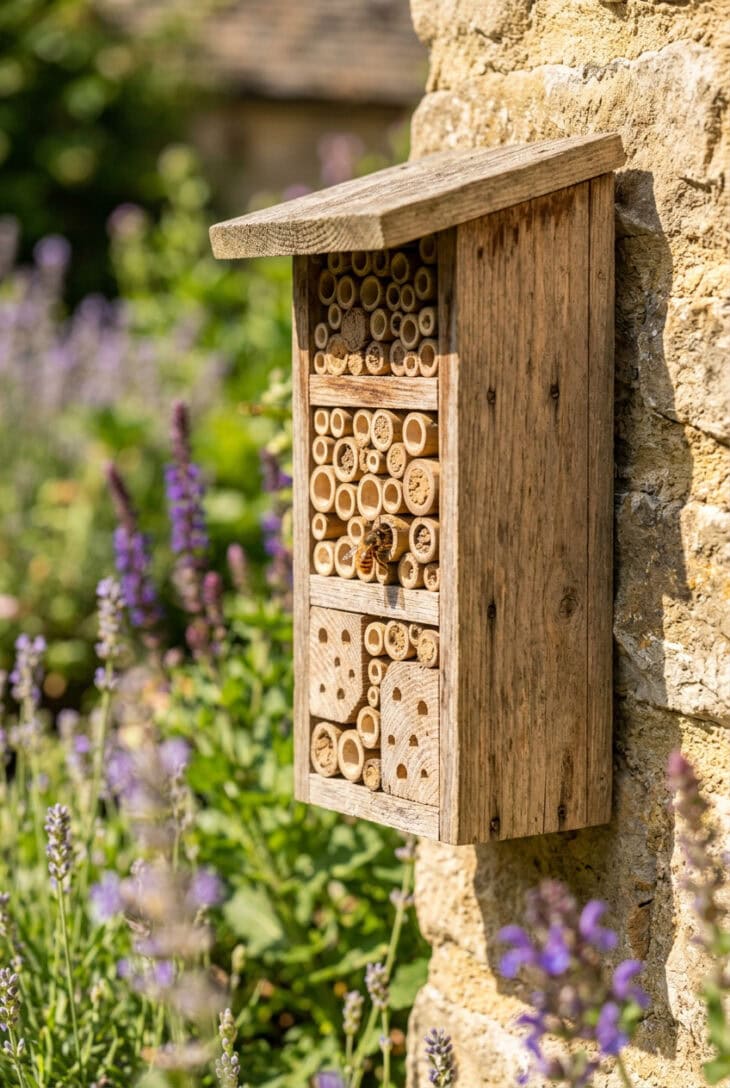
What you see A plain wooden box of hollow canes screwed tight to a wall that catches the morning sun, chest height and rock solid. Half the tubes are already capped with neat mud plugs, each one a sealed nursery, and a rust-colored mason bee is backing into an open cane with her belly dusted yellow.
Why it works Most of the bee species in your yard are not honeybees and do not live in colonies. They are solitary bees, and each female builds and provisions her own nest alone, which means nesting space limits their numbers just as much as food does. Planting nectar without providing nest sites is like opening a restaurant in a town with no houses. Mason and leafcutter bees are also formidable pollinators, worth many honeybees each on fruit blossom, and they will not sting you.
How to get it Mount it 3 to 5ft (90 to 150cm) up on a south or southeast-facing wall in full morning sun, fixed firmly so it cannot swing, with a small roof overhang to keep rain out. Use tubes of mixed diameter from 2 to 10mm, either bamboo or paper liners in drilled hardwood, and make sure they are sealed at the back and smooth inside so wings are not shredded. Skip the pretty painted hotels with pine cones and big holes, which are decoration, not habitat. Every second fall, move the filled tubes to an unheated shed or garage to protect them from woodpeckers and damp, and put them back out in March.
13. A Bare Sunny Bank for Ground-Nesting Bees
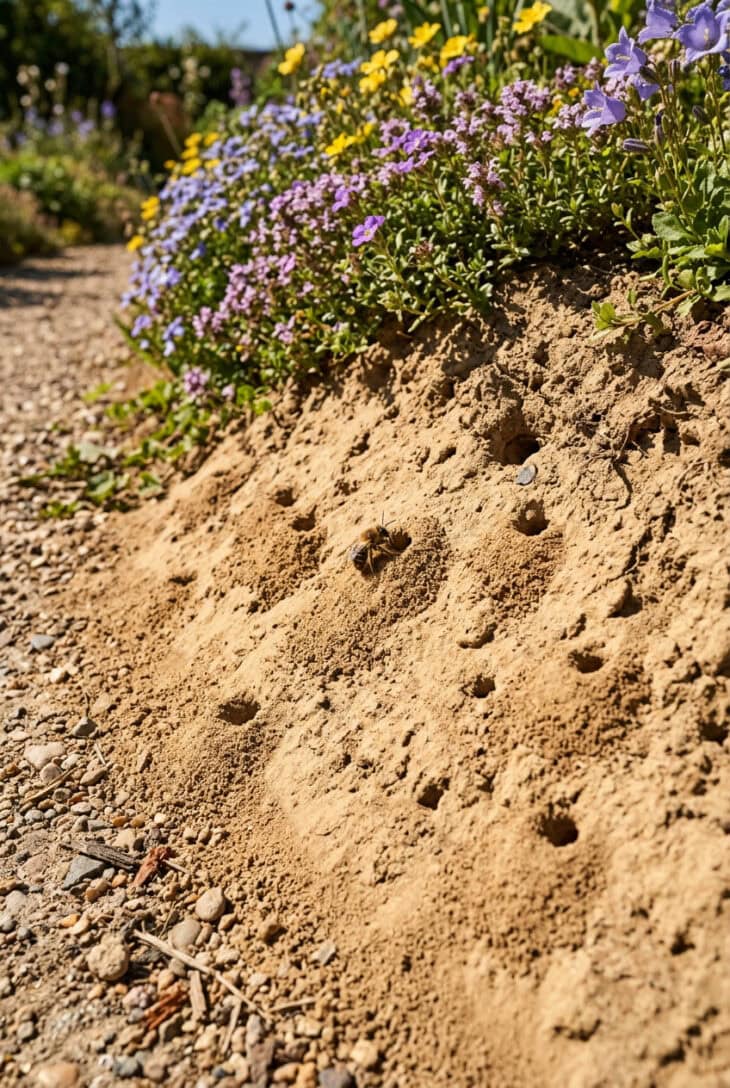
What you see A patch of bare, sun-baked earth that looks, at first glance, like the one place in the garden you failed to plant. Look closer and it is pocked with small round holes, each ringed by a tiny volcano of excavated sand, and a mining bee is hauling herself out of one of them into the light.
Why it works Around seventy percent of native bee species nest in the ground, not in tubes, and what they need is warm bare soil with no mulch, no landscape fabric and no turf over it. Modern gardens have almost none: we mulch everything, we pave, and we grass over the rest. Leaving one sunny patch open is genuinely the cheapest, laziest, highest-impact thing in this entire article, because it costs nothing and takes an afternoon at most.
How to get it Pick a south-facing spot with well-drained sandy or gravelly soil, ideally a slight slope, and simply keep it clear: scrape off mulch and weeds and leave the soil exposed. A patch 3ft by 3ft (90 by 90cm) is plenty, and the edge of a gravel garden or a path edge does the job invisibly. Do not water it, do not fertilize it, do not walk on it. If your soil is heavy clay, build a low bank of sandy loam 12in (30cm) high instead. The nests are harmless and the bees are not aggressive, so it is safe near a path.
14. Leave the Stems Standing Until Late Spring
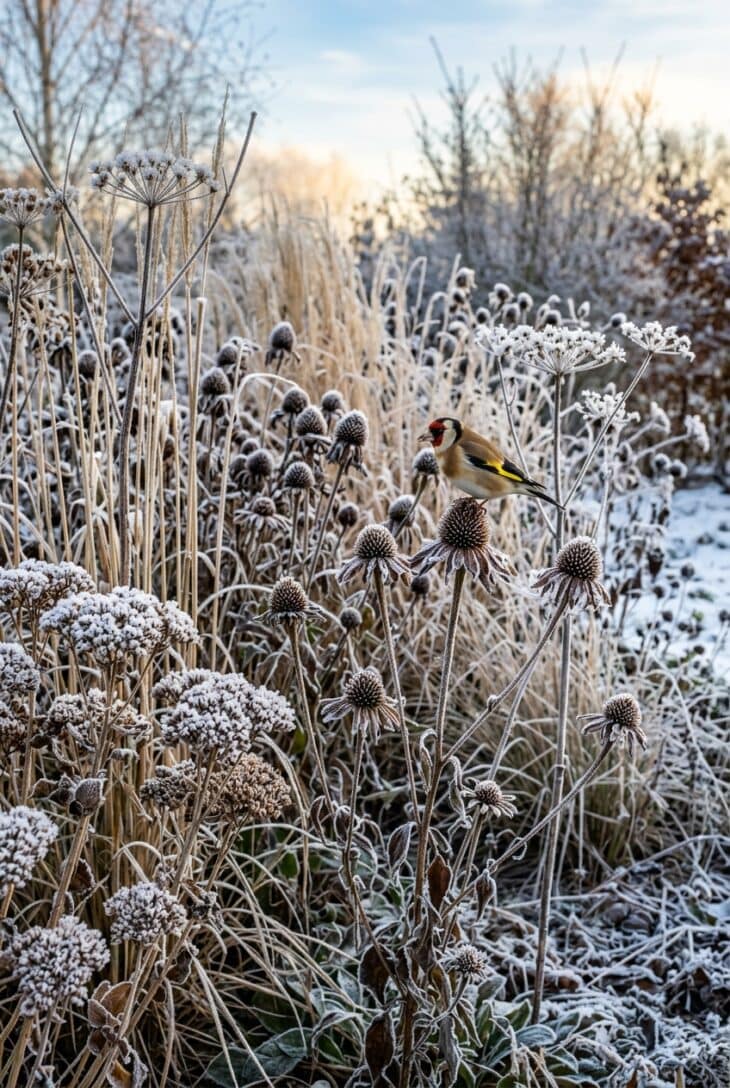
What you see A border in January that was never cut down, and looks deliberate rather than neglected. Coneflower cones, flat sedum plates and hollow grass stems stand stiff and rimed with frost, catching a low gold light, and a goldfinch is balanced on one seedhead pulling it apart.
Why it works Those hollow stems are not dead, they are occupied. Small carpenter bees, mason bees and a long list of other insects overwinter inside pithy and hollow stems, and the classic fall tidy-up puts every one of them in the compost heap or the burn pile. Leaving stems up until late spring lets them emerge on their own schedule. It is also better winter gardening: the frosted structure looks far better than bare soil, and it is one less job in the busiest month, which makes it a rare low-maintenance win that actually helps.
How to get it Leave perennials and grasses standing through winter, and cut them back in late April or early May, once temperatures have been reliably above 50F (10C) for a couple of weeks. When you do cut, leave 8 to 15in (20 to 38cm) of stem stubble in place rather than shearing to the ground, since the new growth quickly hides it and any residents can still get out. Do not shred or compost the cut stems immediately: lay them in a quiet corner for a few weeks first. If a bed really must be tidy, do that one and leave the rest.
15. A Puddling Dish for Butterflies
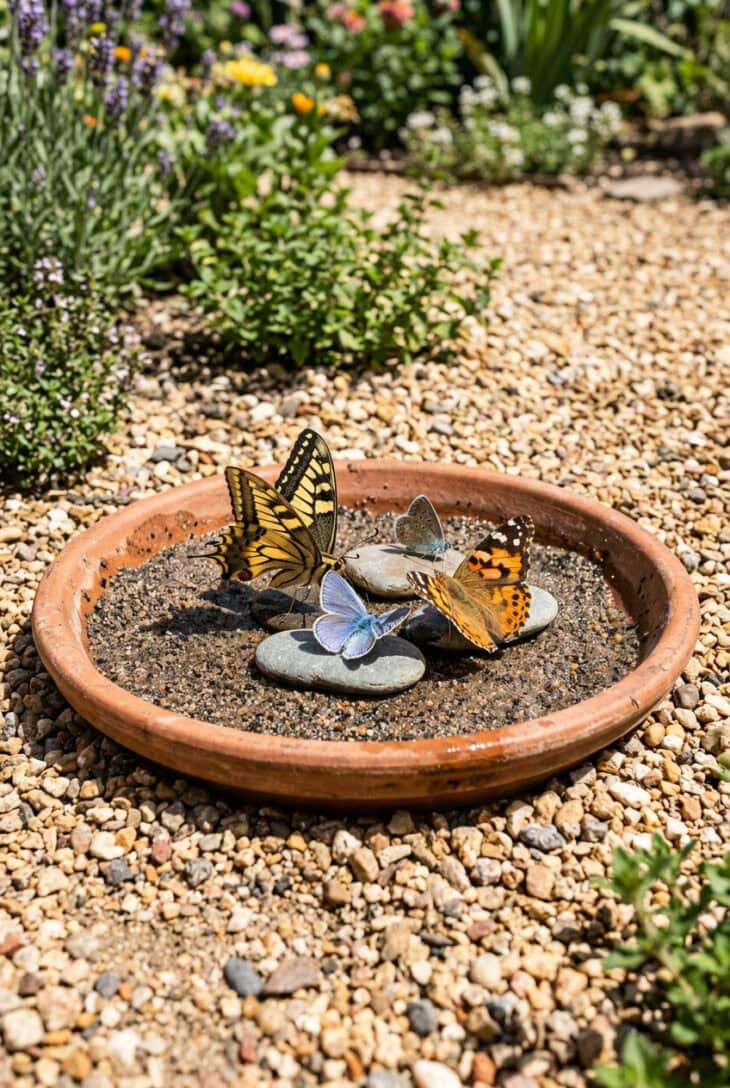
What you see A plain terracotta saucer sunk flush into warm gravel, filled with coarse sand kept just damp, with a few flat stones for standing on. Three butterflies are crowded onto the wet patch with their wings held open flat, drinking from the sand itself rather than from any flower.
Why it works Butterflies get sugar from nectar but they cannot get sodium and minerals from it, and males in particular need salts to breed successfully. In the wild they gather at damp mud and puddle margins to take them up, which is the behavior known as puddling. A tidy garden with no bare wet ground offers nowhere to do it. A saucer of damp sand fills a gap that a border full of the best butterfly plants simply cannot, and it takes ten minutes to make.
How to get it Sink a shallow saucer or an old plant pot base into a sunny, sheltered spot near your nectar planting, and fill it with coarse sand rather than fine builder’s sand. Add a pinch, no more, of sea salt or a spoon of wood ash mixed through, and top with a few flat stones as basking perches. Keep it damp, not flooded: it should look like wet sand, never standing water, so top it up every couple of days in hot weather. Placing it in full sun and out of the wind matters more than anything else.
16. A Flat Basking Stone in Full Sun
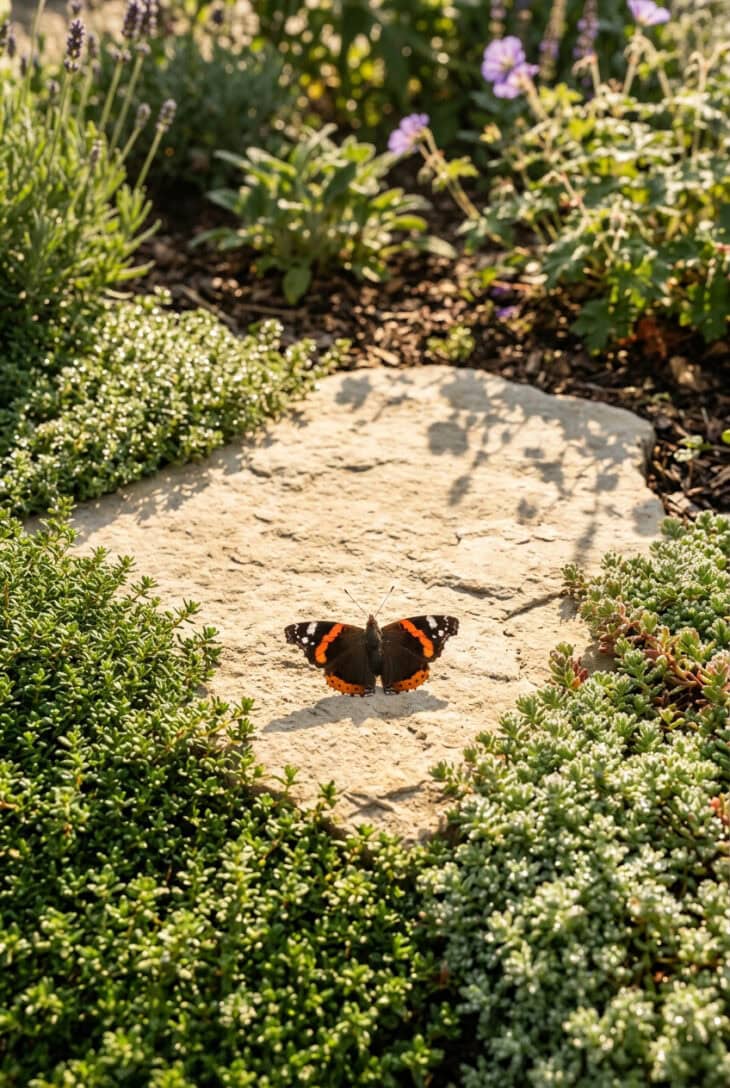
What you see One broad pale slab laid flat at the front of a border, with creeping thyme lapping at its edges. It is the first thing in the garden to dry off in the morning, and a red admiral has claimed it, wings spread flat and wide to catch the light while everything around it is still wet with dew.
Why it works Butterflies cannot generate their own heat. Below roughly 55F (13C) their flight muscles will not work, so on a cool morning they cannot feed, mate or escape a bird, and they must warm up first by spreading their wings on a warm surface. A pale stone in full sun heats fast and holds it, which effectively lengthens the working day in your garden at both ends of the season. It costs one slab.
How to get it Choose a broad flat stone at least 12in (30cm) across, pale rather than dark so it warms without scorching, and set it level and stable at the front of a sunny border where it will get sun from mid-morning. Shelter matters: a spot backed by a hedge or wall that blocks the prevailing wind will be used far more than an exposed one. Surround it with low nectar plants such as creeping thyme (Thymus serpyllum) and sedum so a warmed butterfly can feed without a long flight. Keep it clear of overhanging foliage, since shade at 9am defeats the purpose.
17. Late-Season Fuel: Asters, Sedum and Goldenrod
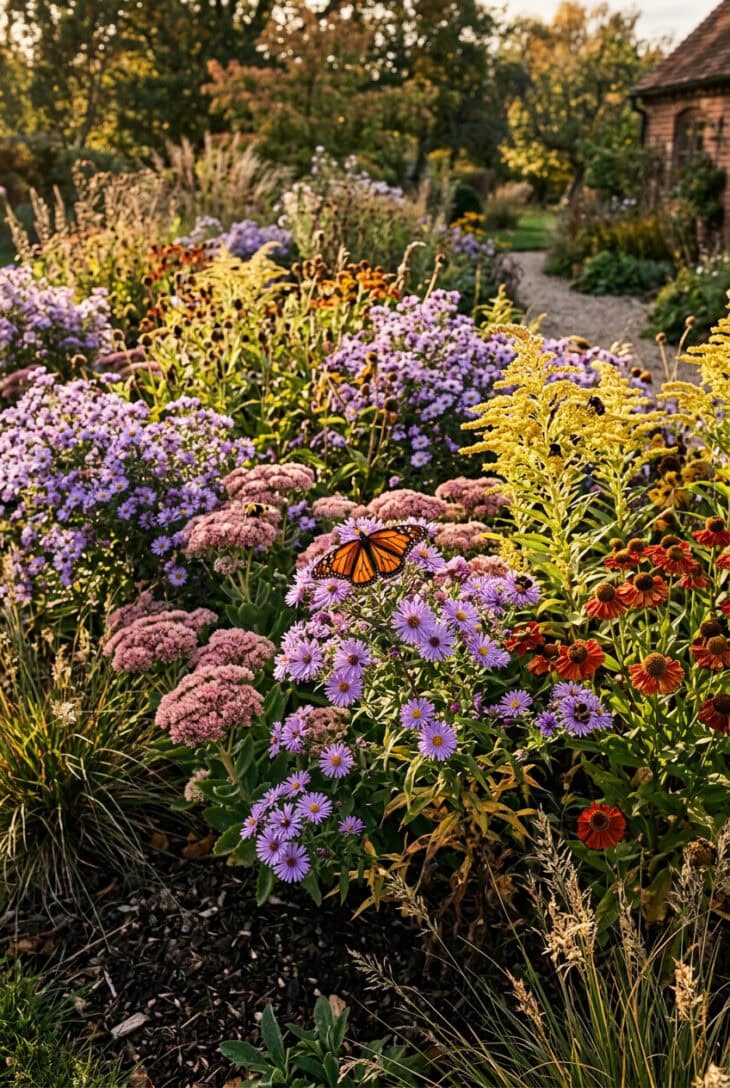
What you see The garden’s last big meal of the year, served in September gold. Purple asters have come up through browning grasses, sedum heads have turned dusky pink and gone flat as landing platforms, and goldenrod plumes lean over the path. A monarch is feeding with its wings held up, stocking fuel for a journey of two thousand miles.
Why it works Fall is the second hungry gap, and it is the one with the highest stakes. Migrating monarchs need nectar to make the trip, bumblebee colonies are producing next year’s queens who must feed heavily before hibernating, and honeybee colonies are laying in winter stores. Yet most gardens run out of flowers by the end of August, right when demand peaks. Late nectar is the difference between a garden that looks good in July and one that actually supports a population.
How to get it Plant New England aster (Symphyotrichum novae-angliae ‘Purple Dome’), sedum (Hylotelephium ‘Autumn Joy’), goldenrod (Solidago ‘Fireworks’, a well-behaved clumping form rather than the running species) and sneezeweed (Helenium autumnale). Add Verbena bonariensis, which flowers until frost and self-seeds politely. Pinch tall asters back by half in early June, the “Chelsea chop”, so they stay upright and flower harder. Do not deadhead any of it in October: leave the seedheads for finches and the stems for overwintering insects.
18. A Clover Lawn Instead of Perfect Turf
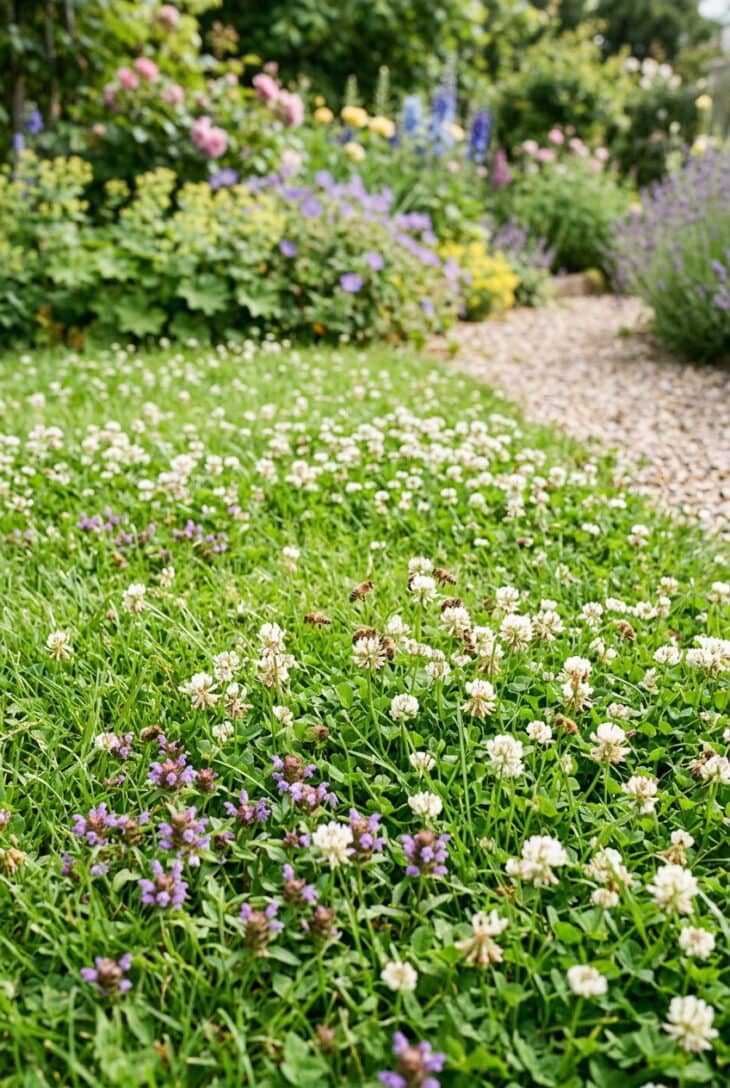
What you see A lawn that is still very much a lawn: soft, green, mown, walkable. Only it is threaded through with white clover heads and low buttons of purple self-heal, and if you stand still on it in June you can hear it. Honeybees are working the clover a few inches from your feet, and the grass stays green through a dry August without a drop of water.
Why it works A conventional lawn is a food desert: a monoculture, cut so short nothing flowers, fed and weedkilled to keep it that way. Clover flips every part of that. It fixes its own nitrogen so it never needs feeding, it stays green in drought when grass browns off, it takes wear, and it flowers for months. You are not giving up a lawn, you are giving up mowing it quite so hard, and getting one of the biggest nectar sources per square foot available.
How to get it Overseed existing turf with white clover (Trifolium repens) at roughly 2oz per 1,000 square feet in spring or early fall: scalp the grass short, scratch the surface, broadcast the seed and water it in. Micro clover is the choice if you want a finer, more uniform look. Raise the mower to 3in (7.5cm) or higher and mow every two to three weeks rather than weekly, which is what lets it flower. Stop all weed-and-feed products, since the herbicide in them is designed to kill exactly this. Add self-heal (Prunella vulgaris) and bird’s foot trefoil for more variety.
19. A Mini Meadow Strip Along the Fence
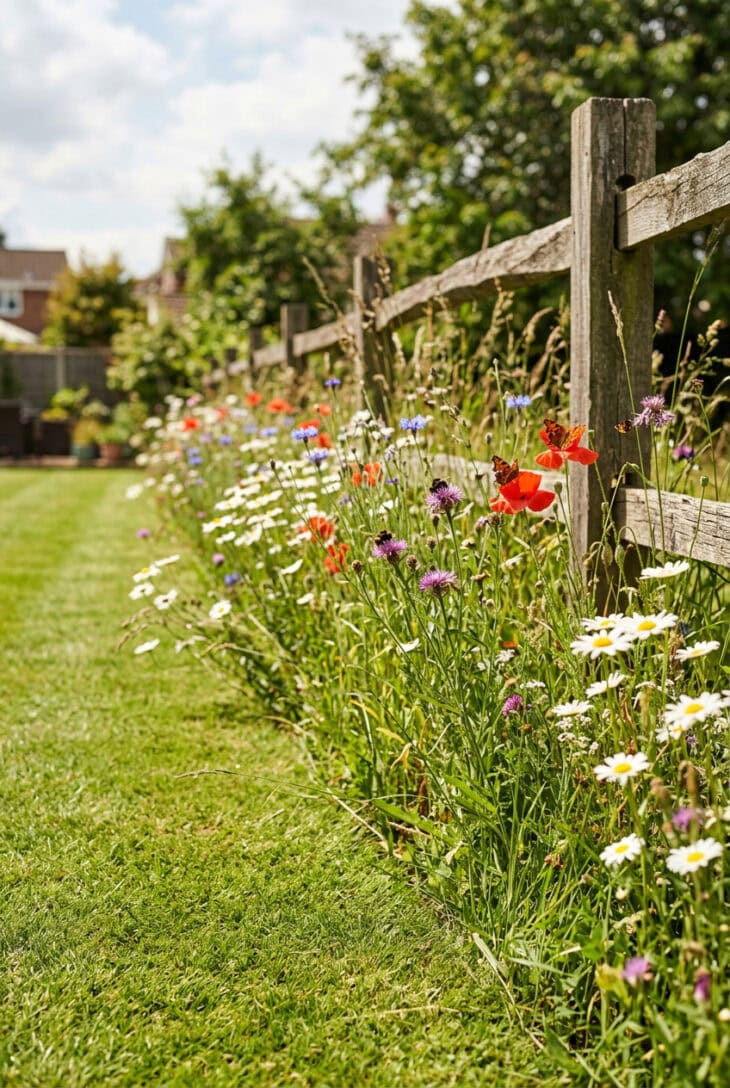
What you see A ribbon of meadow, maybe 4ft (120cm) deep, running the length of the back fence: ox-eye daisies, red poppies and blue cornflowers standing up out of long grass and moving in the breeze. The lawn in front of it is cut short and crisp, and that neat mown edge is what stops the whole thing from reading as neglect.
Why it works A meadow gives you something no border can: sheer density of flowers per square foot, and a mix of species flowering in overlapping waves rather than one big peak. It also feeds the specialists, since many native bees can only use native flowers. You do not need a field. A 4ft strip along a boundary is enough to matter, and framing it with mown grass signals intent, which is the trick that makes a wildlife garden look designed instead of abandoned.
How to get it Meadows want poor soil, so do not add compost, and strip off the top 2in (5cm) of rich turf and topsoil first if you can. Sow a regional native mix in fall at the rate on the packet, rake it in and firm it down, and include yellow rattle if you have grass to suppress, since it parasitizes grass roots and opens gaps for flowers. Mow the whole strip once in late summer after the flowers have set seed, then rake off and remove the cuttings so the fertility keeps dropping. Expect year one to look patchy and year three to look glorious.
20. A Pollinator Container Trio for a Balcony
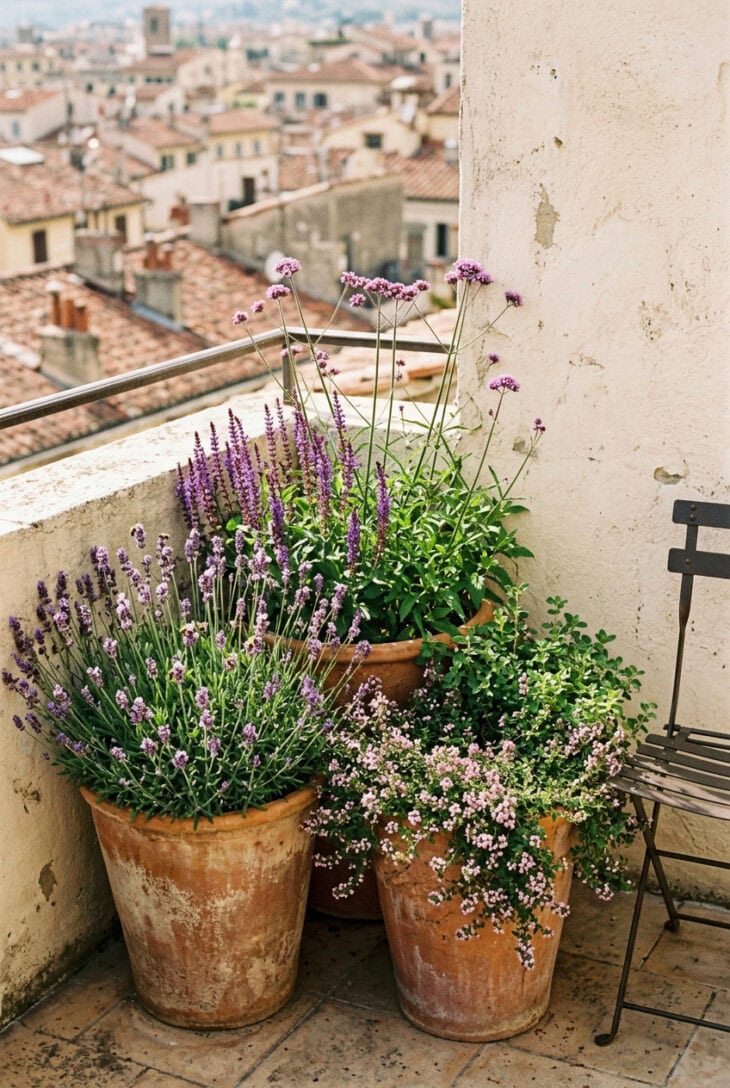
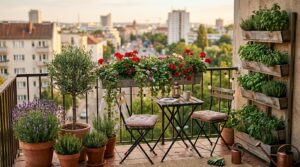
What you see Three big terracotta pots against a warm wall on a balcony four floors up, and bees in all of them. One is a solid mound of lavender, one holds purple salvia with tall wands of verbena floating above it, and the third has thyme and marjoram tumbling over the rim. It is perhaps 10 square feet of growing space, and it is fully staffed.
Why it works Bees fly. A balcony is not a barrier, and pots on a fourth-floor terrace get found within days, particularly in cities where forage is scarce and every scrap counts. Containers also let you do the two things that matter most in a tight space: put the plant in full sun, and give it the sharp drainage the best nectar plants want. This is the whole idea of container gardening pointed at a purpose.
How to get it Go big on pot size: 16in (40cm) diameter or more, because small pots dry out by noon and a wilting plant makes no nectar. Use a gritty peat-free mix, add 20 percent horticultural grit for the Mediterranean plants, and group three pots together so they shade each other’s roots. Plant for succession across the trio rather than one big July peak: something for spring, summer and fall. Feed sparingly, since high-nitrogen feed gives leaves at the expense of flowers, and never use a compost with added insecticide.
21. A Nectar Shrub Backbone
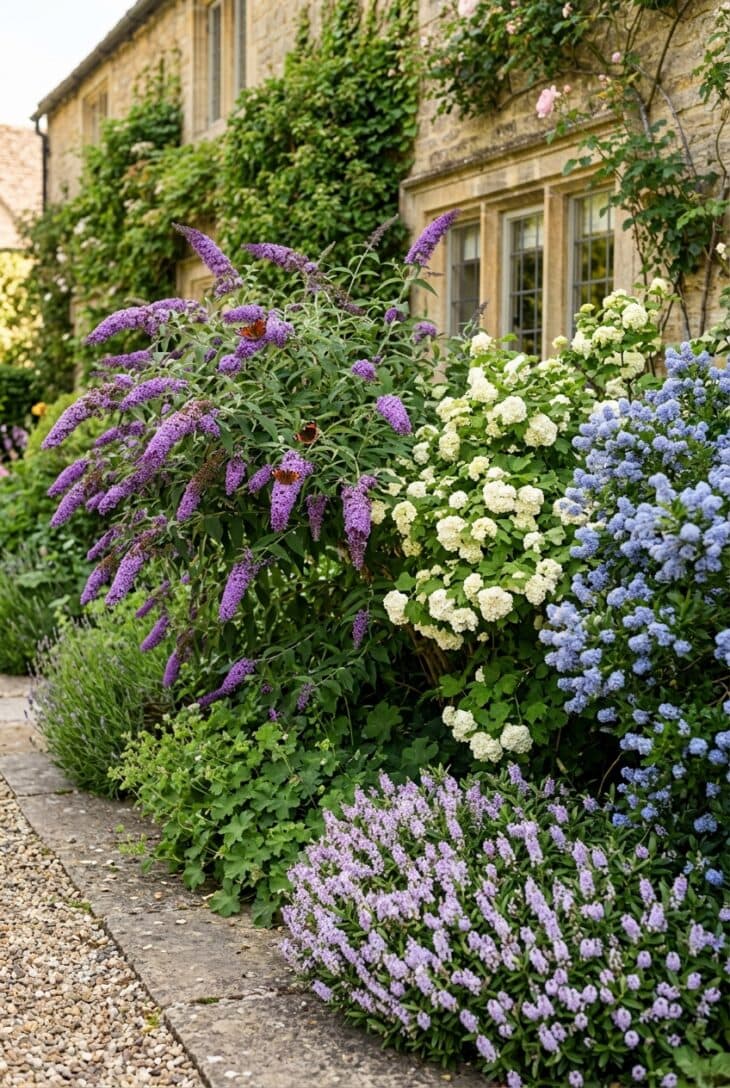
What you see The permanent structure of the garden, doing double duty. An arching butterfly bush leans out over the path hung with purple spikes and three butterflies, a viburnum carries flat white heads beside it, and a ceanothus behind is a solid cloud of powder blue that is audible from several feet away.
Why it works A perennial gives you a handful of flowers; a mature shrub gives you thousands, all at once, at a height insects can find from a distance. Shrubs are the heavy artillery of a nectar garden, and because they are also the bones of the border you are getting the pollinator benefit for free from planting you would do anyway. One good shrub can out-feed an entire flower bed in its two weeks of bloom.
How to get it Spread the bloom across the season: ceanothus and viburnum in spring, butterfly bush (Buddleja davidii) and hebe in summer, then hydrangea (the lacecap types, not the sterile mopheads) and ivy for the very end of the year, since flowering ivy is a critical last meal in October. Prune butterfly bush hard to a low framework in March, or it becomes a leggy 10ft thug. Note that it is invasive in parts of the US, so choose a sterile cultivar such as ‘Blue Chip’ or plant native summersweet (Clethra alnifolia) instead, which is just as good for butterflies.
22. A Flower Alley Through the Vegetable Beds
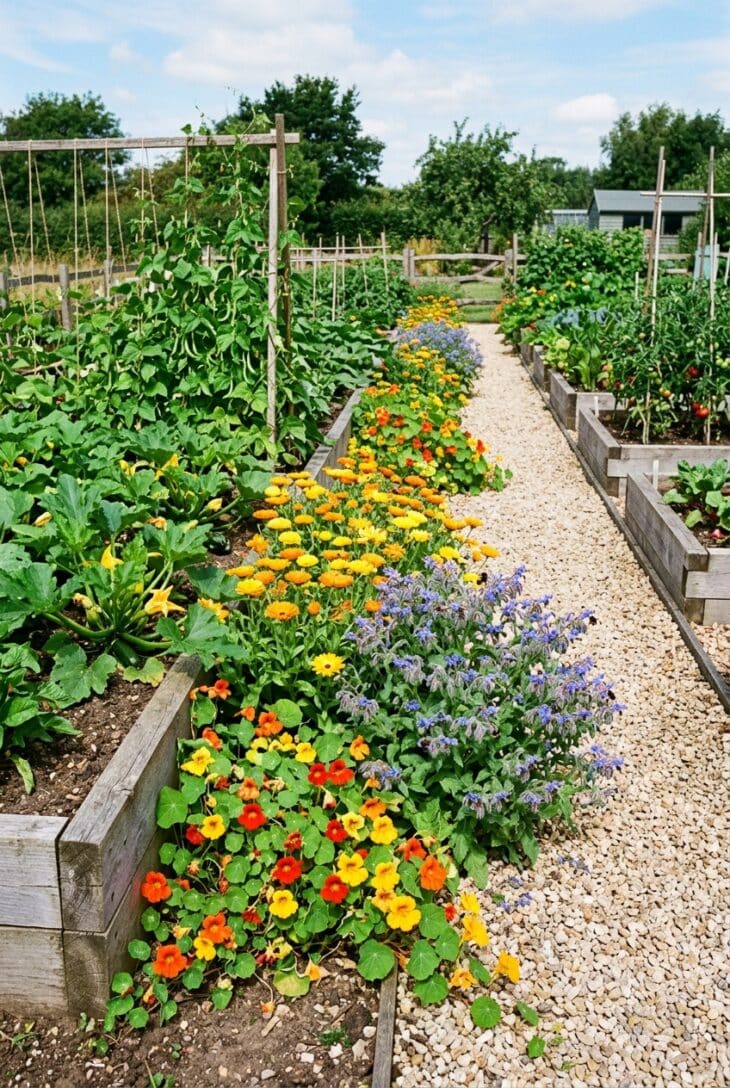
What you see A working vegetable plot with flowers running down the middle of it. Squash and beans fill the timber beds, and the strip between them is packed with orange calendula, nasturtiums spilling over the gravel, and blue borage that is so busy with bees the stems are moving.
Why it works This one pays you back in food. Squash, zucchini, cucumbers, beans, tomatoes and every fruit tree you own depend on insects to set a crop, and a poor bee year shows up directly as squash that swell an inch and then rot at the tip. Flowers in the alleys pull pollinators into the middle of the vegetable garden rather than leaving them out at the boundary, and the same flowers bring in the hoverflies and parasitic wasps that deal with your aphids.
How to get it Sow calendula (Calendula officinalis), borage (Borago officinalis) and nasturtiums (Tropaeolum majus) direct in April along bed edges and path margins, where they need no dedicated ground. Add a row of phacelia, which is possibly the single most bee-attractive annual there is, and let a few brassicas and leeks bolt into flower at the end of their run instead of pulling them. Keep flowers within about 20ft (6m) of the crops that need pollinating. Borage and calendula both self-seed enthusiastically, so you sow them once and then just thin them each spring.
23. An Annual Nectar Patch From Seed
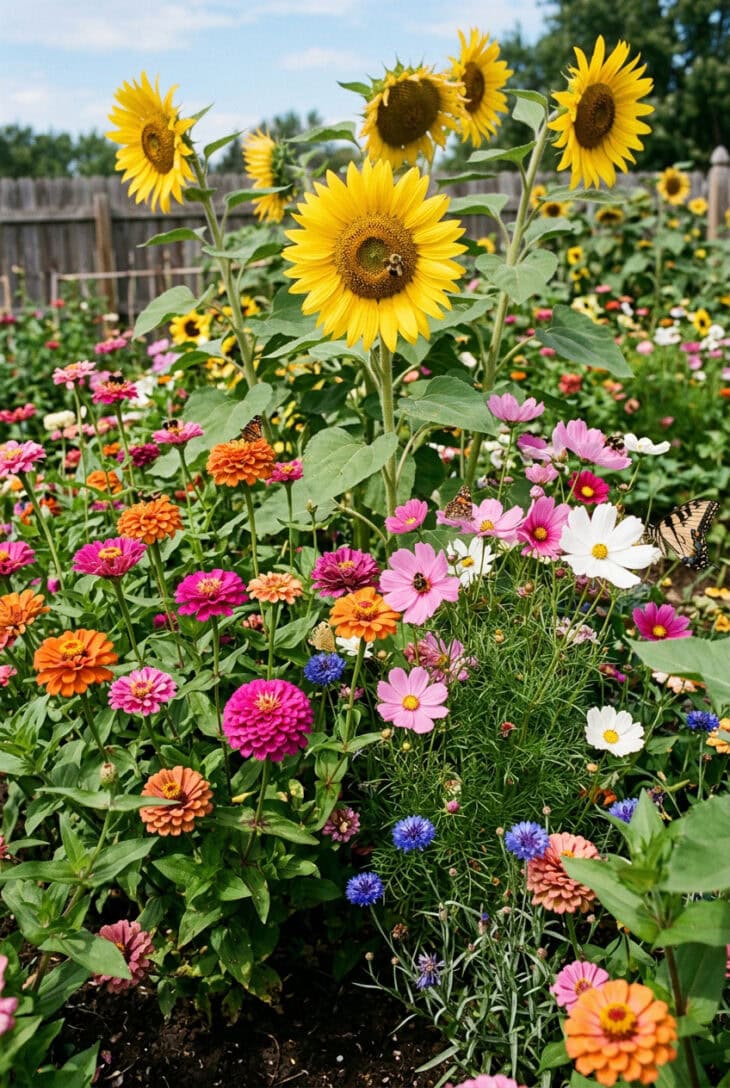
What you see A bed that was bare soil in April and is now shoulder-high chaos in August. Sunflowers stand at the back with bees crawling across their discs, zinnias burn magenta and orange in the middle, and cosmos and cornflowers fill every gap. It cost about the price of a coffee in seed.
Why it works Perennials are the long game, but annuals give you a full nectar bar in a single season, which makes this the fastest and cheapest idea here and the right one for renters, new gardens and anyone impatient. Annuals also flower for months rather than weeks, because they are racing to set seed and will keep producing as long as you keep cutting them. For a new plot with nothing in it, this is how you get bees this year rather than in three.
How to get it Rake a sunny bed to a fine tilth, then broadcast or drill seed in April: single-flowered zinnias (Zinnia elegans), cosmos (Cosmos bipinnatus ‘Purity’), cornflower (Centaurea cyanus), and a pollen-rich sunflower (Helianthus annuus ‘Lemon Queen’), avoiding the pollen-free florist strains bred for clean tablecloths, which are useless to bees. Thin the seedlings properly, since crowded plants flower poorly. Deadhead through summer to keep them going, then stop in September and let the last flowers set seed for the finches. Sow a second batch in June for a fall wave.
24. Put the Sprayer Down
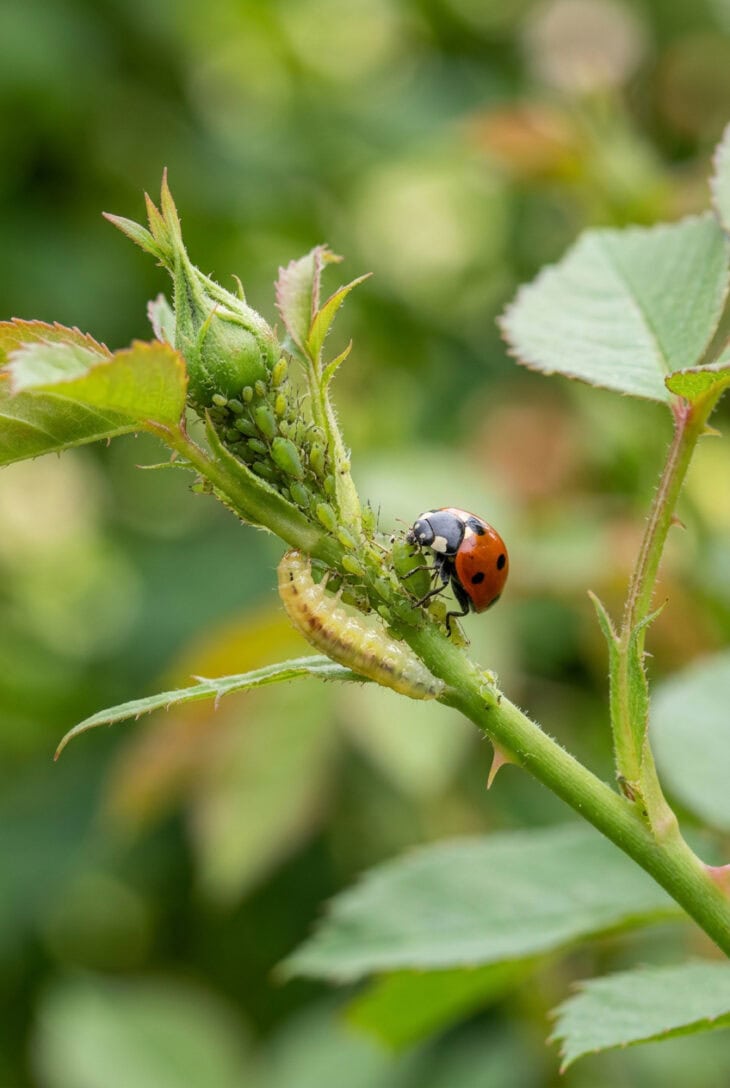
What you see A rose stem with aphids on it, and nobody panicking. A ladybug is working steadily up the cluster, and a small translucent hoverfly larva, which most gardeners would never recognize, is quietly eating its way through the rest. In a fortnight there will be no aphids and no spray was involved.
Why it works Insecticides do not distinguish between the insects you dislike and the ones you spent all spring planting for, and the neonicotinoid class is absorbed into the plant and turns up in its pollen and nectar. Worse, spraying removes the aphids that the ladybugs and hoverflies were about to eat, so their populations crash and the next aphid outbreak arrives with nothing to stop it. Tolerating a small infestation for two weeks is not neglect, it is what lets the predators arrive.
How to get it Stop using insecticides on flowering plants, full stop, and stop using weed-and-feed on lawns. If an aphid colony genuinely bothers you, squash it with your fingers or blast it off with a hose, which takes ten seconds and harms nothing else. Check plant labels when buying, since some nursery stock is still grown with systemic neonicotinoids that persist in the plant for a year. Accept some holes in leaves: a garden with a few chewed hostas and no sprays will always hold more life than a flawless one, and the caterpillars doing the chewing are the butterflies you asked for.
25. Join the Patches Into a Corridor
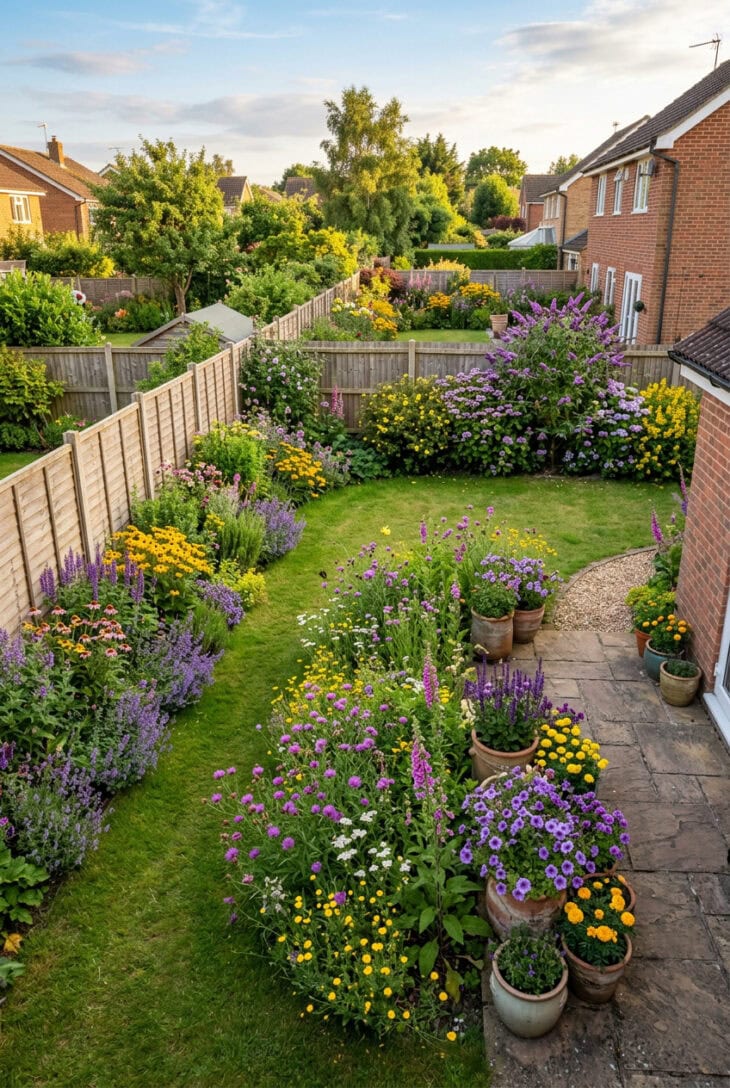
What you see The whole garden read as one route rather than a set of features. The nectar border along the fence runs into the meadow strip, the meadow meets the pots by the patio, the pots lead to the flowering shrubs at the boundary, and the same purples and yellows repeat all the way through. Over the fence, the neighbor’s garden picks it up and carries on.
Why it works Most bees forage within a few hundred yards of their nest, and some solitary bees within a hundred. An isolated island of flowers in a desert of lawn and paving supports far less than the same flowers linked into a chain, because a chain lets insects move, feed and nest across a much larger area. This is the idea that turns a good backyard garden into part of something bigger, and it is why persuading one neighbor to plant matters more than adding another border of your own.
How to get it Look at your plot from an upstairs window and mark where the flowers actually are, then close the gaps between them with pots, a strip of annuals, or simply by letting a section of lawn grow long. Repeat two or three of the same species along the route, since repetition helps insects work efficiently and happens to look intentional. Then look past the fence: a shared wildflower strip along a boundary, or a street where four houses each plant a nectar border, adds up to something no single garden can achieve. Offer the neighbor your spare seedlings, which is the cheapest conservation tool there is.