The Mediterranean garden is the one everybody comes home from holiday wanting. It is not really about the plants, or not only: it is the smell of hot rosemary at four in the afternoon, the sound of gravel underfoot, and the fact that the best seat in the garden is in the shade rather than the sun. All of that is reproducible a long way from the Mediterranean.
Contents
- 01. Start With a Gravel Courtyard, Not a Lawn
- 02. Make an Olive Tree the Centerpiece
- 03. Punctuate the Garden With Italian Cypress
- 04. Render the Walls and Paint Them Chalk White
- 05. Edge a Path With a Lavender Hedge
- 06. Build a Herb Terrace Within Arm’s Reach
- 07. Drape a Pergola in Grapevine
- 08. Group Terracotta Pots Against a Warm Wall
- 09. Let Silver Foliage Carry the Whole Planting
- 10. Terrace a Slope With Dry Stone Walls
- 11. Add a Still Water Basin, Not a Fountain
- 12. Grow Citrus in Pots You Can Move
- 13. Run Bougainvillea Over an Archway
- 14. Clip Evergreens Into Loose Green Balls
- 15. Make the Dining Room a Shaded One
- 16. Let Self-Seeders Colonize the Gravel
- 17. Plant a Garrigue of Cistus and Rock Rose
- 18. Train a Fig Against a Sun-Baked Wall
- 19. Add a Pomegranate for Late Color
- 20. Grow a Potager of Artichokes and Beans
- 21. Use Agave and Succulents as Sculpture
- 22. Cover a Stone Terrace With Wisteria
- 23. Naturalize Alliums and Bearded Iris
- 24. Flower All Summer With Oleander
- 25. Light It With Lanterns and Candlelight
The 25 ideas below run from a whole courtyard rebuild to a single afternoon spent grouping pots against a warm wall. Some suit a baking city terrace, others a windy slope or a suburban back garden with heavy clay. A few need a real summer to work properly, and several will do just as well in a cool, damp climate provided you get the drainage right, which is the one thing this style asks of you.
Take what fits your plot and leave the rest. These ideas layer well, and a garden that borrows three or four of them tends to look more convincing than one that tries to copy a Provencal courtyard down to the last pot.
01. Start With a Gravel Courtyard, Not a Lawn
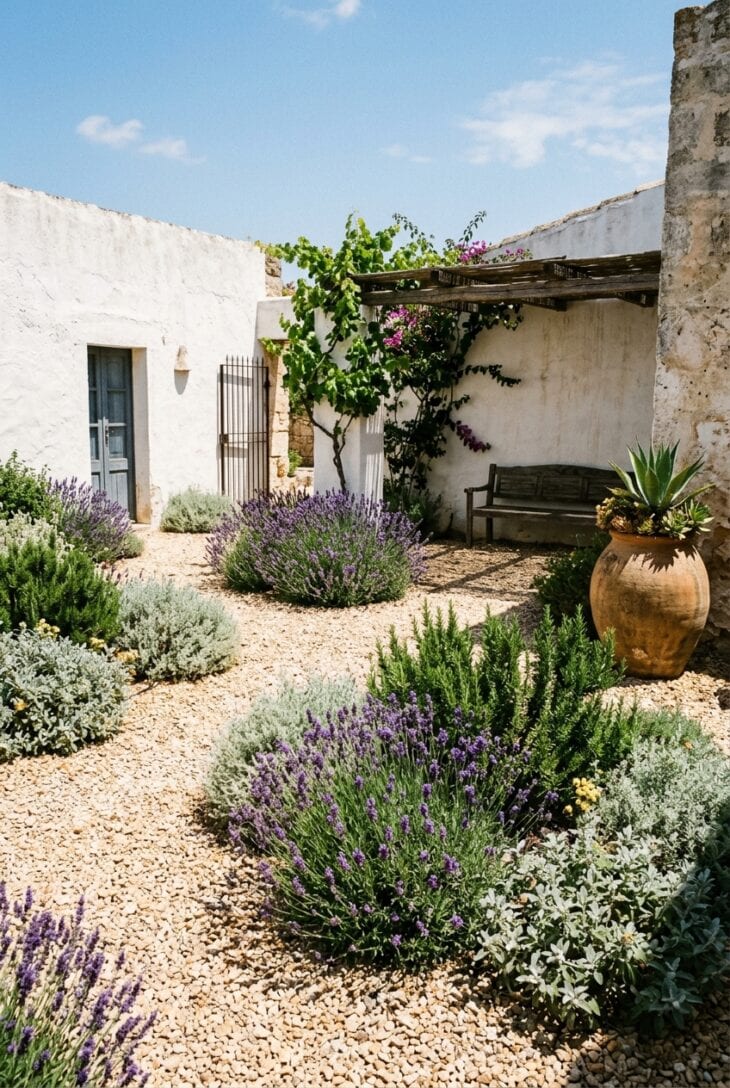
What you see No grass anywhere. The whole floor of the courtyard is pale honey gravel, with mounds of lavender, rosemary and santolina growing straight out of it in loose informal drifts. A bench sits in one corner and a big terracotta jar in another. The sun is hard, the shadows are black, and the walls are chalk white.
Why it works A lawn is the single most un-Mediterranean thing you can put in a garden: it needs water in the exact months there is none, and it turns straw brown just as the garden should be looking its best. Gravel does the opposite. It keeps the crown of every plant dry (winter wet, not cold, is what kills most Mediterranean plants in a temperate garden), it reflects heat and light back up into the foliage, and it lets things self-seed where they want to be.
How to get it Skip the weed membrane, which prevents the self-seeding that gives this style its charm and does not stop weeds anyway. On free-draining ground, spread 3 to 4in (8 to 10cm) of angular gravel (6 to 10mm) straight onto the soil and plant through it. On clay you have to do the work first: dig in a barrowload of grit per square yard, or raise the whole planting area 8 to 10in (20 to 25cm) above grade so water has somewhere to go. Choose gravel in a warm buff or honey shade, since cold blue-grey stone reads as driveway rather than courtyard.
02. Make an Olive Tree the Centerpiece
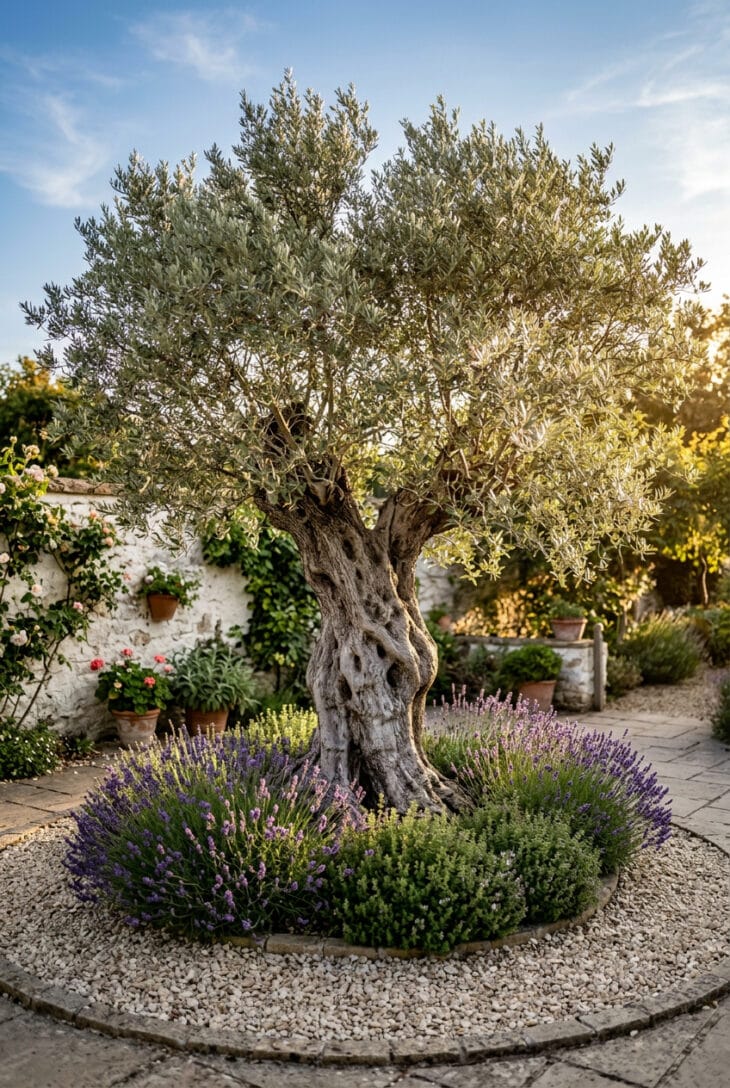
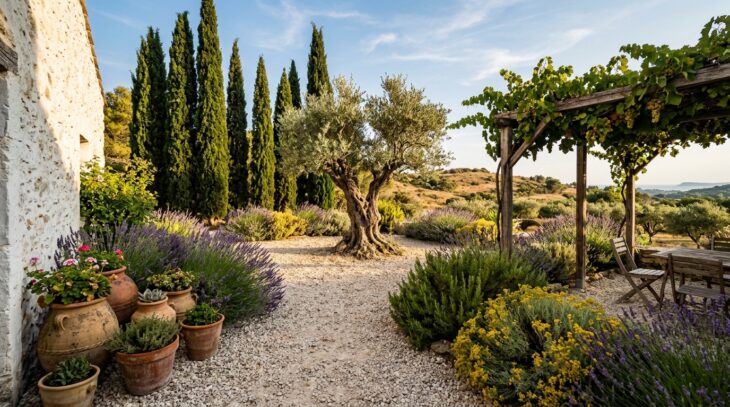
What you see One old olive, its trunk thick, twisted and silver-barked, standing by itself in a circle of gravel with lavender and thyme at its feet. The canopy is a soft grey-green cloud rather than a solid mass, and when the breeze turns the leaves over the whole tree flashes silver. It is doing all the work in the garden on its own.
Why it works One good tree, given room, says Mediterranean faster and more convincingly than any amount of planting around it. The olive in particular carries the whole idea: the silver-grey foliage sets the color key for everything else, the light canopy casts dappled rather than dense shade so you can plant right underneath it, and a genuinely old trunk gives the garden the one thing new gardens never have, which is age.
How to get it Olive (Olea europaea) is hardy to roughly 14F (-10C) once established, so in colder zones grow it in a large pot and move it under cover, or pick a tough cultivar such as ‘Arbequina’. Plant on a slight mound in the sharpest drainage you can build, and never mulch with anything moisture-holding against the trunk. Buy the biggest trunk you can afford, since the character is entirely in the bark and a young whip takes decades to get there. Prune only to open the center up, aiming for a canopy a bird could fly through.
03. Punctuate the Garden With Italian Cypress
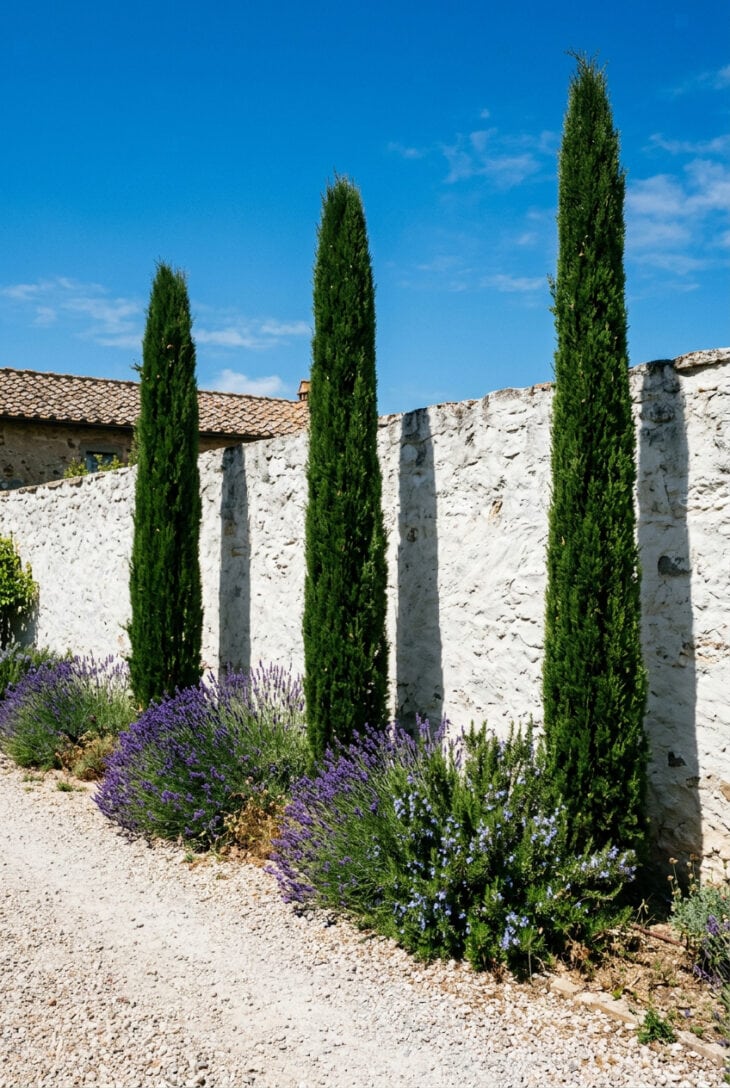
What you see Three dark green columns standing hard against a white wall and a blue sky, with lavender and rosemary mounding at their feet. They are so narrow they take up almost no ground, and so tall they change the shape of the sky. Their shadows fall across the wall as three vertical bars.
Why it works Mediterranean planting is almost entirely made of low mounds and hummocks, which is beautiful and, left to itself, monotonous. Cypresses break the horizontal with a hard vertical, and because they are dark they read as punctuation rather than as mass. Three or five of them, spaced irregularly, will hold a whole garden together and give you the exact silhouette that says Tuscany from a hundred yards away.
How to get it Italian cypress (Cupressus sempervirens ‘Stricta’) is the true narrow form and reaches 20 to 30ft (6 to 9m) but stays under 3ft (90cm) wide. In cold or wet climates it can brown out, so consider Irish yew (Taxus baccata ‘Fastigiata’) or the pencil juniper (Juniperus scopulorum ‘Skyrocket’) as a hardier stand-in. Plant in groups of odd numbers, never in a symmetrical pair either side of a door unless the whole garden is formal. Give sharp drainage, stake for the first two years, and shear lightly in late summer to keep them tight.
04. Render the Walls and Paint Them Chalk White
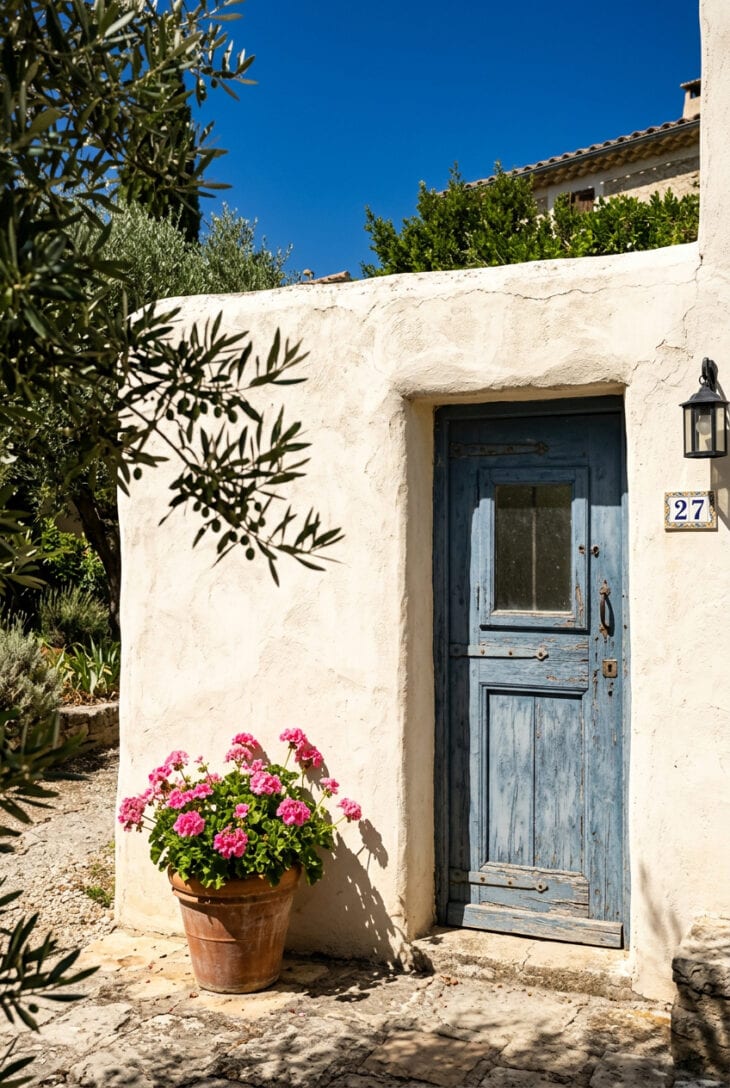
What you see A thick wall finished in chalky off-white, the render slightly uneven so the light catches it in patches. The shadow of an olive branch is thrown across it, moving. A blue-painted door sits in the wall and a terracotta pot of pink geraniums stands at its base. The wall is doing as much for the garden as any plant in it.
Why it works A pale wall is a light source. It bounces sun back into the garden, extends the time a border is usefully lit, and gives silver and grey foliage a background bright enough to actually read against. It also holds heat into the evening, which is why a Mediterranean courtyard stays comfortable long after the sun has gone. And it turns every leaf and branch in front of it into a shadow drawing.
How to get it Use a lime-based render or limewash rather than modern masonry paint: it breathes, ages gracefully into patchiness instead of peeling, and has a soft chalky depth that plastic paint cannot fake. Choose a warm off-white, a bone or a pale sand, since brilliant white goes blue and glaring in strong sun. Keep the finish deliberately imperfect by working it with a wet sponge or a soft brush. Expect to refresh limewash every 4 to 5 years, which takes an afternoon and a roller.
05. Edge a Path With a Lavender Hedge
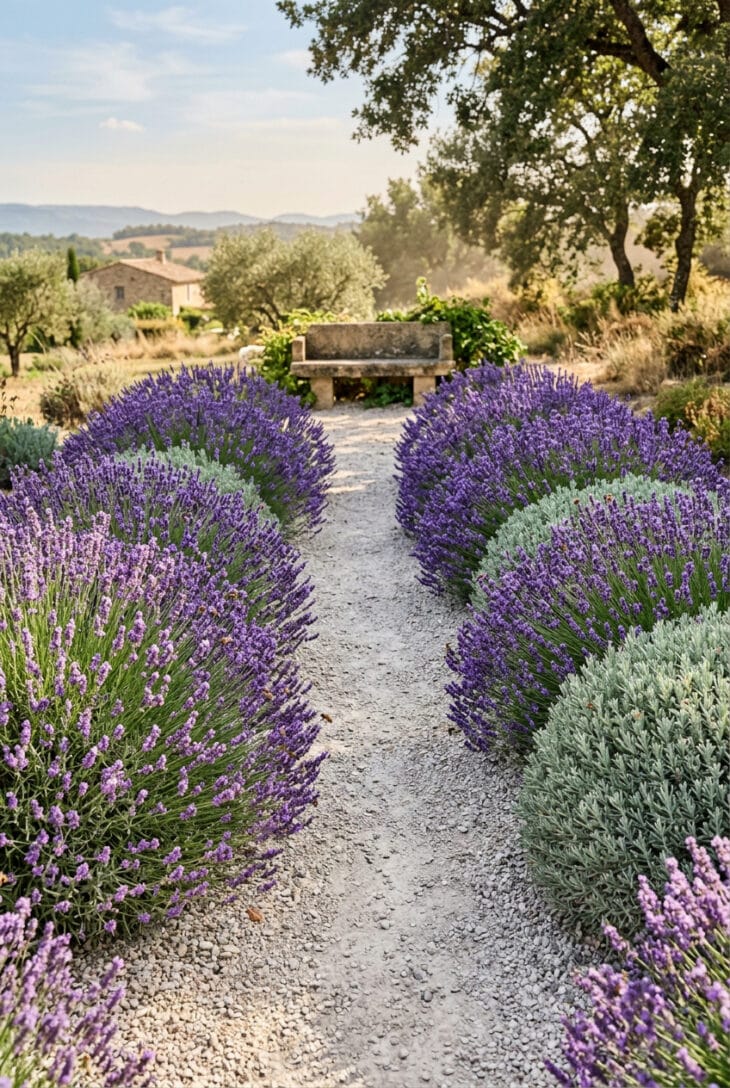
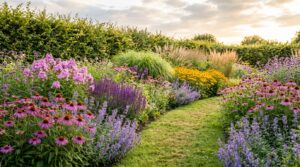
What you see A gravel path running between two tight low hedges of lavender, every mound the same height, every one covered in purple. Bees are all over it and the noise is noticeable. At the end of the path there is a stone bench, and the whole thing shimmers slightly in the heat.
Why it works Lavender is the one plant that gives you three things at once: a formal clipped line, a soft flowering mass, and a scent released by nothing more than brushing past it. Using it as a hedge rather than dotting it through a border is what makes a garden feel designed instead of merely planted, and the repetition is what carries the eye down the path. It is also, crucially, at its best in the driest, poorest, hottest strip you have.
How to get it Use English lavender (Lavandula angustifolia ‘Hidcote’ or ‘Munstead’) for hedging, because it is the hardiest and clips the tightest, and space plants 12in (30cm) apart for a solid line. The pruning rule is what decides whether you have a hedge in five years or a pile of bare wood: cut back by about a third immediately after flowering, taking off all the spent stems and an inch or two of green, but never cut into old brown wood, which will not resprout. Replace plants every 8 to 10 years.
06. Build a Herb Terrace Within Arm’s Reach
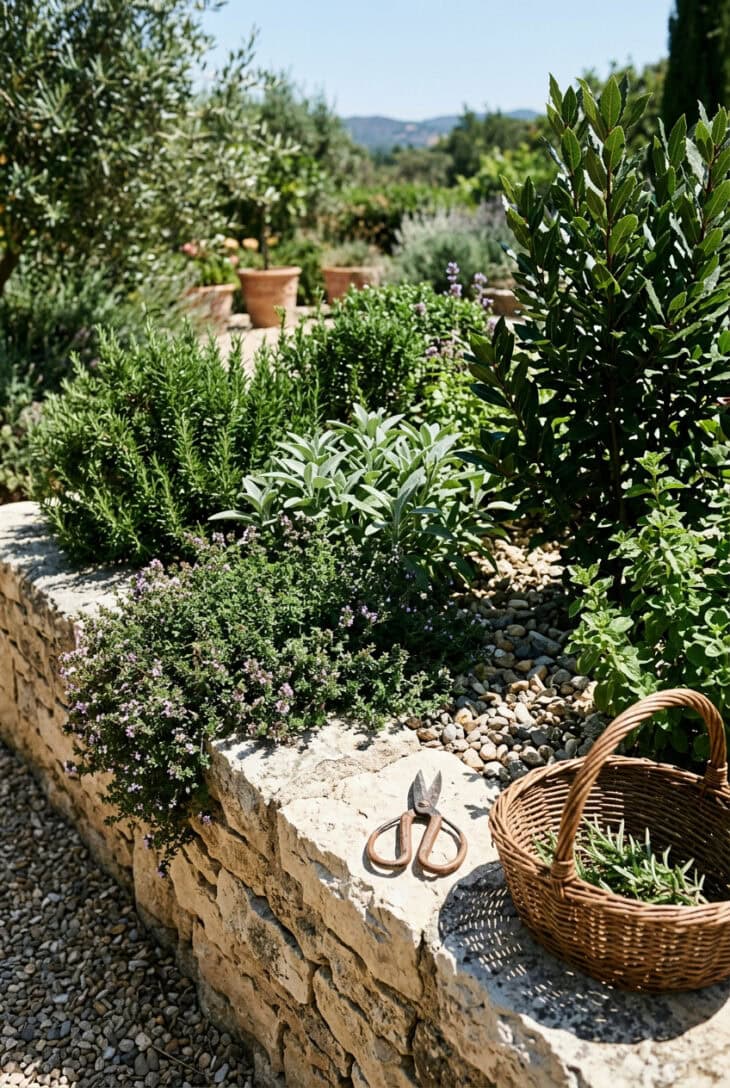
What you see A low terrace of rough pale stone, raised to about knee height and packed with herbs: upright rosemary, silver-leaved sage, thyme pouring over the front edge, oregano and a clipped bay. The soil between is mulched with grit. A pair of scissors and a basket are sitting on the wall, which tells you how often somebody comes out here.
Why it works Mediterranean herbs are the perfect Mediterranean garden plants because they are the same thing: evergreen, aromatic, grey-green, drought-adapted, and happiest in the poor stony ground that defeats everything else. Raising them onto a terrace does two things at once, giving them the sharp drainage they must have and bringing the foliage up to hand height, where you catch the scent every time you walk past and can actually be bothered to cut some for the kitchen.
How to get it Build the bed at least 12in (30cm) deep and fill it with a lean mix: two parts topsoil, one part sharp sand, one part grit, and no compost or manure at all, since rich soil makes soft growth that rots in winter and tastes of nothing. Plant rosemary (Salvia rosmarinus ‘Miss Jessopp’s Upright’), sage (Salvia officinalis ‘Berggarten’), thyme (Thymus vulgaris) and oregano (Origanum vulgare), and mulch with 1in (2.5cm) of grit. Trim each plant lightly after flowering to stop it going woody, and put it where the sun hits it from noon onwards.
07. Drape a Pergola in Grapevine
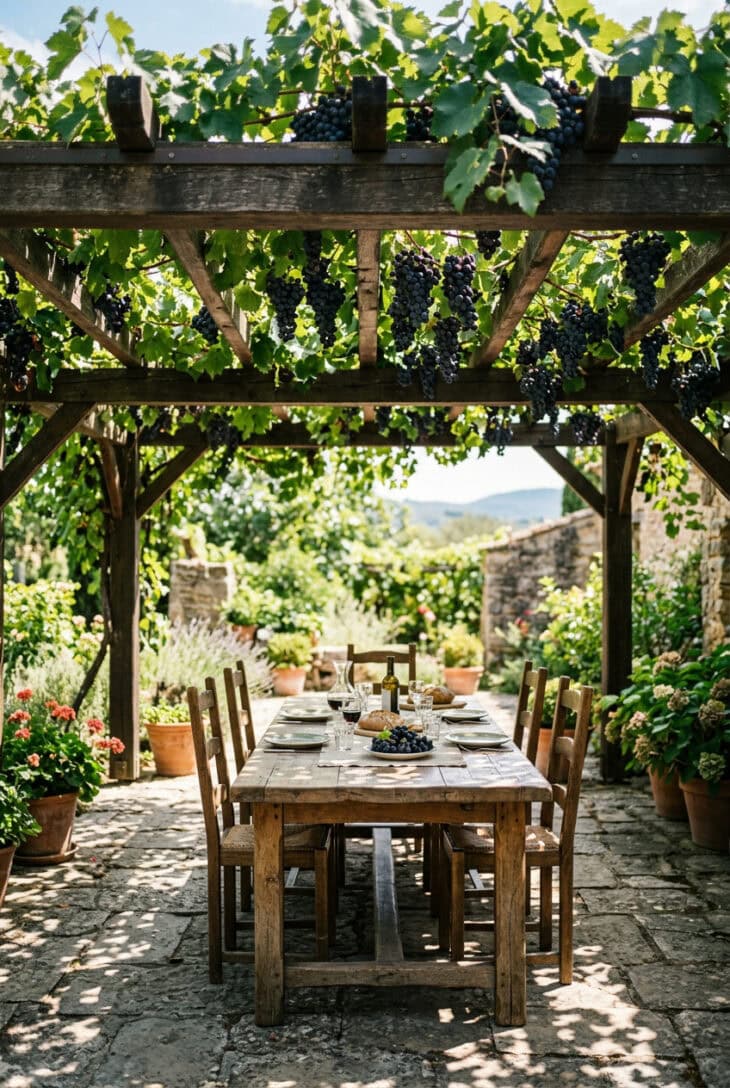
What you see A rustic timber pergola so thickly covered in vine that the beams have almost disappeared, with bunches of dark grapes hanging down through them. Below, a long table and chairs in cool green shade, with coins of sunlight moving across the cloth. Outside the pergola the terrace is blindingly bright.
Why it works In a hot garden, shade is the luxury, and a vine is the best shade-maker there is because it is deciduous. It gives you a dense green roof exactly when you need it in July, then drops its leaves and lets the low winter sun straight through to warm the terrace in February. A solid roof cannot do that. The grapes are a bonus, and the yellow and red autumn color is a second one.
How to get it Build the pergola heavier than looks necessary, because a mature vine is a serious weight: 6x6in (15x15cm) posts and beams at least 6x2in (15x5cm), with the underside of the beams at 8ft (240cm) minimum so you are not ducking. Plant an outdoor grape (‘Boskoop Glory’ for a cool climate, ‘Black Hamburg’ under glass) at one post, train a single stem to the top, then run permanent arms along the beams. Prune hard every winter back to two buds on each spur, or you get a bird’s nest of unproductive growth in three seasons.
08. Group Terracotta Pots Against a Warm Wall
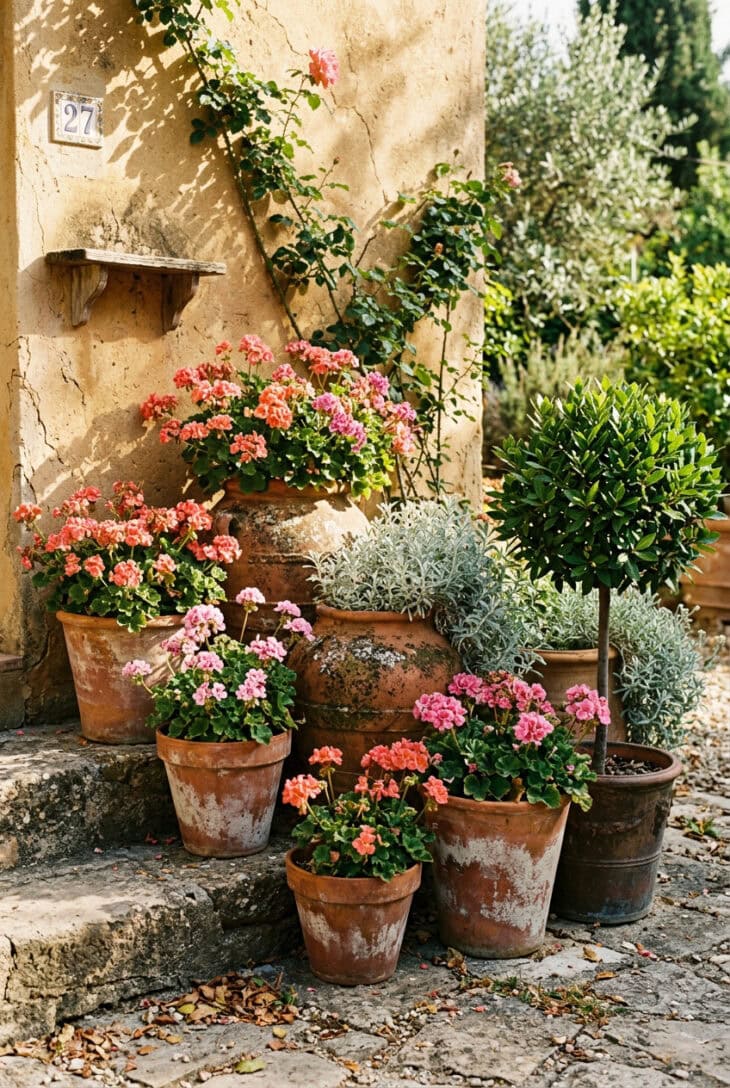
What you see Fifteen or twenty terracotta pots of every conceivable size, banked up against an ochre wall, some on the floor and some raised on steps. Coral and pink geraniums, silver foliage spilling over rims, one clipped bay standing above the rest. The clay is old: white salt bloom in streaks, a little moss on the shaded sides.
Why it works A big group of pots is a border you can build in an afternoon and rearrange whenever you like, which makes it the fastest route into this style for anyone with a paved yard. Massing them is the trick: a dozen pots together look generous and deliberate, while the same dozen dotted around the garden look like clutter. Terracotta is not just decorative either, since the porous clay evaporates moisture and keeps roots cooler than plastic ever will.
How to get it Vary the heights hard (a few big ones, several middling, a scatter of small) and repeat one or two plants through the group to tie it together. Scented geraniums (Pelargonium), lavender, helichrysum and a clipped bay are the classic cast. Buy frostproof terracotta if you have real winters, and raise every pot on feet so the base never sits in water, which is what actually cracks the clay. Water in the evening, and accept that a terracotta pot in full sun in July may need it daily.
09. Let Silver Foliage Carry the Whole Planting
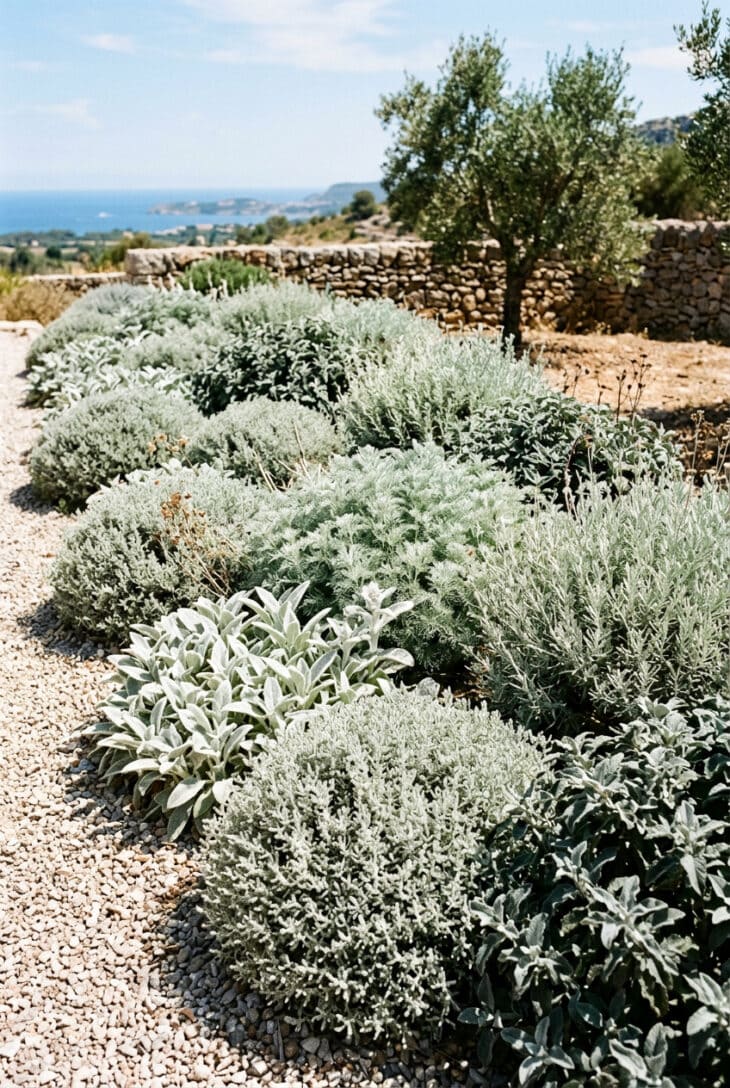
What you see A border with almost no flowers in it and no need for any. Rounded mounds of silver in a dozen different textures: felted, filigree, woolly, needled, some almost white in the sun. Pale gravel runs between them. In the middle of the day it is so bright it is hard to look at, and at dusk it turns luminous.
Why it works Silver leaves are silver because they are coated in fine hairs or wax to cut water loss and reflect fierce sun, so every silver plant is already built for the conditions this style creates. Leaning on foliage rather than flower gives you a border that looks the same in April as in September, holds up in drought, and keeps working in the evening, when silver picks up the last of the light long after color has gone flat.
How to get it Build it from lamb’s ear (Stachys byzantina), artemisia (Artemisia ‘Powis Castle’), cotton lavender (Santolina chamaecyparissus), curry plant (Helichrysum italicum) and grey-leaved cistus, and plant them close enough that the mounds touch and flow into each other. Contrast the textures rather than the colors: a fat felted leaf next to a fine filigree one is the whole design. Cut the woody ones back by a third to a half in mid spring, before growth starts, or they split open in the middle by year four.
10. Terrace a Slope With Dry Stone Walls
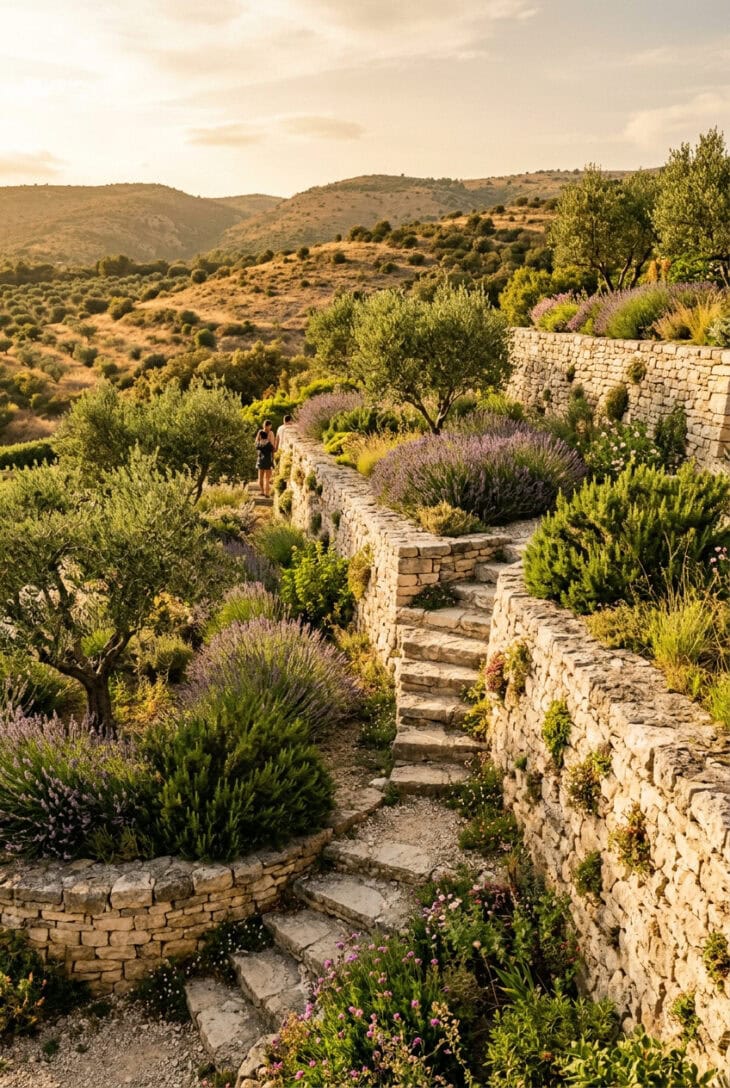
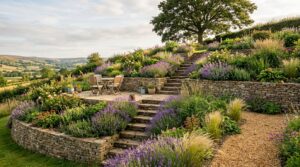
What you see A slope turned into two or three level shelves, each held back by a rough dry stone wall of pale limestone, with stone steps cutting up between them. Olive, lavender and rosemary sit on the flats, and small plants have seeded themselves in the crevices of the walls. In evening light the stone goes gold.
Why it works Terracing is the oldest Mediterranean idea there is, and it solves two problems at once. It gives you level, usable ground on a slope you could not otherwise plant or sit on, and it delivers the sharp drainage this planting demands, since the water simply runs out through the joints. The wall then becomes a habitat of its own: sun-baked crevices where thyme, sedum and erigeron seed themselves and look like they have been there for fifty years.
How to get it Dry stone (no mortar) is essential, since it drains and flexes rather than building up water pressure behind it. Keep any unmortared retaining wall under about 3ft (90cm) high and build it with a slight backward lean of around 1in per foot (8cm per metre) of height, packing the space behind with rubble and gravel. Anything taller than that is an engineering job and needs a proper drained, reinforced wall. Poke small plants into the joints as you build, not afterwards.
11. Add a Still Water Basin, Not a Fountain
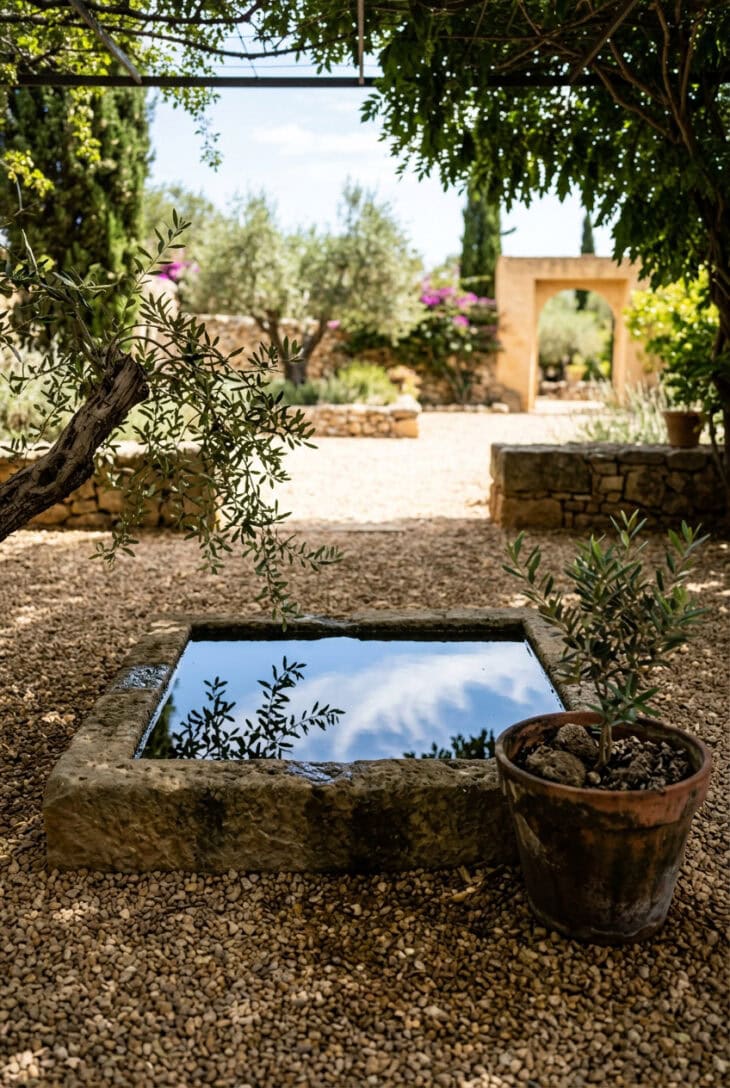
What you see A square stone basin set flush into the gravel, brimming with water so still it is black, holding a perfect reflection of the sky and one olive branch. There is no splashing, no jet, no pump noise. It sits in shade while the courtyard beyond it bakes, and it makes the whole space feel cooler than it is.
Why it works The Moorish gardens that this style descends from treated water as something precious, used sparingly and always for reflection rather than display. A still surface gives you a piece of sky at ground level, doubles the light in a shaded courtyard, and provides a psychological coolness that a splashing fountain, oddly, does not. It also uses almost no water and no electricity, and it never needs cleaning of algae if you keep it shaded.
How to get it A simple stone or rendered trough 24 to 36in (60 to 90cm) square and 12in (30cm) deep is enough. Set it so the water sits within about an inch of the rim, since a brimming basin reads as full and a half-empty one reads as neglected. Site it in shade or part shade to keep algae down, line it with something dark (black butyl or a dark render) to make it reflect properly, and top it up with rainwater. Add a couple of stones as an escape route for insects.
12. Grow Citrus in Pots You Can Move
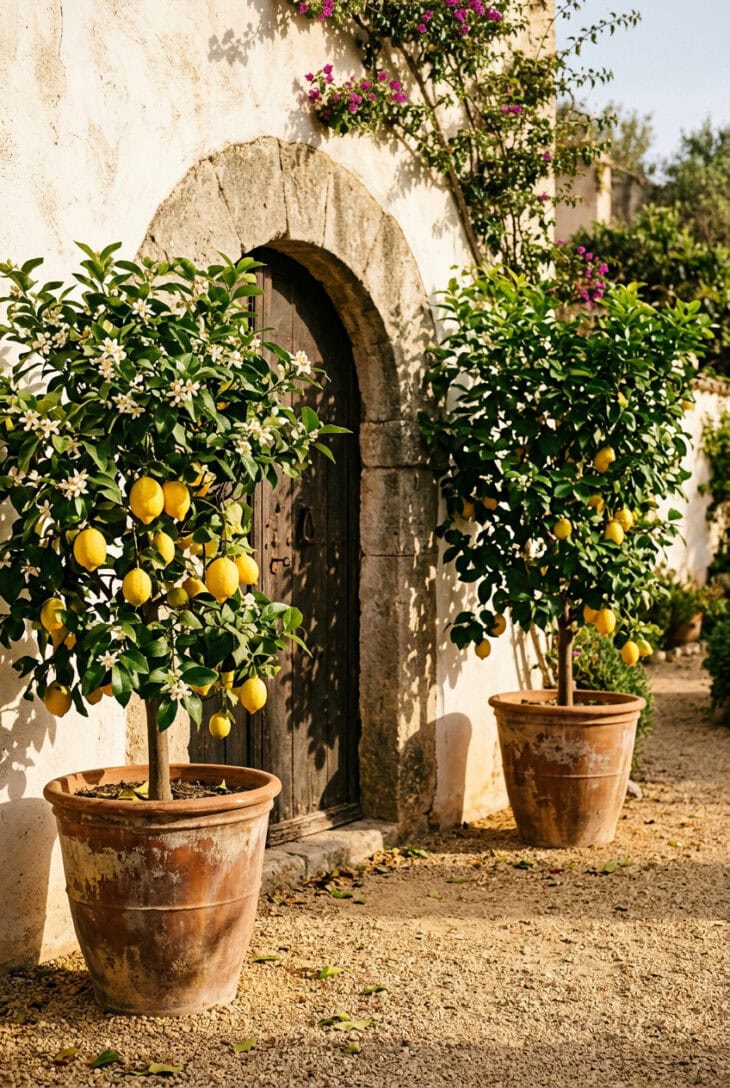
What you see Two lemon trees in big old terracotta pots, standing either side of a stone doorway. Each one is carrying glossy dark leaves, white blossom and ripe yellow fruit all at the same time, which no other plant in the garden manages. The scent of the flowers reaches you before you reach the door.
Why it works Nothing else in a temperate garden reads quite so unmistakably as the south, and the trick is simply to stop trying to plant it in the ground. Grown in pots, citrus can spend May to October in the hottest, most sheltered spot you own and then be wheeled somewhere frost-free for the winter, which is exactly what the great European orangeries were built to do. The reward is fruit, flower and scent from one plant, for a decade or more.
How to get it Meyer lemon (Citrus x meyeri) is the most forgiving and the one to start with, and calamondin is nearly as easy. Use a gritty, free-draining citrus compost, never ordinary potting soil, and let the top inch dry out between waterings, since more citrus are killed by kindness than by drought. Feed with a proper high-nitrogen summer citrus feed and switch to the winter formula in October. Overwinter above 41F (5C) in the brightest place you have, and cut watering right back while it is cool.
13. Run Bougainvillea Over an Archway
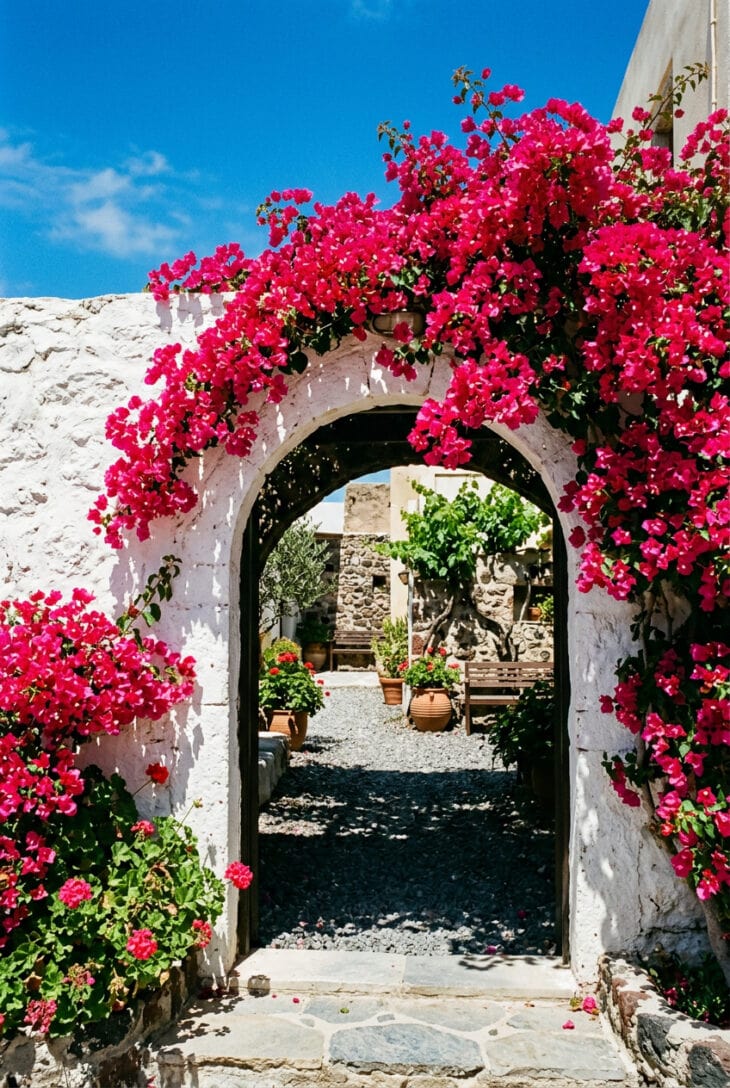
What you see A white stone arch buried under magenta bougainvillea, the papery bracts so dense the plant reads as pure color. Against the white wall and the blue sky it is almost too much. Through the opening there is a glimpse of the cool shaded courtyard on the other side, which is what stops it being merely loud.
Why it works A garden built on grey, silver and stone needs one moment of real saturated color, and it works best when it is concentrated in a single place rather than spread thinly. An archway is the ideal spot because it frames a view and marks a transition, so the color is doing a structural job as well as a decorative one. Bougainvillea also flowers hardest when it is hot, dry and slightly starved, which is when everything else has stopped.
How to get it Bougainvillea (Bougainvillea glabra) needs a frost-free winter and is only an outdoor perennial in zones 9 and above, so in colder places grow it in a large pot against a hot wall and bring it in. Keep it root-restricted and on the dry side, since a well-fed, well-watered plant makes leaves and no bracts. In a cool climate, get the same effect with a climbing rose, a purple potato vine (Solanum crispum) or hardy trumpet vine (Campsis radicans), which give you saturated color on the same structure.
14. Clip Evergreens Into Loose Green Balls
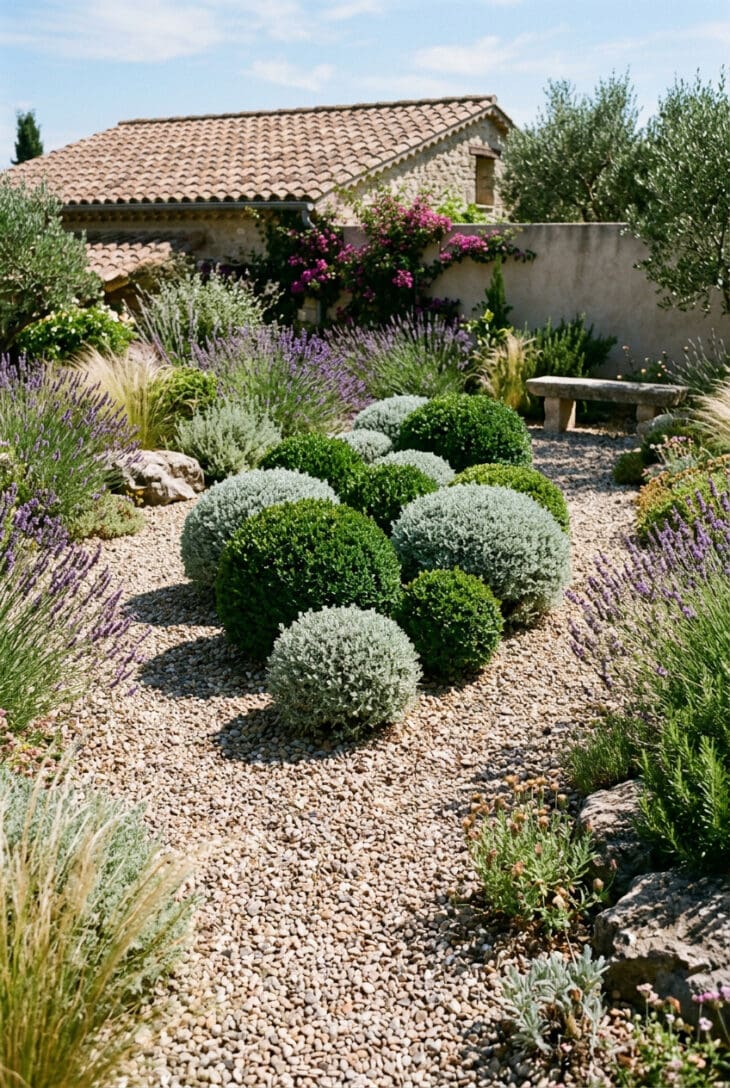
What you see A loose cluster of clipped evergreen balls sitting in gravel like a group of boulders, some dark green, some silvery, all different sizes and none of them in a straight line. Lavender and grasses run around and between them. Each one throws a neat round shadow, and together they hold the loose planting in place.
Why it works This is the trick that makes a relaxed Mediterranean garden look composed rather than scruffy: a handful of hard, geometric, evergreen shapes among all that softness. The contrast between a crisply clipped sphere and a wild froth of lavender flatters both. And because the balls are evergreen, they are still there in January holding the structure of the garden when everything else has been cut back.
How to get it Box (Buxus sempervirens) is traditional but blight and box moth make it a risk, so consider Japanese holly (Ilex crenata), shrubby germander (Teucrium fruticans) for a silver ball, or Phillyrea angustifolia, which is the most authentically Mediterranean of the lot. Clip twice a year, in late spring and again in late summer, on a dull day rather than in blazing sun, which scorches the cut edges. Vary the sizes and cluster them in odd numbers, and never space them evenly, or you have a municipal planting scheme.
15. Make the Dining Room a Shaded One
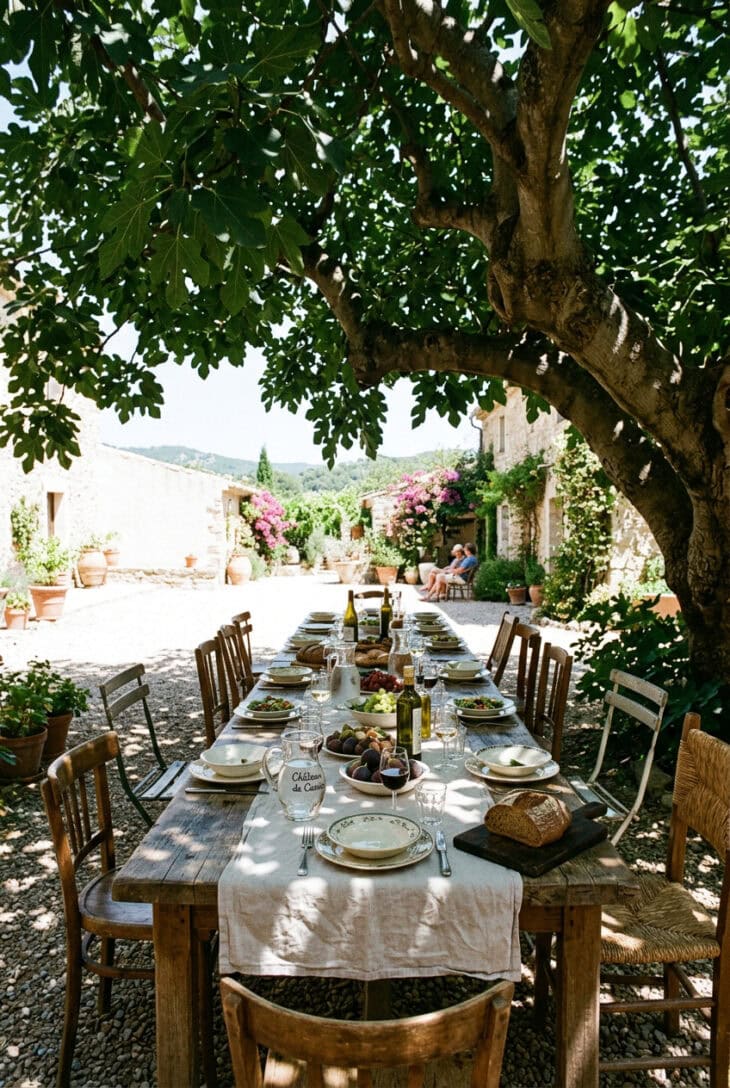
What you see A long wooden table under a fig tree, laid for lunch, with mismatched chairs and gravel underfoot. The light on the cloth is green and cool, broken by moving coins of sun. Ten feet away the courtyard is white with glare. Nobody is sitting out there.
Why it works Northern gardens put the table in the sunniest spot available, and it is the single biggest mistake people make when copying this style. In the countries this look comes from, the sun is the thing you get out of, and every good outdoor room is under a tree, a vine or a roof. Putting the table in shade adds hours to the time you actually spend outdoors in July, and turns the bright courtyard into something you look at rather than sit in.
How to get it Use a tree with an open canopy that gives dappled rather than dense shade: fig, olive, almond, or a multi-stem strawberry tree (Arbutus unedo). If there is no tree, a vine-covered pergola or a simple stretched canvas sail does the same job and is up in a weekend. Allow 36in (90cm) of clearance around the table for chairs to pull out, and lay a firm surface of self-binding gravel or paving so the legs sit level. Face the table so diners look into the garden, not at the house wall.
16. Let Self-Seeders Colonize the Gravel
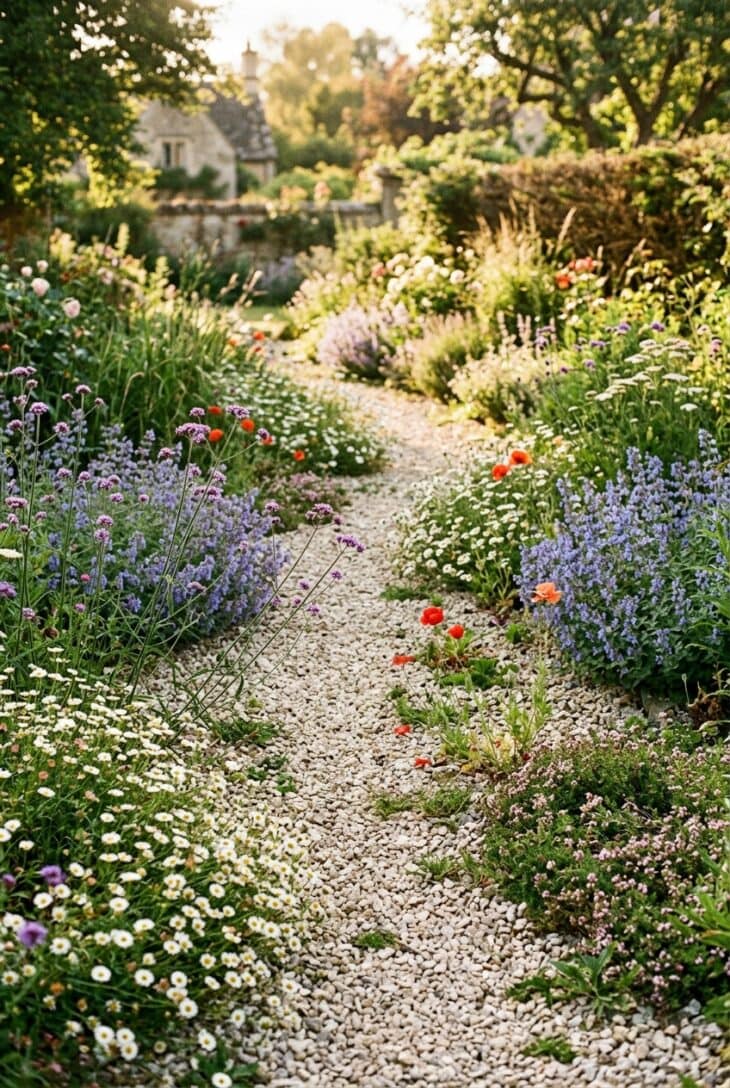
What you see A gravel path with its edges dissolving, because plants have seeded themselves straight into it: little white daisies, purple verbena, blue catmint, a few poppies, mats of thyme. There is no line anywhere between path and border. The path is narrower than it was three years ago and it looks far better for it.
Why it works A Mediterranean garden that is too tidy is a Mediterranean garden that has missed the point, because the real ones are half wild and full of plants growing in the cracks. Self-seeding does the thing no planting plan can do: it puts plants exactly where the conditions suit them, and the resulting apparent randomness is what makes the garden look old and settled. It is also free, and it fills gaps you did not know you had.
How to get it The only requirement is bare gravel and no membrane, since a seed cannot root through plastic. Introduce reliable seeders once and let them go: Mexican fleabane (Erigeron karvinskianus), verbena (Verbena bonariensis), red valerian (Centranthus ruber), fennel and California poppy. The job then becomes editing rather than planting: walk the path every few weeks and pull out what you do not want, keeping about one seedling in five. Hoeing the gravel or spraying it destroys the whole effect in a single afternoon.
17. Plant a Garrigue of Cistus and Rock Rose
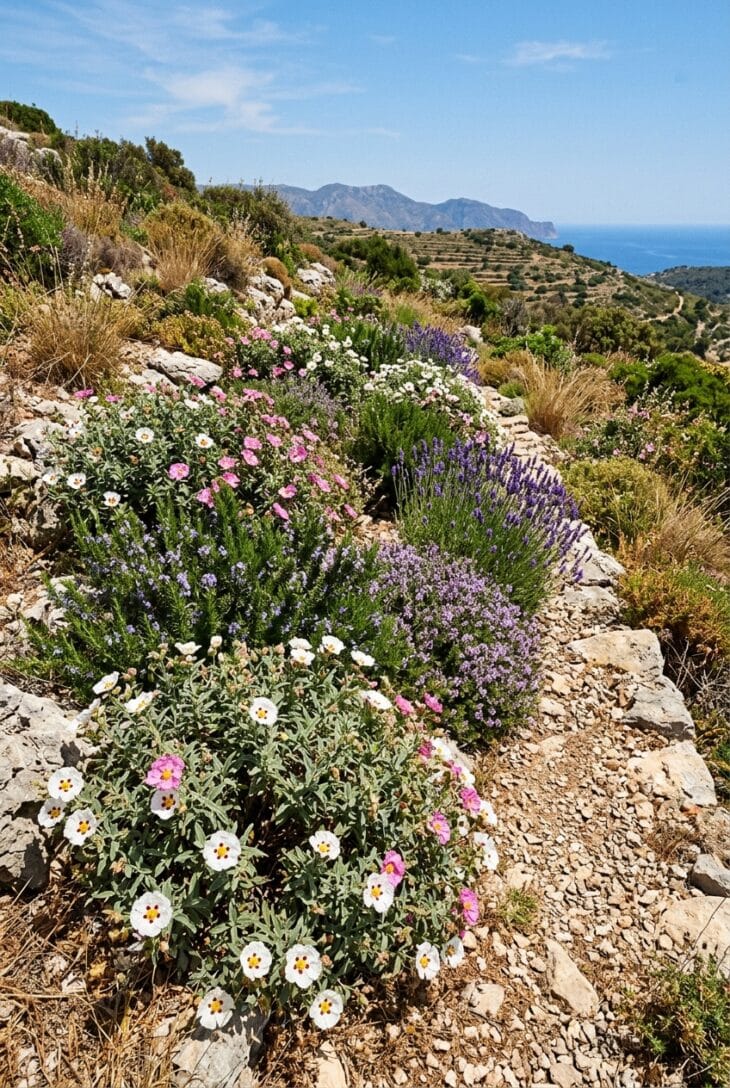
What you see Something that looks less like a border and more like a hillside: low grey-leaved shrubs covered in papery white and pink flowers with dark blotches at the base of each petal, with rosemary, thyme and dry grasses between them and rocks pushing up through it all. On a hot day the whole planting smells of resin.
Why it works Garrigue is the natural scrubland of the Mediterranean basin, and copying a plant community rather than a garden style is the most reliable way to get a planting that actually thrives. Everything in it wants the same conditions (thin, poor, stony, sharply drained soil in full sun) so nothing needs special treatment, nothing needs watering after year one, and the whole thing holds together visually because in the wild it grows together.
How to get it The backbone is cistus (Cistus x purpureus, Cistus ladanifer), with rosemary, thyme, lavender, phlomis and euphorbia woven through, plus a few grasses for movement. Plant small (9cm pots establish far better than large containers in dry ground), plant in autumn so roots get a winter to run, and water only through the first summer. Do not feed and do not enrich the soil, since fertility makes these plants lush, short-lived and prone to rot. Cistus resents pruning, so trim only the soft new growth.
18. Train a Fig Against a Sun-Baked Wall
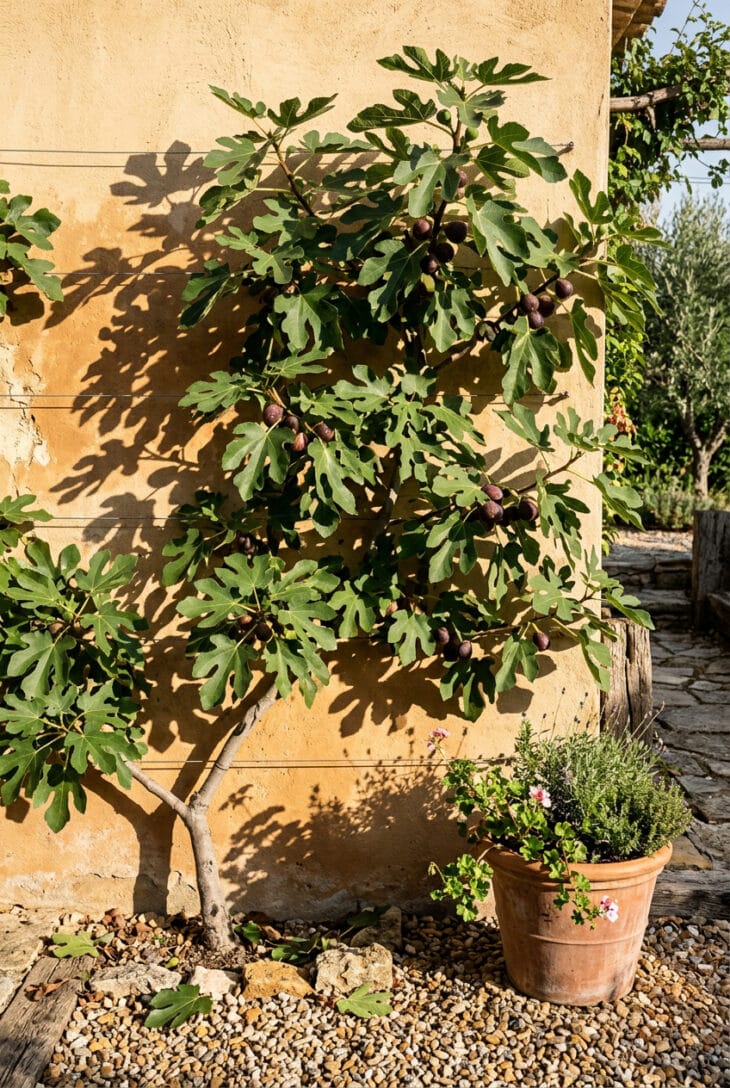
What you see A fig spread flat against an ochre wall like a piece of espaliered sculpture, its huge lobed leaves throwing hard architectural shadows across the render. Ripe purple-brown figs hang among them, split slightly at the base, which is how you know they are ready. The wall behind is radiating heat.
Why it works A fig gives you the boldest leaf shape available in a Mediterranean palette, which is a real asset in a garden otherwise full of small, fine, grey foliage. Growing it flat against a wall does three things: it saves the space a free-standing fig would eat, it uses the wall’s stored heat to ripen fruit in climates that could not otherwise manage it, and it turns a blank expanse of render into the best shadow-play in the garden.
How to get it Figs (Ficus carica ‘Brown Turkey’ is the reliable one in cool climates) fruit best when the roots are confined, so plant into a pit lined with paving slabs, roughly 24in (60cm) each way, with rubble in the bottom. Fan-train the main branches onto horizontal wires spaced 12in (30cm) apart on a south or southwest wall. In cool climates only the small embryonic figs that form in late summer will ripen the following year, so pinch out any pea-sized fruit remaining in autumn and protect the tiny ones over winter.
19. Add a Pomegranate for Late Color
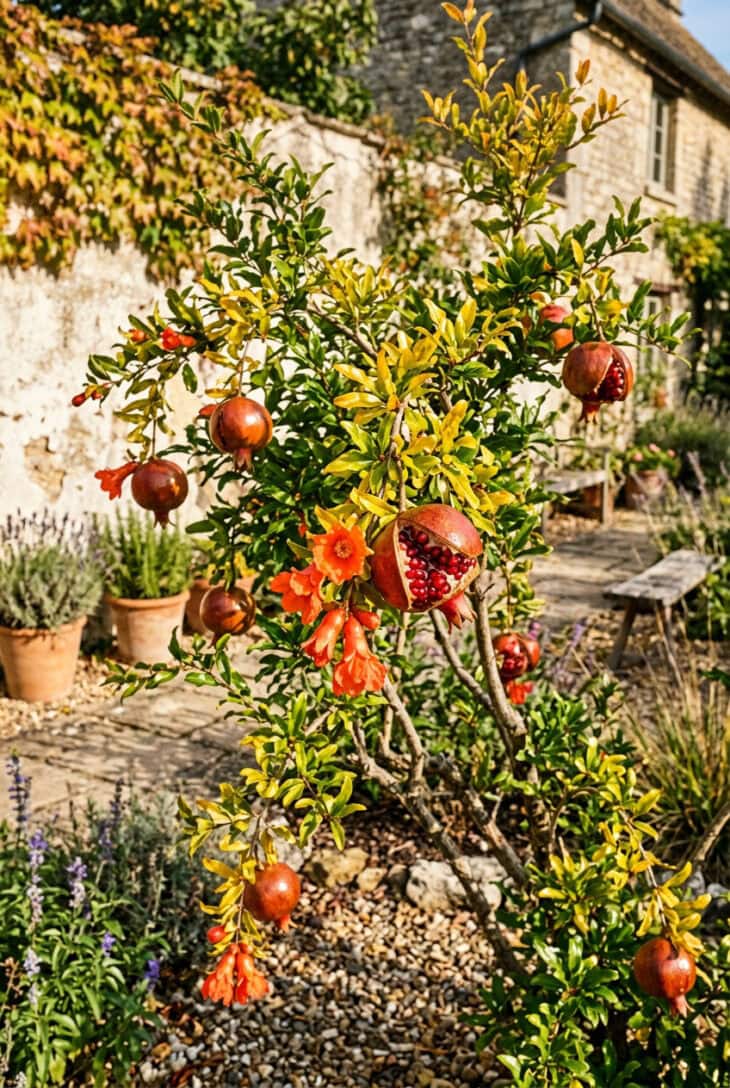
What you see A shrub carrying two things at once: brilliant orange-red trumpet flowers, crumpled like tissue paper, and several fat glossy fruits that have split open on the branch to show the seeds inside. The small leaves are just turning butter yellow. It is October and this is the brightest thing in the garden.
Why it works The Mediterranean palette runs out of steam in autumn, when the silvers have gone dusty and the lavender is cut back. A pomegranate arrives exactly then, with a color (hot orange-red) that appears nowhere else in this style and therefore lands with real force. It is also genuinely tough, taking heat, drought and poor soil, and it can be grown as a shrub, a small multi-stem tree, or clipped into a hedge.
How to get it Pomegranate (Punica granatum) is hardier than people expect, down to about 10F (-12C), but it needs a long hot summer to actually ripen fruit, so in cooler climates grow the dwarf form (Punica granatum var. nana) in a pot and enjoy it for the flowers. Give it the hottest, sharpest-drained spot you have, ideally against a south wall. Prune in late winter to open the center and remove suckers from the base, and be patient, since a seedling can take five or six years to flower.
20. Grow a Potager of Artichokes and Beans
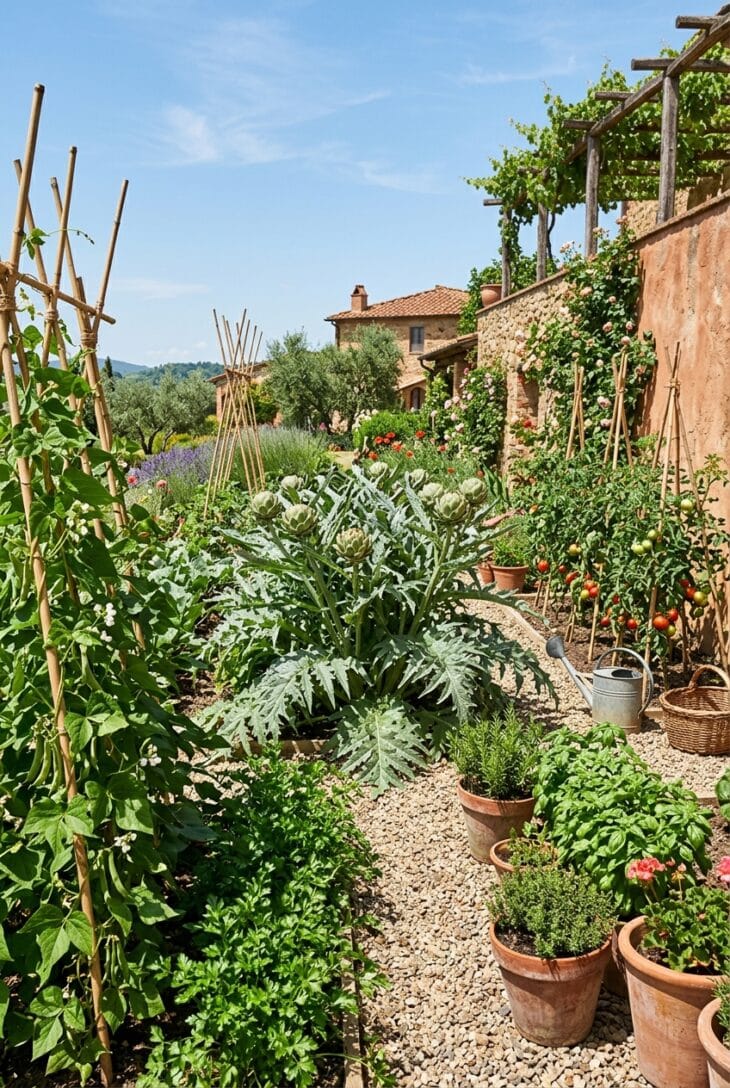
What you see A kitchen garden where the most striking plant is a vegetable: huge silver-grey globe artichokes fountaining out of the ground, four feet across, with bean wigwams behind them and tomatoes staked against a hot wall. Gravel paths run between. It is productive and it is also, unmistakably, ornamental.
Why it works The Mediterranean does not separate the flower garden from the food garden, and the crops it grows are the handsomest ones there are. An artichoke is a better silver foliage plant than most things sold as silver foliage plants, and it holds a border on its own. Mixing edibles straight into the ornamental planting keeps the whole garden productive without giving up an inch to a fenced-off vegetable patch.
How to get it Globe artichoke (Cynara cardunculus var. scolymus ‘Green Globe’) needs real space, so allow 3ft (90cm) each way, and cut the first year’s flower heads off to build the plant up. Cardoon (Cynara cardunculus) is the taller, spinier, purely architectural cousin. Around them, grow the crops that want heat: tomatoes, peppers, aubergines, beans, plus basil and flat-leaf parsley. Unlike the herbs, these are hungry, so this is the one part of a Mediterranean garden where you should feed and water generously.
21. Use Agave and Succulents as Sculpture
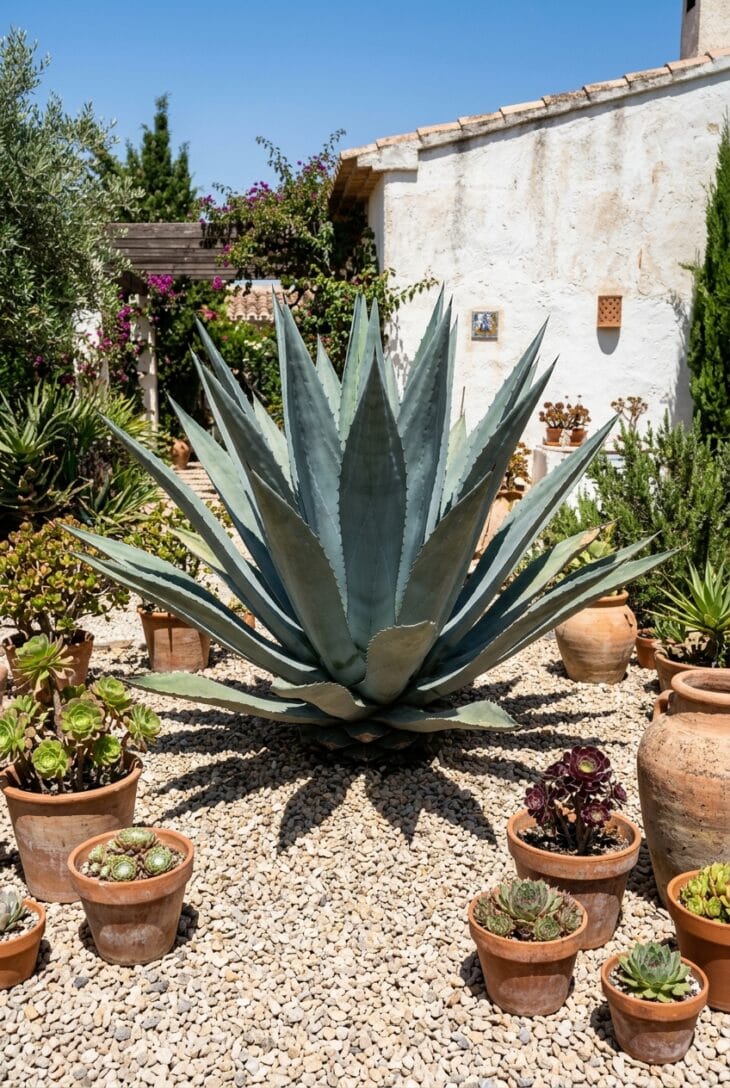
What you see One big blue-grey agave, its thick sword leaves arranged in a perfect symmetrical rosette, standing in gravel against a white wall. The shadows it throws are as graphic as the plant. Around it, smaller aeoniums and houseleeks sit in terracotta pots. Nothing here needs a single drop of water.
Why it works Mediterranean planting is soft, mounded and hazy, and it needs a few hard, deliberate shapes to stop it becoming a blur. A succulent gives you that: geometric, symmetrical, unmistakably intentional, holding its form all year. Placed against a plain white wall, one agave does more for a courtyard than a border of flowers, and it makes the light and shade in the garden into part of the composition.
How to get it Agave americana is the classic and reaches 6ft (180cm) across, so give it room and keep it away from paths, since the spines are vicious. It survives a light frost if it is bone dry, but wet cold will rot it, so plant on a mound in pure grit or grow it in a pot you can tilt or shelter. Aeoniums and echeverias are not frost-hardy at all and are best kept in pots that can come inside. Snip the sharp terminal spine off with scissors if children use the garden.
22. Cover a Stone Terrace With Wisteria
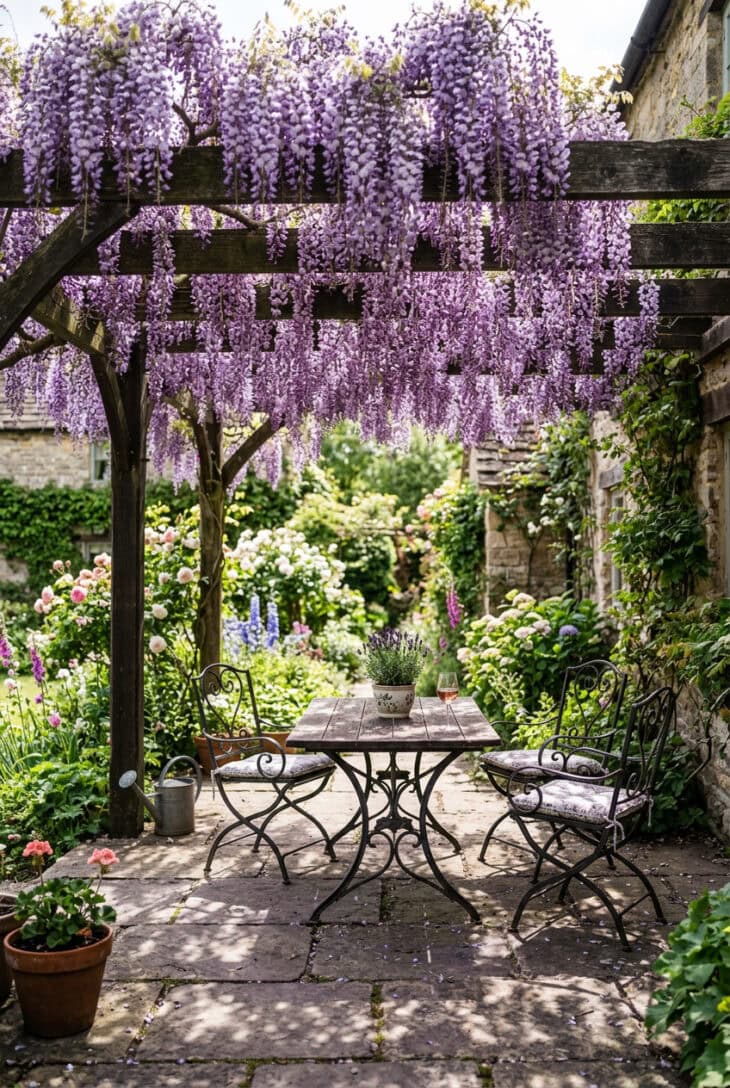
What you see A stone terrace under a pergola that has vanished beneath wisteria, with hundreds of long lilac racemes hanging straight down through the beams, some of them almost brushing the table. The light falling on the flagstones has a faint purple cast to it. The scent is heavy and everywhere.
Why it works Wisteria is the great early-season climber for this style: it flowers in May, before the vines and the roses and long before the lavender, filling the gap when a Mediterranean garden is still mostly grey foliage. Grown overhead rather than flat on a wall, the racemes hang free and are seen from below, which is how they look best, and the leaves that follow give you a dense summer shade canopy for the terrace.
How to get it Buy a grafted, named plant in flower (Wisteria sinensis ‘Prolific’ or Wisteria floribunda ‘Multijuga’), never a cheap seedling, which may take twenty years to bloom or never bloom at all. Build the structure to take real weight, since a mature wisteria can pull down a flimsy pergola. Pruning is what makes it flower and it is a two-stage job: cut the whippy summer growth back to five or six leaves in July or August, then shorten those same spurs to two or three buds in January.
23. Naturalize Alliums and Bearded Iris
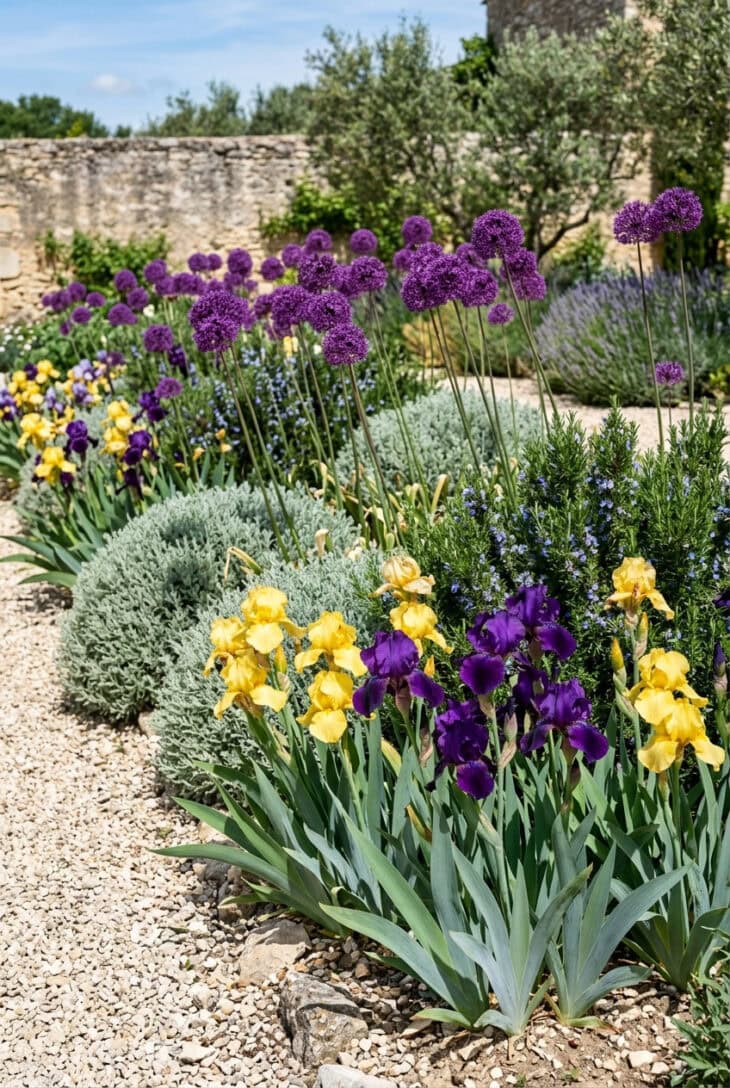
What you see Perfect purple globes floating on straight stems above grey mounds of santolina and rosemary, and at the front, clumps of bearded iris in butter yellow and deep violet, their fat blue-grey sword leaves as good as the flowers. It is May, the gravel is still cool, and the garden has more color now than it will have all summer.
Why it works In a real Mediterranean climate the growing season is winter and spring, and the garden peaks long before a northern border does. Leaning into that with bulbs and rhizomes gives you a genuine spring event, and both of these plants then want exactly what happens next: a hot, dry summer baking, which is the very thing that rots so many other perennials. They earn their place twice, in other words.
How to get it Plant allium bulbs (Allium ‘Purple Sensation’, or Allium cristophii for a bigger looser head) 6in (15cm) deep in autumn, in generous drifts of at least fifteen, and let them seed around. Bearded iris (Iris germanica) has one non-negotiable rule: the rhizome must sit half exposed on the soil surface, facing the sun, and it will not flower if you bury it or if anything shades it. Divide the clumps every three or four years in midsummer, and cut the leaves back into a fan when you do.
24. Flower All Summer With Oleander
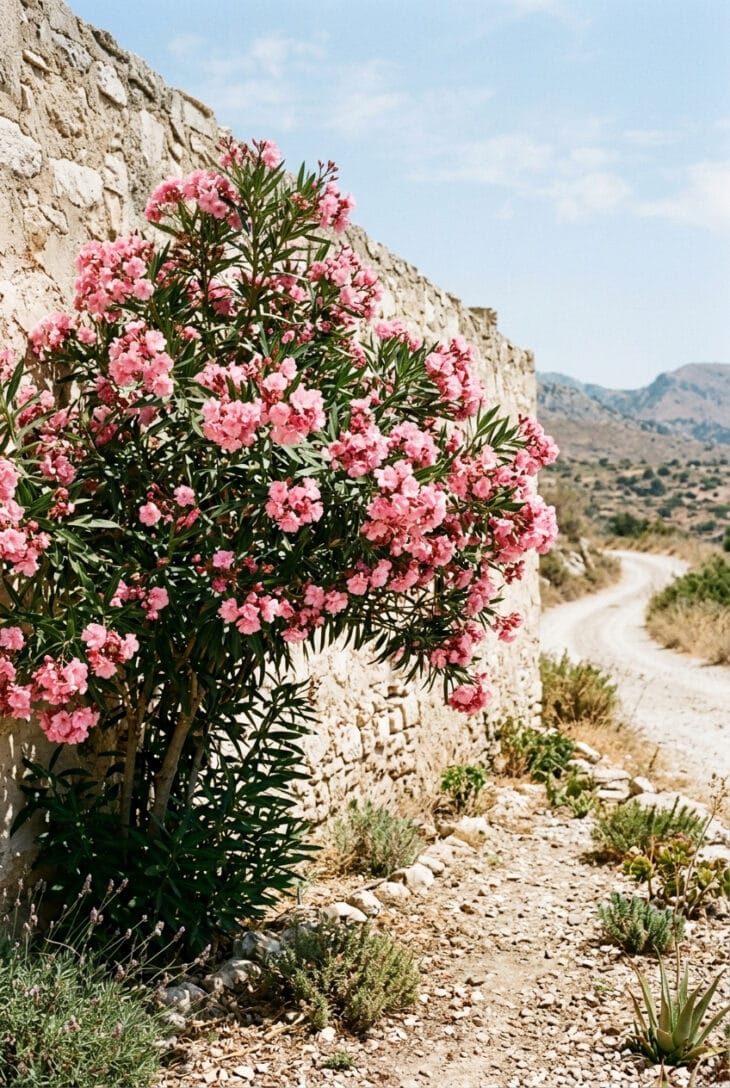
What you see A big shrub smothered in clusters of soft pink flowers, held against narrow dark leathery leaves, standing beside a bleached stone wall in the full blaze of August. Everything around it is dusty and dry and finished for the season. It looks like it is being watered by somebody, and it is not.
Why it works Oleander is the plant that flowers through the part of the summer when a Mediterranean garden has nothing else to give: months of continuous bloom in heat and drought that would flatten anything else. It also has the right leaf for the style, dark and narrow and leathery, which sets off the pale flowers and provides one of the few genuinely deep greens in a silver-dominated palette.
How to get it Oleander (Nerium oleander) is hardy to about 15F (-9C) and is a pot plant anywhere colder, overwintered somewhere cool, bright and frost-free. Give it full sun and prune in early spring, cutting back by up to a third to keep it dense. Take the toxicity seriously, because every part of the plant is dangerously poisonous if eaten and the sap irritates skin: wear gloves to prune, never burn the clippings, and do not plant it where small children or livestock have access.
25. Light It With Lanterns and Candlelight
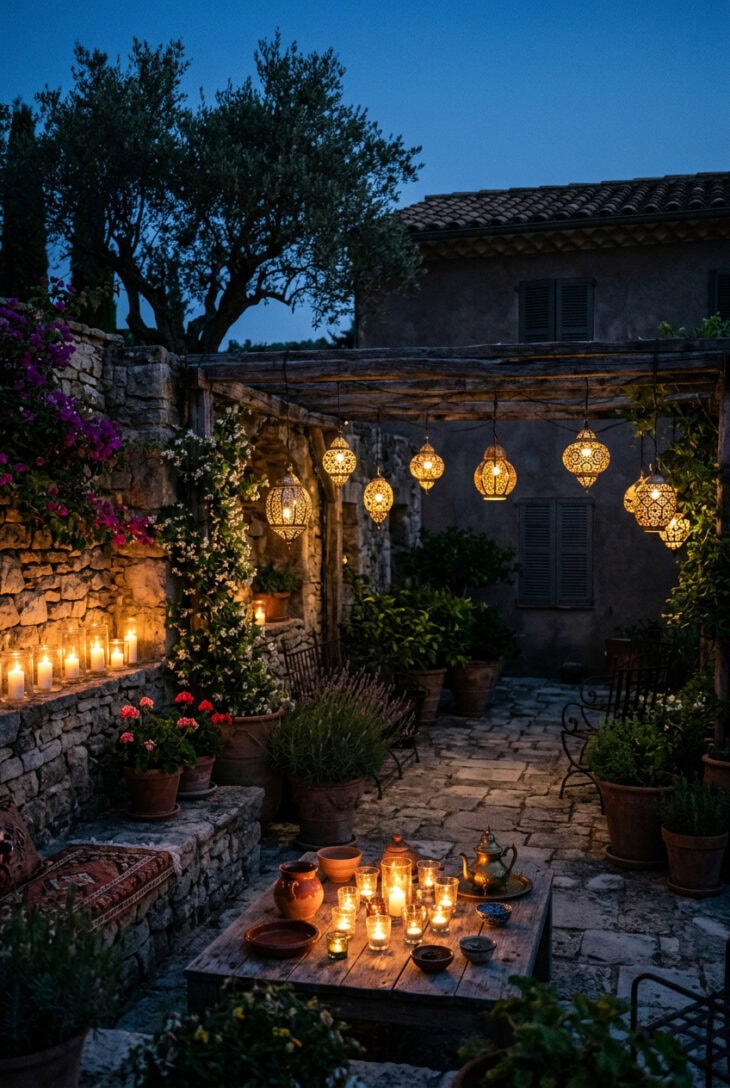
What you see Dusk in the courtyard, and every light in it is a flame. Pierced metal lanterns hang from the pergola and throw shifting patterns across the wall, candles in glass jars run along the top of the stonework, and a cluster of tea lights sits on the table. The olive is a black silhouette against a deep blue sky.
Why it works Bright electric lighting flattens a garden and kills the sky, which is precisely the wrong result for a style whose entire evening character is warmth, intimacy and shadow. Flame does the opposite: it is low, warm, and constantly moving, so it animates the surfaces it touches and leaves everything else in soft darkness. A pierced lantern is a light fitting that projects a pattern, which is the cheapest decoration in the garden.
How to get it Work in pools rather than washes: one bright spot on the table, a few soft ones at the boundaries, nothing in between. Use candles inside glass to keep them alight in a breeze, and hang lanterns at slightly different heights so the patterns overlap. If you want electric light too, keep it warm (2700K or lower), low to the ground, and shielded so the bulb itself is never in view. Uplighting the trunk of the olive or a cypress from below gives the one dramatic gesture the scheme can take.