Spring-flowering trees give a yard its biggest show of the year. This guide sorts the best of them by flower color: pink, white, purple and yellow. Each entry gives the USDA hardiness zones, because the right tree depends mostly on your climate. A Japanese cherry that thrives in Pennsylvania will struggle in Miami, and a golden trumpet tree will not survive a New England winter.
Contents
- Pink Flowering Trees
- Saucer Magnolia (Magnolia × soulangeana)
- Eastern Redbud (Cercis canadensis)
- Japanese Flowering Cherry (Prunus serrulata)
- Weeping Cherry (Prunus × subhirtella ‘Pendula’)
- Flowering Crabapple (Malus spp.)
- Purple Leaf Plum (Prunus cerasifera ‘Newport’)
- Red Horse Chestnut (Aesculus × carnea)
- Flowering Peach (Prunus persica)
- White Flowering Trees
- Yoshino Cherry (Prunus × yedoensis)
- Flowering Dogwood (Cornus florida)
- Kousa Dogwood (Cornus kousa)
- Serviceberry (Amelanchier × grandiflora)
- Star Magnolia (Magnolia stellata)
- Carolina Silverbell (Halesia carolina)
- Fringe Tree (Chionanthus virginicus)
- Japanese Snowbell (Styrax japonicus)
- Royal White Redbud (Cercis canadensis f. alba ‘Royal White’)
- Downy Hawthorn (Crataegus mollis)
- American Plum (Prunus americana)
- Purple Flowering Trees
- Yellow Flowering Trees
The “Native” column in the table shows whether a tree is native to the United States. Native flowering trees such as redbud, dogwood and serviceberry feed far more pollinators and birds than most imports. A few popular spring bloomers are left out on purpose because they are invasive in much of the US, including Bradford (Callery) pear, empress tree (Paulownia) and Chinese wisteria.
| Tree | Botanical name | Group | Native |
|---|---|---|---|
| Saucer Magnolia | Magnolia × soulangeana | Pink | No |
| Eastern Redbud | Cercis canadensis | Pink | Yes |
| Japanese Flowering Cherry | Prunus serrulata | Pink | No |
| Weeping Cherry | Prunus × subhirtella ‘Pendula’ | Pink | No |
| Flowering Crabapple | Malus spp. | Pink | Mostly no |
| Purple Leaf Plum | Prunus cerasifera ‘Newport’ | Pink | No |
| Red Horse Chestnut | Aesculus × carnea | Pink | No |
| Flowering Peach | Prunus persica | Pink | No |
| Yoshino Cherry | Prunus × yedoensis | White | No |
| Flowering Dogwood | Cornus florida | White | Yes |
| Kousa Dogwood | Cornus kousa | White | No |
| Serviceberry | Amelanchier × grandiflora | White | Yes |
| Star Magnolia | Magnolia stellata | White | No |
| Carolina Silverbell | Halesia carolina | White | Yes |
| Fringe Tree | Chionanthus virginicus | White | Yes |
| Japanese Snowbell | Styrax japonicus | White | No |
| Royal White Redbud | Cercis canadensis f. alba ‘Royal White’ | White | Yes |
| Downy Hawthorn | Crataegus mollis | White | Yes |
| American Plum | Prunus americana | White | Yes |
| Jacaranda | Jacaranda mimosifolia | Purple | No |
| Common Lilac | Syringa vulgaris | Purple | No |
| Texas Mountain Laurel | Dermatophyllum secundiflorum | Purple | Yes |
| Purple Robe Locust | Robinia pseudoacacia ‘Purple Robe’ | Purple | Yes |
| Hong Kong Orchid Tree | Bauhinia × blakeana | Purple | No |
| Cornelian Cherry | Cornus mas | Yellow | No |
| Witch Hazel | Hamamelis × intermedia | Yellow | No |
| Golden Chain Tree | Laburnum × watereri | Yellow | No |
| Golden Trumpet Tree | Handroanthus chrysotrichus | Yellow | No |
| Palo Verde ‘Desert Museum’ | Parkinsonia ‘Desert Museum’ | Yellow | Yes (hybrid) |
| Sweet Acacia | Vachellia farnesiana | Yellow | Yes |
| Tipu Tree | Tipuana tipu | Yellow | No |
Pink Flowering Trees
Saucer Magnolia (Magnolia × soulangeana)
Read our guide to Saucer Magnolia

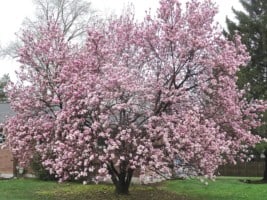
Saucer magnolia is a hybrid first bred in France in the 1820s. It is one of the earliest and showiest spring trees: large, goblet-shaped flowers, pink to purple outside and white inside, open on bare branches in early spring. It grows 20 to 30 feet tall. Late frosts can brown the flowers, so choose a spot out of frost pockets. Zones 4 to 9.
Eastern Redbud (Cercis canadensis)

Eastern redbud is a small native tree, 20 to 30 feet tall. Its bare branches and even its trunk are covered with clusters of rosy-pink, pea-like flowers in early spring. The heart-shaped leaves turn yellow in fall. It is easy to grow in sun or part shade and most soils. Zones 4 to 9.
Japanese Flowering Cherry (Prunus serrulata)

Japanese flowering cherries (sakura), such as ‘Kwanzan’, are the classic cherry-blossom trees. They grow 15 to 30 feet tall, and ‘Kwanzan’ carries double pink flowers in mid-spring. They need full sun and good drainage. Most are fairly short-lived, at around 20 to 30 years. Zones 5 to 8.
Weeping Cherry (Prunus × subhirtella ‘Pendula’)

Weeping Higan cherry is a grafted, small tree, 15 to 25 feet tall, with branches that cascade to the ground. They are covered in pale pink blossoms in early spring. It makes a graceful focal point for a small yard or beside water, and it tolerates heat better than most flowering cherries. Zones 5 to 8.
Flowering Crabapple (Malus spp.)

Flowering crabapples are small trees, 15 to 25 feet tall, with masses of pink, red or white flowers in mid-spring. Small fruits follow and feed birds into winter. Choose disease-resistant cultivars such as ‘Sugar Tyme’ or ‘Prairifire’ to avoid apple scab and fire blight. A few crabapples are native to the US; most garden cultivars are Asian hybrids. Zones 4 to 8.
Purple Leaf Plum (Prunus cerasifera ‘Newport’)

Purple leaf plum ‘Newport’ is a small tree, 15 to 20 feet tall, that flowers very early, often in late winter. Its small pale pink flowers are followed by deep purple leaves that keep their color all season. It is short-lived but very hardy and grows fast. Zones 4 to 8.
Red Horse Chestnut (Aesculus × carnea)

Red horse chestnut is a European hybrid of horse chestnut and the American red buckeye. It grows 30 to 40 feet tall and produces upright spikes of rosy-red flowers in mid to late spring. Its large, palm-shaped leaves cast dense shade. It is less prone to leaf blotch than common horse chestnut. The seeds are poisonous. Zones 5 to 8.
Flowering Peach (Prunus persica)
Read our guide to Flowering Peach

Flowering peach varieties are grown for their double pink, red or white flowers in early spring, not their fruit. They are small, fast-growing trees, 15 to 25 feet tall, originally from China. Like fruiting peaches, they are prone to peach leaf curl and borers and are fairly short-lived. Zones 5 to 9.
White Flowering Trees
Yoshino Cherry (Prunus × yedoensis)

Yoshino cherry is the famous cherry of Washington, D.C.’s Tidal Basin, where it was planted as a gift from Tokyo in 1912. It covers itself in lightly fragrant, white to palest-pink flowers in early spring before the leaves. It grows 30 to 40 feet tall with a broad, spreading crown. Zones 5 to 8.
Flowering Dogwood (Cornus florida)

Flowering dogwood is the classic native spring tree of the eastern US. It grows 15 to 30 feet tall and is often wider than tall. Its four white or pink “petals” are really bracts surrounding a cluster of tiny flowers. In fall it adds red leaves and glossy red berries for birds. It needs part shade and moist, acidic, well-drained soil. Zones 5 to 9.
Kousa Dogwood (Cornus kousa)
Read our guide to Kousa Dogwood

Kousa dogwood flowers about a month after the native dogwood, in late spring, with pointed white bracts held above the leaves. It grows 15 to 30 feet tall. Raspberry-like red fruits follow, and the leaves turn red-purple in fall. It resists dogwood anthracnose, so it is a good substitute where native dogwoods struggle. Zones 5 to 8.
Serviceberry (Amelanchier × grandiflora)

Serviceberries are native small trees, 15 to 25 feet tall, and among the first to flower in spring. Clouds of small white flowers appear before the leaves. In June they bear sweet, blueberry-like fruit that birds and people love. They also have orange-red fall color and smooth grey bark, so they look good in every season. Zones 4 to 9.
Star Magnolia (Magnolia stellata)

Star magnolia is a slow-growing shrub or small tree, 15 to 20 feet tall, from Japan. Its fragrant white flowers, with many narrow petals, open very early, on bare branches in late winter or early spring. ‘Royal Star’ is a popular cultivar that flowers slightly later, which helps it avoid frost damage. Zones 4 to 8.
Carolina Silverbell (Halesia carolina)
Read our guide to Carolina Silverbell

Carolina silverbell is a native understory tree of the Southeast, 30 to 40 feet tall in gardens. In mid-spring, rows of white, bell-shaped flowers hang from the undersides of its branches. It prefers moist, acidic, well-drained soil and part shade. Zones 5 to 8.
Fringe Tree (Chionanthus virginicus)

Fringe tree (grancy greybeard) is a native small tree, 12 to 20 feet tall. In late spring it is covered in fragrant, fringe-like white flowers, and female trees then bear dark blue fruits for birds. It tolerates city conditions and wet soil. Chinese fringe tree is a similar, slightly larger Asian relative. Zones 4 to 9.
Japanese Snowbell (Styrax japonicus)

Japanese snowbell is a small tree, 20 to 30 feet tall, with horizontal branches. In late spring, rows of fragrant, white, bell-shaped flowers hang beneath the leaves, so it is best seen from below, beside a patio or path. It is invasive in a few areas and can self-seed. Zones 5 to 8.
Royal White Redbud (Cercis canadensis f. alba ‘Royal White’)

‘Royal White’ is a white-flowered form of the native eastern redbud. It is a small tree, 15 to 25 feet tall, with pure white, pea-like flowers along bare branches in early spring and the same heart-shaped leaves as the pink form. Zones 4 to 9.
Downy Hawthorn (Crataegus mollis)

Downy hawthorn is a native small tree, 20 to 35 feet tall, of the Midwest and East. It is named for its fuzzy young leaves and twigs. Clusters of white flowers appear in mid-spring, followed by red fruits in late summer that feed birds. It is Missouri’s state flower. It has thorns, so keep it away from paths. Zones 3 to 6.
American Plum (Prunus americana)
Read our guide to American Plum

American plum is a thicket-forming native tree, 15 to 25 feet tall. In early spring, before the leaves, its branches are covered in fragrant white flowers, followed by small red-yellow plums in late summer. It is good for wildlife hedges and jams. Zones 3 to 8.
Purple Flowering Trees
Jacaranda (Jacaranda mimosifolia)

Jacaranda is a South American tree, 25 to 40 feet tall, that covers itself in lavender-blue trumpet flowers in late spring, famously in Southern California and South Africa. It has fine, fern-like leaves. It is frost-tender and grows well only in the warmest parts of the US (zones 9b to 11).
Common Lilac (Syringa vulgaris)

Common lilac is a large, multi-stemmed shrub or small tree, 8 to 15 feet tall. It is grown for its intensely fragrant lilac-purple (also white or pink) flower clusters in mid-spring. It needs full sun and a cold winter to flower well. For a true single-trunk tree, choose Japanese tree lilac, which flowers white in early summer. Zones 3 to 7.
Texas Mountain Laurel (Dermatophyllum secundiflorum)

Texas mountain laurel is a native evergreen shrub or small tree, 10 to 15 feet tall, of Texas and the Southwest. In early spring it bears drooping clusters of violet flowers with a strong scent of grape soda. It is very drought-tolerant. Its bright red seeds are highly poisonous. Zones 7 to 10.
Purple Robe Locust (Robinia pseudoacacia ‘Purple Robe’)

‘Purple Robe’ is a cultivar of black locust, a native tree. It grows 30 to 40 feet tall and bears hanging clusters of fragrant rose-purple flowers in late spring that attract bees. It is fast-growing and tolerates drought and poor soil. Black locust spreads by root suckers and is invasive outside its native range. Zones 4 to 9.
Hong Kong Orchid Tree (Bauhinia × blakeana)

Hong Kong orchid tree bears large, fragrant, rose-purple flowers shaped like orchids from late fall through early spring. It grows 20 to 40 feet tall. It is a sterile hybrid, so it doesn’t set seed or spread, unlike the invasive orchid tree Bauhinia variegata. It grows only in frost-free climates (zones 9b to 11).
Yellow Flowering Trees
Cornelian Cherry (Cornus mas)
Read our guide to Cornelian Cherry

Cornelian cherry is a European dogwood, 15 to 25 feet tall, that flowers in late winter or very early spring. Clouds of tiny yellow flowers cover its bare branches. Tart red fruits follow in summer and are used for jam. It is tough and adaptable. Zones 4 to 8.
Witch Hazel (Hamamelis × intermedia)

Hybrid witch hazels are shrubs or small trees, 10 to 20 feet tall, that flower in late winter. Spidery, fragrant yellow, orange or red flowers line the bare branches for weeks, even through snow. ‘Arnold Promise’ is a popular yellow cultivar. The native Hamamelis virginiana flowers in fall instead. Zones 5 to 8.
Golden Chain Tree (Laburnum × watereri)

Golden chain tree is a small European tree, 15 to 25 feet tall. In late spring it drips with hanging chains of bright yellow, wisteria-like flowers up to 20 inches long. It prefers cool summers. All parts of the tree, especially the seeds, are poisonous, so avoid it where children or pets play. Zones 5 to 7.
Golden Trumpet Tree (Handroanthus chrysotrichus)

Golden trumpet tree is a small South American tree, 15 to 25 feet tall. In early spring its bare branches are covered in brilliant yellow trumpet flowers for one to two weeks. It is drought-tolerant, and it is popular in South Florida and Southern California. Zones 9b to 11.
Palo Verde ‘Desert Museum’ (Parkinsonia ‘Desert Museum’)

‘Desert Museum’ is a thornless hybrid of three palo verdes, bred at the Arizona-Sonora Desert Museum. It grows 20 to 30 feet tall with green bark and branches. It flowers bright yellow for weeks in spring, then flowers lightly into summer. It is one of the best low-water shade trees for the desert Southwest. Zones 8 to 11.
Sweet Acacia (Vachellia farnesiana)

Sweet acacia is a thorny shrub or small tree, 15 to 25 feet tall, native to southern Texas and Arizona. In late winter and early spring it bears fragrant, fluffy yellow puffball flowers, which are used in perfume. It is drought-tolerant and good for wildlife, but it is invasive in some other countries. Zones 9 to 11.
Tipu Tree (Tipuana tipu)

Tipu tree is a fast-growing South American shade tree, 30 to 50 feet tall, with a broad, flat crown. It is widely planted in Southern California and Arizona. In late spring and early summer it is covered with yellow-apricot, pea-like flowers. It needs a warm climate and some summer water. Zones 9 to 11.