By late September, most summer containers are running on fumes. The petunias are leggy, the geraniums have gone woody, and the whole pot looks like it is waiting for permission to stop. A fall planting gives it that permission and starts something new: copper grasses, velvet heuchera, pansies that shrug off frost, and berries that carry on into December.
Contents
- 01. Copper Sedge, Heuchera and Bronze Mums
- 02. Refresh a Tired Summer Pot Instead of Starting Over
- 03. A Pansy Window Box That Blooms Again in Spring
- 04. Purple Millet as a Dramatic Centerpiece
- 05. Native Grasses in Tall Cube Planters
- 06. Golden Forest Grass for a Shady Step
- 07. Succulent-Topped Pumpkins
- 08. Blue and Orange: A Complementary Color Pot
- 09. A Fall Salad Window Box by the Kitchen
- 10. Golden Hinoki Cypress in a Four-Season Pot
- 11. Mexican Bush Sage for Late Hummingbirds
- 12. Heather Baskets in the European Style
- 13. A Soft Pink and Silver Autumn Pot
- 14. Black-Eyed Susans in a Galvanized Washtub
- 15. A Potted Blueberry with Scarlet Leaves
- 16. Autumn Crocus in a Shallow Bowl
- 17. A Formal Pair of Boxwood Planters
- 18. A Hardy Sedum Trough in Autumn Tones
- 19. Cyclamen and Ferns for a Mild-Climate Fall
- 20. A Low Centerpiece Bowl for the Outdoor Table
- 21. A $25 Planter from the Grocery Store
- 22. A Hayrack Planter on a Fence or Railing
- 23. Burgundy Loropetalum for Mild Winters
- 24. Winterberry for Berries into December
- 25. A Post-Frost Window Box of Branches and Dried Stems
The ideas below are planting recipes, each built around a specific combination you can copy. Some are cheap and quick, like a refresh of a pot you already own or a $25 planter from the grocery store. Others are longer-term investments, such as a dwarf conifer or a potted blueberry that will anchor a doorstep for years. There are pots for sun and shade, window boxes for cold northern falls, and planters for mild Southern and West Coast winters where fall is really the start of the growing season.
Each idea explains what you are looking at, why the combination works, and exactly which plants and cultivars to buy. Scroll through for the look you like, or skip to the ones that suit your climate, your light and the containers you already have.
01. Copper Sedge, Heuchera and Bronze Mums
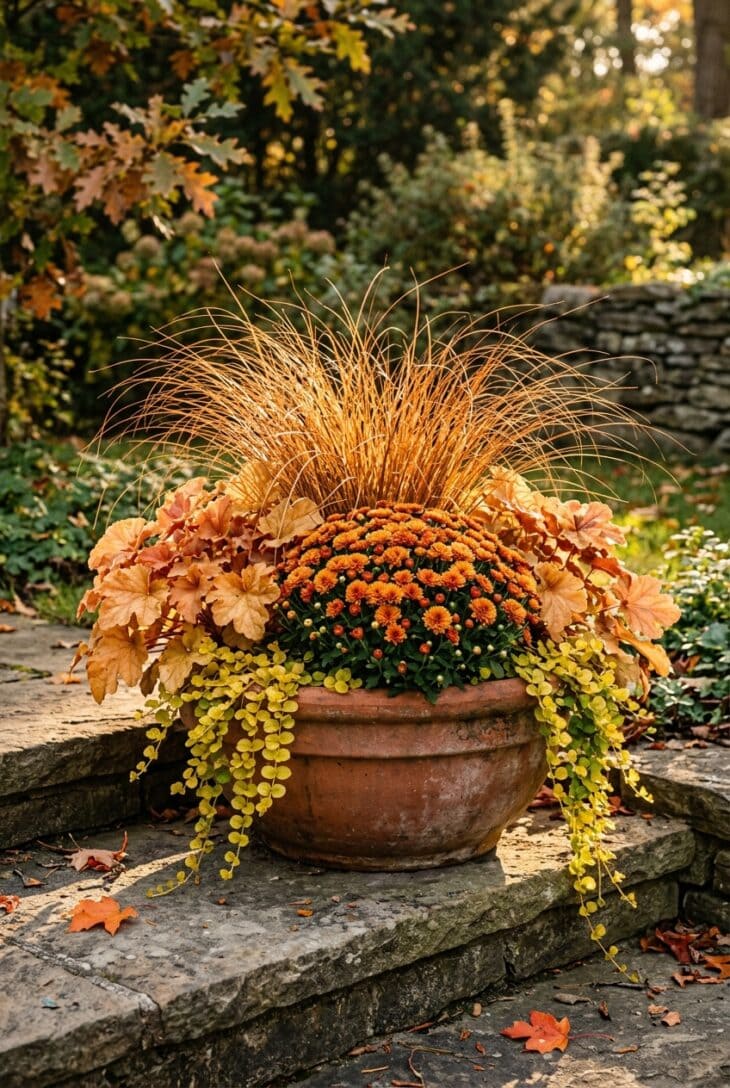
What you see A wide terracotta pot on a stone step, glowing in low October sun. A fine, arching sedge in copper and orange rises from the middle, flanked by ruffled heuchera in caramel and peach. A bronze mum sits at the front like a cushion, and a curtain of golden creeping jenny spills over the rim. Every color in it could have been picked from the maple leaves on the step.
Why it works This is the classic thriller, filler and spiller formula, with every plant chosen from one warm color family, so it looks considered rather than busy. Only the mum is a short-term flower. The sedge and heuchera are perennials that look good from September to hard frost and beyond, so the pot still holds together once the mum has faded. It pairs naturally with the pumpkins and mums of classic fall porch displays.
How to get it Use orange New Zealand sedge (Carex testacea ‘Prairie Fire’) as the centerpiece, with two coral bells (Heuchera ‘Southern Comfort’ or ‘Caramel’) either side. Add one bronze garden mum (Chrysanthemum × morifolium) bought in tight bud, and golden creeping jenny (Lysimachia nummularia ‘Aurea’) at the rim. A pot 16 to 18in (40 to 45cm) wide takes all five plants packed tightly, which is how fall pots should be planted, since little growing happens after planting. Keep creeping jenny in the pot: it can escape into damp ground and spread. In November, move the sedge and heuchera into a border rather than leaving them to freeze in the pot.
02. Refresh a Tired Summer Pot Instead of Starting Over
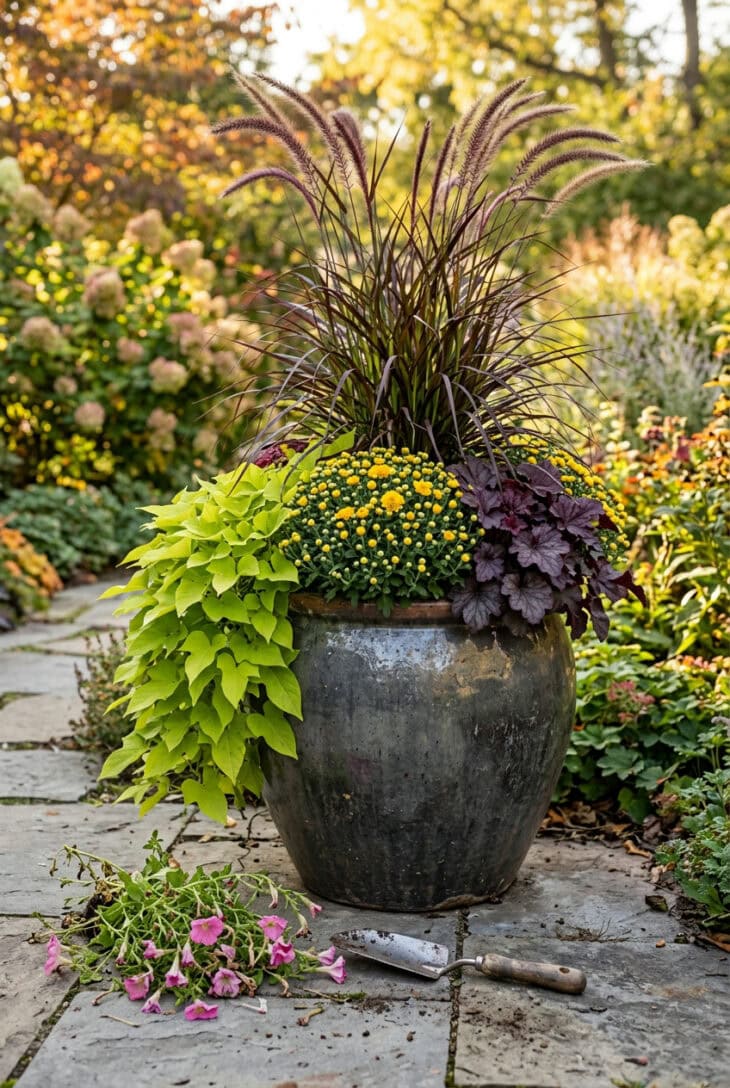
What you see A big gray pot on the patio, mid-makeover. The burgundy fountain grass and the chartreuse sweet potato vine from summer are still there, fuller than ever. Where the tired pink petunias used to be, there is now a golden mum and a dark plum heuchera, and the petunias lie in a heap on the paving next to a trowel.
Why it works Many summer containers have one or two plants that are at their very best in September. Grasses are just coming into plume and foliage plants are at full size, so ripping the whole pot out throws away the most mature part of the display. Swapping out only the flowers that have given up costs a fraction of a new planting and gives an established, full look on day one. If your summer pots followed the thriller, filler and spiller formula, the thriller is usually the part worth keeping.
How to get it Pull anything leggy, mildewed or flowerless, usually petunias, calibrachoa and summer annual salvia. Keep grasses such as purple fountain grass (Pennisetum setaceum ‘Rubrum’), sweet potato vine (Ipomoea batatas), coleus and ornamental peppers. Loosen the gaps with a trowel, add a handful of fresh potting mix to each, and slot in a mum and a heuchera or two in 6in (15cm) nursery pots. Trim any sweet potato vine stems longer than 24in (60cm) so the pot looks tidy rather than overgrown. Water well, then feed once with a liquid fertilizer at half strength; the new plants need little else before frost.
03. A Pansy Window Box That Blooms Again in Spring
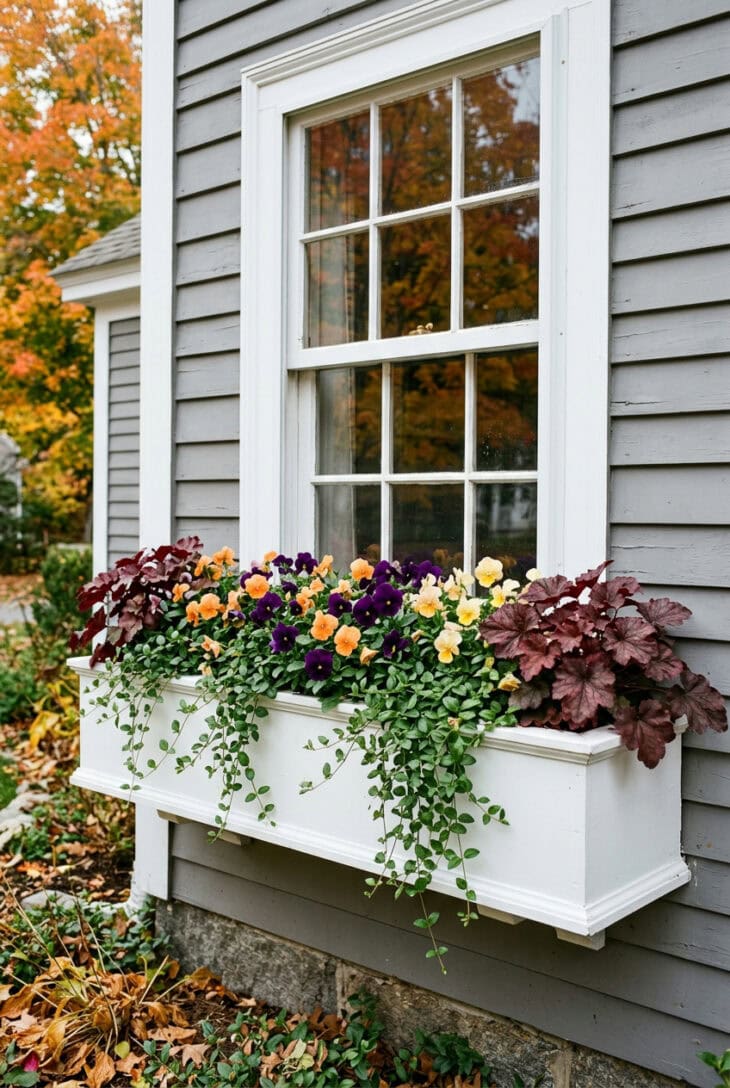
What you see A long white window box under a sash window on a gray clapboard house, filled edge to edge with pansies in deep purple, apricot and butter yellow. Burgundy heuchera anchors each end, and trailing periwinkle drapes over the front. It looks cheerful and full, and under the soil there is a second planting waiting for April.
Why it works Pansies are one of the few flowers that bloom through fall, sit out the coldest weeks, then flower again as soon as spring warms up. Plant tulip bulbs beneath them at the same time and the box does two seasons of work for one planting session. The pansy faces cover the bare soil over winter, and the tulips come up through them, which is a much better look than bare bulbs rising out of empty dirt.
How to get it Use a box at least 8in (20cm) deep. Set tulip bulbs (Tulipa ‘Ballerina’ or ‘Apricot Beauty’) about 4in (10cm) deep and 2in (5cm) apart in late October, then plant pansies (Viola × wittrockiana) on top at 4 to 6in (10 to 15cm) spacing. Trailing pansies such as the ‘Cool Wave’ series fill the front fastest. Add a heuchera at each end, and a trailing plant such as ivy or periwinkle to soften the edge. This works reliably in zones 6 to 8; in colder regions a window box can freeze solid and kill the bulbs, so skip the tulips there or wrap the box in burlap for the winter.
04. Purple Millet as a Dramatic Centerpiece
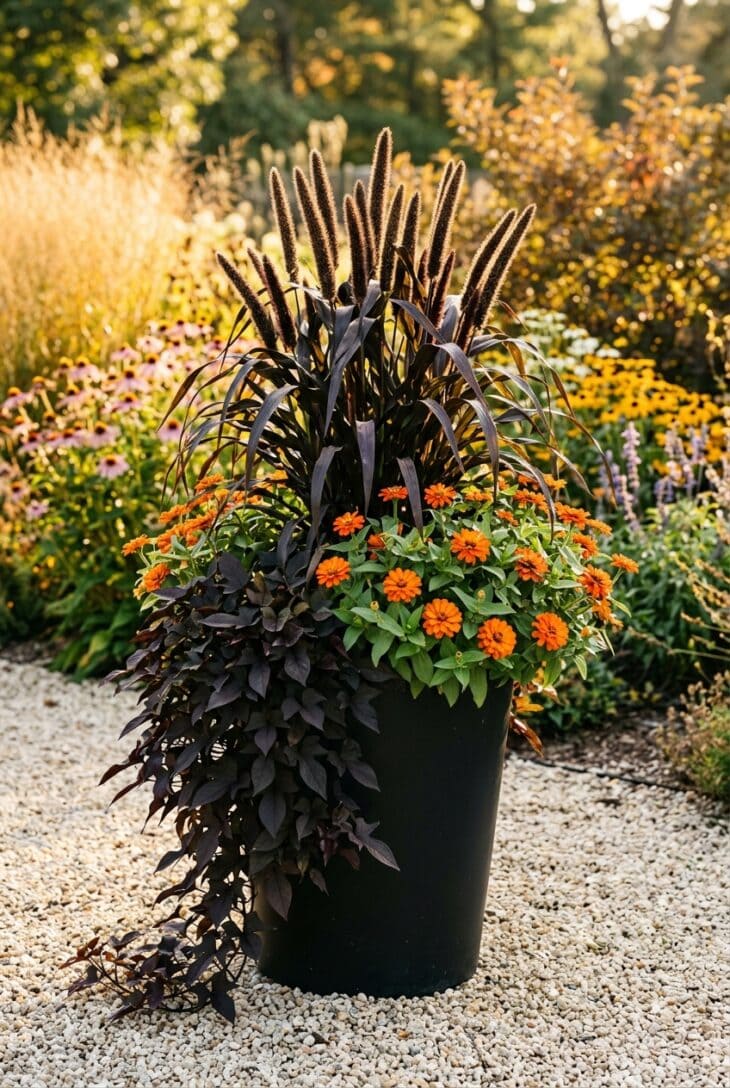
What you see A tall black planter crowned with purple millet, its broad leaves so dark they look almost black and its cattail seed spikes standing high above everything else. Bright orange zinnias fill the rim, and a black-leaved sweet potato vine trails down the side. Against a sunny gravel yard, it is bold, graphic and a little bit gothic.
Why it works Ornamental millet gives the height of a tall grass with far more weight and color, so one clump can carry a large container on its own. The purple-black and orange palette is pure autumn, and it doubles as a ready-made Halloween planter with no extra decorations needed. Once the seed ripens, sparrows and finches come to pick at the spikes, which adds movement to the pot through October.
How to get it Buy ornamental millet (Pennisetum glaucum ‘Purple Majesty’) already in seed head in late summer; it grows 3 to 5ft (90 to 150cm) tall, so choose a heavy pot at least 18in (45cm) across to stop it tipping. For a smaller pot, ‘Jester’ has chartreuse and burgundy leaves at about 3ft (90cm). Ring it with three or four compact orange zinnias (Zinnia ‘Profusion Orange’), which keep flowering until the first frost. Add a trailing sweet potato vine (Ipomoea batatas ‘Blackie’) at the front. The millet needs full sun to stay dark; in shade the leaves fade to green. Everything here is an annual, so compost the lot after the first hard freeze.
05. Native Grasses in Tall Cube Planters
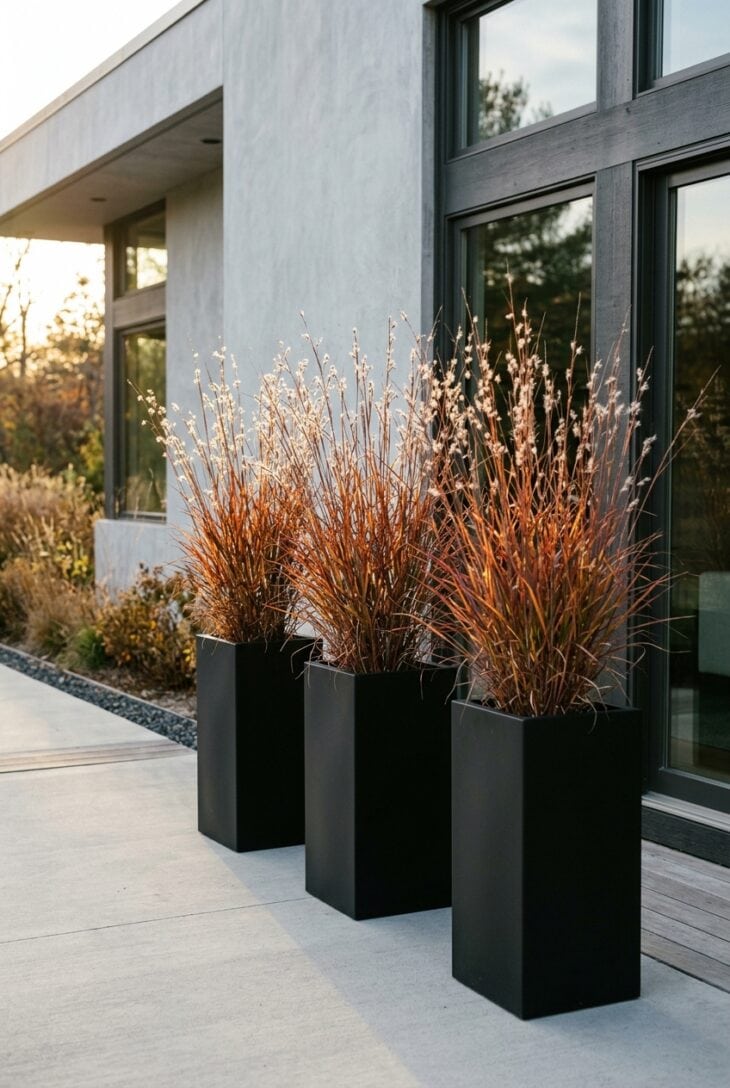
What you see Three tall black cubes set in a line on a pale concrete terrace, each holding an upright clump of grass turned copper, rust and burgundy. Silver seed tufts catch the side light, and against the plain gray wall of the house the grasses almost look lit from within. The look is restrained and architectural, with no flowers at all.
Why it works Repetition is what gives modern garden design its calm, and three matching pots of one plant are about as simple as repetition gets. Little bluestem is at its best in fall, when its blue-green summer leaves turn fiery. Being a hardy native perennial, it also stands through winter as a tawny, upright clump, so the planters never look empty.
How to get it Plant one little bluestem (Schizachyrium scoparium ‘Standing Ovation’ or ‘Blaze’) per planter; ‘Standing Ovation’ stays upright at 3 to 4ft (90 to 120cm) rather than flopping. Use planters at least 18in (45cm) square and deep, in fiberglass or metal rather than clay so they survive freezing. Fill with a lean mix of two parts potting mix to one part grit, because rich soil makes the grass soft and floppy. Plants in pots are roughly two zones less hardy than in the ground, so in zones 3 to 5, group the planters against the house wall for winter. Cut the clumps back to 4in (10cm) in March.
06. Golden Forest Grass for a Shady Step
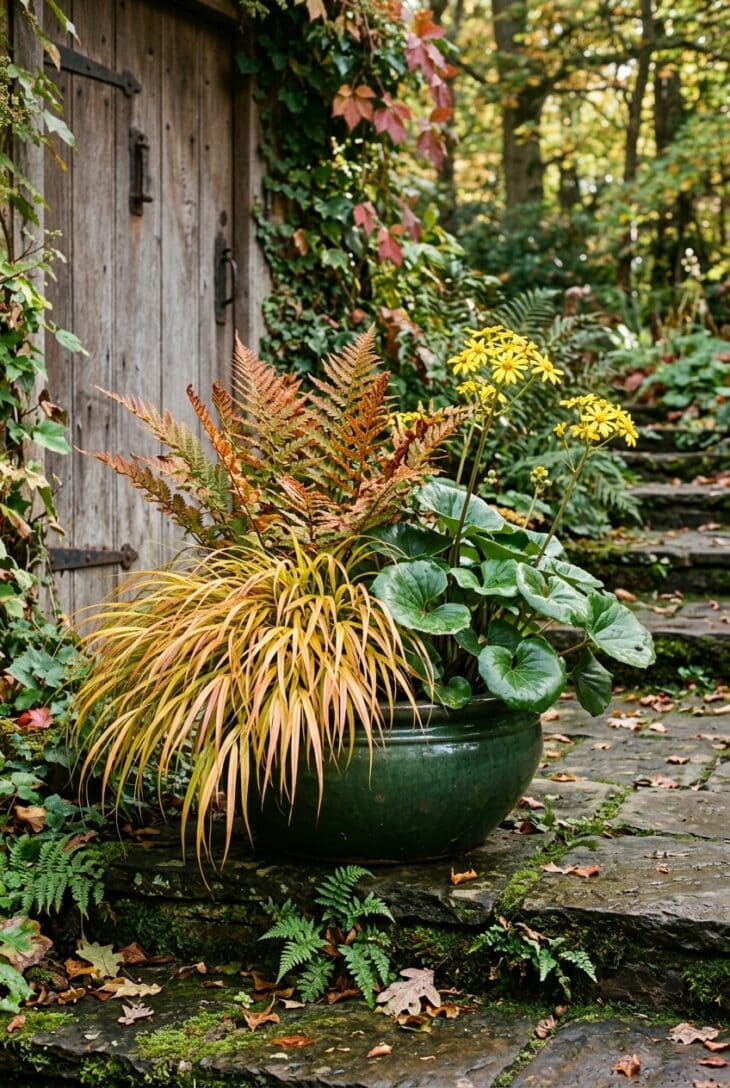
What you see A low green bowl on a shady flagstone step, spilling over with golden forest grass whose leaf tips have begun to blush orange and pink. Behind it a fern unfurls rust-colored fronds, and beside that the big round leaves of a leopard plant hold up clusters of yellow daisies. In a dim corner, the whole bowl reads like a patch of sunlight.
Why it works Most fall planter recipes are built for sun, which leaves shady doorsteps with limp mums that never open. These three plants actually prefer shade and all peak in autumn: the grass colors up, the fern produces its copper fronds, and the leopard plant flowers in October and November, when almost nothing else in shade gardens is in bloom. The mix of fine, feathery and round leaves keeps it interesting without any flowers at all.
How to get it Put Japanese forest grass (Hakonechloa macra ‘All Gold’ or ‘Aureola’) at the front edge so it cascades over the rim. Behind it, plant an autumn fern (Dryopteris erythrosora), and at the side a leopard plant (Farfugium japonicum), which is hardy in zones 7 to 10. North of zone 7, swap the leopard plant for a dark heuchera such as ‘Obsidian’. A bowl 18in (45cm) wide and 10in (25cm) deep suits all three. Keep the soil evenly moist; forest grass browns at the tips if it dries out. All three are perennials, so the bowl can stay planted for several years before it needs dividing.
07. Succulent-Topped Pumpkins
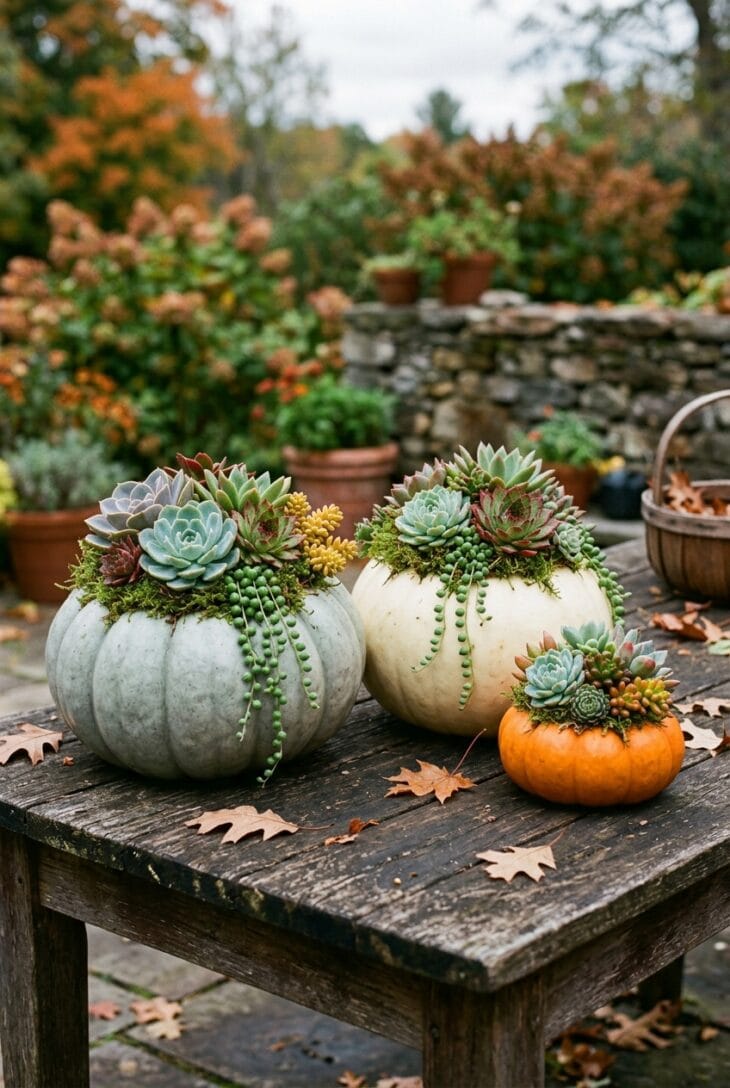
What you see Three pumpkins on an old wooden table, a blue-gray one, a cream one and a small orange one, each wearing a crown of succulents instead of being carved. Blue-green echeveria rosettes, red-tipped hens and chicks and little golden sedum sit in a cushion of moss around each stem, with a few strands of string of pearls trailing down the sides.
Why it works The pumpkin is the planter, and because it is never cut open it lasts two to three months instead of the week or so a carved one manages. Succulent cuttings live off their own stored water, so they need no soil and no watering for weeks. When the pumpkin finally softens, the succulents have usually rooted into the moss and can be potted up as houseplants, so nothing goes to waste.
How to get it Choose flat-topped pumpkins such as ‘Jarrahdale’ (Cucurbita maxima), white ‘Casper’ or ‘Cinderella’, and wipe them with a 1 to 10 bleach solution to slow rot. Coat the top around the stem with spray adhesive or craft glue and press on a layer of dried sheet moss. Snip succulent cuttings, echeveria (Echeveria), hens and chicks (Sempervivum), sedum and string of pearls (Curio rowleyanus), and let the cut ends dry for a day. Attach them to the moss with a dot of low-temperature hot glue, largest rosettes first. Mist the moss once a week and keep the pumpkins under cover: succulents are killed by frost, so bring them inside on cold nights.
08. Blue and Orange: A Complementary Color Pot
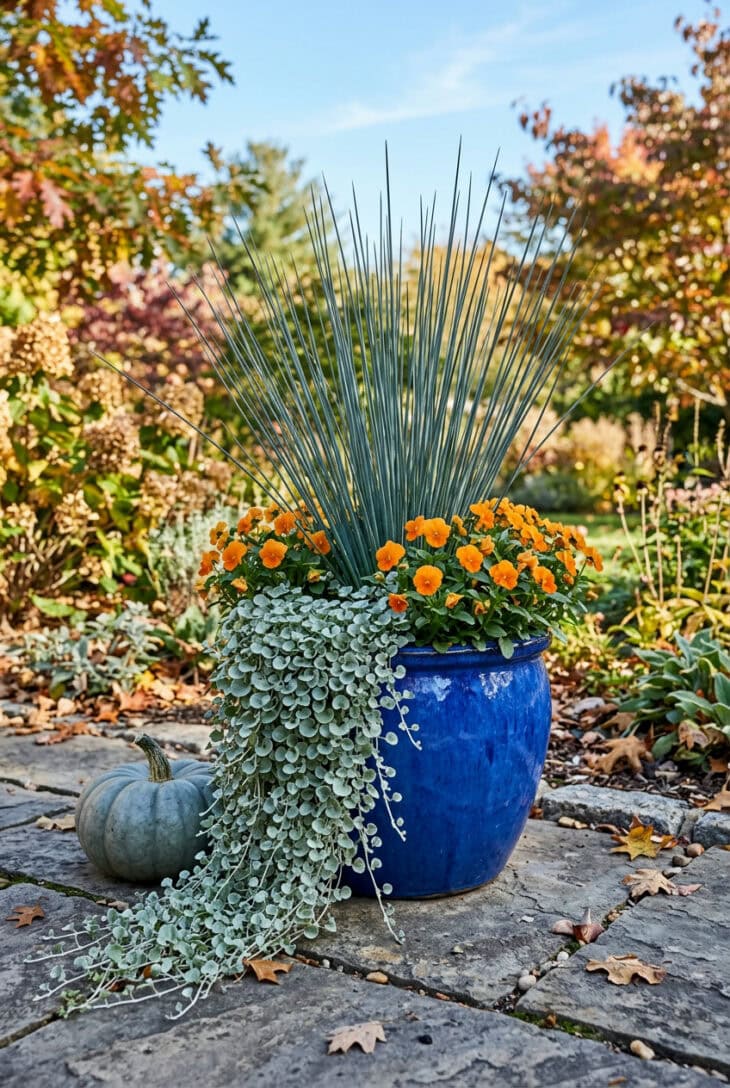
What you see A cobalt blue pot holding a clump of steely blue rush, its stems as straight as pencils. Around its base, a skirt of bright orange violas, and over the edge a long silver waterfall of dichondra. A blue-gray pumpkin sits next to it, echoing the rush. The whole thing is cool and warm at the same time.
Why it works Blue and orange sit opposite each other on the color wheel, so each makes the other look brighter. It is a sharper, more modern take on fall than the usual all-rust palette. The upright rush gives height without any bulk, which leaves room for the violas to be seen, and the silver trailer ties the pot’s cool tones back to the pale stone.
How to get it Plant a blue rush (Juncus inflexus ‘Blue Arrows’) in the center; it is hardy in zones 4 to 9 and likes moist soil, so do not let the pot dry out. Surround it with orange violas (Viola cornuta ‘Penny Orange’ or ‘Sorbet Orange Duet’) at 4in (10cm) spacing. Add two plants of silver dichondra (Dichondra argentea ‘Silver Falls’) at the front; it trails 3ft (90cm) or more and lasts until a hard freeze. A pot 14in (35cm) wide is plenty. Blue fescue (Festuca glauca ‘Elijah Blue’) works in place of the rush in a drier, sunnier spot.
09. A Fall Salad Window Box by the Kitchen
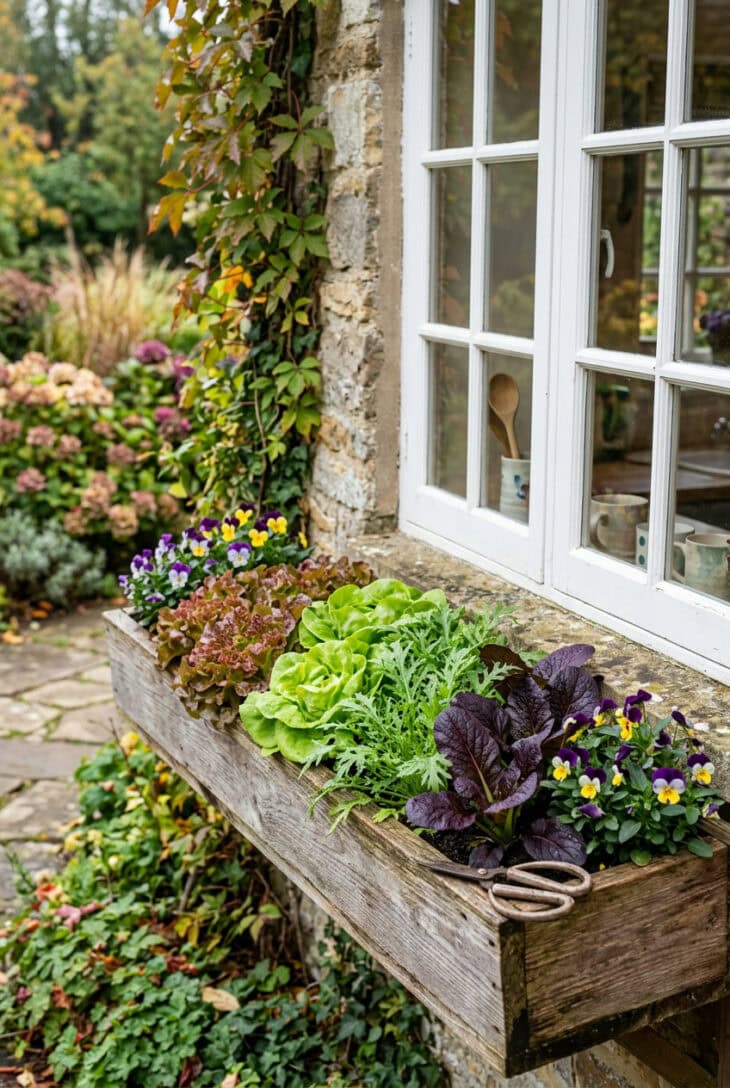
What you see A cedar window box outside a kitchen window, packed with salad: frilly bronze lettuce, bright green butterhead, feathery mizuna and burgundy mustard. A few purple and yellow violas at the ends add color, and a pair of scissors sits on the edge, ready for dinner. Morning dew beads on the leaves.
Why it works Salad greens prefer the cool days and long nights of fall to summer heat, when they bolt and turn bitter. A window box is at arm’s reach, so you can cut a few leaves at a time and the plants keep coming back. It is the smallest possible vegetable garden, and the mix of red, green and purple leaves looks as decorative as any flower box.
How to get it Sow in late August or early September, or buy small plants to get a head start. Use loose-leaf lettuce (Lactuca sativa ‘Red Sails’ and ‘Buttercrunch’), mizuna (Brassica rapa var. nipposinica) and mustard (Brassica juncea ‘Red Giant’), spaced 4 to 6in (10 to 15cm) apart. Violas (Viola cornuta) at the ends are edible too, so everything in the box can go in the salad bowl. A box 6 to 8in (15 to 20cm) deep is enough for greens. Cut the outer leaves and leave the center to regrow, and throw a piece of frost cloth over the box on nights below 28°F (-2°C) to keep the harvest going into November.
10. Golden Hinoki Cypress in a Four-Season Pot
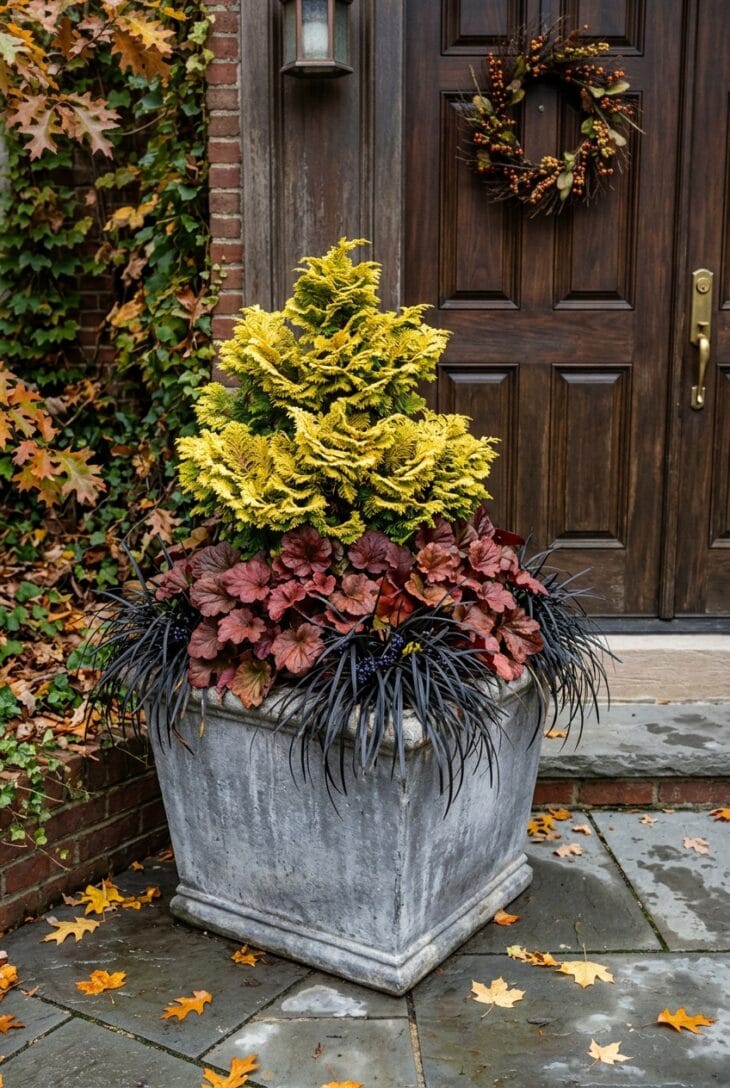
What you see A square stone-gray planter by a dark front door, holding a small golden conifer with soft, layered fans of foliage that look almost sculpted. Around its feet, the big leathery leaves of bergenia have turned deep burgundy, and tufts of black mondo grass mark the corners. The gold, wine and black combination glows even on a gray day.
Why it works This is a planter you buy once. Every plant in it is an evergreen perennial, so it looks the same in January as it does in October, and the bergenia actually gets redder as the weather turns cold. Hinoki cypress is a staple of Japanese garden design for good reason: it grows so slowly that it stays in proportion to its pot for many years.
How to get it Plant a golden dwarf hinoki cypress (Chamaecyparis obtusa ‘Nana Lutea’), which reaches only about 3ft (90cm) after ten years. Surround it with three bergenias (Bergenia cordifolia ‘Bressingham Ruby’ or ‘Winterglut’) and add black mondo grass (Ophiopogon planiscapus ‘Nigrescens’) at the corners. Use a frost-proof planter at least 20in (50cm) square and deep, and a potting mix with added bark for drainage. Evergreens in pots lose water all winter, so water on mild days whenever the soil is dry and unfrozen. It is reliable in zones 5 to 8; in zone 4, move the planter against a sheltered wall from December to March.
11. Mexican Bush Sage for Late Hummingbirds
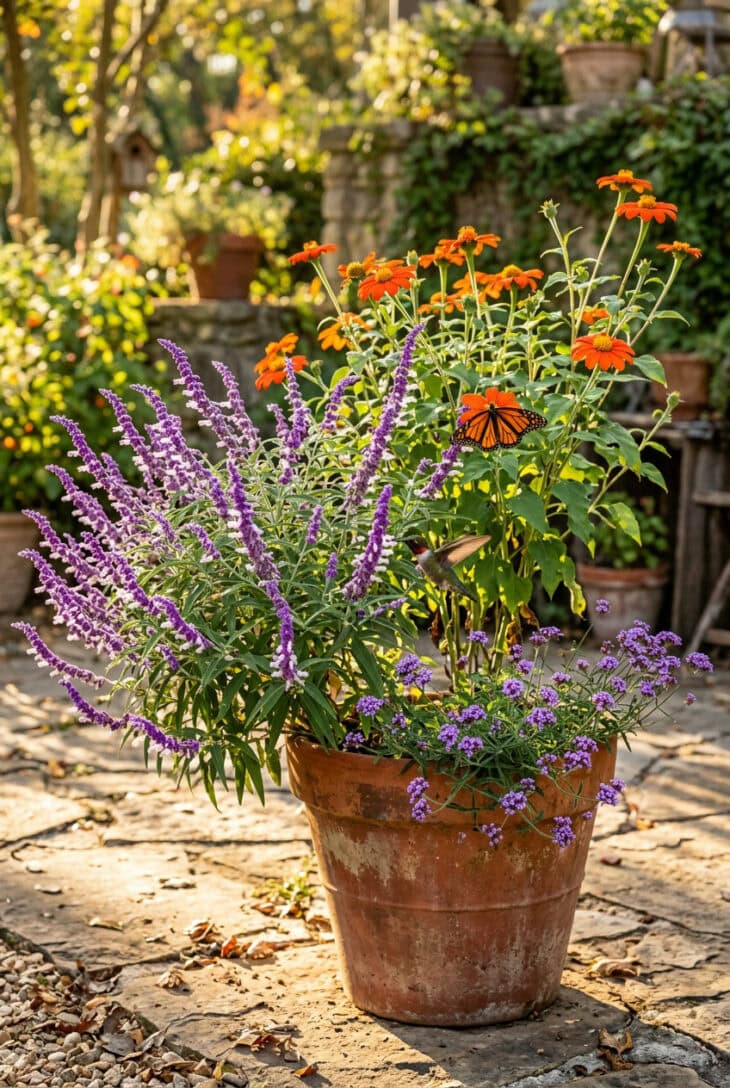
What you see A big terracotta pot on a sunny patio, overflowing with Mexican bush sage: long, velvety spikes of purple with little white flowers tucked inside. Tall orange Mexican sunflowers stand behind it and purple verbena spills over the front. A hummingbird hovers at the sage, and a monarch rests on one of the orange blooms.
Why it works Mexican bush sage does not start its main show until late summer, then flowers straight through fall until frost, just when migrating hummingbirds and monarchs are looking for fuel. The purple and orange combination is lush and warm, and it proves that fall pots do not have to be all mums. This is a planter for warm regions where fall is long and sunny, and a natural fit for anyone building a pollinator garden on the patio.
How to get it Mexican bush sage (Salvia leucantha) grows 3 to 4ft (90 to 120cm) tall and wide, so it needs a pot at least 20in (50cm) across. Behind it, plant Mexican sunflowers (Tithonia rotundifolia ‘Fiesta del Sol’), a compact variety at about 3ft (90cm). Add trailing verbena (Verbena ‘Homestead Purple’) at the front. Give the pot full sun and water deeply whenever the top inch of soil dries. The sage is hardy in zones 8 to 10 and can stay in the pot as a perennial there; cut it back to 12in (30cm) in late winter. Farther north, treat it as an annual or start the pot in spring so it is full-sized by September.
12. Heather Baskets in the European Style
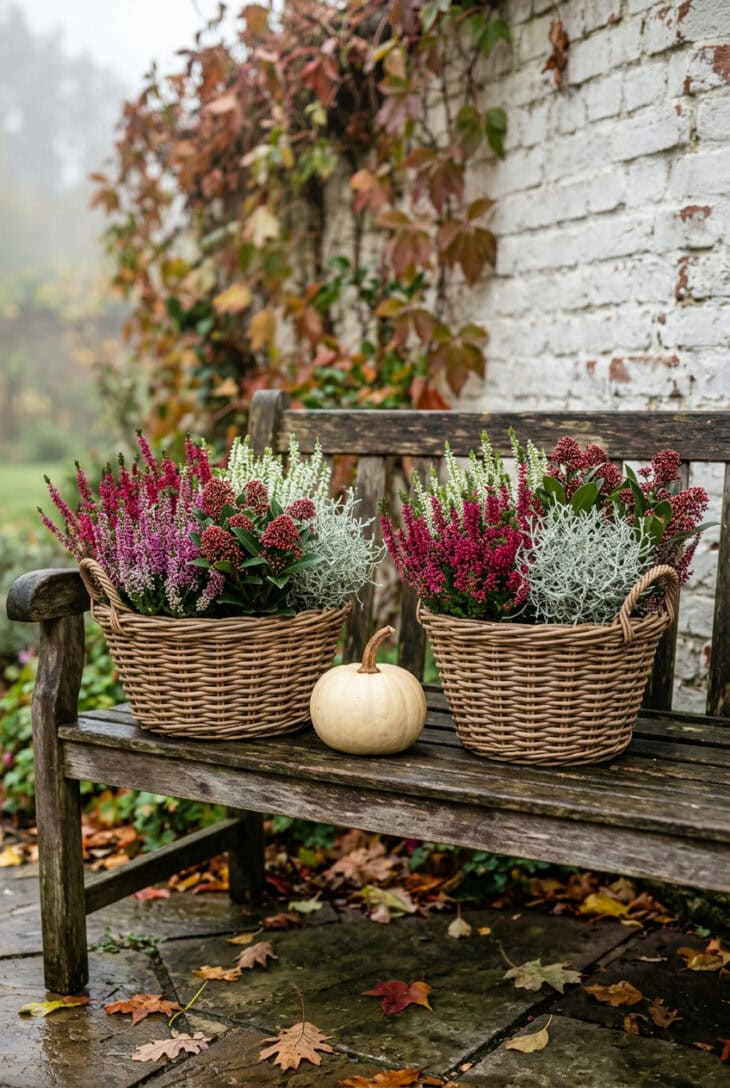
What you see Two wicker baskets on a weathered bench against a whitewashed wall, each crammed with heather in magenta, white and deep red. A small skimmia holds up clusters of red buds, and a soft silver cushion bush fills the gaps like a puff of frost. A cream pumpkin sits between them, and the whole scene looks like a market stall in a European town.
Why it works In much of Europe, heather is the fall container plant, and it deserves to be more common here. The “bud-blooming” types never open their flowers, so they hold their color for months rather than weeks, from September well into winter. Skimmia buds last just as long, and the silver foliage keeps the pink and red from looking too sweet.
How to get it Look for bud-blooming heather (Calluna vulgaris), sold as the ‘Garden Girls’ or ‘Beauty Ladies’ series, in 4in (10cm) pots. Add a Japanese skimmia (Skimmia japonica ‘Rubella’) as the center plant and a silver cushion bush (Leucophyta brownii) for texture. Line each basket with a plastic bag, poke six or eight holes in the base for drainage, and fill with an acidic, ericaceous potting mix, since heather sulks in ordinary compost. Keep the soil moist but never soggy. Heather is hardy in zones 4 to 6 and struggles with hot, humid summers, so in warm regions treat these baskets as a fall and winter display only.
13. A Soft Pink and Silver Autumn Pot
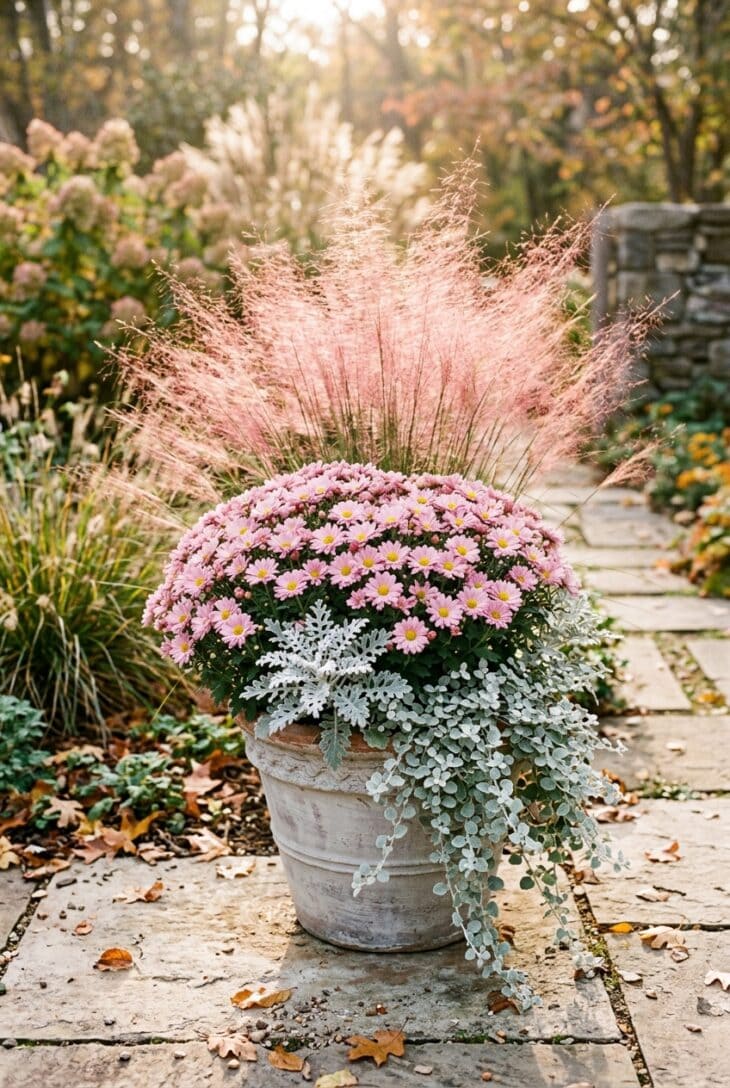
What you see A pale, gray-washed pot with a mound of soft pink daisies at its heart, each with a small yellow eye. Behind them, a cloud of pink muhly grass catches the late sun and shimmers. In front, lacy silver dusty miller and a trailing silver licorice plant make the whole thing look slightly frosted.
Why it works Not everyone wants orange. This palette is gentle and romantic, and it suits a gray, white or pale brick house far better than rust and gold. The pink daisy is a hardy perennial chrysanthemum rather than a florist’s mum, so it can go into the ground after the display and come back every year. Silver foliage also stays bright long after most flowers have been blackened by frost.
How to get it Use the hardy chrysanthemum ‘Sheffield Pink’ (Chrysanthemum × rubellum ‘Hillside Sheffield Pink’), which flowers in October and is hardy in zones 5 to 9. Behind it, plant pink muhly grass (Muhlenbergia capillaris), hardy in zones 6 to 10. At the front, add dusty miller (Jacobaea maritima ‘Silver Dust’) and a licorice plant (Helichrysum petiolare) to trail. A pot 16in (40cm) wide holds all four. Water the muhly sparingly; it prefers to dry out between waterings, which suits the dusty miller too. Pinch off the chrysanthemum’s spent flowers to keep new ones coming through October.
14. Black-Eyed Susans in a Galvanized Washtub
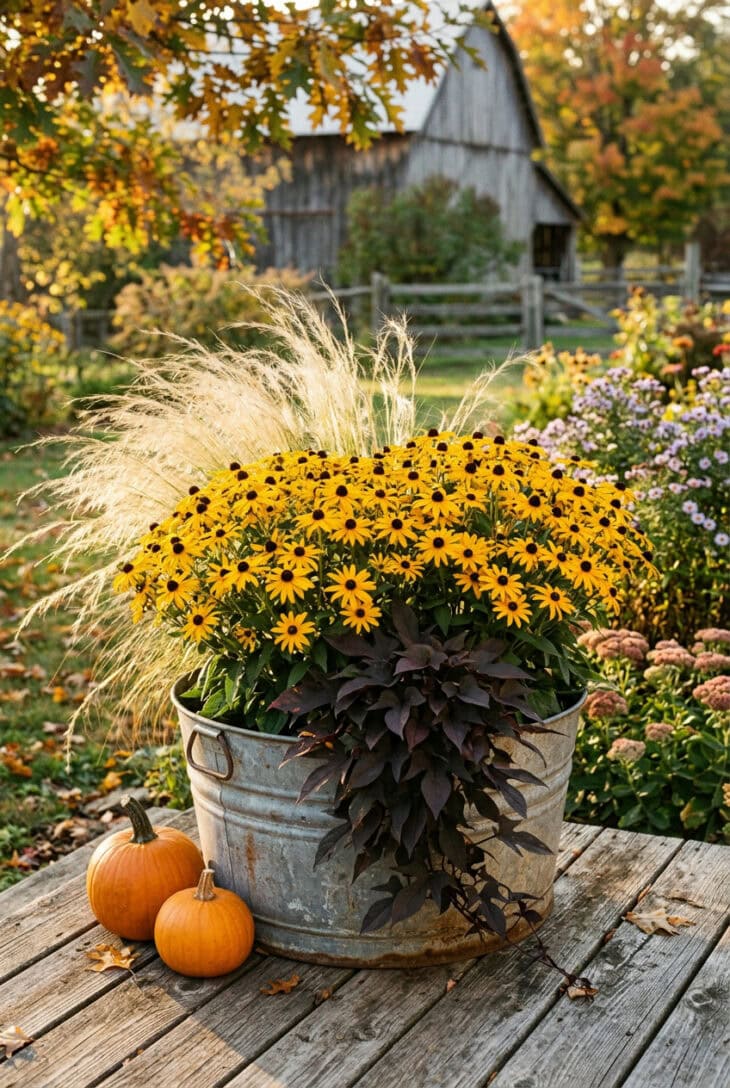
What you see An old galvanized washtub on a wooden deck, filled with a dome of black-eyed susans in bright gold with chocolate centers. Behind them, blond wisps of feathery grass sway in the breeze, and a dark sweet potato vine trails over the rim. A pair of small pumpkins sits beside it, and the gray metal makes the gold look even warmer.
Why it works Black-eyed susans hit their peak from late August through early October, bridging the gap between summer annuals and fall mums. A washtub is wide and fairly shallow, which suits their spreading habit, and the farmhouse look is easy to find at flea markets for a few dollars. The pale grass adds movement that a pot full of daisies alone would not have.
How to get it Drill six to eight 1/2in (12mm) holes in the base of the tub before planting; this is the step most people skip, and the plants rot without it. Plant three compact black-eyed susans (Rudbeckia fulgida ‘Little Goldstar’, about 16in or 40cm tall). Behind them, add Mexican feather grass (Nassella tenuissima), and at the front edge a sweet potato vine (Ipomoea batatas ‘Blackie’). Avoid the feather grass in California and other mild West Coast areas, where it self-seeds invasively; use a clumping sedge there instead. The rudbeckia is a hardy perennial, so plant it in the ground after the display.
15. A Potted Blueberry with Scarlet Leaves
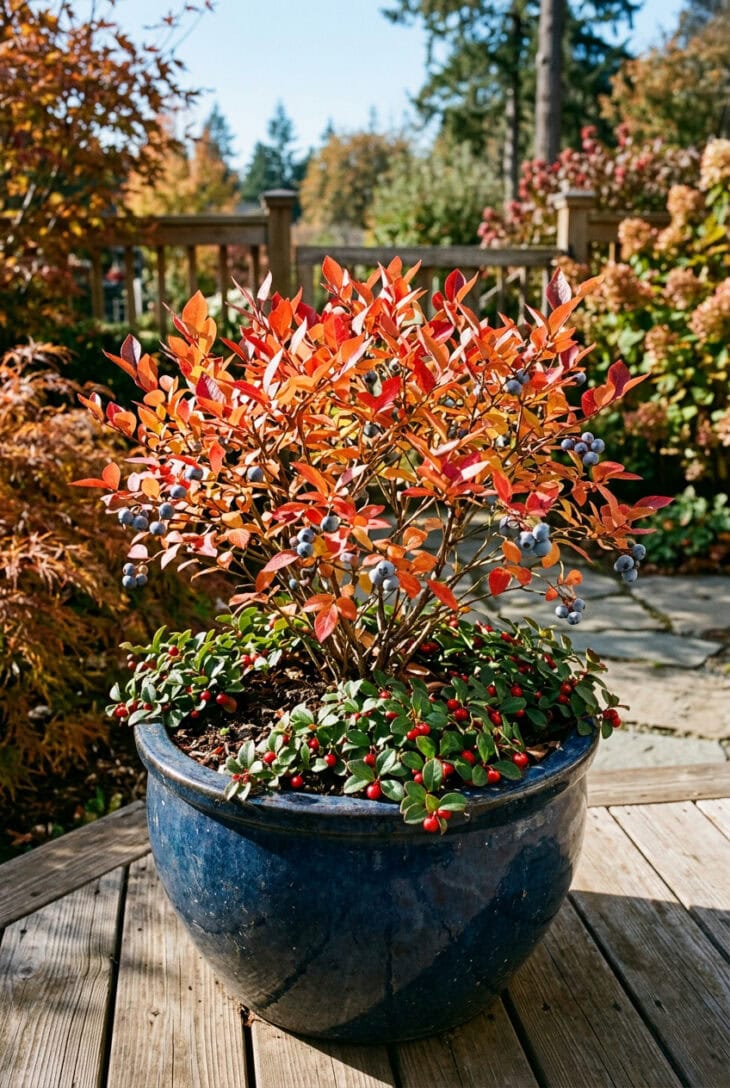
What you see A compact blueberry bush in a dark blue glazed pot, every leaf turned scarlet, crimson or orange. A few dusty blue berries still hang on the twigs. At its feet, a carpet of glossy wintergreen holds bright red berries of its own. In the clear autumn sun, the shrub looks like a small burning bush on the deck.
Why it works Blueberries have some of the best fall color of any shrub, and the dwarf types stay small enough for a pot for many years. You get white spring flowers, summer fruit and a blaze of red leaves, which is more than most ornamental shrubs offer. Growing them in a container also solves their fussiest need, acidic soil, since you control exactly what goes into the pot.
How to get it Choose a self-fertile dwarf blueberry such as ‘Top Hat’ (Vaccinium corymbosum × angustifolium, about 2ft or 60cm tall) or the half-high ‘Northsky’, which is hardy to zone 3. Use a pot at least 16 to 20in (40 to 50cm) wide and an acidic potting mix made for azaleas and rhododendrons. Underplant with wintergreen (Gaultheria procumbens), which likes the same acidic soil and enjoys the light shade under the bush. Water with rainwater where you can, since hard tap water slowly raises the soil pH. Plant in fall and the roots settle in before spring, giving you your first berries the following July.
16. Autumn Crocus in a Shallow Bowl
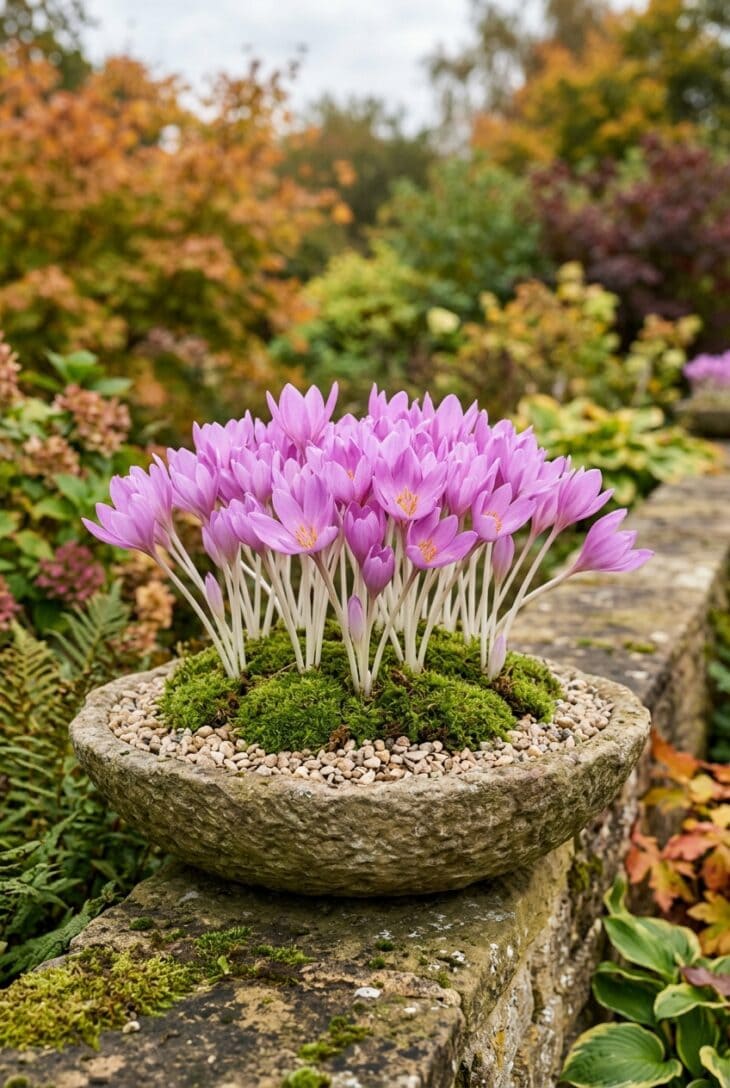
What you see A shallow stone bowl on a garden wall, topped with gravel and moss, out of which rises a cluster of big lilac-pink goblets on pale, leafless stems. Some are fully open, showing their gold stamens. It looks like spring crocuses have turned up six months late, and that is exactly the surprise.
Why it works Autumn crocus is one of the few bulbs that bloom in fall, and it is so eager to flower that the bulbs will bloom sitting on a windowsill with no soil at all. That makes a shallow bowl the easiest planter in this list: no roots to support, just a pretty surface to hold the flowers up. Afterward, the bulbs go into the ground and come back every September.
How to get it Buy autumn crocus bulbs (Colchicum autumnale, or the large pink Colchicum speciosum) in late August, as soon as they appear in garden centers; they often start flowering in the bag. Set them shoulder to shoulder in a bowl 3 to 4in (8 to 10cm) deep on a layer of potting mix, then cover with gravel and a patch of moss. They need no water while flowering. Once the flowers fade, plant the bulbs 4in (10cm) deep in a sunny border, where their leaves will appear in spring. Every part of the plant is poisonous, so place the bowl out of reach of pets and small children.
17. A Formal Pair of Boxwood Planters
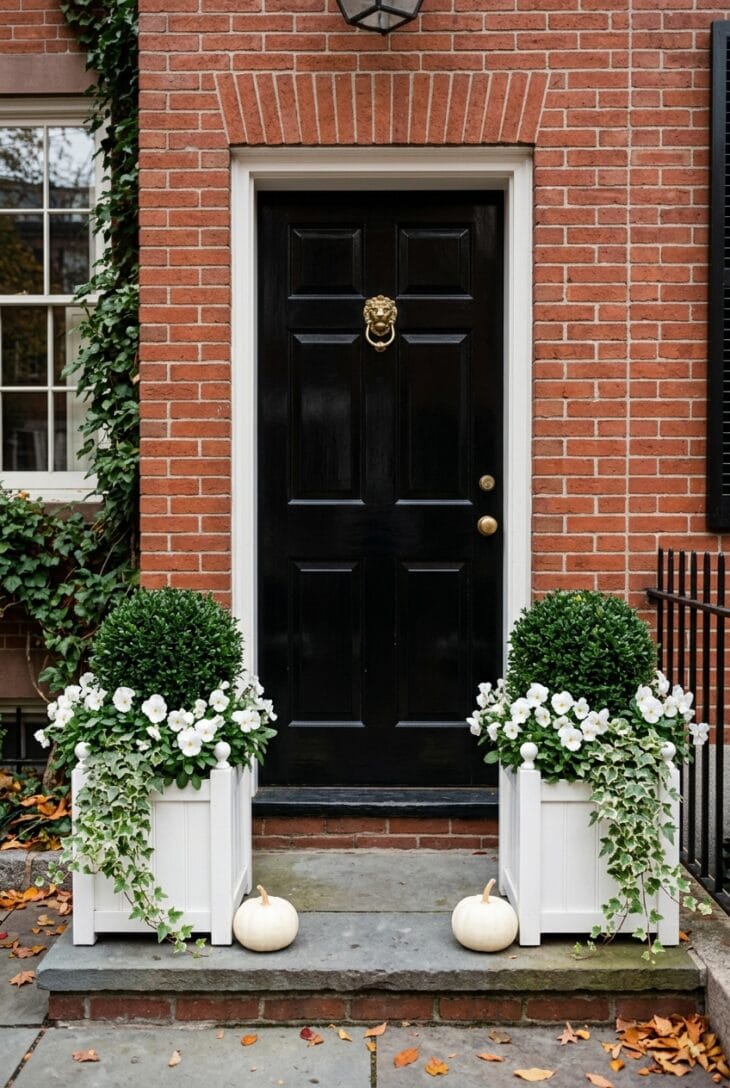
What you see Two white square planters stand either side of a glossy black door with a brass knocker. Each holds a clipped boxwood ball, a skirt of white pansies and variegated ivy trailing down the corners. A white pumpkin sits at the foot of each, and the whole entrance feels calm, crisp and a little bit Georgian.
Why it works Symmetry is the fastest way to make an entrance look intentional, and a green and white scheme never clashes with brick, paint or the neighbors’ decorations. The boxwood is permanent, so all you change each season is the skirt: white pansies now, tulips in spring, white impatiens in summer. For curb appeal, a matched pair at the door does more than a dozen mismatched pots scattered around.
How to get it Buy two boxwood balls about 18 to 24in (45 to 60cm) across, ideally a blight-resistant cultivar such as Buxus ‘NewGen Independence’ or ‘Green Velvet’. Use planters at least 20in (50cm) square so there is room around the root ball for the underplanting. Surround each with six or eight white pansies (Viola × wittrockiana) and a variegated ivy (Hedera helix ‘Glacier’) at each front corner. Boxwood in containers is safe to about zone 6; in colder areas, wrap the planter sides with bubble wrap or burlap in December. Water in winter whenever the soil is dry and unfrozen, since evergreen leaves keep losing moisture.
18. A Hardy Sedum Trough in Autumn Tones
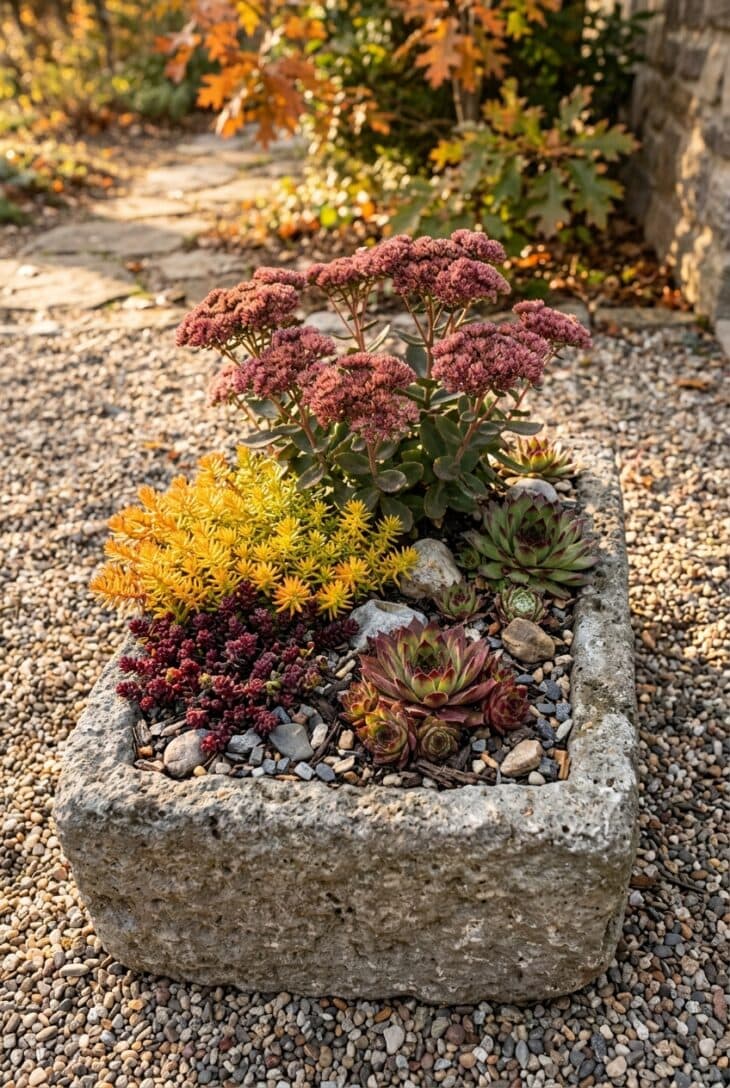
What you see A rough gray stone trough on a gravel patio, planted with succulents in the colors of fall. Tall stonecrop holds up flat flower heads in dusky rust-pink, a golden needle-leaved sedum is turning orange at the tips, and a creeping sedum has gone deep burgundy. Hens and chicks rosettes in green and red sit between small rocks.
Why it works Many hardy succulents change color as the nights get cold, so this trough gets better as fall goes on, not worse. It needs almost no watering and survives freezing winters outdoors, which makes it one of the lowest-effort planters possible. It is a small, portable version of a rock garden, ideal for a hot, dry spot where other pots fry.
How to get it Use a trough at least 6in (15cm) deep, in hypertufa, stone or frost-proof concrete. Fill with a mix of half gritty cactus mix and half pea gravel or crushed stone. Plant one upright stonecrop (Hylotelephium ‘Herbstfreude’, often sold as ‘Autumn Joy’) at one end, then golden sedum (Sedum rupestre ‘Angelina’), ‘Dragon’s Blood’ sedum (Sedum spurium) and a few hens and chicks (Sempervivum) in the gaps. Top-dress with gravel and a few flat stones. All are hardy to zone 4; the only real risk is winter wet, so raise the trough on bricks so water drains freely.
19. Cyclamen and Ferns for a Mild-Climate Fall
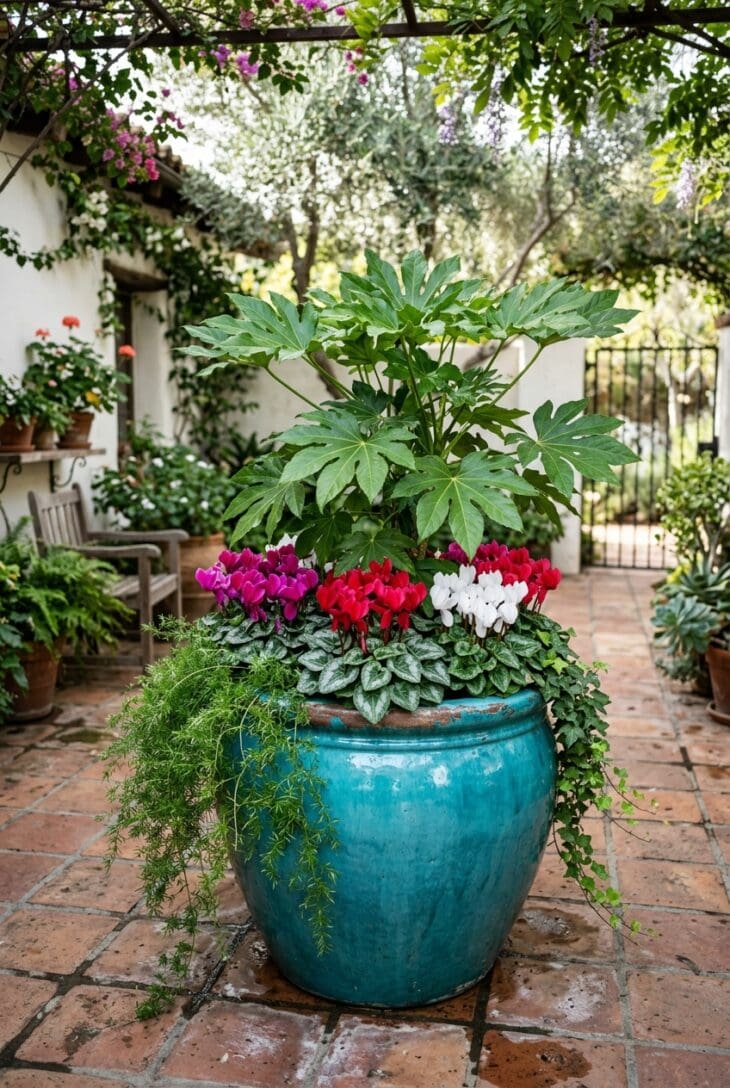
What you see A turquoise glazed pot in a shady courtyard with terracotta tiles. At the back, a Japanese aralia spreads huge, glossy hand-shaped leaves. At the front, a ring of cyclamen with swept-back flowers in magenta, white and scarlet sits over silver-marbled leaves, and a soft asparagus fern spills over the rim. It feels lush and cool, not autumnal in the Northern sense at all.
Why it works In zones 9 to 11, fall is when heat finally breaks and cool-season plants start their long show. Florist’s cyclamen, which most people know as a short-lived houseplant, grows happily outdoors in these climates from October to April, flowering the whole time. The glossy tropical foliage behind gives the pot structure, so it looks good even between flushes of flowers.
How to get it Plant a Japanese aralia (Fatsia japonica) at the back, then five or six florist’s cyclamen (Cyclamen persicum) at 6in (15cm) spacing in front. Add an asparagus fern (Asparagus densiflorus ‘Sprengeri’) at the rim. Set each cyclamen with the top of its tuber just above soil level, and water around it rather than into the crown, which rots easily. Cyclamen like temperatures between 40 and 65°F (4 and 18°C) and bright shade; in full sun or heat above 75°F (24°C) they go dormant. In colder zones, use hardy cyclamen (Cyclamen hederifolium) instead, which flowers in September and October.
20. A Low Centerpiece Bowl for the Outdoor Table
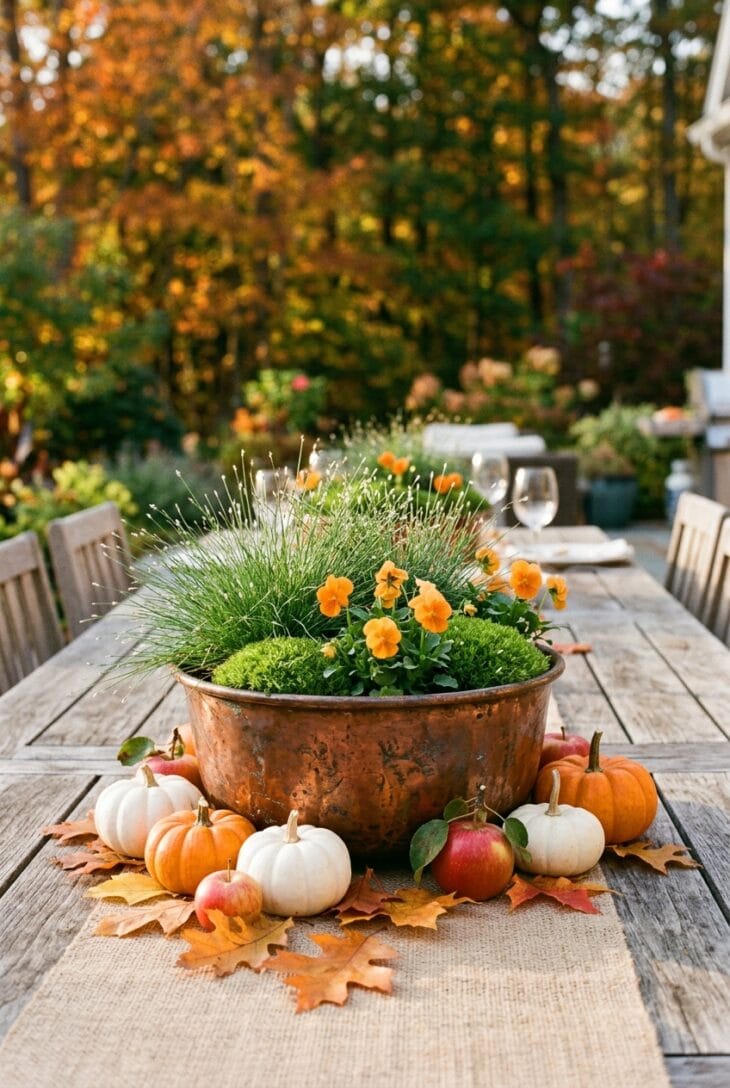
What you see A low copper bowl in the middle of a long wooden table outdoors. Tufts of fine green grass tipped with tiny silver seed heads rise from soft cushions of bright green moss, and a few orange violas peek out between them. Mini pumpkins and small red apples sit around the bowl, and the whole table is lit gold by the late sun.
Why it works Most fall planters live on the floor, but the table is where people actually sit and look closely. A living centerpiece stays low enough to talk over and lasts for weeks, unlike cut flowers. It is a small way to bring the season to a patio dining area, and it can move indoors for Thanksgiving dinner.
How to get it Choose a bowl 12 to 16in (30 to 40cm) wide and at least 4in (10cm) deep, and if it has no drainage hole, put 1in (2.5cm) of gravel in the base and water sparingly. Plant three clumps of fiber optic grass (Isolepis cernua) and fill between them with Irish moss (Sagina subulata) cut into pieces. Tuck in three or four violas (Viola cornuta). Keep it moist, since both the grass and the moss dislike drying out. Scatter mini pumpkins such as ‘Jack Be Little’ and ‘Baby Boo’ and a few lady apples around the base.
21. A $25 Planter from the Grocery Store
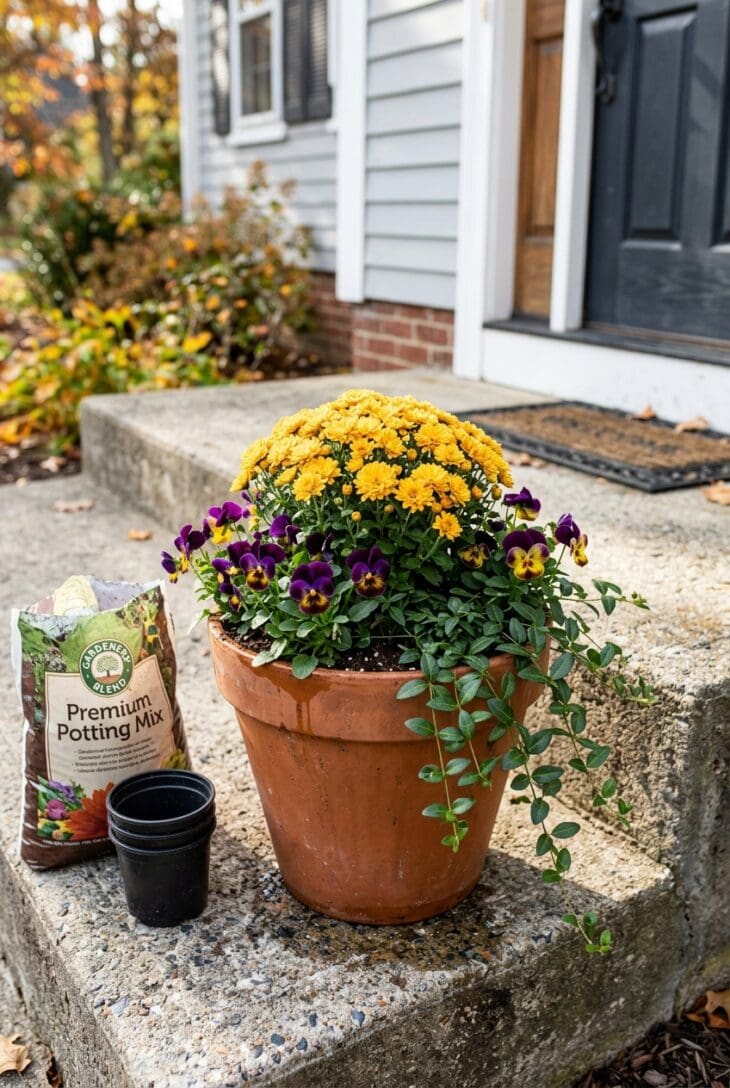
What you see A plain terracotta pot on a concrete step, just planted. A golden mum sits in the center, ringed with purple and yellow pansies, and dark green periwinkle trails over the rim. Beside it lies a bag of potting mix and an empty nursery pot. It is simple and cheerful, and nothing in it was hard to find.
Why it works Supermarkets and hardware stores stock fall mums and pansies by the rack in September, often cheaper than garden centers. Three plant types in two contrasting colors is all a container needs to look planted rather than plonked. The pansies stay in flower long after the mum fades, so when you pull the mum in November the pot still looks alive.
How to get it Buy one 8in (20cm) garden mum (Chrysanthemum × morifolium), about $8, a six-pack of pansies (Viola × wittrockiana) for around $5, and one 4in (10cm) pot of trailing periwinkle (Vinca minor) or ivy. Reuse a pot you already own, at least 12in (30cm) across, and top it up with a small bag of fresh potting mix. Tease apart the mum’s tight root ball before planting, since grocery mums are often badly root-bound. Water every day in warm weather for the first two weeks. After the display, plant the periwinkle as groundcover in shade, but keep it away from woodland edges, where it can spread.
22. A Hayrack Planter on a Fence or Railing
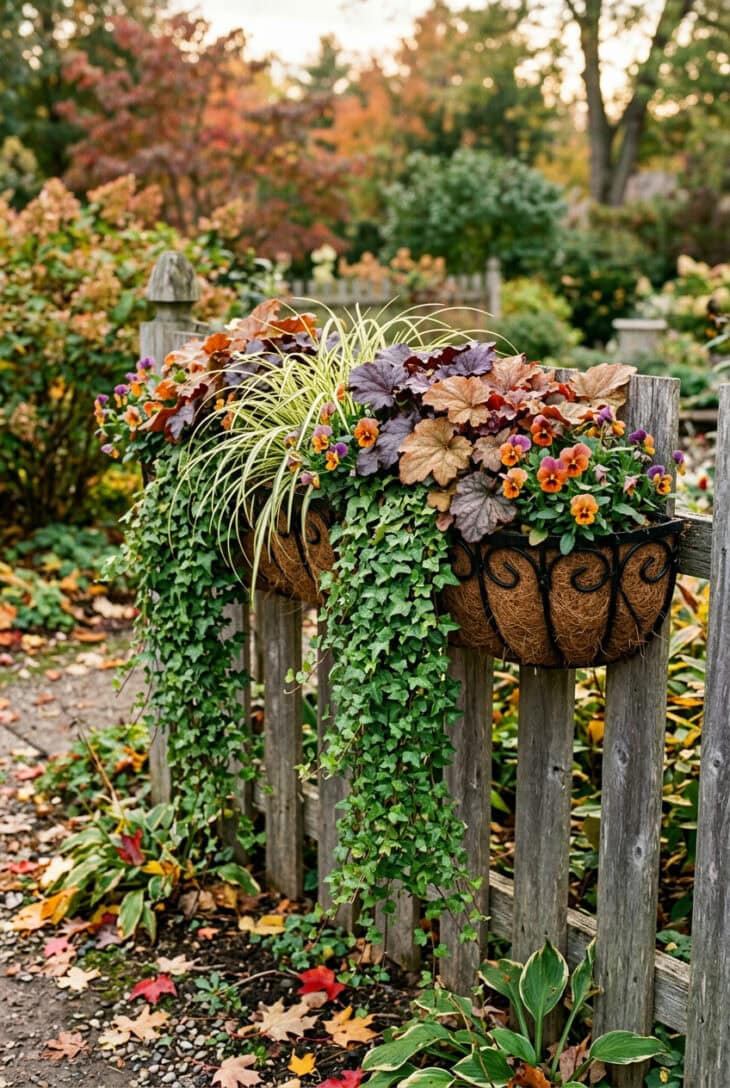
What you see A long black iron hayrack lined with brown coir, fixed to a weathered gray fence. It overflows with bronze and plum heuchera, trailing pansies in orange and purple, and the arching gold-striped leaves of a sedge. Ivy hangs down the fence boards by nearly two feet, turning a bare stretch of fence into a hanging garden.
Why it works Hayracks hold a surprising amount of soil and are planted through the sides as well as the top, so they fill out fast and look abundant from the day they go up. They take up no floor space, which makes them a good fit for balcony gardens and narrow side yards. Fixed at eye level, they are the simplest form of vertical gardening, putting fall color right where you see it rather than down at your feet.
How to get it A 30in (75cm) hayrack takes about ten plants. Line it with a pre-formed coir liner and slip a sheet of plastic inside the back half to stop the fence staying wet. Plant heuchera (Heuchera ‘Palace Purple’ and ‘Caramel’), variegated sedge (Carex oshimensis ‘Evergold’), trailing pansies (Viola ‘Cool Wave’) and ivy (Hedera helix). Cut small slits in the coir front to plant ivy and pansies through the sides, so the whole face gets covered. Screw it into fence posts, not the boards, because a watered hayrack is heavy. Coir dries out quickly, so check it every couple of days.
23. Burgundy Loropetalum for Mild Winters
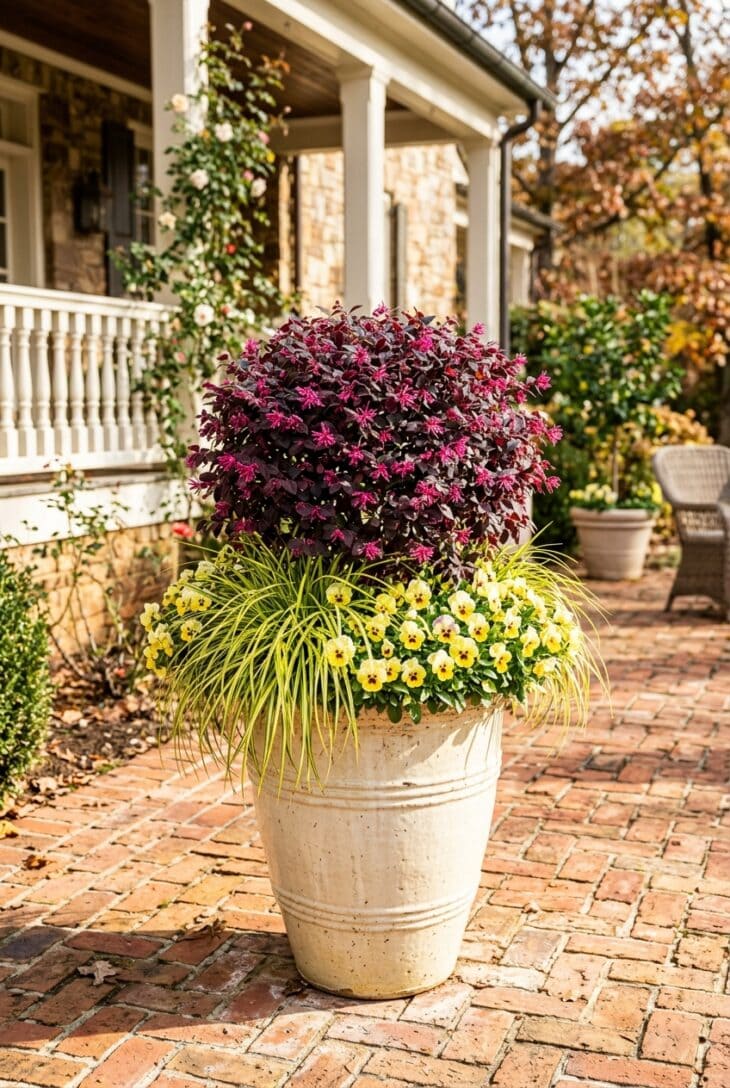
What you see A tall cream planter on a sunny brick patio, holding a dense, rounded shrub with deep burgundy leaves and a sprinkling of hot pink, fringe-like flowers. Around it, a gold sedge arches over the edge, and a ring of butter-yellow pansies catches the sun. Against the old brick, the burgundy looks almost black.
Why it works In the South, where mums sulk in heat and freezes are brief, an evergreen shrub makes a better fall centerpiece than anything seasonal. Loropetalum keeps its purple color all year and often reflowers in fall. The chartreuse sedge is its perfect foil, since burgundy and gold make each other stronger. With only the pansies to swap each season, this is about as low-maintenance as a statement planter gets.
How to get it Choose a compact loropetalum (Loropetalum chinense var. rubrum ‘Purple Diamond’ or ‘Crimson Fire’), which stays around 3 to 4ft (90 to 120cm) in a container. Hardy in zones 7 to 10, it likes slightly acidic soil, so use a mix for azaleas. Plant three gold sedges (Carex oshimensis ‘Everillo’) around it and fill the rim with yellow pansies (Viola × wittrockiana). Use a pot at least 20in (50cm) wide. Trim the shrub lightly after its spring bloom to keep it dense, and replace the pansies with summer annuals in May.
24. Winterberry for Berries into December
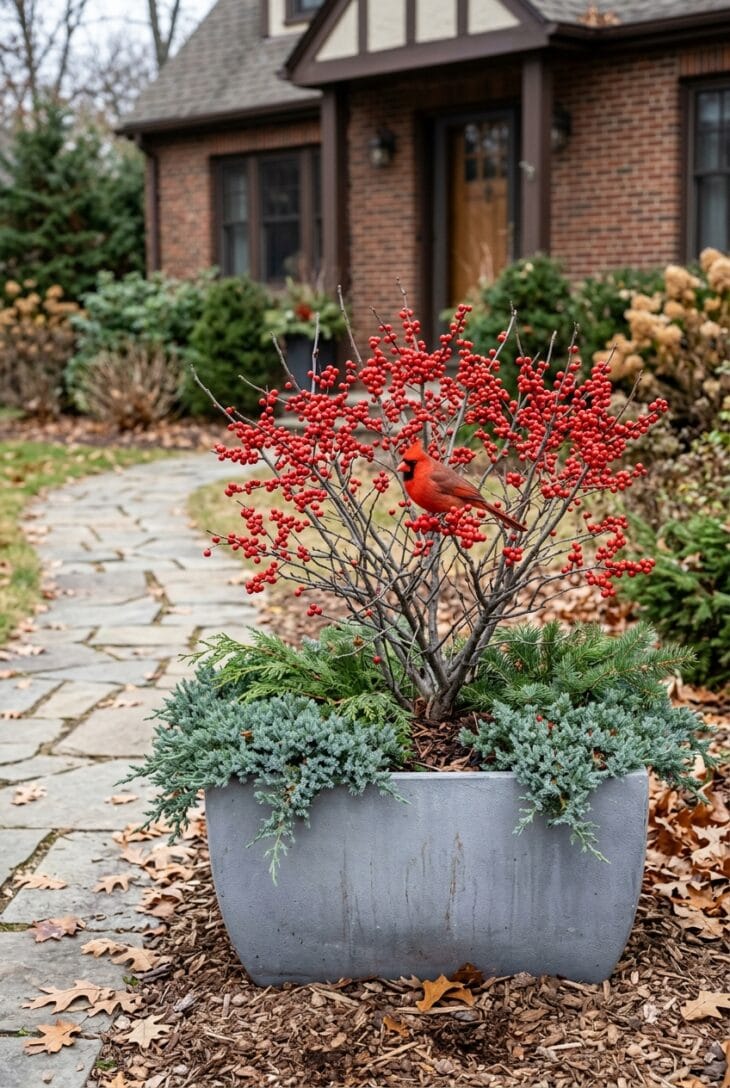
What you see A gray planter by the front path, holding a compact shrub with bare gray branches crowded with glossy red berries. A skirt of silver-blue juniper spills over the edge, and cedar boughs are tucked around the base. A red cardinal perches in the branches, matching the berries almost exactly.
Why it works Winterberry is a native holly that drops its leaves in fall to reveal branches packed with red berries, and those berries hang on into winter. That makes it the perfect bridge from fall to the holidays: the same pot works in October and December with only the addition of a few cut greens. The berries also feed birds when little else is available, which is why it earns a place in any wildlife-friendly garden.
How to get it Buy winterberry (Ilex verticillata ‘Berry Poppins’) already in berry in October; it stays 3 to 4ft (90 to 120cm) tall and is hardy in zones 3 to 9. Only female plants carry berries, and they need a male pollinator such as ‘Mr. Poppins’ within about 50ft (15m) to set fruit the following year. Plant creeping juniper (Juniperus horizontalis ‘Blue Chip’) at the rim to trail. Use a frost-proof pot at least 18in (45cm) wide, and keep it moist, since winterberry is naturally a wetland shrub. Add cut cedar or pine boughs in late November for a holiday look.
25. A Post-Frost Window Box of Branches and Dried Stems
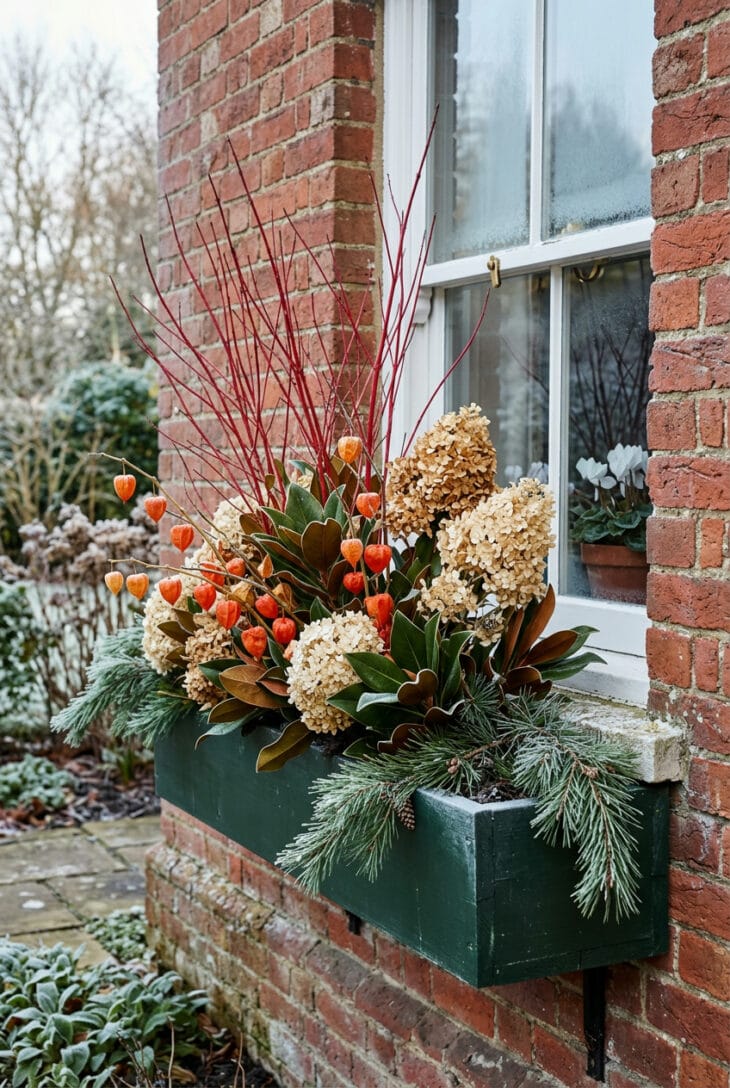
What you see A dark green window box on a red brick house, just after the first frost. There is nothing living in it, but it is anything but empty: red dogwood stems stand at the back, big papery hydrangea heads in cream and tan fill the middle, and orange Chinese lanterns glow on bare stems. Magnolia leaves show their bronze undersides, and pine boughs drape over the front edge.
Why it works A hard frost ends every flower box, often in a single night. Rather than leaving it bare for five months, you can fill it with cut and dried material that frost cannot hurt. Pushed into the old potting soil, the stems freeze in place and stay put through wind and snow, and the display easily lasts until spring. It is also a way to use what the garden already made: hydrangea heads, seed pods and the prunings from the shrub border.
How to get it Pull out the frosted plants but leave the potting soil in the box. Cut 24in (60cm) stems of red twig dogwood (Cornus sericea) and push them in at the back while the soil is still soft. Add dried heads of ‘Annabelle’ hydrangea (Hydrangea arborescens), stems of Chinese lantern (Physalis alkekengi), and a few southern magnolia branches (Magnolia grandiflora). Finish with white pine or cedar boughs over the front edge. Grow the Chinese lanterns in a pot of their own if you want a supply, since they spread aggressively in open ground. In spring, pull everything out and replant the box with pansies.